






Abstract
Since the Second Congo War outbreak in 1998, regional and international mediation efforts have struggled to deliver sustainable peace in the Democratic Republic of Congo (DRC). Plentiful literature attributes this failure to flawed peace agreements that sidestep conflict root causes and lack of credible enforcement mechanisms. However, this article argues that, beyond conflict root causes and the content of peace agreements, the proliferation of multimediation interventions has created overlapping and fragmented processes that undermine the coherence and effectiveness of peace initiatives in the DRC. These overlapping mediation interventions are further complicated by competing mediator interests and strategic coordination blunders.
Introduction
Conflict mediation efforts in the Democratic Republic of Congo (DRC) continue achieving too little peace since the end of the Second Congo war (1998–2003). The First Congo war took place between October 1996 and May 1997, pitting the DRC (then Zaire) government led by Mobutu Sese Seko against a rebel movement led by Laurent Kabila, with the support of Rwanda and Uganda. The war resulted in Mobutu being overthrown and the rebel leader Laurent Kabila taking over as the country’s Head of State. In a turn of events, during his presidency, Kabila began isolating his alliances, signalling a fallout, by expelling Rwandan and Ugandan forces from the DRC, which became a trigger of the Second Congo War between 1998 and 2003. Kabila’s former allies (Rwanda and Uganda) resisted the expulsion by supporting a new war front from Eastern DRC, supporting rebel movements leading to the assassination of Laurent Kabila and subsequently being replaced by his own son, Joseph Kabange Kabila, in 2001. Rwanda sponsored the Rally for Congolese Democracy (RCD-Goma) and the Union of Congolese Patriots (UPC), while Uganda sponsored the Movement for the Liberation of Congo (MLC) and the Rally for Congolese Democracy – Kisangani (RCD-K), a splinter group from RCD-Goma, and the Nationalist Integrationist Front (FNI; Apuuli, 2004). Intense war ended with a military intervention supported by Angola, Zimbabwe, Namibia, Chad, and Sudan and a mediation process fronted by Zambia, whose outcome was a ceasefire peace agreement known as the Lusaka Ceasefire Agreement signed in July 1999. Flashes of violence continued, in violation of the ceasefire agreement, until the signing of the Sun City Agreement in 2002 and the Pretoria Accord in 2003, which formalized the ceasefire agreement and ushered in a transitional government led by Joseph Kabila. The mediation outcomes were hoped to facilitate sustainable peace in the DRC, but the conflicts continued intractably to date.
The country’s renewed conflict in Eastern DRC pitting the Armed Forces of the DRC (FARDC) and its allies against the 23 March Movement/Congo River Alliance [Alliance Fleuve du Congo] (M23/AFC) calls for theoretical and empirical reflections on why peace mediation processes have failed to achieve sustainable peace. The M23 rebel group, mainly made up of the Tusti ethnic group, rose to prominence in Eastern DRC in early 2012 (Owino, 2025), but its resurgence in 2022 has defined the current crisis in eastern Congo (Al Jazeera, 2025a). Although M23 was initially formed to defend ethnic recognition and equal rights, its strong military backing from Rwanda transformed the conflict from a domestic uprising into a regional crisis involving Rwanda, Burundi, and Uganda. In response to the M23 resurgence, the East African Community (EAC) responded by deploying the East African Community Regional Force (EACRF) in November 2022 until December 2023 while exploring mediation options led by the former President of Kenya, Uhuru Kenyatta. The EACRF deployment happened amidst dissatisfaction with United Nations Organization Stabilization Mission in the Democratic Republic of the Congo (MONUSCO), which local communities criticized for passivity. This article will, however, not dwell much on the military missions mandate and objectives, given that its primary focus is centred on mediation overlaps and their challenges.
In 2022, the M23 re-emerged and took control of some parts of Eastern DRC, specifically in the North and South Kivu provinces (IPIS, 2025). The conflict continued to escalate, and by March 2025, the rebel group had captured key districts including Rutshuru, Masisi, Kalehe, Walungu, and Idjwi, as well as the strategic cities of Goma and Bukavu. This violence resulted in the deaths of at least 7000 people and displaced more than 7 million, creating a dire humanitarian crisis in the region (Al Jazeera, 2025b). In an attempt to end the conflict, several mediation initiatives were facilitated, achieving enumerable ceasefire and peace agreements, yet still unable to end the fighting and achieving sustained peace. This raises several questions about why multiple (and sometimes overlapping) mediation efforts have failed to achieve long-term peace in the DRC. A Senior Researcher at the Centre for Conflict and Humanitarian Studies, Al-Khulaifi argued that To achieve a sustainable and enduring peace in eastern DRC, it is essential to address the root causes of the conflict. The region’s vast deposits of natural resources – especially rare earth minerals – have attracted international, regional and local actors competing for control, fuelling instability Compounding this is the Congolese central government’s limited capacity to govern the eastern provinces, enabling the proliferation of armed groups with diverse allegiances. Ethnic tensions further exacerbate the crisis, particularly since the 1994 Rwandan genocide, after which the arrival of Hutu refugees and the formation of hostile militias heightened insecurity and cross-border conflict. (Al-Khulaifi, 2025: 1)
While the above assertion is plausible, this article seeks to argue that it is the use and existence of multiple and overlapping mediation interventions that has failed the achievement of sustainable peace in the DRC. Parallel and competing mediation interventions can be seen to be creating a chaotic peace process between 2022 and 2025, from the Luanda and Nairobi processes in 2022 to the current multimediation processes involving the EAC, Southern African Development Community (SADC), African Union (AU), United States of America (United States), and Qatar, among other mediation players. The presence of non-African mediators, such as the government of Qatar and the United States, also flew in the face of the “African solutions to African problems” principle. These mediation actors’ dynamics qualifies this article’s assertion that there are too many mediators achieving too little peace in the DRC.
Multimediation approach and international mediation theory
The chronicles of regional and international mediation in the DRC’s conflict resolution efforts constitute a complex phenomenon characterized by both successes and failures, and discord and coherence. This observation concurs with Nathan (2015: 2), who describes international mediation in civil wars as “the challenge of managing complexity.” Nathan conceptualizes mediation in civil war – as in the DRC – as a complex system with diverse actors such as “individuals, organisations, and political and social groups that attempt to shape the trajectory of the conflict and the nature of its outcomes.” Mediators themselves are an integral part of this complex system, and they are charged with duties to manage various components (actors) in the mediation system.
Within the DRC mediation landscape, this article is particularly concerned with the multiplicity of mediators who arguably add more complications to an already intricate conflict landscape. This is not to suggest that multiple and overlapping mediation efforts are inimical to successful conflict resolution. However, their effectiveness in contexts like the DRC depends on how they are conducted and how mediators navigate the complex conflict system. This narrowed scrutiny makes “multiple and overlapping mediation” emerge as a critical area of study, exploring its impact on the pursuit of sustainable peace. In this article, “multiple and overlapping mediation” interventions are conceptualized as multimediation.
However, before explaining the concept of multimediation, it is necessary to clarify the theoretical constructs of multiple mediation, overlapping mediation, and multiparty mediation, all of which fall within the broader conceptual ambit of multimediation. Multiple mediation refers to distinct and sequential mediation attempts, often undertaken by different actors over time, to address a conflict. Overlapping mediation, by contrast, denotes simultaneous mediation or conflict-resolution initiatives occurring concurrently, thereby creating the possibility of duplication, competition, and fragmentation (Higgins, 2019). Multiparty mediation, however, refers to a single mediation process involving multiple third parties, which may facilitate a more coordinated conflict-resolution effort. Although these distinctions are analytically useful, a single conflict such as the DRC often exhibits features of several of these forms simultaneously, underscoring the utility of multimediation as a conceptual framework for analysing mediation interventions in the DRC.
Conceptually, multimediation is defined as: the accidental and deliberate use of multiple overlapping mediation processes directed towards the discrete problems and actors that make up a complex conflict system, with a view to unwinding key elements of that system but with an uncertain final destination point in terms of peace. (Bell, 2024: 28)
Bell further notes that multimediation is an attempt to be adaptive to fragmented and complex conflicts where traditional single-mediator models fall short, especially in contexts shaped by geopolitical and national conflict dynamics. This approach involves multiple mediators performing differentiated functions, such as technical facilitation, political leverage, legitimacy building, and grassroots engagement, as well as encouraging networked coordination among them. However, this coordination often occurs within a loosely structured ecosystem that demands adaptive collaboration and synergy.
Multimediation assumptions are tested using the case of the DRC because since the outbreak of the Second Congo War in 1998, numerous peace agreements were signed and violated repeatedly, leading to renewed conflicts. These failures inspired a shift towards multimediation approaches, which are especially evident since 2022, when many mediators came to the fore.
To effectively locate where multimediation fits within the DRC context, it is important to define mediation itself. Theoretically, mediation is “a process of conflict management, related to but distinct from the parties’ own negotiations, where those in conflict seek the assistance of, or accept an offer of help from, an outsider” (Bercovitch, 2009: 343). This definition emphasizes the third-party role in facilitating dialogue among conflict actors to resolve their differences peacefully. Characteristically, mediation is peaceful, voluntary, and a non-coercive approach to conflict resolution. Mediators are expected to remain impartial and help conflicting parties find solutions without resorting to violence or force by assuming three distinct, but related roles – as communicators, formulators of solutions, and as manipulators bargaining towards amicable agreements (Zartman and Touval, 1985: 31–32). In addition, and perhaps most importantly, mediators must “possess intelligence, tact, skills in drafting formal proposals, and a sense of humour, in addition to specific knowledge of the conflict at hand” (Bercovitch, 1997: 146). Arguably, mediators involved in the DRC conflict have failed to display these traits within a shifting geopolitical landscape marked by waning multilateralism and increasing transnational interstate relations. Instead, they have displayed mixed characteristics including tact, intelligence, and impartiality cloned in own strategic interests and incapacity to mediate.
This article, therefore, through multimediation lenses examines the implications of involving multiple mediators in the DRC conflict. It posits that such multiplicity may be counterproductive to mediation success unless diverse actors are well coordinated, cooperate with each other, strengthen African-led mediation agency, and demonstrate genuine commitment to their mediator roles.
Methodology
In order to effectively explore the narratives and dynamics of conflict mediation in the DRC, this study adopted a qualitative research approach, interpretivist design using secondary data sources. Interpretivism, as an analytical philosophy, seeks to explore existing data to understand the meanings, beliefs, and experiences originally captured by primary researchers or data sources (Wiesner, 2022). Hence, the researcher conducted document analysis, drawing lessons from diverse data sources, such as peer-reviewed journals, newspaper reports, policy briefs, expert reports, and reports from regional bodies such as the EAC, SADC, and the AU as well as mediator institutions involved in the DRC.
The sources were carefully selected through online searches using key words such as “DRC mediation,” “DRC and M23 mediation,” “Luanda Process,” “Nairobi Process,” “Qatar mediation in the DRC,” and “United States mediation in the DRC.” The data sources selection was refined by considering relevance to the DRC mediation interventions, the credibility of publishing institutions, and recency of publication. These criteria helped exclude materials that could be perceived as propaganda or inadequately analysed resources.
The researcher remained cautious of potential biases inherent in using secondary data, which could lead to “erroneous conclusions based on researcher bias . . . due to cognitive biases affecting interpretation of the data” (Cheong et al., 2023: 6). To mitigate this risk, data sources were triangulated, including supplementing document analysis with the researchers’ own knowledge of the DRC conflict and mediation processes.
Mediation narratives in the DRC
The conflict in the DRC, as outlined in the “Introduction,” has progressed through multiple phases marked by both military and diplomatic interventions, yet sustainable peace remained elusive. When the conflict resurged in 2022 and 2025, numerous mediators and mediation efforts were deployed without successfully ending the conflict partly because the DRC government selectively engaged with some negotiating parties, excluding others, while key actors such as the M23 and Rwanda continued to exchange counter-accusations against the Congolese state. Figure 1 presents a timeline of selected mediation efforts and the principal actors involved in attempts to end DRC’s protracted conflict.
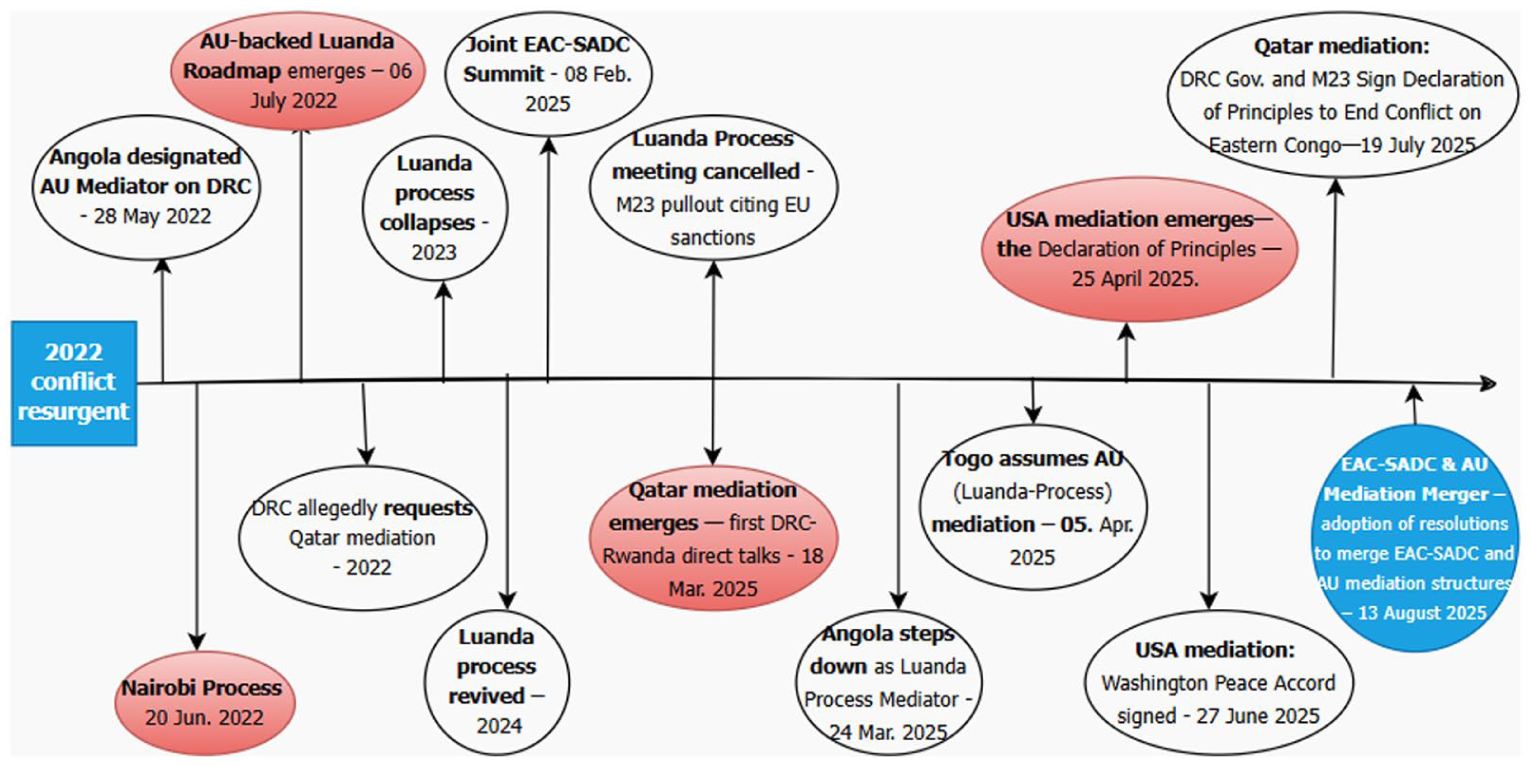
Mediation timelines in the DRC between 2022 and 2025.
A reflection of each of four mediation initiatives deployed in the DRC provides insights into the impact of multimediation in the Congolese quest for sustainable peace and security. As will be noted in the subsequent sections, the complexity of these mediation interventions is particularly striking when viewed through the lens of the AU’s African Solutions to African Problems paradigm which seemed failing to hold water in the DRC peace processes. The paradigm enunciates that “whatever the reality of the situation, solutions must be generated on the continent, for, should Africans import solutions to African problems, then the solutions would be no more African than if they had been imported by non-Africans” (Mensa-Bonsu, 2018: 2). This pan-African idea agrees with the notion of insider mediation, local actors with a deep understanding of the local context, and can build trust with ownership (Svensson and Lindgren, 2013) compared with external actors who may be considered “meddlers” rather than mediators (Khadiagala, 2007).
African-led mediation interventions
Between the year 2022 and 2025 there were two major African-led mediation initiatives in the DRC, one led by the EAC (Nairobi process) and the other by the AU (Luanda process), both as regional efforts to end conflict in Eastern DRC and by extension promote peace and stability in the Great Lakes Region.
The Nairobi Process sought to address the escalating conflict in eastern DRC, particularly involving multiple targeted discussions with armed groups including the M23 and the Allied Democratic Forces (ADF), confidence-building measures with various civil rights and women groups, and the organization of several high-level conferences to resolve tensions and identify pathways to peace. The process was initiated following three high-level meetings held in Nairobi, Kenya, on 8 April 2022; 21 April 2022, and 20 June 2022, convened by EAC Heads of State with Kenya’s former President Uhuru Kenyatta acting as the Chief facilitator (East Africa Community, 2025). The Nairobi process established a two-track approach involving both military intervention (hard power) and the political (mediation) intervention (soft power). In establishing The EAC agreed that “the two processes (dialogue and military approach) will be undertaken simultaneously through EAC Leadership but with full ownership of the Democratic Republic of Congo” (East Africa Community, 2025: 1).
While Uhuru’s mediation leadership started off well, two developments began saddling the mediation initiative. The first development involved the DRC’s December 2023 elections and the subsequent renewed violence in North and South Kivu. The second problem was that by the time of merging the Nairobi and the Luanda process (which shall be explained in detail later), Uhuru Kenyatta felt that he was being sidelined by the SADC and EAC Heads of State engagements in the mediation processes (Wekesa, 2025).
The Luanda Process emerged in July 2022 as part of the International Conference on Great Lakes Region (ICGLR) Roadmap on the Pacification in the Eastern Region of DRC (Luanda Roadmap) under the leadership of the Angolan President João Lourenço, to promote peace and security in the Great Lakes region (New Times, 2022). In late 2022 the Luanda Process was established to maintain dialogue between Rwanda and the DRC in order to diffuse escalating tension and promote peace in eastern DRC with the Angolan President as the AU’s designate mediator in the conflict (Republic of Angola, 2022). The Luanda process collapsed following the resumption of intermittent violence in the region, in violation of the ceasefire agreement reached in the same year (see Republic of Angola’s statement in 2022). The process resumed in 2024 following escalated violence and fighting between the Congolese armed forces – FARDC and the M23 rebels (Asanzi and Hoinathy, 2024). Within this fighting were also mutual accusations between Rwanda and the DRC – with the DRC accusing Rwanda of supporting the M23 rebels while Rwanda accused the DRC of supporting the Democratic Forces for the Liberation of Rwanda (FDLR), a Hutu militia linked to the 1994 Rwanda genocide.
The SADC was not a founding architect of the Luanda Process, it was the AU. However, SADC’s military deployment (SADC Mission in the Democratic Republic of Congo – SAMIDRC) in 2023 made the M23 and Rwanda view the Luanda process as biased, implicating Angola as an interested party in fighting Rwanda and M23 militarily rather than mediation. Angola is a member of SADC, and unavoidably, it was considered complicit in endorsing military deployment into DRC which both Rwanda and M23 considered as direct military engagement rather than peacekeeping.
In February 2025, a joint EAC-SADC summit merged the Luanda and Nairobi processes into a single coordinated effort, with the summit’s resolutions concluding that there was a need to establish an operational framework for this unification. This merging of processes was a deliberate attempt to promote a single, coordinated mediation intervention by synchronizing the two previously fragmented, parallel interventions, thereby reflecting the antithesis of multimediation. The EAC-SADC summit created a single mediation process, whereas multimediation seeks to replace such singularity with multiplicity and overlaps. Nonetheless, despite the unification resolutions, the Nairobi and Luanda processes continued independently.
The Luanda process, unfortunately, collapsed on 18 March 2025 when Angola’s final attempt to broker talks failed after the M23 withdrew citing European Union (EU) sanctions. This is the same day the Presidents of Rwanda and DRC also featured in Doha holding direct talks under the Qatari leadership mediation. The following day (19 April 2025), the AU endorsed the Doha mediation talks, which sounded like a betrayal to the Luanda process that the AU, through Angola’s President, was working on. As a result of this development, arguably, Angola announced that it intended to end its mediator role, diplomatically citing the need to concentrate on its new role as the AU Chair (Reuters, 2025). The AU was, therefore, presented with an opportunity to maintain a single mediation process, the remaining Nairobi process. The continental body, however, appointed the Togolese President, to succeed the Angolan President, further maintaining the parallel (multi)mediation processes. As a result, the Luanda/Nairobi merging process remained unclear, reflecting sluggish coordination. It can, therefore, be argued that the complementary, but overlapping Nairobi and Luanda processes “minimized the AU’s direct influence and exacerbated underlying challenges to mediation” in the DRC (ISS-PSC Report, 2025: 1). Table 1 summarizes the Nairobi, Luanda, Qatar, and the United States mediation process complementarities and overlaps.
Summary of the Nairobi, Luanda, Qatar, and the US mediation process complementarities and overlaps.
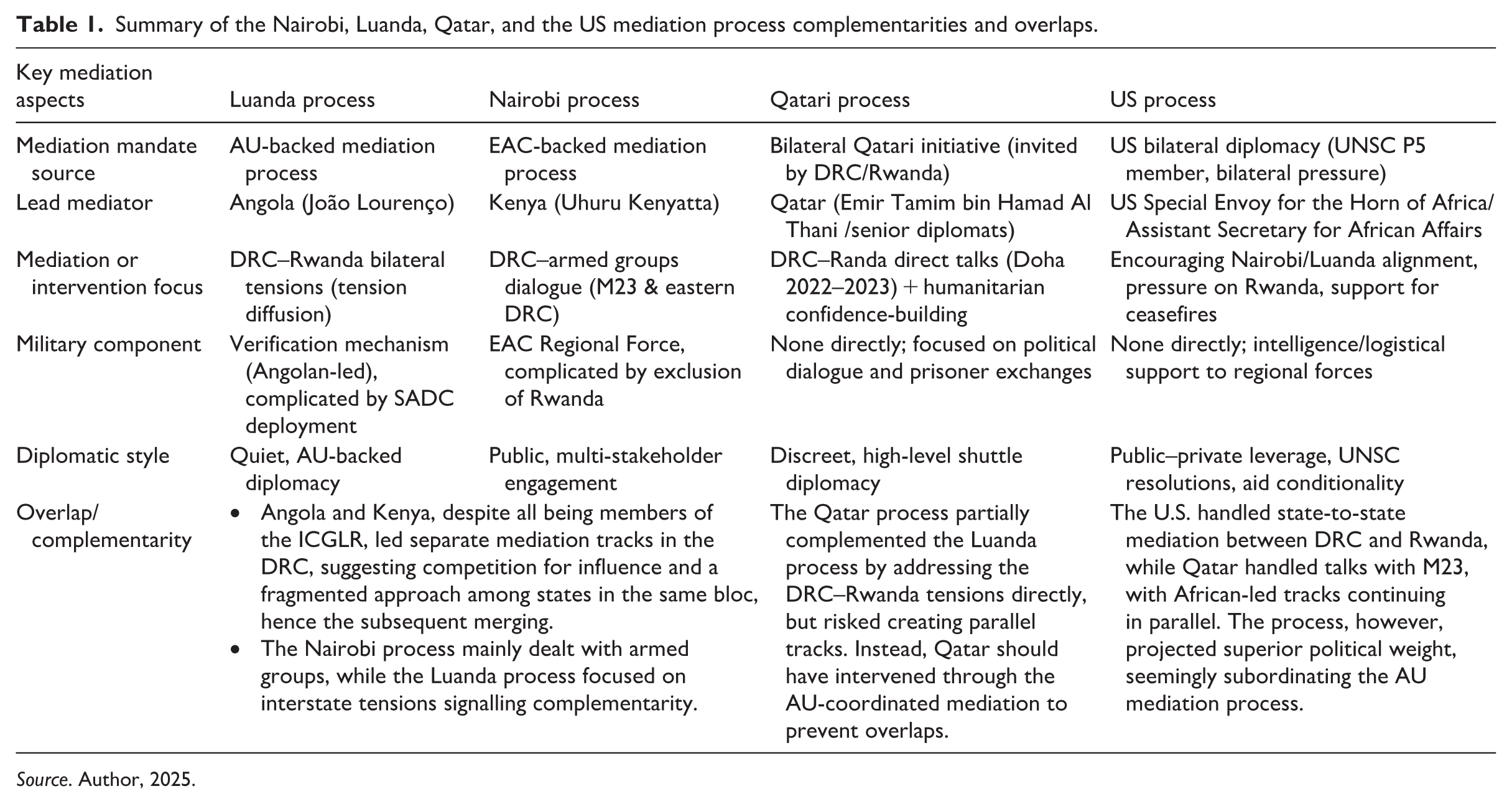
Source. Author, 2025.
The Luanda and Nairobi processes were the most crucial mediation interventions if they had been streamlined and supported effectively. First, a review of the Communique issued by the Republic of Angola following the 2022 Mini-Summit on peace and security in the Eastern region of the DRC (Republic of Angola, 2022) and the Letter to the United Nations Security Council by the Rwandese Permanent Representative to the United Nations in December 2024 (Rwanda’s Permanent Representative to the United Nations – Rwamucyo, 2024), clearly suggests that the AU’s Luanda process endorsed the Nairobi peace process, acknowledging the mutual complementarity. In fact, the two processes ideally complemented each other with the Nairobi process focusing on armed groups, while the Luanda process addressed the DRC–Rwanda political dimensions. The Joint EAC-SADC summit was literally meant to reignite this cooperation by merging the processes to become one intervention instead of running parallel to each other.
Additionally, the use of the military intervention in both processes – Nairobi and Luanda/SADC processes made the mediation intervention even more difficult. First, the EACRF was deployed in 2022 and officially withdrew in December 2023. Its withdrawal was mired in controversy largely due to disagreements over mandate, perceptions of ineffectiveness, and growing tensions with the Congolese government. According to Russo (2023), major concerns for the pull-out included (1) the EACRF’s reluctance to conduct offensive operations against the M23 rebel group; (2) deep mistrust toward certain contingents, especially from Burundi and Uganda, whose forces were accused of maintaining an illegal presence in the DRC; and (3) allegations that some EACRF members were colluding with rebel factions. Although the EACRF’s mandate was to support the EAC political process, this objective was undermined by the diplomatic standoff between Rwanda and the Congolese government, which stalled meaningful progress. Second, the SAMIDRC deployment was not anchored on the political process, but direct combat which angered the M23 and Rwanda. Third, countries involved in the mediation processes both within the Nairobi and Luanda processes were entangled in competing strategic interests in the DRC and within the greater GLR. For example, South Africa was motivated by economic interests in the DRC and maintaining its regional hegemony and prestige while Tanzania prioritized its economic relations with Rwanda. Additionally, “Uganda and Rwanda consider the eastern DRC vital due to their geographical proximity, security concerns and economic stakes” (Handy, 2025: 1).
Regardless of the supposed complementarity between the Luanda and Nairobi processes, African continental policymakers must deeply understand one critical truth, that the emergence of these two parallel processes reflects the failure of the African mediation intervention itself. As Hellmüller and Salaymeh (2024) observe, when a single mediation process is perceived as stagnant and failing, other mediation actors inevitably emerge, and this is precisely what happened in the DRC. This reflection becomes even more striking when the US and Qatari mediation interventions are added to the picture. The proliferation of multiple mediation interventions – the Luanda, Nairobi, Qatari, and US processes – emerged because the AU-led mediation was widely considered as ineffective and stagnant, unable to end the conflict or facilitate a credible pathway to reconciliation and justice. This observation raises a reflexive question for African peace architecture that if parallel processes are a symptom of failure rather than a sign of healthy complementarity, then what deeper reforms are needed to prevent such mediation fragmentation in future conflicts?
Non-African-led mediation interventions
Two prominent, publicly identifiable non-African-led mediation interventions were led by the US and Qatari governments. Both mediation interventions appeared complimentary to each other because after the Qatari government facilitated direct talks between the Congolese and Rwandese presidents, the United States assumed a more prominent role in facilitating a more substantive peace agreement. These two mediation actors may be understood through Khadiagala’s (2007: 10) notion of “perceived meddlers” rather than mediators, often from outside the African continent and “prone to squander the opportunities of invitation and entry.” This critique is reinforced by Ngwane (2008: 56), who argues that: Africa’s dispute resolution industry does not need to venture too far to find its own Oscar Ariases and Jimmy Carters – they are right in Africa’s backyard, provided that Africans learn to winnow the powerful meddlers from the professional mediators.
The Qatar mediation process in the DRC conflict became publicly known on 18 March 2025, when Qatar’s Ministry of Foreign Affairs issued a press statement revealing the first direct talks between the Presidents of Rwanda and DRC (State of Qatar, 2025: 1).Notably, however, Qatar had been involved in the DRC conflict mediation since 2022 at the request of the DRC government. For example, in 2022 Qatar unsuccessfully attempted to organize a meeting between Rwandan and Congolese officials during the FIFA World Cup tournament (Cok, 2025).Furthermore, in 2023, Qatar engaged in shuttle diplomacy, meeting with leaders of countries in the Great Lakes Region, including the lead facilitators of the Luanda and Nairobi mediation processes. This shuttle diplomacy was followed by Qatar organizing a summit in Doha for the leaders of Rwanda and the DRC to sign a peace agreement. However, the summit was cancelled after the Congolese President refused to attend the meeting (Africa Intelligence, 2023). Concerning is that Qatar’s mediation, dating back to 2022, was at the request of the DRC, despite the ongoing Nairobi and Luanda mediation initiatives. This development presumably suggests that DRC’s growing desperation and mistrust of the AU’s Luanda process and the Nairobi process.
The direct talks held on 18 March 2025 in Doha between Rwanda and the DRC followed the merging of the Luanda and Nairobi mediation efforts during a joint EAC-SADC summit held in Dar es Salaam, Tanzania, on 8 February 2025. The statement accompanying the talks noted that “the Heads of State then agreed on the need to continue the discussions initiated in Doha in order to establish solid foundations for lasting peace as envisioned in the Luanda/Nairobi process, now merged and/or aligned” (State of Qatar, 2025: 1). This suggested that Qatar’s mediation was aligned to the merged SADC-EAC mediation process, which implies a sequenced (multiple) mediation process. Arguably, this was not the case, since the DRC and M23 negotiators were scheduled to meet in Luanda on the same day when the Doha talks were happening, a meeting Angola claimed to be unaware of, highlighting a lack of synchronization with the Luanda process. This observation points to multimediation’s counterproductivity.
Qatar’s mediation role in the DRC–Rwanda conflict is twofold, both plausible and questionable, and it challenges the pan-African notion of African solutions to African problems. On one hand, Qatar’s involvement is plausible because mediation is a well-established component of its foreign policy, with a record of successful dispute resolution in Africa. Examples include its mediation of the border dispute between Eritrea and Djibouti in 2006, facilitation of a peace deal between the Chadian government and approximately 40 rebel groups in 2022, and its role in reducing maritime tensions between Kenya and Somalia in 2021 (Cok, 2025; Custers, 2021). In the DRC–Rwanda conflict, Qatar achieved direct talks between the Congolese and Rwandan presidents, something neither the Luanda nor Nairobi processes had managed to accomplish (Security Council Report, 2025). This direct engagement led to an immediate ceasefire, likely due to Kagame’s positive engagement with the Congolese President in Doha. Subsequent rounds of dialogue produced two key outcomes: (1) the signing of a Declaration of Principles by Congolese and Rwandan negotiators, and (2) direct talks between the Congolese government and the M23 rebel group (Government of Rwanda, 2025). These accomplishments significantly contribute to peace efforts in the DRC and the broader Great Lakes region.
On the other hand, the sincerity of Qatar’s mediation is complicated by its strategic economic interests in the Great Lakes region, particularly in Rwanda and the DRC. Sincerity is essential because empathy, transparency, and consistency help convince parties that mediation is not manipulative or biased. Without that confidence, agreements may be signed but not owned by the disputants, and peace could remain fragile. In Rwanda, Qatar Airways holds nearly half of the shares in the state-owned airline RwandAir, and owns a 60% stake in Bugesera International Airport near Kigali (Adesoji, 2025). In the DRC, Qatar has invested in the modernization and management of three airports, as well as in maritime and aeronautical ventures (Custers and Kinkoh, 2025). These substantial economic investments give Qatar leverage as a mediator, as it has a vested interest in maintaining stability to protect its assets. Therefore, Qatar’s commitment to peace may be considered transactional and convenient rather than a principled pursuit of sustainable peace between Rwanda and the DRC. With economic interests at stake, Qatar would prioritize stability for investment in the Great Lakes region over sustainable peace, justice, and reconciliation.
The US mediation efforts in the DRC–Rwanda conflict built upon the earlier Qatar mediation process. This, in theory, reflects a sequenced multiple mediation approach. Following direct talks between the Presidents of Rwanda and the DRC on 18 March 2025, the United States facilitated further dialogue that culminated in the signing of a Declaration of Principles in Washington on 25 April 2025. This declaration affirmed both countries’ political commitment to dialogue “in support of a pathway to peace, stability, and integrated economic development in the eastern DRC region and the resumption of normal bilateral relations between the two countries” (US Department of State, 2025a: 1). Subsequent negotiations led to the signing of a peace agreement, known as the Washington Accord, on 27 June 2025 (US Department of State, 2025b: 1). The US success in facilitating this agreement is highly commendable, especially as it achieved what earlier peace processes such as the Luanda and Nairobi initiatives could not do.
However, similar to the Qatar mediation, the US involvement has been met with mixed reactions, particularly among African states. For instance, some viewed the Trump administration’s mediation as a “hostile takeover” that effectively suspended and undermined “both the EAC-led Nairobi Process and the African Union-backed Luanda Process, led by Angola” (Kibii, 2025). As noted earlier, this perception (or reality) is exactly what Khadiagala (2007) described as meddling rather than mediation, a conception that questions the US legitimacy in the mediation process. The query is significant because the Washington Accord was not comprehensive; it excluded key stakeholders such as the M23/AFC rebel groups, civil society, political parties, and other influential armed actors. As a result, it risks being an elite-driven pact prone to short-term peace due to limited local ownership and potential non-compliance. Notably, the Luanda process aimed to bring all stakeholders to the negotiating table, while the Nairobi process focused on easing tensions between Rwanda and the DRC. The US mediation could have complemented these efforts to enhance inclusivity and sustainability.
Moreover, arguably more critical is the perception that the United States facilitated a transactional peace agreement. From an economic standpoint, the United States has a strategic interest in securing independent supply chains for critical minerals, reducing reliance on China, thus linking peace in the DRC to broader American security and economic prosperity (Brewer and Brokenshire, 2025). To validate this view, the United States notably became actively involved after the DRC President offered Washington access to the country’s critical minerals in exchange for security assistance. Some African commentators such as Wanneburg (2025) have criticized the external mediation as a guise for resource exploitation, describing it as a “Berlin Conference 2.0,” evoking historical European partitioning of Africa, and as legitimizing foreign occupation and exploitation of Congolese resources. These perceptions complicate the acceptance of US mediation, although in practical terms, the intervention achieved tangible outcomes that African-led initiatives failed to secure.
Reflections: The complexities of mediation overlaps
This section reflects on the challenges of multimediation interventions. As noted earlier, multimediation emerged to address the limitations of single-mediator models by proposing the involvement of multiple mediators in a conflict. The DRC provided a perfect match where this approach to conflict resolution played out with African-led mediations (Luanda and Nairobi mediation processes) and externally/non-African-led mediation (Qatari and US mediation interventions). The direct involvement of these mediators in the DRC conflict achieved both successes and failures – measured by the easing of tension between the DRC government and M23 and Rwanda by extension. Ceasefire agreements were facilitated and direct negotiations among conflicting parties were also achieved. In addition, the mediation multiplicities dovetailed well with the AU’s principle of complementarity, which emphasizes coordination and synergy among African institutions and regional mechanisms, including external support to resolving local conflicts (African Union, 1998). The playout of this principle was evident in that the AU recognized the role of regional bodies in conflict prevention and management in line with the AU Peace and Security Architecture. For example, through the Quadripartite Summit, AU supported the ICGLR in addressing conflicts in the Great Lakes Region and it endorsed the role of regional mechanisms such as the EAC and SADC in seeking sustainable peace in the DRC (SADC, 2023).
The achievements of the multimediation processes were arguably insufficient to achieve long-term peace in the DRC, given the persistence of violence and repeated violations of peace agreements by the conflicting parties. This suggests that in complex conflict situations, the adoption of multimediation practices without comprehensive strategic reflection can result in mediators competing rather than collaborating, thereby rendering their efforts counterproductive. This argument is supported by the presence of numerous international and regional mediators whose overlapping and sometimes conflicting agendas undermined the development of a unified strategy and diminished overall effectiveness. Such fragmentation generated several challenges, including weak enforcement of peace agreements and accountability measures, the exclusion of key conflict actors, neglect of the root causes of the conflicts in the DRC, political instrumentalization of the conflict, and failures of trust and coordination among regional bodies and non-Africa mediators, specifically Qatar and the United States. Figure 2 provides a visual multimediation ecosystem in the DRC between 2022 and 2025.
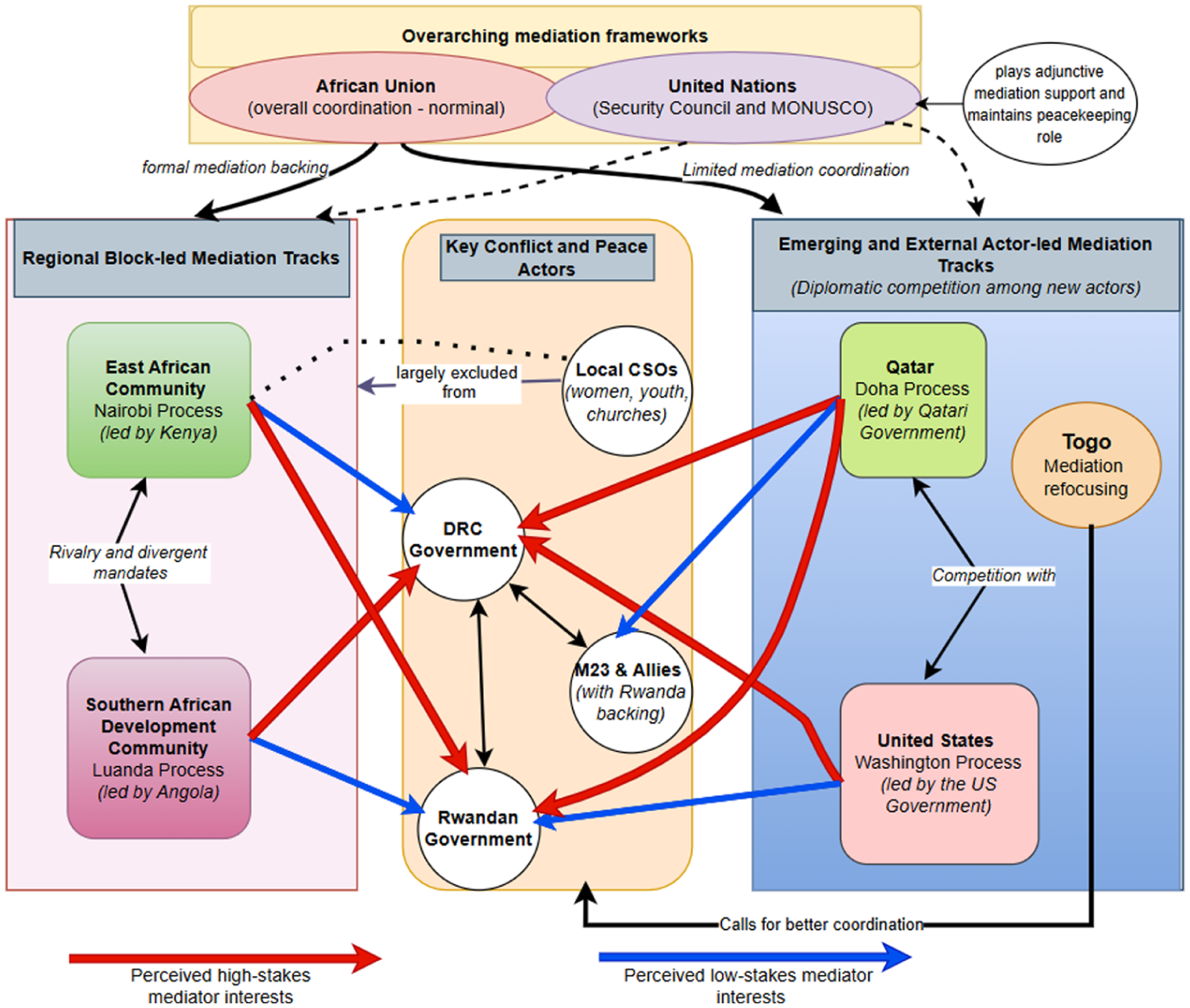
Multimediation dynamics between 2022 and 2025.
Coordination failures among mediation actors
Mediation coordination is extremely important in multiple mediation contexts because it ensures consistency, avoids duplication, and aligns parallel negotiation tracks towards a common outcome (Hoicka, 2025; Zahar, 2023). Where conflicts involve several actors or overlapping engagements, coordination helps mediators to share information, manage timing, build trust, and prevent contradictory messages that can weaken settlement prospects. Its value lies not only in efficiency, but in increasing the coherence, credibility, and durability of agreements. However, in the DRC mediation settings between 2022 and 2025 coordination failures among mediation actors were visibly noticeable.
The AU-backed Luanda Process and the Nairobi Process emerged as two separate but ostensibly complementary initiatives whose impact was largely affected by coordination failures. Hoinathy (2023: 1) notes that “while Nairobi focuses on armed groups, Luanda addresses the DRC-Rwanda political dimensions.” The two mediation tracks’ complementarity was confirmed during the Mini-Summit on peace and security in the eastern DRC, held in November 2022 in Luanda, Angola (Republic of Angola, 2022). However, despite the formal affirmations and some degree of interaction, coordination, and information sharing between these processes, their complementarity remained inadequate. This necessitated the need to formally merge both the Nairobi and Luanda processes into one, an initiative that was kick-started through the Joint EAC-SADC Summit held in Tanzania on 8 March 2025. Nonetheless, the merging process remained unclear and lethargic as a result of non-implementation of agreed issues to be merged. Also, the complementary but overlapping Nairobi and Luanda processes “minimized the AU’s direct influence and exacerbated underlying challenges to mediation” (ISS-PSC Report, 2025: 1).
Coordination failures were further complicated by the involvement of other external actors, notably Qatar and the United States. For instance, the Qatar mediation process came to prominence when the Presidents of the DRC and Rwanda convened in Qatar, coinciding with the Angolan government’s intention to host a meeting between the DRC government and M23 leaders. President Lourenço, who held the AU’s mandate to mediate between Presidents Kagame and Tshisekedi, “was not informed of the encounter in advance, raising concerns about coordination and coherence in peace efforts” (Maina, 2025: 1). Ideally, had the DRC government placed sufficient value on the Luanda Process, it would have ensured that the AU-mandated mediator and the EAC facilitator are kept apprised of the Qatar initiative to prevent not only frustrations on the part of Angola and Kenya, but also to harmonize engagement and sequencing of mediation events.
In fact, the Congolese and Rwanda leadership’s failure to notify either the Nairobi or Luanda mediation facilitators of their direct talks in Qatar bordered on mistrust and demonstrated a disregard for the AU and its regional peace and security mechanisms. The fact that the Congolese and Rwandese Presidents prioritized the Qatari mediation process while sidelining the Angolan mediator, who was officially mandated by the AU, raises three critical concerns: (1) the preference of a non-African, Qatari-led mediation over an African-led initiative; (2) a disrespect towards the AU mediator and the ongoing SADC-EAC mediation efforts; and (3) a desecration of the AU’s principle of African solutions to African problems.
African agency misalignment – African solutions to African problems
The issue of African agency requires a deep reflection as a critical factor in Africa’s pursuit for continental peace and security. As noted earlier, the entry of external mediation actors in the DRC conflict – Qatar and the United States – effectively challenged the AU’s agency and misalignment of the principle ‘African Solutions to African Problems’. This principle is rooted in Pan-Africanism imposing that Africans are capable of solving their own problems and it is befitting that Africans have an opportunity to solve their own problems without interference.
Mensa-Bonsu (2018: 2) enunciates that African Solutions for African Problems implies that “whatever the reality of the situation, solutions must be generated on the continent, for, should Africans import solutions to African problems, then the solutions would be no more African than if they had been imported by non-Africans.” This is exactly what failed until Qatar and the United States stepped into the mediation front. Further humbling is that immediately after the first appearance of the Presidents of Rwanda and Congo in Qatar, the AU Commission Chairperson’s promptly acknowledged Qatar’s mediation process before its own mediator (Angola) made any statement to the same effect. By doing so, the AU undermined itself, and it diluted the normative paradigm emphasizing African ownership of peace processes.
Competing strategic interests at the heart of the DRC mediation duplicities
The multiple mediation efforts in the DRC were further complicated by two critical challenges related to competing strategic interests. First, the national strategic interests of external parties involved in the mediation became a significant driving force shaping the process. This rendered the mediation processes competitive, arduous, and sometimes counterproductive rather than collaborative and constructive. For example, Qatar, which has substantial economic investments in both the DRC and Rwanda, pursued a vigorous peace and stability agenda in the region that appeared closely tied to protecting and advancing its economic interests. Similarly, the US involvement was heavily influenced by its transactional economic interests aligned to access to and control of the DRC’s mineral resources. Beyond the economic dimension, maintaining a strategic presence in the DRC enables the United States to counterbalance China’s expanding economic and geopolitical influence in Central Africa. Regional actors within the Great Lakes region such as Burundi, Uganda, and Rwanda were not only motivated to secure their own borders but also interests tied to exploiting natural resources in the border areas of the DRC. This created a complex web of involvement in the DRC’s peace and stability processes, where peace and security concerns and economic ambitions are closely intertwined.
Second, the involvement of competing regional blocs, SADC and the EAC, escalated regional rivalry around mediation efforts. Initially, the DRC requested military assistance from the EAC but subsequently dismissed this support in favour of an SADC-led mission. This sequence generated tension and mistrust between the two regional bodies. Furthermore, the trading of “interference” accusations between Rwanda and DRC made the EAC and SADC interventions more complex and strained ultimately affecting perceptions of neutrality in mediation efforts led between the Nairobi and Luanda processes. The EAC-led mediation was perceived as leaning towards Rwanda’s interests, while the AU-backed and Angola/SADC-led initiative appeared to support the DRC government, thus undermining the intended mediation complementarity between these two processes.
Adding to the complexity is that Angola was viewed as attempting to asset regional leadership in both the EAC and SADC regions, by virtue of being an AU-backed mediator, subtly competing or rather undermining Kenya’s role and prominence in the Congolese conflict resolution process. Furthermore, troop deployments by Uganda and Burundi, both EAC members, into eastern DRC reflect divergent strategic interests. Their involvement is perceived not merely as peacekeeping but also as an assertion of influence and power projection within the region, further muddying the mediation landscape. Ultimately, rather than fostering complementarity, the coexistence of the Luanda and Nairobi processes underscored regional competition. Arguably, each bloc sought to control the direction and narrative of the mediation process, vying for prominence in resolving the DRC crisis. Debatably, though, this rivalry often hindered unified mediation efforts and complicated the pursuit of sustainable peace in the region.
Exclusion and legitimacy deficits
It is unequivocal that most mediation initiatives in the DRC were structured in ways that systematically excluded grassroots actors and other key stakeholders integral to the conflict dynamics, thereby failing to meet the essential criteria for an inclusive peace process. For instance, the US-led mediation process primarily focused on the DRC and Rwandan government negotiations, significant actors such as the M23 rebel group, civil society organizations, and other armed factions directly involved in the conflict such as Wazalendo (a coalition of community-based self-defence groups) were effectively left out. This exclusion, from mediation negotiations, raises serious doubts about the long-term sustainability of any resulting peace (agreement). Empirical research consistently demonstrates that the omission of critical actors from negotiations can lead to the resurgence of violence, even in the presence of formal ceasefire agreements.
Similarly, the AU-backed Luanda and EAC-led Nairobi processes exhibited a degree of selectivity by primarily engaging M23 alongside the governments of the DRC and Rwanda, while marginalizing civil society actors. This exclusion is significant, as civil society often plays a critical role in building grassroots support, strengthening community resilience, and legitimizing peace efforts. The EAC-led Nairobi process, for instance, focused largely on mediating negotiations between the DRC government and M23, without fully recognizing Rwanda as a central conflict actor. In contrast, the SADC mediation process approached the conflict by directly engaging the governments of Rwanda and the DRC as the primary actors. Despite these differences, both processes remained politically elite-driven, prioritizing state actors while paying limited attention to communities most affected by the violence, as well as to civil society peace institutions that possess valuable insights into the root causes, dynamics, and impacts of the conflict (Al-Khulaifi, 2025).
Furthermore, the exclusion of regional actors with significant strategic interests, such as Uganda and Burundi, both of which not only maintain military presence within the DRC but are also linked to the support of proxy rebel groups, undermines the comprehensiveness and effectiveness of the peace negotiations. These two countries should have been considered as key conflict actors in the DRC because, their absence risks perpetuating instability and it diminishes prospects for a durable resolution to the conflict.
Neglect of root causes
Current mediation processes in the DRC conflict (held between 2022 and 2025) have largely failed to address the country’s root causes comprehensively, a strategic mistake which past conflict resolution mechanisms have committed. The peace initiatives such as the Qatar, United States, AU-backed Luanda Process, and the EAC-led Nairobi Process predominantly focused on ceasefire agreements and negotiations between state actors and select rebel groups. Structural challenges including poverty and unequal benefit and access to natural resources, ethnic marginalization, and poor governance are clearly excluded from the mediation processes. The mediation processes’ exclusion of key stakeholders, such as grassroots communities, broader civil society, and some influential regional actors (including Uganda and Burundi), is a denial of these underlying causes of the DRC’s political crisis. It is this selectivity that undermines the inclusivity and legitimacy of the peace efforts, leaving critical ethnic and political grievances unaddressed (ISS-PSC Report, 2025). Any comprehensive mediation process must address underlying ethnic tensions, governance deficits, and economic drivers of the conflict.
Towards a coordinated mediation approach
To enhance mediation interventions in the DRC, it is essential to establish a single coordinating mechanism such as a dedicated mediators forum to oversee all mediation processes. Lanz and Gasser (2013: 13) argue that international peace mediation is naturally a crowded field driven by “conflicting interests between states involved in mediation, turf battles between organizations with overlapping mandates and disagreements about the normative basis of international politics and conflict resolution.” Henceforth, this coordinated approach will significantly improve mediation resources deployment efficiency and effectiveness, reduce duplication, and foster strategic alignment among actors. This means that the proposed mediation forum must have a clear mandate for hierarchical coordination where a specific recognized organization such as the AU, EAC, or SADC will take a lead and also allocate roles of all parties interested to participate as mediators, thus, enabling an orderly multimediation process.
However, coordination in itself cannot be a technical fix without the cultivation of political will, especially among those actors with deeply embedded (clashing) political interests, including normative disagreements. Hence, the DRC, as the primary party directly affected by the conflict, must maintain consistency in engaging principal mediators and ensure that all ancillary mediators are fully informed about each other’s actions and strategies. This transparency will improve mediators’ accountability, prevent conflicting initiatives and enhance coordination. In addition, regional organizations such as the EAC and the SADC should actively collaborate to align their mediation efforts, ensuring their interventions are complementary and avoid harmful overlaps.
Moreover, ensuring that African ownership remains central to all external mediation efforts will reinforce the legitimacy and authority of the AU and its regional bodies, while promoting contextually appropriate measures that support sustainable engagement and dialogue. However, the shortcomings of the Luanda and Nairobi processes illustrate that regional ownership alone is not a guaranteed solution to intractable conflicts. To avoid what Khadiagala (2007) terms “meddlers,” the AU must assert itself as a proactive orchestrator of sustainable conflict resolution, rather than a passive figurehead that merely endorses the actions of external mediators.
All mediators, particularly African intermediaries, should leverage their geographical and cultural proximity to the conflict by deepening engagement with local actors, including civil society groups. Inclusive peace processes that meaningfully involve these actors are critical for building trust, legitimacy, and effectiveness. Such inclusion also enables linkages between high-level mediation tracks and grassroots peacebuilding interventions, moving towards what Federer et al. (2019) describe as going “beyond the tracks.” The authors argue that all diverse peace mediation processes must be carefully coordinated to prevent duplication, competition, and inefficiencies, while leveraging inputs from every level of peace and conflict resolution. However, a reflexive reading of their work also cautions that linkages between tracks are not inherently positive; they can generate negative impacts if pursued without a clear theory of how each initiative contributes to peace. Continued exclusion or alienation of civil society peacebuilders and smaller rebel groups risks prolonging the conflict and making resolution more complex and elusive. Promoting coordinated, inclusive dialogue is, therefore, vital to achieving sustainable peace, but it must be done with careful attention as to when and how different tracks should connect.
Conclusion
In sum, the multimediation process in the DRC, meant to promote adaptive mediation and institutional complementarity undermined the pursuit of sustainable peace in the country and by extension, the Great Lakes Region. Lack of a unified, inclusive, and locally grounded mediation framework has left the DRC’s peace initiatives fragmented, ineffective, and less credible. While the Luanda and Nairobi processes were two separate complementary mediation interventions, their operationalization promoted regional rivalry between the EAC and SADC member states. Strategic interests among regional economic communities’ member countries, Qatar, and the United States further muddied genuine peace negotiations in the DRC as they became selective, transactional, and competitive as opposed to facilitating complementarity.
Footnotes

Funding
The author received no financial support for the research, authorship, and/or publication of this article.
Declaration of conflicting interests
The author declared no potential conflicts of interest with respect to the research, authorship, and/or publication of this article.