






Abstract
There is a paucity of research on the economic integration of African immigrant youths in the smaller Canadian urban regions. This cross-sectional mixed-methods study examines factors shaping employment outcomes among African-born youths aged 18–30 years in Saskatchewan. Findings from 203 participants show that 48.3% reported difficulty finding work in their field, while 37.4% struggled to meet basic needs. Key barriers included discrimination, unrecognized credentials, and limited social networks. Although higher education and longer residence improved outcomes, they did not eliminate structural challenges. Local experience, language proficiency, and networking enabled integration. The study highlights the need for context-specific policies to address systemic barriers.
Introduction
Economic integration, particularly securing employment and a stable income, is widely recognized as one of the most immediate and pressing priorities for newcomer immigrants during the settlement process (Kaushik and Drolet, 2018). Being able to participate fully in the labour market has far-reaching effects, not just on an individual’s well-being, but also on social cohesion and the country’s overall productivity (Laurentsyeva and Venturini, 2017; Quak, 2019). Between 2016 and 2021, Canada welcomed close to 1.3 million immigrants, which was the highest number of recent immigrants recorded in a Canadian census (Statistics Canada, 2022). Indeed, immigrants bring a wide range of skills, knowledge, innovation, and work experience, making them a vital source of human capital for the economy and society (Peri, 2016; Quak, 2019). In 2025, Canada reaffirmed its commitment to leveraging immigration, to address labour shortages, strengthen key economic sectors, and support communities, with a projection that economic immigrants will account for 64% of all immigration streams in 2027 and 2028 (Government of Canada, 2025). To attract newcomers who can integrate quickly into the labour market, Canada offers economic pathways such as the Federal Skilled Worker Program, the Canadian Experience Class, the Federal Skilled Trades Program, and the Provincial Nominee Program alongside traditional streams, including humanitarian and refugee programs, family sponsorship, and student visas (Government of Canada, 2026).
Despite their significant contributions to the labour force, recent immigrants continue to face economic integration challenges in many countries (Chance, 2023), including Canada (Crea-Arsenio et al., 2022). In 2024, unemployment rates among immigrants in Canada varied based on the length of stay, with 11.1% among those with 5 years of stay and 8.2% among those with 5–10 years of residence. Both rates were higher than the 5.6% rate observed among the Canadian-born population (Statistics Canada, 2025b). This finding, along with evidence from other Canadian studies (Crea-Arsenio et al., 2022; Kazemipur and Halli, 2000a), underscores the persistent and stark economic inequities faced by many recent immigrants. These include slower earnings growth, higher rates of underemployment, and challenges in securing jobs that commensurate with education and experience (Dean and Wilson, 2009; Guo, 2015). Factors contributing to these disparities are multifaceted, and include undervaluation of foreign credentials, non-recognition of international work experience, licensing barriers in regulated professions, limited social and professional networks, and racial discrimination in hiring practices (Creese and Wiebe, 2012; Guo, 2015; Karki, 2025). Visible minority status is consistently reported among key determinant of labour market outcomes, shaping access to employment that matches individuals’ skills (Guo, 2015; Karki, 2025; Nazari, 2024). Other sociodemographic factors, such as gender identity, language proficiency, and legal status, also play an important role (Crea-Arsenio et al., 2022; Wang and Jing, 2018). In addition, social supports, personal and professional networks, and familiarity with Canadian workplace norms influence the success of the economic integration process (Kazemipur, 2006; Nakhaie and Kazemipur, 2013). The COVID-19 pandemic has made these challenges worse. While emergency pandemic income supports briefly reduced poverty, the post-pandemic income-benefit cancelations, combined with rising inflation, have renewed concerns about the economic security and living standards of immigrant families (Dionne and Raymond-Brousseau, 2025). Despite these challenges, evidence suggests that immigrants can demonstrate resilience and adaptability over time, gradually improving labour market outcomes, though recovery is uneven and dependent on multiple structural and individual factors (Lester and Nguyen, 2016).
Some Canadian researchers report that Black immigrant populations experience poverty rates higher than both municipal and national averages, underscoring persistent income disparities (Kazemipur and Halli, 2000b; Livingstone and Weinfeld, 2015). Notably, the composition of the Black immigrant population in Canada has shifted significantly over time, with those born in Africa increasing from 22% between 1981 and 1990 to 70.9% between 2011 and 2021 (Domey and Patsiurko, 2024). This growth highlights the need to consider birthplace and migration histories when analysing economic outcomes. However, African immigrants remain underrepresented in Canadian research and are often grouped within broad racialized categories (e.g. Black), which can obscure distinct migration and labour market experiences. This gap is further reinforced by the geographic concentration of existing studies, which largely focus on major metropolitan centres such as Vancouver, Montreal, Toronto, and Ottawa (Turcotte and Vézina, 2010). As a result, smaller metropolitan regions in provinces like Saskatchewan, despite having some of the highest poverty rates in Canada (Hunter and Sanchez, 2021), have received limited scholarly attention with respect to the economic integration of African immigrants. To help fill these knowledge gaps, we use data from a cross-sectional study to explore how African immigrant youths (18–30 years) in Saskatchewan rate the difficulty of meeting household needs and finding employment in their desired fields, as well as the factors associated with these experiences.
Defining economic integration
Economic integration refers to immigrants’ ability to access, participate in, and contribute to the host country’s economy, and to attain labour market outcomes comparable to those of the native-born population (Kaczmarczyk et al., 2020; Penninx, 2005). In empirical studies, economic integration is seen as multidimensional, closely tied to overall socioeconomic wellbeing, and measured through a range of indicators, such as income and economic security (e.g. wages, individual or household income), employment and occupational mobility (e.g. employed vs. unemployed, type of occupation, occupational index), asset accumulation, neighbourhood and housing conditions, education and health (e.g. years of schooling, health insurance coverage), and reliance on public assistance (Naseh et al., 2024).
Theoretical views highlight the roles of both human and social capital in enabling economic integration. Human capital theory treats education and skills as investments that people make to improve their long-term well-being (Becker, 1994). It also highlights the importance of language proficiency, and credential recognition in shaping earnings and related economic outcomes over the life course, and forms the foundation of significant research on immigration, inequality, and human development (Becker, 1994; Dolado et al., 1994). The Canadian immigration policy has long relied on this model, prioritizing applicants with higher education, language proficiency, and professional experience through the points-based system (Picot et al., 2016; Ellermann, 2020). Yet, the translation of these formal qualifications into economic outcomes is neither immediate nor guaranteed for newcomers. Immigrants frequently experience underemployment, occupational downgrading, and employment in low-wage sectors, often accepting positions below their qualifications to secure initial income (Banerjee et al., 2019; Guo, 2015). Social capital theory (SCT) highlights networks as valuable resources, giving people access to the skills, knowledge, and support embedded in their connections (Coleman, 1988). From an immigration perspective, SCT highlights how ethnic and cross-ethnic networks, trust, and community participation help immigrants access jobs and supports, which improve their economic outcomes. Canadian research shows that bridging social capital and community involvement are linked to higher earnings among immigrants (Raza et al., 2013). Yet visible minority immigrants with low social capital often face persistent income gaps, even after accounting for education and language skills (Li, 2004; Nakhaie and Kazemipur, 2013).
African immigrant youths’ economic integration can be better understood through intersectionality and racialization perspectives, which emphasize how multiple identities and structural inequalities interact to shape labour market experiences. The intersectionality theory argues that experiences of inequality are not determined by a single social category, such as race or gender, but by the interaction of multiple identities and systems of power (Crenshaw, 2013). For African immigrant youths, race, gender, immigration status, age, language proficiency, and family responsibilities may intersect to influence access to employment, income security, and mobility (Amoako et al., 2024; Fruja Amthor, 2017; Nazari, 2024). Relatedly, Critical Race Theory (CRT) examines how race, racism, and power shape social, political, and economic inequalities through institutions rather than individual prejudice, viewing race as socially constructed and racism as embedded within societal structures that influence access to opportunities and resources (Delgado and Stefancic, 2023). CRT further emphasizes social justice by centring the lived experiences and voices of racialized populations in challenging structural inequities (Delgado and Stefancic, 2023; Ford and Airhihenbuwa, 2010). These perspectives deepen our understanding of the human and social capital theories by showing that labour market outcomes are not solely determined by individual qualifications or networks, but also by broader historical and structural processes that advantage or disadvantage immigrant groups. Applying these perspectives is important for understanding the economic integration of African immigrant youths in Canada, whose experiences vary across intersecting social positions and settlement contexts such as Saskatchewan.
Economic outcomes of visible minority immigrants in Canada
By 2022, approximately 9.9% of Canadians were living in poverty, with nearly 1.95 million individuals (about 5% of the population) experiencing deep income poverty, defined as earning less than 75% of the poverty line (Dionne and Raymond-Brousseau, 2025). Recent immigrants and young adults were particularly vulnerable, with 10.8% of those who have resided in Canada for fewer than 5 years and 9.5% of individuals aged 16–24 years living in deep income poverty (Dionne and Raymond-Brousseau, 2025). Both rates are well higher than the national average of 5%. In the same year, the province of Saskatchewan recorded the second-highest rate of deep income poverty at 6.1%. Visible minorities who are immigrants face a significantly higher risk of persistent low income compared with the general population (Raza et al., 2013; Lightman and Good Gingrich, 2018). Among immigrant populations, Africans constitute one of the fastest-growing groups in Canada. By 2021, African-born Black individuals comprised nearly 60% of Saskatchewan’s Black population (Domey and Patsiurko, 2024), increasingly settling in urban centres like Saskatoon and Regina, and, to a lesser extent, in smaller communities across the province (Statistics Canada, 2025a). In Canada, African immigrants, including those with a high level of education, encounter unemployment rates that are among the highest of any immigrant group in Canada (Yssaad and Fields, 2018) and often encounter downward occupational mobility. Barriers such as non-recognition of foreign credentials, lack of Canadian work experience, accent discrimination, and systemic bias contribute to these outcomes (Creese and Wiebe, 2012; Guo, 2015). Recent scholarship emphasizes the need for an intersectional lens to understand how race, gender, immigration status, family status/responsibilities, and other factors (demographic and structural) jointly shape African immigrants’ labour market experiences (Amoako et al., 2024; Kaushik and Walsh, 2018).
This study aims to examine how African immigrant youths in Saskatchewan experience economic integration, with a focus on their ability to meet household needs and secure employment in their desired fields. It also seeks to identify the individual and structural factors that shape these experiences in order to provide context-specific evidence that is often missing from research conducted in larger Canadian cities.
Methods
Data
The present study uses data collected from a larger cross-sectional mixed-methods research project on the experiences of African Canadian immigrant youths (aged 18–30) in navigating settlement and integration support systems in Saskatchewan, Canada. The analysis in this paper primarily used quantitative survey data, supplemented by an exploratory open-ended question to expand on the findings. The data were collected between August 2024 and February 2025 using an online survey administered via Qualtrics in English and French. Of the 252 youths who consented to participate (210 from the English survey and 42 from the French survey), 5 non-African respondents were excluded. A final sample of 203 youths completed the economic integration items. For eligibility, participants had to be youths who self-identified as Black, born in sub-Saharan Africa, had lived in Canada for fewer than 10 years, were fluent in English or French, and resided in Saskatchewan at the time of the study.
Measures
For this paper, the quantitative component examines African immigrant youths’ sociodemographic characteristics, psychosocial experiences, and economic integration, focusing on employment search experiences and the ability to meet personal or household basic needs. An open-ended question embedded in the survey provides additional insight into the perceived underlying reasons for their employment search experiences.
The sociodemographic characteristics include age group (18–24 and 25–30 years); marital status; gender (male, female, other [specify]); highest level of education; language fluency in Canada’s official languages (English, French, or both) before coming to Canada and at the time of this study; length of residence in Canada and in Saskatchewan; and whether they were enrolled in an academic, apprenticeship, or other training program. Participants were also asked about their immigration stream coming to Canada, with response options including student visa; family class; economic category which includes economic immigrants, SINP (Saskatchewan Immigrant Nominee Program), and temporary workers; the refugee/humanitarian category which includes government-assisted refugees, privately sponsored refugees, and humanitarian entrants; and the “other” category which includes blended visa office referrals and other categories.
For psychosocial experiences, two measures were used. Youths were asked to rate their overall sense of belonging in Saskatchewan (i.e. “I feel at home in Saskatchewan”) with response options ranging from “strongly agree” to “strongly disagree.” Perceived discrimination was assessed using a five-point Likert-type-scale item adapted from the Ethnic Diversity Survey (Statistics Canada, 2007), asking how often respondents felt uncomfortable, unsafe, or out of place in Saskatchewan due to ethnicity, culture, race, skin colour, language, accent, or religion.
To assess their economic integration, participants were asked the following questions: (1) “How difficult or easy was it for you to find a job in your desired field?” The response options from Likert-type scale were modified into: difficult, neutral (neither difficult nor easy), easy, not employed; (2) “Please briefly explain why it was difficult or easy to find a job in your desired field” (open-ended item); and (3) “In the past 12 months, how difficult or easy was it for you and your household to meet your needs in terms of transportation, housing, food, clothing and other necessary expenses?” The response options were modified into: difficult, neutral (neither difficult nor easy), and easy. The items have been adapted or modified from well-established tools used in surveys conducted in Canada, including Employment Status Questionnaire (Government of Ontario, 2024) for item (1); The Canadian Survey of Economic Well-being (Statistics Canada, 2014) for item (3); and the Survey of skilled newcomers who previously used employment services (SRDC, 2021) for item (2).
Analysis
The analysis was majorly descriptive. Using frequencies and percentages, the two economic outcomes on difficulty meeting personal or household needs, and difficulty finding a job in one’s desired field, were summarized. Furthermore, cross-tabulations reporting frequencies and percentages, along with Fisher’s exact tests, were used to examine how sociodemographic characteristics and psychosocial experiences varied across both outcomes on economic integration. Frequencies and percentages (%) in the results table are reported as row totals (row-wise), not column-wise. All analyses were conducted in STATA (version 15), with P ⩽ .05 considered statistically significant. Responses to the open-ended item asking why it was difficult or easy to find a job in one’s desired field were thematically analysed to identify key themes reflecting youths’ perceived underlying factors shaping these experiences. They were narratively summarized and sample quotes were included whenever appropriate.
Findings
Descriptive information on sample characteristics
Table 1 summarizes the overall sample characteristics (see the “Overall Sample” column). A total of 203 youths completed the economic integration items, including 171 respondents (84.2%) who completed the Anglophone survey and 32 (15.8%) who completed the Francophone survey. One-third of respondents (n = 67, 33%) were aged 25–30 years, while 63% (n = 128) were between 18 and 24 years and eight participants (4%) did not report their age. Females comprised 54.2% of the sample, while males accounted for 44.8%. Most respondents were single and never married (n = 145, 71.8%).
Cross-tabulation of sociodemographic factors and the two economic outcomes among immigrant youth.
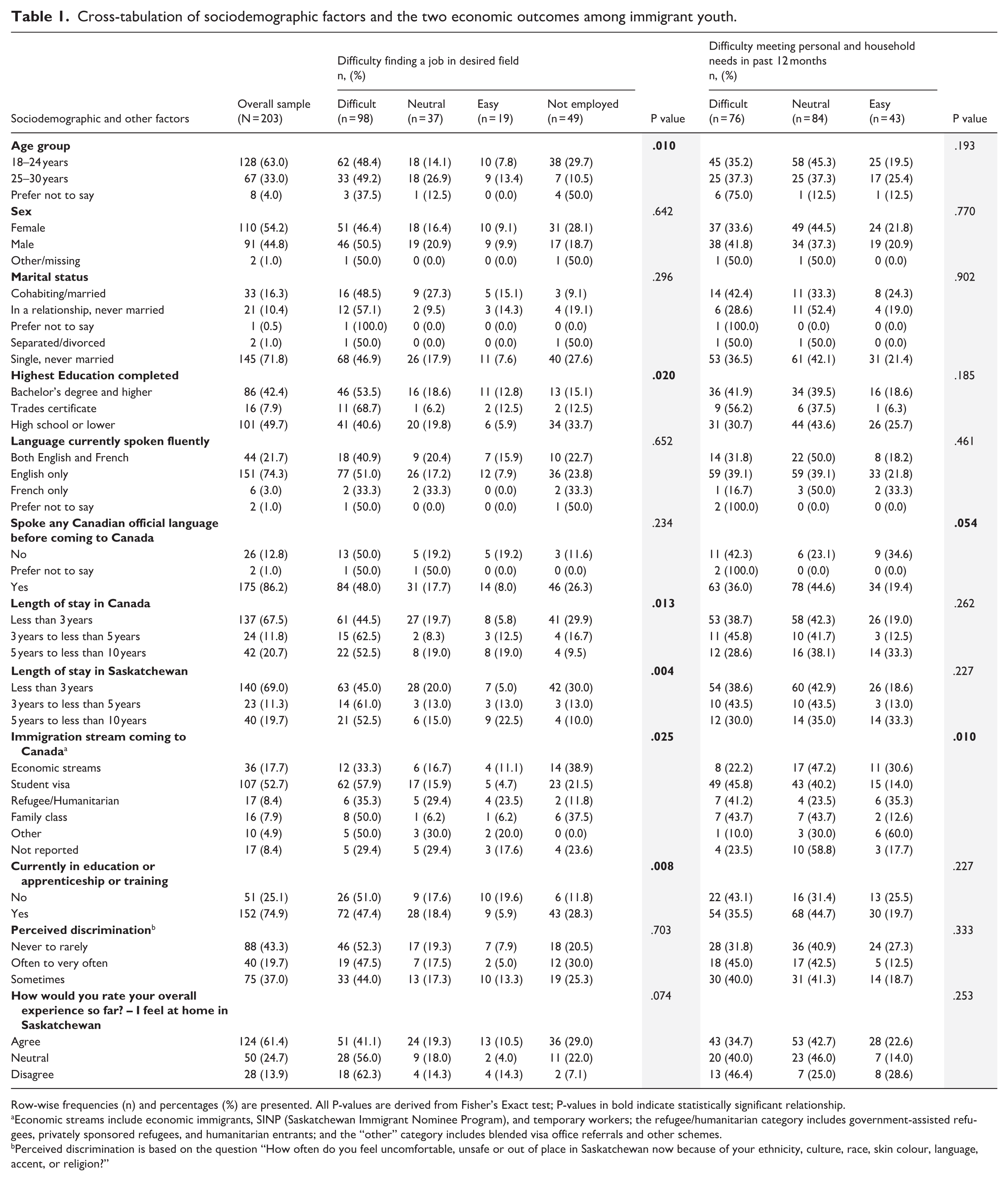
Row-wise frequencies (n) and percentages (%) are presented. All P-values are derived from Fisher’s Exact test; P-values in bold indicate statistically significant relationship.
Economic streams include economic immigrants, SINP (Saskatchewan Immigrant Nominee Program), and temporary workers; the refugee/humanitarian category includes government-assisted refugees, privately sponsored refugees, and humanitarian entrants; and the “other” category includes blended visa office referrals and other schemes.
Perceived discrimination is based on the question “How often do you feel uncomfortable, unsafe or out of place in Saskatchewan now because of your ethnicity, culture, race, skin colour, language, accent, or religion?”
Most youths (n = 140, 69%) had lived in Saskatchewan for less than 3 years, compared with 19.7% (n = 40) who had lived there for 5 to less than 10 years and 11.3% (n = 23) for 3 to less than 5 years.
The most common immigration pathway was the student visa, representing just over half of respondents (52.7%, n = 107), followed by economic streams such as the SINP and temporary worker programs (17.7%, n = 36). Family class and refugee or humanitarian streams together accounted for 16.4% (n = 33) of participants. While a majority of youths reported feeling at home in Saskatchewan (61.4%, n = 124), over half (56.7%, n = 115) indicated experiencing discrimination at least sometimes, often, or very often (Table 1).
Economic integration outcomes
When asked about the difficulty of finding a job in their desired field, nearly half of respondents (n = 98, 48.3%) reported it was difficult (extremely difficult or difficult or somewhat difficult). In contrast, only 9.4% (n = 19) found it easy (extremely easy or east or somewhat easy), 18.2% (n = 37) reported a neutral experience (neither difficult nor easy), and nearly a quarter (n = 49, 24.1%) were not currently employed.
Regarding the difficulty of meeting their own or their household’s basic needs, 37.4% (n = 76) reported difficulty (extremely difficult or difficult or somewhat difficult), 21.2% (n = 43) found it easy (extremely easy or east or somewhat easy), and the largest group, 41.4% (n = 84), reported a neutral experience (neither difficult nor easy).
Sociodemographic factors across economic integration outcomes
Table 1 provides a summary of the results from cross-tabulations of the socioeconomic factors in relation to the two economic integration outcomes of difficulty finding a job in the desired field, and difficulty meeting personal and household needs in the past 12 months.
Difficulty finding a job in the desired field
The age group was significantly related to difficulty finding a job in the desired field (exact, P = .010). While a similar proportion of younger (18–24 years, 48.4%) and older youths (25–30 years, 49.2%) reported difficulty, younger youths were more likely to be unemployed (29.7% vs. 10.5%) and less likely to report neutral (14.1% vs. 26.9%) or easy (7.8% vs. 13.4%) experiences in finding a job.
In addition, level of education was significantly associated with difficulty finding a job in the desired field (exact, P = .020). Youths with a bachelor’s degree or higher, or a trade certificate were significantly more likely than those with high-school education or less to report that finding a job in their field was easy (13% vs. 6%). In contrast, unemployment was twice as prevalent (33.7%) among youths with high school or lower education. Nonetheless, a substantial proportion of youths with postsecondary qualifications continued to report difficulty finding employment in their desired field, including 53.5% of those with a bachelor’s degree and 68.7% of those with a trade certificate, compared with 40.6% among those with a high-school education or less.
Furthermore, the length of stay in Canada and Saskatchewan was significantly associated with difficulty finding employment in the desired field (Canada: exact, P = .013; Saskatchewan: exact, P = .004). For both national and provincial levels, unemployment was threefold higher among youths who had stayed for less than 3 years (29.9% in Canada and 30% in Saskatchewan) than among those with 5–10 years of residence (9.5% in Canada and 10% in Saskatchewan). Easiness in finding a job in the desired field was about fourfold higher among youths who had stayed for 5–10 years (19% in Canada and 22.5% in Saskatchewan) than among those who had stayed for less than 3 years in Canada (5.8%) and Saskatchewan (5%). However, for both places, about 63% who had stayed for 3 to less than 5 years, and 53% who had stayed for 5–10 years reported that finding a job in the desired field was difficult.
The immigration stream was significantly related to difficulty finding a job in one’s desired field (exact, P = .025). Student visa holders reported the highest difficulty (57.9%) and lowest ease (4.7%), with 21.5% not employed. Economic immigrants reported lower difficulty (33.3%) and slightly higher ease (11.1%), though 38.9% were not employed. Refugee/humanitarian and family class respondents had varied experiences, with 35.3% and 50.0% reporting difficulty, respectively.
Being in education, apprenticeship, or training was significantly related to difficulty finding a job in one’s desired field (exact, P = .008). Among those in education or training, 47.4% reported difficulty and 28.3% were not employed, compared with 51.0% reporting difficulty and 11.8% not employed among those not in education or training. Ease was more commonly reported among those not in education or training (19.6% vs. 5.9%).
Non-significant patterns in difficulty finding a job in the desired field were observed across the sociodemographic factors of gender, marital status, official language fluency, perceived discrimination, and feeling at home in Saskatchewan. Taking participant’s gender as an example, more males than females reported difficulty finding a job in their desired field (50.5% vs. 46.4%), but females were more likely to be unemployed (28.1% vs. 18.7%); however, these differences were not statistically significant (exact, P = .642).
Difficulty meeting personal and household needs in past 12 months
Speaking a Canadian official language prior to arrival was borderline significantly associated with difficulty meeting personal and household needs (exact, P = .054). Those who spoke an official language were less likely to report difficulty (36.0% vs. 42.3%) and more likely to report neutral experiences (44.6% vs. 23.1%). However, those who did not speak an official language were almost twice as likely to report ease in meeting their needs (34.6% vs. 19.4%).
Similarly, the immigration stream was significantly associated with difficulty meeting personal and household needs in the past 12 months (exact, P = .010). Student visa holders reported the highest levels of difficulty (45.8%), followed by family class (43.7%) and refugee/humanitarian entrants (41.2%), compared with economic immigrants (22.2%). Economic immigrants were more likely to report neutral (47.2%) or easy (30.6%) experiences.
Non-significant patterns across age groups, gender, marital status, education level, length of stay, perceived discrimination, and feeling at home in Saskatchewan were found in relation to experiencing difficulty in meeting personal and household needs in the past 12 months. Males, for instance, were more likely than females to report difficulty meeting personal and household needs (41.8% vs. 33.6%), although this association was not statistically significant (exact, P = .770).
Perceived underlying factors for easiness or difficulty finding a job in the desired field
When participants were asked why finding a job in their desired field was difficult or easy, several key themes emerged from their responses, as described below:
Insufficient or unrecognized work experience and credential mismatches were significant barriers
The most frequently described issue was difficulty finding employment due to lack of recognized experience, particularly Canadian experience, coupled with not having the required academic qualifications. Some youths indicated that their job references from overseas were not valued, while others indicated that there were no opportunities within their fields of expertise: There is a scarcity of jobs in Regina and my references from home hold nearly zero weight here. (Youth 1) They really don’t consider your education and all and at the end they pay me really little regardless of my education. (Youth 2) The community here prefers one to have Canadian experience, which I do not possess as I just moved from my home country. (Youth 3)
Systemic barriers related to immigration status were significant obstacles
Many youths reported immigration-related constraints, including limited work authorization and employer preferences for citizenship or permanent residence, which restricted access to employment. Various participants, who were international students, identified their status as a limitation to their employment opportunities: Most employers are looking for full-time employees. As an international student, you’re only allowed to work 24 hours. (Youth 3)
Discrimination and labour market competition were notable barriers
Youths identified discrimination and competitive labour market pressures as high-impact contextual barriers. They reported experiences of identity-based discrimination and racism, intense competition in the job market, and limited opportunities in smaller geographic settings: Because, sometimes when you apply for a job and then put down that you are black you don’t get employed. (Youth 4) There is a hidden or explicit racial discrimination in hiring, promotion and compensation. (Youth 5)
However, some youths offered contrasting views, suggesting that labour market competition, rather than discrimination, was the more likely barrier to employment, as reflected in the quote below: It took me a while to get the job and I applied everywhere. I don’t think it’s because of my race, because a lot of my non-Black friends are experiencing the same thing (referring to hardships in finding employment). (Youth 6)
Limited access to social capital and career navigation support were significant barriers
Limited access to social capital and career navigation support were identified by youths as notable barriers to employment opportunities. Youths reported a lack of networking opportunities and referrals, insufficient career guidance in academic settings, limited access to accurate information, and poorly structured resumes as major obstacles to employment: Maybe there are not many opportunities or may be not enough direction is provided in the academic institutions on how proceed after graduation. (Youth 7) Most jobs here are based on referrals so if you don’t know someone where you want to work, you might not get the job. (Youth 8)
While some youths cited the lack of social capital as a barrier, there were some youths who reported that social networks (including friends, relatives and other people) were their primary enablers in finding employment opportunities: Well, I was referred by a friend but it took about 6 months to find a job in my field. (Youth 9)
Local experience and familiarization with Canadian systems as important supportive factors
Local experience and familiarity with the Canadian system were key advantages for youths’ success in finding employment opportunities. Some of the youths who reported ease in finding employment mentioned volunteering or prior work experience, attending high school in Canada, understanding workplace norms, and leveraging the education system as supportive factors: I had to learn to adapt and understand the work ethics of the Canadian work system. It took some time but it helped me a lot in learning how the environment worked. (Youth 10) I was fortunate to land a job right after school because I volunteered at the organization. (Youth 11)
Agency and linguistic capital were important enablers
Taking the initiative and having linguistic capital were important factors influencing youths’ employment prospects. Some youths attributed ease in finding employment to proactive job search efforts and identifying compatible employment skills and values. Language proficiency was also reported to play a key role, with strong English skills and bilingualism providing advantages, while language barriers posed employment barriers: I speak French and English, which helps me a lot and gives me more options. (Youth 12) It took me an entire summer to get a job and I applied everywhere. (Youth 13) . . . when I was looking for work online, it was challenging as most responses were negative. Then one day, I decided to drop off my resumes in person, and I was offered an interview on my first attempt. (Youth 14)
Discussion
This study examined economic integration among African immigrant youths in Saskatchewan, with a focus on their perceived difficulty in securing employment in one’s desired field and in meeting personal and household needs. Our findings reveal considerable economic challenges, with nearly half of youths reporting difficulty finding suitable employment and over one-third experiencing challenges in meeting basic needs. These results are consistent with broader Canadian evidence documenting persistent labour market disadvantages among recent immigrants and visible minority populations (Crea-Arsenio et al., 2022; Guerrero and Rothstein, 2012; Hou and Coulombe, 2010). The challenges experienced by African immigrant youths may reflect not only difficulties of settlement and adaptation, but also the operation of institutional practices, the gendered and racialized labour market dynamics that constrain equitable access to employment opportunities. By focusing on African immigrant youths in a small-populated Canadian Prairie province, this study moves beyond the dominant focus on large populated provinces and metropolitan areas like Toronto, Montreal, and Vancouver, to show how labour market inequalities are reproduced and, in some cases, intensified in non-traditional immigrant destinations in Canada.
Nearly half of the participants (48%) reported difficulty finding employment in their desired field, and only a small proportion (9%) found the process easy. This reflects earlier research showing that immigrants, particularly visible minority newcomers, often experience delayed entry into suitable employment and encounter multiple labour market barriers, such as job mismatch, discrimination, and underemployment (Wilkinson, 2017; Yoshida and Smith, 2008). The results also point to the growing labour market instability of recent immigrant youths. National data from Canada show that the unemployment rate for recent immigrants increased to 12.6% between July 2023 and July 2024, with immigrant youths most affected at 22.8%, underscoring their disproportionate labour market vulnerability (Statistics Canada, 2024). Moreover, the younger age group experienced greater difficulty in finding employment. Other studies have reported similar findings, with some suggesting that younger youths may lack sufficient work experience, while older youths have had more years of schooling or academic qualifications coupled with some work experience, which may improve their employment prospects (Kunz, 2003; Statistics Canada, 2017). Consistent with scholarship on the economic integration of visible minority groups (Guo, 2015; Nazari, 2024), we suggest that the persistent economic integration challenges faced by African immigrant youths reflect intersecting structural barriers related to race, gender, age, and immigration status, which together produce overlapping forms of disadvantage that negatively shape labour market outcomes for this racialized population.
Consistent with human capital theory (Becker, 1994, 1962), education and length of residence were significantly associated with employment outcomes, with youths who had postsecondary education more likely to report ease in finding work than those with lower levels of schooling. However, the findings also reveal important limits to this theoretical framework. Many participants with bachelor’s degrees or higher or with trade certificates still struggled to secure employment in their desired fields, challenging the assumption that education alone leads to successful economic integration (Picot et al., 2016; Ellermann, 2020). This pattern of employment difficulty among highly educated and skilled immigrants is well documented in Canada and is particularly pronounced among visible minorities, and often linked to credential devaluation, limited recognition of foreign qualifications and experience, and occupational downgrading among racialized immigrants (Guo, 2015; Karki, 2026). These dynamics were also reflected in participants’ open-ended responses, where internationally acquired education and experience were frequently described as undervalued. Together, the results point to a disconnect between Canada’s immigration policies that prioritize human capital and the prevalent employer practices that continue to undervalue internationally acquired skills. These findings align with critical race perspectives that view labour markets as shaped by institutional norms and power relations rather than as neutral meritocratic systems, often disadvantaging racialized immigrants despite high levels of human capital (Delgado and Stefancic, 2023). Similarly, Reitz (2001) argued that the underutilization of immigrant skills in Canada reflects structural barriers within labour market institutions rather than deficiencies in immigrants’ qualifications or abilities. Addressing these disparities will require more coordinated policy responses that move beyond a human capital approach to tackle systemic barriers and strengthen settlement and employment supports.
The length of stay emerged as a significant factor, with youths residing in Canada and Saskatchewan for longer periods reporting lower unemployment and greater ease in employment acquisition. This pattern aligns with adaptation theories, which suggest gradual improvements in labour market outcomes as immigrants accumulate local experience, language proficiency, obtain legal status, and institutional familiarity (Farashah and Blomquist, 2022; Reitz, 2007). Nevertheless, the persistence of high levels of difficulty even among those with 5–10 years of residence in our study may indicate segmented pathways of economic integration, whereby visible minority youths remain trapped in cycles of underemployment and precarious work despite prolonged exposure to the Canadian labour market. We also suggest that Saskatchewan’s smaller urban centres offer limited job diversity, narrower professional networks, and fewer career support opportunities, which may further restrict occupational mobility. These constraints were echoed in youths’ open-ended responses describing their experiences of searching for employment. These findings challenge linear models of immigrant adaptation, suggesting that longer residence alone does not eliminate labour market inequalities. Racialized immigrant youth may continue to face exclusionary barriers that sustain economic precarity, especially where institutional supports and ethnocultural networks are limited (Hou and Coulombe, 2010; Karki, 2025; Li, 2004).
The immigration pathway also played a crucial role in shaping economic outcomes, with student visa holders experiencing the highest levels of employment difficulty and hardship in meeting personal and household needs. Structural constraints related to work authorization, employer preferences for permanent residency or citizenship, and limited working hours substantially restricted students’ labour market participation. These findings align with growing evidence that international students occupy a precarious position within Canada’s labour market, often navigating restrictive employment conditions while bearing high tuition and living costs (Bucklaschuk and Wilkinson, 2012; Wilkinson and Garcea, 2017). Previous research has shown that while about one in two Canadian-born students aged 15–19 years work part-time or full-time, only about one in four immigrant youth who have lived in Canada for less than 10 years is employed (Hanvey and Kunz, 2000). In some cases, immigrant youths may also face family expectations to prioritize education in order to improve their long-term career prospects (Areepattamannil and Lee, 2014; Kunz, 2003). The heightened vulnerability of student migrants is particularly concerning given their central role in Canada’s immigration and workforce development strategies (Scott et al., 2015). Without targeted supports, this group risks prolonged economic insecurity, undermining both their long-term integration prospects and the broader objectives of skilled migration policy.
Besides its influence on finding employment, the immigration pathway also influenced difficulty in meeting personal and household needs. Student migrants, refugees, and family class entrants reported substantially higher levels of financial strain than economic immigrants, reflecting both differential access to employment and varying levels of institutional support. The proportion reporting difficulty was high regardless of immigration pathway, which likely reflects the material consequences of labour market exclusion. These findings are consistent with evidence showing elevated poverty risks among recent immigrants and visible minority youths, particularly in provinces with high rates of deep income poverty such as Saskatchewan (Dionne and Raymond-Brousseau, 2025; Domey and Patsiurko, 2024). This pattern is compounded by the rising cost of living in Canada (Chen and Tombe, 2023).
The experiences of discrimination and racialization emerged as salient barriers to employment, with youths describing both overt and subtle forms of exclusion in hiring and compensation. These narratives align with extensive Canadian research documenting racial discrimination in labour markets, particularly affecting Black and African origin populations (Creese and Wiebe, 2012; Lightman and Good Gingrich, 2018). Oreopoulos (2011), for example, demonstrated that applicants with ethnic-sounding names experienced significantly lower callback rates from employers despite possessing qualifications comparable to those of other applicants. While some participants attributed employment challenges to labour market competition rather than racism, this tension reflects broader debates within the literature regarding the visibility and interpretation of discrimination (Galabuzi, 2010). It is important to note that perceived discrimination itself constitutes psychosocial stress that can undermine job search efficacy, well-being, and long-term labour market engagement (Agyare, 2021). In smaller labour markets such as Saskatchewan, social and professional networks are likely tightly knit and racialized exclusion may be especially consequential. Discrimination may reinforce barriers to job entry and may limit access to informal recruitment channels. These findings are consistent with racialization frameworks that conceptualize discrimination not simply as isolated interpersonal prejudice, but as a structural process through which racialized groups are systematically marginalized within social and economic institutions (Banaji et al., 2021). The findings also support critical race scholarship showing how racism can become normalized within institutional practices in ways that appear routine or invisible, yet still generate unequal labour market outcomes for racialized populations (Delgado and Stefancic, 2023).
Social capital and career navigation were identified by youths as important factors for economic integration into the Canadian labour market. Youths identified limited professional networks, lack of mentorship, and inadequate career guidance as significant obstacles, particularly in navigating postgraduation employment pathways. These findings support SCT, which emphasizes the central role of networks, referrals, and institutional trust in facilitating labour market access (Raza et al., 2013). At the same time, participants who reported having influential social ties through friends, relatives, or community connections highlighted these networks as critical resources for securing employment. The findings also point to how unevenly social capital and employment supports are distributed among immigrant youths. We did not conduct further exploratory analyses, but suggest that structural factors such as length of residence, language proficiency, and level of education may influence access to bridging networks, particularly in regions with smaller and less established African communities. These factors have been shown to shape the development of social and economic networks (Portes and Zhou, 2025). Strengthening institutional and community-based mechanisms for building social capital may, therefore, be a key point for intervention. Notably, access to social capital is itself shaped by broader social inequalities, as racialized immigrant youths may have reduced access to influential professional networks and institutional connections that facilitate labour market mobility (Stolle and Harell, 2013). This suggests that unequal access to employment opportunities may be reproduced not only through formal hiring practices, but also through informal network-based processes that advantage more socially established groups.
While our quantitative analysis found that some sociodemographic factors, including sex, marital status, and perceived discrimination, were not statistically significantly associated with difficulty finding employment or meeting personal needs, they nonetheless revealed analytically important patterns. The absence of significant associations may partly reflect the relatively small sample size and the diversity of African immigrant youth experiences. At the same time, the findings suggest that economic vulnerability among African immigrant youths may cut across multiple social categories rather than confined to a single demographic group. Previous Canadian research similarly shows that racialized immigrant populations experience labour market disadvantages across diverse sociodemographic backgrounds due to broader structural inequities embedded within labour markets and settlement systems (Crea-Arsenio et al., 2022; Guerrero and Rothstein, 2012; Hou and Coulombe, 2010). From an intersectionality perspective, these findings highlight how multiple social identities and structural conditions interact in complex ways that may not always produce statistically distinct outcomes, yet still shape experiences of exclusion and precarity (Crenshaw, 2013; Kang and Bodenhausen, 2015). Furthermore, the non-significant association between perceived discrimination and employment outcomes should not necessarily be interpreted as evidence that discrimination is absent. Research shows that racialized individuals may normalize or underreport discriminatory experiences, particularly when exclusion occurs through subtle institutional processes rather than overt acts of racism (Cranston and Bennett, 2024; Mohamed and Beagan, 2019).
While this study offers important insights and helps address knowledge gaps regarding the economic integration of African immigrant youths in Saskatchewan, some limitations should be considered when interpreting the findings. First, the study population is heterogeneous; youths’ experiences and circumstances (e.g. mental health status, accompaniment, future aspirations, and needs) may vary considerably. Second, the relatively small sample size and the imbalance between Anglophone and Francophone participants limited the scope for exploratory and multivariable analyses. Third, while participants were asked to identify their sex and this variable was included in the analysis, the study did not further examine gender identity. We recognize that sex and gender are distinct concepts, and this represents a missed opportunity to explore more deeply how gender intersects with other factors shaping the economic integration of this population. Fourth, the cross-sectional design makes it impossible to determine causal inference and may be subject to recall and social desirability bias. Finally, the potential impact of the COVID-19 pandemic on economic integration was not examined, although it likely influenced some factors associated with youths’ economic outcomes in Saskatchewan.
Conclusion
In conclusion, meaningful employment is central not only to the economic well-being of African immigrant youths in Saskatchewan, but also to their broader processes of settlement, social inclusion, and participation in Canadian society. Despite Canada’s continued reliance on immigration to support economic growth and address labour shortages, this study shows that many African immigrant youths continue to face persistent structural barriers, including credential devaluation, limited labour market opportunities, weak professional networks, and experiences of racialization. These challenges persist even among highly educated individuals and those with longer residence in Canada, suggesting that economic integration cannot be fully explained by human capital accumulation alone, but requires sustained institutional and structural responses. In non-traditional immigrant destinations such as Saskatchewan, where labour markets are more limited and support systems are less extensive compared with larger metropolitan centres, these barriers may be further intensified. Consequently, labour market integration emerges not only as an economic issue, but also as a key indicator of equity, belonging, and participation. Addressing these disparities will require coordinated and sustained efforts across federal, provincial, and local levels to better align immigration selection with labour market realities, improve credential recognition, expand access to career navigation supports and social networks, and address systemic discrimination in employment. Without such targeted and context-sensitive interventions, African immigrant youths may continue to experience constrained opportunities, limiting both their long-term well-being and the broader social and economic benefits that immigration is intended to achieve in Canada. Overall, the findings underscore the importance of situating immigrant youth economic integration within broader systems of racialization and structural inequality. Doing so helps move beyond individualized explanations of labour market outcomes and highlights how institutional practices, immigration structures, and unequal distributions of social and economic resources shape the opportunities available to African immigrant youths in Canada.
Footnotes
Acknowledgements
The authors thank all the participants for sharing their experiences and contributing to this research.

Ethical considerations
Ethical approval to conduct this research was obtained prior to data collection from the University of Regina Research Ethics Board (Approval No.: 733).
Consent to participate
Informed consent was obtained from all study participants and each received 25 CAD as a token of appreciation for their time.
Funding
The authors disclosed receipt of the following financial support for the research, authorship, and/or publication of this article: This research was supported by the Innovation Grant–Saskatchewan Health Research Foundation (Child & Youth Hub); Grant No. associated: 6597.
Declaration of conflicting interests
The authors declared no potential conflicts of interest with respect to the research, authorship, and/or publication of this article.
Data availability statement
The data that support the findings of this study are not publicly available due to ethical or privacy restrictions but are available from the corresponding author upon reasonable request.