






Abstract
Eritrea represents a distinctive model of a garrison police state under the personalized totalitarian rule of President Afwerki since 1993. The regime prioritizes executive authority over the rule of law and relies on pervasive surveillance and militarized governance, consistent with Garrison State theory. Unlike conventional garrison or police states, Eritrea lacks strong formal institutions, electoral legitimacy, and ideological mobilization. Instead, repression is institutionalized through mechanisms such as indefinite military conscription, embedding coercive authority within state structures. This study argues that repression serves both governance and the management of insecurity. External efforts to halt Eritrea’s actions have largely failed to alter the regime’s stance.
Introduction
The article discusses the widespread misunderstanding in the international community about how it has handled the Eritrean government since Eritrea’s independence in 1993. Instead of addressing the primary problem, such as the inherent nature of the totalitarian state, international players have focused primarily on symptoms, such as mass migration and border disputes (Smits and Wirtz, 2023). By exploiting conflicts among the interests of major powers, this strategic incoherence has effectively given the Eritrean regime “immunity” from outside criticism, allowing it to maintain its reign (Kibreab, 2009). Consequently, the political situation in Eritrea remains static, characterized by an increasing reliance on repressive control mechanisms and systematic human rights violations (Müller, 2012).
A review of contemporary political literature reveals at first glance that Eritrea is a prime example of a “garrison police state,” where the lines between the military, the ruling party, and other bureaucratic state institutions are blurred. This has led to the establishment of a totalitarian, closed system insulated from external influences (Tronvoll and Mekonnen, 2014). While systematic human rights violations are a significant topic of discussion in the international community regarding Eritrea (United Nations Human Rights Council (UNHRC), 2016), this paper goes beyond a purely moralistic account to address important questions about the efficacy of the international response. In particular, it poses the following questions: how have regional and international forces responded to an Eritrean government that has shown remarkable resistance to outside pressure? What diplomatic tactics and policy instruments—from “conditional engagement” to UN sanctions—have Western countries and international organizations used to curb or change Asmara’s actions? How successful were these strategies in influencing the ruling regime’s policies or getting past the barrier of domestic repression? When dealing with closed, totalitarian regimes, these concerns provide a crucial foundation for understanding the constraints of international diplomacy and for exploring potential paths to more successful political endeavors.
The external threat narrative has been a consistent theme for President Isaias Afwerki, who alleges Eritrea is under attack from undefined “external forces,” typically referring to regional rivals such as Ethiopia, Western powers—particularly the United States—and broader foreign geopolitical agendas. In his Independence Day address, Afwerki explicitly invoked the notion of “psychological warfare” aimed at spreading misinformation and inciting discontent (Afwerki, 2025). While Eritrea claims to promote human rights, these assertions appear to be tactical rather than genuine, intended to alleviate international scrutiny. The regime employs a dual narrative that prioritizes “development rights”—such as access to basic needs—over traditional political freedoms, framing Western human rights paradigms as colonial impositions.
Methodology
This study investigates power imbalances in state-civil society relations during protracted political crises. It uses a qualitative methodology, combining case study analysis with critical discourse analysis (CDA) as a complementary tool. Eritrea serves as a case of a garrison police state. The analysis prioritizes structural and political perspectives. The CDA—as defined by van Dijk (2015)—is used to deconstruct linguistic mechanisms that reproduce social and political hegemony. The research uses a hybrid area studies approach, with historical and political analysis as the main framework. Discourse analysis augments this to clarify patterns of hegemonic reproduction.
The corpus consists of five major international statements produced between 2005 and 2025. Selection followed methodological criteria to ensure coverage of the crisis period and represent institutional diversity (e.g. the United States, the African Union, NB8, and the European Union (EU)). Validity was confirmed by using only official sources. Unofficial or redundant documents were excluded to ensure accuracy. Eritrea was chosen as an exemplar of personalistic totalitarianism, marked by the absence of democratic institutions and indefinite national service. The regime’s opacity and reliance on secondary data are acknowledged. Convergent findings across sources support analytical credibility.
This study addresses a gap in the literature. It goes beyond the structural depiction of Eritrea as a militarized garrison state. It examines, through CDA, how this model is linguistically reproduced and managed in international discourse. The analysis focuses on statements by international actors after 2005. These statements perpetuate the garrison police logic through three discursive strategies. First, they dilute procedural demands into rote expressions of concern. Second, they depoliticize victims by portraying them as a securitized population. Third, they recast sovereignty as immunity from accountability.
This analysis does more than reapply Tronvoll and Mekonnen’s framework. It reformulates their approach as a discursive formation created by both Asmara and the international community. The study’s main contribution is to theorize the “rhetorically managed garrison state.” In this model, diplomatic patterns normalize exceptionalism and support global inaction alongside military-security architectures.
However, this study has several methodological limitations. The CDA uses a limited corpus of five representative texts. This allows for in-depth interpretation but does not offer the breadth of larger data. The hybrid method typical of area studies prioritizes historical and political context over systematic discourse analysis. Access to unpublished Eritrean domestic discourses was constrained. This limits examination of how internal and external narratives interact. Future research could address these limitations by expanding the CDA corpus to track changes over time. It could also incorporate more official Eritrean sources to better capture the dynamics of a “shared discourse order.” Comparative analysis with other garrison-type regimes, such as North Korea, could further strengthen the theoretical framework.
The paper is divided into four sections in order to accomplish its goals. The first section establishes the theoretical context for the analysis by critiquing the existing scholarly literature on the concept of the garrison police state. A summary of the Eritrean model’s history is given in the second part, which charts the regime’s development from independence to 2025. An analysis of the state’s specific methods of repression and control follows. To address the issues raised by this garrison police state, the final section examines various policy alternatives available to the international community.
A garrison police state
This concept originated in the 1930s and 1940s through the theoretical work of Harold Lasswell, who synthesized observations of emerging militarized societies in his era (Lasswell and Stanley, 2018). Lasswell developed this concept during a period of unprecedented global militarization, when fascist regimes in Germany and Italy, along with imperial Japan, appeared to subordinate civilian life to military imperatives (Kirsten, 2024). His framework emerged not from abstract theorizing but from observing how societies mobilize for perpetual warfare preparation, with technological innovation and the rise of “specialists on violence” institutionalizing military dominance across all societal domains. Lasswell himself cautioned that even Western democracies, including the United States, faced the risk of evolving toward garrison state characteristics if civilian supremacy over military authority was not deliberately maintained (Lasswell and Stanley, 2018).
Lasswell defined the garrison state as “a world in which the specialists on violence are the most powerful group in society,” incorporating power, authority, and influence across political, coercive, and persuasive dimensions (Lasswell, 1941: 455). It should also be mentioned that Lasswell frequently used the terms “garrison state,” “garrison police state,” and “garrison prison state” interchangeably (Kirsten, 2024: 42). The concept operates through three structural pillars: the centralization of power, the manipulation of international crises to justify security measures, and the systematic restriction of civil and political liberties in the name of security (Esman, 2013). Within garrison police states, societal freedom becomes perpetually constrained as populations exist in readiness for total war, whether threatened by real or perceived external and internal dangers. Lasswell observed that compulsory labor systems and marginalized populations typically function as convenient “enemies” and “scapegoats” for regime legitimation. Critically, the garrison state does not require deliberate ideological commitment from its architects—actors need not understand or acknowledge Lasswell’s concept to contribute institutionally to its development (Aron, 1979).
The garrison state concept has transformed from its Cold War roots to modern regional analyses. During the Cold War, both the Soviet and American internal security systems exhibited garrison state characteristics, influenced by internal conflicts over threat definitions. Walker and Lang (1988) noted a “garrison state syndrome” in the Third World, in which environmental threats and military dominance led to persistent militarization, regardless of regime type. Contemporary studies have applied this framework across contexts, including Pakistan, Eritrea, and urban militarization in Latin America, to address gang violence (Saunders-Hastings, 2021). This expansion reflects militarization as the permeation of military values, beliefs, and organizational modes into civilian domains—such as family, education, policing, and public security—often legitimizing force as a routine governance tool (Hochmüller et al., 2024; Martínez and Bueno, 2024). Likewise, Kuehn and Levy (2021) conceptualize militarization as the process that legitimizes the use of military force, whether actual or potential, linking perceived security threats (internal or external) to diminished civilian control across democracies.
The central theme of this study examines the Eritrean state under Isaias Afwerki as a totalitarian regime exhibiting garrison-police-state characteristics, distinct from classical authoritarianism yet built upon its foundations. Following Linz (2000), authoritarian regimes permit limited pluralism, low ideological mobilization, and leadership constraints. In contrast, totalitarian systems—such as Eritrea—eliminate pluralism, enforce total societal mobilization, and pursue totalizing ideological closure through indefinite national service and surveillance. The garrison police state here functions as a militarized subtype of totalitarianism, distinct from yet complementary to classical garrison state theory (Lasswell, 1941), embedding security priorities across educational, economic, civil society, and bureaucratic domains (Shiker and Tsegay, 2025), with centralized decision-making subordinating civilian needs to perpetual defense exigencies—a pattern transcending ideologies, as noted by Fitch (1985) and empirically mapped in Rubinson’s (2024) Garrison Index (1990–2020).
The Eritrean model
To understand the Eritrean model of the garrison police state, it is necessary to trace its trajectory from colonial construction to independent statehood. It has culminated in a highly personalistic autocratic-corporatist order centered on President Isaias Afwerki as the ultimate decision-maker and owner of the political arena (Clark, 2025; Shiker and Tsegay, 2025). Formed initially as an Italian colony and shaped by successive periods of British administration, federation, and annexation, Eritrea endured a protracted struggle for sovereignty (Johnson and Johnson, 1981).
The state’s nascent postindependence liberalization was abruptly terminated by the Eritrean People’s Liberation Front (EPLF) under Isaias Afwerki, who leveraged the secretive Eritrean People’s Revolutionary Party to marginalize opposition, establish ideological hegemony, and centralize executive power (Rufael, 2025; Dorman, 2006). After the de facto independence in May 1991, the Provisional Government of Eritrea retained the EPLF’s field-administration structures. Its Central Committee functioned as a legislature. This led Ethiopia to accept an internationally supervised referendum within 2 years. The United Nations Observer Mission to Verify the Referendum in Eritrea certified the 23–25 April 1993 vote as free and fair. After the referendum, the 135-seat National Assembly elected Isaias Afwerki president on 7 June 1993 (Connell, 2011). However, all constitutional processes, elections, and legislative life after formal independence were systematically hollowed out: no functioning constitution was ever implemented; no national elections have been held; the legislature has not met since 2001; and the ruling front, rebranded as the People’s Front for Democracy and Justice (PFDJ), ceased to operate as a genuine policy‑making body, instead serving as a shell through which the president and a narrow military‑security clique manage access to resources, offices, and protection (de Waal, 2015).
This has produced a corporatist façade without plural representation, in which all organized social and economic spaces—party, army, bureaucracy, and mass organizations—are formally incorporated into the state but in practice subordinated to the personalized commands of the president, who controls appointments, promotions, and sanctions through informal networks rather than predictable legal-bureaucratic procedures (Ahmed and Rukema, 2023; Hirt, 2022; Ogbazghi, 2011). Afwerki’s rule resembles a privately owned political‑business corporation in which loyalty is bought and enforced through a mix of patronage, threat, and violence and in which state institutions function as instruments of extraction and coercion rather than as public agencies. Some scholars have explained this patronage strategy based on what they called the “Isaias Doctrine,” which functions both as a political ideology and a strategic blueprint, constructing Eritrea’s state identity, political legitimacy, and nation-building project by sustaining the fragmentation and weakening of regional actors (Tadesse, 2025: para 5).
Bearing the label of “Africa’s North Korea,” Eritrea is so secretive and repressive that scholarship on the country remains necessarily sparse, with organizations such as Reporters Without Borders having ranked it at or near the bottom of global press‑freedom indices, a context in which works like Tronvoll and Mekonnen’s (2014) study—arguing that contemporary Eritrea approximates George Lasswell’s notion of a “garrison state,” and sometimes described as a “siege state”—stand out as rare, authoritative interventions in an otherwise thin literature (Reid, 2010). The result is a deeply militarized, personalist autocracy that fuses the state, the party, and security organs around one leader, leaving society fragmented, depoliticized, and largely excluded from meaningful participation in governance after more than half a century of uninterrupted totalitarian rule and generating patterns of mass flight, chronic underdevelopment, and the near‑total erosion of institutional checks that might otherwise constrain executive power.
Mechanism of control under conditions of insecurity
In the Eritrean case, regime durability is closely tied to the institutionalization of insecurity as a governing principle rather than a temporary response to an external threat. Coercive state structures that extend into sociopolitical regulation have been established in the country due to enduring perceptions of vulnerability stemming from historical conflicts and geopolitical tensions. The national service program—often referred to as forced labor—integrates military responsibilities into civilian life and blurs the boundaries between governance and defense while serving as a population-control and economic-mobilization tool. The suppression of civil society, independent media, and political plurality, along with the detention of critics without formal charges, serves to solidify this control further. Extrajudicial executions and torture are cited in reports as state crimes against humanity (Amnesty International, 2011, 2014; Office of the High Commissioner for Human Rights (OHCHR), 2016). The regime transitions to a permanent state of militarized control by normalizing extraordinary governance to preserve it and using the national security narrative to defend coercive measures (Ahmed and Rukema, 2023). We can identify five control mechanisms to uphold Eritrea’s garrison state as follows.
The narrative of revolutionary legitimacy
The EPLF established a legitimate revolutionary narrative stemming from its insurgency, which began in 1961 against the Ethiopian regime (Dorman, 2006). It achieved military superiority through participatory governance and the inclusion of various religious and ethnic groups (Connell, 2001). Its victory over Ethiopia in 1991 culminated a popular struggle, and the 99.8% vote in favor of independence in the 27 April 1993 referendum further strengthened its legitimacy.
At the EPLF’s third congress in 1994, the organization was renamed the PFDJ. A national charter was adopted to promote democracy and justice while maintaining national unity, with an explicit ban on other political parties. Isaias Afwerki revealed the existence of a secret internal organization that had influenced EPLF decisions, and he subsequently dissolved it. He sought to replace veteran leaders with new allies and ultimately formed a PFDJ executive council under his leadership (Dirkx, 2025). Despite its theoretical authority, real decision-making power resided in the president’s office, where loyal advisors surrounded Isaias. However, according to Simmons (2020: 16), President Isaias employs elements of the liberation narrative in over 51% of his speeches from 2015 to 2017.
When the Eritrean regime began questioning the loyalty of government officials, those who opposed appointments or criticized policies faced being “frozen,” a tactic that removed them from their positions while still paying their salaries and prohibited them from holding other jobs, leading to a prolonged state of uncertainty with no recourse. (UNHRC, 2015: 98). Postindependence governance closely mirrored wartime practices, combining social and economic reform with severe repression, including dismantling dissent and suspending Eritrea’s first human rights NGO. The ruling PFDJ exploited its revolutionary legitimacy to consolidate power and maintain a repressive political structure, drafting a constitution that appeared democratic.
This approach exhibited some restraint from 1993 to 1998, but the Eritrean–Ethiopian border war (1998–2000) highlighted contradictions in the regime’s narrative of legitimacy, lacking a defensible rationale for militarization. Postconflict calls for democratic reforms were met with harsh repression, particularly in 2001 when G-15 members who criticized President Isaias faced arrest (Dirkx, 2025). A generational disconnect contributed to the decline of the regime’s narrative, as subsequent generations lacked ties to the liberation struggle, revealing governance inadequacies. By 2003–2005, compulsory conscription had become emblematic of the regime’s control and pervasive militarization of society.
Eritrea’s economy worsened due to government mismanagement and a self-reliance policy, leading to declines in basic services and increased unemployment among educated youth. The government’s response to declining legitimacy involved repression and widespread human rights abuses, resulting in a loss of political support for its revolutionary narrative. By the mid-2000s, attempts to evoke wartime sentiments were met with cynicism. The 2002 Warsai-Yikealo Development Campaign targeted youth but left them in a state of perpetual war (Kibreab, 2017). Meanwhile, the education system emphasized military obedience, and the suspended 1997 constitution reflected the PFDJ’s focus on power rather than democratic governance, undermining its revolutionary legitimacy.
The external threat narrative
The Eritrean regime primarily employs a narrative of external threat—centered on Ethiopia—to justify indefinite national service and perpetual militarization, distinct from legitimacy derived from revolutionary history (Bernal, 2024; Kibreab, 2013). The entrenched post-1998–2000 border war frames Ethiopia as a perpetual aggressor, enabling President Isaias Afwerki to divert from democratic pressures via mobilization. In 2002, the “Warsay-Yikealo” campaign extended service from 18 months to indefinite terms for ages 18–40 (often to 57 for men and 47 for women), deploying conscripts into military and unpaid civilian roles to advance a military-economic agenda (Belloni and Cole, 2022). Despite 2017 reform promises and 2018 peace hopes, the 2020 Tigray conflict intensified measures (Human Rights Watch, 2017, 2021). Conscripts endure punitive conditions and meager wages, reliant on diaspora support, fueling emigration as a bid to reclaim personal agency and rights.
In Eritrea, the regime utilizes the narrative of external threats to justify state repression and portrays dissent as a destabilizing force. Harsh measures against draft evaders, including penalties for their families, embed this narrative in society. Ongoing regional conflicts reinforce the regime’s military strategies. For example, Afwerki (2024) states:
“Hostile ‘elites of domination and monopoly’ have pursued myriad hostilities against us for 33 years and are now fomenting another cycle of war—this is an open secret whose details will be divulged at the appropriate time. No reason for anxiety.” This narrative fosters a militarized society where young people are subjected to military authority, and educational institutions resemble training camps. The regime’s propaganda shapes the psychological state of those who flee, contributing to continuous mass emigration and hindering potential democratic reforms.
Institutionalized coercion
Eritrea’s governance system relies on institutionalized coercion through interconnected military, security, bureaucratic, and party structures that stifle political dissent and autonomous action. These may be conceived as instruments of coercion as well as agents of socialization into regime-approved political values and norms (Ogbazghi, 2011). The PFDJ has repurposed its wartime apparatus into a pervasive control system, ensuring that any noncompliance is met with immediate and often severe repercussions. This system is characterized by a lack of differentiation between external and internal security, leading to widespread arbitrary arrests and brutal enforcement practices, including torture, as documented in the US State Department’s Human Rights Report. Detainees face inhumane conditions and are denied fundamental rights, including legal counsel.
Surveillance and spying are prevalent in Eritrea, supported by an entrenched system of informers at local administrative levels known as mimihidar (Connell, 2001, 2011). The regime employs many secret agents focused on identifying draft dodgers, resorting to tactics such as gathering information from the community. A significant number of women and teenagers have become informants for small rewards. The extent of the spying is so overwhelming that even innocuous actions, like writing a song, can be misconstrued as antigovernment. Eritrea houses between 10,000 and 30,000 political prisoners in over 300 clandestine prisons characterized by secrecy, incommunicado detention, and inhumane conditions. This system of hidden incarceration reinforces a climate of fear, contributing to Eritrea’s reputation as one of the most repressive states in Africa (USCIRF, 2025). The government’s totalitarianism is so severe that some describe Eritrea as a “prison state” or liken it to “Africa’s North Korea,” reflecting the regime’s brutal suppression of dissent and repression of freedoms.
The regime is characterized by widespread impunity, with security forces rarely investigated and courts lacking independence, effectively shielding abuses and detentions from accountability. As noted in the US Department of State (2024: 4), “Impunity remained a serious problem . . . the government did not release any information to indicate it conducted investigations of alleged abuses.” Control is reinforced through coercion, including forced political participation, economic pressure, and threats against families of evaders, creating a system of surveillance and fear. Harsh detention conditions further reflect unchecked authority, with reports that “families of detainees had to provide food” and prisons were so overcrowded that detainees “had to sleep in turns” (US Department of State, 2024: 5).
As Figure 1 shows, all institutional mechanisms in Eritrea function as extensions of President Isaias Afwerki’s power, which exceeds constitutional and legal limits. He controls conscription, security, party discipline, and economic resources through a loyal military circle (Horz and Marbach, 2022). Eritrea’s governance is characterized by personalist totalitarianism, with the president operating above the law, as constitutional governance has been suspended since 1997, and parliament has never convened. The presidential office is central to repression tactics, including indefinite conscription, torture, and ideological indoctrination, all aimed at serving Afwerki’s strategic objectives.
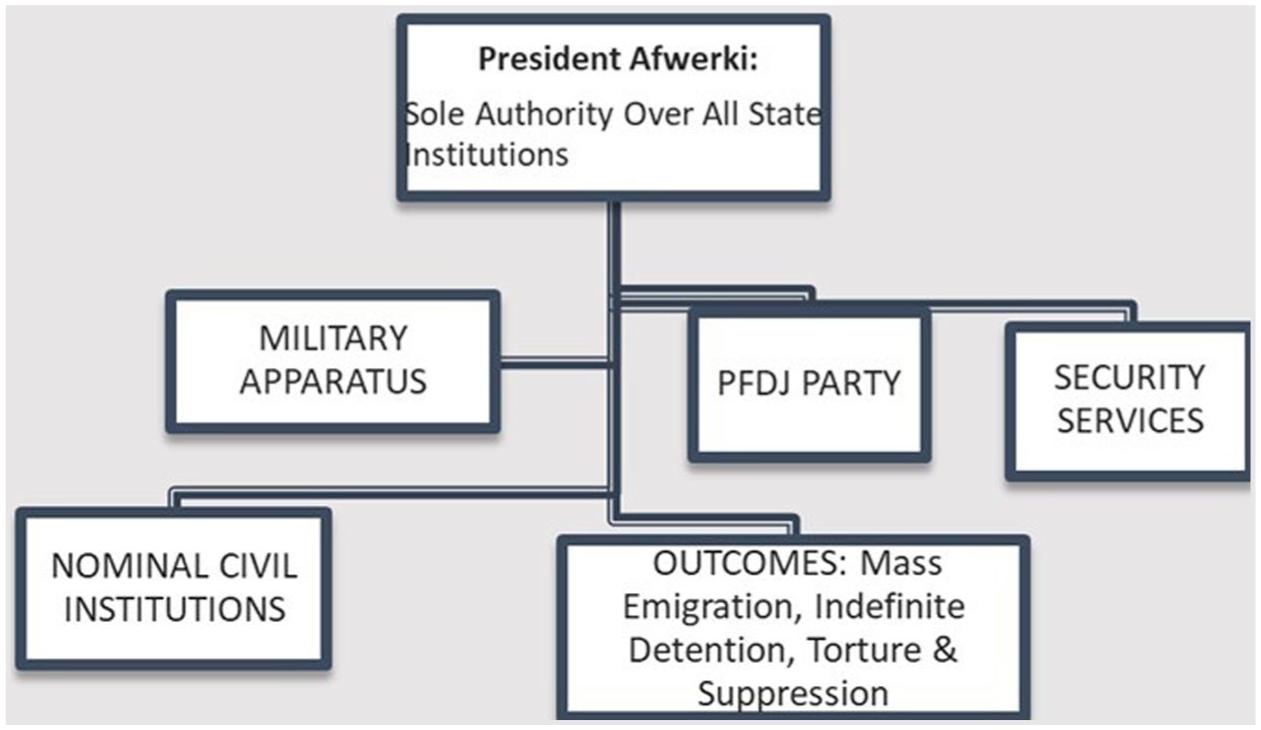
The Eritrean coercive mechanism.
Embedding regime narratives into consciousness
This process systematically embeds regime narratives in educational systems, media, civil society structures, and interpersonal language, leading to the internalization of state values as normalized truths rather than propaganda. Unlike coercive methods that instill fear, ideological normalization works through long-term exposure to official narratives deemed commonsensical, infiltrating personal spheres and effectively turning individuals into agents of their own repression (Riggan, 2016).
Since 2003, Eritrea has incorporated secondary education into its militarized state through the Sawa model, requiring all Grade 12 students to attend the Warsai Yekalo Secondary School within a military camp (Kibreab, 2013). This model combines education with about 5 months of compulsory military training, asserting that it promotes “nationalism, discipline, and hard work,” while linking educational success to military service (Shiker and Tsegay, 2025). However, investigations by Human Rights Watch indicate that the ideological foundation of this system prioritizes military hierarchy over educational content, with students facing military command and even torture for minor infractions, as well as forced labor that disrupts their education. The curriculum reinforces state narratives of self-reliance and vigilance against external threats, notably Ethiopia, deliberately omitting critical perspectives or alternative governance ideas (Riggan, 2020). Educators, often conscripted without training, perpetuate state ideology, conditioning students to equate education with loyalty to the regime rather than fostering independent thought and reasoning skills.
Moreover, since 18 September 2001, the Eritrean regime has monopolized media by shutting down independent newspapers and arresting journalists, leading to complete control over information through the Ministry of Information (Committee to Protect Journalists, 2002). This has resulted in Eritrea consistently ranking as the least free country globally in terms of press freedom, often sharing the bottom position with North Korea in lists of the most censored nations. The ruling party, PFDJ, acts as the sole political authority, transforming civil society organizations into extensions of state control and hindering independent political participation (UNHRC, 2025). The state’s ideology permeates everyday life, with disobedience met with surveillance and collective punishment. The regime also dictates public discourse, penalizing deviations from the official language, thereby reinforcing its narratives on identity and politics.
Ambivalence and complicity
This mechanism reflects a psychological contradiction in which citizens both resist and reinforce regime logic, opposing practices like conscription while accepting narratives that justify repression, thereby weakening unified resistance (Hirt, 2022). Among the Eritrean diaspora, this ambivalence persists, as individuals who flee persecution continue to uphold regime narratives of nationalism and external threats, limiting independent political thought (Hirt, 2015; Negash, 2025). Fragmentation and lack of coordinated opposition are further intensified by transnational control tactics such as surveillance and threats to families (Conrad, 2006a). In addition, large-scale emigration removes politically active individuals, leaving behind a more compliant or demoralized population that undermines collective resistance (see Figure 2).
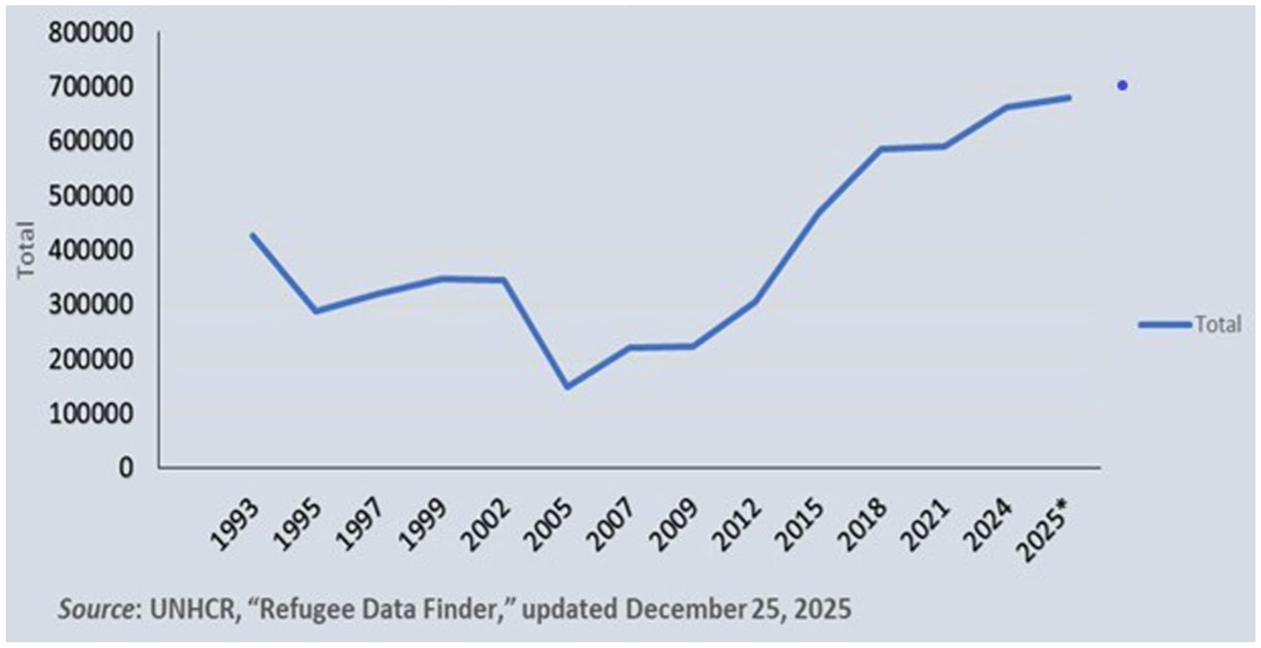
Eritrean refugees and asylum seekers (1993–2025).
As of 2024, approximately 70% of Eritrean refugees are still in East Africa, primarily in Ethiopia and Sudan. Meanwhile, many seek safety or opportunity by traveling along alternative routes, such as the eastern pathway via Djibouti and Yemen to Saudi Arabia or the Central Mediterranean route through Libya into Europe, where they run serious risks like violence, trafficking, and arrest. As a result of this onward migration, large diasporas exist throughout Europe, especially in Germany and Scandinavia, as well as smaller but important populations in the Middle East and North America (United Nations High Commissioner for Refugees (UNHCR), 2024).
The regime employs transnational dominance through hostage tactics, financial monitoring, and infiltration of diaspora groups to weaken unified external pressure for change. Compliance among conscripts stems from fear of torture and a belief in the necessity of indefinite service for national security. Families often view escapees as “enemies,” accepting collective punishment, while educators navigate fear and the belief in education’s value for national progress (Human Rights Watch, 2009). This psychological framework is more sustainable than coercive control, with internalized ideology being a more insidious force. Diaspora members maintain emotional ties linked to PFDJ ideology, viewing military service as a duty, while political prisoners retain their national identity despite their suffering (Conrad, 2006b). The regime’s strategy effectively transforms coercive measures into self-regulation, pushing individuals to adopt state discipline voluntarily.
However, the Eritrean political discourse uses historical appropriation to frame the armed struggle as the ultimate fulfillment of human rights, portraying current demands for civil liberties as a misreading of the national context. As Zerai (2025) argues, this narrative emphasizes independence as a struggle for justice while downplaying ongoing internal issues and the influence of external pressures on human rights discourse.
Managing a garrison police state
Managing Eritrea as a garrison police state presents a significant challenge: strategies aimed at restricting the regime’s expansion have proven insufficient to alter its internal governance or to ensure compliance with human rights principles. The regime’s institutional structure—the integration of the military, security services, party structures, and economic monopolies—creates a self-sufficient system resistant to external pressure and, at the same time, impervious to internal opposition (Ahmed and Rukema, 2023).
The data in Table 1, an analysis of international statements from 2005 to 2025, reveal a move away from judicial censure and toward diplomatically mediated concern. At first, resolutions that emphasized the enforcement of norms, such as those of the 2005 African Commission on Human and Peoples’ Rights, used strong legal language. However, statements from entities such as the EU, the US Senate, and the NB8 used fewer epistemic qualifiers between 2022 and 2025, suggesting a weaker normative force. In addition, EU communications emphasize sovereignty and frame intervention as subject to noninterference principles, thereby displacing accountability while seeming impartial, according to CDA coding. This trend signifies a move from rights-focused condemnation to a more managerial approach, ultimately normalizing structural violations through softened diplomatic language.
Statement of selected international actors on Eritrea’s human rights violations (2005–2025).
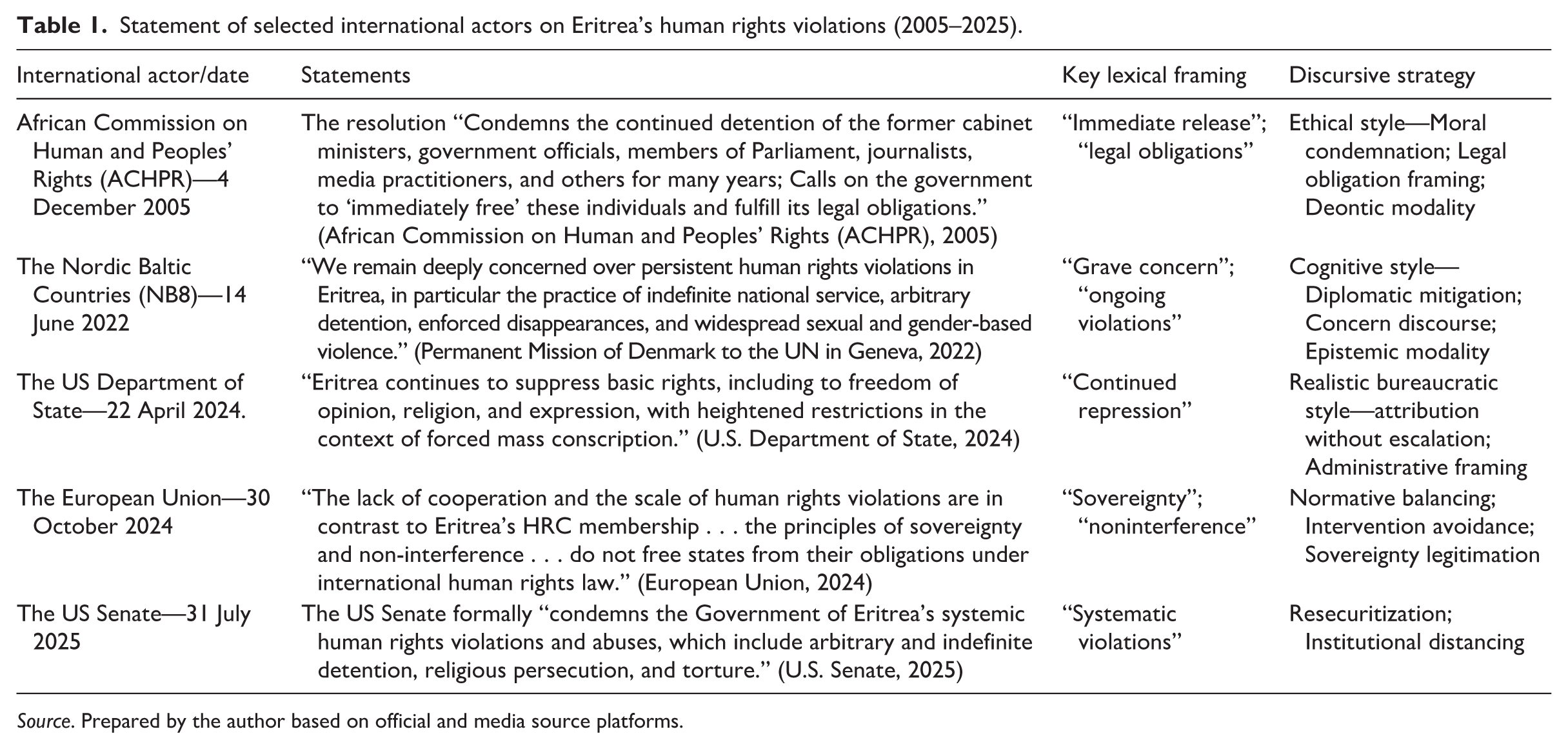
Source. Prepared by the author based on official and media source platforms.
In this regard, several international and regional strategies can be considered. The most direct strategy for managing the Eritrea model is imposing international sanctions. However, the UN Security Council sanctions imposed in 2009 and 2011—including an arms embargo, travel bans, asset freezes, and a ban on taxing expatriates—failed to alter the regime’s behavior or generate internal pressure for change (Hirt, 2015). On the contrary, isolation reinforces the regime’s strategic narrative: external enemies (the West, particularly the United States) are encircling Eritrea, justifying security imperatives and internal repression. Eritrea has acquired significant quantities of military equipment from various suppliers since the lifting of the UN arms embargo in November 2018. Key suppliers include Russia, which provides used Soviet and Russian equipment, and Iran, where there is evidence of military cooperation involving the transfer of drones and ammunition via dedicated cargo ships (Baloi, 2021; Yizezew, 2025). Eritrea’s military partnerships with China have also expanded through investments in port infrastructure under the Belt and Road Initiative.
Crucially, sanctions require multilateral compliance to be effective. The US opposition to lifting sanctions has prevented broader normalization; yet, this isolation has not yielded any leverage, as the regime remains willing to accept international ostracism rather than compromise on governance. As Bruton (2022: para 1) notes, the US insistence on perpetuating Eritrea’s isolation has not had the desired effect on the widely-criticized human rights situation in the country. Instead, she argues, continuing the policy of isolation creates a host of medium-term risks for the United States, as Eritrea pivots away from the West and deepens its relationship with China and the Gulf.
Conditional engagement with Eritrea, offering sanctions relief in exchange for human rights improvements, is seen as strategic but faces challenges, as the regime views these gestures as tactical maneuvers rather than genuine reforms. Despite minor releases of political prisoners, the regime maintains substantial repression. Unconditional engagement risks legitimizing the regime, while weakly conditioned efforts may enable compliance without fundamental change. Diaspora mobilization appears beneficial based on other nations’ experiences, but internal divisions among over 40 opposition groups hinder effective action (Mutambasere, 2020). The regime employs various tactics to control the diaspora, like using family members as hostages and imposing financial surveillance through taxes, further fragmenting opposition (Belloni and Cole, 2022). Albert Hirschman’s (1980) Exit-Voice-Loyalty (EVL) framework asserts that external strategies are ineffective against regimes. The exit (leaving) can enhance voice in repressive regimes by fostering diaspora activism, despite generally functioning as a mechanism of suppression (Kibreab, 2017). The Eritrean government’s management of these dynamics ensures stability without genuine legitimacy, rendering external pressures, such as sanctions, ineffective at inducing substantive change.
Regional efforts to manage Eritrea’s “garrison police state” logic focus on dismantling the regime’s reliance on narratives of external threat by integrating the country into a robust regional security architecture. The 2002 Sanaa Pact, between Yemen, Ethiopia, and Sudan, attempted to manage Eritrea but ultimately failed (Lyons, 2009). Applying the EVL framework, the Eritrean government maintains internal cohesion by cultivating loyalty through the existential defense of sovereignty against perceived enemies, such as Ethiopia and Djibouti. By establishing peace through binding arbitration, joint border commissions, and economic interdependence—particularly after the 2018 rapprochement with Ethiopia—regional actors can undermine the regime’s justifications for unlimited military mobilization (Dessie, 2025). Furthermore, normalizing relations with Djibouti and integrating Eritrea into the Intergovernmental Authority on Development (IGAD) imposes legitimacy costs on continued totalitarian rule, as regional peer pressure and collective security guarantees reduce the perceived need for a militarized domestic posture.
However, regional involvement has proven difficult, as instability in the Horn of Africa—the ongoing conflicts in Sudan, South Sudan, Somalia, and Ethiopia—has given Eritrea strategic importance. The regime’s military interventions (supporting Somali factions, intervening in Yemen, and engaging in destabilizing operations against Ethiopia) integrate Eritrea into regional security dynamics in ways that are valued militarily by regional actors (Gulf states and some African countries). Multilateral regional pressure through the African Union or IGAD, from which Eritrea has withdrawn for the second time, remains weak. Bilateral relations with individual countries (particularly Ethiopia and Djibouti) also remain strained. Consequently, regional instability in Eritrea poses a challenge to any external pressure: the regime cannot be isolated regionally, as actors with divergent interests value its military capabilities.
To transform Eritrea from a “garrison police state” into a sustainable democracy, the study proposed a multidimensional reform framework, grounded in empirical evidence and comparative analysis. Key components include a transitional justice system inspired by South Africa’s Truth and Reconciliation Commissions and Rwanda’s Gacaca courts. A practical way to pursue this system is through truth commissions paired with targeted trials for key military and political leaders. This approach aims to hold wrongdoers accountable without destabilizing the country, as shown in recent studies (Dancy et al., 2025). Likewise, rebuilding civil society by ending the state’s media monopoly under Law 43/1995 and reestablishing independent unions is a crucial step (Burnell, 2000). Opening the public space has led to an increase in civic participation experienced in Tunisia post-2011. However, the risks of militarizing the institutional vacuum, as happened in the Libyan case, should be taken into account (Tayeb, 2025).
Engaging the Eritrean diaspora—estimated at 1.2 million—can enhance reform efforts through political advocacy and remittances that could fund rebuilding efforts. However, strong institutional safeguards are crucial to shield this community from exploitative practices like the notorious “diaspora tax.” Equally vital is encouraging elite defections via “soft landing” arrangements such as conditional amnesties, mirroring the post-Pinochet Chile model; these have proven effective in roughly 22% of African coups, offering a pragmatic path to internal transitions (Svolik, 2012). Finally, shifting to targeted “smart sanctions” over blanket isolation can effectively pressure the regime to reduce forced recruitment while sparing civilians, as demonstrated by their partial successes in Zimbabwe during the 2000s (Rochat and Tsouloufas, 2024).
These strategies require coordinated efforts between the African Union and the United Nations to ensure practical implementation and address past failures, using quantitative indicators and historical context to support them.
Conclusion
This study shows how international diplomatic discourse helps to reproduce totalitarian hegemony in Eritrea by converting a protracted political crisis into a “state of exception” that is justified by sovereignty. It does this by applying CDA within Van Dijk’s three-part framework. The analysis summarizes three key discursive patterns: first, a semantic shift from unequivocal condemnation (“immediate release”; African Commission 2005) to euphemisms (“grave concern”; NB8 2022), reflecting a pragmatic acknowledgment of diplomatic impotence in the face of a regime whose isolation is reframed as “sovereign resilience.” Second, the depoliticization of victims through a shift from specific references (“ministers . . . journalists”) to structural generalizations (“unspecified national service”; US State Department 2024) portrays the population as victims of a persistent problem rather than as targets of political repression. Third, the rhetorical struggle over sovereignty (European Union, 2024: “States are not exempt”) challenges the regime’s narrative without practical intervention tools.
Socially, these patterns show how the international community has failed to foster a discourse that goes beyond standard denunciations (U.S. Senate, 2025) or regional “pragmatic engagement” (security/migration), thereby perpetuating the PFDJ’s “fortress-besieged” mindset that opposes changes to human rights or national service. According to the analysis, language is not neutral but rather a tool of legitimacy. The regime uses its isolation to gain power, and international powers use rhetorical flexibility to defend their policies, making Eritrea into an “African North Korea” without altering the situation on the ground.
By emphasizing the part discourse plays in maintaining power disparities, this study aimed to add to the CDA literature on isolated totalitarian contexts. Future research is advised to examine the influence of social media on global discourse, compare it with North Korea or Venezuela, or trace the development of language in UN resolutions. To break the impasse and achieve a proper balance between the state and civil society in similar crises, a radical international discourse that goes beyond “sovereignty” as a barrier is required. Concrete economic incentives and strong regional alliances should bolster this discourse. This will increase the effectiveness of international intervention against vulnerable totalitarian regimes.
Footnotes

Funding
The author received no financial support for the research, authorship, and/or publication of this article.
Declaration of conflicting interests
The author declared no potential conflicts of interest with respect to the research, authorship, and/or publication of this article.
Data availability statement
This research did not generate any new data. All data used in this article are derived from publicly available sources cited in the reference list.