







Abstract
Concurrent validation procedures were employed, using a sample of African American precollege students, to determine the extent to which scale scores obtained from the first edition of the Learning and Study Strategies Inventory (LASSI) were appropriate for diagnostic purposes. Data analysis revealed that 2 of the 10 LASSI scales (i.e., Anxiety and Test Strategies) significantly correlated with a measure of academic ability. These results suggested that scores obtained from these LASSI scales may provide valid assessments of African American precollege students’ academic aptitude. Implications for teachers, school counselors, and developmental studies professionals were discussed.
Keywords
In light of the interest of educators and researchers in understanding how to identify and improve the study habits of college students (Gordon, 1994; Jones, Slate, & Marini, 1995; Lenier & Maker, 1985; Ley & Young, 1998; Pintrich & Johnson, 1990; Robertson, 1994), several surveys and questionnaires have been developed over the years to measure study skills (Turnbough & Christenberry, 1997). Many of these instruments purport to assess students’ perceptions of learning and use of study strategies. In addition, the underlying goal of these types of instruments is to provide useful information for teachers, school counselors, and developmental studies professionals regarding students’ study habits and learning orientations (Pintrich & Johnson, 1990). Of the most recent instruments developed in the past 25 years, the Learning and Study Strategies Inventory (LASSI) (Weinstein, 1987) has been used extensively in educational settings (H & H Publishing, 2011; Hewlett, Boonstra, Bell, & Zumbo, 2000; Prevatt, Reaser, Proctor, & Petscher, 2007; Weinstein, 1987; Williams, 1995).
The LASSI was designed to yield diagnostic information about students’ self-perceptions of their study skills and learning orientations (Weinstein, 1987). Additionally, the LASSI was developed to help study skills’ instructors and other study skills practitioners (e.g., teachers, school counselors, developmental studies professionals) plan study skills courses as well as assist developmental educators in identifying and improving students’ study skills (Weinstein, 1987). Furthermore, the LASSI was designed to yield information that aids in the prediction of academic achievement (Weinstein, 1987). The first edition of the LASSI consisted of 77 items. Each scale measured unique constructs and characteristics related to study attitudes and behaviors.
Half of the LASSI scales measured psychological and behavioral constructs pertaining to students’ study habits and learning orientations (e.g., Attitude, Motivation, Time Management, Anxiety, and Concentration) (Weinstein, 1987; Weinstein, Zimmerman, & Palmer, 1988). The Attitude scale measured students’ attitudes about education and perceptions of educational goals; higher scores on the Attitude scale indicated that students have high and realistic educational goals (Weinstein, 1987). The Motivation scale measured students’ loci of control to pursue activities that will ensure their academic success in school; higher scores on the Motivation scale indicated that students were more likely to plan and engage in routine study activities (Weinstein, 1987). The Time Management scale assessed the degree to which students use techniques to devise and coordinate their study plan in school; higher scores on the Time Management scale indicated that students have a good understanding of how to develop study schedules and manage their time wisely (Weinstein, 1987). The Anxiety scale assessed students’ perceptions of their level of nervousness and apprehension regarding scholastic responsibilities; higher scores on the Anxiety scale indicated that students understand how to manage high levels of anxiety while performing academic tasks (Weinstein, 1987). The Concentration scale measured students’ abilities to focus on assignments and academic work; higher scores on the Concentration scale indicated that students are successful in managing their time and energy to study and learn academic content (Weinstein, 1987).
The other LASSI scales measured the approaches that students use to learn academic material and course information (e.g., Information Processing, Selecting Main Ideas, Study Aids, Self Testing, and Test Strategies) (Weinstein, 1987; Weinstein et al., 1988). The Information Processing scale measured students’ use of memory aids and other learning methods to support the acquisition of information; higher scores on the Information Processing scale indicated that students employ appropriate techniques to arrange and manage academic information (Weinstein, 1987). The Selecting Main Ideas scale assessed students’ abilities to focus on important course material; higher scores on the Selecting Main Ideas scale indicated that students know how to recognize important course content while studying for tests (Weinstein, 1987). The Study Aids scale measured students’ abilities to design and use test preparation materials; higher scores on the Study Aids scale indicated that students have knowledge of and use study techniques to prepare for tests (Weinstein, 1987). The Self Testing scale measured students’ knowledge and use of approaches to review academic information; higher scores on the Self Testing scale indicated that students recognize the importance of and use strategies to review course content and prepare for tests (Weinstein, 1987). The Test Strategies scale measured the extent to which students employ techniques and methods to study for and take tests; higher scores on the Test Strategies scale indicated that students have knowledge and skills pertaining to studying for and taking tests (Weinstein, 1987).
Research Examining Psychometric Properties of the LASSI
Despite the fact that the LASSI has been used on many college campuses across the country, psychometric data are somewhat limited (Blackwell, 1992; Hayes, 1992). Reliability data, although scarce, provide evidence on the consistency of the instrument to yield similar scores for individuals who retake the instrument in short time intervals (Flowers, 2003; Mealey, 1988). Test-retest data provided by Weinstein (1987) indicated that during a 3-week time interval, test-retest correlations ranged from .72 to .85. Measures of internal consistency have also been reported by Weinstein, who reported coefficient alphas ranging from .68 to .86, and Deming, Valeri-Gold, and Idleman (1994), who reported coefficient alphas ranging from .40 to .79. Taken as a whole, these results indicated that the LASSI scales have an appropriate degree of reliability and internal consistency (Cano, 2006; Weinstein & Palmer, 2002). Moreover, these psychometric data suggest that the LASSI scale scores yield consistent results on repeated measurements and that the item content composing each scale is relatively homogenous (Anastasi & Urbina, 1997; Carmines & Zeller, 1979).
Concerning the issue of validity, the LASSI user’s manual stated, “The LASSI has been subjected to repeated tests of user validity” (Weinstein, 1987, p. 5). To be sure, several studies investigating the validity of the LASSI have been conducted. Ickes and Fraas (1990) conducted a study using 59 college freshmen, enrolled in a liberal arts college, to assess the extent to which the LASSI could help differentiate among mixed-ability students who were identified as at-risk. The findings in their study suggested that the LASSI could not be used to help predict academic performance for at-risk students. The generalizability of these findings to other at-risk populations was constrained because it is possible that, given the homogeneity of this group, the correlation coefficients may have been attenuated because of the range restriction (Spearman, 1904).
Nist, Mealey, Simpson, and Kroc (1990), analyzing data from 168 developmental studies students, found that the LASSI was a good predictor of academic achievement for students who were admitted through the normal admissions process. Deming et al. (1994) used data from 99 developmental studies students to estimate the degree of predictability in LASSI scores for college students identified as at-risk. Their results suggested that the validity of the LASSI may be limited for developmental studies students. Other researchers (Hulick & Higginson, 1989) collected data from 514 college freshmen to measure the extent to which the LASSI was related to students’ grade point averages at the end of their first year. Their findings demonstrated that the LASSI moderately predicted students’ grade point averages. In summary, the validity evidence presented in the literature provided mixed results (Prus, Hatcher, Hope, & Grabiel, 1995).
Purpose of the Study
It is widely known that test users are concerned about the extent to which test scores measure intended constructs and current levels of performance. To ensure that test results are useful to test users, evidence is needed to support the appropriateness of test scores. Validity evidence, then, refers to empirical evidence that supports the assertion that test scores or scale scores obtained from psychological assessment devices reflect intended conceptualizations of interest (Carmines & Zeller, 1979). Moreover, validity evidence refers to statistical indices that support the degree of association between actual constructs or criterions measured versus intended constructs or criterions measured. The type of validity evidence that is germane to a researcher or test user depends on how the test scores will be used in practice (Messick, 1989). Because the LASSI was purported to facilitate the estimation of students’ abilities to understand and use study strategies (Weinstein, 1987), it was reasonable to infer that one outcome associated with a greater understanding and use of various study behaviors would be a higher degree of cognitive development and enhanced intellectual capacities. Prus et al. (1995) suggested that students’ performance on the LASSI should correlate with their educational outcomes. Anastasi and Urbina (1997) noted that criterion validity procedures yield evidence regarding the degree of relationship between behaviors and test scores. Messick (1989) asserted that criterion validity information indicates the extent to which test scores correlate with an individual’s performance in a specific setting.
One form of criterion-related validity is concurrent validity (American Educational Research Association, American Psychological Association, & National Council on Measurement in Education, 1999). It refers to the degree to which an examinee’s test score corresponds with his or her abilities, knowledge level, and current position with respect to a particular criterion. Stated differently, concurrent validity measures the degree of association between measured constructs and current attributes, attitudes, or skills (Hood & Johnson, 1997). Aligned with this concept, Crocker and Algina (1986) indicate that concurrent validity evidence describes the degree to which test scores reflect an individual’s current performance.
The LASSI purports to be used as “a diagnostic measure to help identify areas in which students could benefit most from educational interventions” and as “a counseling tool for college orientation programs, developmental education programs, learning assistance programs, and learning centers” (Weinstein, 1987, p. 2). Accordingly, the present study employed concurrent validation procedures to determine the extent to which the scores obtained from the LASSI scales were appropriate for diagnostic purposes. Because the LASSI was designed to measure the extent to which students use study skills and learning strategies to achieve academic success, it is reasonable to expect scores from the LASSI to correlate with a measure of academic aptitude and intellectual growth. As a result, African American whose LASSI scale scores correspond with high levels of good study skills should also be students who develop high levels of academic achievement. Toward that end, the purpose of the present study was to assess the concurrent validity of the LASSI as a diagnostic measure of academic achievement. Specifically, correlation coefficients were computed between African American students’ scores on each LASSI scale and their ACT scores (ACT, 2011).
Method
Data for the present study were obtained from high school students who participated in a precollege summer program, in 2000, intended to facilitate the transition from high school to college for underrepresented groups in higher education, specifically, first-generation, low-income, and students with disabilities. The program had existed at a large, midwestern institution since 1968 and was partially funded by a federal TRIO grant. To this end, data were obtained from 81 African American students (e.g., 30 males and 51 females). The average ACT score of the student sample was 19.9, with a standard deviation of 3.2. As a point of comparison, in 2000, based on a sample of more than 110,000 African American students, the average composite ACT score for African Americans was 17 (ACT, 2000). The students who participated in the study were enrolled in two 3 credit hour courses during the summer program. In the first week of the program, students were administered the LASSI and individually scored their own instrument according to the guidelines and instructions outlined in the LASSI user’s manual. The researchers then entered raw score data from each student into a statistical computer package for data analysis, and the results were reported significant at p < .05.
Results
Employing criterion validation procedures, the researchers analyzed data from each LASSI scale to determine the extent to which LASSI scale scores could be used diagnostically to measure precollege African American students’ educational outcomes. More specifically, concurrent validity of the LASSI scales was assessed to determine whether the scale scores obtained from the LASSI could be used as valid measures of precollege African American students’ abilities to study and learn in a manner that results in knowledge retention and academic achievement (as measured by a student’s ACT scores). Because high schools and colleges use ACT scores for admissions decisions, course placement decisions, and academic advising purposes (ACT, 2011), ACT scores were employed as a criterion measure of precollege academic performance. As shown in Table 1, correlation coefficients computed between African American students’ ACT scores and each LASSI scale resulted in two significant correlation coefficients: Anxiety (r = .278, p < .05) and Test Strategies (r = .280, p < .05).
Correlations Coefficients for LASSI Scales and ACT Scores
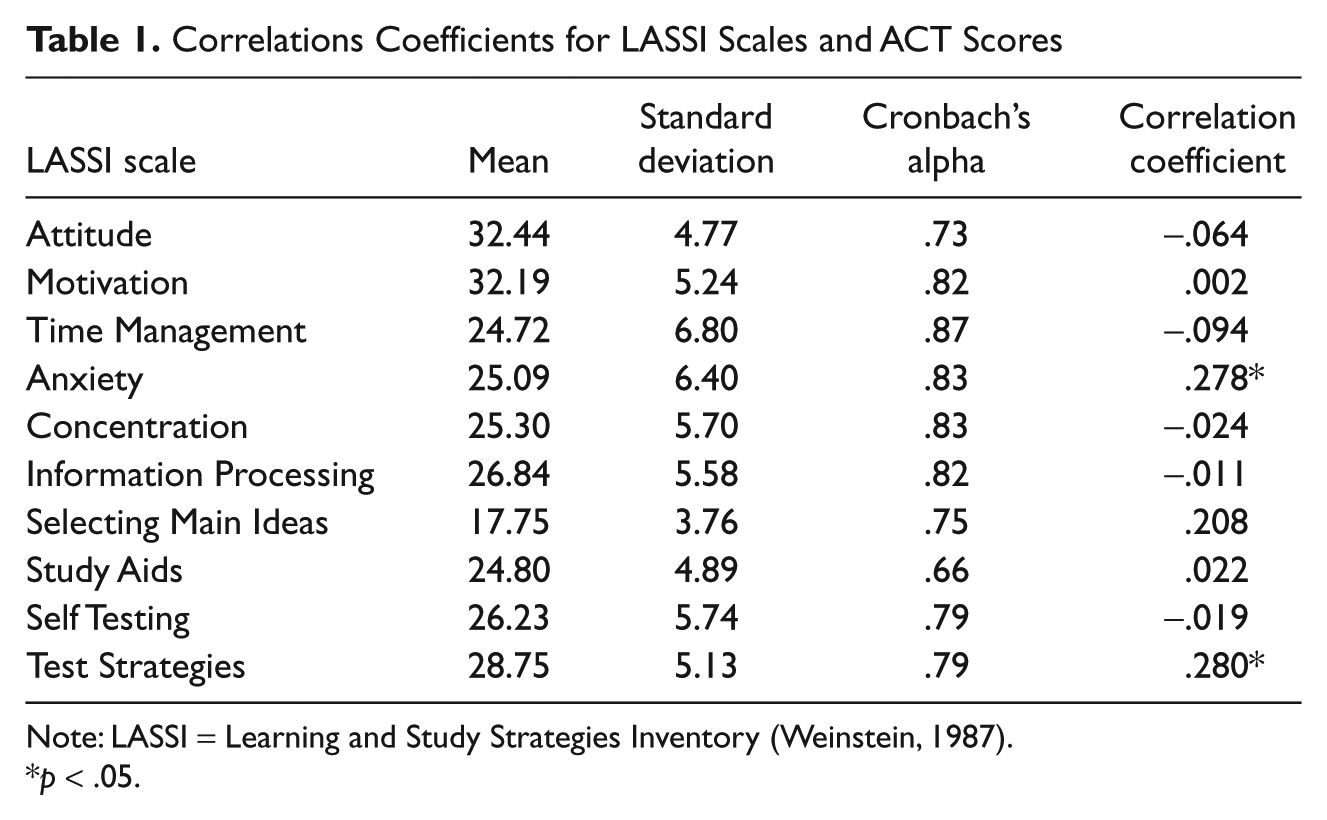
Note: LASSI = Learning and Study Strategies Inventory (Weinstein, 1987).
p < .05.
Discussion
Despite the widespread use of the LASSI (H & H Publishing, 2011), the weight of research pertaining to the ability of the LASSI to accurately assess student achievement is mixed (Hulick & Higginson, 1989; Prus et al., 1995). Past research has shown that higher scores on the LASSI scales corresponded with students who studied more and had higher levels of confidence in their academic abilities to learn in college (Hulick & Higginson, 1989). Research findings have also revealed that the use of the LASSI to predict first-year college student achievement may be restricted (Prus et al., 1995). In light of the inconsistencies in the research literature and given the lack of information available in the LASSI user’s manual regarding the validity of the LASSI (Mealey, 1998), this study sought to provide additional evidence on the psychometric properties of the first edition of the LASSI. According to the stated purposes of the LASSI, it was reasonable to hypothesize that the African American students who obtained higher scale scores on the LASSI were likely to be the students who would score higher on the ACT. If this were true, it was expected that the correlations between students’ ACT scores and LASSI scale scores would be positive. Furthermore, if this hypothesis was confirmed, the data would provide evidence of concurrent validity indicating that the scale scores obtained from the LASSI were adequate predictors of academic achievement as well as study skills behavior. Therefore, a primary goal of the present study was to evaluate the concurrent validity of the 10 scales that constituted the LASSI.
To derive measures of concurrent validity, correlation coefficients were computed between students’ ACT scores and their scores on each LASSI scale. The data analysis revealed that 2 of the 10 LASSI scales (e.g., Anxiety and Test Strategies) were found to correlate significantly with ACT scores. These results provided initial evidence supporting the concurrent validity of these LASSI scales. Overall, the findings presented in this study provided evidence indicating that scores obtained from the Anxiety and Test Strategies scales may be useful in predicting current levels of academic aptitude. Perhaps, because these scales consisted of items that “address the degree to which students worry about school and their performance” and “focuses on students’ approach to preparing for and taking examinations,” respectively (Weinstein, 1987, pp. 2-3), it is not surprising that students who are more likely to perform better on a measure of academic aptitude would also be students who appropriately engage in activities represented by these two LASSI scales. However, what remains unknown is to what extent the other LASSI scales correlate with constructs or criteria related to measures of learning and cognitive ability for African American precollege students. The evidence presented in this study suggested that the other LASSI scales may be limited in this regard.
Viewed collectively, the findings in this study appeared to discourage the use of the first edition of the LASSI to diagnostically assess precollege African American students’ current level of cognitive development. However, it should be pointed out that the LASSI may be appropriately used in other contexts (Weinstein, 1987), such as “a pre-post achievement measure for students participating in programs or courses focusing on learning strategies and study skills” and “an evaluation tool to assess the degree of success of intervention courses and programs” (p. 2). As noted by other researchers (e.g., Nist et al., 1990), more research is needed to provide additional validation evidence that consists of empirical research characterized by longitudinal research designs and mixed-ability sample groups. Moreover, the researchers in the present study recommend that additional research be conducted using similar procedures employed in this study with a larger African American student sample and multi-institutional samples. Also, because criterion-related validity studies employing different criterion variables (e.g., grade point average at the end of the first year of college, self-reported measures of students’ educational gains in college) may yield more informative data regarding the effectiveness and purpose of the LASSI, these studies are recommended for stakeholders interested in pursuing more research on this topic.
Implications for Teachers, School Counselors, and Developmental Studies Professionals
Implications for teachers
In high schools, teachers are powerful forces in the lives of African American students. They have the ability to effect change, whether positively or negatively, in school classrooms. As the work of Flowers, Milner, and Moore (2003) illustrated, teachers’ perceptions can profoundly affect African American students’ educational aspirations. Hence, quality teacher-student relationships are essential for facilitating positive student outcomes. Such a connection is often a requisite for academic success for African American students. In most high schools, it is not uncommon for students to spend the majority of their academic day interacting with teachers. Therefore, teachers are in the best position to assess the abilities and needs of students.
Because it was clear from the statistical findings as well as previous research that African American students could benefit from study skills instruction in high school, it may be worthwhile for high school teachers to invest in the development and implementation of college study skills courses and workshops for their students. These courses and workshops could be designed to provide students with valuable knowledge regarding how to study in college and how to assess and improve existing study skills. Moreover, time management and study skills workshops offered by teachers may help to enhance academic outcomes for African American students in public schools (Ford, 1994; Moore, 2006) as well as in college (Hrabowski, Maton, & Greif, 1998). Such services are especially meaningful and effective when they are infused throughout the curricula and in collaboration with other education professionals, such as school counselors (Moore, 2006).
Implications for school counselors
School counselors are also well positioned to assist African American students in acquiring academic skills and competencies. According to Lee (2001), any services created or offered by school counselors need to reflect the needs and realities of the students they serve. In the case of African American students, it is clear that some students would benefit from specialized services, such as test taking, study skills, and time management workshops. Lee also acknowledged that educational workshops and professional development experiences that consider the impact of culture and ethnicity can enhance students’ skills and expand their knowledge. School counselors can also sponsor other special programs (e.g., Career Day) as well as invite university representatives or college students to share test-taking strategies, study skills tips, and information regarding the importance of doing well in high school (Moore, 2006).
School counselors, similar to teachers, have important roles in school settings. Thus, it is important for school counselors to align their programs and services with the needs of students. Collaborating with teachers is an excellent way to make sure that students’ academic needs are being met. Moreover, school counselors can work in collaboration with teachers to develop meaningful educational programs. For example, school counselors can conduct needs assessments of students’ school issues, present the findings to teachers, and use the results in collaboration with teachers to develop programs and services based on the findings.
Implications for developmental studies professionals
There are a host of external obstacles that inhibit African American students from obtaining a college education (e.g., poverty, inadequate public schools, unchallenging academic programs, poor counseling programs, insufficient parental support, etc.). As a result, many university and public school-based programs have been established to address these issues. One primary type of academic support program in place on many 2-year and 4-year college campuses across the nation is a developmental studies program. Developmental studies programs act as the bridge that connects high school experiences with college expectations.
Traditionally, whether these initiatives take the form of a summer program, weekend academy, or yearlong academic experience, developmental studies programs are designed to prepare students for the rigorous academic and social demands of college life. Accordingly, during these programs, developmental studies professionals’ help African American students learn about different academic majors and career paths. Moreover, developmental studies professionals enable students to acquire college success skills, such as good study habits and strong academic self-concepts. Also, developmental studies professionals attempt to prevent African American students from making unwise decisions in areas such as financial aid, course-taking patterns, and time management (i.e., balancing school, work, and recreational activities in college).
To assist developmental studies professionals in further enhancing students’ success, the LASSI could be administered to participants at the beginning of a developmental studies program and then readministered at the end of the program to measure the extent to which students accrued gains in study skills and study behaviors. Furthermore, diagnostic instruments, such as the LASSI, may provide a good assessment of students’ knowledge of and use of study skills in college (Weinstein, 1987; Weinstein et al., 1988). The information from these assessments may enable precollege African American students to better identify and understand their weaknesses, as well as their strengths, in regard to their study habits and learning orientations.
Conclusion
Meeting the academic needs of African American students, as well as preparing them for the rigors of college, requires that educational professionals, such as teachers, school counselors, and developmental studies professionals, work collaboratively. Given the academic pitfalls of African American students (Flowers et al., 2003; Hrabowski et al., 1998; Moore, Flowers, Guion, Zhang, & Staten, 2004), it is critical that teachers, school counselors, and developmental studies professionals collaborate to gain a better understanding of the issues that plague these students’ academic outcomes and use this knowledge to improve existing school policies and practices. This information can also be used to develop new services to support academic success for African American students in high school and college. Although there are many areas of improvement in this regard, the present study pointed to another issue that has relevance to the educational development of African American students. More specifically, this concurrent validity study highlighted the importance of examining the validity of surveys and questionnaires that are used to assess academic development and the impact of educational programs using an African American student sample.
Limitations of the Study
The present study sought to highlight the relevance and utility of analyzing the psychometric properties of instruments used to measure students’ learning orientations and educational outcomes. However, this study had limitations that should be considered when attempting to evaluate the study’s findings and conclusions. First, African American students completed and scored the LASSI, and then researchers coded the data into a statistical software program. This process may have introduced coding errors. Second, this study included only a small sample of African American students. To enhance the generalizability of the study, similar procedures as those employed in this study are recommended for use on larger samples of African American students. Third, this study employed students’ ACT scores as the criterion variable. Future research may use different criterion variables to assess the concurrent validity of the LASSI (e.g., observational scales, teacher’s ratings of students’ study skills, grade point averages, etc.). Fourth, since this research began, a revised edition of the LASSI has been developed that may produce different results than reported in this study. For example, in the latest revision of the LASSI, an effort was made to develop items that incorporated theoretical and research-based advancements in the areas of learning and cognition (Weinstein & Palmer, 2002). Also, the revised LASSI sought to improve its psychometric properties through item testing and item refinement. Thus, a similar study as reported in this article may be needed to explore the concurrent validity of the second edition of the LASSI.
Footnotes
The authors declared no potential conflicts of interest with respect to the research, authorship, and/or publication of this article.
The authors received no financial support for the research, authorship, and/or publication of this article.