







Abstract
African American and Black Caribbean relations are described as strained. Standard portrayals of Black Caribbeans as a “model minority” that has effectively assimilated into the American landscape often make explicit their distinctiveness from and enmity toward African Americans. Analysis using National Survey of American Life data (N = 6,082), exploring the nature and correlates of intergroup perceptions, reveals that both groups characterize their mutual relationships as being close. Gender and region of residence influence African American feelings of closeness toward Black Caribbeans, while for Black Caribbeans, perceived discrimination was significantly associated with feelings of closeness to African Americans. Black Caribbean immigrants from Spanish-speaking countries and Haiti felt closer to African Americans than did Jamaicans. In addition, foreign-born Black Caribbeans (first generation) felt closer to Black people from the Caribbean than second-generation Black Caribbeans. These and other findings are discussed in relation to research on intergroup closeness among African Americans and Black Caribbeans.
The challenge of an expanding ethnically and racially diverse population and the large-scale immigration of racial minorities has fueled a national debate about the role of race in what America is becoming and prompted a rethinking of traditional racial and ethnic divides (Charles, 2007; Richeson & Craig, 2011; Wright, 2011). Immigration from regions such as Asia and Latin America has rendered archaic the accepted color line (i.e., Black-White) in the United States. Lee and Bean (2007) suggested that “if the problem of the 20th century was the color line, the question of the 21st century could be one of the multiple color lines” (p. 563). While still an issue of affiliation, in this changing landscape, the question is becoming, as Hollinger (2011) asserted, “With precisely who [sic] does one try to affiliate?” (pp. 180-181).
The issues of shifting color lines and intergroup affiliation and identity are especially critical for immigrant groups. Immigrants are said to live in “extended communities” and “transnational families” (Chavez, 1992; Whiteford, 1979), concepts that emphasize the connections that migrants maintain to their country of origin even while being dislocated from it. As a consequence, immigrants in the United States experience competing visions of identity and community, images that are enhanced and maintained by the ongoing processes of immigration.
Within this context of shifting race/ethnic populations and identities, Black Caribbeans represent an interesting case. Like many recent immigrants, they often arrive with substantial social capital, especially those who speak English, which advantages them over other non-English-speaking immigrants, as well as native Blacks. Indeed, there are substantial differences between foreign-born and U.S.-born Blacks, distinctions occurring across a variety of social and health domains. Recent Black immigrants surpass African Americans in household income and hold more prestigious jobs. They report higher levels of physical and emotional well-being and educational achievement than U.S.-born Blacks, higher employment levels, and lower poverty rates (Alex-Assensoh, 2009; Kalmijn, 1996; Logan, 2007; Wheeler, Brooks, & Brown, 2011).
This structural advantage is deepened by White bias and preferential treatment and actions. Employers presume that Black Caribbeans are superior to U.S.-born Blacks, are more compliant employees, and possess a better work ethic and aptitude for learning. However, when studies control for qualifications and work attitudes, differences evaporate (Corra & Kimuna, 2009; Dodoo & Takyi, 2006). Even so, these biases are the basis for preferential treatment of Black Caribbean immigrants (Shaw-Taylor, 2007; Waters, 1999b). For some, these differences suggest that Black immigrants may be America’s new model minority group (Dudley-Grant & Etheridge, 2008; Griffith, Johnson, Zhang, Neighbors, & Jackson, 2011; James, 2002; Model, 2008; Tillery & Chresfield, 2012). In fact, Crosnoe and Turley-Lopez (2011) reported that many foreign-born Blacks’ achievements in outperforming native-born Whites (despite being more socially and economically disadvantaged on average) is one component of the “immigrant paradox” phenomenon.
Despite this relative advantage over African Americans, Black Caribbeans differ from many other immigrants in that they face specific racial discrimination as Blacks (Aman, 2002). Indeed, one might suppose that because they share a racial experience with native-born African Americans, Black Caribbeans would come to psychologically resemble these groups in a variety of ways that might foster the development of Black unity (i.e., Pan-Africanism) and feelings of affiliation. To some extent, the debate over their acclimation to the United States has been couched as an either/or dichotomy as to whether they align themselves via race with native African Americans or maintain their nationalistic/ethnic identities to their home countries via an elevated minority status (Greer, 2013). However, in a complex social context undergoing continuous transformations by immigration, both race and ethnic statuses likely have important influences on intergroup relationships and affiliation (Greer, 2013).
We explore these issues using a nationally representative sample of African Americans and Black Caribbeans to examine factors influencing their perceptions of mutual closeness. Our interests are to examine how African Americans and Black Caribbeans characterize mutual group relationships and whether sociodemographic factors (e.g., gender, region, immigration status) emerge as significant correlates of these attitudes.
African American and Caribbean Blacks: Intergroup and Intragroup Relations
The period of 1960-1980 witnessed a sevenfold increase in the foreign-born U.S. Black population. From 1980 to 2005, that population swelled over 20 times to 2,815,000, most arriving after 1990 (Kent, 2007). Since 2000, 1.3 million Caribbeans obtained legal permanent resident status (Table 2: Department of Homeland Security, 2011—http://www.dhs.gov/files/statistics/publications/LPR11.shtm). The foreign share of Black residents has risen from 1% to 8% and notably altered the ethnic makeup of places such as New York, Boston, and Miami, where over a quarter of Black residents is foreign-born. Two thirds of these immigrants are from the Caribbean (mostly Jamaica and Haiti), and 8% are Black Latino Americans (Kent, 2007). The increased presence and recognition of ethnic diversity within the Black population raises questions about with whom these groups identify.
Cornell and Hartmann (2007) noted three aspects of group identity: boundaries, perceived position, and meaning. Identities are largely constructions and positioning of boundaries separating groups that establish criteria designating in- and out-groups. In this stratified society, groups such as African Americans and Black Caribbeans are positioned relative to each other, part of a hierarchy integrally related to the construction and maintenance of boundaries. Finally, what meanings are attached to groups includes an assignment (by others) and/or assertion (by the group) of factors that determine group membership. Sometimes a group may be able to define/assert its own identity despite outsider assertions. Otherwise, structural or material conditions limit self-definition.
Race identity relies heavily on assignment by others (usually on the basis of physical characteristics) and is typically exclusive. Those in the United States who are racially Black are also socially designated as sharing a common group identity. However, this supposition is questioned in the case of recent immigrants from Africa and the West Indies. In contrast, ethnic identity is at its core self-perception and other perception. Our link to others like ourselves is based in part on our perceived bond with them, and how and where others place us in terms of group membership (Cornell & Hartmann, 2007). Ethnic identity among Black Caribbeans is expressed as closeness toward their own cultural/national group (e.g., Black Caribbeans, Haitians, Jamaicans).
The debate about Black Caribbean and African American affiliations involves whether they share a racial identity or whether Black Caribbeans (or subgroups within that label) emphasize their ethnic identities as separate from African Americans. Emerging work suggests that this either/or approach is limited and hides a more complex set of issues that affect group identities. Group identity among Black Caribbeans is a “complex filter for racial stimuli” (Franklin-Jackson & Carter, 2007, p. 20). Furthermore, similar to Greer (2013), we argue that in fact, race and ethnic factors influence the quality of group interactions and affiliations. Many immigrants may arrive in the United States focused on their ethnic identities, some because that is what they know and defines who they are. Others, however, may perceive that in a hierarchical society, ethnic identities help to distinguish and elevate them above their African American counterparts. Over time, however, race may develop into a master status for some immigrants, while others will resist that trend (Greer, 2013; Marrow, 2009; Rodriguez, 1999a, 1999b; Thornton, Taylor, & Chatters, 2012). The important point is that both processes are at play.
Predictably structural differences, stereotypes, and perceptions have caused tension between the two communities (Tillery, 2011; Tillery & Chresfield, 2012). Many Black Caribbeans have stronger affiliations with Whites than with African Americans (Model & Fisher, 2001) and seem less affected by racial stigma due to a “comfort factor” (Waters, 1999a). That is to say that Black Caribbeans are less angry at Whites, don’t feel that America “owes” them, and consequently, don’t have a “chip on their shoulders.” Male adolescents, however, were an exception to this pattern, as they were more likely to be angry at Whites. One study suggests that Haitians distance themselves from American Blacks to escape the “otherness” of that status.
While they celebrate the common ancestry they share with African-Americans, believe in the same dreams, partake in their aspirations, and bemoan the common adversities, in general they maintain a safe social distance between themselves and the African-American population. (Fouron, 2003, p. 216; Fouron & Schiller, 2001)
Thus, African Americans and Black Caribbeans may not have comparable emotional ties (Rogers, 2000; Vickerman, 1999, 2001). Some Black immigrants recognize a racial link to a common African ancestry and share historical experience with the slave trade, but nationality often takes priority over their racial identity (Foner, 2001). These attitudes are commonly seen by African Americans as “antithetical to racial solidarity” (Rogers, 2006). In turn, African Americans, by virtue of having more negative perceptions of interethnic relations (Jackson & Cothran, 2003), may see Black Caribbeans as having different encounters with American racism. This dissimilarity in experiences with Whites may make it harder for these groups to bond (Alex-Assensoh, 2000; Greer, 2013). Moreover, “blackness” may be challenged on social class grounds, giving affluent Black immigrants openings to transcend racial classification and even become “whitened” (Waters, 1994, 1999a). This situation presents a test for some immigrants, who learn that no matter their ethnic, cultural, and historical diversity, they are treated as Black (Nunnally, 2010).
Greer (2013) suggested that many Black Caribbeans may experience a segmented assimilation due in large part to their being something like a model minority, what she terms an elevated minority status, where they and many others consider Black Caribbeans as “above” African Americans. This is seen in Black Caribbeans stressing their foreignness in contacts with others, keeping their accent and accentuating cultural cues to distinguish them from African Americans (Model & Fisher, 2002; Waters, 1990). This may enhance their own status in the broader society, but it may also cause African Americans to treat them as an out-group. This tension is enhanced by residency. West Indians shape separate enclaves away from Africans, African Americans, and Whites (Case & Hunter, 2013; Crowder, 1999; Vang, 2012). Given these factors, it is plausible that disparities in social capital, different perceptions, residence patterns, and interethnic tension are manifested in divergent identities.
Year of residency and generational status are also factors. Work on second-generation Black Caribbeans (termed West Indians in the original study) often assumes that interaction with native Black counterparts will lead them to adopt an African American identity, rejecting West Indianness. On arrival, Black immigrants, compared with Black Americans, place less emphasis on racial group membership as a defining feature of their self-concepts (Tormala & Deaux, 2006). Greer (2013) found that Black Caribbeans are less likely than Black Americans to perceive race as a “master status” negatively affecting their social and economic standing within the United States (Benson, 2006). However, with the prominence of racial categorization in U.S. society, with time, the importance of racial group membership may increase (Bobb & Clarke, 2001).
Thus, enmity between the two groups is commonly attributed to the first generation who immigrated here with preconceived notions of what it means to be African American (Kasinitz, 1992; Roth, 2009; Waters, 1990), coupled with a strong emphasis on distancing themselves from “black,” and the baggage associated with the term (Bryce-Laporte, 1972, 1993). For them, “black American” serves as the prototypical “other” against which they are compared (De Genova & Ramos-Zayas, 2003) and which helps define and shape the meaning of community (Ong, 2003). This has been a historical trend because immigration law has “drawn from and been indirectly complicit in shaping images of blackness” (Calvita, 2007, p. 10), further undermining any uniformly imagined community. Nonetheless, prevailing racial inequalities compel Black Caribbeans to share a racial group identity with native Blacks (Kasinitz, 1992; Kasinitz, Battle, & Miyares, 2001). Scholars not only point to the salience of ethnic identity among first-generation West Indian immigrants but also recognize that racial identity is primary in many social contexts.
However, none of this should imply that the second-generation identifies as unequivocally (Black) American, because both race and ethnicity are at play (Greer, 2013). Instead, many choose to adopt differing identities—ethnic, hyphenated American, American, pan-ethnic, regional, or multiracial—which need not be mutually exclusive (Kasinitz, Mollenkopf, & Waters, 2004; Portes & Rumbaut, 2001). Waters (1996, 1999a, 2001) found that second-generation identity choices were affected by race, gender, and class. Those identified as Black American, usually males, were from disadvantaged settings who adopted an oppositional culture. Others termed ethnic or hyphenated American were typically middle class. Finally, those with an immigrant identity, commonly females, used it as a means to distance themselves from negative stereotypes of and discriminatory behaviors directed toward U.S. Blacks.
Further highlighting the range of both racial and ethnic identities, some second-generation Black Caribbean immigrants are unlikely to identify as Caribbean or African American (Deaux et al., 2007). Butterfield (2004) found that West Indians’ immigrant and ethnic identities are irrelevant in a society recognizing only Blackness on sight. In contrast, Zephir (2001) found that New York Haitians tend to identify as “bicultural” or “Haitian” versus Haitian American. The former tend to be older, while among the latter are the younger generation who juggle both identities depending on the situation.
This diversity in identities suggests that members of disadvantaged groups express strong commitment to their group’s cause and report highly favorable attitudes and group supportive beliefs. Yet, members often internalize the social standing of their group and reveal either negative attitudes and beliefs toward their own group or, in weaker form, simply do not show the in-group-favoring bias that advantaged group members do (Jost, Banaji, & Nosek, 2004; Uhlmann, Dasgupta, Elgueta, Greenwald, & Swanson, 2002). Sharp divisions around one issue may not reflect major cleavages around issues of race. Foreign-born Blacks arrive with optimistic beliefs about what America has to offer than is found among Black natives, but they are not blind to the role that race plays. Indeed, some work suggests that despite cleavages around certain issues between the two groups, there remains a strong pan-ethnic identity (Benson, 2006; Stout & Le, 2012; Thornton et al., 2012; Unnever & Gabbidon, 2013). Greer (2013) found that native Blacks feel solidarity with other ethnic Blacks, while also feeling that they compete with them for resources. In turn, Black Caribbeans express racial solidarity but distinguish themselves from African Americans nonetheless.
Thus, discrimination plays a major role in imagining community. Blacks (both African American and Black Caribbean) are most likely to report encounters with discrimination, with most adolescent Blacks noting at least one incident. Native-born, Jamaican, and Haitian youth, but especially males, tend to see more discrimination (Kessler, Mickelson, & Williams, 1999; Prelow, Danoff-Burg, Swenson, & Pulgianno, 2004; Sidanius & Pratto, 1999). As these groups become more “American,” differences become less notable and may even reverse by the third generation (Griffith et al., 2011; Sakamoto, Woo, & Kim, 2010; K. Thomas, 2012; Williams & Sternthal, 2010). In fact, Peguero (2012) reported that third-generation foreign-born Blacks have higher drop-out rates than their immigrant parents, have more experiences with violence while at school in comparison to their first- and second-generation counterparts, experience a decline in their educational optimism, and have notably negative attitudes regarding school punishment practices. Owens and Lynch (2012) added that second-generation immigrant Blacks are more susceptible than the first generation to the deleterious consequences of stereotypes that negatively depict African Americans.
Recent literature suggests that Black Caribbeans and African Americans have strong group ties that are at times coupled with negative self-perceptions. Jointly, this would lead us to expect a diverse pattern of identification but one that is nonetheless linked to race. Research among racial and ethnic groups supports the idea that instead of maintaining just one type of community, people are more likely to layer them, in essence expanding/contracting ethnic boundaries depending on context (Okamoto, 2003). This suggests, as well, that feelings of affinity or closeness to other groups will be influenced by both a cultural/national and racial lens.
Closeness
Early research implied that in-group attachment and preference over out-groups was universal, and that in-group bias and out-group dislike are reciprocal, such that in-group favoritism was correlated with intergroup dislike and hostility (Sumner, 1906). Later work (Tajfel & Turner, 1986) suggested that a simple “we/they” distinction will activate disparate reactions to others based on in-group and out-group membership. In-group rather than out-group members are more likely to be seen positively, arouse trust, and enhance cooperative behavior (Hewstone, Rubin, & Willis, 2002; Kramer & Brewer, 1984). In addition, Allport (1954) recognized that in-group attachments are psychologically primary in that they precede the development of attitudes toward out-groups. Thus, in-group bias is not inevitably linked to contempt for out-groups (e.g., Brewer, 1979), and intergroup hostility may not be determined solely by in-group bias (Ahmed, 2007).
Closeness is a marker of in-group bias and is a concept that has been used to examine Black attitudes (e.g., Gurin, Hatchett, & Jackson, 1989; Herring, Jankowski, & Brown, 1999; Kinder & Winter, 2001). Craemer (2008) suggested that in highlighting closeness as a measure of Black group proximity, we may have encouraged implicitly the idea that each group identity is psychologically distinct and perceived as such by members of other groups (Wong & Cho, 2005). This supposition may obscure complex links between in-group closeness and out-group attitudes, for the former may also be positively associated with feelings toward those of different social backgrounds (Dovidio, Saguy, & Shnabel, 2009; Kaufmann, 2003; Sanchez, 2008). Although Brewer (2001) contended that “the idea that an individual’s self-concept is derived, to some extent and in some sense, from the social relationships and social groups he or she participates in” (p. 117), positive intergroup connections are still possible across ethnic boundaries.
The concept of perceived closeness has been used to estimate how similar respondents viewed themselves in relation to their own group and in relation to different racial/ethnic groups. Perceived closeness reflects individuals’ psychological attachment or identification with a particular social group (e.g., Conover, 1984; Gurin, Miller, & Gurin, 1980). Generalized feelings of closeness have been especially useful for assessing interracial attitudes (see Jackman & Crane, 1986; Tropp & Pettigrew, 2005). Other research indicates that the relationship between contact and interracial closeness is generally weaker among Black Americans than among White Americans (see Ellison & Powers, 1994; Tropp & Pettigrew, 2005).
Focus of the Present Study
This study uses data from a national probability sample of African Americans and Black Caribbeans to explore feelings of closeness to imagined communities (Anderson, 1983). Specifically, we are interested in feelings of closeness reported for their respective in-group and out-group (i.e., Black people in this country and Black people from the Caribbean). Our primary interest is to examine factors influencing perceptions of closeness both within and across the two groups. Previous empirical work on closeness among Black Caribbeans points to a notable interminority process that is based on a lived experience of race in the United States that produces generational shifts in rapport with native Blacks. Based on this perspective, we expect to see several patterns.
Overall, both African Americans and Black Caribbeans will report strong feelings of closeness to their own group. While not as robust, they will also demonstrate affinity to the other group. Furthermore, empirical research on Black immigrant groups consistently shows that the likelihood that they identify with and share a sense of common fate with other Blacks increases with time spent in the United States (Vickerman, 1994, 1999; Waters, 1999a). Consequently, U.S.-born Black Caribbeans (second and later generation) will feel notably closer to African Americans than will their immigrant (first generation) counterparts.
Socioeconomic status (SES) is also associated with identity, with some research indicating that middle-class Black Caribbeans are more likely than their working class counterparts to identify with native-born Blacks and report experiencing more discrimination (Vickerman, 1999), while other work indicates that class is unrelated to identification with African Americans (Waters, 1999b). Thus, we also expect that discrimination is related to feeling closer to African Americans. Other evidence suggests that poor language skills among dark-skinned immigrants are related to a greater likelihood of encountering discrimination (Kalmijn, 1996; Waters, 1999a).
Method
Sample
The National Survey of American Life: Coping With Stress in the 21st Century (NSAL) was collected by the Program for Research on Black Americans at the University of Michigan’s Institute for Social Research. The fieldwork for the study was completed by the Institute for Social Research’s Survey Research Center, in cooperation with the Program for Research on Black Americans. The NSAL sample has a national multistage probability design that consists of 64 primary sampling units (PSUs). Fifty-six of these primary areas overlap substantially with existing Survey Research Center’s National Sample primary areas. The remaining eight primary areas were chosen from the South in order for the sample to represent African Americans in the proportion in which they are distributed nationally.
The NSAL includes the first major probability sample of Black Caribbeans. For this study, Black Caribbeans are defined as persons who trace their ethnic heritage to a Caribbean country, but now reside in the United States, are racially classified as Black, and who are English-speaking (but may also speak another language). In both the African American and Black Caribbean samples, it was necessary for respondents to self-identify their race as Black. Those self-identifying as Black were included in the Black Caribbean sample if they (a) answered affirmatively when asked whether they were of West Indian or Caribbean descent, (b) said they were from a country included on a list of Caribbean area countries presented by the interviewers, or (c) indicated that their parents or grandparents were born in a Caribbean area country.
The data collection was conducted from February 2001 to June 2003. The interviews were administered face-to-face and conducted within respondents’ homes; respondents were compensated for their time. A total of 6,082 face-to-face interviews were conducted with persons aged 18 or older, including 3,570 African Americans, 891 non-Hispanic Whites, and 1,621 Blacks of Caribbean descent. The overall response rate was 72.3%. Response rates for subgroups were 70.7% for African Americans, 77.7% for Black Caribbeans, and 69.7% for non-Hispanic Whites. The response rate is excellent given that African Americans (especially lower income African Americans) are more likely to reside in major urban areas that are more difficult and expensive with respect to survey fieldwork and data collection. Final response rates for the NSAL two-phase sample designs were computed using the American Association of Public Opinion Research (AAPOR) guidelines (for Response Rate 3 samples; AAPOR, 2006; see Jackson et al., 2004, for a more detailed discussion of the NSAL sample). The NSAL data collection was approved by the University of Michigan Institutional Review Board.
Measures
Dependent variables
Generalized feelings of closeness are useful for assessing racial attitudes, as affective measures, when compared with other attitude measures, typically show stronger relationships with contact (see Jackman & Crane, 1986; Tropp & Pettigrew, 2005). We use three indicators of subjective closeness to in-groups and out-groups. Respondents were asked how close they felt in their ideas and feeling about things to (a) Black people in this country, and (b) Black people from the Caribbean (e.g., Jamaica, Bermuda, or Haiti)Respondents were asked whether they felt very close, fairly close, not too close, or not close at all to the groups; scores ranged from 4 for very close to 1 for not close at all.
Independent variables
The distribution for all of the independent variables utilized in this analysis is presented in Table 1. Included are everyday discrimination, financial strain, and sociodemographic variables. The everyday discrimination scale (Williams, Yu, Jackson, & Anderson, 1997) assesses chronic and less overt experiences of discrimination (e.g., being treated with less respect than others). This scale has demonstrated good internal consistency and validity (Williams & Williams-Morris, 2000). Respondents are asked, “In your day-to-day life how often have any of the following things happened to you?” They are then asked how often they have (a) been treated with less courtesy, (b) been treated with less respect, (c) received poor restaurant service, (d) people acted as if they are not smart or are dishonest, (e) people acted afraid of the respondent, (f) people acted as if they are better than the respondent, (g) people called the respondent names, (h) people threatened the respondent, or (i) they have been followed by security when shopping in stores. Higher scores on this summary scale denote higher levels of discrimination (0 to 10). Financial strain was measured by the question, “How much do you worry that your total (family) income will not be enough to meet your family’s expenses and bills” (4 = a great deal, 3 = a lot, 2 = a little, 1 = not at all).
Distribution of Demographic and Other Independent Variables.
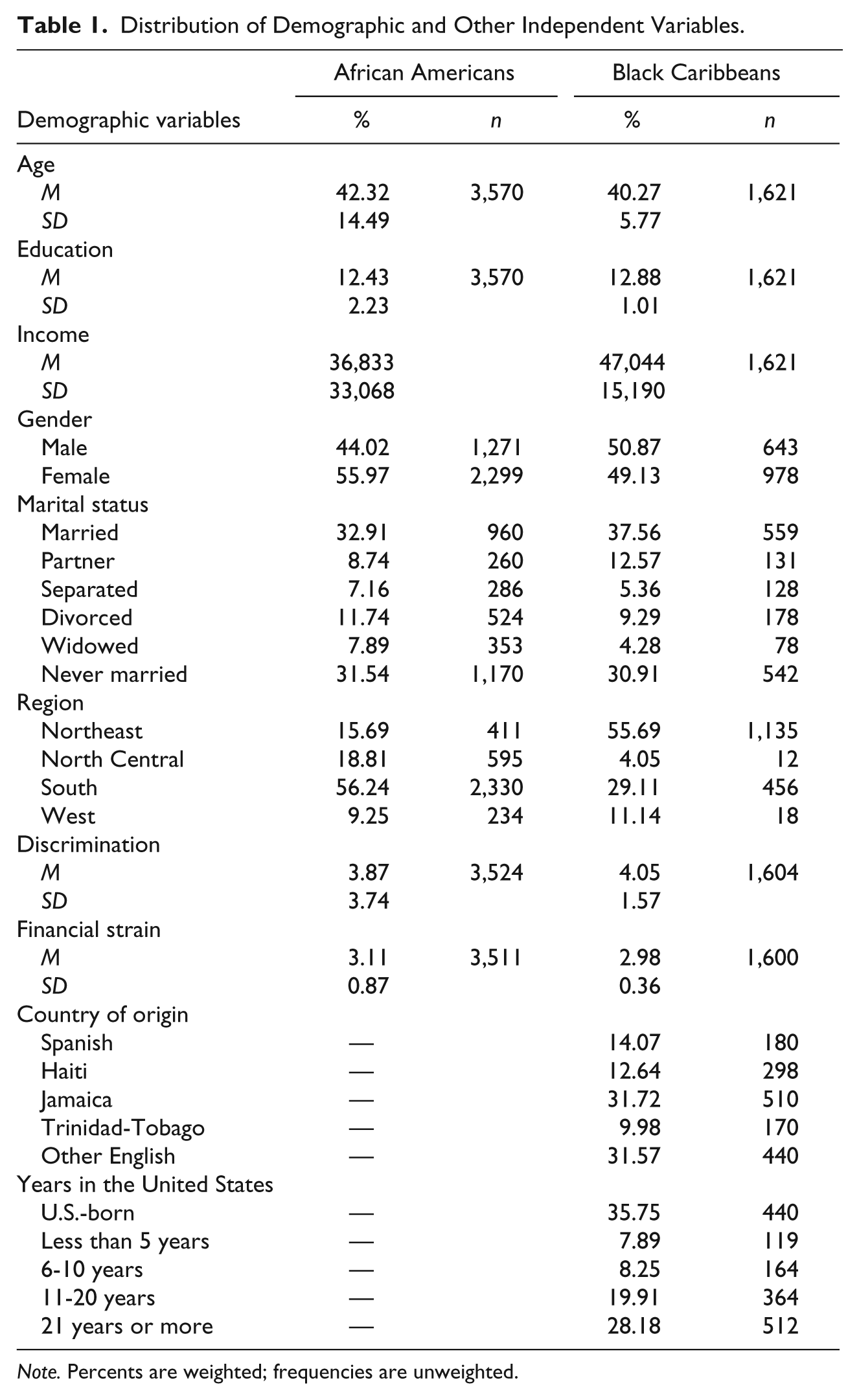
Note. Percents are weighted; frequencies are unweighted.
The sociodemographic variables include age, gender, family income, education, marital status, and region. Missing data for household income were imputed for 773 cases (12.7% of the NSAL sample). Missing data for education were imputed for 74 cases. Imputations were completed using an iterative regression-based multiple imputation approach incorporating information about age, gender, region, race, employment status, marital status, home ownership, and nativity of household residents. Income is coded in dollars and for the multivariate analysis only was divided by 5,000 in order to increase effect sizes and provide a better understanding of the net impact of income on the dependent variables.
In addition, two demographic variables that are particularly relevant to the Black Caribbeans are included in this analysis (immigration status and country of origin). Immigration status has five categories corresponding to respondents who were (a) born in the United States, (b) immigrated to the United States 0 to 5 years ago, (c) immigrated to the United States 6 to 10 years ago, (d) immigrated to the United States 11 to 20 years ago, and (e) immigrated to the United States more than 20 years ago. Finally, respondents identified over 25 different countries of origin. Consistent with research on the Caribbean region, country of origin was categorized based on historical and anthropological designations of the Caribbean as Anglophone (English speaking), Hispanophone (Spanish speaking), and Francophone (French Speaking; see Gossai & Murrell, 2000; Zane, 1999). Jamaica, Trinidad-Tobago, and other English-speaking countries (e.g., Barbados) represent the Anglophile countries; Spanish-speaking or Hispanophone countries include Puerto Rico, Dominican Republic, and Cuba; and Haiti is the Francophone country. The resulting variable, Country of Origin, is recoded into five categories: Jamaica, Trinidad-Tobago, other English-speaking country (e.g., Barbados), Spanish-speaking country (e.g., Puerto Rico, Dominican Republic), and Haiti.
Analysis Strategy
First, bivariate analyses of ethnic differences in closeness are presented. The percentages are weighted based on the sample’s race-adjusted weight measure. Second, multivariate analyses of the three indicators of closeness by ethnicity are presented with demographic factors, financial strain, and discrimination used as controls. Third, subgroup regression analyses are presented—one set of analysis is conducted solely with African Americans and a second set of analysis is conducted wholly for Black Caribbeans. One purpose of the subanalyses is to maximize the demographic variation within these two populations. Therefore, the categories of several independent variables are tailored to the demographic distribution of the African American and Black Caribbean populations. For example, region categories reflect the geographic distribution of these two populations. For Black Caribbeans who are highly concentrated in the Northeast (e.g., New York, Connecticut, Washington, D.C.), region is represented by two categories—Northeast and Other regions. Four regional categories are used for African Americans—Northeast, North Central, South, and West. As mentioned previously, analyses for Black Caribbeans include two Caribbean-specific variables—immigration status and country of origin.
Analyses were conducted using SAS 9.13, which uses the Taylor expansion approximation technique for calculating the complex design-based estimates of variance. To obtain results that are generalizable to the African American and Black Caribbean populations, all of the analyses utilize analytic weights. All statistical analyses account for the complex multistage clustered design of the NSAL sample, unequal probabilities of selection, non-response, and post-stratification to calculate weighted, nationally representative population estimates and standard errors.
Results
Closeness to Black People in the United States
The bivariate analysis of ethnicity on degree of closeness to Blacks in the United States appears in Table 2. African Americans (54.4%) are more likely than Black Caribbeans (48.6%) to indicate that they are very close to Black People in the United States. This significant difference is seen in both the bivariate and multivariate analysis (Table 3). The regression analysis for degree of closeness to Blacks in the United States is presented in Table 4. For African Americans, age, gender, education, and region are all significantly associated with closeness to Blacks in the United States. Both age and education have positive associations indicating that older African Americans and those with more years of education feel closer to Blacks in the United States than their counterparts. African American women indicate feeling less close than their male counterparts and persons in the Northeast feel less close than Southerners. Among Black Caribbeans (Table 3), education, discrimination, region, and country of origin are significant. Black Caribbeans with more education feel closer to Blacks in the United States than their counterparts. Black Caribbeans who report higher levels of discrimination also report higher levels of closeness, as do those residing in the Northeast as compared with those living in other regions. Finally, Black Caribbeans from Spanish-speaking countries and from Haiti feel closer to Blacks in the United States than those from Jamaica.
Bivariate Cross-Tabulation of Differences Between African American’s and Black Caribbean’s Closeness to Black People in the United States, and Black People From the Caribbean.
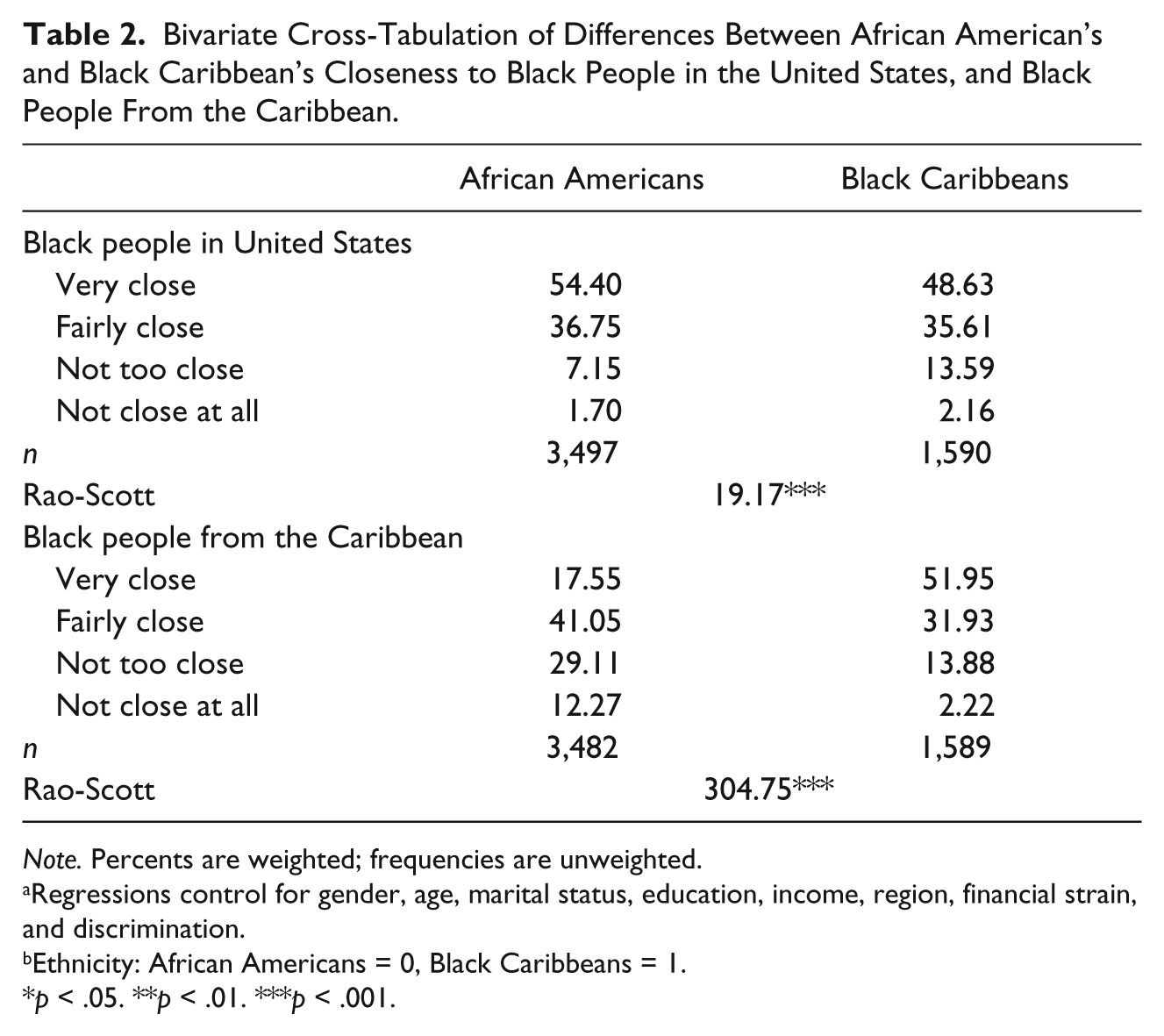
Note. Percents are weighted; frequencies are unweighted.
Regressions control for gender, age, marital status, education, income, region, financial strain, and discrimination.
Ethnicity: African Americans = 0, Black Caribbeans = 1.
p < .05. **p < .01. ***p < .001.
Regression Coefficients for Ethnicity and Feelings of Closeness to Black Groups. a .
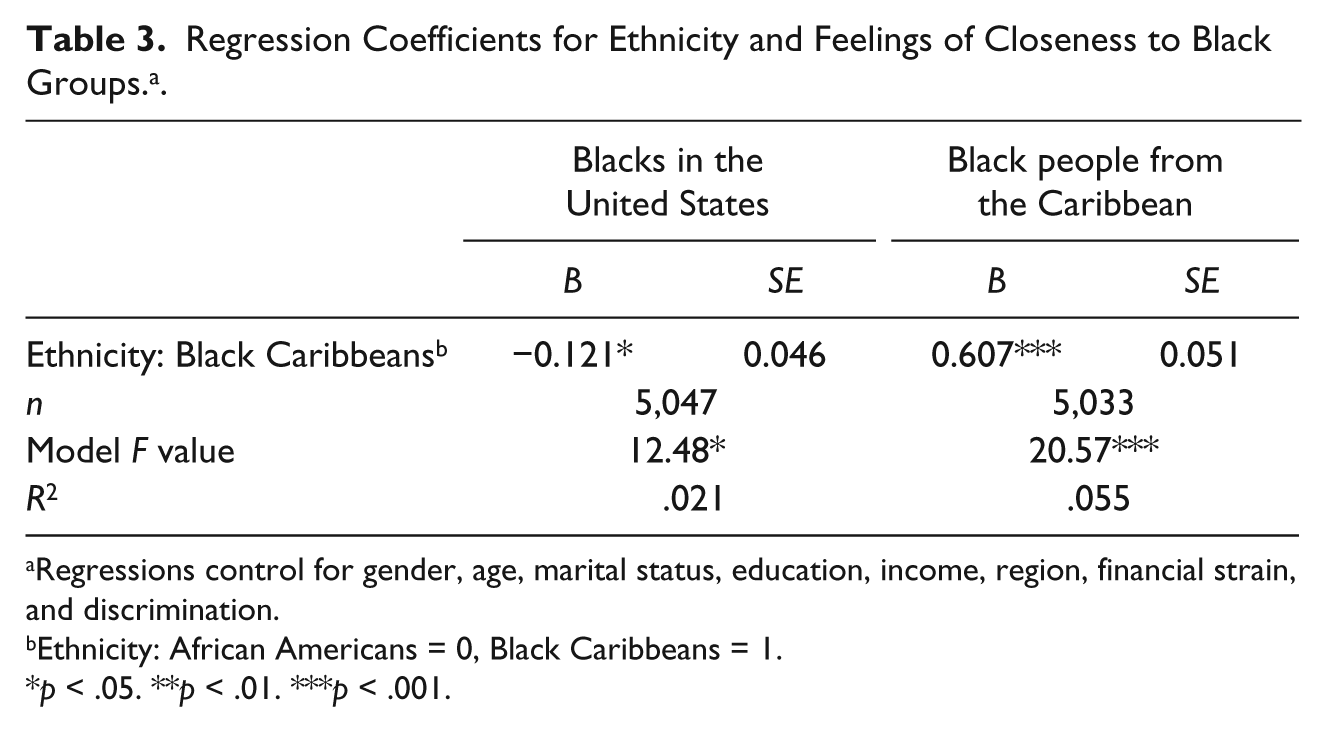
Regressions control for gender, age, marital status, education, income, region, financial strain, and discrimination.
Ethnicity: African Americans = 0, Black Caribbeans = 1.
p < .05. **p < .01. ***p < .001.
Regressions for African Americans’ and Black Caribbeans’ Feelings of Closeness to Black Groups.
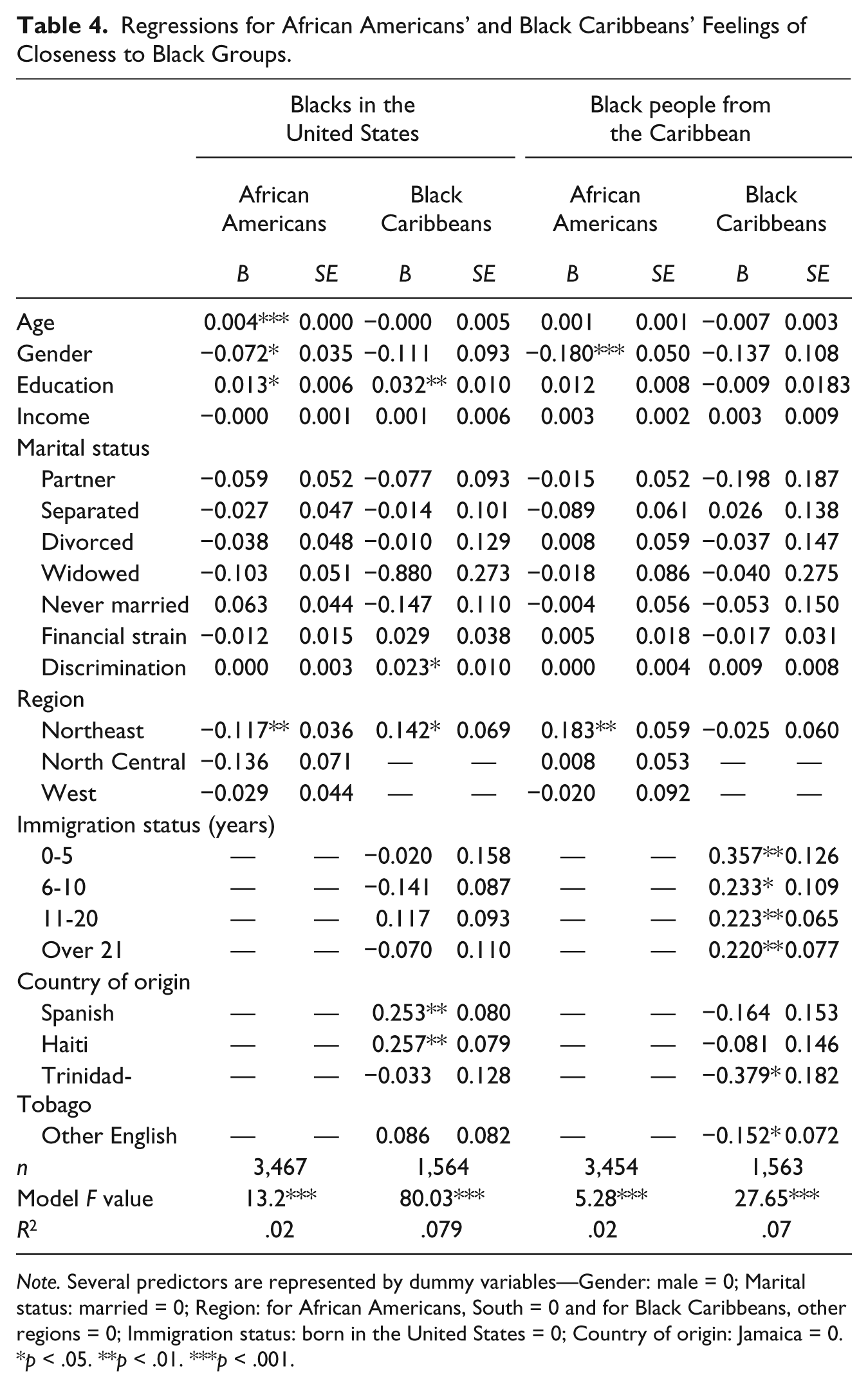
Note. Several predictors are represented by dummy variables—Gender: male = 0; Marital status: married = 0; Region: for African Americans, South = 0 and for Black Caribbeans, other regions = 0; Immigration status: born in the United States = 0; Country of origin: Jamaica = 0. *p < .05. **p < .01. ***p < .001.
Closeness to Black People From the Caribbean
Black Caribbeans report significantly higher levels of closeness to Black people from the Caribbean than African Americans, evident in both the bivariate (Table 2) and multivariate analysis (Table 3). For example, 52% of Black Caribbeans report feeling very close and only 2.2% report feeling not close at all. In comparison, only 17.5% of African Americans report feeling very close and 12.3% report feeling not close at all to Black people from the Caribbean. Regression analysis among African Americans (Table 4) indicates that gender and region are significantly associated with this dependent variable. African American women feel less close to Black people from the Caribbean than do men, and African Americans from the Northeast feel closer than their Southern counterparts. For Black Caribbeans, immigration status and country of origin were significant in that those who immigrated to the United States feel closer to Blacks from the Caribbean than those born in the United States. This association is significant irrespective of the number of years that Black Caribbean immigrants have resided in the United States. Respondents from Trinidad-Tobago and from other countries feel less close to Black people from the Caribbean than persons from Jamaica.
Discussion
Persons of Caribbean heritage, such as Colin Powell, Marcus Garvey, Malcolm X, Harry Belafonte, Nicki Minaj, and Black Enterprise founder Earl Graves have contributed to and been intricately involved in African American life. Even so, it is a consistent refrain that there is “animosity between blacks who entered this country voluntarily by way of the Caribbean, and those whose ancestors came to America chained to slave ships.” Sociologist Mary Waters argued that Caribbean Blacks commonly face enmity in their interactions with native-born African Americans. “There is a great deal of hostility between Caribbean blacks and black Americans,” because “They hold very stereotypical views of each other” (Fullwood, 1995, p. A29).
Our findings support a growing literature that points to a more nuanced and complex relationship between the groups that highlights both their affinities toward one another and the role of race in shaping out-group attitudes (Greer, 2013; Thornton et al., 2012; Unnever & Gabbidon, 2013). African Americans and Black Caribbeans, not surprisingly, feel close to their own ethnic group and, in addition, demonstrate pan-ethnic links as well. Both African Americans (91.1%) and Black Caribbeans (84.2%) indicate that they are very or fairly close to Black people in the United States. In turn, Black Caribbeans felt very or fairly close to Black people from the Caribbean (83.9%), while African Americans held similar but less pronounced feelings of closeness (58.6%) toward them. Although many immigrants may not want to identify with African Americans, they live a racialized social context in which they are regarded as African American. Gaertner and Dovidio (2000) found that more positive attitudes toward out-group members result when people categorize themselves and out-group members in terms of a common, superordinate identity than when they think of themselves as members of distinct groups. In this case, experienced discrimination based on racial status enhances a common racial identity among Black Caribbeans. It is through this recategorization process that other ethnic groups (ostensibly out-groups) become incorporated into individual representations of a racial in-group.
Related to this, regional differences confirmed that Black Caribbeans and African Americans in the Northeast reported higher levels of felt closeness to one another than respondents in other regions of the country. As noted, the Black Caribbean population is especially concentrated in the Northeast region, which provides closer proximity to and interaction with one another. The shared social environment may also highlight common experiences with racial discrimination that serve to heighten a sense of pan-ethnic unity that leads to perceptions of closeness and amicable relationships (Thornton & Mizuno, 1999). Related to this, Black Caribbeans who reported higher levels of everyday discrimination had closer feelings toward African Americans. As Black Caribbeans encounter discrimination and other adjustments to life in the United States, they become more aware of the importance of race in this culture. Facing discrimination may help them understand the salience of race and lead to a stronger identification with the experiences of African Americans and closer feelings toward them as a group (Greer, 2013; Vickerman, 1994, 1999; Waters, 1999a).
Other demographic characteristics were associated with diminished feelings of closeness. African American females were less likely than their male counterparts to feel close to their own and Black Caribbeans, a pattern consistent with previous work (e.g., Thornton & Taylor, 1988a, 1988b). Why this is the case is unclear. Black women are in the unique position of experiencing multiple oppressions (e.g., gender, race, SES) from both within and outside African American communities (Hummer et al., 1999; Szymanski & Stewart, 2010). This context might help explain how many Black women interact with their social worlds. Research suggests that as mothers they are more likely than others to provide racial socialization, teaching their children about the extent and nature of discrimination faced by members of their in-group, as well as strategies to effectively cope with discriminatory treatment (Hughes & Chen, 1997; Hughes & Johnson, 2001; Hughes et al., 2006; Lesane-Brown, 2006; Thornton, 1997). In preparing their children for this environment, Black mothers often incorporate a sense of increased mistrust (Hughes & Chen, 1997; Smith, 2010), perhaps reflected in Black women being among the most resistant to intergroup relations (Childs, 2005).
Moreover, in comparison with males, African American females report receiving higher levels of racial and ethnic socialization (Brown, Linver, & Evans, 2010). Racial socialization are parental strategies conveying explicit/implicit messages about intergroup protocol and relationships, including teaching about racial barriers, coping with racism and discrimination, and negotiating interracial contact (Brown & Krishnakumar, 2007). Ethnic socializations are explicit/implicit messages regarding intragroup attitudes and what it means to be a member of a specific ethnic group, including socialization regarding African American cultural values, cultural embeddedness, history, celebrating African American heritage, and promoting ethnic pride (Brown & Krishnakumar, 2007; Hughes et al., 2006; A. J. Thomas & Speight, 1999). Given their more intense involvement in these practices, African American women may be socialized to be more protective of themselves and their environments than their male counterparts and thus distance themselves from other groups. Interestingly, at least one study suggests that religiosity, particularly being very religious and attending church services more frequently, is related to breaking down those walls with West Indians (Thornton & Mizuno, 1995).
Among both African Americans and Black Caribbeans, education was positively associated with feelings of closeness to Blacks in the United States. African Americans and Black Caribbeans with more education appear more inclined than their counterparts with less education to report closeness with African Americans. There are several potential reasons why for Black Caribbeans, education is positively associated with closeness to Blacks in the United States. Black Caribbeans with higher levels of education may be more astute concerning the operation of discrimination within U.S. society. Persons with higher levels of education may be employed in the professional world that affords them wider contact with African Americans as colleagues, as well as facing their own personal encounters with a racial encounters (e.g., racial glass ceiling) in the workplace (Barrett, 2010). As a consequence, more highly educated Black Caribbeans may be less likely to believe negative stereotypes about African Americans and consequently feel closer to them as a group. Finally, Black Caribbeans with more education may be more knowledgeable about the past efforts of Black Caribbeans, such as Marcus Garvey and Shirley Chisholm, who made substantial contributions to Pan-African movements and the African American civil rights and liberation struggles (Esedebe, 1982; Magubane, 1987; Skinner, 1992; Tillery, 2011). Familiarity with these individuals and pan-ethnic social causes that emphasize the notion of “common fate” for persons of African descent may be influential in shaping perceptions of closeness to African Americans.
The link between Black Caribbeans and African Americans is probably due to a maintenance and substance of a certain “affirmation of race” (Shaw-Taylor, 2007, p. 32), along with a shared African heritage. Furthermore, African Americans’ awareness of significant events within Caribbean and African countries (e.g., dismantling South Africa apartheid, “Haitian boat people”), prominent persons of African and Caribbean descent (e.g., Nelson Mandela, Wyclef Jean, Rihanna), and cultural exchanges (e.g., music, foods, dress) reinforce a shared racial heritage often marked by discrimination. Our findings suggest that African Americans’ and Black Caribbeans’ Pan-African ties reflect symbolic meanings, actual contact and interaction, and shared experiences within racialized contexts.
That 8 of 10 (84%) Black Caribbeans reported being very or fairly close to African Americans suggests a very different picture than the common assertion that relations are strained for these groups or that generational status is associated with felt closeness. Indeed, immigration status was unrelated to feelings toward African Americans, which undercut the idea that there is a generational effect among Black Caribbeans in their feelings toward African Americans. Where immigration status did have a major and clear impact was in Black Caribbean attitudes toward “Black People from the Caribbean.” Consistent with ethnographic research, Black Caribbeans born outside the United States and who immigrated at some point were consistently closer to “Black People from the Caribbean” than those who were born in the United States. This effect was found for all groups of first-generation immigrants—from the very recent (0-5 years) to immigrants who migrated more than 20 years ago. As noted in prior research, first-generation Black Caribbeans closely identify with their national origins (Waters, 1999a). In contrast, second-generation Black Caribbeans, who have grown up in the United States and have a lifetime of experience navigating its racial landscape, express more tenuous ties to people from their Caribbean homeland. Overall, affinity with Caribbean people as a group is a less prominent aspect of the identities of second and later generations of Black Caribbeans.
Country of origin comparisons indicated that immigrants from Haiti and Spanish-speaking countries were much closer in their feelings toward African Americans than Jamaicans. Several factors may be important here. English language skills provide distinct advantages for immigrants across a number of social domains in the United States. Black Caribbeans for whom English is not their first language have an additional characteristic that embodies a sense of “foreign-ness” and increases the likelihood of encountering discrimination and social disadvantage (both structural and in everyday interactions) than their English-speaking counterparts (Kalmijn, 1996; Waters, 1999a). Furthermore, if, in addition, they possess Black-identified physical characteristics (e.g., dark-skin tone), they may encounter the combined effects of both language and racial discrimination. These experiences with discrimination would tend to emphasize race as a master status in very concrete ways and instill feelings of closeness to their African American counterparts. Moreover, because Jamaicans are the largest immigrant group, their critical mass may enable them to distance themselves from African Americans, retain a Jamaican identity, and/or promote an elevated minority status (Model & Fisher, 2002; Waters, 1994). Greer’s (2013) work, in particular, suggests that Jamaicans are advantaged due to their English language skills and better able to embody the model minority stereotype. In contrast, non-English-speaking Black Caribbeans may be less able to exercise that option.
Contrary to findings in the majority of the literature, Black Caribbeans, whether born or immigrating here, do not differ in their feelings of closeness to African Americans. The long-standing assumption has been that Black Caribbeans bring with them different conceptions about race and its importance in life. Related themes suggest that immigrants’ race notions are filtered through nationality and/or ethnic heritage or that individuals attempt to negate race’s impact by investing in beliefs and identities that emphasize that they are better than the Blacks they meet here. While these strategies characterize first-generation immigrants, it is generally thought that subsequent generations become identified with African Americans.
Our findings indicate that something else is operating here. Black Caribbean immigrants are not blank slates when it comes to appreciating their own place in the matrix of U.S. race relations and bring with them a more developed sense of racial consciousness than has been presumed. Today’s technology-driven and communication-accessible world provides immigrants with many avenues by which they can acquire a clearer understanding of what role race plays for all Black ethnics in the United States. In the same way that social, cultural, and political events originating from the Caribbean region and Africa are accessible to African Americans, so events in the United States—both national (e.g., civil rights movement, election of President Obama) and localized (e.g., racial tensions in cities, police violence against Abner Louima and Amadou Diallo)—are known about and closely followed in Caribbean countries.
In summary, our findings provide little evidence of an appreciable rift between Black Caribbeans and African Americans. Some differences were noted in the extent to which the groups viewed one another (Black Caribbeans indicating greater closeness to African Americans than vice versa). Nonetheless, race emerged as an important identity that linked these groups across ethnic lines. The notable split between U.S.-born Black Caribbeans and those who came as immigrants in their feelings of closeness to “Black People in the Caribbean” remains the most prominent divide.
In any case, despite popular rhetoric emphasizing a national community imaged as beyond race (i.e., post-racial America), people of African ancestry, whether immigrants or longtime residents, native or foreign-born, experience a different community and a lived experience that is at its core about race. Our findings suggest that there is no one national community, one identity, but instead there are many. For Black Caribbeans, finding that identity often involves rethinking their home of origin but always within the context of the American landscape rife with racial messages. The present investigation’s use of cross-sectional data from a national sample of Black Caribbeans and African Americans had the advantage of identifying significant within group diversity in the extent and predictors of perceptions of closeness to one’s own and counterpart group. These findings, however, cannot address questions concerning whether and how Black Caribbeans of diverse backgrounds negotiate transformations in individual and group identity (e.g., elevated minority status, ethnic identity, hyphenated American, Black American). These questions are of ongoing interest for many diverse ethnic, racial, and nationality groups as newcomers join the ranks of others in finding their place in the American racial/ethnic landscape.
Footnotes
Acknowledgements
The authors wish to thank the reviewers for their constructive comments.
Declaration of Conflicting Interests
The author(s) declared no potential conflicts of interest with respect to the research, authorship, and/or publication of this article.
Funding
The author(s) disclosed receipt of the following financial support for the research, authorship, and/or publication of this article: This study used data collected with support from the National Institute of Mental Health (NIMH; U01-MH57716) with supplemental support from the Office of Behavioral and Social Science Research at the National Institutes of Health (NIH) and the University of Michigan. The preparation of this article was supported by grants from the NIMH to Drs. Chatters and Taylor (R01-MH082807), and to Dr. Chatters (R01-MH084963) and from the National Institute on Aging for Dr. Taylor (P30-AG15281).