







Abstract
In recent years, there have been a number of examples of African Americans mobilizing around morality politics issues. In Maryland, Black churches and church leaders mobilized against legalizing same-sex marriage. This entailed a more extensive mobilization than for any issue in recent memory. Despite this unprecedented mobilization, a majority of Black state legislators supported a measure legalizing same-sex marriage as the vast majority voted on the basis of their personal attitudes on the issue. This suggests Black legislators may serve as a buffer against Black social conservatism. Examination of this issue yields some important insights in terms of how Black churches mobilize in the contemporary context, perceptions of the political power of the Black church, how conceptions of “civil rights” intersects with this particular issue, and the inadequacy of labels like “progressive” or “conservative” to fully describe many Black political actors—especially when it comes to morality politics.
When the battle over same-sex marriage peaked in Maryland, in 2011 and 2012, African Americans were at the center. Black leaders were in the midst of some of the most controversial moments. It was a Black state legislator who gained national attention for an apparent attempt to silence a professional football player who expressed support for legalizing same-sex marriage. Two Black legislators sparked controversy when they “disappeared” during a key vote. Black churches and ministers were credited with playing a key role in defeating legislation that would have legalized same-sex marriage in 2011. When the legislation was passed the following year, it was a Black minister, with significant support from major Black churches, who coordinated the efforts to collect signatures to get the legislation brought to the public for a referendum—a process that yielded more than twice as many signatures as were needed. As the election approached, advocates on both sides of the issue aggressively courted Black voters with an onslaught of telephone calls, emails, mailings, and targeted television and radio commercials, as both sides had judged that Black voters would be critical to the outcome.
The involvement of Black Marylanders in the same-sex marriage issue was just one of the most recent examples of Black involvement in morality politics that has emerged in the last decade. Black political mobilization around morality issues like homosexual rights or abortion have become increasingly visible since the run up to the 2004 presidential election (Tucker-Worgs, 2011). Given the contrast between these issues and the issues around which Black people have traditionally mobilized (anti-discrimination, economic rights, police brutality, education etc.), this emergent Black morality politics has some important implications. This article attempts to further our understanding of this arena for Black political engagement.
Scholars who have studied the politics around “morality policies,” have had some consistent findings. We are particularly interested in the findings that morality issues have higher levels of public participation and that policy makers tend to be more responsive to public opinion (or what they perceive public opinion to be) on these issues, than on other non-morality issues (Mooney & Schuldt, 2008). Was this also the case for African Americans in Maryland? Was there a higher level of public participation among Blacks around the issue of legalizing same-sex marriage than is typical for public policy debates in Maryland? Did constituents’ attitudes drive the actions of Black state legislators?
To begin to answer these general questions, we ask two specific questions. First, in order to get a picture of Black mobilization around this issue we specifically ask if Black churches and church leaders participated at a higher level than is typical for a policy issue in Maryland. We expect them to be key in any mobilization on social morality issues given that the attitudes surrounding these issues tend to emanate from churches or follow religious sentiments, and the fact that Black churches have historically been a locus for political mobilization. Second, we look to the Black state legislators, most of whom represent predominantly Black districts, and ask if their decisions were driven by the attitudes of their constituents. To answer the second question, we look at the role and responses of Black state legislators and explore the influences on their voting decisions. We also look at the reaction of the broader Black population by considering the attitudes and votes on the issue when it was before voters as a ballot referendum during the 2012 general election.
Our analysis reveals that there was indeed a higher level of participation among Black churches and church leaders than other policy issues. In fact, this issue appears to have entailed the most extensive mobilization of the Black church on a state policy issue in decades. The extensive participation of Black churches in the efforts to stop the legislation illustrate the potential political impact of Black churches, their capacity to mobilize individuals, and the manner in which they mobilize for political objectives in the contemporary context. The actions of the Black legislators were not consistent with the attitudes or actions of the broader Black public. Despite the fact that a consistent majority of the Black public opposed same-sex marriage, a clear majority of Black legislators voted to support legalizing these marriages. Furthermore, when the issue was put before voters, a majority of Black voters cast their ballots against the measure. This divergence seems to be the result of most legislators voting on the basis of their own attitudes, not on the stance of their constituents. Yet, it is clear that some legislators were moved by the mobilization of their constituents against the bill, suggesting that more might have voted differently had they felt more pressure.
Ultimately, this article tells two inter-related stories. The story of Black churches and church leaders mobilizing at unprecedented levels to try to prevent the implementation of a policy that they opposed, and the story of Black legislators who were acting in a context significantly impacted by the actions of these churches and church leaders. In uncovering these stories, our analysis also reveals some interesting insights regarding perceptions of the political potential of the Black church, how conceptions of “civil rights” impacted how people understood the issue, and the inadequacy of labels like “conservative” or “progressive” to fully describe many Black political actors.
We begin with a brief discussion of the emergence of Black morality politics, followed by an overview of what took place in Maryland. We then give an in-depth discussion of the roles played by Black churches and church leaders, Black state legislators and finally the Black voters. We conclude with a discussion of some of the key insights related to this issue in particular, and Black politics in general.
The Rise of Black Morality Politics
We use the term “Black morality politics” to refer to the political mobilization among African Americans around “morality policy” issues. Mooney describes morality policy issues as those for which at least one coalition of advocates portrays the issue as one of “morality or sin” and uses moral arguments to promote their policy preference (Mooney, 2001, p. 3). Studler (2001) emphasizes that “morality policy conflicts are principally about values, not the economics on which most non-morality policy centers” (p. 38). These debates are “framed in terms of fundamental rights and values, often stemming from religious imperatives” (Studler, 2001, p. 39). While many issues can be framed in the context of morality (e.g., poverty, homelessness, or discrimination), “morality politics” centers on policies related to issues of individual morality—with the most prominent issues in recent years being same-sex marriage and abortion rights.
Although the political mobilization of African Americans around morality policy issues is a fairly recent phenomenon, it has been well documented that African Americans have long-held socially conservative views on a wide range of issues (Pew Research Center, 2012; Tate, 2010). Moreover, individual morality has been an element of Black political action in the past, though not in the manner we see today. In the late 19th and early 20th centuries, for example, individual morality and character building were viewed by many as key to racial uplift. What has been described as the “politics of respectability” captures the essence of this sentiment (Higginbothom, 1994). Historians have noted however that the sentiment was one element of a broader strategy for racial uplift and improvement—aimed at expanding rights and opportunities for African Americans. Higginbothom (1994) makes this point in her description of the women’s movement in the Black Baptist church. She notes that,
Through the discourse of respectability, the Baptist women emphasized manners and morals while simultaneously asserting traditional forms of protest, such as petitions, boycotts, and verbal appeals to justice. Ultimately, the rhetoric of the Women’s Convention combined both a conservative and a radical impulse. (p. 187)
During that era and throughout the 20th century, African Americans’ political mobilization centered on expanding political, economic and civic rights, and opportunities for Blacks, not on implementing, or protecting policies that sought to enforce codes of individual morality. Even for those who wove individual morality into their agendas, their promotion of individual morality (which they did believe in) was emphasized as a means to increase the likelihood of the expansion of rights for African Americans.
More recently, we have seen examples of a shift—where morality is sought through state action, but not as part of an agenda to expand rights. While advocates do claim that they seek to improve the conditions of Black people, their agenda is not a claim for expansion of political or economic rights. They argue that the Black family is under attack and needs to be preserved and protected. This preservation will in turn lead to improved conditions for the Black masses. The sentiment has manifest in a number of instances of political mobilizations behind this agenda (Tucker-Worgs, 2011). The last decade has seen various coalitions, marches, mobilizations against same-sex marriage legislation, as well as mobilizations in favor of legal restrictions on same-sex marriage.
Students of the politics surrounding morality policy have found that these politics differ from policymaking around non-morality issues. In particular, they have found higher levels of citizen participation and that “morality policy politics are driven strongly by public opinion, or at least by elected officials’ beliefs about public opinion” (Mooney & Schuldt, 2008, p. 202). Here we are concerned with whether or not this is also the case for African Americans in Maryland, as advocates in that state sought to legalize same-sex marriage. Again, we set out to answer two questions. First, was there a higher level of participation among Black churches and church leaders around the issue of legalizing same-sex marriage than is typical for public policy debates in Maryland? Second, were the actions of Black state legislators driven by constituent attitudes on the issue? To answer these questions we interviewed church leaders, Black state legislators, and key activists. We also reviewed media accounts, advocates’ literature, websites, signage, television and radio advertising, mailings, polling data, financial reports, and voting returns. These sources provide a clear picture of the activities, efforts, and sentiments within Maryland’s Black communities. We turn now to a brief overview of what took place in Maryland.
Legalizing Same-Sex Marriage in Maryland
As the issue of same-sex marriage came to a head in Maryland, the state’s politics were (and still are) dominated by the Democratic Party. The Party controlled all of the statewide elected offices including the governorship, had a better than two to one majority over Republicans in both chambers of the legislature, and held a similar two to one Democrat to Republican advantage in terms of registered voters. Importantly, Blacks, who have opposed same-sex marriage at higher rates than the broader population (Sherkat, Mattias de vries, & Creek, 2010), are a key component of the Democratic coalition that governs the state. Black voters comprise a significant portion of the electorate (approximately 29%), while Black legislators comprise almost one third of the Democratic legislators. 1 Thus, while legalizing same-sex marriage was supported by Democrats, the Black component—and the attitudes of Blacks on the issue had the potential to prevent the passage of the legislation.
In 2012, same-sex marriage became legal in Maryland, as a result of the passage (and a subsequent supportive referendum vote) of the Civil Marriage Protection Act. To understand how the issue was resolved in 2012, one must first look back to a failed attempt to pass the legislation in 2011. Same-sex marriage legislation had been floating around the legislature for almost a decade, but no bill had ever made it out of committee. At the beginning of the 2011 session, word was out among legislators that legislation legalizing same-sex marriage would likely make it out for a floor vote. 2
The bill passed in the Senate, but was ultimately derailed in the House. Participants attributed the failure to the efforts of church and religious folks, most notably the Black church. Perhaps the most controversial moment occurred with the shift in position of Del. Tiffany Alston. Alston, an African American freshman legislator representing a district in Prince George’s County, had signed on as 1 of the 59 co-sponsors of the bill. However, she came under major pressure from church leaders and churches in her district. Alston became the center of attention when she and a colleague “disappeared” from the legislature when it came time to vote to send the bill out of the Judiciary Committee. She later acknowledged that the outcry had forced her to shift her support for the bill.
I feel really strongly that people who love each other should be able to get married, no matter what their gender. But I also realize that that’s not my function here. I’m here to represent the 110,000 people back home, many of whom had called and e-mailed and said, “We don’t want that bill.” (Thomas-Lester, 2011)
Although the bill was ultimately brought to the floor, it was later withdrawn when chamber leaders determined they did not have the votes to pass.
The 2012 legislative session brought the issue back to the forefront. This time the issue was being pushed by the governor, Martin O’Malley. The governor’s leadership on the issue seems to have pushed it through the House. O’Malley, who was on record as opposing same-sex marriage (Kilar, 2012), had previously claimed to favor of civil unions. But, much like President Obama, O’Malley claimed to have evolved his position to one of support for same-sex marriage. 3
When the final votes were tallied, the vote was 25 to 22 in the Senate, with the Black legislators splitting their vote with 6 in favor, and 3 opposed. In the House, the vote was 72 in favor and 67 opposed, with 20 Black delegates voting for the measure, and 13 voting against. Yet, this was not the end of the matter. Opponents of the bill, early on anticipated that they might lose the vote in the legislature. The measure was passed—but with an amendment (offered by Del. Alston) allowing for a delay in implementation if a referendum petition would be submitted by a set date.
As the legislative fight concluded, opponents commenced a massive petition drive to get the measure placed on the November ballot. These efforts were led by Rev. Derek McCoy and the Maryland Family Alliance (MFA), a nonprofit group based in the Black community. They would eventually collect more than twice the number of required signatures, and successfully got the measure placed on the ballot as “Question 6.” Once the referendum was secured, they then shifted their efforts to leading the battle to mobilize and persuade voters to oppose the measure. Ultimately, Maryland voters approved the measure with a close vote—52% in support and 48% opposing legalizing same-sex marriage.
The Church and Church Leaders
Some of the strongest opposition to legislation expanding marriage rights to same-sex couples resides within the Black community—and particularly within the churches. Black churches were a key part of the political battle over same-sex marriage in Maryland. In 2011, Black churches and Black church leaders were key in the successful effort to stop the passage of the legislation. In the following year, the efforts of those opposed to the legislation ultimately failed, but they did have some successes along the way—due to a range of political activities and strategies which reveal a bit of the potential of the mobilized church.
As the legislation was being considered, Black churches and Black church leaders engaged the issue in a number of ways. Leaders lobbied legislators and mobilized congregants to express their opposition via letter writing, phone calls, and rallies at the state capitol in Annapolis. They provided form letter templates, post cards, information on how to contact a legislator, as well as talking points. One church, the First Baptist Church of Glen Arden, brought five buses of people to the capitol to demonstrate against the passage of the legislation. When hearings were held, Black ministers and church members filled the roster of witnesses who wanted to testify against the bill.
Their presence and efforts were noted and felt. Legislators we interviewed described seeing large numbers of church folks and ministers at the capitol. All acknowledged that this was the most they had ever seen the Black churches mobilized around an issue. As Del. Alston acknowledged, she was swayed by the outcry of the opposition in her district which came largely from Black churches (Thomas-Lester, 2011).
There were many individual churches and pastors who made comments or held events, but much of the effort was coordinated through coalitions. In Baltimore, a coalition of Black ministers led by Rev. Errol Gilliard (widely acknowledged as the loudest voice coming from Baltimore) was active and outspoken in its opposition. Legislators commented on seeing the reverend “and his group” roaming around the state capitol. At the center of the opposition, however, was the MFA, led by Rev. Derek McCoy. McCoy, who had coordinated much of the efforts in 2011, was well integrated into national efforts opposed to same-sex marriage and had a history of activism. He had even spent time in California in 2008, mobilizing Black voters in support of that state’s ballot Proposition 8 when voters approved a constitutional amendment limiting marriage to a man and a woman. 4
To coordinate the opposition efforts in Maryland, McCoy and others formed a new group—the Maryland Marriage Alliance (MMA), with McCoy as chairman. This new group was multiracial, bi-partisan, and included a range of faith groups—including the Catholic Church. The MMA paid special attention to Black communities and emphasized grassroots organizing through the churches. They consciously targeted Black legislators because they felt these legislators’ constituents were against the bill. Importantly, McCoy and others suggested that the issue was of particular importance to Black communities. Same-sex marriage was viewed as yet another assault on the culture of marriage. As one of the leading activists explained in our interview, the Black family is “under siege.” Black communities are beset by a range of social problems, much of which can be attributed to the “demise” of “in-tact families.” This battle amounted to a “Custer’s last stand” in defense of marriage. Their objective was to prevent the “further demise of the family.” Same-sex marriage would further erode the culture of marriage, as it “devalues our concept of marriage.” 5
The MMA, which was the key actor in the coalition opposing the legislation and coordinated much of the anti-same-sex marriage effort that occurred in 2012, was supported by national groups and activists opposed to same-sex marriage. For example, the political action committee (PAC) they formed for the run up to the referendum was the recipient of over US$1.2 million from the National Organization for Marriage, and their ad campaign was facilitated through a firm led by a consultant who had been key in same-sex marriage battles in other states—including California, North Carolina, and Minnesota (Linskey, 2012; Maryland State Board of Elections, 2012).
As the legislation passed in 2012, the MMA had already begun to plan for a petition campaign to have the measure placed on the ballot. This action required extensive grassroots organizing and collaboration among a variety of other groups, but at the center was Rev. McCoy and many Black churches. Petitions were gathered at numerous Black churches, and key Black churches served as hubs for collecting petitions. McCoy and others had a rather shrewd strategy. They targeted five key jurisdictions—Anne Arundel, Baltimore, Montgomery and Prince George’s counties, and Baltimore City—the most populous jurisdictions. They understood that previous petition efforts had failed because of improper signatures, so they focused much of their efforts on training petition gatherers. Area “coordinators” held countless training sessions at their Annapolis headquarters, and at other sites around the state where they emphasized talking points and requirements for petition signers. The people they trained then trained others. They claim to have trained over 3,000 people who served as “circulators,” who collected signatures. They sent speakers to various churches. McCoy and others delivered sermons, and had petition drives everywhere they could. The efforts were so successful that they ultimately submitted more than 160,000 signatures, when only about 56,000 were actually needed.
Once the ballot referendum was secured, the MMA shifted their efforts to trying to influence and mobilize voters to vote “No” on Question 6. They used much the same tactics as during the petition drive—emphasizing grassroots mobilization through the churches. McCoy and others traveled the state giving sermons and speaking at churches, and added a media campaign complete with commercials and press conferences.
During 2011 and 2012, a wide range of Black churches mobilized to oppose the marriage legislation. Particularly noteworthy was the role of the Black megachurches. 6 Given the size of their congregations and their resources, these churches have tremendous potential to impact political issues in ways that smaller churches cannot. A number were clearly involved in this campaign, and some observers, including legislators interviewed for this study, attributed great influence to megachurches in Prince George’s County. Below, three examples highlight the range of activities of Black churches and ministers.
Mt. Pleasant Church and Ministries, Baltimore City
Behind the leadership of the pastor, Bishop Charles Johnson and their associate pastor Rev. Daryl Brace, Mt. Pleasant was one of the most active churches in Baltimore. Rev. Brace testified at legislative hearings and lobbied legislators. The church not only circulated petitions, but served as one of the central drop-off points for petition gatherers.
Reid Temple, African Methodist Episcopal (AME) Church in Prince George’s County
Pastor Lee P. Washington also preached against same-sex marriage and spoke out against it in the media. The church actively circulated the petitions to get the measure placed on the ballot. The pastor garnered much media attention when he came to the defense of one of his members, Dr. Angela McCaskill. McCaskill had been placed on paid administrative from her job as Chief Diversity Officer at Gallaudet University in Washington, DC, for signing the petition. Washington sent out a press release supporting McCaskill. He said she should be able to sign the petition as a matter of “religious liberty” and as a “citizen of the United States.” He took the opportunity to emphasize the need to oppose same-sex marriage, stating,
The unfair treatment of Dr. McCaskill is a warning of what is to come if same-sex marriage becomes law in Maryland. It is a clarion call for Marylanders who value religious liberties and individual rights to vote against Question 6. (Washington, 2012)
McCaskill’s situation became a bit of a cause célèbre of the opponents. She appeared in television ads put out by the MMA, national organizations like the Family Research Council called for her reinstatement, and suggested that her suspension was reflective of what was to come if same-sex marriage laws are passed. Locally, Black ministers protested and held a rally at Gallaudet demanding that McCaskill be reinstated.
The First Baptist Church of Glenarden, Prince George’s County
Congregants and their pastor, Rev. John Jenkins, were very active in the campaign. As with many other pastors, Rev. Jenkins preached against same-sex marriage and made statements in the media. As noted above, on one occasion they sent five busloads of congregants to Annapolis to rally against legalizing same-sex marriage. The church was active in terms of collecting signatures for the petition and Rev. Jenkins was noted as a key supporter of the efforts of the MMA. The church even had a Facebook page dedicated to the campaign. The site provided information on contacting legislators, offered sample form letters, gave notice about rallies and petitions, and provided a forum for sharing concerns about the issue.
These are examples of active churches, yet what is notable about the megachurches in Maryland, is actually how few were very active in the campaign against same-sex marriage. Of the 20 Black megachurches in Maryland, only 5 were active in significant ways. There were other megachurch pastors who supported the opposition, yet did little other than circulate petitions and offer behind the scenes moral support to the opponents of the legislation. Most of the Black megachurches—and their ministers, however, did very little. It was an activist minority that was able to make its presence and stance known and felt. In fact, there were some megachurches that were conspicuously missing. With the exception of Mt. Pleasant, the megachurches in Baltimore were not involved in the lobbying and mobilization around the passage of the legislation, and the petition drive. Two of the best-known ministers from Baltimore, made public statements to the media and expressed support for the opponents when the issue was placed on the ballot, but were not publicly active when the issue was before the legislature. One was outspoken in national and local media after the president’s statement in support of same-sex marriage, yet a legislator in whose district this minister’s church is located stated bluntly, that he or she had not heard “one word” from the minister while the issue was being considered in the legislature.
This is reflective of the broader universe of Black churches. While there were many churches involved in the battle against same-sex marriage, most churches did very little if anything. A minority participated, and even fewer participated loudly, as many were quiet supporters. Our interviews with ministers revealed a common theme. Most opposed same-sex marriage legislation, but did little about it other than maybe preaching in support of the biblical definition of marriage. They did not consider it a priority for political mobilization.
One of the key characteristics of the mobilization around this issue was the difference in the mobilization of churches in Baltimore versus Prince George’s County. All of our interviews suggested that there was a stronger, more organized opposition in Prince George’s than in Baltimore. While the reasons for this difference are not clear, there does appear to have been an impact of this divergence.
One of the most intriguing aspects of this issue was the outspoken advocacy in support of legalizing same-sex marriage. Two Black ministers stand out in this regard, and their names came up repeatedly in interviews as well as in the media. Rev. Dante Hickman of Southern Baptist Church in Baltimore and Rev. Delman Coates of Mt. Ennon Baptist Church in Prince Georges County, one of the county’s megachurches. Each made multiple comments in the media, and appeared in television ads supporting Question 6. Coates made multiple appearances in national media outlets supporting the legislation. When the legislative hearings opened in 2012, Coates and Hickman were the first two witnesses to testify in support of the legislation after Governor O’Malley, who sat between them.
In all, we see that Black churches and ministers were central to the unfolding of the issue in Maryland. There was substantial mobilization around the issue. As many of our interviewees commented, it was the most extensive mobilization of Black churches and ministers that anyone could remember. Most of their activity was in opposition to the legalization of same-sex marriage. They used a wide range of political strategies—lobbying, letters, emails, protests, and rallies, used their churches as organizing hubs and centers for raising funds, and allied with other faith groups in the state and national conservative groups. While the legislation ultimately passed and was victorious in the referendum, the Black church led efforts to stop it had some successes despite the limited proportion of churches that participated. This suggests the potential for the mobilized “Black church” to be politically impactful in Maryland.
Black State Legislators
During the 2011 and 2012 legislative sessions, Black legislators occupied a significant portion of the state’s legislative seats. In a legislature dominated by Democrats (35 of 47 Senators, and 98 of 141 in the House of Delegates), Blacks comprised almost a third of the Democratic legislators with 9 in the Senate and 34 in the House. 7 Thus, as a group, Black legislators had the ability to have a major influence on the passage of legislation. This fact was not lost on either the opponents or the advocates for same-sex marriage. Certain Black legislators were the targets of much effort to influence the fate of the bill.
The votes of the Black legislators differed a bit from their Democratic colleagues. While a majority of the Black legislators in each chamber voted in support of the legislation, their votes were divided (6 to 3 in the Senate and 20 to 13 in the House). The Black legislators were more likely to oppose the Bill than their fellow Democrats. While in the Senate, Black and non-Black Democrats voted at about the same rate (roughly one third opposing the legislation), in the House, Black delegates were twice as likely to vote against the bill (40% vs. 20%).
One of the most interesting characteristics of the Maryland Black legislators’ votes was the difference between the votes of the Prince George’s County legislators and those from Baltimore City and Baltimore County. 8 Prince George’s County, which borders Washington, DC, has the largest Black population in the state. It has been noted as having the most affluent Black population in the United States, despite being the home of significant economic diversity. The six Black Senators from Baltimore all voted for the bill, while the three Black Senators from Prince George’s, voted against it. While 11 of the Black delegates from Baltimore voted yes, and 4 voted against the bill, 6 of the Black Prince George’s delegates voted yes, and 7 voted against the bill.
The difference between these two areas brings us to the question of the primary influences on the legislators’ voting decisions. When asked about this disparity, the legislators we interviewed pointed to the personal attitudes of the legislators and constituent preferences (and the mobilizations behind those preferences). In regard to constituents—both Prince George’s and Baltimore legislators pointed to the mobilization of churches in Prince George’s, and the absence of a similar organized effort in Baltimore. Interestingly, many legislators also pointed to a variety of characteristics they attributed to the legislators and residents from the two areas. Prince George’s legislators were said to be “less worldly” than those from Baltimore; Baltimoreans in general were said to have fewer social and moral boundaries; Prince George’s legislators were “more independent,” while Baltimore legislators made their decisions based on their “personal relationships with members of the gay caucus.” More than one respondent noted that “Baltimore had more openly gay legislators,” and suggested that had a significant impact. While these responses were typically off the cuff generalizations, what was important was the sense that the difference was perceived as resting with the personal attitudes of legislators and the differences among their constituencies.
The question of the key influences on legislative decision making is an important one, and key to understanding the trajectory of Black morality politics. Scholars who have looked specifically at legislator behavior on morality issues have come to some consistent conclusions. Constituency preferences are said to be highly important as these issues entail higher than normal levels of citizen participation and studies suggest that policy makers tend to be more responsive to citizen values in this realm than on non-morality issues (Mooney, 2001). Yet, studies have also found a relationship between legislator religious affiliation and decision making, suggesting that legislator’s personal attitudes are a key factor in decision making (McTeague & Pearson-Merkowitz, 2013). Focusing specifically on gay rights issues, Haider-Markel (2001) found that partisanship, ideology, religious affiliation, and constituency preferences all drive legislator behavior.
Taken together, the past research suggests an array of influences centering on constituents whose preferences are shaped by religious and ideological/cultural characteristics and who are deemed to be more active and influential in the realm of morality policy than in non-morality issues and the individual legislator’s attitudes (based on ideology, partisanship, cultural, and religious affiliation; Mooney, 2001; Oldmixon, 2002). The analysis of Black legislators in Maryland supports the notion that these two factors are key, and suggests a third key factor was also at play—political party strategy. For most of Maryland’s Black legislators, the primary influence appears to have been their personal attitude on the issue. Yet, for a small number of legislators, constituent preferences, and party strategy were the primary influences on their vote.
Legislator Attitudes
The primary influence on the voting decision of most of the legislators seems to have been their personal attitudes on the issue. Not surprisingly, most of the interviewees attributed their own vote to their conscience and personal feelings on the issue. The one exception was a legislator who claimed he or she felt a responsibility to the Democratic Party (discussed below). The nature of these interviews, and the context in which they voted, made their statements somewhat compelling.
First, a consistent theme across all of the interviews with legislators was that this issue was the most divisive and most personal that any of them had faced while in the legislature. When asked about the key influences on their votes, those who voted yes emphasized an opposition to discrimination and a sense of compassion for same-sex families. 9 Multiple respondents made mention of the personally moving stories of families who came out to support the legislation. They made reference to their relationships with the openly gay legislators—and highlighted the role of these legislators in appealing to colleagues to support the legislation. For example, Mary Washington, the only openly gay Black legislator, was cited as being influential.
Supporters of the measure spoke of debates they had with ministers and three noted the conflict they had in their own churches. One legislator noted that she was a member of a socially conservative Baptist church—yet, she made the point that on the marriage issue, “I think they’re wrong.”
On the other side, there were interviewees who were very convincing that they personally opposed same-sex marriage. One particularly convincing delegate stated that he would have supported civil unions, but drew the line at marriage. He claimed that he was under no great pressure from the churches in his district, nor was he under any great pressure from the Party or the governor. He claimed, “They knew where I stood.” It is notable that the other legislators in his district voted differently.
More compelling than the case they made for themselves, was the suggestion that their colleagues cast their votes based on personal positions on the issue—even when describing those who voted differently from themselves. The general sense of our respondents was that most of their colleagues voted with their own attitudes. In reference to some specific colleagues they attributed qualities like a “sense of social justice,” or the “protection of civil rights.” Opponents of the bill were said to be voting based on a “conservative ideology.” To be sure, they were often unflattering in how they described those on the opposite side of the vote; describing opponents as “unenlightened,” limited in their “world views,” or persuaded by their personal connections and relationships with gay legislators, rather than “objective reason.”
There were a number of legislators for whom it was easy to accept that they were voting with their personal position on the bill. Mary Washington, is one of course, and Del. Emmitt Burns is another. Burns, also a minister, was probably the most outspoken of the Black legislators in opposition to the bill. He gave what many felt was compelling testimony in the hearings, refuting the notion that the bill was about civil rights. He called upon his history as a civil rights activist in Mississippi in the 1960s and rejected the equation of marriage equality with civil rights. It was Burns who gained national attention when he wrote a letter to the owner of the Baltimore Ravens after a player made statements in support of same-sex marriage. Burns’ letter suggested that the player, Brendan Ayanbadejo, “concentrate on football and steer clear of dividing the fan base,” and that the owner “take the necessary action, as a national football franchise owner, to inhibit such expressions from your employee” (Pyles, 2012).
Political Party
While personal attitude was probably the most significant factor, party strategy was also a key influence for certain legislators. As noted, only one of the interviewees claimed to cast a vote against his or her personal position. That legislator claimed that his or her vote was based on allegiance to the party. It is important to note that there were Democratic party leaders in both chambers that voted against the legislation, including the Senate president. When it came to the House, Speaker Michael Busch told Democratic delegates it would be a “conscience vote.” This meant that the party would not pressure people to vote, and there would not be any consequences for how votes were cast. This was said in both sessions (2011 and 2012). But it seems that was not completely the case. All of the interviewees suggested that the Governor’s role in 2012, made the difference. When he put it on his agenda, many felt it became a party bill.
The Governor actively called and met with legislators. Importantly, the focus of attention was on those whose votes were thought to be in play, or “on those who were Nos but people thought should be Yes’s.” They were called in to meetings to see what could be done to sway them to voting for the legislation. We do not know what was said in these meetings. Some suggest deals were made, others that political cover was offered, along with small favors; some say threats were made. It is unclear how aggressive and strong the governor came, as the interviewees who voted “No” claimed they did not expect a major punishment. It should be noted that redistricting process was underway at the same time, and did seem to work to the disadvantage of at least one Baltimore legislator who opposed the bill.
The governor’s efforts swayed only a handful of votes, but that was all that was needed. While there was no recorded vote in 2011, it was widely held that there were only 67 yes votes in the House, when 71 were needed. In 2012, there were 72 votes for the bill. Only a few legislators changed their vote. It seems that 2 or 3 were Black, one of whom was interviewed for this study. This legislator, who was in a position of leadership claimed that when the governor made it a party bill, he or she felt like he or she had to vote “Yes,” if (“and only if”) his or her vote was necessary for passage. In fact, the legislator was one of the last to actually cast a vote. The legislator had been “a solid No” but felt his or her standing in the party required that he or she support the bill. He or she felt a sense of responsibility to the party and stated bluntly, “the institution is more important” than the individual legislator.
Not all legislators felt this way of course. The House majority Whip, Talmadge Branch (an African American) was public in stating his opposition to the bill, and attributing that stance to the position of the churches in his Baltimore City district (Wagner, 2011). Branch did not lose his leadership position—although one of the legislators interviewed questioned why that had not happened.
Constituent Preferences
As noted above, this issue brought the most extensive mobilization of the Black churches and church leaders that legislators could remember. As such, it is consistent with earlier findings of increased levels of citizen participation on moral policy issues (Mooney, 2001). While it seems to have been less impactful than the legislators own attitudes, constituent preferences were a key factor for at least a subset of the Black legislators.
To begin with, observers were surprised by the mobilization that took place in the 2011 session. Delegate Alston for one, acknowledged that the outcry made her rethink her vote. Her actions of course helped to defeat the bill in that session, but she did vote for legalizing same-sex marriage in 2012. Other delegates also claimed their vote was based on their districts. Two of the four Baltimore legislators who opposed the bill each claimed they were reacting to the will of the churches in their district (the 45th). Both Cheryl Glenn and Talmadge Branch pointed to the opposition of the district’s Black churches as the reason for their vote (Linskey & Bykowicz, 2011; Wagner, 2011). During the floor debate, Glenn claimed, “Black Churches have never asked us for anything . . . They are asking us now, ‘Don’t use the word marriage’” (Linskey & Bykowicz, 2011).
The legislators interviewed suggested that there were certain legislators who had voted with their district rather than their own feelings on the issue. For example, in commenting on two particular Prince George’s delegates (both of whom voted No), one legislator claimed that they “both know their district.” They believed that these particular delegates, like Alston in 2011, were responding to the sentiment of their district. There was much mention of the role of the mobilized churches in Prince George’s. The sense was that the legislators from the districts where these churches were located were under extreme pressure. As one noted, the districts where the pressure was the greatest are the districts where the legislators voted against the bill. A number attributed this pressure to the Black megachurches in the county. A Prince George’s legislator who supported the bill even noted that she “[did not] have any megachurches” in her district—implying that meant less pressure to oppose the bill. The general sense was that constituent preferences manifest through the mobilization of the churches was key for some specific Prince George’s legislators.
In contrast, the Baltimore legislators emphasized the relative impotence of the Baltimore churches. Notwithstanding the public comments of Branch and Glenn, those we interviewed did not feel the Baltimore churches wielded sufficient power to move legislators who wanted to vote for the bill. One Baltimore legislator noted there was not much of an outcry from within her district, and in fact she had not heard from the megachurches in the district. She concluded that, “the community did not care enough about it.”
The Baltimore legislators essentially said they did not feel the pressure to vote against the bill. This was based on the lack of mobilized pressure, but also on their reading of their districts. All of the legislators interviewed noted that their districts were closely divided. Importantly, there was a sense among all of them as well that there would not be an electoral consequence to their vote. Most emphasized that their reelection would be more dependent on constituent services than on controversial votes.
One is left to wonder if the vote would have been the same if the Baltimore churches that opposed the measure were more organized and mobilized. The Baltimore legislators were free to vote the way they felt. But what if they had been pressured?
Maryland’s Black Voters
It is clear that the legislators differed with the broader Black population. As noted already, Blacks have opposed same-sex marriage at higher rates than the rest of the population (Sherkat et al., 2010). This was the case in Maryland throughout the 2011 and 2012. Opinion polls consistently showed that Blacks continued to oppose same-sex marriage at a higher rate than the rest of the state’s population. One pollster found that majority of Black residents opposed same-sex marriage in both 2011 and 2012, with 59% and 60% opposing in each respective year, versus a majority of the White population supporting same-sex marriage (51% and 55%, respectively; Gonzales, 2011, 2012). After passage of the measure in the legislature and as the referendum approached, Black opinion remained opposed. In the days preceding the election a Washington Post poll found 53% opposed the measure as 42 supported it, while 52% of the overall population supported it and only 43% opposed (Wagner, Davis, & Craighill, 2012).
Black opposition continued through to the election. According to exit polls conducted on election day, a majority of African Americans, 54%, voted against the legalization of same-sex marriage, while 46% supported it (Blake, 2012). These results stand in contrast with the majority of Black legislators who supported the legislation. Interestingly, if one looks at the majority Black legislative districts, it seems that most of the Black legislators voted in a manner consistent with the majority of their voting constituents (see Table 1).
Vote for Question 6 in Predominantly Black Districts.
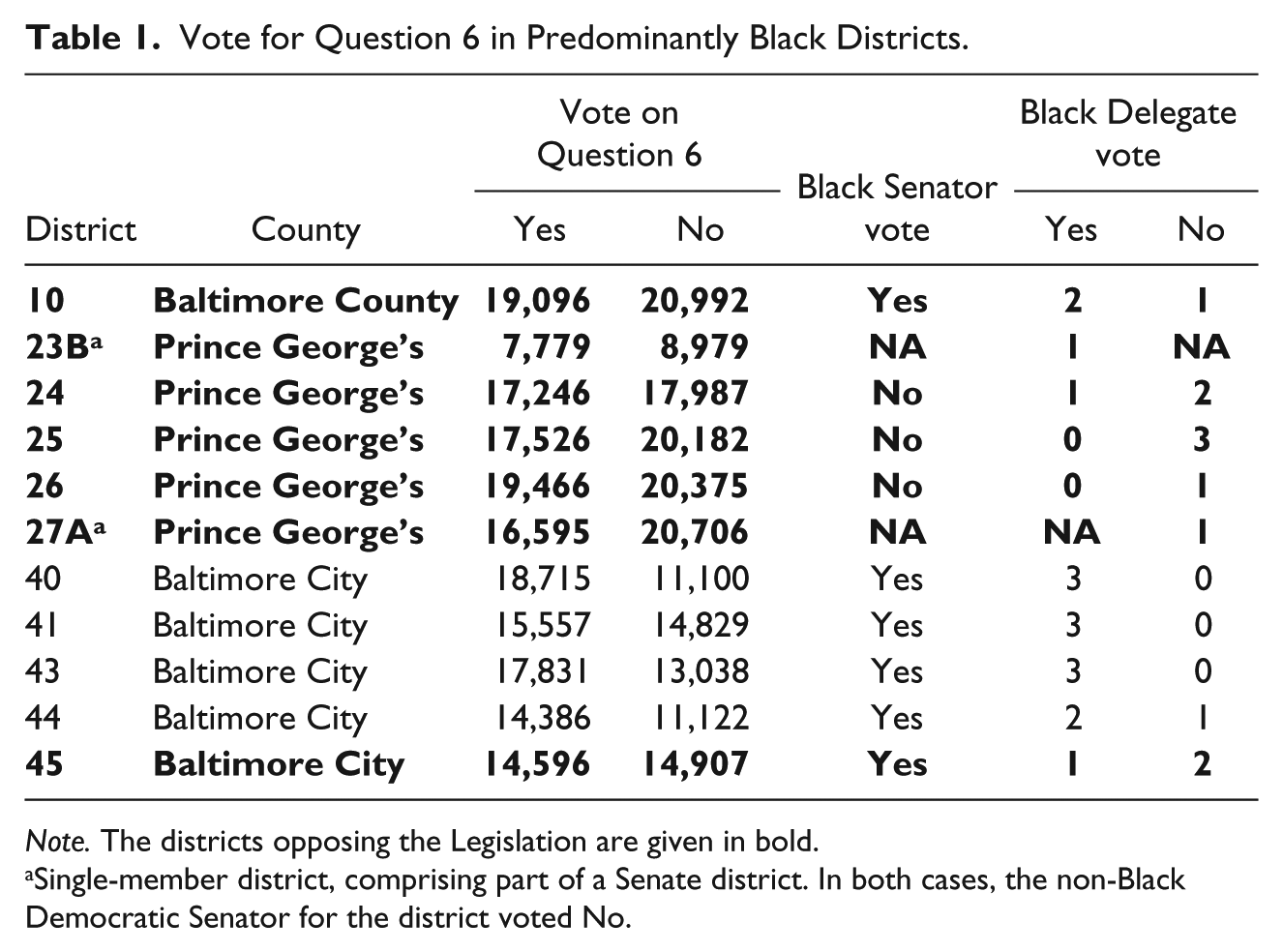
Note. The districts opposing the Legislation are given in bold.
Single-member district, comprising part of a Senate district. In both cases, the non-Black Democratic Senator for the district voted No.
Of the 36 Black legislators representing majority Black districts, 28 voted the same as the majority of the voters in their district, when the legislation appeared on the ballot, while 8 did not. Seven of the 9 senators were consistent with their district, as were 21 of the 27 Black delegates from these districts. Only 1 delegate voted No, whose district later voted Yes, while 5 voted Yes whose districts later voted No.
It is interesting to note the variation across the majority Black districts. That variation is even more pronounced when one looks at the precinct level data. An analysis of precinct level data reveals that while most of the predominantly Black precincts had a majority of votes cast against same-sex marriage, there was tremendous variation. 10 This suggests a level of variation across Black communities, which is difficult to explain. There is a need for a more in-depth analysis of election returns together with other demographic data to possibly explain differences in constituent preferences across voting precincts and districts. But despite the variation, a majority of Black voters opposed legalizing same-sex marriage. Thus, Black legislators as a group differed from the broader Black population as indicated by both the opinion polls before the election as well as how Black voters cast their ballots. The legislators were more likely to support the measure, than the broader Black population.
Conclusion
It is clear that the Black churches and church leaders participated in this issue at a much higher level than is typical. In fact, the level of mobilization of churches, ministers, and congregants was beyond what anyone could remember surrounding a state policy issue. Yet, despite this higher level of participation, the votes of Black legislators as group did not reflect the position of the broader Black community. But the picture is not completely clear. Most of the legislators’ voting decisions were primarily influenced by their own attitudes on the issue, although for a smaller number, their decisions were significantly influenced by their constituent preferences manifested through the mobilization of the churches, and for some others (at least one) the decision was driven by political party. On one hand, this suggests that perhaps with sufficient pressure, legislators may have voted differently. On the other hand, because personal attitude was so important, it would seem that Black legislators might ultimately serve as a buffer against mobilizations of Black social conservatism.
Beyond these direct answers to the questions we put forward at the outset of this article, there are some interesting points that emerge within this analysis worth highlighting. Specifically, these include the perceptions of many observers that the Black church is politically weak, the manner in which notions of civil rights (and the civil rights movement) were incorporated into the debates, an ambivalence among many of the key participants about homosexuality, and finally the insufficiency of terms like “progressive” and “conservative” when it comes to labeling many Black political actors. 11
The perceptions of the limited political efficacy of the Black church were striking given that the Black churches were so engaged in this issue. The Baltimore respondents were consistent in describing a scenario in which the churches there were not as influential as the Prince George’s churches. In fact, they oft noted that the Baltimore churches were no longer politically powerful or politically effective. Moreover, while some candidates still make appearances, they do so more out of habit than necessity.
Even Prince George’s legislators questioned the true effectiveness of the churches. One claimed the Black church as a whole is a “paper tiger.” There are “no consequences” for not going along with their desires. The legislator claimed the Black churches are not effective in communicating the consequences of going against what they want or the “carrot” for going along with what they want. A Baltimore legislator commenting on the Tiffany Alston’s dilemmas equated the scenario to hearing a barking dog. If you are walking by a fence and hear a dog barking, you might be afraid—even though you do not really know if it is a small dog or a big dog. Inexperienced legislators like Alston do not know if the dog that is barking is a small dog or a big dog. The insinuation was that, Alston was afraid of what were really “small dogs” barking.
A second point worth highlighting was the discourse on civil rights. The rhetoric around civil rights was an important aspect of the campaigns in support of same-sex marriage. Black legislators who supported legalizing same-sex marriage, offered advice to the advocates—letting them know how to approach the issue of civil rights. They often said “it is different from African American civil rights struggles”—yet, it is a civil right. It was a nuanced way of approaching the issue—a way to tap into the sense of fairness and equality, and yet not trying to equate the issues of same-sex couples with the issues faced by African Americans. It was clear that civil rights notions did resonate with Black legislators.
On the other hand, there were opponents to the legislation who used the imagery and called upon the legacy of the civil rights movement. Del. Burns was key in this regard. As a veteran of the movement who had come to Baltimore to work for the National Association for the Advancement of Colored People, he used his Civil Rights credentials as part of his discourse in opposing the legislation. Other opponents clearly revered Martin Luther King Jr. and seemed influenced by his model of social action and morality in guiding struggles for justice. For example, the headquarters of the MFA displayed quotes from Dr. King regarding the need to struggle for justice.
The relative ambivalence of many of the legislators and some of the preachers involved in the issue held toward gay lifestyles is another key point. On one side, many of the opponents of same-sex marriage claimed they do not have a problem with anyone loving whomever, but merely wanted to preserve the label of marriage for a man and a woman. Even the rhetoric of many opponents (though not all) was often not condemning of the gay lifestyle. To that end, many supported civil unions as an alternative. In fact, two of the three Baltimore delegates who voted No were on record as being in support of civil unions (Linskey & Bykowicz, 2011). A key advocate against the legislation claimed that they had brought together a bi-partisan coalition with sufficient votes to pass civil unions.
On the other side, many supporters of the Maryland legislation were not necessarily advocates for gay lifestyles. More than one expressed the sentiment of a legislator who said, “you know that’s not really my thing”; suggesting a personal discomfort with homosexuality. Yet, the legislator claimed that the law should treat people equally. This was a recurring theme among, not just legislators, but even religious leaders who came out in support of the legislation. They argued for equality under the law, but then expressed personal discomfort or opposition to same-sex marriage. As one preacher stated in an interview—he reserved the right to be against same-sex marriage “religiously” but for it “civically.”
A final point relates to the inadequacy of the term conservative or progressive to describe many Black political actors. Many of the most ardent opponents were clearly not “conservatives” per se—in terms of advocating a broad conservative agenda or identifying with the conservative movement. We were struck, for example, that one of the key opponents of the legislation had pictures in his office of Malcolm X and images of a Black Jesus. Beyond the symbolic, many key people and churches opposing same-sex marriage took progressive stances on a variety of other issues and identified with the Democratic party. Even Rev. McCoy identified with the Democrats and worked closely with some Democratic legislators to try to influence other legislators.
12
One of the best examples of this was Reid Temple, AME. While taking a public stance against same-sex marriage, the church also has taken the “progressive” position on a number of issues. In their press release, they stated,
As a church Reid Temple takes our role in civic leadership seriously, and has just this year been actively involved in voter registration, opposition to the Maryland gambling referendum, support for the traditional definition of marriage, calling for justice in the Trayvon Martin case, and advocating for the continuance of affirmative action which right now lies before the US Supreme Court. We are a church who cares for all people and believes that safe space for ones’ personal and religious views ought be championed by members of every community. (Washington, 2012)
In all, it is clear that debates and mobilizations around same-sex marriage give light to a wide range of political dynamics at work among African Americans. That these mobilizations represent some of the most effective attempts to mobilize African Americans around a political issue cannot be ignored. What remains to be seen is the trajectory of this morality politics. Will this trend continue or will it subside as particular issues move off the public’s agenda? Has the mobilization of African Americans been the result of this particular issue or is it reflective of a broader political shift?
Ultimately, mobilization around these kinds of morality issues may have significant long-term political implications for African Americans. Such mobilizations may draw attention away from the structural roots of disparities and the policies that may be the real causes of Black suffering. Furthermore, this Black morality politics has the potential to destabilize the political landscape as new alliances are shaped among actors who typically are on opposing sides of the issues that impact Black people’s lives (e.g., organizations like the Family Research Council and churches like Reid Temple AME). Maryland illustrates that this picture is yet unclear. Whether we are witnessing a temporary foray into morality politics or a long-term shift remains to be seen, but the political stakes are high as the potential of a mobilized Black community can be formidable.
Footnotes
Declaration of Conflicting Interests
The authors declared no potential conflicts of interest with respect to the research, authorship, and/or publication of this article.
Funding
The authors received no financial support for the research, authorship, and/or publication of this article.