





Abstract
Historically Black colleges and universities (HBCUs) in the United States are facing turbulent environments that include increased accountability and assessment measures, competition, state mandates, declining budgets, changes in the classroom and pedagogical landscape, and diminutive endowments. These factors are further heightened by an ongoing debate regarding the relevance of HBCUs and a paradigm shift that calls for more entrepreneurial-based leadership in the decision-making process and business-based strategies aimed at institutional survival. However, HBCU leadership, which often ascends from the faculty ranks, does not possess the business degrees or marketing experience that would equip them for the evolving and complex demands of the higher education marketplace. To assist HBCU leadership in navigating the market-driven environment in higher education, this descriptive study explores the factors and issues critical to the survival and sustainability of HBCUs from the perspective of HBCU business deans. Business-based recommendations and strategies conclude this article.
Keywords
Introduction
Higher education environments can be turbulent due to the constant confrontation of new and unexpected problems such as declines in enrollment or the demand of new and costly programs and reports from external agencies (Birnbaum, 1988). Historically Black colleges and universities (HBCUs) in the United States are facing turbulent environments that include increased accountability and assessment measures, competition, state mandates, declines in state and federal funding, changes in the classroom and pedagogical landscape, and diminutive endowments (Duderstadt & Womack, 2003; Gasman, 2013; Hirsch & Weber, 2002; Keller, 1983). All of which threaten their survival and sustainability. Several HBCUs that have been adversely affected include Saint Paul’s College and Morris Brown College. In 2013, St. Paul’s College closed due to business-related factors such as poor financial management and lack of a wealthy donor base (Jealous, 2013; Kelderman, 2012). Morris Brown College also faces challenges regarding its institutional survival. Morris Brown College, which was serving about 50 students in 2012, has been embattled with financial management problems for years. These issues were compounded with the loss of the school’s accreditation in 2003 (DeSantis, 2012; McMurtrie, 2003).
The ongoing debate regarding relevance continues to plague these institutions. Critics such as Vedder (2010) have raised major concerns about the need for continued support for HBCUs. HBCUs have shown their relevance given the fact that they comprise only 3% of colleges and universities in the United States, yet they produce more than 20% of all African American college graduates (Gasman, Baez, Drezner, Sedgwick, & Tudico, 2007; Tatum, 2010). Despite their production of African American graduates, there have been declines in enrollment and the number of degrees awarded to African Americans at HBCUs. From 2009 to 2011, enrollment has dwindled among African American students, the dominant population, at public, 4-year HBCUs (174,099-171,636). Between 1976-1977 and 2010-2011, there have been declines in the percentage of bachelor’s degrees earned by African Americans (−19%) and the percentage of doctoral degrees awarded to African Americans (−1%) (U.S. Department of Education, National Center for Education Statistics, Higher Education General Information Survey, 2013). On average, the graduation rate for HBCUs lies within the 30% range (Integrated Postsecondary Education Data Systems, 2010).
Additional environmental factors, such as the globalization of higher education (Duderstadt & Womack, 2003; Fischer, 2014; Gasman, 2013; Hirsch & Weber, 2002), diversity within the student market (Boland & Gasman, 2014; Gasman, 2013; Kelderman, 2010; Keller, 1983), and fewer barriers to entry by competitors (Duderstadt & Womack, 2003; Hirsch & Weber, 2002), have resulted in ongoing debates and concerns regarding the congruence of the traditional HBCU mission and the changes within the higher education market (Fischer, 2014; Riley, 2010). On one side, HBCU administrators posit that internal changes are needed in order to adapt to the environment; this includes rebranding the HBCU image and adjusting the mission. However, HBCU stakeholders who oppose these changes question the effects of a new mission and image on the longstanding mission, culture, and history that has historically branded these institutions (Kelderman, 2010). According to Anctil (2008a), successful leadership in higher education institutions aims to be both mission driven and market driven.
The aforementioned challenges and turbulent environment facing HBCUs are heightened by a paradigm shift that calls for a more entrepreneurial-based leadership model in the decision-making process, market responsiveness, and business-based strategies aimed at institutional survival (Anctil, 2008a, 2008b; Andrews, No, Nwachukwu, Kaliba, & Yigletu, 2013; Stevenson, 2008). Possible considerations may include HBCU leadership developing system-based strategies from the context of Pfeffer & Salancik’s (1978, 2003) resource dependency perspective, which focuses on institutional action through the scope of the institution’s environment in an effort to procure essential resources from that environment (Powell & Rey, 2015). The employment of marketing strategies (e.g., branding, customer service strategies), which could also greatly impact recruitment, enrollment, retention, persistence, completion rates, accreditation, and institutional development, is another option (Anctil, 2008b). Traditionally, the leadership at HBCUs, which often ascended from the faculty ranks, has not possessed the business degrees or marketing experience that would equip them for the evolving and complex demands of the higher education marketplace (Anctil, 2008b; Gasman, 2013). Given the changes taking place in the academic environment, the perspective of HBCU business school deans is critical. HBCU business school deans have met the unique challenge of obtaining and maintaining specialized accreditations and their business-based skill set is being recognized at the highest level of higher education leadership. Several business school deans have recently become university presidents, examples being Dr. Glenda Glover at Tennessee State University, Dr. Ronald Johnson at Clark Atlanta University, Dr. H. James Williams at Fisk University, and Dr. Jessica Bailey who serves as the Interim President at Fort Valley State University.
The Growing Need for the Perspective of Business School Deans
HBCU business school deans have made significant progress in enhancing their programs as evidenced by the majority of these schools having received specialized accreditation by either the Association to Advance Collegiate Schools of Business (AACSB) International and/or Accreditation Council for Business Schools and Programs (ACBSP). In the case of AACSB, approximately one third of the business schools in the United States have achieved this accreditation (AACSB International, 2015). These accreditations are significant for HBCUs in that they require a critical review of the strategic management, participant qualifications, curriculum, and assurance of learning standards. While all of these categories are important, the participant standards require especially high quality in that faculty must be academically and/or professionally qualified, with the terminal degree and peer-reviewed publications in the case of academically qualified and the master’s degree plus significant professional experience to qualify as professionally qualified. Business schools with such accreditations are expected to show continuous improvement in their performance measures.
In general, business schools have been responsive to the turbulent environment higher education institutions face by developing a management model that emphasizes entrepreneurship innovation, building market share, providing output in the form of business graduates with interdisciplinary skills aimed at addressing the complex problems within organizations, and managing relationships with multiple stakeholders. They tend to have a greater affinity for leadership and management due to their study of organizations. The complexity of leading a business school is comparable with that of a CEO, yet with challenges that do not constrain private enterprise executives (e.g., grappling with tenured workforce, diffused authority, and funding constraints placed by donors) (Mangan, 2011). Therefore, the HBCU business school deans are in a strategic position for understanding the factors required to sustain a high-quality educational organization where they do not in most cases have executive power, but must share power as first among equals.
Factors Impacting Sustainability and Survival at HBCUs
The review of literature finds a number of studies regarding the factors impacting sustainability and survival at HBCUs as indicated by various facets of leadership and researchers. Table 1 highlights these factors.
Representative Research on Factors Impacting Institutional Sustainability and Survival at HBCUs.
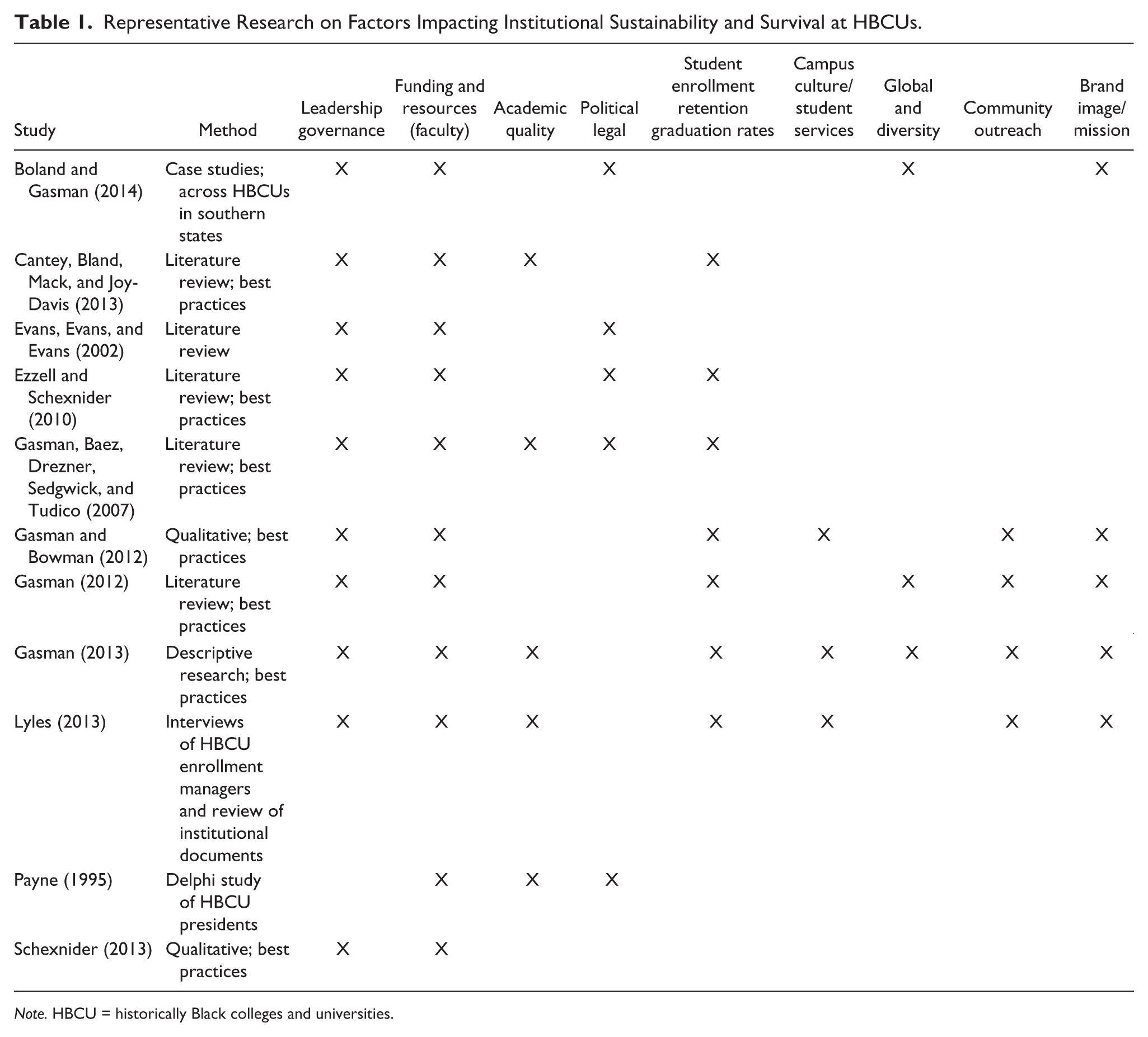
Note. HBCU = historically Black colleges and universities.
Based on the literature review, research on the critical factors affecting the survival and sustainability of HBCUs from the perspective of HBCU business deans is limited. Empirical research regarding institutional sustainability and survival is derived from the perceptions of HBCU presidents and enrollment managers. Although their administrative knowledge and skills are noteworthy, the changes in higher education calls for increased input from administrators who possess the business degrees or marketing experience, hence, business school deans.
Survey Development and Data Collection
Survey development was driven by Pfeffer and Salancik’s (1978, 2003) resource dependency perspective for institutional survival and sustainability, which focuses on environmental awareness and institutional action through the scope of the institution’s environment in an effort to strategically procure essential resources from that environment and research findings by Gasman (2012) regarding factors that affect the survival of HBCUs. The factors developed for the questionnaire are presented in Table 2. An online questionnaire was sent to 46 HBCU business school deans during the 2012-2013 academic year to ascertain their views as to those factors that were considered paramount for HBCU survival and sustainability. The survey is composed of 16 factors, of which 25% are directly linked to the leadership function. The participants were provided a cover letter that asked them to review the questions and to respond using a 5-point scale where 5 is strongly agree. While each factor is considered important and is based on the market-driven environment, it is helpful to know which factors take precedence so HBCU leadership can set priorities in the decision-making process. Thirty-two HBCU business deans responded, resulting in a response rate of 70%.
HBCU Institutional Survival and Sustainability Readiness for Academic Leadership Survey Questions.
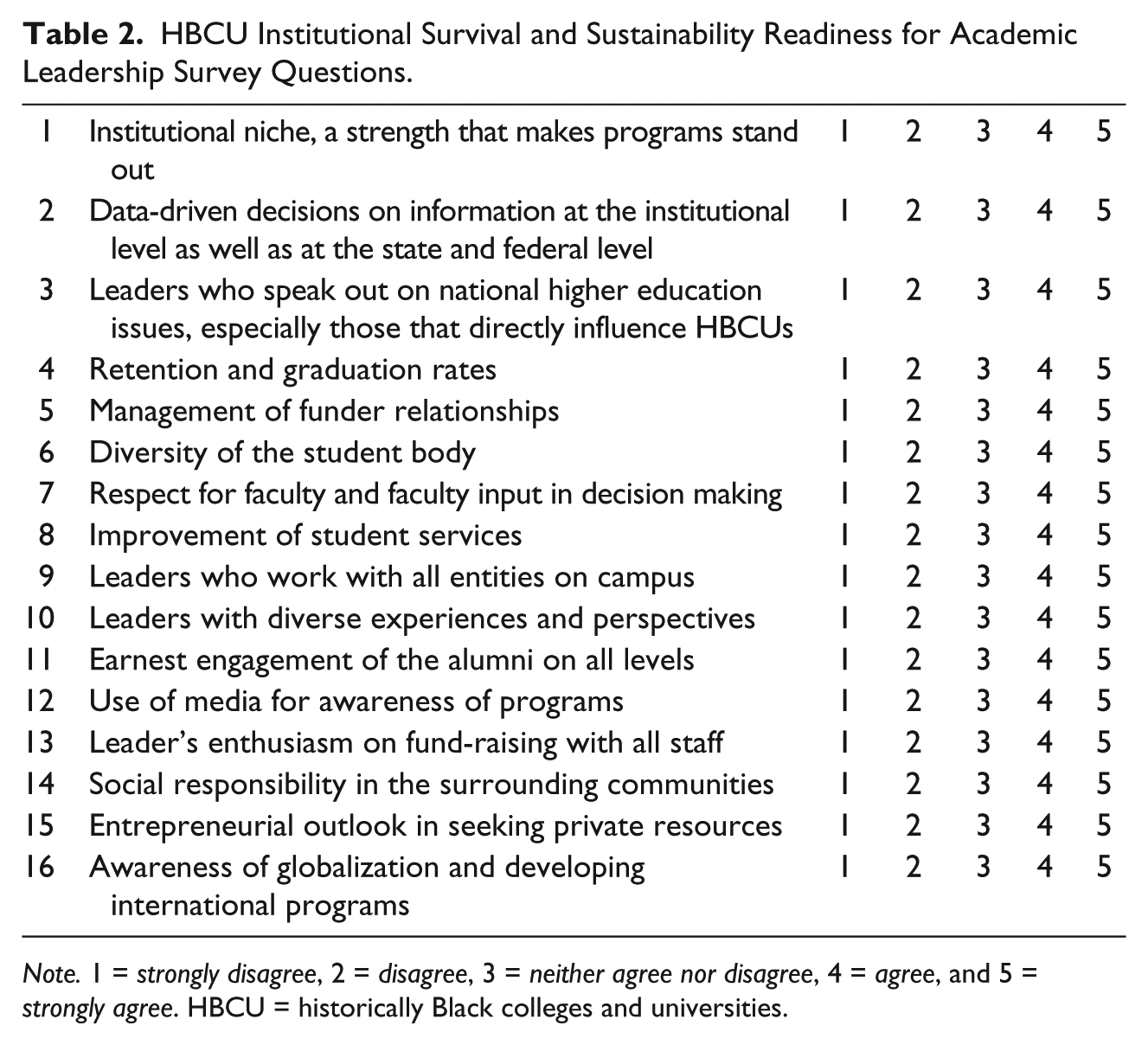
Note. 1 = strongly disagree, 2 = disagree, 3 = neither agree nor disagree, 4 = agree, and 5 = strongly agree. HBCU = historically Black colleges and universities.
Descriptive Analysis
The HBCU business deans were asked to rank the factors that they felt were the greatest threat to the survival of HBCUs on a scale from 1 to 5, where 1 is most critical. The following five factors were ranked: (a) funding, (b) accreditation, (c) leadership, (d) new competition, and (e) political interference. The results of the factor rankings by the deans are illustrated in Figure 1, where funding was ranked as the number one most critical factor for survival as expected, followed by leadership, new competition, accreditation, and finally political interference. Evans, Evans, and Evans (2002) provided information on the role that political intervention can play in the well-being of HBCUs. While this information is enlightening with respect to the ranking, such broad categories are not very helpful in pointing out the details with respect to what leadership issues need to be addressed the most or what can be done in the area of funding to improve outcomes for the HBCUs. In an effort to provide greater detail, additional questions were developed for this research project and are provided in Table 3 based on previous research identified in the literature review.
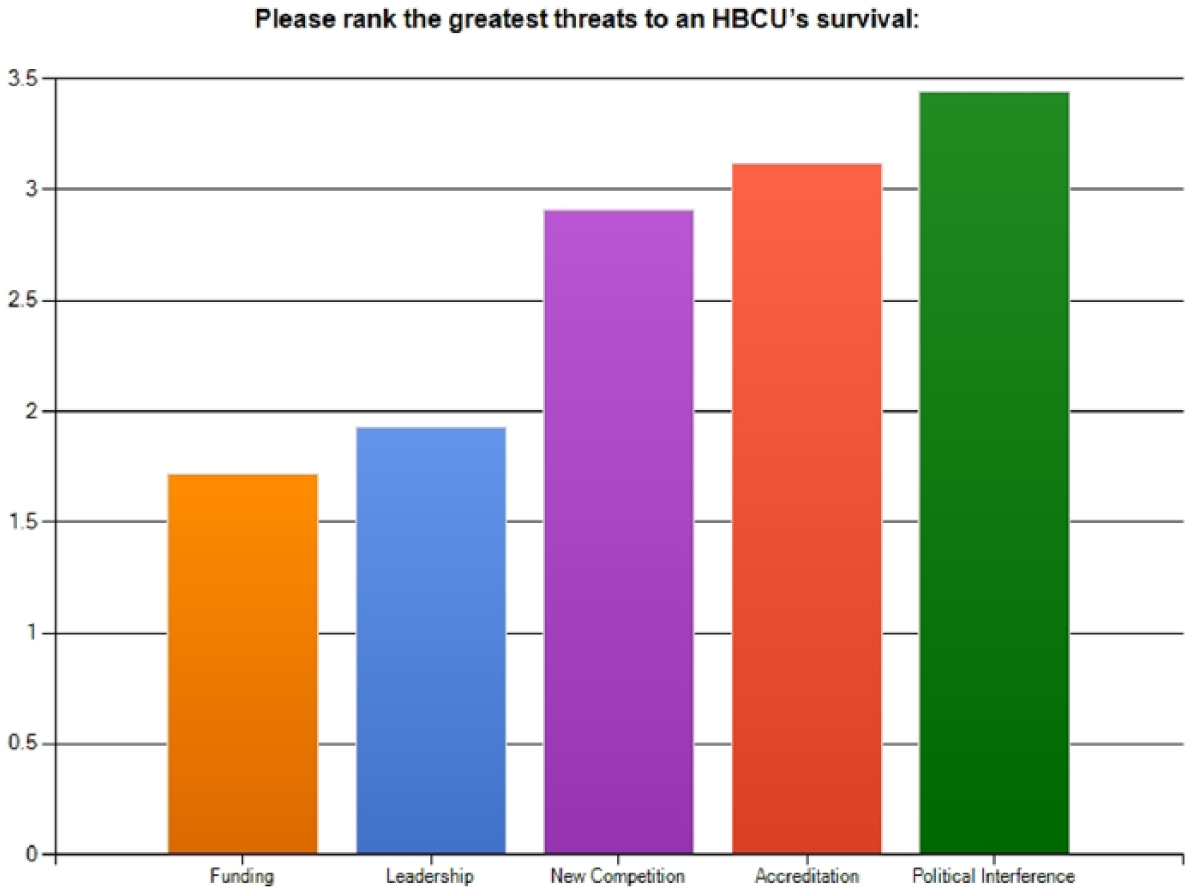
Greatest threat to HBCU institutions’ survival.
HBCU Institutional Survival and Sustainability Readiness for Academic Leadership Survey Results.

Note. HBCU = historically Black colleges and universities.
Details are provided in Table 3 on the survey questions that were developed to assess the relative importance of 16 factors that are considered important for HBCU survival and sustainability. While some of these factors may overlap, the business deans did rank the various questions on a scale from 1 to 5, where 5 is strongly agree and 1 is strongly disagree. In presenting the results, only the percentage of strongly agree will be used to rank the factors in the analysis.
Survey Results
Survival and Sustainability Factors
The survey results, which rank the gravity of the factors as viewed by HBCU business deans, are as follows.
First-tier factors
The most significant factors indicated by the HBCU Business School Deans were as follows: the improvement of student services, and retention and graduation rates, with 71% of the respondents indicating that they strongly agreed that these were the most important factors (survey results are presented in Table 3). HBCUs have traditionally been teaching institutions and these factors would support the view that the services provided to the students especially as it relates to retention and graduation are critical to their long-run survival and sustainability. The gravity of retention and graduation rates as viewed by the survey participants coincides with the literature.
Second-tier factors
The second tier of significant factors with 54.8% of the deans strongly agreeing were institutions that have developed a market niche or academic strength that makes them stand out and those institutions that have leaders who work with all entities on campus, being weighed as equally important. Thus, the view of business deans is that HBCUs should formulate a strategy for developing niches in the higher education marketplace. Leader should also work with all entities to build consensus.
Third-tier factors
Business school deans see leadership with diverse experiences and perspectives, management of funder relations, and respect for faculty input in the decision-making process in the third-tier ranking of factors for HBCU survival and sustainability. Leaders with diverse experiences and perspectives, and the management of funder relationships at an institution were both considered by business deans to be equally important to HBCUs survival and sustainability, with 48.4% strongly agreeing that these factors are important. Institutions that respect faculty and faculty input in the decision-making process received 46.7% of the deans strongly agreeing that this factor is important for HBCU survival and sustainability.
It is interesting to note that the management of funder relations domain is in the third tier. According to Gasman (2013), “fundraising is the most important factor for long-term sustainability of HBCUs” (p. 12). Institutions with significant growth in endowments and progressive alumni giving programs are less likely to incur problems with domains in the first tier (e.g., retention and graduation rates) (Gasman & Bowman, 2012). However, the improvement of student-centered services, which was ranked in the first tier by HBCU business deans, can greatly affect alumni’s willingness to support their business school (Masterson, 2008).
Fourth-tier factors
The fourth-tier factors that are imperative for HBCU survival and sustainability based on the survey are as follows: a leader’s enthusiasm on fund-raising with all staff, having 43.3% of the business deans that strongly agree, an entrepreneurial outlook in seeking resources, use of media for program awareness, and awareness of globalization and dedication to developing international programs. The latter three factors resulted in strongly agree responses from 41.9% of the deans. These factors relate to the need for fund-raising in the acquisition of resources and having a global perspective.
Fifth-tier factors
Factors in the fifth tier relating to HBCU survival and sustainability ranged from 38.7% to 35.5% that strongly agree that they are contributors to HBCU survival and stability. Factors that fall in this category are as follows: employment of data-driven decisions regarding information at the institutional level with 38.7% strongly agreeing, followed by leaders who advocate on national higher education issues, especially those that directly influence HBCUs, and having a diverse student body. The latter two factors resulted in strongly agree responses from 35.5% of the deans.
While these factors are rated lower than the previous ones, over one third of the deans surveyed rated these factors as strongly agree for HBCU survival and sustainability. The decision-making process with respect to use and availability of data has received much attention and can be enhanced based on the availability of databases and implementation of best practices. Thus, the analysis of decision making in a time where state governments are looking to streamline budgets and focus on other priorities, such as health care, K-12 education, and crime prevention, further heighten the importance of this factor (Duderstadt & Womack, 2003).
The last factor in the grouping is the need for a diverse student body. This is the only factor that received responses in the strongly disagree and disagree categories. Some respondents may see this as a movement away from the original mission of the HBCU institutions to educate African Americans. HBCUs such as West Virginia State University, Bluefield State College, and Lincoln University of Missouri have become majority White institutions (“The Persisting Myth That Black Colleges Are Becoming Whiter,” 2005) and, therefore, may no longer provide the programs that were associated with the HBCU designation. Diversity of the student body at HBCUs may continue to be an ongoing debate given the push for it and the increase in enrollment of other ethnic groups such as Latinos at HBCUs (Boland & Gasman, 2014; Gasman, 2011, 2013; Kelderman, 2010).
For HBCU leaders who are concerned about deviating too far from the original mission, alternative options should be examined when addressing student diversity. Diversity is unique in that it encompasses a number of perspectives. For example, diversity in age is one consideration. Diversity can also start with diversifying the mind-set and experiences of the current student body. This can include the adoption of long-term and short-term study abroad programs for students and opportunities to learn critical languages such as Arabic and Chinese (Gasman, 2011, 2013). Internationalizing the HBCU experience through study abroad experiences is worth considering because only 3.4% of African American students participated in a study abroad experience in 2003/2004. In 2013/2014, 5.6% of African American students participated in a study abroad experience, a growth of only 2.2% in a 10-year period (Institute of International Education, 2015). Diversifying the student body from this perspective can create opportunities for increased funding through grants and partnerships.
Sixth-tier factors
The sixth and final tier of factors for HBCU survival and sustainability were earnest engagement of alumni at all levels with 32.3% strongly agreeing and demonstrating social responsibility in the surrounding communities with 29.9% strongly agreeing that this factor is important for HBCU survival and sustainability. These factors were ranked as strongly agree by slightly less than one third of all the deans surveyed. The alumni and surrounding communities have been, at times, major sources of concern for the HBCU community. The literature also rates the alumni engagement domain higher due to its impact on funding and sustainability (Gasman, 2013; Gasman & Bowman, 2012).
Recommendations for HBCU Entrepreneurial Leadership in a Turbulent Environment
An entrepreneurial leadership model is an option that should be considered to address the challenges and changes that are impacting HBCUs. This form of leadership calls for less dependence on state funds, federal funds (e.g., Title III), and student tuition. Moreover, this model often occurs under constrained resource conditions (Becherer, Haynes, & Fletcher, 2006; Stevenson, 2008) and requires leaders to regularly monitor the resources and constraints deriving from both the internal and external environments that affect their institutions (Birnbaum, 1988; Pfeffer & Salancik, 1978, 2003). The following themes propose ways in which this model can be integrated.
Theme 1: Adapting and Changing to Fit Environmental Requirements
This perspective aligns with Tier 1 through Tier 4 factors and the Tier 6 factors as outlined in Table 3. By understanding entrepreneurial leadership from this perspective, universities can assess the needs of the marketplace, and then adapt their product and services accordingly (Pfeffer & Salancik, 2003). Recommendations that emerge are entrepreneurial leadership through strategic partnerships, fund-raising and development, and brand marketing.
Entrepreneurial leadership through strategic partnerships
Strategic partnerships, such as higher education/community partnerships, are congruent with the core mission of the public university and align with the land grant model (Duderstadt & Womack, 2003; Hirsch & Weber, 2002; Maurrasse, 2001). Higher education/community partnerships support the community service component of higher education and are responsive to societal needs and impact the institutional health of higher education. These partnerships meet a broader societal demand, particularly those partnerships that address poor and disenfranchised populations where the needs are most severe (Maurrasse, 2001; Powell & Rey, 2015).
Moreover, a turbulent environment is not a time to be insular, protective, and self-absorbed. Higher education leadership should be attempting to create and expand synergistic partnerships with other domestic and international universities, federal entities, nonprofits, local communities, emerging growth industries, and businesses worldwide. These partnerships, which include contracted services or joint delivery of training or related services to third parties, result in a competitive advantage and create new revenue streams for HBCUs (Hirsch & Weber, 2002; Wilson, 2011; Zeiss, 2003).
Entrepreneurial leadership through fund-raising and development
One way, fund-raising and development can be employed is through the curriculum. HBCUs, business schools in particular, can use this strategy to their advantage by working with their faculty to develop a concentration within their marketing, entrepreneurship, or business administration curriculum. Students in the fund-raising concentration could gain field experience by working in the university’s foundation or department of institutional development (Gasman & Bowman, 2012).
A second option is through the mobilization of alumni. Involving alumni by continually informing them about new initiatives, triumphs and institutional direction through social media, email, and traditional mail should be considered. Periodic surveys should be conducted to monitor the most effective means of reaching them. Hosting alumni gatherings on campus or in cities where there is an established chapter or a densely populated alumni group and strengthening the relationship with the national alumni association can also mobilize their involvement (Bowman & Gasman, 2014).
A third option is to create a campus culture and mind-set that fosters fund-raising and giving. Hence, “crisis” fund-raising should be avoided. At the student level, this culture can encompass student giving programs, fund-raising phone-a-thons, and service learning projects. The fund-raising mind-set should not just be limited to the actions of students. HBCU leadership should consider investing more funds in institutional advancement and the Alumni Relations department (Bowman & Gasman, 2014).
Entrepreneurial leadership through brand marketing
Anctil (2008b) contended, “a clear brand image functions as a relationship builder between members of the community and further binds them to the institution” (p. 98). Branding creates a clear and salient message about the product (well-prepared graduates) and helps to build awareness and relevance in an often crowded and competitive marketplace (Anctil, 2008b). Relevance is an area that HBCUs have consistently dealt with, particularly in a time of integration, limited state and federal resources, and declining enrollment. HBCU leaders have affirmed that a change in image is needed (Kelderman, 2010). However, skeptics claim that this change may compromise the mission of HBCUs. That is why it is important for HBCUs to develop brand-marketing strategies that are both mission driven and market driven (Anctil, 2008a). According to Keller (1983), leadership questions universities should consider include: What business are we really in? With our traditions, location, and collection of faculty and administrators, what should our institution be building toward? What should our university aspire to be 10 years from now?
Theme 2: Attempting to Alter the Environment to Fit the Institution’s Capabilities
Alternatively, public universities can adopt the strategy of altering the environment in order to fit the institution’s capabilities. This perspective aligns with Tier 5 factors and overlaps into the Tier 1 factors as outlined in Table 3. Under this theme, HBCU leadership can create environments by excluding some environmental elements and including others (Pfeffer & Salancik, 2003). The following recommendations, driven by the data-based decision-making factor, suggest how entrepreneurial leaders could utilize this perspective to their advantage:
Cost leadership through data-based decision making
Data-based decision making is imperative for a cost leadership strategy. By evaluating institutional data, universities can determine programmatic effectiveness and impact and make reductions and changes accordingly (Fischer, 2011). This encompasses strategically streamlining, merging, modifying or even phasing out certain academic programs and services, so that HBCUs have greater clarity regarding their purpose, mission, and brand image (Powell & Rey, 2015).
Another cost leadership option with entrepreneurial implications is responsibility center management (RCM). Rather than a highly centralized budget that provides for the cross-subsidization of low performing programs by higher performing ones, this budget process provides greater transparency. For example, academic programs that have the potential for high growth can self-generate the funds needed to achieve their potential, while those lower performing programs must explore alternate options for sustainability (Fethke & Policano, 2012).
Recruitment initiatives and data-based decision making
Attempting to alter the environment to fit the institution’s capabilities can be utilized when selecting key student markets to recruit from. For example, universities that obtain a significant amount of their resources from alumni may institute selection procedures which ensure sufficient supplies (Pfeffer & Salancik, 2003; Powell & Rey, 2015). By evaluating institutional and programmatic data (e.g., surveys, reports that are submitted to governing and accrediting boards), HBCUs could segment their markets and concentrate on recruiting within that particular environment. To illustrate, if university data yield a heavy concentration of nontraditional students who commute, work full-time, have children, and are 25 years of age or older, then the university could modify its services by offering more online programs and/or classes, hybrid programs and/or classes, and flipped classroom experiences to appeal and retain existing students while leveraging these features to recruit and enroll a greater number of nontraditional students (Powell & Rey, 2015).
Footnotes
Declaration of Conflicting Interests
The author(s) declared no potential conflicts of interest with respect to the research, authorship, and/or publication of this article.
Funding
The author(s) received no financial support for the research, authorship, and/or publication of this article.