







Abstract
The level of colorism that developed among blacks in the United States (U.S.) and Brazil, during the 20th century, gave rise to intense altitudes of intraracial discrimination. This distinct form of discrimination was based on proximity to whiteness and white privilege. This essay will illustrate how attitudes toward complexion, within the black community, are a direct consequence and perpetual remnant of the white supremacy and racial hierarchy that developed in colonized societies. Colorism manifested itself in different forms in Brazil and in the U.S. However, the level of black-on-black discrimination that it spawned was grounded in the belief that one’s immediacy to whiteness created a vehicle for upward mobility.
Introduction
The term “colorism” was first coined and popularized by Pulitzer Prize-winning author Walker (1983) in the book entitled, In Search of Our Mothers’ Garden. In this book Walker explores an array of issues facing people of color, with the most notable subject being the issue of skin complexion. In Racism In The 21st Century: An Empirical Analysis of Skin Color, Hall (2008b) defines colorism as the act of discriminating against an individual based on the hue or shade of his or her skin complexion, and in some cases based on an individual’s eye color and hair texture. Colorism usually occurs among individuals of the same race and typically reveals a preference for lighter skin over darker skin and an inclination for European features over non-European features. The brand of colorism that materialized among blacks in the United States (U.S.) and Brazil, during the 20th century, gave rise to intense altitudes of intraracial discrimination. This distinctive form of discrimination was based on proximity to “whiteness” as it relates to an individual’s phenotype and the advantages and benefits of “white privilege” that these physical attributes commonly conveyed.
Colorism manifested itself in varied forms in Brazil and the U.S., yet the intraracial discrimination that it produced was unequivocally fueled by the belief that the lightness or darkness of an individual’s skin tone determined the nearness to whiteness and the promise of upward mobility. Attitudes toward complexion, within the black community, are a direct consequence and perpetual remnant of the white supremacy and racial hierarchy that developed in colonized societies. In Color Stories: Black Women and Colorism in the 21st Century, Wilder (2015) asserts that colorism also exposes the many forms of black self-hatred that have been developed and sustained as a result of centuries of European indoctrination. This form of black-on-black discrimination not only helped to sustain white supremacy but it also made racial solidarity and cohesion a difficult feat, even in the 20th century. This study will examine the influence of colorism on African American and Afro-Brazilian culture, between the years of 1928 and 1988, and will illuminate how intraracial discrimination among blacks, based on skin hue, aligns closely with some of the methods and practices of racial prejudice perpetuated by white supremacists.
The Roots of Colorism
Historiography related to the study of colorism has traced the roots of this form of intraracial discrimination back to the institution of slavery in the Americas. During the period of slavery, in both Brazil and the U.S., miscegenation between white men and enslaved women, largely through rape as a means and expression of dominance, was not uncommon. This interracial contact led to the emergence of a mulatto or mixed-race population. This population presented a varied range of skin hues and physical features that borrowed from both the African and European ancestry of these individuals. Although the offspring produced through acts of sexual violence against African women were typically categorized as “black” in the U.S. and placed in non-white racial categories in Brazil despite their European lineage, many were afforded special privileges based on skin complexion and their connection to their white heritage (Graham, 1999a).
As slaveholders and their family members gradually instituted the caste system amid black slaves, the slaves themselves came to believe that one group was superior to the other. To further intensify the complexion-based hierarchy among slaves, slave masters began to place their light-skinned slaves in the masters’ homes, away from the fields, for the purpose of performing housework and other domestic duties (Graham, 1999b). This separation in the slave population, based on physical characteristics, created a deep intraracial divide that led to resentment on the part of the darker-skinned slaves and black self-hatred among the lighter-skinned slaves. This division based on physical features also illuminated the fact that the possession of lighter skin enabled members of the enslaved population to enjoy certain advantages that were not available to dark-skinned individuals.
Two Distinct Histories
When examining the manifestation of colorism in the U.S. and Brazil, it is important to consider the major differences between the two countries’ histories. In the U.S., enslaved Africans were a minority population. In late August 1619, the first enslaved Africans arrived in the American colonies at the English settlement of Point Comfort, which is present day Hampton, VA (Newby-Alexander, 2019). In the following years, people of African descent remained a small minority throughout the British North American colonies. Europeans largely settled in the North American colonies in family groups and not as individuals, which fueled the natural growth of the white population. Additionally, outside of the low country colonies of the Carolinas and Georgia, where enslaved Africans were more isolated with minimal contact with whites, minority enslaved populations were forced to assimilate to European culture (Kolchin, 2003).
Since the early years of European settlement, sexual exploitation of enslaved women by white men remained a constant threat. Miscegenation, through forced interracial sexual contact, produced people of mixed ethnicity and contributed to the creolization of the African population. In the U.S., individuals of mixed race were defined as black during the colonial period and treatment of biracial children by white fathers varied (Bodenhorn, 2002). In many instances, lighter-skinned slaves received a favored status from white slave owners in addition to social and economic benefit. For example, many of the slaves who were granted manumission and who had subsequently ascended to the upper economic level were of mixed racial ancestry. The light-complexioned members of this population often inherited money and properties from their European or white fathers and were able to reach new, previously unattainable, levels in society (Schweninger, 1990). This in turn led to an even greater intraracial rift causing many African Americans to internalize the belief that privilege, economic advancement, and social status correlated with an individual’s phenotypic proximity to whiteness. This proximity was habitually associated with skin hue and physical characteristics. After emancipation in 1865 and well into the 20th century as negative attitudes toward African features remained, the eugenics movement of “race improvement” began to thrive in parts of the U.S (Dikötter, 1998). This movement buoyed the practice of colorism by promoting the belief that African hereditary traits were biologically inferior.
In Brazil, the construct of race was quite different. Dissimilar to the U.S., Brazil was home to a majority black population during the colonial period. In 1500, the Portuguese laid claim to Brazil and for more than three and a half centuries, slavery powered the Brazilian economy. About 40% of the enslaved Africans brought to the Western Hemisphere during the slave trade ended up in Brazil and beginning in the 1530s, Brazil’s sugar plantations emerged as a major profit producer (Anya, 2017). The transatlantic slave trade in Brazil did not end until the 1850s and Free Womb Laws, were first enacted in 1871. Free Womb Laws freed children subsequently born to slave mothers, even though these children remained under the control of their mother’s master until age 21 (Abreu, 1996). The abolition of slavery did not come until May 13, 1888, with the passage of the “Golden Law,” making Brazil the last country in Latin America to end slavery (Neto, 2012).
In contrast to the U.S., during Brazil’s colonial period, the vast majority of European settlers were single men. Forced sexual contact between Portuguese men and enslaved African women resulted in a multiethnic society that produced distinct racial categories. In Brazilian slave societies, the more European features one had, the higher their social status. To rise socially, some Africans and biracial individuals sought to marry someone with lighter skin. Lighter-skinned individuals, however, were reluctant to marry someone with darker skin for fear of losing social status (Hernández, 2015a). These prejudices resulted in a disdain for African features among the popular classes and social elites and also established European physical features including skin, hair, and eye color as the gold standard of beauty.
Brazil’s mixed race or pardo population often enjoyed advantages in society that were not extended to the pretos or non-mulatto blacks (Telles, 2006). In Brazil, the pardos constituted a separate class during slavery, often representing an intermediate group between whites and blacks (Telles, 2006). As the offspring of white Portuguese men and enslaved African women, this intermediate group often received benefits and opportunities that were typically denied to the darker-complexioned pretos. Some of these benefits included inheritance in land and wealth from their European fathers, access to education and the potential for social mobility (Russell-Cole et al., 2013a). This too caused a great intraracial gap among Afro-Brazilians, making black racial solidarity difficult to achieve.
Adding in the issue of colorism allowed the pardos to distinguish themselves even more from the pretos, giving rise to the white supremacy-based celebration of their inherited light complexions and European features. In Race in Another America: The Significance of Skin Color in Brazil, Edward E. Telles emphasizes how, in Brazil, social stratification followed color: the lighter the skin, the wealthier one is likely to be and conversely, the darker, the poorer. Lighter skin, and in some cases the socially constructed label of light skin, is expressly preferred in Brazil for what it signifies (Russell-Cole et al., 2013b).
The Brazilian government also participated in the devaluing of black skin. Inspired by the eugenics movement the government and Brazilian elites believed that massive white European immigration would lead to race mixing and the “whitening” of the majority black Brazilian population after emancipation (Hernández, 2015c). “Whitening” is an ideology that was largely accepted in Brazil from 1889 to the 1920s as the solution to erase the majority black population (Hernández, 2015b). Advocates of Brazil’s “whitening” campaign believed that blacks would eventually vanish after several generations of miscegenation with whites (Hernández, 2015d). For individuals in Brazil who are phenotypically white, racial classification is not necessarily determined by the genetic make-up of that individual, but can also be defined by social factors and the individual.
The U.S. and Brazil have two distinct colonial and post-colonial histories. Each country has manifested racial classification in different ways, yet colorism emerged in a similar fashion. In Brazil and in the U.S., the colorism that developed during these countries’ colonial pasts did not die with the emancipation of slavery but instead traveled through time at the right hand of white supremacy and European dominance, while giving rise to an enduring and powerful form of self-inflicted discrimination.
The Brown Paper Bag Test: Admittance to Social Mobility
Throughout the 20th century, many aspects of life among the black elite in the U.S. operated under the theories attributed to the “Brown Paper Bag” test. This test measured a person’s acceptability based on whether their skin hue was lighter or darker than a brown paper bag. The test involved placing an arm inside a brown paper bag, and only if the skin on the arm was lighter than the color of the bag would the person be considered to have passed the test (Russell-Cole et al., 2013d). This test was often utilized to determine a prospective member’s entry into societal organizations including sororities and fraternities, social clubs, and even churches. Dr. Audrey Elisa Kerr, who conducted a comprehensive survey and a series of interviews on the use of the “Brown Paper Bag” test among Washington, D.C.’s old guard black elite, asserts that many used this test as a method of preventing other members of the black community from entering their exclusive circles. For example, Jack and Jill of America, a youth organization that was founded in 1938 for the purpose of bringing African American middle- and upper-class children together for social and cultural purposes, used to regularly exclude darker-skinned applicants from membership while using a brown paper bag as a measuring stick for lightness (Russell-Cole et al., 2013c).
African American social organizations including sororities and fraternities have been infamously associated with the “Brown Paper Bag” test. Many developed a reputation for using this standard to keep membership in their organizations consistently light-skinned. A sophomore at Howard University named Taylor (1928) published an article in The Hilltop student newspaper that accused the fraternities and sororities on Howard’s campus of selecting members based on skin complexion and proximity to whiteness. The student’s article reads, Ever and anon rumors and reports come out of our colleges and institutes that color prejudice is in evidence and color discrimination practiced. We are not so surprised when we hear such rumors and reports about institutions of learning owned, controlled and attended by white people, but it certainly comes as a great shock and causes a feeling of shame when we hear such news about Negro colleges. At first glance it would seem incredible that Negros, themselves the victims of ignorant prejudice and discrimination because of color should follow the lead of the Nordics. And yet a sophomore at Howard University, our proudest institution of learning, makes such a charge against the Negro fraternities and sororities there. . .Negros, young and old, everywhere in the world today and particularly in the United States, have got to clearly understand that whatever the gradations of color in the group, they are all Negros. It isn’t of the slightest moment that one Negro can boast of several white ancestors while another cannot except as it reveals his lamentable ignorance, blindness and lack of race respect. The lightest Negro in the United States, if known as a Negro, will be Jim Crowed as quickly as one possessing no Caucasian ancestry.
Taylor’s 1928 article in The Hilltop effectually demonstrates a student’s perspective on the complexion-based restrictions that were placed on African American college students as they attempted to engage in social activities. While many members of African American sororities and fraternities have disputed this charge of colorism, others will confess that the more elite the fraternity or sorority, the lighter skinned its members seem to be. At Howard University, Alpha Kappa Alpha Sorority, Inc. and Kappa Alpha Psi Fraternity, Inc. had perpetual reputations, whether true or not, for being partial toward those with light skin and naturally straight hair (Russell-Cole et al., 2013e).
The “Brown Paper Bag” test gained even more popularity at the U.S.’s historically black colleges and universities in the 1930s and 1940s. While none of the black colleges had official stipulations as it related to students being lighter than a brown paper bag in order to be successful in the admissions process, a vast majority of the African American college student population during this era had light skin (Burger & Hill, 1998–1999). Throughout this period of the 20th century, light-skinned blacks were generally more successful economically and could afford the cost of higher education for their children. In addition to gaining access to social clubs at black colleges, only light-skinned females would be selected for homecoming queen at the majority of these schools. For example, Howard University crowned its first dark-skinned homecoming queen in 1967 (Burger & Hill, 1998–1999).
A Família
In Brazil, colorism is so deeply engrained in the culture that it extends beyond the confines of social organizations and educational institutions and has taken root in the most sacred human institution of all, the family. In her survey of Brazilian families, Dr. Elizabeth Hordge-Freeman explores the dynamics of colorism that exist within Brazilian families during most of the latter half of the 20th century. She highlights the fixation that existed among Afro-Brazilians regarding racial features such as skin tone, grade of hair, and eye color. Her study, involving 15 Afro-Brazilian families, illuminates the privileges of whiteness that are assigned to light-skinned Brazilians and the intensity of racial hierarchy that many Brazilians created within their own families.
Hordge-Freeman’s research suggests that negative socialization within families, based on skin hue can lead to a desire to distance one’s self from their race. To demonstrate this effect, Hordge-Freeman presents the Pereira family. The Pereira family was composed of a father and his three daughters, all of whom possess African features. Hordge-Freeman (2015b) asserts that this family offers a persuasive example of how the internalization of racial and phenotypic hierarchies compromises the quality of family relationships and leads to abandonment and exploitation. The Pereira daughters reveal how their father, who had social and economic ambitions, abandoned the family to marry a white woman for the purposes of “whitening” his family and future children Hordge-Freeman (2015c). Hordge-Freeman’s research also reveals how individuals within the same family are positioned differently and how they are socialized with practices, language, and emotions that correspond to their positions in a racialized society based on skin tone.
Hordge-Freeman’s (2015a) study also examines spouse selection in Brazil, which reveals a preference of a light-skinned spouse in order to ensure that children of a specific hue are produced. She argues that unlike Afro-Brazilian men, who might rely on economic status as a good that can be exchanged in the marriage market, black women, particularly dark-skinned women, have much less symbolic or economic capital available. For this reason, it is not uncommon to see dark-skinned Afro-Brazilian women pursue white, European men. Additionally, this study highlights the quest for lighter-complexioned offspring, preferential treatment to family members with light skin by parents and grandparents, and the importance of hair length and texture in Brazilian families. It also illuminates how the most sacred and intimate relationships in a person’s existence have been indoctrinated by white supremacy through the funnel of colorism and the belief that phenotypic proximity to whiteness ensures socio-economic advancement.
Passing
During the first half of the 20th century, passing for white remained a common practice for those individuals who lacked identifiable African features. The decision by individuals possessing racial ambiguity, to pass for white for the purpose of economic advancement or racial convenience, further emphasizes the level of privilege that is associated with light skin and straight hair (Hobbs, 2014). As the phenomenon of passing for white revealed itself to whites, measures were often taken to prevent light-skinned blacks from passing as white in order to gain the benefits associated with white privilege. As passing began to gain even more footing in the 1940s and 1950s, whites typically solicited the assistance of blacks to assist in identifying members of the black community who were passing into white communities and social arenas (Kerr, 2006).
From the late 1920s until the 1950s, white establishments occasionally employed blacks to work as “spotters,” individuals who stood at the entrance to white establishments to keep blacks who appeared white from passing into “whites only” public places (Kerr, 2006). To avoid being “spotted,” many blacks who passed developed methods to avoid being exposed. During conversations with many light-complexioned blacks among the old guard elite, Lawrence Otis Graham, in his survey of individuals who had family members that had chosen to pass as white revealed disconcerting “tips” that he labels “The Rules of Passing.” Graham’s compiled list reads:
Passing will be easier if you attempt it while away at a predominately white college, preferable in a rural town;
Change your last name to one that is not associated with black family names such as Jones, Jackson, Johnson, Williams, Thomas, and Brown;
Re-create your family tree by describing yourself as an only child born of parents who died years ago;
Relocate to a community that insulates you from interacting with blacks and avoid cities like New Orleans and Charleston where whites are adept at spotting light-skinned blacks;
“Kill yourself off” in the minds of black people that know you and your family;
Realize that blacks, not whites, are the ones who can threaten your security as a black person living a lie;
Avoid getting tanned or contact with the sun when necessary;
Realize that no one can be trusted with your secret including your spouse or closest friends;
Avoid sitting next to or being photographed with black people;
If your black relatives are unwilling to support you, make a clean break from them;
Claim southern Italian or Greek ancestry and
Consider adopting a white child, to avoid the possibility of giving birth to a brown baby or “throwback child.” (Graham, 1999d)
In the U.S., where the racial classification of the “one-drop rule” was implemented legally, passing created a complex dynamic for individuals with minimal African ancestry and corresponding features. Under this rule, an individual with one or more Sub-Saharan African ancestors was considered black by American racial standards (Graham, 1999c). Brazil, however, did not subscribe to such a rule and many chose to identity as white based on phenotype and not lineage. The “one drop rule” emphasizes the problematic and intricate implications of racial classifications and delineations of race yet it confirms the benefit of being “less black” in appearance.
The 1934 classic film, Imitation of Life, tackled the issue of passing through the character of Peola Johnson. Peola was the daughter of an African American mother and a light-skinned African American father who could “pass” for white. Her desire was to “pass” for white in order to escape her black identity and the societal racial injustice that comes with being a black woman in the U.S (Regester, 2010a). A major Hollywood film, like Imitation of Life, which presents an African American character, cloaked as white, infers that “whiteness” is more desirable than “blackness,” given the societal privileges that it yields (Regester, 2010b).
The success of Imitation of Life spawned the career of African American actress Fredi Washington, who portrayed the character of Peola (Figure 1). After starring in Imitation of Life, Washington began to receive accolades for her dramatic portrayal of Peola. However, leading roles for black actresses in Hollywood were non-existent. For Washington, casting was also difficult because, like her character in Imitation of Life, she was a black woman with white features (Regester, 2010b). Many assumed that Washington desired to “pass” for white in an attempt to gain footing in white society. However, this was not the case. In a 1945 interview with the Chicago Defender newspaper, Washington expressed her opinion on “passing” as white and was quoted as saying: You see I’m a mighty proud gal and I can’t for the life of me, find any valid reason why anyone should lie about their origin or anything else for that matter. Frankly, I do not ascribe to the stupid theory of white supremacy and to try to hide the fact that I am a Negro for economic or any other reasons, if I do I would be agreeing that to be a Negro makes me inferior and that I have swallowed whole hog all of the propaganda dished out by our fascist-minded white citizens (Conrad, 1945).

African American actress, Fredi Washington, as Peola Johnson in the 1934 film Imitation of Life (public domain).
Skin Bleaching
The practice of skin lightening has existed for hundreds of years. Many ethnic groups all over the world have engaged in this practice. What makes skin lightening different for blacks is that the beauty standard that was imposed on this population was based on Eurocentric standards. These standards enhanced their subordination by forcing them to strive for the impossible achievement of racial transformation (Rondilla & Spickard, 2007). The quest for lighter skin, particularly by women of color, resulted in the popularity of skin bleaching creams and pills. Despite the damaging permanent effects of these products, advertisements have helped to convince women of color that the lighter your skin is, the more attractive you are. Throughout the twentieth century, many black leaders spoke out against skin bleaching practices, as well as hair straightening. In addition, the African American press published numerous articles decrying these practices, even though skin lightening advertisements continued to appear in many black publications (Glenn, 2008a) (Figure 2). Some of the skin lightening advertisements read: “Life Is More Fun When Your Complexion Is Clear Bright and Light!,” “Remove That Mask of Dull, Dark Skin and Give Romance a Chance!,” and “The Nicest Things Happen to Girls With Light, Bright Complexions!” These slogans were coupled with images of black women appearing in side-by-side images. In one frame the woman was dark and in the other frame she appeared lighter and smiling.
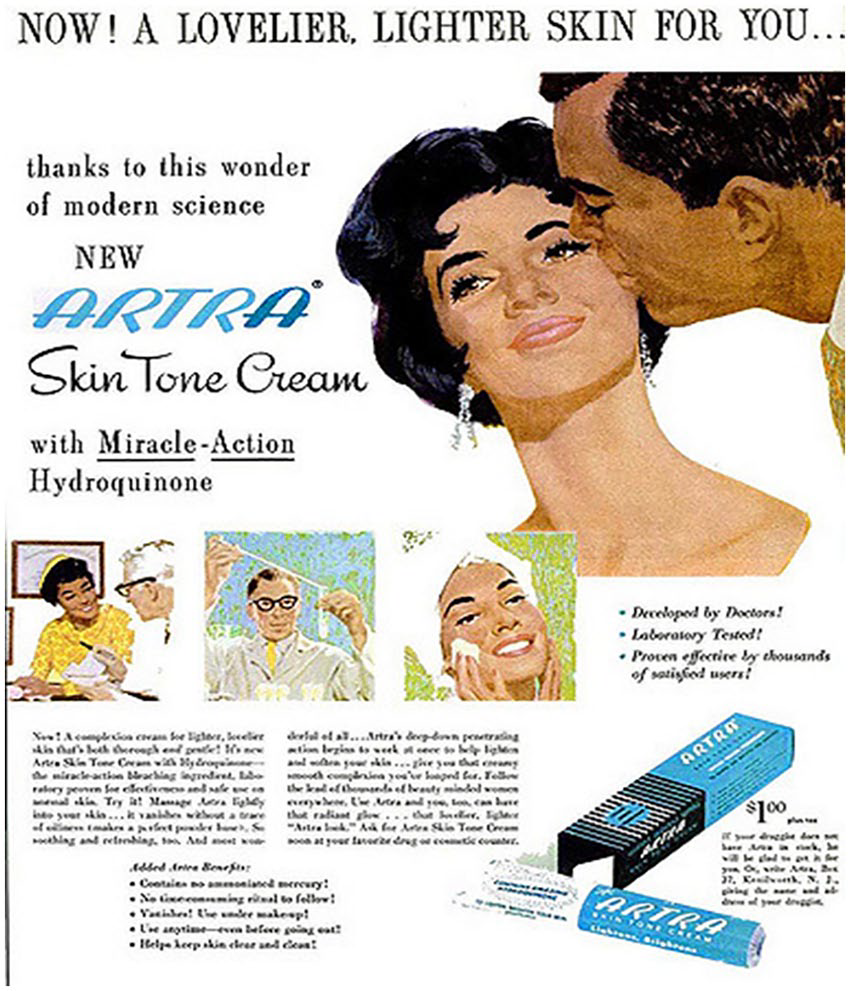
Arta skin lightening cream advertisement from Ebony magazine, November, 1959.
Many of the skin whitening ads that appeared in magazines in Brazil and the U.S. from the 1940 through the 1980s revealed an undying goal of attaining a lighter skin complexion and an attempt to achieve the beauty standards of a colonized mentality. A chemical analysis of one of the most frequently advertised skin whitening creams, Nadolina Bleach, revealed that it contained 10% ammoniated mercury, which can cause serious health risks and severe discoloration of the skin. This information, however, did not have a major impact on its sales (Glenn, 2008b).
In Latin America, especially in Brazil, skin tone is a major marker of status and a form of symbolic capital, despite national ideologies of racial democracy. As a result, skin whitening or bleaching among Afro-Brazilian women is a common practice (Glenn, 2008c). This has prompted large multinational firms to expand marketing of skin lightening products, while specifically targeting Brazil and other Latin American countries. These lightening products include creams, soaps and pills. Additionally, a prescription-strengthened lightening cream was developed and distributed in Brazil in the 1970s and 1980s (Glenn, 2008d). The longing for lighter skin, as evidenced by the widespread practice of skin bleaching among the African Diaspora in the U.S. and Brazil, can be viewed as a part of the legacy of colonialism that is structured to devalue non-European physical characteristics (Glenn, 2008e).
Popular Culture
Popular culture has been another significant and impactful arena for the manifestation of colorism in both the U.S. and Brazil. Embedded in the leftover colonial structure is a strong value of European aesthetics, specifically light hair, light eyes, straight hair, and light skin (Hall, 2008a). Dating back to the early days of television and film in the U.S., the inclination for light-skinned entertainers for specific movie and television opportunities and dark-skinned actors for others was extremely apparent. For example, black characters in race movies had to be light-skinned, while actors playing in mainstream white movies had to be dark-skinned (Adams, 2007). This is also apparent in Latin America as well as evidenced by looking at the television soap opera stars on the popular telenovelas miniseries in the 1970s and 80s (Hall, 2008a). Although Afro-Brazilians consistently made up a significant portion of the country’s population, they were rarely featured in Brazilian TV programs (Figure 3).
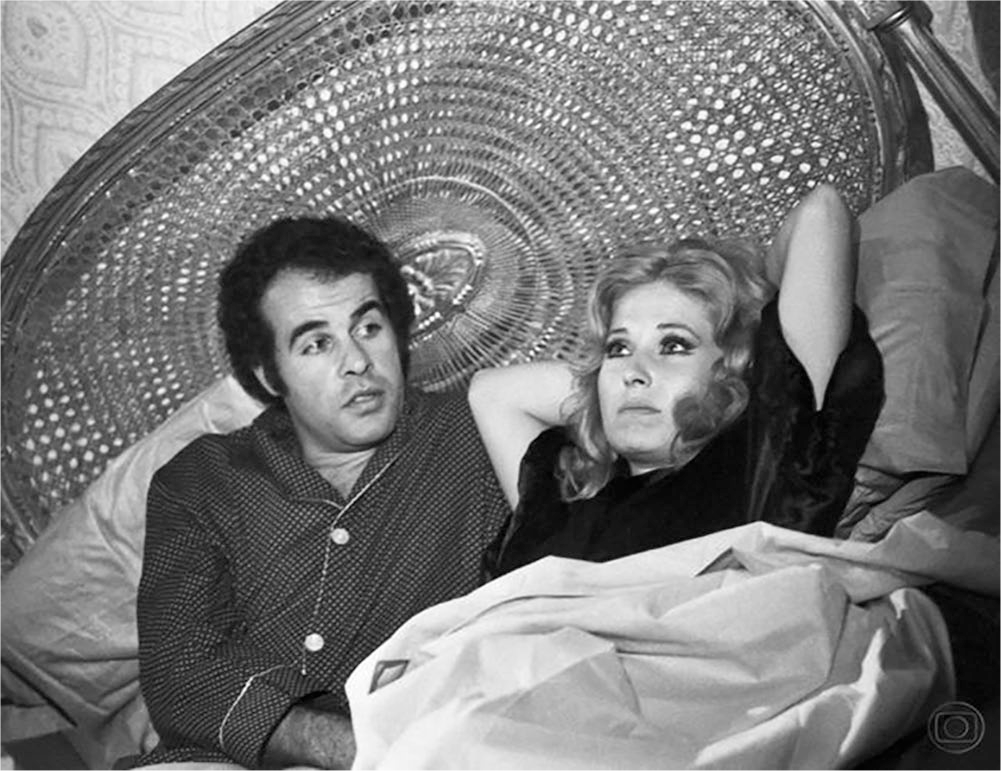
Osmar Prado and Pepita Rodrigues in the Brazilian telenovelas, Anjo Mau (1976). In Brazil, Osmar Prado is considered a white man (public domain).
In addition to television and film, the presence of light-skinned black women in both countries is ever present on the cover of magazines, in music videos and in national beauty pageants. For example, the body types and hairstyles in the Miss America pageants, among African American participants hardly differed from the European American contestants. Many have criticized that contestants of color have tried to imitate and emulate the European standard of beauty. That standard often includes a lighter skin tone. In fact, Vanessa Williams, the first black Miss America, was very light-skinned with gray-green eyes and light hair (Reginald Daniel, 2006).
The problematic issue of colorism has also been consistently covered by the African American press. For example, in the December 1984 issue of Ebony magazine, the publication directly tackles the sensitive issue of colorism in Black America. Ebony reveals that in a national survey of 1200 Black Americans, the majority of black men indicated that they were more attracted to light-skinned black women versus dark-skinned black women. Ebony (1984) also illuminates survey findings that indicate that the issue of colorism tended to be more of a sensitive issue for black women versus black men. Additionally, the magazine discusses the parental preferential treatment that is often given to light-skinned children over dark-skinned children. These findings by Ebony reveal that, in America, issues related to Eurocentric standards of beauty were still present in the post-Black Pride, Black is Beautiful era of the late 1960s.
Conclusion
In his 1988 film entitled School Daze, filmmaker Spike Lee addresses the unrelenting issue of colorism in a very effective way. In the film, Lee depicts light-skinned and dark-skinned women engaging in hateful and hurtful intraracial conflict based on colorism, on the campus of a historically black college. What this film seeks to teach its viewers is that a struggle over colorism is ultimately a struggle with one’s self. Colorism revealed itself through different practices in Brazil and in the United States. However, the intraracial discrimination that it spawned had its roots in white supremacy that stemmed from a colonial past. Proximity to whiteness, based on skin complexion was the driving force and this disparaging form of black-on-black discrimination not only helped to give white supremacy new life, but it also continued to cause intraracial rifts within the black community throughout the 20th century.
Footnotes
Declaration of Conflicting Interests
The author(s) declared no potential conflicts of interest with respect to the research, authorship, and/or publication of this article.
Funding
The author(s) received no financial support for the research, authorship, and/or publication of this article.
