







Abstract
Black male college graduation gaps pose critical questions for parents, teachers, policymakers, and the Black community. Black males face systemic challenges that derail them from higher education. This research, drawing on a larger study, investigated Black parental expectations, strategies, and activities used to cultivate academic success and foster the development of college aspiration in high schoolaged sons. The findings revealed a central theme of parenting with intent, that Black parents: (1) reinforced the importance of school and learning in a family-school nexus; (2) fostered a strong value of attending and completing college to attain success; (3) held high expectations that “set the bar” for academic excellence; (4) instilled class consciousness to develop an awareness of the utility of college; (5) aided in the development of responsibility, agency, and self-efficacy; and (6) evidenced a commitment to their sons as their “first priority” by helping them navigate the college admissions process.
Keywords
Globally, Black males face unique challenges that threaten their survival. Non-degreed Black males are subjected to a multitude of problems that are both economic and social. They lead all other racial and gender groups in incarceration and unemployment rates, live in the perpetual threat of gun violence (Martin et al., 2017), are overrepresented in the prison population (Alexander, 2010), and live in urban impoverished communities (Wilson, 1999). According to the National Center for Educational Statistics (McFarland et al., 2017), there were approximately 2,000,000 Bachelor’s degrees conferred in 2017. Of the total number, Black males earned 70,554, or 4%, trailing behind other racial and gender groups in college and university enrollments.
Parental involvement in students’ academic affairs (Hong & Ho, 2005; Im et al., 2016), parenting practices and styles (Davis-Kean, 2005; Herndon & Hirt, 2004), and parental behaviors and expectations (Davis-Kean, 2005; Kirk et al., 2011), are all linked to increased academic success. They are correlated with children’s interest in learning, academic identity, and eventual desire to attend college (Harrigan, 1993). Academic success refers to increasing grade point averages, reading and math scores, productive student-teacher relationships, and stronger scholastic achievement (Allen, 2016; Mandara & Murray, 2000; Posey-Maddox, 2017).
Black males are frequently scrutinized and marginalized in educational spaces (Alexander, 2010; Brown et al., 2013; Collins, 2006; Ferguson, 2000; Howard, 2013; Lewis & Erskine, 2008; Noguera & Leslie, 2014; Polite & Davis, 1999), regardless of their socio-economic status (Lacy, 2007; Lewis-McCoy, 2016). Studies have shown the impact of parental involvement in Black children who are continually exposed to racism, poverty, and prejudice (Allen, 2013; Greif et al., 1998; Mandara, 2006). For Black males, proactive (Allen, 2013) and protective parenting by at least one family member is related to the academic success and development of college aspiration (Kirk et al., 2011; Smith & Fleming, 2006). Black parents prioritize their children’s academic success; they take a child-centered approach to understand the pressures their children face in educational settings and assist them in addressing and overcoming them (Hrabowski et al., 1998). Additionally, they hold high academic expectations for their children and help them develop student-teacher relationships (Allen, 2016; Hébert et al., 2009). Racial socialization empowers Black males with historical and racial knowledge that enhances their resiliency (Allen, 2016), increases their self-esteem (Lesane-Brown, 2006), and helps them to navigate racially diverse spaces with tactical practices of self-determination (Carter, 2006). Black middle-class parents with experiential knowledge about racism frequently talk with their sons about racial matters, which helps them to thrive both socially and academically (Allen, 2013; Carter, 2006).
Very few sociological studies include middle-class Black male students who are enrolled in private or suburban learning environments (Frasure-Yokley, 2015; Lacy, 2007; Lewis-McCoy, 2016). This lack of research fails to acknowledge the social contexts, social class, and cultural factors that create unique identities (Noguera & Leslie, 2014) and help explain the challenges that Black male students face in academic settings. In this study, middle-class Black parents describe the attitudes and strategies that were deployed to shape their sons’ college aspiration, Hrabowski discourse (Nasir, 2012; Sellers et al., 1998; Shelton & Sellers, 2000). It uniquely fills in gaps in the mainstream literature related to Black parenting and socioeconomic status, academic success, and college aspiration. Intentional parenting and college aspiration of Black male high school students from middle-class backgrounds, who attended both suburban public and predominately White private schools are observed, analyzed, and discussed.
Methodology
The findings of this research emanate from a larger ethnographic investigation (Cochran-Jackson, 2017) that took place in a large southern metropolitan city. The activities and behaviors of 30 Black male high school students (n = 30) and 30 of their parents (n = 30) were examined, to unpack the development of higher education aspiration.
Participants
In the larger body of work, the researcher used purposive sampling to examine the effects that the intersections of race and gender had on higher education aspiration for young Black males. Parents and students were recruited from neighborhood churches, social organizations, government agencies and outreach groups, and solicited through the distribution of fliers strategically placed in a variety of educational settings. The analysis in the present study was derived from interview data of seven parents selected from the larger study who described specific strategies, expectations, and activities that were employed to ensure their sons’ academic success and development of college aspiration.
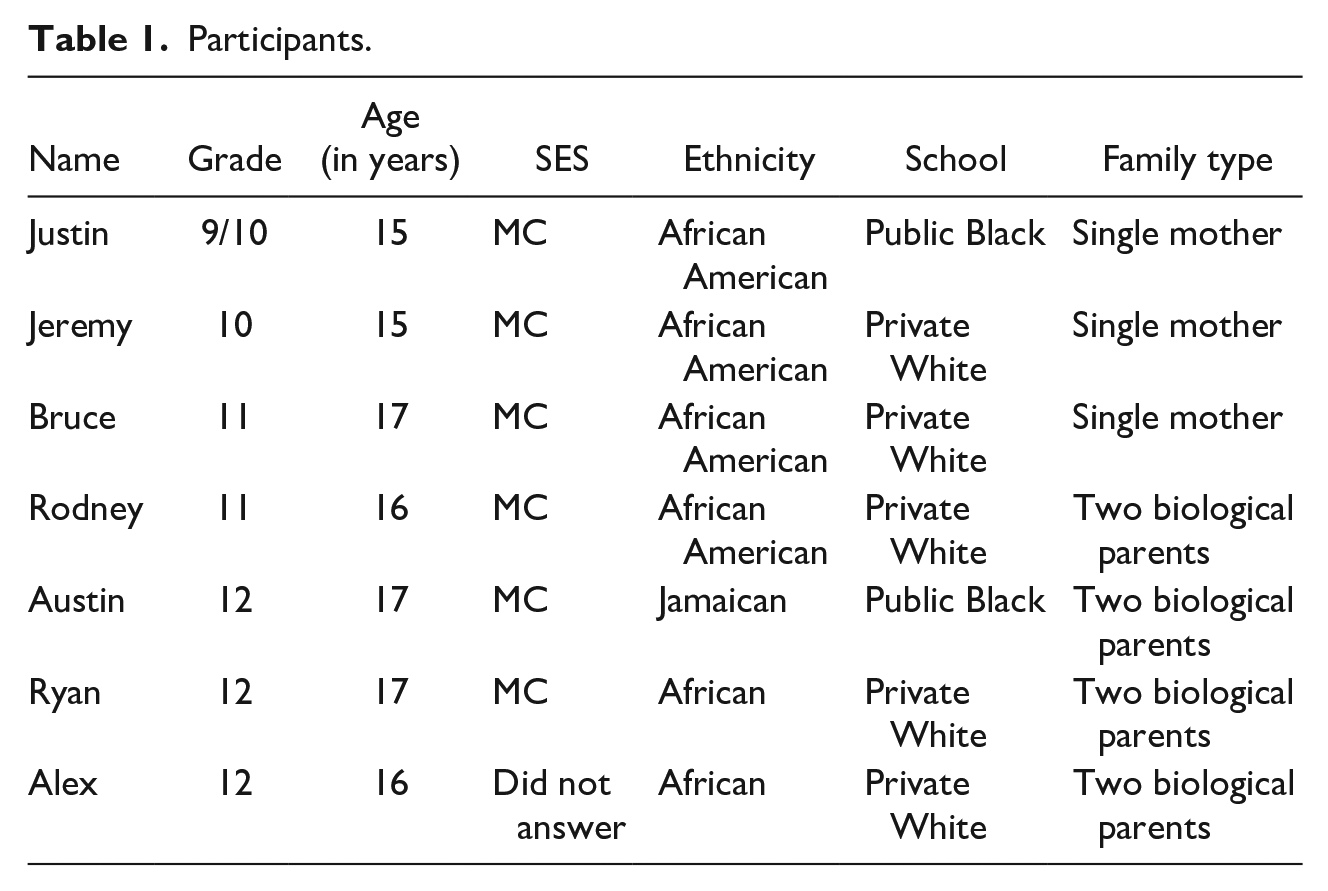
Four of the biological parents were married in two-parent households, and there were three single-female/headed families. All of the parents were biologically related to their sons. Six of the participants identified their household as middle-class ($50,000 and above annual incomes), and one of the fathers chose not to answer the question regarding income. The students’ ages ranged between 15 and 18 years, and the mean age was 17 years old. Of the seven student participants, one male was 15 years old, in the ninth grade, and was taking 10th grade classes; the mean grade level was the 12th. Related to ethnicity, there were four African Americans, two Africans, and one Jamaican in the study. The students attended two majority Black public high schools which were located in suburban middle-class neighborhoods, and five predominately White private schools that were located in suburban upper middle-class areas (see Table 1).
Participants.
Data Collection and Analysis
Data were collected through audiotaped in-person and over-the-telephone, semi-structured, and open-ended interviews, which lasted from 60 to 90 minutes. Parents were asked questions about their sons’ educational experiences and college aspiration, educational activities, specific actions they engaged in, and expectations they held to promote their sons’ academic success and interest in attending college. They were also asked to describe their feelings about the impact of college, how they prepared their sons for higher education, and some of the ways they empowered them with skills that might ensure their admission.
The analysis occurred as an iterative process, involving simultaneous data collection and data analysis (Lincoln & Guba, 1985). Each transcript was read initially, and a line-by-line analysis of the interview data was performed. Through constant comparison of the data, a viable analytic technique facilitated efficiency in examining the many pages of text, resulting in emergent themes which reflected the perspectives of the participants. The concepts emerged from the data and were coded into categories. The process was repeated until all possible themes had been extrapolated.
Findings
Several crucial themes emerged during the data analysis. Overall, the parents in this study delivered a variety of calculated strategies and practices to foster academic success and develop college aspiration. They adopted intentional attitudes that combined discipline with compassion and a shared sense of respect for their sons. The parents held high expectations for persistence and excellence in their son’s academic efforts, and for college attendance and completion. They communicated with their sons continually, encouraging them to embrace a strong value for education and a persistent work ethic, and expressed a commitment to their sons by spending time with them while providing resources and concrete suggestions to help them succeed with schoolwork, and standardized test preparation. In word and deed, the parents demonstrated that their sons were a priority to them. These themes from the findings revealed a connection to college aspiration, and the following excerpts from the interviews demonstrate parenting with intent which was used to influence the young Black males’ interest in attending college.
Parents specifically: (1) connected their sons to educational outcomes by holding them accountable for completing homework and engaging in activities to help them independently achieve academic success; the data revealed a commitment to the young Black males as their “first priority”; (2) held high expectations that “set the bar” for academic excellence; (3) aided their sons in developing responsibility, agency, and self-efficacy; (4) fostered a strong sense of the importance of attending and completing a college education to become successful; (5) instilled a sense of class consciousness to develop an awareness of the utility of higher education; and (6) helped their sons navigate and excel in the college admissions process.
Providing Stability and Committing to Sons as “First Priority”
Parents demonstrated their commitment to their sons by aiding with school matters and encouragement that established a family-school nexus. Their actions were consistent and intentional to help Black males achieve academic success and develop the desire to attend college.
Austin was a 12th grader who lived in a Black middle-class suburban neighborhood. He attended a predominately public Black high school in his local community and initially experienced tremendous difficulty in the transition from middle school. Anthony, Austin’s father, stated,
Austin has had a difficult time with school from elementary. Well, there was, there seemed to be a disconnect with what they were teaching and what he was learning. Also, he was painfully shy. In fact, in the fifth grade, I believe that he was supposed to do an assignment which they had a lot of reference material. And he was so shy, until he wouldn’t get up to get the reference material to look at it. He just sat down as if he had it. Instead of saying I didn’t do the homework and I don’t have it, finally his partner said, I don’t think he’s got it. It was just a really painful thing for him to get through.
Anthony’s description of Austin as “painfully shy,” emphasized the necessity of a strategic intervention to provide help. He saw that his son’s shyness prohibited his ability to ask his teachers for help. Anthony felt compelled to strategize and execute an intervention and worked with Austin on a daily basis. Having earned a master’s degree, he had a flexible work schedule which allowed him to invest hours helping his son with homework assignments and gaining self-confidence. During this time, Anthony noted that Austin also suffered from debilitating challenges with learning. He asked specific questions to conceptualize the problems and then devised strategies to help Austin overcome them. His father, Anthony, stated,
We, we, ah, sat down here and I got his grades, and we went through it, just focused on what he understood, we do A, then we do, B, then we do C. It’s not intuitive to him. And we went through and sat down and um, worked it out that way. Everything that he believed he understood, um, we went over it, and if he gave it to me a certain way, and it was wrong, I would say no, this is what you want to do. Forget about what you learned, remember, your brain is your enemy, and is trying to trick you. This is what we did. . . I am working right now on moving towards college and the things he needs to do. So that is the way we have worked it.
Anthony spent many hours helping Austin transition from middle-, to high school. The commitment of time he spent and the intervention he designed revealed that Austin’s academic achievement and success were Anthony’s top priority.
Yaa was parent to Ryan, a 12th grader who attended a predominately White private high school in a suburban setting. She was married to a medical doctor and worked part time as a mediator. To shape his school related behaviors, she talked with him a lot to make sure he stayed on track academically. She stated:
We used to check a lot of his work, I still go to conferences but right now I talk more and since he’s getting older, we try to make him more responsible. I still talk with him every day to make sure he is still doing the work; we talk to him a lot instead of looking and checking his work. I am strict not laid back at all, though.
Yaa revealed a scaffolded strategy that she and Ryan’s Dad engaged in for some time. Their communication was used to shape specific life skills in Ryan, and to strengthen his outlook on the importance of education, academic performance, and output. This strategy was intentional and was hands-on; it required consistency and commitment, and also indicative of the important position Ryan held with his parents. She explained
I think it is important to have an education, so I am more dictatorial saying you gotta do this, you gotta do it. He has not choice, he can choose a profession but going to college you have no choice. You are going to college that’s the way it is in our house. You will get your undergraduate degree.
Yaa left her profession as a teacher to devote time to raising her son. She described it as an obstacle that blocked her ability to spend time with her children, who she prioritized over her career. Yaa’s training as a teacher was beneficial in helping Ryan with academic work. Her middle-class status allowed her to work part time and allocate the majority of her time to developing her children.
Rodney was an 11th grader attending a predominately White, private, high school in an upper middle-class neighborhood. His mother Darlena had a strong value for education. Before her children were born, she had a demanding full-time career working for a communications company. She recalled that,
When we first got married, you know, we didn’t really talk about whether one would work, and one would stay home. My husband did mention that he would like for that to be the case. One of the things he mentioned is that I just don’t want my kids to grow up in daycare. I don’t want anybody else raising my kids, so that was I guess you could take that as a sign or a hint in a way but. I had a good job, working for a telecommunications company, and had a good opportunity of climbing the corporate ladder but I knew also that I wanted to be married and wanted to have kids. After I had my first child, I realized that I wanted to be in their presence at all times and we just decided that was what we would do.
Expressing a strong value for learning and describing what was needed for her children to do well academically, Darlena stated,
One of the things we liked about private school was the smaller settings or smaller classrooms. . .more individual, ah, teacher student ratio or smaller ratio between student and teacher, that type of thing. We also just looked for something that would cater to different learning styles. I guess we are not anti-public school and have never been, but these were the things that we thought would be achieved in a private school setting. When our kids first started out in their preschool and kindergarten years, we always had the desire to just do private school, even prior to me homeschooling they were in private school. I wanted to be involved in their education and see how they learn, to move them as fast or as slowly as needed.
She later re-enrolled Rodney and his siblings to a private school that she drove them to every day because she felt that it was important for her to do so. Darlena’s and Rodney’s Dad’s first priorities were their children and they both were invested in making sure that Rodney was equipped with the knowledge, skills, and attitude to succeed academically. Darlena took a directed approach to Rodney’s education. She made decisions about the type of learning environment she wanted him in and then strategically placed him there. During the time that these interviews took place, Darlena was employed part time. When asked about how she helped 11th-grade Rodney and her other children, she stated,
I make sure that he focuses with his work, we’re constantly asking what homework they have how much time, do you need to go somewhere and focus, and you know, we try to have a place in the house for the kids to do where they can concentrate and do, you know, what they need to do.
Both parents constantly reinforced the importance of completing homework assignments and paying attention in school to Rodney and his siblings. They frequently reminded their children to accept the responsibility of attending to school matters.
Similarly, Mr. Andrews had a solid relationship with his son Alex who was a senior attending a private school in a suburban White upper middle-class setting. Although the socio-economic status of the Andrews family was never revealed, Mr. Andrews was a computer consultant, and his wife was an attorney. Mr. Andrews tutored Alex since he was a little boy, which benefited him tremendously; Alex started a tutoring business with his two younger brothers. They tutored other students at the high school and church they attended. Mr. Andrews and his wife always monitored Alex’s schoolwork. They restricted their sons’ access to video games and television, and frequently talked about setting and accomplishing goals, and the importance of education and college. He was very clear about limiting his son’s access to popular culture to restrict the potential distractions from academic achievement. Mr. Andrews talked with Alex to keep him engaged with schoolwork. He said,
I always tell my boys you only have one job and that is school. If you can do that, without any pressure, we don’t pressure them, we just let them know that this is your focus, don’t lose focus so we ask for their homework and what they have, have you done it, to just make sure that they are on top of their game.
Holding High Expectations That Set the Bar for Academic Excellence
When asked about his expectations for Alex, Mr. Andrews stated, “I will say that you should at least finish graduate school and that is the kind of role model that I would love for them to follow. . .” His expectations had an impact on Alex’s class selections. Mr. Andrews explained, “Education is a top priority in our family. For the most part, [he] has always taken challenging courses, and I am very pleased.”
Mr. Andrews also held high expectations for academic excellence. Regarding the school Alex attended, he said,
I think there are too many politics in public school and for public school teachers. . .We decided that it would better for our children to go to private school because the public school we were in didn’t make AYP. The next year they got AYP, but Alex didn’t get challenged as much as we had hoped. The school he attends now is a very, very good school. They want to push you to be a thinker and not a passive learner.
Studies have shown that children’s perception about their parents’ expectations for school correlates with their own educational expectations, and it is noted that children’s perceptions about their parents’ expectations for school success is more influential than just parents’ expectations (Phillips, 1987). Because of the high expectations Mr. Andrews held for education, and those he held for his son, Alex’s target schools consisted of highly ranked colleges. He was admitted to Rennselaer Polytechnic Institute’s STAR Program (a precollege initiative) and expected to receive a substantial financial scholarship from the college he decided to attend.
For a long time, Mr. Andrews directed Alex’s focus on completing schoolwork and being proactive in excellent academic performance. He stated,
We are very, very involved in their education from the time they were in preschool. I always tell my boys you only have one job and that is school. If you can do that, without any pressure, we don’t pressure them, we just let them know that this is your focus. Don’t lose focus, so we ask for their homework and what they have, have you done it, to just make sure that they are on top of their game.
Wood et al. (2007, 2009) argued the influence of parental expectations in shaping Black male academic performance. It is an essential ingredient in the development of college aspiration. Parental expectations were inherent within the guidance to foster and reinforce academic interest and heightened performance within Black males.
Dr. A.K. was a dentist with a 24-year practice and her son Bruce attended a private, White, suburban high school. Her expectations for Bruce were centered in college completion. She expressed, that,
The expectation is that you’ll go to college and that you have to go to grad school afterwards to get a terminal degree. That is the expectation for all my kids. . .I think they don’t see themselves as middle-class but see themselves as very poor. My money goes to tuition; so, they see how hard I work every day and how tired I am. They see that you’ve got to work to achieve the dream.
When asked about academic related strategies, Dr. A.K., said,
[I] set the bar and help him navigate, all three of my kids did differently. I never needed to look at book or paper, I never needed to help them, even when I wanted to. So, I basically set the bar and I probably nag a little, did you study this, did you do this, when is your quiz, just constantly letting them know that I’m trying to be on it.
Dr. A.K.’s high expectations and strong value for education were continually conveyed to Bruce. She modeled the utility of education through the hard work she performed in her profession to pay private tuition. Through the execution of intentional strategies, Dr. A.K. set the bar for academic excellence to ensure that Bruce developed a strong work ethic for completing schoolwork. Her efforts reflected intentional parenting and academic empowerment.
Debra shared Dr. A.K.’s expectations for excellence in her son’s future. She was a public health advisor and mother to Justin who attended a predominately Black, suburban middle-class, high school. She held high expectations for 10th-grader Justin, and when asked how she felt about the importance of a college education, stated,
Yes, Justin will attend college and Justin will graduate. Ah, because it is just as common as getting out the bed and washing your face. It is totally the core of something that you have to do attending school and graduating high school. . .college. . .. it’s a must.
Debra’s explanation reiterated that parents set high expectations for academic excellence and hold their sons accountable to meet and exceed their standards. In doing so, they emphasized the importance of learning and reinforced a family-school nexus that initiated at home, allowing for their sons to internalize it as a part of their family’s core value. Debra’s expectations for Justin shaped their interactions and helped him to stay focused on academic efforts that would help him successfully complete a college education.
Developing Responsibility, Agency, and Self-Efficacy
Parents in this study engaged in specific attitudes and behaviors to prepare their children for college admission and completion. Yaa and her husband’s strategy was to empower Ryan to become more independent. They took a more graduated approach, and as he got older, allowed him to take more responsibility with his school affairs. They were proactive in providing a tutor to ensure Ryan’s success and academic enhancement with math. Yaa continued to help Ryan with developing and navigating the student-teacher relationship. When asked to describe the specific actions she engaged in to ensure her son’s academic success, she, answered,
I still go to teacher conferences, but right now I talk more and since he’s getting older. Next year he will be on his own, we try to make him more responsible. I still talk with him every day to make sure he is still doing the work. We talk to him a lot instead of looking and checking his work, we’re not checking as much now. So, we just talk a lot about it to make sure he is up to speed. We told him if you need any help let us know and I used to help a lot in math and now we’re just giving him the tutor right now.
Anthony sought to develop Austin’s independence and responsibility. For years, they jointly worked on homework lessons and organizational skills. As Austin got older, Anthony told him that he would back off when Austin felt confident about his schoolwork. He was looking for Austin to inform him of when to do so.
Joyce was an epidemiologist and mother to Jeremy, who attended a private White suburban high school. She continually empowered Jeremy in navigating his school environment. She said,
Jeremy is really quiet and doesn’t speak up for himself. Over the years I have told him, ‘you need to ask your teachers questions, that’s why I’m paying them instead of coming home with all these questions. You need to ask those folks.’ Over the years he has gotten to where he will ask his teachers questions and they wouldn’t answer them. So, every day he would come home and cry because he had an assignment that he didn’t understand. So, the second week I emailed the teacher and ask for a consultation and the teacher didn’t write me back for a week and he did this two years ago; he ignored me. I cc’d the principal and this time after a week he responded. . .I had to go up there. . . He apologized profusely but I betcha the next time he will answer my emails.
Initially, Joyce asserted her authority and took calculated actions with Jeremy’s educational access. She worked with him for several years to effectively communicate with his teachers, and continually advocated for Jeremy. Through consistent communication and strategizing, Joyce bolstered Jeremy’s confidence and empowered him to be more vocal about his academic needs since he was not getting the attention he needed to perform well in school.
Fostering the Importance of Attending and Completing a College Education
Many argue that because of the educational gap between Black and White students, Black males are especially in need of college interventions and development (Uwah et al., 2008; Wyatt, 2009). Parents in this study fostered college aspiration by engaging their sons in academic and social interactions that began in early grade levels and continued through high school.
Anthony had a master’s degree and knew first-hand about the impact of higher education. At the time of the interview, after many years of working with Austin to help with the development of organizational and cognitive skills, their focus shifted to the college search and admissions process. He described a strategy used to help Austin move “towards college.”
I bring up and say, hey, what is this, go search your notes, are you putting the dates on this stuff? Make sure you’ve got it all in order. Over the summer, I’m using the Lexile score to try to find books in his range that I know the SAT are looking for that kind of knowledge base. He’s taking calculus and AP environmental science and taking two computer sciences courses. He’s on the right path and I’m more happy to let go of the reigns and let him take the lead with it. I told him. . .I’m waiting for you to kind of tell me when you’ve got it.
Mr. and Mrs. Andrews were steadfast in their strategy for keeping their sons poised to getting into college. Without the assistance from his parents, social controls, instilled values, the many conversations, guidance, and direction given regarding academic and social matters, Alex may not have developed a strong value for education or the desire to attend a top tier college. He told,
With regards to college, one of the things we tell all of our kids to think about is, what would they like to do, after they are finished with high school and, once they kind of get some ideas as to what they would like to do. Alex sees his education as important because he realizes how valuable that is and how education can pretty much define what he wants to do in life and so he is taking that very seriously, so I would have to say that is the most important thing.
Instilling Class Consciousness to Demonstrate the Utility of Higher Education
Parents in the study promoted class consciousness within their sons to show the relevance and utility of education. Dr. A.K. connected higher education completion to socio-economic success. She expressed this to Justin, and argued that,
Because they both have to live in the world and be self-sufficient, the expectation is that you’ll go to school and that you have to go to grad school afterwards to get a terminal degree. That is the expectation for all my kids. They see that you’ve got to work to achieve the dream.
Dr. A.K. modeled educational utility by aiding her oldest daughter in attaining a bachelor’s degree from Wellesley and securing a career in investment banking. She paid Bruce’s private school tuition and enjoyed playing golf and tennis in her spare time.
Joyce paid for additional after-school tutoring and PSAT test taking classes for Jeremy. She had a strong value for education and admitted that she talked “incessantly” to her 10th grader about school and the priority of completing college. Joyce stated,
Education is the key to success. I went to school my whole life. Education has made me who I am. . .that why he’s been to Africa and Canada three times and even Alaska and Hawaii. I want Jeremy to live up to his potential and I think I provide an avenue for him to do that. Last year, I paid for a tutor to help with remedial math, two hours every Saturday that cost $100 per week. I wasn’t happy giving up my Saturdays; I told him that if you don’t do well, it is not my fault. So, I just feel that it is my responsibility to position him where he will have sufficient options. That is what I’m trying to do.
Joyce’s commitment to Jeremy’s academic achievement stemmed from the knowledge of what education had contributed to her life. The sacrifices she made to pay for after school and PSAT tutoring helped to prepare him for life as an adult, so that he would be able to support himself and his family. Joyce was an epidemiologist. She owned a house, two cars and paid private school tuition. Her son Jeremy had traveled to Africa, Canada three times, Hawaii and Alaska. She told Jeremy that it was because of the power of education that she was able to provide this lifestyle for him.
Yaa was married to a physician and worked part time as a mediator. They paid Ryan’s tuition and allowed him to play on the golf team at his private school. Debra was a public health advisor who lived in an upper-middle-class neighborhood and took Justin on summer vacations every year. She had taken Justin to Mexico, the Bahamas, on several cruises, and regularly exposed him to plays. Joyce attributed her success to education she received and reminded Justin of the power of education and the opportunities that it made possible for them both.
The parents of Ryan, Austin, Alex, Rodney, Jeremy, and Bruce exhibited strong values for education. All the parents were college graduates, and some obtained master’s and professional degrees. Their intentional strategies connected their sons to the relevance of learning, achieving academic success, and attending, and completing college. The parents modeled educational utility through the professions they worked in and the lifestyles they created. They showed their sons how education had made their lives more comfortable financially and how it had provided them with the time and resources they were able to provide.
Helping to Prepare for the College Admissions Process
Joyce enrolled Jeremy in an SAT preparation course. When asked about college preparation, Joyce told,
We love playing word games, we love practicing our SAT words, we’re loving changing verb forms so, if we say something is the noun form, what is the adjective form of that word? We do all kind of play to be prepared for the SAT, which is all words. So, if you can do and it’s all fun, maybe you learn something, and you didn’t have to work hard.
Joyce was deeply committed to Jeremy’s educational success and engaged him in vocabulary building exercises to increase his SAT scores. She found ways to make learning both fun and cognitively stimulating, through gameplay. Joyce also provided Jeremy private tutoring to help him perform better in math. She said,
My son can’t get information because somebody’s ignoring him. And I know, he gets on their nerves, you keep asking the same stupid question, that’s the reason I got him a math tutor, however, that’s their job so, ah, I haven’t talked with her yet but if I feel like he needs some extra help I will email them and say talk to him after homework. Or can you stay after school, he’s having problems with this, this, or that, you know, so I try to advocate for him and make sure he gets what he needs.
Bruce’s mom, Dr. A.K., talked about what she did to ensure her 11th-grader’s success. She provided Bruce with tutoring to help with test taking strategies, to increase his scores, and to reduce the anxiety he may have experienced. She also stated that she paid for private SAT tutoring so that he could, “Just learn the tricks of the exam. . .he needs to be coached for the exam because otherwise he would not do as well as other folks who are being coached.”
Debra held high expectations for Justin and was a highly involved parent with an intentional presence. She held high expectations of Justin and communicated with him about everything related to education and his social realm:
I think I should, but I like, I took his phone away, and I told you video games, he’s not doing video games, little TV during the week, I do let him listen to his radio and the mess that is on there, you know, I think I should not let him listen to, but I think you have to give some, I try to talk to him about the lyrics that Little Wayne and the crew is talking about so we do have conversations but I think I probably need to be a little sterner.
The parents’ experiential knowledge helped in preparation of the college admissions process. They made sure that their sons were academically prepared for the entrance exams and helped them develop the skills to navigate the test taking process. The creative strategies of gameplay and ongoing conversations were intentional strategies that revealed parental commitment to academic success.
Discussion and Recommendations
Mainstream research has failed to acknowledge the existence of this demographic and has neglected to examine the unique challenges they face in their educational settings (Frasure-Yokley, 2015; Lacy, 2007; Lewis-McCoy, 2016). This study focuses on middle-class Black males who attended private and suburban public high schools in a metropolitan southern city. It revealed the perspectives and actions of parents who are actively engaged in positioning their sons for success by engaging in intentional attitudes, behaviors, and strategies that were used to increase academic success and college aspiration. Parental involvement is intrinsically linked to educational success (Ford et al., 1999; Jeynes, 2005; Polite & Davis, 1999). Middle-class Black parents recognize the microaggressions that plague educational environments and place greater emphasis on socializing their children for higher education, and occupational attainment (Allen, 1976). Parents modeled the utility and value of higher education, while fostering a strong sense of the importance of college education as a means of attaining success. They made numerous sacrifices to ensure that their sons were motivated and academically prepared to attend college. Young Black males developed cognitive skills to learn new information and gained interest in attending college because of their parents’ efforts.
Intentional strategies positively shape college aspiration, and Black males benefit from these directed relationships with their parents (Carter, 2006; Kunjufu, 1982; Ladson-Billings, 1995; Murrell, 1999). The parents invested countless hours of their time, provided abundant resources, and served as education specialists, learning diagnosticians, guidance counselors, mentors, and tutors. They drove miles outside of their neighborhoods to place their sons in schools that they personally selected, and demonstrated the purpose and power of education in providing comfortable lifestyles for themselves and their sons. Students were taught to develop both cognitive and noncognitive skills which made them more likely to thrive in educational settings, and successfully navigate the college admissions process. For Black males, regardless of socio-economic status, politics are pervasive in many educational settings (Baldridge et al., 2011; Ferguson, 2000; Ginwright, 2009; Lewis-McCoy, 2016), resulting in microaggressions that derail their educational opportunities for learning and future interests in college. Family-school partnerships are linked to academic success (Allen, 2013; Carter, 2006; Lacy, 2007; Rollock et al., 2011), and participants forged family-school connections that inspired their sons’ college aspiration through intentional activities and conversations. Given the lack of support that many of the young Black male participants in this study faced in their school environments, the guidance they received from their parents was crucial because it is unlikely that they would have received it from any other source.
Intersectionality theory explains that multiple structures of oppression combine and create conditions that detract Black male students from learning (Baldridge et al., 2011; Collins, 2006; Polite & Davis, 1999). In many school settings, the mere presence of Black males creates obstructions that threaten their ability to thrive academically. Because of the challenges Black male students face that are related to their gender and race, regardless of their socioeconomic status, additional research is needed using a lens of intersectionality.
The results of this study pointed out three recommendations. Firstly, parents act as powerful social agents throughout their children’s lives; they must be actively involved in learning and school environments to empower them for success (LaRue & Majidi-Ahi, 1989). Black males are never guaranteed academic assistance or inspiration from teachers in educational settings. To ensure their success, parents must create and sustain a family-school nexus. Secondly, schools serve as critical social agents of children, impacting their life chances. Of tantamount relevance is developing an intrinsic value for and interest in Black males in both public and private school settings. Incremental attitudinal and behavioral adjustments can be made by teachers and administrators in classrooms and learning environments. Incentivizing research and awarding grant funding may provide the needed impetus for change. The third recommendation relates to the macro-level changes that are needed. Policymakers who share connections with and concerns for the Black community must ignite a call to arms for aiding Black males. Forming alliances, panels, and committees comprised of parents, teachers, education administrators, and social activists to discuss the problems Black males face in public and private educational environments is a beginning. Creating and enforcing policies and initiatives to combat this social problem is essential.
Conclusion
This study revealed the impact of parenting, the need for adopting a lens of intersectionality in research related to Black males and education, and the necessity of school reform. It focused on a population of Black males who were able to succeed academically and develop the desire to attend college based on the commitment, strategies, practices, and resources provided by their parents. Challenges and microaggressions are commonplace in educational settings; using a lens of intersectionality will explain the unique conditions and interactions that are created by race and gender and will increase our understanding and awareness of the perils that thwart Black male educational achievement. Finally, too much attention is paid to Black male underachievement and not enough on the many Black males who are thriving and attaining educational success across educational settings. This has hindered the understanding of the factors which promote Black male success. A new research agenda will consist of featuring young Black males who are succeeding in educational pursuits to give credence to the ones who are succeeding, and hope to the ones who are not.
Footnotes
Declaration of Conflicting Interests
The author declared no potential conflicts of interest with respect to the research, authorship, and/or publication of this article.
Funding
The author received no financial support for the research, authorship, and/or publication of this article.
