







Abstract
This paper presents the findings from interviews of renowned Black education scholars discussing the challenges Black students are facing in the K-12 educational system. The paper begins with an introduction outlining the “cultural war” that has been waged against Black youth, it provides an overview of Afrocentric theory as it is used in the field of education, provides the methodology used to glean data, offers an analysis from interviews, and provides implications and discussion for the ways in which Black students would be better served if education policy, research, and practice were positioned to acknowledge the successes that African centered education has had among Black youth. The findings include three interconnected themes, including: the need for a culturally centered and culturally responsive pedagogy as educational imperatives, the role of expectations and cultural centeredness in shaping educational achievement, and the significance of intergenerational learning and humanely equitable relationships in fostering the academic and personal growth of Black students.
Plain Language Summary
This article argues that Black students are often harmed by an educational system that ignores or devalues their culture, history, and lived experiences. Through interviews with leading Black education scholars, the study explains that African Centered Education (ACE) can help improve Black students’ academic success, identity, confidence, and sense of belonging.
The scholars emphasize that culturally centered teaching, high expectations, positive relationships, and community involvement are critical for helping Black students thrive. The article concludes that schools, teacher preparation programs, and policymakers should take African Centered Education more seriously as a pathway toward educational equity and empowerment.
Introduction
The persistent educational trials and tribulations of Black students in the United States are a predictable outgrowth of the legacy of systemic racism/white supremacy within US society. For decades, the marginalization of Black youth has been perpetuated by curricular omissions, deficit-oriented pedagogy, and educational policies that fail to address the unique cultural and historical contexts of Black youth. Amid these issues, African centered education (ACE) has emerged as a vital and transformative “agent” for change (Shockley & Frederick, 2010). ACE, grounded in African-centered (aka Afrocentric) theory, offers a radical reimagining of education that centers the cultural identities, histories, and lived experiences of people of African descent (Asante, 1991). ACE has the potential to disrupt the Eurocentric narratives of traditional schooling in the US and it provides an empowering and affirming educational experience for Black youth.
Black youth in the United States have been at the center of cultural wars that seek to delegitimize their identities, aspirations, and lived experiences through systemic policies and media narratives. For example, the “war on drugs” in the 1980s disproportionately targeted Black communities, leading to mass incarceration and the criminalization of Black youth, despite similar drug usage rates among white youth (Alexander, 2021). Similarly, educational policies such as zero-tolerance discipline policies have disproportionately expelled and suspended Black students, feeding the school-to-prison pipeline (Morris, 2017). More recently, bans on critical race theory and restrictions on Black history curricula in schools illustrate ongoing efforts to erase and suppress Black youth’s understanding of their own heritage and systemic inequities (King & Swartz, 2015). These cultural battles are not only about policy but also about controlling the narratives that shape Black youth’s self-perception and opportunities for social mobility.
In this context, “cultural war” refers to the deliberate and systemic efforts to undermine, erase, or devalue Black identity, history, and ways of knowing within educational and societal institutions. It manifests through curriculum exclusions, punitive discipline policies, and the suppression of culturally affirming practices that support Black children’s growth and humanity. This war is not just about policy, it’s about power, belonging, and who gets to decide whose stories are deemed worthy of shaping the future.
This paper explores the role of African centered education as a catalyst for change, both within the Black community and in the broader U.S. educational system. Through qualitative interviews with leading scholars in Black education—all of whom contributed to a docu-series focused on Black youth—this study examines the perspectives of those at the forefront of advocating for a more culturally centered pedagogy. The scholars’ reflections not only underscore the critical need for ACE, but also provide rich insights into the ways in which this pedagogical approach can serve as a tool for both academic success and socio-political empowerment. By drawing from their voices and analyzing their perspectives, this paper presents an argument for the urgent integration of African centered education into mainstream educational discourse and practice.
The next section outlines the research question, followed by a discussion of the African-Centered Education (ACE) framework, which situates this study within the broader intellectual tradition of Afrocentric theory. This is followed by a review of the relevant literature that has shaped the conceptual foundations of African Centered Education. Subsequently, the findings and analyses derived from the interviews are presented, offering critical insights into the perspectives of Black scholars. The final section explores the implications of these findings for policy, practice, and future research, concluding with a broader discussion on the significance of African Centered Education in contemporary educational discourse.
Research Question
What are the perspectives and understandings of leading Black education scholars on the notion of a cultural war being waged on Black youth via the US educational system?
Conceptual Framework
African centered (aka Afrocentric, will be used interchangeably) theory is an intellectual paradigm rooted in the philosophical, historical, and cultural traditions of African people both on the continent and throughout the diaspora. It seeks to reposition Africa and its descendants at the core of scholarly inquiry, privileging African epistemologies, values, and worldviews in the production of knowledge. African centered theory is not merely a reaction to a Eurocentric worldview, instead it is a reclamation of African ways of knowing that existed long before Western colonial incursions (Asante, 1990). It emphasizes the interconnectedness of all aspects of life, viewing knowledge production as a holistic process that is inseparable from the spiritual, communal, and ethical dimensions of existence. Afrocentric theory is a means of intellectual decolonization, challenging the pervasive dominance of Western thought and affirming the validity of African intellectual traditions as equally legitimate comprehensive frameworks.
One of the core tenets of African centered theory is the ancient concept of Ma’at, an ancient African principle that emphasizes truth, reciprocity, balance, order, harmony, propriety, and justice as fundamental to both individual and collective existence (Karenga, 2004). Informed by Ma’at, African-centered theory advocates for the pursuit of knowledge not solely for personal advancement, but for the betterment of the community and the upliftment of African people globally. It also stresses the centrality of African history as the foundation for understanding contemporary issues, rejecting the marginalization and distortion of African contributions to human civilization (Diop, 1955/1974). By centering African perspectives, African centered theory challenges the epistemic violence wrought by colonialism, which has systematically excluded, misrepresented, and subjugated African oriented ways of knowing.
African centered theory also underscores the importance of nommo, which is the generative power of the word in African cosmology as a means of articulating African realities and aspirations. Through nommo, African centered theory privileges oral traditions, storytelling, and linguistic practices that are deeply embedded in African cultures, recognizing them as legitimate modes of knowledge transmission (Karenga, 2014). The emphasis on language as a tool for cultural continuity also speaks to the theory’s resistance to linguistic imperialism, which has often sought to delegitimize African languages and their role in shaping African consciousness. By reclaiming African languages and ways of speaking and knowing, African centered theory promotes the retention of cultural memory and the affirmation of African identities within global discourses.
African centered education, grounded in the principles of African centered theory, is an educational approach that seeks to affirm and nurture the cultural identity, history, and epistemological traditions of African people. This form of education intentionally centers Africa and its diasporic experiences in the curriculum, challenging the Eurocentric biases that have historically dominated educational systems, particularly within the context of colonial and postcolonial societies. African centered education posits that the intellectual, social, and psychological development of Black students cannot be fully realized without an educational framework that affirms them (King & Swartz, 2015; Shockley & Lomotey, 2020).
The relationship between cultural loss in Black communities and the forces of assimilation is deeply intertwined with the systemic educational disenfranchisement faced by Black students, which is rooted in the imposition of Eurocentric values, norms, and pedagogies within K-12 institutions. Assimilation, as it pertains to Black communities, functions as a mechanism of cultural erasure, where Black students are socialized into adopting worldviews, epistemologies, and behavioral norms “that are alien to their cultural heritage” (Shockley, 2003, p. 96). That process disrupts the continuity of Black cultural knowledge, displaces traditional modes of socialization, and positions Black students as outsiders within a system that marginalizes their identity and fails to affirm their humanity. As a result, Black children are systematically alienated from their cultural foundations, contributing to the phenomenon of Black educational failure, which manifests in high dropout rates, disengagement from school, and puts them between a rock and a hard place (miseducation vs. no education at all) within school systems (Shockley & Hilliard, 2008). Shujaa (1994) clarifies this poigniantly, The schooling process is designed to provide an ample supply of people who are loyal to the nation-state and who have learned the skills needed to perform the work that is necessary to maintain the dominance of the EuropeanAmerican elite in its social order. For African Americans, individual success in schooling is often simply a matter of demonstrating one’s ability to represent the interests of the European American elite. Through such a process, African people as a group are able to derive little benefit from the schooling of our members and, even then, it is most likely to be in the interests of the European American elite for us to do so (Shujaa, 1994, p. 10).
The loss of cultural identity through assimilation is both individual and collective, producing trauma that weakens the very fabric of Black communities. As Black children are educated within predominantly Eurocentric frameworks that prioritize Western ideals and histories while neglecting or distorting African and African diasporic contributions to human civilization, they become disconnected from their ancestral lineage, history, and sense of self. The disconnect fosters a psychological and emotional dissonance that compromises their capacity to navigate educational spaces successfully (Hilliard, 1995a). The absence of an African-centered paradigm in education contributes to the internalization of inferiority (Akoto & Akoto, 1999), where Black students may come to believe that their culture, language, and ways of knowing are inherently less valuable than those of the dominant society. All of this leads to internalized oppression, which can have devastating consequences for the self-esteem of Black youth, it may negatively impact academic engagement, and long-term socio-economic mobility.
In light of the aforementioned, the introduction and of an African centered education within K-12 institutions emerges as a critically important solution to addressing Black educational failure. African centered education, which again is grounded in the philosophical, historical, and cultural traditions of African people, offers an epistemological alternative that seeks to reclaim and affirm the intellectual legacy of Black communities. It provides Black students with a curriculum that is culturally relevant and centers African history, culture, languages, and contributions to global knowledge systems, thus offering an educational experience that is affirming, empowering, and situated to combat psychological misorientation.
By situating Black students within a framework that affirms their cultural identity, African centered education has the potential to reverse the negative effects of assimilation and cultural loss.
The implementation of African-centered education holds the potential to transform the broader educational landscape by challenging the universalization of Eurocentric cosmology, axiology, and epistemology as “singular standard of knowledge”. It calls into question the validity of an educational system that excludes or marginalizes the experiences of non-European people, demanding a more inclusive, pluralistic, and equitable approach to education that honors the diversity of human experiences and intellectual traditions (Asante, 1991). In the aforementioned sense, African centered education represents a corrective measure for Black educational failure and a transformative framework for reimagining education as a whole.
Literature for Understanding the Cultural War on Black Youth
African Centered Education is, perhaps, the most useful tool for socializing Black people toward being active agents in the war that has been waged against them. Historically speaking, ACE is inherently connected to both education as a field of study and African American studies as a field of study; however, unlike many other approaches used within the field of education, it is not a “strategy” that has been created from research in the field. ACE is formidable in “battling” cultural genocide because it is proactively positioned at an early age as opposed to being a reactionary set of ideals that are adopted after a person of African descent moves into adulthood and is prepared to increase self-knowledge. By definition, “African Centered Education as a movement is part of a historical continuum, a part of that three millennia struggle to reconstitute African civilization; to vindicate those innumerable souls lost and being lost in the most heinous crime in human history, the holocaust of African enslavement. African Centered Education is one battlefront in the ongoing war to recover and reconstitute African civilization and dignity” (Akoto, 1992, p. 58).
In the sense of what Akoto (1992) posits above, ACE is best understood as the education-based part of a larger movement to recover and reconstitute that which has been lost since African civilization has been torn asunder. Researchers such as historian Williams (1971/1987) place Africans at the center of their own historical story. Often, stories about African people are told from the perspective of other groups as “subject” and African people as “objects.” Once placed at the center of their own historical story, it becomes clear that African people lost much more than just their freedom. They lost their land, languages, cultures, folkways, mores, connections to their families, connections to their religious and spiritual Deities, and even their philosophical, epistemological, and axiological groundings were dislocated. Williams (1971/1987) clarifies that the losses were not just a result of enslavement, they were as a result of wars that have been waged against African people since the dynastic periods in ancient Egypt, which was originally called Kemet. Williams (1971/1987) explains that later in African history, Africans would lose wars waged against them by Europeans and Arabs, which weakened them in preparation for what Akoto (1992) calls the worst crime in human history, the holocaust of African enslavement.
While the magnitude of the material losses have almost been immeasurable, ACE practitioners and Black psychologists argue that the greatest losses have actually been psychological. That is, the most damaging outcome of the wars have been the ways that people of African descent now think about themselves. African American psychologists and psychiatrists such as Wilson (1991), Cress-Welsing (1991), Akbar (1996), Nobles (1986), Newton (1983), Hilliard (2002), and organizations such as the Association of Black Psychologists claim that the wars (which have prompted cultural genocide) have caused people of African descent (in the US and abroad) to have: a negative self-image as a result of anti-Black images in media and other texts (Akbar, 1996); violence within the community as a result of resource deprivation (Wilson, 1991); poor health as a result of medical apartheid (Washington, 2006); economic deprivation (Anderson, 2000); a lack of psychological and physical safety and security (Cress-Welsing, 1991); and miseducation (Woodson, 1933). In his foundational book, Woodson (1933) describes an educational system that is so anti-Black that it causes “anti-self thinking,” “If you can control a man’s thinking you do not have to worry about his action. When you determine what a man shall think you do not have to concern yourself about what he will do. If you make a man feel that he is inferior, you do not have to compel him to accept an inferior status, for he will seek it himself. If you make a man think that he is justly an outcast, you do not have to order him to the back door. He will go without being told; and if there is no back door, his very nature will demand one” (Woodson, 1933, p. 4). The combination of all of the damage that has been done from wars, miseducation, enslavement, lack of resources, etc. has been labeled “the maafa.” Maafa is a kiswahili word which means “the great disaster.” The purpose of African centered education is to undo the damage that has been done resulting from the maafa, and a major goal of ACE is to prevent further damage by providing a meaningful and relevant education for Black children and youth.
ACE, as it is thought of more contemporarily, can be understood as being an outgrowth of the 1960s Black consciousness and Freedom Schools Movements. Freedom Schools were initially designed to help African Americans achieve social, political, and economic equality in the United States. A major goal of Freedom Schools was the acquisition of Black community control of the education of Black youth. Interest in Freedom Schools and the desire for independent Black institutions led to the current ACE movement. Freedom Schools were an alternative to the Eurocentric public schools, which many African American parents, educators, and psychologists believed were negatively impacting Black youth psychologically.
ACE now represents one of the major outgrowths of the 1960s Black consciousness movement that has had immense staying power because of the Black community’s concerns about the education of Black children and youth. ACE is a type of pedagogy and educational practice that centers the needs and interests of Black children and communities by requiring educators to become familiar with the issues, problems and perspectives that exist within Black communities. Asante (1990) asserts that “Africology” is the Afrocentric study of people of African descent. He explains that the “mere study of phenomena of Africa is not Africology but some other intellectual enterprise” (p. 14). Therefore, the most important element of Africological research is that it is “Afrocentric.” Afrocentricity (aka African centeredness) literally means “placing African ideals at the center of any analysis that involves African culture and behavior” (Asante, 1998, p. 2). In other words, Africological researchers are able to view phenomena with crucial reference to African history, traditions, and culture which informs analyses and interpretations of events and data. Furthermore, African centeredness is an approach to data that requires those who take it on to have an acute understanding of the history and culture of people of African descent (in Africa and abroad) and to see people of African descent as fully capable human agents who are able to “control the psychic and physical spaces around them” (Akoto, 1992, p. 3). There are seven major constructs which African centered education researchers and practitioners draw upon to elucidate African centered education (Shockley, 2007). Those seven constructs are (1) an understanding that Black people are, in fact, Africans (2) an understanding that all people identified as being of African descent are Africans with a common aim and destiny, that belief is called Pan Africanism, (3) the practice of reAfricanization, which relates to adopting aspects of indigenous African cultural practice into one’s life, (4) the adoption of traditional/indigenous African values, such as the ancient concept of Maat (truth, justice, etc), into one’s life, (5) the practice of Black nationalism, which relates to believing that people of African descent constitute a nation that must be built for survival and sustainment, (6) an understanding and belief that educational institutions for Black children must be fully controlled by people of African descent, and (7) an understanding that there is a difference between education—which is the type of knowledge transmission process that Black youth need in order to learn how to solve problems and build institutions within their own communities, and schooling—which relates to the culturally mismatched training process that Black children are currently receiving in schools which prevents them from being able to use their “education” to solve problems and build institutions within their own communities.
In both theory and practice, African centered education involves operationalizing both Africology and the advancement of the seven constructs to advocate for Blacks to culturally reattach themselves to their African cultural heritage. Social activist Marcus Garvey and renowned anthropologist Cheikh Anta Diop were pioneers in the movement toward building an understanding of the direct and seamless relationship between people of African descent and the classical African civilization of Kemet (ancient Egypt/Nubia during the time it was ruled by Blacks). Diop (1955/1974, 1991) set the stage for what would become a full-fledged movement toward establishing the cultural unity of Africa (i.e., noting the striking sameness from one ethnic group to another on the African continent) and the anteriority of African academics, philosophy, and spirituality. Other scholars and activists such as the former president of Senegal, Leopold Senghor, wished to assert that Africans had specific African characteristics, values, and esthetics that were distinctly different from their European conquerors. Asante (1980) produced the first substantive account of “Afrocentricity” in his foundational book entitled Afrocentricity. Asante (2003) is recognized as the major proponent of Afrocentricity—the notion of it being a Black self-respecting approach to data and human phenomena that is “distinct from a Eurocentric ideology and allows African agency, that is, a sense of self-actualizing based upon the best interests of African people” (prologue). In addition, scholars such as Dove (2021) and Welsh-Asante (1990) advanced Afrocentricity as a necessary innovative approach to understanding data and phenomena that relate to people of African descent. A number of other scholars, such as the renowned historian Clarke (1991a, 1991b), advanced the term African centered to describe an approach to data and human phenomena that builds on Diop’s work and adds to it the crucial need for Blacks to nation build.
Educational psychologist and historian Hilliard (1995a, 1995b, 1997, 2002) and the founders of Nationhouse African Centered School Kwame and Akua Akoto (Akoto, 1992; Akoto & Akoto, 1999) have advanced the African centered movement and made the concepts developed by anthropologists, historians, and activists applicable within the field of education. In their later works, Hilliard and Akoto call for an “African education” (foregoing “centered”) for Black children, which they deem is possible through a process of Sankofa, which literally means that people of African descent should mentally and/or physically “return to the source” and retrieve their African culture; hence, they call for a “re-Africanized” education for children of African descent. In order for Black children to receive an African education, adults who teach Black children must “Africanize” themselves by becoming familiar with the culture, values, folkways, and mores of African groups through processes such as deep study, travel, and initiation.
A process of reAfricanization (i.e., Sankofa) is an imperative because the current system has caused what Akoto (1992) refers to as inferiorization. Akoto (1992) posits that inferiorization is carefully crafted process which has led to Black youth seeing themselves as being inferior, “The process of inferiorization is accomplished primarily through the agency of formal education/indoctrination; not through armed might, but through non-African or alien culturally-centered educational systems, including the philosophy, the pedagogy, and the curriculum” (p. 41). He continues, “Where the content, form, and implementation of the education of a people is controlled by another people, that education serves no other purpose than the subordination of the less powerful group, and maintenance of control by the dominant group. Education employed in this way is simply indoctrination and is the preferred tool of war for the conquering group to maintain the compliance and subservience of the vanquished group” (p. 42).
Many African centered scholars and practitioners argue that the process of inferiorization and “alien indoctrination” (Akoto, 1992) contributes to the ailments in Black communities. For example, the identity crisis among people of African descent began at the dawn of the enslavement of Africans. African centered scholars further the notion that the Black child is an African person, and a sense of responsibility for Africa should be transmitted to him/her. The African centered belief purports that if Blacks in the US understood themselves to be African, such understanding would have a positive impact on their identity development. This knowing of who you are is important because it eradicates inferiorization.
Positionality
As a scholar with extensive experience in education, Africana studies, and educational leadership, my research has been grounded in an African centered and culturally relevant theoretical frameworks that prioritize the histories, experiences, and epistemologies of people of African descent. My professional and personal commitments to equity and culturally responsive education shape my approach to scholarship, particularly in examining how systemic structures impact Black communities. Given my background in both academic and community-based educational initiatives, I recognize that my perspectives influence the way I interpret data and engage with participants. While I strive for rigor and objectivity, I acknowledge that my positionality as a researcher committed to educational justice informs my analysis and the questions I pose in my work.
Methodology: Framing the Cultural War Multimedia/Data Collection Project
The use of qualitative interviewing techniques in this study proved to be a powerful and essential tool for data collection, particularly given the profound insights sought from participants. By facilitating open-ended discussions, this approach enabled the extraction of nuanced understandings, personal experiences, and reflective insights from some of the most prominent scholars of Black education in the U.S. Through these interviews, the participants’ intellectual, emotional, and ideological responses to the pressing question of whether a cultural war is being waged against Black youth in U.S. schools were brought to the fore, allowing for a comprehensive exploration of a deeply systemic issue.
Research Design
This study employs a qualitative research design, utilizing in-depth interviews with education scholars as the primary method for data collection. Given the study’s focus on African Centered Education (ACE) and its implications for policy, practice, and pedagogy, interviews provided a means to engage directly with scholars whose work has critically shaped this field. Participants were selected based on their extensive contributions to education, Africana Studies, and culturally centered pedagogical frameworks. Rather than relying solely on traditional academic rankings, selection criteria included the scholars’ research output, their role in shaping discourse on ACE, and their engagement in practical applications of these theories in educational spaces. Some participants were identified through their published scholarship, while others were chosen based on their leadership in African centered schools, curriculum development, or policy work that advances the education of Black children. All of them are education scholars with university-based appointments.
To ensure ethical research practices and protect participant confidentiality, all scholars were anonymized and assigned pseudonyms in accordance with Institutional Review Board (IRB) protocols. The interview process was designed to balance formal and informal approaches. Formal interviews consisted of pre-structured questions that guided discussions on key themes such as the historical foundations of ACE, its implementation in various educational settings, and its potential for broader policy adoption. However, informal interviews allowed for a more dynamic exchange, often unfolding spontaneously based on the direction of the conversation. This approach was particularly valuable in capturing deeper reflections, experiential knowledge, and nuanced insights that might not have emerged in a rigidly structured format.
Methodologically, this study is deeply informed by Africology, which emphasizes an epistemological framework rooted in African ways of knowing. Drawing from this tradition, the interview process was not merely extractive but engaged scholars in a dialogic exchange that honored their lived experiences and intellectual labor. The use of a more dynamic process for gleaning data aligns with African oral traditions, where storytelling, personal narrative, and fluid conversation serve as vital methods of knowledge transmission. By embracing this methodological approach, the study not only centers African epistemologies but also resists conventional Western research paradigms that often impose rigid structures on data collection and analysis. This methodological stance ensures that the study remains true to the intellectual traditions that inform African Centered Education itself.
Rationale
The decision to employ qualitative interviewing (Glesne, 2016) as the primary data collection method was driven by the need to capture the subjective, experiential, and intellectual insights of leading scholars whose work has been foundational in shaping discourse on Black education. Given the overarching aim of this research, which was to understanding the scholars’ perceptions of cultural genocide and the systematic miseducation of Black children, interviews offered the necessary flexibility to delve into individual perspectives while maintaining a structure that ensured key thematic areas were explored.
Borrowing from phenomenological approaches (van Manen, 2017), I hoped to elicit the lived experiences and professional reflections of the participants as it centers on uncovering the meanings individuals attach to their experiences, thus aligning with the goal of understanding how scholars interpret and articulate a perceived cultural war against Black youth.
Data Collection Procedures
The data collection phase of the project spanned a year of planning, coordination, and logistical preparation, which included extensive travel to conferences, private homes, and other locations for interviews. The extended preparatory period was necessary to accommodate the demanding schedules of the scholars.
The core interview questions were designed to probe the scholars’ perceptions of whether a cultural war is being waged against Black youth in U.S. schools, their research findings on this issue, and their recommendations for educators, policymakers, and researchers. Sample questions included:
How would you define a “cultural war” and do you believe that there is a cultural war that has been waged against Black youth in the U.S. educational system?
What have you found in your research that is critical for teachers and caretakers of Black youth to know?
What have you learned through your research about Black youth?
What is the responsibility of Black teachers in solving the problems being experienced by Black youth in U.S. schools?
What are successful strategies being used to reach Black youth that you have seen in your research?
The questions above were the core of each interview; however, all of the interviews included much informal discussion and unplanned questions. Each interview was conducted in 60 to 90 min, sessions were recorded with the participants’ consent and participants knew that their session would be used for research and for a docu-series/documentary project. During the data collection phase, it became clear that the insights shared by these scholars were not only academically significant and socially transformative, shedding light on the broader cultural and ideological battles being waged within the U.S. educational system.
Evolution of the Project
Initially, the project was envisioned as a research paper only, but early on I decided that I wanted to consider creating a documentary to capture these scholars deep insights on film permanently. At first, I settled on a single documentary film that would synthesize the interviews into a cohesive narrative about the systemic challenges Black youth face in schools. However, as the depth and scope of the interviews unfolded, it became evident that the volume of critical insights and transformative ideas warranted a broader platform. The richness of the data, particularly regarding the scholars’ discussions of miseducation and the need for more intergenerational interaction, demanded a more extensive format for dissemination.
Recognizing the importance of making this knowledge widely accessible, a decision was made to expand the project into a feature docu-series, ultimately titled “Cultural War: Focus on Black Youth.” The series captures the scholars’ arguments and their impassioned calls to action, offering viewers an in-depth analysis of the systemic cultural war against Black youth and tangible solutions for addressing it. The docu-series format allowed for a deeper examination of the themes, dividing the material into thematic episodes that explore different facets of the issue, such as teacher preparation, policy failures, pedagogical approaches, and community concerns.
The shift from a single documentary to a multi-episode series was validated by the subsequent interest from major streaming platforms. After the series’ completion, it was licensed by Tubi Television, Amazon Prime, and several other networks, including the African Diaspora Network. The series is now available to over 200 million viewers, marking it the first of its kind to systematically address the miseducation of Black children and the larger narrative of Black cultural genocide.
Data Analysis
Following the transcription of interviews, a thematic analysis was conducted to identify and categorize recurring patterns across the scholars’ responses. This process involved several rounds of coding, beginning with open coding to capture initial themes, followed by axial coding to establish relationships between the themes and higher-level conceptual categories. The data were systematically analyzed with the aim of extracting the core issues raised by the scholars, particularly concerning the perceived cultural war against Black youth and the strategies they propose to combat educational inequities.
The analysis was informed by African Centered theory as explicated in previous sections, which provided a framework for interpreting the scholars’ reflections on systemic racism, cultural hegemony, and institutionalized practices of marginalization. By employing African Centered theory, the study not only illuminated the scholars’ views on education but also contextualized their views within broader historical and sociopolitical discourses on race, culture, and power.
Findings
The findings presented in this section emerge from a qualitative analysis of interviews conducted as part of the docu-series Cultural War: Focus on Black Youth. The interviews feature Black education scholars who illuminate critical themes surrounding the educational experiences of Black youth in the United States. Central to the findings are three interconnected themes: the need for a culturally centered and culturally responsive pedagogy as educational imperatives, the role of expectations and cultural centeredness in shaping educational achievement, and the significance of intergenerational learning and humanely equitable relationships in fostering academic and personal growth.
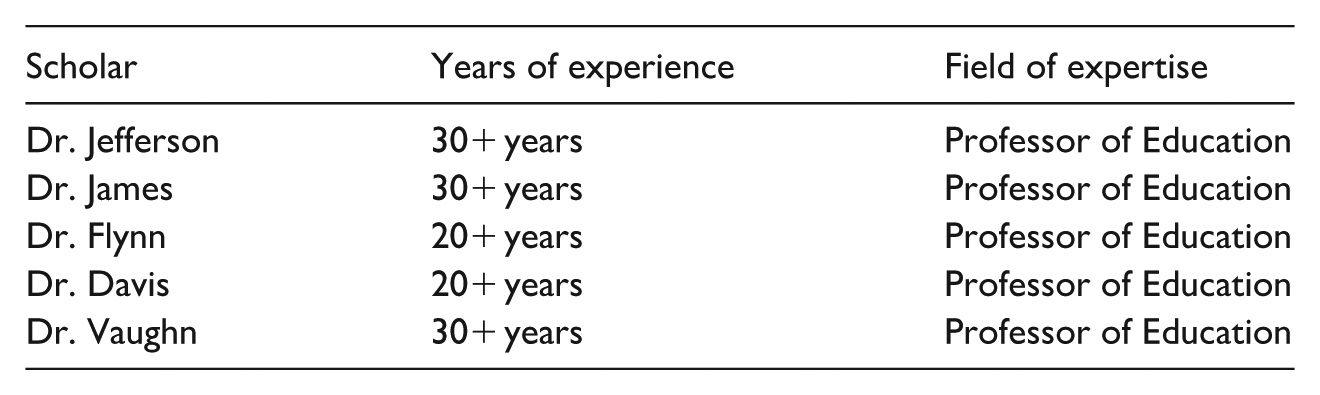
As mentioned above, the participants in this study are noted Black education scholars. The chart below depicts their number of years of experience in the profession (pseudonyms used).
The Need for a Culturally Centered and Culturally Responsive Pedagogy as Educational Imperatives
One of the recurring themes is the critical importance of culturally centered and culturally appropriate education for Black students. Note that participants use the term culturally centered interchangeably with African centered recognizing both as frameworks that prioritize African epistemologies, histories, and ways of knowing in the learning process. Scholars emphasized that educators must understand, as one participant calls it, “the condition of Black education” and they must know “the cultural uniqueness of Black students” in order to deliver an education that resonates with their lived experiences. Without this culturally centered and responsive approach, public schools will fail to meet even basic educational goals for Black students. The participant argues that the failure to provide such an education means that teachers, particularly Black educators, risk being “complicit in the miseducation of Black students.”
The focus of the participant was on recognizing and addressing the specific needs of Black students, and he is calling on educators to create an educational environment that not only respects but also celebrates their cultural heritage. Participants clarified that “. . .an Afrocentric centered education involves teaching methods that are aware of the systemic issues that Black students face, as well as creating curricula that reflect their histories and cultures.” In doing so, he argues that, “educators empower students to see themselves positively represented in the curriculum, breaking down barriers of low expectations that so often accompany Black students’ education.”
The respondents elaborated on the critical necessity for an African centered (which some participants referred to as culturally centered) and responsive pedagogy as transformative educational imperatives. Such pedagogical approaches emerge as vital to address the systemic disparities in the academic outcomes of Black students and to actively dismantle the long-standing deficit models that have traditionally framed the educational experiences of these students. One respondent explained that, “Culturally centered pedagogy is not merely a supplemental instructional strategy, it’s foundational to the restructuring of education for Black students and represents an epistemic shift toward a curriculum and teaching methodology that validates and centers the lived experiences of Black youth and their communities, and they’re not getting any of that in schools.” Scholars note that there is data to support the argument for African centered education in schools, but school systems refuse to acknowledge or implement it. One scholar explained that there is a “persistent lack of alignment between Eurocentric practices and the cultural realities of Black students, and it results in educational environments that are disconnected from their socio-historical contexts.” Participants repeatedly noted the damaging effects of curricula that remain rooted in Eurocentric narratives and pedagogical practices that either ignore or devalue Black students’ cultural capital. The prevailing mode of education, according to several participants, operates within a framework of “low expectations,” where teachers and administrators often underestimate the intellectual capabilities of Black students, assuming their potential is limited to sports and entertainment. Such biased expectations, coupled with curricular content that marginalizes Black experiences, reinforces the structural inequities embedded within the educational system.
Participants argued for an African centered culturally responsive pedagogy to address the deficits. Central to this pedagogical approach is its recognition of Black students’ cultural backgrounds as assets rather than deficits. Respondents highlighted how African centered teaching leverages students’ knowledge of their own histories, languages, and communities as foundational to the learning process. Such pedagogy demands a reframing of traditional content and instructional practices to ensure they reflect the cultural wealth of Black students, thus fostering environments where students can see their lived realities mirrored and validated in their educational experiences. A respondent who is an education scholar and founder of an African centered school explained that “Teachers who use African centered education are aware of the cultural backgrounds of their students but can also use it to facilitate deeper learning and engagement from a community-centered perspective. They don’t see a group of poor Black people they see richness and culture.” Furthermore, respondents emphasized that the adoption of a culturally centered pedagogy requires substantive teacher preparation and ongoing professional development. The respondent noted that, “Effective implementation is contingent upon teachers being well-versed in both the historical and contemporary contributions of Black communities, as well as having a critical understanding of how systemic oppression and racial inequities permeate in the field of education.” Respondents argue that educators should leave teacher education programs equipped to counteract the dominant narratives that have historically marginalized Black voices within the curriculum.
The study also reveals that African centered pedagogy is inextricably linked to the broader socio-political project of educational justice. One respondent explained that “. . .an African centered pedagogy opposes hegemony and Black youth need that not just for during time they are in school, but in order to change realities associated with Black life after graduation.” Participants articulated a vision of pedagogy that is not merely reactive to the needs of Black students but is proactively transformative, advancing an agenda that seeks to empower students to critique, resist, and ultimately reimagine the societal structures that confine them.
Respondents argue that culturally centered pedagogy is essential to fostering a more equitable, inclusive, and justice-oriented educational system, one that not only serves the needs of Black students but also upholds the integrity and richness of Black cultural traditions within educational spaces. Without such a transformative shift in pedagogy, the educational system risks perpetuating the very inequities it purports to address.
The Role of Expectations and Cultural Centeredness in Educational Achievement
An important finding relates to the pervasive issue of lowered expectations for Black students within educational institutions. Participants noted that the expectations are often shaped by entrenched stereotypes and racial biases, which influence both teacher-student interactions and broader educational practices. As one participant stated, “There’s a tendency to put greater attention to Black kids when it comes to disciplinary issues. White children can be doing the same thing, but teachers notice it more because of an expectation with Black children.” That observation reflects a broader societal narrative, one that positions Black people as less capable or prone to “behavioral issues,” and such beliefs which contribute to inequitable disciplinary measures and lower academic expectations.
Another participant offered insight into how these low expectations manifest in day-to-day interactions, describing how a teacher responded to a parent’s concern about their child’s grade with the comment, “Well, you shouldn’t be upset with him. He’s doing really good for him.” That type of commentary reflects a pervasive bias where Black students’ achievements are measured against a diminished standard, rather than being held to the same high academic benchmarks as their peers. The internalization of such low expectations can have long-lasting effects on students’ academic self-concept and motivation and can also limit their potential.
Evidence of the systemic nature of these low expectations is found in the structural limitations imposed on Black students. One participant recalled visiting a high school in Oakland where geometry was not even offered as a course. When questioned, the school administration responded that “we don’t have anybody who really wants to take it.” Respondents argue that such institutional decisions limit access to essential curriculum content and signal to Black students that academic rigor and intellectual pursuits are not for them, which perpetuates a cycle of underachievement and disengagement, reinforced by the limited opportunities available to these students.
While expectations play a critical role, the data also underscore the importance of culturally centered pedagogy in fostering Black students’ academic achievement, which helps to raise expectations. Participants repeatedly stressed that Black students’ success is intimately tied to their ability to see themselves reflected in the curriculum and in the educational practices of their teachers. One participant noted that it is essential for educators to “encourage parents to be involved because when they are not, teachers close the door and do what they want, and most teachers are not going to impart a culturally responsive educational experience for our students because ‘you can’t teach what you don’t know.’” That statement suggests that cultural relevance is not a mere addendum to traditional curriculum but a necessary framework through which Black students can access, engage with, and succeed in education and society.
Participants also articulated the responsibility of Black educators to advocate for and implement African centered pedagogy. One participant emphasized that “Low expectations is a big part of the problem, but Black teachers also have a responsibility to call out other things that are damaging to Black children,” highlighting the critical role these educators play in confronting harmful biases and advocating for more equitable educational practices, which aligns with existing literature which suggests African centered pedagogy is essential in combating the negative impacts of low expectations and fostering an environment in which Black students can thrive.
An African centered curriculum corrects the historical erasure of Black contributions to knowledge and society while also creating a learning environment that validates and celebrates the cultural heritage of Black students. As one participant noted, “. . .we need to make sure that we take a look and push for a curriculum. . . that teaches the actual history of African Americans and Africans.” This shift in curriculum is not merely about adding “diverse voices,” it requires a fundamental rethinking of how knowledge is constructed and transmitted within educational settings. A curriculum that centers Black history and culture not only serves to educate students but also works as a form of empowerment, helping students to build positive identities and resist the internalization of societal stereotypes.
The data suggest that both high expectations and knowledge of African centered theory is where meaningful educational reform must occur to promote the academic success of Black students. One participant described how successful Black students and teachers operate in classrooms that emphasize “humanely equitable relationships,” where students are treated with respect and recognized for their unique contributions. A humanely equitable pedagogical approach contrasts sharply with the hierarchical and rigid structures that often characterize traditional Eurocentric classrooms where Black students are marginalized, and as on participant noted, “. . .even though they know this is going on, they fight us with all the tools in their arsenal when we give solutions to fix it. . .and they have a lot of tools, and we have very few.” It was the aforementioned statement that helped me to understand that this may, in fact, be a cultural war, hence, the title of the film.
Intergenerational Learning and Humanely Equitable Relationships
Participants highlighted the role of intergenerational learning and the fostering of humanely equitable relationships in the educational success of Black students. Through an analysis of participants’ insights, it becomes clear that educators, and particularly Black educators, play an instrumental role in bridging generational knowledge and addressing historical inequities. A participant stated that, “Educators of Black youngsters should be people who are repositories of knowledge about who we are as a people, and they should be people who don’t look at it like I’m the all-knowing being in here, and you are here just to learn from me. What about all the brilliance they bring to the table as well?” At the heart of the African centered approach lies the importance of the development of relationships with Black youth that are grounded in mutual respect and understanding.
Intergenerational learning emerged as an important mechanism for cultural transmission, enabling younger generations of Black students to access knowledge that is rooted in the historical and contemporary experiences of their communities. Participants expressed that intergenerational learning extends beyond academic content, involving the transmission of values, cultural identity, and a sense of belonging. One participant stated, “Members of the community should also know what is the status of Black students from K to 12, and the role that they can play. . .in terms of providing mentoring and things of that nature, to help counteract intentional miseducation.” The acknowledgment of a need for “community cultural transmission” highlights the critical role that Black community members play in preserving and passing on cultural heritage.
One participant emphasized that in order to truly effect change, Black educators must also train their colleagues to be more culturally responsive, noting, “Black teachers also have a responsibility to give the teacher who is only able to educate one particular type of child tools to help them to better address the needs of Black children. And they have got to teach them what Black people have done in the past to ensure cultural continuity.” That observation underscores the potential of intergenerational learning not only within the student-teacher relationship but also among educators, creating a ripple effect that strengthens cultural competency across the teaching staff.
In addition to intergenerational learning, the findings underscore the importance of fostering humanely equitable relationships between educators and Black students themselves. Such relationships are characterized by mutual respect, high expectations, and an acknowledgment of the unique cultural backgrounds that students bring into the classroom. One participant described the burden placed on Black educators in a predominantly white educational system, stating, “There’s a tremendous burden for Black educators, particularly because they’re in a minority and they’re in a hostile environment. But I think that standing by and not addressing these issues in terms of the education of Black children is to be complicit in their miseducation.” That statement reveals the dual challenge faced by Black educators: they must simultaneously combat institutional racism while working to build relationships with students that affirm their humanity. Black educators are often positioned as mediators between their students and a system that devalues them, which requires a delicate balance of advocacy and emotional labor. In that sense, humanely equitable relationships are not merely about fairness in academic expectations but also about creating a safe space in which Black students can thrive.
The findings suggest that culturally centered teaching is key to cultivating humanely equitable relationships, especially considering that relationship building has always been a cornerstone of African centered education. As one participant put it, “Often, white teachers’ behavior of having low expectations while wanting to be nice puts a barrier between them and Black students because the relationship can’t build when they are seen as being less than.” That assertion reveals that educators must be well-versed in the cultural contexts of their students to build relationships that are grounded in empathy, respect, and high expectations. Such relationships can serve as a counterbalance to the racialized biases that Black students often encounter, fostering a classroom environment where Black students are respected.
The data exemplify that intergenerational learning and humanely equitable relationships are interdependent in the context of Black students’ education. Intergenerational knowledge, when combined with culturally responsive and equitable relationships, creates a learning environment in which Black students can thrive. One participant highlighted the importance of educators understanding the historical context of Black education, noting, “We need to make sure that they are knowledgeable about the actual history of African Americans and Africans. . .to counter the pseudo-knowledge that we were given in white supremacist curricula.” This suggests that intergenerational learning is not just about passing down cultural knowledge but also about rectifying historical wrongs and ensuring that Black students receive an education that is reflective of their lived realities.
Humanely equitable relationships provide the emotional and intellectual scaffolding necessary for this type of learning to occur. When students feel respected and valued by their teachers, they are more likely to engage with the curriculum and participate in the learning process. Conversely, when educators fail to build equitable relationships, intergenerational knowledge is likely to be lost or devalued, perpetuating cycles of alienation and disengagement among Black students.
Limitations of the Study
One limitation of this study is that it exclusively captures the perspectives of Black scholars, without incorporating the voices of students who are directly impacted by culturally centered education. Including student interviews could have provided a more comprehensive understanding of how these educational frameworks influence learning experiences, identity formation, and academic outcomes. Additionally, the study is limited by the relatively small sample size of interviewed scholars, which, while rich in expertise, may not fully represent the diversity of perspectives within the broader field of African-centered education. Furthermore, the study relies on qualitative interviews, which, though valuable for in-depth analysis, do not offer the generalizability of large-scale quantitative research. Future studies should address these limitations by integrating student perspectives, expanding the participant pool, and employing mixed-methods approaches to triangulate findings and enhance the study’s broader applicability.
Implications and Discussion
Policy
The findings of this study underscore the urgent need for educational policies that institutionalize African centered education as a central framework within public and private schooling systems. Policymakers must advocate for curriculum reforms that integrate African epistemologies, histories, and cultural knowledge, moving beyond the superficial inclusion of Black history month or tokenized lessons. African centered education requires structural commitment, such as mandating culturally responsive training for all educators and ensuring that school funding models support the development and implementation of curricula that are culturally centered and culturally relevant for Black students. Furthermore, disciplinary policies must be revised to confront racial biases that disproportionately affect Black students, ensuring equitable treatment and high expectations across all educational contexts.
Educational Practice
At the level of practice, educators must be equipped with the knowledge and tools to provide a culturally centered and responsive pedagogy that affirms the identities and experiences of Black students. Teacher preparation programs should integrate African centered educational theories into their curriculum, challenging deficit perspectives and fostering high expectations. Schools should actively support intergenerational learning by engaging community members and elders to create humanely equitable relationships within educational spaces. These practices not only uplift students academically but also instill a sense of cultural pride, which are foundational to sustained educational success.
Research
Future research should continue to explore the efficacy of African centered education in diverse educational contexts, with a particular focus on longitudinal studies that examine its impact on Black students’ academic outcomes, self-concept, and community engagement. Additionally, research must critically assess how educators navigate the implementation of culturally centered pedagogy in environments that remain resistant to systemic change. By identifying best practices and potential barriers, scholars can contribute to the refinement of African centered approaches and advocate for the broader adoption of the framework. Continued research in this area will provide the empirical foundation necessary to influence policy and practice, while simultaneously advocating for true educational equity for Black students.
Evolving Cultural Wars and the State of ACE
While ACE has grown in visibility and sophistication since the cultural battles of the 1980s and 90s—manifesting through independent African-centered schools, culturally responsive pedagogies, and theoretical frameworks rooted in Black epistemologies, there remains a stubborn resistance in mainstream educational systems to fully embrace or legitimize its transformative potential. This resistance is part of what distinguishes the current era: despite increased data on the positive impacts of culturally grounded education, we are witnessing a backlash in the form of anti-Black legislation, book bans, and efforts to silence conversations about race and equity in schools.
What we have learned over the past 40+ years is significant—we now have a deeper empirical and theoretical understanding of how ACE enhances identity formation, academic achievement, and psychological well-being among Black youth. We have seen grassroots movements, parent-led initiatives, and scholarly contributions expand the discourse and practice. But our progress has not been linear. In many ways, we remain in an “educative phase,” not because the knowledge is lacking, but because the political and institutional will to implement what we know is insufficient.
To move from awareness to transformation, we must recalibrate our strategies. This means building more robust alliances between scholars, practitioners, and communities to institutionalize ACE beyond isolated programs. It means reimagining teacher education so that African centered frameworks are not optional, but foundational. And it means mobilizing policy-level changes that protect and fund culturally grounded education. The desired result is a liberatory education for Black youth, which requires us to stop asking if ACE works and start organizing around how to make it systemically possible.
African Centered Spaces
There are African-Centered Education (ACE) spaces that policymakers, teacher educators, and researchers can examine to inform educational practice and policy. Empirical studies on African-centered schools, such as those conducted by Lee (1992) and Shockley and Frederick (2010), offer valuable insights into how these educational models function and their outcomes for Black children. Additionally, Freedom Schools, including the one founded by Charles Cobb in the 1960s and others operating in cities like Indianapolis, Chicago, Houston, and Atlanta, serve as contemporary examples of culturally affirming spaces that align with the principles of ACE. These institutions draw from historical models of Black self-determined education, such as the Mississippi Freedom Schools of the 1960s, reinforcing the relevance of ACE in today’s educational landscape. The DocuSeries Cultural War: Focus on Black Youth features existing African centered institutions that are currently in operation. Further research is needed to systematically assess the pedagogical strategies employed in these schools and their broader implications for policy and teacher preparation.
Conclusion
In conclusion, the cultural war on the true education of Black youth, perpetuated through systemic inequities and the miseducation of Black students, calls for a transformative shift toward African centered education in schools. This approach, rooted in the recognition and affirmation of Black cultural identities, is essential for dismantling the deficit narratives that undermine the academic achievement and holistic development of Black youth. By fostering culturally centered and culturally responsive pedagogy, elevating expectations, and nurturing intergenerational and humanely equitable relationships, African centered education offers a pathway to reclaiming the dignity and intellectual empowerment of Black students. The urgency of this educational reform lies in addressing the current academic disparities and in cultivating a generation of students who are deeply connected to their heritage and equipped to navigate and challenge societal structures of oppression.
Footnotes

Funding
The author received no financial support for the research, authorship, and/or publication of this article.
Declaration of Conflicting Interests
The author declared no potential conflicts of interest with respect to the research, authorship, and/or publication of this article.