







Abstract
This study pays specific attention to co-parenting conflict in Trinidad, one of the countries that comprise a small twin island state (Trinidad and Tobago). Empirical research on co-parenting conflict in Trinidad’s cultural context remains limited particularly concerning the nature of Afro-Trinidadian co-parental conflict post-separation and divorce. This study explores the nature of co-parenting conflict among Afro-Trinidadian families following divorce or separation. Data was collected using qualitative methods that comprised 13 semi-structured interviews with co-parents who would have parented at least one child following the dissolution of the relationship. Participants were recruited via a flyer posted on social media, snowball, and purposive sampling methods. Thematic analysis was employed and themes derived formed soundbites that highlighted conflictual issues around co-parenting among Afro-Trinidadians. Findings reveal that while co-parenting conflict is often shaped by interpersonal tensions, it is also deeply influenced by broader issues such as finances, gender expectations, disciplinary practices, decisions about education and the cultural impact of social support, which all intersect with communication. This research contributes to a growing body of literature that seeks to contextualize co-parenting within culturally specific frameworks. By amplifying voices overlooked in mainstream discourse, the study provides critical insights into how conflict is experienced and navigated by Afro-Trinidadian co-parents and offers recommendations for promoting healthier co-parenting relationships and child outcomes within Trinidad. Further, there are implications for Trinidad and Tobago, to employ community programs around co-parenting and re-energize traditional family values, as well as engage in continuous research and collaboration with macro society to address co-parental conflict in a productive manner.
Introduction
Separation and divorce are often stressful life events that are commonly linked to a decline in the well-being of parents, children and the parent-child relationship (Ambros et al., 2022; Leopold & Kalmijn, 2016; Williams & Dunne-Bryant, 2006). For parents with children, not all divorce or separation result in the cessation of interaction upon the termination of the romantic relationship (Ferraro, 2017). Rather, many parents are required to maintain a co-parenting relationship for the welfare of the children. A recent definition, according to Nwanamidwa & Ramatswi (2025, p. 233) describes co-parenting as “shared responsibilities and coordinated efforts of two parents in raising their children.” Co-parenting conflict refers to persistent disagreements, tension, or hostility between individuals who share responsibility for raising a child. It often emerges in the aftermath of relationship dissolution and can manifest across multiple domains, including discipline, decision-making, communication, and emotional support (Addelyan Rasi et al., 2024; Feinberg, 2003; Zemp et al., 2018).
Significant research conducted reflects the experiences of co-parents after the dissolution of relationships from a Eurocentric or North American context. Given that Black identity is not monolithic and parenting experiences are deeply shaped by cultural and contextual factors, there remains a significant gap in research exploring the specific experiences of Afro-Trinidadian co-parents. This study aimed at filling this conceptual gap by understanding the nature of conflict amongst Afro-Trinidadian co-parents following divorce or separation. This study has implications for how co-parenting is experienced after the dissolution of a romantic relationship, in Trinidad and Tobago, paying specific attention to island of Trinidad.
Contextualizing Divorce and Separation in Trinidad and Tobago
Trinidad and Tobago’s history is wrapped in enslavement and colonialism, which saw the islands being influenced by European religion and beliefs that was introduced on the plantation. African men on the plantation were not allowed to marry or assume strong patriarchal roles within their family unit, and due to the nature of enslavement could have been separated from their families at any time to fulfill work duties at plantations their masters found fit (Forde, 2020). As a result, the plantation economy impacted on Caribbean families, causing changes to family structure via the separation, partnering and coupling practices, as well as men’s sexual behaviors and women’s responses.
Statistics from the Family Court of Trinidad and Tobago indicate a steady increase in divorce filings over the 5-year period spanning 2016 to 2021. The report indicated a notable decline in divorce cases during the 2019 to 2020 period, that can most likely be attributed to the pandemic-related disruptions of the court’s operations, and a resurgence of divorce filings during the 2020 to 2021 period when the court resumed full operations (See Table 1).
Divorce Filings in Trinidad and Tobago During the Period 2016–2021.
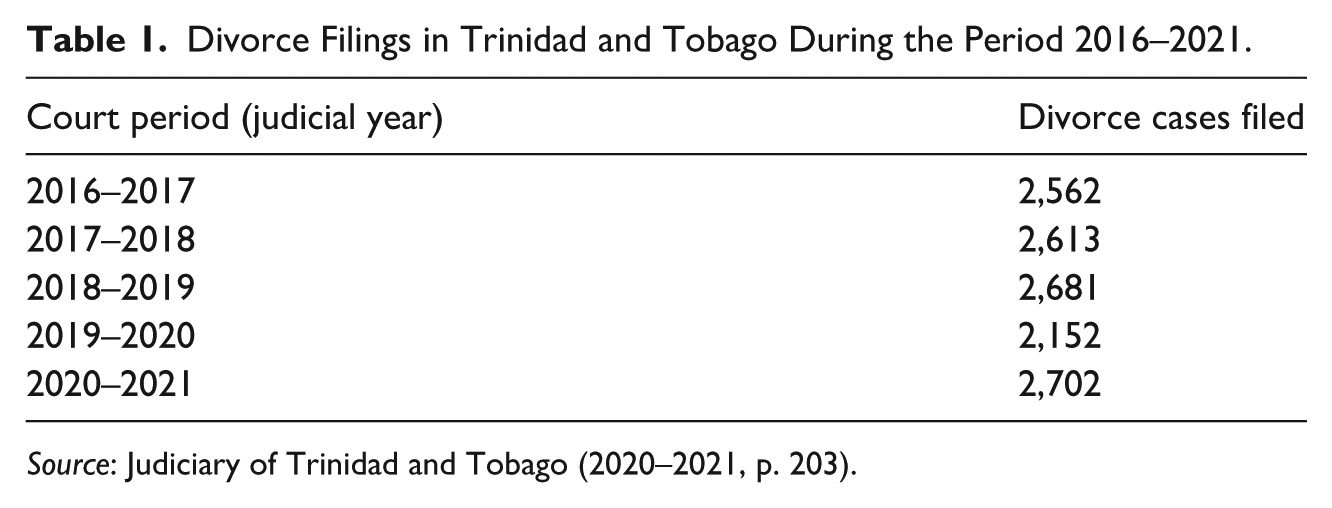
Source: Judiciary of Trinidad and Tobago (2020–2021, p. 203).
The Family Court of Trinidad and Tobago also reported a breakdown of custody matters, which saw a steady decline over the period (2016–2021), with 501 cases being filed during 2016 to 2017, and 565 custody matters were filed during the 2017 to 2018 judicial year. The 2018 to 2019, 2019 to 2020 and 2020 to 2021 period saw 454, 414 and 407 custody cases being filed respectively (Judiciary of Trinidad and Tobago, 2020–2021, p. 203). In Trinidad and Tobago’s culture children of separated spouses remain with their mother most times, while the father contributes financially toward maintenance and care of the child.
Child maintenance refers to “lump sum or periodical payments made toward a child’s upkeep usually paid by the non-resident parent to the parent who is responsible for day-to-day care of the child” (Judiciary of Trinidad and Tobago, n.d.). According to court data, maintenance matters filed were highest at 1,490 in 2020 to 2021 from a low of 1,191 during the previous year (Judiciary of Trinidad and Tobago, 2020–2021, p. 203). The period that indicates a high rate of maintenance cases corroborates with the highest rates of divorce cases filed. This seems to suggest that children are impacted by the high number of families seeking marital dissolution, and highlights the need for co-parenting solutions.
A review of the court’s case type activities during the 2020 to 2021 law term, saw 43% of cases being attributed to divorce proceedings, 24% were maintenance cases and 7% custody cases (Judiciary of Trinidad and Tobago, 2020–2021, p. 205). This statistic appears to concur with the idea that parental separation when there is child/children involvement, is filled with nuances that manifest in daily co-parental interactions.
Literature Review
Existing literature tends to either generalize the experiences of Afro-Trinidadian families or incorporate them into broader demographic categories, thereby overlooking the cultural nuances and contextual factors that shape co-parenting practices in Trinidad and Tobago. This literature review aims to position the current study within the wider body of co-parenting research, while highlighting key gaps that underscore the necessity for a context-specific investigation into conflict among Afro-Trinidadian co-parents.
The Nature of Conflict in Co-parenting Relationships
Difficult interactions post separation may not only exist among the adults involved, but also impact children where dyads are formed and targeting of a parent can occur. The targeted co-parent may also experience Parental Alienation Syndrome (PAS), where perpetrating co-parent depicts them in a negative light to the children, belittles their authority and purposely disrupts their visitations or time with the children (Berman & Weisinger, 2024; Kruk & Harman, 2025).
Co-parents in a high conflict relationship, do not communicate with each other, or are unable to appropriately articulate their needs from the other party in co-parenting (Bai et al., 2023; Beckmeyer et al., 2022; D’Abate, 2016). This type of co-parenting interaction is marred with negative elements that are sometimes played out in the presence of the children (verbal and physical exploitations, parental alienation, mistrust and lawsuits), placing them at risk of psychological harm as well as being caught up in social service system (D’Abate, 2016). While literature acknowledges the positives of father interaction with children in co-parenting arrangements (Carlson et al., 2008; D’Orsi et al., 2023; Varga & Gee, 2017), most times fathers are alienated from their children. Alienation can occur purposefully, due to the stressful nature of separation, or fathers are pushed away by the mother who has custodial privileges and is perhaps pursuing another relationship (Braithwaite et al., 2003). The impact of high conflict co-parenting relationship was also seen in Kopystynska et al. (2020) who posited that paternal parenting is usually vulnerable to the quality of relationship with the mother, therefore high conflict relationships contribute to little or no paternal co-parenting while low conflict relationships is vice versa. High levels of support and communication among co parents are hardly associated with conflict (Visser et al., 2017).
Sources of Co-parental Conflict
Co-parenting conflict is dynamic and influenced by a range of contextual factors. Socioeconomic stressors (Feng & Teti, 2025; Schoppe-Sullivan & Mangelsdorf, 2013), family structure (Feinberg et al., 2011; L. Ganong et al., 2022), mental health challenges (Mandarino et al., 2016), the presence of new partners (Koster et al., 2021), and unresolved issues from the previous romantic relationship can exacerbate tensions between co-parents (Fretwell, 2023; Kelly & Emery, 2003). Importantly, cultural and community contexts also shape the expression and management of conflict. For example, extended family involvement, societal norms around parenting roles, and access to supportive services can either buffer or intensify co-parental discord.
The sources of co-parental conflict are usually set against the backdrop of a volatile separation compounded by an equally explosive and lengthy divorce process. Issues deriving from such situations are usually multi-textured and intersect with each other (Smyth & Moloney, 2019). Some of intersecting issues are mental health, substance/alcohol abuse, family violence, economic stressors, poorly executed legal, mediation and psychosocial services, ideological beliefs and societal expectations (Smyth & Moloney, 2019).
Social networks were listed as a source of conflict but can also be a mediating factor and source of support (Visser et al., 2017). Social networks consist of third parties referred to as “close friends or family members of victims” (Green et al., 2008; Reimnitz et al., 2024). According to Sprecher and Felmlee (2000), Reimnitz et al. (2024) social networks can also approve of relationship breakup and make negative statements about the ex-partner, rendering emotional support, feelings of belongingness and positivity.
Involvement in step-families can also serve as a source of conflict in co- parenting. Some issues were uncovered within step-families as highlighted by (L. Ganong et al., 2022): perceptions of step-parent roles, the development of stepfamilies, conflict, dialectical tensions managed by step-parents and step-children, disclosure and avoidance, and the post-divorce relationships between ex-spouses. They also discussed re-negotiating boundaries and communication among co-parents.
Strategies to Mitigate Co-parental Conflict
Literature highlights several coping strategies used by co-parents to reduce or deal with conflict within the co-parent arrangement. Research by Stolnicu et al. (2022) highlights four main axes related to mitigating high conflict post-divorce co-parenting: (1) Parents for life, (2) Acting in the child’s best interests, (3) Managing disagreements, and (4) Healing the separation.
Another arrangement to co-parent, utilized the conflictual parallel parenting style, where parents communicate and interact very little with each other while maintaining relationships with their children. Studies show that 15% of parents have ongoing conflict up to 2 years after separation and 9% to 18% remain in high to moderate conflict up to 6 years after divorce (Stokkebekk et al., 2021). In conflict parallel parenting, each parent is free to parent as they see fit regardless of rules and expectations set in the other home. While this can allow for continuous conflict in childcare and discipline, it also serves as a solution, since both parents are still involved in the child’s life and children witness less parental conflictual situations.
Co-parenting programs were also found to be an effective method in preparing parents for co-parenting realities as outlined in Choi et al. (2018). The programs were mandatory and although some fathers disapproved of the approach, they acknowledged the benefits.
Theoretical Framework - The Bioecological Model
This study is grounded in Bronfenbrenner’s Bioecological Model of Human Development (Bronfenbrenner, 1977; Bronfenbrenner & Ceci, 1994; Kambara & Lin, 2023; Liem and McInerney, 2018), which provides a framework for understanding the multiple, interacting systems that shape co-parenting relationships. This model has been previously used in several studies to examine parenting matters including joint custody and children’s mental and physical health (Riser, 2025), coparenting conflict and self-efficacy (Zhang et al., 2022).
The model emphasizes that individual behavior and family dynamics are influenced by a series of nested environmental systems, the microsystem, mesosystem, exosystem, macrosystem, and chronosystem. Each of these systems interact to affect human development and social functioning.
In the context of this research, the microsystem includes the immediate interactions between Afro-Trinidadian co-parents and their children, capturing the day-to-day negotiations, communication patterns, and emotional exchanges that define their co-parenting relationships. The mesosystem reflects the interconnections between family members, extended kin, and institutional supports such as schools, social services, or the legal system, which can either mitigate or intensify conflict. The exosystem encompasses external factors such as workplace stress, community resources, and judicial interventions that indirectly influence co-parenting behaviors. The macrosystem situates these dynamics within broader sociocultural, economic, and historical contexts, including societal norms about gender roles, parenting, and the legacies of colonial and postcolonial family structures in the Caribbean. Finally, the chronosystem captures the dimension of time and how the duration of separation, evolving family roles, and generational changes affect co-parenting relationships. By applying the bioecological model, this study situates the conflicts between Afro- Trinidadian co-parents within a holistic, culturally informed framework that recognizes the interplay between individual, relational, and structural forces in shaping post-separation family life in Trinidad and Tobago.
Methodology
The study was framed using a qualitative methodology, specifically a phenomenological approach, to examine the nuances of co-parenting conflict. The phenomenological approach, aided this research by providing rich insights while capturing a range of lived experiences of Afro-Trinidadian co-parents, around how they navigate conflict.
Data was collected using a semi-structured interview with 13 parents who were involved in co-parenting of at least one child following the dissolution of their relationship. Semi-structured interviews are best suited for this research as it unlocks a space for open responses from interviewees which adds to the richness of data . It also allows for the researcher to probe widely thus, participating in the co-production of knowledge (Xu, 2024). This resulted in deeper exploration of thoughts, feelings, experiences and beliefs of the persons who have lived through and negotiated the phenomenon under study. Permission for conducting this research was obtained from the Campus Research and Ethics Committee of the University of the West Indies (Ref: CREC-SA.1762/09/2022).
Participants were recruited via advertising (electronic flier shared on social media), using snowball and purposive sampling techniques. The flier was shared to our networks, who shared on their social media platforms, and interested persons contacted the researchers. At the end of the interview, participants were asked to recommend at least one person that suited criteria for this study. The participant told the potential person about the research, once interest was confirmed, they were given a phone number to initiate contact with researchers. Purposive sampling was also used in recruiting participants, as researchers’ approached individuals they knew were involved in co-parenting arrangements. Potential participants were informed of the study and asked of their interest, once affirmed, they were sent informed consent forms and contacted within 3 to 4 days to discuss any queries and move forward with arrangements for interviewing. Similar arrangements were made with participants obtained via snowball sampling.
Participants in this study were parents involved in heterosexual relationships, man or woman, over the age of 18 years old, divorced or separated who were involved in a co-parenting relationship in non-nuclear family structure for at least 12 months and willing to share their experiences.
A sample size of 20 persons was deemed appropriate (10 men and 10 women). This sample size was selected as it allowed the generation of rich data while reaching the point of saturation as discussed by (Braun & Clarke, 2021). Although, 20 persons were screened and scheduled for interview, only 13 parents completed the interviews. Data for this research was therefore collected from eight men and five women via zoom.
Apart from saturation, the significance of 13 participants as relevant for this study is justified in (Mthuli et al., 2022) who unpacked the concept of information power as an aid in deriving appropriate sample size. This concept posits that the more information the interviewee holds relevant to the topic of study, the less participants are needed (Mthuli et al., 2022, p. 812). They also echoed the sentiments that adequacy of sample size can be observed if the “sample is small enough to manage data collection and large enough to provide richly textured understanding of the phenomenon under inquiry” (Mthuli et al., 2022, p. 812). The latter was relatable in this research experience.
Confidentiality during the interview process was ensured, by arranging times convenient to participants to conduct interviews and e-mailing them a copy of the informed consent letter before the interview date. Each interview lasted about 45 min– to 1 hr, and recorded interviews were stored in an electronic folder with password protection and accessible only by the main interviewer.
Data was then transcribed; by listening each interview and typing verbatim, this helped the researcher to become familiarized with the data. Thematic analysis was used where words and short phases form soundbites to highlight themes around conflictual issues in co-parenting. Data was coded manually using an inductive approach, by first reading through each interview and highlighting words or phrases that were common among participants in answering a question. Similar responses were highlighted using the same color and notes were made as needed besides the word or phrase. The color coded words or phrases were revisited and placed into general themes that formed findings.
Researchers approached this study agreeing that people are the experts of their reality, therefore participants should be allowed a space the help us understand their lived realities, thus knowledge is co-produced via a collaboration of participants and researchers. Credibility in this research was ensured by engaging in reflexivity, ensuring lenses through which data was seen were not influenced by the researchers’ perspectives. To achieve this, journaling was employed and data was approached with a high sense of self-awareness that allowed for questioning of knowledge and ways of viewing the world that was taken for granted . Peer debriefing, was also employed where findings and its meanings were discussed, which allowed for discussion of views that were not considered.
Validity was ensured via the methods employed to aid in answering the research questions, which were also reflected in the methodology section, as well as providing contextual and demographic information.
This research sought to answer the questions: What are some causes of co-parental conflict you have experienced? And how is co-parental conflict experienced in non-nuclear families in Trinidad and Tobago?
Demographics of Participants
All participants resided separately from the person with whom they share co-parental responsibilities, and six men were involved in other multiple relationships. One woman was re-married, another was in a relationship and the others were single. While some co-parenting arrangements were derived via the court system, others were agreed upon or naturally followed societal expectations around gendered parental roles when separation occurs.
Table 2 (below) summarizes the main demographics of participants.
Demographic Information for Participants.
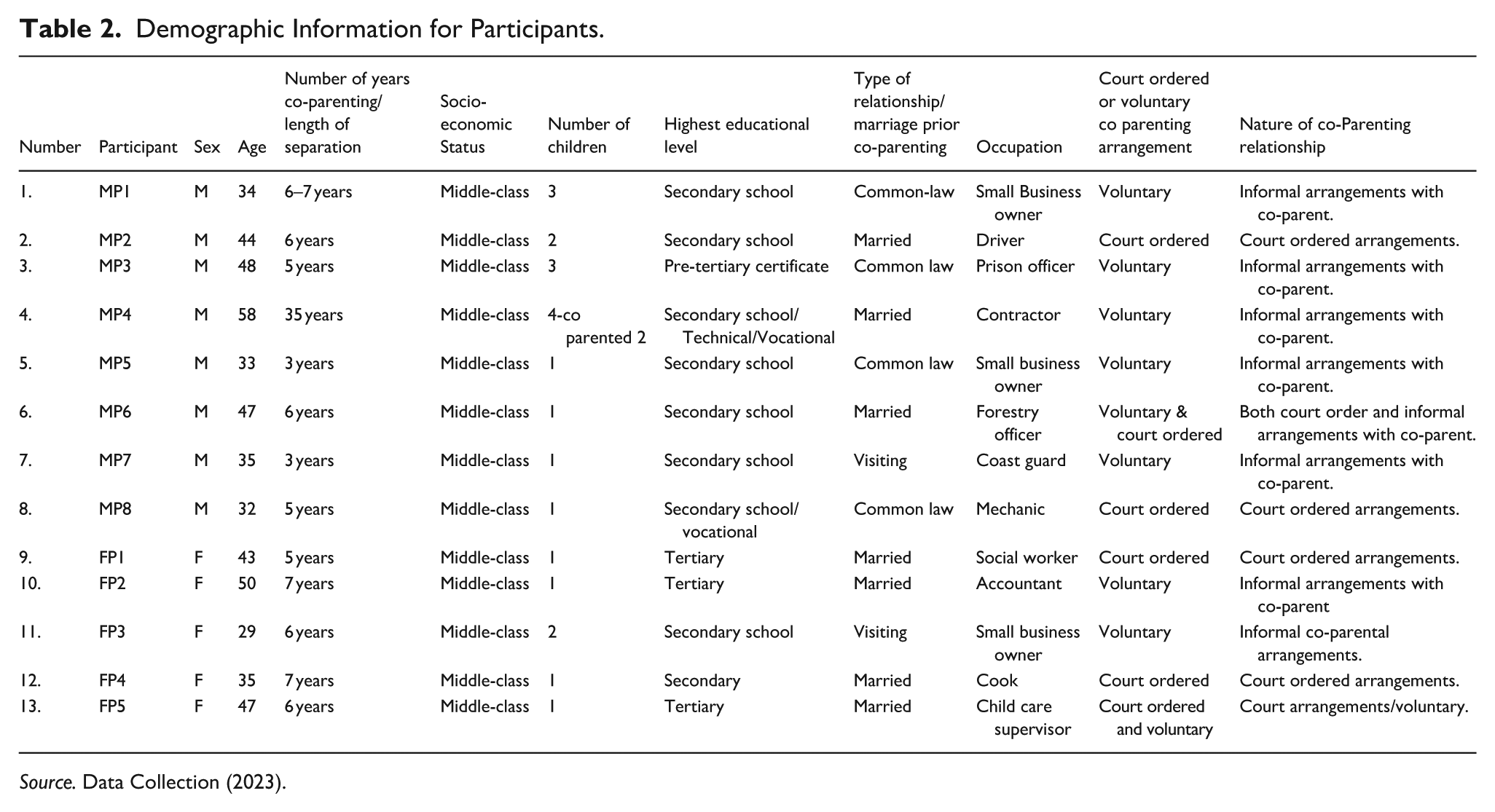
Source. Data Collection (2023).
Thirteen co-parents participated in this study (8 men and 5 women) ranging in age from 29 to 58 years. Most participants identified as lower to middle-class and reported between 3 and 35 years of co-parenting or separation, with one participant (MP4) having the longest duration of 35 years. The majority had secondary-level education, while a few attained tertiary or vocational qualifications. Participants’ occupations reflected diverse working- and middle-class professions, including small business owners, public service officers, and professionals such as a social worker and an accountant. Most participants were previously in common-law or marital relationships, with a few reporting visiting arrangements. In terms of co-parenting structure, voluntary and informal arrangements predominated, though several participants indicated court-ordered or mixed (court and voluntary) agreements. The data overall suggest a mature, socioeconomically stable group with varied relational histories and co-parenting dynamics, reflecting the complexity of shared parenting experiences within working Trinidadian families.
Findings
The core of this study was focused on understanding the nature of conflict in co-parenting. While analyzing narratives, most persons discussed how the conflict began. This formed the theme.
Sources of Conflict
Financial
Most co-parents interviewed discussed finance as a source of conflict. For men, financial issues were discussed in relation to their role, as it was felt they were seen as “money donors.” If money was not given the way the woman co-parent dictated or expected, then the man co-parent faced consequences that included no access to the child, nor parental participation in decision making. One man participant discussed the way finances affected his co-parental arrangements negatively by leaving him void of his child if he does not give money to the mother:
but when I talk about it is not like I not financing my children or they not being taken care of. Is the fact that you have to put money into the co-parent’s hands. So, because you didn’t put money into the hand it could cause the co-parent to move “a different way” towards you. So, there might be conflict with bringing the child which could create another conflict. (MP 1)
The second man co-parent also described not having access to his children due to having financial issues that prevented him from contributing the full amount ordered by the court. He is able to pay half the amount, and although arrangements were made via the court, he noted dwindling accessibility to his children:
Money is always– will always be an issue, although things come through the court, still money is a problem. I lost my job due to the pandemic, but I spoke with her and she agreed to accept half the money. Now, that is a problem, she wants the whole amount, and suddenly I notice a problem with the children coming on weekends. I not getting to see them, they always have excuses. (MP 2)
For women who identified finances as a source of co-parental conflict, there were connotations of power in their experiences. Where the man co-parent will contribute as he wanted and amounts he felt was appropriate, whether arrangements were derived via the court or informal parental agreement.
Women participant 2 noted the way she had to account for money given by the child’s father and his tendency to give an amount he found appropriate regardless of the purpose for the money she requested:
He would question what the money will be going towards, and sometimes he would short on his agreed amount, because he knows I work for more money than him. (FP2)
Woman participant 1 explained how power was exerted despite court ordered arrangements:
When the child was smaller, he was supposed to provide 100% toiletries. I provided him with a list, but when that time came around, he will call to say me and the child can meet him at the grocery . So, he is not sending the money, which is no problem, that’s why I sent him a list. But he still tries to dictate in subtle ways. As the child is older, the court decided how much he has to pay monthly, and months will pass without him sending a payment. (FP1)
Communication
Although it was not identified by some participants as a major source of conflict, communication is a thread that was seen throughout all interactions among co-parents. It was also one of the major intersectional points. Communication issues ranged from talking too much or not talking. Conflict was also caused by chosen mode of communication or misunderstanding.
Man participant 4 referred to phone calls he will receive from his woman co-parenting partner when finances were late or the child needed something, as their arrangement was informal and not via court systems:
I lock off my phone if you decide to talk too long. I have a controlled environment. Nobody have to call my phone with long stories. I am a contractor. . .some payments are late or delayed, but I make sure and handle my business. (MP4)
Man participant 7 discussed that there was no communication from his son’s mother post separation, due to her being angry after he moved on. He was able to obtain some details about the child after she took him to court for maintenance:
If something was going on with the child, I would never know. Is only when we went to court for maintenance, I was privy to what school the child going and all that type of information. (MP7)
Woman participant 4 recognized the use for communication among parents, and resorted to a social media app to maintain communication, as face-to-face meetings and conversations with her co-parenting partner were becoming tedious and risky. However, there were sometimes unanswered questions or lack of clarity in arrangements, creating a space for conflict to arise:
Well, I– we don’t talk period. Is only WhatsApp messages that is the only form of communication. So, whatever is said on WhatsApp is up to interpretation, it’s not like a conversation. Is also if and when the other person feel to respond. (FP 4)
Woman participant 1 described how communication was used as a tool for emotional abuse, power, self-regulation and manipulation:
he would even try to say, um threatening power stuff like he would take the child and I would never see him again. All these kinda crazy talk. (FP 1)
Discipline and Child Rearing Practices
Conflict arises as each parent has their own vision of what is acceptable or not for the child’s development and general welfare.
Man participant 1 discussed the way his co-parenting partner openly discussed issues she was having with him in the presence of the child, which prompted the child to be “disrespectful” to him and rejected his attempt to reprimand her:
In one instance the co-parent was talking about me in front the child, creating a level of disrespect from the child to me as the parent; it difficult now to discipline the child. (MP1)
Man participant 2 described feeling helpless about directing or teaching his children to do things the way he deems proper, as they do not live with him and would unlearn his way when they leave after a weekend:
What some parents might push for others might not–you know the different styles and arrangements–living arrangements. Because the children live with the other parent they would do things different to how I want it done and I won’t be able to have control over it. (MP 2)
The man participant 5 felt strongly that a child should not be exposed to what he deemed “adult conversations,” a value shared in most traditional Caribbean homes:
So, all those things is not my daughter knowing, it’s her mother saying it. And to me that’s something you don’t do where a child is concerned because a child is only a child. If you bring a child into an adult conversation then you are creating something that you don’t want in the future. (MP 5)
Woman co-parent 1 highlighted the vast difference in values her son experiences at her home and that of his father, which is very frustrating for her:
So, the whole values is an issue because when he goes down there education is not positive, there is limited supervision. I don’t encourage screentime. Down there because nobody actually wants to do activities with him, the supervision is screentime. (FP 1)
Education
Co-parents interviewed highlighted the way agreement and support related to their child’s educational pursuits served as a source of conflict in their arrangement.
Man co-parent 2 shared that his efforts to assist his children where he felt they were lacking was met with disagreement:
I had a conflict with her with the education aspect where she didn’t want me to give the children school work when they here on the weekend–and I had a problem, because I couldn’t see my children struggling to read and spell– and she says I must not give them spelling or anything to read. (MP2).
Man co-parent 3 described how co-parental conflict led to lack of support related to the child’s education, and the way it impeded his process to obtain remedial intervention for the child:
When she was in standard three, I realized she was degenerating in her schoolwork she started making C’s, then R’s and I tried to reach out to the mom and say we should do an educational assessment on her. The mother neither here nor there, she doesn’t talk to me—I went and find a place, but the mother’s consent was needed, she never gave consent. (MP3)
Woman co-parent 1 noted the difference in priorities education was given at both homes and felt strongly that the child’s sentiments were reflective of such:
Little one came home from his dad’s one day and told me, “Mommy, why you always sending me with work?” I said “Excuse what do you mean?” He said “Well Mommy school is for school work and home is not for school work. You always sending a big set of work. What you feel it is? You don’t know that’s for school?” (FP 1)
Quality of Support
Participants highlighted that the quality of support they received from their community or lack thereof greatly impacted on how they managed their co-parenting relationships in both positive and negative ways.
Man participant 7 discussed a negative way the quality of support his co-parenting partner receives impacts their co-parental relationship:
My ex takes a lot of “chain up” (talks from external players that motivates the listener to anger and action), from her friends and my in-laws. She will call me to say this one said this, or that one said that. So, if her friends or family see me going out to eat, or with my friends, they tell her. That causes big problems because she will ring down my phone all the time, asking how I have money to spend out and not send for the children. (MP 7)
On the other hand, several participants said that their family and friends try to support the co-parenting arrangement. They used phrases such as “my parents act as mediators” (MP6), “my friends always encourage me to talk it out with her” (MP2) and “my family said I have to be more accommodating because he is the child father and we need to live in harmony” (FP1). These statements highlighted positive quality of support from the participants’ environment.
Court Ordered Vs Voluntary Co-parenting Outcomes
Four women and two men were in court ordered co-parenting arrangements, one man and one woman participant chose an informal arrangement although there was a court order.
One co-parental partner appeared to be involuntary after the court denied him full custody of the child:
The court just gave him visitation rights and every other weekend. Well, it supposed to be every other weekend that the father takes the child but it don’t usually work out that way so maybe once for the month the father take her for a weekend. (FP 4)
Man co-parent 1 practices voluntary co-parenting and although he acknowledged that communication among co-parents can be better:
The communication between parents can be better, but we get what we need done for the child. For visitation we have no special time, is whatever suits the person needs and the children needs. (MP1)
Discussion
The findings of this study clearly show that conflict in co-parenting derives from varying nuances resultant of everyday interaction between separated adults. While the initial objective of their interaction is to ensure both parties act in the best interest of the child/ren and in some cases instructions from the court help to direct parental affairs toward the child/ren, conflict still occurs. A deeper exploration of the outcomes show that everyday interactions between co-parents are impacted by personal expectations, gender roles and power plays, ideological beliefs and societal expectations, and lack of commonality, or difference in goals and values for the child/ren. Communication was found to be the common intersectional point.
All of the persons interviewed can be considered working or middle-class citizens. In instances where the caregiving and financially responsible parent is the mother, she assumes greater authority over the child’s affairs, perceiving limited need to consult or collaborate with the non-contributing parent. This creates a hostile covert mode of conflict in the co-parenting arrangement as identified in Krishnakumar & Buehler (2000) stemming from the societal notion that the man must provide in order to be a part of his child’s life. In such instances, the woman usually refers to the child as “my child,” thereby excluding all paternal acknowledgments and ties.
Overall et al (2016) posits that maleness comprises the ownership and exhibition of power. In this research, men’s power was demonstrated via their masculinity and social privileges that accompany being man. Society has established gender roles for relationships that align with laws and norms, stemming from religion, which govern “family living.” Further, gender roles after childbirth have been described as assuming a traditional nature (Stueve et al., 2001). While religious books, laws and norms are unclear about what happens when a relationship ends and children are involved, individuals seek to negotiate this area as best as they can. The current situation appears chaotic as co-parents vie for dominance based on roles, identity and power (Körner, 2021).
Identities and behaviors as parents are strongly influenced by gender, therefore each parent sees themself and parental roles through the eyes of their co-parent or partner (Stueve et al., 2001). Displays and practice of poor co-parenting usually lends to powerplays that are demonstrated via aggression, Finzi-Dottan & Cohen (2014) noted that steady displays of antagonistic, controlling and intimidating ways of dealing with conflict is associated with reduced father involvement and other indicators of an under-developed co-parenting relationship (Finkel, 2016).
Some parents choose to stick to traditional values in child rearing, while others believe in moving with “the modern era,” which ever methodology they choose to include in their co-parenting arrangement, mutual support and coordination of their behaviors are necessary for ideal child development (Kara & Sümer, 2022).
Communication was used both negatively and positively, as well as different modes. When used positively regardless of mode, good communication can defer a co-parent’s feeling of being excluded or left out from the child/ren’s life (Bergström et al., 2019). As seen in this research, while technological mode of communication may lessen the discomfort of face-to-face interaction, especially in strained co-parenting relationships, it can also be used to disrupt communication, withhold information or exclude the other co-parent from the child/ren’s life and decision making (L. H. Ganong et al., 2012), thus heralding in conflict.
Limitations
While this study provides valuable insights into the nature of co-parenting conflict among Afro-Trinidadian families, several limitations must be acknowledged. Firstly, given the use of purposive sampling, the study may be affected by self-reporting biases. Participants’ responses about conflict and parenting behaviors may be influenced by social desirability (Akbulut, 2025) or reluctance to disclose sensitive information, particularly when discussing contentious issues like custody disputes, emotional stress, or perceived failures in parenting. Second, the design limits the ability to draw conclusions about the long-term impact of co-parenting conflict or how these dynamics evolve over time. A longitudinal approach would be better suited to capturing shifts in co-parenting relationships and their effects on child outcomes. Finally, the study may not fully account for structural or systemic factors—such as legal constraints, socioeconomic disparities, or access to support services—that shape how co-parenting conflict is experienced and managed. Future research should adopt more intersectional and longitudinal approaches to deepen understanding and inform culturally relevant interventions.
Recommendations and Conclusion
This research shows that co-parenting among Afro- Trinidadians interviewed, is a sensitive area, filled with opportunities for practitioners and service providers in the field. Although the sample size was small, rich qualitative data gathered allowed for an introductory glance into the issue and sets a foundation for further research to be carried out.
Based on the experiences of co-parental conflicts, focusing on community programs that raise awareness around co-parenting, gender roles and identity as Afro-Trinidadian co-parents are recommended. Re-enforcing Trinidad and Tobago’s unique ways of being, our sense of community spirit and traditional family values must be examined toward extracting, further developing and implementing useful practices and values.
Structural influences cannot be out ruled, as there is a space for intergenerational exploration of defining or re-defining the meaning of co-parenting and the roles of parenting partners in a Trinidadian space via collaborative efforts between respective key ministries and stakeholders.
Further research and exploration of this area is also recommended as Trinidad and Tobago, like the world continue to experience a rise in family dissolution where there are children involved.
This study highlights the complex and culturally nuanced nature of co-parenting conflict among Afro-Trinidadian families, particularly in the context of separation and divorce. It underscores how factors such as cultural expectations, family structures, and societal norms intersect to shape the co-parenting experience in ways that differ from dominant Western narratives. The findings point to the need for a more localized and culturally grounded understanding of how conflict unfolds and is managed within Afro- Trinidadian family systems.
By centering the voices and lived realities of Afro- Trinidadian co-parents, the study contributes to filling a critical gap in the literature, which has often overlooked or generalized the experiences of Afro- Trinidadian families. It also emphasizes the importance of context-specific interventions that acknowledge the diversity of parenting arrangements and the socio-emotional challenges that may accompany post-separation parenting.
Footnotes

Ethical Considerations
Ethical approval for this study was granted by the Campus Research and Ethics Committee of the University of the West Indies (Ref: CREC-SA.1762/09/2022).
Consent to Participate
Consent was communicated verbally, since interviews as done via zoom. However, a copy of the informed consent was sent to all participants at least 1 week before the interview, for their perusal.
Funding
The authors received no financial support for the research, authorship, and/or publication of this article.
Declaration of Conflicting Interests
The authors declared no potential conflicts of interest with respect to the research, authorship, and/or publication of this article.