






Abstract
This study explores how the documentary Good Hair functions as a mediated counter-narrative, influencing the modern natural hair movement among Black women. Using multi-method qualitative approaches—textual analysis of viewer reviews, a focus group with Black women, and an interview with a natural hair care expert—we examine the film’s impact on perceptions of beauty, identity, and health. Findings reveal that Good Hair provided viewers with a sense of awareness, liberation, and validation, prompting cultural dialogue and in some cases, behavior change. The film challenged dominant beauty norms and inspired reflection on hair practices historically shaped by Eurocentric standards. Through these responses, we argue that Good Hair serves not only as a cultural artifact but as an educational tool that catalyzed change within Black communities. We position it within the framework of mediated counter-narratives.
Plain Language Summary
This study examines how the documentary Good Hair influenced conversations about Black women’s hair, beauty standards, and identity. Using viewer reviews, a focus group with Black women, and an interview with a natural hair expert, the study explores how the film encouraged audiences to reconsider harmful beauty ideals rooted in Eurocentric standards. Findings suggest that Good Hair helped many viewers feel validated in embracing natural hairstyles while also increasing awareness about the cultural, emotional, and health implications of hair practices such as chemical relaxers. The study argues that the film contributed to broader discussions surrounding the natural hair movement and Black women’s representation in media.
Keywords
Introduction
Chris Rock left the 94th Academy Awards as the only host to ever be slapped. Remembering Rock’s dubious “joke” about Jada Pinkett-Smith’s closely cropped buzz cut while referring to the feature film GI Jane (Goodman, 2023), embarrassment and exhilaration mixed, and fueled social media sites as “The Slap” lit up every major platform. Subsequently, the firestorm highlighted Rock’s questionable empathy toward women suffering from alopecia—a claim that Rock vehemently denies given that he was unaware of Pinkett-Smith’s alopecia diagnosis (VanHoose, 2022a).
Once could never really know if Rock had knowledge of Pinkett-Smith’s diagnosis, but what is known is that Rock knows Black hair. Rock produced the documentary film Good Hair (2009), which addresses the narratives associated with Black hair through the lens of history and interviews with Black celebrities motivated by his then-3-year-old daughter, Lola, who asked him, “Daddy, how come I don’t have good hair?.” Good Hair is still a point of conversation because narratives concerning Black hair continue daily. Black women represent 80% of buyers in the hair care industry (Rock & Stilson, 2009), while also being at the crux of devaluation and oppression because of hair history and textures (Donahoo, 2022). The consequences of Black hair as it relates to professionalism and economic opportunity (Rowe, 2022), financial burden and maintenance (T. A. Johnson & Bankhead, 2014), unsettling attention (Gill, 2015), representation in media, ignorant comments (Rowe, 2022) and more are real and impact Black women daily. Black hair and its textures are considered in queries of competence or appropriateness in workspaces (Rowe, 2022), which do not impact non-Black groups in the same way.
In 2009, Sheila Bridges appeared in Good Hair, discussing living with alopecia. Bridges was appalled at Rock’s joke at the Oscars, and reified that it is “painfully humiliating” being bald in a world that is obsessed with hair and the formidable connection with hair and a woman’s identity (Smithers, 2022).
Good Hair was a moment that directly addressed issues related to Black hair and its textures, giving center-stage to how Black women feel and engage with their hair, how suppliers and hair-doers service their clients, and how history and culture inform Black hair. This study examines the following RQ: In what ways has Good Hair influenced audience understandings of Black hair by reframing historical narratives and catalyzing shifts in behavior and self-perception? In answering this research question, we used, among other methods, retrospective autoethnographic reflections for self-analysis to foreground any conflicts, biases, experiences and interactions with the film Good Hair and our own hair and verified and confirmed preliminary findings and themes using a cultural expert.
The cultural dialogue surrounding Black hair has a rich and contested history that far precedes Chris Rock’s Good Hair. From the straightening combs popularized by Madam C.J. Walker in the early 20th century to the radical embrace of natural styles during the Black Power movement of the 1960s and 70s, Black hair has always functioned as both a site of resistance and regulation (Byrd & Tharps, 2014; hooks, 1996). The emergence of figures like Lauryn Hill and Erykah Badu in the 1990s further galvanized a generation to view natural hair as a declaration of self-love and cultural pride. Prior to Rock’s documentary, Black women were already cultivating knowledge communities via salons, natural hair expos, and digital platforms such as YouTube, laying the groundwork for what would become a full-fledged natural hair movement. Community-led projects like the 2005 documentary Nappy, children’s books affirming Afro-textured hair, and film works like George C. Wolfe’s The Colored Museum (1986) and Spike Lee’s School Daze (1988) helped shape a cultural archive of Black hair discourse. Thus, Rock’s film should be seen not as the inception of this conversation, but as one contribution within a long-standing genealogy of Black esthetic resistance and cultural production. Black hair is lived as much as it is theorized, as such we begin by situating ourselves as Black women scholars whose embodied experiences shape both our engagement with Good Hair and our methodological approach.
Researcher Reflexivity: An Autoethnographic Reflection
As Black women scholars whose personal hair journeys mirror the tensions explored in Good Hair, we approach this work not from a distance, but from within. Our bodies, strands, and lived experiences are intimately bound to the narratives this documentary unravels. This autoethnographic reflection serves not only as a methodological entry point but also as a reflexive act of witnessing—foregrounding the complexities, conflicts, and embodied knowledges that shape our engagement with the film and its cultural legacy (Ellis et al., 2011; Ortlipp, 2008).
One of us has worn locs since 2002, a decision catalyzed by the trauma of hair thinning sustained from years of relaxing her hair. This transformation was not only physical, but spiritual—affirmed by the rise of Lauryn Hill and Erykah Badu in the late 1990s. Their unapologetic embrace of natural hair was more than a style; it was a declaration of identity and freedom. At a time when “professionalism” demanded conformity to Eurocentric beauty standards, locs became a refuge—rooted in cultural pride and personal healing. Watching Good Hair reaffirmed resistance while also resurfacing long-standing tensions shaped by media commodification of natural styles, contested meanings of texture within Black communities, and the enduring influence of respectability politics. This path toward locs—anchored in cultural affirmation and resistance—parallels the narrative tensions that Good Hair surfaces, particularly in its treatment of natural-hair as both a political and esthetic choice.
The other author’s journey both diverges and converges. After 13 years of wearing her hair naturally, she recently made the decision to return to a relaxer. This transition was shaped by evolving lifestyle needs, professional demands, and a personal redefinition of beauty and care. Initially inspired by Good Hair to embark on her natural journey, she now views her return to relaxed hair as equally liberatory—a decision grounded in autonomy rather than cultural pressure. It reflects the tension the documentary evokes: the overlapping pressures of self-expression, societal judgment, and practicality. In revisiting Good Hair through the lens of this transition, the tension between autonomy and communal expectation is even more pronounced—revealing the emotional labor behind every styling choice.
Together, we write from two poles of Black hair experience, each informed by our own histories and shaped by the discourse Good Hair both reflects and critiques. Our reflections are not offered to resolve these contradictions but rather to name them: the tension between liberation and labor, between cultural pride and esthetic preference, between what is visible and what is deeply felt. In doing so, we align with Black feminist standpoint theory which affirms that the lived experiences of Black women are essential sources of knowledge—shaped by intersecting systems of power, representation, and resistance (Collins, 2000; Hill Collins & Bilge, 2016).
This reflexive posture not only strengthens the integrity of our multi-method approach but also honors the spirit of the study itself—affirming that Black hair is never just hair, but a site of memory, identity, resistance, and grace. To study it with honesty requires not only analysis, but heart, vulnerability, and lived witness. Grounded in this reflexive positioning, we now turn to the historical and scholarly conversations that situate Good Hair within longer genealogies of Black hair politics.
Literature Review
A Brief Hairstory
Hair has long functioned as a defining and contested marker of identity. The textural uniqueness of Black hair has been subject to global discrimination with deep roots in colonialism and slavery (Rowe, 2022). Our “hairstory” (Rowe, 2022) is intertwined with slavery, oppression, protest, identity, and social classification. During the Transatlantic, enslavement trade Africans were forcibly stripped of their hair—a dehumanizing act intentioned to sever cultural ties and spiritual heritage (T. A. Johnson & Bankhead, 2014). Yet Black hair retained cultural meaning, with coils and curls historically conveying social status, communal messages, and personal identity. While this study focuses primarily on Black women in the United States, references to African hair practices acknowledge diasporic continuities rather than collapsing distinct cultural contexts.
Across historical periods, Black women have navigated, negotiated, and strategically engaged dominant beauty norms—sometimes adopting, sometimes resisting, and often redefining hair practices shaped by survival, agency, and cultural self-determination (Rowe, 2022). At the same time, representations of Black hair as unruly, excessive, and in need of containment have shaped cultural discourse. Literary works have often exposed the violence embedded in these representations. In Tar Baby (1981), Toni Morrison employs charged imagery to dramatize how Black hair has historically been framed within Western esthetic hierarchies: . . .hair looked overpowering—physically overpowering, like bundles of long whips or lashes that could grab her and beat her to jelly. And would. Wild, aggressive, vicious hair that needed to be put in jail. Uncivilized, reform-school hair. Mau Mau, Attica, chain gang hair (113).
As relaxers, lye, and straightening tame the curls and coils of our scalps, visuals of Angela Y. Davis and Pam Grier, in some cases, were popularized and promoted a new narrative of Black being beautiful and as an act of rebellion against dominant beauty standards. During civil rights protests, even Dr. Martin Luther King, Jr., said, “I don’t care what anyone says, I have good hair!” (S. Banks, 2022). Black is beautiful and profitable (Gill, 2015) and whether categorized as good or allegedly “bad”, so is the hair. Historically, the negative spectrum of Black hair is defined as “good” or “bad.” Good hair is primarily associated with European textures of loose curls and waves, and bad hair is associated with African textures, coils and tight curls (Rowe, 2022). Hair type could be a marker for access to better economic, academic, and social standing. Texturism refers to discrimination against individuals with tightly coiled or coarse hair textures (Asare, 2022). Hair classification systems have historical roots in pseudoscientific racial hierarchies, first documented by eugenicist Eugen Fischer (Fischer, 1914) and later popularized through Andre Walker’s hair-typing system (Asare, 2022; Bryant, 2015). Because hair can significantly affect social and professional perception, many Black women remain acutely aware of how their hair is read within dominant cultural frameworks (T. A. Johnson & Bankhead, 2014). As Rowe (2022) notes, hair texture becomes a highly visible feature of identity, often requiring substantial labor, alteration, or expense to conform to dominant expectations.
Legacy of Black Hair Politics in Media
Black hair has historically been regulated within U.S. social institutions since the era of slavery (Pitts, 2021). Prior to enslavement, hairstyles functioned as markers of social status, ethnic identity, and spirituality across African societies (Mbilishaka et al., 2020; Smith, 2018). Under enslavement and colonial rule, however, these meanings were disrupted as Eurocentric beauty standards positioned Black hair as deviant and inferior.
In response, many Black women adopted hair straightening practices in the early 20th century as a strategy for social mobility within racially stratified institutions (Byrd & Tharps, 2014). At the same time, figures such as Madame C.J. Walker promoted hair care practices grounded in Black self-agency, emphasizing scalp health and grooming tailored to Black women’s needs. By the late 20th century, natural hairstyles reemerged as visible expressions of Black political identity, particularly through media representation and activism. Images of Angela Y. Davis’s afro, widely circulated in outlets such as Ebony, symbolized resistance to dominant beauty norms (Byrd & Tharps, 2014; Hazell & Clarke, 2008).
In the 21st century, natural hairstyles—including locs, braids, and afros—continue to function as expressions of identity, pride, and cultural affirmation (Versey, 2014). Yet discrimination persists within schools, workplaces, and other institutional settings. In response, advocacy groups and legislators introduced the CROWN Act (Creating a Respectful and Open World for Natural Hair), which prohibits discrimination against natural hairstyles such as locs, braids, and afros. Although widely celebrated as a symbolic milestone, the Act’s protections remain uneven. In many jurisdictions, its provisions apply primarily to public sector employees, and enforcement varies significantly across states and municipalities (CROWN Coalition, 2023).
Prior to the release of Rock’s Good Hair (2009), several cultural works had already explored the politics of Black hair. Chenzira’s Hairpiece: A Film for Nappy Headed People (1984) used animation and satire to critique media representations of Black women’s hair. Kimbell’s My Nappy Roots: A Journey through Black Hair-itage (Kimbell, 2006) documented the historical evolution of Black hair practices across, the enslavement era, and the natural hair movement. Similarly, Lee’s School Daze (1988) dramatized intracommunity tensions around colorism and hair texture in the musical number “Good and Bad Hair.”
Children’s literature has also played an important role in shaping cultural narratives about Black hair. Yarbrough’s Cornrows (1979) connects African hairstyles to ancestral heritage and storytelling traditions. Herron’s Nappy Hair (1997) celebrates natural textures through African American oral traditions, while Tarpley’s I Love My Hair! (1998) encourages young Black girls to embrace their natural beauty. Collectively, these works laid the groundwork for broader conversations about identity, beauty politics, and resistance to Eurocentric standards.
Rock’s Good Hair expanded this discourse by bringing these themes to a wider public audience. Chris Rock’s Good Hair belongs to a broader cultural archive that has long addressed the politics of Black hair through performance, satire, and visual storytelling. In Lee’s School Daze (1988), the musical number “Good and Bad Hair” stages a choreographed confrontation between straight haired and natural haired women, laying bare intracommunity tensions. Similarly, Wolfe’s The Colored Museum (1986) features the vignette “The Hairpiece,” in which wig heads argue over a woman’s identity and sense of self. Even earlier, Woodie King Jr.’s 1969 play in Growing into Blackness depicts a college student defiantly rejecting a relaxer, exposing generational rifts. These theatrical and cinematic treatments demonstrate that Good Hair was not a cultural anomaly but a continuation of a lineage of Black creative expression grappling with beauty, power, and politics.
Shaping the Natural Hair Market: Social Media, Black Entrepreneurship, and the CROWN Act Post Good Hair
The natural hair movement has expanded significantly in the years following Good Hair (2009), shaped by social media, Black entrepreneurship, and legal advocacy such as the CROWN Act. By exposing the cultural and economic implications of the Black hair care industry, the documentary helped intensify public discourse surrounding natural hair and contributed to increased consumer interest in products designed for textured hair. Together, these developments transformed the natural hair market from a niche segment into a mainstream multibillion-dollar industry.
Social Media as a Catalyst for Change
Social media platforms—including YouTube, Instagram, and TikTok—have played a central role in democratizing information about natural hair care. Influencers such as Naptural85, Natural Neiicey, and The Chic Natural produced tutorials and personal narratives that helped viewers transition from chemically treated hair to natural styles. These platforms enabled real-time product demonstrations, styling techniques, and shared hair journeys that fostered community while challenging Eurocentric beauty norms (Byrd & Tharps, 2014).
As natural hair content expanded online, consumer awareness grew. Randle (2015) notes that increased visibility of natural hair practices corresponded with declining chemical relaxer sales and rising demand for curl definers, natural oils, leave-in conditioners, and protective styling products. This shift also disrupted longstanding assumptions that natural hair was “unmanageable” or “unprofessional.” In addition, many consumers began calling for warning labels on chemical relaxers, drawing attention to potential health risks long associated with these products.
Black Entrepreneurship and Market Disruption
The growth of online discourse surrounding natural hair coincided with the emergence of Black-owned hair care brands addressing the needs of consumers historically underserved by mainstream beauty companies. Brands such as Shea Moisture, The Mane Choice, Camille Rose Naturals, and Alikay Naturals leveraged social media to build direct relationships with consumers while promoting culturally specific hair care solutions (I. Banks, 2020). Their success disrupted traditional beauty markets and increased representation within major retail spaces.
For example, Shea Moisture evolved from a small family-run company into a widely recognized brand later acquired by Unilever in 2017, demonstrating the commercial viability of products designed specifically for textured hair. As these brands expanded, retailers such as Target, Ulta, and Walmart broadened their product offerings to include more diverse hair care lines.
Legal Recognition: The Impact of the CROWN Act
Legal advocacy has further reinforced the cultural legitimacy of natural hairstyles. The CROWN Act (Create a Respectful and Open Workplace for Natural Hair), first passed in California in 2019, prohibits discrimination based on hair texture and protective styles such as locs, braids, and twists (CROWN Coalition, 2020). Although widely celebrated, its protections vary by jurisdiction and often apply primarily to public sector employees. Despite these limitations, the legislation represents an important symbolic shift, affirming natural hair as a protected expression of cultural identity. Together, the influence of social media, Black entrepreneurship, and legal advocacy has reshaped the natural hair care landscape in the years following Good Hair.
Mediated Counter-Narrative as a Theoretical Frame
Counter-narratives describe alternative stories that resist dominant cultural narratives and offer marginalized communities a means to reinterpret their histories and identities (Behm-Morawitz & Valerius, 2024; Mora, 2014; Valerius & Behm-Morawitz, 2026). These narratives empower marginalized groups by challenging harmful representations and offering alternative frameworks for understanding lived experiences (Andrews, 2004; Gabriel, 2017). As Andrews (2004, p. 1) explains, counter-narratives are “the stories which people tell and live which offer resistance, either implicitly or explicitly, to dominant cultural narratives.” In this sense, counter-narratives may also counteract the effects described by cultivation theory, which suggests that repeated media exposure shapes audience perceptions of social reality (West & Turner, 2010).
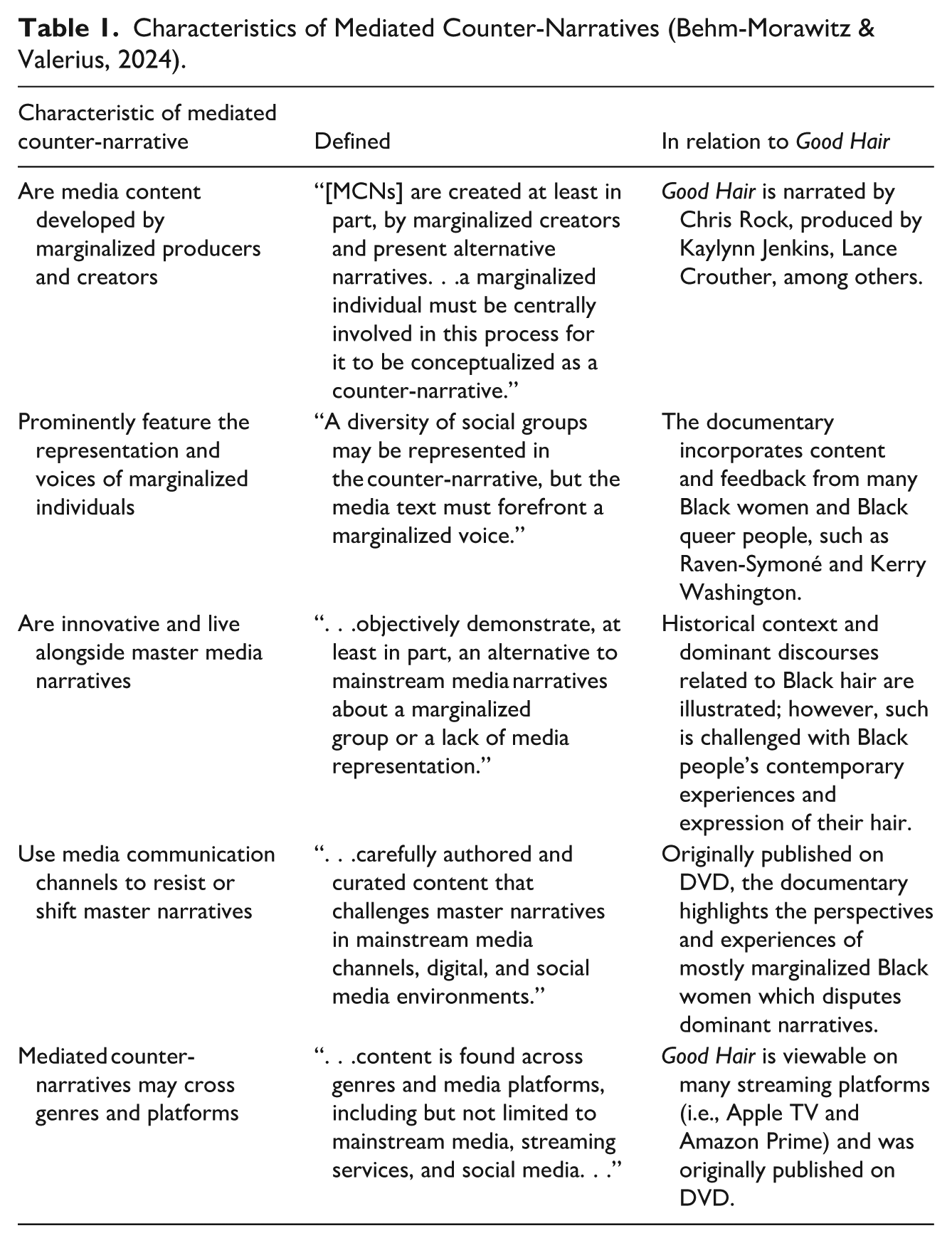
Media plays an important role in circulating such narratives to broad audiences. Mediated counter-narratives (MCN) refer to stories produced within media environments that amplify marginalized voices while challenging dominant frameworks of representation (Behm-Morawitz & Valerius, 2024). Within this framework, Good Hair (2009) functions as a mediated counter-narrative that interrogates prevailing discourses surrounding Black hair while contributing to a growing cultural movement toward acceptance and celebration of natural hair.
Directed by Jeff Stilson and narrated by comedian Chris Rock, Good Hair explores the cultural, social, and economic implications of Black hair across diverse African American experiences. Sparked by a personal question from his young daughter—“Daddy, how come I don’t have good hair?”—Rock uses humor and investigative journalism to examine the societal pressures that shape Black beauty standards (Rock & Stilson, 2009). The documentary investigates the billion-dollar Black hair care industry through visits to salons, laboratories, barbershops, and the Bronner Bros. Hair Show in Atlanta, while also highlighting the potential health risks associated with chemical relaxers.
One of the film’s most revealing segments follows Rock to India, where much of the human hair used in weaves is sourced through religious temple offerings. This sequence exposes a global supply chain in which Black consumers spend billions of dollars on products and services often controlled by non-Black businesses (I. Banks, 2000). Through interviews with stylists, scholars, celebrities—including Nia Long, Ice-T, and Maya Angelou—and everyday consumers, the documentary positions hair as a site where identity, cultural politics, and economic power intersect.
Although Rock serves as the film’s visible narrator, Good Hair is also shaped by the intellectual influence of co-producer and cultural critic Nelson George. Known for his work examining Black cultural production and commodification, George brings analytical depth to the documentary’s exploration of beauty politics. His earlier scholarship on the commercialization and appropriation of Black culture (George, 1988, 2004) echoes throughout the film’s examination of global hair markets and the dominance of non-Black ownership within beauty supply industries. Through this lens, the documentary translates complex critiques of Black cultural commodification into a form accessible to broader white mainstream media audiences while remaining legible to Black viewers.
Rock’s role in the documentary is also shaped by his positionality as a Black father raising two Black daughters. His investigation emerges from a deeply personal concern with how Eurocentric beauty standards influence the self-perception of Black girls and women. In this sense, the film reflects themes aligned with African womanist thought, which emphasizes family-centrality and collective responsibility within Africana communities (Aldridge & Wheeler, 2001; Hudson-Weems, 2000, 2024). From this perspective, Rock’s inquiry becomes not simply comedic commentary but part of a broader effort to understand how racialized beauty standards affect Black families and communities.
This study therefore positions Good Hair as a mediated counter-narrative that challenges dominant definitions of “good hair” while exposing the economic and cultural systems that sustain them. By bringing longstanding conversations about Black hair politics into wider white mainstream media spaces, the documentary contributed to renewed public discourse surrounding beauty standards, identity, and racialized esthetics.
This study argues that Good Hair impacted audience perceptions of “good hair” by exposing the detrimental effects of popular hair care practices and counteracting the harmful historical narratives that “good hair” is straight hair. The impact and cultural significance of Good Hair is examined through the lens of mediated counter-narrative (Behm-Morawitz & Valerius, 2024). Positioning mediated counter-narrative as the theoretical framework, this study maps and highlights the significance of Good Hair as both an intervention and disruption within dominant media narratives and historical discourses surrounding “good hair.” In doing so, it positions the film as a cultural catalyst that sparked broader conversations about identity, beauty norms, and racialized esthetics while contributing to the ongoing legacy of Black hair discourse. This study argues that while earlier works laid critical groundwork by examining Black hair through historical, cultural, and interpersonal lenses, their reach was largely confined to academic spaces, grassroots communities, and children’s literature audiences, limiting their circulation within white mainstream media audiences prior to Good Hair. Good Hair, as a mediated counter-narrative, brought these conversations to a wider white mainstream audience by leveraging Chris Rock’s celebrity status, comedic approach, and, perhaps most compellingly, his perspective as a Black father to Black daughters.
Methods
This study asks: How has the documentary Good Hair shaped audience perceptions of Black hair by challenging historical narratives and influencing attitudes, behaviors, and identity formation within the natural hair movement? To address this question, we employed a multi-method design combining textual analysis, a focus group, retrospective autoethnographic reflection, and an expert interview. Together, these approaches allowed us to examine both public discourse and lived experience, while strengthening analytic credibility through triangulation (Torrance, 2012).
To examine audience perceptions of Good Hair, we conducted a textual analysis of 467 Amazon.com reviews posted between 2009 and 2018. To clarify responses to historical narratives surrounding Black hair, we conducted one focus group. To account for researcher positionality, we used retrospective autoethnographic reflection to foreground our own experiences, biases, and interactions with Good Hair and our hair journeys. Finally, to corroborate preliminary findings, we conducted an in-depth interview with Black scalp and hair expert Dr. Kari Williams.
Textual analysis is a qualitative method used to examine the cultural and ideological assumptions embedded within media texts (Fürsich, 2009). As Barthes notes, a text is “made of multiple writings, drawn from many cultures and entering into mutual relations of dialogue, parody, [and] contestation” (Barthes, 1977, p. 148). In this study, textual analysis enabled us to identify recurring perceptions in viewer responses and interpret broader cultural discourse surrounding the film (Belsey, 2013; Frey et al., 1999).
The focus group consisted of a convenience sample of five Black women whose adoption of natural hair as a lifestyle was informed by viewing Good Hair. Focus groups are particularly useful for examining shared meanings within a specific population (Thomas et al., 1995). This relatively homogenous group—millennial Black women in their late 20s to mid-30s who were pursuing or had completed doctoral-level training—supported open discussion of the deeply personal and often controversial topic of Black women’s hair (Green et al., 2003). Participants were asked questions such as: “What was your experience like as you transitioned from processed hairstyles to being natural?” and “Do you think this film contributed to your natural hair movement in any way?”
Retrospective autoethnographic reflection was used to foreground researcher reflexivity. As Black women, we employed retrospective autoethnographic reflections for self-analysis to foreground any conflicts, biases, experiences and interactions with the film Good Hair and our own hair to be reflexive. Thus, we the authors, “chose to make [their] experiences, opinions, thoughts, and feelings visible and an acknowledged part of the research process through keeping reflective journals and using them in writing up the research” (Ortlipp, 2008, p. 695).
This study also included a semi-structured in-depth interview with Trichologist Dr. Kari Williams, a leading voice in the natural hair movement and a specialist in hair and scalp health. Williams has worked with prominent Black celebrities including Brandy Norwood, Tyra Banks, Meagan Good, Chrisette Michele, Willow Smith, and Ava DuVernay, and currently serves as Director of Education for Beyoncé’s hair-care company, Cécred (Dorisca, 2024). Conducted one-on-one with one of the authors, the interview deepened our understanding of Good Hair’s cultural impact and corroborated emerging themes (Hocking et al., 2003; Figure 1).
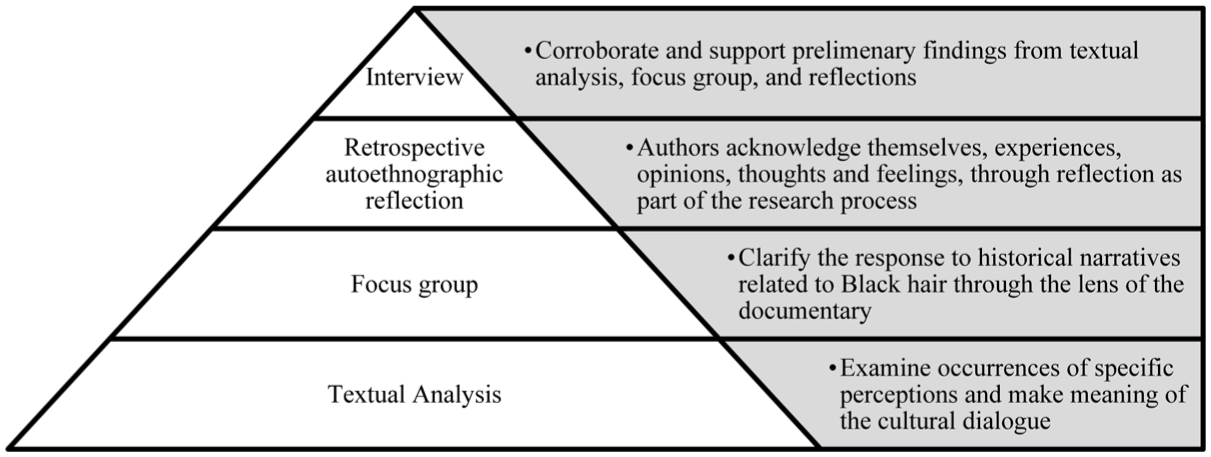
Methods. Note. Original figure created by the authors based on the study’s methodological framework.
Data Collection Procedure
As part of this multi-method design, audience reviews of Good Hair were collected exclusively from Amazon.com. Amazon was selected because of its broad user base and its function as a commercial site where viewers voluntarily provide consumer-generated reflections on media texts, whether prompted by the platform or offered independently (Cheung & Lee, 2012). Unlike curated film review platforms, Amazon reviews offer insight into everyday audience interpretations expressed in public, non-specialized language. Because Good Hair circulated widely through home media and streaming, Amazon also served as a useful digital ethnographic site for examining audience reception outside elite or academic spaces (Rambe, 2012).
Amazon reviews were treated not as representative opinion data, but as cultural artifacts reflecting affective and identity-based responses to a film addressing deeply personal and political issues (Gray, 2003; Jenkins, 2006). Although the platform tends to polarize responses into “positive” or “critical” reviews, these extremes were analytically useful for examining how the film resonated with viewers. To address the limitations of relying on a single online platform, we triangulated the review data with the focus group, expert interview, and autoethnographic reflections.
The initial Amazon sample included 467 reviews posted between October 2009 and March 2018. Because Amazon automatically categorizes customer reviews as “positive” or “critical” (Amazon Customer Service, 2024), we first reviewed both categories for relevance. Many “critical” reviews focused only on DVD quality, including scratches or playback problems, rather than the film’s content. These were excluded as irrelevant to the research question.
The final textual analysis sample consisted of 250 reviews that directly engaged the documentary’s educational, thematic, or entertainment value. Reviews that merely summarized the film or discussed only the product purchase experience were excluded. The remaining reviews were captured and thematically coded using the critical textual frameworks of Fairclough (1995), Hall (1997), and Krippendorff (2018).
IRB approval was obtained for the interview and focus group components. The focus group drew from a convenience sample of five Black women recruited from a university setting. Participants were initially identified by the researchers based on visible natural hairstyles and then screened through self-identification. Inclusion criteria required that participants wear their natural hair and have viewed Good Hair. The 55-min focus group was conducted in a private on-campus room and followed a structured moderator guide designed to elicit reflections on identity, beauty politics, and the documentary’s portrayal of Black hair (see Appendix for focus group questions).
Data Analysis and Management
To address the research question, we conducted a critical interpretive thematic analysis across three primary data sources: Amazon reviews, the interview with Dr. Williams, and the focus group. Following Braun and Clarke (2006), the analysis involved identifying, coding, and interpreting recurring patterns and themes related to Black hair politics and beauty standards.
Interview and focus group recordings were transcribed using Jefferson’s notation to preserve conversational nuance (Atkinson & Heritage, 1999). Transcriptions were completed using Temi and then reviewed manually. Researchers engaged in repeated readings and marginal note-taking before conducting a final coding pass focused on recurring themes relevant to the research question. This iterative process allowed for triangulation across methods and strengthened the depth and credibility of the findings.
Results
Education: Good Hair in the Age of Information
The textual analysis of Amazon.com customer reviews revealed two prominent themes: education and action. Reviews categorized as educational described the film as an effective tool for learning, highlighting how viewers gained new knowledge they did not possess prior to watching Good Hair. Those labeled under action described responses that extended beyond viewing—such as feeling empowered, recommending the film to others (“must see”), changing behaviors, or reinforcing existing commitments to natural hair (Table 1).
Characteristics of Mediated Counter-Narratives (Behm-Morawitz & Valerius, 2024).
The in-depth interview with Dr. Kari Williams affirmed these themes. Williams identified three primary factors contributing to the natural hair movement: the age of information, increased educational access among the millennial generation, and the release of Good Hair. Her insights align with the demographic profile of this study’s participants and confirm that the film functioned not only as a catalyst for awareness but also as a touchstone for behavioral and cultural change. Likewise, the focus group of millennial Black women validated patterns observed in both the audience reviews and interview, with recurring themes of “validation and confirmation to go natural,” “education as protection from harmful industry practices,” and “liberation.”
Taken together, the triangulated findings across all three methods were synthesized into the following thematic categories: (1) Good Hair in the Age of Information and Education; (2) Good Hair as a Catalyst for Change in Behavior; (3) Freedom of Natural Hair as a Lifestyle to Stay. These categories provide deeper insight into how audiences perceived Good Hair and the extent to which it influenced their adoption of natural hair as a lifestyle. The final themes are visually represented in Table 2.
Themes identified in Amazon.com customer reviews.
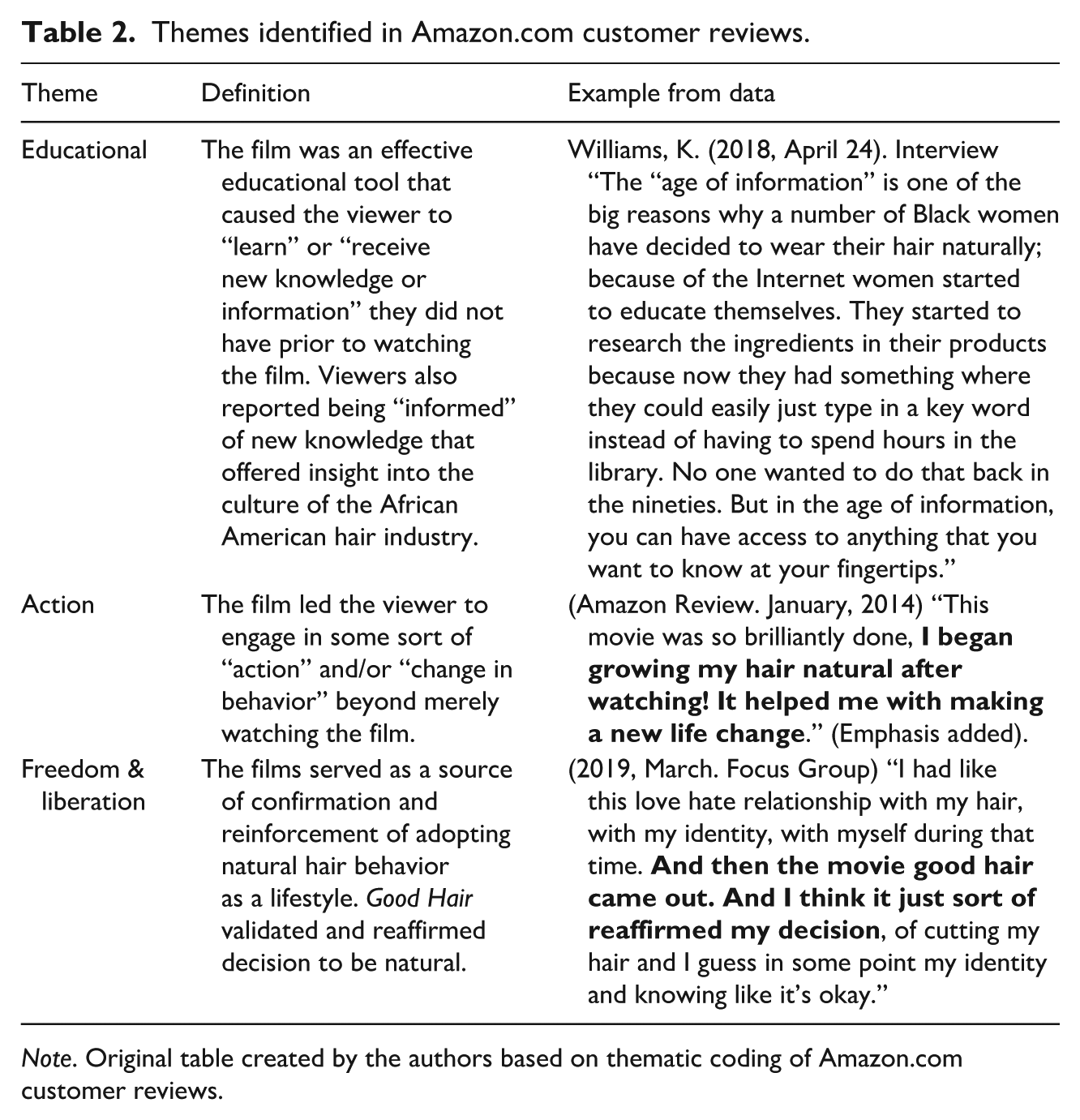
Note. Original table created by the authors based on thematic coding of Amazon.com customer reviews.
One of the recurring themes emerging from the textual analysis of Amazon customer reviews for Good Hair was the categorization of the documentary as “educational” or “informative.” Viewers frequently expressed that the film introduced them to new knowledge, particularly about the complexities of the African American hair care industry. These reviews revealed a sense of discovery—an awakening to deeper cultural dynamics previously unknown. For example, one Amazon viewer said, October 8, 2015—A very well put together documentary on African women and their women. Very gentle way to expose the truth without being offensive or putting African sister down. . .just giving them knowledge on a deeper subject what they may not have known before.
This theme of learning is echoed in the expert interview with Williams, who underscored the critical role of education in the emergence of the natural hair movement. She attributed the shift to three key factors: the rise of the internet and access to information, the increasing education levels among millennial Black women, and the catalytic release of Good Hair itself.
The focus group discussion with Black women further reinforced this theme of education as empowerment. Participants described Good Hair as offering knowledge that served as both “armor” and “ammunition” against harmful beauty industry practices that often did more harm than good. Echoing the insights from the textual analysis, one participant noted how this collective knowledge was not only changing behavior, but also forcing the industry to evolve: We’re forcing the industry to change in some instances as to what they say. Like we’re not just going to buy anything, the movement has definitely forced the industry to think differently about our needs as far as haircare. we’re able to educate and sit in spaces like this and educate one another and talk about Black haircare. (2019, March. Focus Group)
Action: Good Hair as a Warning and Catalyst for Change
According to Williams, Good Hair vividly exposed the health risks of hair care practices long known in the medical community—particularly the dangers of sodium hydroxide, a primary chemical in hair relaxers. Viewer responses reflected this awareness, often paired with decisive behavioral shifts. One Amazon reviewer wrote: “I knew that the chemicals I’d used for years were bad for my hair, but I did not realize how very dangerous they are. I will never relax my hair again.”
Williams noted that Black women diagnosed with fibroid tumors frequently had a history of using relaxers. Medical research has since supported this concern, linking relaxer use to increased risks of uterine cancer and fibroids, particularly among post-menopausal Black women (Bertrand et al., 2023; Chang et al., 2022; Gaston et al., 2019). These health concerns, compounded by the documentary’s revelations, led many women to reembrace their natural hair. As Williams explained: My business became a safe haven. . . Women in their 40s and 50s would come in saying they had never seen their natural curl pattern because their hair had been relaxed since childhood. Williams, K. (2018, April 24). Personal Interview.
Beyond health, Good Hair challenged Black women to interrogate the meanings behind their beauty choices. Williams emphasized the film’s psychological impact: For Black women, it’s all about the hair and in this movie, what we see is what we already know, that a number of Black women choose to wear their hair in weave or to straighten their hair. But then we started to dive deeper into the psyche behind why those choices are being made. Then we start to peel away the layers as to why Black women are making these choices and it’s not just about lifestyle, it’s about a beauty standard. Then it makes us start to question and say, ‘OK, what is really the best choice for me? And if I’m going to make the best choice for me, why am I making this choice?’ It started to force women to really think about the choices that we’re making. Williams, K. (2018, April 24). Personal Interview.
This insight confirms the impact, Good Hair as a mediated counter-narrative that educates and informs its audience, raises awareness and enhances knowledge, encouraging the possible adoption of natural hair among Black women. The film served not only as a source of revelation but as a reaffirmation for those already on a natural hair journey. Focus group participants described Good Hair as validating and empowering. One participant shared: I had like this love hate relationship with my hair, with my identity, with myself during that time. And then the movie good hair came out. And I think it just sort of reaffirmed my decision, um, of cutting my hair and, and, and I guess in some point my identity and knowing like it’s OK. (2019, March. Focus Group)
Together, the reviews, expert interview, and focus group data underscore Good Hair as more than a documentary—it is a mediated counter-narrative that educates, affirms, and catalyzes cultural and behavioral shifts. Equipped with new knowledge, many Black women began to reconsider not only their beauty routines but also the deeper societal forces shaping them.
Freedom of Natural Hair as a Lifestyle to Stay
Focus group discussions revealed that Good Hair was more than educational—it offered Black women affirmation in their natural hair journey. Echoing findings from the interview and textual analysis, participants consistently described the film as a catalyst for “freedom and liberation,” shifting natural hair from a trend to a lifestyle. One participant described the experience as therapeutic: The conversation that Chris Rock had was so therapeutic. . . that I could turn to other individuals who look like me and we can share in the same sentiment. . . For me it was therapeutic. It was finding my identity, my true self. (2019, March. Focus Group)
While the film validated natural hair for many, participants acknowledged that natural hair also presents challenges. Some women reverted to relaxers or weaves for ease of manageability—a reality one of the authors personally experienced. One participant described this shift: “I feel like perm has been replaced by weave. It’s just a new identity that’s still not yourself. Like it’s not the perm anymore but it’s still something different. So, I feel like perm has been replaced by weave.”
Despite these complexities, the overwhelming consensus was that natural hair has evolved into a holistic lifestyle choice. It reflects broader shifts toward health, identity, and generational change. As one participant noted: I think it’s a lifestyle and I think it’s here to stay. . . because of the health of it. There are more African Americans treating their whole lives better holistically, and haircare has become part of that experience. (2019, March. Focus Group)
Discussion
Findings from this study affirm the power of mediated counter-narratives in amplifying marginalized voices and fostering behavioral change (Behm-Morawitz & Valerius, 2024). Film has long been a vehicle not only for conveying health messages but also for influencing knowledge, beliefs, attitudes, and behaviors (Shen & Han, 2014). One of Good Hair’s most memorable moments—Professor Berry’s demonstration of sodium hydroxide dissolving a soda can—left a lasting impact on both the authors and focus group participants. This visual metaphor illuminated the dangers of a substance Black women and young Black girls routinely apply to their scalps in pursuit of Eurocentric beauty standards (Rock & Stilson, 2009). Across the interview, focus group, and textual analysis, Good Hair was shown to contribute to the broader natural hair movement, leaving some viewers forever changed in how they view themselves and their hair. The film’s curated content challenges mainstream narratives and disrupts dominant discourses around hair, Black beauty and identity (Behm-Morawitz & Valerius, 2024).
Still, the film’s framing—centered on a Black male comedian interrogating Black women’s beauty choices—warrants critical reflection. Africana womanism, as articulated by Hudson-Weems (2004), emphasizes the lived realities of Black women within community contexts. While Rock’s intentions may have been rooted in concern as a father, the use of comedy to explore such a sensitive issue risks reinscribing patriarchal oversight. As Trina Jones (2011) asserts, Black hair is deeply political—not merely esthetic—and critiques offered by male public figures must be situated within a historical context of gendered surveillance. Notably, Good Hair foregrounds Black women’s voices through figures such as actress Nia Long, who appears in the film and participated prominently in its promotional circuit, signaling an awareness that Rock, as a Black male, is not positioned to speak for Black women but rather to amplify conversations already unfolding within Black communities. Accordingly, Rock should not be understood as a “savior” of the natural hair movement, but as a cultural actor navigating the fraught intersections of advocacy, comedy, and privilege as a Black father responding to the questions raised by his daughters.
While Chris Rock’s controversial Oscars joke reignited scrutiny over his sensitivity to Black women’s experiences—particularly regarding alopecia and public vulnerability (Smithers, 2022; VanHoose, 2022b)—it is equally important to examine the tension between his role as provocateur and his prior labor in Good Hair. The documentary stands as a complex and at times contradictory cultural contribution: one that centers Black women’s voices, critiques Eurocentric beauty norms, and disrupts dominant narratives (Behm-Morawitz & Valerius, 2024; Rock & Stilson, 2009), even as Rock’s later public remarks revealed the limitations and fragility of his advocacy.
Despite the contradictions embedded in Rock’s public persona, Good Hair remains a powerful example of a mediated counter-narrative—one that emerges from within a marginalized community and challenges mainstream representations by elevating Black women’s lived experiences (Behm-Morawitz & Valerius, 2024). While Rock’s later actions may complicate his role as an advocate, they do not negate the cultural labor and visibility that Good Hair brought to a topic historically silenced or stereotyped in dominant media. Rather, the film’s enduring relevance underscores the layered nature of mediated resistance: that even flawed messengers can contribute to meaningful shifts in public discourse. In this light, Good Hair continues to serve as a cultural artifact that informs, educates, and affirms—its value not diminished, but reframed within a broader legacy of struggle, contradiction, and cultural negotiation.
At the same time, while Rock’s motivation behind Good Hair was rooted in a desire to explore the complexities of Black hair for the sake of his daughters, this does not absolve the harm caused by his Oscars joke. As a father, Rock may not have intended malice, but the cultural weight of Black women’s hair—particularly in the context of alopecia—demands more than comedic framing. Delivered on a global stage, the joke undermined his earlier advocacy and highlighted the fragile boundary between entertainment and accountability. Though the intent may have been humor, the impact carried a cost—one that came at the expense of Jada Pinkett Smith’s deeply personal battle with alopecia.
Chris Rock’s legacy in the discourse of Black hair is marked not by moral perfection, but by the paradoxes that accompany public figures navigating personal responsibility and communal representation. As a Black father moved by a daughter’s question, his decision to create Good Hair was a form of mediated labor—a cultural offering that challenged dominant narratives, uplifted marginalized voices, and catalyzed long-overdue introspection. In the process, Rock not only answered his own inquiry but also created space for generations of nameless and faceless little Black girls—girls he may never meet—to see their hair and their stories reflected in a new light.
His later misstep at the Oscars serves as a sobering reminder that advocacy demands consistency, especially when one’s platform holds the power to both heal and harm. Still, Good Hair endures not because its creator is flawless, but because its message transcends him. It remains a testament to the power of mediated counter-narratives to provoke change, even when born from contradiction. And in that complexity, Rock’s contribution remains not only relevant—but necessary.
Footnotes
Appendix 1. Research Interview Questions
Appendix 2. Focus Group Protocol

Funding
The authors received no financial support for the research, authorship, and/or publication of this article.
Declaration of Conflicting Interests
The authors declared no potential conflicts of interest with respect to the research, authorship, and/or publication of this article.