







Abstract
An increasing number of companies are introducing artificial agents as self-service tools on their websites, often motivated by the need to provide cost-efficient interaction solutions. These agents are designed to help customers and clients to conduct their business on the website. Their role on commercial websites is often to act as online sales/shopping assistants with the hope of replacing some of the interactions between customers and sales staff, thus supplementing or replacing human-to-human communication. However, research on artificial agents and comparisons with human-to-human communication, in particular, is still scarce. The purpose of this article is to explore the similarities and differences in communication between an artificial agent and customers compared with face-to-face communication between human service providers and customers. The method employed is a qualitative comparison of face-to-face human service provision in a travel agency setting and logs of interactions between customers and an artificial agent on an airline company website. The analysis is based on the theory of “activity-based communication analysis” and makes use of a framework of specific communication features provided by this theory. The article demonstrates a number of deficiencies in communication between artificial embodied agents and humans, suggesting that artificial embodied agents still lack many of the desirable communicative aspects of human-to-human service encounters.
Keywords
Introduction
The recent and rapid rise in Internet usage has resulted in both suppliers and customers relying increasingly on the use of artificial rather than human agents to provide information to customers. Although previous research has compared face-to-face and computer-mediated communication generally (Berry, 2006; Bordia, 1997; Hoffman & Novak, 1996; Markman, 2009; Meijden & Veenman, 2005), there is little research on the similarities and differences between computer-mediated and human-to-human interactions between service providers and service receivers (Lind & Salomonson, 2006; Salomonson, Lind, & Alm, 2008). Furthermore, there is a need for research that studies artificial agents on live, functioning websites (Keeling, McGoldrick, & Beatty, 2010). In this article, we compare human face-to-face service encounters with service encounters where the service provider is an artificial agent with a two-dimensional face and body. The purpose of this is to explore the similarities and differences in communication between an artificial agent and customers compared with face-to-face communication between human service providers and customers. To what extent does the communication between an artificial agent and customers exhibit communicative features found in human-to-human service encounters? This can enable a better understanding of the changes needed to improve communication between artificial agents and customers. The article consists of four sections. First, we present a literature review of previous research into online artificial agents, comparisons with human-to-human communication, and communicative features of service encounters. Then, we present the method and analysis employed. In the third section, based on a communicative framework, we analyze and discuss the results of the comparison of human-to-human and human-to-computer communication. The final section consists of conclusions and suggestions for further research.
Literature Review
An increasing number of organizations, both public and private, are introducing online artificial agents on their websites to help customers and clients to conduct their business. Chatbots.org lists 822 (September 24, 2011) artificial agents throughout the world. Most of these are accessed via the Internet and many reside on organization websites. The introduction of nonhuman agents like these is often motivated by the organization’s need to provide cost-efficient interaction solutions, for instance, by replacing human-to-human service encounters. However, research on the use of online artificial agents on commercial websites is, with some exceptions, scarce. Below, we now present previous research on online artificial agents and show that there is a need for studies comparing human-to-human interactions with interactions between humans and online artificial agents. To make these comparisons, we then outline some of the distinguishing communicative features of service encounters between humans.
Online Artificial Agents and Comparisons With Human-to-Human Interaction
Previous research on artificial agents in commercial settings has been based on experiments where participants have interacted with fictitious companies on experimental websites (Åberg & Shahmehri, 2000; Luo, McGoldrick, Beatty, & Keeling, 2006; Wang, Baker, Wagner, & Wakefield, 2007) or on especially constructed websites to make hypothetical purchases (Holzwarth, Janiszewski, & Neumann, 2006; Keeling et al., 2010). Other researchers have discussed how future, artificial shopping agents may change e-commerce markets by significantly extending the search and evaluation capabilities of consumers (Barlow, Siddiqui, & Mannion, 2004). In line with Keeling et al. (2010), we therefore argue that there is a need for research that studies artificial agents on live, functioning websites.
These and similar kinds of artificial agents are sometimes called “avatars” (Barlow et al., 2004; Holzwarth et al., 2006; Keeling et al., 2010; Wang et al., 2007) and can be defined as “general graphic representations that are personified by means of computer technology” (Holzwarth et al., 2006, p. 20). Avatars can serve as identification figures, as personal shopping assistants, as website guides, as conversation partners (Holzwarth et al., 2006), or as salespeople (Keeling et al., 2010). In this article, we employ the term artificial embodied agent (AEA). We define an AEA as an online graphic embodiment that provides service to a customer/client/user on behalf of a specific organization.
To what extent does the communication between an artificial agent and customers exhibit communicative features found in human-to-human service encounters?
The role of AEAs on commercial websites is often to act as online sales/shopping assistants with the potential to replace some of the interactions between customers and sales staff (e.g., Holzwarth et al., 2006; Keeling et al., 2010). AEAs are thus introduced for the purposes of supplementing or replacing human-to-human communication. The intention is also to provide artificial agents that are as close as possible to human agents. It is thus relevant to compare human-to-AEA communication with human-to-human communication and to study the role of AEAs in social settings. As Kumar and Benbasat (2002) claim, the specific communication characteristics of website interfaces seem to invoke feelings of social presence, that is, a feeling of interacting with real people. An AEA can thus be evaluated as a social actor on the Internet (Kumar & Benbasat, 2002).
Wang et al. (2007) investigate how the social cues (usually communicative behavior during a social interaction) produced by AEAs on retail websites influence consumers’ affect and shopping value. Their results show that social cues induce perceptions of website sociality, leading to increased pleasure and arousal. Social cues can also provide consumers with enhanced perceptions of human connection and the formation of emotional bonds. If computer technology exhibits humanlike behaviors, such as turn-taking during conversations and reciprocal responding, users will be more likely to personify the technology (Moon, 2000; Nass, Lombard, Henriksen, & Steur, 1995), that is, treat it as a social agent. Holzwarth et al. (2006) posit that having an AEA pictured during the human-computer interaction will make the interaction feel more conversational and reciprocal. They (Holzwarth et al., 2006) show that using an AEA on a retail website to deliver product information can positively affect the online shopping experience by creating a more positive perception of the entertainment value and informativeness. This makes shoppers more satisfied with the retailer, more positive about the product, and more likely to purchase it. Other researchers (e.g., Barlow et al., 2004; Redmond, 2002) claim that AEAs can increase the entertainment value, the information value, and the satisfaction of the web-based shopping experience for the customer. Fogg (1998) states that AEAs on retail websites, acting as on-screen assistants, could substitute for face-to-face interaction and promote user engagement. Keeling et al. (2010), in a study where participants used AEAs under controlled conditions (two especially constructed retail websites), demonstrate that social or task-oriented communication styles contribute to user trust and patronage intentions.
Lou et al. (2006) investigate what they call on-screen characters (on an especially constructed website simulating an online bookseller) and focus on their design and influence on consumer trust. Their results suggest that the humanlike characters are more likeable, appropriate, and trustworthy in general terms. However, they also demonstrate that, with regard to the perceived capabilities of on-screen characters, cartoon-like characters, especially female ones, had a more positive effect on the website interface. Additionally, a study based on a laboratory experiment reveals that anthropomorphic product recommendation agents (i.e., agents with humanlike characteristics) that match the ethnicity of their users are perceived as more sociable, more enjoyable, and more useful to interact with than the mismatched ones (Qiu & Benbasat, 2010). The research into AEAs relating to commercial websites (although experimental) has thus shown that there are some potential benefits to introducing these kinds of technological services on websites.
There are also numerous studies of comparisons of face-to-face and computer-mediated communication (e.g., Berry, 2006; Bordia, 1997; Hoffman & Novak, 1996; Kiesler & Sproull, 1992; Markman, 2009; Meijden & Veenman, 2005). However, as Qiu and Benbasat (2005) state, most of these studies have been conducted in the field of Computer-Supported Cooperative Work, focusing on the effects of different communication media on users’ collaboration and communication behavior. There are few studies that compare actual communication during human-to-human commercial service encounters with service encounters between humans and AEAs. Salomonson et al. (2008) make comparisons like these based on citizens’ interactions with an AEA provided by a municipality. Comparisons are also made by Lind and Salomonson (2006), but their article lacks any empirical data from interactions. These studies do not really provide any analysis of the communicative features of the interaction. We argue that, to further increase understanding of the use of AEAs on commercial websites, and to contribute toward developing this type of service further, it is essential to (a) have empirical data on actual interactions of both types, that is human-to-human and human-to-AEA, and (b) make comparisons based on a communicative theoretical framework. Next, we characterize some distinguishing communicative features of service encounters. This will enable comparison between human-to-human communication and communication between humans and AEAs.
If computer technology exhibits humanlike behaviors, such as turn-taking during conversations and reciprocal responding, users will be more likely to personify the technology.
Communicative Features of Service Encounters
A social activity is a type of collective interaction with a specific purpose, often with specific roles and artifacts, which takes place in a specific type of social and natural context (Allwood, 2000). This definition also correlates well with descriptions of service encounters, for instance, activities during which customers directly interact with service providers (Surprenant & Solomon, 1987). It can refer to not only people meeting face-to-face but also to meetings mediated by technologies such as the telephone, e-mail, or the Internet (Bitner, Brown, & Mueter, 2000; Meuter, Ostrom, Roundtree, & Bitner, 2000). Previous research into service encounters has demonstrated the important role of frontline staff in service provision. Frontline staff are key to providing a good level of service since they are often the primary point of contact before, during, and after a purchase (Chung-Herrera, Goldschmidt, & Hoffman 2004). They are also of importance in developing customers’ trust (Darian, Wiman, & Tucci, 2005), increasing their service encounter satisfaction (Bitner, Booms, & Tetreault, 1990) and providing service recovery when failures occur (Bell & Luddington, 2006; Maxham & Netemeyer, 2003). As Chebat and Kollias (2000, see also Bitner, Booms, & Mohr, 1994) indicate, the human interaction element is thus essential when determining whether or not service delivery is to be deemed satisfactory (Chebat & Kollias, 2000).
Some distinguishing features of service encounters are that they occur for a reason, the scope of the interchange is often quite focused, the information exchange is often task-related, and the client and service provider roles are well defined (Czepiel, Solomon, Surprenant, & Gutman, 1985). A service encounter can thus be said to be a social activity, the purpose of which is to provide a specific type of service. To accomplish this, at least two roles are typically involved: that of the “service provider” and that of the “service receiver.” In a service encounter, the service provider is typically assumed to act on behalf of the organization. This will also hold true for cases where an AEA occupies the role of the service provider. Other roles may also be involved, for example, roles connected to other activities that are instrumental in delivering the primary service, for example, roles connected with the finance department, computer services, and delivery. Each role can be analyzed in terms of competence requirements, obligations, and rights (Allwood, 2000). Thus, a service provider has to have the necessary competence to provide the relevant service. The competence requirements are reinforced by the rights and obligations connected to the role. For example, the rights of a service provider are often connected to receiving compensation for the service provided or to expectations of polite behavior on the part of the service receiver. A service encounter also frequently makes use of typical instruments or other artifacts to provide the service (e.g., telephones, computers, e-mail, the Internet). It is often restricted and, to some extent, enabled by rules and regulations concerning how the service can be provided. Finally, the encounter often takes place in an environment that is typical of the service (schools, hospitals, stores, travel agencies, etc.). All the factors mentioned have the dual function of enabling (functioning as resources) and constraining a particular type of service encounter. In our analysis of the particular cases of service communication that we will be examining below, we will see how the factors, by constraining and enabling, influence the various features of communication we will be considering.
Another feature of a social activity (Allwood, 2000) is that it often has an internal structure of subactivities or phases, that is, it opens, continues, and closes in a particular way. A service encounter might thus have the following subactivities:
Greetings (or other ways of establishing contact between service provider and service receiver)
Statements of the service required
Establishing specifics concerning the service
Providing the service
Ensuring that the service receiver is sufficiently satisfied
Agreeing on dates for continued service and payment for the service
Closing and leave-taking
Part of the internal structure of a social activity is constituted by typical “exchange types” (Allwood, 2000), where an exchange type can be defined as a typical “sequence of communicative acts.” These exchange types are, in many cases, a result of the fact that a particular social activity requires a particular type of information to be provided and shared by the role occupants, for example, greetings are exchanged and questions answered, while other exchange types are connected to generic needs that exist in most types of social activity and communication, for example, a question regarding clarification followed by a repetition of what was said.
Frontline staff are key to providing a good level of service since they are often the primary point of contact before, during, and after a purchase.
Thus, from a communication point of view, a service encounter proceeds by means of information sharing and co-construction of a sufficient degree of understanding (for the purposes at hand) between the service provider and the service receiver. Sharing and co-construction are achieved interactively by the two parties, who “take turns” in “contributing” information to the encounter. Each turn contains a “communicative contribution,” which is externally expressed, for example, through gestures, spoken words, or written messages, and which consists on the content/function side of one or more communicative acts, which are the smallest action units of communication (defined as the communicative function associated with a contribution or part contribution). Human-to-human service encounters thus contain a number of communicative features that are of importance. As mentioned, the purpose of this article is to explore the similarities and differences in communication between an artificial agent and customers compared with face-to-face communication between human service providers and customers.
Method
The method employed in this article is a type of qualitative analysis. An analysis of two cases of face-to-face human service provision in a travel agency setting is compared with an analysis of the service provided by an AEA on an airline company website. These two activity settings are chosen because they both concern service provision relating to travel. The empirical material consists of (a) transcriptions of face-to-face interactions between a travel agent and customers and (b) logs of interactions between customers and an AEA. The transcriptions of the face-to-face interactions come from the Göteborg Spoken Language Corpus (n.d.; cf. Nivre, 1999). Although the human-to-human interaction data are 12 years old, it is still valid since the purpose of using these data is to provide an understanding of generic human-to-human interaction features that have not changed during the past 12 years and are not very dependent on changes in the technological landscape, namely, customers talking (face-to-face) to travel agents in a physical store. Our analysis is thus grounded in actual data from interactions rather than on interviews or questionnaires that focus on the service providers’ or the service receivers’ perspective of the encounters. A total of 1,370 logs of interactions between customers and an AEA were provided by the airline, in 2008. These logs covered two full days (one in March 2008 and one in September 2008) of interactions between the customers and the AEA. The study is limited to the verbal communication between the human travel agent and to the customer and the interaction logs between the customer and the AEA. The reason for excluding communicative body movements is that AEAs in commercial settings (including the one studied) are still limited to very few such movements. The studied AEA does not use any facial expressions above and beyond blinking her eyes regardless of the questions asked by the customers.
Comparison of the two types of interactions was made using a number of basic communicative features, which are instrumental in service encounters (as well as in many other types of encounters). The analysis is based on the theory of activity-based communication analysis (ACA), which, we believe, in comparison with many other approaches used in earlier studies (for instance, conversational analysis to analyze talk-in-interaction in organizational settings; see, e.g., Boden, 1994; Clifton, 2006, 2009; Markman, 2009; Nielsen, 2009; Salomonson, 2005), brings some new aspects to the area (Allwood, 2000, 2007; Allwood & Lind, 2010). We argue that ACA provides a basis for understanding similarities and differences, for example, when comparing artificially supported service provision and human-to-human service provision. One of the underlying ideas of ACA is that a good way to understand the nature of a social activity is to study the communication typifying that activity. One reason for this is that communication is the primary means of achieving the goals of most social activities. The analysis in this article has, thus, been conducted by looking more carefully at some of the features characterizing the communication within two service providing activities. In the next section, we now compare face-to-face encounters between customers and service providers at a travel agency (H2H) with encounters between customers and an AEA on the website of an airline company (H2AEA). This is done by presenting excerpts and analyzing them in relation to eight communication features taken from ACA.
Analysis and Discussion of Results
These features are chosen to aid a holistic analysis of the service encounters (involving certain influencing factors in a social activity, i.e., purpose, roles, artifacts, regulations, and environment; Allwood, 2000) and subsequently move on to consider how they influence specific features of communicative interaction. Excerpts were compared using the following eight distinct features as the basis for comparison:
Turn management
Communicative functions of contributions (i.e., communicative acts)
Communicative feedback
Communicative relevance
Referential cohesion
Change of perspective and the co-construction of information
Amount of information
Degree of simultaneous information
The features come from previous ACA studies (Allwood, 2000, 2007; Allwood & Lind, 2010), as well as from discourse analysis, conversation analysis, and pragmatics (Levinson, 1983; Stubbs, 1983). The features are found in most types of communication and are central to, or even necessary for, communication in general. This means that examination of these features will guarantee that what is being examined is relevant to and suitable for comparison between different types of communication. The features we are studying are not empirically mutually exclusive; rather, they support and mutually reinforce each other. Thus, referential cohesion, adequate feedback, comprehensible relevance, and judicious amounts of simultaneous and sequential information should all facilitate the co-construction of cognitive understanding, while some symmetry in turn management and in taking the perspective of the other will facilitate the co-construction of motivation and empathy.
The sampling rationale was to search for the eight features in data from both types of settings (H2H and H2AEA). The logs of the interactions between the customers and the AEA contain information about (a) the start and stop times of the interaction, (b) the questions asked (or other input) by the customer (written in the dialog window on-screen), and (c) the answers (or other responses) by the AEA (presented in the same dialog window). Face-to-face interactions between travel agents and their customers consist of complete interactions, that is, from the time when the customer initiates the dialog to the time when it ends. The excerpts presented in this section were chosen since they are representative of the eight examined features. Our approach can be characterized as “abductive” in the sense of Peirce (1940; see also Peirce CP 5.171-172, 1903); that is, we have selected examples that enable us “to see the general in the particular” or to use intuition and insight, to guess at explanations from observing these particular examples. Since our attempted explanations are neither arrived at by deduction or statistically supported induction, this means that, like in other approaches (the approach is fairly common in linguistics, philosophy, logic, and, to some extent, conversational analysis [CA]) relying on an “abductive” approach, our results are very sensitive to counterexamples. In the manner advocated by Karl Popper (1959), we want to make strong claims that are clear enough to enable falsification. One way to facilitate this is to reproduce excerpts enabling the reader to assess the reasonableness and validity of the claims we have made. As might be expected, our comparison reveals a number of differences, and also similarities, between the two types of communication. See also the appendix for a description of our transcription conventions regarding H2H communication.
Turn Management
With regard to the first feature, “turn management,” we consider turn length, whether overlap occurs, and whether there are any attempts to hold or take turns. In many social activities, it is desirable to have “symmetric turn management,” so that both parties get a roughly equivalent chance to contribute to the shared information. However, in some types of service encounters (or parts of service encounters), turn management naturally becomes more asymmetric due to one of the parties having more information to contribute. If it is an information-providing service, this might often be the service provider.
With respect to turn management, a fundamental difference between the H2H and H2AEA interactions studied is that in H2AEA there are no overlaps or attempts to hold or take turns (in the sense of interrupting). A turn by a customer is followed by a turn from the AEA. The AEA then “waits” for the customer to take the next turn. Even if the customer wants to hold his/her turn, for example, to add another question, the AEA answers so promptly that this is not possible. The AEA does not “know” when the customer has finished, or not finished, so it never interrupts (compare this with, e.g., chat conversations between humans), but rather follows a preplanned structure of discourse. However, the AEA sometimes offers the customer a chance to respond in the middle of its own turn by providing clickable options. One example of this occurs when the AEA, based on a turn by the customer (C), provides multiple clickable options regarding questions that the customer might want an answer to (see Excerpt 1 below). When the customer clicks on one of these options, the AEA displays the questions (Turns 3 and 5) seen in the dialog below while simultaneously providing an answer. The question displayed by the AEA is only visible in the “dialog box” for about a second or so before disappearing. The customer’s turn taking is thus reduced to clicking on the query options that he/she is offered.
Excerpt 1: Dialog D 184 AEA turn management (translated from the Swedish)
1. C: latest time for check-in
2. AEA: Exactly when you have to be at the airport depends on how you check-in, which destination you are traveling to, and how much baggage you have. You’ll have to check-in and be at the gate by 20 minutes at the latest prior to departure. On the page I have opened, you will find information about check-in times and when you can drop off your baggage. Related questions: [Presents clickable options “Where can I check in?”; “Baggage”; “Passports and visas”; “Assistance at the airport”; “Traveling with animals”; “I am traveling on an e-ticket, what’s that?”]
3. C: Clicks on the option “Where can I check in?”
4. AEA: You can check in via our web page, using WAP—our mobile portal, or SMS. Using these methods, you can check in at the earliest 22 hours before your flight and up until 1 hour prior to departure. Another alternative is to check in at our self-service kiosk at the airport. (You can choose a seat up until 3 hours prior to take-off.) On the page that I have opened, you can choose the alternative you find most suitable. If you’d like to know your latest check-in time, click here [link]. Please bear in mind that these times apply when you travel with [Company name]. Related questions: [Presents clickable options “To Internet check-in”; “When do I have to be at the airport?”; “Can I check in via the Internet or via a cell phone if I have baggage?”; “I’m traveling on an e-ticket, what’s that?”; “What do I need at check-in?”; “Assistance at the airport”; “Traveling with animals”]
Please help me to improve! Win a gift voucher valued at 500 SEK by answering three questions. Would you like that? [Presents clickable options “Yes”; “No”
5. C: Clicks on the option “I am traveling on an e-ticket, what’s that?”
6. AEA: Traveling on an e-ticket means that your booking is stored electronically in our booking system without a paper ticket being printed. Your E-ticket ID is what you use instead of a ticket. You can use all the major credit cards, a EuroBonus card, or a booking reference. Up to 9 people can travel on one E-ticket ID. Related questions: [Presents clickable options “Do I have to bring my credit card if I have an E-ticket?”; “Can I check in using a card that has expired?”; “Can I change my E-ticket ID?”]
Another example (Excerpt 2 below) of a turn offering during the H2AEA dialog occurs at the very beginning of each interaction, whereby the AEA greets the customer and requests that he/she asks questions using short sentences:
Excerpt 2: Dialog D 48 AEA Initial sequence (translated from the Swedish)
AEA: Good morning! My name is Eva and I’ll help you to find the answers to your questions and information on our website. Please ask your questions using short sentences.
In H2H, turn management has a different nature and is characterized by frequent overlaps, as demonstrated in Excerpt 3 between the travel agent (A) and the customer (C). Square brackets show the parts of an utterance that overlap with other utterances. Slashes indicate pauses of different lengths (/ short, // intermediate, and /// long).
Excerpt 3: Overlaps (translated from the Swedish)
17. A: yes it will be // [7 you can find ]7 maybe //
18. C: [7 we take ]7 it [8 I believe ]8
19. A: [8 cheap ]8 down [9 there ]9
20. C: [9 you think]9 around that time, then I would like that of course but e{h} //
it depends on the price /
Besides overlaps, other characteristics of the H2H turn management include the use of nonprepared questions. In Excerpt 4, both the travel agent and the customer ask questions (Turns 165, 168, 170). Curled brackets { } indicate sounds that are not pronounced.
Excerpt 4: Eliciting information (translated from the Swedish)
165. A: and / u{h} when did you say coming back, on the sixth /
166. C: yes / u{h} //
167. A: or somewhere there //
168. C: yes / do you get here on the sixth too ///
169. A: let me see ///
170. C: what time // [99 (…) ]99
171. A: [99 yes ]99 /// fully booked / but if you leave u{h} /// on the sixth in the evening from < phuket > then you’ll be in < copenhagen > on the seventh in the morning ///
In Turn 166, the customer hesitates and the agent adapts to this, by opening for an alternative return date. In Turn 169, the agent hesitates, which allows the customer (Turn 170) to insert a specifying question. In both cases, hesitation triggers additional activity on the part of the interlocutor. This can also be seen in the following example, where the customer interrupts the travel agent who is hesitating (Excerpt 5):
Excerpt 5: Hesitation and interruption (translated from the Swedish)
32. A: [19 and e{h} ]19
33. C: [19 is ]19 that direct or do you have to go via < bangkok >
In the examples above, hesitation triggers a response, providing an alternative that might be constructive. None of these fairly common features of H2H service encounters occurs during the H2AEA encounter.
Communicative Function of Contributions
The second feature concerns the types of “communicative acts” employed. Here, we analyze the communicative functions of the contributions, for example, whether they are “enquiries,” “claims,” or “proposals,” and so on, and, in more detail, which specific sorts of enquiries or claims they are. Communicative acts are fairly often characterized by multifunctionality, either sequentially or simultaneously. There is sequential multifunctionality when one contribution consists of several consecutive communicative acts and there is simultaneous multifunctionality when a contribution, or a part contribution, simultaneously involves two communicative acts; for instance, I want to go to Paris when uttered in a travel agency can simultaneously be a statement about what a customer wants to do and a request for information concerning how one might get to Paris. As we have already mentioned, roles are connected with rights and obligations (and commitments). Obligations and commitments are to a great extent co-constructed through the communicative acts and reactions to these that occur during the encounter. This means, for example, that a statement expressing a service-related need or wish (for instance, I want to go to Paris), when made by the service receiver, is more easily interpreted by the service provider as a request for the service in question, even if the statement is not in itself a request.
When examining the communicative functions of contributions, we can see that there are examples of claims, enquiries, and proposals in both H2H and H2AEA interactions. In H2H dialogs, enquiries are frequently used by both customers and travel agents to elicit information. In H2AEA interactions, most queries are provided by the AEA as clickable options as well as given “canned” answers by it (see Excerpt 1 above). An example of a combination of enquiry and claim in the H2H context occurs when the travel agent requests information (Turns 6 and 8 in Excerpt 6 below) about the type of travel arrangements the customer has seen and the customer replies by claiming that it will be too expensive (Turn 9 in Excerpt 6). The customer seems to take the agent’s query as a suggestion and responds by rejecting it, claiming that the cost will be too high. This, in turn, enables the agent to infer and make a claim about what the customer might want.
Excerpt 6: Queries, rejections, and suggestions (translated from the Swedish)
6. A: < yes > / is it a package trip you’ve seen there or //
@ <other language: english >
7 C: [2 < n+ > yes: ]2
@ <cutoff: no >
8 A: [2 or what did ]2 you have in mind /
9C: no I think / it’ll be too expensive if we include a hotel so we u{h} /
10B: < / > / yes you just want the flights /
While during the H2H dialog, both parties make requests for information, in the H2AEA interaction the absolute majority of enquiries are preplanned, options from which the customer is requested to select one or more (see Excerpt 1). The following excerpt (Excerpt 7) also demonstrates that the AEA makes a claim after the customer’s question. However, the claim is clearly self-contained and is not made relevant through any implicit consideration of the consequences, as is done with the claims made in Turns 9 and 10 above (Excerpt 6).
Excerpt 7: Dialog D14 Request for information followed by a claim containing information assumed by the AEA to be relevant (translated from the Swedish)
1. C: What do I do if I want to take a dog along with me on the trip?
2. AEA: You can take your cat or dog aboard our flights on condition that you make a booking and your request is granted in advance. In some cases, there are certain restrictions and rules, so please ask when making your booking and, if necessary, contact the embassies in the relevant countries. I’ll open a page where you can find more information, for example about prices. Note that other rules will apply if you do you not travel with your dog. Contact [Company name], Cargo or Jetpak for more information. Related questions: [Presents clickable option “I’m allergic to pets”]
Communicative acts are fairly often characterized by multifunctionality, either sequentially or simultaneously.
Often, customers only use a single word, or a couple of words, as an enquiry when they start interacting with the AEA, presumably because they know the AEA is keyword-based. An example of this occurs in Excerpt 8 below where the customer types in the word “commute.” The AEA responds with a descriptive statement, containing what might be relevant information, and an offer to the customer to choose between different clickable options. The customer then clicks on an option (“Travel Pass Individual”), which, through “keyword” recognition, becomes a ready-made enquiry (“What Is Travel Pass Individual?”).
Excerpt 8: Dialog D7 Single-word request for information (translated from the Swedish)
1. C: Commute
2. AEA: You have a question about Travel Passes. Below, you can choose between our different Travel Pass products: “Travel Pass Individual”; “Travel Pass Multiple”; “Travel Pass Corporate”. Related questions: [Presents clickable options “I have a booking on my Travel Pass, what time have I booked?”; “Can I extend my Travel Pass?”; “Does my Travel Pass guarantee me a seat on the plane?”; “What benefits do I get with my Travel Pass?”; “Where can I find information about my Travel Pass journeys?”]
3. C: What is Travel Pass Individual? [clicks on option “Travel Pass Individual”]
Even if customers use single-word contributions to trigger “ready-made questions” to put to the AEA, spontaneous, “noncanned” requests for information and elicitations of information really only occur in human-to-human interaction. Over and above asking the customer to select queries, the AEA also makes one form of enquiry and that occurs when asking the customer if he/she wants to answer questions about the AEA’s ability to help him/her (see Excerpt 9).
Excerpt 9: Dialog D 27 AEA request for information (translated from the Swedish)
4. AEA: Prices for excess baggage are dependent on the route. We have different prices for different destinations. I’m opening a page where you’ll find more detailed information about your actual trip. For certain types of sporting equipment, such as skiing and golfing equipment, there are special fees. We kindly ask you to contact [Company name] telesales on 0770 123123 [number changed] for more information. Help me to improve and win a gift voucher valued at 500 SEK by answering 3 questions, would you like that? [Presents clickable options “Yes”; “No”]
5. C: Clicks on option “Yes”
6. AEA: Was I of any help to you? [Presents clickable options “Yes”; “No”]
7. C: Clicks on option “No”
8. AEA: Will you use me again in the future to answer your questions? [Presents clickable options “Yes”; “No”]
9. C: Clicks on option “Yes”
10. AEA: What can I do to improve? [Presents clickable options “Booking”; “Check-in”; “EuroBonus”; “Baggage”; “About our company”; “Other?”]
11. C: Clicks on option “Check-in”
12. AEA: If you want to be in the lottery, you’ll need to give us your contact details. Choose an alternative below: [Presents clickable options “YES, I’d like the opportunity to win a gift voucher”; “NO, I don’t want to give you my contact details.”]
13. C: Clicks on option “Yes”
14. AEA: Enter your name, email address, and / or phone number so we can notify you if you win.
15. C: [Customer types in name and email address]
16. AEA: Thanks for entering! Your views are valuable to us. We’ll contact the winners within two weeks. Please feel free to ask me some more questions.
As can be seen above, another difference between H2H and H2AEA interaction is that the AEA makes no suggestions to the customer. An example of a suggestion during H2H can be seen in the following excerpt (No. 10) where the travel agent (A) implicitly suggests, during Turns 22 and 24, that the customers find their own hotel on arrival:
Excerpt 10: Suggestion (translated from the Swedish)
20. A: {y}es yes / no you won’t find any inexpensive trips from here like [10 package trips]10 no since it’s high season you know /
21. C: [10 I won’t ]10 yes I [11 understand ]11
22. A: [11 but when you come down ]11 if you’re
23. C: yes
24. A: used to traveling [12 you might perhaps ]12 find [13 something yes ]13
Communicative Feedback
The third feature examined is “communicative feedback,” that is, communicative means employed by communicators to ensure that joint contact, perception, understanding, and mutual satisfaction are achieved. Such means are essential in service encounters and involve words (e.g., “yes,” “no”) and/or gestures (e.g., head nods or head shakes) that allow communicators to keep track of each other’s willingness and ability to continue communicating, as well as whether and how what is being communicated is being perceived, understood, accepted, and otherwise emotionally reacted to.
We find that H2H communication contains much more communicative feedback than H2AEA communication. The participants are constantly giving signs of contact-perception-understanding (CPU), cf. Allwood, Nivre, and Ahlsén (1992), using words or utterances like “yes,” “no,” “okay,” and “mmm.” Feedback functions also include the expression of agreement and acceptance. One party makes suggestions, or requests, specifying information concerning the service to be provided, by asking questions, while the other party guides the first by giving feedback to these suggestions and requests (Turns 103, 104, 106, 107, 109, and 111 below). See the following excerpt:
Excerpt 11: Feedback (translated from the Swedish)
102. A: but the problem is getting to < bangkok > // [62 it’s ]62 [63 full ]63
@ < name >
103. C: [62 yes ]62
104. C: [63 yes ]63 yes
105. A: when it comes to domestic you almost always [64 find ]64 /
106. C: [64 yes ]64
107. C: yes //
108. A: but it’s starting to fill up so /
109. C: m: //
110. A: the next thing you can do is // on the ninth it seems / pretty okay so [65 you could ]65 try being on a waiting list and then /
111. C: [65 m: ]65
During H2AEA interaction, there are no signs of the feedback functions of CPU. However, customers sometimes give feedback (through acceptance or nonacceptance) to alternative offers, suggestions, and yes/no questions by the AEA. In the case of both offers and questions, the AEA presents clickable alternatives (yes or no) on the website. An example of this practice occurs in the following excerpt (No. 12).
Excerpt 12: Dialog D 107 AEA feedback (translated from the Swedish)
6. AEA: … … …
Help me to improve and win a gift voucher valued at 500 SEK by answering 3 questions, would you like that? [Presents clickable options “Yes”; “No”]
7. C: Clicks on option “Yes”
8. AEA: Was I of any help to you? [Presents clickable options “Yes”; “No”]
9. C: Clicks on option “Yes”
10. AEA: Will you use me again in the future to answer your questions? [Presents clickable options “Yes”; “No”]
11. C: Clicks on option “Yes”
12. AEA: What do you think I could improve? [Presents clickable options “Booking”; “Check-in”; “EuroBonus”; “Baggage”; “Other”?]
13. C: Clicks on option “Check-in”
14. AEA: If you want to take part in the lottery, you’ll have to give me your contact details. Choose an alternative below: [Presents clickable options “Yes”; “No”]
15. C: Clicks on option “Yes”
As we can see, feedback is restricted to locations predetermined by the AEA and thus loses the spontaneous guiding aspect that we see that it has during the H2H dialogs, where content is co-created during the interaction between the interlocutors.
Communicative Relevance
One of the forces at work in communication is the desire of the communicators to be “relevant” to what is being done or said. In contrast to so-called “relevance theory” (Sperber & Wilson, 1986), we take “communicative relevance” (the fourth feature studied) here as essentially being constituted through a means-ends relationship (Allwood, 1984). Actions (both communicative actions and others) are relevant in relation to particular goals (or purposes) as means of achieving these goals. Communicative relevance is, in general, a matter of degree, and since interactions are often multifunctional, several purposes can be relevant at the same time. Investigating communicative relevance might, thus, give us an idea about what actions communicators regard to be relevant during service encounters.
Two very pervasive types of relevance are global relevance to the activity at hand and local relevance to the preceding contribution. In the H2H interactions, we find that both kinds of relevance are continuously present, whereas in the H2AEA interactions, there is mostly global relevance and some very poor local relevance. The two types of relevance often interact in H2H communication. This can be seen in the sensitive, frequent use of implicit information, where global relevance influences local relevance in order to achieve relevant connections between contributions. This type of interaction is mostly lacking in the H2AEA interactions, which, to a great extent, are dependent on local keywords triggering the global preplanned expectations of the people who created the system, see Excerpt 13 below, where the phrase “how much baggage” (Turn 1) and the word “pay” (Turn 3) seem to trigger the preplanned “canned” answers that ignore the rest of the consumer’s query and, thus, achieve only partial local relevance.
Excerpt 13: Dialog D 17 AEA use of globally preplanned local relevance (translated from the Swedish)
1. C: How much baggage can I bring from ATL to Stockholm in January 2009?
2. AEA: The amount of baggage you can bring without incurring additional charges depends on what type of ticket you have and where you’re traveling to. Read more on the page I’ve opened. Related questions: [Presents clickable options “How much does excess baggage cost?”; “Special baggage”; “Traveling with animals”]
3. C: Can I check in 3 bags from ATL to Stockholm if I pay for the third one?
4. AEA: This is a question about payment. The most common questions about payment are: [Presents clickable options “Is my credit card charged?”; “Is my booking OK?”; “I’ve received information that you can’t debit my account”; “When do I have to pay?”; “What cards can I pay with?”; “I haven’t got a receipt”; “You’ve charged my card multiple times”; “Can I pay for someone else?”; “Can someone else pay for my ticket?”; “Can I purchase my flight by installment?”]
In contrast, the H2H interaction, in most excerpts, for example, Excerpts 6 and 11 above, exhibits a different kind of flexible local relevance, where global and local goals interact to create the implicit context that motivates the suggestions being made. Another example of this can be found in Excerpt 14 below.
Excerpt 14: H2H flexible local relevance influenced by global relevance (translated from the Swedish)
25. C: [14 so then ]14 so it should be flights/
26. A: just flights [15 two weeks ]15 or how long do you want to stay /
27. C: [15 yes ]15
28. C: no to u{h} / u{h} a return flight / fifth or sixth of January /
29. A: so it’s just under a month / then [16 three weeks or so ]16
30. C: [16 u{h} three weeks approximately ]16 yes //
The agent has understood that the customer only wants the charter flight, without hotel accommodation, and is trying to determine the length of his/her stay. He does this by calculating the duration from the desired date for a return flight and the previously given departure date. The global relevance is given by the expectation of a return ticket with a certain duration and the local relevance is gained by keeping this goal in mind and then using the relevant information that was given earlier (the departure date), combining it with information in the preceding utterance (desired return date) and then presenting a conclusion concerning the length of stay. This conclusion is acknowledged and affirmed by the customer’s feedback, consisting of the repetition “three weeks approximately.”
Referential Cohesion
A fifth feature we have investigated is “referential cohesion.” Which phenomena do communicators refer to and how is reference to these phenomena maintained throughout the encounter? Referential cohesion is essential in many social activities since it helps maintain co-constructed understanding and relevance to what is being talked about. It concerns the degree to which the participants relate, more or less explicitly, to previous parts of the interaction, making use of a kind of collective memory of already-made contributions. Referential cohesion can be observed when different interlocutors use co-referential devices to maintain the activation of introduced referents. Such devices include the repetition of referring expressions (often nouns), the use of proforms (mostly pronouns) to reactivate the referent of an already-mentioned antecedent, predications without a subject that require the reactivation of an already-mentioned referent, as well as various types of inferences that require the activation of already-mentioned referents. During H2H, the travel agent and the customer constantly make reference to previous parts of their dialog. One such example is when they talk about what type of flight arrangement the customer wants (Excerpt 15):
Excerpt 15: Referential cohesion (translated from the Swedish)
30. A: m: / let’s see what I have on package holidays there /// m: all package holidays are fully booked // as it looks right now in three weeks time a regular flight will be the only option //
31. C: m: /
32. A: [19 and u{h} ]19
33. C: [19 is that ]19 direct or will I have to fly via < bangkok >
The agent mentions (Turn 30) that charter (package holidays) is not an option since these are fully booked and so it will have to be a regular flight. In Turn 33, the customer uses the word “that” to refer to the option of taking a regular flight. In H2AEA interaction, the AEA does not refer to previous parts (further back than the previous turn) of the interaction (since probably no record is kept of this in the AEA), whereas this occurs fairly often during H2H interactions. Instead, the AEA treats every contribution (e.g., a question) made by the customer as a new turn with no reference to previous turns during the interaction. One consequence of this is that the AEA cannot handle sequences of related questions. In this sense, H2AEA interaction contains no collective memory. Consider again Excerpt 13 below:
Excerpt 13: Dialog D 17 AEA (non-)use of referential cohesion (translated from the Swedish)
1. C: How much baggage can I bring from ATL to Stockholm in January 2009?
2. AEA: The amount of baggage you can bring without incurring additional charges depends on the type of ticket you have and where you’re traveling to. Read more on the page I have opened. Related questions: [Presents clickable options “How much does excess baggage cost?”; “Special baggage”; “Traveling with animals”]
3. C: Can I check in 3 bags from ATL to Stockholm if I pay for the third one?
4. AEA: This is a question about payment. The most common questions about payment are: [Presents clickable options “Is my credit card charged?”; “Is my booking OK?”; “I’ve received information that you can’t debit my account”; “When do I have to pay?”; “What cards can I pay with?”; “I haven’t got a receipt”; “You’ve charged my card multiple times”; “Can I pay for someone else?”; “Can someone else pay for my ticket?”; “Can I purchase my flight by installment?”]
During Turn 4, the AEA demonstrates a lack of memory regarding what the customer asked for during Turn 1. The customer receives an answer about baggage during Turn 2 and then uses a follow-up question during Turn 2 regarding the possibility of paying for a third bag. The AEA interprets this as a general question about payment and not something related to baggage. However, the AEA uses repetitions, one of the instruments for creating cohesive reference. An example of this occurs in Excerpt 16:
Excerpt 16: Dialog D61 AEA use of repetition (translation from the Swedish)
1. C: What kind of airplane is used on flight SK2027?
2. AEA: You have questions regarding flight SK2027. The information I have about this flight is: [link]
3. C: What kind of airplane is a Boeing Douglas MD-80
4. AEA: On the page that I’ve opened, you can read more about the different airplanes we use. To find out more about the number of seats, how far between the seat rows, or the fuel consumption, click on the link. For more information about and photos of our airplanes, click on the link below [link]
The example demonstrates that the AEA repeats certain keywords, in this case “SK2027” and “airplane.” However, the example also shows that the AEA picks up the words being used without really “understanding” what they refer to. The customer has to specify and reformulate his/her question in order to get information about the airplane itself, and not the flight.
Referential cohesion is also related to information cohesion in a slightly wider sense, that is, how information previously contributed is used later on during the interaction. This is done continuously during H2H interaction, for an example see Excerpt 17 below, but not during H2AEA interaction.
Excerpt 17: Information cohesion (translated from the Swedish)
1. C: [3 yes for ]3 / we / don’t you also think it will be very high numbers if one is to [4 < // > ]4 @ < laughter >
2. A: [4 for ]4 four, yes of course
The customer asks the travel agent if he/she thinks the trip will be very expensive, but does not finish that sentence. Instead, the customer starts laughing. The agent responds by agreeing that it will be costly and relates it to the number of people traveling together, information previously given during the interaction by the customer.
Change of Perspective and the Co-Construction of Information
A sixth feature is the “change of perspectives and the co-construction of information” brought to the encounter by the service provider and the service receiver. We are particularly interested in how perspectives like these are changed to facilitate service provision. Mostly, this will probably involve the service provider attempting to take the perspective of the service receiver, in order to increase the receiver’s satisfaction.
When a participant in H2H interaction obtains supporting motivation from the other party, this often involves a change of perspective. For example, when the customer seeks advice from the agent concerning whether or not the price of the trip will be too high (see above, Excerpt 6 in Section “Communicative Function of Contributions”), he/she is also making the agent take the customer’s perspective. This type of change of perspective does not occur during H2AEA interaction. A further difference is that, in H2H, the linguistic-cognitive operations of the participants involve a more complex co-construction of information (understanding). Co-construction means that the participants together construct the content of the contributions made and the content jointly shared. This is achieved, for example, through reformulations, repetitions, the use of pronouns, and the frequent use of questions to elicit information and clarify the dialog. Consider again Excerpt 14 from the H2H travel agency dialog, which demonstrates how the customer and the travel agent co-construct shared information through questions and answers:
Excerpt 14: Co-construction of content (translated from the Swedish)
1. C: [14 so then ]14 so it should be flights/
2. A: just the flights [15 two weeks ]15 or how long do you want to stay /
3. C: [15 yes ]15
4. C: no to u{h} / u{h} a return flight / fifth or sixth of January /
5. A: so it’s just under a month / then [16 three weeks or so ]16
6. C: [16 u{h} three weeks approximately ]16 yes //
Another example is provided in the following excerpt (No. 18), where we can see that an understanding of what the agent and the customer are talking about requires access to previously co-constructed content. Without this, even though they are in a travel agency, there are many options like car rentals, hotels, restaurants, or tickets for buses, trains, or flights.
Excerpt 18: Co-construction of content (translated from the Swedish)
59. C: but if [38 you don’t ]38 know the price then it [39 feels ]39
60. A: [38 {y}es ]38
61. A: [39 no ]39 / but we can book it and then you have a < price gua+ > / or // then you have an “open purchase” until the price is set /
62. @ < cutoff: price guarantee >
63. C: do you really have [40 that ]40
64. A: [40 m: ]40 / [41 so that’s ]41 what we can do in that case //
65. C: [41 m: ]41
66. C: yes / u{h} < v+ > / but do you have any idea which / company is the cheapest / used to be the cheapest /
An important part of the complex co-construction of understanding is the implicit information either taken for granted or contributed by the participants. An example of this occurs in Excerpt 6, when the participants, during a travel agency dialog (H2H), demonstrate implicit knowledge of the topic being discussed:
Excerpt 6: Co-construction of understanding using implicit information (translated from the Swedish)
6. A: < yes > / is it a package holiday you have seen there or //
@ < other language: English >
7. C: [2 < n+ > yes: ]2
@ < cutoff: (no) >
8. A: [2 or what did ]2 you have in mind /
9. C: No I think / it’ll be too expensive if we include a hotel so we u{h} /
10. A: < / > / yes you only want the flights /
@ < click >
11 C: yes /
12. A: OK / [3 m: ]3
When the travel agent asks the customer if he/she is considering charter, he/she answers that this will probably be too expensive since it includes hotel costs. The travel agent replies by suggesting that the customer only buy the journey. This indicates an understanding of the preconditions involved when buying an airplane ticket. It is also a sign of an implicit cognitive model of what charter flights involve. Contextual understanding is more implicit and plays a greater role during H2H interaction than during H2AEA interaction.
Amount of Information
We also investigate the amount of information shared. Generally, it is beneficial to avoid too much information (due to constraints on cognitive processing), or too little (due to the risk of not providing a satisfactory level of service; Grice, 1975 [maxim of quantity]; Allwood, 1976 [cognitive consideration]).
The AEA often presents an answer to a specific question together with large amounts of potentially relevant information. For example, the AEA answers a question about baggage weight by opening a separate webpage containing that information, as well as by providing additional clickable options that contain information about the cost of excess baggage, special baggage, and traveling with animals (Excerpt 19 below).
Excerpt 19: Dialog D27 AEA providing potentially relevant information (translated from the Swedish)
1. C: Baggage weight?
2. AEA: The amount of baggage you can take without incurring additional charges depends on the type of ticket you have and where you are traveling to. Read more on the page I have opened. Related questions: [Presents clickable options “How much does excess baggage cost?”; “Special baggage (bikes, golf bags, etc”; “Traveling with animals”]
This can be seen as an attempt, based on predictions about what might constitute relevant information, to capture what the customer wants without having to provide precise answers to new questions, which the AEA is unable to do. The customer was not specific about what kind of information he/she wanted regarding baggage weight. Based on “keyword matching,” the AEA provides a large amount of information that can aid the customer in finding the answer to his/her question. There are also situations where the AEA demonstrates and acknowledges an inability to handle the large amount of information being provided by the customer. One example of this is the following (Excerpt 20):
Excerpt 20: Dialog 256 AEA handling a large amount of information from the customer (translated from the Swedish)
1. C: Hello! We’ve booked a trip to Egypt with Apollo [a travel agency], booking reference xxx-yyy, departure date 081015 and return date 081026. We’re traveling out with Novair but returning with [Company name]. We can pre-book seats with Novair but we can’t book seats coming home with [Company name]. How can we do this?
2. AEA: It’s difficult for me to understand questions that are too complex. Try asking one question at a time. If you want to, you can also chat with someone in Internet Support who may be able to help you. Would you like to do that?
During the H2H interactions between the travel agent and the customer, we have not found any individual contribution made by the participants that contains too large an amount of information in the same way.
Degree of Simultaneous Information
The final feature is the extent to which this information is provided simultaneously during one communicative contribution. Besides providing an answer in the AEA window, the AEA also often opens up a new window that contains information relating to the customer’s question. A question about weight of luggage results in a new window providing information about the permitted weight in relation to the type of ticket and the destination. There is also simultaneous information during H2H communication, but it is of a different kind. Usually, it involves the simultaneous use of spoken words, prosody, and visible communicative movements, where prosody and body movements increase the redundancy of what is being said, but also, for example, provide an emotional-attitudinal aspect to what is being said. This type of simultaneous information is lacking in H2AEA interaction. As shown in our discussion about turn management above, simultaneous information during H2H communication is also frequently displayed through overlaps in the conversation between the travel agent and the customer.
Results in Relation to Previous Research on AEAs
As presented in the literature review, the main argument for introducing AEAs seems to be the reduction of costs and, in connection with this, the increased availability (24/7) of frequently requested information. The question is whether these advantages are sufficiently great to overcome the drawbacks noted above and whether AEAs have a sufficient potential as service providers to legitimize the further development of such agents. If this is the case, the deficiencies noted can be seen as challenges to meet and overcome. However, the fact that we were able to use the same generic communicative features to investigate both H2H and H2AEA communication shows that there are also similarities between the two types of communication. In all likelihood, some of the features we have discussed can be used to guide a development toward greater flexibility and more sensitivity to the interaction between global and local relevance for H2AEA communication; in a way this is similar to what characterizes H2H interaction. This is desirable, for example, since the communication style of online sales assistants seems to be important and social- and task-oriented communication styles seems to contribute toward both user trust and patronage intentions (Keeling et al., 2010). This indicates the need for further developing the communicative abilities of the existing AEAs, since this could induce the positive effects of AEAs mentioned by Barlow et al. (2004), Holzwarth et al. (2006), and Redmond (2002), that is, customers’ trust but also entertainment value, information value, and the satisfaction of web-based shopping experiences. A more satisfied customer is also more likely to return to make additional purchases. If, as Holzwarth et al. (2006) and Keeling et al. (2010) suggest, AEAs are expected to function as online sales/shopping assistants, then customers will need to be able to interact with them in a way more similar to what is found in H2H communication. A customer who encounters poorly developed AEAs may, despite the potential novelty and entertainment value, lose interest in the website, and companies will then risk losing some of the advantages of the AEA claimed to exist in previous research.
Conclusion and Areas of Future Research
The purpose of this article has been to explore the similarities and differences in communication between an artificial agent and customers compared with face-to-face communication between human service providers and customers. To what extent does the communication between an artificial agent and customers exhibit the communicative features found in human-to-human service encounters? Based on an “abductive approach” to empirical data (Peirce, 1940), we have investigated typical communicative behaviors in H2H and H2AEA interactions, which suggest that artificially embodied agents lack many of the desirable communicative traits of the H2H service encounters. The deficiencies of H2AEA communication pointed out in this article are the following:
Turn management: The AEA has turns that are too long and cannot handle interruptions and overlap.
Communicative functions: The AEA cannot handle (perceive, understand, and produce) implicit communicative functions. The AEA can only handle planned (canned) communicative functions.
Communicative feedback: The AEA cannot handle (perceive, understand, and produce) adequate communicative feedback.
Communicative relevance: The AEA has insufficient relevant adaptation of its answers. The AEA will produce the same answer again and again, given particular keywords (see, for instance, the example in Excerpt 13).
Referential cohesion: The AEA cannot handle referential connections going back more than one turn. Even this is misunderstood, because of superficial “keyword” dependence (see Excerpt 16).
Change of perspective and the co-construction of information: The AEA cannot change perspective and all co-construction is preplanned, that is, in a sense presupposing Leibnizean preestablished harmony between customer and agent (Rescher, 1991).
Amount of information: The AEA provides too much information in large simultaneous chunks rather than in small relevant incremental chunks guided by feedback.
Our study suggests that it is too early to replace human agents with AEAs due to the current limitations inherent in AEAs. However, with the ongoing development of the AEAs’ communicative abilities, there is a potential for the advantages of using AEAs during service encounters to exceed the disadvantages. When this occurs, we may begin to witness an increased replacement of human agents with AEAs.
Our study has been limited to the perspective of an individual service receiver. There may be other types of service receivers who will experience and place demands on an AEA differently. Consider the perspective of an organization—why does it invest in the introduction and development of AEAs? Which communicative features do organizations want to include in AEAs? In the present case, the staff of the studied organization also use the AEA. Are they placing other communicative demands on the AEA than external customers? A fourth party that is of interest, and not discussed in this article, consists of the providers of the technology. What frame of reference governs their understanding and conception of AEAs?
The use of AEAs in combination with other forms and tools of communication could also be the subject of further research. For example, a customer could search different websites in parallel while at the same time also interacting by chatting with family members, friends, or even company representatives when deciding about suitable travel arrangements. This can be related to Turner and Reinsch’s (2007) concept of multicommunicating, that is, being involved in several conversations at the same time. This has become increasingly possible with the emergence of new electronic “lean media” that engage communicators less richly and holistically (see also discussion in Jackson, 2007). What role does an AEA play in a process of multicommunication? Is it less stressful or more stressful, less enjoyable or more enjoyable than other electronic media?
A further dimension of interest to explore concerns what it would mean for the service receiver to be an AEA. One example of this occurs in the stock market, where there are artificially embodied agents acting on behalf of the client. Which communicative features do AEAs like these need? Are there any distinctive features in this type of AEA that could be taken over in the development of AEAs as service providers?
In our analysis, we have used communicative features based on ACA to investigate differences and similarities between human and AEA service providers. This analytical framework has played the part of pinpointing some important generic characteristics of human-to-human communication. This investigation has resulted in the claims made above, but it should also be noted that we have not been able, so far, to use all the analytical power of ACA in our study. For example, we have only studied the text-based communication of the AEA, leaving the effects of pictures, diagrams, and the humanoid behavioral virtual reality representation for later investigation. However, as mentioned, the AEA studied (and similar AEAs in other commercial settings) are still limited to very few communicative bodily gestures. In future studies, we can see two important further uses of ACA in exploring the potential of an AEA during the service encounter. The first involves using ACA as an instrument for designing future AEAs in a spirit of design science (Hevner, March, Park, & Ram, 2004), where a comparison of the existing deficiencies of an AEA, together with characteristics of H2H communication, could be used as a basis. The second is to use ACA for distinguishing which validity claims could and should be raised with regard to the functionality of artificially embodied agents.
To conclude, we might once again consider whether or not the introduction of computer-based artifacts as substitutes in many human-to-human settings is really desirable. Will their more general introduction mean that there are features of human life that might disappear in the society of the future in the continuous hunt for better and potentially standardized solutions?
Footnotes
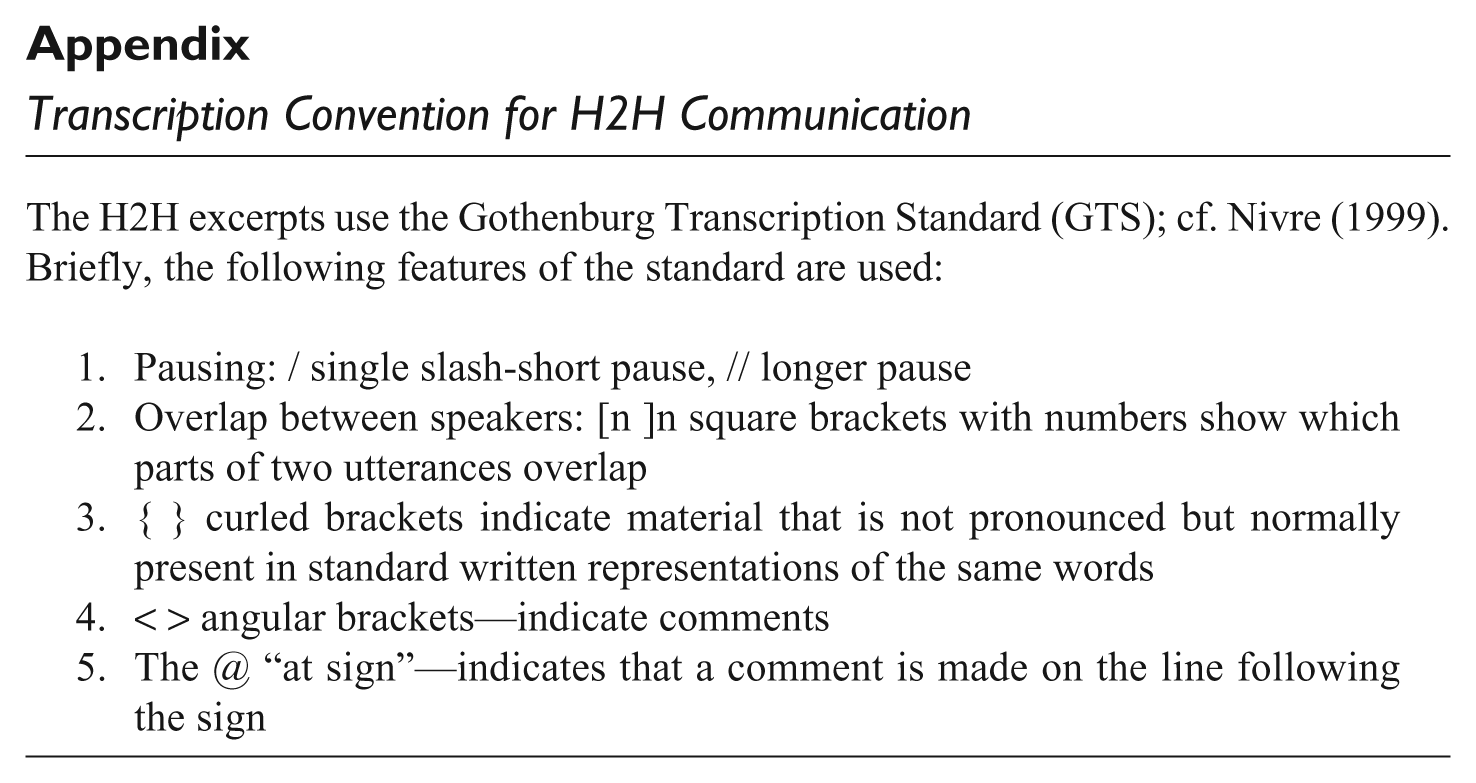
Appendix
Transcription Convention for H2H Communication
| The H2H excerpts use the Gothenburg Transcription Standard (GTS); cf. Nivre (1999). Briefly, the following features of the standard are used: |
|
Pausing: / single slash-short pause, // longer pause Overlap between speakers: [n ]n square brackets with numbers show which parts of two utterances overlap { } curled brackets indicate material that is not pronounced but normally present in standard written representations of the same words < > angular brackets—indicate comments The @ “at sign”—indicates that a comment is made on the line following the sign |
Declaration of Conflicting Interests
The author(s) declared no potential conflicts of interest with respect to the research, authorship, and/or publication of this article.
Funding
The author(s) received no financial support for the research, authorship, and/or publication of this article.