






Abstract

Sponge-Forming Liquid Silicone Rubber Composition and Silicone Rubber Sponge
Inventor(s): Endo, S., Toyama, T., and Nozoe, T.
Sources: US Pat.: 11,034,815
Corporate/Assignee: Dow Toray Co. Ltd.
A sponge-forming liquid silicone rubber composition is provided. The composition generally maintains a stable emulsified state, can form a low-density silicone rubber sponge having a uniform and fine open-cell foam structure even when a coating or molding method involving shearing force and thin layer formation is used, is less likely to contract during curing, and that forms a silicone rubber sponge having a density close to the density designed on the basis of water content. A low-density silicone rubber sponge material using the sponge-forming liquid silicone rubber composition is also provided. The sponge-forming liquid silicone rubber composition comprises (A) an alkenyl group-containing organopolysiloxane, (B) an organopolysiloxane having a silicon atom-bonded hydrogen atom, (C) a mixture of water and an inorganic thickener, (D) an emulsifier, and (E) a hydrosilylation reaction catalyst. The contained amount of the component (C) in the entire composition is 70 mass % or more.
Auxetic Expansion Joint Seal
Inventor(s): Robinson, S. R.
Sources: US Pat.: 11,028,577
Corporate/Assignee: Schul International Co., LLC
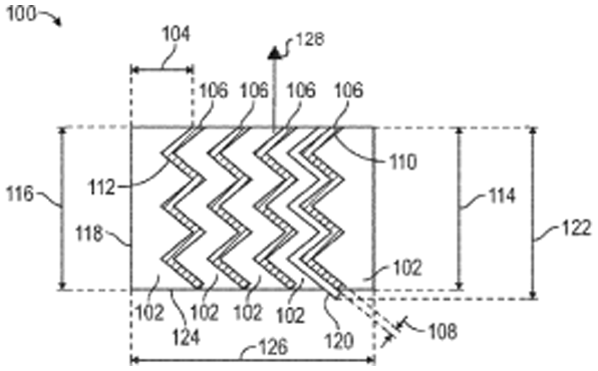
The present disclosure relates generally to systems for providing a durable water-resistant and fire-resistant foam-based seal in the joint between adjacent panels. A fire-resistant and water-resistant expansion joint seal is provided which includes one or more foam members and a plurality of intumescent members interspersed within the foam member or members to provide a spring recovery force and fire resistance.
Method for Forming a Mold Tool for Poured Foam Parts
Inventor(s): Gearhart, D., Rudzewicz, B., and Kipke, T.
Sources: US Pat. App.: 20210187793
Corporate/Assignee: RCO Engineering Inc.
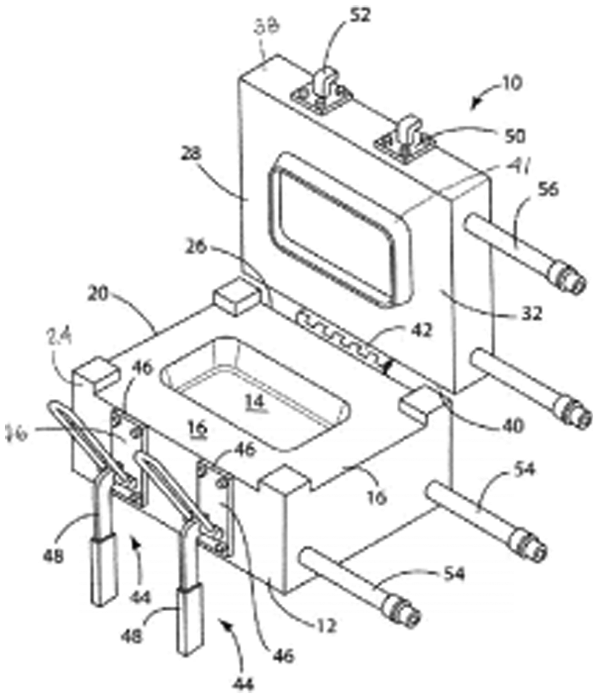
A method of manufacturing a mold tool for manufacturing poured foam parts wherein the mold tool includes lower and upper molds and the method includes 3D printing a composite mold to form a mold cavity for forming the poured foam parts. The 3D printing of lower and/or upper molds decreases the time and expense required for producing a mold tool whether for prototype or full production foam parts.
Aerogel Composite Material, and Production Method Thereof
Inventor(s): Tada, R. and Ota, H.
Sources: Jap. Pat.: 2021-036038
Corporate/Assignee: Inoac Gijutsu Kenkyusho: KK
PROBLEM TO BE SOLVED: To provide an aerogel composite material having less powder dust and high thermal insulation performance while being flexible, and a production method thereof.
SOLUTION: An aerogel composite material includes a foam substrate that is a foam body having open cells and an aerogel packed in the foam substrate. The aerogel composite material has a density of 0.05-0.40 g/cm3. The foam substrate has a density of 0.015-0.20 g/cm3 and an air permeability of 0.5-300 (cm3/cm2/sec). The foam substrate is melamine foam, polyimide foam or thermal compression molded polyurethane foam.
Resin Foam Production Method, Resin Foam and Heat Insulator
Inventor(s): Yoda, S. and Otake, K.
Sources: Jap. Pat.: 2021-031592
Corporate/Assignee: National Inst. Of Advanced Industrial Science and Technology Tokyo Univ. of Science
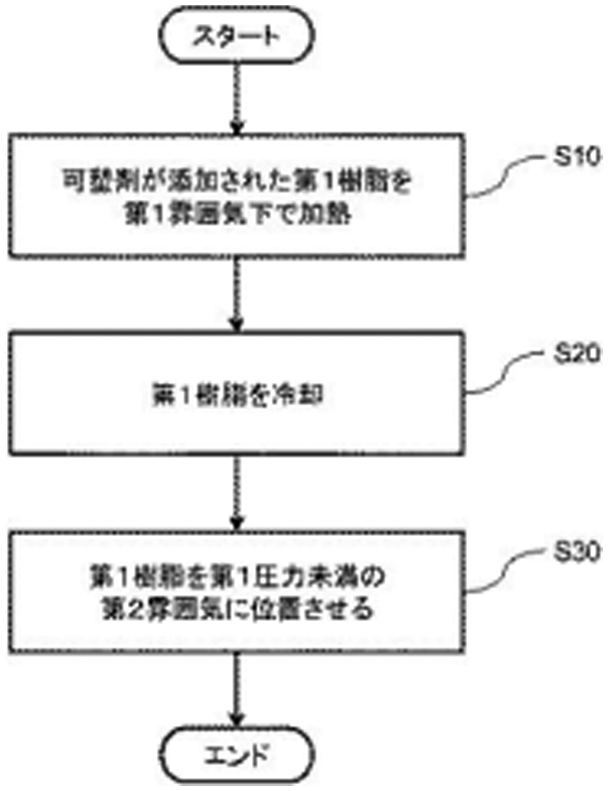
PROBLEM TO BE SOLVED: To efficiently produce a resin foam containing a plasticizer.
SOLUTION: In a step S10, a first resin to which a plasticizer is added is heated in a first atmosphere containing a first gas. The first resin is cured, for example, gelled by heating. A step S30 is performed after the step S10. In the step S30, the first resin is positioned in a second atmosphere in which the partial pressure of the first gas is less than the first pressure. As a result, a part of the first gas dissolved in the plasticizer is separated from the plasticizer. In the step S10, the first resin is cured to the extent where the resin is foamed by the first gas separated from the plasticizer. Therefore, by the treatment in step S30, the first resin is foamed by the separated first gas, and the volume of the first resin is expanded. It is preferable that a cooling step (step S20) is performed between a heating step (step S10) and a depressurizing step (step S30).
Compositions Comprising a Fluoroolefin
Inventor(s): Minor, B. H. and Rao, V. N. M.
Sources: US Pat.: 11,046,875
Corporate/Assignee: The Chemours Co. FC, LLC
The present invention relates to compositions for use in refrigeration, air-conditioning, and heat pump systems wherein the composition comprises a fluoroolefin and at least one other component. The compositions of the present invention are useful in processes for producing cooling or heat, as heat transfer fluids, foam blowing agents, aerosol propellants, and fire suppression and fire extinguishing agents.
Process and Intermediates for Preparing (E)-1,1,1,4,4,4-Hexafluorobut-2-Ene
Inventor(s): Peng, S. and Petrov, V. A.
Sources: US Pat. App.: 20210188743
Corporate/Assignee: The Chemours Co. FC, LLC
The present application provides processes and intermediates for preparing (E)-1,1,1,4,4,4-hexafluoro-2-butene and compositions which may be useful in applications including refrigerants, high-temperature heat pumps, organic Rankine cycles, as fire extinguishing/fire suppression agents, propellants, foam blowing agents, solvents, and/or cleaning fluids.
Method for Producing Foam, and Foam
Inventor(s): Takasa, M. and Chinsoga, T.
Sources: Jap. Pat.: 2021-038313
Corporate/Assignee: AGC Inc.
PROBLEM TO BE SOLVED: To provide a method for producing a foam that makes it possible to produce a foam of thermoplastic resin having excellent heat insulating performance.
SOLUTION: A method for producing a foam produces a foam by foaming thermoplastic resin with a foaming agent containing 1-chloro-2,3,3,3-tetrafluoropropene.
Composite Materials
Inventor(s): Le Gall, E., Ostrowsky, F., and Souvay, D.
Sources: US Pat.: 11,046,042
Corporate/Assignee: Zephyros, Inc.
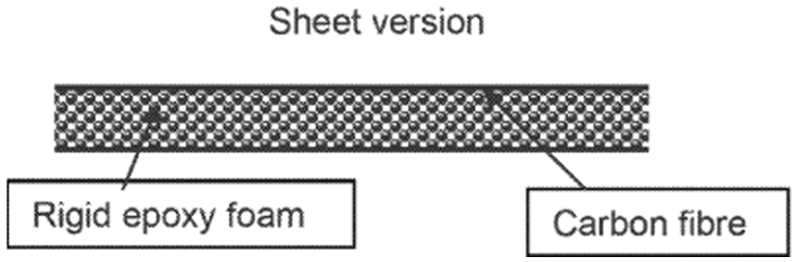
Light weight composites with high flexural strength comprise epoxy foam sandwiched between two layers of facing material have high strength and low weight and can be used to replace steel structures. The facing layer may be fibrous material especially glass or carbon fibres, the facing material is preferably embedded into the epoxy matrix. Alternatively they may be matching box structures or concentric metal tubes. The sandwich structures may be prepared by laying up the fibre; coating and/or impregnating the layer with epoxy resin, laying a layer of heat activatable foamable epoxy material, providing a further layer of the fibrous material optionally coated and/or impregnated with epoxy resin on the foamable material ad heating to foam and cure the epoxy materials. Alternatively they may be formed by extrusion of the foamable material between the surface layers.
Fabric-Like Material for Reinforcement in Urethane Foam Molding, and Method for Producing Urethane Foam Molded Body Utilizing Same
Inventor(s): Murata, Y., Inuzuka, K., Iwasawa, T., Hara, K., and Senaga, T.
Sources: US Pat.: 11,045,983
Corporate/Assignee: Toyota Boshoku Kabushiki Kaisha, Mold Technical Office Co. Ltd., Toyo Ink SC Holdings Co. Ltd., Toyo ADL Corp., and Toyochem Co. Ltd.
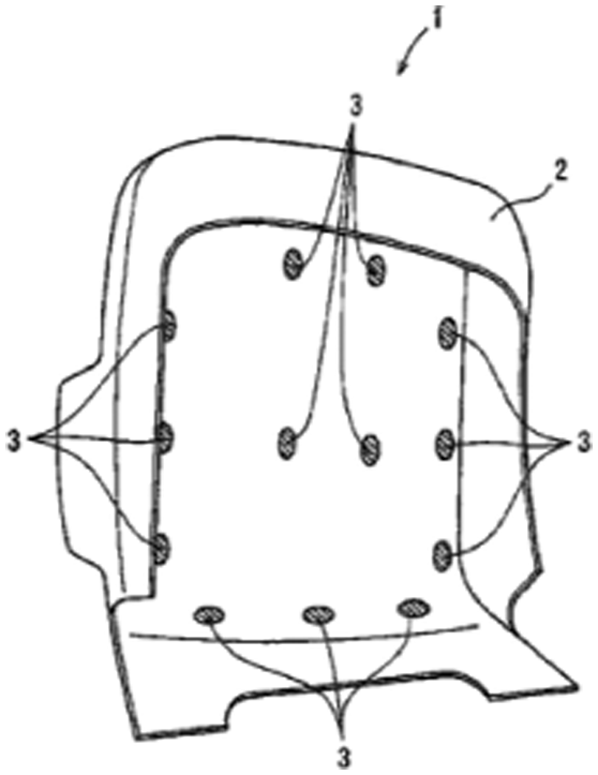
A fabric-like material for reinforcement in an urethane foam molding is obtained by impregnating a part of a surface of a nonwoven fabric of organic fibers with a hot melt magnetic material and immobilizing the hot melt magnetic material. The hot melt magnetic material satisfies compositions described below and has a softening point of 70 to 100.degree. C. Ethylene-vinyl acetate copolymer (A): 10 to 95% by mass. Wax (B): 0 to 30% by mass. Magnetic powder (C): 5 to 70% by mass. (The total of (A), (B) and (C) is 100% by mass.).
Blow-Molded Foam
Inventor(s): Onodera, M., Sumi, T., Tamada, T., Igarashi, Y., and Ohno, Y.
Sources: US Pat.: 11,045,982
Corporate/Assignee: Kyoraku Co. Ltd.
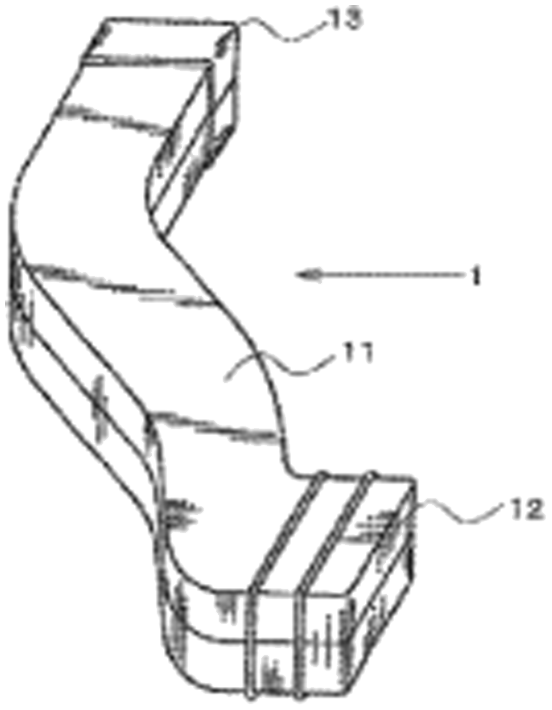
An object of the invention is to provide a blow-molded foam which has homogeneous foamed cells in size, is light in weight, and is excellent in surface smoothness, and a process for producing the same. The invention is directed to a blow-molded foam 1 having a wall portion formed in such a manner that a thermoplastic resin containing a foaming agent mixed therewith is subjected to blow molding. Herein, the wall portion has a closed cell structure in which a plurality of foamed cells are contained. The wall portion has an expansion ratio of not less than 2.0 times. The wall portion has an outer face having a center-line average surface roughness Ra of less than 9.0 .mu.m. The foamed cell has a cell diameter having a standard deviation of less than 40 .mu.m in a thickness direction of the wall portion.
Foam Compositions and Uses Thereof
Inventor(s): Baghdadi, H. A.
Sources: US Pat.: 11,034,813
Corporate/Assignee: Nike, Inc.
A variety of foams and foam components are provided, including foam components for articles of footwear and athletic equipment. The articles include a composition having a foam structure, wherein the composition includes a thermoplastic copolyester elastomer comprising: (a) a plurality of first segments, each first segment derived from a dihydroxy-terminated polydiol; (b) a plurality of second segments, each second segment derived from a diol; and (c) a plurality of third segments, each third segment derived from an aromatic dicarboxylic acid. Methods of making the compositions and foams are provided, as well as methods of making an article of footwear including at least one of the foam components. In some aspects, the foams and foam components can be made by extrusion or injection molding to foam the polymeric composition, or extrusion or injection molding to foam the polymeric composition followed by compression molding of the foam.
Process for Producing Foam Molded Parts with Aesthetic Surfaces by Foam Injection Molding
Inventor(s): Raithel, B., Nissner, N., Bernhardt, A., Roettel, S., Juan, P., and Pope, A.
Sources: US Pat.: 11,027,466
Corporate/Assignee: Ineos Styrolution Group GmbH
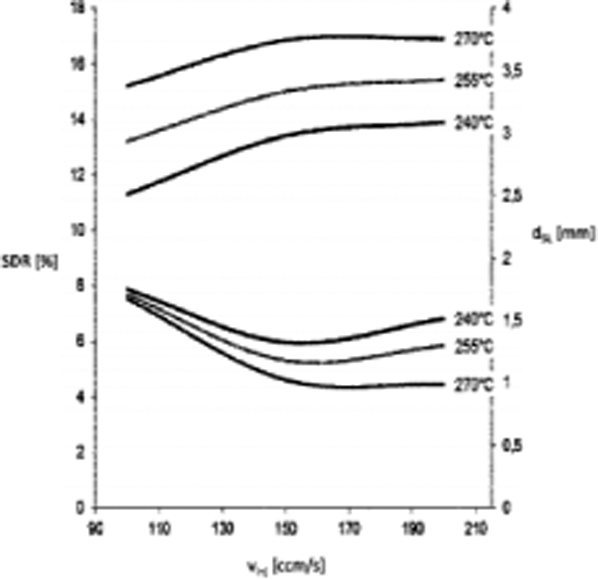
The invention relates to a process for producing a foam molded part, wherein a foamable material S comprising a thermoplastic polymer matrix M and at least one foaming agent F is foamed by foam injection molding. The polymer matrix M is preferably based on at least one thermoplastic styrene copolymer, such as ABS and ASA, and wherein the at least one foaming agent F is selected from chemical foaming agents, releasing carbon dioxide, and physical foaming agents, being carbon dioxide or nitrogen.
Polymer Foam Articles and Methods of Making Polymer Foams
Inventor(s): Minnich, J. L., Biggs, T. J., and Rhoades, A. M.
Sources: US Pat.: 11,021,587
Corporate/Assignee: Moxietec, LLC
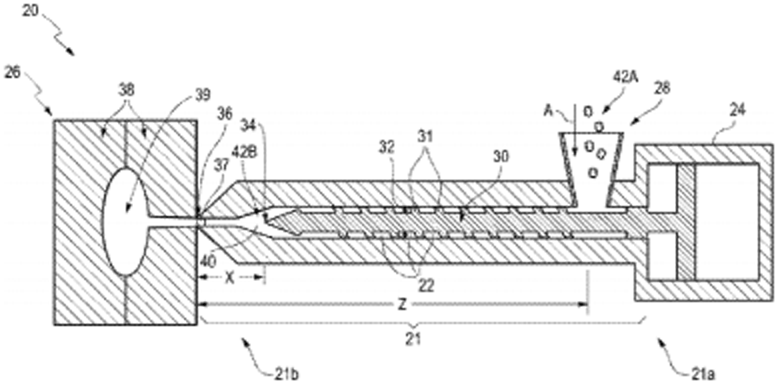
Molded polymer foam articles are described as having a novel a foam structure. The polymer foam articles include a continuous polymer matrix defining a plurality of pneumatoceles therein which is present throughout the entirety of the article, including in the surface region extending 500 microns beneath the surface of the article. The surface region is further characterized as having compressed pneumatoceles. The novel foam structure is achieved even when molding polymer foam articles comprising a thickness of more than 2 cm, a volume of more than 1000 cm.sup.3; or both a volume of more than 1000 cm.sup.3 and a thickness of more than 2 cm. Methods of making the molded polymer foam articles are also described.
Composite Structure
Inventor(s): Klumb, G. A., Aou, K., Shah, V. K., and Kiszka, K. F.
Sources: US Pat. App. 20210189055
Corporate/Assignee: Dow Global Technologies LLC
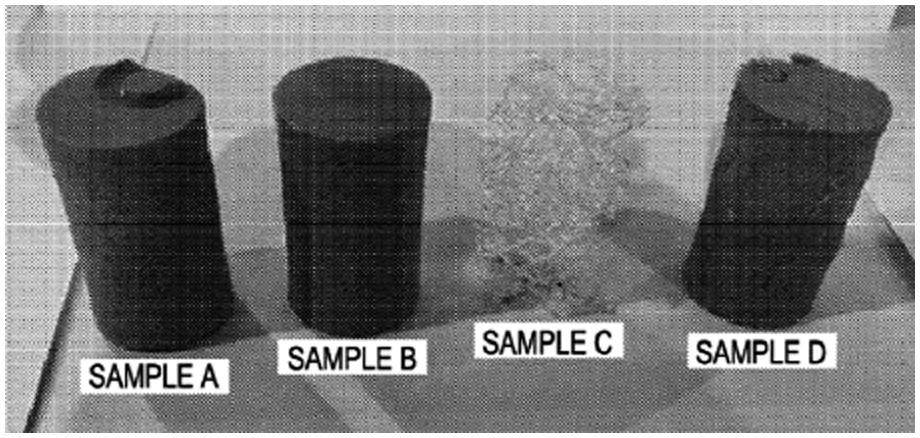
A composite structure including (a) a three-dimensional random loop material comprising a plurality of random loops arranged in a three-dimensional orientation formed from a polyolefin polymer; and (b) a polyurethane foam in contact with substantially all of the surfaces of the three-dimensional random loop material; wherein the polyurethane foam can be the reaction product of (a) an isocyanate component; and (b) an isocyanate-reactive component; and a method of making the above polyurethane foam and three-dimensional random loop composite structure.
Foam Fabric
Inventor(s): Lung, A.
Sources: US Pat. App. 20210187800
Corporate/Assignee: Taikone Technologies Inc.
The present invention is related to a foam fabric and method of making it.
Foam
Inventor(s): Taniyama, T. and Iga, T.
Sources: US Pat. App. 20210179801
Corporate/Assignee: Zeon Corp.
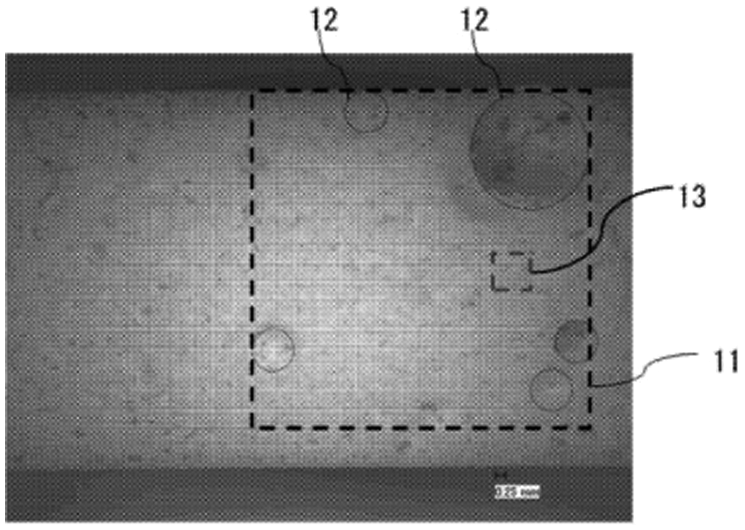
A foam containing a nitrile group-containing conjugated diene copolymer and a urethane polymer, wherein relative to 100 wt % of the sum of the nitrile group-containing conjugated diene copolymer and the urethane polymer, the nitrile group-containing conjugated diene copolymer is present in an amount of less than 90 wt % and the urethane polymer is present in an amount of more than 10 wt %, the nitrile group-containing conjugated diene copolymer contains ethylenically unsaturated nitrile monomer units in an amount of more than 31 wt %, the foam has a density of 0.08 to 0.30 g/cm.sup.3, and in observation of an arbitrary cross section of the foam, air bubble cross sections present in the cross section have an average diameter of 350 .mu.m or less, and the number of air bubble cross sections with a diameter of 0.6 mm or more present in the cross section is 0.062 per mm.sup.2 or less.
Syntactic Foam Radome Structure
Inventor(s): Ziolkowski, F. P.
Sources: US Pat. App. 20210175616
Corporate/Assignee: CPI Radant Technologies Division, Inc.
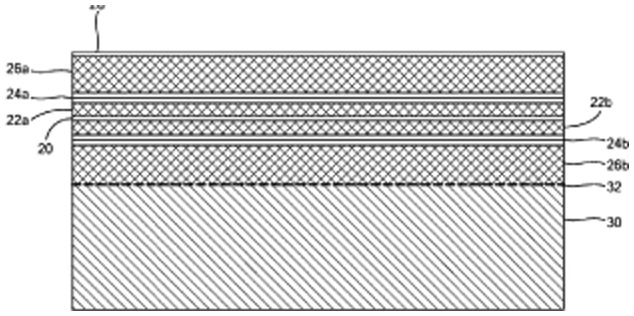
A radome wall structure includes one or more laminate plies, a first syntactic foam layer on one side of the one or more laminate plies, and a second syntactic foam layer on the other side of the one or more laminate plies. One or more laminate plies are between a third outer syntactic foam layer and the first syntactic foam layer and one or more laminate plies are between a fourth inner syntactic foam layer and the second syntactic foam layer. An interior matching layer is adhered to the fourth inner syntactic foam layer.
System Optimization Using Compressed Reticulated Foam Structures
Inventor(s): Hall, M., Schaffarzick, D., and Benson, M.
Sources: US Pat. App. 20210164072
Corporate/Assignee: ERG Aerospace Corp.
Heterogeneously dense (relative density) continuous one-piece insoluble reticulated foam material with a continuous relative density gradient and/or distinct and marked relative densities and methods of manufacture.
Crosslinked Polyolefin Foam Having Large Core Cells
Inventor(s): Shimura, K. and Gray, G. L.
Sources: US Pat. App. 20210163701
Corporate/Assignee: Sekisui Voltek, LLC
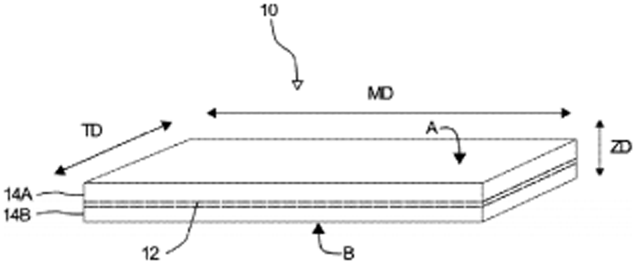
A closed cell crosslinked polyolefin foam sheet comprises an opposing first surface region and second surface region, and an intermediate region disposed therebetween, wherein the intermediate region is configured to have a gel content lower than an average gel content of the first surface region and the second surface region to enable a controlled tear propagation within the intermediate region when a splitting force is applied to the closed cell crosslinked polyolefin foam sheet. For example, a ratio of a gel content of the intermediate region versus an average gel content of the first surface region and the second surface region may be about 75% or less, and a ratio of the average cell size of the intermediate region versus an average cell size of the first surface region and the second surface region may be about 125% or higher.
Low Density Fluoropolymer Foam
Inventor(s): Zerafati, S. and Partridge, R. H.
Sources: US Pat. App. 20210163704
Corporate/Assignee: Arkema Inc.
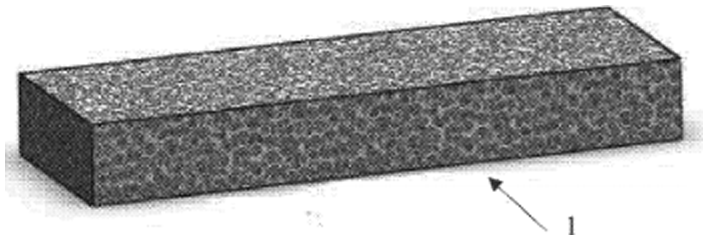
The invention relates to low density fluoropolymer foam, and preferably polyvinylidene fluoride (PVDF) foam, such as that made with KYNAR PVDF resins, and articles made of the foam. The foam is produced by adding microspheres containing blowing agents to the polymer and processing it through an extruder. The microspheres consist of a hard shell containing a physical blowing agent. The shell softens at elevated temperatures and allows the expansion of the blowing agent, and microsphere to create larger voids within the polymer matrix. By proper control of the polymer composition, viscosity, processing temperature, blowing agent selection, loading ratio, and finishing conditions, useful articles such as foamed PVDF pipe, tube, profiles, film, wire jacketing and other articles can be produced. The microspheres may be added to the fluoropolymer matrix by several means, including as part of a masterbatch with a compatible polymer carrier.
Electromagnetic Wave Shield Material
Inventor(s): Matsumura, T. and Suenaga, Y.
Sources: JP Pat.: 2021-048346
Corporate/Assignee: Sekisui Techo Seikei KK
PROBLEM TO BE SOLVED: To provide an electromagnetic wave shield material having excellent electromagnetic wave shielding properties.
SOLUTION: An electromagnetic wave shield material according to the present invention is an effervescent molded product made of a resin composition including a thermoplastic resin and a conductive filler, and electromagnetic wave shielding at frequencies 1 GHz and 15 GHz is 20 dB or more, and a large number of bubbles formed by foaming are present in the effervescent molded product, and presence of a large number of bubbles allows many conductive fillers to be brought into contact with each other to form a conduction path in the effervescent molded product, and to impart excellent conductivity and electromagnetic wave shielding to the effervescent molded product. By using such an effervescent molded product, it is possible to provide an electromagnetic wave shield material having excellent electromagnetic wave shielding.
Conductive Roller, Manufacturing Method Therefor, Transfer Device, Process Cartridge, and Image Forming Device
Inventor(s): Rokutan, M. and Shingu, K.
Sources: JP Pat.: 2021-047294
Corporate/Assignee: Fuji Xerox Co. Ltd.
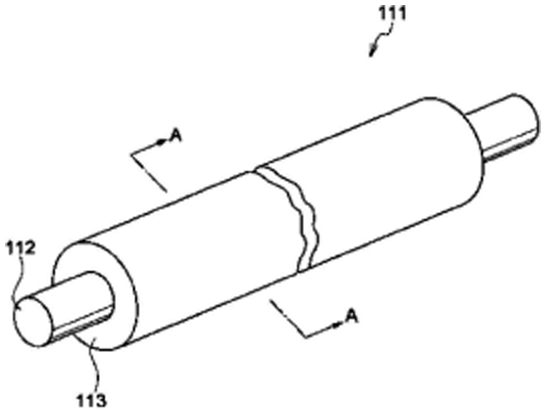
PROBLEM TO BE SOLVED: To provide a conductive roller which comprises a conductive elastic foam layer as the outermost layer and is less likely to cause abnormal discharge between itself and an opposing member when a voltage is applied.
SOLUTION: A conductive roller is provided, comprising a support member and a conductive elastic foam layer disposed on the support member. In spectra of period (μm) and amplitude (μm) obtained by fast Fourier transforming a rugged waveform in an axial direction of an outer peripheral surface of the conductive elastic foam layer, an integrated value St of the amplitude in a period range of 100 to 300 μm, inclusive, is 455 μm or less.
Laminate Sheet and Manufacturing Method of the Same
Inventor(s): Nagasawa, T. and Kikuchi, A.
Sources: JP Pat.: 2021-045971
Corporate/Assignee: Inoac Gijutsu Kenkyusho: KK
PROBLEM TO BE SOLVED: To provide a manufacturing method of a laminate sheet capable of easily solving air accumulation, having viscosity strength, capable of repeated use and laminating on a surface treated glass and hardly generating heat crack even laminated to an indoor face.
SOLUTION: There is provided a manufacturing method of a laminate sheet having a porous foam layer and a low shrinkage degree layer arranged on a single surface side of the porous foam layer and having lower shrinkage degree than that of the porous foam layer, including a processes of foaming an emulsion composition containing emulsion and a frother by using a mechanical froth method to form an expanded body and curing the expanded body, where the emulsion composition made by mixing an acrylic emulsion, ethylene vinyl acetate copolymer resin emulsion and urethane emulsion of 0 wt.% or more and less than 30 wt.% based on total amount of the emulsion and the porous foam layer has self adhesiveness.
Polypropylene Based Resin Multilayer Foam Sheet
Inventor(s): Umemori, M., Ichino, K., Yaso, Y., and Hotta, Y.
Sources: JP Pat.: 2021-045959
Corporate/Assignee: Japan Polypropylene Corp.
PROBLEM TO BE SOLVED: To provide a polypropylene based resin multilayer foam sheet for obtaining a polypropylene based resin multilayer foam having uniform fine foam cells and allowing a molding to have a good appearance.
SOLUTION: A polypropylene based resin multilayer foam sheet comprises: a foam layer comprising a foaming polypropylene based resin composition; a PP filler layer containing an inorganic filler; and a surface layer comprising a thermoplastic resin composition. The foaming polypropylene based resin composition contains, in specific proportions, a foaming agent and a polypropylene based resin composition that contains, in specific proportions, a crystallization nucleating agent (K) and a polypropylene based resin mixture. The polypropylene based resin mixture contains, in specific proportions: a polypropylene resin (X) having a specific long chain branching structure; a propylene-based block copolymer (Y), which is a multistage polymer comprising a specific propylene (co)polymer (Y-1) and a specific propylene-ethylene copolymer (Y-2); and a specific propylene-α-olefin random copolymer (Z).
Foamable Colored Resin Particle, Method for Producing the Same and Foam Particle Molding
Inventor(s): Komiyama, Y. and Shima, M.
Sources: JP Pat.: 2021-042346
Corporate/Assignee: JSP Corp.
PROBLEM TO BE SOLVED: To provide a foamable colored resin particle that shows a blue color and can inhibit the occurrence of a decomposition product of a coloring agent to cause an odor, a method for producing the same and a foam particle molding.
SOLUTION: A foamable colored resin particle has a base resin containing a polystyrene resin, a coloring agent containing a green dye and a violet dye, and a foaming agent. The content of the coloring agent is 0.05 pt.mass or more and 0.30 pt.mass or less with respect to the base resin 100 pts.mass. The ratio of the violet dye content to the green dye content is 0.2 or more and 2.0 or less.
Multilayered Polymeric Film
Inventor(s): Carroll, L., McManus, M., Nevins, D., Davis, D., Mickey, T., and Brownfield, D.
Sources: JP Pat.: 2021-041706
Corporate/Assignee: Ampacet Corp.
PROBLEM TO BE SOLVED: To provide a multilayered polymeric film having a visual effect.
SOLUTION: The present disclosure provides a multilayered polymeric film comprising first polymeric layer comprising a foaming agent and a second layer comprising a polymeric resin and a special effect agent, wherein the special effect agent reflects through the first layer to create a multi-dimensional, textured color effect and wherein the foaming agent of the first layer is on the side of the first layer opposite the second layer side.
Resin Foam Sheet and Method for Producing the Same
Inventor(s): Shimura, S., Okumura, N., and Kobayashi, M.
Sources: JP Pat.: 2021-038375
Corporate/Assignee: Inoac Corp.
PROBLEM TO BE SOLVED: To provide a resin foam sheet which enables high foam molding, has good appearance and high mechanical characteristics such as elastic modulus, extensibility and peel strength while having flexibility, and is low in manufacturing cost.
SOLUTION: A resin foam sheet is obtained by foaming a resin composition containing a polyolefin resin, a copolymer and a polymer (A) including a structure of the following formula 1, in which the resin foam sheet has a gel fraction measured according to JISK6796:1998 of 10-45 mass%. (Formula 1) R1-Si-O-R2. In formula 1, R1 is a group having a hydrocarbon group including a repeated structure, and R2 is an alkyl group or a group having a structure of the following formula 2. (Formula 2) -Si-R3. R3 in Formula 2 has a group having a hydrocarbon skeleton including a repeated structure.
Silicone-Based Resin Foam and Method for Producing Silicone-Based Resin Foam
Inventor(s): Takahashi, A. and Yano, T.
Sources: JP Pat.: 2021-031640
Corporate/Assignee: Inoac Corp.
PROBLEM TO BE SOLVED: To provide a novel silicone-based resin foam which, while having properties of a silicone-based resin, has excellent appearance, is flexible, has good distortion recoverability, and contains a skeleton other than a siloxane bond and a silazane bond, and to provide a method for producing a silicone-based resin foam which enables easy designing and production of a silicone-based resin foam which satisfies required various physical properties.
SOLUTION: Provided is a silicone-based resin foam obtained by foaming a silicone-based resin composition. The silicone-based resin composition comprises a compound (A) having a plurality of alkoxysilane groups at a terminal, a compound (B) having a plurality of silanol groups at a terminal, and a compound (C) having a plurality of functional groups including an active hydrogen at a terminal.
Foam Particle, Foam Molded Article and Composite Structural Member
Inventor(s): Kuwabara, Y.
Sources: JP Pat.: 2021-031623
Corporate/Assignee: Sekisui Plastics Co. Ltd.
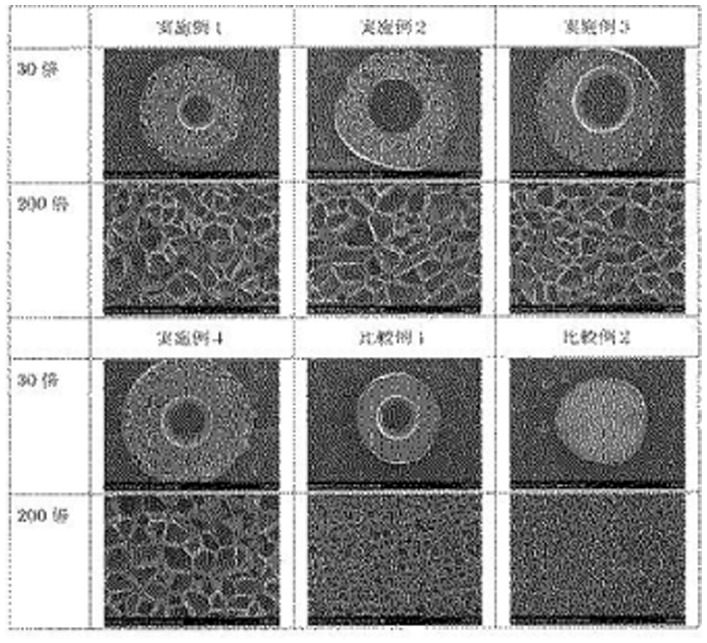
PROBLEM TO BE SOLVED: To provide a foam particle having both high foamability and mechanical properties.
SOLUTION: The foam particle is composed of a base resin containing a polycarbonate resin having a glass transition temperature of 140 to 155°C and an amorphous polyester resin having a glass transition temperature of 100 to 130°C. The amorphous polyester resin contains a unit derived from a cyclic diol. In a cross-sectional photograph taken in an area of 11.9 mm2 at a magnification of 30 times, the foam particle includes small bubbles having a bubble diameter of 50 μm or more and less than 300 μm and large bubbles having a bubble diameter of 300 μm or more and 2 mm or less.
Molded Foam and Production Method Therefor
Inventor(s): Nomura, S. and Ishikawa, K.
Sources: JP Pat.: 2021-031586
Corporate/Assignee: Kureha Corp.
PROBLEM TO BE SOLVED: To provide a molded foam that can easily achieve weight reduction by foaming and its control.
SOLUTION: The molded foam has a matrix composed of a fluororesin composition comprising a thermoplastic fluororesin as a main component, and a plurality of cells present in the matrix. The thermoplastic fluororesin has a melting point of 165-200°C, and the cells are closed cells, which have a size of 50-200 μm in terms of volume-based median diameter.
Method for Producing Colored Foamed Particle of Polypropylene-Based Resin, Colored Foamed Particle of Polypropylene-Based Resin, and Molded Article of Colored Foamed Particle of Polypropylene-Based Resin
Inventor(s): Sakamura, T. and Ota, H.
Sources: JP Pat.: 2021-031540
Corporate/Assignee: JSP Corp.
PROBLEM TO BE SOLVED: To obtain chromatic foamed particles capable of easily obtaining molded article of chromatic foamed particle which are brightly colored and have suppressed color unevenness by in-mold molding.
SOLUTION: A method for producing a colored foamed particle of polypropylene-based resin according to the invention comprises: melting and kneading a colored master batch containing chromatic pigments, a foam regulator, and polypropylene-based resin to produce colored resin particles; and foaming the colored resin particles to produce colored foamed particles by a so-called dispersion medium discharging expansion method. Concentrations of the chromatic pigments in the colored master batch is specified, and a ratio of a melt flow rate (II) of the colored master batch to a melt flow rate (I) of the polypropylene-based resin (A) is within a specific range.
Foam Molding Body and Manufacturing Method Thereof
Inventor(s): Ono, Y.
Sources: JP Pat.: 2021-030664
Corporate/Assignee: Kyoraku Co. Ltd.
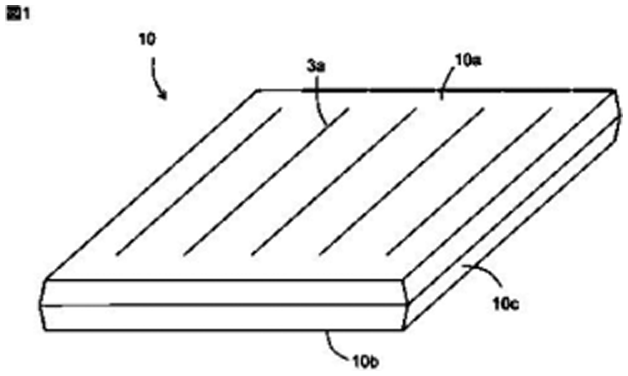
PROBLEM TO BE SOLVED: To provide a foam molding body with excellent mechanical strength.
SOLUTION: According to the present invention, there is provided a foam molding body having a base wall and an opposing wall separated from each other, the foam molding body having inner ribs between the base wall and the opposing wall, the inner ribs extending from the base wall to the opposing wall and the tip of the inner ribs being welded to the opposing wall.
Fiber-Reinforced Resin Composite Molding and Method for Manufacturing the Same
Inventor(s): Oyabu, A and Tanabe, N.
Sources: JP Pat.: 2021-030616
Corporate/Assignee: Inoac Corp.
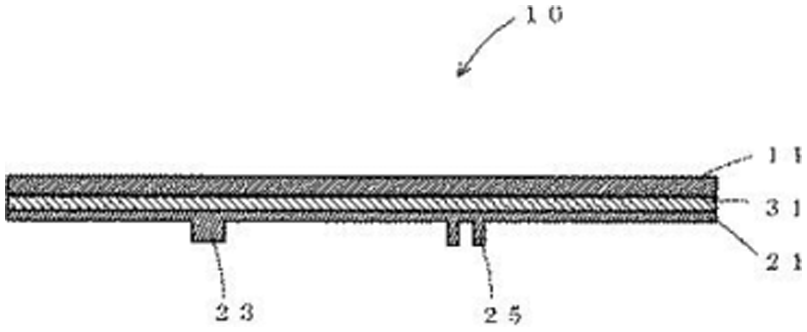
PROBLEM TO BE SOLVED: To provide a fiber-reinforced resin composite molding which has no disorder of fibers nor voids even in a complicated shape and has good appearance.
SOLUTION: A fiber-reinforced resin composite molding 10 is composed of a surface layer part 11 formed of a fiber-reinforced resin material for surface layer part formation, a base layer part 21 formed of a compound for base layer part formation and an intermediate layer part 31 formed of a thermosetting resin foam sheet of an open-cell structure arranged between the surface layer part and the base layer part, in which the surface layer part, the base layer part and the intermediate layer part are cured by heat compression and integrated with each other in the state where the fiber-reinforced resin material for surface layer part formation and the compound for base layer part formation are stacked so as to sandwich the thermosetting resin foam sheet of the open-cell structure.
Hemorrhage Management System
Inventor(s): Maitland, D. J., Landsman, T. L., Touchet, T. J., Cosgriff-Hernandez, E. L., Wilson, T. S.
Sources: US Pat.: 11,020,507
Corporate/Assignee: Lawrence Livermore National Security, LLC and The Texas A&M University System
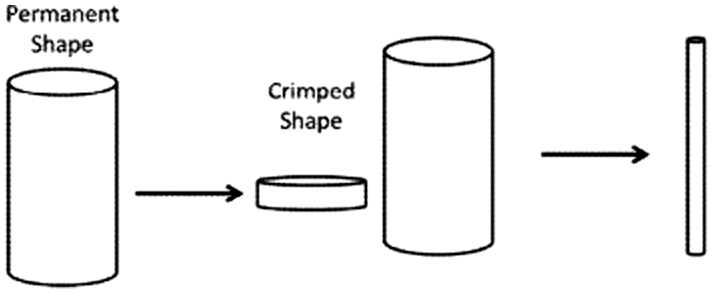
An embodiment includes a wound dressing comprising: a shape memory polymer (SMP) foam, including open cells, having first and second states; and a hydrogel (HG) included within the cells; wherein (a) in a first position a composite, including the SMP foam and the HG, is configured to be located proximate a hemorrhagic tissue with the SMP foam in the first state; (b) in a second position the composite is configured to be expanded to the second state against the hemorrhagic tissue when the SMP foam is plasticized at 37.degree. C. depressing a glass transition temperature (T.sub.g) of the SMP foam to below 25.degree. C. Other embodiments are described herein.
Noise Muffler for an air Moving Device
Inventor(s): Jasteh, S. and Simard, W.
Sources: US Pat. App. 20210189927
Corporate/Assignee: Rheem Manufacturing Co.
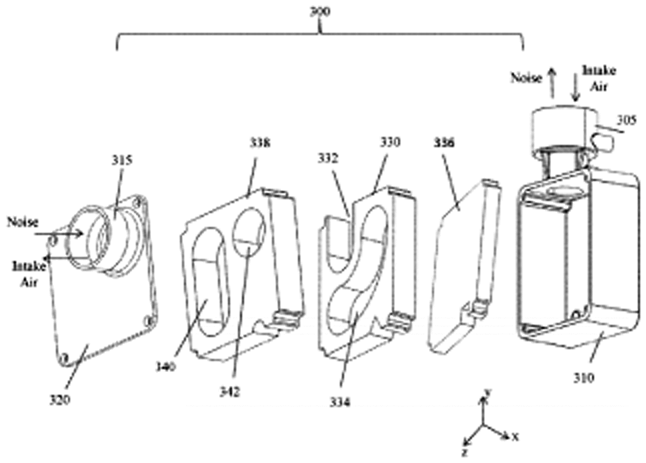
A noise muffler for an air moving device can include a housing with a housing inlet, a housing outlet, and at least a first foam component and a second foam component. The first foam component and the second foam component are placed within a cavity of the housing and define an air passageway. The first foam component and the second foam component redirect air flow through the cavity in three dimensions in order to muffle noise generated by the air moving device.
Components for Articles and Methods of Making Components from Embroidered Beads
Inventor(s): Luedecke, T.
Sources: US Pat. App. 20210186149
Corporate/Assignee: Under Armour, Inc.
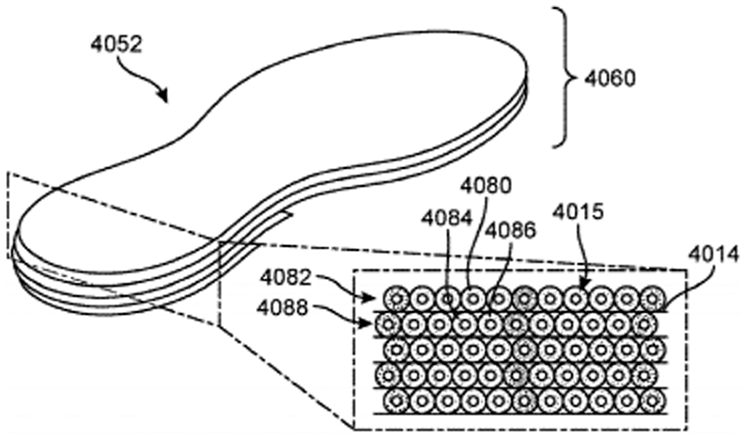
Beads may be stitched to a substrate layer and then fused to form structures including foam midsoles, foam pads, and other foam structures. Beads may be embroidered to multiple substrate layers and then folded or stacked together to form a preform used in a mold to form a midsole.
Method of Manufacturing fir Eresistant Coaxial Cable for Distributed Antenna Systems
Inventor(s): Rogers, W. E.
Sources: US Pat. App. 20210183539
Corporate/Assignee: American Fire Wire, Inc.
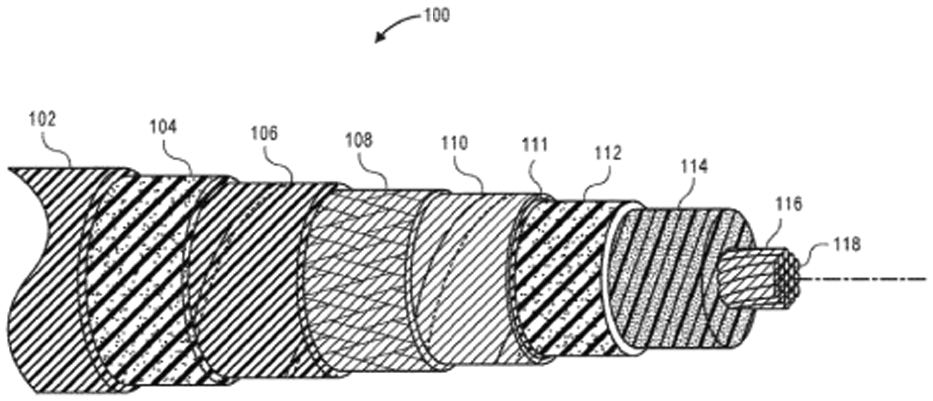
A fire resistant coaxial cable and method of making is described that has a 2-part dielectric made of a polymer foam and a ceramifiable silicone rubber. The polymer foam, which can be polypropylene or other polymers, leaves little-to-no residue in the cable that causes electromagnetic loss when upon burning. The polymer foam can be extruded over a center conductor using an inert gas, such as nitrogen, to propagate the foam, ensuring little-to-no residue in the cable. The ceramifiable silicone rubber can be extruded over the polymer foam. The ceramifiable silicone rubber can have a polysiloxane matrix with inorganic flux and refractory particles that ceramify under high heat, such as temperatures specified by common fire test standards (e.g., 1850.degree. F./1010.degree. C. for two hours). The cable is configured to maintain a relatively coaxial relation between a center conductor and an outer conductor even under aforementioned fire tests. Another layer of ceramifiable silicone rubber surrounds the outer conductor and continues to insulate it from the outside if a low-smoke zero-halogen (LSZH) jacket burns away.
Footwear Articles and Methods for Preparing a Footwear Article
Inventor(s): Bellali, S., Wang, L., and Song, H.
Sources: US Pat. App. 20210177104
Corporate/Assignee: Vans, Inc.
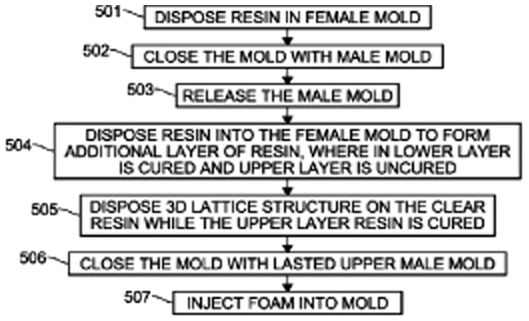
Methods for preparing a footwear article are disclosed herein. An example method may comprise disposing resin adjacent a mold, disposing a lattice structure in at least a portion of the resin disposed adjacent the mold, closing the mold using a lasted upper, injecting foam into the closed mold such that the foam operates to couple the lasted upper and the lattice structure together.
Method for Assessing the Long-Term Thermal Resistance of Closed-Cell Thermal Insulating Foams at Multiple Mean Temperatures
Inventor(s): Owens, S. G.
Sources: US Pat. App. 20210172893
Corporate/Assignee: Covestro LLC
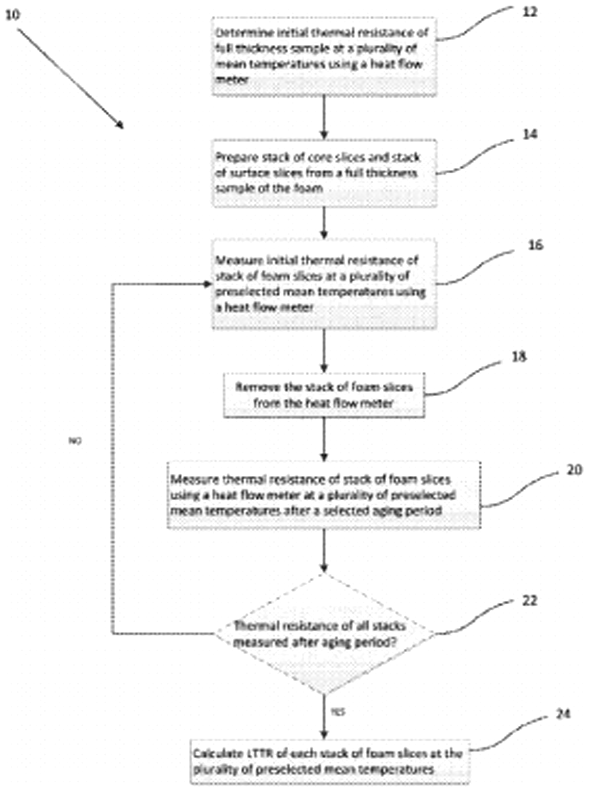
Methods for measuring long-term thermal resistance of closed-cell foam. The methods include: (a) placing a stack of slices cut from a sample of the foam between two isothermal plates in a calibrated heat flow meter comprising a heat flux transducer; (b) measuring an initial thermal resistance of the same stack of slices at a plurality of preselected mean temperatures within the temperature range of 10.degree. F. to 150.degree. F., wherein the stack of foam slices stays inside the heat flow meter throughout step (b); (c) at a time calculated to represent a selected aging period of the foam, placing the same stack of slices between two isothermal plates in a calibrated heat flow meter and measuring the thermal resistance of the stack of slices at a plurality of preselected mean temperatures within the temperature range of 10.degree. F. to 150.degree. F., wherein the stack of foam slices stays inside the heat flow meter throughout the measuring portion of step (c); and (d) calculating the long-term thermal resistance of the foam at each of the plurality of preselected mean temperatures.
Adhesive Tape
Inventor(s): Hatakeyama, T. and Sakamoto, K.
Sources: US Pat. App. 20210171803
Corporate/Assignee: Mitsubishi Chemical Corp.
An adhesive tape includes a substrate [I] and an adhesive agent layer of a polyester adhesive agent provided on at least one of opposite surfaces of the substrate [I]. The substrate [I] is one selected from a polyolefin resin foam substrate, a urethane resin foam substrate, and an acrylic resin foam substrate. The polyester adhesive agent is made from a polyester adhesive agent composition [II] which contains a polyester resin (A) having a weight average molecular weight of 5,000 to 300,000, and having a structural unit derived from a polyol and a structural unit derived from a polyvalent carboxylic acid compound containing an aromatic structure-containing compound in a proportion of not greater than 80 mol %. The adhesive tape is excellent in adherence between a polyester adhesive agent layer and a polyolefin resin foam substrate, a urethane resin foam substrate, or an acrylic resin foam substrate.
Layered Scrub
Inventor(s): Busby, T. P.
Sources: US Pat. App. 20210169299
Corporate/Assignee: Bright Box Lab, LLC
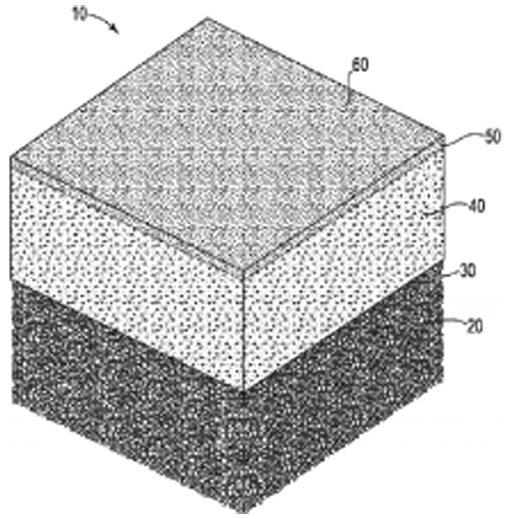
A layered scrub having an aspect ratio of between 0.75 and 1.25 is presented, comprising: a) a scrubber layer; b) a sponge layer; optionally c) a rigid boundary layer, which optionally is directly bound to layer c) and/or layer b); and optionally d) a dense sponge layer. In some such embodiments, layers d) and b) are unitary. In some embodiments, the layered scrub has a height of between 5.0 centimeters and 11.0 centimeters and may be generally cubic. In some embodiments, the scrubber layer comprises a non-reticulated hydrophobic polyurethane foam, the sponge layer and/or the dense sponge layer comprises a hydrophilic polyurethane foam, and the rigid boundary layer comprises polyurethane. In some embodiments, dense sponge layer d) bears printed designs or information.
Method for Producing Vehicular Seat Pad and Foam Molding Die for the Production of the Same
Inventor(s): Matsumoto, M.
Sources: JP Pat.: 2021-045365
Corporate/Assignee: Inoac Corp.
PROBLEM TO BE SOLVED: To provide a vehicular seat pad that contributes to improved yield, and a foam molding die for the production of the same.
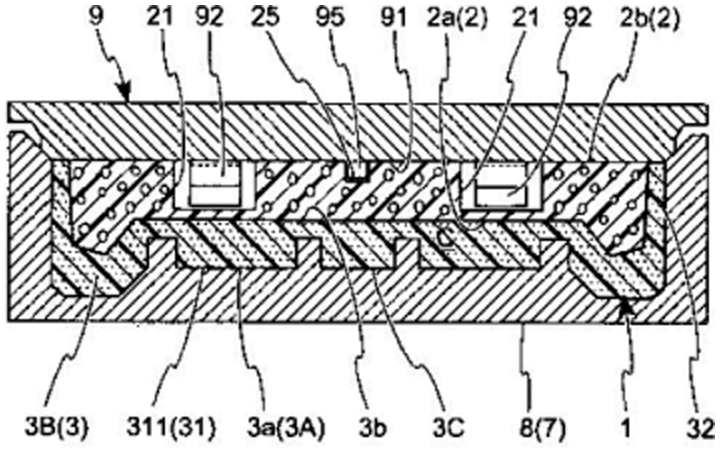
SOLUTION: A method for producing a vehicular seat pad includes the foam molding of a second foam 3 in which a surface layer 31 on the side to contact with a seated occupant is placed on a first foam 2 with its rear surface exposed to be a lower layer. A foam molding die 7 is used in which the first foam 2 is foam molded to be harder than the second foam 3 and smaller in unit weight, and on the rear surface of the first foam 2, a plurality of recessed grooves 21 are formed, separately aligned in groove direction, while on a cavity face 91 of an upper mold 9 corresponding to each recessed groove 21, an elastic clip 92 with its clip length L9 shorter than a groove length L2 of the recessed groove 21 projects so as to fall within the range of the groove length L2. With the rear surface 2b side of the first foam 2 turned upward, the elastic clip 92 is elastically deformed and inserted into the recessed groove 21, and its elastic resilience causes the first foam 2 to be locked and set to the upper mold 9, before a foam material g for the second foam is injected onto a lower mold cavity face 81 to close the mold. After the lapse of a proper time, the second foam 3 is foam molded.
Sound Absorbing and Insulating Material
Inventor(s): Hattori, T. and Ito, H.
Sources: JP Pat.: 2021-043388
Corporate/Assignee: JNC Corp. and JNC Fibers Corp.
Publication Date: March 18, 2021
PROBLEM TO BE SOLVED: To provide a sound absorbing and insulating material having excellent sound absorbing and insulating properties in a low frequency region to a high frequency region.
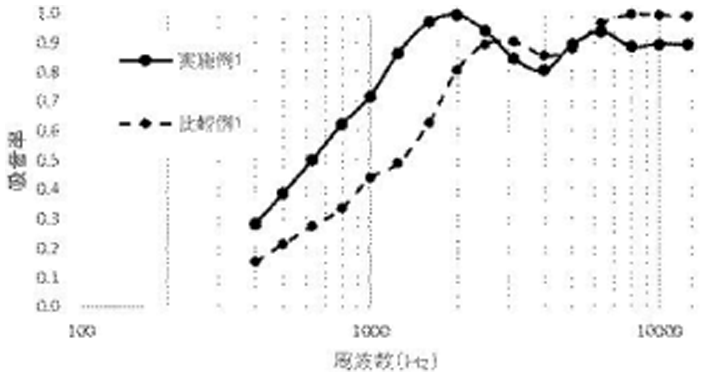
SOLUTION: The sound absorbing and insulating material is a sound absorbing and insulating material containing a fiber layer, a porous layer, and an elastic layer. The fiber layer has an average flow pore diameter of 1.0 to 60 μm and a breathability of 30 to 220 cc/cm2 s by Frazier method. The porous layer is a layer consisting of at least one selected from a group consisting of foams having communication holes, non-woven fabrics, and woven fabrics, and has a thickness of 3 to 40 mm, and a density is lower than that of the fiber layer and is 3 to 150 kg/m3. The elastic layer is a layer composed of at least one selected from a group consisting of an independent foam and a rubber sheet. And the fiber layer is arranged so as to be on the incident side of sound with respect to the porous layer and the elastic layer.
Sanitation Pad for Women and Method for Separating Microbes from Skin of Wearer
Inventor(s): Digvijay, R., Han, E., Wang, S., and Lin, G.
Sources: JP Pat.: 2021-041145
Corporate/Assignee: Practor & Gamble Co.
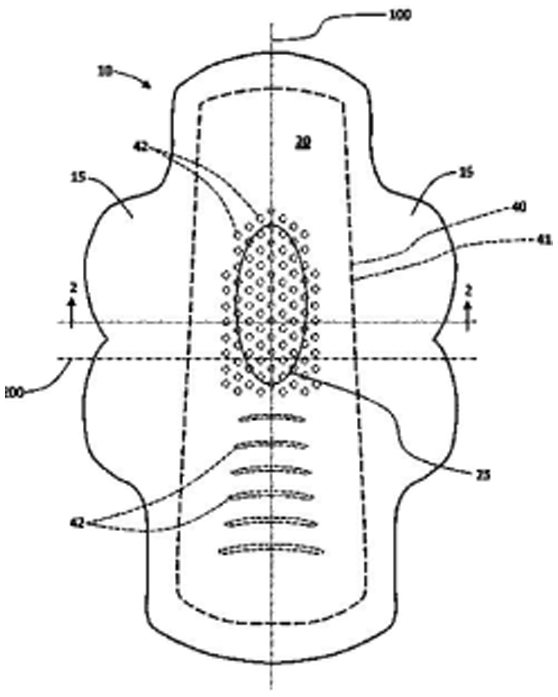
PROBLEM TO BE SOLVED: To provide an absorbent article comprising a preferable touch feeling related to nonwoven, and having a top sheet formed of a nonwoven web material including hydrophilic fibers.
SOLUTION: Tendency of a top sheet material for absorbing and holding a discharged menses fluid which is caused by existence of hydrophilic fibers, is reduced by including an absorbent core structure which includes a preferable absorbent open cell foam material being arranged right under the top sheet in a state of directly facing and contacting an external surface of the top sheet and tightly contacting. The foam material of an absorbent layer 40 efficiently draws a body fluid from the top sheet 20, and separates the body fluid from the top sheet and holds the body fluid, by a preferable production. In such a configuration, growth of microbes which may be supported by the body fluid which is held by the top sheet contacting a surface of the skin of the wearer, is reduced or inhibited, and using a disclosed article, the microbes can be separated from a proximate region on outside of a genital organ of the wearer during menses.
Process for Production of Expandable Vinyl Aromatic Polymer Granulate Having Decreased Thermal Conductivity
Inventor(s): Kondratowicz, F. L., Rojek, P., Mikoszek-Operchalska, M., and Utrata, K.
Sources: JP Pat.: 2021-038393
Corporate/Assignee: Synthos SA
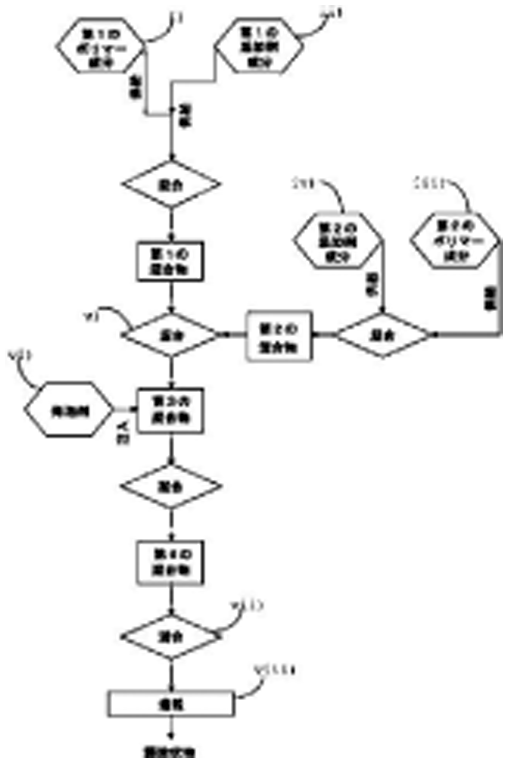
PROBLEM TO BE SOLVED: To provide: foams that are prepared from a polymer based on a vinyl aromatic monomer and optionally one or more comonomers and have improved mechanical, thermal and self-extinguishing properties; and processes for production thereof.
SOLUTION: An extrusion process for production of an expandable vinyl aromatic polymer granulate comprises: mixing first and second additives with first and second polymer components, respectively, in dedicated mixers so as to produce first and second mixtures; mixing the first and second mixtures so as to produce a third mixture; injecting a blowing agent into the third mixture so as to produce a fourth mixture; mixing the fourth mixture; and pelletizing the fourth mixture so as to obtain the granulate.
Insulation Structure Body with Vacuum Insulation Material, and Use of the Same
Inventor(s): Yuasa, A.
Sources: JP Pat.: 2021-036155
Corporate/Assignee: Panasonic IP Management Corp.
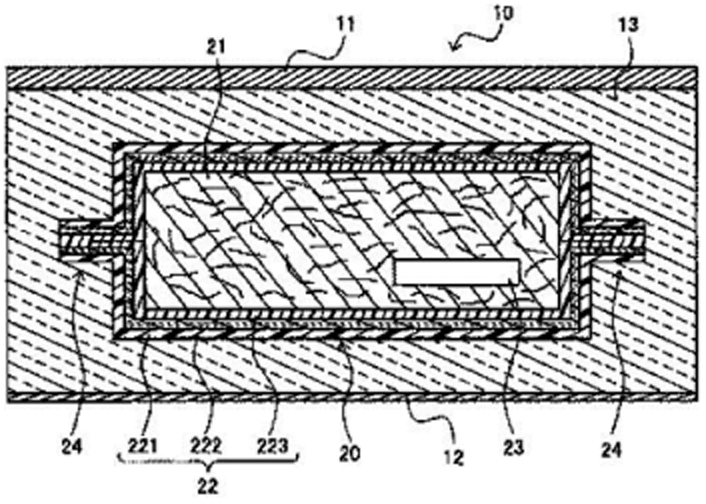
PROBLEM TO BE SOLVED: To provide an insulation structure body with a vacuum insulation material, enabling favorable use even in humid environment.
SOLUTION: An insulation panel 10 as an insulation structure body includes a vacuum insulation material 20, and a foam insulation material 13. The vacuum insulation material 20 includes an outer coating material 22 having gas barrier properties, and a core material 21 filled in the outer coating material 22. The inside of the outer coating material 22 is in a pressure reduced state. The outer coating material 22 includes a gas barrier layer 222 containing at least a laminar clay mineral; and an outer surface protection layer 221 such as an outer part layer located at the outside of the gas barrier layer 222. In at least one of the outer part layer and the foam insulation material 13, moisture adsorbent is included in dispersion.
Injection Foam Molding Method
Inventor(s): Kameyama, T., Sugimura, K., Fukuda, T., and Kamitori, H.
Sources: JP Pat.: 2021-030512
Corporate/Assignee: Toyota Motor Corp.
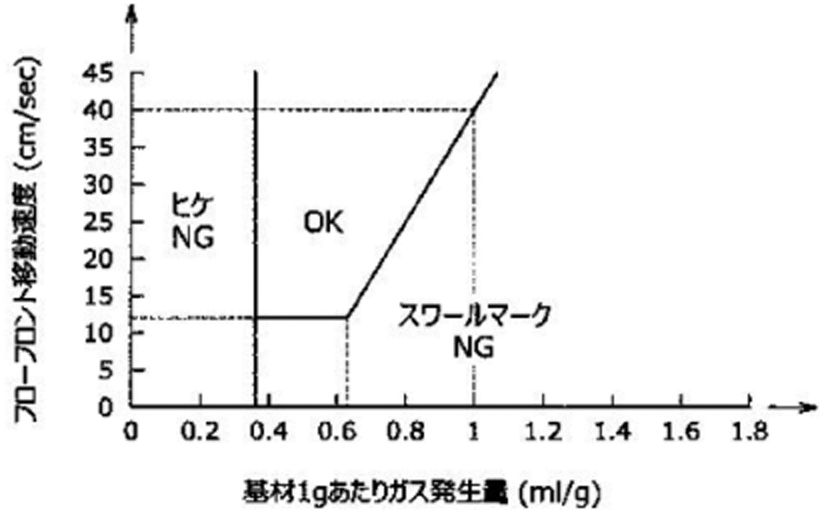
PROBLEM TO BE SOLVED: To provide an injection foam molding method capable of suppressing the generation of swirl marks while attaining the reduction of cost and the reduction of cycle time.
SOLUTION: Upon an injection foam molding method, in an injection step of injecting a foam resin material into a cavity, as the relation between the flow front movement speed (cm/s) of the foam resin material and a gas yield (ml/g) per g of the resin material, the gas yield per g of the resin material is controlled to 0.36 ml/g or more and the flow front movement is controlled to 75×the gas yield (ml/g) per g of the resin material-35 or more and also 12 (cm/s) or more. In this way, since special dies and facilities for the pressurization of the cavity and the heating of dies are not required, the reduction of cost can be attained, and further, since the pressurization of the cavity and the heating of dies are not essential, the generation of swirl marks can be suppressed while attaining the reduction of cycle time.
Synthetic Resin Foamed Sheet and Method for Producing the Same, Laminated Sheet, and Food Container
Inventor(s): Kurihara, H.
Sources: JP Pat.: 2021-046466
Corporate/Assignee: Chuo Kagaku Co. Ltd.
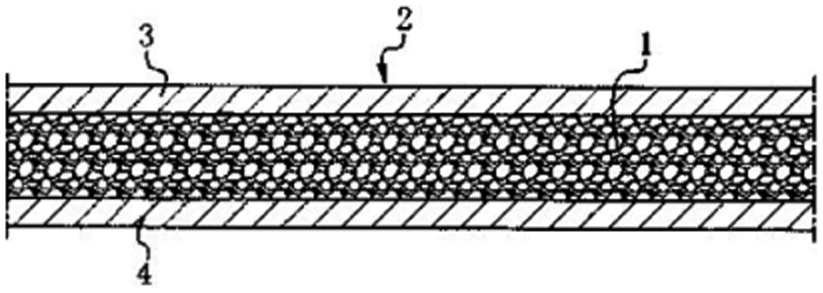
PROBLEM TO BE SOLVED: To provide a synthetic resin foamed sheet which exhibits high flexural strength in a state of being formed into a molded article such as a food container and can obtain practically sufficient strength in a synthetic resin sheet formed of a recycled raw material containing methacrylic acid.
SOLUTION: A synthetic resin foamed sheet 1 is composed of a mixture containing a recycled raw material derived from a polystyrene-based resin sheet containing methacrylic acid. The mixture contains styrene as a main component and contains methacrylic acid and a rubber component and is foamed into the foamed sheet. The mixture preferably contains 80 to 94 wt.% of styrene, 5 to 14 wt.% of rubber, and 0.1 to 2.0 wt.% of methacrylic acid, respectively.
Lignin-Containing Foamed Rubber
Inventor(s): Ikeda, H. and Miyaji, K.
Sources: JP Pat.: 2021-031665
Corporate/Assignee: N/A
PROBLEM TO BE SOLVED: To provide a foamed rubber composition in which lignin and a lignin derivative are contained and that is obtained by using water as a foaming agent and by controlling cross-linking speed.
SOLUTION: The present invention relates, in one embodiment, to a foamed rubber composition which is a foamed rubber molded body containing a rubber component, and lignin and a lignin derivative as one component, and in which, characterized, a foaming agent other than water is not contained, and, in addition, the foamed rubber molded body is produced regardless of the amount of the foaming agent and by adjusting the cross-linking condition, and to a method for producing the same.
Mixed Metal Catalyst Compositions and Methods for Making Polyurethane Foam
Inventor(s): Bender, J. D., Rogers, J. R., Vincent, J. L., and Stevens, R. E.
Sources: US Pat.: 11,046,850
Corporate/Assignee: Evonik Operations GmbH
A composition and process to make polyurethane foam using a stable liquid catalyst composition comprising at least one liquid bismuth carboxylate catalyst and at least one liquid dialkyltin dicarboxylate complex are disclosed. The disclosed composition and process yield polyurethane foam having favorable properties, but requiring less metal. The polyurethane foams produced by this catalyst composition and method are useful for laminated boardstock, construction panels, appliance insulation, spray-applied insulation, seat cushions, and mattresses.
High Resiliency Polyurethane Foams Made with High Functionality, High Equivalent Weight Polyols with Mainly Secondary Hydroxyl Groups
Inventor(s): Babb, D. A. and Masy, J-P.
Sources: US Pat.: 11,041,041
Corporate/Assignee: Dow Global Technologies LLC
High resiliency polyurethane foam is made from a polyether polyol having an equivalent weight of at least 1000. At least a portion of the polyether polyol is one or more random copolymer(s) formed by polymerizing a mixture of 70 to 95% by weight propylene oxide and 5 to 30% by weight ethylene oxide onto an initiator compound. The random copolymer(s) has a nominal hydroxyl functionality of at least 5, a hydroxyl equivalent weight of at least 1500 g/equivalent and no more than 0.01 milliequivalents per gram of terminal unsaturation. The randomly polymerized propylene oxide and ethylene oxide constitute at least 80% of the total weight of the random copolymer. At least 70% of the hydroxyl groups of the random copolymer are secondary hydroxyls.
Polyols for Thermoset and Thermoplastics Applications of Lignin
Inventor(s): Kurple, E.
Sources: US Pat.: 11,034,790
Corporate/Assignee: N/A
A composition comprising: lignin, a polyol carrier compound and an isocyanate is disclosed. The lignin being mixed with the polyol carrier compound. The polyol carrier compound is selected from the group consisting of TCPP, TECP, TMCP, TDCP, ethoxylated and propoxylated phenols, tris-chloroisopropyl phosphate, amino methyl propanol, glycerin carbonate, polyether modified polysiloxanes, bromophthalic anhydride derivatives, propanediols; bromine, chlorine and/or phosphorus based fire retardents, epoxies, glycerins, sugar, glycols, certain natural oil based polyols and ethoxylated and or propoxylated alcohols. The lignin-polyol carrier compound mixture is reacted with the isocyanate producing a foam, plastic or other material. For a thermoplastic solid the same polyol carrier compounds are used but in higher percentages of lignin.
Polyol Compositions, a Process for the Production of these Polyol Compositions, and their Use in the Production of Open Celled Polyurethane Foams Having High air Flow
Inventor(s): McVey, S. B., Gower Jr., W. C., Hager, S. L., Moore, M. N., and Reese, J. R.
Sources: US Pat.: 11,028,218
Corporate/Assignee: Covestro LLC
This invention relates to a novel polyol composition and a process for preparing these polyol compositions. These novel polyol compositions comprise (a) an in-situ formed polyol blend which comprises (i) one or more polyether monols and (ii) one or more polyether polyols; and (b) a polyether polyol. This invention also relates to a process for preparing an open celled, flexible polyurethane foam in which the isocyanate-reactive component comprises this novel polyol composition, and to a viscoelastic polyurethane foam wherein the isocyanate-reactive comprise the novel polyol composition.
Polyols for Improved Viscoelastic Foams with Reduced Temperature Sensitivity
Inventor(s): Barksby, N., Neal, B. L., McVey, S. B., and Hayes, J. E.
Sources: US Pat.: 11,021,567
Corporate/Assignee: Covestro LLC
This invention relates to a process for preparing viscoelastic polyurethane foam in which the isocyanate-reactive component comprises a specific polyol blend, and to viscoelastic polyurethane foam wherein the isocyanate-reactive comprises the specific polyol blend. The polyol blend may be an in situ formed polyol blend.
High Strength Polyurethane Foam Compositions and Methods
Inventor(s): Allen, S. D., Sendijarevic, V., and Sendijarevic, A.
Sources: US Pat.: 11,021,564
Corporate/Assignee: Saudi Aramco Technologies Co.
Disclosed are high strength polyurethane foam compositions and methods of making them. In one aspect, the inventive polyurethane foams include strength enhancing additives comprising one or more polycarbonate polyols derived from the copolymerization of CO.sub.2 and one or more epoxides. In one aspect, the inventive methods include the step of substituting a portion of the polyether polyol in the B-side of a foam formulation with one or more polycarbonate polyols derived from the copolymerization of CO.sub.2 and one or more epoxides.
Amine Composition Useful for Making Polyurethane Foam
Inventor(s): Xi, K., Burdeniuc, J. J., Hsu, I. J., Keller, R. J., Miller, T. J., Bender, J. D., and Kniss, J.
Sources: US Pat.: 11,021,561
Corporate/Assignee: Evonik Operations GmbH
A catalyst composition for making polyurethane foam, the catalyst composition including a compound having a general formula R.sup.1R.sup.2R.sup.3N, wherein each of R.sup.1, R.sup.2 and R.sup.3 are independently selected from the group consisting of: a compound according to formula (I): ##STR00001## wherein n=1 to 5; and R4, R5 and R6 are each independently hydrogen, methyl, ethyl and propyl groups; hydrogen, a C1-C6 alkyl group compound, a C1-C6 cycloalkyl group compound, a C1-C6 alkenyl group compound, a C1-C6 alkynyl group compound, a C1-C6 aryl group compound, and a C1-C6 aralkyl group compound, each group being substituted or unsubstituted; wherein at least one of R.sup.1, R.sup.2 and R.sup.3 is a compound according to formula (I). A polyurethane composition and method for forming a polyurethane foam are also disclosed.
Low Viscosity (Meth)Acrylates as Reactive Additives in Reactive Compositions for Making Rigid Polyurethane/Polyisocyanurate Comprising Foams
Inventor(s): Joncheray, T. J., Bernardini, J., and Vandenbroeck, J.
Sources: US Pat. App. 20210189083
Corporate/Assignee: Huntsman International LLC
A reactive composition is disclosed for making a polyisocyanurate-polyurethane comprising rigid foam (PIR-PUR), said reactive composition comprising a polyisocyanate composition, an isocyanate-reactive composition, at least one catalyst compound suitable for making the PIR-PUR comprising foam, at least one blowing agent; and optionally one or more surfactants, one or more flame retardants, one or more antioxidants, or combinations thereof characterized in that the reactive composition further comprises a reactive viscosity reducer selected from at least one acrylate and/or methacrylate compound having no isocyanate-reactive groups and having a viscosity at 25.degree. C. below 100 mPas.
Polyurethane Foam
Inventor(s): Wang, J.
Sources: US Pat. App. 20210179799
Corporate/Assignee: Levitex Foams Ltd.
A polyurethane foam is disclosed having unique load bearing characteristics rendering it suitable for a variety of applications. The foam exhibits high surface-softness and smoothness properties, making it well-suited for use in articles such as pillows and mattress toppers. However, upon continued application of pressure, the resilience of the foam increases sharply, translating into a remarkable support characteristics that make the foam suitable for use in the seat portions of chairs and sofas, as well as in the base portion of mattresses. The foams therefore address the limitations of conventional, high-resilience and visco-elastic polyurethane foams. A process of making the foam and its use in various articles is also disclosed.
Electrically Conductive Urethane Foam
Inventor(s): Kozlowski, E., Carraro, B., Vivian, A. M., and Kang, K.
Sources: US Pat. App. 20210178932
Corporate/Assignee: N/A
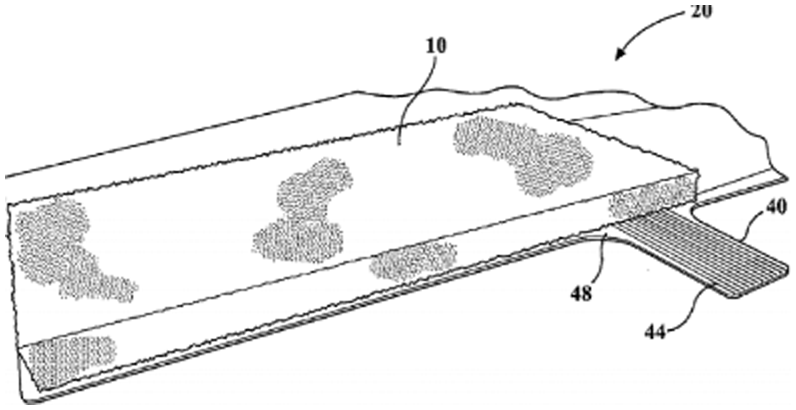
A polyurethane foam is disclosed having unique load bearing characteristics rendering it suitable for a variety of applications. The foam exhibits high surface-softness and smoothness properties, making it well-suited for use in articles such as pillows and mattress toppers. However, upon continued application of pressure, the resilience of the foam increases sharply, translating into a remarkable support characteristics that make the foam suitable for use in the seat portions of chairs and sofas, as well as in the base portion of mattresses. The foams therefore address the limitations of conventional, high-resilience and visco-elastic polyurethane foams. A process of making the foam and its use in various articles is also disclosed.
Acetoacetylated and (Meth)Acrylated Resin Compositions and Thersets and Foams Therefrom
Inventor(s): Webster, D., Krall, E. M., Sutko, K. M., Hart, A. T., Bansal, K., and Qardir, M.
Sources: US Pat. App. 20210171720
Corporate/Assignee: NDSU Research Foundation
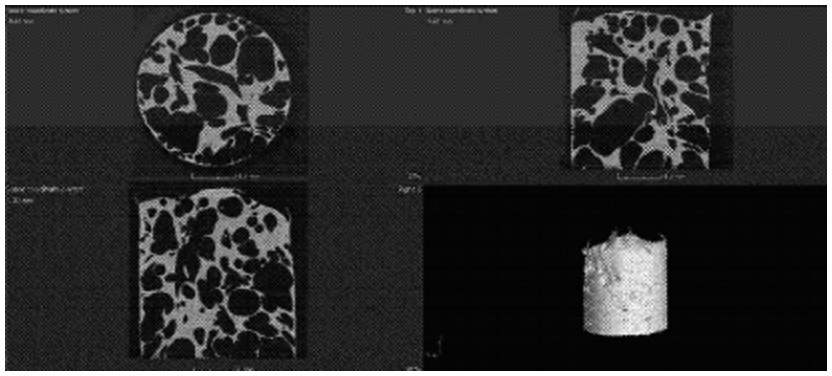
The invention relates to acetoacetylated lignin resin compositions comprising the reaction product of lignin and an acetoacetate ester. The invention also relates to (meth)acrylated lignin resin compositions comprising the reaction product of lignin and a (meth)acrylic compound. The invention also relates to methods of making the acetoacetylated and (meth)acrylated lignin resin compositions. The invention also relates to curable coating compositions comprising the acetoacetylated and (meth)acrylated lignin resin compositions. The invention also relates to methods of making the curable coating compositions of the invention. The invention also relates to methods of applying curable coating compositions of the invention to substrates. The invention also relates to articles of manufacture comprising a curable coating composition of the invention and a method of making such article. The invention also relates to foam materials comprising the reaction product of an acetoacetylated resin composition, a polyamine compound, and a physical blowing agent and/or a polysiloxane compound.
Polyol Composition and Polyurethane Foam
Inventor(s): Kono, S.
Sources: US Pat. App. 20210163666
Corporate/Assignee: Sanyo Chem. Industries, Ltd.
Provided is a polyol composition which has good dispersion stability of a polyuria resin contained therein and maintains a uniform appearance over time as well as during the production, and which can be reacted with polyisocyanate to obtain a polyurethane foam having excellent flame retardancy. The present invention pertains to a polyol composition that is used as a raw material for a polyurethane foam containing a urea group-containing reaction product having a compound (A), which has two primary amino groups and at least one polyalkyleneoxy chain (a) in the molecule, and a polyisocyanate (B) as essential raw materials, and being obtained by reacting the primary amino groups of the (A) with the isocyanate groups of the (B), wherein the polyalkyleneoxy chain (a) is a chain to which 1-100 moles of a C2-4 alkylene oxide have been added.
Method for Producing Polyurethane Hard Foam Composite Ekements Using Mannich Polyols
Inventor(s): Jacobmeier, O., Kaluschke, T., Renner, C., and Thater, M.
Sources: US Pat. App. 20210163661
Corporate/Assignee: BASF SE
The present disclosure relates to a method for producing rigid polyurethane foam composite elements, including at least one outer layer and a rigid polyurethane foam layer, by mixing (a) polyisocyanates with (b) compounds having at least two hydrogen atoms reactive with isocyanate groups, (c) optionally flame retardant(s), (d) blowing agent, (e) catalyst, and (f) optionally auxiliaries and adjuvants to form a reaction mixture, applying the reaction mixture to the outer layer, and curing it to form the rigid polyurethane foam. The present disclosure further relates to a rigid polyurethane foam composite element obtainable by such a method.
Flame-Retardant Rigid Polyurethane Foam
Inventor(s): Okada, K., Kajita, M., and Kirie, Y.
Sources: JP Pat.: 2021-038409
Corporate/Assignee: Sekisui Chem. Co. Ltd.
PROBLEM TO BE SOLVED: To provide a flame-retardant rigid polyurethane foam that exhibits improved humidity resistance while having flame retardancy.
SOLUTION: A flame-retardant rigid polyurethane foam contains a flame retardant, the foam having a ratio of the maximum peak intensity ratio (P1) of the foam after moist heat treatment of the foam for one week at a temperature of 80°C and a humidity of 85% to the maximum peak intensity ratio (P2) of the foam before the moist heat treatment of 85% or more (P1/P2×100). The P1 and P2 each refer to the ratio of the maximum peak intensity of 1390 to 1430 cm-1 to the maximum peak intensity of 1500 to 1520 cm-1 when the infrared absorption spectrum is measured at a position 5 to 10 mm from the surface of the foam, and the average intensity of 1900 to 2000 cm-1 is adjusted to zero.
Composition for Polyurethane Integral Skin Foam, Polyurethane Integral Skin Foam, and Method of Producing the Same
Inventor(s): Nagaoka, T., Ito, H., and Yoshii, N.
Sources: JP Pat.: 2021-038299
Corporate/Assignee: Tosoh Corp.
PROBLEM TO BE SOLVED: To provide a composition for a polyurethane integral skin foam provided with color fastness, and excellent in mechanical strength while having high impact resilience, a polyurethane integral skin foam, and a method of producing the polyurethane integral skin foam.
SOLUTION: The problem is solved by a composition for a polyurethane integral skin foam including: an organic polyisocyanate composition (A); a polyol constituent (B); a catalyst (C); and a foaming agent (D), where the organic polyisocyanate composition (A) includes a specific isocyanate group-terminated adduct, the isocyanate group content is 10-20 mass%, the polyol constituent (B) includes polyoxyalkylene polyol using a specific catalyst, the hydroxyl value is 18-28 mg KOH/g, and the total degree of unsaturation is 0.001-0.03 meq./g.
Polyurethane Foam and Shoe Sole Member
Inventor(s): Honda, W. and Mori, H.
Sources: JP Pat.: 2021-031564
Corporate/Assignee: Achilles Corp.
Publication Date: March 1, 2021
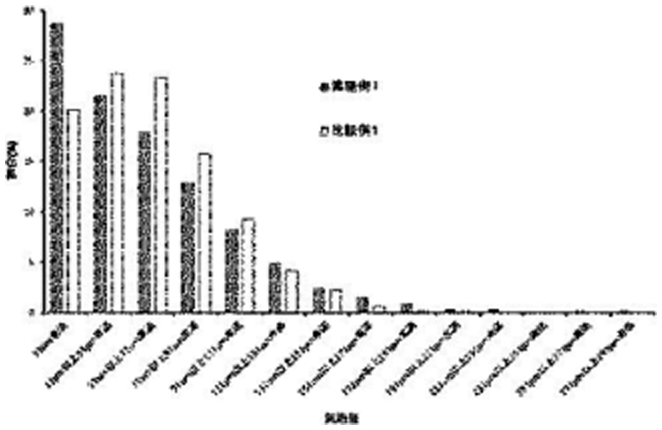
PROBLEM TO BE SOLVED: To provide: a polyurethane foam that has a high impact resilience and is also excellent in shock absorption; and a shoe sole member using said polyurethane foam.
SOLUTION: Provided is a polyurethane foam having a soft segment formed from polyol component and a hard segment formed from a structural part having a urethane bonding part, and in which the polyurethane foam has an average cell diameter of 30 μm or more and 100 μm or less and a number of bubbles having a cell diameter of less than 31 μm of 21% or more, and the impact resilience of polyurethane foam measured in accordance with JIS K 6255 is 75% or more.
Polyamide Resin Foamed Particles and Method for Producing Same
Inventor(s): Hayashi, T. and Hira, A.
Sources: US Pat. App. 20210189089
Corporate/Assignee: JSP Corp.
Publication Date: June 24, 2021
A polyamide-based resin expanded bead comprising a foam layer formed by expanding a polyamide-based resin, wherein on a first DSC curve and a second DSC curve, the first DSC curve has a melting peak (intrinsic peak) having a peak top temperature on a low temperature side equal to or lower than a peak top temperature of a melting peak of the second DSC curve and a melting peak (high temperature peak) having a peak top temperature on a high temperature side exceeding the peak top temperature of the second DSC curve, and, the peak top temperature of the melting peak of the second DSC curve is 180.degree. C. or higher and 280.degree. C. or lower, and the polyamide-based resin expanded bead has an apparent density of 10 to 300 kg/m.sup.3 and a closed cell ratio of 85% or more.
Method for Molding Laminated Composite Sheet Comprising Fiber Reinforced Resin Sheet and Resin Foamed Sheet
Inventor(s): Toriyama, M.
Sources: JP Pat.: 2021-041634
Corporate/Assignee: Monopost Co. Ltd.
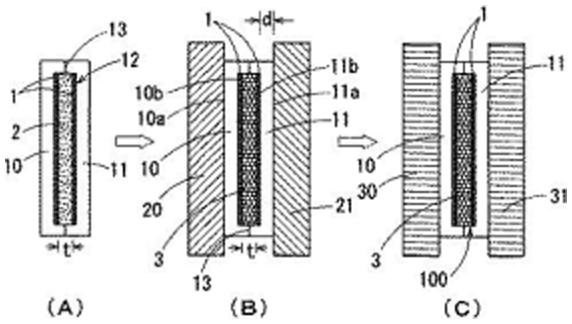
PROBLEM TO BE SOLVED: To provide a manufacturing method capable of obtaining a laminated composite sheet molding having a uniform thickness and flatness.
SOLUTION: In a method for manufacturing a laminated composite sheet, two molded fiber reinforced resin sheets 1 are brought into close contact with each of inner surfaces of a pair of molds 10 and 11 comprising a metal with a high thermal conductivity and having the same, uniform thickness. A gap between the fiber reinforced resin sheets is uniformly held, and a foamable resin mixture 2 uniformly mixed with thermoexpansible foaming particles is filled into the gap. Next, heated metal bodies 20 and 21 are brought into contact with respective outer surfaces of the molds, and they are heated simultaneously from both outer surfaces to raise the temperature to a temperature at which the fiber reinforced resin sheets are not thermally deformed. The thermoexpansible foaming particles are expanded to mold the foamable resin mixture into a foamed resin sheet 3, and at the same time, laminate and integrate with the fiber reinforced resin sheets. Then, instead of the heated metal bodies, cooled metal bodies 30 and 31 are brought into contact to simultaneously chill the mold and the laminated and integrated sheets from both outer surfaces.
Foamed Particle Production Device and Production Method
Inventor(s): Ebii, M., Murakami, Y., and Furukawa, R.
Sources: JP Pat.: 2021-038282
Corporate/Assignee: Kaneka Corp.
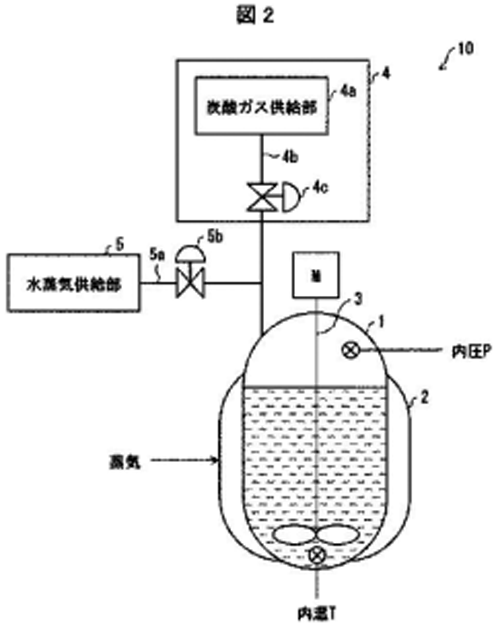
PROBLEM TO BE SOLVED: To prevent a drop in the inner temperature of a foaming tank in the latter half of a foaming step.
SOLUTION: A foamed particle production method has: a pressure control step in which a foaming tank (1) is supplied with carbon dioxide and an amount of the carbon dioxide supplied is controlled, to keep constant the pressure of a gas layer in the foaming tank (1) during the foaming step; and a water vapor supply step that supplies water vapor into the foaming tank (1) so that a water vapor partial pressure is kept constant during the foaming step.
Foamed Particle Manufacturing Equipment and Manufacturing Method Thereof
Inventor(s): Ebii, M. and Fukuda, T.
Sources: JP Pat.: 2021-037635
Corporate/Assignee: Kaneka Corp.
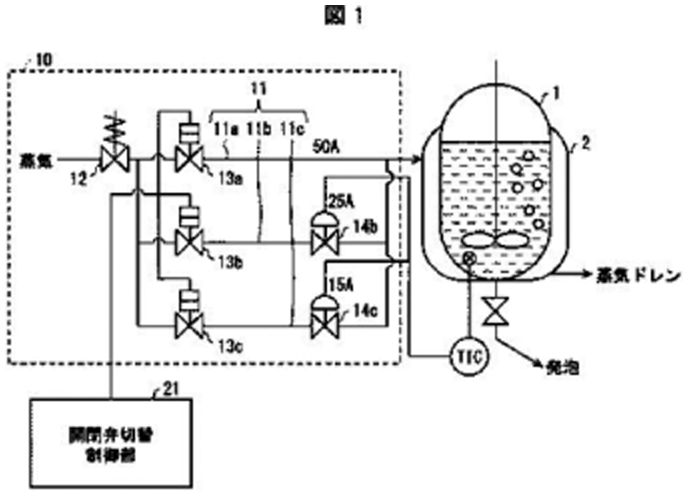
PROBLEM TO BE SOLVED: To provide precisely control a temperature inside a foaming vessel.
SOLUTION: In a foamed particle manufacturing apparatus of the present invention, a temperature control unit (10) is provided with a pressure reducing valve (12) for keeping a pressure of steam supplied to a jacket part (2) constant, branch pipes (11a to 11c) that branch from a downstream side of the pressure reducing valve (12), and a steam supply amount is different from each other, an on-off valve switching control unit (21) for controlling opening/closing switching of the branch pipes (11a to 11c), and control valves (14b, 14c) for regulating an amount of steam in the branch pipes (11b, 11c).
Manufacturing Method of Foamed Resin Molded Products
Inventor(s): Ida, T.
Sources: JP Pat.: 2021-030440
Corporate/Assignee: Daisen Co. Ltd.
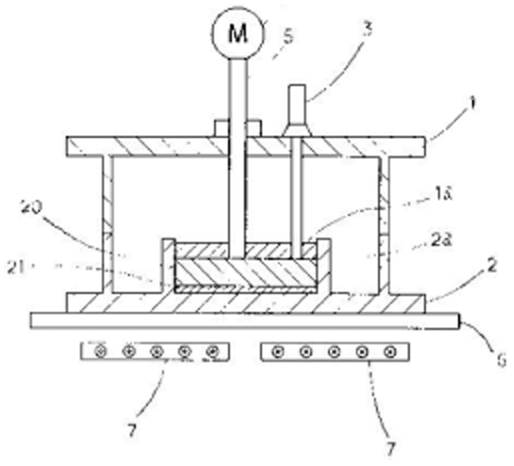
PROBLEM TO BE SOLVED: To provide a method for producing a foamed resin molded product capable of integrally molding a foamed resin molded product having a skin layer on a surface in a pair of molds.
SOLUTION: The manufacturing method consists of a process of a step of filling a foamed resin raw material into a cavity formed by a pair of molds that is connected to and separate freely with each other, a process of heating the mold with steam, a process of heating and foaming and fusing the raw material to make a foamed resin molded product, then, a step of further raising the temperature of the mold by electromagnetic induction heating and melting a surface of the foamed resin molded product in contact with this temperature-raised mold to form a skin layer, and a step of opening the mold and taking out the foamed resin molded product after cooling the mold. The thickness of the skin layer to be generated can also be adjusted by the force of pressing the foamed resin molded product.
Methods of Manufacturing Articles Having Foam Particles
Inventor(s): Kvamme, B.
Sources: US Pat. App. 20210145116
Corporate/Assignee: Nike Inc.
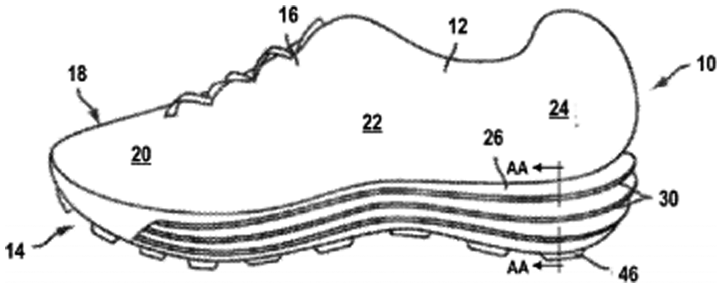
Methods for manufacturing three-dimensional components of articles, including articles of footwear, apparel, and sporting equipment are provided. The disclosed methods comprise providing a first composition comprising a plurality of foam particles suspended in a liquid polymerizable composition, polymerizing a first portion of the liquid polymerizable composition to form a first layer of polymeric material at least partially encapsulating a first portion of the plurality of foam particles, repeating the polymerizing and forming for at least a second and third iteration, each iteration forming a layer on the previous layer, thereby forming a three-dimensional component having at least three layers, each layer including foam particles at least partially encapsulated by the first polymeric material. Articles manufactured using the disclosed methods are also provided.
Uses of Fluorinated Epoxides and Novel Mixtures Thereof
Inventor(s): Petrov, V. A., Brandt, D. R., Minor, B. H., Kontomaris, K., Robin, M. L., Wysong, E. B., Musyimi, H. K., and Glatt, C. M.
Sources: US Pat. App. 20210139441
Corporate/Assignee: The Chemours Company FC, LLC
This application relates to compositions comprising one or more partially fluorinated epoxides and/or one or more perfluorinated epoxides which may be useful in applications including refrigerants, air conditioning, heat transfer media, high-temperature heat pumps, organic Rankine cycles, fire extinguishing/fire suppression, propellants, foam blowing, solvents, dielectrics, and/or cleaning fluids.
Foam Composition with Improved Properties and Appilcations Thereof
Inventor(s): Rodrigues Camilo, A. P., Delevati, G., Zehetmeyer, G., and Soto Oviedo, M. A.
Sources: US Pat.: 11,015,035
Corporate/Assignee: Braskem S. A.
Foamed compositions that include: one or more foamable polymers; one or more ionomeric additives; and wherein the foam composition exhibits shrinkage as determined at 70.degree. C.*1 h according to the PFI method between 0.1 and 3.5%. Methods may include preparing a polymer composition by combining one or more foamable polymers and one or more ionomeric additives in a mixer to produce the polymer composition; and foaming the polymer composition to generate a polymer foam exhibiting shrinkage as determined at 70.degree. C.*1 h according to the PFI method of between 0.1 and 3.5%.
Copolymer Foam with Polyamide Blocks and Polyether Blocks
Inventor(s): Cocquet, C., Pineau, Q., Loyen, K., Fernagut, F., and Cheminet, H.
Sources: US Pat.: 11,008,464
Corporate/Assignee: Arkema France
The invention relates to a non-cross-linked copolymer foam with polyamide blocks and polyether blocks, wherein: the polyamide blocks of the copolymer have an average molar mass of from 200 to 1,500 g/mol; the polyether blocks of the copolymer have an average molar mass of from 800 to 2,500 g/mol; and the weight ratio of the polyamide blocks to the polyether blocks of the copolymer is from 0.1 to 0.9. The invention also relates to a method for manufacturing said foam and items manufactured from said foam.
Method of Making Coextruded, Cross-Linked Polyolefin Foam with Tpu Cap Layers
Inventor(s): Ben-Daat, D., Baldwin, J., Bock, K. M., and Sieradzki, P.
Sources: US Pat.: 11,007,761
Corporate/Assignee: Toray Plastics (America), Inc.
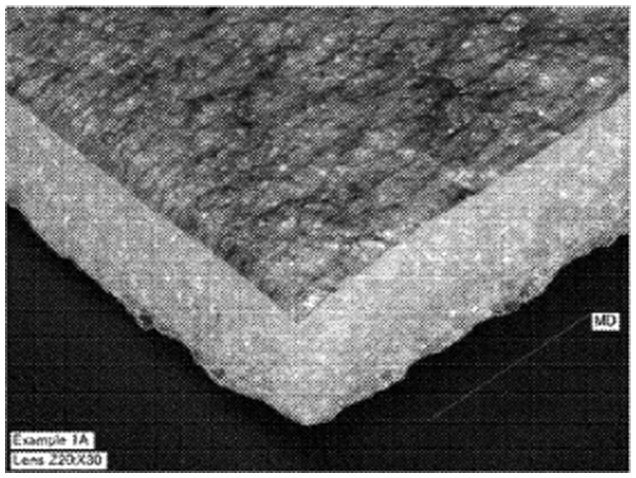
The present disclosure is directed to a physically crosslinked, closed cell continuous multilayer foam structure comprising at least one foam polypropylene/polyethylene layer with a TPU cap layer. The multilayer foam structure can be obtained by coextruding a multilayer structure comprising at least one foam composition layer with at least one cap composition layer, irradiating the coextruded structure with ionizing radiation, and continuously foaming the irradiated structure.
Absorbent Core and Absorbant Articles Having Anisotropic Foam Structures
Inventor(s): Houben, A., Rodrigues Perez, M. A., Lopez Gil, A., Tirado Mediavilla, J., Garcia Gonzalez, J., Dhooge, L., and Ruets, K.
Sources: US Pat.: 11,007,094
Corporate/Assignee: Ontex BV, and Ontex Group NV
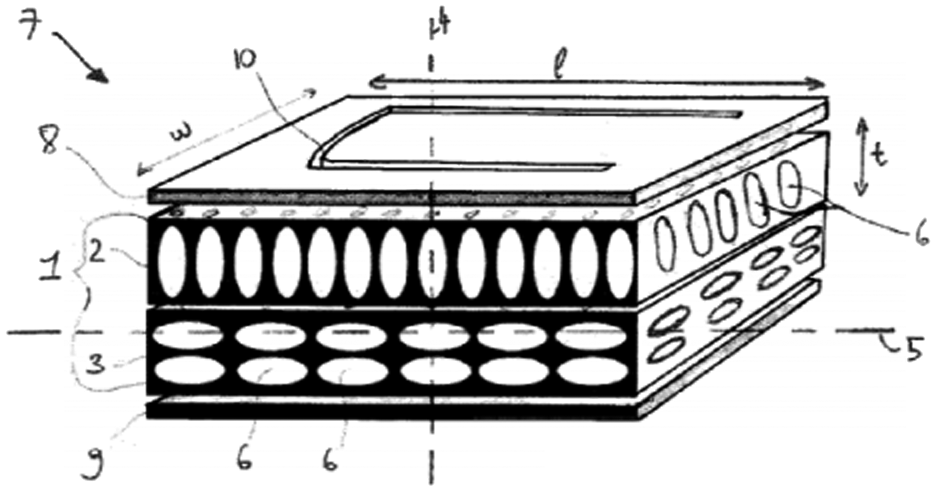
An absorbent core for an absorbent article, the absorbent core comprising at least two layers, each layer having a width w and a length l along a first plane and a thickness t extending perpendicular thereto, wherein the layers are arranged in facing relationship along the first plane, and wherein the layers comprise a polymeric foam having an open cell and interconnected porous structure. The first and second layers comprise an anisotropic cell structure having an axis of anisotropy extending substantially parallel to a longest length of a plurality of substantially neighbouring cells. The axis of anisotropy of the second layer extends substantially perpendicular to said thickness t and parallel to said first plane and the axis of anisotropy of the first layer is substantially perpendicular to the axis of anisotropy of the second layer.
Foam Laminate Dressing
Inventor(s): Tummey, D. M.
Sources: US Pat.: 11,007,082
Corporate/Assignee: Innovative Therapies, Inc.
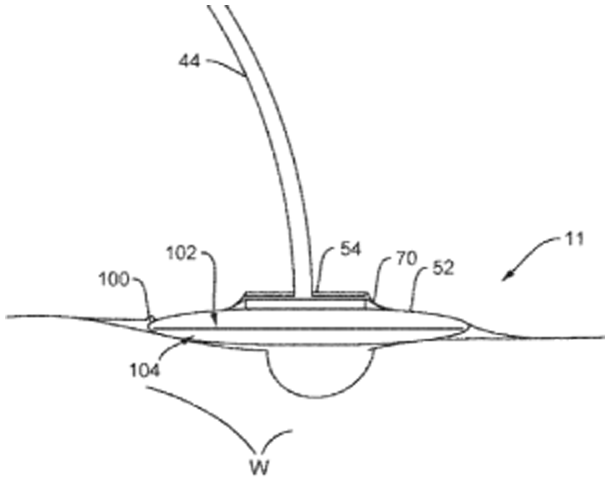
A foam laminate dressing includes a first distinct hydrophobic reticulated foam layer and an underlying second distinct hydrophilic layer bonded to the first layer and of substantially same length and width as the first distinct hydrophobic reticulated foam layer.
Method of Preparation of Cardo Polyetherketone (Pek-C) Structural Foam
Inventor(s): Zhou, G., Wang, H., and Li, W.
Sources: US Pat.: 11,001,689
Corporate/Assignee: Jiangsu Sino-Tech Polymerization New Materials Industry Technology Research instituteChang Chun Institute of Applied Chemistry Chinses Academy of Sciences
A method of preparation of a cardo polyetherketone structural foam material, including the following steps: 1) performing a mould pressing on a cardo polyetherketone resin by a high-temperature vulcanizing machine to prepare a foaming billet; 2) placing the foaming billet in a foaming cavity of a mould-pressing machine, performing a penetration and a swelling by introducing a supercritical fluid to achieve diffusion equilibrium, forming a polymer-supercritical fluid homogeneous solution, and 3) making the polymer-supercritical fluid homogeneous solution supersaturated through a sudden release of the inner pressure of the system, thereby inducing nucleation and foaming, and finally forming a structural foam having a closed pore structure with a uniform pore size and an adjustable pore density. The production process of the present invention is clean, environmentally friendly, and has relatively high efficiency. The obtained structural foam has good mechanical properties.
Foamed Blow Molded Article
Inventor(s): De Jonge, H. M. H., Gerrits, N. S. J. A., and van Es, M. A.
Sources: US Pat.: 10,994, 519
Corporate/Assignee: Sabic Global Technologies B. V.
The invention is directed to a blow molded article. The article comprises at least three layers wherein layer A comprises polymer, layer B comprises a foam composition comprising high density polyethylene having a quotient of melt strength and apparent viscosity>2 cN/k.Pa.s and layer C comprises polymer wherein the layer comprising the foam composition is enclosed between two layers A and C and wherein the melt strength is determined as described in ISO 16790:2005 and the apparent viscosity is determined as described in ISO 11443:2014 and wherein the foam composition is produced with a physically blowing agent.
Method for Producing a Foam Body Having an Internal Structure
Inventor(s): Achten, D., Heil, R., Albach, R., Ehlers, N., Clasen, D., Praet, S., and Pajonk, A.
Sources: US Pat. App. 20210154899
Corporate/Assignee: Covestro Deutschland AG
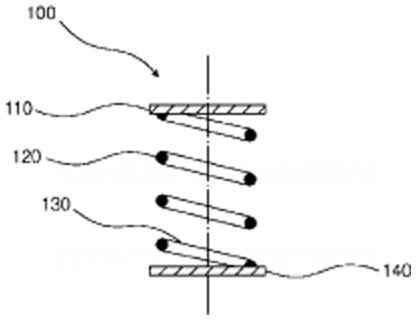
A method for producing a foam body (10) having an internal structure (100, 200, 300), comprising the steps: I) selecting an internal structure (100, 200, 300) to be formed in the foam body (10), the structure comprising a first polymer material; II) providing a foam body (10), the foam body (10) comprising a second polymer material which is different to the first polymer material; III) injecting, by means of an injection means (20), a predefined amount of a melt of the first polymer material or a predefined amount of a reaction mixture (30, 31, 32) which reacts to form the first polymer material at a predefined location inside the foam body (10), corresponding to a volume element of the internal structure (100, 200, 300); IV) repeating step III) for further predefined locations inside the foam body (10), corresponding to further volume elements of the internal structure (10), until the internal structure (10) is formed. The invention also relates to a foam body (10) which has an internal structure (100, 200, 300) and is obtainable by the method according to the invention.
Composite with Direct Bonding Between Rubber and Foam
Inventor(s): Zhang, Z. and Qin, H.
Sources: US Pat. App. 20210146661
Corporate/Assignee: Performance Materials NA, Inc.
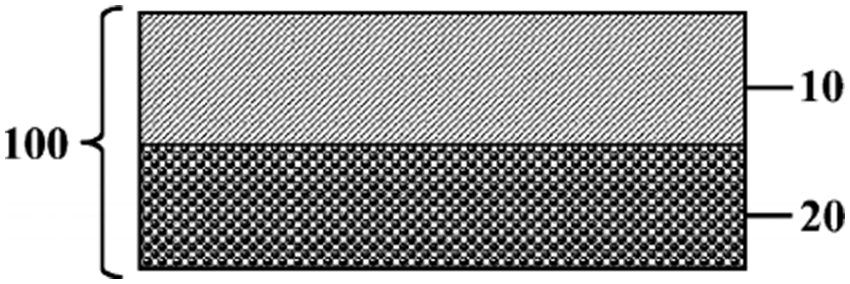
This disclosure relates to a composite comprising (a) a rubber layer comprising a cured rubber and optionally a first copolymer having carboxyl groups or anhydride groups; and (b) a foam layer comprising a crosslinked ethylene vinyl acetate and optionally a second copolymer having carboxyl groups or glycidyl methacrylate groups; wherein the foam layer has at least one surface adhering to the rubber layer directly, and provided that either the first copolymer or the second copolymer is present, and the composite is free of glues or adhesive films in the interface between the rubber layer and the foam layer.
Silicone Sponge Roller for Fixing Device and also Heat Fixing Device
Inventor(s): Kurosawa, M., Tsuda, S., and Ebata, K.
Sources: US Pat. App. 20210141325
Corporate/Assignee: Kinyosha Co. Ltd.
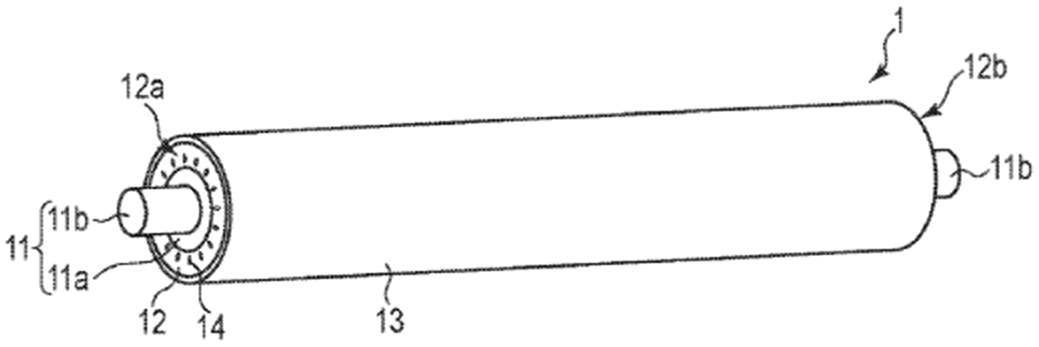
A silicone sponge roller for a fixing device, includes a roller substrate, a silicone sponge layer formed on the roller substrate, and a surface layer including formed of a fluorocarbon resin formed on the silicone sponge layer. The silicone sponge layer is a foam including a silicone rubber and air bubbles formed from microballoons scattered in the silicone rubber. The silicone sponge layer includes air permeating through holes aligned along the axis direction of the roller substrate, opening to both end surfaces of the silicone sponge layer. The air bubbles exist in the periphery of the through holes, and at least a part thereof is positioned in the inner surface of the through hole.
Compositions Comprising Latent Heat Storage Materials and Method of Making the Same
Inventor(s): Sawafta, R. I. and Naser, N.
Sources: US Pat. App. 20210139760
Corporate/Assignee: Phase Change Energy Solutions, Inc.
In one aspect, compositions are described herein. In some embodiments, a composition comprises a latent heat storage material having a solid-to-gel transition between about -50.degree. C. and about 100.degree. C. at 1 atm. In some embodiments, a composition comprises a foam and a latent heat storage material dispersed in the foam, the latent heat storage material having a solid-to-gel transition between about -50.degree. C. and about 100.degree. C. at 1 atm.
Foam Compositions and Uses Thereof
Inventor(s): Baghdadi, H. A.
Sources: US Pat. App. 20210139682
Corporate/Assignee: Nike Inc.
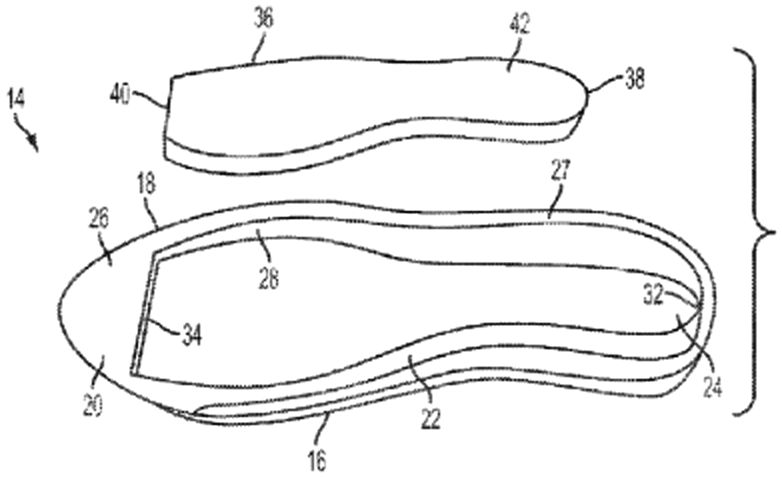
Components for articles of footwear and athletic equipment are provided including a foam. A variety of foams and foam components and compositions for forming the foams are provided. In some aspects, the foams and components including the foams can have exceptionally high energy return while also having improved durability and softness. In particular, midsoles including the foams are provided for use in an article of footwear. Methods of making the compositions and foams are provided, as well as methods of making an article of footwear including one of the foam components. In some aspects, the foams and foam components can be made by injection molding or injection molding followed by compression molding.
Foamed Injection Molded Article
Inventor(s): Gerrits, N. S. J. A., de Jonge, H. M. A., van Es, M. A., and Yanev, A.
Sources: US Pat. App. 20210139663
Corporate/Assignee: Sabic Global Technologies B.V.
The invention is directed to a foamed injection moulded article comprising a foam composition obtained by foaming high density polyethylene having a quotient of melt strength and apparent viscosity >2 cN/KPas wherein the melt strength is determined as described in ISO 16790:2005 and the apparent viscosity is determined as described in ISO 11443:2014.
Resin for Foam Molding, Foam Molded Article, and Method for Producing Foam Molded Article
Inventor(s): Someya, T. and Sano, T.
Sources: US Pat. App. 20210130563
Corporate/Assignee: Kyoraku Co. Ltd.
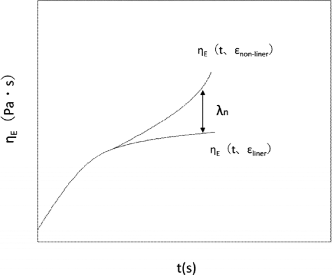
According to the present invention, provided is a foam molding resin containing low-density polyethylene, wherein a strain hardening degree of the low-density polyethylene is equal to or more than 0.40.
Compositions and Methods for Manufacturing Footwear Stiffeners
Inventor(s): Goldberg, B., Martell, D., and Provencher, L.
Sources: US Pat. App. 20210129482
Corporate/Assignee: Stanbee Company Inc.
A microcellular shoe stiffener has at least one adhesive layer coextruded with and carried on a stiffener core. A liquid, such as liquid nitrogen, is introduced into the extruder for the stiffener core to produce a closed cell foam with a gaseous component. The gas reduces the weight and cost of the stiffener with out significantly reducing stiffness and resiliency.
Polypropylene-Based Foam Particle, and Molded Article of Polypropylene-Based Foam Particle
Inventor(s): Ota, H. and Sakamura, T.
Sources: JP Pat.: 2021-028363
Corporate/Assignee: JSP Corp.
PROBLEM TO BE SOLVED: To provide foam particles capable of producing a molded article of foam particles having excellent strength when compressed and other characteristics such as moldability, and a molded article having excellent strength.
SOLUTION: There are provided polypropylene-based resin foam particles having an inner foam layer composed of a polypropylene-based resin (A) and an outer layer composed of a thermoplastic resin (B), and a molded article of polypropylene-based resin foam particles. The polypropylene-based resin (A) contains an ethylene-propylene-butene copolymer (a) having a butene component content of 7-20 mass% and a mass ratio (butene component content/ethylene component content) of the butene component content and an ethylene component content of 7 or more.
Styrene-Based Resin Foam Block
Inventor(s): Kido, S., Okamura, K., Kirihata, H., and Takeshima, T.
Sources: JP Pat.: 2021-024937
Corporate/Assignee: JSP Corp.
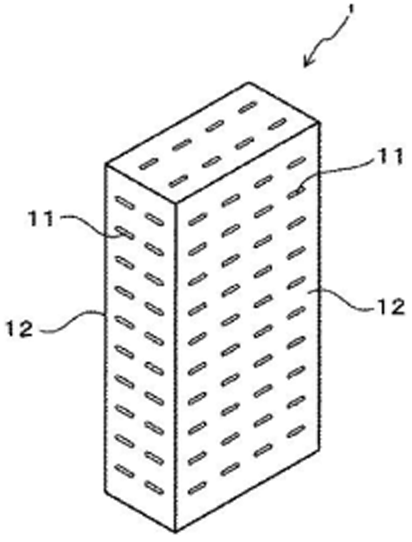
PROBLEM TO BE SOLVED: To provide a styrene-based resin foamed block that can shorten the curing period and is less likely to cause casting defects.
SOLUTION: A resin foamed block 1 is obtained by in-mold molding of styrene-based resin foam particles, and has a rectangular parallelepiped shape having a thickness of 400 mm or more. The spread area ratio Sdr(A) of the surface of the resin foamed block 1 is 0.03 or more and 0.10 or less. The fusion rate (C) at the center of the resin foamed block 1 is 70% or more, and the spread area ratio Sdr(B) is 0.01 or more and 0.05 or less. The ratio of the spread area ratio Sdr(A) to the spread area ratio Sdr(B), Sdr(A)/Sdr(B), is 1.0 or more. The average apparent density of the resin foamed block 1 is 10 kg/m3 or more and 100 kg/m3 or less.
Foamable Acrylic Resin Particles, Acrylic Resin Foaming Particles and Acrylic Resin Foaming Particle Mold
Inventor(s): Sumida, S. and Haraguchi, K.
Sources: JP Pat.: 2021-024885
Corporate/Assignee: JSP Corp.
PROBLEM TO BE SOLVED: To provide foamable acrylic resin particles, which has a high cohesiveness even inside foamable particle molds and are capable of suppressing shrinkage after cast molding, acrylic resin foaming particles produced by foaming the foamable particles, and acrylic resin foaming particle molds produced by cast molding of the foamable particles.
SOLUTION: The foamable acrylic resin particles comprise an acrylic resin, a foaming agent, and a carboxylic acid ester. The weight average molecular weight of the acrylic resin is 50,000 or more and 140,000 or less, and the glass transition temperature Tg1 is 112°C or more and 125°C or less. The boiling point of the carboxylic acid ester is higher than 130°C. The difference between the glass transition temperature Tg1 of the acrylic resin and the glass transition temperature Tg2 of the acrylic resin composition containing the acrylic resin and the carboxylic acid ester Tg1-Tg2 is 2°C or higher and 10°C or lower.
Polypropylene Resin Multilayer Foamed Sheet
Inventor(s): Umemori, M., Ichino, K., Yaso, Y., and Hotta, Y.
Sources: JP Pat.: 2021-014110
Corporate/Assignee: Japan Polypropylene Corp.
PROBLEM TO BE SOLVED: To provide a polypropylene resin multilayer foamed sheet for obtaining a polypropylene resin multilayer foam having uniform and fine foamed cells and good appearance of a molded article.
SOLUTION: There is provided a polypropylene resin multilayer foamed sheet which comprises a foam layer composed of a polypropylene resin composition for expansion molding containing 0.05 to 6.0 pts.wt. of a foaming agent based on 100 wt.% of a polypropylene resin composition (provided that the total of (X), (Y) and (Z) is 100 wt.%) comprising 67.5 to 2.5 wt.% of a polypropylene resin (X) having a specific long-chain branched structure, 2.5 to 67.5 wt.% of a propylene-based block copolymer (Y) which is a multistage polymer composed of a specific propylene (co)polymer (Y-1) and a propylene-ethylene copolymer (Y-2) and 10 to 65 wt.% of a specific propylene-α-olefin random copolymer (Z), a PP filler layer containing an inorganic filler and a surface layer composed of a thermoplastic resin composition.
Foam and Method to Produce the Same
Inventor(s): Tanaka, Y. and Tando, A.
Sources: JP Pat.: 2021-011551
Corporate/Assignee: DM Novafoam Ltd., Daiwabo Holdings Co. Ltd., and Daiwabo Co. Ltd.
PROBLEM TO BE SOLVED: To provide a polyol-containing composition, a foamable polyurethane composition and a polyurethane foam, achieving both of the stability of a foaming agent to a catalyst and excellent foaming properties.
SOLUTION: A polyol-containing composition for obtaining a foamable polyurethane composition by reacting with polyisocyanate, contains polyol, a foaming agent and a catalyst, the catalyst containing a carboxylic acid ammonium salt that is a quaternary ammonium salt of a carboxylic acid having 5 or more carbon atoms, a heterocyclic compound having a nitrogen atom, and a transition metal salt.
4-Methyl-1-Pentene Based Resin Foam and Method for Producing the Same
Inventor(s): Tanaka, Y., Kimura, Y., and Yagi, T.
Sources: JP Pat.: 2021-011550
Corporate/Assignee: DM Novafoam Ltd.
PROBLEM TO BE SOLVED: To provide a 4-methyl-1-pentene based resin foam which has a high expansion ratio.
SOLUTION: The present invention prepares a 4-methyl-1-pentene based resin foam which contains a 4-methyl-1-pentene based resin, while having an expansion ratio of 3 times or more. The limiting viscosity (η) of the 4-methyl-1-pentene based resin as measured in a decalin solvent at 135°C may be 0.5 to 5 dl/g. The 4-methyl-1-pentene based resin may have a glass transition temperature of 0°C to 80°C. The 4-methyl-1-pentene based resin may have a melting point. The 4-methyl-1-pentene based resin may be a 4-methyl-1-pentene/C2-20 α-olefin copolymer (in particular, a 4-methyl-1-pentene/C2-4 α-olefin copolymer). The 4-methyl-1-pentene based resin foam may have an expansion ratio of 10 times or more.
Multi-Layer Wearable Body Armor
Inventor(s): Barr, C. G. and Tannehill, J.
Sources: US Pat.: 11,015,904
Corporate/Assignee: Honeywell Federal Manufacturing & Technologies, LLC
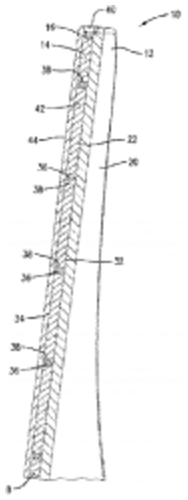
A multi-layer body armor plate includes a strike plate; a mesh layer positioned over the strike plate, the mesh layer having a number of open cells; and an outer skin layer positioned over the mesh layer so as to encapsulate the open cells of the mesh layer between the strike plate and the outer skin layer. The open cells of the mesh layer may entrap air or may be filled with expandable, buoyant foam.
Compressible Foam Foundations for Mattress Support
Inventor(s): Stewart Jr., J. D.
Sources: US Pat.: 11,006,762,
Corporate/Assignee: Mattress Angle, LLC
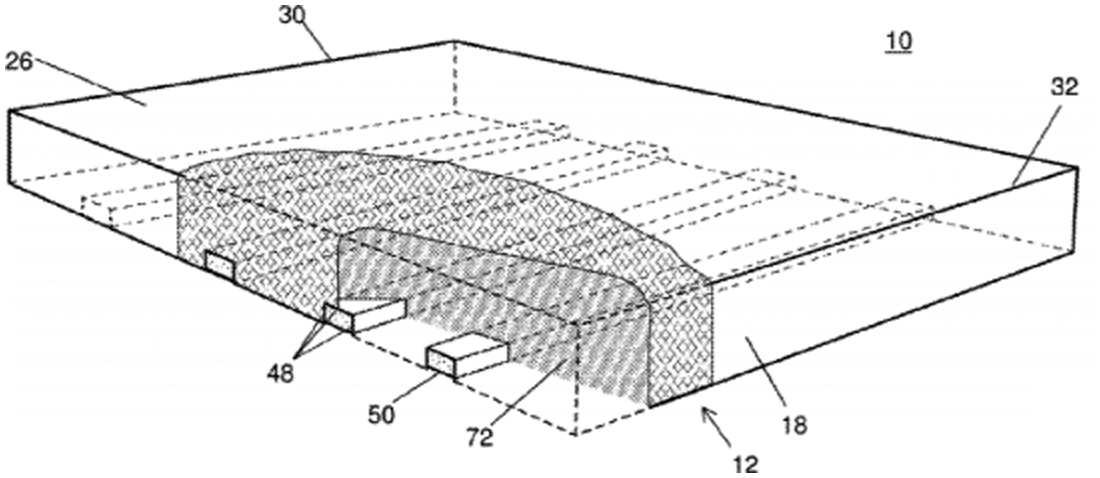
A foundation for a mattress is formed from one or more single-layer, unitary foam blocks with supports that extend across each foam block's bottom side. The supports provide crosswise support across a bed frame and can be directly attached to the foam block or may be provided in a kit or separately sourced. The foam block is rigid enough to support a mattress and is compressible so it has a compressed configuration and an expanded configuration, and its bottom side may have channels for the supports. In the compressed configuration, the foundation may be folded and vacuum-sealed in a plastic membrane which provides benefits for storing, shipping, and delivering the foundation. When the foundation is delivered to its place of use, the compressed foundation is removed from its packaging, allowing the foam block to return to its expanded configuration.
Acoustic Absorber
Inventor(s): Lee, T. and Iizuka, H.
Sources: US Pat.: 11,004,439
Corporate/Assignee: Toyota Motor Engineering and Manufacturing North America, Inc.
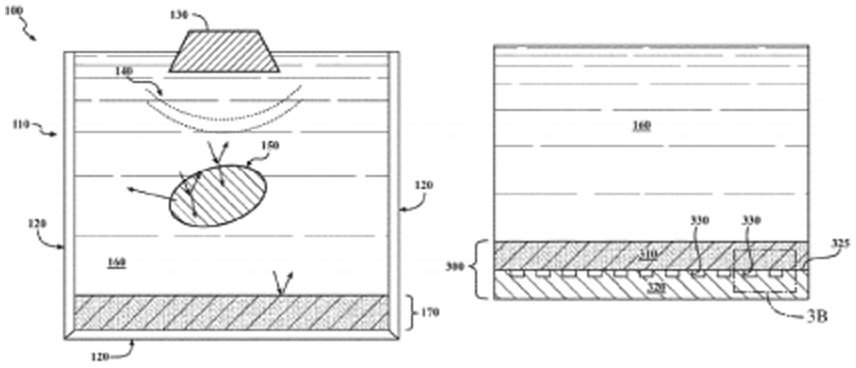
Acoustic measurement systems include an enclosure having a high efficiency yet very thin acoustic absorber coating portions thereof, in order to diminish background reflections. The thin acoustic absorber includes a reflective sublayer having a periodic array of indentations on its surface. The periodic array of indentations can be one-dimensional or two dimensional. The thin acoustic absorber further includes a thin absorbing layer overlaid on the reflective sublayer, and typically formed of a viscoelastic foam. The thin acoustic absorber possesses unprecedented absorption efficiency across a broad frequency range and at normal or oblique angles of incidence.
Vehicle Seat Core and Seat Pad
Inventor(s): Fukuta, A.
Sources: US Pat.: 11,001,180
Corporate/Assignee: Sekisui Plastics Co. Ltd.
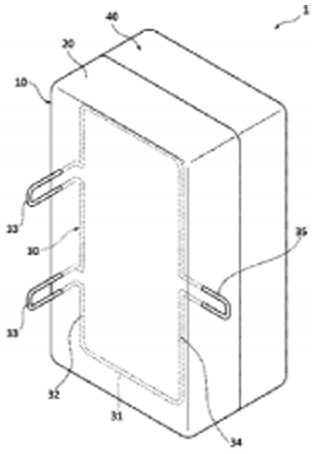
The present invention provides means for improving bondability between a vehicle seat core and a cushion in a vehicle seat pad formed by integration of them without significantly impairing mechanical properties. A vehicle seat core is characterized in that it is a vehicle seat core for forming a vehicle seat pad by integration with a cushion, which comprises a foamed resin molded body obtained by filling a cavity of a mold with a plurality of foamed resin particles and performing in-mold foam molding, and that at least a partial region of a surface of the foamed resin molded body to which the cushion is bonded when forming the vehicle seat pad has a surface expansion rate of 40% to 85%, and the foamed resin molded body has a first fusion rate of 95% or more or a second fusion rate of 60% or more.
Double-Sided Adhesive Tape Having Improved Impact Strength for Display Device
Inventor(s): Koo, T. W., Kim, D. S., Jo, C. W., Hong, S. H., Park, M. S., and Kim, T. H.
Sources: US Pat. App. 20210147716
Corporate/Assignee: Youngwoo Co. Ltd.
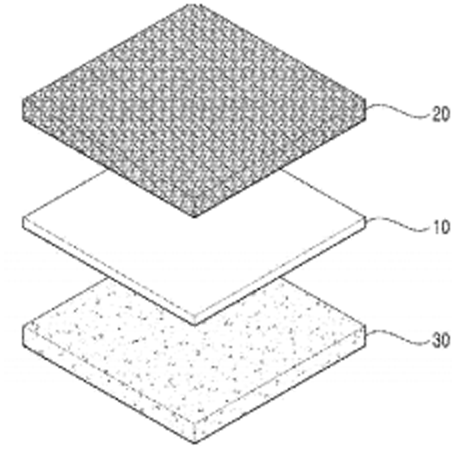
The present disclosure relates generally to a double-sided adhesive tape having improved impact strength for a display device. More particularly, the double-sided adhesive tape includes a base layer, a foam adhesive layer formed on one surface of the base layer and made of acrylic foam, and an adhesive layer formed on the other surface of the base layer. The double-sided adhesive tape having improved impact strength for the display device having the above structure in which the foam adhesive layer having excellent impact strength is formed, thereby suppressing occurrence of cracking on a glass surface of the display device due to external impacts and exhibiting an excellent waterproofing effect.
Composite Material for Wound Treatment
Inventor(s): Gardiner, E. S. and Paledzki, M.
Sources: US Pat. App. 20210138103
Corporate/Assignee: Molnlycke Health Care AB
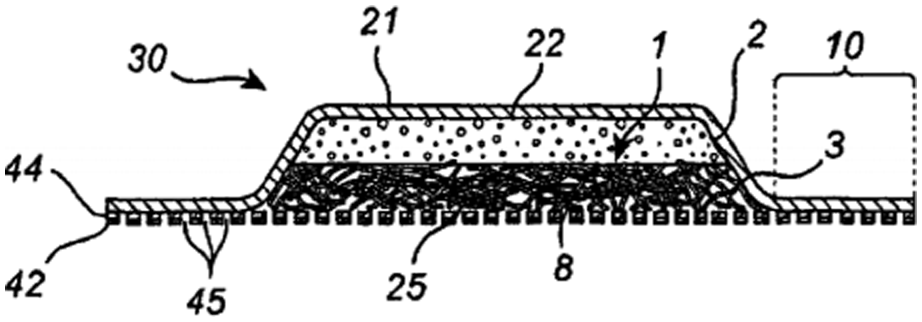
Disclosed is a method for making a composite material, which is of particular use in wound treatment. The composite material has a hydrophilic polyurethane foam material with a first polyurethane polymer; a hydrophilic fiber material having a second polymer, wherein said second polymer is not a polyurethane polymer and wherein said fiber material is capable of absorbing and retaining a fluid. The first polymer is covalently bonded to the second polymer.
Floor Sheet for Sports Facility
Inventor(s): Akashi, K.
Sources: JP Pat.: 2021-028442
Corporate/Assignee: Toli Corp.
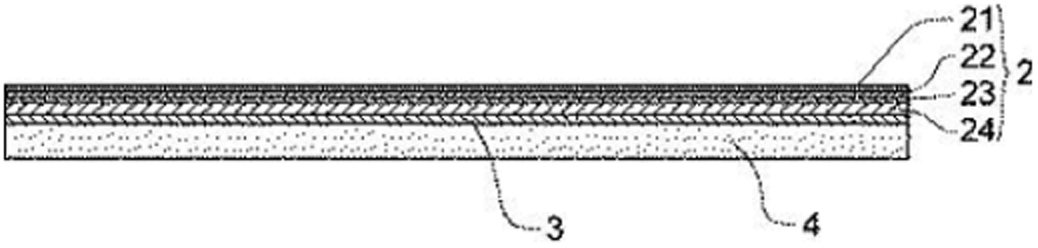
PROBLEM TO BE SOLVED: To provide a floor sheet for a sports facility excellent in impact absorption and ball repulsion while making the overall thickness relatively small.
SOLUTION: A floor sheet for a sports facility comprises, in order from the upper side, a laminated structure which has a non-foamed resin layer 2, a fiber reinforced layer 3 containing glass fibers, and a foamed resin layer 4 having a thickness of 2.9 mm to 5 mm, and has a ball rebound rate of 90% or more, and a G-value of 100 or less, and a thickness of 4 mm to 6 mm.
Double-Sided Adhesive Tape
Inventor(s): Hario, A. and Ishido, Y.
Sources: JP Pat.: 2021-028386
Corporate/Assignee: Sekisui Chem Co. Ltd.
PROBLEM TO BE SOLVED: To provide a double-sided adhesive tape having heat resistance and flexibility.
SOLUTION: The double-sided adhesive tape includes a foam substrate and adhesive layers on both surfaces of the foam substrate. The double-sided adhesive tape has a ratio (G'(110°C)/G'(90°C)) of the storage modulus G'(110°C) at 110°C to the storage modulus G'(90°C) at 90°C of 0.4 or more and a 25% compressive strength at -30°C measured according to JIS K 6254 of 400 kPa or less. The thickness of the double-sided adhesive tape is 0.6 mm or less.
Electric Wire or Cable
Inventor(s): Kuwajima, T.
Sources: JP Pat.: 2021-026895
Corporate/Assignee: Yazaki Energy System
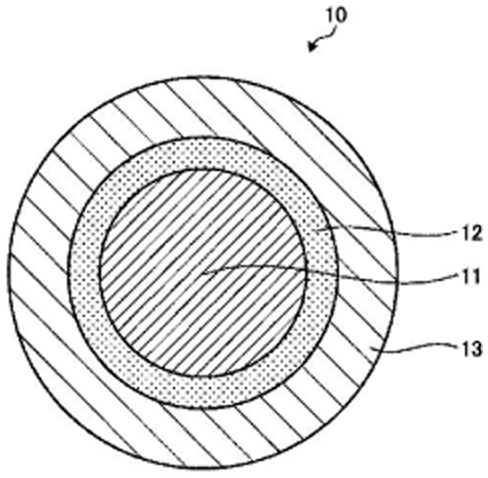
PROBLEM TO BE SOLVED: To provide an electric wire or a cable which is excellent in cutting up property, and improved in mechanical and electrical characteristics.
SOLUTION: An electric wire or a cable comprises a conductor and an insulation layer provided on a periphery of the conductor. The insulation layer is a foaming crosslinked polyolefin insulation layer obtained by using polyolefin and a chemical foaming agent, a physical foaming agent or a foaming microcapsule, the chemical foaming agent or the foaming microcapsule is included by an amount of 0.1 mass parts or greater and 2.0 mass parts or smaller to 100 mass parts of the polyolefin, or the physical foaming agent is mixed with the polyolefin in a uniform state. The insulation layer has a foaming ratio of 5% or greater and 30% or smaller, a foaming cell diameter is 150 μm or smaller, and cutting up force is 12 N/mm or smaller.
Foam Molding Die and Foam Molding Device
Inventor(s): Nakamura, Y.
Sources: JP Pat.: 2021-024215
Corporate/Assignee: Sanpo Kanagata Seisakusho KK
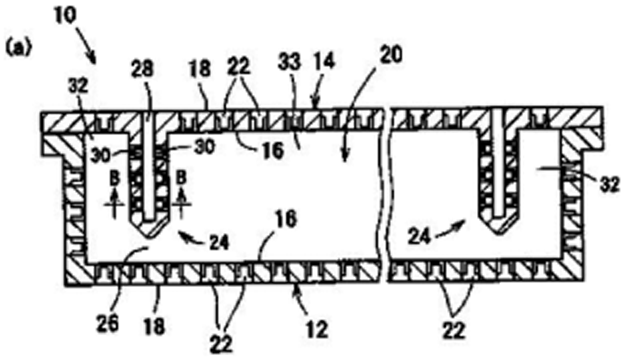
PROBLEM TO BE SOLVED: To provide a foam molding die capable of forming deep grooves simultaneously in a heat insulation plate in a manufacturing step of a heat insulation plate by foamable resin bead molding.
MEANS FOR SOLVING THE PROBLEM: A foam molding die 10 of the present invention is assembled with a first molding die 12 and a second molding die 14 which include a molding face 16 and a rear face 18 provided with first vapor holes 22 perforating the molding face 16 and the rear face 18. In a foam molding die for manufacturing a foamed molding by thermal blowing of foamable resin beads filled in a mold cavity 20 composed of the molding face 16 of the first molding die 12 and the molding face 16 of the second molding die 14, a projected line 24 projecting from the molding face 16 of one of the first molding die 12 and the second molding die 14 toward the other molding face 16 with a gap 26 therebetween is provided, an opening 28 for conducting a vapor to the projected line 24 from the rear face 18 in the projection direction of the projected line 24 is provided, and a second vapor hole 30 is provided on one or both sides of the opening 28.
Foamed Sheet Production Method
Inventor(s): Umemori, M., Hotta, Y., and Takahashi, K.
Sources: JP Pat.: 2021-014529
Corporate/Assignee: Japan Polypropylene Corp.
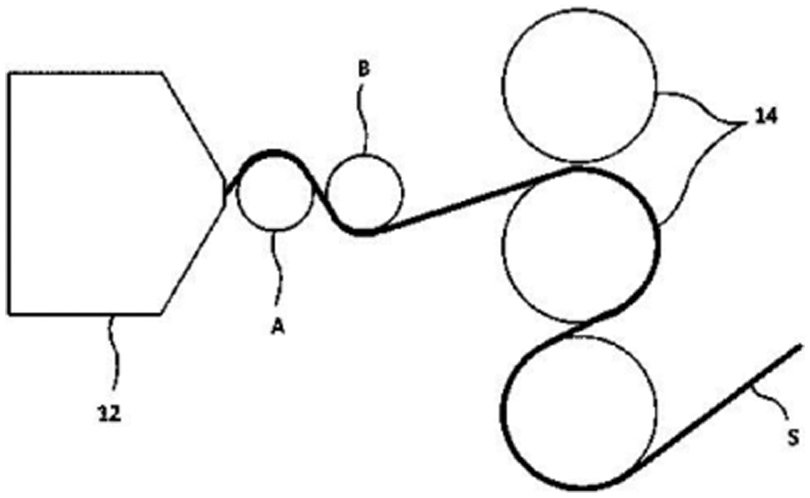
PROBLEM TO BE SOLVED: To provide a foamed sheet production method in which the tension of each portion in the process of taking off a resin sheet does not become excessive in extrusion foam molding using a T-die.
SOLUTION: A production method for foamed sheets includes an extrusion process of extruding the expandable resin sheets from an extruder equipped with a T-die and a cooling process of cooling the resin sheet. In the cooling process, the resin sheet is cooled by a first chill roll (A) disposed just after a die exit and having a drive mechanism, a take-up speed decision roll arranged rearward the first chill roll and deciding a resin sheet take-up speed, and one or more chill rolls (group)(B) arranged between the first cooling roll and take-up speed decision roll, and the resin sheet is taken off in such a state that a tension of the resin sheet does not become excessive.
Injection Molding System and Injection Molding Method
Inventor(s): Chen, C-H. and Yeh, L-H.
Sources: JP Pat.: 2021-014115
Corporate/Assignee: Otrajet Inc.
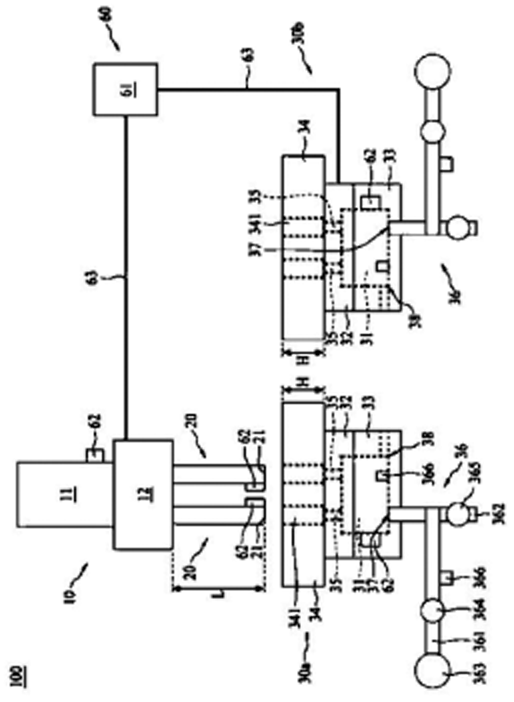
PROBLEM TO BE SOLVED: To provide an injection molding system and an injection molding method capable of increasing a production efficiency of a foamed polymer molded product.
SOLUTION: An injection molding system of the present invention includes: an extrusion system 10 configured to produce a mixture; a discharge channel 20 including a discharge port 21 that communicates with the extrusion system and is configured to discharge the mixture; and molding devices 30a, 30b configured to receive the mixture. Each molding device includes a hollow space 31 and a supply port 35 that is communicable with the hollow space and engages with the discharge port.
Process for Creating a Foam Utilizing an Antimicrobial Startch Within a Process for Manufacturing a Paper or Board Product
Inventor(s): Backfolk, K., Heiskanen, I., Saakkonen, E., Partti-Pellinen, K., and Siitonen, S.
Sources: US Pat.: 11,001,969
Corporate/Assignee: Stora Enso OYJ
The present invention relates to a new process for creating foam in a process for manufacturing a paper or board product. According to the present invention, certain types of antimicrobial starch is used in the creation of the foam.
Method of Manufacturing Flexible Insulating Element with Recycled Expanded Polystyrene Foam
Inventor(s): Hager, T. W.
Sources: US Pat. App. 20210156140
Corporate/Assignee: N/A
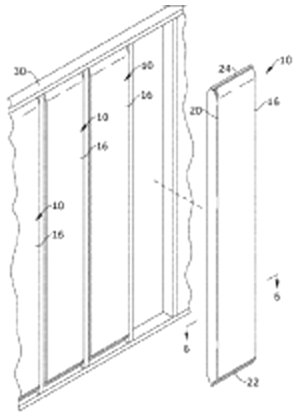
A method of recycling expanded polystyrene foam into flexible insulation elements that are made from 100% recycled material.
Compositions for Forming Enviromentally Friendly Polyhrethane Foam and Method for Manufacturing Polyurethane Foam
Inventor(s): Song, G. S., Yoo, S. H., Ryu, H., Park, H. M., and IM, J. S.
Sources: US Pat. App. 20210147609
Corporate/Assignee: SamYang Corp.
The present invention relates to a composition for forming an environmentally friendly polyurethane foam, the composition having improved storage stability, air permeability, and anti-oxidation characteristics and to a method for manufacturing a polyurethane foam and, more specifically, to an isocyanate pre-polymer prepared by reaction of a polyisocyanate and a polyol component comprising a bio-polyol, to a composition for forming an environmentally friendly polyurethane foam, the composition having improved storage stability, air permeability, and anti-oxidative characteristics by comprising the pre-polymer as one component, to a method for manufacturing a polyurethane foam using the same, and to an environmentally friendly polyurethane foam manufactured thereby.
Method of Pouring Polyisocyanurate Foam Directly onto a Facer to Improve Cell Orientation and Density Stratification
Inventor(s): Bombar, R., Machaalani, C., and Dodi, J. M.
Sources: US Pat.: 11,015,337
Corporate/Assignee: John Manville
A method of forming a polyisocyanurate foam board includes providing a polyol and adding an isocyanate to the polyol to form a polyisocyanurate foam. A first inner surface of a first facer material is treated with a first flow of hydroxyl containing molecules. A second inner surface of a second facer material is treated with a second flow of hydroxyl containing molecules. The polyisocyanurate foam is coupled to the first treated inner surface and the second treated inner surface such that the polyisocyanurate is sandwiched between the first facer material and the second facer material, thereby exposing opposing outer surfaces of the polyisocyanurate foam to the hydroxyl containing molecules. A density of a medial portion of the polyisocyanurate foam is greater than a density of the polyisocyanurate at the opposing outer surfaces.
Method, Apparatus and System for Producing a Polyurethane Sports Flooring
Inventor(s): Sick, S., Finder, Z., and Lohr, I.
Sources: US Pat.: 11,015,302
Corporate/Assignee: Polytex Sportbelage Produktions GmbH
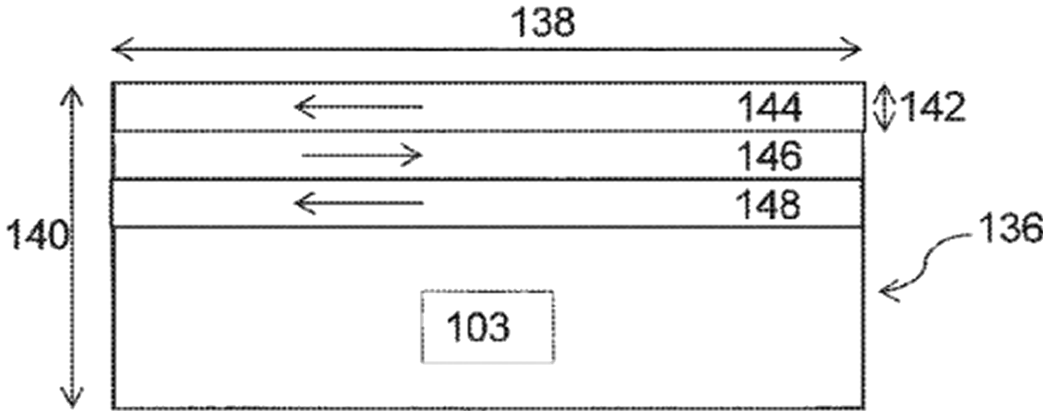
A method for producing polyurethane flooring includes providing polyurethane reactive components including a isocyanate component and a polyol component, determining environmental data, determining process parameters for mixing the polyurethane reactive components, wherein the process parameters depend on the environmental data, mixing the foam for the polyurethane flooring by mixing the isocyanate component and the polyol component using a froth foam process with the process parameters, applying a first lane of the liquid foam to a ground, applying a second lane of the liquid foam to the ground, wherein a side edge of the second lane gets in contact with a side edge of the first lane, wherein the process parameter are determined so that the foam of the first lane is not cured before applying the foam of the second lane. Furthermore, the invention relates to an apparatus and a system for producing a polyurethane flooring.
Flexible Polyurethane Foam Based on Polyoxymethylene-Polyoxyalkylene Block Copolymers
Inventor(s): Albach, R. and Stute, A.
Sources: US Pat.: 11,001,666
Corporate/Assignee: Covestro Intellectual Property and Co. VG
The present invention relates to a method for producing flexible polyurethane foams based on polyoxymethylene-polyoxyalkylene block copolymers. The invention also relates to the use of the flexible polyurethane foams thus produced and their use for producing furniture upholstery, textile inlays, mattresses, automobile seats, headrests, armrests, sponges, foam sheets for use in automobile parts such as roof linings, door panel upholstery, seat covers and technical components. The invention finally relates to a two-component system for producing flexible polyurethane foams.
Polyurethane Foam Forming Compositions
Inventor(s): Trimbos, Y. F. H., Duijisters, T., Boeykens, I., and Geboes, P.
Sources: US Pat. App. 20210155740
Corporate/Assignee: Soudal Turnhout BE
The present invention relates to the field of polyol components suitable for forming polyurethane foam, in particular two component polyurethane foam the resulting foams and methods for their production. The present inventors found gaseous hydrohaloolefin containing polyol components possessing improved shelf-life properties, in particular polyol components comprising a gaseous hydrohaloolefin blowing agent, a nitrogen catalyst and a tin catalyst, wherein the tin catalyst comprises a sulfur atom. The present inventors also found that the shelf-life is further improved if the nitrogen catalyst is at least partially protonated by reaction with an acid, such as an organic acid.
Foam Formulations
Inventor(s): Girotti, C. and Bandoli, A.
Sources: US Pat. App. 20210147611
Corporate/Assignee: Dow Global Technologies, LLC
Embodiments of the present disclosure are directed towards foam formulations that include a high functionality polyether polyol, an aromatic polyether polyol, an amine initiated aliphatic polyether polyol, and a diol.
A Process for Producing a Polyurathen Insole
Inventor(s): Liang, Z. P. and Zhong, Y. B.
Sources: US Pat. App. 20210139638
Corporate/Assignee: BASF SE
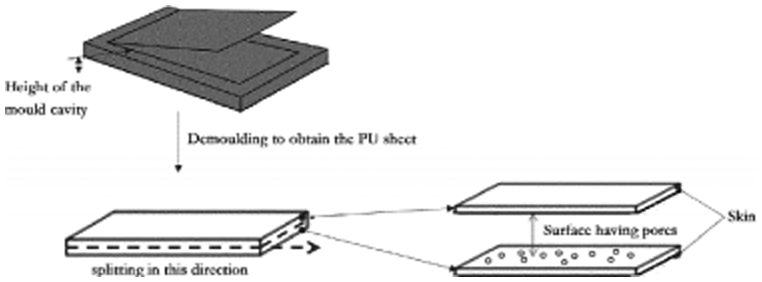
Described herein is a method for producing a PU foam insole, including the following steps of: (1) pouring the raw materials used to form a PU foam into a mould, reacting to obtain a PU sheet, where the height of the mould cavity is from about 1.0 to about 1.6 times of the total thickness of two finished insoles; (2) splitting the PU sheet into two halves in the horizontal direction to obtain two pieces of PU insole material, where one surface of the material has open pores, and the other surface of the material has a skin; and (3) attaching a piece of fabric onto the surface having open pores of the material obtained in step (2). Also described herein is a PU foam insole produced by the method.
Compression Set
Inventor(s): Landers, R., Hermann, D., Wessely, I. D., Ferenz, M., and Ziegler, R.
Sources: US Pat. App. 20210137276
Corporate/Assignee: Evonik Operations GmbH
What are described are shaped hot-cure flexible PU foam articles, preferably mattresses and/or cushions, wherein the hot-cure flexible polyurethane foam has been obtained by reaction of at least one polyol component and at least one isocyanate component in the presence of at least one compound of formula (1a) and at least one compound of formula (1b) and at least one blowing agent and at least one catalyst.
Composition Kit for Preparing Polyurethane Foam and Preparation Method and Application Thereof
Inventor(s): Zhao, S., Yuan, H., Lang, J., Xing, Y., and Kong, Y.
Sources: US Pat. App. 20210130565
Corporate/Assignee: Hefei Hualing Co. Ltd., Hefei Midea Refrigerator Co. Ltd., Midea Group Co. Ltd.
A composition kit for preparing a polyurethane foam and a preparation method and applications thereof are provided. The composition kit for preparing a polyurethane foam includes a first component and a second component. The first component and the second component are disposed in different containers respectively. The first component includes an organic isocyanate and a low boiling point foaming agent. The second component includes a polyol composition, a high boiling point foaming agent, a composite catalyst, water, and a silicone oil.
Shaped Pu Foam Articles
Inventor(s): Terheiden, A., Ruediger, L., Hermann, D., Kniss, J. G., Borgogelli, R., White, K., and Wessely, J. D.
Sources: JP Pat.: 2021-017596
Corporate/Assignee: Evonik Operations GmbH
PROBLEM TO BE SOLVED: To provide shaped PU foam articles suited very well to recover their original shape after compression over a period of at least 20 hours.
SOLUTION: Described herein are shaped PU foam articles, preferably mattresses and/or cushions, where the polyurethane foam is obtained by reaction of at least one polyol component and at least one isocyanate component in the presence of at least one compound of formula (1a) and at least one compound of formula (1b) and at least one blowing agent.
Raw Material Dispersion of Antimicrobial Polyurethane Foam Containing Zeolite and Chitosan Nanofibers
Inventor(s): Hongyuku, N. and Kambe, Y.
Sources: JP Pat.: 2021-017495
Corporate/Assignee: Sanyo Shikiso KK
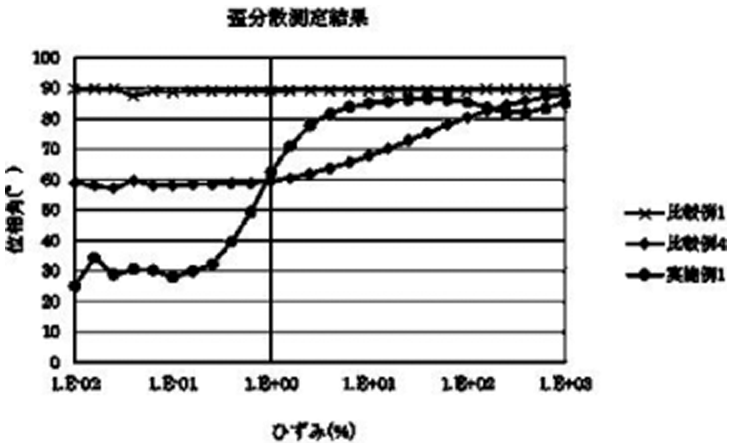
PROBLEM TO BE SOLVED: To provide a dispersion of a polyol or a surfactant for producing an antibacterial polyurethane foam, which is less likely to cause phase separation and discoloration by light irradiation.
SOLUTION: The present invention provides a dispersion, which is raw material of an antibacterial polyurethane foam, comprises: zeolite carrying a silver-based antibacterial agent; chitosan nanofibers; and a polyol, a nonionic surfactant, or a cationic surfactant. The chitosan nanofibers have the following properties: (a) a particle size of 400 coarse particles in 1 mL of 0.1 mass% aqueous solution as measured by a number counting type particle size distribution measuring apparatus is 50 μm or less and (b) a viscosity of a 2 mass% aqueous solution (20°C) at a shear rate of 1/sec is 500 mPa s to 50000 mPa s. A content of the chitosan nanofibers relative to a total mass of the dispersion is 0.3 mass% to 0.8 mass% (in the case of polyol) or 0.3 mass% to 1.2 mass% (in the case of nonionic surfactant or cationic surfactant).
Composition for Rigid Polyurethane Foam and Method for Producing Rigid Polyurethane Foam
Inventor(s): Nakajima, Y. and Ishikawa, Y.
Sources: JP Pat.: 2021-014480
Corporate/Assignee: Tosoh Corp.
PROBLEM TO BE SOLVED: To provide rigid polyurethane foam production of which does not involve complicated steps, which can be produced by a common foam production facility, and which shows little temporal deterioration of heat insulation performance.
SOLUTION: A composition for rigid polyurethane foam comprises a polyol composition (E) and an isocyanate group terminal prepolymer (F), in which the polyol composition (E) contains a phthalic acid-based polyester polyol and at least one selected from halogen-containing polyether polyols, the isocyanate group terminal prepolymer (F) is a reaction product of a specific isocyanate composition (G) and a diol (H), and the diol (H) contains a phthalic acid-based polyester diol and at least one selected from halogen-containing polyether diols.
Polyol-Containing Composition, Foamable Polyurethane Composition and Polyurethane Foam
Inventor(s): Kajita, M.
Sources: JP Pat.: 2021-011572
Corporate/Assignee: Sekisui Chem Co. Ltd.
PROBLEM TO BE SOLVED: To provide a polyol-containing composition, a foamable polyurethane composition and a polyurethane foam, achieving both of the stability of a foaming agent to a catalyst and excellent foaming properties.
SOLUTION: A polyol-containing composition for obtaining a foamable polyurethane composition by reacting with polyisocyanate, contains polyol, a foaming agent and a catalyst, the catalyst containing a carboxylic acid ammonium salt that is a quaternary ammonium salt of a carboxylic acid having 5 or more carbon atoms, a heterocyclic compound having a nitrogen atom, and a transition metal salt.
Method and Device for Producing a Foamed Particle Part
Inventor(s): Sommer, H., Kurtz, W., and Reuben, N.
Sources: US Pat.: 11,014,276
Corporate/Assignee: Kurtz GmbH
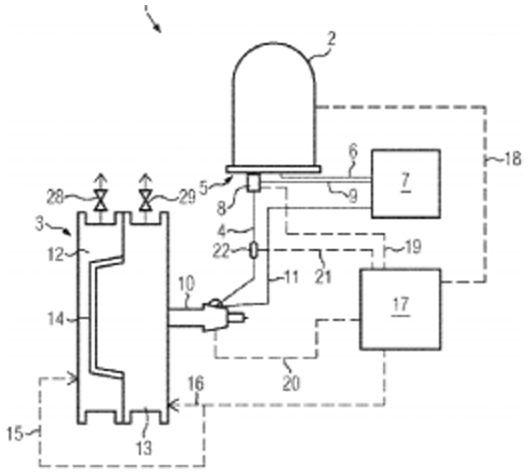
The invention relates to a method and an apparatus for the production of a foam particle part. The method comprises the following steps: feeding of foam particles from a material container to a mould by means of a pipe thermoplastic welding of the foam particles in the mould to make a foam particle part with the input of heat, wherein steam is added to the foam particles to be fed.
Method for Manufacturing Articles Utilizing Foam Particles
Inventor(s): Levy, C. R., Mace, R. A., and Schiller, D.
Sources: US Pat. App. 20210147650
Corporate/Assignee: Nike, Inc.
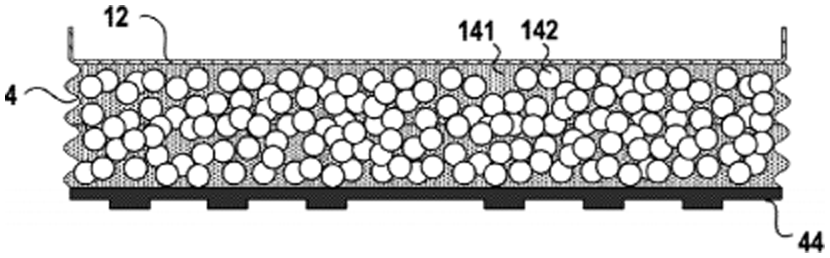
Methods for manufacturing components of articles, including articles of footwear, apparel, and sporting equipment are provided. The disclosed methods comprise extruding a first composition comprising a plurality of foam particles suspended in a first material, wherein each particle of the plurality of foam particles is formed of a foamed second polymeric material; and solidifying the extruded first composition, forming a component. Also disclosed are first compositions comprising a first material and a plurality of foam particles comprising a foamed second polymeric material suspended in the first material. Articles and methods of manufacturing articles using the disclosed methods and compositions are also provided. This abstract is intended as a scanning tool for purposes of searching in the particular art and is not intended to be limiting of the present disclosure.
Foamed Particle and Molded Particle of Foamed Particle
Inventor(s): Shima, M. and Nagaki, M.
Sources: JP Pat.: 2021-020980
Corporate/Assignee: JSP Corp.
PROBLEM TO BE SOLVED: To provide a molded product of foamed particle that exhibits conductivity or electrostatic diffusion, has little variation in surface resistance value, has good fusibility and is excellent in toughness and to provide a foamed particle that can produce the molded product of foamed particle.
SOLUTION: There are provided: a foamed particle having a foamed particle body and a carbon nanotube adhered to the surface thereof; and a molded product of foamed particle produced by in-mold molding of the foamed particle. The foamed particle body is produced by performing impregnation and polymerization of a styrene-based monomer in a polyethylene-based resin. The foamed particle body comprises, as a base material resin, a composite resin of a polyethylene-based resin and a polystyrene-based resin. The absorbance ratio D698/D2850 of an absorbance D698 at a wave number of 698 cm-1 to an absorbance D2850 at a wave number 2850 cm-1 on the surface of the foamed particle body is 1 to 8.
Integrated Molded and its Manufacturing Method
Inventor(s): Ogak, Y., Nagashima, R., and Sasaki, K.
Sources: JP Pat.: 2021-020355
Corporate/Assignee: JSP Corp.
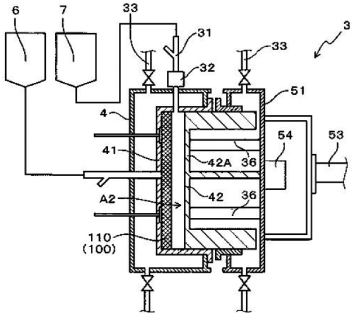
PROBLEM TO BE SOLVED: To provide an integrated molded body having a good appearance, and its manufacturing method.
SOLUTION: A cavity of a molding die is defined as a first molding space. The first molding space is filled with first thermoplastic polymer foamed particles 100. The first thermoplastic polymer foamed particles 100 have a foamed core layer using a thermoplastic polymer as a base material and an adhesive layer formed on its outer surface. The first thermoplastic polymer foamed particles 100 are heated by a heating medium to form an intermediate molded body 110. A second molding space A2 is formed between the intermediate molded body 110 and a molding die 42. The second molding space A2 is filled with second thermoplastic polymer foamed particles. The first thermoplastic polymer foamed particles 110 constituting the intermediate molded body 100 and the second thermoplastic polymer foamed particles are heated by a heating medium. Thus, an integral molded body is obtained.