






Abstract
Thermally expandable microspheres with a shell composed of acrylonitrile, methyl methacrylate, and isooctyl acrylate encapsulating isooctane were synthesized and employed as foaming agents to fabricate advanced polypropylene foam. A systematic comparison was conducted between the nucleating effect of these microspheres and the foaming performance of the conventional chemical foaming agent azodicarbonamide. Characterization via infrared spectroscopy, thermogravimetric analysis, scanning electron microscopy, and mechanical testing revealed that the thermally expandable microspheres exhibited well-controlled expansion behavior within the polypropylene matrix. Their maximum expansion temperature (185°C) aligned well with typical polypropylene processing temperatures. At an 8 wt% loading, the foam density decreased to 0.601 g/cm3, corresponding to a 32.2% reduction compared with polypropylene, while maintaining a moderate and uniformly distributed cell structure. Compared with the chemical foaming system, the polypropylene foamed with microspheres exhibited a more regular cellular morphology. The addition of a nucleating agent significantly enhanced the crystallinity of polypropylene, leading to improved impact and tensile strength. Moreover, the thermal conductivity of the foam was reduced to 0.090 W/m·K, achieving a balanced combination of lightweight characteristics and functional performance. This study confirms the efficacy of thermally expandable microspheres as foaming agents for polypropylene and demonstrates that their synergistic use with nucleating agents offers a promising strategy for producing low-density, high-performance foamed polypropylene. These materials show broad potential for applications in automotive lightweighting, building insulation, packaging cushioning, submarines, and aerospace.
Keywords
Highlights
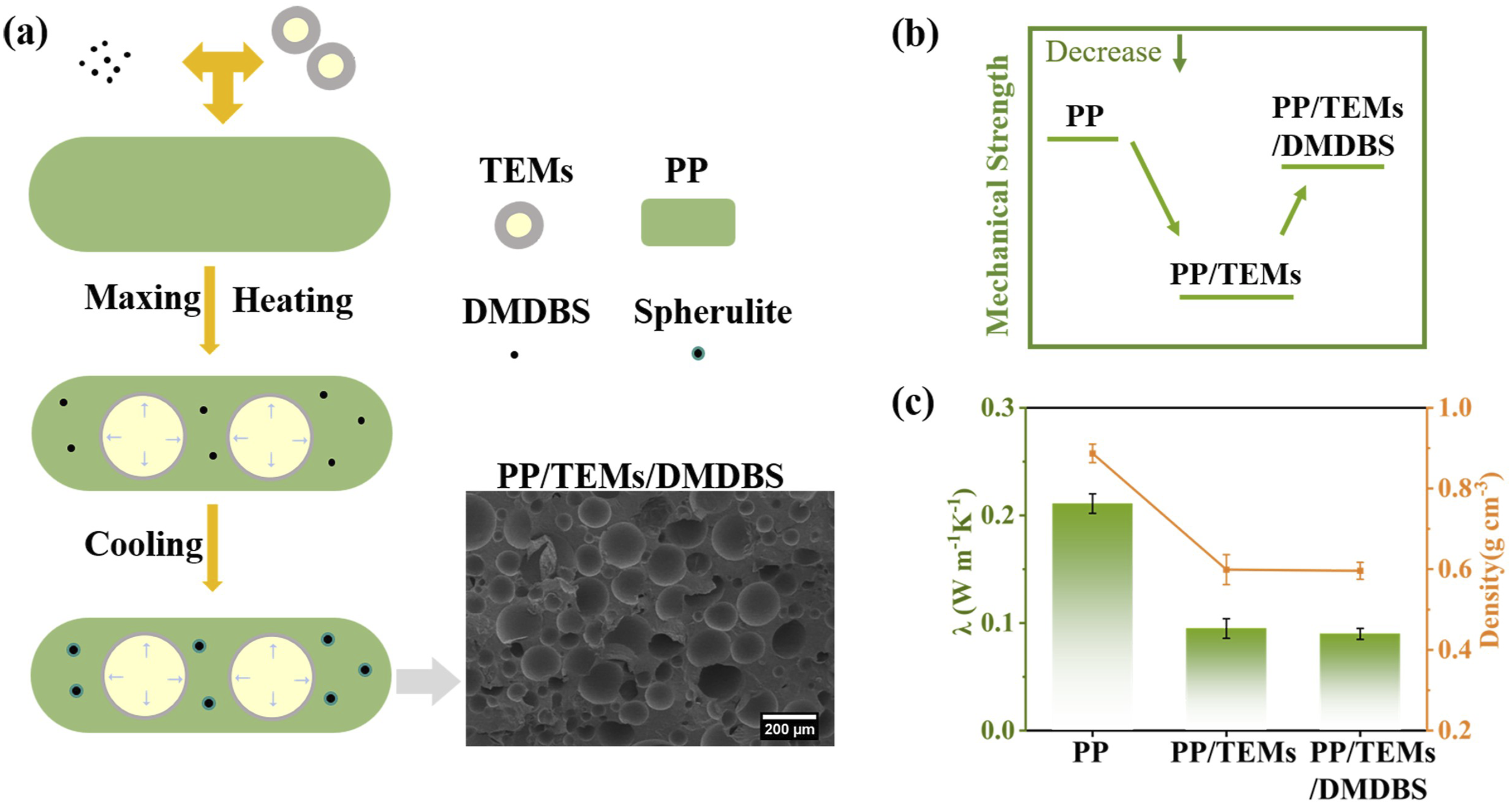
(1) Advanced PP foams were fabricated with thermally expandable microspheres (TEMs), which resulted in a uniform cell size distribution and a 32.2% reduction in density. (2) The synergistic effect of TEMs-DMDBS enhanced the crystallinity and mechanical properties of advanced PP, achieving a balance between lightweight and performance. (3) The thermal conductivity of advanced PP was reduced to 0.090 W/(m·K) mainly due to the result of uniform cell size.
Introduction
Polypropylene (PP) is one of the most widely produced and utilized thermoplastic polymers globally, valued for its well-balanced properties, excellent processability, cost efficiency, and recyclability. It plays a critical role across numerous industries, including packaging, automotive, home appliances, and consumer goods. In recent years, growing demands for lightweight materials, energy conservation, emissions reduction, and functional performance have driven research toward developing PP-based materials with reduced density,1–4 enhanced strength, and improved thermal and acoustic insulation.2,5 Among various strategies, foaming technology has emerged as a particularly effective approach to achieve these objectives. 6 By introducing a controlled cellular structure of micron-sized pores into the polymer matrix, foamed PP exhibits significantly lower density while offering notable advantages in cushioning, energy absorption, and thermal insulation.1,7,8 The substitution of conventional solid PP with its microcellular foamed counterpart not only reduces material consumption but also contributes to lower product weight and lifecycle energy use. Consequently, microcellular foamed PP holds considerable promise for advanced applications in automotive, aerospace, construction, industrial, and agricultural sectors.1,5,9,10
As a semi-crystalline polymer, PP presents notable challenges in the production of foamed materials.8,11,12 The foaming agent, as a core component of the PP foaming process, 7 critically determines key material characteristics including density, cellular morphology, crystalline structure, and mechanical performance. Although conventional chemical blowing agents such as azodicarbonamide (AC) are widely used, they often result in non-uniform cell structure and offer limited control over density. 13 On the other hand, thermally expandable microspheres 14 (TEMs), a class of unique physical blowing agents,15,16 offer benefits including steady, predictable expansion behavior and controllable particle size, creating new opportunities for the development of high-performance lightweight PP foams. TEMs are functional core-shell particles 17 that have attracted growing interest in recent years for applications ranging from polymer foaming15,18 to insulating coatings. 19 Their expansion mechanism arises from the synergistic interaction between a thermoplastic polymer shell and an encapsulated liquid alkane core: upon heating, the core volatilizes to generate internal pressure, which softens and expands the shell; subsequent cooling solidifies the structure and fixes the expanded volume.16,20 In recent years, research on the application of TEMs in the field of PP foaming has continued to advance. For example, Zhang et al. 21 successfully prepared PP/TEMs composite foams with a bimodal cell structure using two types of TEMs with different foaming temperatures. Compared to foams prepared using a single type of TEMs, these composite foams exhibited significant improvements in tensile strength, toughness, and elongation at break. Contreras et al. 22 optimized injection molding parameters and TEMs content using the Taguchi method, thereby achieving a balance between low density and high flexural modulus in foamed polypropylene; under the optimal parameter combination, the material density reached 0.834 g/cm3. Kawaguchi et al. 23 study showed that the use of TEMs in the foaming and extrusion of PP can reduce density by more than 30% while maintaining a smooth surface, but no study has examined changes in mechanical properties. Although TEMs have shown great potential in the preparation of PP foam materials, there are currently relatively few systematic studies on the thermal insulation properties of PP/TEMs systems, and how to further improve their comprehensive mechanical properties while maintaining low density remains an urgent scientific problem to be solved.
Based on this, the present study aims to investigate the relationship between the preparation, structure, and properties of lightweight foamed polypropylene composites using self-made TEMs as a foaming agent. The study will first conduct comprehensive chemical and thermodynamic characterization of the synthesized TEMs to accurately understand their microstructure and thermal expansion properties. Second, it will systematically analyze the influence of TEMs loading on the foaming behavior, microcellular morphology, bulk density, and mechanical properties of the PP composites, and optimize key process parameters during injection molding, such as mold temperature and injection pressure. To gain a deeper understanding of the advantages and disadvantages of different foaming systems and the mechanisms underlying performance enhancement, comparisons will be made with traditional AC foaming agents. Additionally, the nucleating agent 1,3:2,4-bis-O-(3,4-dimethylbenzylidene) sorbitol (DMDBS) will be introduced into the PP/TEMs system to regulate the crystallization behavior of the PP matrix, 24 thereby exploring the intrinsic relationship between pore structure, crystallization behavior, and thermal insulation performance. This study aims to provide in-depth theoretical insights and reliable experimental evidence for the development of next-generation high-performance, low-carbon-footprint PP/TEMs foamed materials, thereby promoting their widespread application in lightweighting fields such as the automotive and construction industries.
Experimental
Materials
Thermally expandable microspheres (TEMs) with a particle size of 56.15 μm and a density of 1.1333 g/cm3 were synthesized in the laboratory. Polypropylene (PP, grade EP540) was supplied by Kingfa Science & Technology Co., Ltd; its density and melt flow index were 0.89 g/cm3 and 9.27 g/10min (230°C/2.16 kg), respectively. Polyvinylpyrrolidone (PVP), acrylonitrile (AN), methyl methacrylate (MMA), and azodicarbonamide (AC), were purchased from Meryer. Magnesium chloride hexahydrate and hydrochloric acid were obtained from Sinopharm. Benzoyl peroxide (BPO) and 1, 6-hexanediol diacrylate (HDDA) were sourced from Aladdin Biochemical Technology Co., Ltd., China. Sodium chloride, sodium hydroxide, sodium nitrite, isooctyl acrylate (IOA), and isooctane were purchased from Shanghai Titan. N-Vinylpyrrolidone (NVP) was obtained from Energy Chemical. The nucleating agent 1, 3: 2, 4-bis-O-(3, 4-dimethylbenzylidene) sorbitol (DMDBS) was obtained from Ron Chemical Co., Limited. All materials were used as received without further purification.
Material preparation method
Sodium hydroxide and sodium chloride were dissolved in water to obtain Solution 1. Magnesium chloride hexahydrate, PVP, and sodium nitrite were dissolved in water to obtain Solution 2. Solution one was added dropwise into Solution 2 to serve as the continuous phase. Separately, isooctane, AN, MMA, IOA, BPO, and HDDA were mixed to form the dispersed phase. The dispersed phase was then added into the continuous phase, and the mixture was emulsified under stirring. After purging with nitrogen, the polymerization was carried out at 70°C under constant stirring for 20 h, followed by the addition of NVP and further reaction at an elevated temperature for 2 h. Upon completion of the polymerization, the pH was adjusted to acidic conditions. The resulting product was filtered, washed, and dried to obtain TEMs.
PP and TEMs were first dried in a forced-air oven at 60°C for 6 h to eliminate moisture. Subsequently, according to the prescribed formulation, a measured amount of PP was blended with a predetermined quantity of the microspheres until a homogeneous dispersion was achieved, ensuring a stable composite mixture. The compounded material was then injection-molded using a micro-injection molding machine to fabricate standard foamed PP test specimens. Key processing parameters, including temperature and pressure, were carefully optimized to promote complete expansion of the microspheres and to guarantee that the specimens met the required quality standards for subsequent testing.
Characterization methods
Particle size and size distribution were studied using a laser particle size analyzer (PSA1190 L, Anton Paar). The encapsulation content of the foaming agent was measured by thermogravimetric analysis (TGA, NETZSCH Instruments). Samples were heated from 50°C to 650°C at a rate of 20°C/min under a nitrogen atmosphere. DSC curves were measured using NETZSCH’s DSC instrument. The phase transition temperatures of the foaming agent were determined from the DSC curves. Infrared (IR) spectra were measured using a Nicolet 8700 (USA) Advanced Fourier Transform Infrared Spectrometer. IR spectra of the product microspheres were acquired using the ATR method. The volume-average particle size and particle size distribution of the microspheres were measured by a laser particle size analyzer. The particle size dispersion index (D90-D10)/D50 was calculated. The results indicated that a smaller particle size distribution corresponded to a narrower dispersion. Wide-angle X-ray diffraction (WXRD) patterns were recorded using an X-ray diffractometer with Cu Kα radiation (λ = 1.54 Å) in the 2θ range of 5–40°, at a scanning rate of 5°/min.
Particle morphology, cross-sectional morphology of injection-molded samples, and morphology after potassium permanganate etching were observed using scanning electron microscopy (SEM, Hitachi S-4800).
Additionally, SEM images were analyzed using software (ImageJ) to calculate the bubble density of the samples. The bubble density N0 represents the number of bubbles per unit volume in the composite material and is calculated as follows:

A: Area of SEM image (cm2), n: Number of bubbles counted in the image, M: Magnification of the image,
Tensile tests were conducted at a tensile speed of 5 mm/min in accordance with GB/T 1040.2-2022. Three-point flexural tests were performed at a crosshead speed of 2 mm/min according to GB/T 9341-2008. Notched cantilever beam impact performance tests were conducted using an impact testing machine per GB/T 1843-2008. Five measurements were taken for each sample to ensure data repeatability. Injection-molded foamed PP composite samples were tested using a solid density meter.
Calculated using the formula:



RTS: Relative tensile strength, RFS: Relative flexural strength, RIS: Relative impact strength, TS PP : Tensile Strength of PP, TS fPP : Tensile Strength of foamed PP, FS PP : Flexural Strength of PP, FS fPP : Flexural Strength of foamed PP, IS PP : Impact Strength of PP, IS fPP : Impact Strength of foamed PP.
The thermal diffusivity (α) was measured at 30°C using a laser flash thermal conductivity analyzer (LFA-467, NETZSCH, Germany). Prior to testing, samples were cut into 1 cm squares and coated with a thin layer of graphite on both sides to enhance laser absorption. For each sample, three distinct points were selected, and three replicate measurements were performed to minimize experimental error. Sample thickness was determined using a micrometer with an accuracy of ±0.5 μm, with three measurements per sample to ensure data reliability. Specific heat capacity (Cp) was evaluated via the sapphire method using differential scanning calorimetry (DSC, 204F1, NETZSCH, Germany).
Calculated using the formula:

Results and discussion
Structural and performance analysis of high-temperature resistant thermally expandable microspheres
The infrared spectrum presented in Figure 1(a) exhibited characteristic peaks consistent with the chemical structure of the thermally expandable microspheres (TEMs). This agreement confirmed the success of the polymerization process. In the spectrum of the TEMs, an absorption band at 2240 cm-1 corresponded to the stretching vibration of the –C≡N group. This feature verified the incorporation of acrylonitrile (AN) into the copolymer network. A strong and well-defined peak at 1728 cm-1 was assigned to the C = O stretching vibration of ester moieties derived from both methyl methacrylate (MMA) and isooctyl acrylate (IOA). The presence of this peak confirmed the successful copolymerization of these two monomers. The lactam carbonyl group of N-vinylpyrrolidone (NVP) gave rise to a characteristic doublet between 1680 cm-1 and 1700 cm-1 as a result of vibrational coupling. Observation of this doublet in the TEMs spectrum demonstrated the effective inclusion of NVP. A broad absorption centered near 2955 cm-1 originated from C–H stretching vibrations associated with CH2–CH2 units, the long alkyl chains of IOA, and the encapsulated isooctane blowing agent. Further evidence for the incorporation of IOA and the successful entrapment of isooctane was provided by the splitting of the methyl bending vibration in the 1460-1370 cm-1 region. This splitting pattern is characteristic of the isooctyl group. Overall, the FTIR analysis identified all expected structural signatures of the TEMs and confirmed the efficiency of the polymerization and encapsulation processes. Characterization of TEMs: (a) FTIR spectrum; (b) DSC thermogram; (c) TG/DTG curves; (d) Particle size distribution; (e) SEM image of unexpanded microspheres; (f) SEM image of expanded microspheres; (g) Visual comparison of microsphere volume before and after thermal expansion; (h) Optical microscopy image of unexpanded microspheres; (i) Optical microscopy image of expanded microspheres.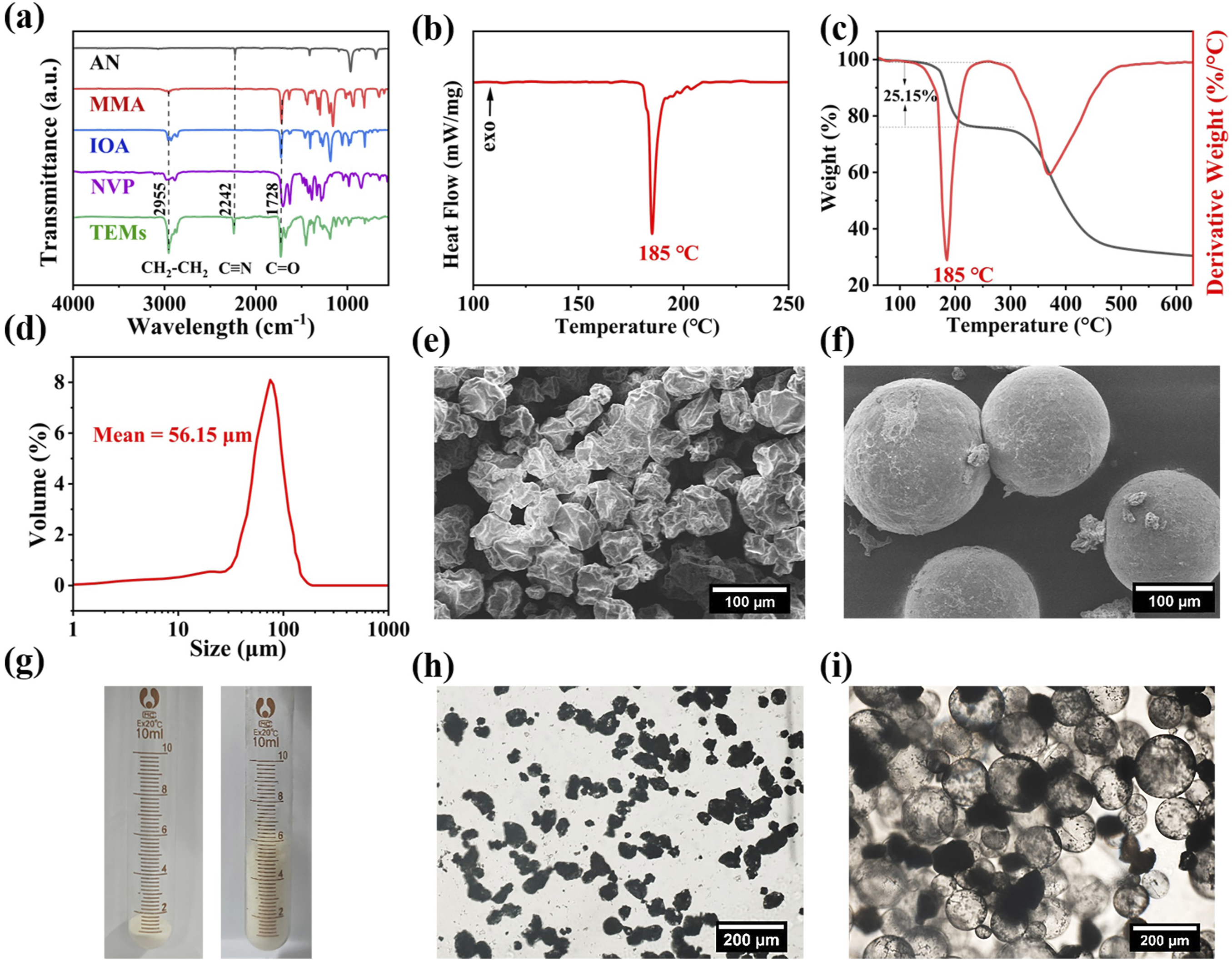
Figure 1(d) and Table S1 presented the particle size distribution of the TEMs. The median diameter (D50) was determined to be 55.67 μm, and the volume-average particle size was 56.15 μm. The particle size dispersion index (PDI), calculated as (D90-D10)/D50, was found to be 1.07, which indicated a narrow size distribution. These results confirmed that the synthesized microspheres possess uniform dimensions and a moderate particle size, rendering them suitable for subsequent foaming applications.
Thermogravimetric analysis (TGA) was used to further investigate the expansion behavior and thermal stability of the microspheres. As shown in Figure 1(c), two distinct weight-loss stages appeared during the heating process. The first stage, which occurred between 145°C and 230°C, was primarily ascribed to the release of the encapsulated n-octane blowing agent. This initial mass loss corresponded to volatilization of the alkane compound and marked the expansion phase of the microspheres. The measured mass loss in this region indicated an encapsulation efficiency of 25.15 % for the foaming agent. This result confirmed the successful entrapment of iso-octane within the polymer shell during synthesis. The second weight-loss stage, which occurred above 300°C, corresponded to the thermal degradation of the polymer shell constituents. The relatively high decomposition temperature observed in this stage reflects the excellent high-temperature stability of the microsphere shell material.
Comparison of the SEM obtained before and after heating (Figure 1(e), 1(f)) with the corresponding thermal stage microscopy images (Figure 1(h) and (i)) revealed a pronounced morphological transformation. At room temperature, the microsphere shell comprised AN, MMA, IOA, and hydrogen-bonding polar monomer units. Strong intermolecular interactions within this composition imparted high rigidity to the shell. Consequently, the microspheres underwent non-uniform contraction during cooling, which produced a rough surface, an irregular shape, and characteristic wrinkles. Upon heating, the microspheres exhibited substantial expansion, with the diameter increasing by 300% to 500%. A statistical analysis of the expanded microsphere diameters in Figure 1(i) was performed, and the results are presented in Figure S1. The average diameter of the expanded microspheres was 238.12 μm, a value approximately 4.24 times greater than the initial pre-expansion diameter of 56.15 μm. Concurrently, the microsphere surface became smoother and its overall morphology approached that of a regular sphere. This evolution confirmed the thermal response mechanism inherent to the core–shell architecture. During heating, the internal blowing agent vaporizes and generates expansion pressure, while the polymer shell traverses its glass transition temperature, shifting from a rigid state to a viscoelastic state. This transition permits controlled volumetric expansion while preserving the structural integrity of the shell. 25
Heating 0.1 g of TEMs from room temperature to 190°C at a rate of 10°C/min produced a pronounced volumetric increase. As shown in Figure 1(g), the foamed volume reached approximately six times that of the original sample. Hot-stage microscopy observations (Figures 1(h) and 1(i)) further confirmed a uniform expansion process. The characteristic expansion temperatures were derived by integrating the hot-stage microscopy data (Figures 1(h) and 1(i)) with the DSC trace (Figure 1(b)) and the TG curve (Figure 1(c)). The onset expansion temperature (Tstart) was determined to be 142°C, the maximum expansion temperature (Tmax) was 185°C, and the expansion termination temperature (Tf) was 230°C.
Effect of TEMs content on the properties of foamed polypropylene materials
Differential scanning calorimetry analysis of PP revealed a melting point of approximately 170°C (Figure S2a). The synthesized TEMs exhibited a maximum expansion temperature (Tmax) of 185°C. This value falls within the typical processing window of PP and therefore confirms the compatibility of the TEMs with PP-based processing. Thermogravimetric analysis of PP (Figure S2b) indicated an onset decomposition temperature near 400°C. This temperature substantially exceeds the conditions commonly encountered during fabrication. Consequently, the thermal stability of PP under the intended processing conditions is affirmed.
A series of PP foams were prepared with varying TEMs contents as the blowing agent, and their mechanical properties were systematically evaluated. An increase in TEMs content was accompanied by a pronounced decrease in composite density. As shown in Table S2 and Figure 2(a), neat PP exhibited a density of 0.887 g/cm3. The incorporation of 12 wt% TEMs reduced the density to 0.585 g/cm3. This change corresponded to a density reduction of 34.1% Relationship between TEMs content and density and relative mechanical properties of foamed PP composites.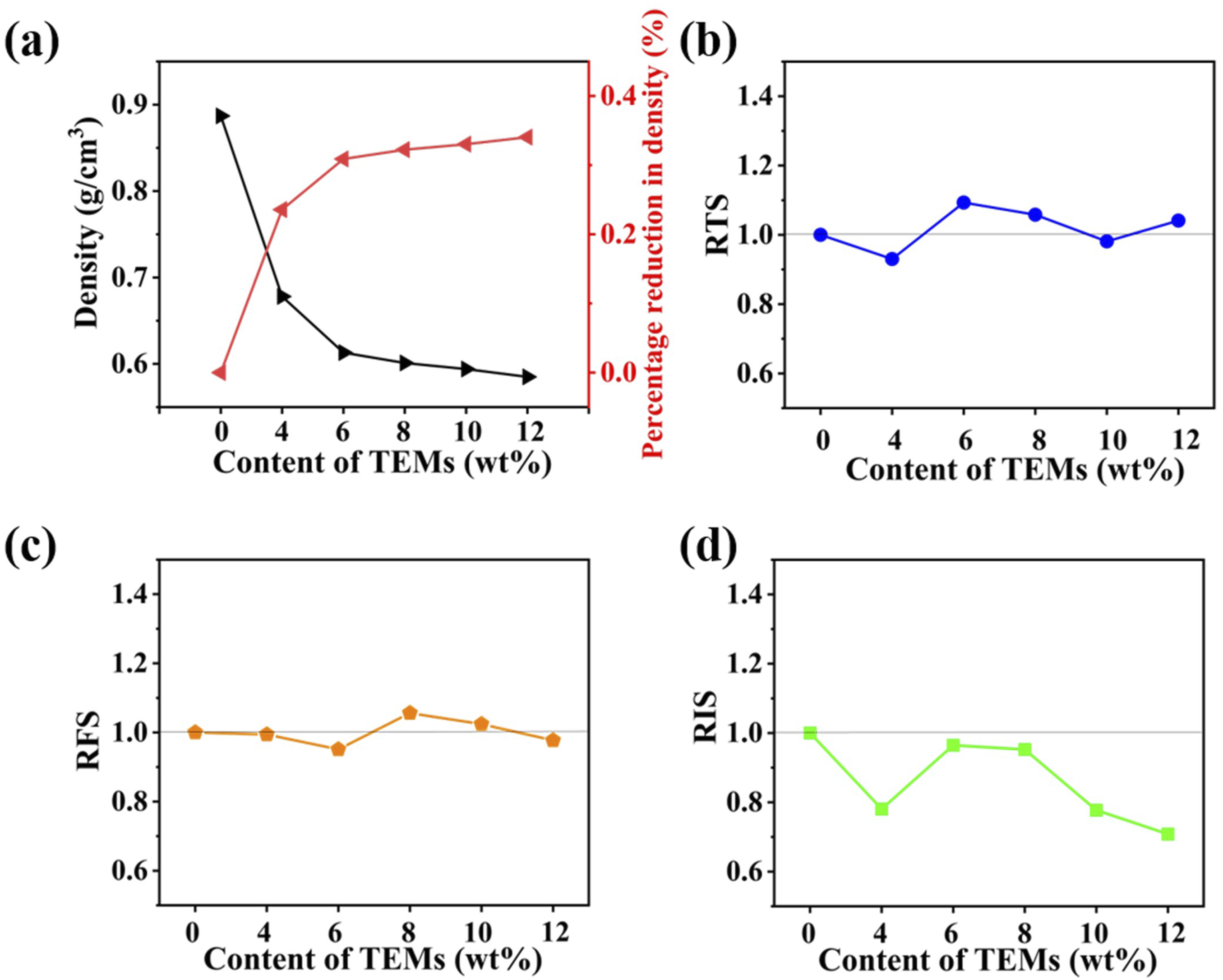
Figure 2 illustrates the influence of TEMs content on the mechanical properties of the foamed PP composites. The material density decreased consistently as the TEMs content increased. This trend was accompanied by marked reductions in tensile strength, flexural strength, and impact strength. The loss of mechanical performance was attributable to two primary factors. First, the processing conditions and foaming agents may have generated an inhomogeneous cell structure with irregular or agglomerated pores, a phenomenon commonly observed in polymeric foams. These enlarged cells act as stress concentrators and preferential sites for crack initiation, thereby impairing overall mechanical integrity. Second, PP is a semi-crystalline polymer whose mechanical properties depend strongly on its crystalline morphology (Figure 5d). The presence of TEMs disrupted the orderly alignment of molecular chains during crystallization. This disruption hindered crystal growth and perfection and consequently diminished mechanical strength.
The relative tensile strength, flexural strength, and impact strength were calculated from the experimentally measured data for foamed PP with varying TEMs contents. These results are presented in Figure 2. As shown in Figure 2(b), the relative tensile strength initially increased with TEMs content and reached a maximum at 6 wt%. This enhancement was attributed to the uniform dispersion of the microspheres and to the bridging effect exerted by their shells. Both factors improve stress transfer within the matrix. Beyond this optimum content, the tensile performance declined. This decline resulted from a reduced effective load-bearing area and intensified stress concentration around the pores. As illustrated in Figure 2(c), the relative flexural strength peaked at a TEMs loading of 8 wt%. At this content, the cellular structure approached a homogeneous, honeycomb-like arrangement that effectively distributes flexural stresses. Deviations from this loading level introduce structural inhomogeneity and consequently lower the flexural performance. The relative impact strength, shown in Figure 2(d), remained close to that of neat PP within the 6-8 wt% TEMs range. In this window, impact energy is absorbed through deformation of the bubble walls and through the inherent toughness of the microsphere shells. When the TEMs content reached 12 wt%, however, a higher density of defects and pronounced stress concentration led to a significant deterioration of impact resistance.
Figures 3b–f presented SEM micrographs of the foamed PP composites containing 4 wt%, 6 wt%, 8 wt%, 10 wt%, and 12 wt% TEMs. The images revealed a clear increase in cell density as the TEMs content increased. The corresponding statistical analyses of cell sizes for these composites were provided in Figures. 3(h–l). For comparison, the cross-section of neat PP (Figure 3a) appeared dense and featureless and showed no discernible pores. At 4 wt% TEMs (Figure 3b), a small number of isolated cells began to appear. The cell density continued to rise as the loading increased to 12 wt% (Figure 3f). The most uniform cell structure was achieved at a loading of 8 wt% (Figure 3d). At 12 wt%, however, localized cell coalescence and compression became evident. This trend can be explained by the role of TEMs as nucleation sites. An increase in TEMs content directly raises the initial number of cells. An excessively high concentration, however, leads to insufficient inter-particle spacing. During thermal expansion, the closely packed microspheres impinge upon and fuse with neighboring cells, a process that degrades the integrity and uniformity of the cellular structure. Cross-sectional SEM images (a–f) and cell diameter distributions (h-l) of foamed PP samples with different TEMs contents; (g) variation in cell sizes and cell density.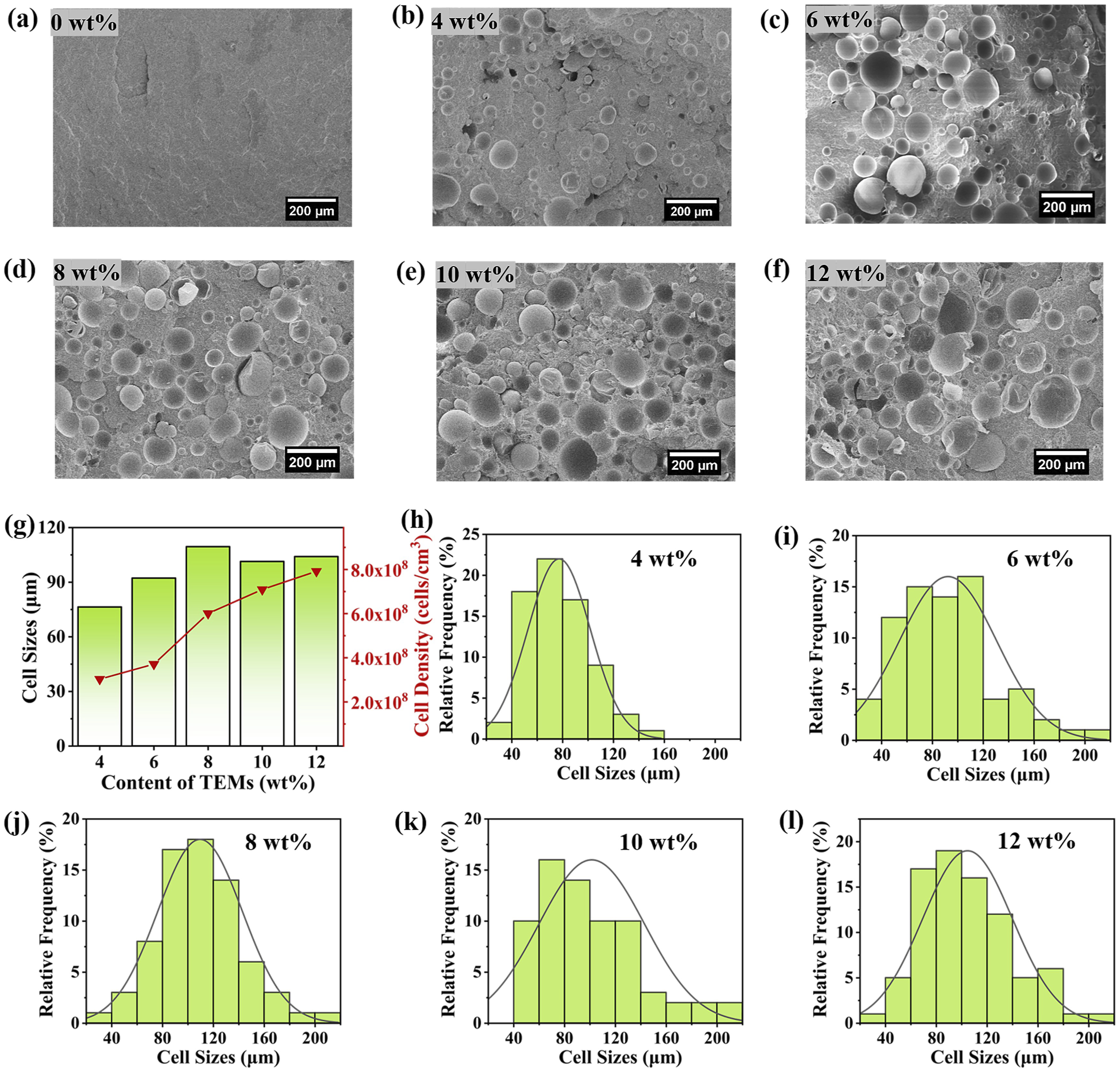
Based on the comprehensive analysis, a TEMs loading of 8 wt% was identified as the optimal formulation for the PP foam composites. At this concentration, the material achieved a substantial reduction in density, reaching 0.601 g/cm3, which corresponded to a decrease of 32.2% relative to neat PP. Microscopically, the foam exhibited a well-distributed cellular structure with moderate cell density, and no observable defects were detected. Regarding mechanical performance, the composite retained high relative tensile strength (1.058), relative flexural strength (1.056), and relative impact strength (0.952). These results demonstrated an effective balance between weight reduction and overall property retention. The findings provide critical theoretical and experimental support for the practical application of foamed PP. They further demonstrate that the optimized use of TEMs enables the fabrication of lightweight PP foams with well-preserved comprehensive properties.
Effect of processing conditions on the properties of foamed polypropylene materials
The macroscopic behavior of a foam directly reflects its underlying cellular morphology. Microstructural characteristics, which include cell size, cell distribution, and cell wall integrity, are critically determined by injection molding parameters, most notably temperature and pressure. 26 These processing conditions govern the expansion dynamics of the TEMs, the melt rheology of the PP matrix, and the interfacial interactions between the two phases. The data presented in Table S3 demonstrated that injection temperature exerted a pronounced effect on both foam density and the resulting mechanical properties. A distinct optimal temperature range was identified within which expansion efficiency and structural uniformity are effectively balanced.
The expansion of microspheres is fundamentally driven by the vaporization of the encapsulated alkane solvent. Foaming initiates when the internal gas pressure exceeds the external pressure imposed by the surrounding polymer melt. The expansion ratio of the resulting bubbles correlates positively with internal gas pressure and increases significantly with a reduction in external pressure or an extension of expansion time. During the injection molding trials, microsphere expansion was initially suppressed within the high-pressure feedstock zone. Upon injection into the mold cavity, the rapid pressure drop created a favorable condition for expansion. Nevertheless, the concurrently lower temperature increased the melt viscosity and reduced the internal pressure of the microspheres, thereby restraining bubble growth. Consequently, precise control of melt temperature emerges as the critical determinant for achieving optimal microsphere expansion.
An increase in the injection temperature minimized the temperature differential between the polymer melt and the blowing agent, which promoted higher internal bubble pressure. Concurrently, the associated reduction in melt viscosity enhanced microsphere expansion, leading to a higher expansion ratio and ultimately yielding lower-density products. However, when the temperature exceeded a critical threshold, excessive bubble expansion resulted in markedly thinner cell walls. During mold filling, these attenuated walls became susceptible to rupture and collapse under shear stresses. This phenomenon significantly reduced the population of intact cells and consequently increased the final foam density. SEM observations of the foamed PP microstructure, presented in Figure S3, corroborate this mechanism and illustrate the distinct morphological evolution induced by varying injection temperatures.
As shown in Figure 4a and Figure S3, within the injection temperature range of 190 to 200°C, the foamed PP exhibited a high density of uniformly distributed fine cells. When the temperature was increased to the range of 210 to 220°C, the cell population decreased markedly, the size distribution broadened, and large irregular pores appeared. At 220°C, partial collapse and coalescence of the microspheres were evident, which further reduced bubble density. By 230°C, structural integrity deteriorated substantially. Gas escape led to localized matrix densification, which in turn altered the mechanical response of the material. As summarized in Figure 4b, the relative tensile strength, flexural strength, and impact strength derived from experimental measurements all attained their maximum values at an injection temperature of 200°C. This outcome indicates the existence of an optimal processing window that effectively balances cellular morphology and mechanical performance. (a) Variation in cell diameter and cell density of foamed PP material at different injection temperatures; (b) Variation in relative mechanical properties of foamed PP composite material at different injection temperatures; (c) Variation in relative mechanical properties of foamed PP composite material at different injection pressures.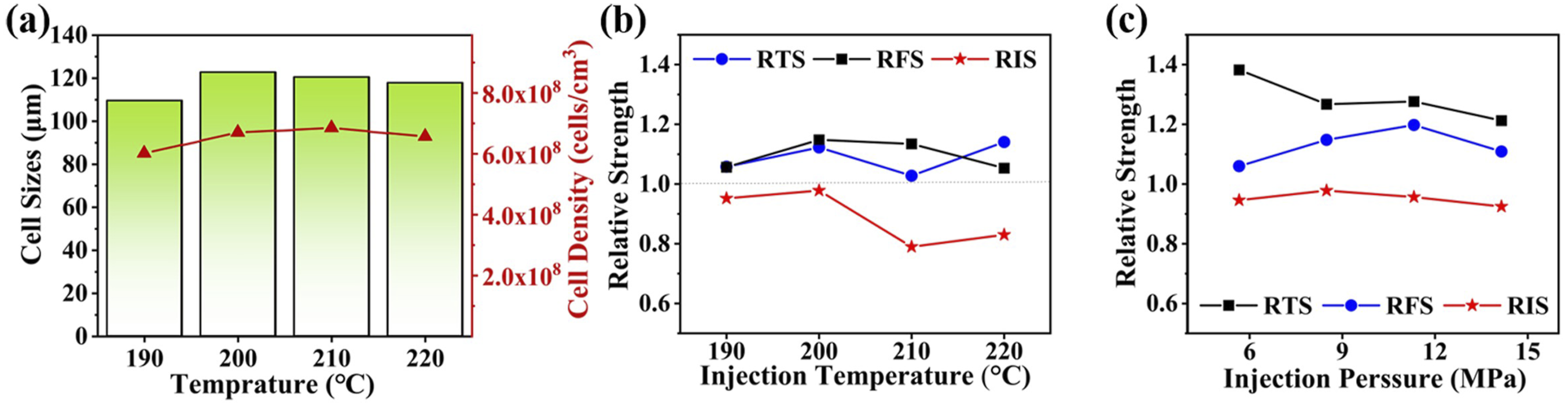
Injection pressure significantly influences the mechanical properties of the foamed polypropylene composites and the melt flow behavior of the samples. During the molding process, the melt is injected through the nozzle and then flows sequentially through the runner system and gate before finally filling the cavity. The filling process proceeds smoothly only when the injection pressure is sufficient to overcome the various flow resistances encountered along the path. Experimental data showed that a gradual increase in torque during injection molding corresponded to a rise in injection pressure and a marked extension of the melt flow distance until the mold cavity became completely filled. When the injection pressure remained below 5.66 MPa (corresponding to an equipment torque lower than 100 N·m), filling was incomplete and the mold cavity could not be fully occupied. Once the injection pressure exceeded 5.66 MPa, however, the mechanical properties and density of the prepared specimens stabilized, as shown in Figure 4(c). These results indicate that the foamed melt possesses excellent compressive stability and a broad processing window, which affords good process adaptability in practical molding operations.
Comparative analysis of different foaming agents
Wide-angle X-ray diffraction (WAXD) characterization of the PP foams prepared with different foaming systems revealed that all samples exhibited the characteristic α-phase diffraction peaks at 2θ values of approximately 14.0° (110), 16.8° (040), 18.5° (130), 21.1° (111), and 21.6° (041).27,28 These observations indicate that the foaming agents did not alter the crystal polymorph of PP but rather modulated its overall crystallinity,
24
as presented in Figure 5d. The PP/AC sample displayed only a slight reduction in diffraction peak intensity relative to neat PP, a result which suggested that the chemical foaming process caused minimal disruption to the crystalline order. Although gas evolution from AC decomposition creates cells, it does not substantially hinder the orderly packing of PP chains, thereby allowing high crystallinity retention. In contrast, the PP/TEMs samples showed a pronounced reduction in diffraction peak intensity with increasing TEMs content, which signified a significantly lower crystallinity compared to both neat PP and the PP/AC system. This decrease can be attributed to two primary factors. First, the TEMs act as an inert dispersed phase that effectively dilutes the PP mass fraction per unit volume, thereby reducing the total crystalline content. Second, the microspheres introduce physical barriers and interfacial interactions that impede the regular arrangement of polymer chains and restrict spherulitic growth, thus suppressing crystalline perfection. (a) Cross-sectional SEM image of PP/AC; (b) Cross-sectional SEM image of PP/TEMs; (c) Cross-sectional SEM image of PP/TEMs/DMDBS; (e) SEM image of crystalline region of PP/TEMs; (f) SEM image of crystalline region of PP/TEMs/DMDBS; (d) XRD comparison of different materials; (g) Comparison Chart of Compression Tests for Different Materials; (h) Comparison of relative mechanical properties of different materials; (i) Comparison of cell size and cell density of different materials.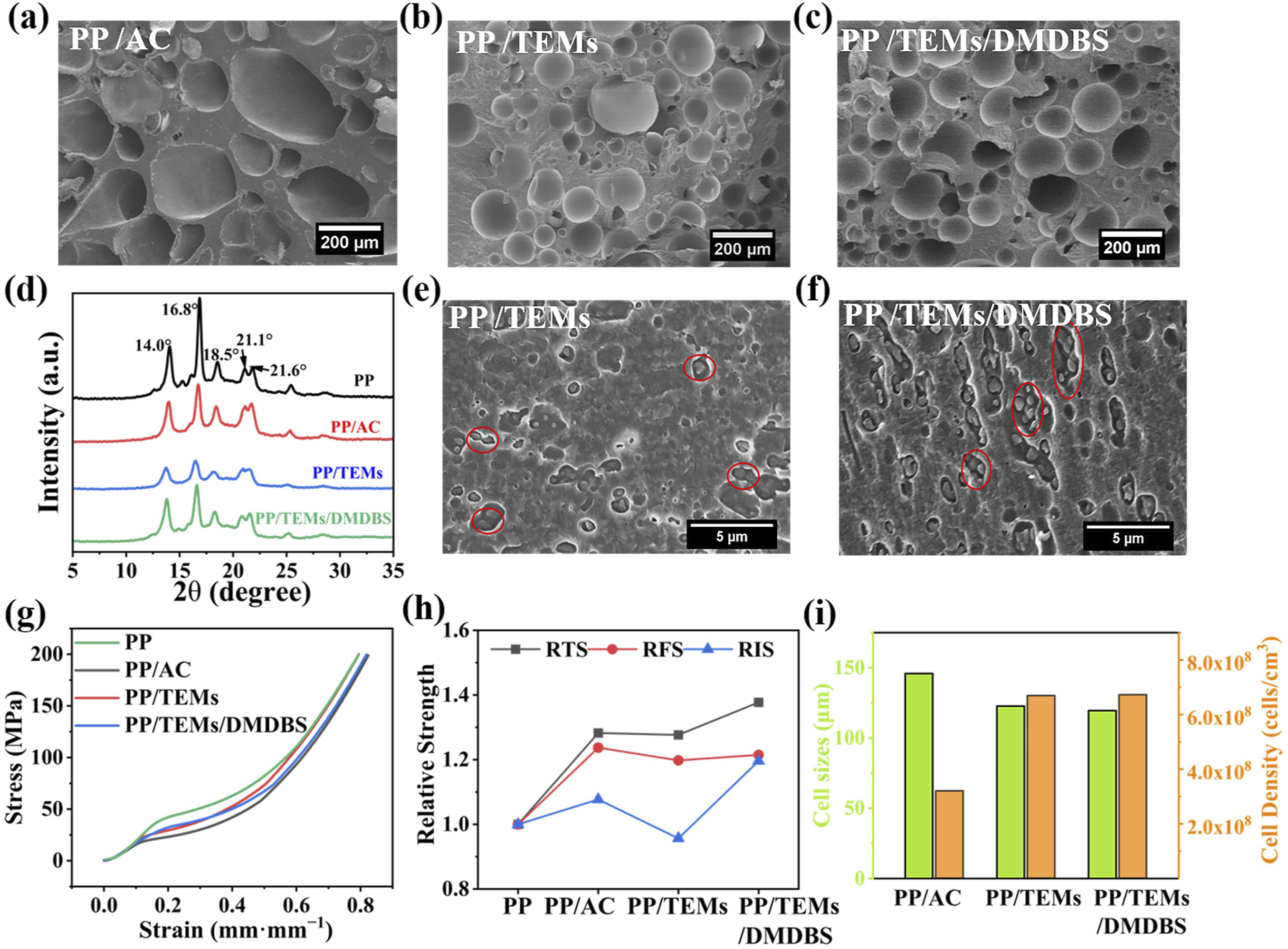
The nucleating agent DMDBS was introduced into the PP/TEMs system to enhance crystallinity and consequently improve the mechanical properties of the composite. DMDBS provides a potent heterogeneous nucleation effect that effectively counteracts the crystallization inhibition caused by the TEMs. As shown in Figure 5d, the addition of DMDBS (PP/TEMs/DMDBS) produced a marked increase in diffraction peak intensity compared with the PP/TEMs system. 24 This increase was attributed to the formation of numerous highly efficient nucleation sites, which promoted the ordered arrangement and stacking of PP molecular chains. Consistent with this interpretation, the crystalline morphologies presented in Figures 5(e) and 5(f) revealed that DMDBS significantly raises the spherulite population density and refined spherulite size. 29 Collectively, these results confirm that DMDBS effectively restores and elevates the overall crystallinity of the PP/TEMs composite.
Density is a central parameter for assessing the degree of lightweighting in foamed materials, as it is closely associated with the foaming efficiency and the resulting cellular architecture. As summarized in Table S5, the densities of the PP materials varied considerably across different formulations. Neat PP, serving as the un-foamed reference, exhibited the highest density of 0.887 g/cm3, consistent with its fully consolidated structure. The density decreased to 0.603 g/cm3 for the PP/AC sample foamed with the conventional chemical blowing agent AC, 13 a value comparable to that of the PP/TEMs sample. Employing TEMs as the foaming agent led to a further reduction. The PP/TEMs sample reached a density of 0.599 g/cm3, a 32.5% decrease relative to PP, which underscores the superior expansion capability of TEMs. The introduction of the nucleating agent DMDBS yielded the PP/TEMs/DMDBS composite, which maintained a comparable density of 0.596 g/cm3, confirming that DMDBS does not compromise the lightweighting effect.
Regarding cell structure, the PP/TEMs/DMDBS foam achieved a high cell density of 6.73 × 10⁸ cells/cm3 (Figure 5i). At a similar density level, AC chemical foaming produced a lower cell density of 5.10 × 10⁸ cells/cm3 and was accompanied by irregular cell morphology. This performance notably surpassed the values reported in the literature for AC-foamed PP at comparable densities, where cell densities were as low as 2.25 × 10⁴ cells/cm330 and were characteriz 31 ed by large, non-uniform cells. These values remained an order of magnitude lower than the cell density achieved here with TEMs and were consistent with the superior results (5.57 × 10⁸ cells/cm3) reported for TEMs-based foaming in other studies. 32
A comparative analysis of the cell morphology shown in Figure 5(a–c) and S4 revealed that the enhanced foaming efficiency of the TEMs system stemmed from its distinct expansion mechanism. Upon heating, the TEMs underwent controlled volumetric expansion and generated a high density of individually encapsulated cells with uniform size within the PP matrix. The resulting cell density was markedly higher, and the cell size distribution was significantly narrower than those obtained with AC foaming. This improvement originated from the well-defined and monodisperse nature of the pre-formed microspheres. Such uniformity prevented the cell coalescence and collapse that frequently accompany the heterogeneous gas evolution typical of chemical foaming. As a result, the TEMs system achieved a substantial reduction in density without compromising structural integrity. By contrast, conventional chemical foaming agents such as AC 30 exhibit lower foaming efficiency and impose more stringent processing requirements.
The mechanical behavior of polymeric foams depends strongly on their underlying microstructure, particularly on crystalline morphology and cellular architecture. The tensile, flexural, and impact strengths measured for the various PP samples were listed in Table S5. Figure 5(h) presented a direct comparison of their relative mechanical properties. When considered alongside the crystallographic analysis described above, these results allowed clear structure-property relationships to be established.
As summarized in Table S5, the tensile and flexural properties of the foamed composites are governed primarily by their crystallinity and cellular architecture. Neat PP exhibited the highest strength owing to its elevated crystallinity and pore-free structure. The PP/AC composite displayed only a marginal reduction in strength. This trend aligned with its largely preserved crystalline structure, which effectively maintained matrix rigidity. In contrast, the PP/TEMs foam showed markedly lower tensile and flexural strengths. The decline was attributed to two concurrent effects of TEMs, namely a reduction in the overall crystallinity of the matrix and the generation of a cellular morphology that hindered efficient stress transfer. The inclusion of the nucleating agent DMDBS in the PP/TEMs/DMDBS formulation mitigated the loss of crystallinity. Relative to the PP/TEMs system, this led to a 7.4% recovery in tensile strength and a 0.9% improvement in flexural strength. Such improvement directly supports the role of DMDBS in enhancing mechanical rigidity through crystalline perfection. The present approach yields a distinct performance advantage when compared with conventional foaming techniques. For example, chemical foaming can diminish tensile strength by as much as 63% at a comparable density near 0.6 g/cm3. 33 Notably, the PP/TEMs/DMDBS composite developed in this work attained a tensile strength of 16.36 MPa at a density of 0.596 g/cm3, corresponding to a modest decrease of just 7.5% from the value of neat PP. This outcome illustrates an exceptional balance between density reduction and the retention of mechanical properties.
Impact strength is an indicator of a material’s fracture resistance and toughness. Neat PP exhibited an impact strength of 11.10 kJ/m2. This value stemmed from its fully dense and defect-free structure. For the PP/AC composite, the impact strength decreased to 8.19 kJ/m2. This decrease could be attributed to internal flaws introduced by residual low-molecular-weight byproducts from the chemical foaming process. The PP/TEMs sample showed a further reduction to 7.17 kJ/m2. This reduction was primarily due to disruption of the crystalline structure caused by the microspheres. Notably, the addition of the nucleating agent DMDBS in the PP/TEMs/DMDBS formulation restored the impact strength to 8.92 kJ/m2. This corresponded to a substantial recovery of 24.4% relative to the PP/TEMs system.
Figure 5(g) presents the compressive stress–strain curves of neat PP, PP/AC, PP/TEMs, and PP/TEMs/DMDBS foams. The PP/AC system exhibited the lowest compressive strength due to severe stress concentration caused by its large cell size. In contrast, the PP/TEMs system showed improved compressive performance owing to the smaller cells and the rigid shell support of the TEMs. After introducing DMDBS, the PP/TEMs/DMDBS foam further achieved a compressive strength of 33.5 MPa because of induced crystallization and enhanced interfacial bonding.
Figure 6(a) and Table S6 presented the thermal conductivity of the polypropylene composite foamed with TEMs (PP/TEMs). The measured value was 0.095 W/(m·K), which corresponded to a reduction of approximately 55 % relative to neat PP. This value was also lower than that obtained for the chemically foamed PP/AC sample (0.101 W/(m·K)), indicating superior thermal insulation performance. The pronounced decrease in thermal conductivity can be primarily ascribed to the substantial reduction in density and the formation of a closed-cell structure. The numerous spherical pores disrupt the continuity of the polymer matrix and consequently impede conductive heat transfer through solid pathways. In addition, the high cell density and uniform pore distribution (Figure 5h) generated a large population of cell walls. These walls elongated and scattered the heat transfer path while effectively attenuating radiative heat flow. The entrapment of a significant volume of low-conductivity air, together with the corresponding decrease in the solid polymer fraction, contributed collectively to the overall reduction in thermal conductivity. The thermal conductivity of the PP/TEMs/DMDBS composite was 0.090 W/(m·K), which was slightly lower than that of the PP/TEMs sample. This further decrease can be ascribed to the higher crystallinity promoted by DMDBS. Increased crystallinity generally lowers the specific heat capacity of the polymer phase.
34
The specific heat capacity of a polymer is closely linked to its microstructure. In crystalline regions, the molecular chains are packed tightly and orderly, and segmental motion is severely restricted. In amorphous regions, the chains adopt a looser arrangement and exhibit greater segmental mobility. As a result, the heat capacity of the crystalline phase is typically lower than that of the amorphous phase. This difference contributes to a slight improvement in the thermal insulation performance of the polymer. Notably, the thermal conductivity obtained in this study was 0.090 W/(m·K). This value was lower than the 0.111 W/(m·K) reported in the literature for foamed polypropylene samples of comparable density.
35
These findings indicated that the present approach achieved a favorable balance between weight reduction and enhanced thermal insulation. (a) Thermal conductivity comparison of different foamed PP composites, (b) Temperature variation in infrared thermal imaging, (c) Infrared thermal imaging comparison.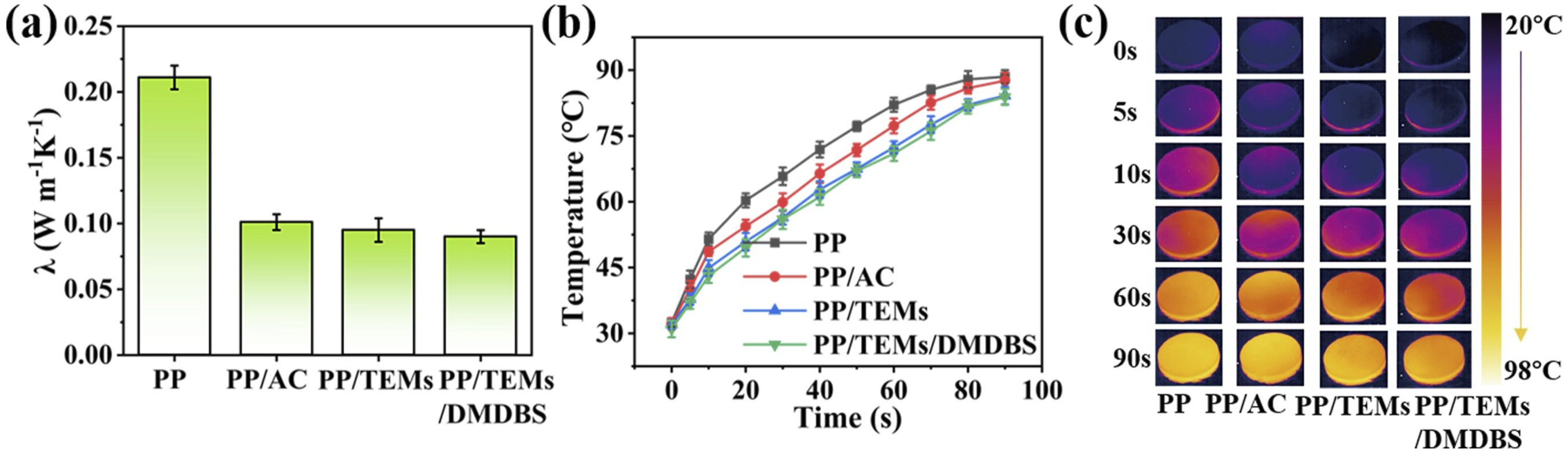
Infrared thermography was employed to monitor surface temperature evolution and further validate the thermal insulation capability of the composites (Figures 6(b) and 6(c)). After 90 s of heating, the surface temperature of the PP/TEMs material was markedly lower than that of both neat PP and the PP/AC foam. These results clearly demonstrated the superior thermal insulation performance of the PP/TEMs/DMDBS composite. The enhanced insulation is primarily ascribed to the high cell density and the predominantly closed-cell morphology. The numerous cells entrap a large volume of static air. Meanwhile, the closed cell walls effectively suppress gas convection and attenuate radiative heat transfer. These factors act collectively to yield a significant improvement in overall thermal resistance.
Conclusion
In this study, core-shell structured thermal expansion microspheres (TEMs) were designed, synthesized, and applied as a highly efficient physical blowing agent for the fabrication of advanced PP foams. The thermal expansion profile of the TEMs aligned well with conventional PP processing windows, which enabled controlled foaming without the need for additional process modifications. At an optimal TEMs loading of 8 wt%, the foam density decreased to 0.601 g/cm3. This value corresponded to a 32.2% reduction relative to neat PP, while a uniform cellular structure with a moderate cell density was maintained. Compared with foams prepared using the conventional chemical blowing agent AC, the TEMs-based system exhibited significantly improved foaming efficiency, a more regular and finer cellular morphology. The incorporation of the nucleating agent DMDBS effectively counteracted the crystallization inhibition induced by the TEMs through heterogeneous nucleation. As a result, both the tensile strength and the impact strength of the foam were enhanced. Consequently, an excellent balance between weight reduction and mechanical performance was achieved. Furthermore, the foam exhibited a low thermal conductivity of 0.090 W/(m·K), which provided notable thermal insulation.
In summary, the synergistic PP/TEMs/DMDBS system developed in this work enables the production of foamed PP materials that combine low density, structural integrity, and superior thermal insulation. This material holds considerable promise for a broad range of industrial applications, including packaging cushioning, building insulation, automotive lightweighting, and interior components for submarines and aerospace structures.
Supplemental material
Supplemental Material - Preparation and properties of advanced polypropylene materials from thermally expandable microspheres
Supplemental material for Preparation and properties of advanced polypropylene materials from thermally expandable microspheres by Lingmin Kong, Ruixue Wang, Shanyi Guang, Hongyao Xu in Journal of Cellular Plastics
Footnotes

Funding
The authors disclosed receipt of the following financial support for the research, authorship, and/or publication of this article: This work was supported by the National Natural Science Foundation of China (Grant No. 52372282).
Declaration of conflicting interests
The authors declared no potential conflicts of interest with respect to the research, authorship, and/or publication of this article.
Supplemental material
Supplemental material for this article is available online.
References
Supplementary Material
Please find the following supplemental material available below.
For Open Access articles published under a Creative Commons License, all supplemental material carries the same license as the article it is associated with.
For non-Open Access articles published, all supplemental material carries a non-exclusive license, and permission requests for re-use of supplemental material or any part of supplemental material shall be sent directly to the copyright owner as specified in the copyright notice associated with the article.
