






Abstract
The fiber that serves as a reinforcement in reinforced composites may be artificial or natural. Past studies show that artificial fibers such as glass, carbon, etc., have been generally used in fiber-reinforced composites. Although glass and other synthetic fiber-reinforced composites possess high specific strength, their fields of application are very limited because of their inherent higher cost of production and low biodegradability. In this study, woven coir and woven coir–glass fiber-reinforced polyester composites were developed and their mechanical properties were evaluated. Scanning electron micrographs of fractured surfaces were used for qualitative evaluations of the interfacial properties of woven coir and woven coir–glass hybrid polyester composites. The results indicated that the properties of woven coir composites can be considerably improved by incorporation of glass plies.
Introduction
Despite the fact that glass fiber-reinforced composites have excellent thermal and mechanical properties, it is difficult to devise suitable disposal methods for them. Due to many environmental problems, the disposal methods for glass fiber-reinforced composites and their recycling have been seriously acknowledged. 1 Natural fibers exhibit many advantageous properties such as reinforcement for composites. They are low-density materials, yielding relatively lightweight composite with high specific properties.2,3 Natural fibers also offer significant cost advantages and benefits associated with the processing in extraction and preparation as compared to synthetic fibers such as glass, nylon, carbon, etc. However, mechanical properties of natural fiber composites are much lower than those of synthetic fiber composites. Natural fibers also play an important role in developing biodegradable composites to resolve the current ecological and environmental problems. Composites made of natural fibers offer the opportunity for extensive applications in fields such as consumer goods, low-cost housing and civil structures, and for many other common applications where the prohibitive cost of reinforcements at present restricts the use of conventional lightweight reinforced composites. 4 Another disadvantage of natural fiber composites which makes them less attractive was the poor resistance to moisture absorption. 5 Hence, the use of natural fiber alone in polymer matrix is inadequate in satisfactorily tackling all the technical needs of a fiber-reinforced composite. In an effort to develop a superior, but economical composite, a natural fiber can be combined with a synthetic fiber in the same matrix material so as to take the best advantage of the properties of both fibers. This results in a hybrid composite and having increased mechanical properties than natural fiber composite. Pavithran et al. 6 evaluated the enhancement in the properties of coir–polyester composites by incorporating glass as intimate mix with coir. Mishra et al. 7 studied the effect of glass fiber addition on tensile and flexural strengths and Izod impact strength of pineapple leaf fiber and sisal fiber-reinforced polyester composites. Harish et al. 8 investigated the mechanical properties of randomly oriented coir composites mixed with epoxy resin and suggested part applications for low-load composite. They assessed the mechanical properties of non-woven aligned mat-type coir/polyester composites. Sabeel et al. 9 studied the effect of stacking sequence on the mechanical properties of woven jute–coir hybrid composites and they suggested the glass plies at the extreme ends have good mechanical strength. The work of mechanical property evaluation of woven coir composites and woven coir–glass hybrid composites are limited in the literatures. So, this study focused on the evaluation of mechanical properties of woven coir and woven coir–glass fiber-reinforced polyester composites. In this study, the evaluation of tensile, flexural, and impact properties of woven coir composites was carried out and these results were compared with that of woven glass and woven coir–glass hybrid composites. The effect of hybridization with glass on tensile, flexural, and impact properties of woven coir composites was also studied.
Experimental
Materials
The green husk coir fibers were mechanically extracted from the green husk of coconut after soaking the husk in water. The green husk fiber bales were soaked in water for 3–7 days to remove the coloring matter and to make the fibers soft for spinning into yarn. The discontinuous fibers were formed into continuous fibers by spinning and lacing as strands. Then, they were loaded into spinning looms and weaved as mats by careful attention of controlling the same number of fibers in each strand. Woven coir mat is made by two sets of yarns interlaced at right angles to create a single layer. 10 Biaxial plain mat is characterized by twisting two strands to make up the yarn.
Woven coir fabric having a count of 10 × 10 (10 yarns in warp direction and 10 yarns in weft direction per strand) was used as reinforcement. The weight of the fabric used was approximately 1220 g/m 2 . The plain-weave glass fabric of weight of 610 g/m 2 , supplied by Binani Industries Limited, Mumbai, India was used. Apart from the most usage and high strength of 610 g/m 2 glass-woven fabric, its selection is justified by two reasons also. One is having equal strand with the prepared coir strand and the other is the selected g/m 2 , which is half of the g/m 2 value of prepared coir mat. The resin system consists of unsaturated orthophthalic polyester (specific gravity at 27°C: 1.136, viscosity: 470 cP, and mass: 449.96 g/m 2 ), Methyl ethyl ketone peroxide catalyst and cobalt octoate accelerator supplied by Sri Vinayaka Enterprises, Chennai, Tamilnadu, India was used. The resin properties such as specific gravity and viscosity were tested according to IS 6746:1994 and mass was tested as per ISO 3374 test methods at OCV Reinforcements Manufacturing Ltd, Thimmapur, Andhra Pradesh, India.
Composite fabrication
Hybrid composites of woven coir and glass were prepared by simple hand lay-up process in a mold at ambient temperature. Polyvinyl acetate release agent was applied to the surfaces of the mold. Woven coir and glass fabrics were pre-impregnated with the matrix material consisting of unsaturated polyester, accelerator, and catalyst in the ratio 1:0.015:0.015. The impregnated layers were placed one over the other in the mold (36 × 36 cm 2 ) and pressed with 1000-N weight for 1 h before removal at ambient temperature. Uniform thickness was achieved using spacers of desired thickness between the mold plates. After 1 h, the composite was removed from the mold and cured at room temperature for 24 h. The same procedure was followed to prepare woven coir and woven glass fabric polyester composites.
Tensile testing
Specimens for tension test were cut from the manufactured composite and finished to the accurate size using emery paper. Tests were conducted using Shimadzu testing machine (model: AG-IS 50 kN, capacity: 5 tons, accuracy: 0.2%, and cross-head movement: 0.5–500 mm) at a cross-head speed of 5 mm/min as per ASTM D638 standard. Five specimens with identical dimensions for each composite material were tested as per ASTM standards and average result was determined.
Flexural testing
Flexural test was conducted as per ASTM D 790. The test was conducted using the Instron machine (Model: 3382) with Series IX software using a load cell of 10 kN at 2.8 mm/min rate of loading. Testing conditions of 23 ± 2°C temperature and relative humidity of 50 ± 5% were followed.
Impact testing
The impact strength of the samples was measured using an Izod impact test machine as per ASTM D256-05 standards. The test specimen was supported as a vertical cantilever beam and broken by a single swing of a pendulum in ATS FAAR Impact tester (model: 16.1 and capacity up to 25 J). At the point of impact, the striker has a known amount of kinetic energy. The impact energy is calculated based on the height to which the striker would have risen, if no test specimen was in place, and this is compared to the height to which the striker actually rises. Factors that affect the Izod impact energy of a specimen will include yield strength and ductility, notches and temperature, and strain rate. For each case, a total of five specimens were tested and all the tests were carried out at room temperature (23 ± 2°C).The Izod impact strength was calculated using the formula given below:
Results and discussion
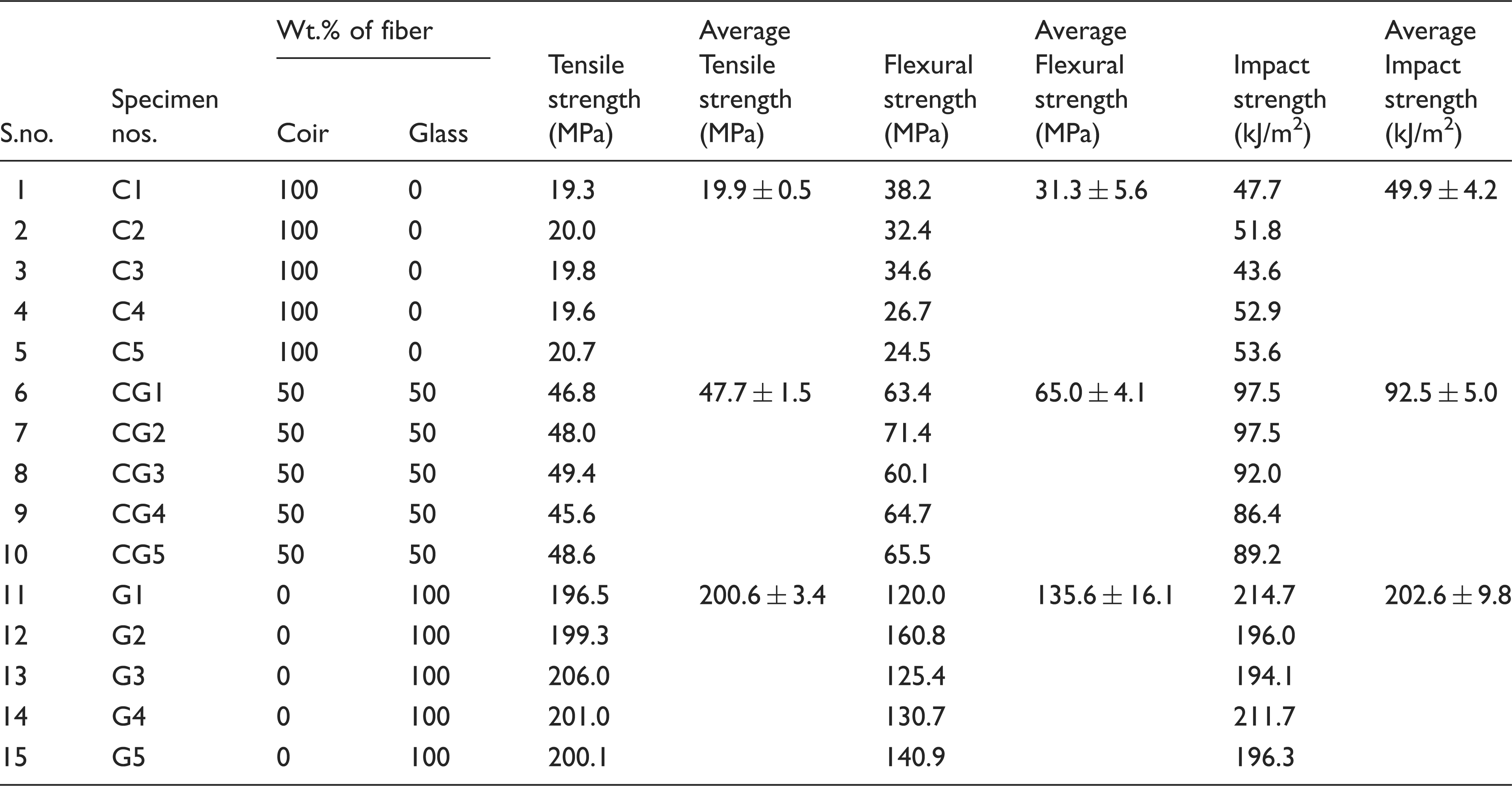
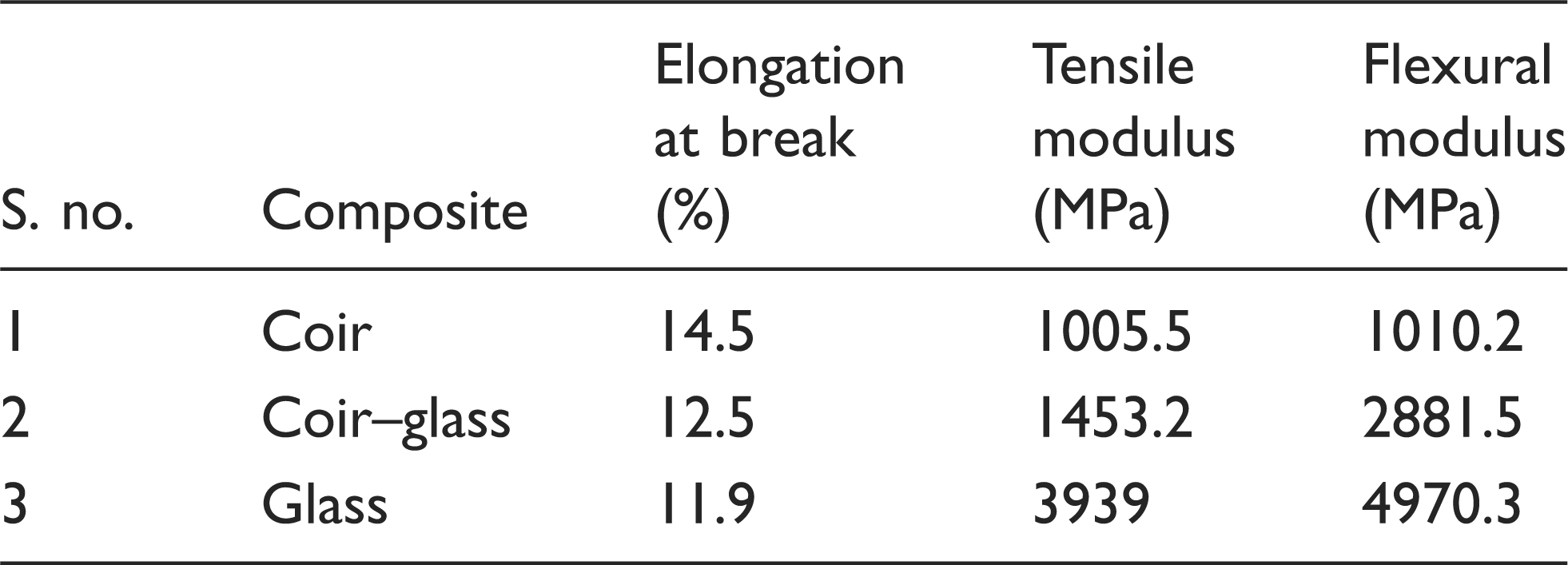
The tested results are given in Table 1. Figures 1, 2, and 3 reveal that the tensile, flexural, and impact properties of coir composites are increased by the incorporation of glass fibers. In the figures, the tested mechanical properties of woven coir, woven coir–glass, and woven glass composites are represented with the help of C, CG, and G abbreviations, respectively. Table 2 shows the average values of elongation at break, tensile modulus, and flexural modulus for the woven coir, woven coir–glass, and woven glass composites.
Tensile strength of woven mats. Flexural strength of woven mats. Impact strength of woven mats. Tested mechanical properties Average values of elongation at break, tensile and flexural moduli


Tensile testing of woven coir/polyester composites
Woven coir/polyester composites exhibit average values for the tensile strength of 19.9 ± 0.5 MPa. These values are significantly higher than those measured for non-woven coir/polyester composite specimens
11
and non-woven coir/epoxy laminate specimens.
8
The tensile strength of glass/polyester composites is 200.6 ± 3.4 MPa. So, there is a chance to improve the tensile strength of coir fibers by the incorporation of glass fibers. The scanning electron microscopy (SEM) image of the cross-sectional view of coir fibers in polymer matrix is shown in Figure 4. The scanning electron micrograph of the arrangement of fibers in the polymer matrix of the woven coir is shown in Figure 5.
SEM image of cross-sectional view of woven coir/polyester specimen. Scanning electron micrographs of woven coir/polyester specimen.

Woven coir–glass/polyester composites
The tensile strength of unreinforced polyester resin is found to be 43.6 MPa. The tensile strength of the composite is influenced by the strength and modulus of the fibers. The tensile strength and modulus of woven coir–glass composite is found to be 47.8 ± 1.5 MPa, which is larger than the tensile strength of the resin. It is found that there is sharp increase in the tensile strength with the incorporation of glass fiber as extreme glass plies. The increase in the tensile strength and modulus of hybrid composite is attributed to the reason that, glass fibers are stronger and stiffer than coir fibers. Observation of failed specimens revealed that failure in woven coir laminate is sudden with no or little pull-out of coir fibers, whereas in hybrid laminates, failure is governed by extensive fiber pull-out and breakage. One reason for this may be due to higher strength of glass fibers than coir fibers. The fracture of woven glass composite specimen during tensile testing is shown in Figure 6.
Scanning electron micrographs of glass/polyester specimen after tensile fracture.
Flexural testing
The load–deflection diagrams of woven/coir, woven coir–glass, and woven glass composites are shown in Figures 7, 8, and 9. All the curves indicate non-linear behavior. The point of deviation from nonlinearity is the indication of failure initiation due to development of crack on the tension side. Flexural properties are studied for the combination of glass/coir fiber content of 50:50% and the total fiber weight of 126 g and resin weight of 354 g. In this study, an attempt has been made to study the arrangement of glass fiber plies at the extreme and coir fibers in the middle. This can be justified from the fact that the flexural strength and stiffness are controlled by extreme layers of reinforcement. The flexural strength is found to have the highest value of 38.2 MPa and modulus of 1096 MPa for woven coir/polyester composites which is higher than those measured for nonwoven coir/polyester composite specimens.
11
The SEM of the woven coir–glass specimen representing the failure on the tension side under flexural load is shown in Figure 10. Larger extension of the glass fibers leading to large fiber pull-out and matrix failure could be observed from the figure. The average flexural strength of woven coir–glass/polyester composites is 65 ± 4.1 MPa which is a mid-value of woven coir (31.3 ± 5.6 MPa) and woven glass fabric (135.6 ± 16.1 MPa). The introduction of glass fiber in coir composites increased the flexural strength more than two times than that of woven coir/polyester composites.
Flexure extension vs. flexure load of woven coir/polyester composites. Flexure extension vs. flexure load of woven coir–glass/polyester composites. Flexure extension vs. flexure load of woven glass/polyester composites. Scanning electron micrographs of woven coir–glass/polyester specimen after flexural fracture testing.


Impact testing
The impact testing of the woven coir–glass/polyester specimen resulted in hackle formation with significant matrix debris, indicative of the impact loading damage. The fibers at the top have broken due to the impact damage. The fiber has cracked at different levels, which indicates that a certain amount of energy has been absorbed during pull-out of the fibers. As shown in Figure 11, the fiber has offered resistance and has absorbed energy in its own fracture. The presence of matrix debris was found in all the fractured fractographs due to impact damage. The lower impact strength of the coir/polyester specimens was due to the poor interface bonding. The average impact strength of woven coir–glass/polyester composites is 92.6 ± 5 kJ/m
2
hich is a mid-value of woven coir (49.9 ± 4.2 kJ/m
2
) and woven glass fabric (202.6 ± 9.8 kJ/m
2
). The introduction of glass fiber in coir composites increased the impact strength of woven coir/polyester composites significantly. In the hybrid composites, the fracture of coir fiber was not complete because it was bonded between glass mats and this illustration is given in Figure 12.
Scanning electron micrographs of glass/polyester specimen after impact testing. Scanning electron micrographs of woven coir–glass/polyester specimen after impact testing.

Conclusions
(1) Woven coir/polyester composites exhibit average values for the tensile strength, flexural strength, and impact strength of 19.9 MPa, 31.3 MPa, and 49.9 kJ/m
2
, respectively. (2) Woven coir–glass/polyester composites exhibit average values for the tensile strength, flexural strength, and impact strength of 47.7 MPa, 65 MPa, and 92.5 kJ/m
2
, respectively. (3) Woven glass/polyester composites exhibit average values for the tensile strength, flexural strength, and impact strength of 200.6 MPa, 135.6 MPa, and 202.6 kJ/m
2
, respectively. (4) The mechanical properties are improved in woven coir–glass/polyester composites due to the presence of the strong interlaminar bond, which enables the adjoining woven coir mat to restrain and localize the failure of glass mat. As the failed glass fiber plies are still to able to carry the load, the woven coir fibers can effectively transfer the load from the glass fibers without failing catastrophically.
The values of mechanical properties of woven coir/polyester composites are significantly lower than those measured for E-glass-woven specimens. The two extreme glass plies on either side of woven coir increase mechanical properties of woven coir composites with a good balance of properties and cost.
Further research work need to be carried out in the development of coir fiber-reinforced composites. The use of treated fiber in the fabrication of woven coir polyester composites may give improved mechanical properties.
Footnotes
Acknowledgments
The authors thank the Director, Central Institute of Plastics Engineering and Technology, Chennai for providing the test facilities and the technical staff, Coir Board, Pollachi for providing the machinery set-up for preparing woven coir mats.