







Abstract
Aluminium matrix based metal matrix composites (MMCs) are being extensively used in various industrial applications that need high strength combined with low weight, high hardness, wear resistance, high temperature resistance, improved impact strength, etc. They are amenable to secondary manufacturing processes such as extrusion, rolling, forging, welding, etc. However, because of their complex nature, both in terms of composition and difficulty in manufacturing by the standard fabrication techniques, researchers are keen to study various combinations of constituent materials – matrix and reinforcement, their processing, property evaluation, and extending their applications in various fields. This article presents the details of the investigation comprising stir casting of Al7075 matrix material reinforced with Al2O3 particulates. An attempt has been made to predict the impact strength of these MMCs, which is an important property that decides their suitability in shock loading environment, both in the as-cast and forged conditions. Multi-factor, rotatable, central composite design has been used to predict the impact strength in terms of charpy-V. The mathematical models developed are validated using Fisher’s F-test.
Introduction
Metal matrix composites (MMCs) are a variety of composite materials, which are obtained by combining metallic matrices with reinforcing constituents mostly, in the form of a ceramic or relatively soft and/or compliant phases, such as graphite flakes, lead particles, reinforcing metals, etc.1–4 Aluminium-based MMCs find applications in areas like automotive components, aerospace, structures, mining equipments, etc., as they possess combination of properties such as improved strength, toughness, hardness, wear resistance, corrosion resistance, and other desirable properties contributed by the constituent phases.5–14 The reinforcements are in the form of particulates and short/long fibers. Recently, particulate MMCs comprising Al alloy matrices and SiC or Al2O3 reinforcement are being considered for a range of industrial applications, though MMCs Ti-, Fe-, and Mg-matrices combined with other reinforcements (Ti, B2, B4C, SiO2), TiC, WC, BN, ZrO2, etc. have also been investigated. However, Al2O3 is a preferred choice to SiC, because of its greater stability in Al alloys. 15
It is important to note that the choice of matrix and reinforcement, specification of the way in which the composites are synthesized, and the manner in which a stock item/component is fabricated by employing suitable secondary processes (e.g. rolling, extrusion, forging) to which they are often subjected to, have a great bearing on the development of these MMCs.15–17 Al-based particulate MMCs are most commonly manufactured by melt incorporation and casting technique or powder blending and consolidation. However, whether cast or produced via powder metallurgy, the lack of toughness, ductility and formability still limits the industrial applications of these materials. Hence, it is imperative to know the process parameters governing the properties such as hardness, strength under impact, bending, wear resistance, tensile strength, etc. of these particulate MMCs in the as manufactured and secondary processed conditions.
A detailed literature survey conducted by the authors indicated that although a number of mechanical properties of particulate reinforced aluminium matrix composites have been examined and reported, there is relatively less information about impact behavior of these materials. In particular, Al2O3 reinforced aluminium matrix composites which have important applications in many fields, need to be evaluated with regard to impact behavior and formability and a lack of this kind of information often limits the industrial applications of these composites. Many researchers have attempted to assess the impact behavior of Al-based MMCs and the effect of applying different secondary processes such as extrusion, rolling, forging, and even welding. For example, Hunt et al. 16 have observed that toughness and yield strength were independent of particle size both in as-cast and extruded form of 6061/Al2O3 composites. On the other hand, Kim et al. 17 have reported from their study of 6061/SiC particulate with T6 conditioning that there existed a critical particle size, above which the composites would fracture due to particle mixing. Whitehouse and Clyne 18 studied the effect of reinforcement shape on the fracture behavior of powder formed and extruded Al/Al2O3 composites and reported that void formation at the interfaces and delamination were the main causes of fracture than particles size. Mummery and Durby 19 have reported that larger particles sizes resulted in lower ductility, but when particles were smaller in size ductility remained unaffected. Application of forging resulted in redistribution of reinforcement particles and absence of segregation, if any, which helped improve the impact strength of forged composites as compared to as-cast composites. Mallik et al. 20 have studied the effect of SiC particle content on the mechanical properties and forgeability of Duralumin-based particulate MMCs produced by stir-casting. They have shown that both tensile strength and impact strength increased consistently with SiC particle size. Also, porosity was indicated to reduce after forging at 25°C (room temperature). Hung et al. 18 have studied fracture toughness (KIC) and low cycle fatigue of 6061/Al2O3 particulate composites by measuring fracture toughness as a function of particle concentration and aging temperature with a view to understanding fracture behavior of these MMCs. They have indicated that fracture toughness decreased with increasing reinforcement content due to large particle size. Luri et al. 21 have studied the effect of friction stir welding on the charpy-V of AA7005/Al2O3 composites produced by liquid metal process and extruded at 480°C. They have reported that, in general, particle size had little effect on the energy absorbed by as-cast composites (0.7 J). However, application of secondary process like friction stir welding resulted in increased charpy-V (2.6 J). They have attributed this phenomenon to void removal and redistribution as well as grain refinement of particulates at the welding temperature. Wei and Huang 22 have studied the influence of heat treatment and extrusion on instrumented charpy-V and KIC. They have considered four types of matrix-based aluminium metal matrix composites and concluded that toughness of matrix, particle size, and distributions due to extrusion play an important role in improving the energy absorbed and both instrumented charpy-V and KIC gave consistent results.
From the foregoing, it is evident that there is no consensus in the reported work as far as Al-based MMCs are concerned. Hence, the authors have undertaken a research program to develop Al7075/Al2O3 composites produced by stir-casting technique followed by forging. This paper presents the details of an attempt to model the impact strength of these composites in their as-cast and forged conditions. Multi-factor, multi-reaction-based response surface method (RSM) with central composite design (CCD) has been employed.23,24
Material
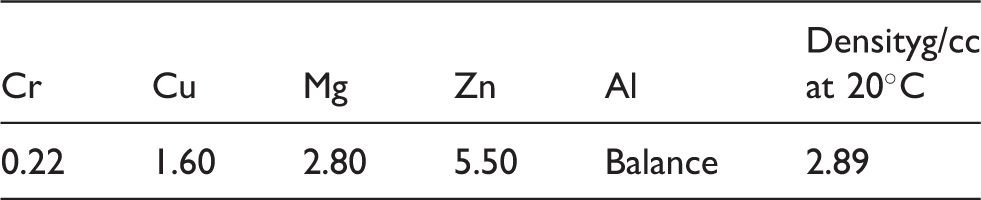
The aluminium MMCs investigated in this work comprised Al7075 as matrix material and Al2O3 particulates as reinforcement. The properties of the matrix are given in Tables 1 and 2. Al2O3 particulates were in the range of 36–72 µm. The composites were fabricated by melt route using stir casting. Figure 1(a) and (b) show the schematic and close-up views of the stir casting process, respectively. The details of the experimental steps used for stir casting process are explained elsewhere.
25
(a) Schematic view of stir-casting set-up; (b) close-up view of stir-casting set-up. Al2O3 particulates of various sizes are added to the melt at 730°C which is continuously stirred using a motorized ceramic coated stainless steel rod. Chemical composition of Al7075 Details of other important properties of Al7075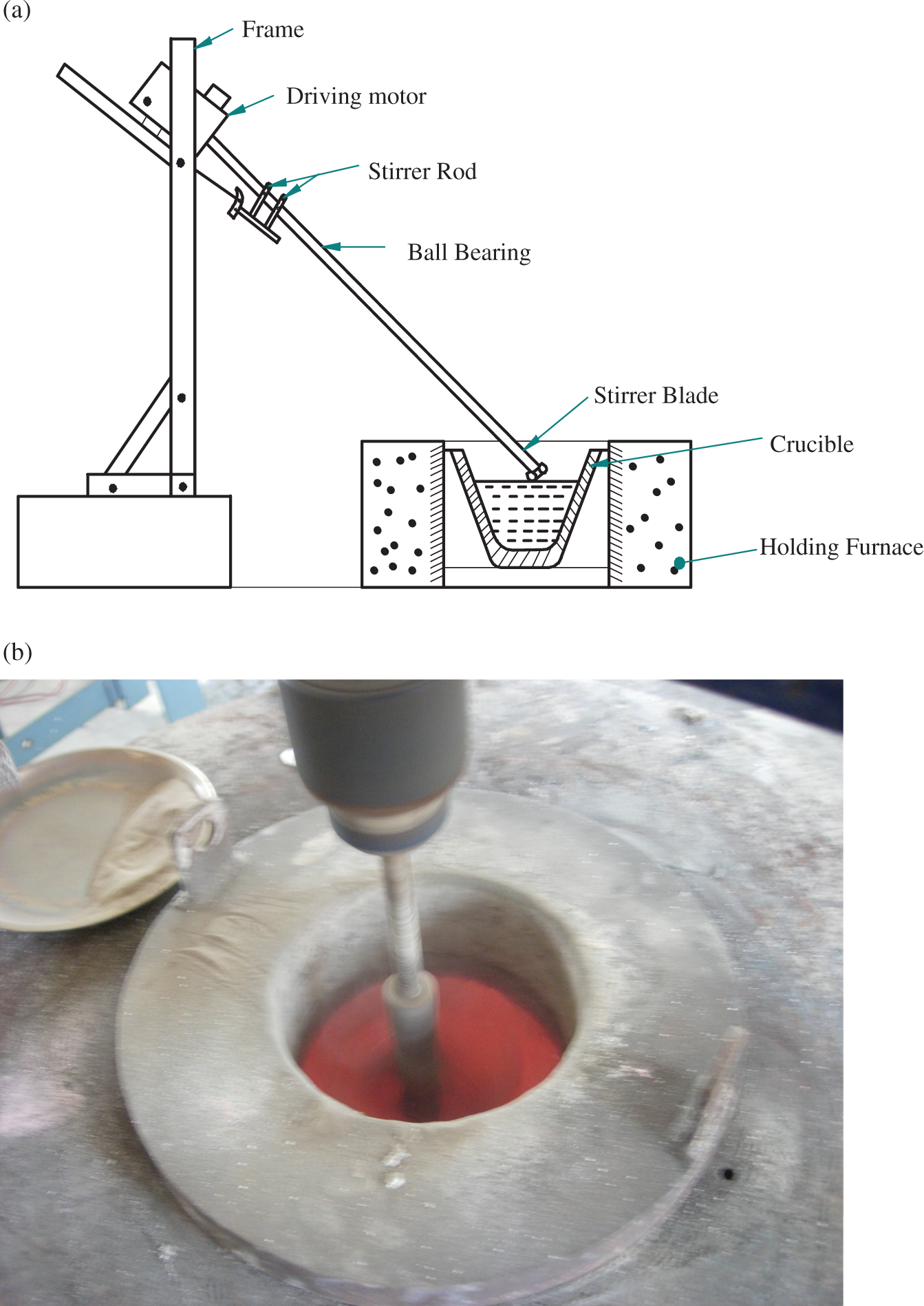

Experimental program
Coded values of input variables at different levels for as-cast samples

Coded values of input variables at different levels for forged samples

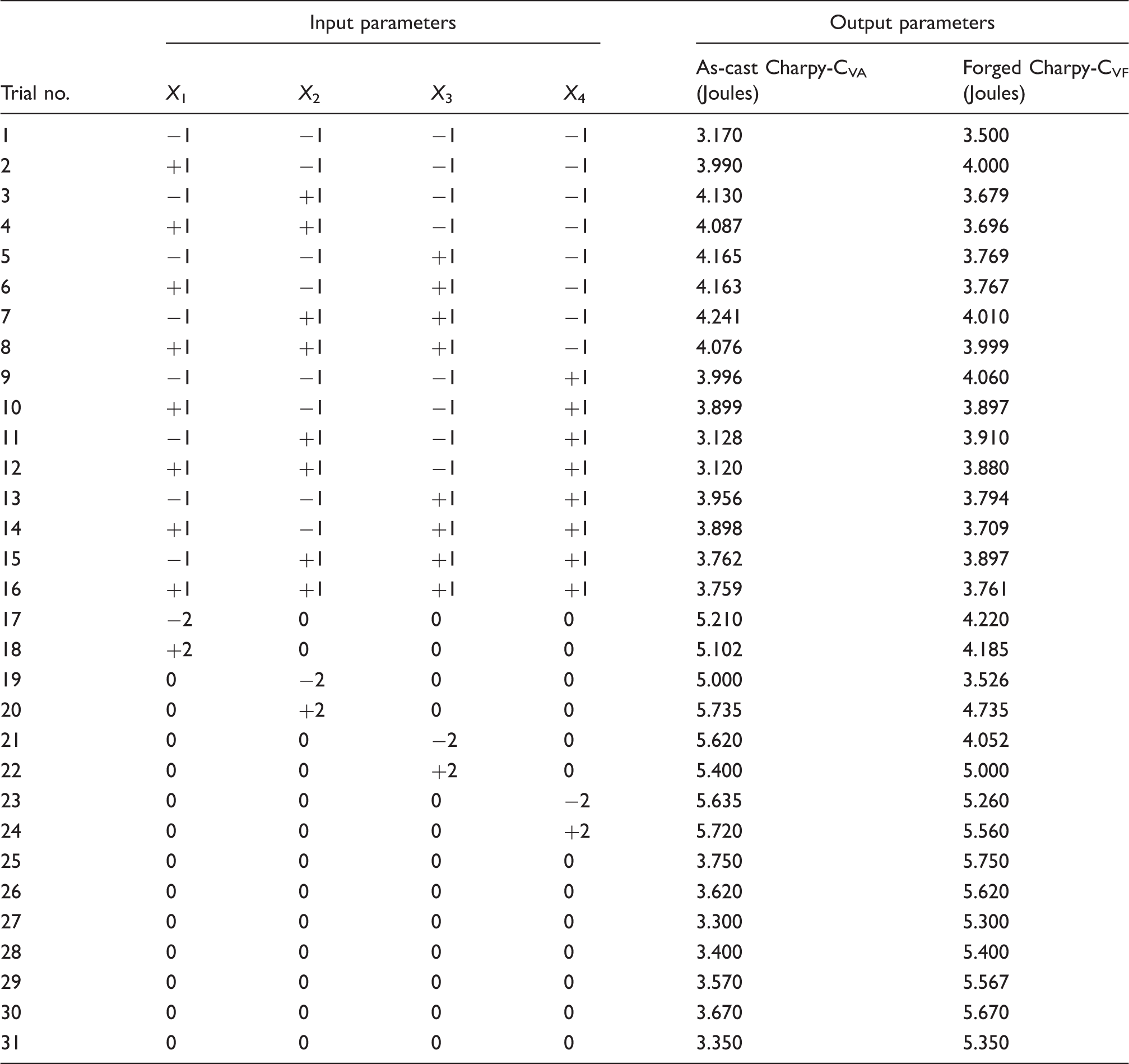
Central composite design matrix for preparation of as-cast and forged composite samples along with responses. 23
Developing the charpy-V model and checking the adequacy
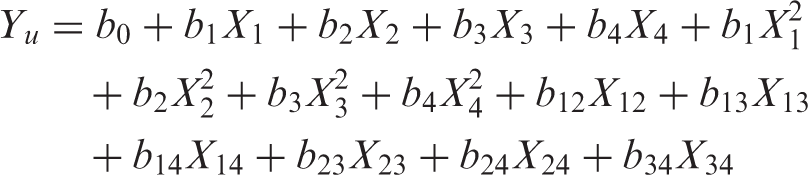
A polynomial response surface of the second order was used to express the relation between the response, i.e. Charpy-V (Yu), and the four input parameters, namely, reinforcement size(D), % weight of reinforcement (W), holding temperature (T), and holding time (t) and was assumed to be of the form,

The resulting second-order equation could be expressed as
Evaluation of the coefficients of models
The values of the regression coefficients were evaluated with the help of the following equations (3) to (6).




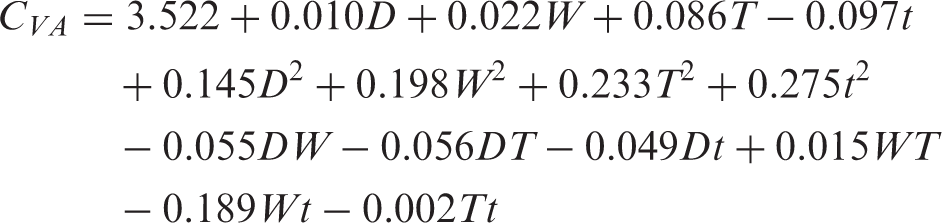
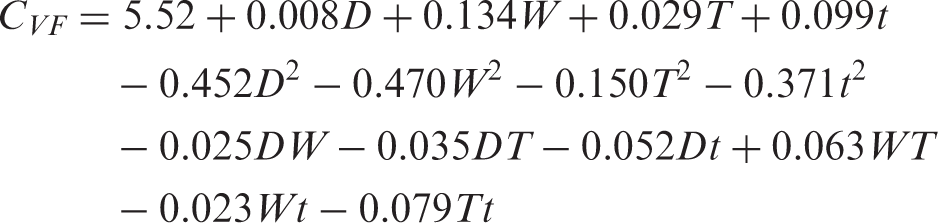
Substituting the values of coefficients, determined as above the fitted second-order models for as-cast and forged cases are given in equations (7) and (8), respectively
As-Cast Charpy-V
Forged Charpy-V
Discussion
Basically, some primary discontinuities are associated with MMCs, such as voids, inclusion and matrix domination. Each of these discontinuities affects their properties. Further, application of a secondary process like forging is likely to result in elimination of residual pores and defects formed during casting, more uniform distribution of the reinforcing particles, stronger bonding between the matrix and particles and some times, a more ductile matrix which might result from the homogenization and refinement of grains during working. Consequently, this may result in increase/decrease in the impact strength of the resulting products.22,26 Wei and Huang 22 have reported that Al2O3 particles were predominantly seen to crack and that optimum toughness corresponded to optimum bond strength: lower or higher strengths were found to lower the toughness.
Conclusion
Based on the present work the following conclusions may be drawn.
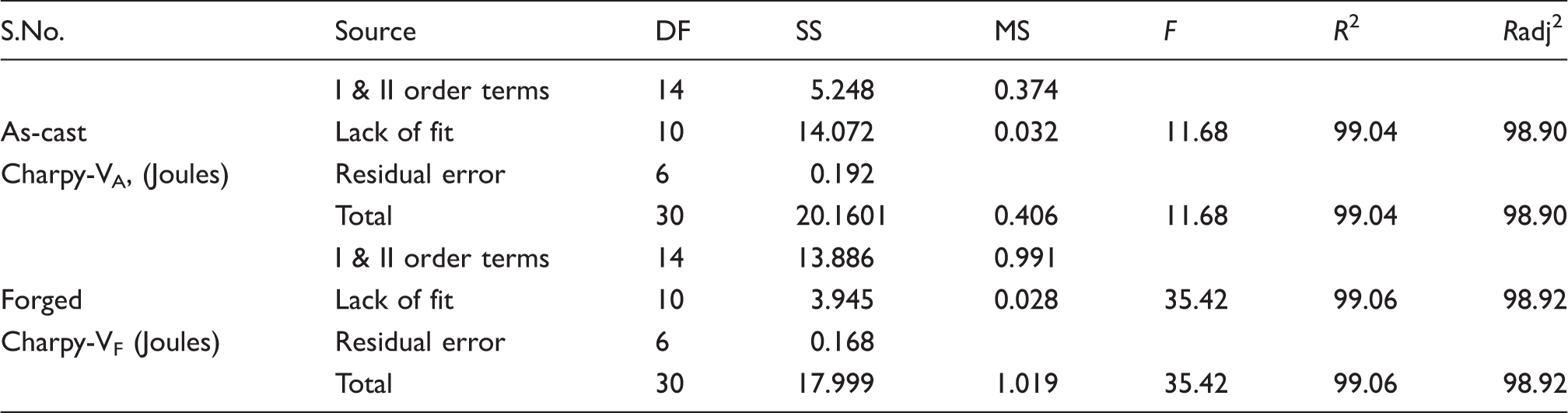
A second-order rotatable design can be used to predict the impact behavior. The mathematical model developed can be used to correlate the toughness parameters and their interactions with the response parameters. The impact strength of the Al-7075/Al2O3 composites, in the as-cast and forged conditions is basically consistent and the optimum condition of toughness is obtained by using stir casting process with optimum values of reinforcement (Al2O3) size, weight percent of Al2O3, holding temperature and holding time. As per analysis of variance, the F-values corresponding to the models are greater than the standard F-value as obtained for degree of freedom (4, 16). Hence the model is validated with 99% significance level. Elimination of residual pores and defects formed during casting, more uniform distribution of reinforcing particles, stronger bonding between the matrix and particles, and refinement of grains during working have a greater bearing as far as impact strength is concerned. As such, a careful and judicious application of these models is recommended.
Footnotes
Funding
This research received no specific grant from any funding agency in the public, commercial, or not-for-profit sectors.
Conflict of Interest
None declared.