







Abstract
The carbon nanotube (CNT)/polypropylene(PP) composites have been prepared with the aid of a silane coupling agent (ZFDA, Dow Corning® Z‐6173) and then characterized by electron microscopic, electrical, mechanical, and thermal measurements in order to understand the role of the silane coupling agent in CNT/PP composites. It was experimentally found that the best usage of ZFDA was 20 wt% based on the CNTs. The coupling agent could effectively reduce the percolation threshold to 0.01 wt% from 2.7 wt% for electrical conductivity and at the same time largely improve tensile modulus of CNT/PP composites without sacrificing tensile strength. Being similar to CNTs, the coupling agent‐treated CNTs (named as ZCNTs) could act as a nucleating agent to shift the crystallization temperature of PP to higher temperatures but decrease crystallinity of PP with increasing filler content. The role of the silane coupling agent in these CNT/PP composites has been explored in detail.
Introduction
Most of polymer materials have very high electrical resistance. In electronic industries, polymeric materials are being widely used to produce numerous parts such as circuit boards, IC chip trays, encapsulants for electronic device, housings of personal computers, frames of monitors, keyboards, mouses, and so on. Many of these applications take the advantages of polymer materials as good insulators, but some applications require polymer materials to be electrically conductive. For example, conductive polymers can be used for electromagnetic shielding, anti‐static electricity, printed circuit boards, electrodes of electrochemical devices such as fuel cells, etc. However, there are only few types of inherently conductive polymers commercially available but they usually have poor processability because they are not thermo‐plastic. For example, polyaniline (PANI) is a well‐known conducting polymer but its application is limited as PANI is not thermoplastic and a doping process is necessary to induce electrical conductivity.
A common approach for the development of conductive thermoplastics is achieved through adding conductive fillers into a non‐conductive polymer matrix. The commonly used conductive fillers include metal powder, carbon nanotubes (CNTs), carbon black, graphite, and so on.1–7 These conductive filler/polymer composites have attracted much attention recently due to their high potentials in industrial applications.
In all the conductive fillers mentioned above, CNTs exhibit fascinating electrical and mechanical properties because of their unique molecular structures. Fundamental research works on CNTs and their applications have grown rapidly.6,8–10 However, a number of challenges must be overcome before CNTs are exploited for envisioned applications to polymers. For example, CNTs are generally entangled together and tend to agglomerate in a polymer matrix as bundles, ropes, or aggregates. The weak interfacial bonding between CNTs and a matrix polymer may make it impossible for their composite to fully take advantages of the superior properties of CNTs. Some different approaches have been used to reduce the amount of CNTs and improve the properties of CNT/polymer composites. For example, Guadagno et al. 11 prepared COOH‐functionalized carbon nanotubes (MWCNT–COOH)/epoxy composites, where the amount of MWCNT–COOH was reduced to 0.5 wt%. Yan et al. 12 applied Ar and H ion beams to irradiate multi‐walled carbon nanotube (MWCNT) networks in order to increase the electrical conductivity. As a result, the conductivity of MWCNT networks could be doubled by H ion irradiation. Therefore, it is expected that for the same conductivity the amount of CNTs can be significantly reduced by the H ion irradiation. 12 Our group recently studied the effect of a non‐ionic surfactant, Triton X‐100, as a dispersing aid, on the electrical, mechanical, and crystalline properties of MWCNT/polypropylene (PP) composites. 13 We found that Triton X‐100 is able to significantly decrease the percolation threshold for electrical conductivity to result in a higher electrical conductivity. 13
Silane coupling agents also have been used in some applications for surface modification of nanoparticles for improving dielectric properties in organic–inorganic nanocomposites. 14 Silane coupling agents are organosilicon compounds that have two different groups: one that reacts with a polymer matrix and the other that reacts with fillers such as CNTs. Thus, this unique characteristic enables a silane coupling agent to link CNTs with a polymer matrix. The possibility of significant enhancement in interfacial adhesion between CNTs and a polymer matrix through the incorporation of an appropriate silane coupling agent may open a new way to develop advanced composite materials. Silane coupling agents have been used to improve processability, dispersion of inorganic fillers in polymer matrixes, mechanical performance and durability of some filler/polymer composites.15–20 Most studies have mainly focused on mechanical properties of composites. For instance, Nakatani et al. 17 found that the interfacial adhesion properties of syndiotactic polypropylene/cellulose compositeuse can be affected by the chemical structure of silane coupling agents. The Ma's study 18 showed that the traditional silane coupling agents could effectively improve the performance of PEEK composites. Lin et al. 19 found that the addition of silane coupling agents into nano‐SiO2/PP system further improved the tensile modulus of the PP nanocomposites. Khan et al. 20 used 3‐aminopropyl‐triethoxy‐silane to improve the mechanical properties of poly(caprolactone)‐based composite. In the case of CNT/polypropylene (PP) composites, almost no studies have been found from the literature with regard to surface treatment of CNTs with a silane coupling agent and its effects on electrical properties. Therefore, the present work aims to investigate how a silane coupling agent can improve the interfacial adhesion between CNTs and PP, and further affect the mechanical, electrical and thermal properties of CNT/PP composites.
Experimental
Materials
Polypropylene in the form of pellets (characteristic cylindrical diameter 2.5 mm, length 3 mm) was purchased from Sigma Aldrich (USA). Its nominal average molecular weight was 340,000 according to the supplier. Multiwalled carbon nanotubes (MWCNTs) were purchased from Iljin Nano Tech (Korea). Their diameter and length were about 10–15 nm and 10–20 µm respectively. Dow Corning® Z‐6173 (ZFDA) (b.p. 110°C, viscosity 9.9 mm2/s, specific gravity 0.97) was purchased from Dow Corning (USA). Absolute ethanol was purchased from Sigma Aldrich (Singapore).
Surface treatment of CNTs with ZFDA
In one of our experiments for the surface treatment of CNTs with ZFDA, 500 mg of CNTs and 100 mg of ZFDA were added into 200 ml of absolute ethanol, and then the mixture was subjected to ultrasonication (Cole‐Parmer 8900, USA) for 1 h. After ultrasonication, the dispersion was dried in a vacuum oven at 40°C for 2 days to remove ethanol. After drying, the CNTs’ surfaces were believed to be covered or coated by the silane coupling agent. In this example, the usage of ZFDA is said to be 20 wt% based on the CNTs. In the present study, the ZFDA‐treated CNTs were named as ZCNTs.
Preparation of composites
The fillers (pristine MWCNTs or ZCNTs) and PP were mixed at various desired weight ratios using a micro‐compounder (Haake MiniLab 2, Germany) at 200°C and a rotation speed of 70 rpm for 10 min. Finally the CNT/PP composite samples were molded by a mini‐jet molding machine (Haake MiniJet 2, Germany). Some of the molded samples were annealed at 220°C for 30 min by placing them into an oven.
Characterization
The chemical characterization of ZCNTs was carried out using Fourier Transform Infrared spectroscopy (FTIR). The FTIR spectra were recorded from 500 cm−1 and 4000 cm−1 on a Shimadzu IR Prestige 21 FTIR spectrometer.
The through‐plane electrical conductivity of the composites was measured according to ASTM D4496. The samples of a known cross‐sectional area and thickness were placed between two copper electrodes and the DC resistance was measured using a Fluke 110 multi‐meter. The surfaces of the sample in contact with the electrodes were covered with carbon paper in order to minimize errors in conductivity measurement due to micro‐roughness of sample surfaces. It was ensured that the surface area of the electrodes exceeded the cross‐sectional area of the samples. The lowest limit of the conductivity measurements was 1 × 10− 10 S/cm.
The dispersion state of CNTs in the PP matrix was observed by field emission scanning electron microscopy (FESEM, JEOL JSM‐7600 F, Japan). The mechanical properties of the composites were measured at room temperature and a speed of 50 mm/min using Instron according to ASTM D638. The crystallization behaviors of PP composites were studied by differential scanning calorimetry (DSC Q200, TA Instruments, USA) in N2 atmosphere. The samples were first quickly heated to 200°C and melted completely, cooled to 40°C at a rate of 10°C/min, and then heated to 200°C at a rate of 10°C/min. In this way, the crystallization curves of the PP composites were obtained.
Results and discussion
Chemical characterization of ZCNT
Figure 1 shows the FTIR spectra of the MWCNTs, ZFDA and ZCNTs. The peaks at 1646 cm−1 and 1460 cm−1 of the MWCNT spectra are the skeletal vibrations of the aromatic C = C groups, and the peaks from 2956 cm−1 to 2854 cm−1 represent the stretching vibrations of the aromatic Ar–H groups, which all are characteristic of the MWCNTs.
21
The peaks at 1261 cm−1, 1092 cm−1, and 802 cm−1 of the ZFDA spectra correspond to the in‐plane bending vibration of Si–CH3, stretching vibration of Si–O–C and out‐of‐plane bending vibration of Si‐H respectively.
16
The presence of these peaks at the ZCNT sample indicates that ZFDA has attached to the MWCNTs.
FTIR spectra of MWCNT, ZCNT, and ZFDA.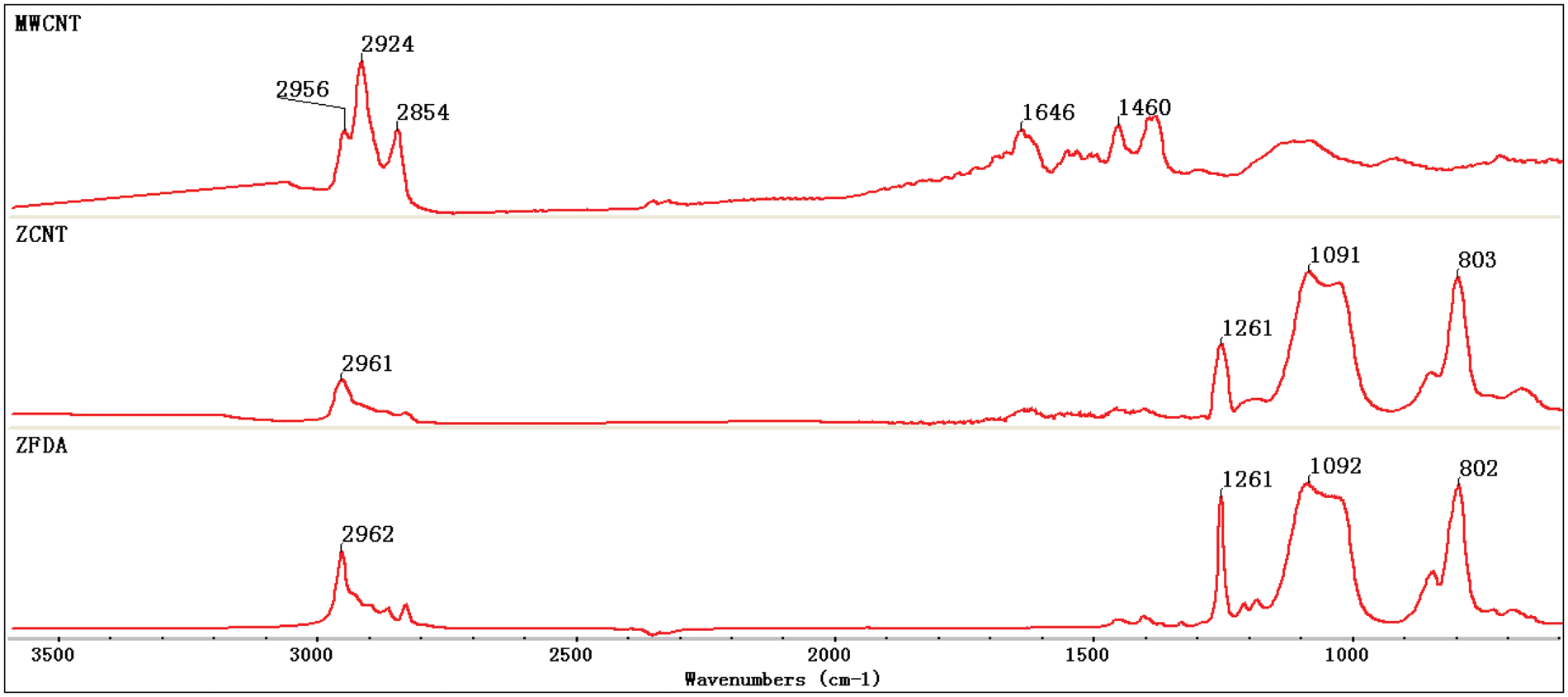
Microstructure of composites
The ZCNT/PP composites fractured in liquid nitrogen were observed using FESEM. Some of selected FESEM micrographs are shown in Figure 2, where the micrographs in Figure 2(a) and (b) were taken from the ZCNT/PP samples while Figure 2(c) and (d) were for the CNT/PP samples. In these FESEM micrographs, the black area indicates the PP matrix and the white tube‐like shapes represent the CNTs and ZCNTs. From these FESEM micrographs, we observe that fillers have been dispersed relatively well in the PP matrix within the microscopic scale. However, the dispersion states of ZCNTs and CNTs in the PP matrix are different. Let us compare the FESEM micrographs for the same contents (i.e. 1 wt% and 5 wt%) of carbon nanotubes in the ZCNT/PP and CNT/PP samples (i.e. Figure 2(a) with (c) and Figure 2(b) with (d) respectively). In the ZCNT/PP composites, the ZCNTs were dispersed relatively well and the agglomerates were smaller. But the CNT/PP composites contained the bigger and denser agglomerates of CNTs. Therefore, the ZFDA could help to improve the dispersion of CNTs in the PP matrix by reducing the surface energy of CNTs and decreasing the van der Waals force between CNTs because the ZFDA attached onto the surface of CNTs increased the steric hindrance of CNTs. As shown later, a better dispersion of fillers in the polymer matrix will result in the percolation occurring at a lower content of fillers.
SEM micrographs of CNT/PP and ZCNT/PP composites: (a) 1% ZCNT/PP, (b) 5% ZCNT/PP, (c) 1% CNT/PP, and (d) 5% CNT/PP.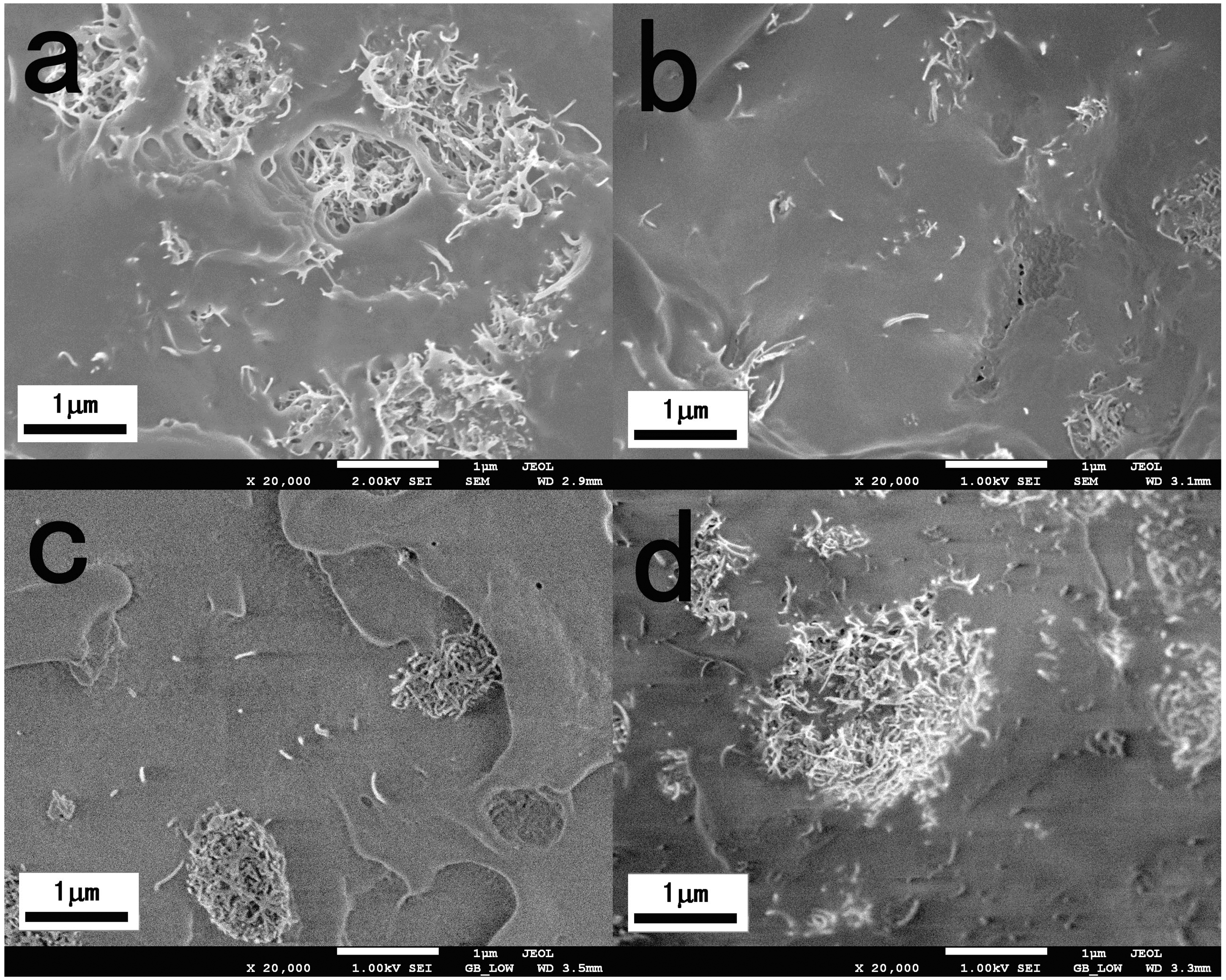
Electrical conductivity of composites
Pure PP is an excellent insulating material and has electrical conductivity of 10−17 S/cm.
22
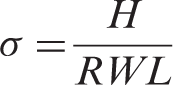
To make PP electrically conductive, electrically conductive fillers must be added. The CNT/PP and ZCNT/PP composites were molded into the square shape samples and then the resistance of each sample was measured. The electrical conductivity was calculated using the following equation
In order to find the best usage of ZFDA for the treatment of CNTs, the ZCNTs with different ratios of ZFDA:CNT were prepared and then used as fillers for making composites with PP. In these composite samples, the content of CNTs in the composites was fixed at 10 wt% and the content of ZFDA based on CNTs was varied from 0 to 100 wt%. The results of electrical conductivity for the ZCNT/PP composites are shown in Figure 3. It is observed that the conductivity of the ZCNT/PP composite increases monotonously with increasing the content of ZFDA based on CNTs when the content of ZFDA is lower than 20 wt%, but tends to level off after 20 wt%. This demonstrated that ZFDA had reached the highest effect on improving electrical conductivity of composites at a level of 20 wt% based on CNTs. Therefore, in the following work, we used the 20 wt% ZFDA based on CNTs.
Electrical conductivity of ZCNT/PP composites as a function of ZFDA's usage based on the amount (in weight) of CNTs. In these ZCNT/PP composites, the content of CNTs was fixed at 10 wt%. Here, 20 wt% of ZFDA's usage means that the amount of ZFDA in the corresponding ZFDA treated CNTs (i.e. ZCNTs) is 20 wt% of the amount of CNTs. Thus, in a 10 wt% ZCNT/PP composite with 20 wt% of ZFDA's usage, the contents of CNTs and ZFDA are 10 wt% and 2 wt%, respectively.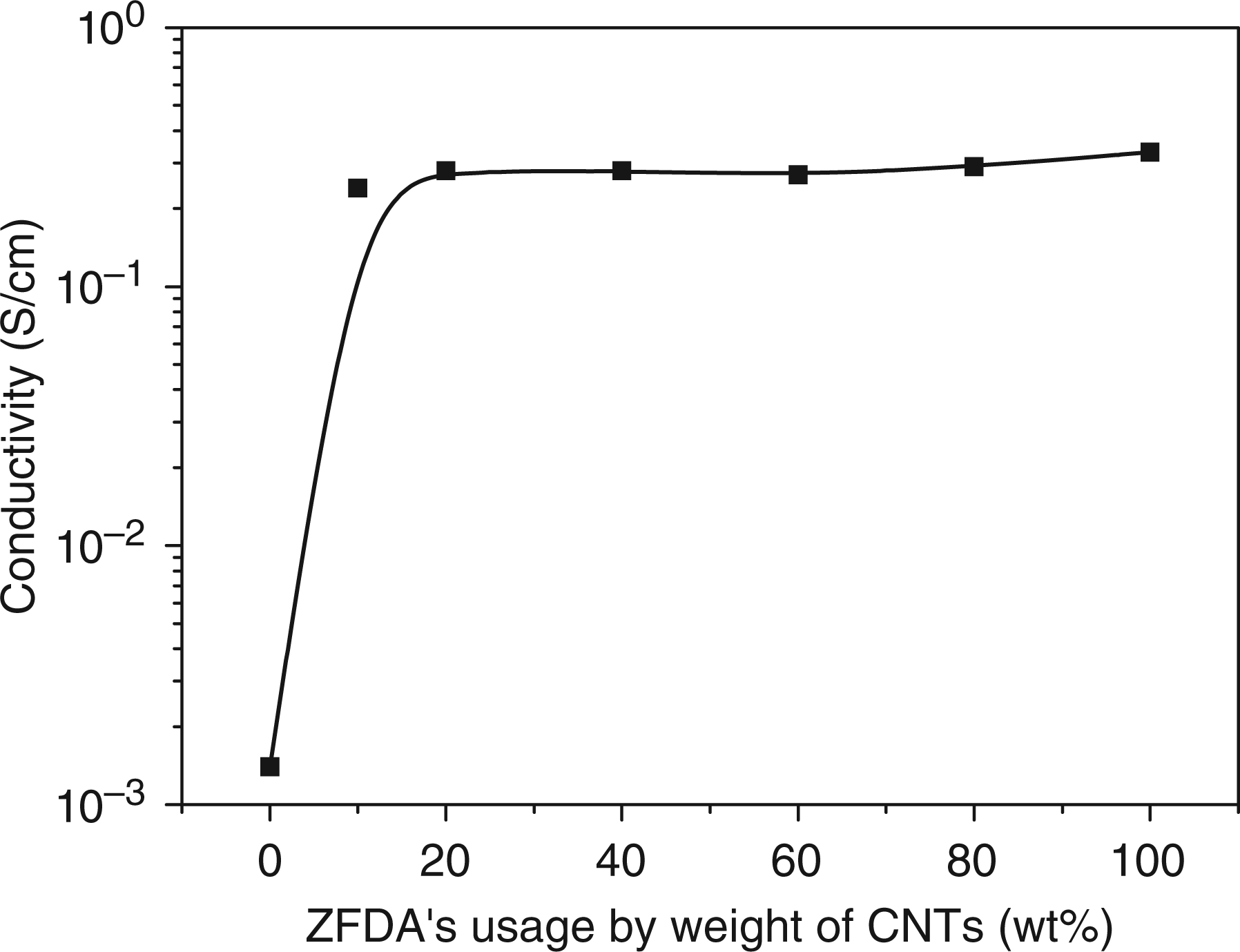
The electrical conductivities of all CNT/PP and ZCNT/PP composites prepared in this work are shown in Figure 4 as a function of filler's content in wt%. Depending on the type and content of fillers, the composites behaved differently.
Electrical conductivity of CNT/PP and ZCNT/PP composites as a function of filler content.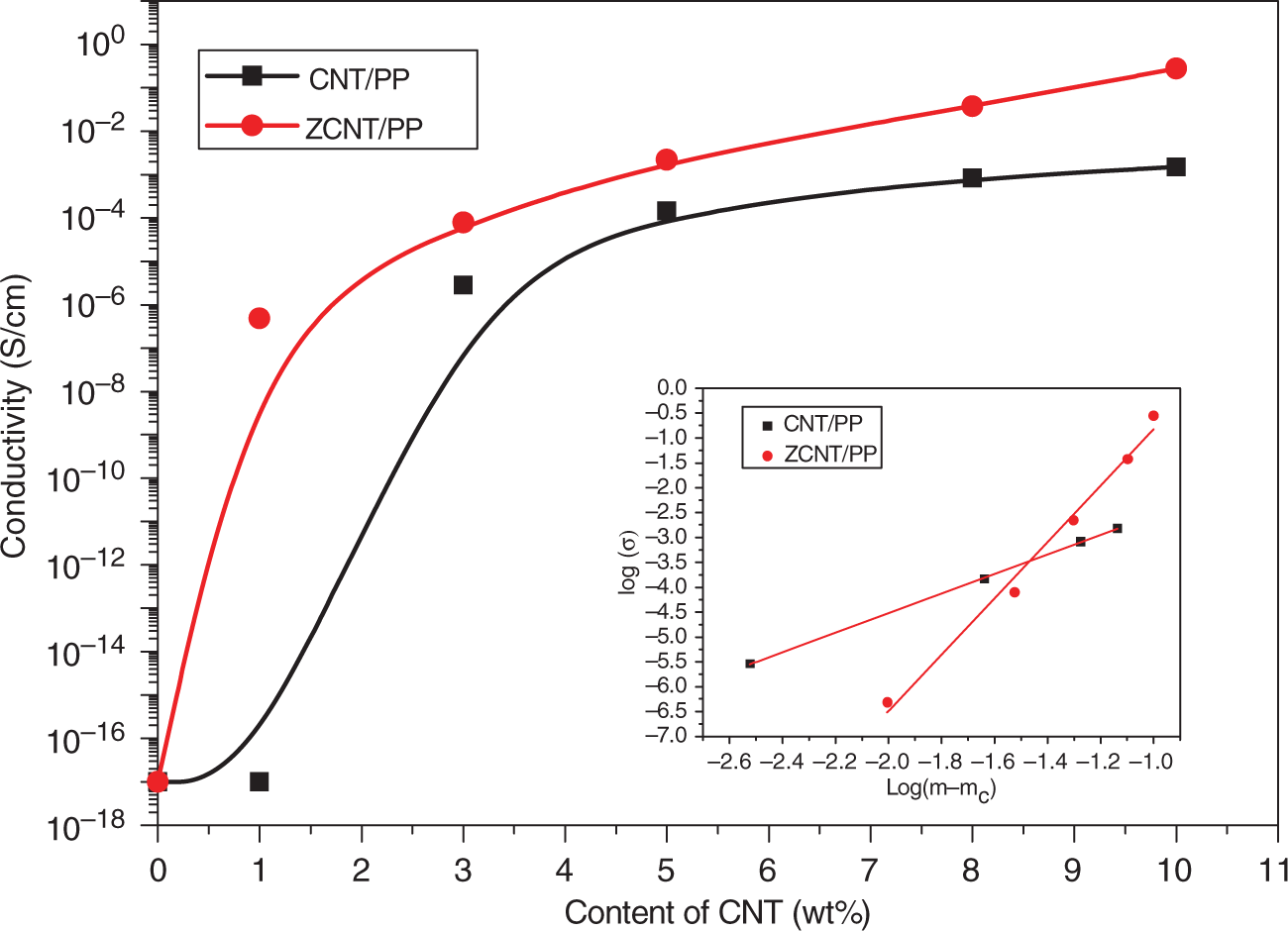
The electrical conductivity of a composite can be best described by a scaling law based on the percolation theory

We expected that the ZFDA could contribute significantly to the electrical conductivity of CNT/PP composites due to the improved dispersion of CNTs. In Figure 4, the composites containing ZCNTs exhibited the more pronounced enhancement in electrical conductivity than their counterparts containing pristine CNTs. The curve fitting using equation (2) gives the percolation threshold mc = 0.01 wt% and mc = 2.71 wt% for ZCNT/PP and CNT/PP, respectively. Thus, the results proved that the ZCNTs can dramatically decrease the percolation threshold.
We have recently prepared the CNT/PP composites (named as SCNT/PP composites) using the sodium dodecyl sulfate (SDS) treated CNTs, and found that the percolation threshold mc was 0.22 wt% and the highest electrical conductivity of SCNT/PP composites was 3.4 × 10− 2 S/cm2 at 10 wt% CNTs. Compared with SCNTs, it is obvious that the ZCNTs can give a much higher conductivity. The main reason why ZCNTs are better than SCNTs is considered to be due to the stronger interaction of ZFDA with CNTs, as compared to SDS, which helped CNTs to be dispersed into the PP matrix more efficiently than SDS. Secondly, since silane coupling agents are able to bond inorganic materials (e.g. CNTs) to organic materials (e.g. PP), the strong interfacial adhesion between CNTs and PP may stabilize the dispersion of CNTs in the PP matrix and prevent CNTs from agglomeration. For SDS, its main function is to reduce the surface tension of raw CNTs, but SDS is unable to link CNTs with PP due to its feature as an anionic surfactant and the fact that PP is neither ionic nor polar.
An additional issue associated with using a surfactant (e.g. SDS) to treat CNTs for the improvement of CNT dispersion in a polymer matrix like PP is the difficulty of removing the surfactant after the surfactant treatment of CNTs. In many cases, big amounts of the surfactant have to remain in the final composites, which could deteriorate both electrical and mechanical properties of the resulting composite products. For example, extra amount of SDS added with CNTs into PP may significantly improve the dispersion of CNTs but at the same time SDS may ‘block’ CNTs from their connection into a conductive network to result in a low electrical conductivity. The extra amount of SDS contributes to the decrease in mechanical properties of CNT/polymer composites.
These two types of CNT/PP composites showed the different patterns of evolution for electrical conductivity. The conductivity of the CNT/PP composite increased monotonously with increasing filler loading but tended to level off after 8 wt% loading. The electrical conductivity of the ZCNT/PP composite also increased monotonously with increasing filler loading but tended to continue increasing after 8 wt% loading. At the same content of 10 wt%, the ZCNT/PP composite reached a conductivity of 0.28 S/cm, while the CNT/PP composite only reached a conductivity of 1.51 × 10⁻³ S/cm, showing the advantage of ZCNTs as an effective conducting filler for making electrically conductive polymer composites.
The electrical conductivity of either CNT/PP or ZCNT/PP composites is mainly determined by the state of fillers in the PP matrix: dispersion and distribution. As proved by FESEM, for the pristine CNTs, they tended to agglomerate and the dispersion of pristine CNTs in the polymer matrix was not as good as ZCNTs (Figure 2(c) and (d)). On the other hand, ZCNTs can give a better dispersion in the polymer matrix (Figure 2(a) and (b)) for the reasons discussed earlier. The better dispersion means that the ZCNTs are able to form more connections than pristine CNTs, leading to higher electrical conductivity of composites.
Mechanical properties of composites
The tensile modulus and strengths for two kinds of composites are shown in Figures 5 and 6, respectively. For tensile modulus, both composites showed the approximately linear increase with filler content. Compared with the CNT/PP composites, the composites containing ZCNTs exhibited a much higher slope of increase in modulus. For instance, the addition of 1 wt% ZCNTs to PP increased the modulus by 16%, and the addition of 1 wt% CNTs increased the modulus by 15%, which are not much different between ZCNTs and CNTs. But at 10 wt% of fillers, the modulus was increased by almost 80% with ZCNTs, but by 46% only with CNTs. The significant difference in increasing tensile modulus between ZCNTs and CNTs is considered to be due to the differences in filler dispersion and interfacial interaction between fillers and the matrix.
29
As discussed previously, ZCNTs have a better dispersion in PP and a stronger interfacial interaction with PP than CNTs, allowing the significant contribution to the modulus.
Tensile modulus of CNT/PP and ZCNT/PP composites as a function of filler content. Tensile strength of CNT/PP and ZCNT/PP composites as a function of filler content.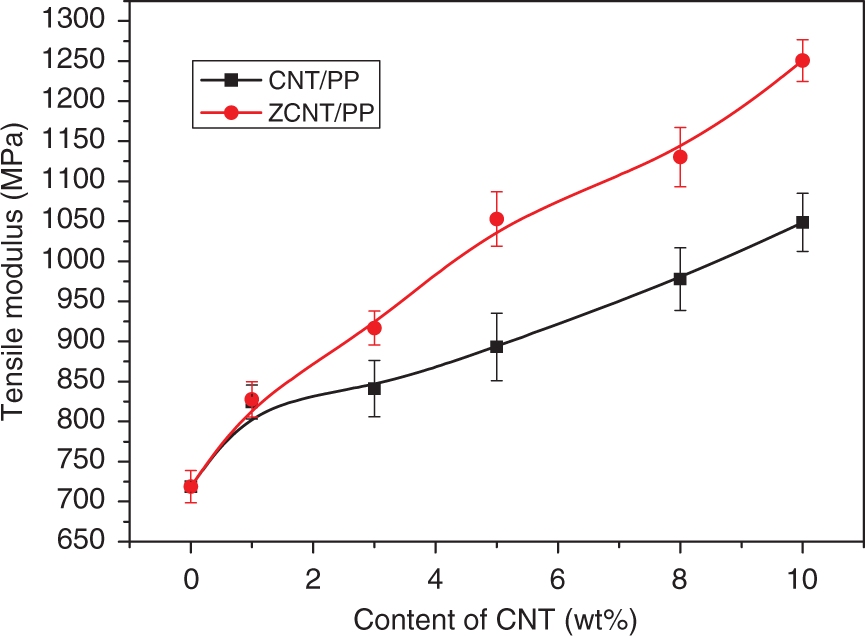
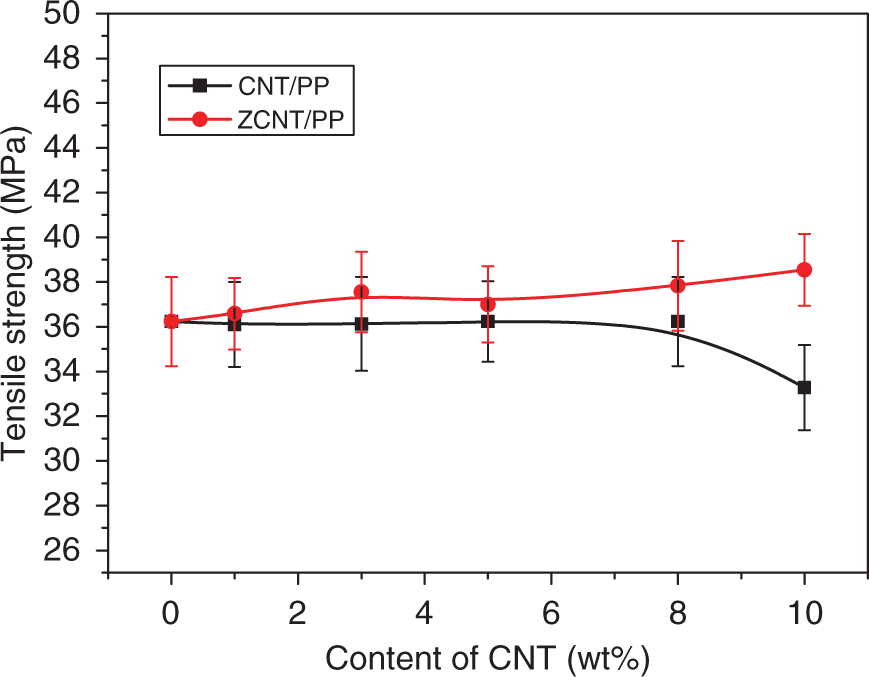
The effect of CNT fillers on tensile strength is different from that on tensile modulus, as shown in Figure 6. In the range of filler content, both ZCNTs and CNTs increased the tensile strength gently with increasing filler content, but the ZCNTs showed a stronger effect on the strength over the CNTs. For filler contents greater than 8 wt%, the strength of the ZCNT/PP composite still tended to increase while the strength of the CNT/PP composite exhibited a tendency to decrease.
Crystallization of composites
The crystallization properties of the composites were studied using differential scanning calorimetry (DSC). Since both types of fillers (CNTs and ZCNTs) do not show any thermal transitions in the experimental range of temperature (40–200°C) for DSC, the crystallinity of PP, Xc, could be then calculated using the following equation
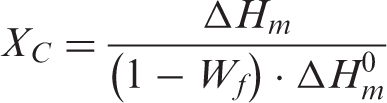
Figure 7 shows the nonisothermal crystallization curves for the CNT/PP and ZCNT/PP composites up on cooling from 145°C at 10°C/min. For each composition, there is only one single exothermic peak appearing between 145°C and 90°C, which is identified as the crystallization peak, and the peak temperature of the exothermic peak is defined as the crystallization temperature Tc. The crystallization temperature of unfilled PP is 111.6°C. From Figure 7, it is interesting to note that addition of both fillers could shift the crystallization temperature of PP to higher. The relative shift of Tc is quite evident at the lowest filler content (1 wt%) and Tc further increases with increasing the content of CNTs or ZCNTs. The higher crystallization temperatures of the PP composites than unfilled PP mean that upon cooling crystallization of PP started earlier in the composites than in unfilled PP. This is because fillers could act as nucleating agents to induce crystallization of the polymer melt in the cooling process. The effect of fillers on Tc was found to be different in such an order: CNTs > ZCNTs. For example, 5 wt% CNTs could shift Tc of PP from 111.6°C to 129.4°C, while 5 wt% ZCNTs changed the Tc to 124.0°C. Thus, Tc of the 5% CNT/PP was 5.4°C higher than that of the 5% ZCNT/PP. This result suggests that CNTs was a more effective nucleating agent for PP than ZCNTs. This might be due to the weaker interaction of CNTs with PP. On the contrary, the stronger interactions between ZCNTs and PP are deemed to hinder crystallization of PP. Some works in the literature also reported that CNTs can act as a nucleating agent in many kinds of polymer matrixes to accelerate crystallization.31–36
Nonisothermal crystallization curves of: (a) CNT/PP and (b) ZCNT/PP composites measured by DSC at a cooling rate of 10°C/min.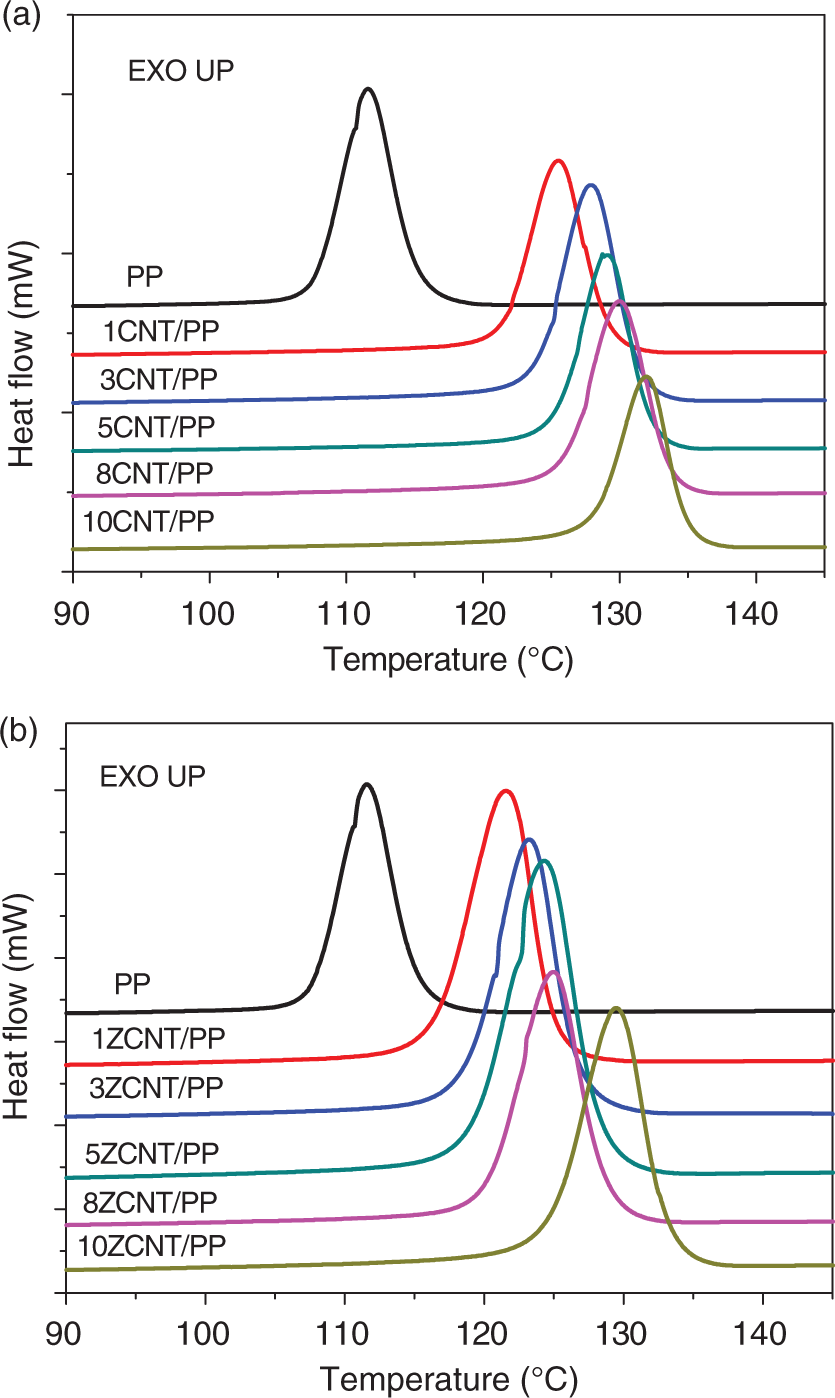
Crystallization temperature Tc, melting temperature Tm, and crystallinity Xc for CNT/PP and ZCNT/PP composites
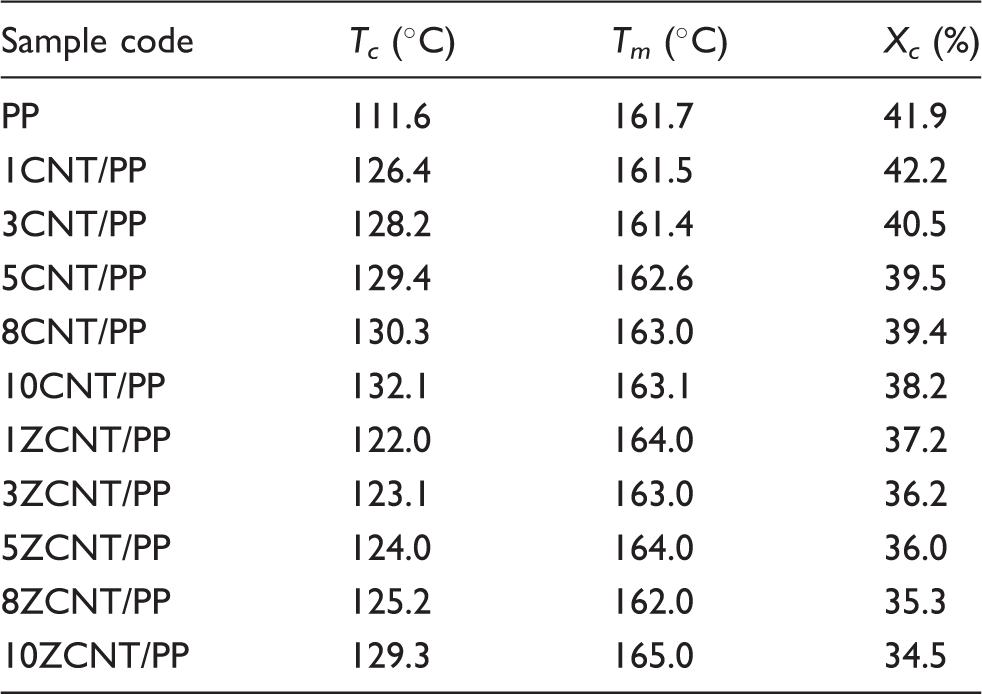
No significant changes in the melting point of PP were detected from all these composites as shown in Table 1 and Figure 8.
Melting curves of: (a) CNT/PP and (b) ZCNT/PP composites measured by DSC at a heating rate of 10°C/min.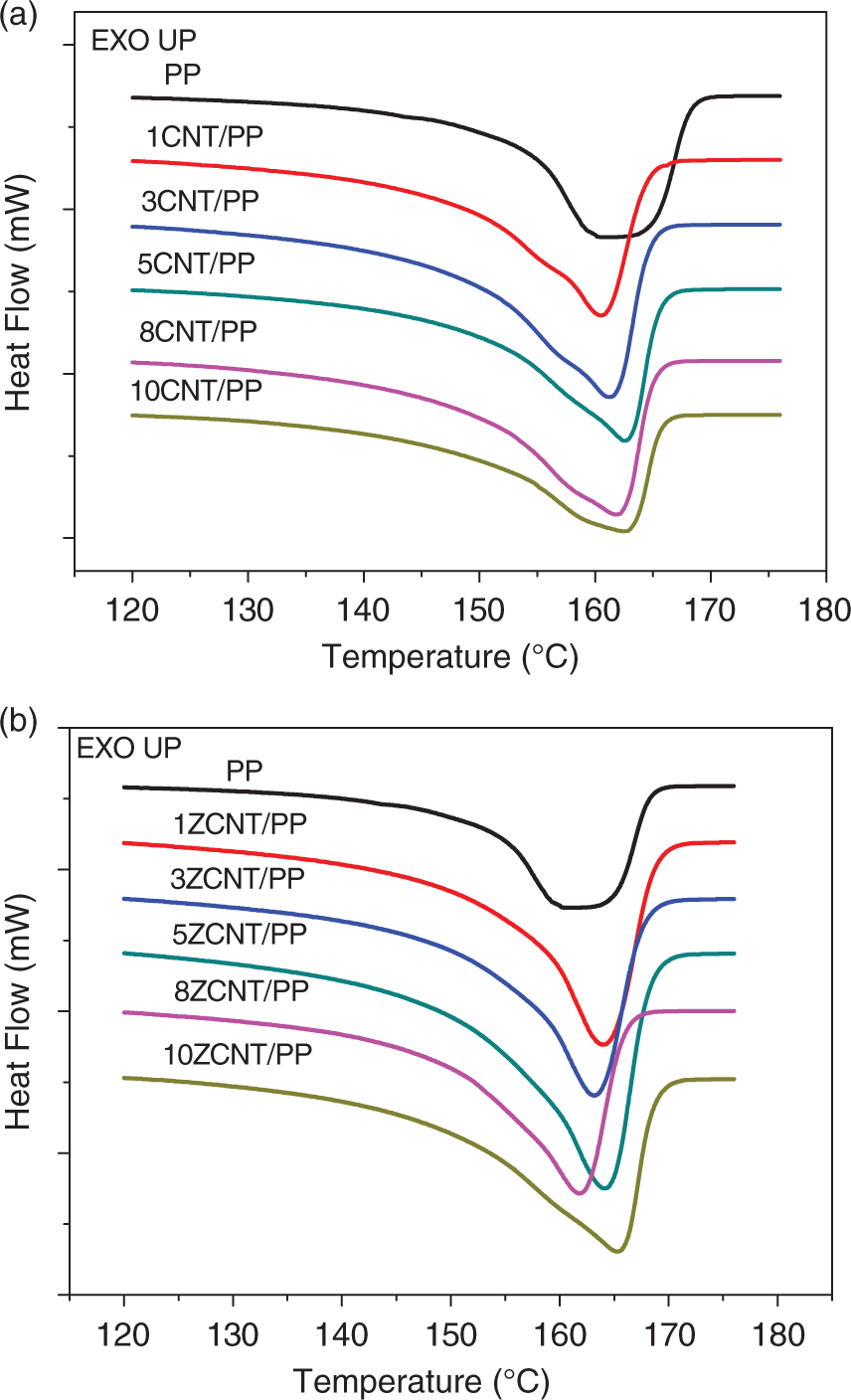
Conclusions
In summary, we have successfully prepared carbon nanotube/polypropylene composites using ZFDA as a new dispersing aid and an interfacial modifier. The best usage of ZFDA was found to be 20 wt% based on the CNTs. From this study, the following conclusions are drawn. (1) The ZFDA was able to significantly decrease the percolation threshold to 0.01 wt% from 2.7 wt% for electrical conductivity. At a given content of fillers, the electrical conductivity of the composites containing ZCNTs was more than 10 times that of those containing pristine CNTs, confirming the advantage of the ZCNTs as effective conductive fillers. (2) Both pristine CNTs and ZCNTs could improve tensile modulus, but the ZCNTs had a much stronger effect than pristine CNTs. (3) Both pristine CNTs and ZCNTs acted as nucleating agents in the PP matrix to increase the crystallization temperature Tc but lower crystallinity Xc, and the effects of ZCNTs on Tc and Xc were significantly greater than CNTs. The role of the ZFDA in a CNT/PP composite has been understood as its ability to improve both the dispersion of CNTs in the PP matrix and the interfacial interaction with PP.
Footnotes
Funding
This work was supported by the A*STAR SERC Grant (grant number 0721010018), Singapore.
Conflict of Interest
The authors declare that they do not have any conflict of interest.