






Abstract
This paper represents a comparison between the predictions of Cuntze’s Failure Theory, referred to as ‘failure mode concept model, and experimental results provided in Part B of the second World-Wide Failure Exercise. The results covered 12 test cases, involving an isotropic matrix material, 7 UD laminas and 4 multi-directional laminates subjected to 3D states of stress. The UD lamina data, needed for the validation of the failure mode concept-based UD strength conditions, were broadly applicable, whereas the laminate data could only partly serve for model verification because some test cases show some discrepancies. Also, there was a lack of test data in some of the test cases and it is concluded that there is a need to obtain more representative test data. Nevertheless, a good mapping could be achieved by the applied strength conditions dedicated to the specific test case.
Keywords
Introduction
Proving the capability of the tri-axial failure mode concept (FMC) theory requires realistic, well-evaluated and well-understood experimental data. In an attempt to achieve that, the author has made a contribution to Part A of the second World-Wide Failure Exercise (WWFE-II), Part A, with the aim of assessing the capability of the FMC model for predicting failure in composite laminates under tri-axial stresses, see Reference [3]. In the present paper, and as a contribution to Part B of the WWFE-II, the author and originator of the FMC makes a comparison between the theoretical predictions for 12 different test cases (TC) and experimental results provided by the organisers of the WWFE-II.4,5
The paper starts with providing a description of the experimental data provided and their origin. Comments are then made about the usefulness of the data and the testing techniques used to generate the experiments. The correlation between the theory and the experiments is then described.
It was found that it was necessary to modify the Mohr-Coulomb required material friction parameter (not provided, had to be estimated in Part A) in order to capture trends exhibited by the experimental results. Also, the matrix model was improved despite the fact that the matrix data seems not to exhibit a 2ndTg-effect. Finally, first with the delivery of the Part B test data, an average stress–strain curve could be determined, which is required to accurately perform the TC2, TC3 and TC4 analyses.
Cuntze’s failure mode concept-based failure theory
General
The model (see References [3,6]) involves the following: (a) proposing appropriate non-linear stress–strain curves for the UD lamina before and after occurrence of initial failure (interfibre-failure [IFF]), (b) taking into account the effect of pressure on mechanical properties and (c) incorporating five failure distinct modes (two fibre-failure (FF) and three IFF, see Figures 1 and 2), into a single equation.
Tri-axial state of stress, acting at a matrix material and a UD material cube. For lamina coordinate and fibre orientation angle, see second World-Wide Failure Exercise (WWFE-II) Part A.3 Failure mode concept (FMC) view of the fracture types of brittle transversely isotropic UD material.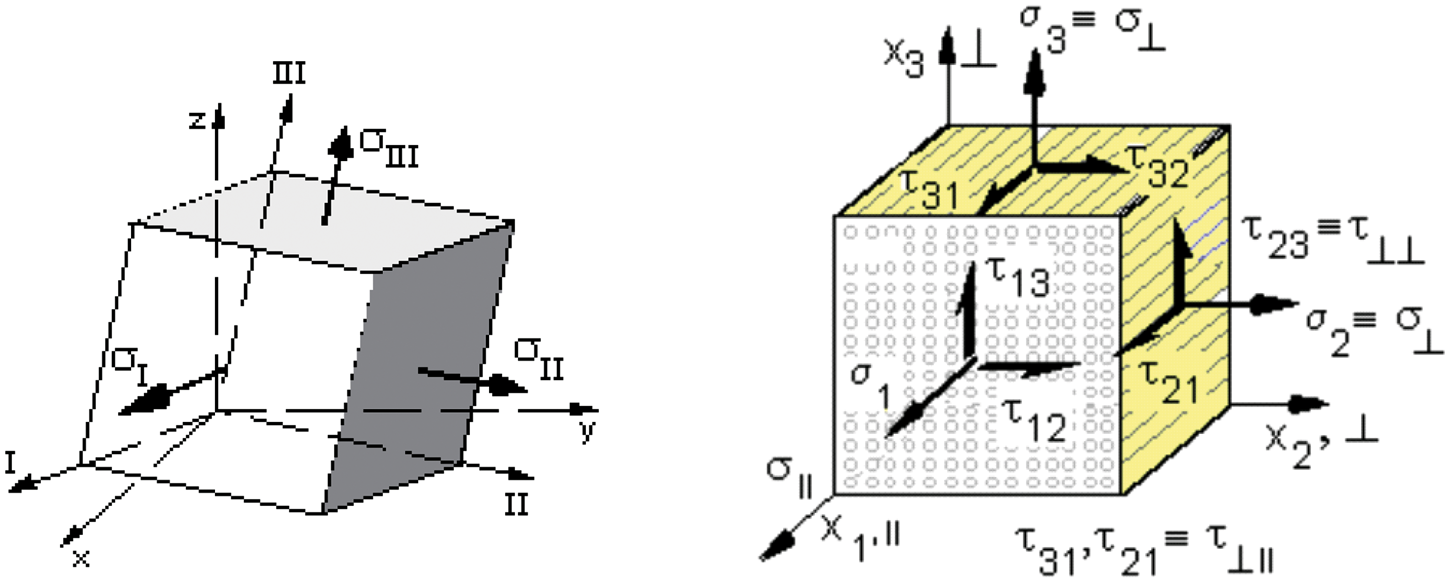
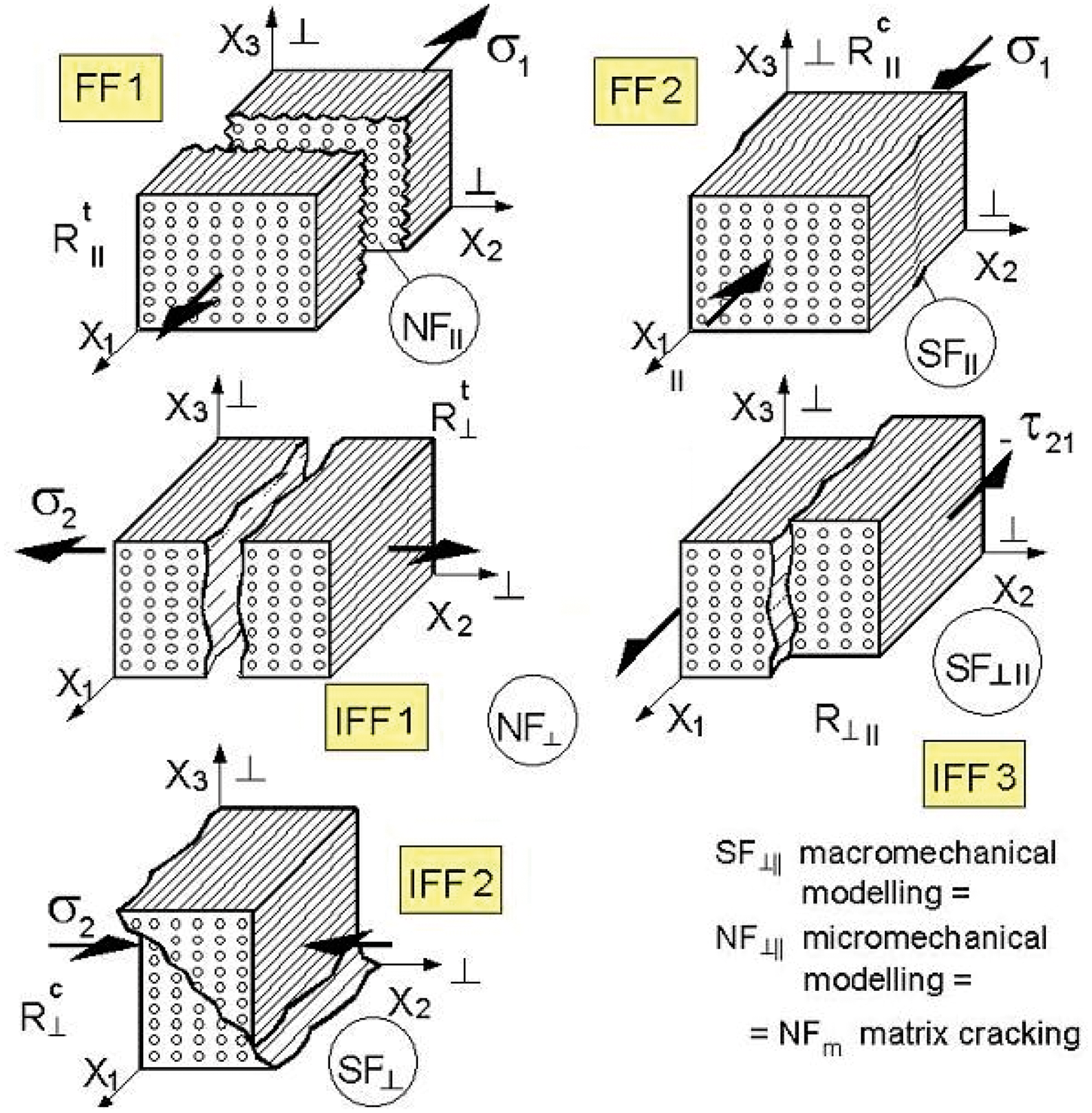
For the UD material element, Figure 1 depicts the 3D state of stress – – –
Fibre orientation is defined as positive when the angle is measured from the x direction to fibre direction (x1).
Hence, a full non-linear failure analysis of 3D states of stress is understood here to involve four distinct parts:
Failure conditions to assess multi-axial states of stress (see Figure 1), Non-linear stress–strain curves of the UD lamina material as input (see Part A), Non-linear coding for obtaining a realistic response of the laminate and Incorporation of the effects of the ‘hydrostatic pressure’.
Assumptions for modelling in the WWFE-II
Key features of the FMC, published in WWFE-II, Part A, are listed in Table 1. In order to be able to apply these features to solve problems involving triaxial loadings, the following assumptions have been considered:
– Pore-free material, specimen surfaces polished and well sealed – Fibre volume content is constant ( – Perfect bonding between adjacent layers is assumed here, neglecting layer waviness and edge effects – The incorporation of the effects of the 2ndTg shift on the behaviour of a lamina has been carried out through the use of suitable micro-mechanical equations. – A linear relationship is used to describe the softening (decrease of the slope) of the modulus and the shear strength of the matrix as a function of pressure. – The UD lamina is assumed to be transversely isotropic and behaves in a brittle manner. This matches with Part A and the provided UD test data – The fracture type, referred to as normal fracture (NF) or shear fracture (SF) in Figure 2, depends on the model level: For IFF3, the fracture type may be an NF (constituent micro-level) or a SF (lamina macro-level). Main features of the failure mode concept (FMC) and associated non-linear analysis
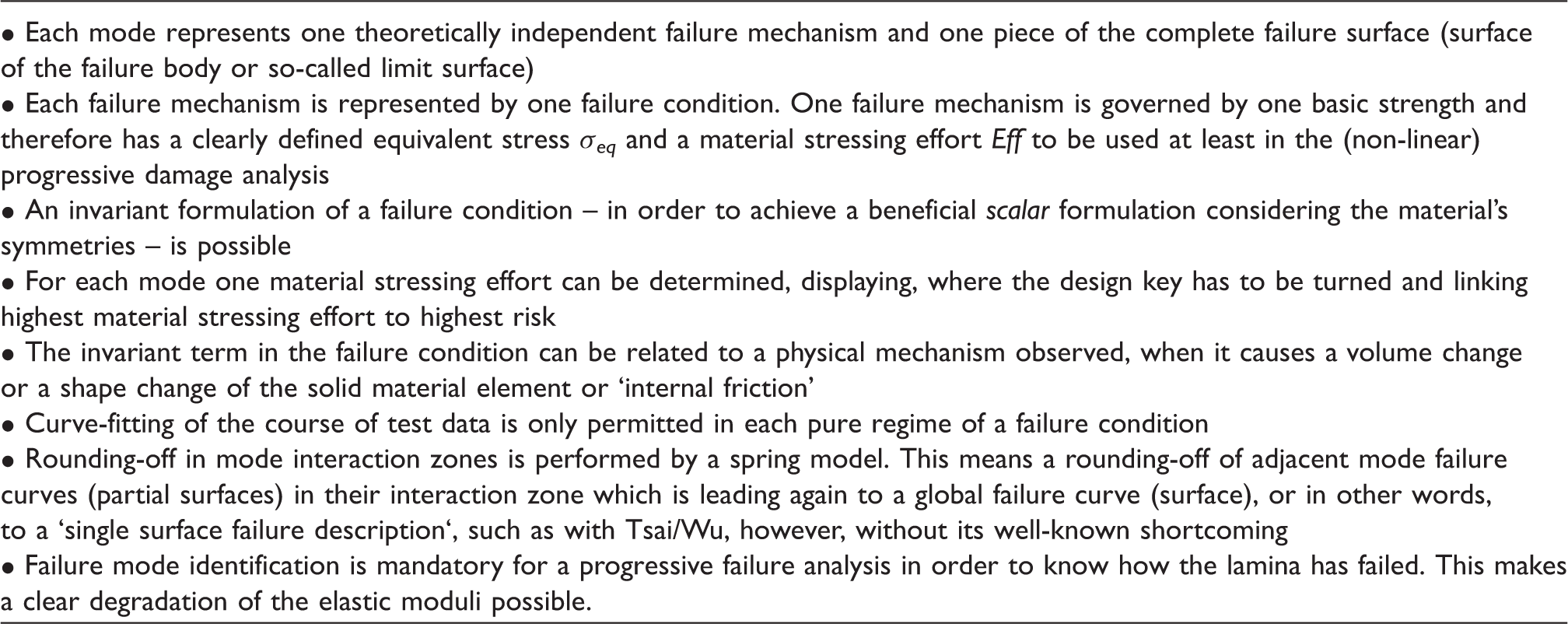
Details of possible refinements of the analysis and changes in modelling
FMC-based failure conditions and non-linear analysis
Due to a change in the given matrix behaviour (Part A: information yielding; B: information fracture), matrix modelling was changed from ductile to semi-brittle behaviour.
The non-linear analysis used here is the same as in Part A, where a secant-modulus procedure was adopted. A simple MathCad 13 code was used.
Re-work of the matrix model in ultra-high compression domain
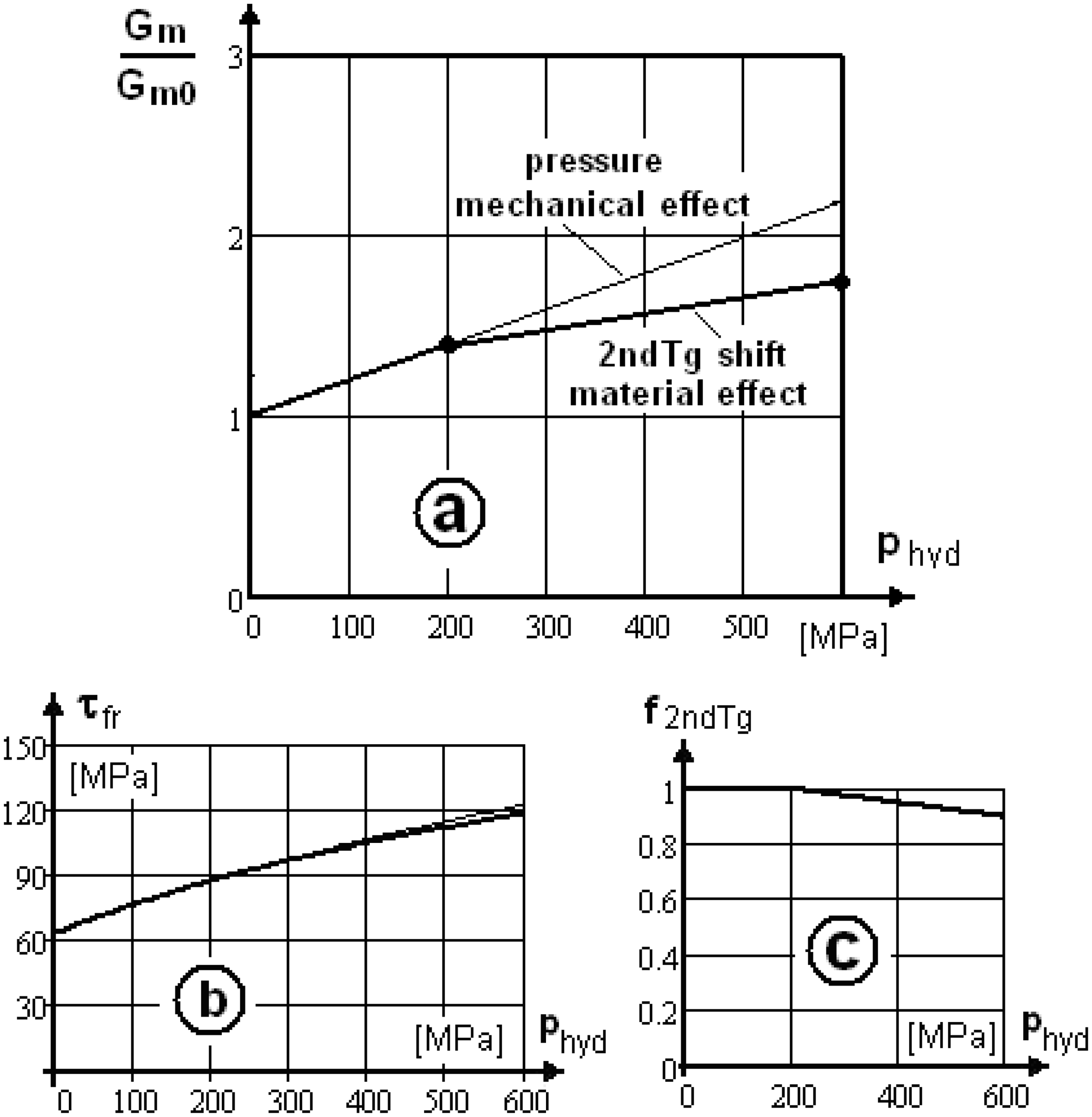
Considering elastic stiffness, from the various cited references a semi-empirical approach can be constructed on basis of previously published test results for the shear modulus, References [7, Figure 5; 8]. The kinked curve in Figure 3 can be fitted with a bi-linear manner function (series spring model) as follows:

with
with (a) 2ndTg shift effect: Dependence of the matrix shear modulus on p
hyd
. Assumption for PR319: knee point 200 MPa at ratio 1.4; final point 600 MPa at ratio 1.75, see Reference [15]). (b) Distribution of fracture stress. (c) Decay function TC1: Tri-axial compressive failure stress curve 
To be inserted into this equation is the effective hydrostatic stress 
In the case of tri-axial and lateral bi-axial compression (
Transfer to UD stiffnesses and UD strengths
For the UD material, the 2ndTg-effect will differ from that which is obtained for the pure matrix, the effect is usually minor. However in the TC, lacking of knowledge for the UD materials, the strength reduction factor
‘Strength’ decrease and ‘healing’
According to the usual failure condition
With respect to a ‘healing’ of the ‘diffuse’ micro-cracking situation, the effect of pressure is inherent in the lamina and the laminate high pressure test data (e.g. TC 2). It needs to be separately modelled, whenever applicable.
Consideration of in-situ effect of the embedded lamina
Properties used as input (see e.g. Reference [9]) for the analysis are test results from isolated UD lamina specimens such as a tensile coupon. They are load-controlled derived and results of weakest link type, whereas the in-situ behaviour of an embedded UD lamina is deformation-controlled and therefore of redundant type. This fact shows up that a good mapping of the course of ‘isolated UD test data’ does not involve the full information necessary for a qualified post-IFF analysis of laminates, which consist of a stack of embedded laminas.
Brief descriptions of test cases and comments on Part B test data provided
Description of test specimens
In this paper, an attempt is made to validate a theoretical model of the reality by some experimental realisations of the reality. To accomplish this, 12 challenging TC are provided by the WWFE-II organisers5 involving (see Table 4 in Part A):
Epoxy material under a tri-axial state of stress 0° unidirectional lamina under various tri-axial states of stress [0/90]s, [±45/90/0]s, [±35]s multi-directional laminates under various tri-axial states of stress and through-thickness loadings and three stress–strain curves for
– 0° unidirectional laminas under various tri-axial states of stress – [±35]s laminates under a tri-axial state of stress and – [0/90]s laminates under through-thickness compression.
Different shapes of the test specimens were used in the experiments. These are as follows:
For TC1, a solid cylinder specimen For TC 2,3,4,8,9: thick-walled tubes, For TC5: a rectangular block, For TC6,7: dog-bone-shaped machined specimens from pultruded rods, For TC10,11 waisted (dog-bone shaped) tubes milled from a laminate block and For C12: waisted solid laminate specimen.
Test results for TC2 and TC3, obtained from 0° pin-wound tubes, were also provided by the organisers. However, these results cannot be used (see Annex 5) for the validation of the UD strength conditions, just the data from the hoop-wound tubes are applicable.
Above variations in test specimens (manufacture etc.) have different effects on the quality of the validation. In total, nine different tri-axial failure domain envelopes and three stress–strain curves have to be correlated.
Comments on experimental input
Making an attempt to understand the provided experimental results one has to distinguish whether the test results are fracture values in total stresses or hydrostatic pressure superposed fracture stresses. This difference is not always clearly expressed in the given test information. From comparing data of various sources one can only sort out What might be meant? Due to Figure 4, for the example UD lamina, tri-axial failure information can be provided in several ways ( Transfer of experimental data in compressive and tensile domains. x = provided data, parallelogram = transformed data.
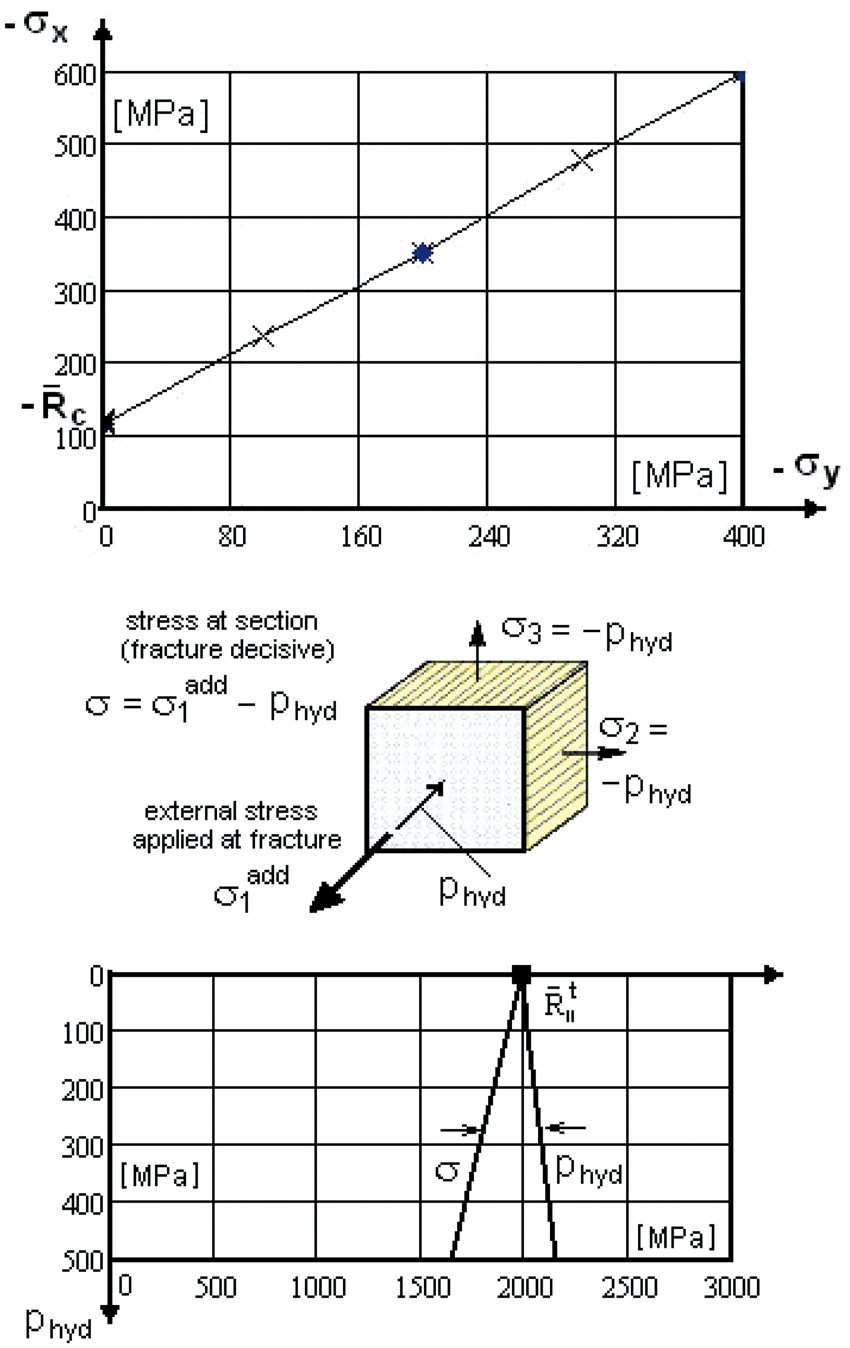
In order to correctly interpret the diagrams in the associated literature, one has to carefully check whether the diagram is of the type
In order to interpret and use the test data (not all are clear) correctly, it is of basic interest to understand what is behind, what are the test specimens and the test rig (examples TC 10, 11). In this context, TC tests, test specimens and test data are commented in detail in the next chapters beginning with some “linformation phrases” typical for the TC.
Discussion of test data and associated information provided for Part B
Basic material properties are provided in Annex 3
“Test data from a sealed cylindrical bar epoxy specimen in a container filled with a highly pressurized fluid.
10
The axial loading is carried out by a pull rod. The necessary two seals cause friction which is considered in the provided fracture stress data. The axial fracture stress is computed from the measured load divided by the original cross-section”.
Barrelling was not monitored! Not all physically needed properties, such as the (low) material friction of this semi-brittle matrix material, could be provided by the organisers.
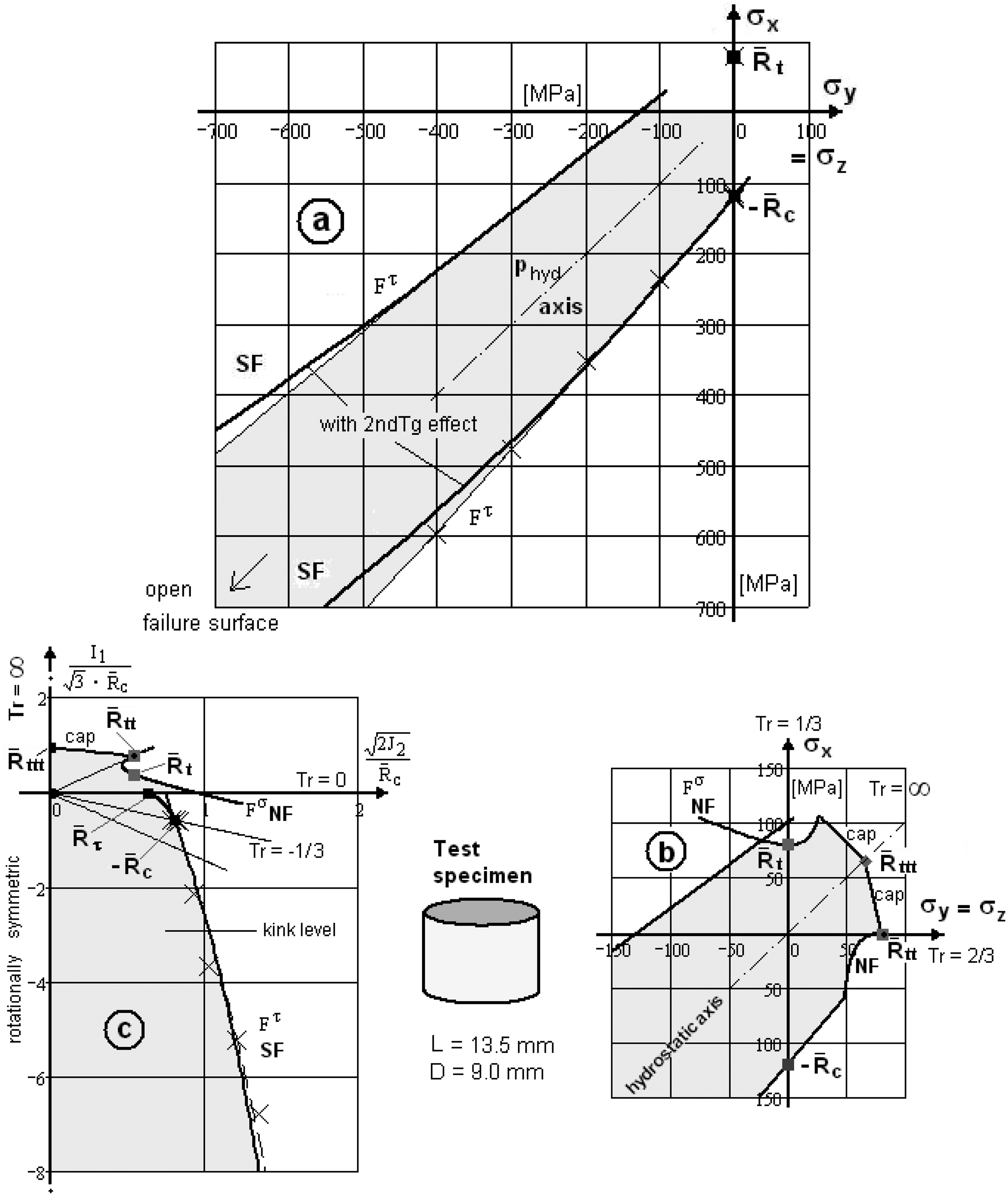
– The course of the provided test data does not exhibit the 2ndTg-effect demonstrated by a slope beyond the epoxide-typical −200 MPa (hydrostatic pressure, equal compressive stresses) kinking point, Figure 5a. This of course also meets the 2ndTg-matrix modelling under a general 3D compression loading with different stresses in the three coordinate directions. Information for modelling the change of stiffness and ‘strength’ is not directly given, and in literature the data vary. Therefore, a correction factor
Unfortunately, literature could not fill the lack of information. Instead, a discrepancy was found: Beyond the kinking point, Young’s modulus E still increases in Reference [10] with a distinct (lower) slope, whereas in References [7,8,11,12], the related shear modulus – In Reference [10], it is reported: All test specimens under compression failed by yielding (for Part B the failure type yielding was corrected by the reviewer into fracture which is essential). This holds from atmospheric pressure up to – The provided dataset forms a straight line and thereby does not show any 2ndTg-effect, Figure 5(a). On the contrary, beyond the indicated kink level (at about −200 MPa) the Figure 5(c) shows a widening of the failure surface instead of a shrinking. It looks as if the effect needs not to be addressed for this matrix material. Nevertheless, for a visualisation of the tendency of the 2ndTg shift effect a 10% slope decay is assumed and displayed in the Figures 5a and 5c.
Modifications from Part A to Part B: As the providers have changed the information on the matrix behaviour from yielding to fracture the friction model parameter
TC2: Fracture stress TC3: Failure shear strain 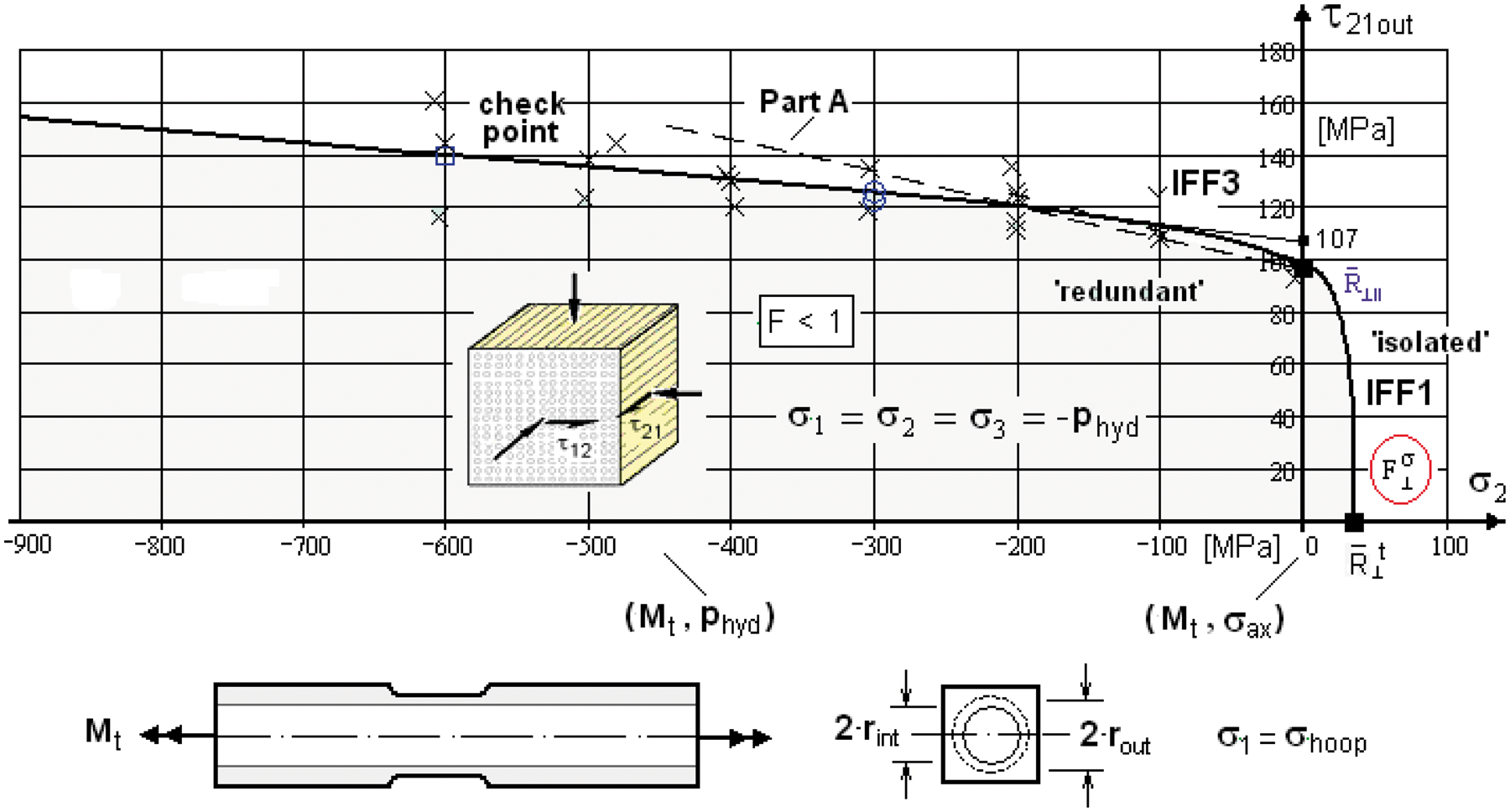
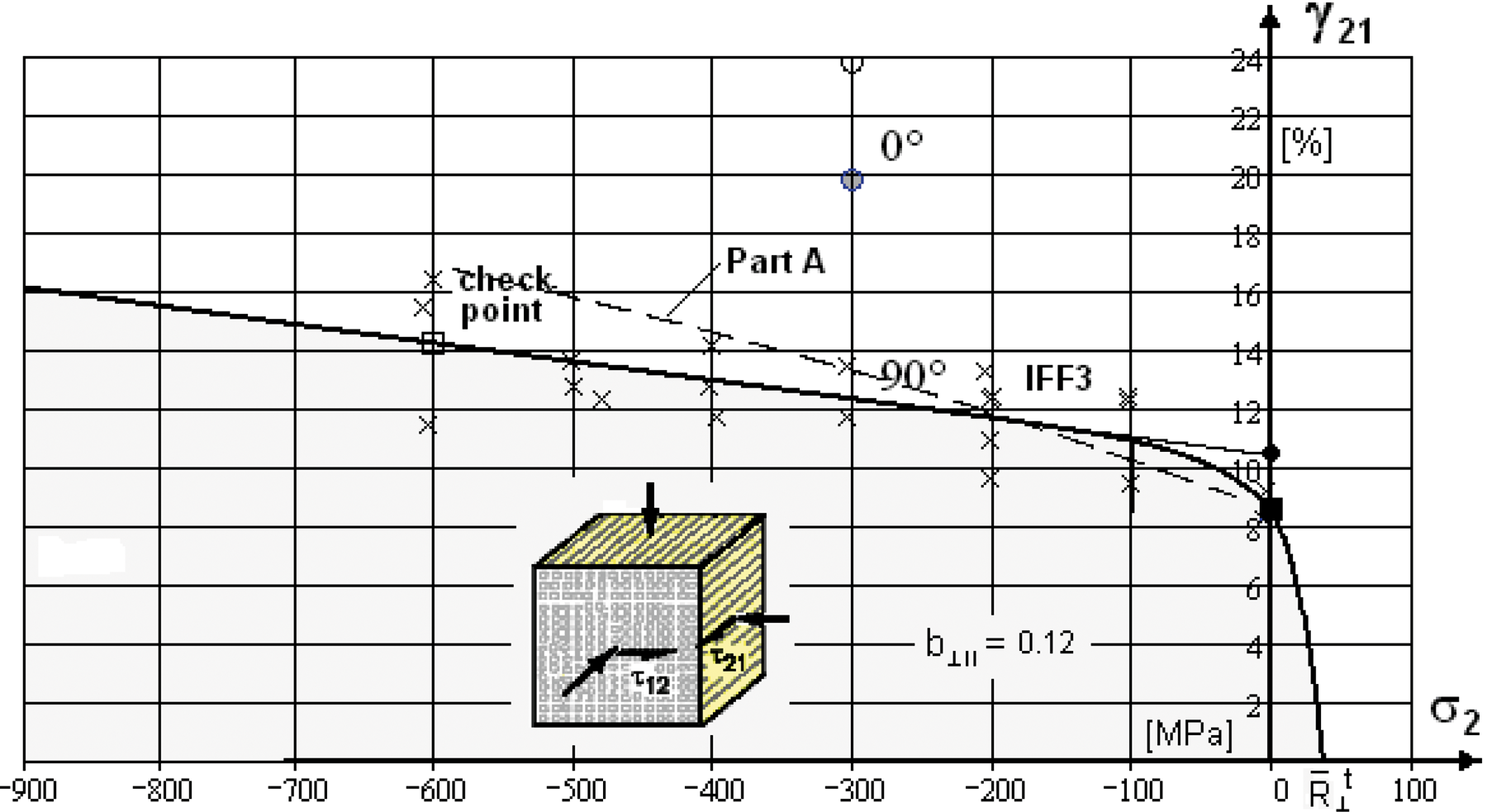
The test results obtained from the two test specimen types show wide scatter and jumping. Test data does not show a 2ndTg-effect. Investigated are only the 90° tubes. An investigation, why the data set of the twisting 0° tube is not used (see Figure 8), is performed in Annex 5.
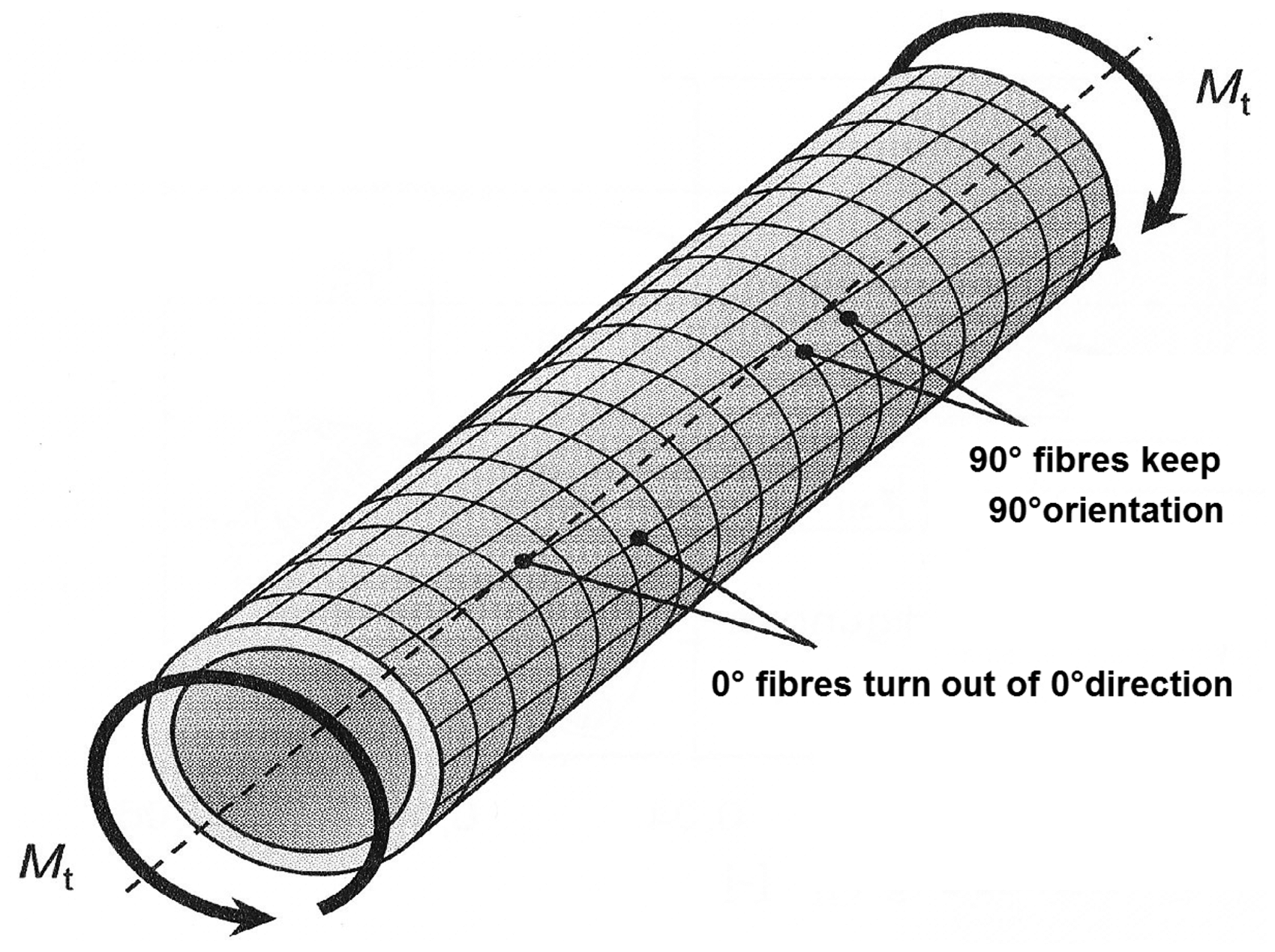
– The tubes are relatively thick-walled. This means for torsion that the shear stress grows from inner to outer radius. Therefore, Change of the fibre orientation under torsion in TC2, TC3 (courtesy IKV Aachen26).
For the other critical stress, the filament hoop stress and its strain – A Finite Element Analysis check delivered a filament hoop strain at about
Theoretically from simple elastomechanics, the hydrostatically loaded tube will break at
– Novel idea: (1) At a first look, the jump in data size at – For TC2 and TC3, an average stress–strain curve must be used. This curve could not be well assessed by the Part A data and because the friction parameter – The thick wall has an effect for tubes with high hoop stiffness such as the 90° tubes and marginal effect in case of 0° tubes. – Bottleneck of the two specimens: Under radial pressure, the 90° reinforced tubes experience a rapidly altering hoop stress over the radius. Under torsion, the 0° tubes experience a stress-significant turning of the fibre orientation. Due to the turning of the fibre direction under torsion, the 0° tubes experience a much more complicated and different stress state than the 90° tubes and can therefore not put together in the same diagram, see Annex 5. – For the 90°-test specimen the torsion moment causes a 
Modifications from Part A to Part B: TC2 and TC3 have to use an average (typical) stress–strain curve. This could be first obtained from Part B knowledge. Having known the average curve in Part A, the predicted curves would not differ from the Part B ones.
“In the case of 90° tubes, the shear strength and the strain to fracture increase approximately by 43% and 65%, respectively, from atmospheric pressure up to
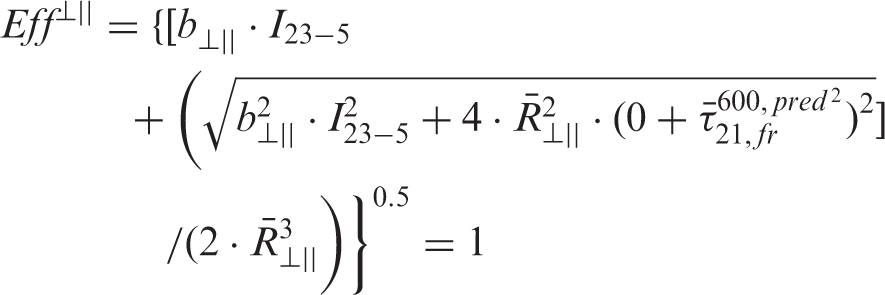
The required TC3 curve is a fitting curve through all the fracture points of the shear strain–shear stress Ramberg-Osgood curves (R-O was the chosen fitting function, all four R-O parameters vary with – The jump in data size at – The final rounding procedure is performed analogously to TC2 by a correction function



Modifications from Part A to Part B: In Part A the fitting approach was solely backboned by results from Shin and Pae. See TC2, too.
“Test data from References [
11
,
12
]. Thick hollow circular cylinders as 90°-tube test specimens. At minimum, 3 tests were carried out at each condition of pressure. Shear was introduced by application of a torque to the end of the test specimen”. TC4: Shear stress–shear strain curves for 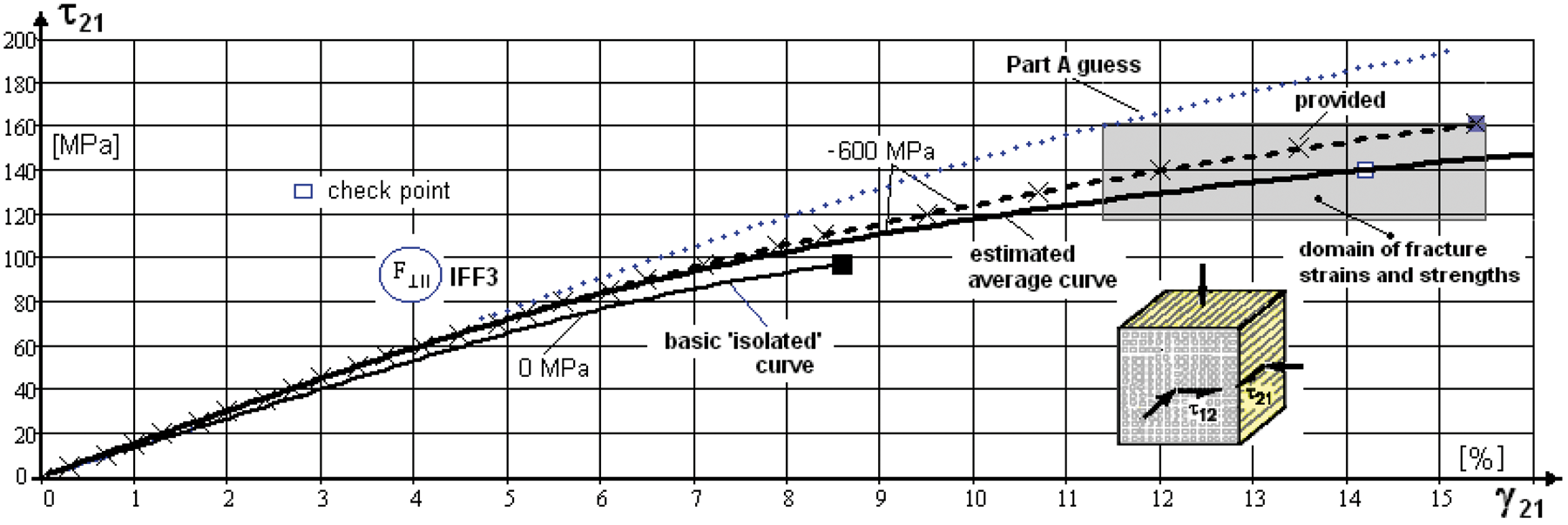
According to the obtained experimental data, the investigation of the TC2 through TC4 begins with the mapping of provided shear stress–shear strain data. The generated curve will be a single curve (≡ one test realisation) within the scatter band of the provided curves. For the envisaged strain-hardening FRP materials, this curve will be engineering-like mapped by
– The degree of the strain-hardening non-linearity mainly affects – Novel idea: There must be a link between TC2, TC3 (both the curves result from a bunch of different test specimen curves) and TC4 (single curve of the bunch). This link, marked by a common check point (hollow square) in the three figures, can be only obtained if the TC4 single curve is replaced by an average (typical) shear stress–shear strain curve.

For performing this, it is assumed that the centre of the ‘fracture stress/fracture strain domain’ is the most probable, ‘average’ failure point. The idea above to obtain an average curve is effortful, because all R-O parameters of each curve change, and no similarity can be stressed:
– Basic average ‘isolated’ curve, for orientation: Prediction of average – Estimation of a shear fracture value at – Determination of remaining properties to compute the R-O parameters, estimated by using information from Pae-Shi curves15: – Above data based on – Provided test data, single curve: – Searched Part B average (bar over) curve:




Modifications from Part A to Part B: Change from estimated
“Test data from Reference [
10
], compression tests: rectangular blocks (5 × 5 × 20 mm3 coupons, cut from filament wound UD panels) under combined axial loading with lateral pressure. During test, the (hydrostatic) pressure was first increased to a pre-determined level and then kept constant while TC5: Tri-axial failure state of stress: 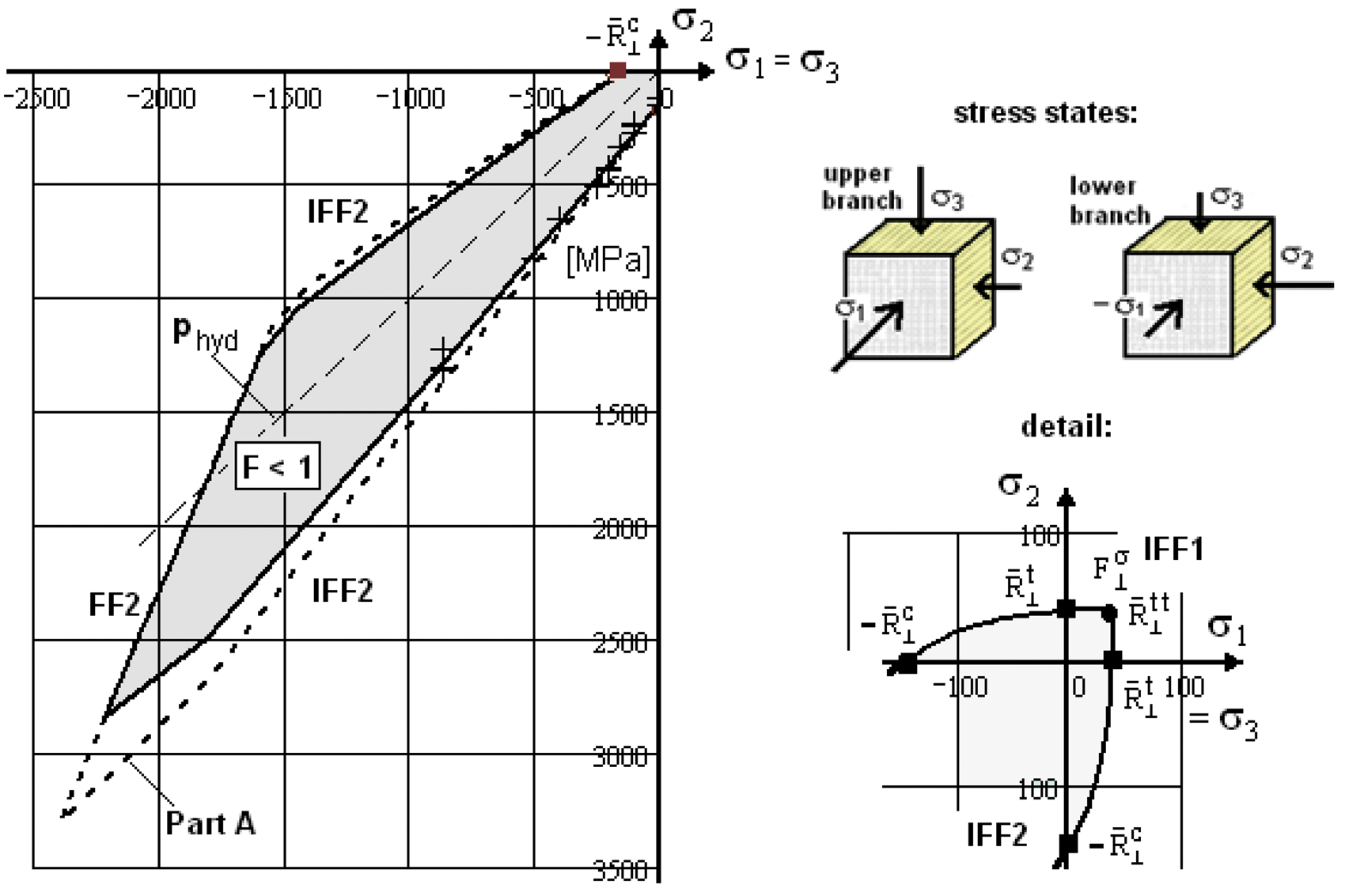
Task is the prediction of the failure envelope in all quadrants. Test data are provided for tri-axial compression in quadrant III, lower branch, only. They look good but do not indicate any 2ndTg effect by a kink point or deflection point, respectively. A comparison can be only made in quadrant III.
– The slope of the course of test data shows that the UD material is less brittle than assumed in Part A. Therefore, the friction parameter
Modifications from Part A to Part B: Change
“The test data were taken from Zinoviev and from Wronski and Parry Reference [
16
]”. TC6: Through-thickness stress 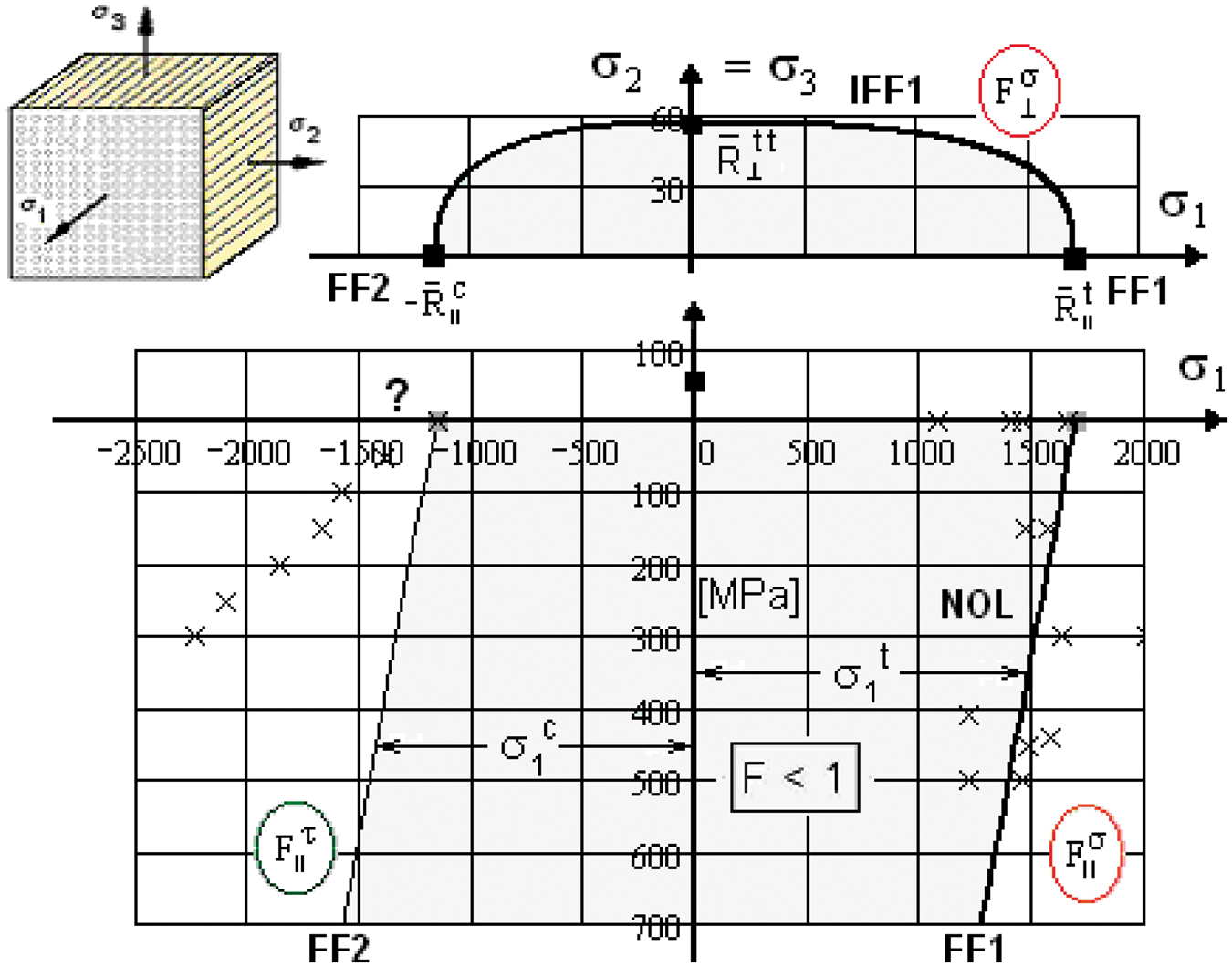
The test data of TC6 and TC7 show large differences in quadrant IV. For mapping of the tension curve FF1 in quadrant IV no reliable test data set was provided. TC 6 presents a diffuse scatter in quadrant IV. This can be explained from own tests with Naval Ordinance Laboratory (NOL) rings. It is known that the additional bending stress at tensioning the NOL ring causes pretty a stochastic fracture with a fracture level pretty lower than that from the usual coupon test. A stadium ring would have delivered better results but is more difficult to produce. Therefore, the results from Zinoviev cannot be used for validation.
– The tendency of the left branch, mode FF2, from Wronski-Parry (quadrant III) is the same as in TC7, fortunately, and could be a validation basis. The left branch indicates a kink and thereby – for the first time possibly – seems to indicate some 2ndTg-effect. – In TC3 and TC4, it was demonstrated that the shear fracture strain increases with – TC7 will be the better test case for deeper investigations than TC6 and shall be discussed. Just the fibre material is different, glass changes to carbon.
Modifications from Part A to Part B: None.
“Test data from Parry-Wronski.
18
19
Tests executed with dog-bone test specimens, as before. Failure modes observed are longitudinal splitting, kinking, kink band”.
TC7: Through-thickness stress 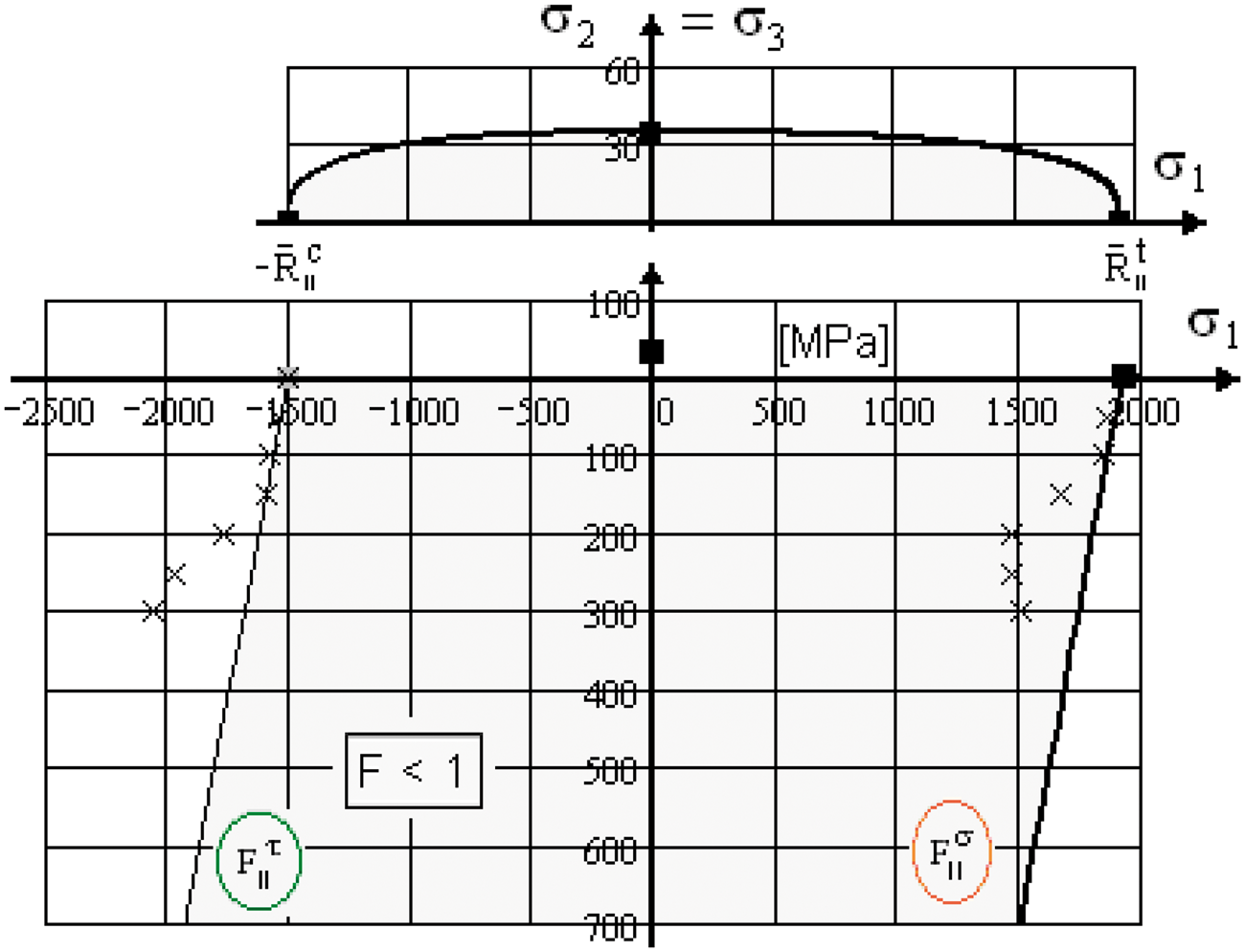
The course of the test data indicates that the predictions in Part A may have been performed on the basis of a not really understood 2ndTg matrix modelling and that the matrix does not really show any 2ndTg-effect. On top, still now, some discrepancies disturb the use of the provided TC7 test data for model validation.
Due to missing test points, the provided through-thickness strength – Test data look better than in TC6. However, it is not understood why the tendency of the curves in quadrant III and IV is so different. Primarily, Poisson is acting at smaller bi-axial states of compression stresses first, the 2ndTg effect acts later at higher pressures. Therefore, due to the Poisson effect, the compressive fracture failure strain and similarly the failure stress in quadrant III, which acts at the cross section, is increased and in quadrant IV the tensile failure strain (right curve) is reduced. This would result in a similar curvature tendency in both the quadrants.
With increasing failure strain, the ‘compression’ curve becomes more horizontal and the ‘tension’ curve more vertical. How long the vertical drop will go (the provided data set ends at – In quadrant IV, it looks at – All the courses of the provided test data and of other test data have a flattening tendency as it is also depicted in quadrant III. From this might be questioned whether measurement or evaluation of the provided test data might not be adequately performed, at least in quadrant IV. Influence on the curves have the in-plane major Poisson’s ratio
Modifications from Part A to Part B: None.
“The test data were taken from Reference [
20
] and the test specimens were filament wound tubes”.
TC8: Effect of the applied surface pressure 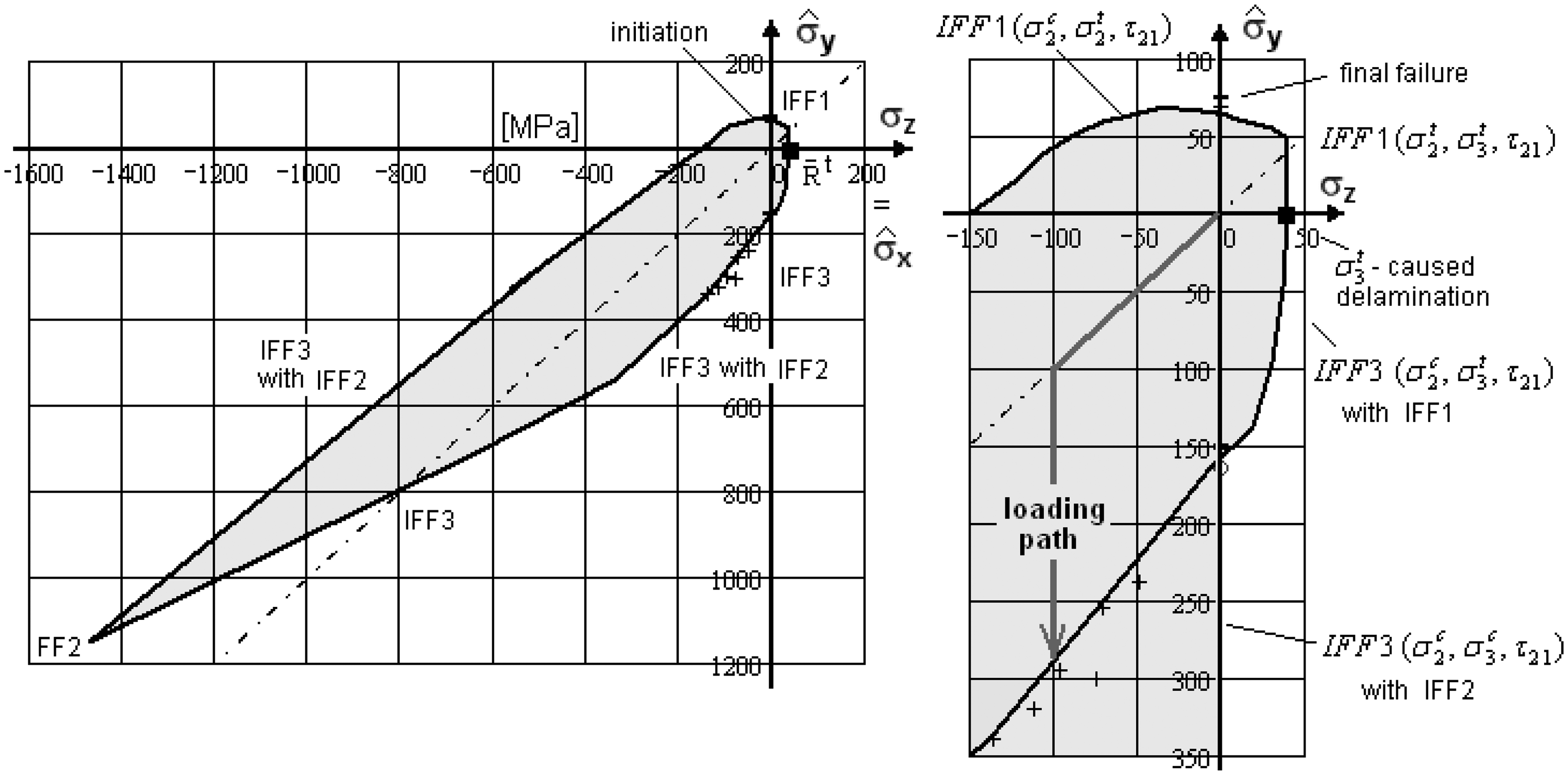
Data for the upper branch is missing. Data for the quadrants I, II, IV could be not provided in order to have a good basis for the validation. Figure 14 describes test arrangement and stresses. The high values of the three test data at the positive – A re-investigation of the friction parameter – An improved non-linear programming is necessary, especially due to the fact that in TC9 both the failure modes IFF2 and IFF3 have a similar risk to fracture, or - in other words - the material stressing effort is similar for both modes in the envisaged two-fold failure domain. – The fibre volume contents for Part B was increased from the initial 60% up to Modelling of TC8 test situation, t
k
= 0.25 mm, t = 2 mm laminate thickness.
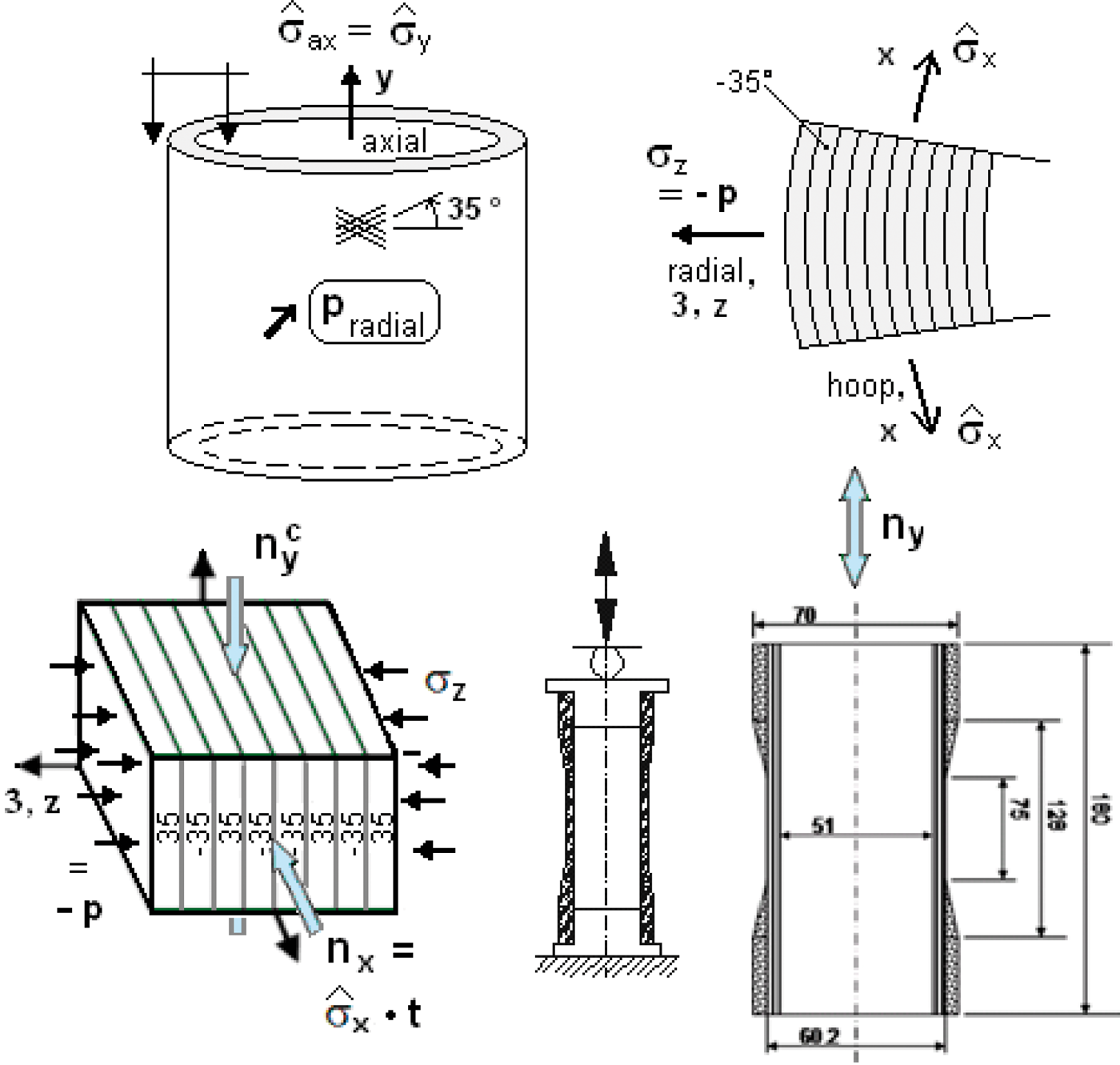
An increase of the fibre volume content on the elasticity properties is not considered due to the other uncertainties and that the stress–strain curve would have to be adapted and hardening parameters to be reworked with all its work consequences.
Modifications from Part A to Part B: Change of
TC9: Comparison between theoretical predicted stress–strain curves 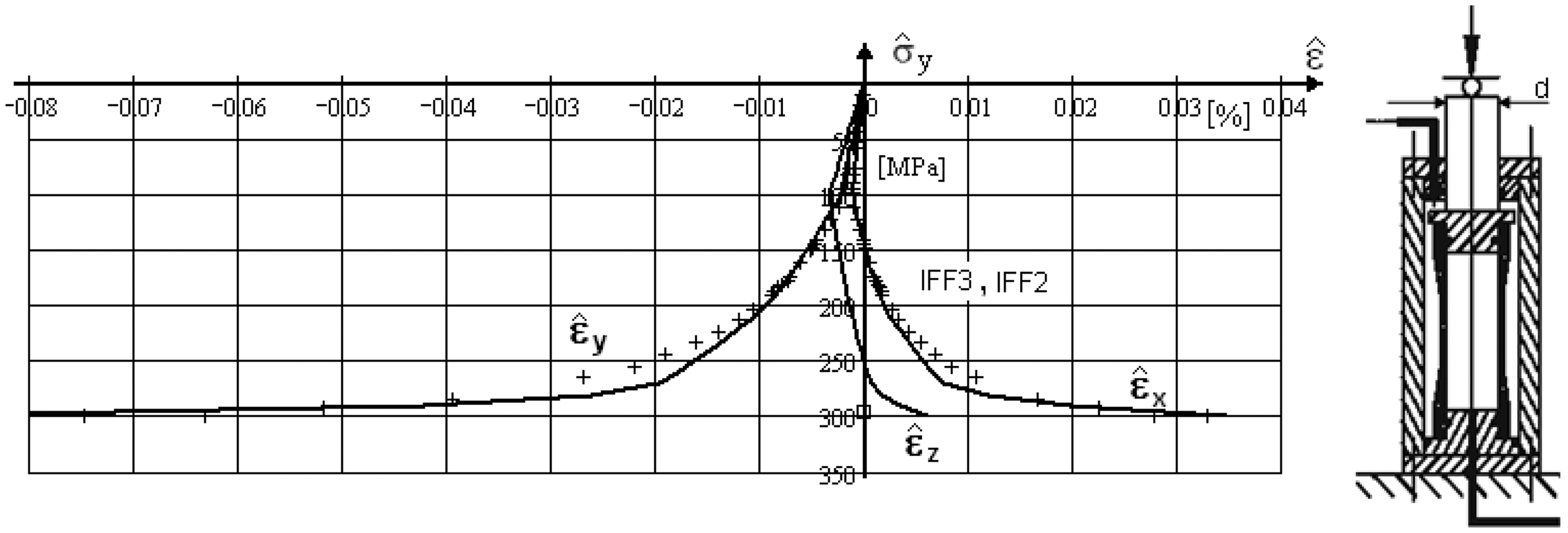
“Test data were taken from Reference [ 20 ].”
Data for
Modifications from Part A to Part B: Change of
TC10: Applied section shear load-caused maximum-thickness failure shear stress 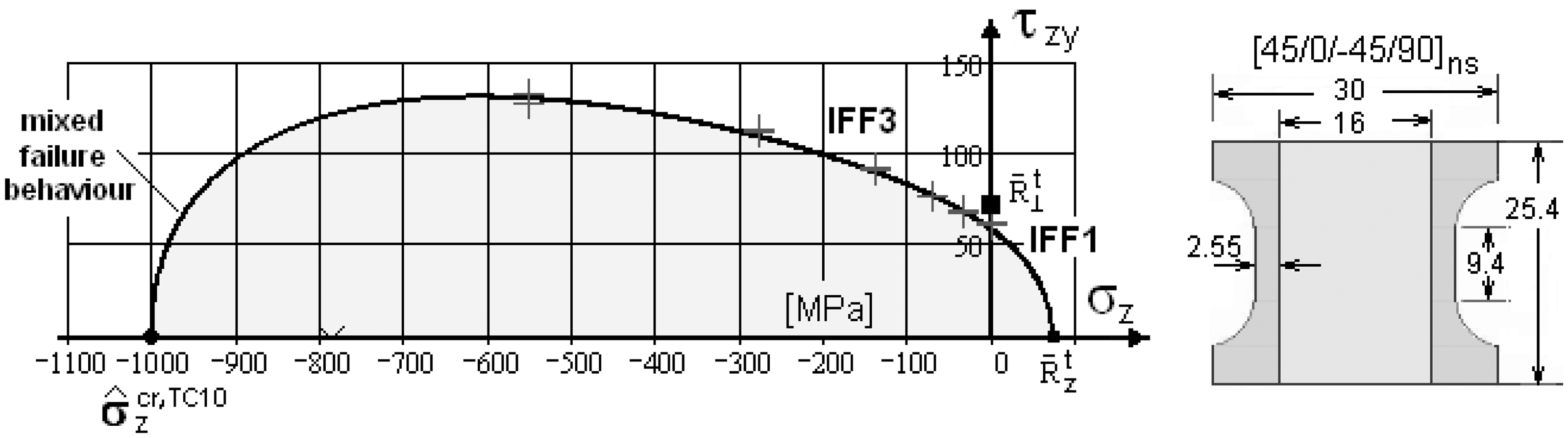
“Test data were taken from DeTeresa.21 22
Figure 17(a) shows a 90°-lamina of the stack of the thick-walled tube milled from a laminate block. For comparison, Figure 17 depicts the traditional wound or tape-layered tube; Modelling of TC10 test situation: (a) a 90°-lamina of the stacked thick-walled tube milled from the sketched laminate block for comparison and (b) the traditional wound or tape-layered tube.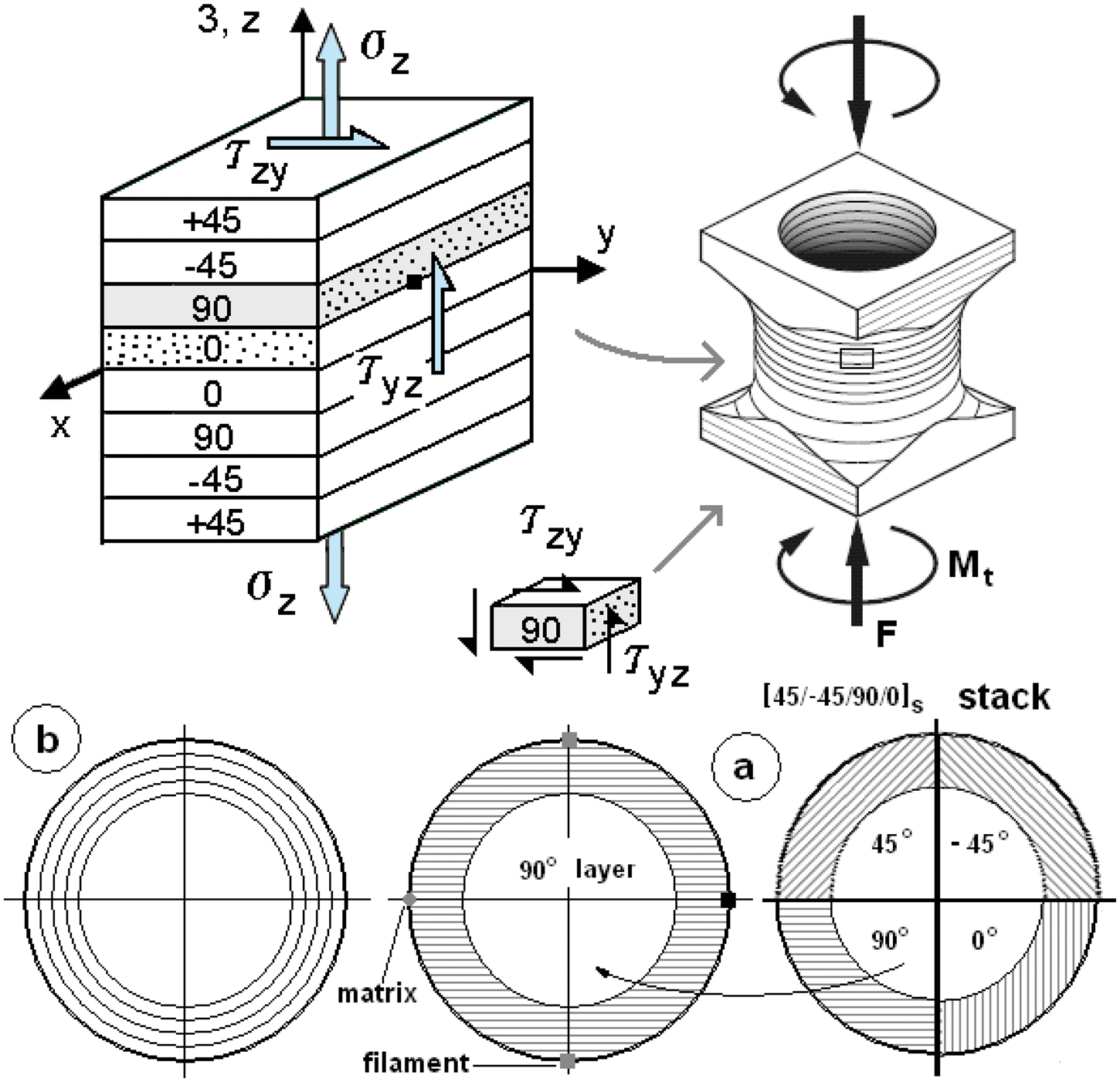
Test situation does neither generate a uniform stress state in the critical locations nor a small stress gradient. With respect to the non-uniform shear stress field at the cross-section plane, it can be stated that the test specimen does not give much experimental evidence. The specimen encounters multi-site failure within each lamina and at the same time multi-ply failure in all laminas. This means that a multi-fold fracture danger is given in the stack. Therefore, the specimen is not an adequate tool to validate strength-failure conditions.
In Figure 17, maximum filament and matrix failure locations are indicated. These critical locations are bound to the varying lamina fibre orientation and take different positions over the stack and can be assumed. The failure mode is IFF and the associated critical interlaminar stress state can be estimated.
Three different sub-stack descriptions are found in the provided documents: [45/–45/90/0]ns, [90/45/–45/0] and [45/0/–45/90] (from theoretical reasons a stack with minimum angle change would be best because it leads to the smaller interlaminar stresses to achieve compatibility of the lamina deformations). However, this does not have an effect because the specimen is milled from a laminate brick.
– The tube is thick-walled, which means that the outer shear stress will be fracture decisive. Principally, for TC 10 and TC11, a lamina-to-lamina 3D FEA would be necessary for stress analysis. In Reference [13], a ‘smeared’ model is presented that substitutes the effortful 3D model. This helps to obtain a faster solution for the specimen’s deformation behaviour. Finally however, the actual stress state at the critical location is required for strength judgement. – Before using the provided approximate quasi-isotropic laminate's through-thickness (crushing or squeezing) fracture stress value
Modifications from Part A to Part B: TC10 was not investigated in Part A. A test curve is the result of both the partners, of test specimen and of test rig. In Part A, the author assumed an ARCAN test rig, loaded by scissor forces F , whereas in Part B the De Teresa torque test rig is used. This caused a change in the prediction of failure location as well of type and curve. The ARCAN test rig shows a more uniform stress state than the DeTeresa torque test rig.
“Test data from De Teresa,
12
,
13
test execution as for TC10”.
TC11: Thickness failure shear stress 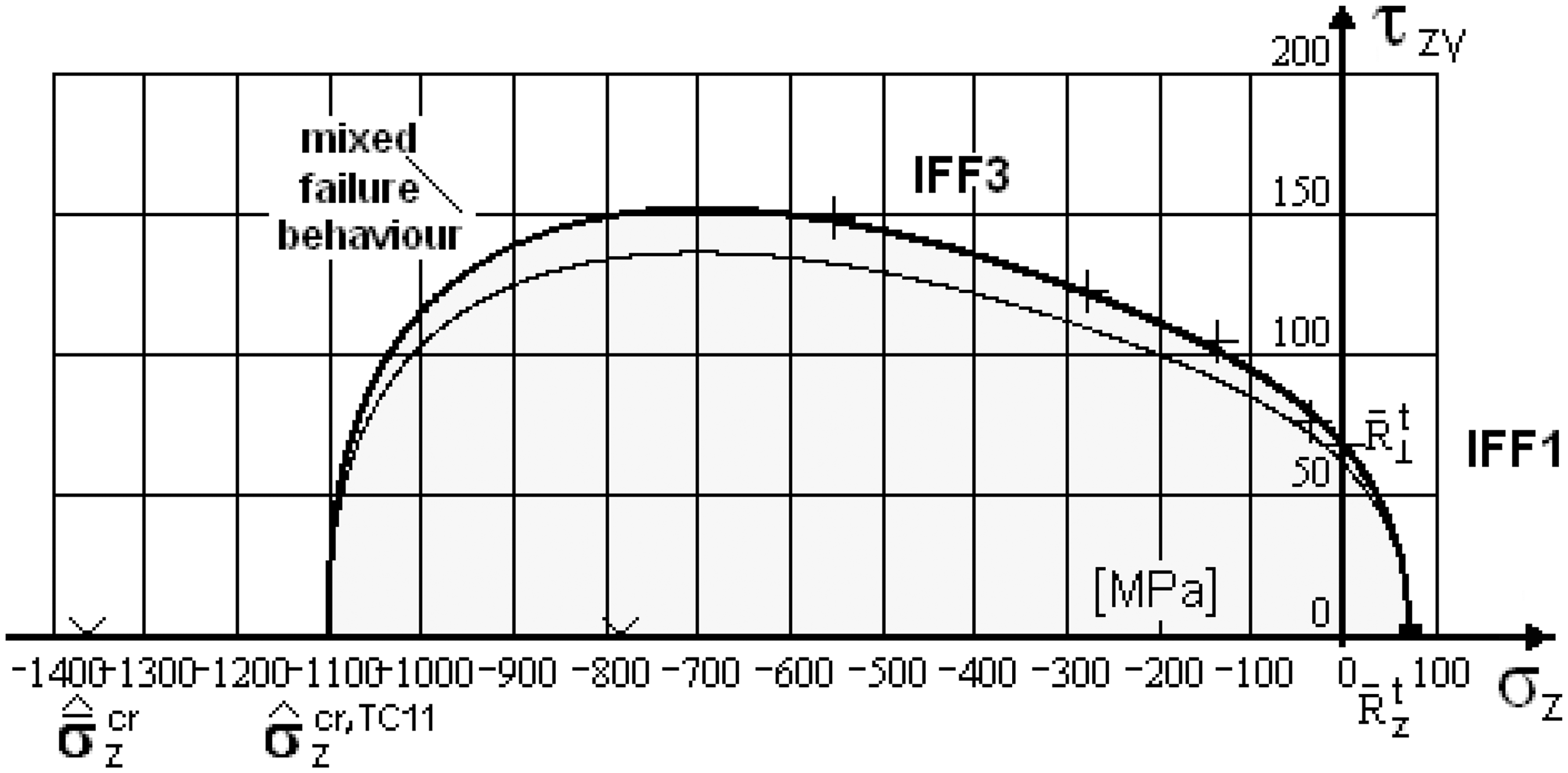
The dog-bone-shaped tube test specimen TC11 has less different layer angles than TC10. Therefore, the fracture curve should be longer and lie a little higher than curve TC10 due to the fact that a lower number of critical locations (just 0° and 90°) is encountered. This fracture stress capacity, higher than for TC10, is assumed to be
Modifications from Part A to Part B: The test rig became known and the loading situation had to be fully reworked. The assumed crushing stress was increased from
“No data was available from the work reported by DeTeresa et al. for this Test Case. Consequently, the organisers suggest experimental data that TC12: Predicted single stress–strain curve caused by a through-thickness compressive stress 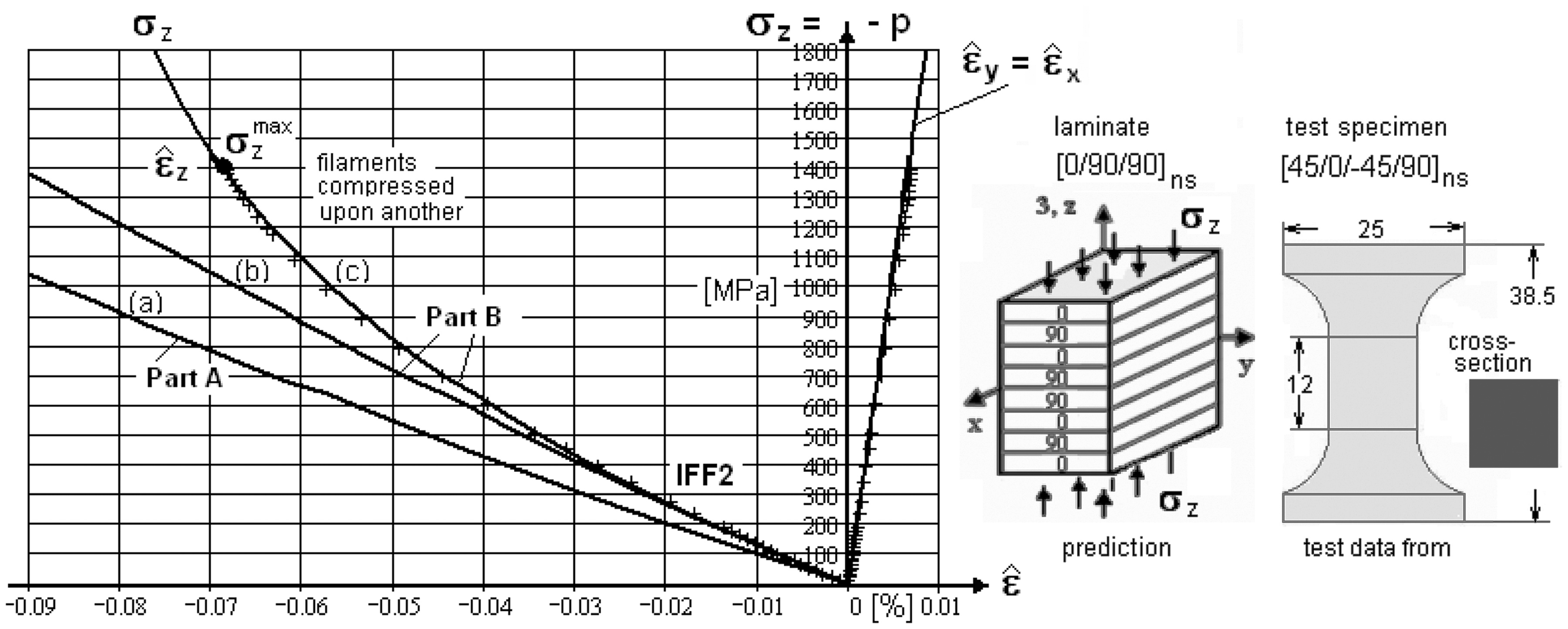
It is not clear why this TC is marked as a cross-ply, but the curve stems from a lay-up that is a quasi-isotropic angle-ply! The effect of the curing stress is of practical interest in the positive domain, and therefore not requested in quadrant III.
– The provided (in Part B) similar curve will be considered. It is one single curve of 5 experiments. The through-thickness stress – The Part A curve does not have the tangent stiffness of the ‘similar’ curve. Because a 3D-CLT delivered the same low initial slope, it could be concluded that the transverse elasticity moduli – A further effect is to be considered: With increasing thickness reduction, the filaments are more and more pressed upon another. By that, the composite modulus

Modifications from Part A to Part B: (1) Correction of a mistake (curvature of the predicted curve in Part A was opposite to the experimental curve. Caused by a typing error in the equations coded). (2) Increase of the initial lateral elasticity modulus at origin from
Comparison between theoretical predictions and experiments
Some additional figures are added to demonstrate special features of modelling and tests.
Problem: How does tri-axial compression influence the failure behaviour if two components of the stress vector are equal?
Task: Determination of the tri-axial fracture failure curve
It is well known from the cited literature and at QinetiQ that hydrostatic pressure stress states higher than 200 MPa will change the second glass temperature point of the matrix with the described stiffness worsening effect on the matrix. Second Tg-effect and Birch-effect have been effortfully implemented into the author's FMC-based 3D-CLT-MathCad program.
Comparison:
– Figure 5(a): Mapping of provided test data in quadrant III with provided data (thin) and with an assumed 2ndTg shift effect (bold) to show tendency in the case of the assumed effect size would occur. The slope of the lower curve with the assumed 2ndTg-effect shows a reduction beyond −300 MPa. This means that the compressive stresses – Figure 5(b) predicted curves in the quadrants I, II, IV: An interaction of shear failure (SF) and normal failure (NF) in their transition zones in the quadrants II and III (Figure 5(b)) by a simple linear approach in 3D space (Figure 5(c)), characterized by Lode coordinates, was not executed due to a lack of data in the transition zones. – Figure 5(c): Visualisation of provided test data in 3D space with provided data (dashed) and with an assumed 2ndTg shift effect (bold). – Mapping of test data, given in quadrant III only, could be achieved after describing shear failure in a more ductile way (due to Part B information). This meant, lowering the unknown friction parameter from
Results: (1) A 2ndTg-effect seems not to exist for the matrix. Unfortunately, 2ndTg modelling – needed for the following TCs – could not be substantiated by the provided matrix test data set. (2) Course of given data could be well mapped. In Figure 5(b) and TC1(c), the interaction or out-smoothing in the transition zones SF-NF was not performed. Failure surface is not closed.
Problem: Influence of hydrostatic pressure
Task: Determination of the fracture failure curve
Comparison:
– Course of scattering 90° tube test data could be well mapped after considering the average stress–strain curve and the hoop stress distribution (outer hoop stress is higher than the inner one). – The sudden increase (jump) at zero hydrostatic pressure is assumed to be the consequence of the healing by – The failure curve is closed (still shown in Part A). But, to add to the Figures TC2 and TC3, an estimated closed failure curve is speculative and adds no value to the comparison because the failure is no material failure anymore but very likely structural failure that cannot be predicted by a strength failure condition for that material.
Problem: Influence of the hydrostatic pressure
Task: Determination of the fracture failure curve
Comparison:
– Course of scattering 90° test data could be well mapped. The failure curve is closed. – The sudden increase (jump) at zero hydrostatic pressure is assumed to be the consequence of the healing influence of
Problem: Influence of an initially constant hydrostatic pressure on the in-plane shear stress–shear strain curve.
Task: Determination of the stress–strain curve
Comparison:
– The determination of an average curve (bold) enabled to equally well map TC2 and TC3 and to show up the check point that links the curves. – The provided single curve test data could be well mapped (dashed curve in TC4).
Note: The ‘check point’ (
Basic problem: How much lateral stress
Task: Determination of the fracture failure curve
Comparison:
– The course of provided test data could be well mapped. The failure curve is closed. – Assuming that the model pre-requisites remain valid, final failure by kinking (FF2) is possible under – Computation indicates wedge failure IFF2 in quadrant III. Under – For information: Test data from DeTeresa24 for the upper branch (2nd solution) of the failure curve in quadrant III are lying on the predicted upper branch after being re-evaluated by subtracting
Problem: How much compressive fibre-parallel stress
Task: Determination of the tri-axial failure curve
Comparison:
– No mapping is possible in quadrant III, left branch or compressive branch. The provided tensile strength does not fit to the provided data set (three crosses). – The ‘tension’ branch in quadrant IV cannot be used because the distribution of fracture test data delivers no experimental evidence for a validation.
Task: See TC 6, just the UD material of TC7 is different to TC6.
Comparison:
– Data look more reasonable than in TC6. However, no satisfactory mapping is possible in the quadrants III and IV. The course of data points exhibits probable contradictions that cannot be explained by the author (see section 4.3). Mapping is sufficiently good for
Idea, concerning a probable error-prone data evaluation: The compressive curve would better match with TC7 data if the
Problem: Effect of the applied surface pressure
Task: Determination of the average laminate fracture stress
Comparison:
For TC8 and TC9, analysis follows the mentioned 3D-CLT-MathCad program.
– IFF1 at the positive – At the positive – Mapping of test data is not fully satisfactorily in domains (valid for TC9, too) where the complicate non-linear treatment of the commonly acting two modes IFF2 and IFF3 (of about the same size of
Problem: Effect of the applied surface pressure
Task: Determination of the stress–strain curves
Comparison:
For low values, – Initiation of shear failure IFF3 triggers final wedge failure IFF2. This doubly non-linear task could not be handled sufficiently well. – Mapping of test data is pretty good in the usual engineering domain, however not satisfactorily in the high strain domains because of the complicate treatment of the acting two-fold failure behaviour. For explanation of the high effort: with mises, just one failure mode is to be treated and not two as here.
Keep in mind: The usual composite design requires, due to functional and design requirements, strain values less than 0.5% = 0.005.
Problem: Effect of an applied surface pressure
Task: Computation of the interlaminar failure shear stress
Curing stress from effective temperature
Comparison:
Danger to failure, indicated by the material stressing effort, is encountered at multiple sites along the circumference of each single lamina and in addition – angle alternated – in all laminas at the same time.
The test specimen cannot be simply modelled, FEA is mandatory without having any simplifications from circumferential symmetry. Stress analysis would require a 3D material/geometrical non-linear FEA. This means that the FMC would have to be implemented into a source deck which is very costly. After analysis, the FE stress results obtained for TC10, TC11 and TC12 will have to be transferred into stresses that are judgeable by strength failure conditions. This is difficult because the analysed cut-out test specimen does not involve the desired and necessary uniform stress distribution in the critical locations.
Therefore, stress state and distribution at the critical locations of TC10 and TC11 have been investigated and it was found that the sole consideration of the three interlaminar stresses – Failure responsible in the compression domain are the shear stresses. Computation indicates shear failure IFF3 (is initial and final failure) before ‘crushing’ failure comes to act at – In order to well map the course of test data, a pretty low interaction value (safe side) of
Problem and Task: As before, just the lay-up is a cross-ply.
Comparison:
Due to the less fibre orientations, this stack has less critical locations than TC10. Therefore, as confining crushing stress, – With this simple strength model, a very good mapping was obtained.
Problem: Effect of the applied surface pressure
Task: Determination of strain–stress curves
Comparison:
At the high-pressure domain of the curve, a UD material analysis comes to an end because the pre-requisite ‘homogenized UD material' is violated. An approach was searched that captures the growing influence of a filament-upon-filament situation. This was considered by the simple approach of a distinct non-linear increase of – Applying the Part A property – The filament-upon-filament progressive fracture situation was captured by using equation (10). Afterward, the course of the Part B test data could be well mapped. – The computation indicates initiation of wedge failure IFF2 at about
Conclusions
Relevance of results to design practice
Usually, bi-axial and tri-axial compression brings a beneficial increase of load-carrying capacity. This can be utilized in structural domains (i.e. joints, submarines, bearings, impact ballistics, anchor points of tension cables, hangers of helicopter blades, pressure vessels) where such situations are encountered. Physically-based, lamina-oriented and validated 3D failure conditions are the tools to use these benefits in design engineering.
Principally, just the lamina test cases TC2 through TC7 are directly applicable for validating the FMC failure conditions including tri-axial pressure behaviour of the matrix investigated in TC1. The laminate test cases TC8 through TC12 can only serve for verification of the full failure theory. In each TC the investigation of the influence of wall-thickness on hoop stress is mandatory.
Based on functional and operational requirements, often design limits are posed in terms of deformation or as project-specific design limit strains of about
Further, a fully crushed laminate has usually no practical value because it can only be compressed but not tensioned again. Of course, one might simulate this special ‘structural’ failure (no real material failure anymore, according to the FMC) behaviour of the laminate beyond the applicability limit of material strength failure conditions in order to obtain more confidence in the non-linear theory.
Another fact is, also linked to structural failure, that practically a real material strength value is never measured for
Some specific points and facts can be dedicated to the 12 TC:
TC1:
– In the hydrostatic domain, for this dense matrix an open failure surface exists – No 2ndTg-effect found was demonstrated by the test data, but even more the opposite tendency was obvious. Therefore, unfortunately, matrix behaviour and 2ndTg-effect modelling, which would have to be built up in TC1, could not be substantiated for the mandatory use in several of the following TC. TC1 is just informative for design.
TC2, TC3, TC4:
– Sufficient test data was provided to use the results and to benefit in shear stress-dominated designs when high pressures are acting such as at the anchors of tension cables of bridges. Only the 90° values can be directly used for design purposes but not the 0° tube values (see Annex 5).
TC5:
– As the lower branch in quadrant III could be mapped and the upper branch indirectly by the literature, the obtained results can be used in design.
TC6 , TC7 :
– The sudden drop in quadrant IV cannot be explained. The Poisson effect seems to be ruled out at medium pressures after being overemphasized at small pressures. Experiments are required which capture a domain until about
TC8, TC9 :
– TC8: Results may be used in design practice as, with the simple non-linear MathCad program, values on the conservative side are computed in the provided test data domain. – TC9: Within the technical domain of a fracture strain <0.5% the results can be used for design purpose.
TC10, TC10, TC12 :
– TC10, TC11: Despite of the fact that mapping could be achieved the results cannot be generalized for design purpose. – TC12: The provided ‘similar’ data set could be well mapped after increasing the stiffness due to the fact that fibres will come to lie upon another after a distinct surface compression level. The results are not applicable for the usual structural design but give a hint upon the risk in an extreme loading case. No further use is possible with such a 'squeezed' laminate.
Some basic conclusions:
* Generally, it is physically not accurate to predict a failure surface with the knowledge of strength data only! Friction is inherent with brittle behaving materials and must be considered. * In contrast to a dense isotropic material, a dense UD material might fracture under a very high hydrostatic compression stress ( * Higher load-carrying capacity or resistance, obtained under * Experimental results can be far away from the reality like a bad theoretical model. Theory creates a model of the reality, ‘only’ and one experiment is ‘just' one realisation of the reality. Lesson Learnt: Generating reliable 3D test data is a bigger challenge than generating a good theory.
Issues with the model
* Problems with convergence in the iteration loops were encountered in TC8 and TC9 where modelling large non-linear strains and deformation is not robust using the simple MathCad code. However, if the FMC equations were embedded into a commercial FEA code (NASTRAN is interested) then the instability of the analytical MathCad code could be overcome. * A novel idea is the treatment of TC2, 3 and 4: The first point is the distinction of redundant and isolated behaviour. Using this, no mapping problems in the vicinity of the abscissa existed anymore. The second point is the idea with the determination of the average stress–strain curve. This made it possible, that in all the three curves the physically given 'check point' is consistently placed.
Filling gaps in the test data domain
* There were several sources of error besides the errors that directly happen to occur in the challenging tests. These are the evaluation of raw test data, placing of test data in the graph and the quality of the test data. Encouraging the quality of test data is a permanent task. * Lack in tests data domains: Only well-understood testing and material behaviour can verify the assumptions made and validate a model. The provided test results cover a wide range of 3D stress combinations, but it remains quite a lack of data in certain areas. Due to this lack of knowledge, questionable test data could not be discussed or possibly re-evaluated. * The strain-hardening branch can be fitted on basis of the provided properties, whereas the strain-softening branch of embedded laminas (post-initial failure, ‘embedded’ properties) with characterization of the lamina’s in-situ behaviour must be assumed. Necessary for the non-linear analysis procedure of the laminate are the secant moduli * Besides the approach above, continuum damage and fracture mechanics approaches are also applied. * 2ndTg-effect in higher hydrostatic work cases: The effect reduces the slope of the curves of the elasticity moduli and of the resistances (‘strengths’). Both the property types show an increase of the associated curve under
Understanding failure phenomena and terms
* The first FF in case of mass-optimized laminates (fibre-dominated laminates) means final failure, if the laminate is not over-dimensioned. So, usually FF in at least one lamina of a laminate means final failure of the laminate. Therefore, the biaxial failure envelopes for final failure of laminates predicted by various theories do not differ that much, as long as the laminates have three or more fibre directions. Also, the predicted stress/strain curves of such laminates look very similar because the fibres that are much stiffer than the matrix carry the main portion of the loads. Different degradation procedures after the onset IFF do therefore not influence the predicted strains very much. This is especially true for CFRP laminates. * Initial failure (onset of failure) and final failure is indicated by a loss in stiffness, which is indicated by a kink and a drop in the load. Failure by IFF is always indicated in the figures, but marking final failure is a problem whenever strong non-linearity occurs, such as large deformation or large strain. For instance, the solid compression-loaded TC12 will not fall apart under
The author would like to bring to the attention of the readers that a comprehensive assessment of the capability of the current method in relation to that of other models employed in WWFE-II is made in Ref. [28].
Footnotes
Funding
This research received no specific grant from any funding agency in the public, commercial, or not-for-profit sectors.
Acknowledgement
The author gratefully thanks A Freund (TU-Dresden, Institut fuer Leichtbau und Kunststofftechnik) for test data evaluations and Dr J Broede for helpful discussions.
Conflict of interest
None declared.