





Abstract
An accurate study for dynamic behavior of viscoelastic thin laminated composite beams and plates resting on viscoelastic foundations is presented. Boltzmann superposition integral based on the dynamic mechanical analysis results is adapted to accurately predict viscoelastic behavior of polymeric fiber-reinforced composite structures. Also, foundation viscoelasticity is described based on the Kelvin–Voigt model. Integro-differential governing equations of motion are derived based on classical lamination theory via Hamilton principle. Galerkin weighted residual method, iterative QZ algorithm, and Fourier transform are applied to obtain natural frequency, loss factor, and transient response of structures resting on suppressive foundations. Influence of foundation and geometrical parameters and also boundary conditions on the dynamic behavior is put into evidence via a parametric study, and pertinent conclusions are outlined. Due to the absence of similar results in the literature, this paper is likely to fill a gap in the state of the art of this problem.
Keywords
Introduction
Viscoelastic materials, such as polymers, exhibit both viscous and elastic behavior simultaneously; it means that energy dissipation occurs during deformation process. Vibrations are undesirable for structures, due to the need of structural stability, durability, reliability, performance in harsh environments, and noise reduction. The viscoelastic materials with damping property allow undesirable mechanical vibrations and wave propagation to be passively suppressed. These types of materials are extensively used in many modern engineering applications like aircrafts, ships, buildings, and space structures since they may eliminate the need for special energy absorbers and dampers to attenuate undesirable noise and mechanical vibration.
Viscoelasticity is an inherent property of the material, which normally appears as time dependency of material properties.1–3 One of the most accurate models for linear viscoelasticity is the Boltzmann superposition theory in which time variation of all material properties is implemented in the constitutive relations.4–6 However, many researchers assumed time-independent constants or simple complex viscoelastic properties.7–10 The time dependency of material properties usually lead to complexity of the solution procedure so that some researchers challenged the problem by presenting various solution approaches.11–17 Reddy 11 applied variational principles for integro-differential equations which were arisen from the time-dependent viscoelastic constitutive equations. Kaminskii and Selivanov 12 used the branching operator continued fraction approximation for the deformation analysis of cracked composite plates. Sladek et al. 13 applied a meshless local Petrov–Galerkin method to viscoelastic Reissner–Mindlin composite laminated plates with constant bulk modulus under static and impact loads. The governing equations were transformed into local integral equation and a numeric example was presented by using moving least squares. Li et al. 14 analyzed the free vibration behavior of isotropic viscoelastic Timoshenko beams using the Galerkin approach in conjunction with fractional derivative for three-dimensional constitutive relations. Finite element, finite difference, and differential quadrature methods were other prominent numerical techniques used by various researchers for viscoelastic problems.15–18
Although viscoelasticity is internal material characteristic such as elasticity, plasticity, pseudo elasticity, etc. external damping can be also modeled by viscoelastic medium or foundation.19–22 The viscoelastic foundation is composed of elastic and viscous parts. The elastic part can be modeled by linear spring or nonlinear spring known as hardening/softening foundations. Viscous part is also considered by dashpot as a dissipating factor in the foundation and may lead to suppress structural vibration. Babadzhanova et al. 19 studied vibration of orthotropic viscoelastic laminated composite plates resting on simple complex viscoelastic foundation with simply supported boundary conditions (BCs). They used approximation technique of straight lines in conjunction with the averaging method to solve the problem. Some researchers investigated vibration suppression of isotropic homogenous elastic beams resting on viscoelastic foundations.20–22
The literature survey reveals the fact that comprehensive studies were dedicated to investigate vibration damping of mechanical structures with inherent viscoelastic behavior, whereas few research works focused on the transient vibration of viscoelastic structures resting on viscoelastic foundations. 19 Also, to prevent facing with some mathematical complexity, viscoelastic material behavior was usually simulated using simple constants or models.3,4,7–10,12,13 To the best of authors’ knowledge, there is no accurate vibration damping analysis of viscoelastic composite structures on viscoelastic foundations assuming time dependency for all material properties, in the open literature. In the present work, the main idea is arisen from a fact that the authors’ interest is to distinguish share of each viscosity on damping behavior of viscoelastic composite structures resting on viscoelastic foundation. In the other words, it is about comparison between internal damping effect due to accurate viscoelasticity and external damping effect due to foundation viscosity on the dynamic treatment of structures.
In the present work, an accurate dynamic analysis is developed to analyze free vibration and damping of fiber-reinforced composite beams and plates with polymer matrix resting on viscoelastic foundations as practical structural elements in dynamical environments. These simulations may be applied for railroad vibration with damping layer on the lateral surface of the rail for the beam and the polymeric composite flooring on the floor as a viscoelastic foundation for the plate.
23
The Boltzmann superposition integral theory based on the dynamic mechanical analysis (DMA) results and Kelvin–Voigt model are adapted to describe viscoelastic behavior of laminated composite structures and foundations, respectively. The displacement field of the viscoelastic laminated composite structures is assumed based on the classical lamination theory. Toward obtaining the governing equations of the vibrational response, the Hamilton principle is employed. Galerkin weighted residual method, Fourier transform, and iterative QZ algorithm are applied to extract natural frequency, modal loss factor, and transient response of freely vibrating viscoelastic laminated composite beams and plates resting on viscoelastic foundations. The solution procedure flowchart is depicted in Figure 1 for aim of illustration. Due to lack of similar results in the open literature, accuracy of the present solution procedure is verified by comparing the numerical results with existing results in the limited cases of viscoelastic plates and elastic plates resting on viscoelastic foundations. After validation study, a set of parametric study is performed to provide an insight into the influence of stiffness and viscosity of foundation, geometrical parameters, and BCs on the vibration characteristics of viscoelastic laminated composite structures resting on suppressive foundations.
Procedure of solution.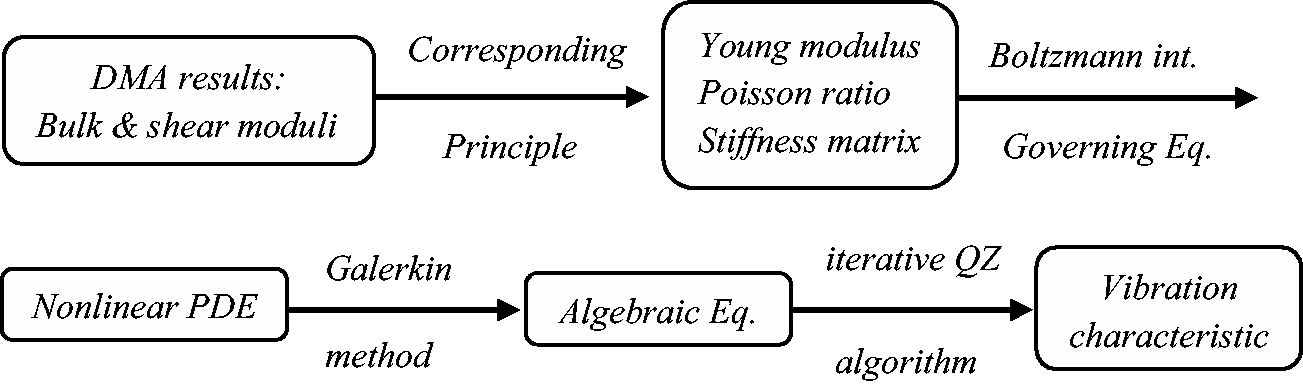
Material and method
Constitutive equations
Consider a rectangular fiber-reinforced laminated composite plate with polymer matrix resting on a viscoelastic foundation as displayed in Figure 2(a). The length of plate is a and width and total thickness of the plate are denoted by b and h, respectively. The Cartesian coordinate system (x, y, z) is located on the middle surface of the composite plate. In addition, laminated composite beams with rectangular cross section on viscoelastic foundation can be considered with dimensions H and L in the x and z directions, respectively.
General schematic of viscoelastic laminated composite plate resting on viscoelastic medium (a) and edge conditions (b).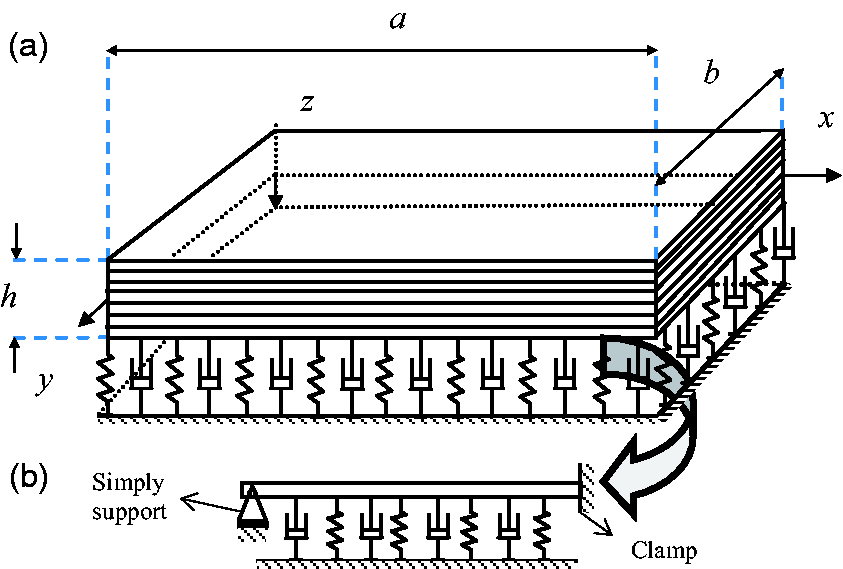
The infinitesimal deformation of thin monoclinic laminates is analyzed using the classical lamination theory. The linear viscoelastic constitutive equations for kth lamina in a plane stress state can be expressed based on the Boltzmann superposition theory as
2
in which
in which Vm, Vf, Em, Ef, Gm, Gf,
Among the mentioned material properties, matrix and fiber volume fraction, Young and shear moduli also Poisson ratio of fiber are assumed to be constant or time independent, whereas shear and Young moduli, and Poisson ratio of matrix are considered to be time dependent.
By using Alfrey’s corresponding principle together with Laplace transform,
2
the time-dependent arrays of stiffness matrix can be expressed as
Kinematics equations
Based on the classical laminated plate theory (CLPT), the displacement components of a material point within the laminate domain in Cartesian coordinates system can be written as
The strain–displacement kinematic relations associated with the displacement field (8) can be expressed as
Governing equations of motion
According to the Hamilton principle, the motion equations of thin plate-like structures resting on viscoelastic foundations can be derived based on the displacement field (8) as
24
Constitutive and kinematic relations of viscoelastic beams are similar to those for the plates but all terms involving displacement component in the y direction and differentiation with respect to the y variable are neglected. The equations of motion for thin beams resting on viscoelastic foundations can be derived as
By substituting the kinematic and constitutive equations into the motion equations (15), the integro-differential equations of motion for viscoelastic laminated composite beams resting on viscoelastic foundations are obtained as
Equations (13) and (16) are, respectively, three and two highly coupled integro-partial differential equations of motion in terms of displacement components in the space and time domain. These equations will be solved to investigate transient response of vibrating viscoelastic laminated composite beams and plates resting on viscoelastic foundations in the next section.
Solution methodology
In this section, integro-differential equations (13) and (16) are solved based on the Galerkin weighted residual method using appropriate shape functions. The same procedure is considered for solving integro-differential equations in both cases of the viscoelastic beams and plates resting on viscoelastic foundations. In order to study free vibration behavior of the viscoelastic composite structures on viscoelastic foundations, a separable solution of the shape functions describing the modes of the vibration and a harmonic function of time can be adapted as follows
For plates
For beams
The Galerkin weighted residual method together with appropriate shape functions is applied to treat the spatial dependency of the governing equations of motion of the viscoelastic composite structures resting on viscoelastic foundations. The resulted nonlinear algebraic equations of motion in the frequency domain is then solved using iterative QZ algorithm, which yields complex natural frequency in the form of
The time histories of displacement components can be obtained by substitution of the complex natural frequencies into equation (17) for a multiterm Galerkin solution as follows
Results and discussion
Boundary conditions.
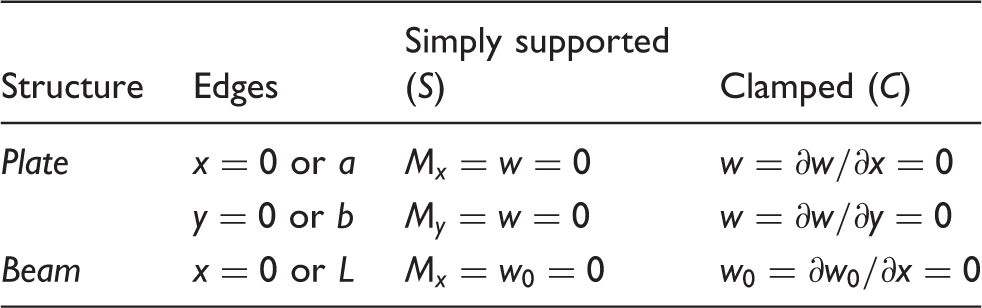
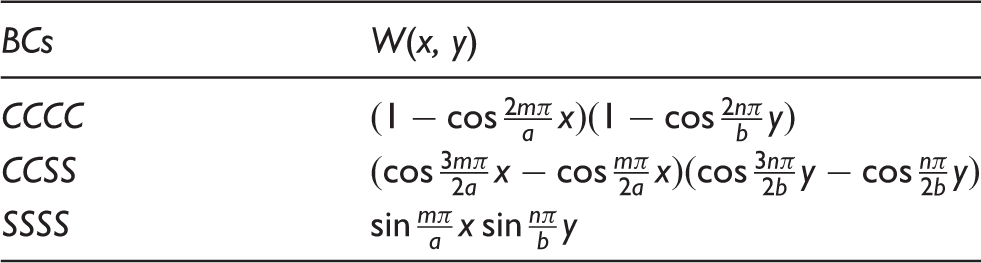
Plate shape functions for different boundary conditions. 25
Comparative study
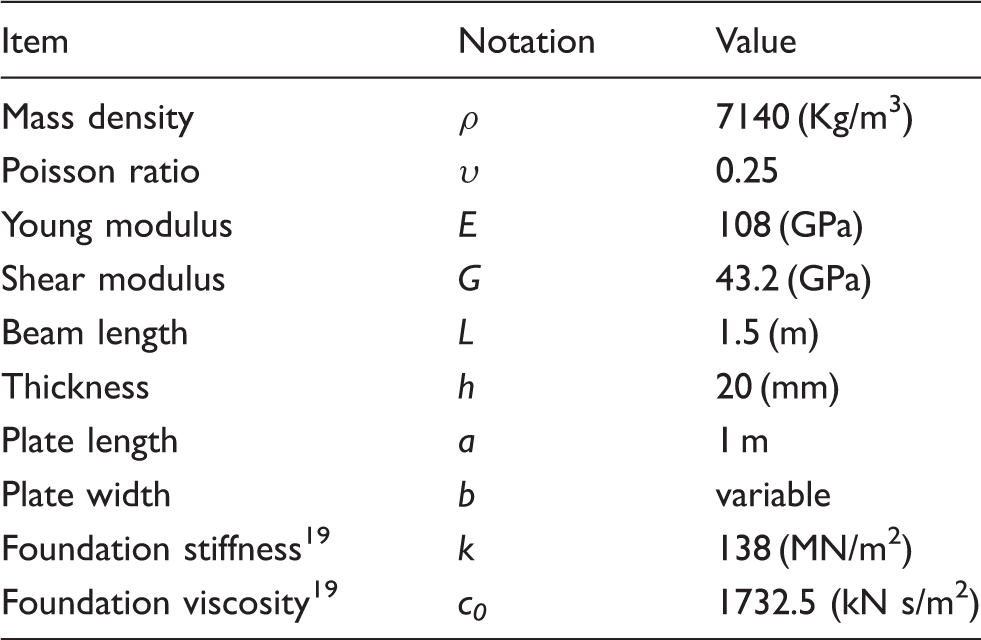
Material and foundation properties.
The natural frequencies and loss factors of the elastic plate on viscoelastic foundation.
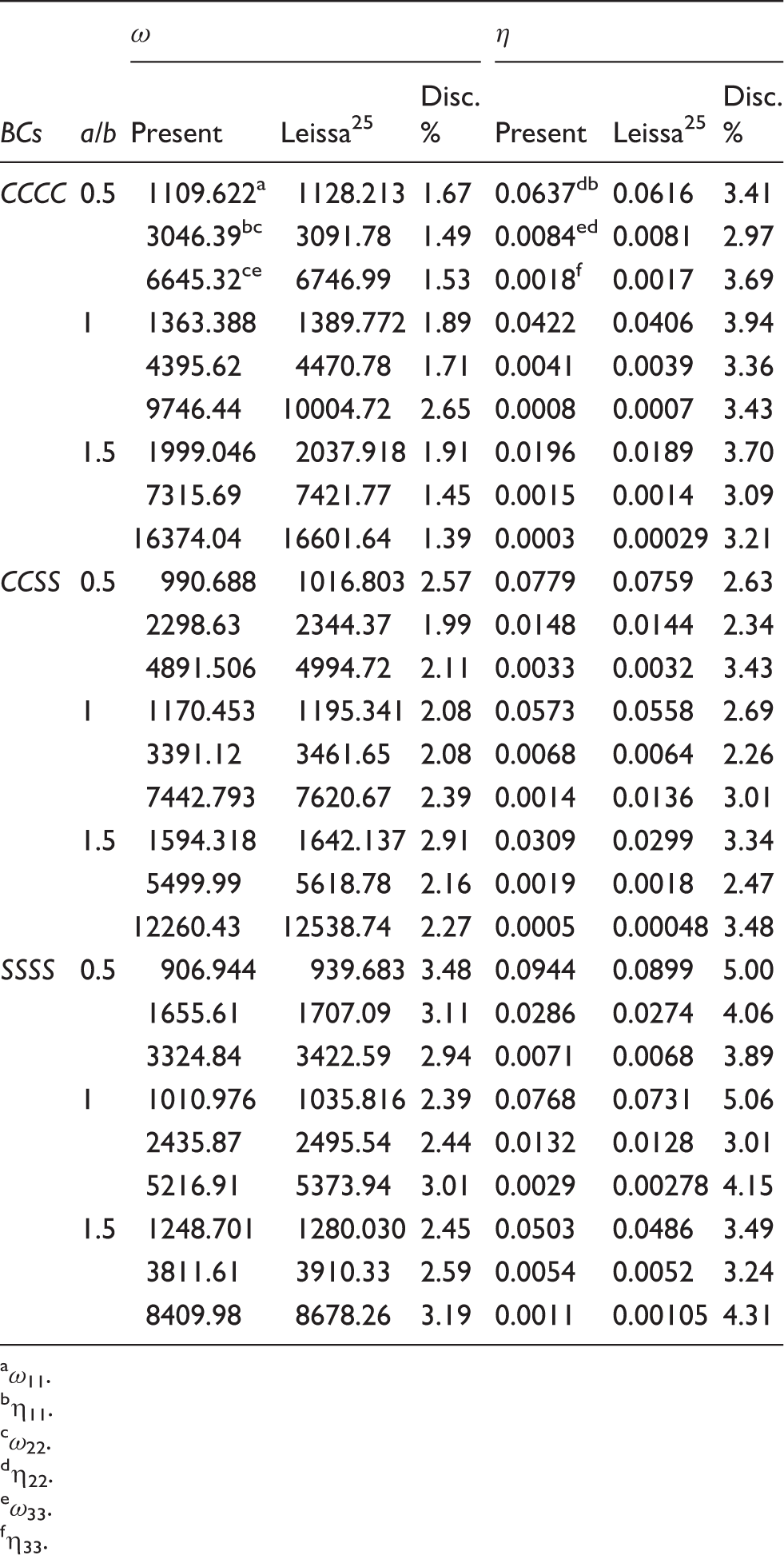
ω11.
η11.
ω22.
η22.
ω33.
η33.
The polymeric based plate data with

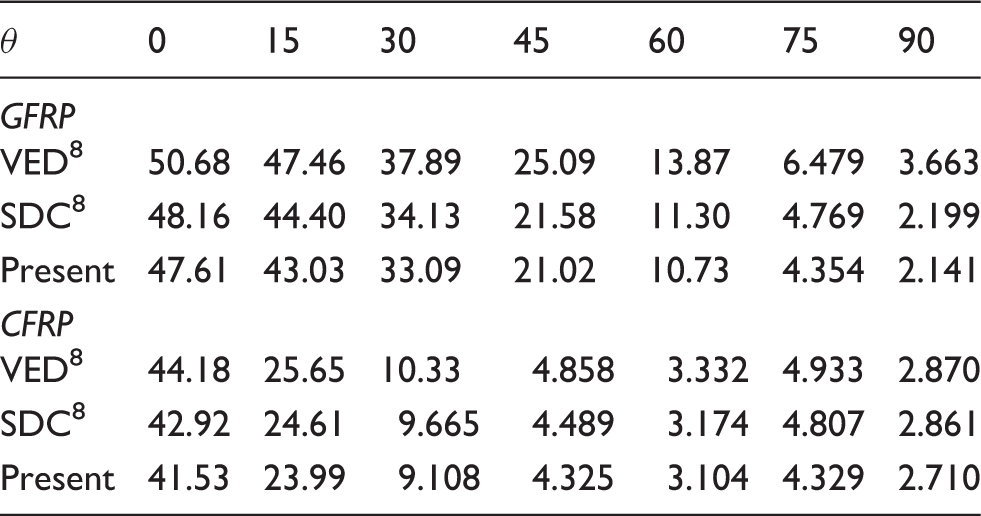
Percentage of fundamental loss factor (
Parametric study
Viscoelastic plates
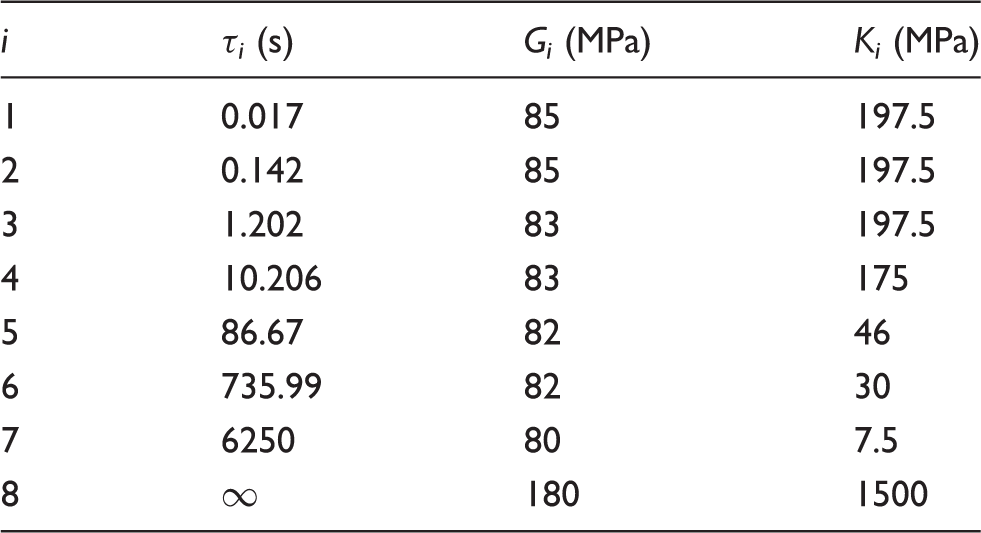
In this section, the effects of foundation parameters including stiffness and viscosity, BCs and geometrical parameters on the natural frequency, modal loss factor and dynamic response of viscoelastic plates resting on viscoelastic foundations with unit length and variable width are investigated. The material properties are given as
Prony–Dirichlet series coefficients.
Natural frequency and loss factor of viscoelastic composite plates with various a/b.
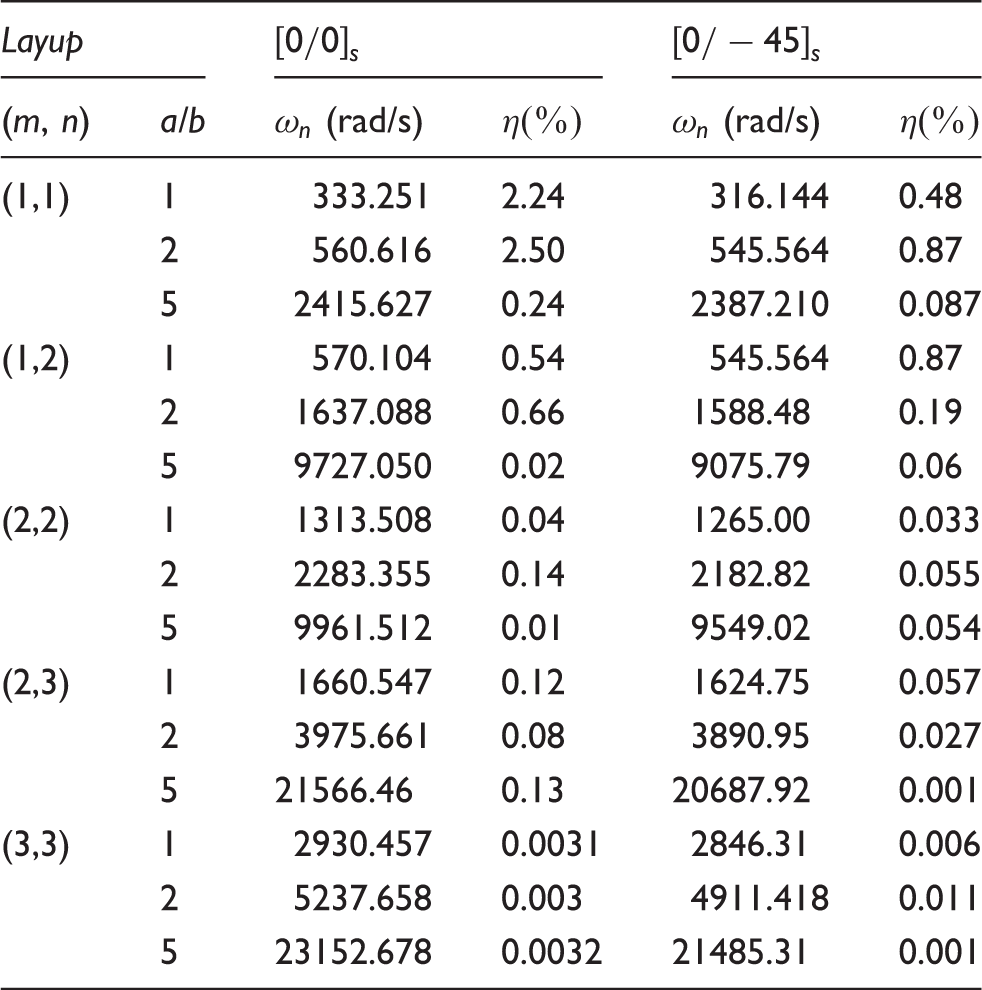
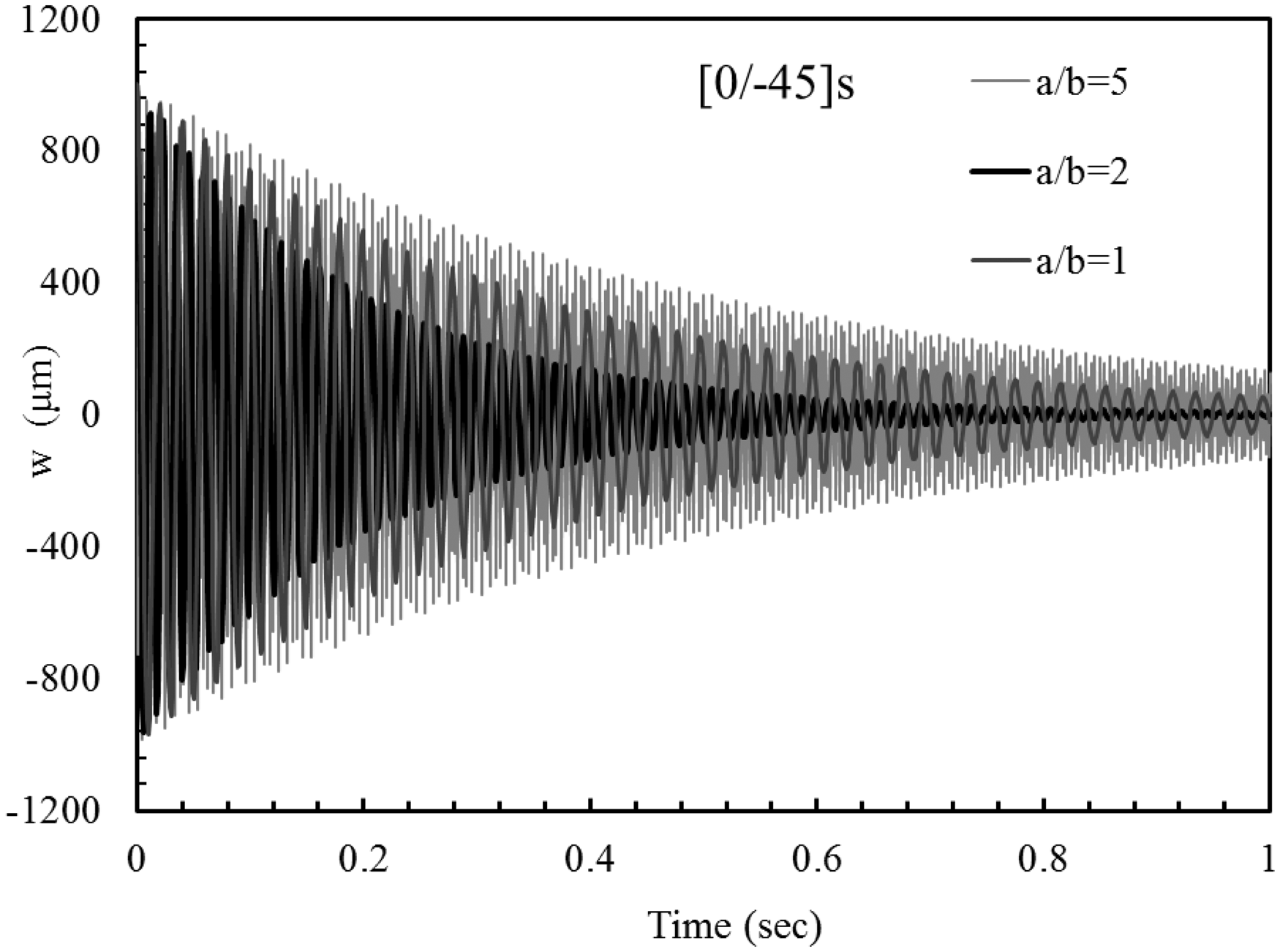
In order to grasp physical comprehension and damping conception of viscoelastic plate with represented vibrational characteristics in Table 8, the time history of central deflection of simply supported viscoelastic composite plates due to initial 1 mm/s velocity and 1 mm displacement with various aspect ratios is depicted in Figures 3 and 4 for Central deflection time history of viscoelastic composite plates Central deflection time history of viscoelastic composite plates 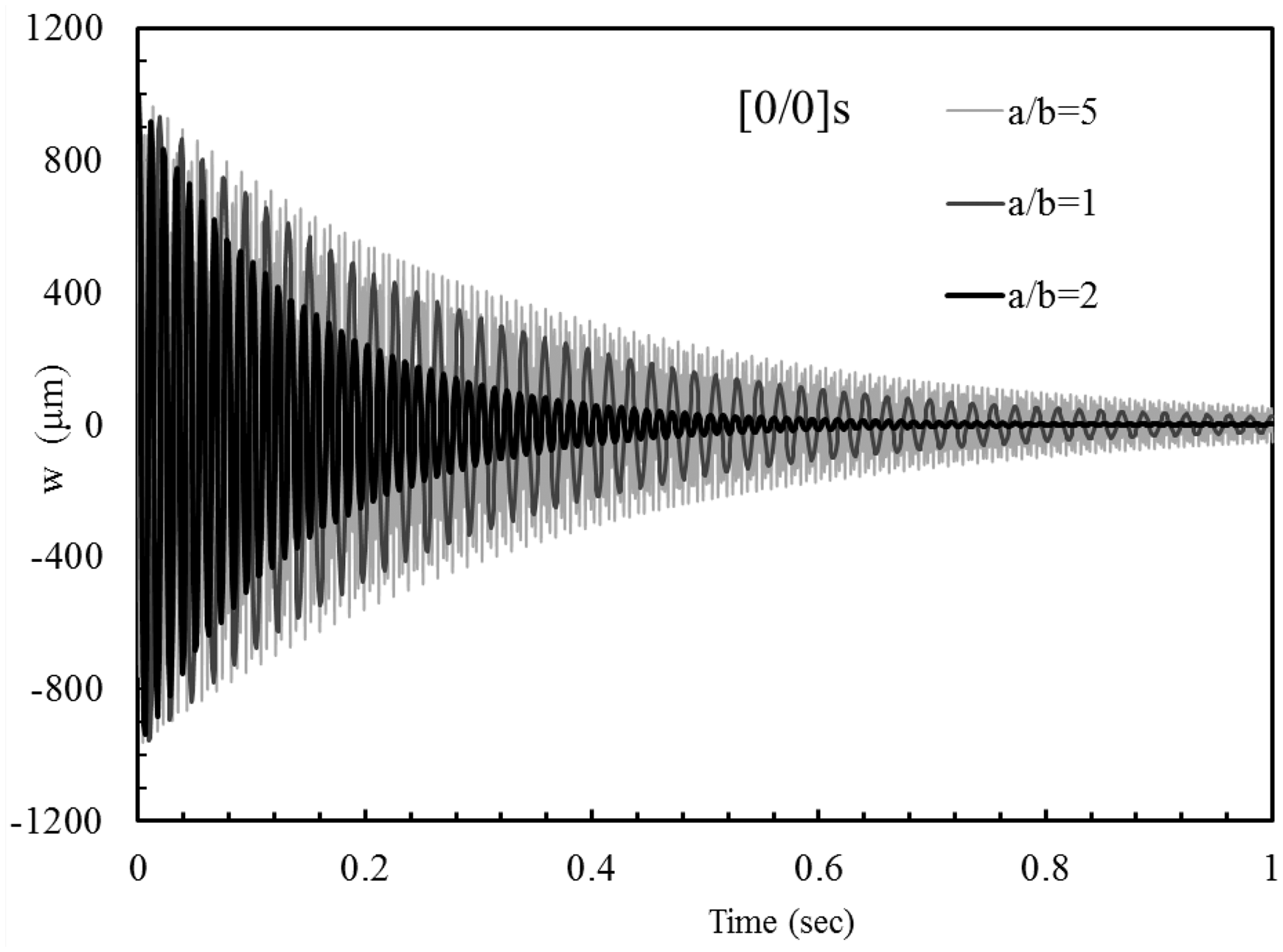
Foundation stiffness is prominent factor, which increases the structure stiffness; therefore, leads to the higher natural frequency of the structure. Some values of the stiffness increase the natural frequency to the extent that the loss factor approaches to the negligible value or in the other words viscoelasticity of the structures has no important role on the structure behavior.
Influences of elastic foundation stiffness on the natural frequency and modal loss factor of viscoelastic laminated composite plates with The ω versus mode numbers for The effect of foundation stiffness on vibration characteristics of viscoelastic composite plates on elastic foundations.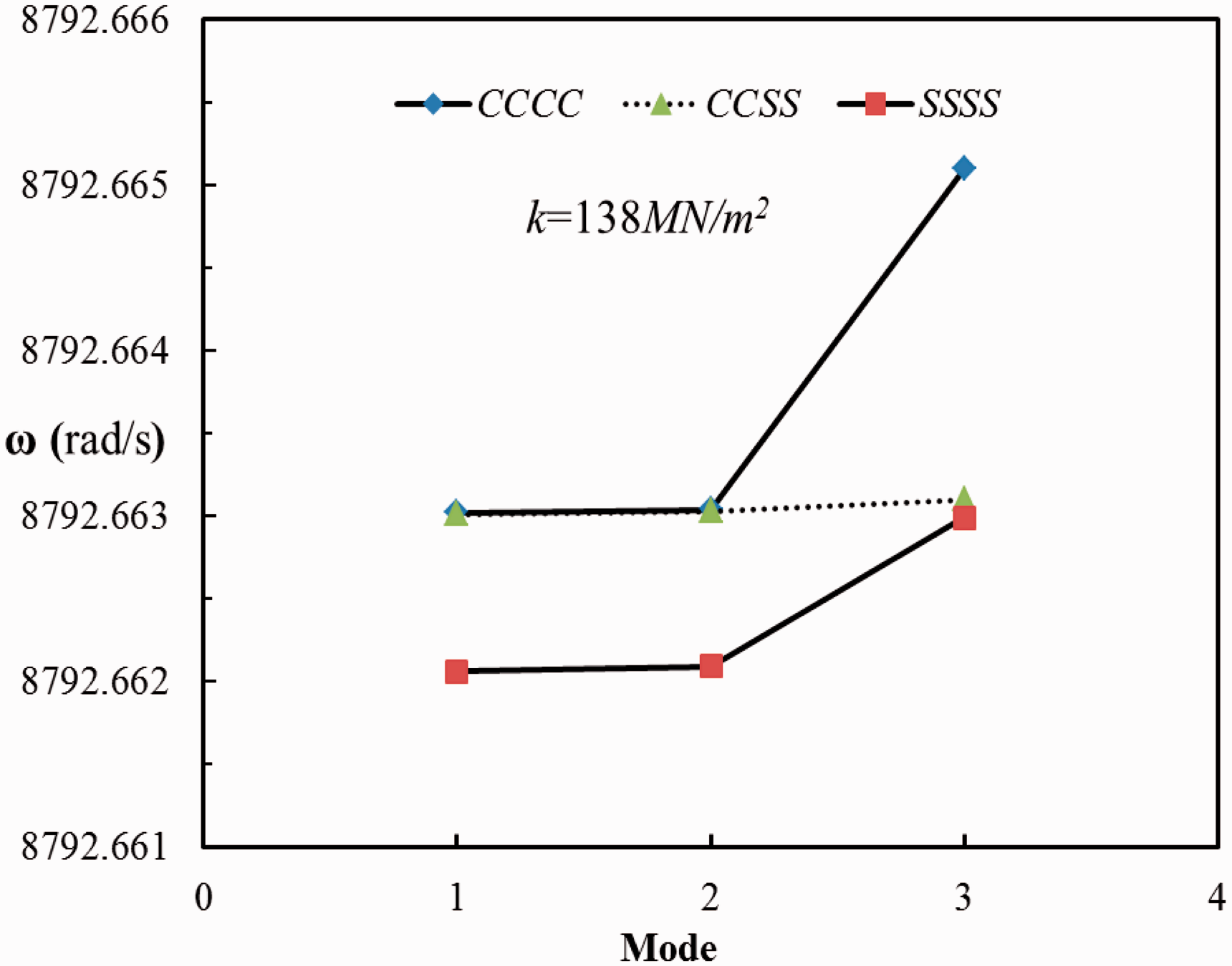
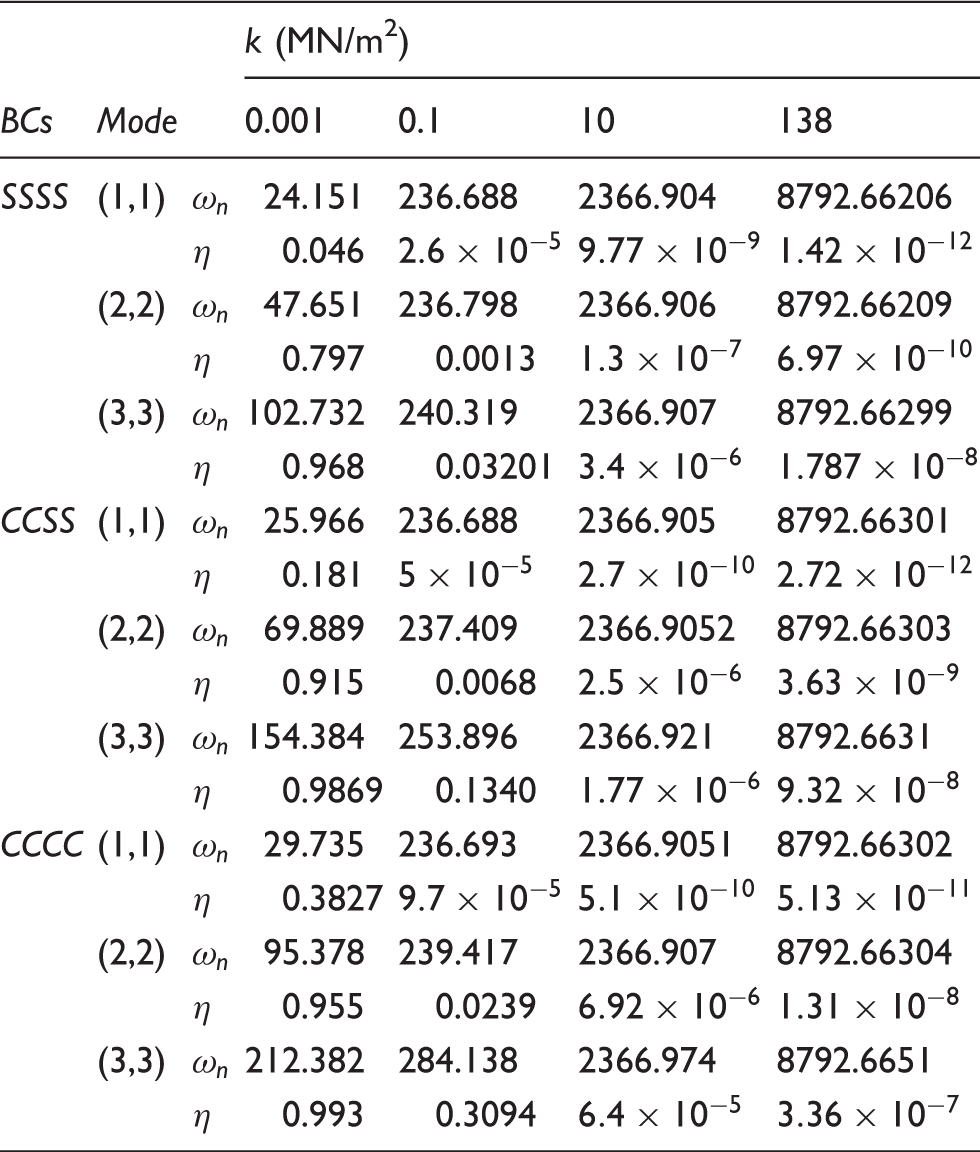
In addition, foundation stiffness increment up to the highest value results in neglecting plate treatment on system behavior. In the other words, the foundation stiffness and inertia of the plate are the main effective factors on the vibration behavior of the system with this set of parameters.
As can be found, SSSS BCs have less natural frequency and loss factor compared to the other BCs. In the other words, the stiffer BCs have higher natural frequency and loss factor. Moreover, for high values of foundation stiffness, natural frequency almost remains constant when the mode number increases. It means that the system with this set of parameters behaves like, not as an exact single degree of freedom (SDOF), so that the mode numbers variation of the structures has no obvious effect on the natural frequencies. Again, it is worth mentioning that this continuous system is not a SDOF, in spite of being similar (not the same) natural frequencies; as mentioned before, these values reveal remarks that the mode numbers and BCs have negligible effects on the system natural frequency for this set of parameters.
Influence of BCs on the central deflection time history of the viscoelastic plates resting on elastic foundation with 0.001 MN/m2 stiffness is illustrated in Figure 6. This figure indicates that the vibration amplitude and damping time are significantly reduced when the edge conditions become more constraints. As can be seen in Figure 6, the SSSS, CCSS, and CCCC plates lose initial oscillation amplitude up to 38, 92, and 99% at Effect of boundary conditions on the central deflection time history of viscoelastic plates.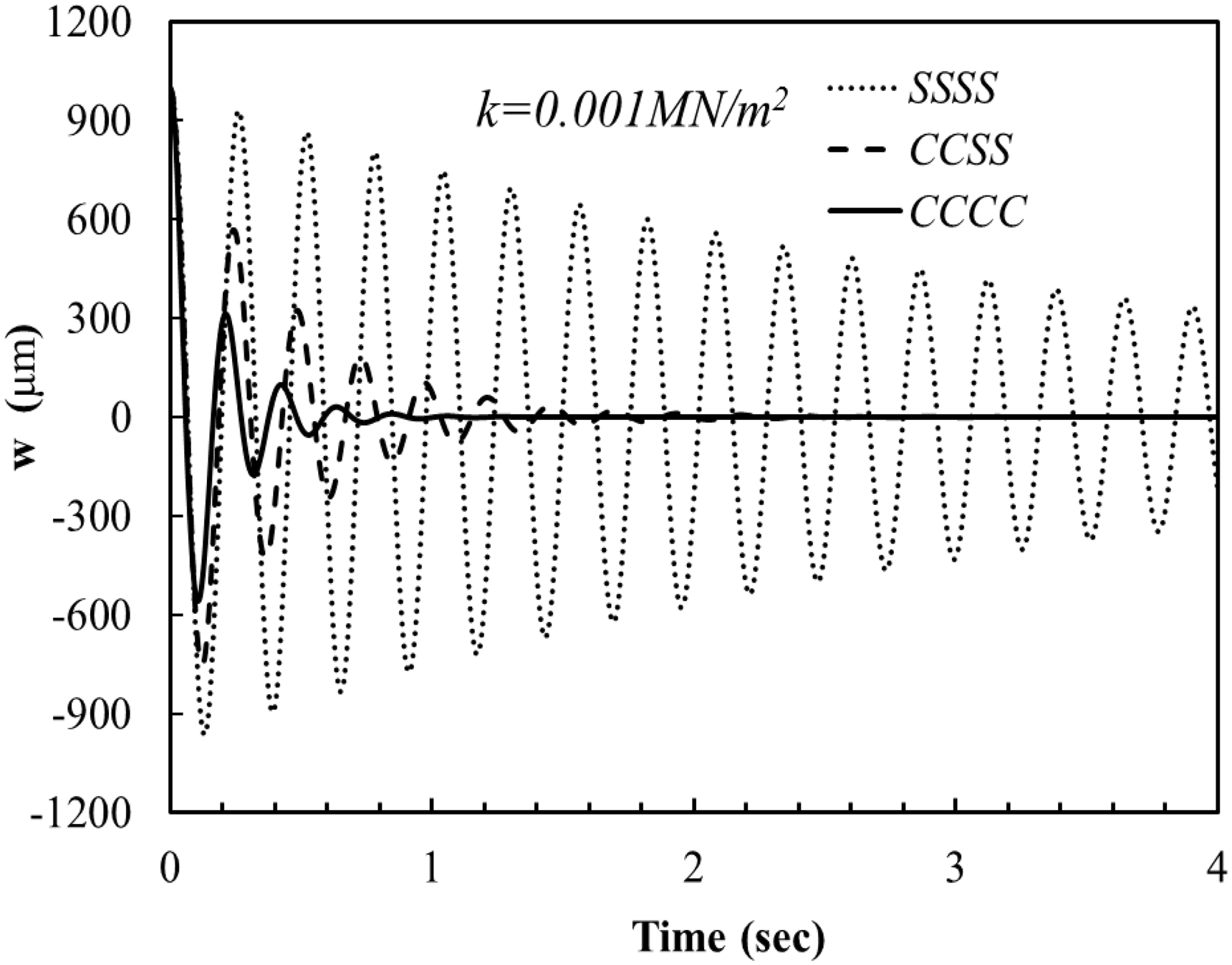
Natural frequency and loss factor of square plate with various foundation viscosities.
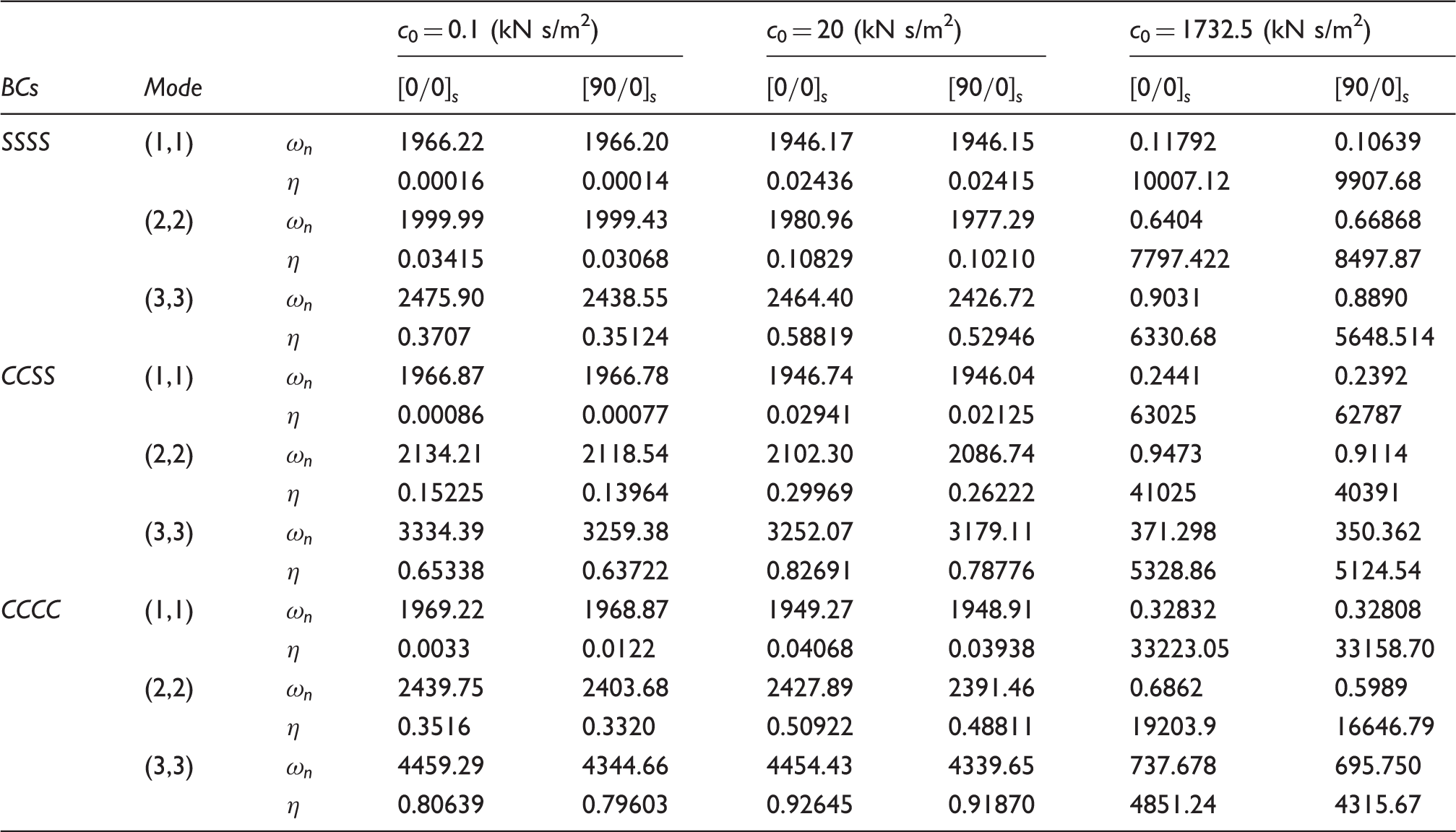
It is seen that, in all the BCs,
Viscoelastic Beams
In this part, the vibration behavior of viscoelastic beams resting on viscoelastic foundations is investigated. The polymeric cured resin properties are considered as listed in Table 7. It is expected that the beam structures behave like to the plate one studied in proceeding section.
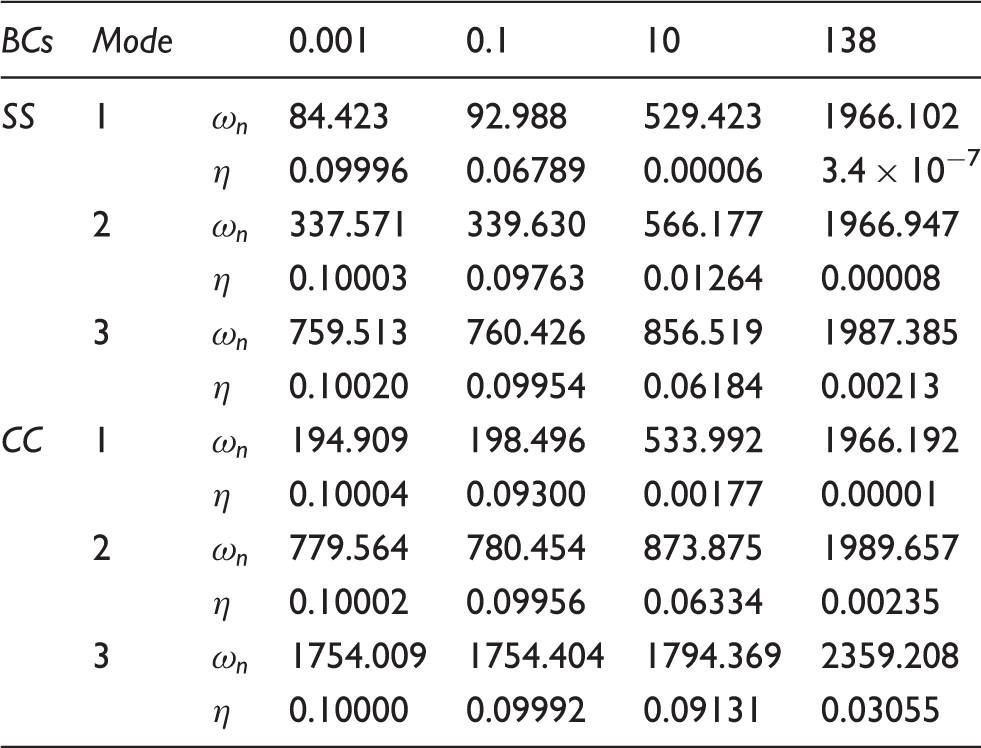
The first five natural frequency (rad/s) and loss factor (%) of viscoelastic beams.
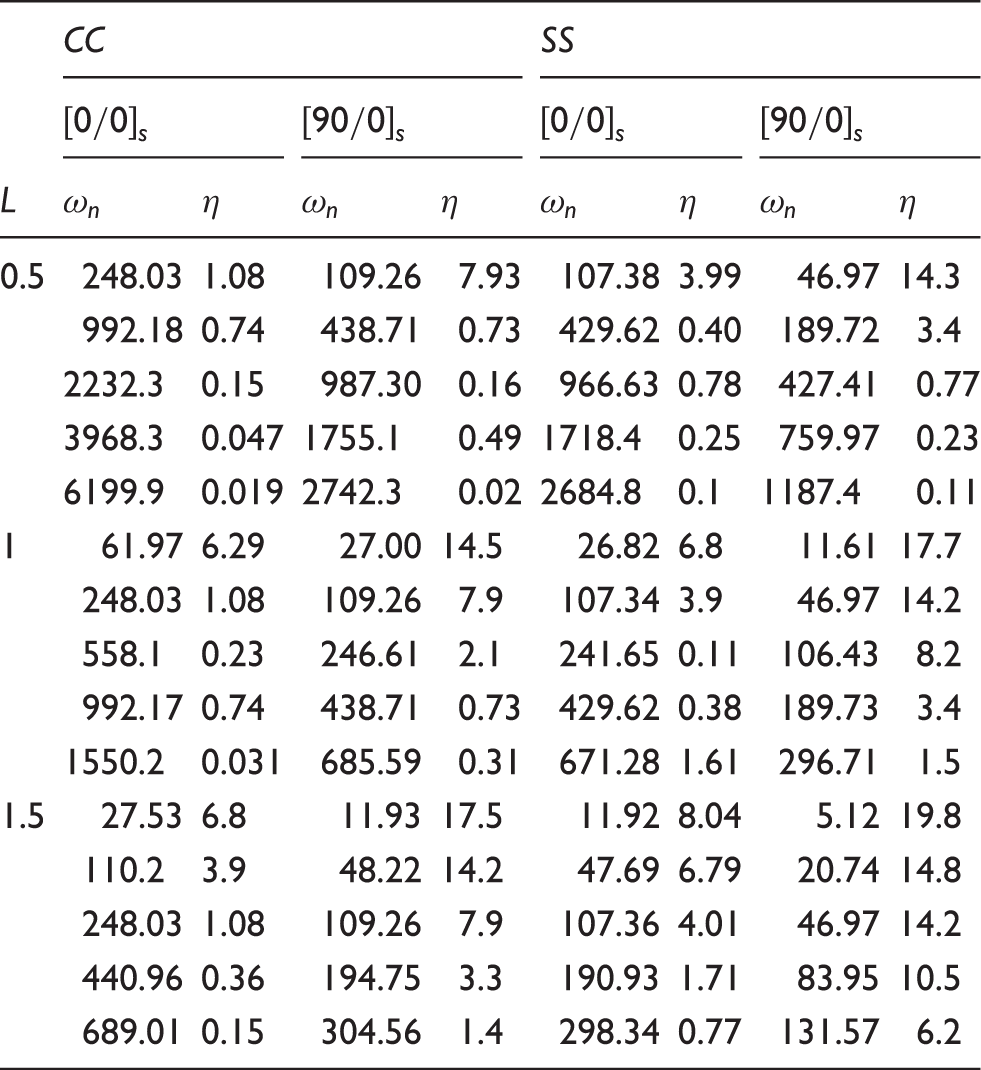
Effect of foundation stiffness k (MN/m2) on the natural frequency and loss factor of the viscoelastic composite beams.
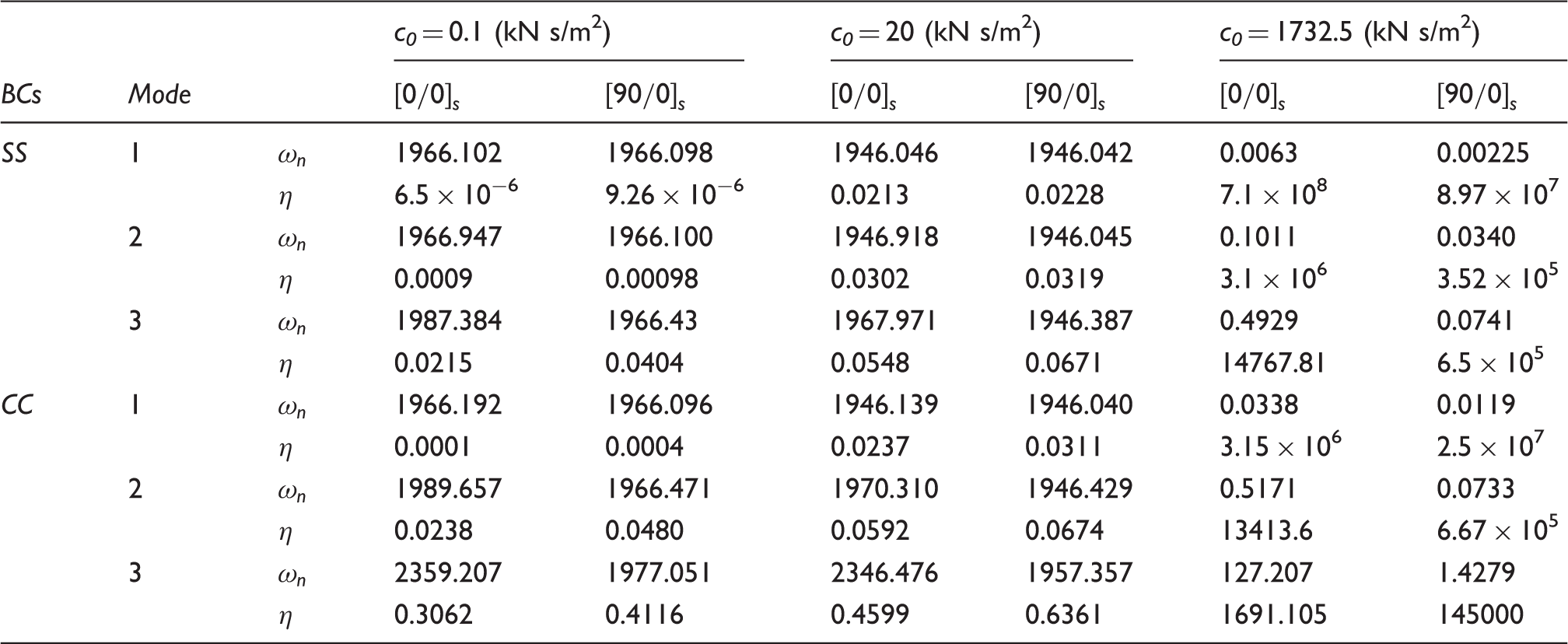
Effects of foundation viscosity on the natural frequency and loss factor of the viscoelastic composite beams.
Transient response of viscoelastic laminated composite beam with Central deflection time history of viscoelastic composite beams on elastic foundation for different boundary conditions.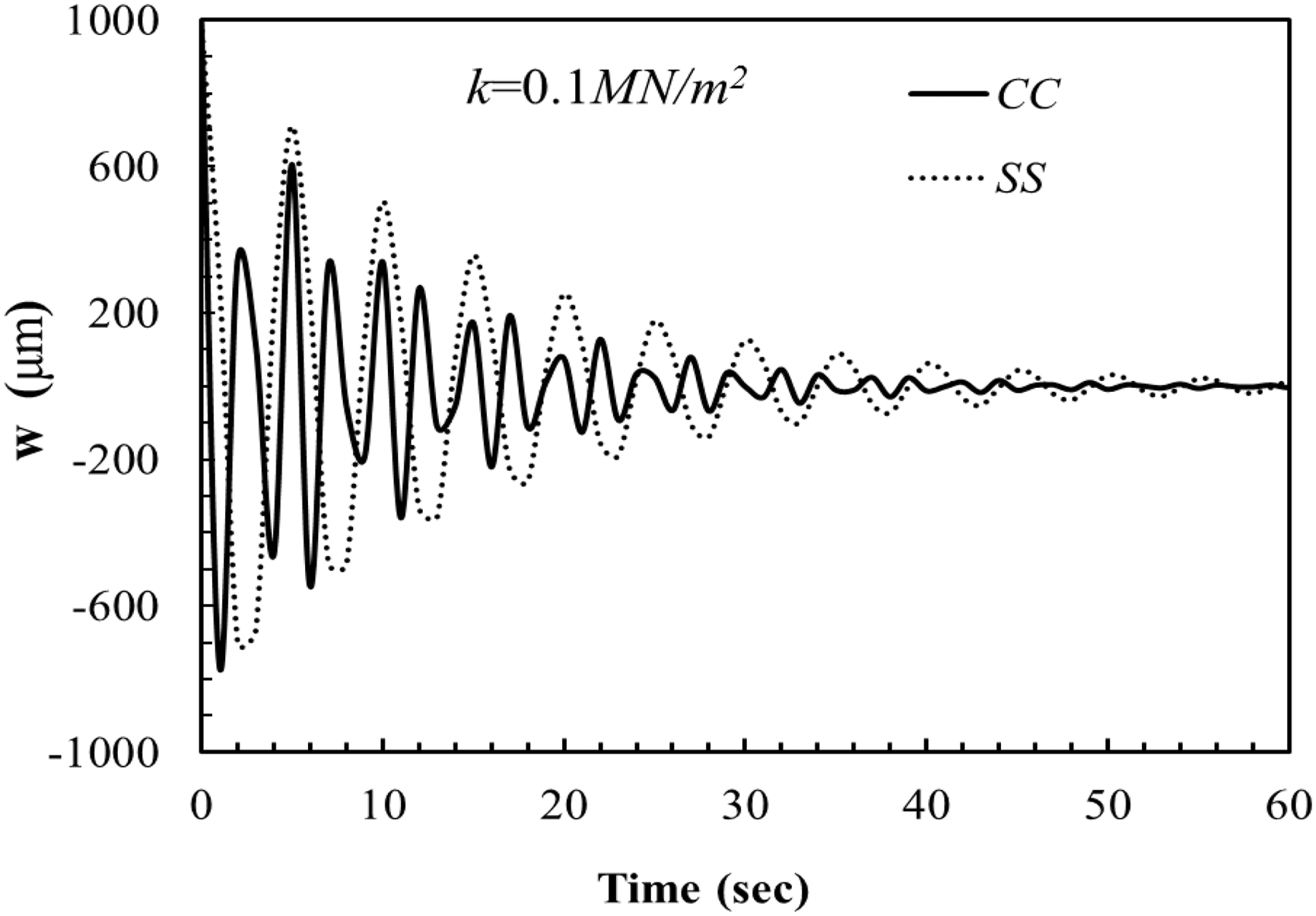
Influence of foundation viscosity variation on the damping and vibration of viscoelastic composite beams resting on foundation with 138 MN/m
2
stiffness is studied in Table 13. The results show that increment of foundation viscosity up to 20 kN s/m2 has no significant effect on the natural frequency, although it leads to obvious increment of the loss factor. As can be found from this table, the system with 0.1 and 20 kN s/m2 foundation viscosities almost has represented similar natural frequency so that the lamination scheme and edge conditions (SS and CC) have no obvious effect on the vibrational characteristics, although there are some tiny differences between natural frequencies of system with various layups in different edge conditions. In both SS and CC edge conditions, the first and second natural frequencies have values with tiny differences while the third natural frequency represents larger values especially in
Concluding remarks
The present work is concerned with the dynamic response of freely vibrating viscoelastic laminated composite beams and plates resting on suppressive foundations. The constitutive relation of the fiber-reinforced composite laminates with polymer matrix is established by adopting the Boltzmann superposition principle. The polymeric matrix behavior is extracted from DMA results in terms of Prony–Dirichlet series. The Kelvin–Voigt model is considered to describe the foundation viscoelasticity. Employing the Hamilton principle, the governing equations of motion of viscoelastic laminated composite beams and plates resting on viscoelastic foundations are derived based on the displacement field of the classical lamination theory. Applying Galerkin weighted residual method, Fourier transform, and iterative QZ algorithm, the solution of unknown variables is obtained in the space and time domain. Due to lack of similar results in the specialized literature, the results of elastic isotropic plates on viscoelastic foundation and viscoelastic composite plates with constant complex stiffness and constant Poisson ratios are computed and compared with their counterparts in the literature. Then, a detailed analysis of the influence of stiffness and viscosity of foundation, geometrical parameters and BCs on the natural frequency, modal loss factor and transient response of freely vibrating viscoelastic laminated composite beams, and plates resting on viscoelastic foundations is carried out.
As revealed in the “Results and discussion” section, the viscoelastic beams and plates have internal damping capability due to existence of viscoelastic behavior of constitutive materials in the structures. Moreover, the effect of edge conditions, lamination schemes, stiffness, and viscosity of foundation can be applied simultaneously to study foundation–structure interaction and its vibrational and dynamic treatments. The following main conclusions can be drawn:
Foundation viscosity has significant influence on the dynamic behavior of the structure. It is observed that the high values of foundation viscosity may lead to the transition of harmonic motion into the inharmonic one. Increment of the aspect ratio leads to ascending the natural frequency while a specific manner of loss factor cannot be observed. Foundation stiffness increases the natural frequency of the plate to the extent that the loss factor approaches to the negligible value or in the other words viscoelasticity of the structures has no important role on the structure behavior. The edge conditions have prominent effect on the natural frequency and loss factor of the viscoelastic plates resting on elastic foundation. However, it is found that increasing the foundation stiffness to the highest values debilitates BCs effects. Stacking sequence Long beams represent low natural frequency and high loss factor while the short beams tend vice versa. Furthermore, natural frequency variation is more prominent than loss factor variation. Significant descent of the loss factor is observed especially in the lower mode when the foundation stiffness is increased. Moreover, the loss factor of the first mode is more sensitive to the foundation stiffness variation. The foundation with high values of viscoelasticity can be utilized to control the delirious vibration and fluctuation manner of beam and plate structures.
Finally, due to the absence of similar results in the specialized literature, the results of this research are expected to contribute to a better understanding of the vibrational characteristics of viscoelastic beams and plates resting on suppressive foundations. From a practical point of view, the results may be instrumental toward a reliable design of armored railroads with damping layer on the lateral surface and the polymeric composites flooring on the floor in dynamical environments.
Footnotes
Acknowledgement
The authors would like to express their gratitude to the anonymous reviewers who made valuable comments and suggestions to improve the paper.
Conflict of interest
None declared.
Funding
This research received no specific grant from any funding agency in the public, commercial, or not-for-profit sectors.