







Abstract
Laminated SiCw/SiC ceramic composites were fabricated by chemical vapor infiltration and tape casting, and the effects of matrix modification on microstructure and strengthening/toughening of the composites were investigated by polymer infltration and pyrolysis and liquid silicon infiltration. With increasing cycles of polymer infltration and pyrolysis, density of the composites increased effectively, and the flexural strength and fracture toughness increased obviously. With increasing time of liquid silicon infiltration, density of the composites increased significantly, but the flexural strength and fracture toughness increased firstly and then decreased gradually. After modification by polymer infiltration and pyrolysis, the bonding of interfacial and interlaminar was not changed, and the density increase led to the property increase. After modification by liquid silicon infiltration, the interlaminar bonding was not changed and interfacial bonding of whisker/matrix was strengthened, and the density increase led to the property increase.
Keywords
Introduction
Laminated ceramic composites show promise for overcoming the brittleness of monolithic ceramics and are attractive materials for applications requiring high strength and toughness.1–4 Especially, the strength/toughness of laminated ceramic composites is much better than that of monolithic ceramics because of the control of different constituents. Comparing with hot-pressing sintering techniques, laminated SiCw/SiC ceramic composites fabricated by tape casting and chemical vapor infiltration (CVI) have several advantages, such as large volume fraction of whiskers, mild damage of whiskers, and good strengthening/toughening potential, but the large porosity (about 19%) impedes improvement of mechanical properties of the composites. 5 Therefore, it is necessary to develop a cost-effective process with the aim to highly densify the composites, and if possible, to further increase mechanical properties of the composites.
Among different modification techniques, the most employed ones are polymer infiltration and pyrolysis (PIP)6–8 and liquid silicon infiltration (LSI).9–11 These two techniques are more economically attractive and make the composites densification with short fabrication time. The microstructure changes of the composites after matrix modification process have an effect on their properties. In these processes, the density of the composites should be increased and the whiskers are not damaged.
In order to achieve strengthening/toughening of the laminated SiCw/SiC ceramic composites, effects of the matrix modification by PIP and LSI on mechanical properties and microstructure were investigated, and the effect mechanisms were discussed.
Experimental procedure
Fabrication
High purity β-SiC whiskers with average length 18 µm and diameter 1.5 µm (Alfa Aesar, MA, USA) were used as reinforcement. Triethyl phosphate was used as dispersant, polyvinyl butyral was used as binder, glycerol and dioctyl phthalate were used as plasticizer, n-butanol and ethylene glycol were used as defoamer, isopropanol and toluene were used as solvent in the slurry.
The whole fabricating procedure for laminated SiCw/SiC ceramic composites was shown in Figure 1. The SiC whiskers combined with solvent and dispersant were ball-milled for 6 h by using Al2O3 ball as grinding media. Then, the whisker dispersions combined with other chemical reagents were ball-milled for another 6 h to obtain well-dispersed slurry. The ball milling speed was restricted to 160 r/min to protect whiskers from damage. After mixing, the slurry was degassed in a vacuum atmosphere to remove gas bubbles. The casted sheet was dried naturally, and its thickness was usually 300 µm. The SiC matrix was deposited by isothermal/isobaric CVI, which was deposited from methyltrichlorosilane (MTS, CH3SiCl3). The detailed CVI process was described elsewhere.
5
The thickness of the “green” composite was about 4 mm, and the volume fraction of SiC whiskers was 40%. After CVI, the “green” composite was machined and polished into specimens with dimensions of 3 mm × 4 mm × 40 mm and 3 mm × 4 mm × 30 mm, respectively.
Experimental procedure for fabrication of laminated SiCw/SiC ceramic composites.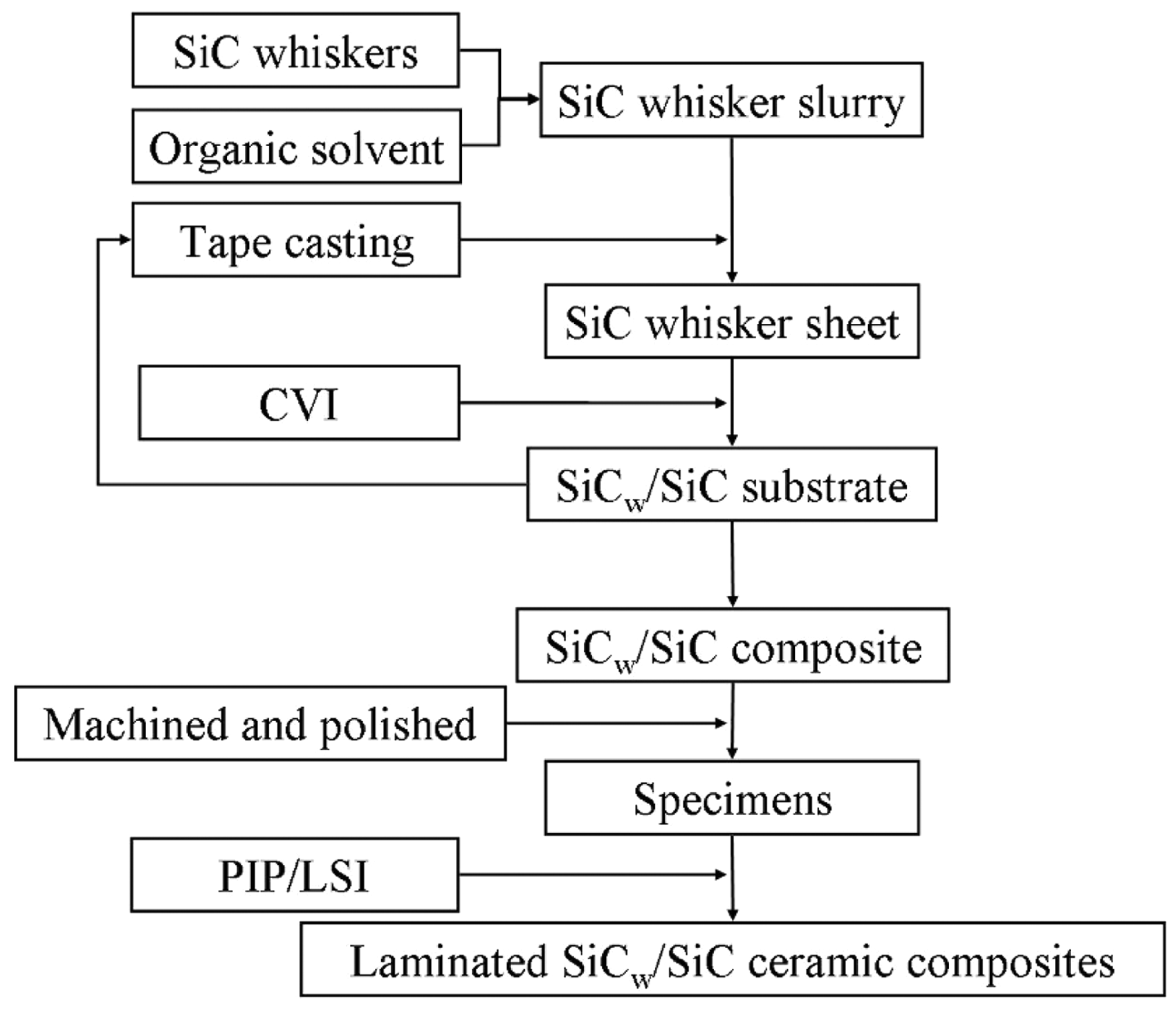
Matrix modification
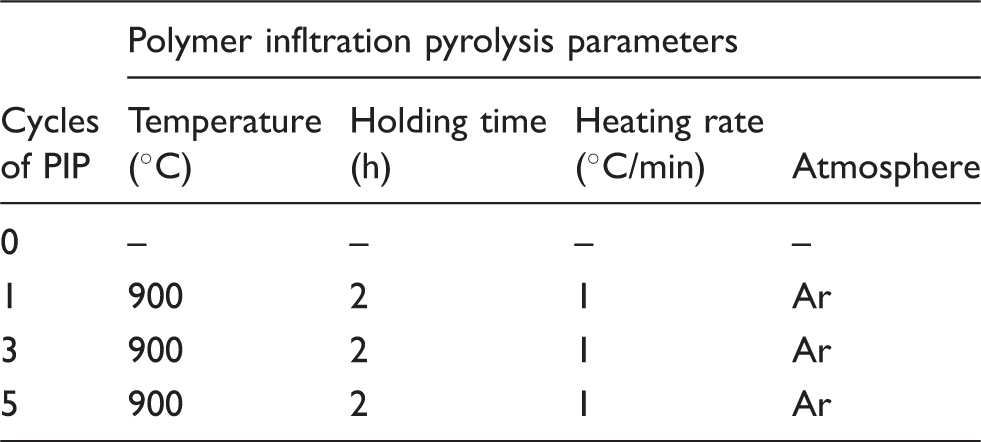
Polymer infltration pyrolysis parameters of laminated SiCw/SiC ceramic composites.
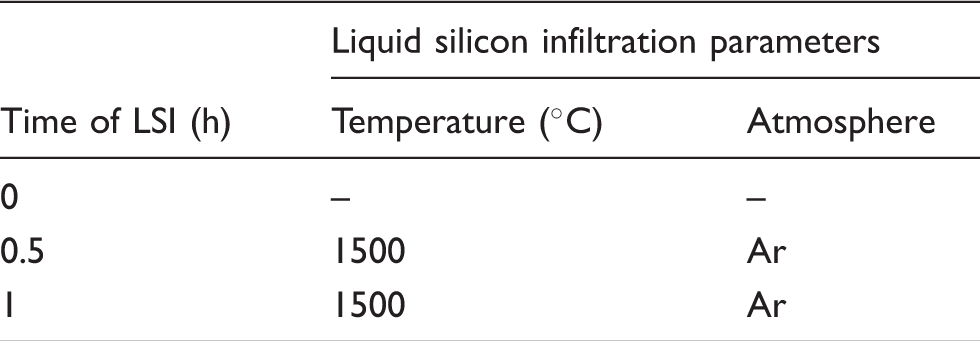
Liquid silicon infiltration parameters of laminated SiCw/SiC ceramic composites.
Characterization
The density and open porosity of the specimens were measured by Archimedes method. The flexural strength of the composites at room temperature (RT) was measured by using specimens of 3 mm × 4 mm × 40 mm with a span of 30 mm and a crosshead speed of 0.5 mm/min (SANS CMT 4304, Sans Materials Testing Co., Shenzhen, China). The fracture toughness was determined on five 3 mm × 4 mm × 30 mm bars by the single-edge-notched beam method at RT with a crosshead speed of 0.05 mm/min. The notch length was about 2 mm which were measured accurately by scanning electron microscopy (SEM). The microstructures of composites were observed by SEM of S-2700, Hitachi, Japan. The whisker/matrix interface was characterized by high-resolution transmission electron microscopy of Tecnai F30, FEI, USA.
Results and discussion
The infuence of PIP
The mechanical properties of the composites after different PIP processes are shown in Figure 2(a). With increasing the cycles of PIP, the flexural strength and fracture toughness of the composites increased rapidly before three cycles of PIP and increased slowly after three cycles of PIP. After five cycles of PIP, the flexural strength and toughness of the composites reached 356 MPa and 8.66 MPam1/2, which increased about 13 and 7%, respectively.
Mechanical properties of composites: (a) after different PIP processes and (b) after different LSI processes.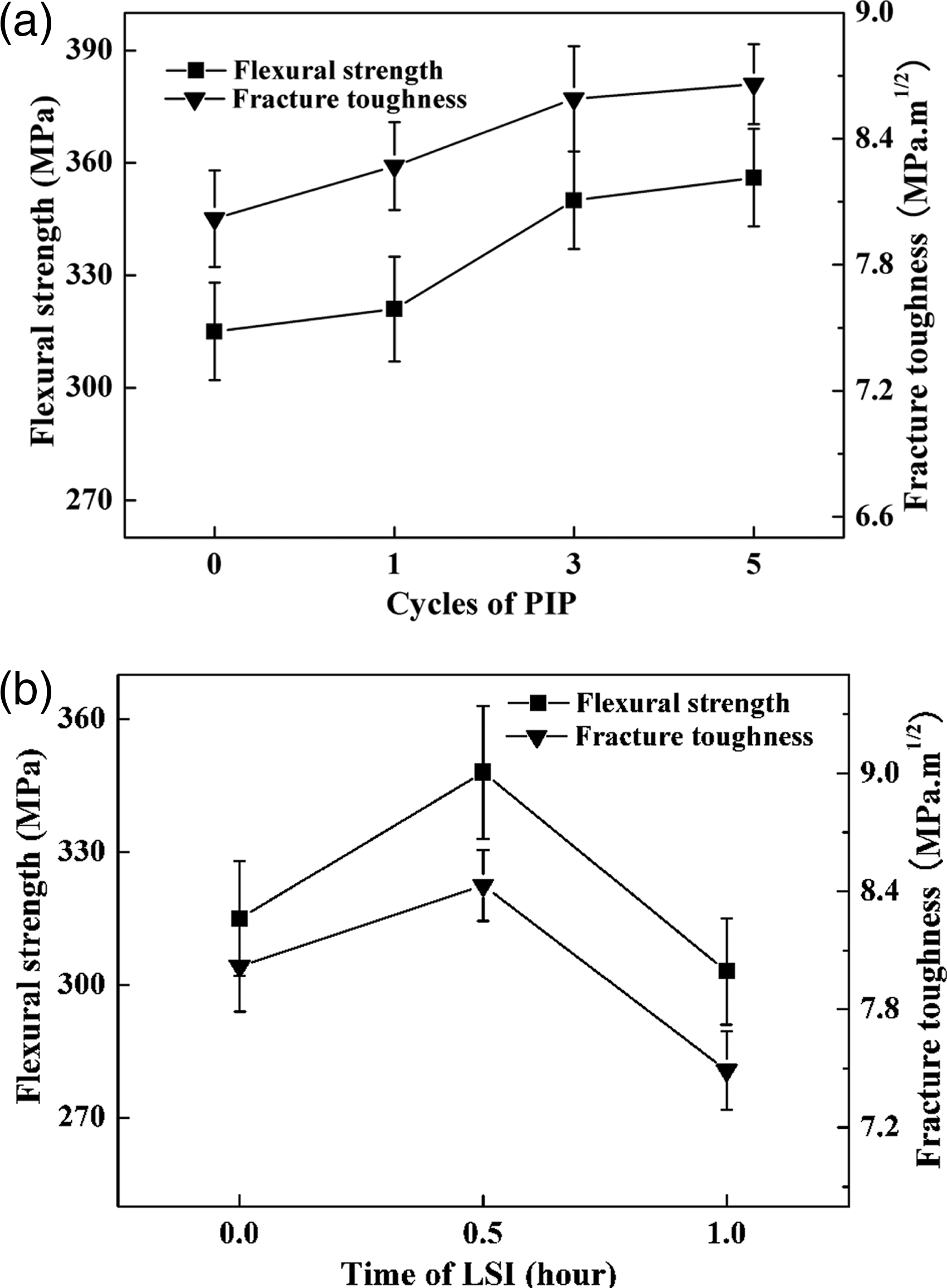
The density and open porosity of the composites after different PIP processes are shown in Figure 3(a). It can be seen that the density was increased significantly with increasing cycles of PIP. The density reached 2.64 g/cm3 as the cycles of PIP were enhanced to five, which was about 10% higher than that of the composites without modification. Correspondingly, the open porosity was decreased to 73.7%. It can be noted that the density was a linear increase, and the open porosity was a nonlinear parabolic decrease with increasing the cycles of PIP. The initial decrease of open porosity is attributed to the decrease of the small-sized pores with PCS, and the following rapid decrease of open porosity is mainly due to the infiltration of PCS into the large-sized pores. The small-sized pores were existed within cluster of whiskers and the large-sized pores were located between cluster of whiskers. However, the density of the composites can be increased by infiltrated PCS wherever it existed in small- and large-sized pores in the composites. The fracture surface of the composite modified after five cycles of PIP is shown in Figure 4(b). Some isolated pyrolysized matrix (black arrows) can be observed in the large-sized pores after five cycles of PIP. It is attributed to the shrinkage of infiltrated PCS by pyrolysis process, which leads to a limited contribution to strength/toughness of the composites and results in a little increase in mechanical properties of the composites after five cycles of PIP. The result is consistent with the result of Figure 2(a).
Density and open porosity of composites: (a) after different PIP processes and (b) after different LSI processes. Fracture surface of composites (a) without modification and (b) with modification by five cycles of PIP.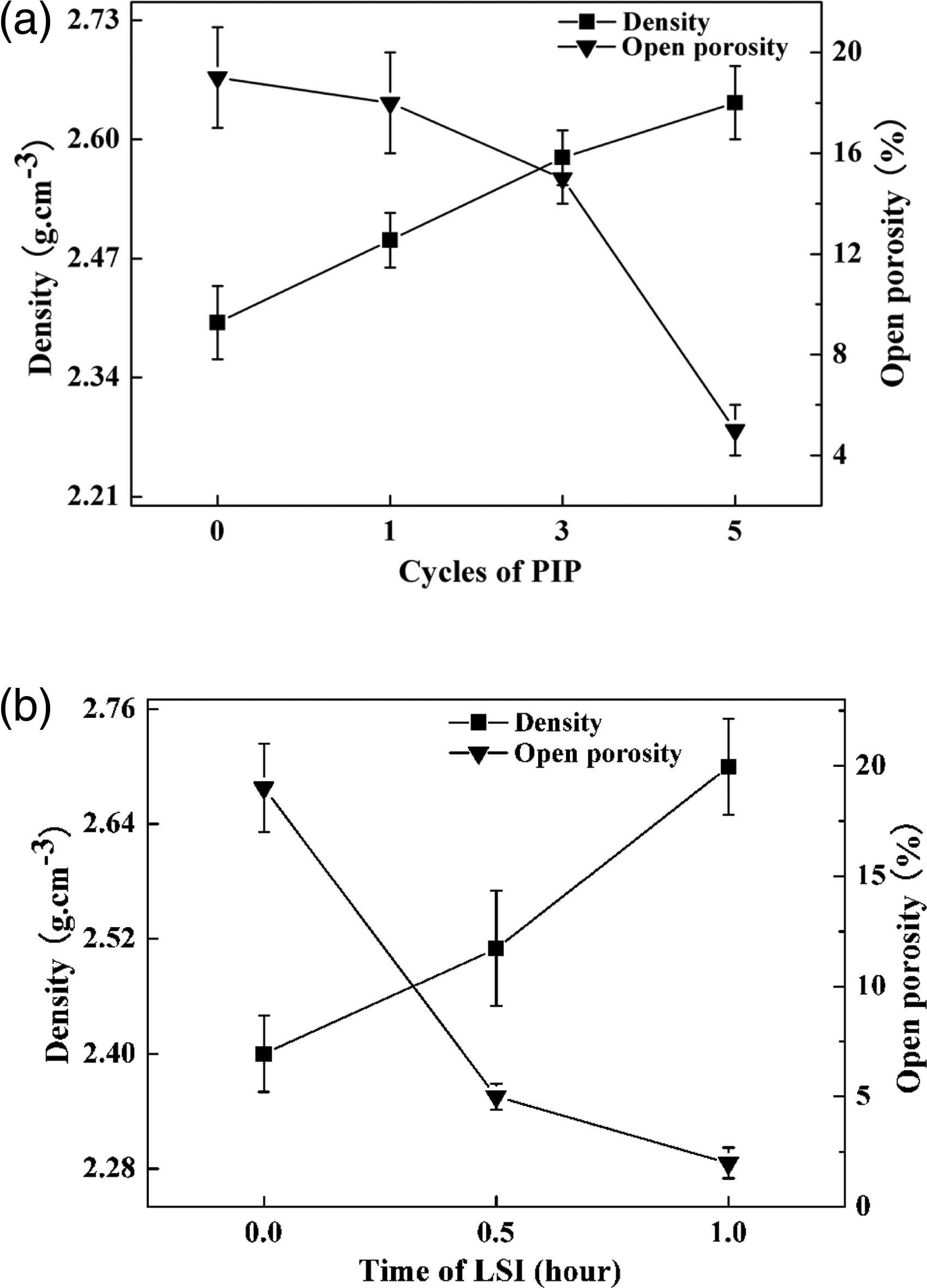
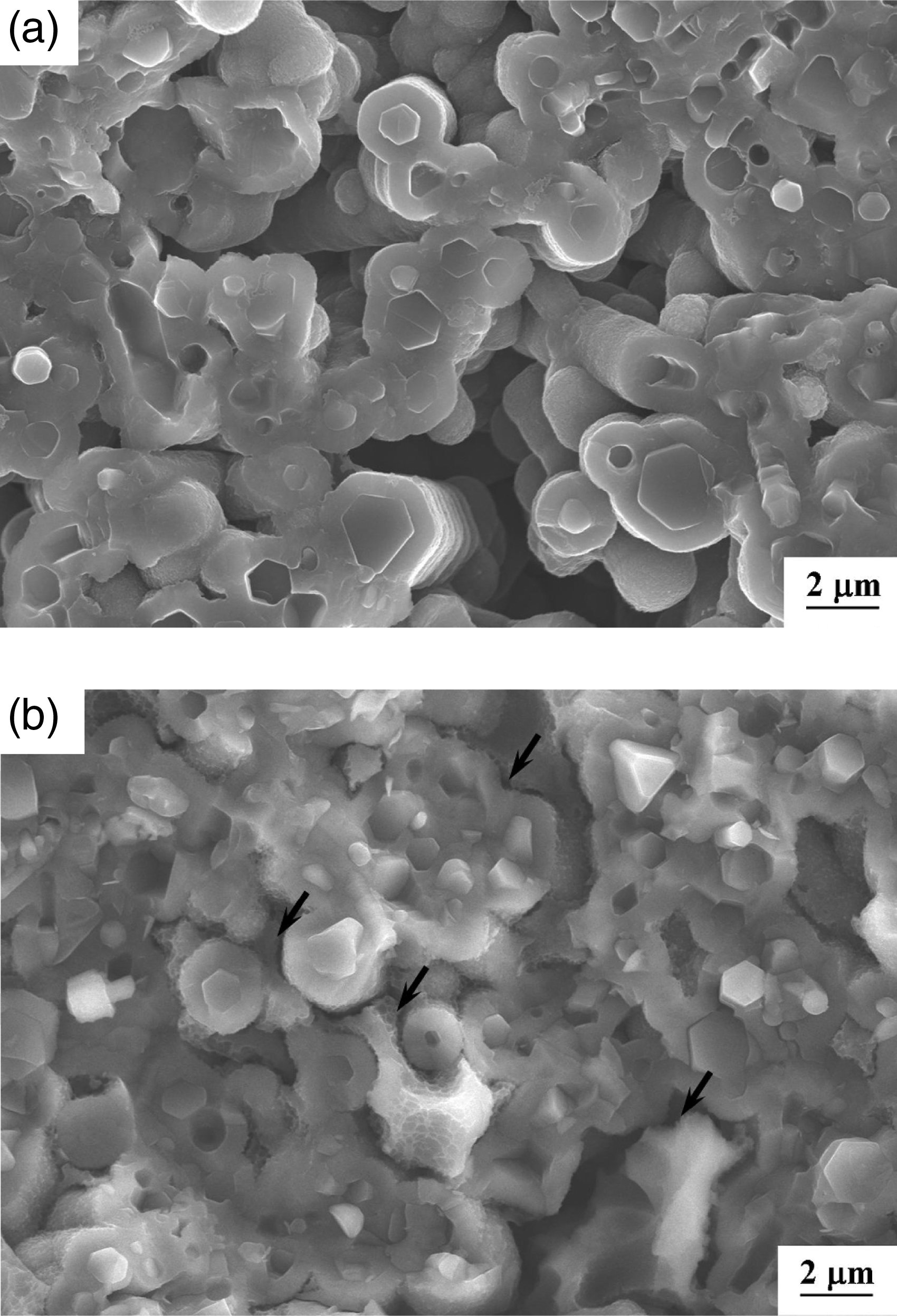
Figure 4 shows the morphology of fracture surfaces for the composites with and without modification. The whiskers represented intact morphologies after CVI and PIP process in Figure 4(a), indicating that the whiskers cannot be damaged during that process. The whiskers with large aspect ratio were beneficial to strengthening/toughening the composites. It can be seen from Figure 4(a) that the composites had a few large-sized pores and whisker pull-out. After modification by PIP (Figure 4(b)), only a few small-sized pores can be found, and the pull-out number and pull-out length of whiskers were increased, indicating that densification of the composites was improved and the interfacial bonding of whisker/matrix was unchanged after PIP process.
In summary, the increased density was responsible for strengthening/toughening of laminated SiCw/SiC ceramic composites after PIP process.
The infuence of LSI
The mechanical properties of the composites after different LSI processes are shown in Figure 2(b). With increasing time of LSI, the flexural strength and fracture toughness of the composites increased slowly before 0.5 h of LSI and decreased rapidly after 0.5 h of LSI. After 0.5 h of LSI, the flexural strength and toughness of the composites increased 7.3 and 3.9%, respectively.
The density and open porosity of the composites after different LSI processes are shown in Figure 3(b). It can be seen that the density was increased significantly with increasing time of LSI, and the open porosity was decreased dramatically. After 1 h of LSI, the density of the composites increased 12.5% and the open porosity decreased 89.5%, respectively. The decrease in open porosity is more rapid; the gain in density obtained with shorter time seems to be possible after 0.5 h of LSI process, indicating that the LSI process is more desirable to densify the laminated SiCw/SiC ceramic composites. In addition, the increasing trend in density is consistent with the decreasing trend in mechanical properties of the composites, revealing that the increase of the time of LSI means the increase of silicon content that results in decreasing the mechanical properties of the composites. The result agrees well with the result of Figure 2(b).
The morphology of fracture surfaces for the composites after different LSI processes is shown in Figure 5. It can be seen from Figure 5(a) that the composites without modification showed a not dense fracture surface and a few whisker pull-out. However, the composites modified by LSI showed dense fracture surfaces, as shown in Figure 5(b) and (c). The small- and large-sized pores within the whiskers and cluster of whiskers were occupied by the reaction of SiC and residual Si. With increasing time of LSI, the densification of the composites was obviously increased. After modification by LSI, the whiskers also represented intact morphologies, and the pull-out number and pull-out length of whiskers were a little decreased with increasing time of LSI, indicating that interfacial bonding of whisker/matrix was changed from weak to strong.
Fracture surfaces of composites after LSI: (a) 0 h, (b) 0.5 h, and (c) 1 h.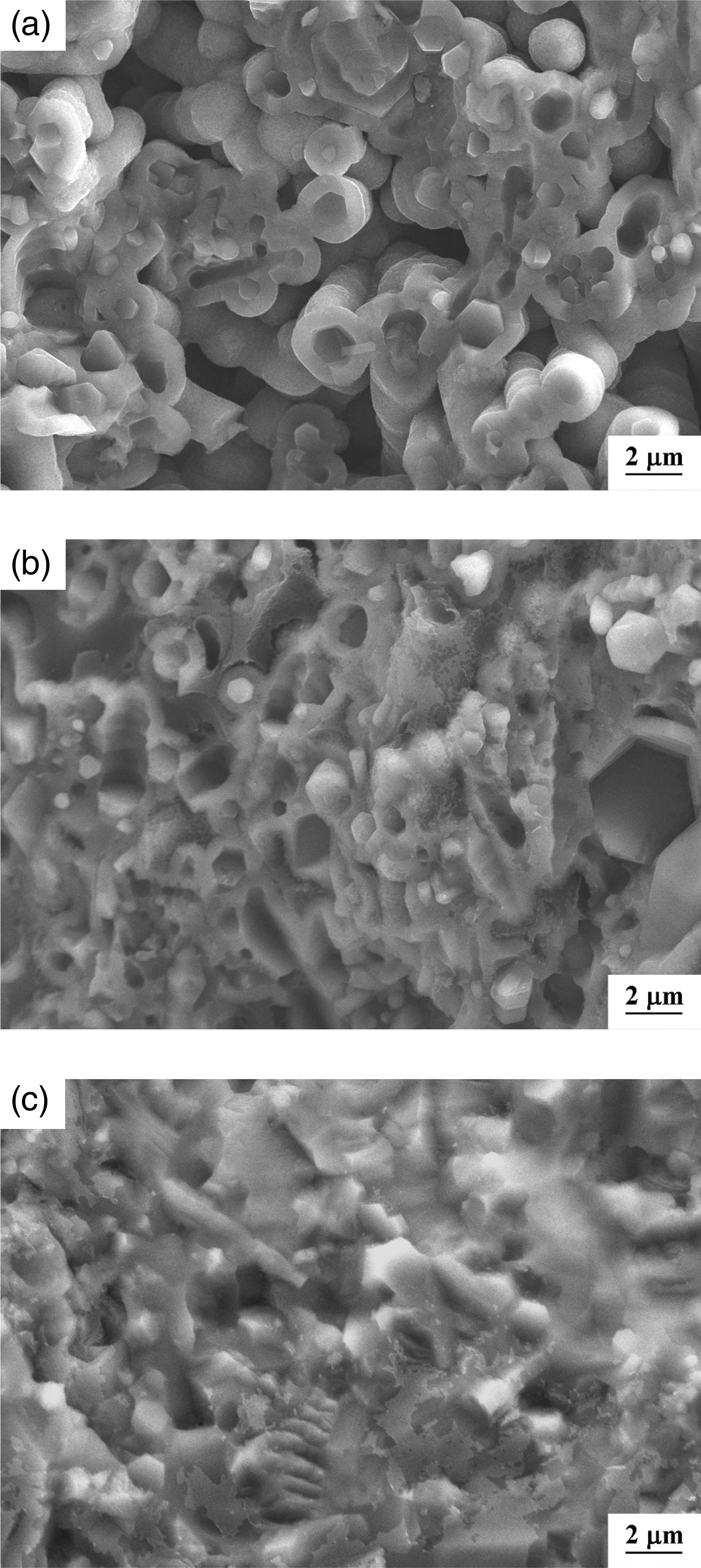
In summary, the change of density and interfacial bonding between whisker and matrix was responsible for changing mechanical properties of laminated SiCw/SiC ceramic composites after LSI process.
Matrix modification mechanisms
Matrix modification mechanisms of PIP
To understand strengthening/toughening mechanisms of the composites with PIP process, the crack path was observed by SEM. Figure 6 shows the cross-section of the composites with and without modification by PIP produced from three-point bending test. Comparing with the composites without modification (Figure 6(a)), the composites modified by PIP exhibited longer crack prorogation path and more crack deflection along with the interlaminar (Figure 6(b)).12 The crack can be effectively deflected in the interlaminar, indicating that the interlaminar bonding strength was not increased after PIP process.
SEM micrographs of cross-section of composites (a) without modification, (b) with modification by five cycles of PIP, and (c) with modification by 0.5 h of LSI.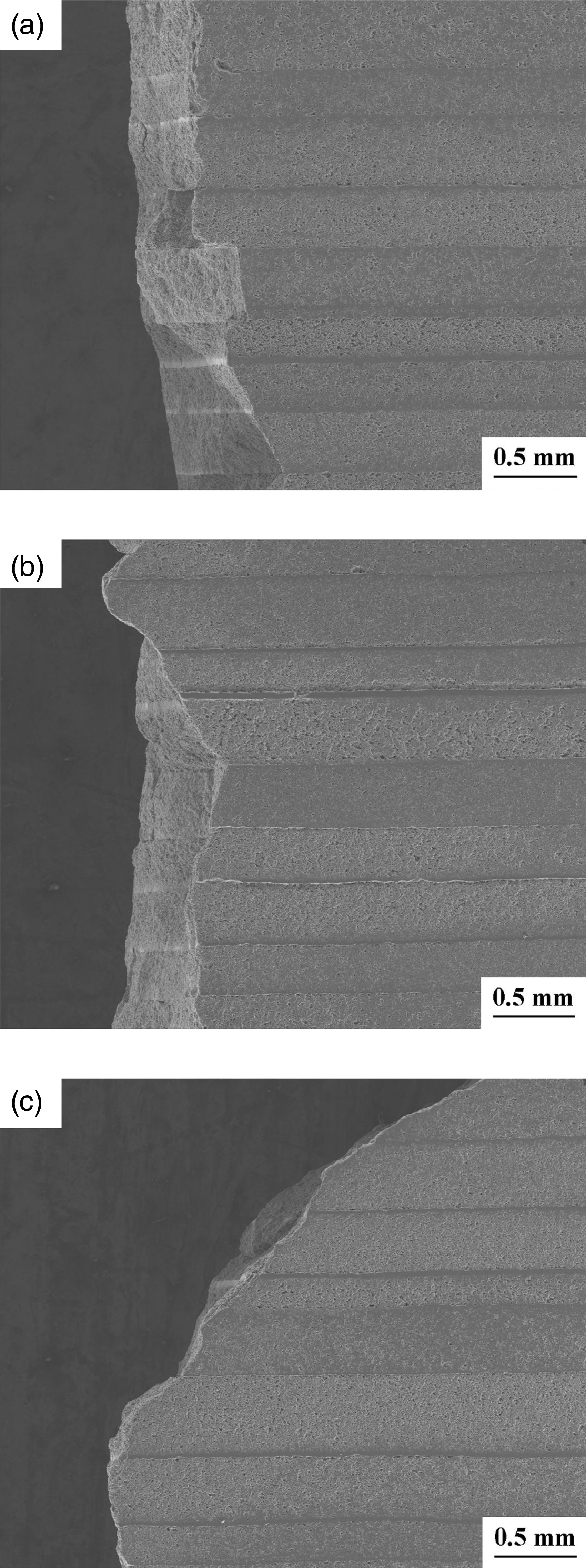
According to Figures 4 and 6, the composites modified by PIP exhibited more crack deflection and whisker pull-out. After modification by PIP, increasing density of the composites tends to enhance the load bearing capacity of whiskers, which makes an increase in strength of the composites. Moreover, increasing density of the composites tends to strengthen the bonding between interfacial and interlaminar. As a result, interfacial and interlaminar bonding strength of the composites are not increased by PIP process, which makes an increase in toughness of the composites.
The strengthening/toughening of laminated SiCw/SiC ceramic composites modified by PIP process can be explained by enhancing the density of composites and keeping the interfacial and interlaminar bonding strength, both lead to crack deflection and whisker pull-out at a higher stress.
Matrix modification mechanisms of LSI
The cross-section of the composites with and without modification by LSI produced from three-point bending test was shown in Figure 6(c). After modification by LSI, crack prorogation path was increased, revealing that the interlaminar bonding strength was not increased after LSI process, which was contributed to toughness of the composites.
The relationship between strengthening/toughening mechanisms and microstructure of the composites can be demonstrated clearly by examining the interface of whisker/matrix, as shown in Figure 7. Comparing to the composites without modification, the composites modified by LSI exhibited thinner amorphous phase between whisker and matrix. There was an amorphous interphase of SiCxOy at the whisker/matrix interface,
5
and the following reactions were assumed to occur while the composites were infiltrated at 1500℃ in vacuum atmosphere13,14
High-resolution transmission electron micrographs of interface in composites after LSI: (a) 0 h, (b) 0.5 h, and (c) 1 h.


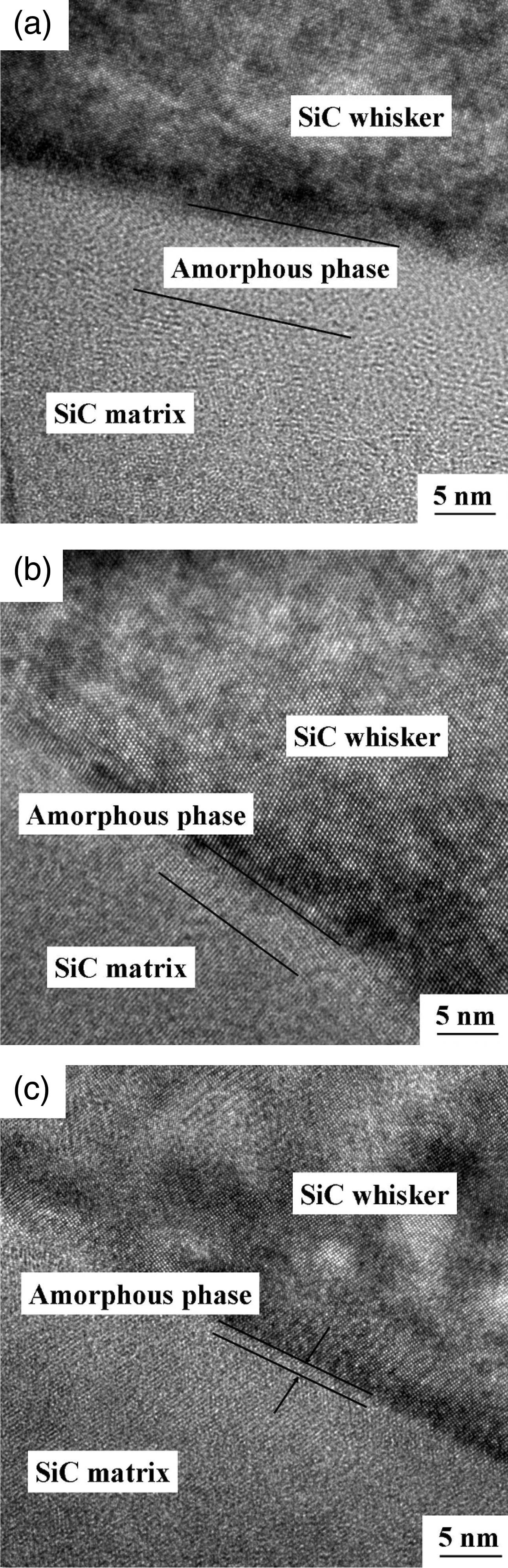
The density can be increased by SiC produced from LSI process, and interfacial bonding of whisker/matrix can be strengthened by SiC produced from whisker/matrix interface. After 0.5 h of LSI, increasing density of the composites tends to enhance the load bearing capacity of whiskers, and reducing the thickness of amorphous phase tends to decrease the load bearing capacity. As a result, the load bearing capacity is increased, which makes an increase in strength of the composites. On the other hand, increasing density of the composites tends to enhance the crack propagation resistance, and reducing thickness of the amorphous phase tends to increase the crack propagation resistance. Consequently, the interfacial shear strength of the composites is not increased enough by LSI process, which makes an increase in toughness of the composites. When the time of LSI reached 1 h, the thickness of the amorphous phase was too thin, leading to strong interfacial bonding of whisker/matrix and decrease in strength and toughness of the composites.
The effect of LSI process on laminated SiCw/SiC ceramic composites can be explained by increasing density of the composites and strengthening the interfacial bonding of whisker/matrix. The dense structure and not too strong interfacial bonding of whisker/matrix lead to increases in strength/toughness of the composites.
Conclusions
Laminated SiCw/SiC ceramic composites were modified by PIP and LSI. The PIP process can effectively increase density and strength/toughness of the composites. The flexural strength and fracture toughness of the composites modified by PIP increase, respectively, 13 and 7%, owing to the increased density of composites and unchanged bonding of interfacial and interlaminar. The isolated pyrolysized matrix existed in large-sized pores, resulting in the limited contribution of PIP to the mechanical properties of composites. The LSI process also can effectively increase density and mechanical properties of the composites, but strong interfacial bonding of whisker/matrix causes brittle fracture of composites and decreases the mechanical properties of composites.
Footnotes
Funding
This study was financially supported by the Natural Science Foundation of China (51272210, 50902112, and 51032006) and partially supported by the Project “111” (B08040).
Conflict of interest
None declared.