






Abstract
The main objective of this work was to explore for the first time the potential of the co-grinding process using a high-energy vibrated ball mill to prepare poly(3-hydroxybutyrate-co-3-hydroxyvalerate) (PHBV)/wheat straw fibers biocomposites. Grinding conditions of virgin PHBV pellets were examined by focusing on the evolution of particle size, morphology, crystallinity, and molecular weight. Temperature and grinding duration were demonstrated to be the key parameters affecting PHBV milling. In a second step, mechanical properties of biocomposites prepared by cryo-co-grinding were discussed in relation to the processing conditions and the resulting structure of materials. Comparing to virgin PHBV, the reinforcing effect of wheat straw fibers was very poor, regardless of the good dispersion of fibers within the polymer matrix induced by co-grinding. The increased brittleness and decreased toughness of biocomposites were attributed to (a) a poor interfacial compatibility between wheat straw fibers and PHBV and (b) the degradation of PHBV during processing, as revealed by the decrease in molecular weight.
Keywords
Introduction
In the latest years, ecological concerns have encouraged to reduce the use of non-renewable raw materials by stimulating the development of new environmental-friendly materials made from natural resources. Among fully biodegradable polymeric materials under normal composting conditions, polyhydroxyalkanoates (PHAs) are expanding to different areas of applications. 1 PHAs are high molecular polyesters naturally produced by wide ranges of microorganisms, displaying comparable characteristics to conventional thermoplastics. Among the various PHAs, poly-3-hydroxybutyrate (PHB) and poly(3-hydroxybutyrate-co-3-hydroxyvalerate) (PHBV) are the two most widely studied members. The PHBV copolymer has the advantage of an increased thermostability and toughness when compared to PHB homopolymer. 2 The drawbacks of PHBV are still the high cost compared with that of petroleum-based plastics, and a relatively low impact resistance.
Recently, lignocellulosic agricultural residues such as wheat straw,1–4 corn straw, 1 soy stalk, 1 and ground olive stones4,5 have been used as fillers to improve mechanical behavior and toughness of PHBV, lowering the price of the resulted composites,1,6,7 or bring new functionalities such as water vapor permeability.3,4 However, the main drawback of such lignocellulosic fibers-polymer composites is the poor fiber/matrix affinity owing to the intrinsic hydrophobicity of most polymers that contrasts with the hydrophilicity of lignocellulosic fibers. It makes difficult the dispersion of fibers in the polymer matrices (due to agglomeration into knotty masses) and results in a poor fiber/matrix interfacial adhesion, leading to weak mechanical properties. To overcome this problem, different physical or chemical treatments have been proposed to increase the similarity of the surface properties of the composite components, including: (a) the fiber surface modification prior to its incorporation in the matrix to increase their surface free energy and particularly their hydrophobicity, (b) the polymer matrix modification to increase its hydrophilicity, or (c) the introduction of amphiphilic compatibilizing agents during the process.8,9
An alternative process to improve the interface between the fibers and PHBV without adding any additional agent could be co-grinding. This solvent-free method is assumed to induce the generation of reactive free radicals on the surfaces of the constituents that can thereafter react together to create covalent linkages. It is based on the principle of alternate fragmentation and agglomeration of particles through mechanical co-allowing in a high-energy ball mill. 10 Normally, polymers involved in co-grinding are in the form of powder and do not display the same hardness, which leads to different grinding rates. During the fragmentation–agglomeration process, the polymer with lower hardness adheres to the other polymer particles leading to a progressive covering of this latter polymer. Initially, this type of process was first developed to improve oxide dispersion of metallic superalloys 11 and it has been recently extended to polymer-based blends and composites.10,12–16 However, the manufacture of lignocellulosic fibers-PHBV-based biocomposites by co-grinding has never been yet explored.
It has been shown that co-grinding clearly improves the mechanical properties of composites when compared to that obtained by a simple blending,10,12,14 since the adhesion on the polymeric surface and the dispersion of the filler into the matrix are better. Thus, the main objective of the present work is to explore for the first time the potential of the co-grinding process using a high-energy ball mill to design PHBV/wheat straw fibers (WSF) composite materials with tailored mechanical properties. For that purpose, three scientific bottlenecks have to be resolved: (a) to understand the grinding behavior of constituents alone, (b) to comprehend the mechanisms involved during co-grinding, and (c) to get knowledge on the relationships between the processing, the structure, and the mechanical properties of resulting composite materials. Since the grinding behavior of wheat straw has already been deeply investigated 17 but not the one of PHBV, this work first focused on studying the impact of pertinent grinding conditions not only on PHBV particle size and morphology to get better knowledge about PHBV fragmentation and agglomeration phenomena but also on intrinsic characteristics such as molecular weight and crystallinity. From an applied point of view, this allowed to set up the PHBV pre-grinding conditions in such a way to minimize the damage of the polymer. In a second step, this work aimed at understanding the processing and structure of PHBV/WSF composite during co-grinding. Finally, one formulation was selected to prepare PHBV/WSF composite materials whose tensile properties were discussed in relation to their microstructure evaluated by scanning electron microscope (SEM) observations, thermal properties, crystallinity, and polymer molecular weight.
Experimental procedure
Materials
PHBV (3% HV) pellets were supplied by Tianan Biologic Material Co. Ltd. (China) under the trade name of ENMAT™ Y1000P. As reported by the manufacturer, PHBV contains 0.5% of nucleating agents (boron nitride) and 1% of antioxidants (Irganox 1010) and displayed a density of 1.25. Pellets were dried over silica gel before processing. Native wheat straw (T. aestivum cv. Dakter) was harvested in 2013 and kindly provided by the experimental domain DIASCOPE of INRA Melgueil (France). WSF was composed of 32 ± 0.8% cellulose, 20.5 ± 0.5% hemicelluloses (arabinoxylans), 17.4 ± 0.3% Klason lignin, 9.5 ± 2.2% extractives, and 6.1 ± 0.1% ashes, with a moisture content of 7.8 ± 0.1%. The density of WSF, evaluated in a previous work by picnometry, 18 was 1.57.
Grinding of raw materials
Grinding of PHBV
Conditions of PHBV pre-grinding prior to co-grinding process.

Energy consumption of PHBV cryo-grinding
The specific energy consumption of PHBV cryo-grinding was measured using a wattmeter. The active power (W) and time were logged into a PC card at 1-s intervals. The specific energy consumption (SEC, in J.g−1) was calculated according to:

Grinding of native wheat straw
WSF were produced by following a two-steps grinding process according to Silva and Rouau. 17 For that purpose, native wheat straw (stored at room temperature with moisture content of 8 wt% w.b.) was first reduced using cutting mill equipment with a 4.0 mm sieve. Second, wheat straw was ground with an impact mill operating at 18,000 rpm and equipped with a 0.3 mm sieve (trapezoid holes), a 8-teeth rotor and an output recovery by cyclone. The final median particle size (d50) of WSF was 224 ± 12 µm. WSF displayed the same average composition has native wheat straw.
Preparation of PHBV/WSF composites
Co-grinding
The polymer matrix in the form of powder (PHBV) and the filler (WSF) were co-ground in a high-energy vibrated ball mill (MM400 Retsch, Germany) during 40 min. It was kept in a 50 mL jar containing one stainless steel ball with a diameter of 25 mm. Two grams of PHBV pellets (δ = 1.25) were placed in the container. A WSF content of 20 wt% (corresponding to a volume content of 16.6 vol%) was used for all experiments. This filler content has been chosen in accordance with previous results. 3 Likewise, PHBV was ground separately following the same conditions to characterize its behaviors during the process. Samples were taken throughout the co-grinding process in order to be analyzed.
Film preparation
Films were obtained by thermo-pressing the co-ground material using a hydraulic press (PLM 10 T. Techmo, Nazelles, France) at 170℃ and 150 bars during 5 min. To control the thickness of films, a 0.2-mm Teflon frame was used between the plates. Accordingly, the average thickness of films was 0.21 ± 0.01 mm.
Characterization of PHBV/WSF composites
Particle size
Particle size distribution during the grinding process of either PHBV or WSF was by the median size (d50), corresponding to a cumulative frequency of 50% from 0.02 to 2000 µm. For that purpose, a laser diffraction particle size analyzer Mastersizer 2000 (Malvern Instruments Ltd., United Kingdom) was used. It has been found that laser diffraction can be considered as a suitable, rapid, and precise technique to calculate size distributions for median sizes lower than 500 µm. 3 Samples were suspended in ethanol directly in the measurement cellule and then suspensions were analyzed between 10 and 20% of obscuration. In the case of co-ground materials, the size distribution of the particles was measured by means of image processing using the program Image J. One-hundred particles were measured on each image. The analysis was done in triplicate.
Scanning electron microscopy
SEM observations were performed using SEM S-4500 (Hitachi, Japan) with an acceleration voltage of 2 kV and a detector for secondary electrons. All samples were coated with gold/palladium on an ion sputter coater. For the observation of cryo-fractured cross-sections, films were previously frozen under liquid nitrogen, and then fractured.
Tensile properties
Tensile tests were performed on films previously stored at 53% RH in a desiccator containing a saturated solution of MgNO3. Tensile strength (σ), strain at break (ɛ), and Young’s modulus (E) of the composites were determined using a Zwick instrument (Zwick Ulm., Germany), following the method ASTM D 882 (ASTM 2001). Initial grip separation and cross-head speed were set at 40 mm and 10 mm.min−1, respectively. Tensile strength was calculated by dividing the maximum load by the initial cross-sectional area of the sample. The strain at break was calculated as the elongation at the rupture point of sample divided by the initial length of a sample. At least six measurements were made for each sample.
Thermal properties
Thermal analysis was performed by using a differential scanner calorimeter (DSC) Q-200 (TA Instruments, USA). Nitrogen was used as the purge gas for the DSC cell. About 7 mg of sample was weighed and sealed in aluminum DSC pans. The samples were first heated from −20℃ to 200℃ at scanning rate of 50℃.min−1. Following samples were cooled from 200℃ to −20℃ at rate of 10℃.min−1. Then, the samples were re-heated to 200℃ at 10℃.min−1. The thermal parameters were obtained from the DSC curves. The melting (Tm) and crystallization (Tc) temperatures were obtained as the maxima of the first-order transition peaks, while the crystallization (ΔHc) or melting (ΔHm) enthalpies were calculated from the area of the peaks.
The degree of crystallinity (Xc) of PHBV in PHBV/WS composites was estimated according to equation (1):

Molecular weight
Molecular weight was measured through gel permeation/size exclusion chromatography (GPC/SEC). Samples for GPC analysis were prepared by dissolving 25 mg of the material in 5 mL of chloroform under stirring at 50℃. Composites containing WSF were first filtered on a 45-µm pore filter (VWR filter paper, qualitative 413), and then all samples were filtered on Macherey-Nagel CHROMAFIL syringe filter 0.2-µm pore size (O-20/15 MS type). Molecular weight analysis was carried out using a Waters GPC (Frankfurt, Germany) equipped with a differential refractive index detector (Waters 410) and a 600-mm column PL gel MixC 5 µm. Twenty microliters of sample solution were injected and chloroform was used as eluent at 1 mL.min−1. The calibration curve was determinated using polystyrene standards (Polymers Laboratories standards, peak molecular weight range 580–2470 g.mol−1). The GPC data were calculated using an integrator for weight-average molecular weight.
Results
Grinding of PHBV
The grinding behavior of native wheat straw has already been deeply investigated, 17 but not the grinding behavior of PHBV. Therefore, this section will focus on the grinding ability of PHBV. PHBV was supplied in the form of pellets, which required a first grinding step to obtain a powder with an average particle size lower than 400 µm for further co-grinding with WSF.
It is known that materials that are brittle and not affected by a moderate increase in temperature (inevitably caused by the grinding process) are easy to grind with standard impact or shear equipment under ambient conditions. 20 Nevertheless, when a material is present in its elastomeric state and/or is sensitive to an increase in temperature, it is necessary to use low temperature-controlled grinding. In this regard, the choice of the appropriate grinding conditions is mainly governed by the glass transition temperature (Tg) of the material. 20 In the present study, PHBV was brittle, due to the high crystallinity degree and the large size of the spherulites, while its glass transition temperature of PHBV was lower than room temperature (Tg = 3℃). 21 This indicates that its amorphous phase is at the elastomeric state. 22
The PHBV pre-grinding step should be thus adjusted in such a way to achieve the targeted particle size reduction while controlling the local increase in temperature and minimizing the damage of its intrinsic properties. For that purpose, different parameters of grinding were examined, including type of mill (impact milling, low-energy tumbling ball milling, and high-energy vibrated ball milling), temperature (ambient and cryogenic conditions), time, and frequency (Table 1).
Despite of the brittle behavior of the PHBV, it was found that PHBV pellets could not be ground at room temperature regardless of the type of milling process, i.e. either impact milling or tumbling ball milling (Table 1). Indeed, in the case of impact milling, PHBV got stuck in between the holes of the sieve mesh, meaning that the size reduction of the material was hindered by an increase of local temperature. Likewise, the changing parameters in the low-energy ball mill such as duration, rotation speed, and charge ratio did not have a positive effect on the PHBV grinding. Given the impossibility to reduce the size of PHBV pellets at room temperature, cryogenic conditions have been successfully tested to obtain powders of PHBV.
The high impact milling process was conducted below the glass transition temperature of the materials by using liquid nitrogen. For that purpose, a high-energy vibrated ball mill was chosen because of its possibility to be combined with cryogenic conditions. The jar containing the PHBV sample was immersed in liquid nitrogen for about 2 min before the grinding process. Different parameters of cryo-grinding were tested including the number and type of balls, the frequency, and the duration (Table 1). Best conditions for the cryo-grinding process of PHBV in a ball mill were identified based on the evolution of the particle size, energy consumption of the process, particle morphology, and changes in molecular weight of PHBV.
As regard the number and type of balls, it was found that PHBV was only partially ground when small stainless steel balls were used (4 balls, 15-mm diameter, 2 and 4 min). However, when only one larger stainless steel was used (ball of 25-mm diameter), PHBV was completely ground (Table 1). That is why only one large ball was used for the following study.
Figure 1 shows the evolution of particle size during cryo-grinding of PHBV using one stainless steel iron ball (25 mm) and two different frequencies, i.e. 20 and 25 Hz. A particle size of 399 ± 14 µm was reached after cryo-grinding during 2 min at 25 Hz. Almost the same particle size (420 ± 24 µm) was reached when a frequency of 20 Hz was used. Nevertheless, in this latter case, a higher duration of milling was required (6 min instead of 2 min), which might increase the energy consumption and consequently the processing cost. Such frequency effect is consistent with previous results dealing with the ball milling of wood and cellulose, showing that the higher the frequency, the bigger was the fraction of fine particles in the samples.
23
Suryanarayana
24
and González et al.
25
also reported that the frequency had an impact on the milling time. They showed that an increase in frequency resulted in a greater energy input into the powder, making the grinding of the material faster.
Progress of particle size evolution (µm) during the cryo-grinding of PHBV using one stainless steel ball (25 mm) at 20 and 25 Hz. Energy consumption (KJ.g−1) is represented with circles and corresponds to the energy consumption of cryo-grinding at 25 Hz.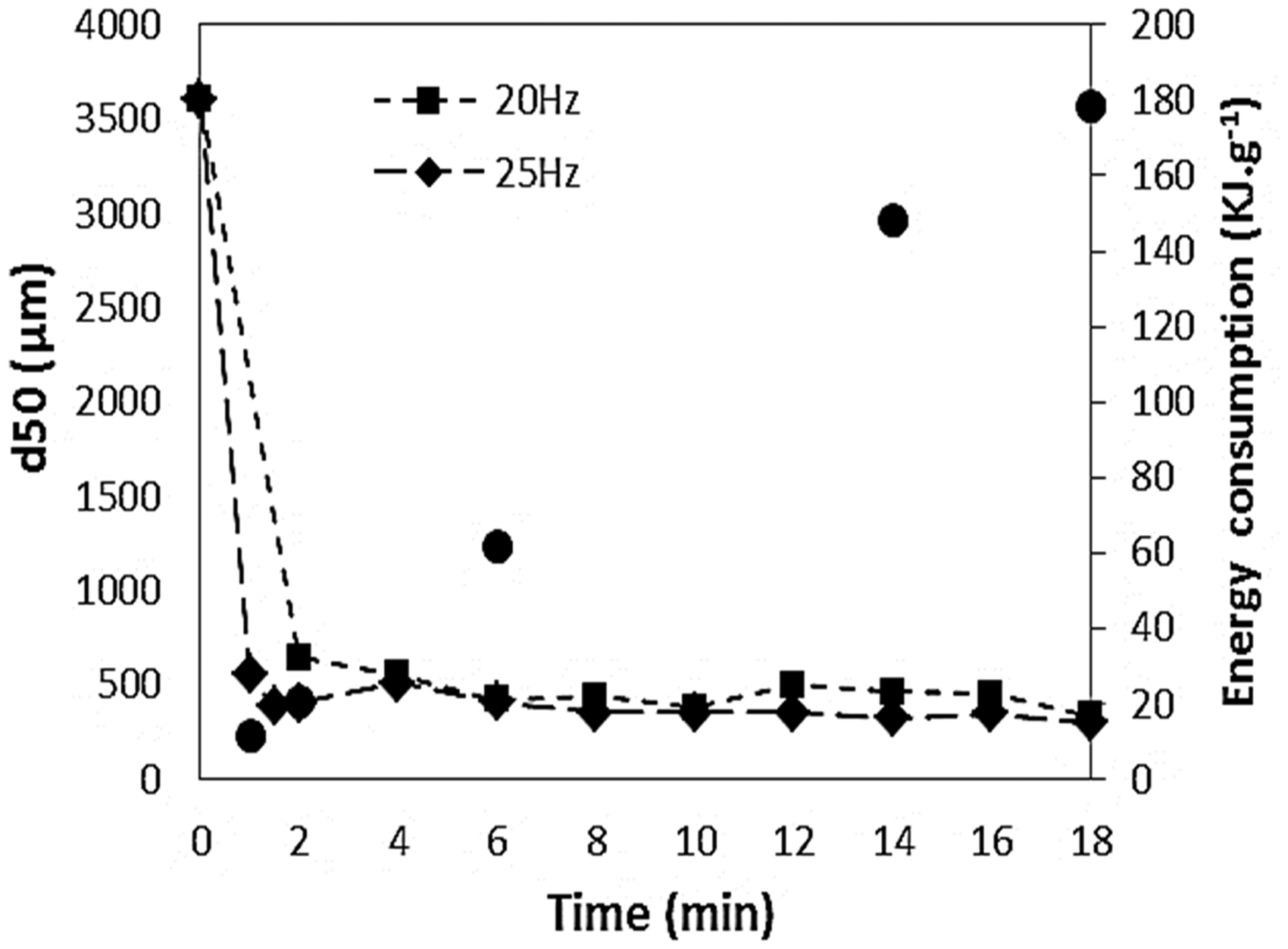
Milling duration is known to be one of the most important parameters in milling of powders. As a general rule, reduction in particle size usually occurs with increasing milling time. However, it is desirable to use the minimum time required to limit the contamination by metallic particles coming from the degradation of stainless steel balls and to decrease the overall energy consumption. Generally, time required to achieve the steady-state conditions is shorter for high-energy mills than for low-energy mills. 24 Therefore, the impact of time (from 1 to 20 min) on the cryo-grinding ability of PHBV pellets has been studied. Each sample was characterized in terms of particle size, molecular weight, and energy consumption.
Figure 1 shows that the cryo-grinding of PHBV during 1.5 min at 25 Hz of frequency results in a median particle size of 381 ± 132 µm, whereas grinding for 2 min leads to a mean size of 399 ± 14 µm. This increase in the median size for 1.5 min of cryo-grinding could be due to the fact that the particle size distribution was not homogeneous, which could be visibly at sight. Grinding below this time (e.g. 1 min) had a minimum effect on particle size reduction, causing only a slight fragmentation of PHBV pellets. After 4 min of cryo-grinding at a frequency of 25 Hz, a slight increment in particle size was observed (511 ± 13 µm). This can be attributed to an agglomeration phenomenon occurring throughout the grinding process, which results from the establishment of interactions between particles with increasing surface areas.
The agglomeration phenomenon was delayed when a lower frequency was used, i.e. 20 Hz, due to a slower particle fragmentation (after 12 min instead of 4 min). SEM micrographs show PHBV particles obtained after 2 and 18 min of cryo-grinding at 25 Hz (Figure 2). It can be noticed that after 2 min of cryo-grinding, PHBV particles display an irregular shape (Figure 2(a)), whereas after 18 min, particles appeared as round and compact agglomerates (Figure 2(c)). These findings are consistent with results discussed above concluding that the agglomeration phenomenon occurred after 18 min of grinding.
Scanning electron micrographs of cryo-ground PHBV using one iron ball (25 mm) at 25 Hz: during (a,b) 2 min and (c,d) 18 min. The white bar represents (a,c) 300 µm and (b,d) 3 µm.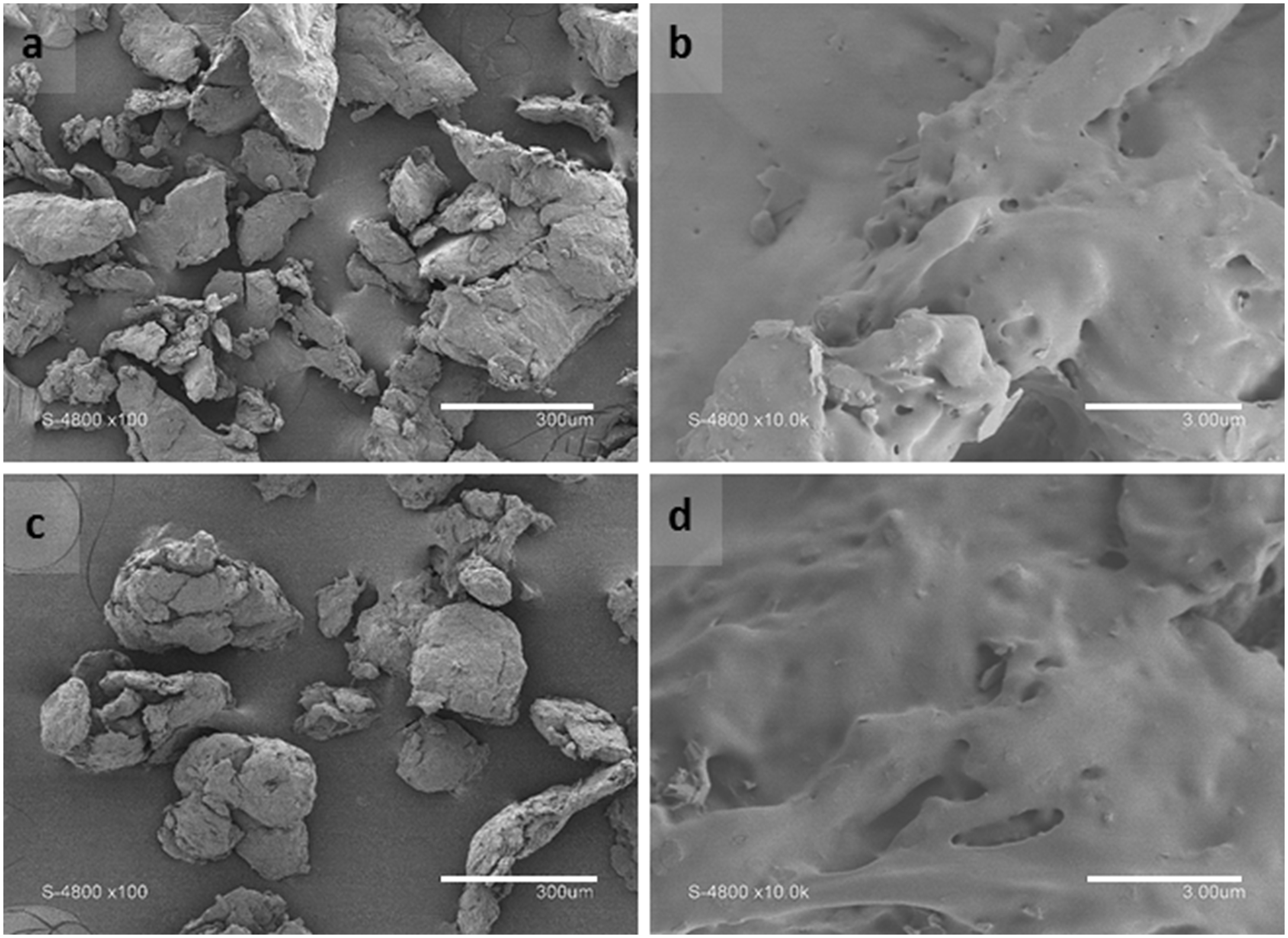
Weight- and number-average molecular weight (Mw and Mn, respectively) and polydispersity index (PDI) during PHBV processing.

Typical variation coefficient is from 1 to 2%.
PHBV virgin.
PHBV cryo-ground at 2 and 18 min.
PHBV/20% WS co-ground at 5, 25, and 40 min.
Film of PHBV ground alone for same conditions of co-grinding.
PHBV/20% WS film made by co-grinding for 40 min.
Thermal parameters of PHBV processing and PHBV/WSF composites.

PHBV virgin.
HBV cryo-ground for 2 min at 25 Hz.
PHBV/20% WSF co-ground at 5, 25, and 40 min.
Film of PHBV ground alone for same conditions of co-grinding.
PHBV/20% WSF film made by co-grinding for 40 min.
Tc: crystallization temperature; ΔHc: associated heat of crystallization; Tm: melting temperature; ΔHm: associated heat of fusion; Xc: crystallinity degree.
All together, we showed that temperature and grinding time were the key parameters affecting the PHBV milling. The best conditions for the PHBV grinding were the use of a high-energy vibrated ball mill under cryogenic conditions, one stainless steel ball (25-mm diameter), 2 min, and 25 Hz of frequency.
Co-grinding of PHBV and WSF
To improve the interfacial affinity between PHBV and WSF, a mechanical alloying method by co-grinding was used. For that purpose, PHBV in the form of powder (cryo-ground under the conditions previously described, d50 of 399 ± 14 µm) was mixed with 20 wt% of WSF (d50 of 223 ± 12 µm) and co-ground in a high-energy vibrated ball mill during 5, 25, or 40 min at 25 Hz. The evolution of the particle size distribution, molecular weight, and thermal properties during the co-grinding process was evaluated to understand mechanisms involved during co-grinding.
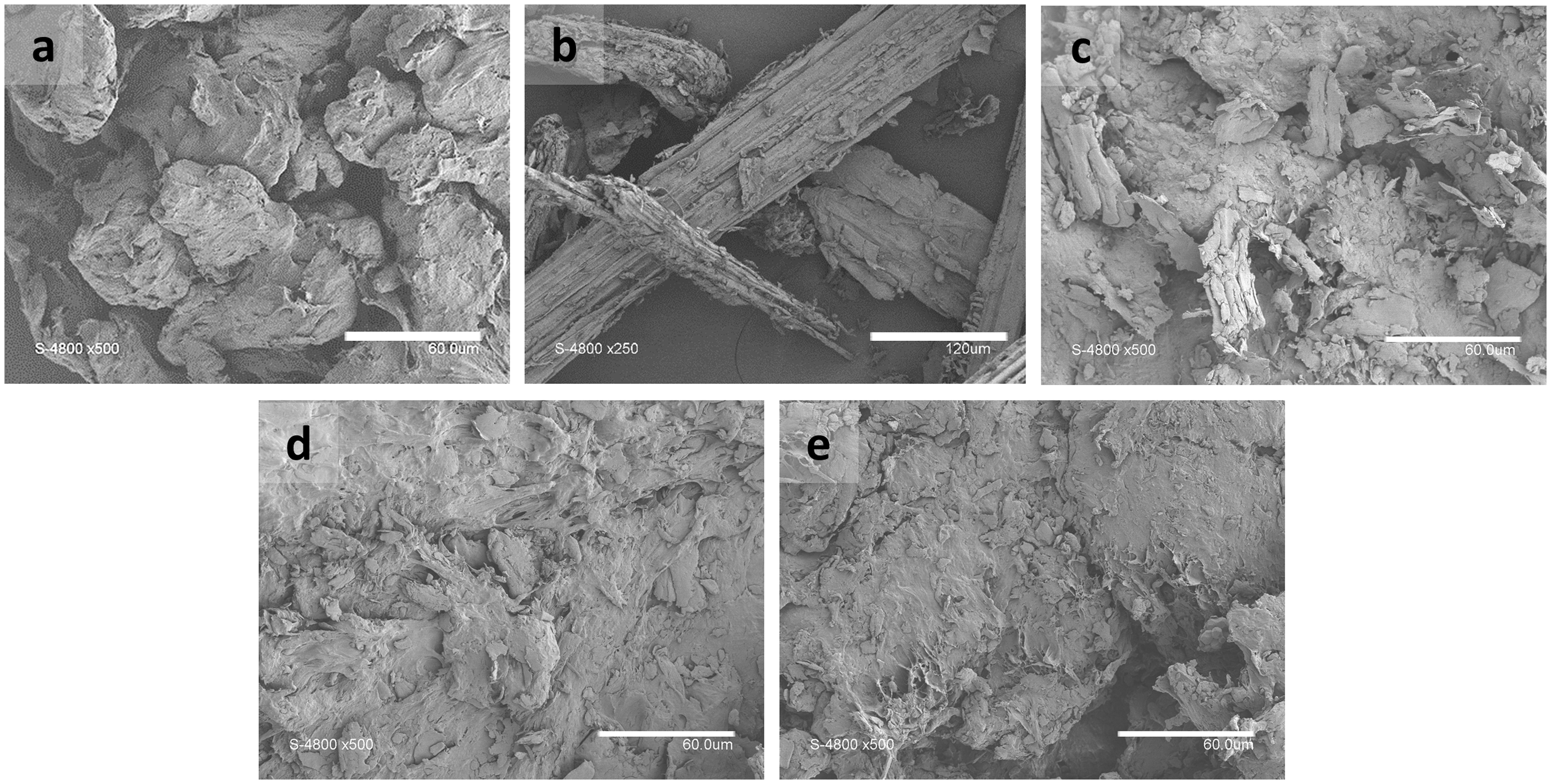
Figure 3 displays the evolution of the size distribution of PHBV/WSF co-ground particles upon time. A displacement of the size distribution of PHBV/WSF co-ground particles toward larger particle sizes is noticed that after 5 min of co-grinding, which could be attributed to the previously mentioned agglomeration phenomenon, as observed on SEM pictures displaying WSF particles stuck on PHBV particles (Figure 4(c)). As co-grinding proceeds, the agglomeration phenomenon becomes more evident. Because the temperature increases during co-grinding, ground particles tend to agglomerate more easily due to the sticky behavior of PHBV. Fragmentation of wheat straw occurs faster than PHBV. As a result, the wheat straw fragments can adhere to the polymer particles and undergo in their turn a fragmentation. Consequently, wheat straw particles agglomerate on the free faces of the PHBV particles, thus, slowing down its agglomeration while following with its fragmentation. These phenomena might explain the appearance of two size populations at 25 min of co-grinding. Likewise, after 40 min of co-grinding, the size of PHBV/WSF aggregated particles decreases as a consequence of the fragmentation phenomenon. SEM observations showed that after 40 min of co-grinding, WSF particles were dispersed into the matrix (Figure 4(d)), with an improved dispersion state as the co-grinding time increased (Figure 4(e)).
Particle size distribution of PHBV/WSF composites during co-grinding at 5, 25, and 40 min. SEM micrographs of PHBV after cryo-grinding 18 min at 25 Hz (a); wheat straw fibers after fist grinding process (b); co-ground PHBV/WSF composites using one stainless steel (25 mm) at 25 Hz during 5 min (c); 25 min (d); and 40 min (e). The white bar represents (a,c–e) 60 µm and (b) 120 µm.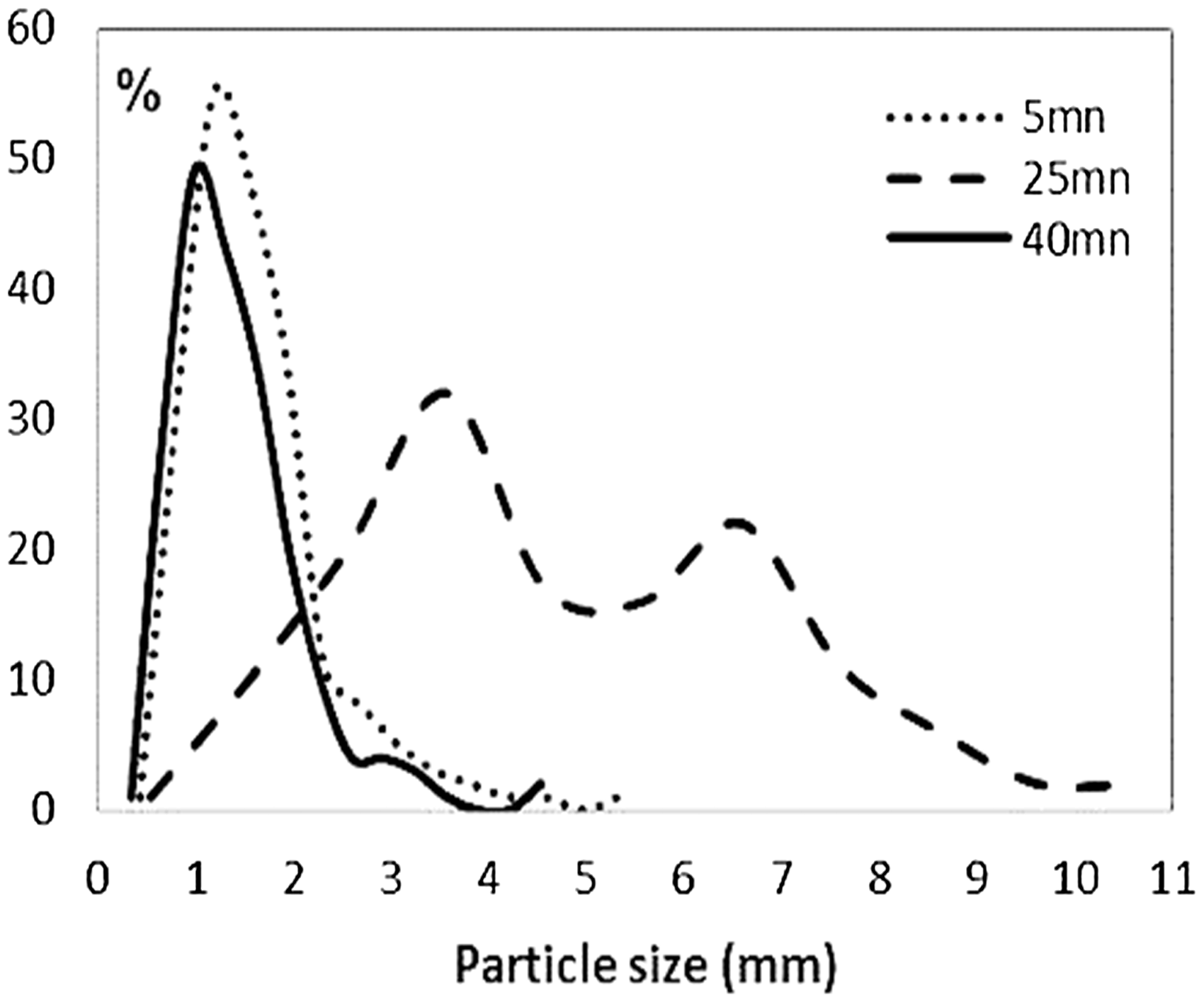
The effect of co-grinding on the molecular weight of PHBV is presented in Table 2. It is observed that the molecular weight decreases along with co-grinding time. After 25 min of co-grinding, the molecular weight of PHBV was decreased almost in half (234,300 Da) when compared with raw PHBV pellets (438,300 Da), whereas the molecular weight of PHBV after 40 min of co-grinding decreased around 66% (147,300 Da). As mentioned before, some factors, such as mechanical shear and fracture of polymer particles, could induce chains scission, which could be accompanied by decrease in molecular weight. 27 In addition, PHBV is well known for its sensitivity to thermal treatment leading to degradation reactions. The main degradation of PHBV is produced for an intramolecular cis-elimination, which causes random chain scission, leading to an extreme reduction of the polymer molecular weight and the formation of a new acid end.28,29 This reaction can be induced by wheat straw degradation products such as water, alcohols, 30 and carboxylates. 31 In this study, the decrease in the molecular weight was a result of the local increase temperature during co-grinding process leading to degradation reactions on the PHBV.
In summary, during co-grinding of PHBV and WSF, a competition between fragmentation and agglomeration occurs and a composite material is produced. At 40 min of co-grinding, WSF were well dispersed within the matrix, which might have a positive effect on mechanical properties. Thus, based on SEM observations (Figure 4), the co-grinding material during 40 min was selected to prepare a composite film whose properties will be discussed below.
Processing/structure/mechanical properties relationships of co-ground PHBV/WSF composites
Typical stress vs. strain curves of the PHBV/WSF composite materials are shown in Figure 5. All materials, either unfilled or filled, showed similar rigid and fragile behavior.
Typical stress vs. strain curves of PHBV materials. PHBV cryo-ground for 2 min; PHBV further ground alone for 40 min; PHBV/WSF composites filled with 20% WSF co-ground for 40 min.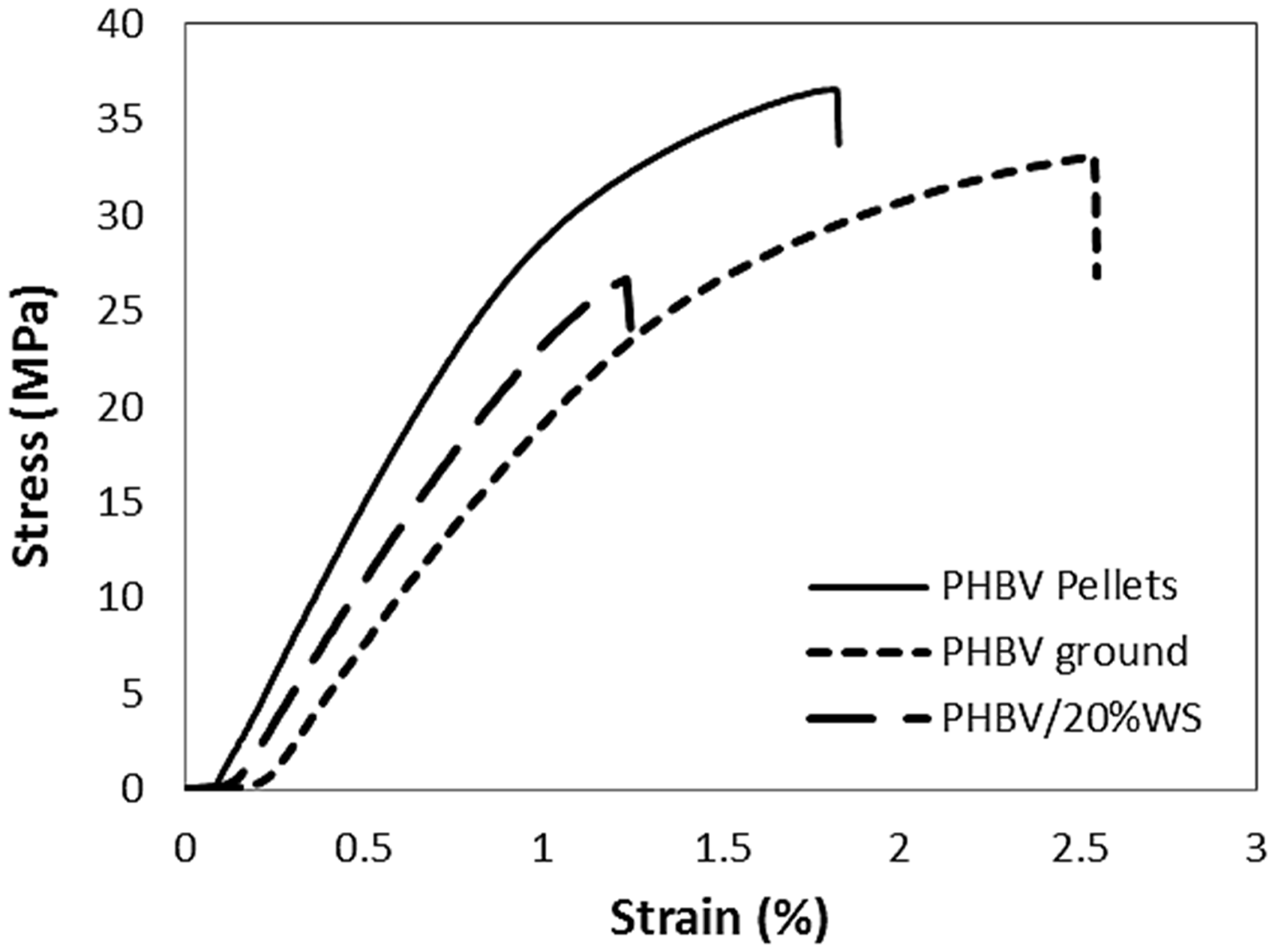
Tensile properties of PHBV materials.

Stress at break (σ), strain at break (ɛ), and the Young’s modulus (E).
PHBV pellet.
PHBV/20% WSF composite made by extrusion from Berthet et al. 4
Film of PHBV ground alone for 40 min (25 Hz).
PHBV/20% WSF film made by co-grinding for 40 min.
According to previous literature,10,12,14 the principal purpose of co-grinding process is to enhance the tensile properties of composites by (a) reducing the size of the filler, which makes possible to improve the dispersion within the matrix; and (b) modifying the interactions between the matrix and the filler, which improves the interfacial compatibility between components. These two aspects will be discussed below.
Figure 6 shows the SEM micrographs of the cryo-fractured cross-sections of both the PHBV matrix (cryo-ground) and PHBV/WSF composite film. Two different magnifications were used to display the filler dispersion and interfacial adhesion. It can be noticed that the cross-section of the neat PHBV film is rather smooth and presents some white marks ascribed to the inorganic crystals used as nucleating agent (Figure 6(a) and (b)).
21
Micrographs of PHBV/WSF composite material showed rough fractured surfaces due to the presence of WSF. The dispersion of WSF into the PHBV matrix was homogeneous, with no evidence of debonding or pull-out mechanism. The co-grinding process reduced the particle size of the wheat straw enhancing the dispersion within the PHBV matrix (Figure 6(c) and (d)). Nevertheless, interfacial gaps or microvoids between the matrix and the fibers were observed on the composite (Figure 6(c) and (d)), meaning a poor affinity between both components. The presence of such defects may cause a poor load transfer from the continuous polymer phase to the dispersed fibers,
5
limiting the reinforcing effect on the composite. Similar behavior on the PHBV matrix has been observed by Martino et al.,
21
Berthet et al.,3,4 and Wolf et al.
32
when WSF were added as a filler.
Scanning electron micrographs of cryo-fractured cross-sections of PHBV films: PHBV matrix cryo-ground (a,b) and PHBV/WSF composites (c,d). The white bar represents (a,b) 75 µm and (b,d) 30 µm.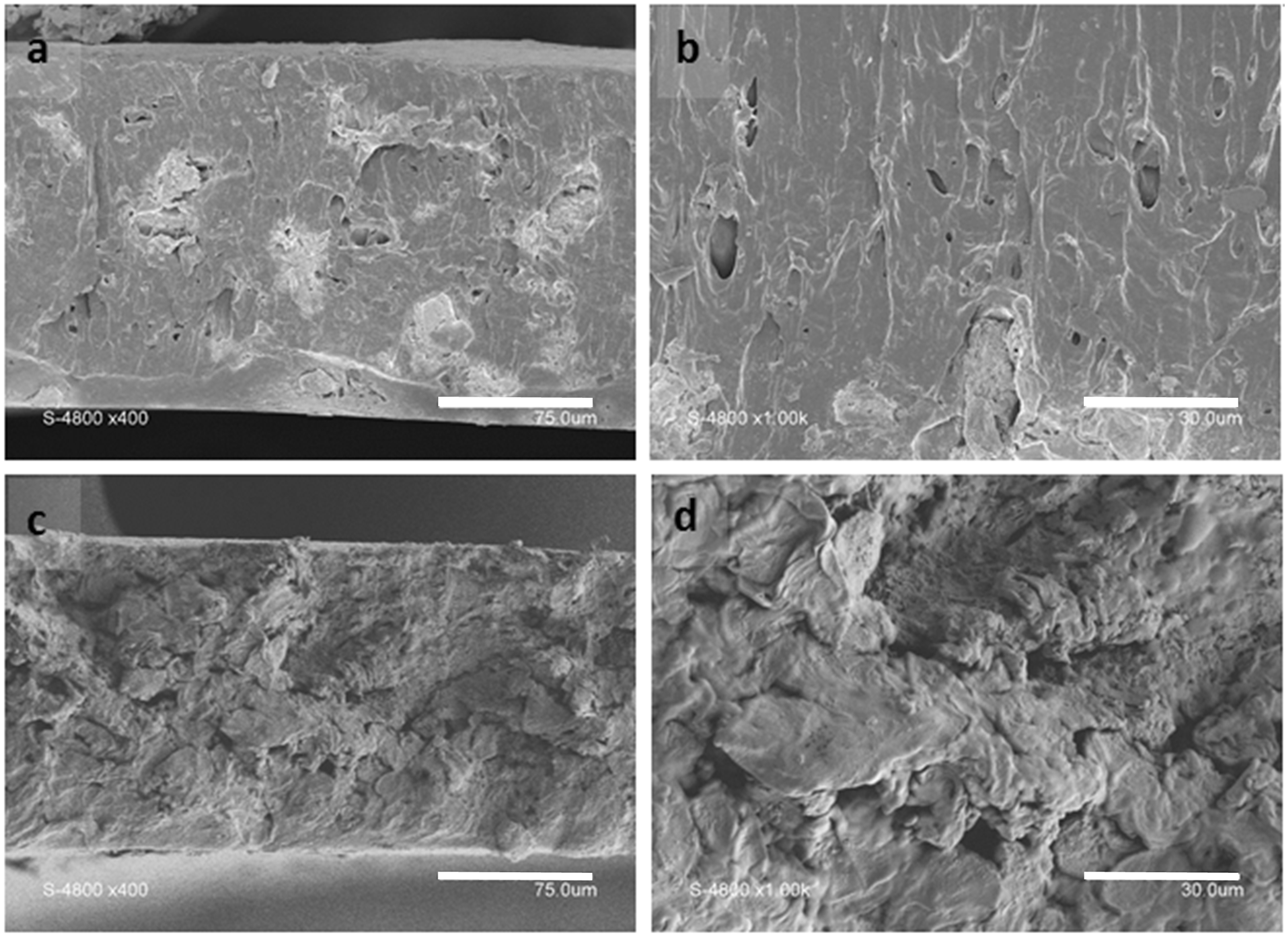
It has been demonstrated that ultimate mechanical properties not only depend on the fibers size, the aspect ratio, and the adhesion between fiber and matrix, but also on the polymer chain length and morphology and crystalline structure.33–35 Thus, it is worth noting that the hindrance of reinforcement effect could also be attributed to structural changes at the molecular level. The evolution of the PHBV molecular weight in the PHBV/WSF composite film was assessed by GPC to investigate the effect of thermoforming on mechanical properties. The molecular weight of the PHBV/WSF composite film slightly decreased after thermoforming process (147,300 Da) in comparison with the co-ground composite material during 40 min (141,600 Da). The degradation of PHBV polymer chains occurring during thermomechanical processes has been previously reported by Leroy et al. 28 According to Avella et al., 8 carboxyl end-groups bonded to cellulose in lignocellulosic fibers could attack the inner ester groups of PHBV, yielding random scission reactions. As a consequence, during processing, a decrease of PHBV molecular weight could occur with a decrease of mechanical strength and thermal resistance of the polymer.
DSC measurements were performed to characterize the thermal behavior and the crystallinity of PHBV/WSF composites (Table 3). All the thermal parameters were affected by the presence of WSF in the PHBV matrix. A decrease in the melting temperature (Tm) of the co-ground PHBV/WSF composites as compared with virgin PHBV (pellets) was noticed, which might be attributed to the previously reported decrease in polymer molecular weight. In addition, the presence of WSF seemed to induce crystals defects and/or reduce crystallite sizes, which led to lower melting temperature in relation to the PHBV matrix.36,37 Same behavior of melting temperature decreased was observed in the PHBV/WSF composites as the co-grinding time increased. Less perfect crystals, which are less stable from a thermodynamic point of view, melt at lower temperature than more perfect crystals. 2 The crystallization temperature (Tc) was also reduced when WSF were added to the PHBV matrix. This findings suggests that the presence of WSF slowed down the crystallization of PHBV as a consequence of the impediment of chain mobility. 4
The presence of WSF in the co-ground composite noticeably decreased the crystallinity degree (Xc 46% at 5 min of co-grinding) when compared with the PHBV cryo-ground (62%). Nevertheless, crystallinity degree of PHBV slightly increases after 40 min of co-grinding until Xc = 50% and even increased more after thermoforming until Xc = 52% (Table 3). This behavior can be explained for a possible reorganization in the crystalline areas of the composite during co-grinding and thermoforming, leading to more perfect and stable crystals.
In summary, these results demonstrate that (a) the poor interfacial compatibility between WSF and PHBV and (b) the molecular weight degradation of PHBV during processing are key factors that limit the reinforcing effect. Nevertheless, when comparing our results with those of Berthet et al. 4 obtained on similar biocomposites processed by melt extrusion in a twin-screw extruder, it can be noticed that the use of co-grinding permits to limit the degradation of mechanical properties of PHBV (Table 4).
Conclusions
A composite material based on PHBV as the polymer matrix and WSF as fillers was produced by co-grinding using a high-energy vibrated ball mill. The grinding behavior of PHBV pellets under different conditions was first studied focusing on the morphology and degradation of the polymer. Owing to the crystallinity and the glass transition temperature of PHBV, efficient grinding efficiency of PHBV was only possible under cryogenic conditions. In a second step, cryo-ground PHBV and WSF were co-ground in a high-energy vibrated ball mill to produce a composite material. Presenting only the results for three co-grinding times could be too poor to conclude on co-grinding mechanisms. However, this study allowed to show that the reinforcing effect of WSF was quite limited, as revealed by the decrease of both the strain and stress at break but an increase of the Young’s modulus. This was attributed to thermal degradation of PHBV upon processing, as well as to a still poor fiber/matrix interfacial adhesion. It is important to highlight that the degradation of ultimate tensile properties was limited in the case of composites produced by co-grinding as compared with composites classically prepared by twin-screw extrusion, due to an improvement of the dispersion of fibers within the polymer matrix.
Footnotes
Acknowledgements
This work was carried out in the framework of the Ecoefficient Biodegradable Composite Advanced Packaging (EcoBioCAP) project.
Declaration of Conflicting Interests
The author(s) declared no potential conflicts of interest with respect to the research, authorship, and/or publication of this article.
Funding
The author(s) disclosed receipt of the following financial support for the research, authorship, and/or publication of this article: The European Commission through the Seventh Framework for Research & Technological Development (FP7/2011-2015) (Grant Agreement FP7-265669); the National Council of Science and Technology (CONACyT; Grant Number 232435) and the European Union Latin America Academic Links (EULALinks; Grant number EULA1200264).