






Abstract
Herein, poly(3,4-ethylenedioxythiophene):poly(4-styrenesulfonate) (PEDOT:PSS)/silicon dioxide nanoparticles (SiO2-NPs) composite films were prepared via a simple method by direct vacuum filtration technique. The effect of SiO2-NPs contents on the thermoelectric performance of PEDOT:PSS was investigated systematically. PEDOT:PSS nanofilm without SiO2-NPs exhibited a maximum electrical conductivity of 1487 S cm−1 and a Seebeck coefficient of 17.4 µV/K. When the SiO2-NPs were introduced, the Seebeck coefficient of PEDOT:PSS/SiO2-NPs nanocomposite films increased to a peak value of 24.2 µV/K at 20 wt% SiO2-NPs, and the corresponding electrical conductivity was 1132 S/cm. Although a compromise in electrical conductivity, a large optimized power factor up to be 66.29 µW/m K2 was achieved due to the contribution of improved Seebeck coefficient. The presence of SiO2-NPs in the composite films with small-size structure and abundant grain boundaries may cause the carrier scattering and filtering effect, which accounts for the enhanced Seebeck coefficient.
Introduction
Thermoelectric (TE) materials, whose ability is directly converting heat into clean electricity by harvesting abundant solar, geothermal and discarded fossil-fueled heat, will provide a sustained supply of energy and play an important role in facing the energy challenge of the future.1–3 The energy conversion efficiency of TE materials is determined by four parameters, the electrical conductivity (σ), the Seebeck coefficient (S), the absolute temperature (T), and the thermal conductivity (κ), and quantified by an equation: ZT = σS2T/κ,4 where ZT is a dimensionless figure-of-merit. Besides, power factor (P, expressed as σS2), also can be used to characterize the material’s ability of translating a temperature difference into electrical power.
Although numerous papers have been published on semiconductors,5–7 conductor oxides 8 and some artificial inorganic TE materials, 9 the wide applications are limited by the expensive raw materials, complicated processing procedure, and poor mechanical property.10–12 Conducting polymer, especially the poly(3,4-ethylenedioxythiophene):poly(4-styrenesulfonate) (PEDOT:PSS) has attracted increasing attention because of the great advantages of abundant resources, excellent mechanical flexibility, and easy processing into various forms.13–17 As a TE material, on the one hand, PEDOT:PSS possesses the intrinsically low thermal conductivity of 0.028–0.6 W/m K.18,19 It is orders of magnitude lower than that of inorganic TE materials, which offers an enormous advantage for the application in TE device. On the other hand, to improve the electrical conductivity of PEDOT:PSS, various attempts have been developed to enhance the value, by different film forming methods such as drop-casting, spin-coating, and dilution-filtration,20–23 or the addition of organic solvents or ionic liquid,24,25 post-treatment including dipping and solvent vapor annealing,26–29 and so on. After such continuous efforts, electrical conductivity of PEDOT:PSS can be easily enhanced to ∼103 S/cm in the published paper.23,30,31 However, enhanced electrical conductivity usually results in a decreased Seebeck coefficient due to the strong interdependence between them. 32 In order to achieve an optimized power factor, reasonably controlling between the above two parameters is indispensable. Constructing a polymer/inorganic composite material, such as PEDOT:PSS/graphene,33–35 PEDOT:PSS/SWCNT, 36 PEDOT:PSS/MoS2, 30 and PEDOT:PSS/Bi2Te3 or Bi2Te3-based alloy nano-sheets12,19 has been proved an effective route to obtain an improved power factor due to the synergistic properties arising from the molecular level mixing.
SiO2 nanoparticles (SiO2-NPs) are resourceful, low-cost, and environmentally friendly, and possess the characteristic of small-size, large specific surface areas and abundant boundaries. The introduction of nanoscale constituents with these characteristics mentioned above may contribute to the TE performance of PEDOT:PSS. 37 In addition, as far as we know, effect of SiO2-NPs as an additive on the TE properties of PEDOT:PSS has not been reported. In the present work, a simple method was employed to prepare the PEDOT:PSS/SiO2-NPs nanocomposite films by direct dilution-filtration. Encouragingly, the Seebeck coefficient is improved, resulting in a large optimized power factor up to be 66.29 µW/m K2.
Experimental
Raw materials
PEDOT:PSS aqueous solution (CLEVIOS PH1000) with a concentration of 1.3 wt% was obtained from H. C. Stark. Silicon dioxide (SiO2) nanoparticles with a diameter of 20 nm were purchased from XFNANO INC. DMSO (99%) was purchased from Bodi Chemicals (Tianjin, China).
Fabrication of PEDOT:PSS/SiO2-NPs composite films
In a typical procedure (Scheme 1), PEDOT:PSS aqueous solution and SiO2 nanoparticle were added into a tiny bottle according to the designed mass fraction, following by intense stirring for 24 h and ultrasonic dispersion for 0.5 h. Then a 200 µL above mixed solution was pipetted into a 3.0 mL DMSO with ultrasonic treatment for 0.5 h. Finally the PEDOT:PSS complex solution was directly vacuum filtrated, and then baked under vacuum at 60℃ for 24 h. In addition, the as-prepared nanofilm could be separated completely from the filter paper by soaking in the deionized water. So the PEDOT:PSS/SiO2-NPs nanocomposite films will not be limited to the substrates, which may benefit to the fabrication of TE device.
Measurements and characterizations
A Keithley 2700 Multimeter (Cleveland, OH) and a regulated DC power supply (MCH-303D-II, China) in conjunction with Labview (National Instruments, Austin, TX) was assembled into a four-point probe apparatus, which was used to measure the electrical conductivity and Seebeck coefficient of the samples. Before the testing, PEDOT:PSS/SiO2-NPs films were cut into a rectangular shape and suspended between two TE devices for generating temperature difference. In addition, the temperature difference ΔT of about 5 K was used into the equation S = −(ΔV/ΔT) for Seebeck coefficient measurement, and the film thickness was measured by the scanning electron microscope (SEM) of the cross section for electrical conductivity calculation. For the characterizations, NICOLET 5700 Fourier-transform infrared spectroscopy (FTIR) was used to examine the chemical structure information. Hitachi S-3000 N scanning electron microscopy was used to record the surface morphology of the composite films.
Results and discussion
The surface morphology of PEDOT:PSS/SiO2-NPs nanocomposite films was recorded by SEM with a 10000 times magnification. PEDOT:PSS nanofilm without SiO2-NPs has a smoother surface compared with those of PEDOT:PSS/SiO2-NPs nanocomposite films containing different quality of SiO2-NPs, as shown in Figure 1. When the content of SiO2-NPs increased, the surface of nanocomposite films became rougher with a great number of particles and grain boundaries uniformly distributing on the whole films as shown in Figure 1(b) to (d), and the amount of particles and grain boundaries increased with the content of SiO2-NPs increasing. These changes indicated that SiO2-NPs were covered with PEDOT:PSS on the surface and the PEDOT:PSS/SiO2-NPs nanocomposite films were prepared successfully.
SEM images of PEDOT:PSS/SiO2-NPs nanocomposite films containing different content of SiO2-NPs: 0 wt% SiO2-NPs, (b) 10 wt% SiO2-NPs, (c) 20 wt% SiO2-NPs and (d) 40 wt% SiO2-NPs.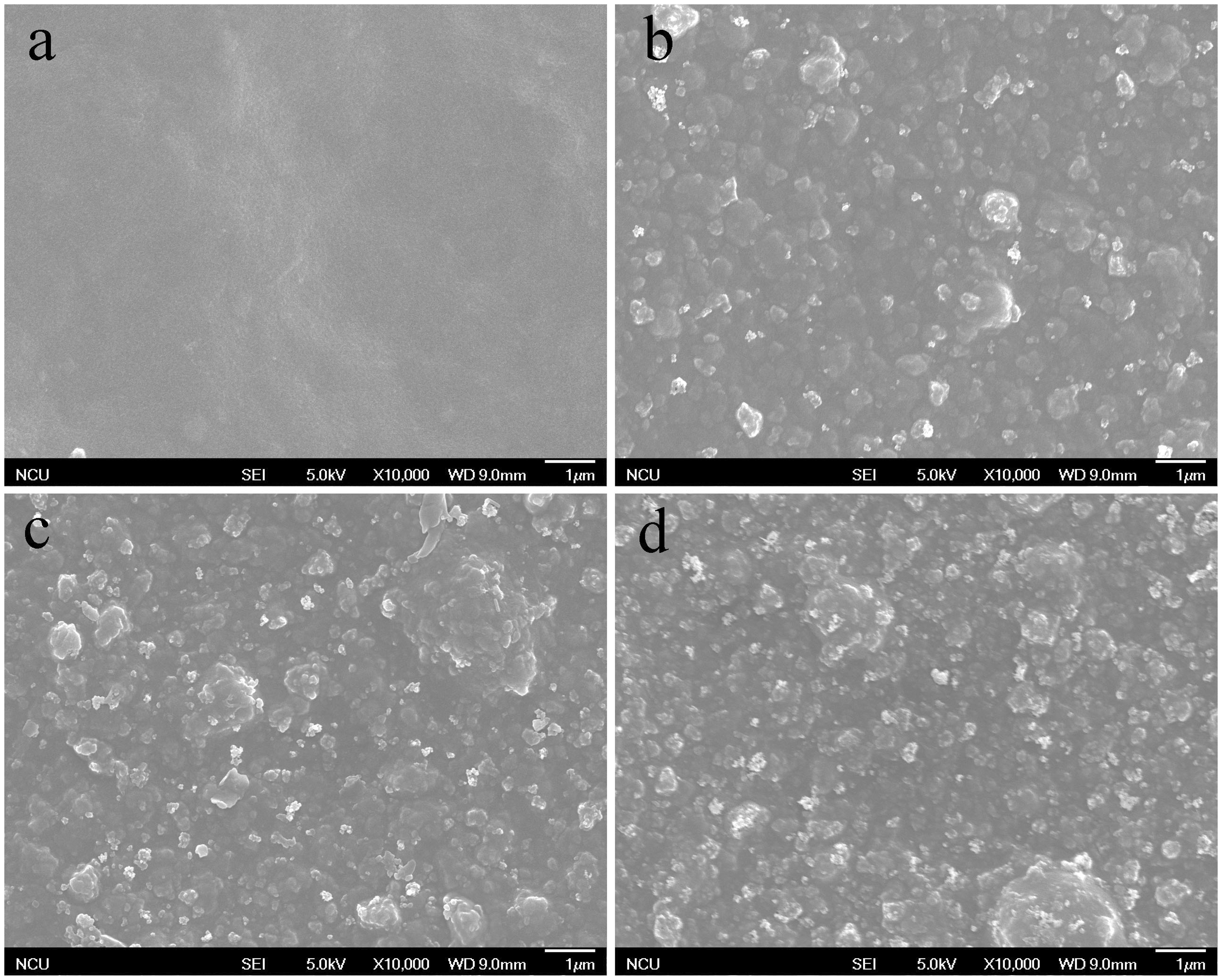
The chemical structures of SiO2-NPs, pure PEDOT:PSS nanofilm and PEDOT:PSS/SiO2-NPs nanocomposite films were investigated by FTIR spectroscopy in the range 1800–600 cm−1, and the results are shown in Figure 2. As seen in the spectrum of SiO2-NPs (Figure 2(a)), the intense silicon–oxygen covalent bonds vibrations appear mainly in the 1250–1000 cm−1 range. The broad absorption peak at 1101 cm−1 and a shoulder at about 1200 cm−1 are assigned to the asymmetrical stretching vibration of Si–O–Si bond, and the symmetric stretching vibration appears at 801 cm−1.
38
Furthermore, the absorption peak at about 960 cm−1 is assigned to the Si–O in-plane stretching vibration.
39
The band at 1634 cm−1 is attributed to the deformation vibration of H–O–H,
40
which derives from the litter water adsorbed by the SiO2-NPs due to its large specific surface area. In the spectrum of pure PEDOT:PSS film (Figure 2(b)), several characteristic peaks were uncovered. The absorption peak at 1532 cm−1, 1258 cm−1, and 1159 cm−1 are attributed to the benzenoid rings of the PSS, asymmetric and symmetric vibrations of SO3 groups in PSS chains, respectively.41,42 The band at 1092 cm−1 can be attributed to the stretching of the ethylenedioxy groups.
43
The band at 1640 cm−1, 1461 cm−1 and around 1386 cm−1 could be assigned to the skeletal vibration of C=C in the aromatic ring.
44
In Figure 2(c), the composite films clearly displayed all the characteristic bands of PEDOT:PSS, confirming that the addition of SiO2-NPs did not affect the chemical structure of PEDOT:PSS. Few absorption peaks of SiO2 have been observed in the spectrum of composite materials, which can be ascribed to that its absorption peaks are covered by the vibration absorptions of PEDOT:PSS.
FT-IR spectra of (a) SiO2-NPs (b) PEDOT:PSS nanofilm and (c) PEDOT:PSS/SiO2-NPs nanocomposite films containing 20 wt% SiO2-NPs.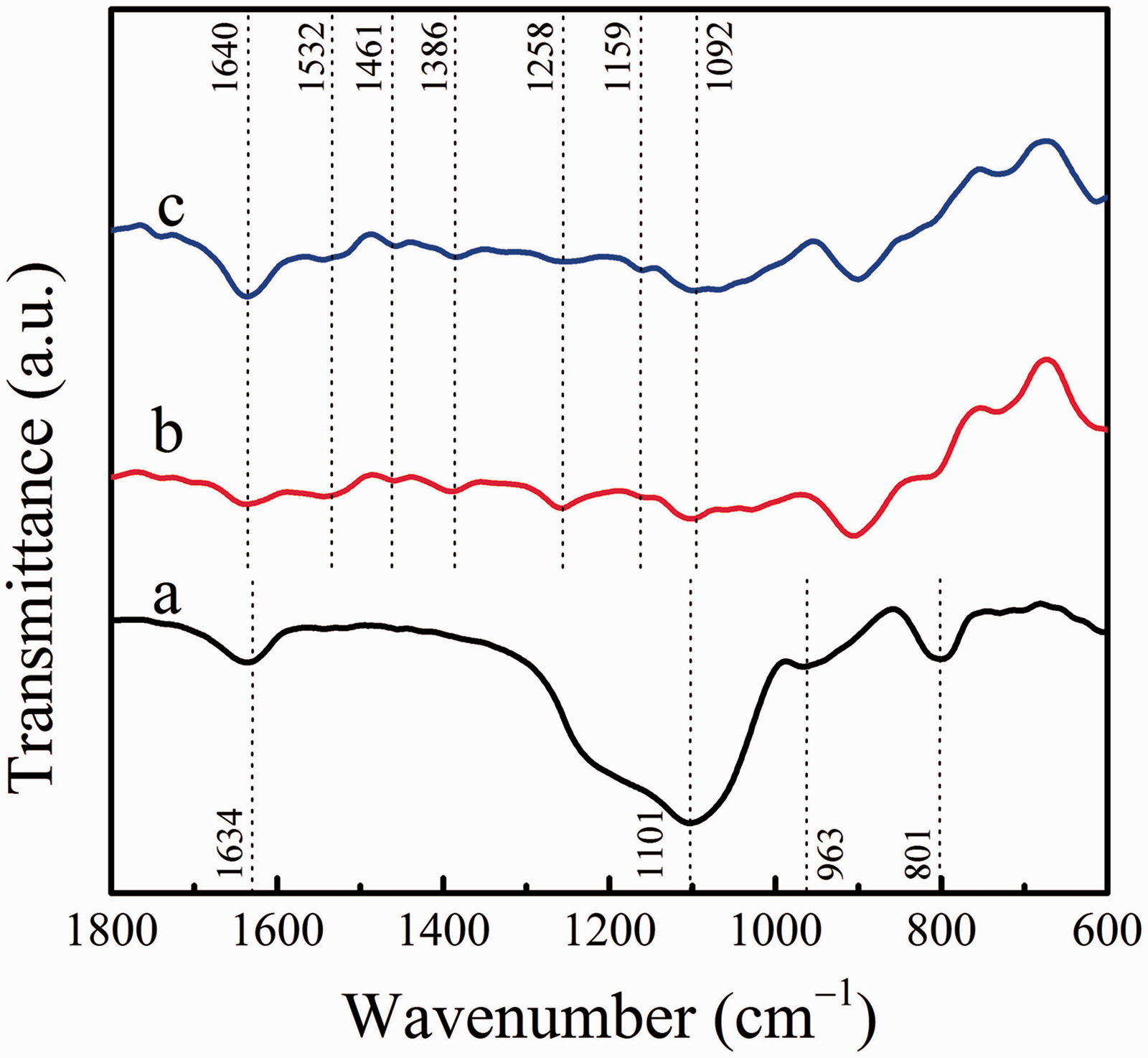
Room-temperature electrical conductivity and Seebeck coefficient of the PEDOT:PSS/SiO2-NPs composite films as a function of SiO2-NPs content have been presented in Figure 3. As can be seen, the electrical conductivity of PEDOT:PSS nanofilm without SiO2-NPs possesses a maximum value of 1487 S/cm and the corresponding Seebeck coefficient of 17.4 µV/K, which approaching to the values given by Xiong et al.
23
When the content of SiO2-NPs increases from 0 to 40 wt%, the electrical conductivity shows a decreasing tendency, reaching the value of 867 S/cm at 40 wt% SiO2-NPs content. It could be attributed to the existence of insulating SiO2-NPs, which influences the conductive network of PEDOT:PSS by hindering the transmission of some carriers. On the other hand, the Seebeck coefficient firstly increases with the amount of SiO2-NPs increasing and then slightly drops when further increasing the SiO2-NPs content, resulting in a value of 24.2 µV/K at 20 wt% SiO2-NPs content. The observed changes may be ascribed to the addition of SiO2-NPs with the features of particle size in nanometer level and abundant grain boundaries. In a TE material, Seebeck coefficient is an intrinsic electron transport property and determined by the charge diffusion which is driven by entropy difference between the hot end and cold end. Under a temperature gradient, carrier diffusion within a heterogeneous conductive network could be described by a hopping mechanism. When SiO2-NPs was added into PEDOT:PSS aqueous solution, the nanocomposite films with higher surface roughness were formed, which lead to charge carrier filtering effect and strong carrier scattering.3,12,37,45,46 As a result, the Seebeck coefficient is enhanced eventually.
Room-temperature electrical conductivity and Seebeck coefficient of PEDOT:PSS/SiO2-NPs nanocomposite films.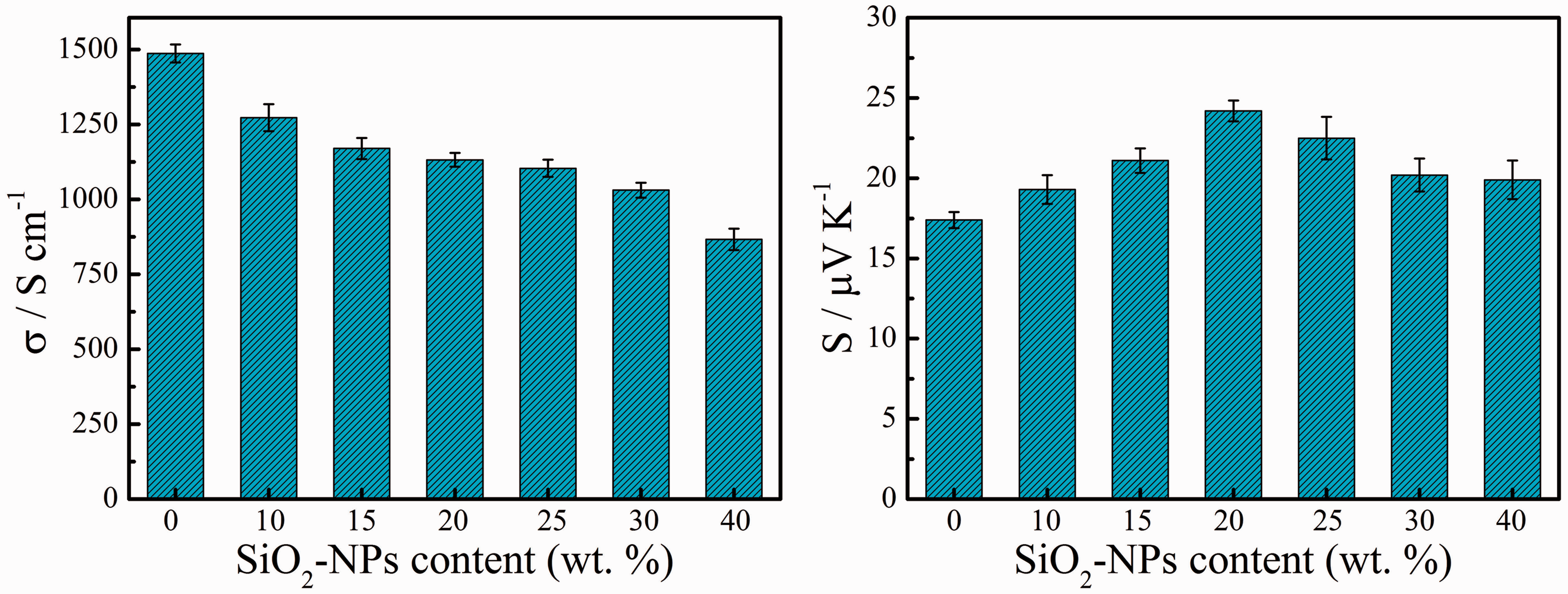
The power factors of PEDOT:PSS/SiO2-NPs nanocomposite films were calculated and shown in Figure 4. Thermoelectric power factor shows a similar trend as the Seebeck coefficient, which firstly increases with the increasing SiO2-NPs content and then decreases when further increasing the SiO2-NPs content. As observed, although the electrical conductivity always drops, the corresponding Seebeck coefficient has a peak value at 20 wt% SiO2-NPs content, wherein achieving an optimized maximum power factor value of 66.29 µW/m K2, which is higher than that of PEDOT:PSS nanofilm without SiO2-NPs (45.02 µW/m K2). The improved power factor of PEDOT:PSS/SiO2-NPs can be attributed to that the contribution of Seebeck coefficient overwhelmed the reduction of electrical conductivity.
The calculated power factor of PEDOT:PSS/SiO2-NPs nanocomposite films.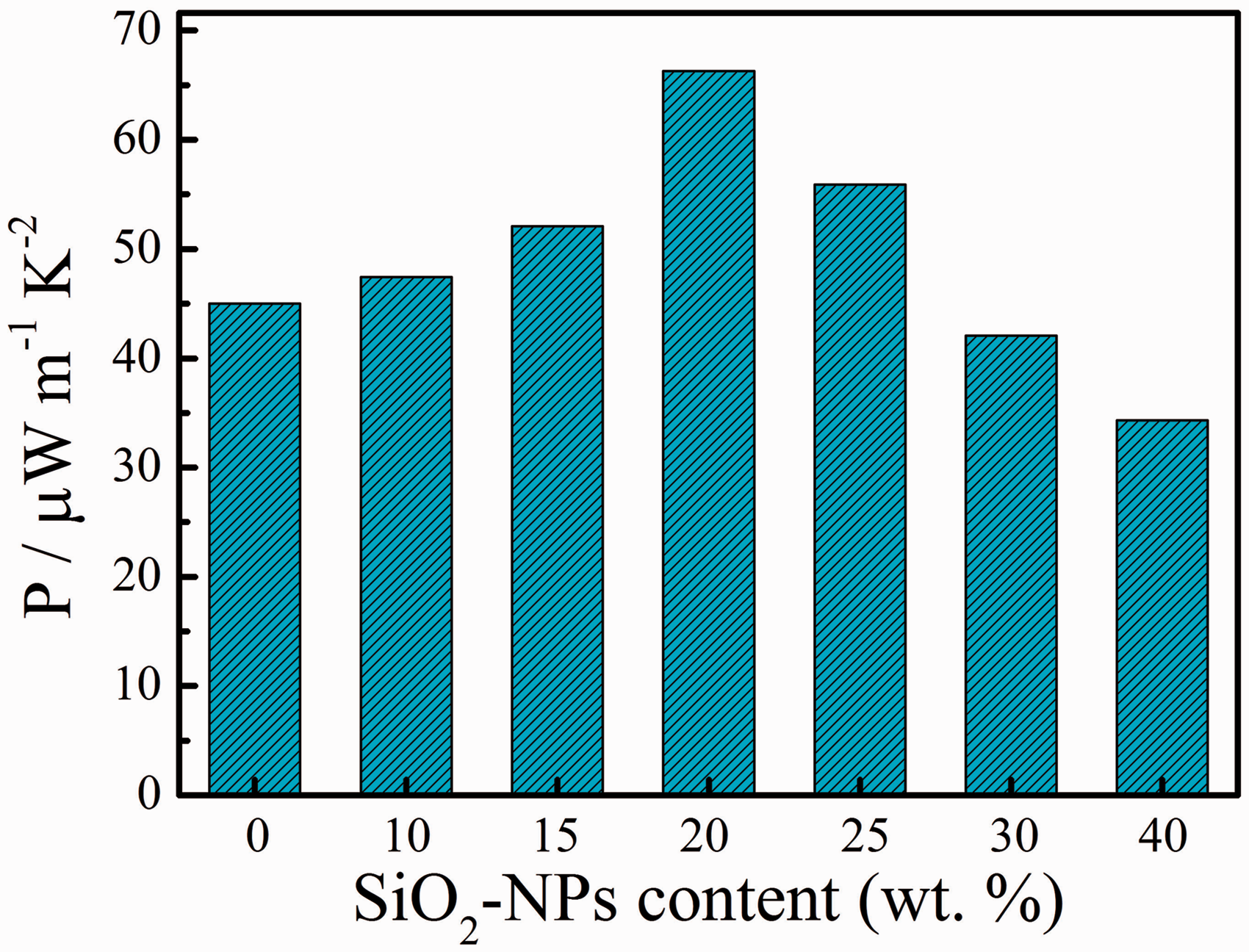
Conclusions
The PEDOT:PSS/SiO2-NPs nanocomposite films have been fabricated successfully by direct dilution-filtration and their TE performance has been investigated. PEDOT:PSS nanofilm containing 0 wt% SiO2-NPs exhibited a notable electrical conductivity of 1487 S/cm and a Seebeck coefficient of 17.4 µV/K. As the SiO2-NPs content increased, the Seebeck coefficient of PEDOT:PSS/SiO2-NPs nanocomposite films was enhanced and reached a peak value of 24.2 µV/K at 20 wt% SiO2-NPs. Although the electrical conductivity suffered a sacrifice, a large optimized power factor up to be 66.29 µW/m K2 was achieved due to the contribution of improved Seebeck coefficient. The improved TE properties were attributed to that the addition of SiO2-NPs generated a higher surface roughness, which may cause the charge carriers filter effect and carrier scattering. Our results have demonstrated that to fabricate PEDOT:PSS/SiO2-NPs nanocomposite films is feasible and effective for the TE improvement of PEDOT:PSS.
Schematic illustration of the preparation of PEDOT:PSS/SiO2-NPs nanocomposite films.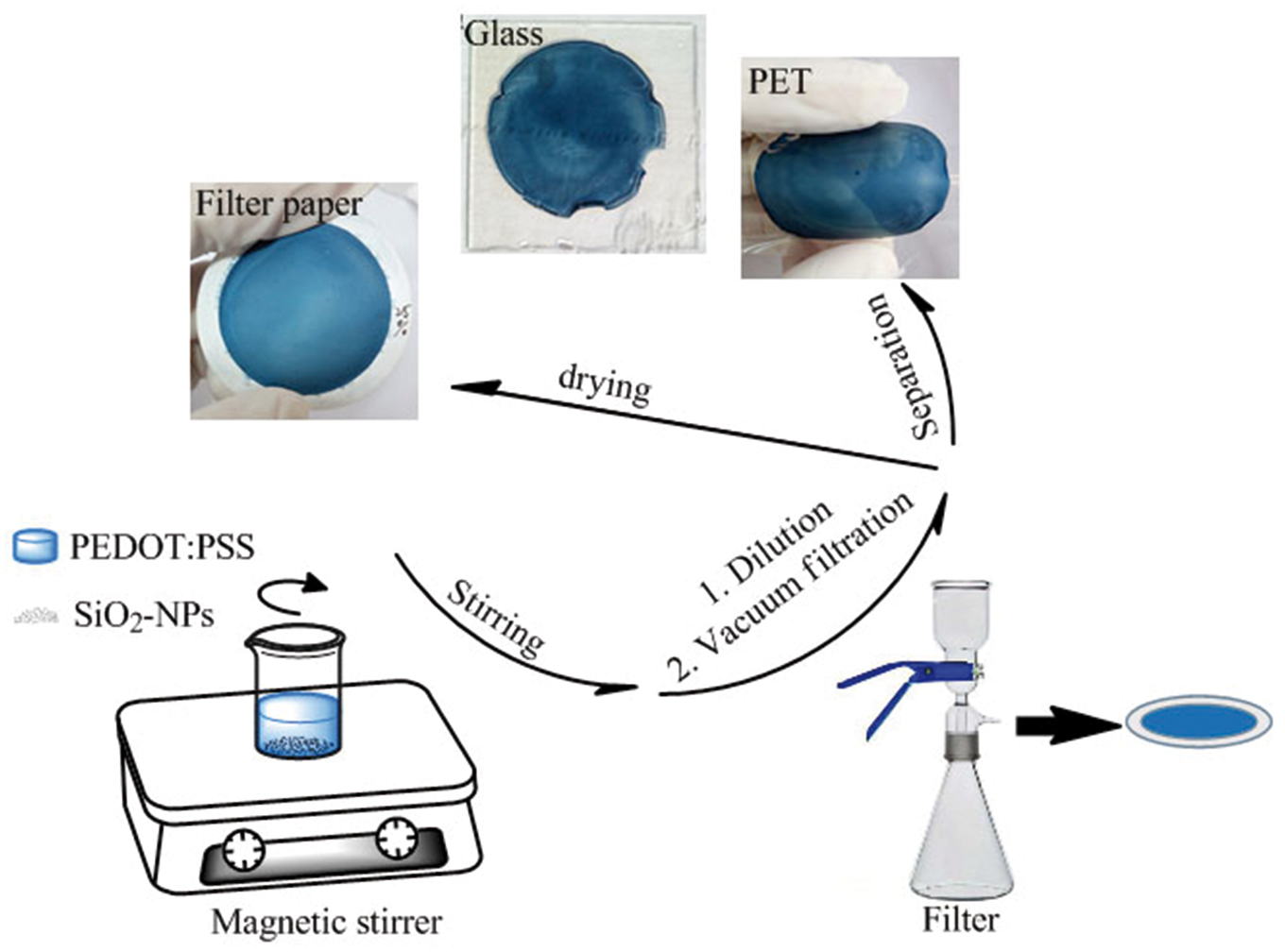
Footnotes
Acknowledgement
Endou Liu and Congcong Liu contributed equally to this work.
Declaration of Conflicting Interests
The author(s) declared no potential conflicts of interest with respect to the research, authorship, and/or publication of this article.
Funding
The author(s) disclosed receipt of the following financial support for the research, authorship, and/or publication of this article: This work was supported by the National Natural Science Foundation of China (51463008, 51402134, 51572117), the Natural Science Foundation of Jiangxi Province (20142BAB216032, 20142BAB216029, 20161BAB216129), the Ganpo Outstanding Talents 555 projects, the Postgraduate Innovation Project of Jiangxi Province (YC2015-S391).