






Abstract
Currently, graphene is used in aluminum matrix composite manufacturing due to its superior mechanical properties. However, few detailed studies exist on the effect of the process conditions such as sintering temperature (TS), time (tS), and a number of graphene nanoplatelets. Therefore, the effects of different sintering times (tS = 60, 120, 180, 300 min), sintering temperatures (TS = 550, 600, 630℃), and graphene addition (0.1, 0.3, 0.5 wt%) on apparent density and hardness were reported in detail in this study. The crystal structure and microstructure of fabricated composites by powder metallurgy method were examined with X-ray diffractometer and scanning electron microscopy. Apparent density and mechanical properties were tested by density meter and micro Vickers hardness tester. The results indicated that the best sintering time, sintering temperature, and graphene addition were determined to be 180 min, 630℃, and 0.1 wt%, respectively, for the best hardness of composite. The hardness of composite increased from 38 to 57 HV when compared with pure aluminum under the best process conditions.
Introduction
Aluminum and its alloys are used very frequently in the electronic, automotive, aeronautical, and aerospace industries due to their important performance and traits including high ductility, good workability, good electrical and thermal conductivity, high strength-to-weight ratio, and superior corrosion strength. Aluminum and its alloys in the application needs greater mechanical properties, thermal conductivities, wear resistance, and corrosion resistance. The composite form of aluminum reinforced with ceramic particulate and fibers is not enough to solve these problems. Thus, some unique approaches are required to increase strengthening aluminum and its alloys.1–3 Over the last two decades, there has been a high demand for improving the strength of aluminum and its alloys. 3 Hence, aluminum-based metal matrix composites with nanoparticles have attracted many researchers. Carbon-based materials like carbon nanotubes, graphite, and graphene nanoplatelets (GNPs) have been among the extensively researched materials due to their superior mechanical, 4 electrical, 5 thermal properties, 6 and tribological behaviors.7,8 Graphene is the most preferred material among carbon-based materials due to its extraordinary properties.
Graphene is a two-dimensional material, a single layer of graphite including sp2-hybridized carbon atoms. 9 In addition, graphene is an attractive material owing to its good tribological behaviors,10–14 high electrical,15,16 thermal,17,18 and mechanical properties19–27 such as high fracture strength (125 GPa), 28 a high Young’s modulus (1 TPa), 28 high thermal conductivity (5000 W/m K), 29 and extreme charge-carrier mobility (200,000 cm2/V s). 30 Therefore, graphene is used as reinforced materials in different matrices such as ceramics, polymers, and metals.
Recently, graphene has had major importance for the fabrication of aluminum matrix composites. Many researchers have made successful attempts to fabricate graphene-reinforced aluminum composites for their mechanical applications. Bartolucci et al. 31 fabricated graphene/multiwall carbon nanotube (MWCNT)-reinforced aluminum nanocomposites by powder metallurgy (P/M) method. Compared to the pure aluminum, the addition of 1 wt% MWCNT increased the tensile strength of aluminum by up to ∼12%. However, the addition of 0.1 wt% graphene decreased the tensile strength of aluminum by up to ∼18% because of forming aluminum carbide. Bastwros et al. 32 investigated the flexural strength of aluminum graphene nanocomposites produced by P/M method. An enhancement of 47% in strength was determined when compared with the Al6061 alloy. Wang et al. 33 prepared graphene-reinforced aluminum composites using P/M method. The tensile strength of aluminum composites with only 0.3 wt% GNPs addition is 62% enhancement over pure aluminum. Li et al. 3 researched the tensile strength of aluminum/graphene composites produced by P/M method. They reported that the addition of 0.5 and 1 wt% graphene in aluminum matrix increased the ultimate tensile strength by up to ∼20 and ∼66%, respectively. However, the tensile strength sharply reduced above 1.0 wt% of graphene content owing to the agglomeration of graphene. Rashad et al. 34 investigated the effect of graphene addition to the pure aluminum matrix using the semipowder method on the tensile, compressive strength, and hardness of composites. Compared to monolithic aluminum, the tensile strength (+11.1%) and Vickers hardness (+11.8%) of the Al–0.3 wt% GNPs composite increased, whereas compressive strength (−7.8%) decreased. Although some positive studies have been performed many unknown influential parameters, such as graphene amount, sintering time, and sintering temperature, need to be researched in graphene-reinforced aluminum composites. Most of the existing papers focus on the mechanical properties of Al–GNP composites just one graphene composition, sintering temperature, and sintering time. To our knowledge, there has been no publication on the effect of process variables such as graphene amount, sintering temperature, or sintering time.
The purpose of the present work was to produce various aluminum–graphene composites using P/M method. This study has led to the fabrication of three composites: Al–0.1 wt% GNPs, Al–0.3 wt% GNPs, Al–0.5 wt% GNPs and pure aluminum. This study aims to investigate the effects of sintering time, sintering temperature, and graphene addition on apparent density, micro hardness, and structure of aluminum.
Materials and methods
Materials
In this study, pure aluminum powder (99% purity and 8–15 µm diameter) and GNPs (5–8 nm thick with a typical surface area 120–150 m2/g) were used as matrix and reinforcement element to produce Al–GNP composites. Aluminum powders were purchased from Alfa Aesar (United Kingdom). GNPs were supplied by Grafen Chemical Industries (Turkey) with the product code of iGP2.
Methods
The P/M method was used to fabricate Al–GNPs composites as shown in Figure 1. In this method, aluminum powders were blended in an ethanol medium using a mechanical mixer. Simultaneously, GNPs (weight 0.1, 0.3, 0.5%) were separately ultrasonicated for 1 h. GNP slurry was added drop by drop into the aluminum–ethanol mixture. Mixing was performed until a homogeneous slurry was obtained. The prepared mixture was ground for 12 h, and then, the mixture was filtered using filtering equipment. After filtering, the mixture was dried under vacuum overnight. The composite powder was pressed into a mold under 600 MPa to form green cylindrical samples 130 mm × 30 mm in size. After shaping, the samples were sintered under vacuum in the tube furnace at different sintering temperatures (TS = 550, 600, 630℃) and different sintering times (tS = 60, 120, 180, 300 min).
Schematic diagram of Al–GNPs composites fabrication with powder metallurgy method. GNP: graphene nanoplatelet.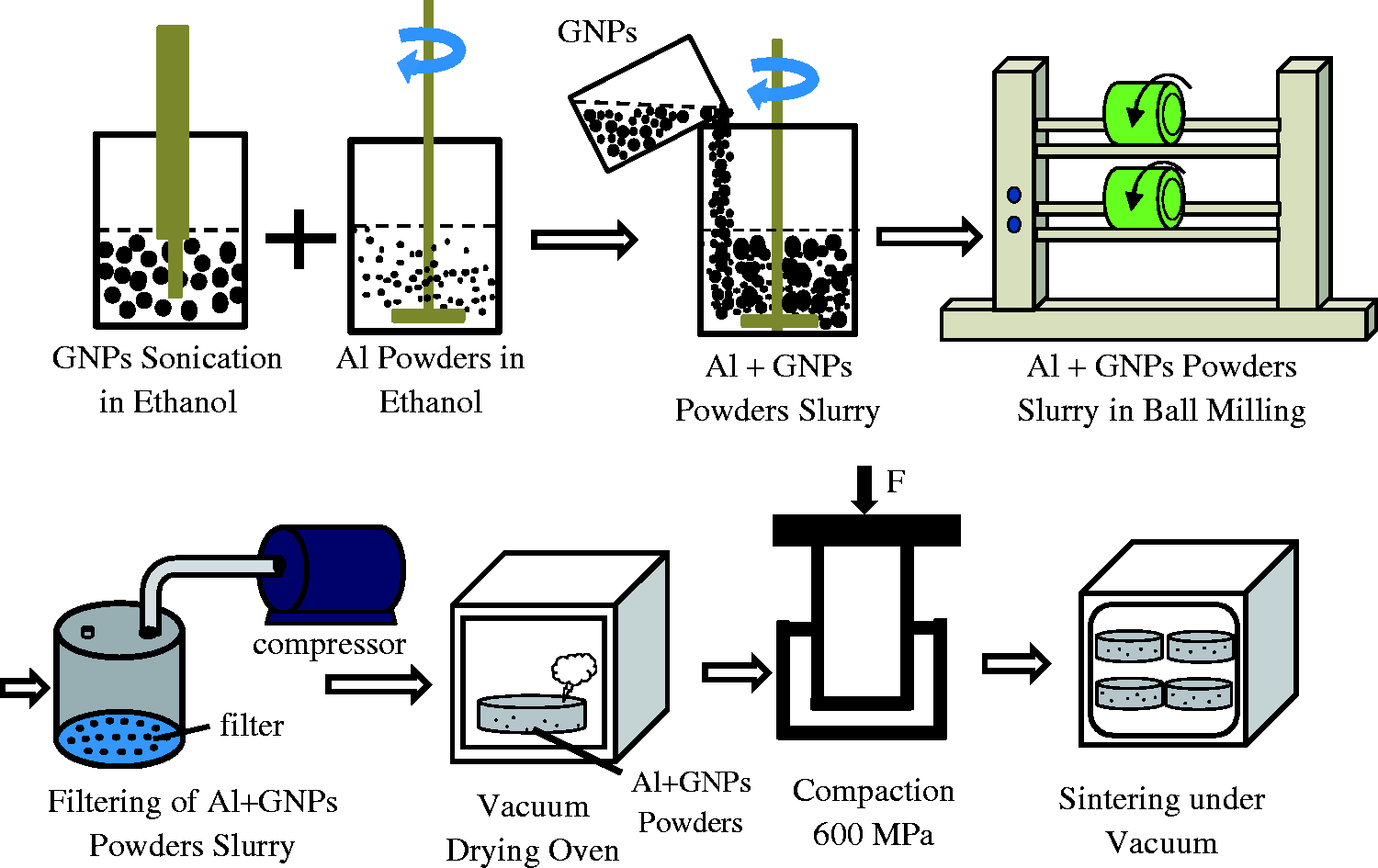
Characterization
The microstructure of starting powders and heat-treated composites were characterized by scanning electron microscopy (SEM, Jeol JSM-7001F). EDX map, line scan, and STEM analyses were performed with the same device to observe distributions of GNPs in composites. X-ray diffraction (XRD) analysis (Rigaku Rint 2200) was used to examine the phase analysis after sintering. Malvern Mastersizer 3000 was used to measure particle size distribution of the Al particles using laser diffraction. In this measurement, a laser beam applied through a well dispersed particulate powder and the angular variation in the intensity of the scattered light is measured. The theoretical densities of pure Al powder and GNPs were 2.7 and 2.25 g/cm3, respectively. The apparent density of Al–GNPs composites was calculated using the Archimedes principle. The apparent density (ρD) can be expressed as given in equation (1)
The hardness of composites was measured using a micro Vickers hardness tester (HV1000B micro Vickers hardness tester) under a load of 200 g and dwell time of 15 s. The measurement was performed six times from random places of polished cross-sections and then they were averaged.
Results and discussion
Secondary electron images of aluminum and graphene powders from SEM are given in Figure 2. As shown in Figure 2(a), the size of aluminum particles is less than 15 µm. Figure 2(b) demonstrates the stack-like GNPs, with less than 10 nm thickness. As shown in in Figure 2(c), average particle size distribution is nearly 10 µm. This analysis confirms the SEM results.
SEM micrographs of (a) Al powder, (b) graphene powder, and (c) particle size distribution of Al particles. SEM: scanning electron microscopy.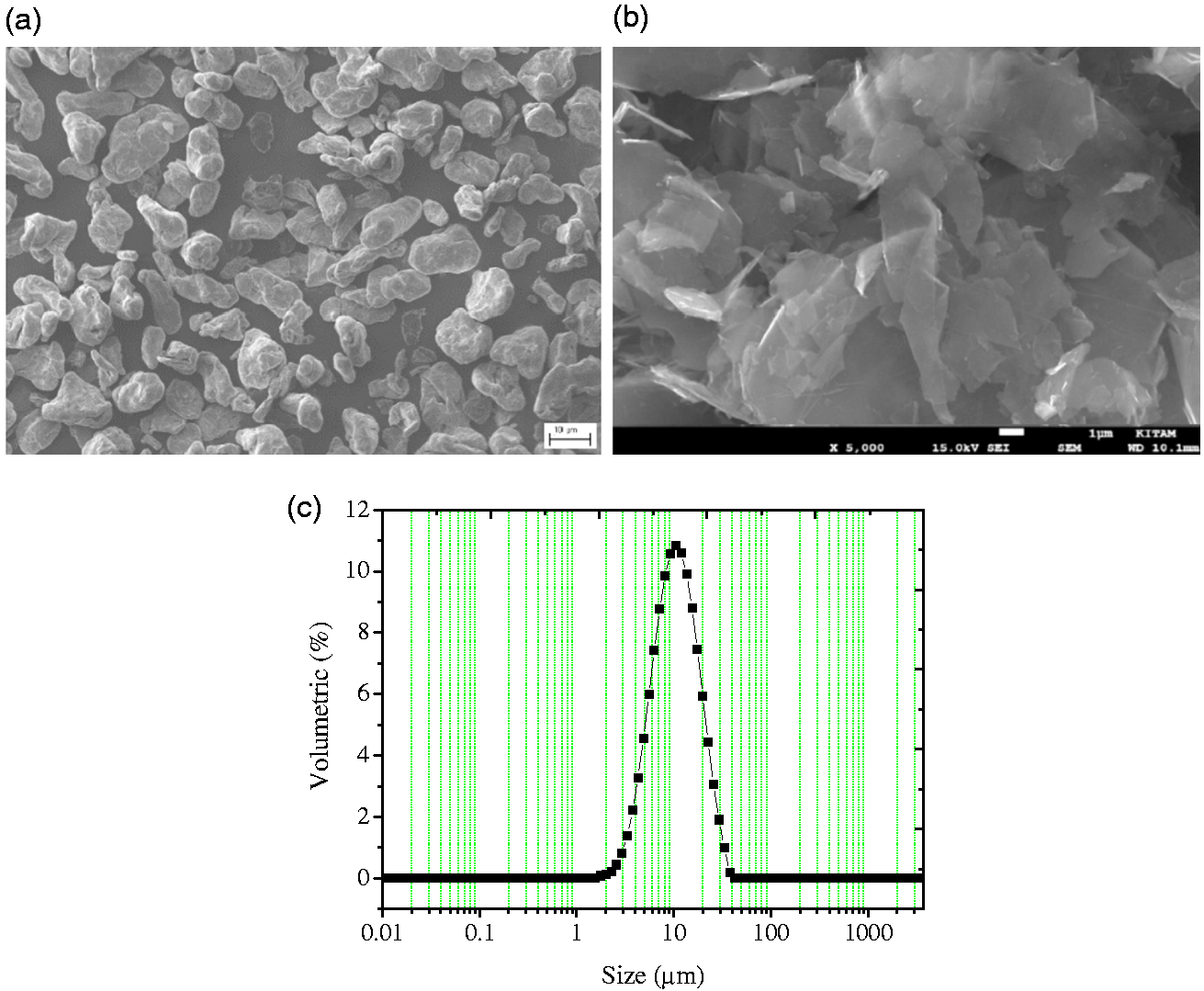
The apparent density of Al–GNPs composites was measured by Archimedes method. It depends on many factors, such as particle size distribution, particle shape, friction between particles, agglomeration tendency of particles, packing density during shaping, reinforced powder amount, sintering temperature, and time.
35
The variation of apparent density with sintering time for various GNPs contents in the Al matrix is given in Figure 3(a). The apparent density of the composite increased with GNPs content (up to 0.1 wt%) and then decreased with an increasing amount of graphene. In this figure, the sintering temperature is constant as TS = 630℃. The apparent density of Al composites for all GNPs compositions was increased up to tS = 180 min and then decreased with increasing sintering time due to grain growth. The maximum apparent density (ρ = 2.52 g/cm3) is obtained at tS = 180 min for Al–0.1% GNP composites when compared with pure aluminum and other graphene-reinforced composites. The effect of the sintering temperature on the apparent density of composites for various amounts of GNPs is shown in Figure 3(b). In general, apparent density increases with increasing temperature for 180 min. As given in equation (2), this can be explained by the relationship between diffusion and sintering temperature. According to this equation, higher apparent density can be performed at a higher sintering temperature
The variation of the apparent density with sintering time at (a) TS = 630℃ and temperatures at (b) tS = 180 min for various GNPs addition in Al matrix. GNP: graphene nanoplatelet.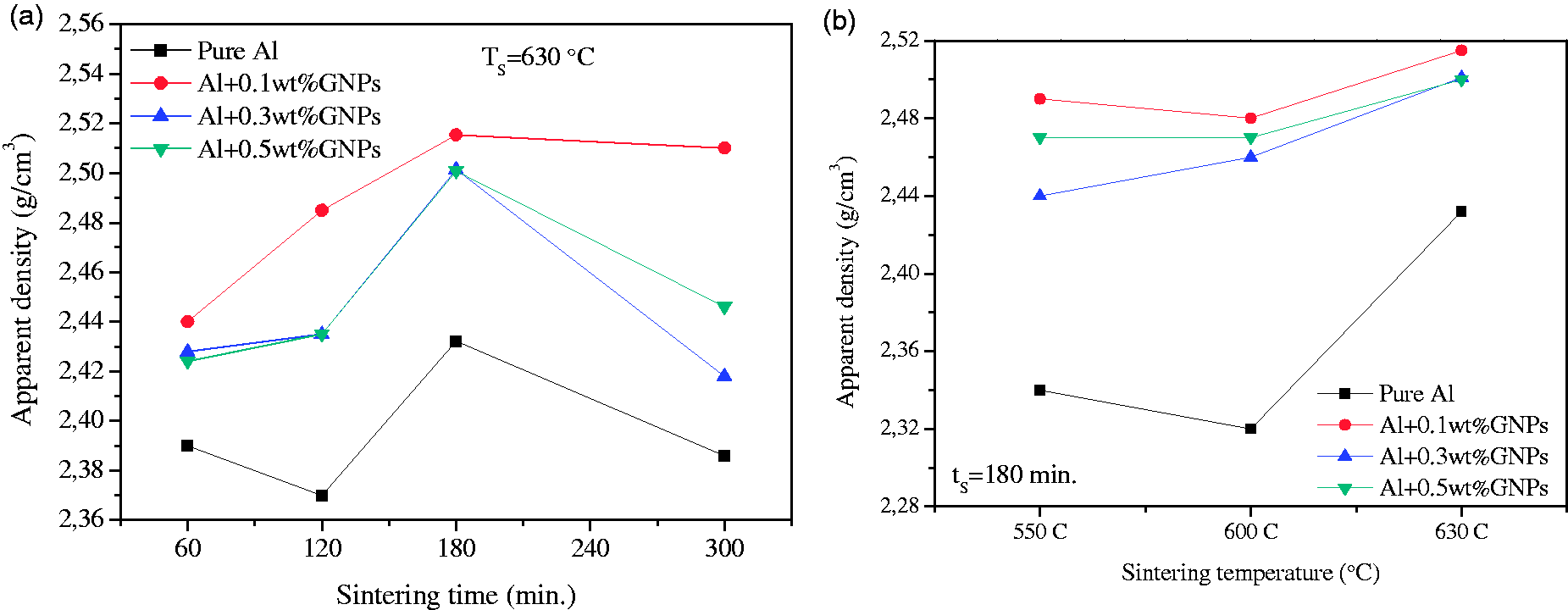
The formation and growth of interparticle bonding depend on solid-state diffusion. Diffusion bonding has a critical role in microstructure and mechanical properties.
36
Therefore, the optimum sintering time and temperature have great importance for controlling densification and grain growth for the mechanical, magnetic, and electrical properties of composites.
37
The effects of sintering time on the hardness of aluminum composites are given in Figure 4(a). Aluminum composites were sintered at four different sintering times (tS) – 60, 120, 180, 300 min – at the best sintering temperature (TS = 630℃). It can be seen that the highest hardness values are obtained at tS = 180 min for 0.1 wt% graphene content. The results show that the addition of GNPs up to 0.1 wt% into pure aluminum increases the hardness of aluminum composites. The addition of graphene above 0.1 wt% decreases the hardness of these composites due to agglomeration tendency of graphene. These agglomerated powders cause friction between particles. Therefore, the interaction between aluminum particles and GNPs reduces with agglomeration. This leads to higher porosity and causes a decrease in hardness. The hardness of composite for tS = 300 min is reduced to permit the grain growth of aluminum. The effect of sintering time on the composites structure and mechanical properties are given in equation (3). According to this equation, atomic displacement is related to the square root of time. This means that atomic diffusion promotes grain coarsening with increasing time. Therefore, larger aluminum grain size reduces the hardness of composites
36
The micro Vickers hardness of aluminum composites for various GNPs content sintered at various sintering time for (a) TS = 630℃ and various sintering temperatures for (b) tS = 180 min. GNP: graphene nanoplatelet.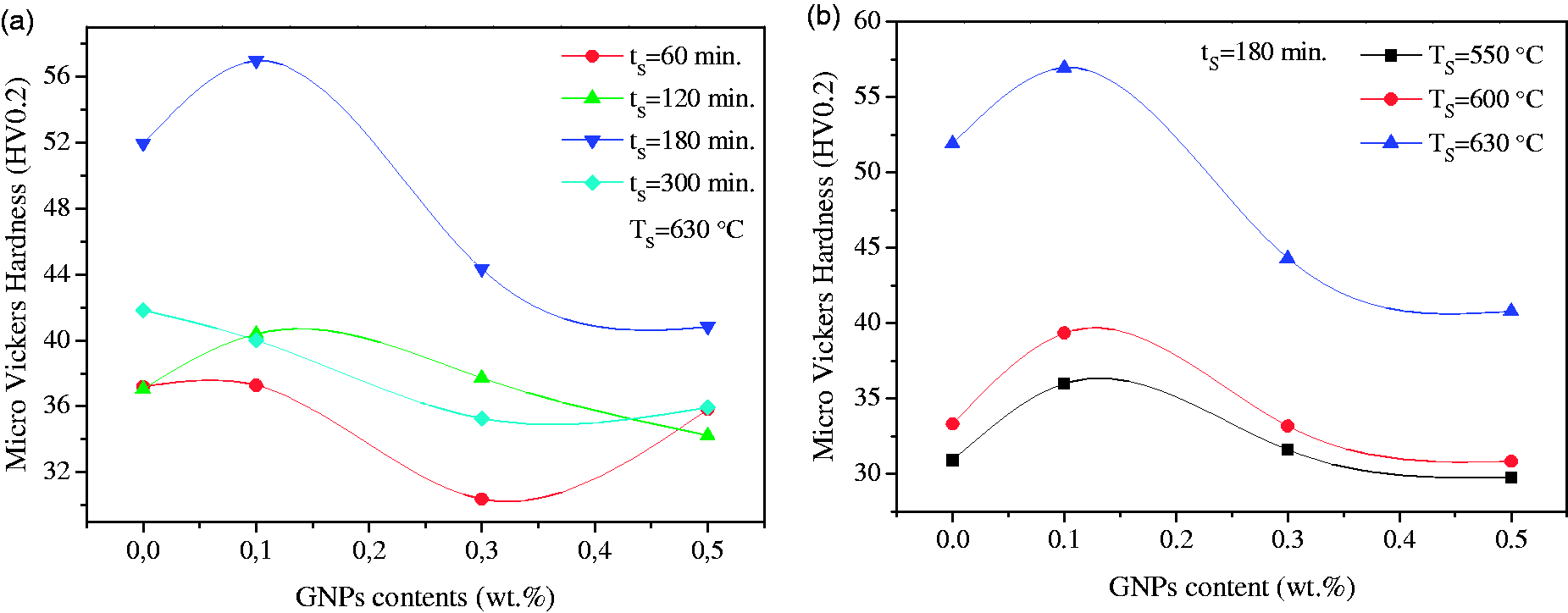
In this equation, D is the diffusion coefficient, r is the radial distance, and tS is the sintering time. Figure 4(b) presents the micro Vickers hardness of aluminum composites at 550℃ (1), 600℃ (2), and 630℃ (3) sintering temperatures for 180 min sintering time. The hardness of aluminum composites up to 0.1 wt% significantly increased and then decreased with increasing amount of GNPs. Maximum hardness values were obtained at TS = 630℃ for all GNPs content. The proper amount of GNPs addition (0.1 wt%) to aluminum has a positive effect on the hardness of the composites. The micro Vickers hardness of the pure aluminum (51.93 HV) and aluminum composites with 0.1, 0.3, and 0.5 wt% GNPs addition was found to be 56.95, 44.31, and 40.81 HV, respectively. The hardness of aluminum composites up to 0.1 wt% increased and then decreased with increases in the amount of GNPs at TS = 630℃ and tS = 180 min. In general, the strength enhancement of the composite can be achieved with uniformly dispersed GNPs and well-bonded particles. Therefore, sintering temperature and the amount of GNPs play a major role in good bonding between particles without grain growth.33,36 As given in equation (2), a denser and more strongly bonded microstructure can be achieved at a higher sintering temperature. Additionally, the proper amount of well-dispersed GNPs provides a larger interfacial area between aluminum particles. 36 These GNPs act as two-dimensional obstacles at the grain boundaries. They restrict grain growth during sintering and prevent dislocation movement during plastic deformation.27,33 Therefore, the hardness of the aluminum composite increases at a certain temperature and time (630℃, 180 min) and with the proper amount of GNPs (0.1 wt%). After the addition of 0.1 wt% GNPs, a poor interface between aluminum and graphene formed due to large agglomerated graphene clusters, which can lead to higher porosity and lower hardness.32,36
GNPs content, sintering temperature, and time are closely related to density, porosity, and grain growth. Abnormal grain growth has an adverse effect on mechanical properties of composites. Grain size of 0.1 wt% GNP-reinforced aluminum composites at 630℃ for 120, 180 and 300 min is given in Figure 5(a) and (c). It is evident that grain size increased with time. Grain size for 120, 180, and 300 min are estimated as 8.57, 8.85, and 10.31 µm, respectively. Although composite has a smaller size for 120 min, it has a porous microstructure due to insufficient sintering time. Similarly, excess sintering time (300 min) causes grain growth and more porosity. Therefore, optimum sintering time is selected as 180 min because of more densified microstructure without excess grain growth. This analysis supports the results of hardness and density.
SEM images of top surface of the 0.1 wt% GNP–Al composites at 630℃ for different sintering times: (a) 120 min, (b) 180 min, and (c) 300 min. GNP: graphene nanoplatelet; SEM: scanning electron microscopy.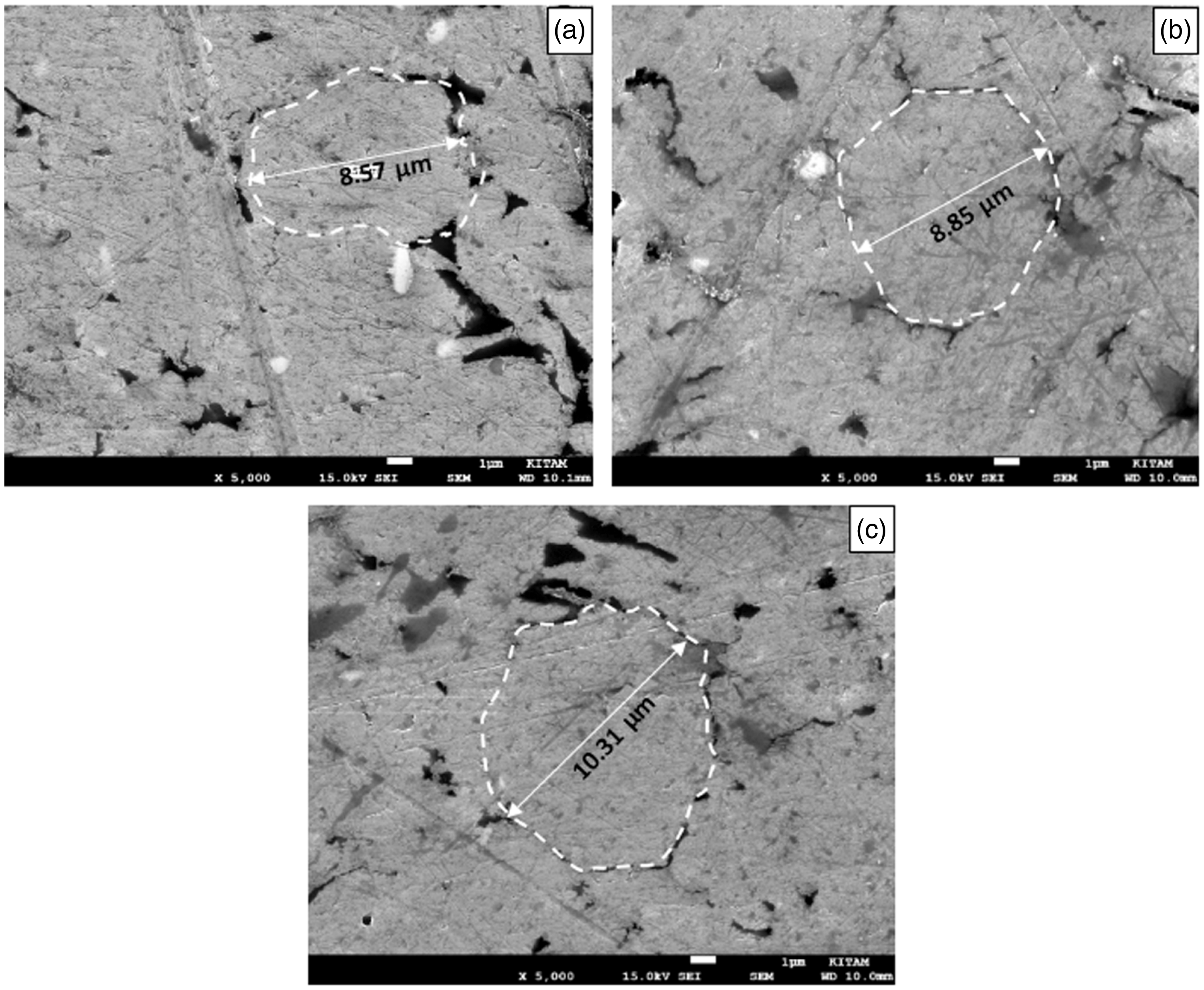
The XRD plots of GNPs, pure aluminum, and GNP-reinforced aluminum composites are given in Figure 6. In the figure, GNPs are presented at 2θ equal to 26.5° and 54.8°. The figure shows the XRD analysis results for pure and GNP-reinforced composites at 630℃ for 180 min. Reflections do not include the carbon element due to nanometric size, low GNPs content, or a low detection limit of XRD. Moreover, an undesired second phase, such as aluminum carbide peaks for all GNPs amounts, is not observed at 630℃ for 180 min due to a low level of sensitivity of the XRD devices.
X-ray diffraction patterns of GNPs, pure aluminum, and GNP-reinforced aluminum composite at 630℃ for 180 min. GNP: graphene nanoplatelet.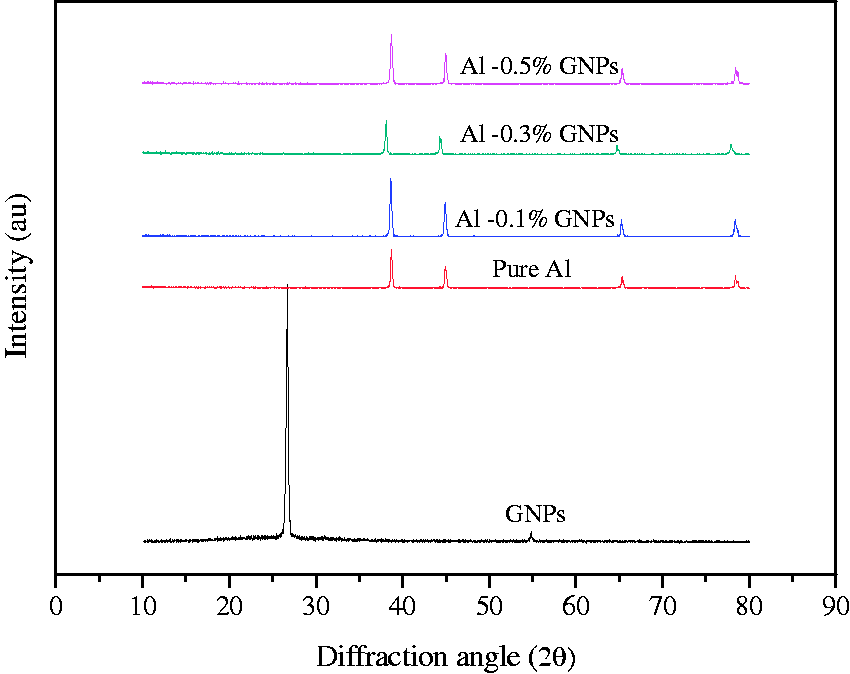
The effect of various sintering temperatures on composite microstructure for the best graphene content (0.1 wt%) is given in Figure 7. In this figure, low- and high-magnification SEM images of the cross-section of the Al–0.1 wt% GNPs composites were sintered at 550, 600, and 630℃ for 180 min. It can be seen that in Figure 7(a) and (c) the microstructure of the composites changes with increasing sintering temperature. The aluminum particles do not display good bonding at 550 and 600℃ (Figure 7(a) and (b)). However, neck formations between the aluminum particles are observed at 630℃ (Figure 7(c)). In a low-magnification SEM image, it is difficult to detect GNPs due to their nanosize. Thus, high-magnification SEM analysis was performed to confirm the presence of GNPs in the aluminum matrix. As shown in Figure 7(d) and (f), it is clear that GNPs are located along the aluminum grain boundaries. The interaction of GNPs and aluminum interphase is very poor at 550 and 600℃ when compared to 630℃. The sintering temperature is shown to have great importance in providing a denser microstructure. As mentioned before (equation (2)), a denser microstructure can be obtained at higher temperatures due to a higher diffusion rate.
SEM images of fracture surface of the 0.1 wt% GNP–Al composites at different sintering temperatures: (a–d) 550℃, (b–e) 600℃, and (c–f) 630℃ for 180 min. GNP: graphene nanoplatelet; SEM: scanning electron microscopy.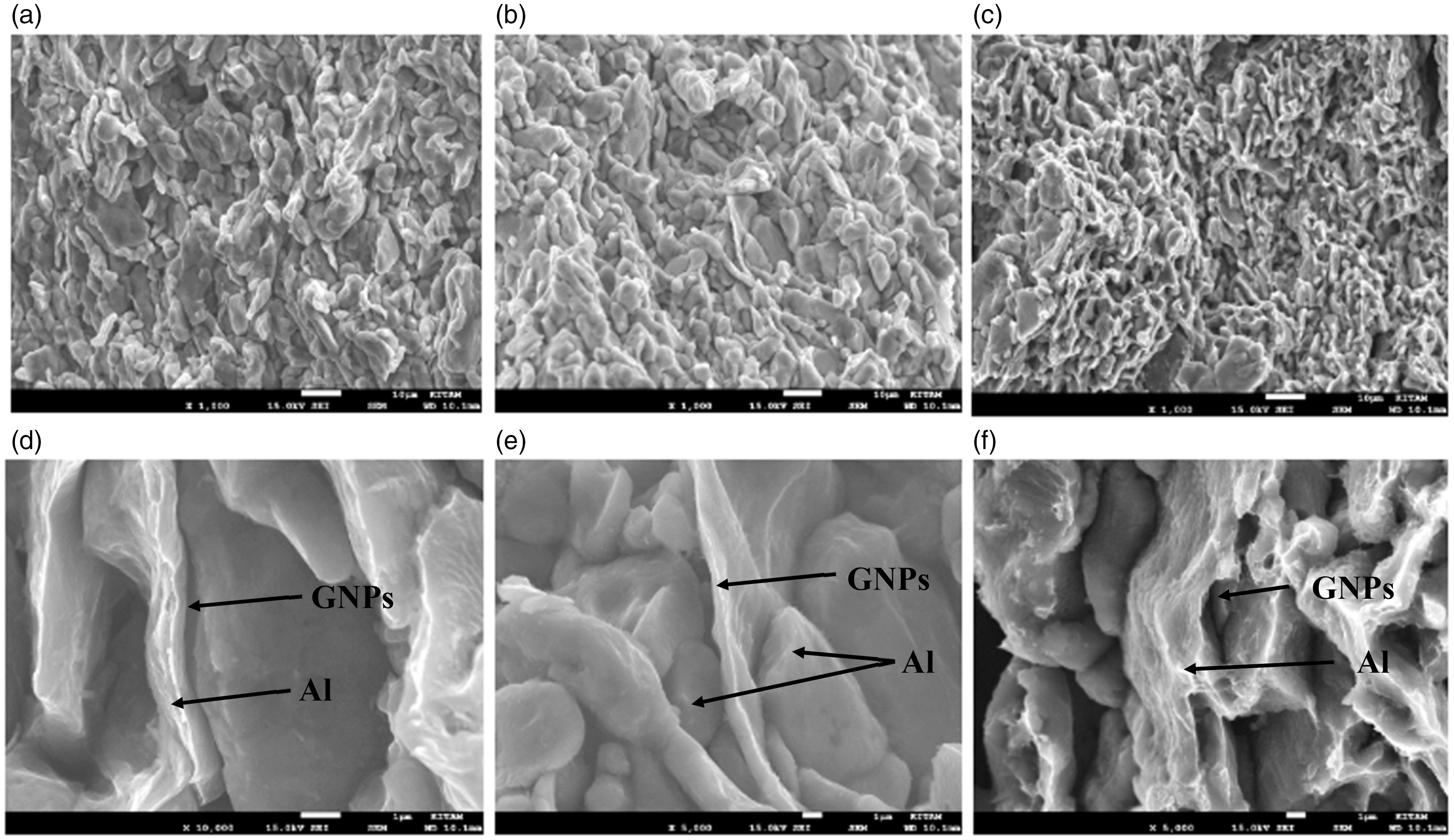
Figure 8 gives the effect of different sintering times at 630℃ on Al–0.1 wt% GNP composites’ microstructure. It is clear that the morphology of composites changes with an increasing sintering time. Similar to the sintering temperature results, weak particle bonding is observed between the aluminum particles at 630℃ for 120 min (Figure 8(a) and (b)). Better bonding between the particles and good neck formation occur at 630℃ for 180 min (Figure 8(c)). As shown in the high-magnification SEM analysis (Figure 8(d) and (f)), the GNPs are placed along the aluminum grain boundaries. The GNPs and aluminum interphase at 630℃ for 180 min are stronger than at 60 and 120 min. The results show that sintering time plays a critical role as sintering temperature due to the dependence of diffusion on sintering time. As shown previously (equation (3)), atomic displacement and diffusion depend on time. Finally, there is a good agreement with the apparent density, hardness, and microstructure of composite depending on both sintering temperature and time.
SEM images of fracture surface of the 0.1 wt% GNP–Al composites at different sintering times: (a–d) 60 min, (b–e) 120 min, and (c–f) 180 min at 630℃. GNP: graphene nanoplatelet; SEM: scanning electron microscopy.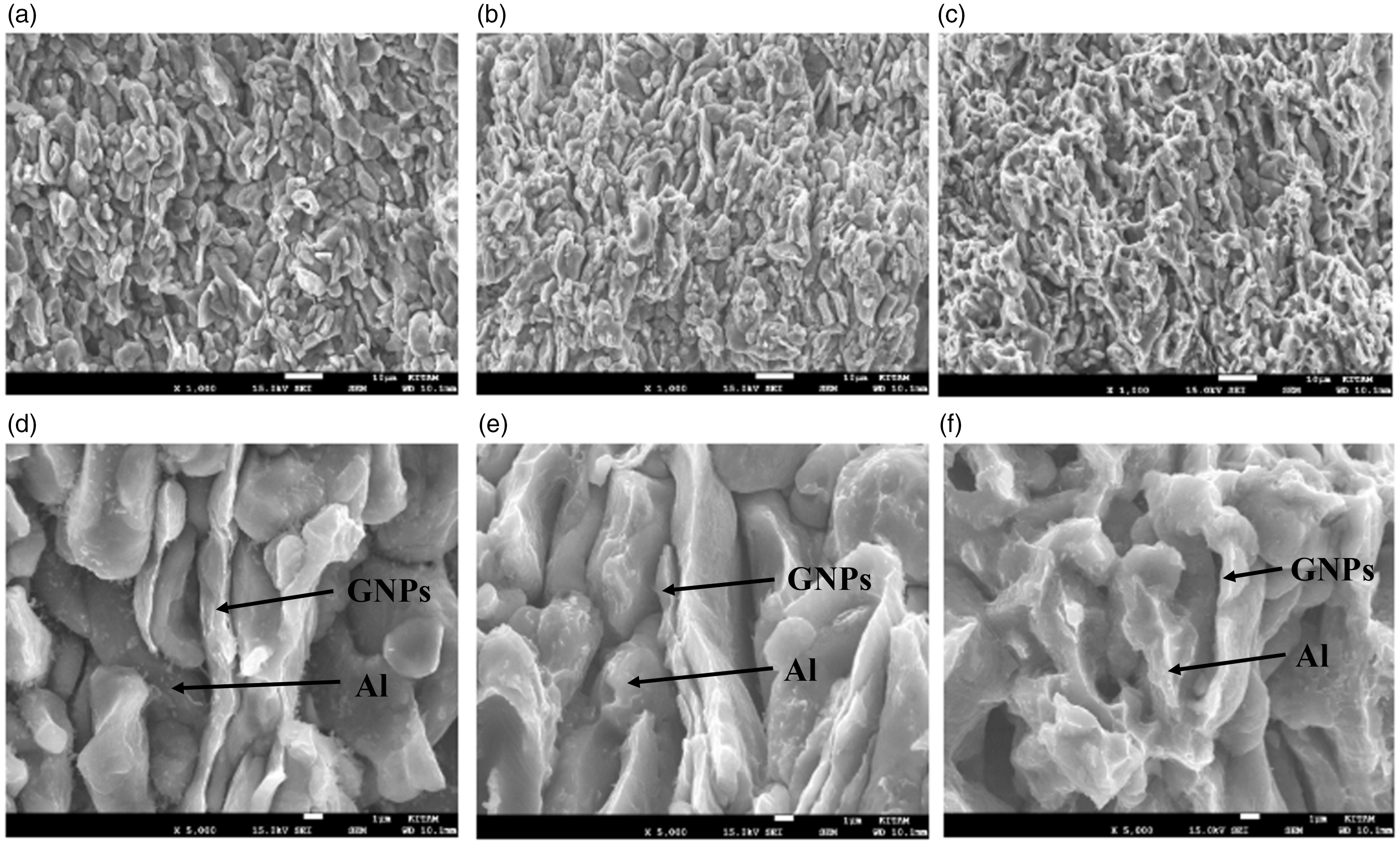
Figure 9 presents the elemental map and line scan of an aluminum matrix reinforced with 0.1 wt% of GNPs at 630℃ for 180 min. From the elemental maps of the composite on the polished surface, it is clearly shown that the main elements in the composite are Al (yellow distribution) and C from GNPs (blue distribution). C is homogeneously distributed in Al matrix (Figure 9(a) and (c)). To confirm the presence of GNPs at the grain boundary, EDX map scan was performed at fracture surface of composites. As present in Figure 9(d) and (f), GNPs takes place at aluminum grain boundaries where aluminum- and carbon-rich regions have yellow and purple distribution, respectively. Moreover, EDX line scan confirms the elemental map results. As shown in Figure 9(g) and (h), the signal of the aluminum is at a minimum as the carbon-rich region is approached and carbon signal increases at graphene-rich region. Moreover, these analyses confirm why the hardness and density are high. The EDX map analyses show no excess porosity, and line scan verifies that the GNPs are at the aluminum grain boundary which acts as a barrier at aluminum grain boundaries. It means the refining of the composite in small grain size without coarsening of the aluminum matrix. These led to increasing density and hardness of composites.
38
Furthermore, STEM image in Figure 9(i) verifies the map and line analyses. The plate-like graphene clusters with the morphology of irregular shapes are located at the grain boundaries.
Elemental maps (a–f), line scan (g and h), and STEM analysis (i) of the 0.1 wt% GNP–Al composites at 630℃ for 180 min. GNP: graphene nanoplatelet; STEM: scanning transmission electron microscopy.
Conclusion
In this study, GNP-reinforced aluminum composites were successfully fabricated using P/M method. The effect of the process parameters such as the amount of GNPs, sintering time, and temperature on the density, micro hardness, and microstructure of composites was studied in detail. Fabricated composites showed significant enhancement in apparent density, hardness, and structure at optimum process parameters. From the results, we can conclude the following:
The highest apparent density (from 2.32 to 2.52 g/cm3) and micro hardness (from 38 to 57 HV) were observed for a concentration of Al–0.1 wt% GNPs at 630℃ for 180 min. The apparent density and hardness of Al–GNP composites began to decrease above 0.1 wt% GNPs content due to the agglomeration tendency of GNPs. The apparent density and hardness were reduced by about 3 and 30%, respectively. Over 0.1 wt% GNPs content, the particle settlement is restricted, and graphene cannot be distributed homogeneously in Al powder. This causes the high friction during shaping. Moreover, this agglomerated graphene weakens the contact area between matrix particles. This leads to increase in porosity and decrease in hardness. Increased sintering time (more than 180 min) had an adverse effect on the apparent density and hardness of composites due to the permission of the grain growth of the aluminum. The grain size of 0.1 wt% GNP-reinforced Al composite at 630℃ for 120, 180, and 300 min is estimated as 8.57, 8.85, and 10.31 µm. The composites had a porous microstructure due to insufficient sintering time (120 min). Similarly, long sintering time (300 min) led to grain growth and more porosity. The highly dense microstructure was obtained without excess grain growth for 180 min. From the SEM analyses, bonding between the particles and good neck formation were observed at 630℃ for 180 min. The map scan and line scan analyses confirmed the GNP distributions in the matrix. GNPs were detected along the aluminum grain boundaries.
Footnotes
Declaration of Conflicting Interests
The author(s) declared no potential conflicts of interest with respect to the research, authorship, and/or publication of this article.
Funding
The author(s) disclosed receipt of the following financial support for the research, authorship, and/or publication of this article: The authors pleased to acknowledge the financial support for this study from Ondokuz Mayıs University, Scientific Researched Project Department. PYO.MUH.1902.15.001. We would specially like to thank the Black Sea Advanced Technology Research and Application Center (KITAM) in Ondokuz Mayis University for characterisation support.