






Abstract
The main objective of the present paper is to study the water absorption of jute–glass–carbon-reinforced epoxy composites and its subsequent effect on the in-plane shear performance of these composites. The effects of the reinforcement hybridization, stacking sequence and relative fabric amounts on the shear behavior of dry and wet conditioned composite specimens are reported and discussed. Composites have been fabricated in inter-ply configuration using the hand lay-up process. The prepared specimens have been subjected to distilled water and sea water immersion at room temperature for 60 days. Results indicated that water uptake of jute-reinforced composite and its hybrids with glass and/or carbon follows Fickian-like behavior. Water uptake induces a significant decrease in the in-plane shear strength. Hybridizing jute fabric with glass and/or carbon fabrics improves the in-plane shear properties of both dry and wet specimens. The stacking sequence and relative fabric amounts have a noticeable effect on the studied shear properties. Also, the hybrid composite with jute as facings and glass as core, JGJ, offers the most balanced set of properties on a cost-effective basis compared to the other studied hybrids.
Introduction
Synthetic fiber reinforced composites (SFRCs) have been widely used in various industrial applications such as marine, aerospace and sports, etc. Indeed, compared to metallic materials, SFRCs offer many advantages such as light weight, high strength and design flexibility. 1 Recently, the industrial policies are more attentive to the issues concerning sustainability, recycling and environmental care. Thus, the high use of synthetic fibers as reinforcing materials in composites raises some environmental problems in terms of their recyclability at the end of life cycle. These ecological problems motivated researchers to investigate other constituents eco-friendlier such as natural fibers and biopolymers.2–4 Thus, the use of natural fibers as alternative reinforcing materials in composites has spread more and more because of their superior properties such as easy availability, low cost, light weight, fairly good mechanical properties, non-abrasive, non-toxicity and pollution-free production.5,6 These advantages of natural fibers (such as abaca, jute, sisal, banana, cotton, coir, hemp, flax, kenaf, and ramie) compared to synthetic fibers make them an interesting research area and extensive efforts are being made to tap their full potential. 7
Moreover, natural fibers have the potential to be used as a replacement for traditional reinforcing materials in composites for applications which require high strength-to-weight ratio and further weight reduction. Despite the superior advantages of natural fiber reinforced composites (NFRCs), they have some drawbacks such as low mechanical properties compared with SFRCs, low thermal stability (degrade at 20025℃) and poor adhesion between fibers and matrix, due to their hydrophilic nature, which leads to the swelling of fibers and the moisture absorption.8,9 Consequently, the use of natural fibers alone to reinforce a polymer matrix is inadequate for satisfactorily tackling all the technical needs of fiber-reinforced composites. It is well known that the mechanical properties of NFRCs are lower than those of SFRCs. However, the specific properties of some natural fibers are comparable to those of their synthetic counterparts and consequently, combining natural and synthetic fibers (termed hybridization) improves the properties of the composite by taking the advantages of the characteristics of both fiber types. 10
Among natural fibers, jute fiber represents an attractive area of investigation, due to its high content of cellulose when compared with other natural fibers. ute fiber has low density and hence it is able to reduce the weight of the composite up to very low. So, by using it, the developed composite is cost effective. Although synthetic fibers such as glass, carbon, Kevlar and aramid act as strong reinforcements in polymer composites, they need high cost for common and day-to-day applications. The usage of such synthetic fibers is justified for aerospace and military applications where the high cost is not of high importance. 11 Numerous investigations have been conducted on the characterization of jute–glass hybrid composites. Mohan and Kishore 12 reported that replacing the outer plies of jute/epoxy composites with glass fiber improves the flexural properties and protects jute core from weathering. Clark and Ansell 13 evaluated the mechanical properties of three- and five-ply jute–glass hybrid composites. It was found that five-ply laminate with glass core and skin offers better properties than the other composite. Sabeel and Vijayarangan 10 and Sabeel et al. 14 found that the tensile, flexural, interlaminar shear and impact properties of jute–polyester composites were improved by the incorporation of glass fiber. Surya et al. 15 observed that the addition of E-glass fabric to the outer layers of jute-reinforced composites improves their tensile, bending and impact properties.
Many composite structures fail due to shear stresses. Different standard methods for studying the shear properties of composites are proposed in the literature. Among them, the V-notch shear test is the most popular method, which uses a flat specimen that is easier to be fabricated while allowing a nearly pure-shear stress state at the shear plane.16,17 This test was originally proposed by Iosipescu 18 to determine the shear properties of isotropic materials such as metals. Walrath and Adams 19 used V-notch specimens with a modified test fixture in their work with composites. However, there are few available data in the literature regarding the shear properties of hybrid composites measured using the V-notch shear test. A theoretical evaluation of the applicability of the V-notch shear test has been conducted by Chiang and He 20 for hybrid composites having unidirectional glass and carbon fiber tows. This theoretical study showed that the V-notch shear test can be used to determine the shear modulus of hybrid composites that were studied. However, in practice, premature failures due to the stress concentrations caused by the existence of geometry and material discontinuities at the free edges of the notches near the notch roots can make the test unsuitable for determining the shear strength. He et al. 21 used the V-notch shear test to investigate the shear modulus and strength of unidirectional carbon–glass/epoxy hybrid composites. Selmy et al. 22 studied the shear properties of unidirectional glass-random glass/epoxy hybrid composites. Results indicated that the shear properties of unidirectional glass fiber-reinforced composite can be improved by the incorporation of random glass fiber and forming hybrid composites. Ramnath et al.23,24 noticed that the fiber orientation plays a vital role on the shear properties of abaca-jute–glass fibers-reinforced composites. Also, it was observed that abaca-jute hybrid composite has better shear properties than abaca fiber composite and the shear strength is improved by adding glass fiber at the facings. Later, Selmy et al. 25 investigated the shear properties of unidirectional polyamide-random glass/epoxy composites. Results showed that the existence of polyamide fiber at the composite external layers improves the shear properties.
Considering the humidity effect on the mechanical properties of polymer composites, all polymer composites absorb moisture to some extent in humid atmospheres or when they are immersed in water. This effect depends on various factors such as fiber and matrix types, fiber volume fraction and orientation, stacking sequence, temperature and area of the exposed surface. 26 Generally, water absorption affects the performance of NFRCs negatively.27,28 Several studies have been performed to investigate the effect of water absorption on the mechanical properties of NFRCs such as hemp, 29 jute, 30 bamboo 31 and flax. 32 These studies showed that the mechanical properties such as tensile and flexural strength would be significantly reduced because of the weak interfacial adhesion between fiber and matrix caused by water uptake.
From the above literature review, it can be concluded that the studies related to the effect of water absorption on the mechanical properties of composite materials did not account for the in-plane shear properties. In the present study, the in-plane shear properties of jute–glass–carbon-reinforced composites and the effect of water absorption upon them were investigated. Nine laminates were fabricated in inter-ply configuration with the hand lay-up process. To evaluate water absorption effect, the prepared composite specimens were immersed in distilled water and sea water for 60 days. The in-plane shear properties of dry and wet specimens were determined using the V-notch shear test. The effects of the reinforcement hybridization, fabric contents and stacking sequence on the in-plane shear properties of the fabricated composites in both dry and wet conditions were discussed.
Materials and methods
Materials
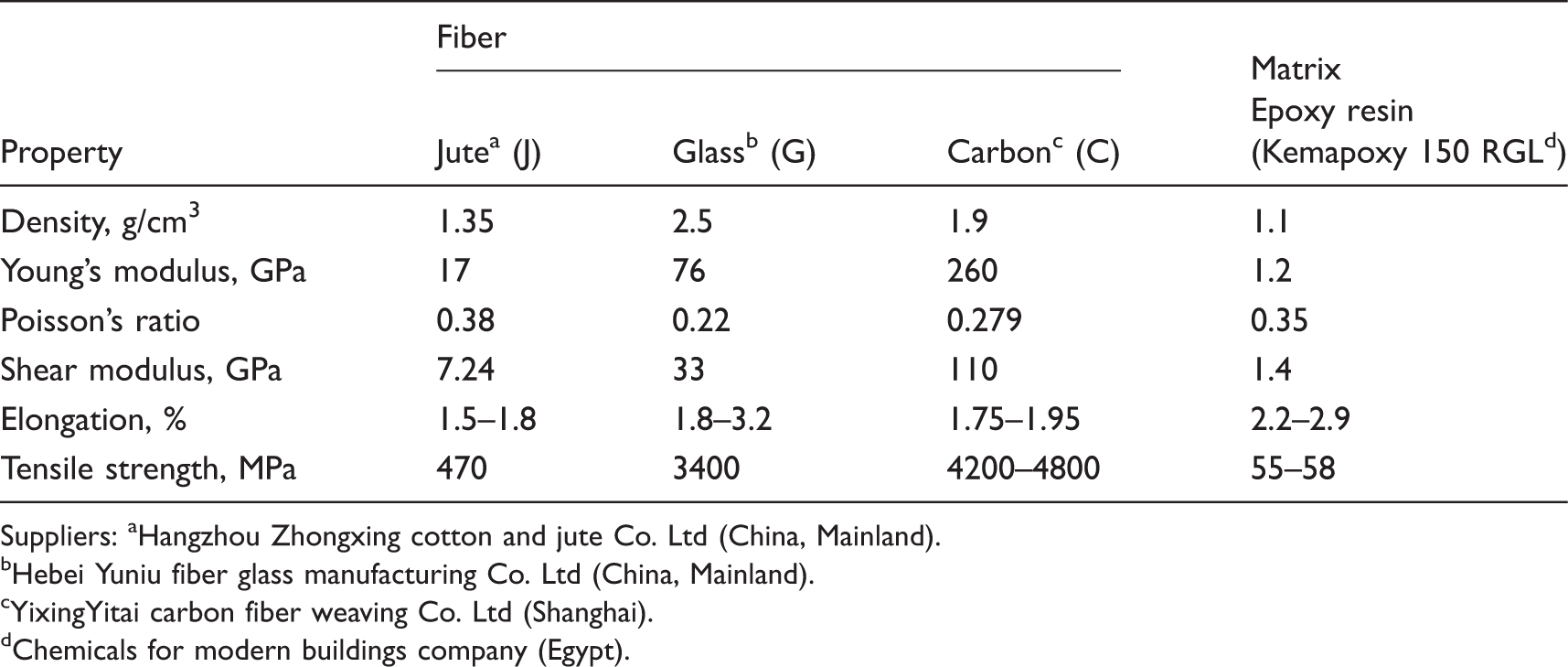
The materials used to fabricate the inter-ply hybrid composite laminates are 0°/90° plain weave jute (J), chopped glass mat (G) and 0°/90° 2 × 2 twill weave carbon (C) fabrics, as shown in Figure 1. The fabrics used, i.e. jute, glass, and carbon, have the same areal density of 200 g/m
2
. The number of yarns in weft and warp directions is the same in woven jute and carbon fabrics. Kemapoxy 150 RGL was chosen as a matrix material. The mechanical properties of the fibers and matrix are provided in Table 1.
Surface images of (a) jute, (b) glass, and (c) carbon fabrics used in this study. Properties of fibers and matrix given by the suppliers. Suppliers: aHangzhou Zhongxing cotton and jute Co. Ltd (China, Mainland). Hebei Yuniu fiber glass manufacturing Co. Ltd (China, Mainland). YixingYitai carbon fiber weaving Co. Ltd (Shanghai). Chemicals for modern buildings company (Egypt).
Specimen fabrication
Configurations, coding and stacking sequence of the fabricated composite laminates.
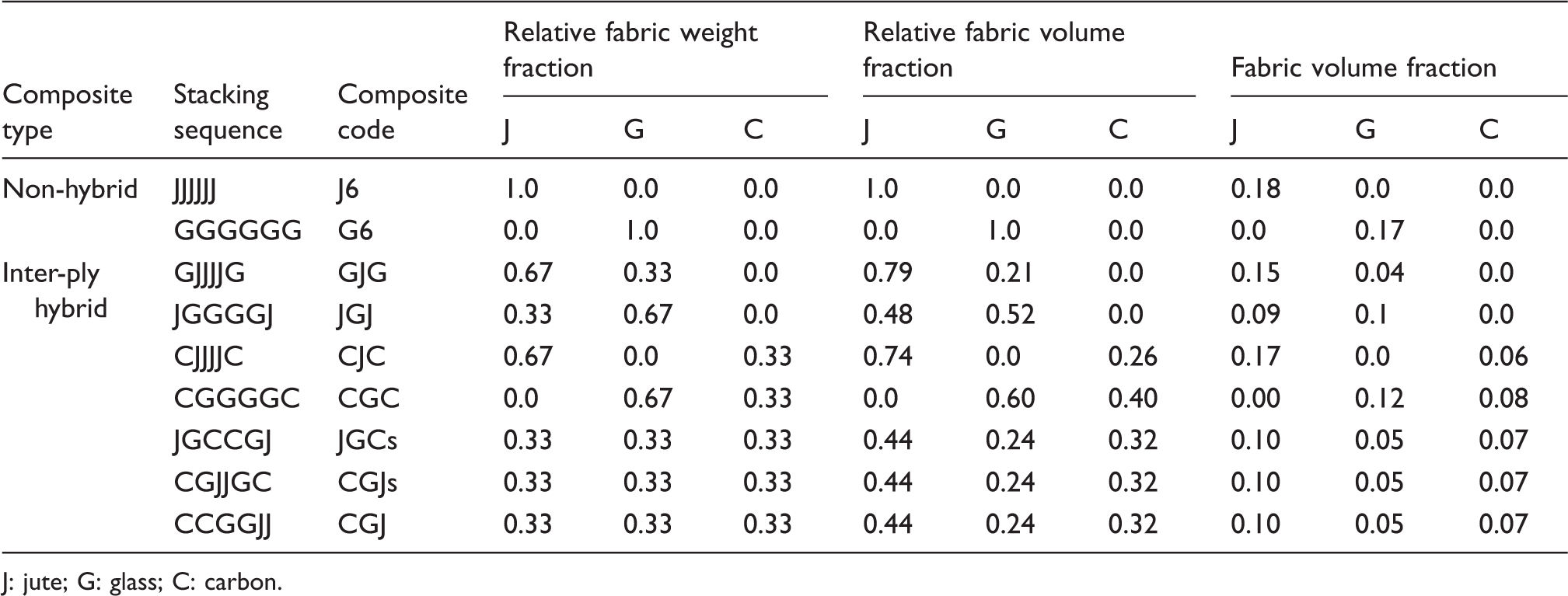
J: jute; G: glass; C: carbon.
Measurements and characterizations
Void content
The void content (

Experimental densities were measured at room temperature according to ASTM D79239 as

Water uptake
Specimens were immersed in distilled water and sea water at room temperature for 60 days. They were withdrawn from water from time to time, wiped to remove water droplets and regularly weighed using a digital balance with precision up to 10−4 g to measure the mass change during the water absorption process. Water uptake tests were carried out according to ASTM D5229/D5229M-14,
40
in which the water uptake content M
t
can be calculated as follows

To this end, different theoretical methods can be employed to describe the water uptake performance of composites. Fick's law was used for the analytical prediction of moisture absorption behavior. For a composite sample with thickness h and uniform initial distribution and equal initial surface concentration, Fick's law leads to the following equation
41

Shen and Springer
42
simplified equation (5) as the water absorption can be predicted analytically based on the value of 
From equation (6), the composite diffusion coefficient D through thickness can be obtained as

Since most moisture diffusion experiments include moisture diffusion through six surfaces, the predicted value of D from equation (8) leads to error.
43
For true one-dimensional diffusion coefficient D, a correction factor is used to account for the edge effect, so the corrected diffusion coefficient D
c
is calculated as

In-plane shear test
Iosipescu shear tests were performed on a universal testing machine (testometric 300 kN) with 2 mm/min cross-head speed as per ASTM D5379-93.
44
The V-notch specimen is held in the fixture shown in Figure 2(a) and the load is applied to produce a state of predominant shear. The load is increased until the specimen is broken and at this point, the corresponding load is noted. Two strain gages were bonded at the center region of the specimen at ± 45° directions (Figure 2(b)). The applied shear stress ( (a) Iosipescu test fixture and (b) test specimen, dims are in mm.

Specific properties
Using the specific properties concept is important when comparing composites fabricated from different materials. This concept is rational in all engineering applications, aiming for weight reduction. The specific property is evaluated by dividing the obtained experimental value of the property by the density of the specimen.
Cost ratio
Cost is a significant factor in the design of hybrid composites as it is affected by the design and fabrication parameters. The key cost drivers for design are material types, configuration and complexity, whereas those for fabrication are related to labor and tools costs and production volume. The fabrication parameters are not under the designer's control. For example, if it is assumed that 40% of the composite cost is owing to material cost, then material cost can be used as a rational proxy for the cost index.45–47
In this study, the prices of the constituents are as follows: 0.5 $/m2 for jute, 2.7 $/m2 for glass, 50 $/m2 for carbon and 7.0 $/kg for epoxy resin. It is obvious that the cost of m2 jute is about 0.19 and 0.01 times those of glass and carbon, which means that using jute as a partial alternative to glass-mat or carbon fabric is cost-effective. Generally, there is a great potential for cost reduction of composite structures through many strategies including the usage of natural fibers instead of synthetic ones. 48 Here, the cost ratio was calculated as the shear strength divided by the cost of the specimen.
Results and discussions
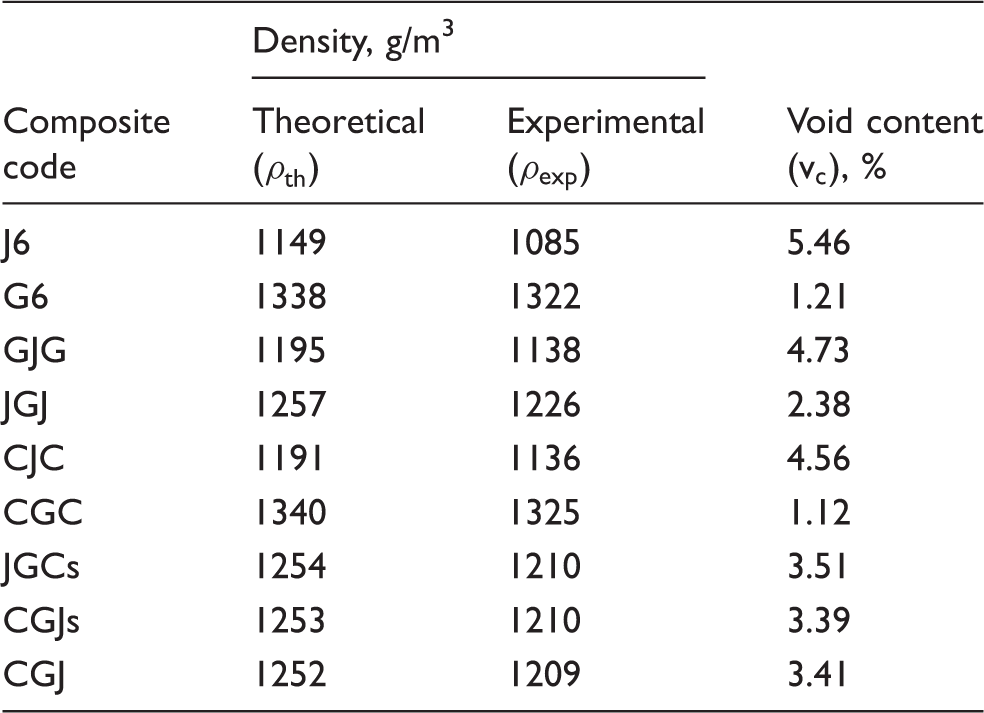
Void content
The densities and the void content of J–G–C-reinforced epoxy composites.
Water uptake
Typical plots of percentage water uptake versus square root of time for the fabricated composites are shown in Figure 3. Three samples of each composite type were immersed in distilled water and sea water at room temperature, each for 60 days. It is obvious from Figure 3 that the rate of water diffusion into the immersed samples is time-dependent. All composites absorb water very rapidly at the initial stage and later a saturation level is attained without any further increase. The highest water uptake is noticed for J6 composite, while the lowest one is noticed for CGC composite. This is due to the void content in J6 composite, the hydrophilic nature of jute and capillary action when the fiber ends are exposed to water.
53
As a consequence, increasing jute fabric amount in hybrid composites increases the capability of water absorption as noticed for GJG, which goes with the results obtained by Rashdi et al.
54
On the other hand, incorporating glass and/or carbon fabrics to jute-reinforced composite makes it more hydrophobic and thus decreases the water uptake. Also, good adhesion between matrix and glass and/or carbon fabrics decreases the velocity of the diffusing molecules. The strong adhesion results in tighter packing within the epoxy-fiber network and consequently, the distance traveled by the diffusing water molecules between the two consecutive collisions would drop (mean free path) and lower water uptake is obtained.
55
Additionally, it is noticeable that the stacking sequence distinctly affects the water absorption characteristics, the existence of carbon fabric at the periphery, i.e. CGJs increases the resistance to water absorption as carbon fabric acts as a barrier to jute fabric preventing direct contact between jute fabric and water.
Water uptake of J–G–C-reinforced epoxy composites.
Uptake of distilled water is slightly higher than that of sea water for all composites under consideration due to the presence of ions in salt water. 56 The same finding was recorded by Davies et al. 57 and Abd El-baky. 51 Salt molecules reduce the activity of water molecules and result in addition of salt particles on the specimen surface which could further inhibit the water absorption. Also, the accumulation of sodium chloride ions on the fabric's surface for specimens immersed in sea water increases with time and hinders subsequent water diffusion. Again, void content influences the water absorption process, i.e. voids accumulate water and in the case of sea water they form concentrated salt solutions. Also, the interface quality (fiber-matrix interface and the different layers interface) contributes to the water absorption. 58
Although water absorption is greater for distilled water, the saturation time is approximately the same for both distilled water and sear water. As reported by Abd El-baky, 51 the lower trend of sea water uptake can be due to the deposition of trace elements on the surface of composite body which intervene with the diffusion process. Also, this can be attributed to the hydrolysis mechanism of the cellulose within natural fiber, which is expected to be more pronounced in sea water, as reported by Yan and Chouw. 59
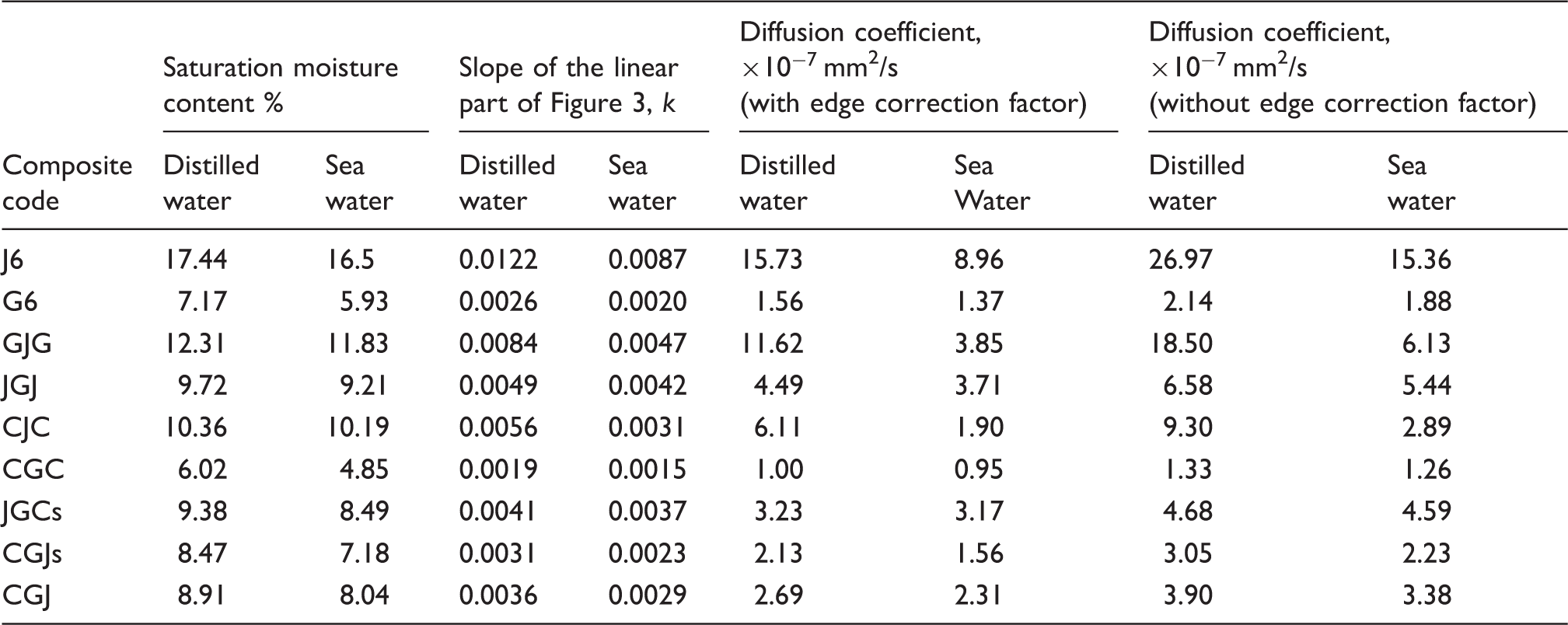
Diffusion coefficient for J–G–C-reinforced epoxy composites upon immersion in distilled water and sea water at room temperature for 60 days.

Experimental and analytical results of water absorption in J–G–C-reinforced epoxy composites.
As expected, diffusion coefficient without edge correction factor is higher than that with edge correction factor for all composites. Edge correction factor decreases the diffusion coefficient by about 41% and 25% for, respectively, J6 and CGC composites. Also, the influence of the edge correction factor is almost the same for both distilled water and sea water. Replacing the outer layers by glass and/or carbon effectively decelerates water diffusion into jute-reinforced composite. These results quantitively agree with those reported by Cheour et al., 1 Kumar and Sabeel 60 and Pandita et al. 61 The higher the diffusion coefficient, the lower the resistance to water absorption.
Shear strength and modulus
Typical load–displacement plots for dry and wet conditioned J–G–C-reinforced epoxy composite specimens are shown in Figure 5. Wet specimens were immersed in distilled water and sea water for 60 days at room temperature. Wet specimens exhibit similar load–displacement behavior as that for dry counterparts. The load–displacement plots, except that for JGCs, have almost a linear behavior up to the maximum point followed by a load drop. JGCs composite has a linear behavior in the initial portion followed by a neck which represents the crack developing at the notch root. After that the load increases again until reaching the maximum point after which a load drop is noticed.
Load–displacement curves for J–G–C-reinforced epoxy composite coupons, (a) dry, (b) immersed in distilled water, and (c) immersed in sea water.
Figure 6(a) shows the relationship between the shear stress and the strain measured from + 45° and −45° strain gages bonded on the center regions of test specimens. Based on this figure, the relationship between the shear stress and shear strain can be constructed as illustrated in Figure 6(b). The in-plane shear strain is calculated using equation (11). The values of the in-plane shear modulus have been determined experimentally from the slope of the shear stress–shear strain curves shown in Figure 6(b) using equation (12) at 0.5% strain level. It is clear from Figure 6(b) and Table 5 that CGC composite has the highest shear modulus and shear strength followed by G6. The lowest shear modulus and shear strength are associated with J6 and CJC composites. Also, the hybridization of jute fabric composite with glass-mat and/or carbon fabric improves its shear properties.
Shear properties of J–G–C-reinforced epoxy dry specimens, (a) shear stress Shear properties of J–G–C-reinforced epoxy composites. Shear properties of C6 are taken from Swanson et al.
62

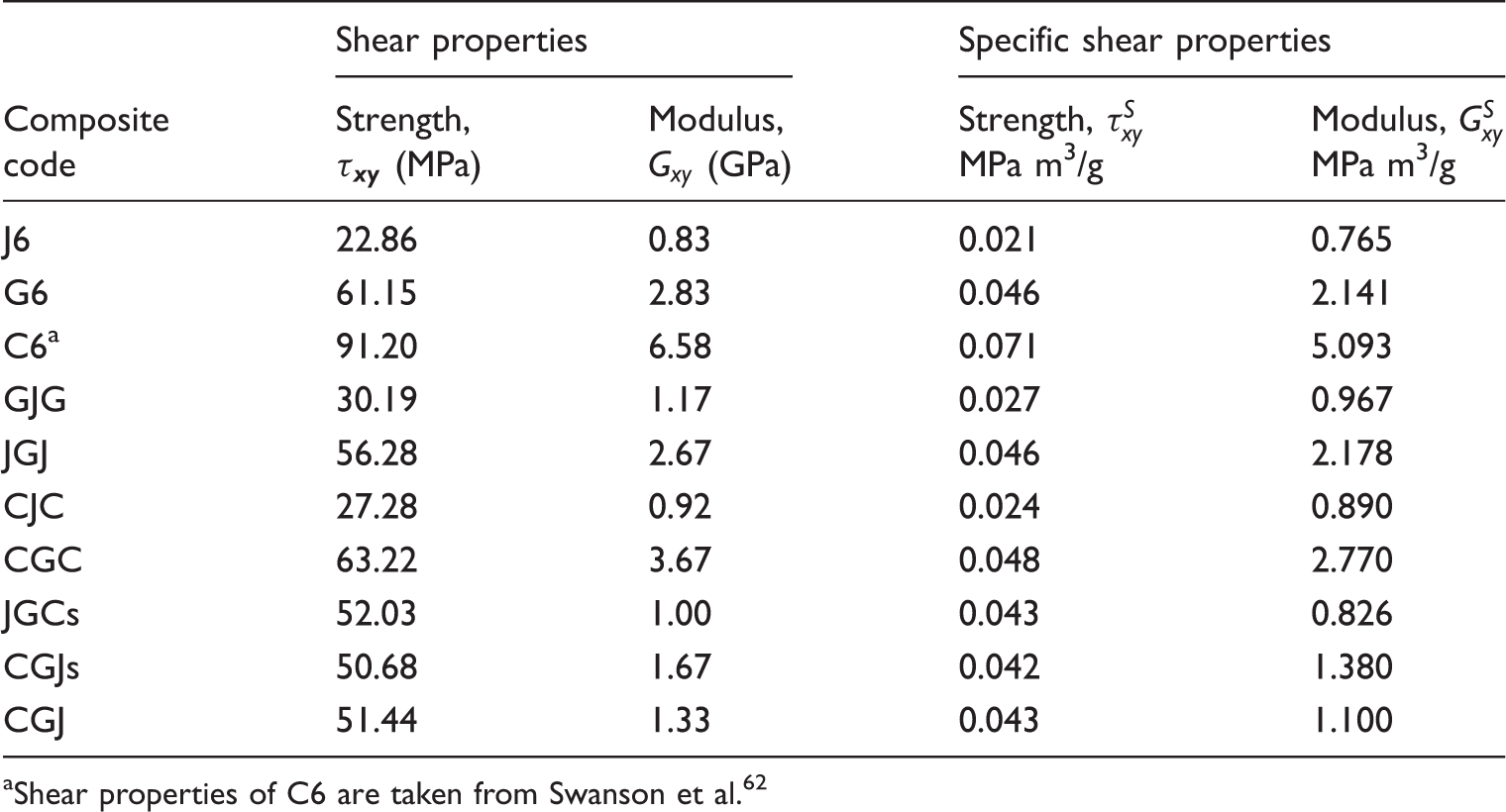
Regarding jute-glass hybrid composites, it was noticed that the shear modulus and strength are increased when the glass fabric content increases relative to jute fabric. This is due to the better mechanical properties of glass fabric compared to jute fabric. Shear modulus and shear strength of JGJ hybrid composite are about 2.28 and 1.86 times those of GJG, respectively.
It is important to investigate the influence of stacking sequence on the shear properties of hybrid composites, keeping the same number of plies and the same relative fabric contents, i.e. CGJs, JGCs and CGJ. It is clear that the order of plies has an insignificant effect on the shear strength because of that all plies are subjected to the same strain and the shear properties are mainly dependent on the fiber strength and modulus, fiber length and orientation, fiber/matrix interfacial bond and fiber content. 63 Stacking sequence obviously affects the shear modulus as the shear modulus becomes higher when the high strength fabric-reinforced layers are used in the specimen skin. The shear modulus of CGJs composite is about 1.67 times that of the composite with the opposite arrangement, i.e. JGCs. Also, the shear properties of all fabricated hybrid composites are much higher than those of jute-reinforced composite.
Figure 7 shows the shear strength of J–G–C-reinforced epoxy composites under dry and wet conditions. Water uptake appears to negatively affect the shear strength of the studied composites. This degradation in the shear strength is due to water diffusion along the interface between J– and G– and C–fabrics and epoxy matrix. The presence of water at the interface weakens the interfacial strength, which in turn accelerates the failure process. Water absorption during loading considerably accelerates the crack initiation and crack propagation.
Effect of water uptake on shear strength of J–G–C-reinforced epoxy composite specimens.
Specific shear properties
Various specific shear properties of the fabricated composites are presented in Table 5. Comparing the hybrid composites, one can note that CGC composite shows the highest specific shear strength and modulus, followed by JGJ. As previously mentioned, specific property value depends on two variables, namely the experimental property and the composite density. The specific property is higher when the experimental property increases, and the density decreases.
Failure modes
Jute–glass–carbon-reinforced epoxy composite specimens fail during testing using Iosipescu test due to pure shear stress along the roots of the two V-notches. Figure 8 shows some failure signs for dry J–G–C fabric-reinforced composite specimens. The premature failure occurs at the notch tip area due to the stress concentrations caused by the existence of geometry and material discontinuities at the free edges of the notches. The failure signs were noticed to be matrix fretting which is parallel to the loading direction and connects the two V-notches, inclined cracks across the specimen width and material crushing at inner loading points. Also, two asymmetrical horizontal macro-cracks starting just below the notch tips and propagating in the opposite sides were noticed. These failure signs are similar to those reported by Chiang and He
20
and Khashaba.
16
Common failure signs for J–G–C-reinforced epoxy composite specimens tested using Iosipescu shear test.
Cost ratio
Cost ratio for all studied composites is estimated as the specimen shear strength divided by its cost. As noticed from Figure 9, the presence of jute fabric in hybrid composites improves the cost ratio. Comparing the studied hybrid composites, JGJ hybrid composite seems to be the best appropriate choice for structures under shear loading from the point of view of cost.
Cost ratio of J–G–C-reinforced epoxy composite specimens under in-plane shear loading.
Conclusions
The in-plane shear properties of jute fabric-reinforced epoxy composite laminates and their hybrids with glass-mat and/or carbon fabric were presented and investigated using Iosipescu test, taking into account the effect of water absorption. The composites were fabricated using the hand lay-up process. Specimens were immersed in distilled water and sea water for 60 days at room temperature. Results showed that the addition of glass and/or carbon fabric to jute fabric-reinforced composite distinctly enhances its shear properties. The stacking sequence has insignificant effect on the shear strength, but it has a noticeable effect on the shear modulus. Also, water uptake of the fabricated composites was found to increase with increasing J-fabric content. The presence of carbon fabric at the outer layers decreases the water uptake. For all studied composites, water uptake of distilled water is slightly higher than that of sea water. Besides, immersing the specimens in distilled water and sea water has almost the same impact on reducing the shear strength. The amount of water absorbed can be effectively controlled by changing the stacking sequence and the fabrics relative content, while the shear properties are dominated by the fabrics relative content. Furthermore, the fabricated jute–glass–carbon hybrids found to have economical and specific shear strength benefits. With the proper choice of the hybrid reinforcing materials and plies stacking sequence, the fabricated hybrid composites can achieve a shear property profile close to those of homogeneous-reinforced laminates in terms of specific properties. Such hybrid composites may find applications in moderate load-bearing structures like seat backings, bumpers, table tops, machine covers, luggage shelves and cabinets.
Footnotes
Declaration of Conflicting Interests
The author(s) declared no potential conflicts of interest with respect to the research, authorship, and/or publication of this article.
Funding
The author(s) received no financial support for the research, authorship, and/or publication of this article.