






Abstract
The effects of temperature and thermal cycling on the residual stress and failure behavior of different polymer matrix composites have been investigated in this paper. A new algorithm within the framework of the classical laminate plate theory (CLPT) has been presented to calculate the residual stresses. The modified Tsai-Wu failure criterion has been employed to study the failure behavior of different stacking sequences. Numerical results show that the residual stress and failure index of the composites decrease with the increase of the temperature. It has also been established that thermal cycling condition leads to reduction of the residual stresses and increment of the failure index.
Keywords
Introduction
Spacecrafts, satellites, and other aeronautical vehicles are exposed to space environment during long-term missions. Structural parts can be submitted to cyclic mechanical loading and temperature variations (between −50℃ and about 130℃) during the supersonic flight. 1 Structural materials that are exposed to this environment can suffer degradation over time and their mechanical behavior such as vibration2,3 or buckling reaction 4 should be studied. Fatigue failure is a progressive form of local damage and can be produced by thermal cycling. Therefore, the investigation of thermal cycling effects would be necessary for future space studies.
González et al. 5 presented an extended finite element analysis to simulate damage on carbon fiber-reinforced polymer as a consequence of thermal fatigue between 50℃ and 150℃ under atmospheres with different oxygen content. They realized that damage level in the oxidative environment is higher than the one that was in the inert environment. Jedidi et al. 6 studied the drying effect of supersonic flight at high temperature (130℃), on the durability of the material. They also proposed different accelerated cycles adapted to the new situation of supersonic flights and focused on the cyclical drying of the material. Zhang et al. 7 presented an experimental and finite element method (FEM) study of thermal cycling-induced microcracking in carbon/epoxy triaxial braided composites. Transverse microcrack morphology was investigated using X-ray computed tomography. The differing performance of two kinds of composites was discovered and analyzed. Simulation results exhibited a decrease in strength and stiffness with increasing crack density. They also investigated thermal cycling effects (ranging between 55℃ and 120℃) on two different composites and observed that the variation of the mass and the volume of composites were less than 1.0% after 160 cycles. Some other researches have been done on thermal fatigue effects and its simulation as well.8–10
One of the most obvious effects of thermal cycling is appearing of thermal residual stresses11–13 which is because of the mismatch in shrinkage between the fiber and the matrix. Residual stresses can cause several defects in composite laminates such as delamination and warpage or lead to fatigue failure.14,15 Safarabadi 16 proposed a procedure to integrate micro and macro thermal residual stresses in composite laminates. He employed the classical lamination theory (CLT) to predict macroscopic thermal residual stress of each layer in laminated composites. Available experimental data from hole-drilling method showed that the proposed combination approach yields more precise residual stresses predictions in comparison with the state that the CLT is used only. Studies have shown that it is difficult to determine the thermal residual stresses which are experienced by the matrix in laminated composite structures by experimental tests.17,18 So, development of new models and algorithms in order to evaluate the residual stresses under thermal cycling is essential.
In this study, the effects of temperature and number of thermal cycling on residual stresses for different stacking sequences of the PMCs have been considered during thermal cycling. A new algorithm has presented to calculate the residual stresses under thermal cycling condition. The algorithm contains four boxes:
a) Thermal and mechanical property evaluation as a function of number of cycles and temperature b) Geometry and stacking sequence consideration c) Calculation of residual stresses using CLPT d) Modified Tsai-Wu failure criterion method to obtain the failure index.
This analysis has considered stiffness and strength as a function of thermal cycles while multi variable polynomial approximation has been used to obtain the CTE as a function of temperature and thermal cycles. Residual stresses under different temperatures and thermal cycles for different stacking sequences have been analyzed. Finally, the failure behavior of different composites has been studied.
Experimental conditions
Thermal cycling
Researchers usually use different thermal cycling profiles to study the behavior of aerospace vehicles such as satellite components which depends on their case study or thermal cycling test apparatus.19,20 For this study, one thermal cycle
19
is used as a change in temperature from −70℃ to + 100℃ and back to −70℃. This profile has a transition rate of 3–5℃ per minute; a dwell period at the temperature extremes is about 15 min (Figure 1).
Thermal cycling profile.
Materials
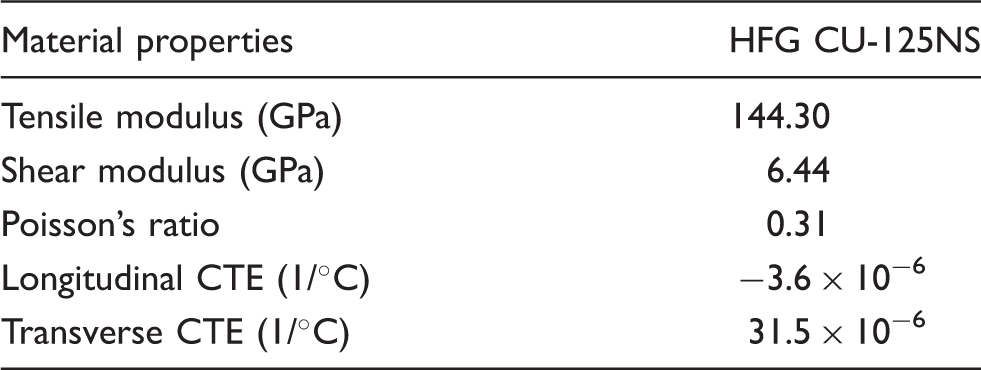
Mechanical and thermal properties of graphite/epoxy composites at 25℃. 19
Problem formulation
Residual stress calculation
Residual stresses in macroscopic level can be estimated by CLPT.
14
This theory has been employed to calculate the residual stresses during thermal cycling process of the carbon/epoxy composite. In the PMCs, fibers have much lower CTE in comparison to the matrix. Also, the matrix has more contraction during the curing process. Therefore, in cross-ply laminates, a compressive residual stress in longitudinal direction and a tensile residual stress in transverse direction are generated. Thermal forces and moment resultants are defined as A multi-layer polymer composite plate.


In order to calculate the residual strain of the kth layer, equation (4) is proposed. After that the residual stress of the kth layer of PMCs can be obtained as follows
23

in which
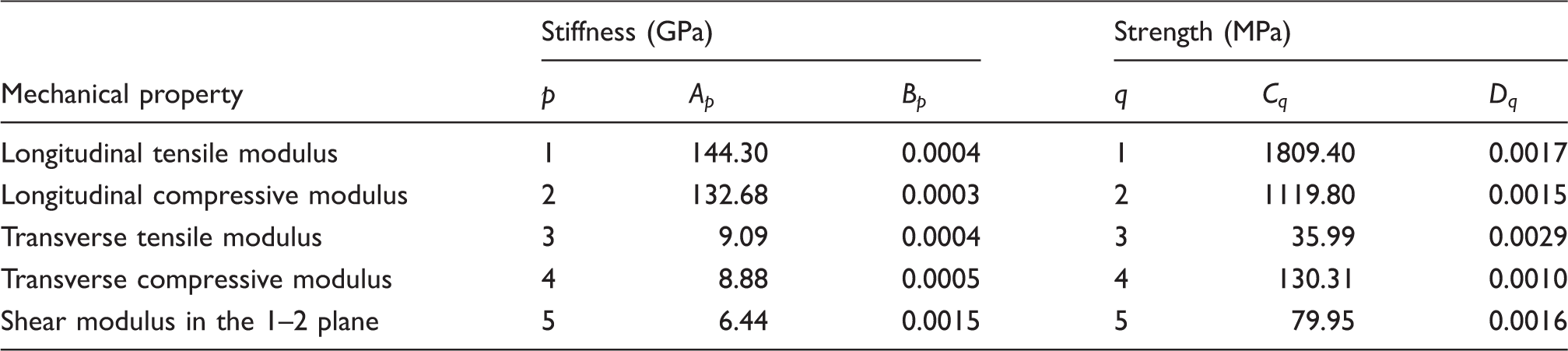
Mechanical properties

Exposure constants
Thermal properties
The CTE can play an important role in determination of residual tensile stresses, hence an accurate prediction of CTEs during thermal cycling would be important. Available experimental results 19 have shown that the longitudinal and transverse CTE of composites change as a function of temperature and thermal cycles.
There are a number of experiments available which have been designed based on the Taguchi method and that have analyzed the influence of various parameters such as the lay-up, number of thermal cycles and weight fraction of fibers on the mechanical properties.8–10 The mechanical properties of specimens are obtained using the tensile test before and after the thermal cycling load. Also, a regression analysis was developed for modeling the mechanical properties using the effective factors. Finally, sensitivity analysis of the effective factors was studied to describe the relationship between these parameters. 10

CTE constants.

Figure 3 shows variation of longitudinal and transverse CTE in terms of temperature for various number of thermal cycles. As it is shown in this figure, the CTEs of composites decrease with increase of thermal cycles. The reduction in CTE is caused by matrix loss due to thermal cycles. Since the fiber has a lower CTE than the matrix, the increase in fiber volume fraction leads to a reduction in the CTEs of the composite.
19
(a) Variation of longitudinal CTE of the graphite/epoxy composite under thermal cycling conditions. (b) Variation of transverse CTE of the graphite/epoxy composite under thermal cycling conditions.
Modified failure criteria
In order to predict the failure cycle of composites induced by thermal cycling, different modified failure methods are used. In this study, Tsai–Wu failure criterion is employed to analyze the failure of composites under thermal cycling condition. This criterion is one of the most commonly used criteria, and also often a better prediction method than some phenomenological criteria.
From equation (5), five fundamental strengths can be expressed as a function of number of thermal cycles as


From equations (8) and (9), the modified Tsai–Wu failure criterion can be presented as follows

Solution procedure
The algorithm of residual stress calculation is presented in Figure 4. As you see in this figure, the procedure of calculation consists of four boxes (Thermal cycling, Geometry and layup design, Residual stresses calculation, and the modified Tsai-Wu failure criterion (Failure calculation)).
The algorithm of residual stresses and failure calculation of PMCs under thermal cycling condition.
In thermal cycling box, thermal profile function and curing properties of composite (such as free stress temperature and
Subsequently, residual stress of the lamina at different temperatures and number of thermal cycles are obtained in residual stress calculation box. Finally, due to degradation of strength properties of PMCs, failure index of the lamina is calculated by using modified Tsai-Wu failure criterion in the fourth box.
A subroutine has been developed in MATLAB commercial software to implement the residual stress and failure calculation procedure which was described above (Figure 4).
Results and discussion
Validation
In this step, our study is validated with an available research
19
that predicted the failure cycle of HFG CU-125NS graphite/epoxy composites exposed to the LEO environmental factors with a stacking sequence 
Macro stresses of symmetric On-axis stress validation in each ply of the 
Residual stress analysis
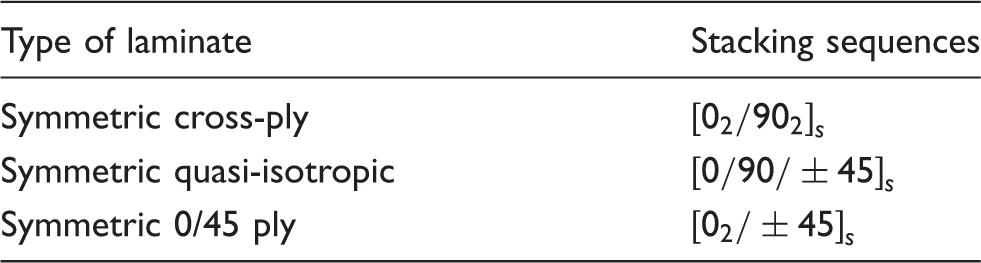
Different stacking sequences as the case studies.
Comparison of residual stresses
Residual stresses of each layer of different laminates (at room temperature) are compared and shown in Figure 6. Part (a) shows the normal residual stresses of each layer. As shown in this figure, (a) Normal residual stresses of different stacking sequences at room temperature. (b) Transverse residual stresses of different stacking sequences at room temperature. (c) Shear residual stresses of different stacking sequences at room temperature.
In part (b), transverse residual stresses of different stacking sequences are compared. As shown in this figure, the
Part (c) shows shear residual stresses of different stacking sequences. As shown in this figure, the
The influence of temperature on the residual stresses
Different layers of three types of laminate were analyzed in the previous part and it was clarified that the first layer of the
Figure 7 depicts off-axis residual stresses of each stacking sequences in terms of temperature. It is necessary to notice that in this step, there is no thermal cycling effect and residual stresses have been compared before composites are subjected to thermal cycling conditions.
(a) Residual stresses of the first ply of the 
All these three figures illustrate that with increase of temperature, the value of residual stresses decreases.
The influence of thermal cycles on the residual stresses
In continuation of previous studies, the influence of thermal cycling on the residual stress of polymer matrix composites is investigated. For this purpose, the number of thermal cycles is considered between N = 0 and N = 200 cycles under the similar thermal cycling profile. The most critical layer of each stacking sequence is chosen and residual stresses are calculated and shown in Figure 8.
(a) Normal residual stress of the first ply of the 
As shown in parts (a) and (b), normal and shear residual stresses are similar in the first ply of the
Failure analysis
A parametric study is conducted in this section to analyze the failure of different composite laminates, with a particular focus on the effects of the temperature and thermal cycles.
Comparison of different laminates
The failure index of different composite laminates was calculated using the modified Tsai-Wu failure criterion (equation (10)) and is presented in graphical form in Figure 9. As shown in this figure, the failure indexes of both cross-ply and quasi-isotropic laminates are similar. The minimum and maximum failure indices of these laminates are 0.28 and 0.44, respectively. The failure index of the Failure index of different laminates.
Investigation of the failure surface
Figure 10 shows the comparison of the failure surface and normal residual stress of the Comparison of the failure surface and normal on-axis stress of the first ply of the 
The influence of temperature and thermal cycles on the failure index
Figure 11 shows the variation of failure index as a function of temperature and thermal cycles for different composite laminates. As shown in these figures, failure index decreases with the increase of temperature. It is also concluded that the failure index of composites increases linearly as the number of thermal cycles increases. The lowest amount of the failure index is observed when there is no thermal cycle (N = 0).
(a) Failure index of the
Conclusion
The residual stress and failure index of three different composite laminates have been investigated in this paper within the framework of the classical laminate plate theory. A novel algorithm was presented to calculate the residual stress of composites under thermal cycling conditions. Different layers of each composite laminate were checked and the most critical ones were chosen to study. Then the modified Tsai-Wu failure criterion was employed to analyze the failure of different symmetric composites subjected to thermal cycles. Based on the investigation of the effects of the temperature and thermal cycles, the following conclusions can be made.
Residual stress
Residual stresses of the composites decrease with the increase of the number of thermal cycles. The value of residual stress at each step of the thermal cycle process highly depends on the initial residual stresses and layups. The numerical results showed that each cycle leads to almost 0.28% reduction of residual stress in the cross-ply stacking sequence of
Failure index
Failure index decreases with the increase of the temperature. The
Footnotes
Declaration of Conflicting Interests
The author(s) declared no potential conflicts of interest with respect to the research, authorship, and/or publication of this article.
Funding
The author(s) disclosed receipt of the following financial support for the research, authorship, and/or publication of this article: The authors are grateful to the University of Kashan for supporting this work (grant no. 785401/05).