






Abstract
Mg–SiC nanocomposite samples were fabricated using split Hopkinson pressure bar for different SiC volume fractions and under different temperature conditions. The microstructures and mechanical properties of the samples including microhardness and stress–strain curves were captured from quasi-static and dynamic tests carried out using Instron and split Hopkinson pressure bar, respectively. Nanocomposites were produced by hot and high-rate compaction method using split Hopkinson pressure bar. Temperature also significantly affects relative density and can lead to 2.5% increase in density. Adding SiC-reinforcing particles to samples increased their Vickers microhardness from 46 VH to 68 VH (45% increase) depending on the compaction temperature. X-ray diffraction analysis showed that by increasing temperature from 25℃ to 450℃, the Mg crystallite size increases from 37 nm to 72 nm and decreases the lattice strain from 45% to 30%. In quasi-static tests, the ultimate compressive strength for the compaction temperature of 450℃ was improved from 123% for Mg–0 vol.% SiC to 200% for the Mg–10 vol.% SiC samples compared with those of the compaction at room temperature. In dynamic tests, the ultimate strength for Mg–10 vol.% SiC sample compacted at high strain rate increased remarkably by 110% compared with that for Mg–0 vol.% SiC sample compacted at low strain rate.
Keywords
Introduction
Mg and its alloys are among lightest metals with special properties such as high specific strength. Due to low weight of Mg and its effects on reducing the fuel consumption in vehicles and consequently reducing the environmental pollutions, it has gained wide application in automobile and aerospace industries. However, due to its low strength, wear, corrosion resistance, and melting temperature, pure Mg cannot be used in cutting-edge industrial applications such as engine block in car manufacturing industry. 1 These shortcomings can be overcome to some extent by using Mg–matrix composites and nanocomposites instead of pure Mg. Mg-based composites which use ceramic materials to reinforce Mg not only show improved mechanical properties but also resist high temperatures. Various studies show that using Mg-based nanocomposites with ceramic nanoparticles reinforcement can improve Mg's mechanical properties. 2 Ceramic nanoparticles such as SiC, Al2O3, B4C, and TiB2 have attracted more attention due to their superiority to other nanoparticles. Among these nanoparticles, SiC has gained more application in Mg-nanocomposites fabrication. 2 Production of nanocomposites using powder metallurgy (PM) methods is relatively simple and has extensively been used in the investigations.3–5 Nanocomposite materials can also be produced through dynamic methods or consolidation using shockwaves and high-velocity compaction methods. The main advantage of these methods is that usually (though not always) sintering which is normally an important step in PM methods is eliminated from the production cycle. High-velocity compaction methods usually use explosions or high-pressure gases to accelerate a projectile or the impact of a drop hammer (DH) to compact the mixed powders. The weight of DH varies between 5 kg and 1200 kg with the velocities ranging from 2 m/s to 30 m/s. 6
Dynamic compaction processes induce high temperature necessary for local sintering, which enables local metallurgical bindings between particles while keeping the other parts of the powder relatively cold. Consequently, high rate consolidation techniques minimize the microstructural changes such as particles agglomeration and microstructure growth which usually occur at elevated temperatures.7,8 Faruqui et al. 9 used the shockwave produced by an explosion for compaction of Mg–SiC powders and fabricated samples with 98–99% of theoretical density and investigated their microstructures. Majzoobi et al.10,11 and Majzoobi et al. 12 and Atrian et al. 13 also used dynamic equipment for compaction of Mg–SiC powder samples with different SiC nanoparticle volume fraction.
The current investigation is part of an extensive investigation for improving the mechanical response of Mg–SiC nanocomposites using different compaction techniques and different test conditions such as elevated temperatures. The first part of the investigation 14 dealt with production of the nanocomposite samples using DH testing device at different temperatures. The second part of the investigation 15 was related to fabrication of the nanocomposites using Hopkinson bar testing apparatus at a single temperature. The main objective of this work is to study the effect of compaction temperature on density, microhardness, and compaction behavior of samples produced by high-rate consolidation technique using a split Hopkinson pressure bar (SHPB). In addition, the compressive flow stress of the fabricated samples under both the quasi-static and dynamic loadings is studied.
Materials and methods
Materials
In this study, Mg powder with purity of 99.5% with particle size of 100 μm (regular morphology) was used as matrix and SiC powder with purity of 99% and particle size of 75 nm (spherical morphology) was used as reinforcing phase. Further information can be found in Majzoobi et al. 14 and Rahmani et al. 15
Fabrication of Mg–SiC nanocomposite
The experimental design.

Simulation of compaction process
In order to properly set up the components and initialization of SHPB parameters, it was necessary to estimate the stress induced in the sample during the impact. In this regard, finite element (FE) analysis of the compaction process was performed using Autodyn commercial FE code. More details about FE simulation are described in Rahmani et al.
15
FE analysis showed that maximum stress applied to the punch in SHPB was around 2.2 GPa. This stress has been shown to be enough to fuse the powder particles together or to cause cold sintering.
16
In order to establish the relation between the striker velocity and the compressed air inside the gun's reservoir and fluid dynamics, the Hopkinson bar was simulated using AUTODYN/EXPLICIT software (Figure 1). The simulations were performed using axial symmetric conditions and at 25℃. The reservoir, launch tube, and the projectile were considered in the simulations. Using the Eulerian and Lagrangian Algorithm (ALE) and elements the solid–fluid transactional behavior was investigated in the simulation of the gas gun. ALE method was used for free movement and border conditions.
17
In this regard, the reservoir and tube were modeled as Eulerian elements, which can easily simulate the fluid dynamic process. On the other hand, Lagrangian elements were used for modeling the projectile and calculation of velocity and solid parameters such as stress and strain. The number of elements used in simulation proved to be sufficient for convergence of the results.
2D axisymmetric model in AUTODYN for simulation of fluid dynamics.
In order to examine the validity and accuracy of the FE model, the numerical and the experimental results were compared. To this end, the simulations were performed for four pressures of 10, 20, 30, and 40 bar and the projectile velocity was computed. Figure 2 shows the variation of the projectile speed versus the reservoir pressure. As the figure suggests, a reasonable agreement is seen between the numerical and experimental results. The difference is due to assumption of ideal gas and negligible fluid viscosity and post pressure forces in the simulations.
Variation of projectile velocity versus vessel pressure.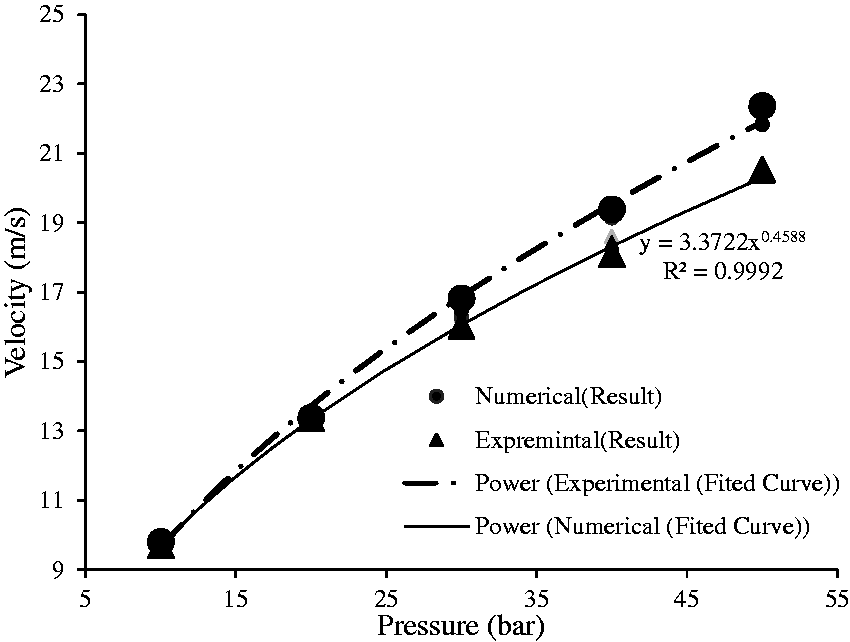
Nanocomposite characterization
The microstructure and the surface quality of the compacted samples were examined using optical and scanning electron microscopy (SEM). The samples were polished before the examination. Sample density was calculated using Archimedes' principle.
18
The microhardness tests were conducted according to ASTM E384-99.
19
The Vickers hardness tests were carried out at six points of samples (three on the top and three on the bottom surfaces) using a tetragonal indenter with a weight of 100 g for 15 s. In order to determine the compaction behavior of samples, the low strain rate (around
Results and discussion
X-ray diffraction examinations
Figure 3 shows the X-ray diffraction (XRD) patterns of Mg–3 vol.% SiC nanocomposite samples produced using dynamic compaction at different temperatures. The patterns show that despite high temperature, no new phase has been created after compaction. Williamson–Hall method was employed to separate the effects of crystallite and strain.
20
More details about W–H analysis and the computational procedure can be found in Rahmani et al.
15
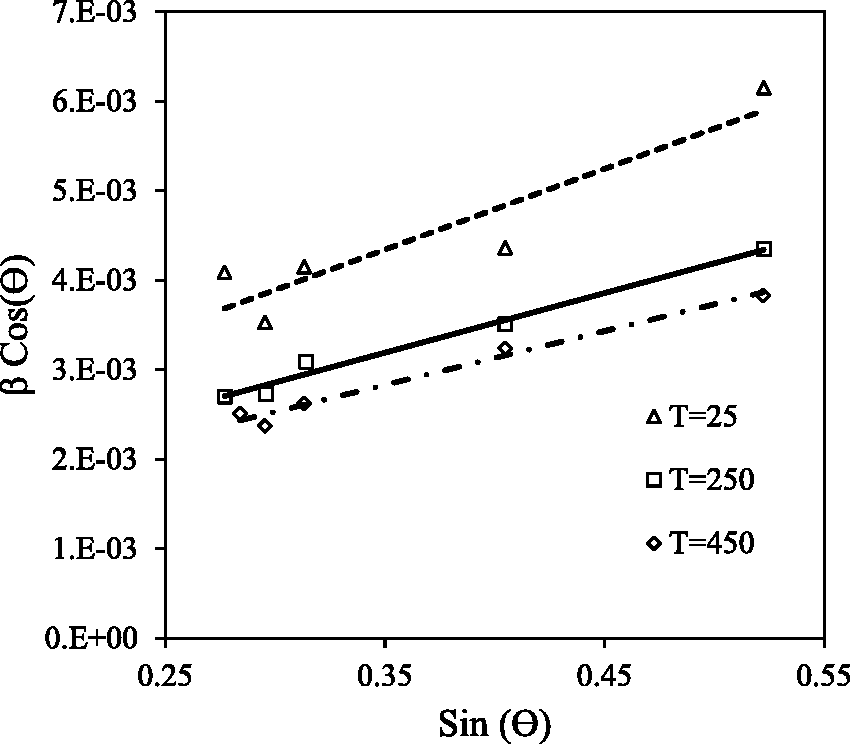
The Williamson–Hall curves of samples whose XRD patterns were presented in Figure 3 are shown in Figure 4. According to the figure, the crystallite size has increased from 37 nm to 72 nm with the temperature increase from 25℃ to 450℃. Lattice strain also has decreased from 0.45 to 0.30. This behavior can be due to increase in grain size as a result of increase in temperature.
21
Majzoobi et al.
14
reported similar behaviors in Mg–SiC nanocomposites prepared using hot dynamic compaction method. They attributed this increase to lower degree of precipitation.
XRD pattern of dynamically compacted pure Mg and Mg–3 vol.% SiC nanocomposites at different temperature. Williamson–Hall plots of dynamically compacted Mg−3 vol.% SiC nanocomposites with various fractions SiC reinforcement at 25℃, 250℃, and 450℃.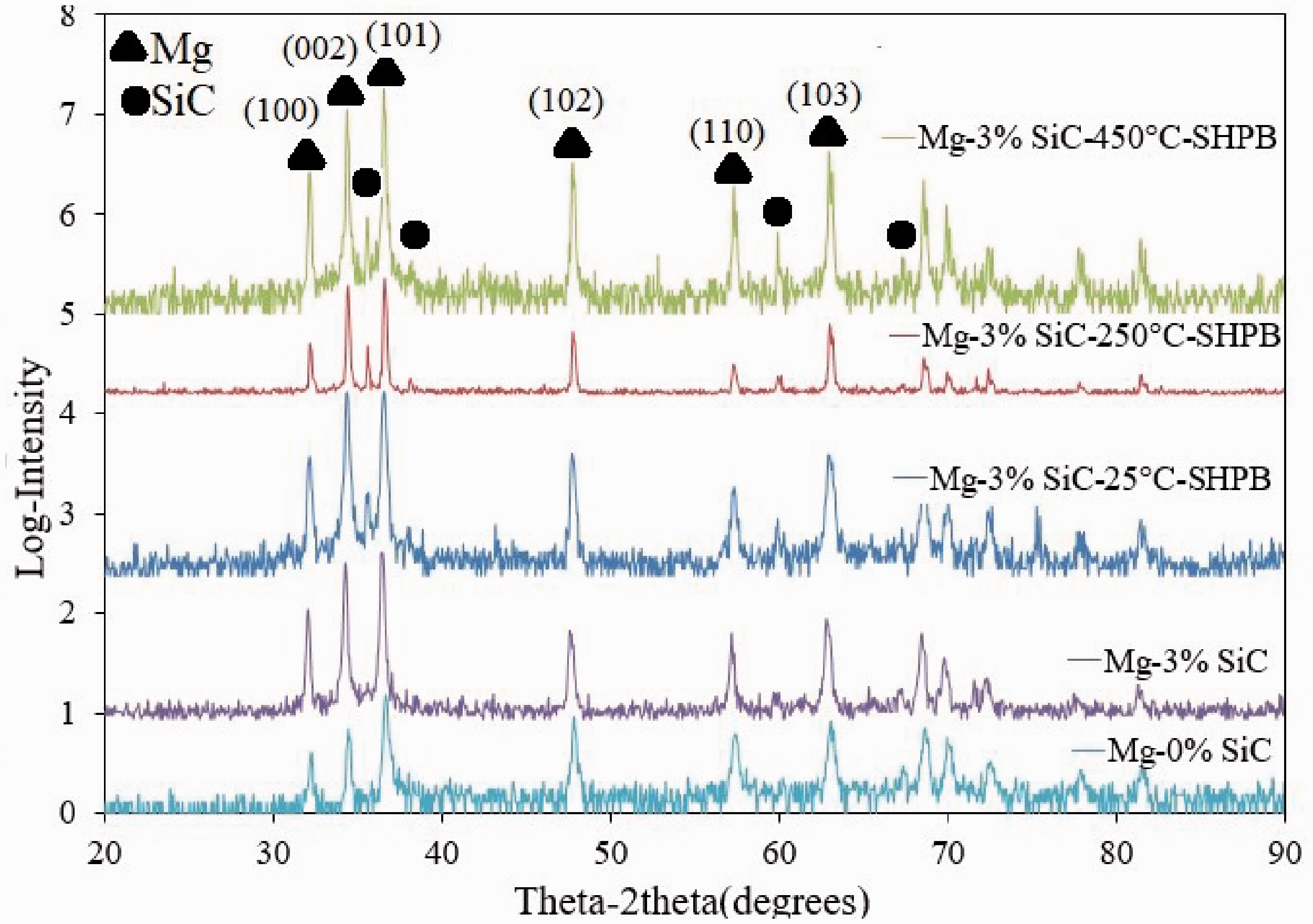
Microstructural investigation
Figure 5 shows the SEM images of samples fabricated at 450℃ for SiC volume fractions of 3% using drop hammer (DH) and SHPB devices. The figure clearly illustrates large pores created due to defective compaction and imperfect sintering in DH samples. The SEM images shown in Figure 5 indicate that the pores in SHPB specimens are less populated than those in DH samples. Goh et al.
22
and Seetharaman et al.
23
reported similar results for the composites they used in their investigations. The porosity observed in SEM images agrees well with the trend of the relative density measurements. The higher relative density in SHPB samples can be due to (1) the effect of high compaction impact loading and (2) the energy created due to friction and adiabatic heating of powder particles.
SEM micrographs of Mg–3 vol.% SiC dynamically compacted by (a) SHPB and (b) DH (drop hammer).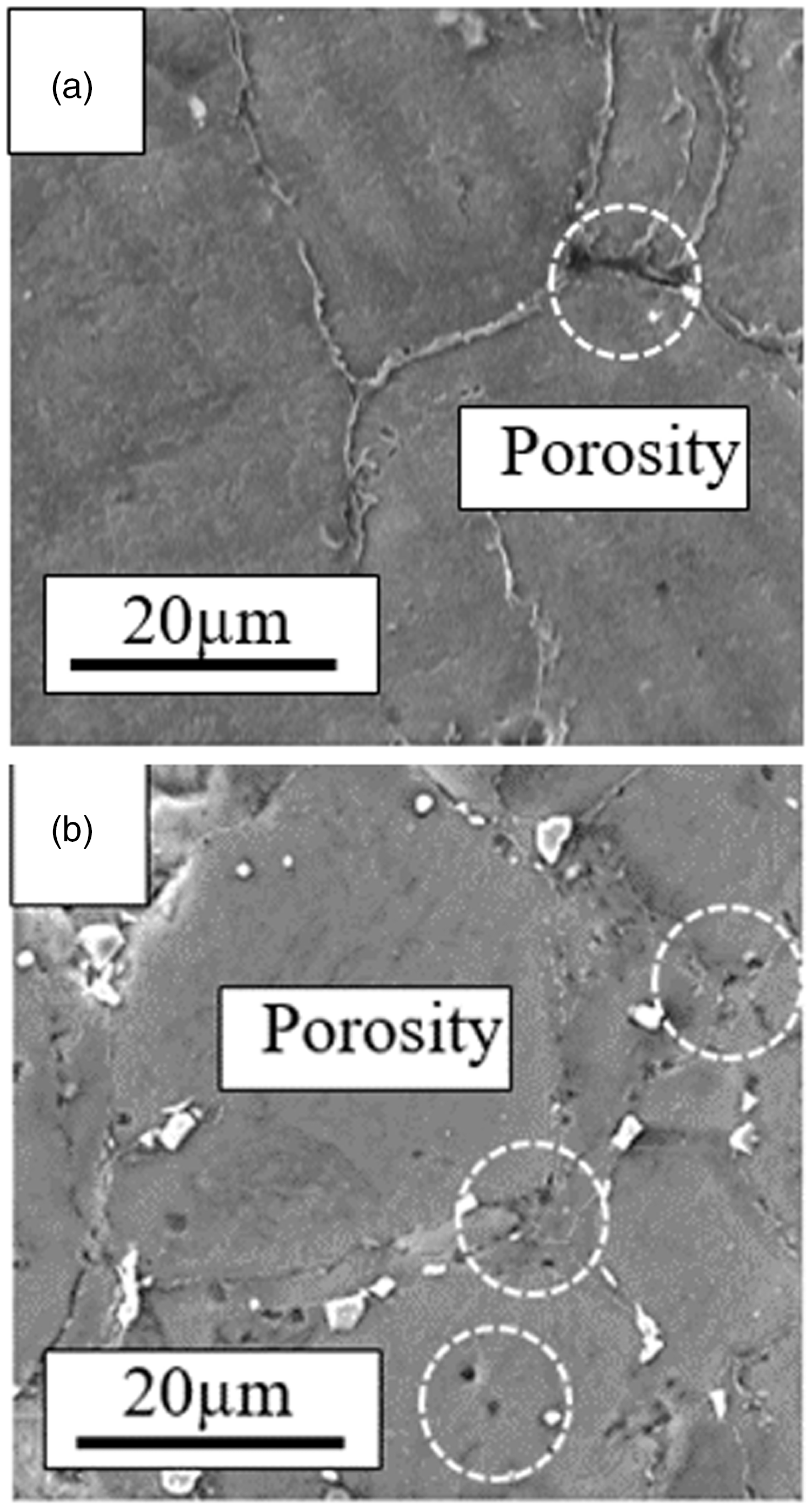
Figure 6 shows the SEM images of SiC nanoparticles at the borders of two Mg particles. The X-ray map of SiC particles illustrated in Figure 6(b) shows more uniform distribution of SiC particles compared to Mg particles and their agglomeration in triple grain boundaries. The Energy-dispersive X-ray spectroscopy (EDS) point analysis shown in Figure 6(c) reveals that particles distributed at the boundary of Mg are SiC nanoparticles. These hard nanoparticles prevent full bonding of Mg particles and cause porosity in the samples. The reduction in relative density due to the increase in volume fraction of reinforcing particles has been reported in the literature.14,15
EDS point analysis of the region around the SiC particle shown by the circle in X-ray maps of SiC particles.
Density
Archimedes' principle was employed to measure the density which is a suitable benchmark to evaluate the powder compaction quality. Variation of relative density versus temperature and nanoparticle content is shown in Figure 7. As can be seen, temperature and nanoparticle content have opposite effects on relative compaction. While density increases at higher compaction temperatures, the increase in nanoparticle content gives rise to the density reduction. The reason is that at higher temperatures, powder's hardness and yield strength decreases and as a result the compressibility of the powder increases.
24
On the other hand, adding SiC particles increases hardness and strength of nanocomposite which leads to reduced relative compaction and increased porosity.
25
Iwaoka and Nakamura
26
stated that with the increase in compaction, porosity of samples decreases. As can be seen, by increasing the temperature from room temperature to 450℃, relative density for Mg–SiC samples with 10 vol.% of SiC increases by 2%. In dynamic compaction, the transferred energy leads to high instantaneous pressure rise in power. This results in an adiabatic process in which heat created due to pressure doesn't have enough time to dissipate and consequently results in increased local temperature in powder and softening of powder particles.
6
This internal heat leads to increased plastic deformation of particles and local welding and sintering specially at higher temperatures.
Variations of relative densities against SiC content for three temperatures.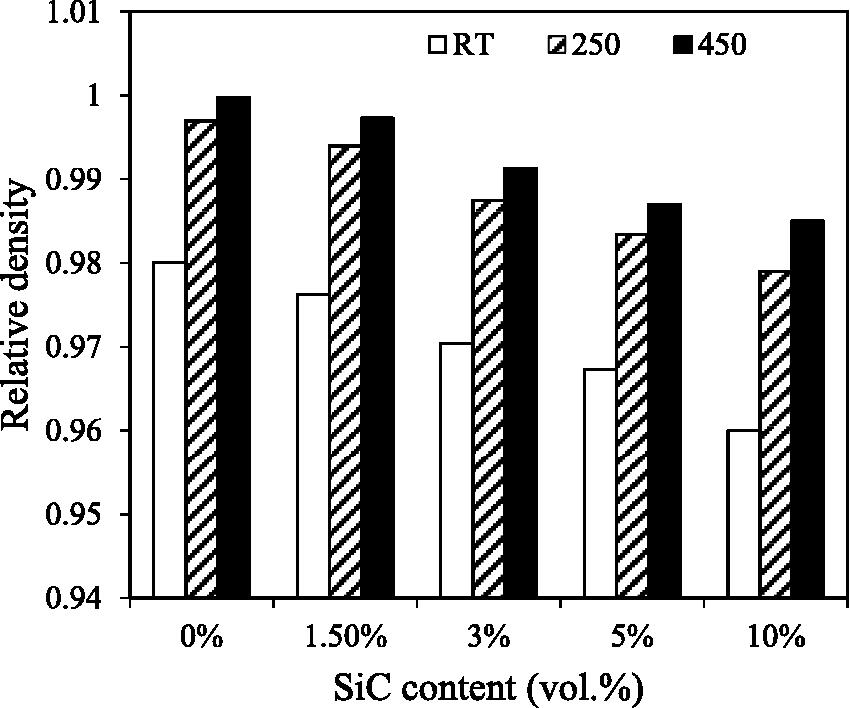
Goh et al.
27
and Seetharaman et al.
23
reported similar results in their investigation. The results of the current study show that when using dynamic compaction process, relative compaction only changes by 2% for the samples compacted at 450℃. SEM images of samples presented in Figure 8 show the porosity at different temperatures. It is worth noting that samples compacted at lower temperatures have pores with sharp points which are not fully sintered (Figure 8(c)) while at higher temperatures (Figure 8(a)), the grain boundaries are welded together and the number of observed pores decreases.
Temperature effect on the microstructure of dynamically compacted specimens of Mg–0 vol.% SiC fabricated by SHPB at (a) T = 450℃ (ρRel = 99.9%), (b) T = 250℃ (ρRel = 99.2%), and (c) T = 25℃ (ρRel = 98.1%).
Vickers microhardness
The results of Vickers microhardness measurement for different SiC volume fractions and different temperatures presented in Figure 9 show increase of 18%, 31%, and 45% in microhardness of Mg–10 vol.% SiC samples prepared at 25℃, 250℃, and 450℃, respectively. As can be seen, SiC reinforcement increases Vickers hardness especially at higher temperatures. Higher temperatures lead to disappearance of spaces between powder particles and full sintering.
26
This improvement can also be due to uniform distribution of reinforcing nanoparticles.
28
The improvement in microhardness can also be due to hardness of nanosized SiC-reinforcing particles, which limits the local deformation during compression (hardening effects of SiC nanoparticles).12,29 Similar behaviors have been reported by Tun
30
and Rahmani et al.
15
The hardness of the samples produced using SHPB is due to the improved bonding explained in Density section and described by Yi et al.
6
The variation of hardness values with SiC nano-particles for samples compacted at different temperatures.
Quasi-static compressive test
Compression tests were carried out at the crosshead speed of 1 mm/min and at room temperature, using a Santam testing equipment. The engineering stress–strain curves of the samples prepared at room temperature are shown in Figure 10. As can be seen, reinforcing Mg matrix with SiC particles improves the ultimate compression strength by around 30% and reduces the elongation by 14%. The quasi-static compressive properties of the fabricated samples at different temperatures are given in Table 2. Substantial improvement in compressive yield stress (CYS), ultimate compressive strength (UCS), and toughness of the compacted samples can be seen in the Table 2.
Quasi-static compressive stress–strain curves of dynamically compacted sample at 25℃. Quasi-static compressive properties of fabricated samples at different temperatures. CYS: compressive yield stress; UCS: ultimate compressive strength.
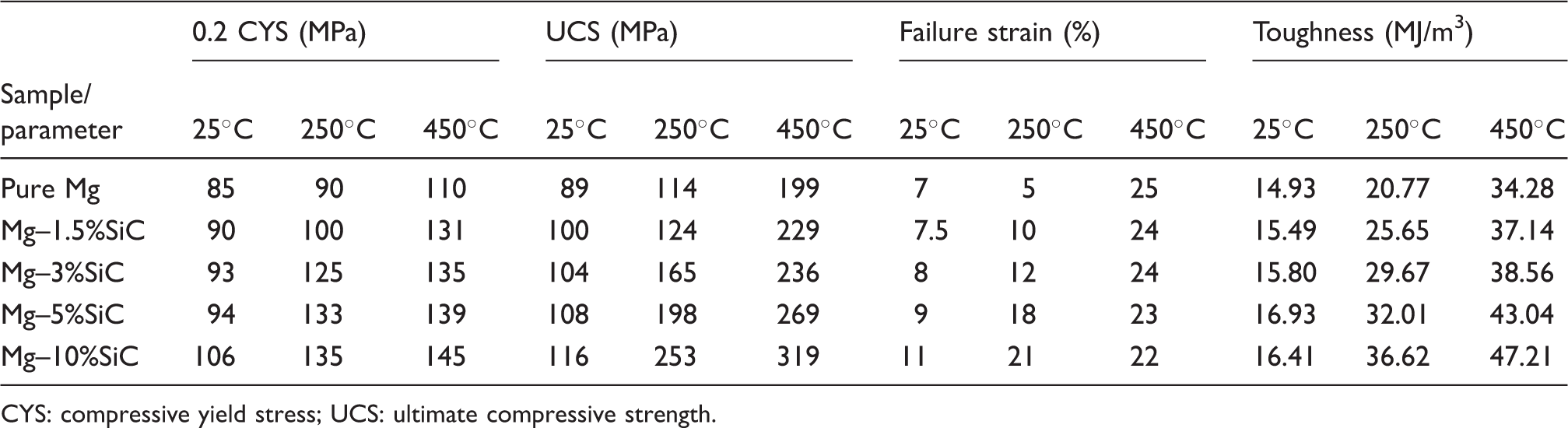
Figure 11 shows the effect of compaction temperature on compression strength of Mg–10 vol.% SiC samples. It is clear from the figure that the compaction temperature of 450℃ has significantly increased the samples' UCS and elongation by 175% and 200%, respectively. Variation of UCS versus SiC contents for different temperatures is shown in Figure 12. As can be seen, the UCS for the compaction temperature of 450℃ has improved from 123% for Mg–0 vol.% SiC to 200% for Mg–10 vol.% SiC samples compared with those of the compaction at room temperature. This improvement can be due to better sintering quality of samples at higher temperatures which was discussed in the previous sections.
The effect of compaction temperature on quasi-static compressive flow stress of Mg–10 vol.% SiC nanocomposite. Quasi-static ultimate compressive strength (UCS) of dynamically compacted sample at different temperatures.

The increase in UCS of nanocomposites can be due to (a) Orowan strengthening due to presence of SiC nanoparticles,
12
(b) mismatch between coefficient of thermal expansion (CTE) of Mg
Dynamic compressive test
The stress–strain curves of dynamically compacted samples at 450℃ temperature and the strain rate of Dynamic compressive stress–strain curves (strain rate Variation of ultimate compressive strength versus SiC content for two strain rates of 

Variation of UCS versus SiC content for two strain rates of 0.008/s and rate 1600/s is shown in Figure 15. As it is observed, the effect of strain rate on the compacted samples is more profound than the effect of SiC content. As the figure shows, if the variation for each strain rate is considered separately, the strength improvement is around 30% depending on the SiC content level. This improvement, however, is between 70% and 110% depending on the SiC content level, when the effect of strain rate is also considered in the comparison. The maximum improvement is obtained for Mg–10% SiC compacted at high strain rate.
Variation of ultimate compressive strength versus SiC content under two strain rates of 0.008/s and rate 1600/s.
A comparison between the maxima of the quantities obtained from split Hopkinson pressure bar (SHPB) and drop hammer (DH) tests.

CYS: compressive yield stress; UCS: ultimate compressive strength.
Conclusion
The following conclusions can be reached based on the results of this study:
Mg–SiC nanocomposites were successfully produced at different temperatures using SHPB. Temperature also significantly affects relative density and can lead to 2.5% increase in density. Adding SiC-reinforcing particles to samples increased their Vickers microhardness from 46 HV to 68 HV (45% increase) depending on the compaction temperature. Higher increase was obtained for higher temperatures. XRD analysis showed that by increasing temperature from 25℃ to 450℃, the Mg crystallite size increases from 37 nm to 72 nm and decreases the lattice strain from 45% to 30%. In quasi-static tests, the UCS for the compaction temperature of 450℃ was improved from 123% for Mg–0 vol.% SiC to 200% for the Mg–10 vol.% SiC samples compared with those of the compaction at room temperature. In dynamic tests, the ultimate strength for Mg–10 vol.% SiC sample compacted at high strain rate increased remarkably by 110% compared with that for Mg–0 vol.% SiC sample compacted at low strain rate.
Footnotes
Data availability
The raw/processed data required to reproduce these findings cannot be shared at this time as the data also forms part of an ongoing study.
Declaration of Conflicting Interests
The author(s) declared no potential conflicts of interest with respect to the research, authorship, and/or publication of this article.
Funding
The author(s) received no financial support for the research, authorship, and/or publication of this article.