






Abstract
Glass fiber reinforced polyester composites are economic and high-performance composite materialsthat has gained a wide range of applications. Besides the developments in composites design, scientific studies addressing the consequences of thermal changes on the mechanical properties of fiber reinforced polymer composites(FRPCs) are scarce. Therefore, the main aim of the present work is to investigate the physical/mechanical properties of glass fiber reinforced polyester composites under thermal shocks. The effects of thermal cycle duration (2, 5 and 20 hours) on the porosity and mechanical properties (maximum stress, strain, elastic modulus and impact resistance) of polymeric composites reinforced by glass fiber, woven fabric and copper/silica nanoparticles (NPs) were investigated. The results exhibited that the porosity and mechanical properties changed obviously in long duration cycles, i.e., 20 hours. Major reduction trends were observed when the fabric reinforced samples were further reinforced by NPs. It was concluded that although NPs reduce porosity and pose filling effect in composite matrix, can also provide stress concentration locations. The composites reinforced by woven fabric and prepared by RTM method provide better mechanical properties. Moreover, after thermal shocks, the fibers within the composite structure formed curved shapes. Consequently, a reduction occurred at the elastic modulus of fibrous reinforced composites (fiber or fabric) after thermal cycles. Besides theelevated porositywas the predominant factor reducing elastic modulus, fiber deformation was also considered as a hidden factor which has never been discussed in previous research studies. A model of bicomponent structure was used to explain the effects of fiber deformation on elastic modulus of the FRPCs.
Keywords
Introduction
Polymeric composites are widely used in aviation crafts, marine vehicles, electronic devices, medical equipmentand construction materials. 1 For almost all applications, the final performance strongly depends on the appropriate combination of polymeric matrix and the reinforcing phase. 2 Accordingly, efforts have been pursued inproviding reliable materials to meet high mechanical properties,3,4 physical stability, 5 thermal stability 6 and cost effectiveness. 7
In a composite structure, the matrix material is responsible to withstand environmental degradations 8 and uniformly distribute loads between the reinforcing materials. 9 Recently, Vasavi et al. provided a critical review on erosion resistance of polymeric composites 10 indicating their potential applications in novel fields.In polymeric composites, the matrix phase consists of a polymeric resin such as polyester, 11 vinyl ester 12 and epoxy. 13 Among the commonly used materials, polyester is the most promising resin due to the ease of manufacturing and cost effectiveness. 11 On the other hand, appropriate reinforcements contribute to efficiently strengthenthe composites by adjusting stresses, balancing loadsor preventing crack propagation. 14 Many researchers have dedicated considerable efforts toimprove themechanical property of compositeswith employing various materials as reinforcements.Therefore, reinforcements with different properties and geometries, such as fibers, 15 particles 16 , 17 or fabrics 18 have been used.
Fiber reinforced polymer composites (FRPCs) include a wide range of polymer materials reinforced by various fibers such as glass, carbon, natural fibers and etc. 19 Many studies have focused on polyester composites reinforced by glass fibers 20 or fibrous structures containing glass fibers. 21 Recently, Rashid et al. used hybrid woven roving and chopped strand mat glass fabric as the polyester composite reinforcements. 22 Glass fibers pose good combination of mechanical properties,good toughness, high tensile strength, medium density and thermal stability. 23 E-glass fibers exhibit good stiffness, strength, electrical and weathering properties when being used as the reinforcing material. 24
Mehdikhani et al. provided a comprehensive review on void formation, characteristics, and effects on mechanical performance of FRPCs. 25 Besides the developments in design of fiber reinforced polymeric composites, only a few research studies have focused on investigating mechanical properties of polymeric composites reinforced by both fibers and nanoparticles. 26 Some types of nanoparticles such as nanoclay, 27 graphene oxide 28 and carbon nanotube 29 were previously investigated as the reinforcing material. Since high expansion metals (such as copper) tend to be rapidconductor of heatandceramics (such assilica)arethermally stable, the type of nanoparticles seems to affect the thermal properties of FRPCs. However, effects of nanoparticle type on the mechanical properties of FRPCs have not been investigated up to now. Furthermore, no much work is found based on investigating thermal changes effects on the mechanical property of nanoparticle/fiber reinforced polymeric composites.It is essential to note that, in many applications such as defense, marine, aviation, and automotive applications, the environmental conditions are not constant all the time. Therefore, FRPCs may be subjected to variable temperatures from hot to cold or vice versa, which is referred as thermal shocks. The unequal thermal expansion coefficients of the matrix and fibers cause considerable stresses growth in composite structure under thermal shocks. 30 Therefore, evaluating the physical and mechanical properties of FRPCs under thermal shocks is of great importance. Recently, Shettar et al. investigated the thermal shock effects on the properties of nanoclay-glass fiber reinforced epoxy composites. 31 There is no evidence in literature, to our knowledge, to investigate the mechanical/physical properties of polyester composites reinforced by glass fibers and nanoparticles under thermal shocks.On the other hand, previous research studies reported that in severe conditions debonding effect occurs between fiber and matrix.32,33 From literature, only limited studies have been conducted to point out fiber deformation aspects in elastic behavior of polymeric composites.
Considering the research gaps, the present work aims at investigating the physical/mechanical properties (porosity, elastic modulus, maximum stress/strain and impact resistance) of glass fiber reinforced polyester composites under thermal shocks. Effects of type of reinforcement such as nanoparticles (copper or silica), fibers or fabric and method of making composite (hand lay-up/Resin Transfer Method (RTM)) were also investigated. Furthermore, the present work provides a novel viewpoint to the effects of fiber deformation on the elastic modulus of composite after being exposed to thermal cycles which has never been discussed in previous research studies.
Materials and methods
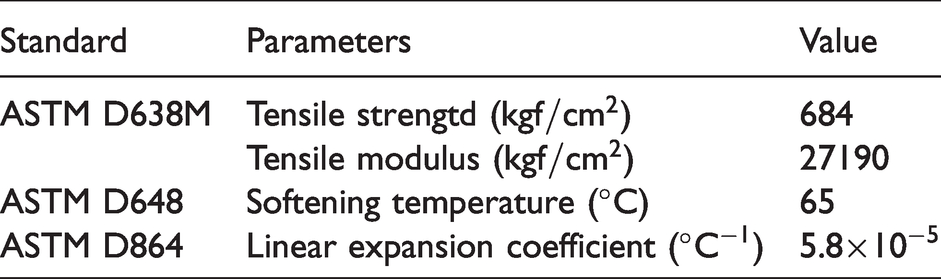
Polyester resin was purchased from Shell Chemical Co.The mechanicaland thermal properties of polyester resin were the same reported by Ref.18 as presented in Table 1. Methyl Ethyl Ketone Peroxide (hardener) andCobalt Naphthalate(accelerator) were purchasedfrom Vanticio AG (Switzerland) and Merck Co., respectively. 1%wt of Cobalt Naphthalate, 2%wt of Methyl Ethyl Ketone Peroxide and 97%wt of polyester resin were mixed uniformly to make the composite matrix.
The mechanical and thermal properties of polyester resin.
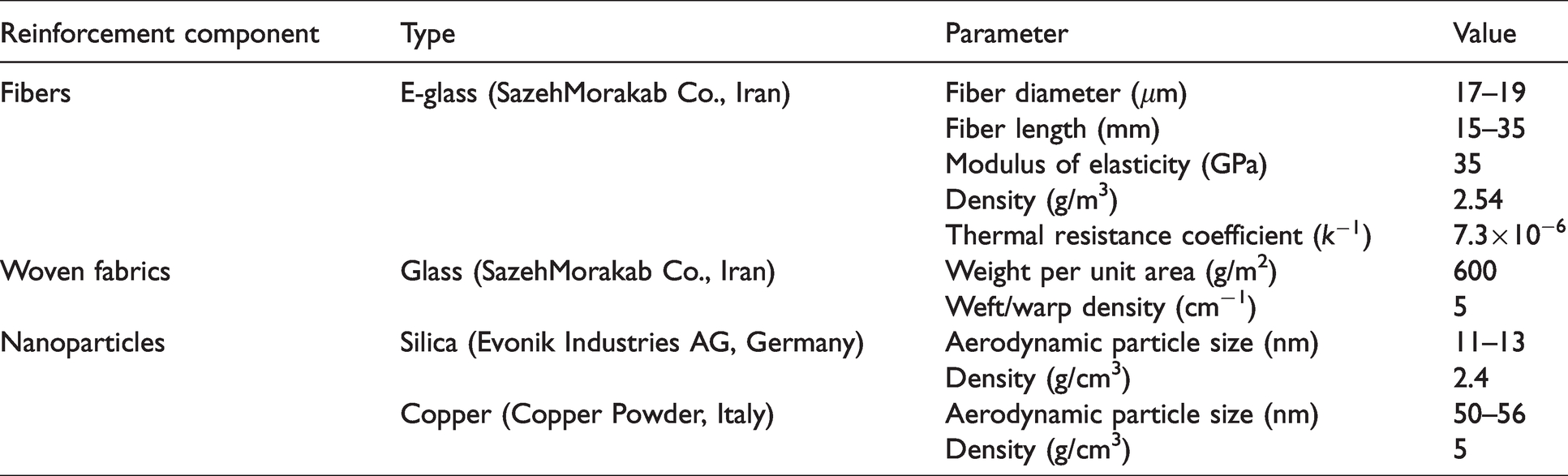
E-glass fibers, woven fabrics and nanoparticles,with the characteristics mentioned in Table 2, were used as the reinforcing components.
The characteristics of reinforcement components.
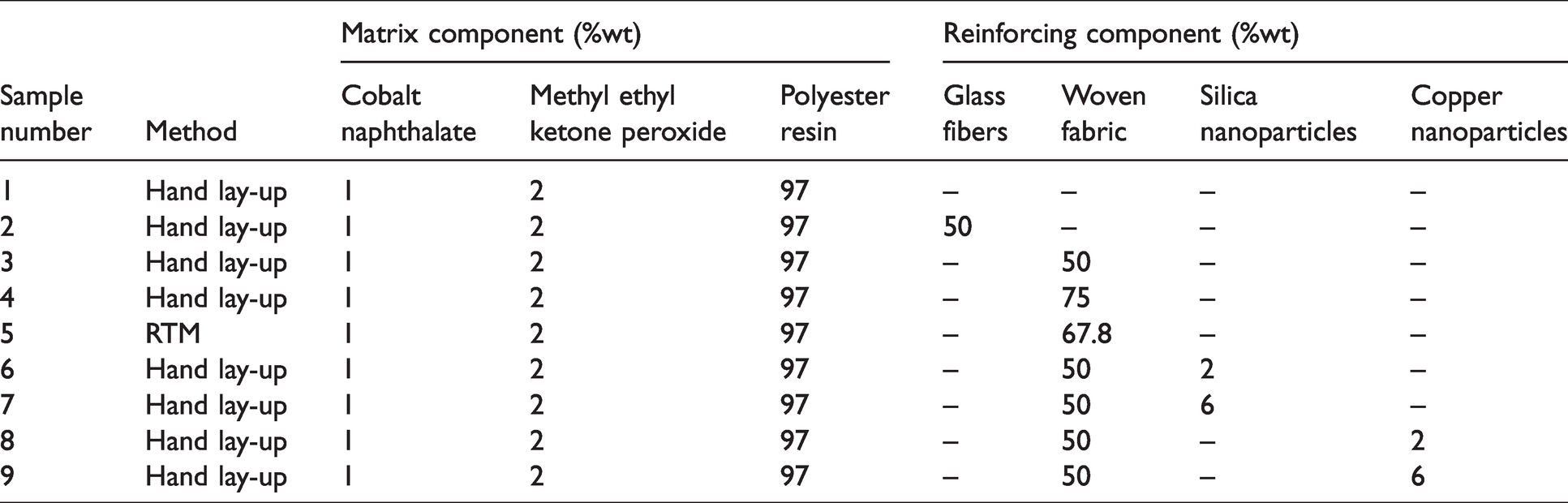
The composite samples were fabricated using two different methods of hand lay-up and Resin Transfer Molding (RTM) with various combinations of composite matrixand additives, as mentioned in Table 3. In fiber reinforced samples, the glass fibers were distributed randomly. In fabric reinforced samples, the warp and weft fibers were oriented in the 90° and 0° directions, respectively. The manufacturing steps in the hand lay-up method was conducted in the same way as explained by the previous study. 34 The prepared mixtures were evenly injected in the wooden melamine-coated molds (40 × 35 cm2). The reinforcing materials (fibers, fabrics or nanoparticles) were added to the mixture, and the mixture wascured at room temperature for 3 hours. Then, the samples were taken out of the molds with the lateral thickness of 4.53 mm. In the case of nanoparticle reinforcements, all the components except the hardener were mixed by an electronic stirrer (RZR 2102) with rotational speed of 200 rpm for 3 hours and then the hardener was added. Afterwards, the mixture was cured for the next 3 hours at room temperature. The final thickness of 4.58 mm was obtained.In RTM method, the manufacturing process steps were conducted in Alborz Co. (Montazerieh Industrial Zone, Isfahan) in the same way as explained by the previous work. 35 First, the woven fabricwas inserted in a mold. Then, the mold was closed and clamped shut before injecting the matrix mixture through a small hole while allowing the air to vent out through another hole. Therefore, in compare to the hand layup method, less excess air could be entrapped within the fiber/matrix interface with the aid of applied pressure during RTM processing. Afterwards, the mold was placed at room temperature for 8 hours and the sample was taken out. Finally, the thickness of 4.47 mm was observed. Each test was repeated 5 times and the average of observations was reported as the result of each specimen test.
Method of manufacturing and the composite components for each sample.
Dumbbell and rectangular shaped samples with specific mass fraction, were cut from the molded sheets by a computer numerical control (CNC: Jahanmachine Company, Tehran, Iran) device, according to ASTM D638 and ISO 179-2000, respectively, to perform tensile tests.
Thermal shock procedure
Thermal shocks occur in polymer composites during heating/cooling conditions as a result of the different thermal expansion coefficients in the reinforcing materials and the polymer matrix that influence the composite performance. Shimaz oven (model CO1409, Iran) and Vafaei freezer (model V413, Iran) were used to provide the warm (+60°C) and cold (−10°C) environment, respectively. In order to investigate the effects of thermal shocks on the physical and mechanical properties of the samples, 20 specimens of each sample were selected. 5 specimens of each sample were selected as the pristine samples that were not subjected to any thermal shocks. The other specimens were subjected tostatic and cyclic thermal conditions by keeping themin thewarm environmentfor a defined time (i.e., 2, 5 or 20 hours) and then immediately placing theminthe cold environment for the same time duration (i.e., 2, 5 or 20 hours). It means that, for instance, in a 20 hours cycle, 5 specimens of each sample were subjected to the warm condition for 20 hours and then subjected to the cold condition for 20 hours. Each cycle was repeated 4 times in each testwithout any delay time. In order to investigate the effects of thermal shocks on the physical and mechanical properties of the samples, the porosity, maximum stress, strain, elastic modulus and impact resistance of the samples were investigated through several tests.
Physical and mechanical tests
The weights and thicknesses of the samples were measured before and after subjecting to thermal cycles. The bulk volume can be calculated by
Tensile tests were performed by using Hounsfield-H50KS (UK) apparatus according to the standard test of ASTM D638. For fabric reinforced samples, the tensile tests were conducted in the warp direction. Regarding the relationship between engineering and true stress/strain values, the maximum tensile stresses/strains were calculated. The impact resistance was measured by using AMSLER-PW30/15K (Germany) apparatus according to the standard test of ISO 179-2000. Fiber deformations were observed by HEWLETT PACKARD PL22 equipped with a DS26311 Canon camera. Then, statistical analyses of observations were performed with the use of SPSS software. In order to compare the means, Tukey tests and Analyses of Variances were applied.
Theory of bimetallic thermostats
Timoshenko developed the theory of bi-metallic thermostats, 36 which can be used to explain the effect of fiber deformationson the composite strength under thermal shock conditions. Herein, it is assumed that a single fiber in the composite structure subjected to a thermal shock, can be considered as a bicomponent fiber. Since in the present work, temperature is the only variable that changes, there is reason to believe that any bending deformations in fibers is attributed to their bicomponent structures. Otherwise, straight fibers would remain straight under thermal strains. Herein, a composite strip is assumed as a representative volume element (RVE). According to the mechanics of bicomponent structures subjected to different strain states, axial loads and bending moments acting to the RVE provide a bending deformation to the fibers, as shown in Figure 1.

The fiber deformation from straight to curved in the RVE after temperature change.
It is assumed that there is no interfacial shear force between fiber and matrix. On the other words, the matrix completely surrounds the fiber and no slippage occurs between fiber and matrix. Consequently,since the RVE is subjected to a thermal load caused by a differential temperature, i.e., 



Substituting equation (4) into equation (1) gives
Rai et al. proposed a model to predict the tensile modulus of the composite reinforced by curved fibers.
38
As shown in Figure 2(a), in a x-y coordinate system, it is supposed that the path of a fiberembedded within the matrix followsthefunction of a half sinusoidal wave,which can be expressed by (a) The curved fiber and (b) the geometrical parameters in the curved fiber within the composite under tensile loads.


By differentiation of equation (6) and substituting into equation (7), yields
By geometrical analysis in Figure 2(b), following equation is derived

On the other hand, the induced strains at different axis orientations will be38,39 






In a composite structure reinforced by fibers, longitudinal orientation of fibers results in maximum tensile strength. When the maximum tensile stress is applied, the composite with straight fibers is subjected to the pure tension of 
For composites having curved fibers oriented along tensile force, the maximum strain is calculated by
The elastic modulus can be obtained by the following equation38,39 
By comparing equation (16) with equation (14), it is obvious that the maximum elastic modulus of composite structures reinforced by curved fibers is less than those reinforced by straight fibers. For this reason, together with the thermal debonding effects, thermal shocks cause a significant reduction in tensile strength of composites reinforced by fibers which was not considered in previous research studies.
Results and discussion
From themicroscopic observations in Figure 3, it was found that the flat configuration of the fibers in the composite structure would deform into a curved shape after being shocked by thermal stresses. Since with temperature change, such deformations are observed in bicomponent structures, the theory of bicomponent structures can be applied for the fibers within the composite matrix. The effects of thermal debonding, as mentioned in previous works40,41 together with the theory of bicomponent structures which was not considered in previous research studies, can successfully explain how the thermal shocks cause a significant reduction in tensile strength of composites reinforced by fibers.

The optical images of the fiber reinforced polymeric composite before and after being shocked by thermal stresses.
Porosity and density characterization
Weight measurements were obtained by an electronic scale with precision level of 0.01 g. The densities of the samples were estimated based on the weights and dimensions of the samples. Figure 4(a) and (b) provide representative comparisonsof the porosities and the densities of the samples, respectively.

(a) The porosities and (b) densities of the samples.
It is clear that since glass fibers (2.54 g/cm3) pose higher densities than composite matrix (1.05 g/cm3), fiber reinforcements increase the composite density. Moreover, the porosity of the composite is also increased due to the increased number of fibers ends and probability of the trapped air presence. While nanoparticles pose filling effectswhich increase the density of the samples and reduce the porosity. As woven fabrics pose less porosities than chopped fibers with the same content, woven fabric reinforcementsrepresent higher samples’ densities. In the case of fabric reinforcements by RTM method (i.e., sample 5), the minimum trapped air results in the highest value of density.
Effects of thermal shocks on the physical and mechanical properties
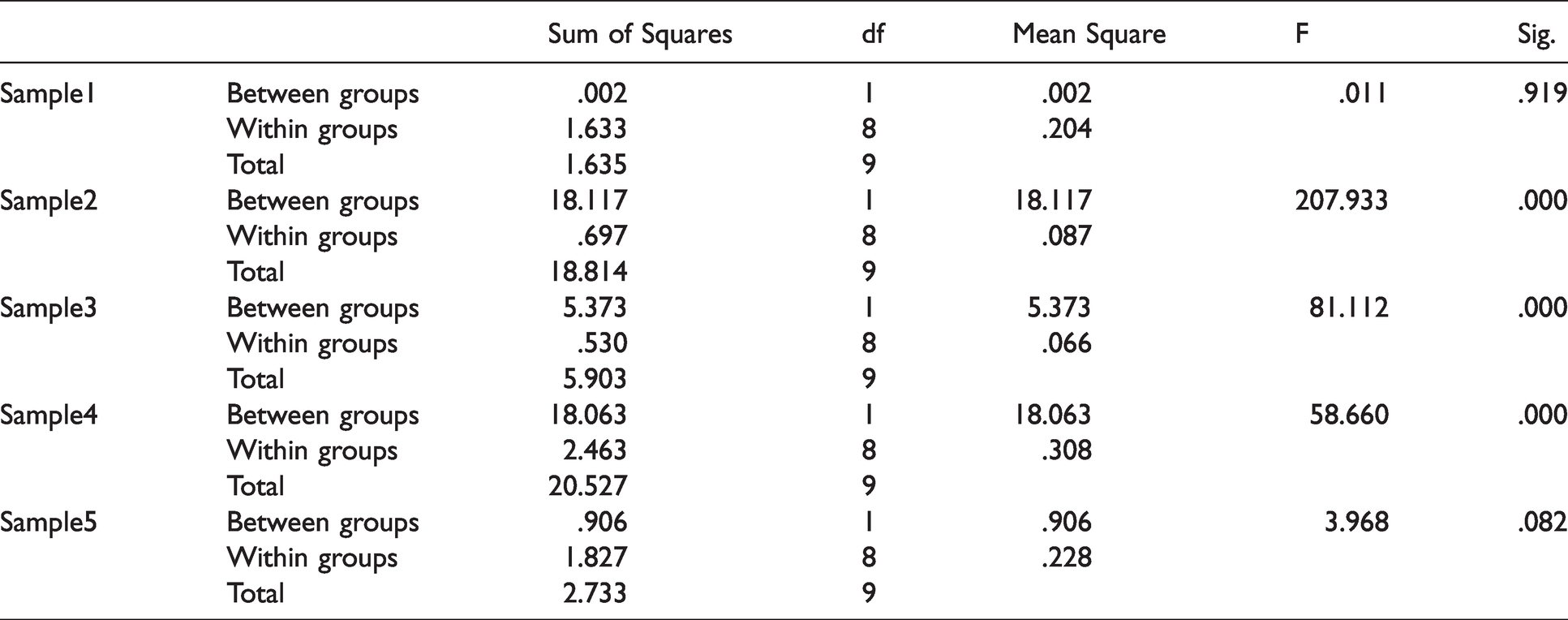
According to Table 4, the results of statistical analysis (one-way analysis of variance, sig. > 0.05) revealed that there were no significant differences between the porosities of the non-reinforced samples(sample 1) before and after being exposed to the thermal shocks. However, the porosity of the fiber/fabric reinforced samples (sample 2, 3 and 4) increased after being exposed to thermal cycles (sig. < 0.05). As shown in Figure 5(a), the porosity of fiber reinforced sample (sample 2) is much higherthan that ofthe fabric reinforced sample (sample 3). This is due to the effects of fiber ends which increase the matrix/reinforcement interface. On the other hand, according to the results of statistical analysis (one-way analysis of variance, sig. > 0.05),no significant change was found for the porosity of the samples reinforced by RTM method (sample 5) before and after being exposed to the thermal shocks. It can be concluded that the method of making reinforced composite is an important factor affecting composite properties which was also reported by previous works. 42
The results of statistical analysis (ANOVA) for comparing the porosity of sample 1, 2, 3, 4 and 5 before and after being exposed to the thermal stresses.

The changes in the (a) porosity, (b) true maximum stress, (c) true strain, (d) elastic modulus and (e) impact resistance of the fiber and fabric reinforced samples (i.e., sample number 2 and 3) under thermal cycles (2, 5 and 20 hours).
Figure 5(b) to (e) shows the changes in the physical and mechanical properties of fiber and fabric reinforced samples (i.e., sample number 2 and 3) under thermal cycles. The results showed that the time of 2 hours was not enough to make a significant change on the maximum stress obtained for the fabric reinforced samples. Therefore, the time of 20 hours was considered as the more reliable cycle time to evaluate the changes in mechanical properties of the samples after being exposed to thermal shocks. For fiber reinforced samples, the fiber ends affect the stress transfer at the interface which cause a significant reduction in the tensile strength and elastic modulus of the sampleafter being exposed to thermal cycles. On the other hand, thermal cycles weaken the bonding force between fibrous structure (fiber or fabric) and the composite matrix. Therefore, fiber sliding effect takes place which in fact extends the maximum strain of the sample.
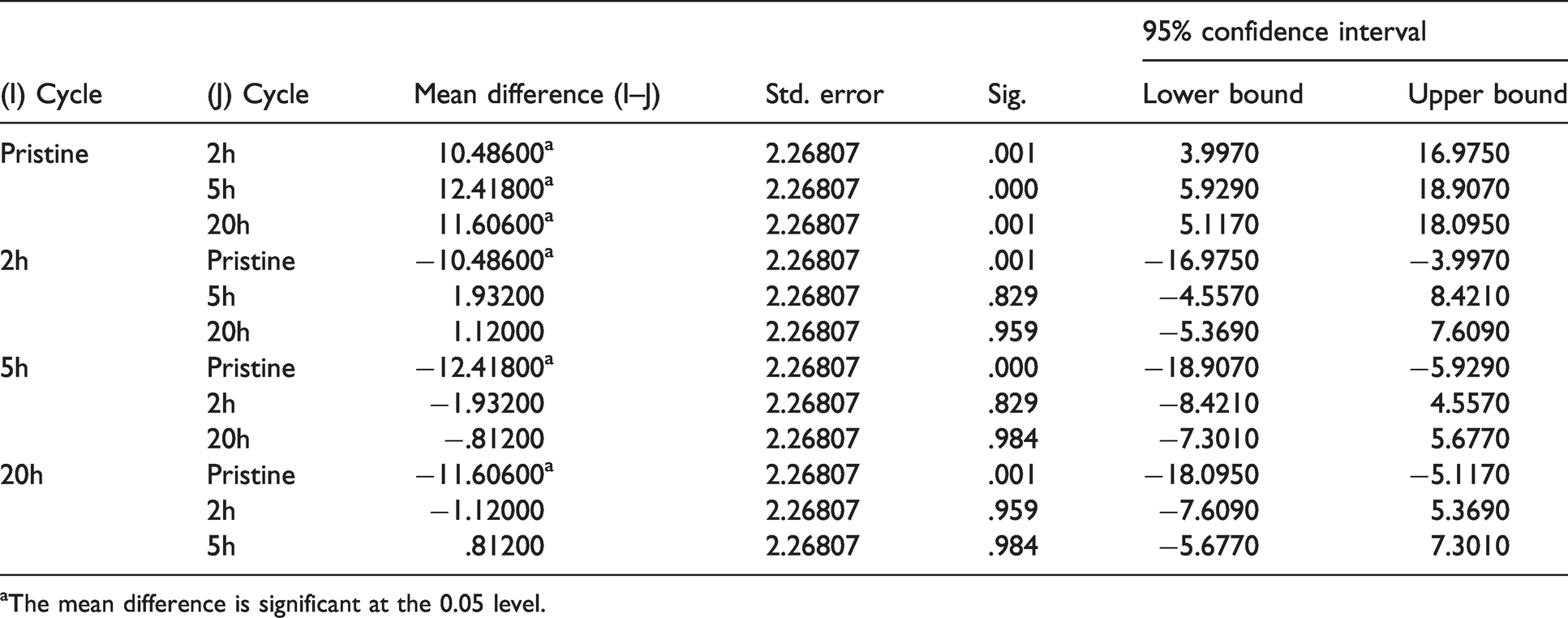
Although the changes in impact resistance of sample 2 under different thermal cycles were not obvious, Tukey tests (statistical analysis) were performed to compare the means (Table 5). It was found that the impact resistance of sample 2 decreased after being exposed tothermalcycles and the statistical analysis confirmed the significant reduction.It means that the samples reinforced by 50%wt of glass fibers became more brittle after thermal procedures.
The results of statistical analysis (Tukey tests) for comparing the impact resistance of sample 2 under different thermal cycles.
aThe mean difference is significant at the 0.05 level.
As the time of 20 hours was considered as the more reliable cycle time, the porosity and mechanical properties of the samples were investigated before and after 20 hours of thermal exposure time. According to the results (Figure 6(a)), no significant change occurred in the porosity of the copper NPs/fabric reinforced composite (i.e., sample 6 and 7) after being thermally shocked. In fact, comparing the samples reveals that the lower susceptibility of the samples to response to thermal shocks can be attributed to the lower porosity of samples. Similar trends were also observed for silica NPs/fabric reinforced samples (i.e., sample 8 and 9).

the changes in the (a) porosity, (b) true maximum stress, (c) true strain, (d) elastic modulus and (e) impact resistance of the samples after the 20 hours cycles of thermal shocks.
As shown in Figure 6(b) and (c), a significant reduction inmaximum stress and strain of the non-reinforced samples (sample 1) was observed after being exposed to thermal cycle which can be attributed to the crack formation phenomena. On the whole, as shown in Figure 6(d), higher amounts of reinforcements enhance the mechanical properties of the composite. However, an interesting result was found for the sample prepared by RTM method. Sample 4with 67.8% of fiber content posed the highest tensile strength even higher than the sample 5 with 75% of fiber content. Therefore, it can be concluded that the method of making composites is the most determining factor affecting mechanical properties. Less porosity and better mechanical properties were obtained by RTM method due to the less excess air entrapped within the fiber/matrix interface with the aid of applied pressure during processing. An unusual result was also observed between the NPs/fabric reinforced samples and the fabric reinforced samples. At the first sense, since NPs act as filling components which reduce the porosity of sample, it was expected that samples 6, 7, 8 and 9 pose better mechanical properties compared to sample 3. However, experimental results showed that NPs induced an obvious reduction in mechanical properties. As mentioned by previous works,43,44 agglomeration of nanoparticles is one reason providing stress concentration locations. With increasing the proportion of nanoparticles from an optimum level, the probability of agglomeration of particles becomes greater and makes a nonuniform stress distribution. Consequently, increasing the stress concentration locations results in an unexpected failure. 45 In this work, 2%wt of nanoparticles seems to be enough to create stress concentration locations. In the other words, NPs could not transfer stress within a fibrous/matrix structure while could improve the thermal stability by filling the voids and preventing the composite from cracks growth.
Comparing the impact resistance of fiber and fabric reinforced samples, as shown in Figure 6(e), woven fabrics especially made by hand lay-up method, provide better impact resistance which can be attributed to their fiber orientation. Since the porosity obtained by hand lay-up method was morecompared to RTM method, it can be concluded that voids and entrapped air contents promote the energy attenuation and improve impact resistance. Increasing the NPs content had no significant effect on the impact resistance.
Conclusion
The effects of thermal cycle duration(0, 2, 5 and 20 hours) of thermal shocks on theporosity and mechanical properties (maximum stress, strain, elastic modulus and impact resistance) of polymeric composites reinforced by glass fiber, woven fabric and copper/silica NPs were investigated. Changes in porosity and mechanical properties were more obvious in long duration cycles, i.e., 20hours. Therefore, the investigations were performed before and after a 20 hours cycle of thermal shocks. It was concluded that reinforcements improve the mechanical properties. Reduction trends were observed when fabric reinforced samples were further reinforced by NPs. Which means that although NPs pose filling effect in composite matrix and reduce porosity, provide stress concentration locations. In the other words, 2%wt of nanoparticles seems to be enough to create stress concentration locations. Therefore, NPs act as the filler materials rather than stress transferring components.
The samples reinforced by woven fabric and prepared by RTM method provide better mechanical properties. Moreover, after thermal shocks, the fibers within the composite structure formed curved shapes. According to the results, a reduction occurred at the elastic modulus of fibrous reinforced composites (fiber or fabric) after thermal cycles. Although the porosities of the samples were elevated, fiber deformation was considered another factor affecting elastic modulus which has never been discussed in previous research studies. A model of bicomponent structure was used to explain the effects of fiber deformation on elastic modulus reduction of the composite samples.
Supplemental Material
sj-pdf-1-jcm-10.1177_00219983211017648 - Supplemental material for Analysis of impacts of thermal shocks on mechanical properties of E-glass fiber reinforced polyester composites
Supplemental material, sj-pdf-1-jcm-10.1177_00219983211017648 for Analysis of impacts of thermal shocks on mechanical properties of E-glass fiber reinforced polyester composites by Zahra Jamshidi, Sayyed Mahdi Hejazi, Mohammad Sheikhzadeh and Azam Alirezazadeh in Journal of Composite Materials
Footnotes
Declaration of Conflicting Interests
The author(s) declared no potential conflicts of interest with respect to the research, authorship, and/or publication of this article.
Funding
The author(s) received no financial support for the research, authorship, and/or publication of this article.

References
Supplementary Material
Please find the following supplemental material available below.
For Open Access articles published under a Creative Commons License, all supplemental material carries the same license as the article it is associated with.
For non-Open Access articles published, all supplemental material carries a non-exclusive license, and permission requests for re-use of supplemental material or any part of supplemental material shall be sent directly to the copyright owner as specified in the copyright notice associated with the article.
