






Abstract
In recent years, Flexible sensors have emerged as a highly active field due to their promising applications in artificial intelligence systems and wearable health care devices. However, achieving a high sensitivity in a wide pressure range is still a challenge. Here, a three-dimensional network structure CNT-rGO aerogels were prepared by a hydrothermal redox method, which can effectively enhance the mechanical strength and enrich the electrical conductivity paths. Moreover, the CNT–rGO aerogel-based piezoresistive sensor exhibited a fast response time (∼300 ms), wide working range (0∼3.5 kPa−1), high sensitivity (11.8 kPa−1), and good stability (∼2000 cycles). So the piezoresistive sensor can be employed to monitor and distinguish both large motions (e.g., weight placed on the aerogel) and subtle motions (e.g., pronounce and pulse), which shows potential applications in measuring pressure distribution, distinguishing tiny stress changes, and monitoring human body motion.
Introduction
With the rapid development of electronic sensing technology and organic electronics, wearable sensors have made major breakthroughs in medical detection, electronic skin and monitoring human body motion.1–4 Among these, piezoresistive sensors prepared based on graphene aerogel have attracted wide attention because of their fast response time and good stability.5–8 For example, Pan and coworkers used a CVD process to deposit graphene on a three-dimensional nickel foam and then completely etch the template completely to form a pure three-dimensional graphene structure. 9 The sensor had the advantages of a wide range (0∼10kPa) and fast response time (100 ms). However, poor sensitivity hinders their practical application in piezoresistive sensors, and the high price of CVD process is not suitable for mass production. 10 Therefore, the development of graphene aerogel sensors with a high sensitivity in a wide pressure range and low cost is now the focus of research.
In this study, We used hydrothermal redox method to prepare CNT–rGO aerogels, which are not only inexpensive, but also have high sensitivity (11.8 kPa−1) in a wide measurement range (0∼3.5 kPa) by doping CNT. One-dimensional carbon nanotubes (CNTs) are used in piezoresistive sensors because of their excellent electrical conductivity. 11 In addition, compared with other sensing materials such as Metal nanoparticles and Conductive Polymers,12–14 CNTs with high aspect ratio can form a three-dimensional conductive network structure in the aerogel under the condition of a small amount of doping. The mechanical properties of CNT–rGO aerogel have also been improved. For example, Yang et al. prepared CNT–rGO aerogels reduced by ascorbic acid. 15 The graphene aerogels demonstrated good electrical behaviour, but their mechanical properties are not good because the residual ascorbic acid restrict the recovery of aerogels. In addition, we soaked the hydrogel in an ethanol solution with a proper concentration before freeze drying, the mechanical strength of the graphene aerogel was enhanced greatly because the low freezing point of ethanol solution, which effectively retarded its freezing and then kept the porous structure undestroyed. 16 Based on this, our sensor show excellent durability over 2000 cycles. In terms of application, The CNT–rGO aerogel piezoresistive sensor can be used not only to measure pressure distribution but also to monitor health conditions, including the identification of sounds and pulse rates in adults.17-19
Experimental
Materials
Flake graphite was purchased from Qingdao Jin Ri Lai Graphite Co., Ltd. Nitric acid, ethylenediamine (EDA), H2SO4 (98%), KMnO4, P2O5, H2O2 (30%), K2S2O8, and ethanol were purchased from the Sinopharm Chemical Reagent Company. Multi-walled carbon nanotubes with outer diameters of 10–20 nm and lengths of greater than 5 μm were provided by Shenzhen Nanotech Port Co., Ltd. The 0.22 μm pore polycarbonate membrane was purchased from Tianjin Jinteng Experimental Equipment Co., Ltd. High-purity milli-Q (18.2 MΩ resistivity) water was used in all experiments.
Preparation of graphene oxide solution
GO was synthesized using the modified Hummers method using flake graphite. 2.5 g of potassium persulfate and 2.5 g of phosphorus pentoxide were added to 12 ml of sulfuric acid in turn, and heated to 80 °C. 3 g of natural flake graphite was added, and maintained at a constant temperature for 4 h. Upon cooling to room temperature, 0.5 L of deionized water was added, and the mixture was deposited for 12 h. After filtration using a polycarbonate membrane with 0.22 μm pores, the products were placed in an oven at 30 °C for 12 h. 120 mL of sulfuric acid was added at 0 °C, then 15 g of potassium permanganate was added slowly with stirring, keeping the temperature below 20 °C. A water bath was used to heat to 35 °C, and this constant temperature was maintained for 2 h. 250 mL of deionized water was added and the mixture was stirred for 2 h. The temperature was kept below 50 °C. 0.5 L of deionized water was added, and the mixture was stirred for 10 min. 20 mL of hydrogen peroxide was added slowly. The solution turned a golden yellow color, and was deposited for 12 h. The supernatant fluid was poured out, and 90 ml of concentrated hydrochloric acid was added. The solution was separated into two 5 L beakers which were filled with deionized water. These were left to stand, then the supernatant fluid was poured out. The beakers were filled with deionized water again and left to stand until stratification occurred. This process was repeated until a pH value of 5 or 6 was obtained. Through dialysis, the pH was adjusted to neutral. The solution was then centrifuged at a speed of 5000 rpm for 10 min. Finally, the washed solution was corrected by adding deionized water (5 mg/ml) for further experiments.
Preparation of oxidized CNT
Oxidized CNTs were synthesized according to a chemical method reported in the literature. 20 Typically, 1.0 g of CNTs was added to 120 mL of concentrated H2SO4 and stirred at room temperature for 15 min. Then 40 mL of concentrated HNO3 was added and refluxed at 60 °C for 3 h. Oxidized CNTs were collected by repeated centrifuging, washing with deionized water, and freeze drying.
Preparation of graphene aerogel and CNT–rGO aerogel
75 mg of oxidized CNTs and 0.75 mg of sodium dodecyl sulfate were added to 30 mL of deionized water and the resulting mixture was sonicated for 5 h to form a dispersion (2.5 mg/ml). GO and CNT solutions with different mass ratios including 1:0, 10:1, 20:1, and 40:1 were mixed and stirred for 1 h to form uniform GO–CNT dispersions. Then, EDA was added and each dispersion was transferred into a Teflon-lined stainless steel autoclave and heated at 120 °C for 12 h with a volume ratio of 6:1000. The resulting hydrogel was placed in an aqueous ethanol solution of 10 wt% for 12 h and freeze-dried (−80 °C pre-cooling) for 48 h to obtain the graphene aerogel and the CNT–rGO aerogel. The final aerogel was obtained by further annealing at 200 °C in Ar gas for 2 h.
The mass, volume, density and porosity of various aerogels.

Fabrication of the piezoresistive sensor
Silver paste (Dupont 4929 N, Dupont Corporation, Wilmington, DE, USA) was used to glue copper foil on the upper and lower surfaces of the aerogel as electrodes. The aerogel was then put into an oven at 120 °C for 2 h. The piezoresistive sensor was then fixed and encapsulated within a PE (polyethylene) plastic film. Changes in current and resistance caused by pressure were recorded using an electrochemical workstation (CHI660E) and automatic original analyzer (TongHui 2829 C).
Characterization and measurement
The morphologies of the aerogels were observed using scanning electron microscopy (SEM, Merlin, Zeiss). The electrical current and resistance were measured using an electrochemical workstation (CHI 660E) and automatic original analyzer (TongHui 2829 C). X-ray diffraction (XRD) patterns were recorded using a Bruker D8 diffractometer using Cu Kα radiation as the X-ray source. Compression, elasticity, and fatigue resistance were measured using a QT-6203S universal testing machine (Qian Tong Instrument Equipment Co., Ltd., Jiangsu, China). The thermogravimetric analysis (TGA) was performed on a Netzsch STA 449 C using the following temperature program: heating from 20 °C to 100 °C at a rate of 10 °C/min, then heating to 600 °Cat 10 °C/min after 10 °C constant temperature for 10 minutes. All samples were purged with nitrogen at 20 mL/min and tested in an alumina crucible.
Discussion
Fabrication and characterization of the CNT–rGO aerogel sensor
CNT–rGO aerogels were prepared by a hydrothermal redox process, which is a green, low-cost, and large-scale method to produce complex three-dimensional structures. The preparation process for the CNT–rGO aerogel is shown in Figure 1(a). GO has strong hydrophilicity and exhibits good dispersion in water, while CNTs are hydrophobic and exhibit poor dispersion in water. To increase the dispersion of CNTs in water, the CNTs were refluxed in a mixture of H2SO4 and HNO3. The oxidation of the carbon nanotubes produces many hydrophilic groups, such as hydroxyl and carboxylic groups. These groups disperse the CNTs evenly in water and aqueous GO solutions. Moreover, CNTs can also effectively prevent the restacking of GO during the aerogel formation process.
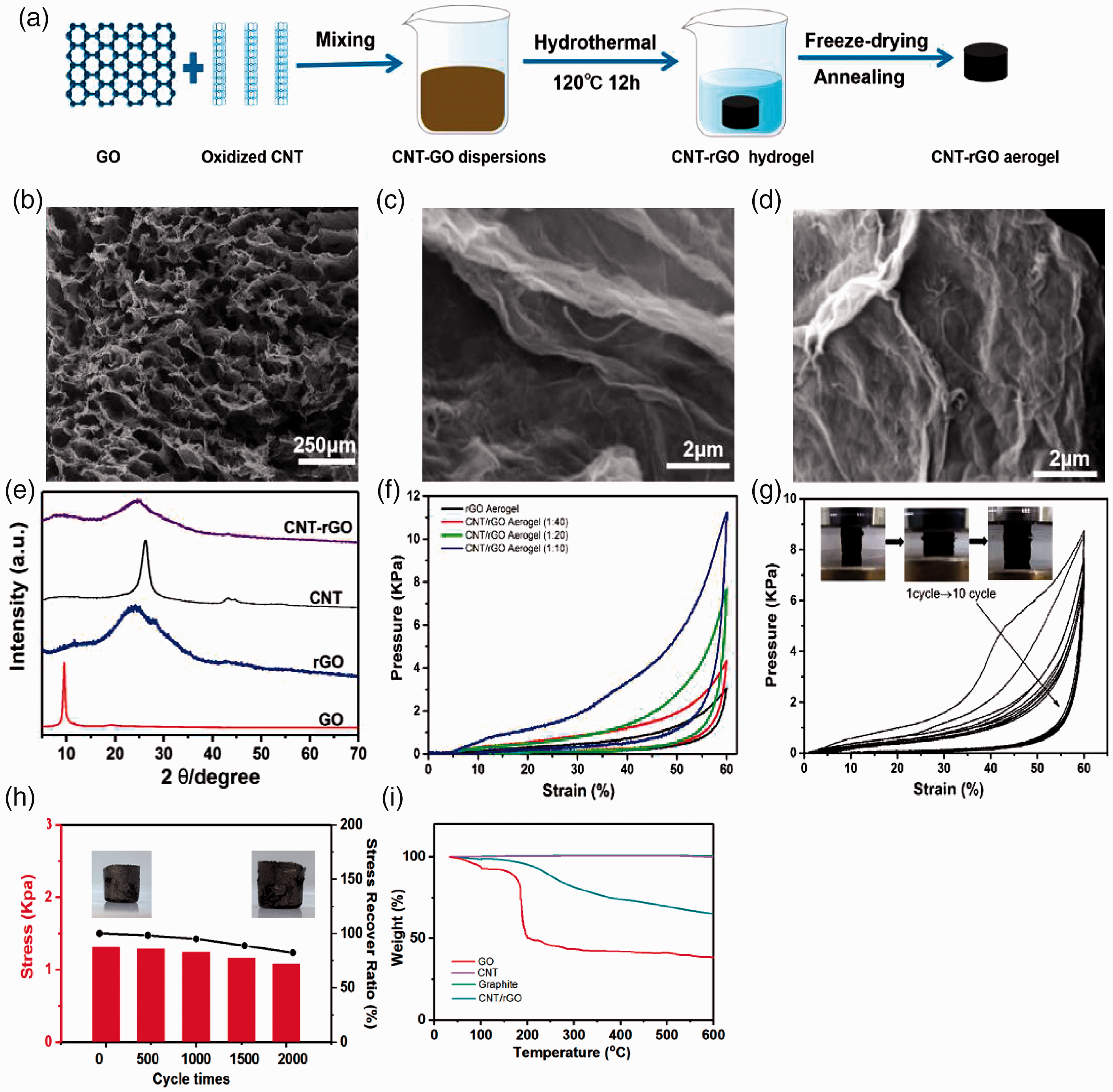
Pressure sensor based on the CNT–rGO aerogel. (a) Schematic illustration of the fabrication of the CNT–rGO aerogel. (b–d) Cross-sectional view SEM images of the CNT–rGO aerogel. (e) XRD patterns of CNTs, GO, rGO, and the CNT–rGO aerogel. (f) Compressive stress−strain curves of the rGO and CNT–rGO aerogel. (g) Compressive stress–strain curves of the CNT–rGO aerogel (1:20) at a strain of 60% for 10 cycles, with the inset showing photographs of the CNT–rGO under a compressing-releasing cycle. (h) Compressive stress and the stress recovery ratio at different cycles, with the inset showing photographs of the 1th, and 2,000th compressed aerogel. (i) Thermogravimetric analysis (TGA) curves of the as-prepared samples.
The final CNT–rGO aerogel is flexible and ultralight enough to be lifted by a leaf. Figure 1(b) to (d), images obtained using a scanning electron microscope (SEM), show that the CNT–rGO aerogel has a hierarchical three-dimensional network-like structure with micromesopores connected, in which the nanosheets are interconnected with each other. The addition of CNTs can improve the hole structure inside the aerogel, so that it has more contact points to provide rich conductive paths under the same area, and the reduction of the pore size makes it more responsive under low pressure. As shown in Figure 1(c) and (d), most of the CNTs are covered or wrapped by the graphene sheet to form a reticular framework. There are also carbon nanotubes sandwiched between the graphene sheets. The multiple forms of the graphene sheets and CNTs increase the surface roughness of the graphene sheets and facilitate the formation of cross-linking structures between layers. Moreover, the presence of CNTs sandwiched between the graphene sheets further increases the conductive path and thus improves the sensitivity. Figure 1(e) shows XRD patterns of GO, CNTs, rGO, and the CNT–rGO aerogel. The presence of CNTs is proved by the strong diffraction peak at 2θ = 26.1° (d-spacing = 3.4 Å), 21 whereas GO exhibits a diffraction peak at 2θ = 9.9° with an interlayer spacing of 8.9 Å. In addition, a weak peak is observed at 2θ = 20.2°, indicating that oxygen-containing groups were introduced in the oxidation process. 22 After the reduction process, the GO peak at 2θ = 9.9° disappeared. Meanwhile, rGO presents a new broadened diffraction peak at 24.7° (d-spacing = 3.7 Å, much lower than GO, 8.9 Å, but slightly larger than natural graphite, 3.4 Å), confirming the evolution of the structure from graphite to graphene. 23 In addition, these results demonstrate the existence of π–π stacking between the graphene sheets in rGO, indicating that rGO is composed of in homogeneously stacked graphene sheets. In addition, the diffraction pattern of CNT–rGO includes diffraction peaks from both rGO and CNT, indicating the successful incorporation of CNTs into the CNT–rGO aerogel.
The mechanical properties of the aerogel were systematically investigated using compression tests. Figure 1(f) and (g) show the compressive stress-strain curves of the CNT–rGO and pure rGO aerogels when the strain is set at 60%. Although both CNT– rGO and pure rGO aerogels were able to withstand considerable deformation (over 60%), the mechanical properties of the CNT–rGO aerogels improved with the addition of CNT. This is because Young’s modulus of CNTs is larger, therefore adding CNTs into the rGO system can improve its antipressure ability and the robustness of its performance. As illustrated in Figure 1(g), the aerogel can be compressed to more than 60% and its original shape can be easily recovered after release, proving the stability of the continuous compression deformation process and increasing the life of the sensor. Since the aerogel we made was a cylinder, the height of the aerogel was measured with a ruler, then the diameter of the aerogel was measured with a spiral micrometer. The volume of the aerogel was calculated according to the formula:
Pressure-sensing properties of the CNT–rGO aerogel sensor
The sensitivity of the piezoresistive sensor is defined as
During compression, the pores in the CNT–rGO aerogel are squeezed and the distance between the pores decreases, leading to an increase of the conductive path. Naturally, this causes an increase of the corresponding current under the compressed state when a fixed voltage is applied, which is the core physical mechanism in the piezoresistive sensor. We conducted a series of static and dynamic electrical tests and found that various mass ratios of CNTs to GO induced different electrical responses under the same pressure values, as shown in Figure 2(d). We observed that the current intensity increases as the pressure increases, ensuring that the sensor is able to distinguish different levels of pressure. The relative current change of all the CNT–rGO aerogels is higher than that of pure rGO. When the ratio of rGO to CNTs is about 20:1, the relative current change reaches its maximum value. Figure 2(d) shows the electrical response of the piezoresistive sensor at different ratios of rGO to CNT, with the highest sensitivity at the intermediate ratio (20:1), followed by the large ratio (10:1), then the small ratio (40:1), then the pure rGO.

Basic sensing performance of the CNT–rGO aerogel. (a) I − V curves of the CNT–rGO aerogel. (b) Response time and recovery time of the CNT–rGO aerogel. (c) Current output after more than 2000 loading and unloading cycles, indicating good durability. (d) Relative current change with respect to the applied pressure, where the four curves represent ratios of CNT–rGO of 0:1, 1:10, 1:20, and 1:40.
The high sensitivity of the CNT–rGO aerogel-based sensor can be explained as follows. When the aerogel is squeezed, the pores composed of nanosheets are in close contact, and the contact area increases, leading to an increase in the electric current. When CNTs with high conductivity are added to the rGO aerogels, the current change of the CNT–rGO aerogels is greater than that of pure GO aerogels. At constant rGO concentration, the conductive pathway increases with increasing CNT content, resulting in increasing sensitivity of the hybrid aerogel. However, excessive addition of CNTs (when the ratio of GO to CNTs exceeds 20:1) significantly increases the conductivity, making the aerogel a good conductor. A large number of CNTs connect the graphene nanosheets to each other, which results in no change or little increase of the conductive path between the nanosheets before and after compression, affecting further increase of corresponding conductive path. As the conductive path approaches saturation, the resistance changes tend to decrease, so the ratio of 20:1 has a greater sensitivity than the ratio of 10:1. In addition, the diagram of the variation of current with pressure can be divided into low-voltage and high-voltage regions, similar to most piezoresistive sensors reported at present. The sensitivity of low pressure areas below 0.5 kPa was 7 kPa−1, while that of high pressure areas above 0.5 kPa was 11.8 kPa−1, which is significantly higher than that for piezoresistive sensors such as silver nanowires, 25 copper nanowires, 26 and graphene/polyurethane foam. 27 Large deformations of many micropores in our aerogel samples, ranging from a few microns to tens of microns, occur only at relatively high pressures and are therefore highly sensitive to large forces.
Furthermore, the linear relation of the I − V curves (Figure 2(a)) from −0.1 to 0.1 V indicates that ohmic contacts were formed between the CNT–rGO and the electrodes. With increasing pressure, the slope of the I − V curves increases, indicating the continuous decrease of the sensor’s resistivity. The CNT–rGO aerogel sensor provides fast response (317 ms) and recovery (303 ms), as shown in Figure 2(b). The response and recovery times of the three-dimensional network aerogel structure are fast, making it suitable for practical application. To assess the durability of the CNT–rGO aerogel sensor, 2000 cycle tests were performed, as shown in Figure 2(c). After 2000 observations, the sensor signal shows little attenuation and each load-unload cycle maintains nearly the same current amplitude, indicating that the piezoresistive sensor has a long service life and high stability. Although the addition of CNT improved the mechanical properties of the aerogel, with the increase of compression times, the pore structure inside the aerogel inevitably collapsed and could not be completely recovered nor returned to the original state. As shown in Figure 1(h), When the number of compresses reached 2000 times, the stress recovery ratio drops obviously, leading to a deterioration in sensing performance.
Practical application of the CNT–rGO aerogel sensor
The sensor based on the CNT–rGO aerogel has the advantages of a highly conductive network, high sensitivity, and robust mechanical properties, which make potential applications likely. An LED lamp was applied to the sensor to form a series circuit under a power supply of 3 V to test the electrical response of the sensor to various pressures. As shown in Figure 3, upon increasing the external force from 0.086 kPa to 4.317 kPa, the brightness of the LED lamp changed from light red to dark red, reflecting the increase in the current caused by the decrease in the resistance while under increasing stress. We found that the current response was significant even when placing a paper crane on the CNT–rGO aerogel, as shown in Figure 4(a). Next, we wrote on the surface of the aerogel, and it could recognize the letters “a,” “b,” and “c,” as shown in Figure 4(c). The aerogel was fixed around the neck of the tester, who said the words “a,”, “abc,” and “aerogel,” as shown in Figure 4(d). In addition to the above applications, the CNT–rGO aerogel sensor was installed on an adult man’s wrist as a pulse detector. As shown in Figure 4(b), characteristic peaks of a typical human pulse waveform corresponding to “P” (percussion) and “D” (diastolic) are clearly discernable, 28 indicating that this sensor has high sensitivity. This shows that the CNT–rGO aerogel sensor performs well in the real-time monitoring of human health.

Variation of the response of the LED luminance with the applied pressure on the CNT–rGO aerogel sensors: (a) 0.086 kPa, (b) 2.158 kPa, (c) 4.317 kPa.

Real time monitoring of tiny amounts of strain, a human voice, and motion using CNT–rGO aerogel sensors. (a) Current response of the pressure sensor operating with a paper crane. (b) Current response of the pressure sensor to the arterial pulse waves when the sensor was attached to a person’s wrist. (c) Current response of the pressure sensor with “a,” “b,” and “c” written on it. (d) Current response of the pressure sensor when the wearer said “a,” “abc,” and “aerogel.”
Conclusion
In summary, the CNT–rGO aerogel was prepared using simple hydrothermal reduction technology and used in piezoresistive sensors. Due to the synergistic effect between CNTs and rGO, the three-dimensional aerogel demonstrated excellent sensing performance with high sensitivity (11.8 kPa−1), fast response time (∼300 ms), and fine stability (2000 cycles). Compared with pure rGO aerogels, the mechanical properties and sensitivity of the CNT–rGO aerogels are greatly improved. Not only can the sensor detect a wide range of pressures, it can also detect subtle health changes in humans, and even a pulse in the wrist.
Footnotes
Declaration of Conflicting Interests
The author(s) declared no potential conflicts of interest with respect to the research, authorship, and/or publication of this article.
Funding
The author(s) disclosed receipt of the following financial support for the research, authorship, and/or publication of this article: This work was supported by the National Key Research and Development Program of China (2017YFB0307001) and the National Natural Science Foundation of China (91648109), Jiangsu Provincial “333” High-level Talent Training Project, Jiangsu Province Cultivation base for State Key Laboratory of Photovoltaic Science and Technology.
