






Abstract
Binary and ternary composites were synthesized using a polyester matrix reinforced by two types of carbon inclusions, namely, carbon nanotubes (CNT) and graphite (Gt) (CNT/Gt/Polyester). Thermal analyses were performed, using thermogravimetry and differential scanning calorimetry, which allowed us to observe significant changes in glass transition temperatures and degradation temperatures of the composites. Dielectric measurements were performed in a frequency range from 100 Hz to 1 MHz and temperature from –33 to 107°C. The dielectric permittivity values of the CNT/Gt/Polyester ternary composites, compared to the Gt/Polyester binary composites, indicate that the addition of CNT particles to the Gt/Polyester binary system significantly improved the dielectric permittivity, due to the enhanced interfacial polarization of the host matrix, while the frequency dependence of the electrical modulus spectra revealed a Maxwell–Wagner–Sillars dielectric relaxation process that was found to follow the Cole–Davidson approach.
Introduction
Polymer composites with nanostructured carbon fillers have recently received significant interest in research and industry owing to their high conductivity, ease of processing, low weight, etc.1–4 They are largely employed in a variety of applications, including flexible conductive materials, antistatic materials, and electromagnetic shielding materials.5–7 Each type of carbon particle, namely, carbon black (CB), graphite (Gt), carbon fiber (CF), and carbon nanotubes (CNT), possesses specific characteristics. For instance, Gt is cheap, but generally has a high percolation threshold, which might affect mechanical properties. CNT has an extremely low percolation threshold due to their high inherent conductivity and large aspect ratio, but they have a high cost for a wide application. 8 The combination of different carbon fillers would be a good option to achieve a balance between properties and cost because, in our case, the polyester is a low cost material when compared with other potential polymer matrices and the fillers, as are introduced in low concentrations, do not compromise the final costs of the composite. Indeed, some polymer blends containing two different carbon fillers (e.g., CF and CB) have a remarkable increase in electrical conductivity, which has been reported in other works.9–14 It is generally assumed that two types of carbon particles are able to form supporting conductors: those networks in which the CF or the fibrous filler operates at long distances, while the CB or Gt particulate filler serves as an interconnection between the fibers by forming local conductive paths.9,10
One of the methods that can provide valuable information on the frequency responses of polymer composites is dielectric spectroscopy. Several relaxation types could be noticed in such heterogeneous systems, namely polymer matrix-related dipolar and Maxwell-Wagner-Sillars (MWS) relaxations.15–17 The reason behind the relaxation is the presence of freely immobilized intrinsic fillers (catalyst, impurities…) in the polymer phase. Charges can migrate upon the applied electric field as long as the temperature is high enough to ensure certain mobility in the material. These free carriers are then trapped at the interfaces that separate the two media of different conductivity and permittivity, thus allowing interfacial polarization. 18
The dielectric analysis is a process that measures two basic electrical properties of the material: the capacitance and conductance/or resistance versus frequency. These measurements are then used to calculate the real and imaginary parts (ε′, ε″) of the complex permittivity. In polymers and polymer composite materials, interfacial polarization is mostly occurring as additives, fillers or impurities migrating to interfaces or sites where discontinuity of dielectric properties makes these systems heterogeneous. Generally, interfacial relaxation is masked by the phenomenon of conductivity and dielectric permittivity may reach high values at low frequencies.19,20 To address this concern in the study of interfacial polarization, it was agreed to adopt the formalism of the “electrical modulus”, originally initiated by McCrum et al. 21 Macedo et al., 22 who used it for the inquiry of electrical relaxation phenomena in glass ionic conductors, and El Bachiti et al. 23 used it for analyzing the relaxation process in ferroelectric ceramics. It was also used in polymers and biopolymers to study their relaxation conductivity.24–26
In this paper, ternary composite materials were prepared by mixing CNT and Gt particles into the polyester matrix. We focus our interest to investigate the influence of the CNT/Gt content on the thermal and dielectric properties of the composites. The thermal properties were analyzed by thermogravimetry (TGA) and differential scanning calorimetry (DSC). The dielectric properties were analyzed using the complex permittivity and the electrical modulus, depending on the frequency, temperature, and fillers concentration in the polymer matrix. Furthermore, Nyquist plots were used to interpret the electrical modulus spectra of all the studied samples.
Experimental
Materials and samples preparation
The used polymer is an unsaturated polyester resin 154TB provided from Cray Valley/Total, USA, containing 31% of styrene monomer and requiring 30 min for gelation at room temperature. The Graphite (Gt) sample consists of natural graphite flakes from Madagascar afforded by CRPP Center, Bordeaux University in France. The grain size ranges from 20 to 100 µm, the density is 2.09–2.26 g/cm3, and the electrical resistivity is from 5 to 8 Ω µm at 20°C. Multi-walled carbon nanotubes (CNT) were supplied by Cheap-Tubes, USA; their average diameter is about 50 nm, the length ranges from 10 to 20 µm and purity is above 95%. The CNT/Gt/Polyester composite samples were prepared with an 8% total content in the fillers (CNT + Gt), which were mixed at different ratios. The CNT/Gt mixtures were mixed with the polyester in different concentrations and stirred at room temperature. The CNT/Gt mixtures were first dispersed in the liquid phase methanol under magnetic stirring in a beaker to reduce the aggregates size. After complete evaporation of methanol at room temperature, the obtained CNT/Gt powder was then directly added to the polyester. Finally, the mixture was injected into sample molds. The samples were removed from the mold when they achieved gelation, after a few hours at room temperature, and then they were left to rest in order to reach the complete polymerization. The prepared samples of ternary composites with detailed concentration values are tabulated in Table 1.
Prepared samples of CNT/Gt/Polyester ternary composites.

Thermal characterization
Thermogravimetric analysis (TGA) was performed on a Netzsch TG209 F1 Libra balance. Experiments were carried out under nitrogen and synthetic air at 20°C/min. Differential scanning calorimetry (DSC) measurements were performed using a Mettler DSC-823e equipment, under a constant flow of N2 (60 mL/min), on ∼10 mg sample aliquots, and placed into standard 40 µL aluminum crucibles. The device was calibrated using an indium standard. The heating program was preceded by erasing thermal history. For this aim, samples were subjected to dynamic heating from room temperature to 200°C at 10°C/min heating rate, held at 200°C for 5 min, and cooled down to room temperature at –10°C/min. Subsequently, the heating cyclic program applied to the samples was from –50 to 200°C, with a heating/cooling rate of 10°C/min. Glass transition temperature (Tg) values were taken as the inflection point during the cooling step of the last cycle. Average Tg values and sample standard deviations were calculated from four measurements for each material.
Dielectric characterization
Dielectric measurements were performed using an Agilent 4294A Impedance Analyzer in the frequency range from 100 Hz to 1 MHz. Isothermal measurements were carried out in the range from –33 to 107°C. The sample surfaces were polished and covered with a thin layer of silver paint. In the electrical model, each sample is realistically represented by a parallel combination of a capacitor 


Results and discussion
Thermal analysis
DSC experiments of the neat polyester (S1) and its composites S2, S3, and S4 are shown in Figure 1. As can be seen, all samples exhibited a clear glass transition (Tg), particularly during the cooling down. The Tg values and their standard deviations were calculated and listed in the inset of Figure 1. Certain changes can be observed in the Tg depending on both filler concentrations. The Tg value of the composite S2 is 11°C higher than that of the pure polyester. This could be related to an increase in the rigidity of the system, as a consequence of the graphite presence, which would hinder the mobility of polymer chains. 27 Such an imposed motion restriction is indicative of a reinforcing effect. Then, the substitution of 0.5% graphite for CNT (sample S4) seems to palliate this effect, suggesting that CNT would not impose such a restriction in the motion of polymer chains as compared to graphite.
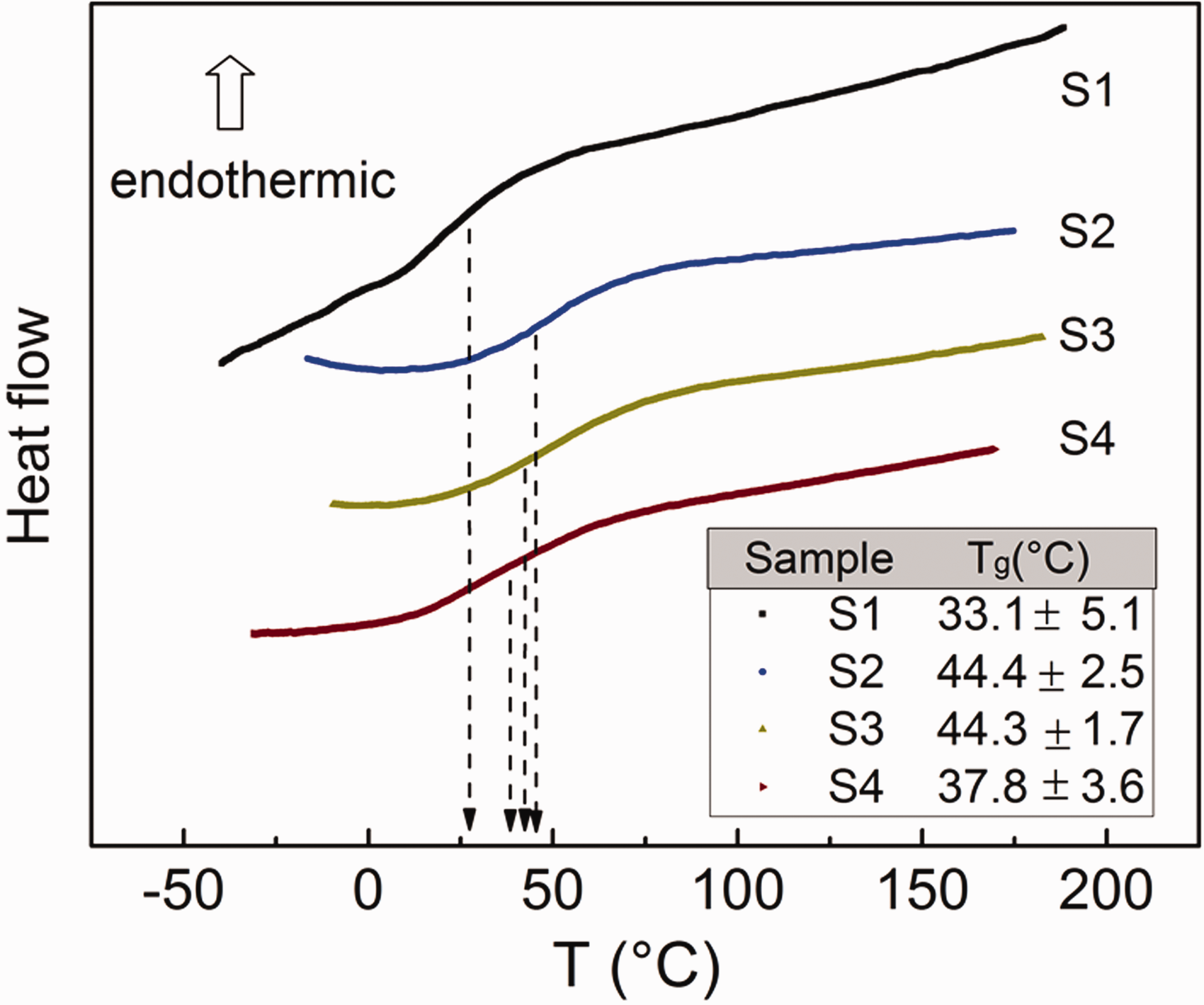
DSC curves of the neat polyester matrix (S1) and its composites (S2, S3 and S4). The inserted table shows the Tg values with their associated standard deviations.
TGA experiments were conducted to study the thermal and thermo-oxidative stability of the neat polyester (S1) and its composites S2, S3, and S4 (Figure 2(a) and (b)). In both nitrogen and synthetic air atmospheres cases, weight losses start above 100°C, indicating that all the materials bear low levels of moisture. Moderate weight losses occur in both inert and oxidative atmospheres in the range of 150–300°C. An abrupt loss is observed around 350–420°C due to degradation of the polymer. Polyester and polystyrene chains break to form a primary char, releasing CO, CO2, styrene and phthalic anhydride as the main gas products. 28 In addition, the degradation under oxidative atmospheres revealed another weight loss at a high temperature around 510–550°C, which is associated with char oxidation. 28

TGA experiments under (a) nitrogen and (b) synthetic air atmospheres of S1, S2, S3 and S4 specimens.
In order to look for a deeper analysis and identify reference temperature in TGA curves, we calculated the derivative plots (DTG). As an example, Figure 3(a) and (b) compares the plot of weight loss and its derivatives for the neat polyester (S1) under nitrogen (Figure 3(a)) and synthetic air atmospheres (Figure 3(b)). The determined values of the characteristic degradation temperatures of pure polyester (S1) and its composites (S2, S3 and S4) are summarized in Table 2. The inspection of these results indicates that (i) the thermal degradation takes place as two overlapping processes under nitrogen, providing the two temperatures Td1 and Td2, as it was previously observed in conducting polymer composites consisting of polypyrrole particles in a polymethylmethacrylate matrix. 29 In contrast, the degradation under oxygen takes place with at least an extra step, i.e, in addition to two successive degradations at Td1 and Td2, a third degradation is revealed at Td3. (ii) As a general trend, the composites show almost identical Td values, while most of them are higher than that of the neat polyester. Under the air atmosphere, the maximum stability is observed for the 8% Gt (S2) composite without CNT.
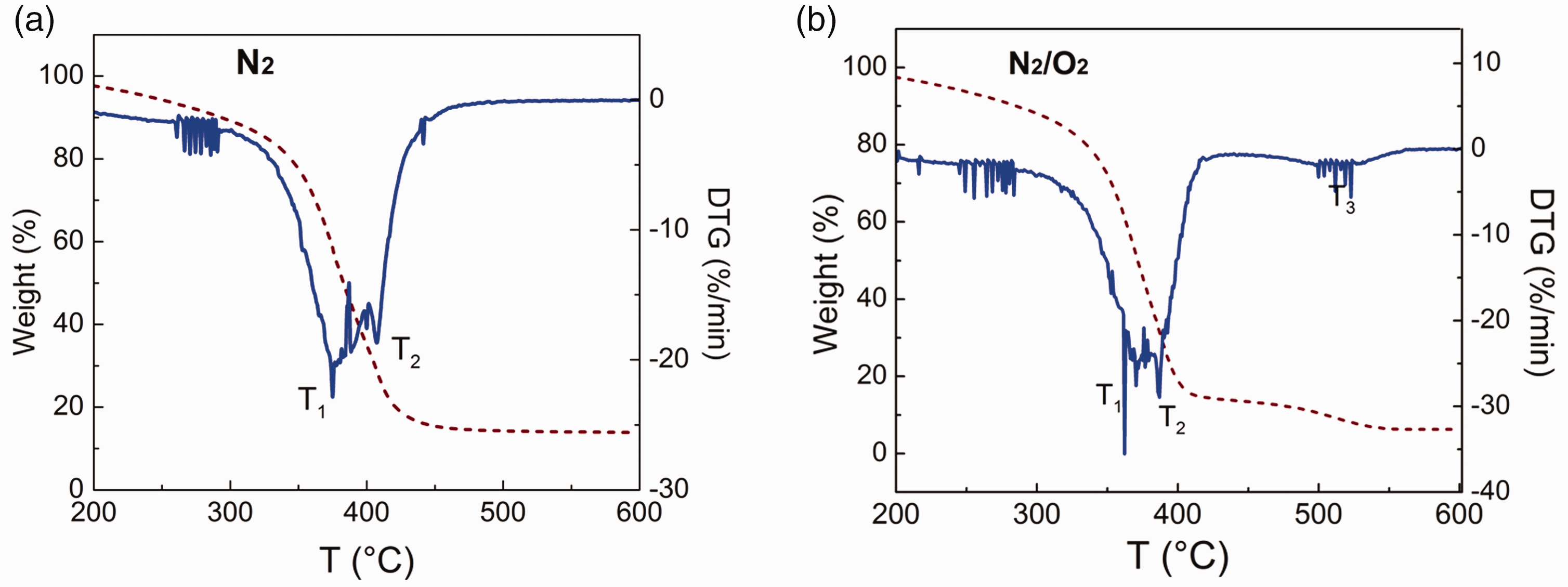
Mass loss (TG%) and derivative mass loss (DTG) under nitrogen (a) and synthetic air atmospheres (b) of S1 vs. temperature of the neat polyester.
Characteristic degradation temperatures of S1, S2, S3 and S4 composites obtained from TGA measurements under nitrogen and synthetic air atmospheres.

It can be concluded that the thermal stability of the resin substantially improves with the addition of the fillers, particularly under the oxidative atmosphere. This effect might be associated with the thermal dissipation and radical trapping abilities of the carbon fillers. 30 – 32 In fact, the thermal transport through the fillers hinders local heating, while radical chain reactions are soon terminated by reaction with carbon nanostructures. Another contribution to thermal stability might come from an improvement in the polymer barrier properties (a decrease in the gas permeability). 33 If the presence of the filler delays the evolution of gas products, the degradation temperature should increase. It has been found that the change in barrier properties using graphene fillers is larger than with nanotubes. 33 From the thermal analyses performed in this study, we noticed that graphite fillers would be a good asset for improving thermal and thermo-oxidative resistance of polyester resins, as well as increasing the rigidity of the system, while CNT particles show a compensating effect of the chain motion restriction induced by graphite, as for the decrease in Tg.
Dielectric permittivity analysis
Comparative plots of the frequency dependence of the real (ε′) and imaginary (ε″) parts of the complex permittivity of the neat polyester matrix (S1) and its composites (S2, S3, and S4) are shown in Figure 4(a) and (b), at room temperature. We can observe that both ε′ and ε″ increased with the incorporation of 8% of Gt particles and it became more significant with the substitution of Gt by CNT particles. The high improvements of dielectric permittivity at low frequency can be attributed to the interfacial polarization, known as MWS effect.16,34 This effect appeared in heterogeneous media due to the accumulation of charges at the interfaces. Generally, the dielectric permittivity of polymer composites can be improved by a further increase in the Gt loading. But, in our case, the mechanical properties of composites greatly decline due to the high loading of Gt fillers and regulating the dielectric permittivity by adjusting the filler content becomes very difficult.
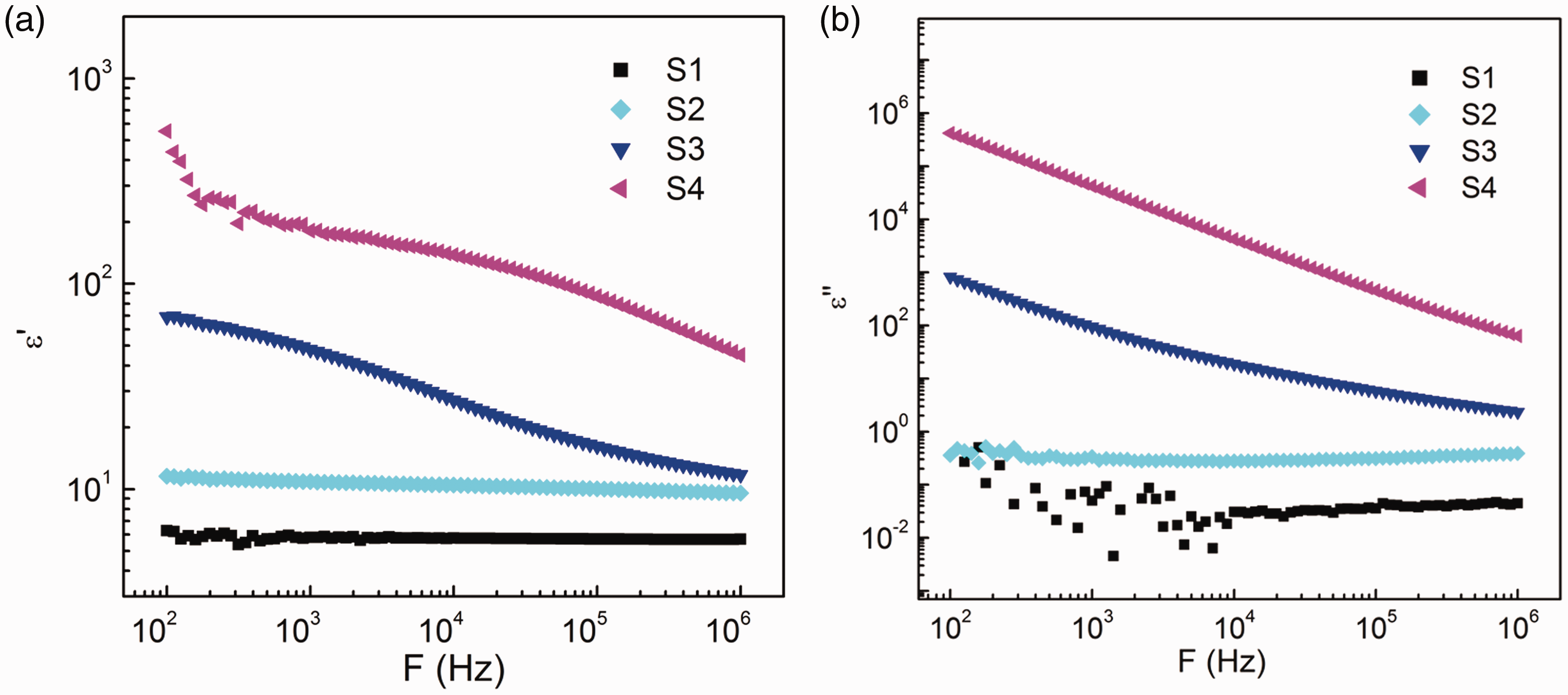
Frequency dependence of dielectric permittivity (a) real part and (b) imaginary part of S1, S2, S3 and S4 composites at room temperature.
Thanks to the CNT unique properties with extremely small size (compared to Gt), high conductivity and high mechanical strength, the incorporation of a small content of CNT strongly improves dielectric permittivity. Therefore, in order to further enhance the dielectric permittivity by using almost the same filler content, in this study, the CNT/Gt/Polyester three phase composites were prepared. We note that the substitution of Gt with CNT in the CNT/Gt/Polyester composites (Figure 4(a) and (b)) increased relatively the dielectric constants at low frequencies, and this is because of the largest difference of the electrical conductivity between the filler and the polymer resulting in a stronger interfacial polarization compared with the Gt/Polyester composite. The significant improvement in the dielectric permittivity that can be achieved with a relatively low loading of the CNT is due to the high surface area, and high aspect ratio, leading to the improved interfacial polarizations of the Gt/Polyester. This happens at low frequency applied alternating voltage, 35 as the mobile charges may easily hop out of the low energy sites, which leads to the increase of the polarization of composites and therefore causes the increase of both real and imaginary parts of the complex permittivity.36,37 As the frequency increases, the oscillations of mobile charges with the macromolecular structure of composite increase, resulting in the reduction of the dielectric permittivity.
In order to analyze the temperature effect on dielectric permittivity of the neat polyester and its composites, we have represented in Figure 5, the imaginary part, ε″, versus temperature of sample S3 at different frequencies (Figure 5(a)) and comparative curves of all samples at 5 kHz (Figure 5(b)). It can be observed that, ε″ presents remarkable variations at the glass transition temperature (Tg); below this temperature ε″ is slightly constant for samples S1 and S2 and shows small decreases for samples S3 and S4, this can be explained by the fact that the CNT existing in samples S2 and S3 are aligned with the effect of an applied field reduces the phase lag, 38 thus decreasing the dielectric loss of the composite, and above the Tg, ε″ showed a significant increase at several frequencies, which can be ascribed to the orientational polarization connected to the thermal motion of molecules. As the temperature is increased, the orientation of the dipoles is facilitated and the imaginary part of the dielectric permittivity increases as well. 39 On the other hand, it can also be seen that the dielectric constant decreases with frequency, as the dipoles are unable to orientate themselves with the applied field. While ε″ increases with the increasing of fillers, and this is related to the increase of mobility and polarization of space charge carriers.
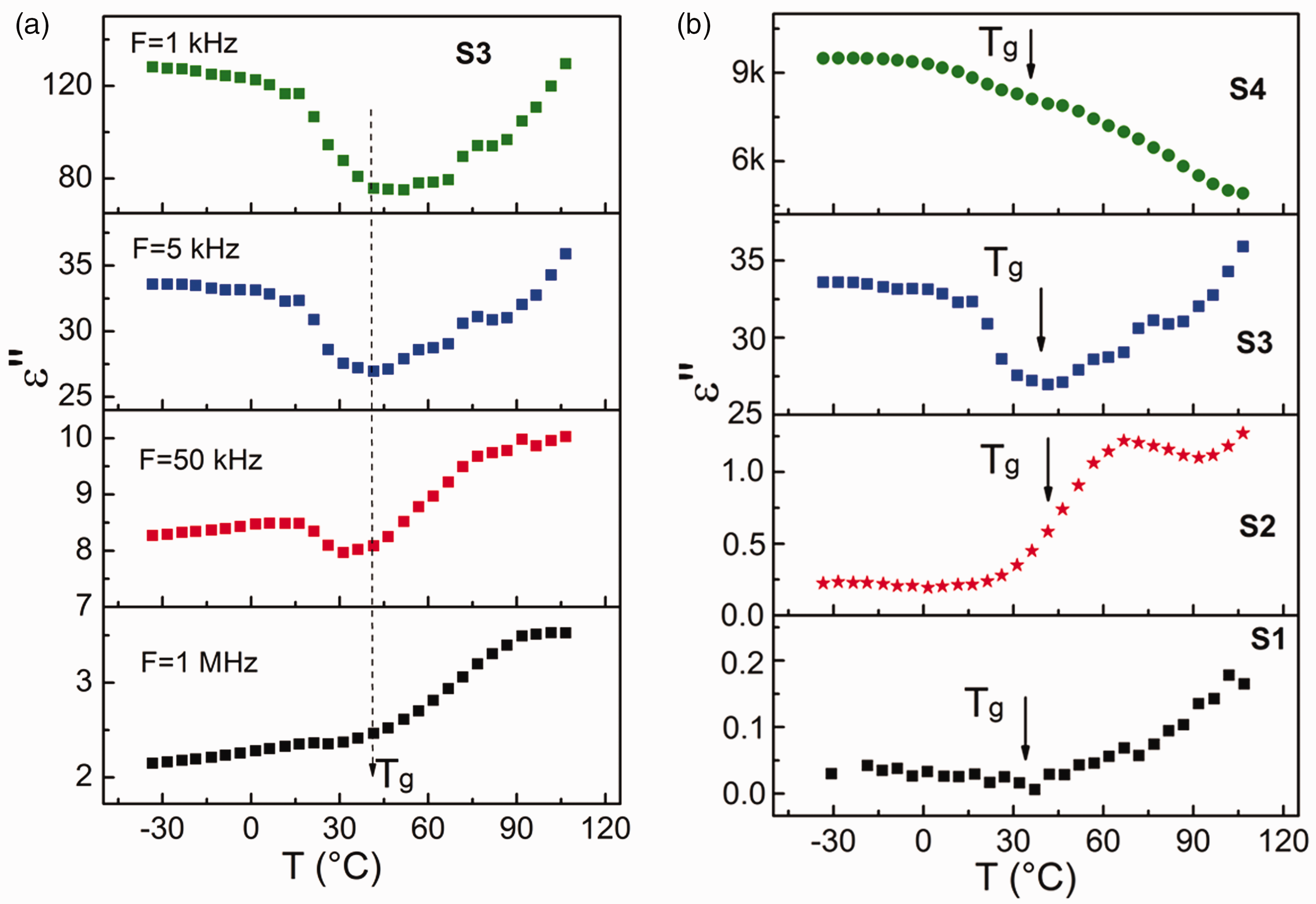
Temperature effect on dielectric permittivity ε″: (a) at different frequencies of sample S3, (b) comparison between the neat polyester and its composites, at 5 kHz. The marked Tg represent the values obtained from DSC measurements.
Electrical modulus analysis
The electrical modulus formalism has been used in several works for interpreting the relaxation processes appearing in the dielectric responses of composites materials based on polymeric matrix reinforced with conducting fillers.40,41 Figure 6 shows the imaginary part, M″, of the complex modulus as a function of frequency for neat polyester (S1) and its composites (S2, S3, and S4), in the range of temperatures below and above the glass transition point Tg. Analysis of these figures yields the following results: (i) for the neat polyester matrix (S1) no relaxation can be detected, (ii) the incorporation of 0.8% Gt particles (S2) to this matrix permits to identify of a remarkable relaxation and this relaxation appears more clearly with the addition of 0.2% CNT particles to the Gt/Polyester binary composite (S3), meaning that the conducting particles are the responsible for dielectric relaxations, and (iii) these relaxations depend strongly on temperature and shift toward high frequencies as the CNT particle concentration increases. As a result, and compared to the investigation of Psarras et al. 42 who presented a study on iron particles loaded-polymer composites, we attributed this relaxation to the interfacial polarization or so-called MWS effect that results from the charge accumulations inside the polyester matrix confirming the behavior of the permittivity spectra discussed above mentioned.16,34 We note that for the composites S2, S3 and S4, the value of the real part, M′, of the complex modulus drop to zero at low frequencies, indicating that the electrode polarization has a negligible effect in our case.43,44
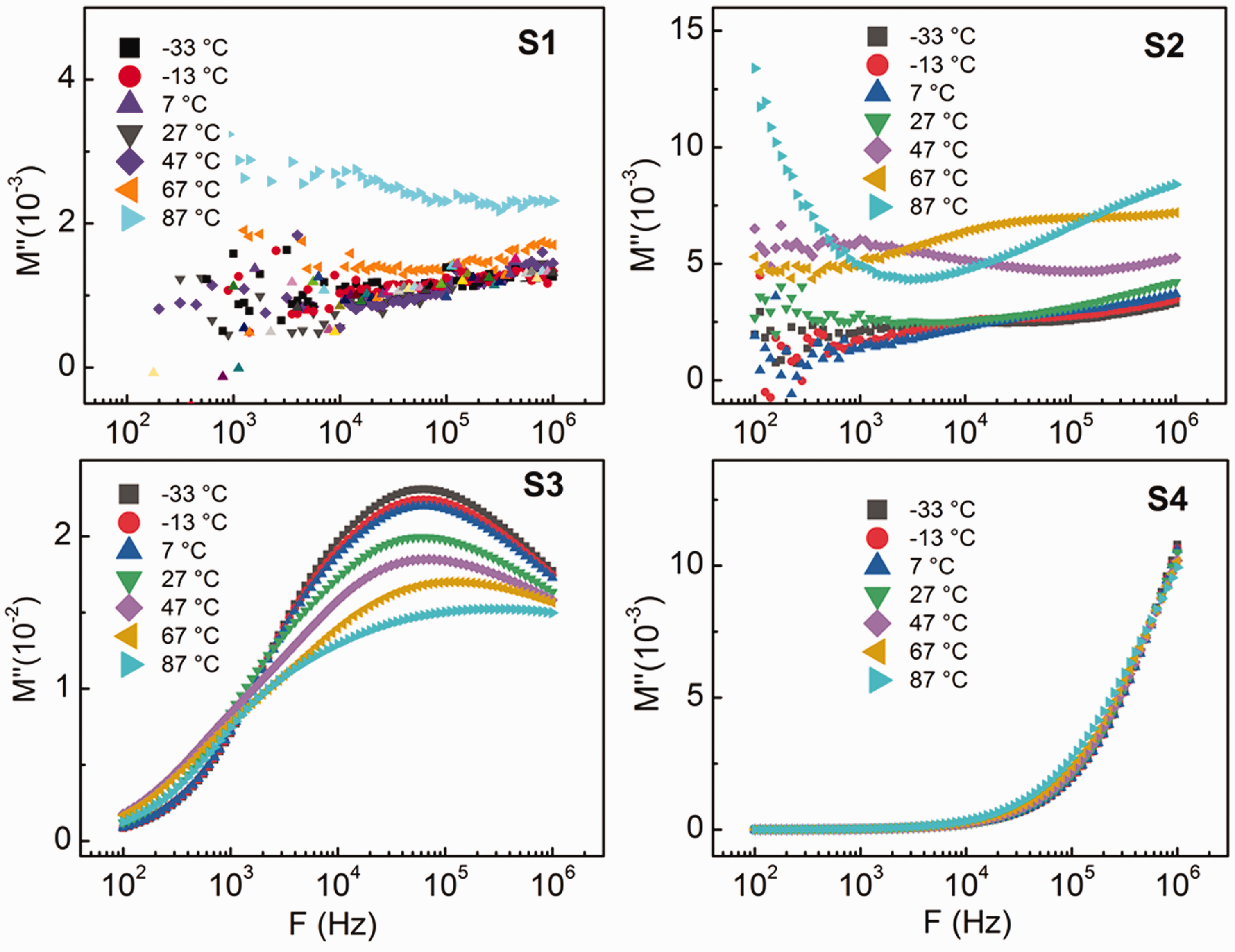
Imaginary part of the electrical modulus, M″, as a function of frequency for the composites S1, S2, S3 and S4, at different temperatures.
Cole–Davidson modeling
As observed in Figure 6, the asymmetrical spectra of M″ (F) indicates that the Debye model is inappropriate to describe the relaxation occurring in our composites, and should be replaced by a frequency-dependent electrical modulus, written as
45



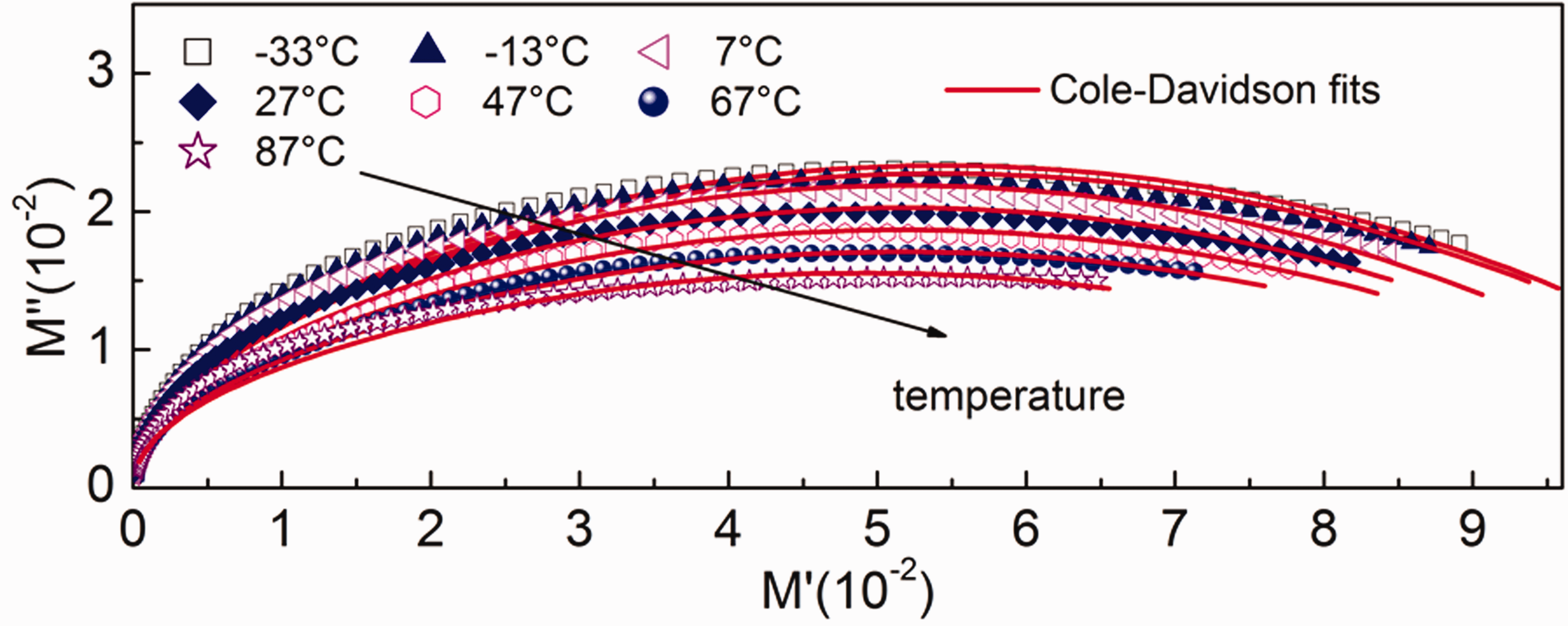
Nyquist representation of the complex electric modulus of the sample S3. Solid lines are produced by fitting experimental points to the Cole-Davidson model (equations (5) and (6)).
Parameters evaluated by fitting the experimental data according to the Cole–Davidson model (equations (5) and (6)) for the Gt/polyester composite (sample S2) and the CNT/Gt/polyester composite (sample S3).

Conclusion
This paper presents studies of thermal and dielectric properties of binary and ternary composites based on the dispersion of Gt and CNT particles in a polyester matrix. Thermal analysis showed that Gt fillers would be a good asset for improving thermal and thermo-oxidative resistance of polyester resins, and increasing the glass transition temperature (Tg). The addition of small quantities of CNT fillers decreased the thermal degradation temperature and Tg values concerning the binary Gt/Polyester composite. Dielectric analyses were carried out in the frequency range from 100 Hz to 1 MHz and temperature below and above Tg. The dielectric permittivity analysis showed that the addition of CNT to the Gt/Polyester composite leading to an enhancement of interfacial polarization of composite, while the electric modulus exhibits a typical dielectric relaxation process that attributed to the Maxwell–Wagner–Sillars relaxation, and the behavior of this relaxation is analyzed using the Cole–Davidson model.
Footnotes
Declaration of Conflicting Interests
The author(s) declared no potential conflicts of interest with respect to the research, authorship, and/or publication of this article.
Funding
The author(s) disclosed receipt of the following financial support for the research, authorship, and/or publication of this article: Project I3N, UIDB/50025/2020 and UIDP/50025/2020, FCT/MEC and the financial support from the Diputación General de Aragón under project T03_20R (Grupo Reconocido).
