







Abstract
In this work, we investigate toughening mechanisms in soft polymers reinforced with stiff fibers, particularly focusing on the effect of the strength of the fiber-matrix bond on the toughness. We print polydimethylsiloxane with short milled glass fibers using direct ink writing, an extrusion-based 3D printing method. This process produces composites with aligned fibers. Fibers can be treated with acid prior to printing, which improves the strength of the fiber-matrix bond. This results in higher yield stress and toughness. The higher toughness of the composites can be attributed to intrinsic mechanisms such as matrix deformation and fiber pullout, as well as to extrinsic mechanisms like mechanical dissipation. The intrinsic toughness of the composites is analytically estimated using a micro-mechanical model and experimentally measured by stretching the composites in the direction of fiber alignment. Finally, we demonstrate partial healing of the fiber-matrix bond after initial pre-stretch. Thermal treatment of the damaged composites results in partial recovery of stiffness and toughness.
Introduction
Fiber-reinforced composites can provide an excellent combination of low mass and superior mechanical properties, including high stiffness and toughness. While many composites, including carbon-fiber epoxy composites, are already widely used in industry, there are still numerous open research questions, particularly for fiber-reinforced soft composites (FRSCs) with stiffnesses on the order of kPa and MPa. Emerging applications such as stretchable electronics1–3 and soft robotics4–7 require tough, yet soft, materials, similar to the properties of soft biological materials such as skin. These application demands have led to a number of strategies for developing tough, soft materials, including hydrogels and elastomers. These include, for example, tough alginate-polyacrylamide hydrogels with periodic long thermoplastic fibers networks, 2 random steel wool networks, 8 woven glass fabric composites with high strength and toughness,9,10 and soft composites with topological interlocking between the soft matrix and a macroscale structure.11,12
In order for composites to achieve useful mechanical properties, stress must be transferred between fibers and matrix. Shear lag models have long been used to describe this in composites with finite fiber length 13 and infinite fiber length, 14 providing full elasticity solutions around the fibers. Modeling of failure processes in fiber-reinforced composites has been limited to unidirectional composites with continuous fibers. Budiansky, Hutchinson, and Evans studied matrix fracture in ceramic composites without fiber fracture, characterizing the effect of frictional forces and interfacial toughness. 15 Later work allowed fibers to fracture, and showed that fiber pullout can contribute significantly to toughness during fracture.16–19 The contribution to toughness arising from fiber pullout has also been experimentally characterized for carbon fiber-reinforced composites with stiff matrices (i.e., epoxy, ceramic).20,21 In conventional fiber composites, other mechanisms, such as fiber fracture, fiber-matrix debonding, and matrix fracture, contribute little to the toughness of the composites. 22 Though there are many studies on fiber-reinforced polymer composites, they have mainly focused on composites with stiff matrices. Recently, a study has applied composite mechanics to FRSCs with continuous fibers. 23 A key difference of soft composites is that the elastic contrast between fiber and matrix is much larger than for conventional composites. This results in a large load transfer length, reducing the stress concentration when a fiber breaks. Energy stored in the fibers before failure is large and dissipated through this process. 23 Another difference with the failure of FRSCs is that matrix deformation contributes significantly to the toughness of the composites, which is generally neglected in the traditional composites literature, since matrices such as epoxy and ceramics are brittle and fail at low strain. In addition to this mechanism, which, since it is a direct result of the microstructure of the composites, is an intrinsic toughening mechanism, some fiber-reinforced composites can toughen via extrinsic mechanisms such as fiber bridging. Soft materials can also be toughened extrinsically via mechanical dissipation, a mechanism for materials that undergo hysteresis during loading and unloading (e.g., tough hydrogels with sacrificial networks). 24 As the crack propagates, the material around the crack experiences unloading. The energy that drives crack growth under such conditions is the intrinsic energy required to generate new surfaces and the energy dissipated during loading and unloading. 25 A previous study has characterized the effect of mechanical dissipation on the toughness of double-network hydrogels. 26
Extrusion-based 3D printing allows one to manufacture short, fiber-reinforced composites with controlled, spatially-varying fiber alignment, making use of shear-induced alignment of fillers during extrusion.27–29 Using direct ink writing (DIW), an extrusion-based 3D printing approach,
30
we fabricate composites with short glass fiber (GF)-reinforced Polydimethylsiloxane (PDMS) and investigate the source of toughness in such composites. In prior work, we have developed a modified shear lag model that accurately predicts the tensile behavior of GF-PDMS composites as a function of the fiber length distribution and the critical length required for shear stress transfer.
31
This model helps explain an observed instability in the tensile behavior at low volume fractions, as well as a ductile-to-brittle transition that occurs as a function of volume fraction. In this work, we investigate the effect of the strength of the fiber-matrix bond (specifically the critical shear stress between the fibers and the matrix) on the toughness of the composites. The strength of the fiber-matrix bond is controlled by treating the fibers with sulfuric acid prior to 3D printing. The acid treatment promotes additional hydroxyl groups on the fibers, as shown in Figure 1(a). After mixing the fibers with a PDMS ink, hydroxyl groups on glass fibers form Si-O-Si bonds with methyl groups on PDMS,32,33 as shown schematically in Figure 1(b) and (c). Acid-treatment of the fibers improves the strength of the fiber-matrix bond, and thereby the tensile properties and fracture properties of the composite. Previous work has shown that PDMS-GF composites exhibit a hysteresis during loading and unloading, resulting from fiber-matrix debonding and subsequent fiber-matrix interaction.
31
Hence, we can expect mechanical dissipation to also contribute to the toughness of PDMS-GF composites, as described in Figure 1(d) and (e). This failure mechanism can also be observed in SEM images of the fracture surface, as shown in Figure 1(f). Individual fibers protrude from the matrix after complete fracture, associated with fiber-matrix debonding and subsequent fiber pullout. During initial loading, the fibers debond from the matrix irreversibly in a small region ahead of the crack tip, as shown in Figure 1(d). When the crack propagates through this region, the material in this area unloads, leaving permanent plastic stretch and dissipated energy (the area under the loading-unloading curve, as shown in Figure 1(e)). Here, we quantify the toughening mechanisms of PDMS-GF composites, including both intrinsic and extrinsic mechanisms. (a) Schematic showing the effect of acid treatment on the fibers; (b–c) comparison of bonding in the untreated and acid-treated fiber-matrix networks, respectively; (d) extrinsic mechanisms for PDMS-GF composites: Fiber-matrix debonding occurs in short fiber-reinforced elastomers; significant dissipation occurs due to sliding between matrix and fibers after initial debonding; (e) the different stages of the fiber-matrix morphology are shown schematically for a representative stress-stretch test. Material ahead of the crack tip undergoes large deformation, causing fiber debonding. After crack formation, material around the newly formed crack relaxes, producing significant energy dissipation; (f) Scanning electron microscope image of the fracture surface of the composite. Scale bar is 100 μm.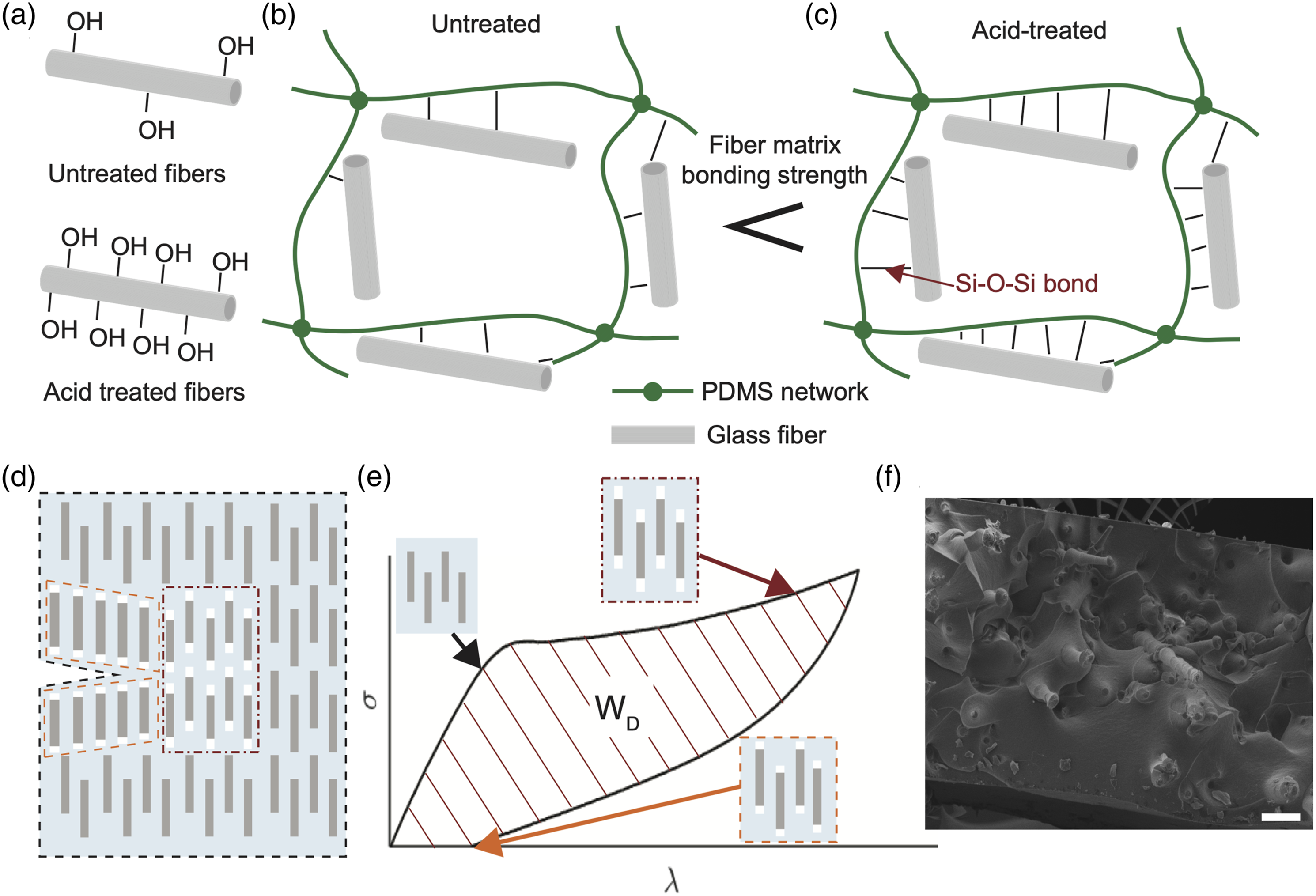
Materials and methods
Fiber treatment
The glass fibers were ultrasonically cleaned in isopropanol for 10 min and subsequently rinsed with deionized water. Then the washed glass fibers were treated with a 0.5 mol/L H2SO4 solution for 30 min with active stirring. The acid was removed by rinsing with deionized water three times, followed by drying at 60°C overnight.
DIW printing
Samples were printed using a commercial 3D printer (Makergear M2) that was previously modified to enable DIW. The composite material is made by combining 85 wt.% SE 1700 (Dow) and 15 wt.% Sylgard 184 (Dow), each at a 1:10 cross-linker ratio. This material was mixed with milled glass fibers (Fiber Glast 29, 1/16”) at specified vol. % using a vacuum mixer (FlackTek). The material was then transferred to a syringe and centrifuged to remove air. We extruded the material pneumatically through a nozzle with 410 μm inner diameter at a pressure of 30 psi.
Mechanical testing
All mechanical tests were conducted in displacement control at a rate of 0.02/s using an Instron 68SC-5. Samples were clamped with jaw faces using a screw action clamp. The toughness of the composites (in the form of thin strips with a crack) can be calculated as the strain energy density of material in the uncracked region at the critical stretch λ c , at which the crack propagates, multiplied by the height of the sample. Specifically, the toughness is computed as G = W (λ c )H0. For samples with a homogeneous arrangement of fibers, we tested a long thin strip of length L = 80 mm, height between grippers H0 = 20 mm, and thickness t = 0.6 mm, with a pre-cut crack of 20 mm. We tested the pre-cracked samples until complete fracture. The critical stretch λ c is defined as the stretch when the crack starts to propagate, as indicated by a drop in load. The strain energy density W(λ) in the material as it is stretched to λ is calculated as the area under the stress-stretch curve from the tensile samples.
Scanning electron microscopy
The fracture surfaces of the composites were characterized using a scanning electron microscope (SEM, JEOL 7500F) at 2 kV.
Enhancement of tensile and fracture properties
In order to quantify the influence of the strength of the fiber-matrix bond on the mechanical properties of the composites, we measure the properties of the composites with and without treated fibers. The treated composites use glass fibers that have been treated with sulfuric acid (0.5 mol/L) to promote hydroxyl group termination on the glass surfaces. We 3D print thin samples with both untreated fibers and acid-treated fibers at 5 and 10 vol.%. First, we uniaxially load conventional tensile specimens in the direction of the fibers (details in methods) to measure the stress-stretch response of the composites (Figure 2(a)). For composites with 5 vol.% glass fibers, the acid treatment doubles the ultimate strength of the composites, but significantly decreases the ductility and the stretch of rupture (as shown in Figure 2(c)). There is still some softening in the stress-stretch response (at a stretch of approximately 1.25) due to fiber-matrix debonding.
31
For composites with 10 vol.% glass fibers, the yield stress increases approximately 20% while no significant change in stretch of rupture is observed after acid treatment. The unchanged stretch of rupture suggests that the failure of the composites at higher volume fractions is limited by other mechanisms, such as matrix fracture. This may result from the reduction in the mean distance between fibers at higher volume fractions, resulting in higher stress concentrations in the matrix. Importantly, for both high and low volume fractions, the initial stiffness of the composite remains unchanged, suggesting that the acid treatment of the fibers does not change the physical properties of the fibers (Figure 2(b)). In our prior work we developed a modified shear lag model to describe the tensile responses of similar composites using physical parameters such as the length of the fibers L0, the radius of the fibers r, and the critical shear stress between fibers and matrix τ
c
(a) The stress-stretch response for unnotched samples with various fiber treatments (dashed lines are fits of the modified shear lag model of Ref.
31
using all the same parameters other than critical shear stress τ
c
); (b) initial modulus E and (c) stretch of rupture for unnotched samples; (d) stress-stretch response for notched samples with various fiber treatments; (e) measured toughness and (f) critical stretch for various fiber treatments.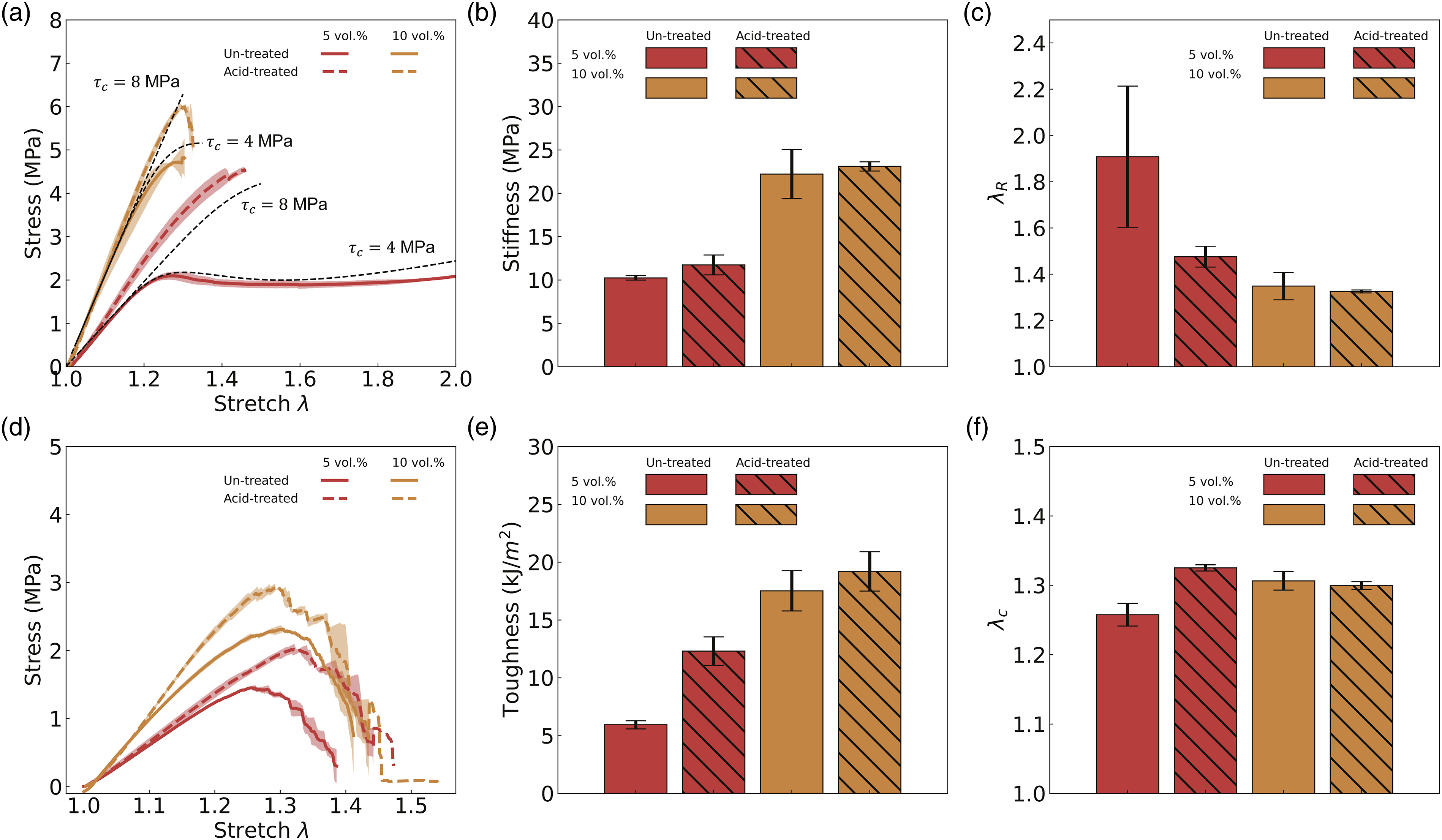

Next we tested long thin strips of the composites with a pre-cut crack oriented perpendicular with the direction of fiber alignment (see schematic in Figure 1(d)). The stress-stretch plots for these notched specimens are shown in Figure 2(d). The acid treatment results in a larger critical stretch λ c and a higher toughness (Figure 2(d)). The acid treatment of the fibers improves the toughness by nearly 100% and 33% for specimens with 5 vol.% and 10 vol.%, respectively. The increase may be lower for composites with 10 vol.%, since higher volume fractions may cause the fracture behavior to become dominated by the matrix properties. Certain soft materials have been found to be extremely flaw insensitive, meaning that cracks below a certain length do not lead to premature material failure. These materials rupture at the same stretch at which the pristine material does. 34 The PDMS-GF composites with 10 vol.% (with both types of fibers) show analogous insensitivity to flaws. The critical stretch λ c = 1.30 (as shown in Figure 2(f)) is very close to the rupture stretch (λ R = 1.32) of unnotched samples. This suggests that this composite is flaw-insensitive for cracks below 20 mm. Moreover, Chen et al. define a parameter called the length of flaw sensitivity r = G/W f as the ratio between toughness G and work of fracture W f (strain energy density at stretch of rupture). By applying this principle, we find the length of flaw sensitivity for unidirectional composites with 10 vol.% is also 20 mm, which is very close to what we observed in the notched samples with 20 mm pre-cut cracks.
Intrinsic toughening

Parameters for calculating toughness of PDMS-GF composites.

Extrinsic toughening
The intrinsic toughness calculated in Table 1 is generally lower than that measured from experiments. This discrepancy may arise due to the additional toughening occurring via extrinsic mechanisms. The extrinsic toughening of PDMS-GF composites is attributed to energy dissipated during crack propagation.25,26 The overall toughness is the combination of intrinsic toughness G0 and toughness from dissipation G
D

Material immediately ahead of the crack tip undergoes hysteretic loading as the crack grows and the material returns to the unloaded state. During the loading and unloading process, the material dissipates energy which is quantified as W
D
. Following prior work that quantified the effect of dissipation on toughness,
26
the effect of the extrinsic toughening can be calculated as

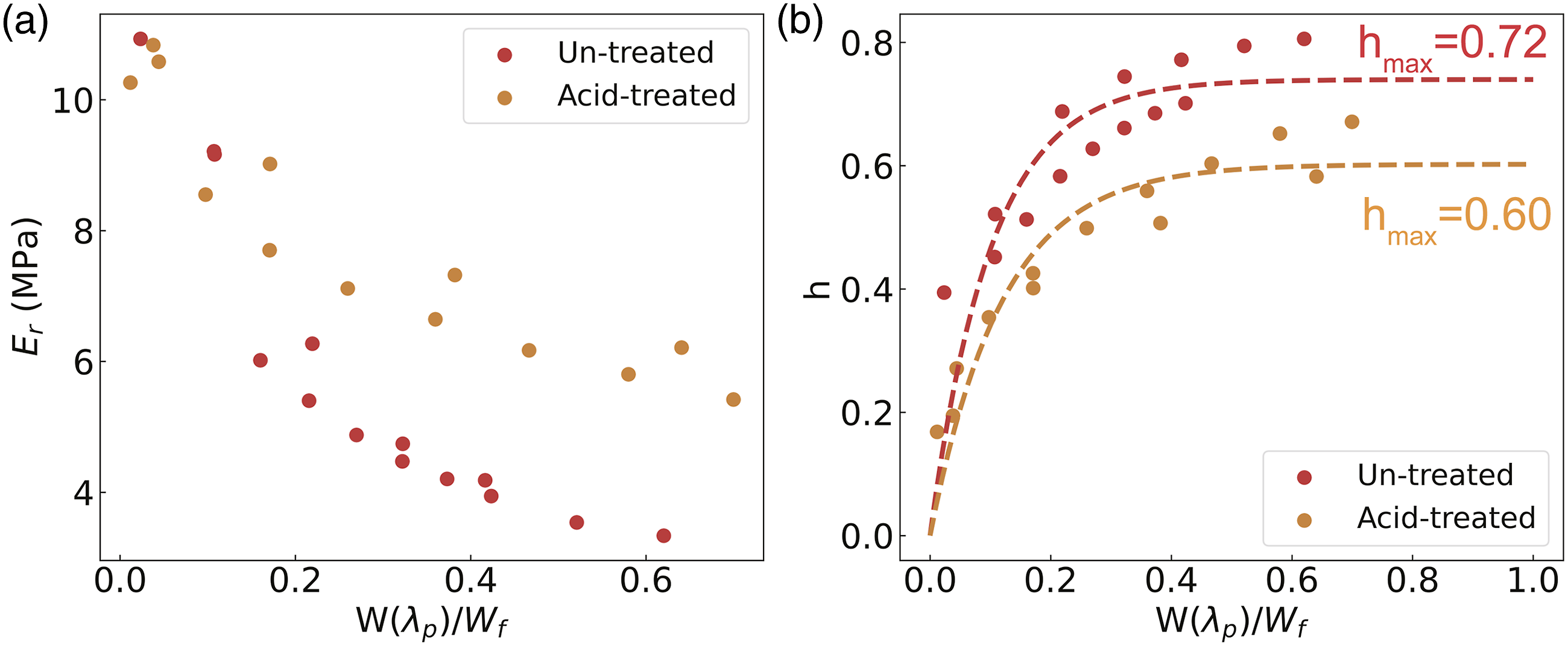
Experimentally, we first measure the hysteresis ratio as a function of the pre-applied stretch by conducting cyclic tests, with increasing stretch applied with each cycle. In Figure 3(a), we plot the initial stiffness of the loading portion of each cycle as a function of the strain energy density W (λ
p
), normalized by the total work of fracture W
f
(area under the stress-stretch curve for unnotched specimens). As the material is stretched to higher amplitudes, there is a drop in the initial stiffness during reloading. This indicates that damage has occurred, analogous to the Mullins effect. The initial stiffness degrades less for composites with acid-treated fibers (50% degradation for composites with acid-treated fibers, vs 70% degradation for composites with untreated fibers). The hysteresis ratio h is calculated for each cycle and plotted versus normalized strain energy density in Figure 3(b). Composites with untreated fibers dissipate a significant amount of energy even at very low stretch, up to 40% at an applied stretch of λ
p
= 1.10. In contrast, the composites with acid-treated fibers show little dissipation at small stretch, dissipating 40% of the energy only at an applied stretch of λ
p
= 1.20. As the applied stretch increases, the hysteresis ratio eventually plateaus, with a maximum at hmax. To quantify the maximum dissipation, we fit the experimental results to an exponential function, which we previously used to model damage in the PDMS-GF composites during monotonic loading
31
(a) Residual modulus during reloading versus normalized strain energy density for a given pre-stretch λ
p
. (b) The hysteresis ratio from cyclic loading tests.
Next, we measure the toughness of the composites that have been pre-stretched. The experimental steps (i to iv) are illustrated in Figure 4(a). A pristine specimen with no pre-cut crack is stretched to λ
p
(step i and ii). After unloading from the pre-stretch (step iii), a 20 mm crack is added using a razor blade. The notched sample is then loaded to failure (step iv), allowing extraction of the critical stretch at which crack propagation is initiated. This experimental method has been used previously to measure the effect of dissipation, e.g., for hydrogels.
26
For composites with untreated fibers, we pre-stretch three individual samples to λ
p
= 1.2, 1.35, 1.5. For composites with acid-treated fibers, we pre-stretch three individual samples to λ
p
= 1.125, 1.25, 1.375. We report the toughness of the composites as a function of normalized strain energy density in Figure 4(b). We also report the toughness of pristine samples, corresponding to the data points for which the pre-stretch strain energy density is zero. For composites with untreated fibers, the toughness drops rapidly and stabilizes with the latter two pre-stretch values. This indicates that the intrinsic toughness G0 is indeed being measured. In contrast, the toughness of the composites with acid-treated fibers drops linearly as the pre-stretch strain energy increases. At pre-stretch λ
p
= 1.375 (which is very close to 1.44, the stretch of rupture for unnotched samples), the composites with acid-treated fibers are still tougher than the composites with untreated fibers without prior loading. (a) Schematic showing the steps taken to measure the toughness of the composites experimentally. A pristine sample (step i) is stretched to λ
p
(step ii), followed by unloading (step iii). A notch is then cut in the sample, which is then loaded to failure (step iv). (b) Experimentally-measured toughness as a function of pre-stretched strain energy density, which shows the effect of dissipation on the toughness of pristine samples. Pre-stretched strain energy density is normalized by the strain energy density at fracture.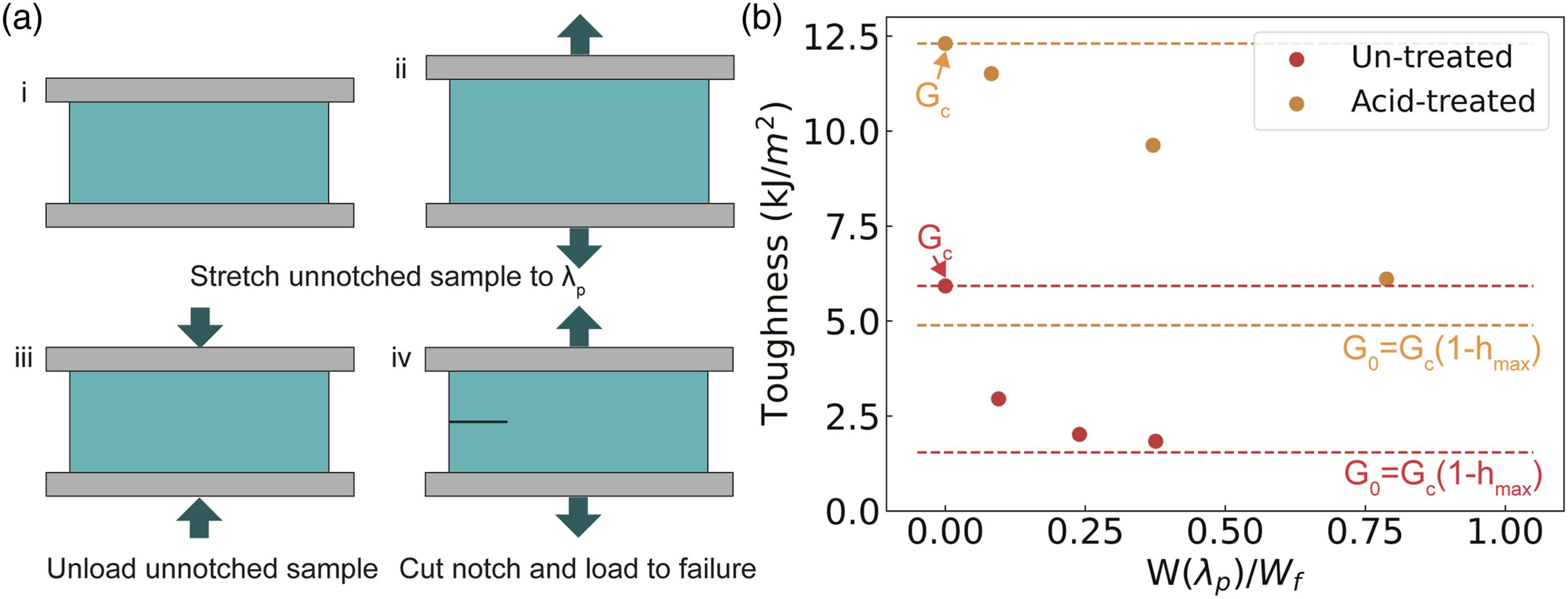
The intrinsic toughness G0 of both composites is estimated via a micro-mechanical model according to equations (2) and (3). It can also be determined experimentally using equation (4) by measuring hmax (from the repeated cyclical loading test of Figure 3(b)) and toughness of the composites without pre-stretch. This estimate is shown in Figure 4(b) as dashed lines for 5 vol.% untreated and acid-treated composites with α = 1, showing a good agreement with the estimate of intrinsic toughness reported in Table 1. This suggests that the energy dissipated during loading and unloading of materials contributes fully to the enhancement of toughness. Also, by extrapolating the experimental toughness with various pre-stretch (Figure 4(b)), one can find that the intrinsic toughness obtained from equation (4) is very close to the toughness if W (λ p )/W f = 1. Hence, equation (4) can be used to extrapolate the intrinsic toughness, which is reported in Table 1. Comparing the experimental value with the micromechanical model, a small discrepancy is found for composites with untreated fibers. They agree well for composites with acid-treated fibers. This supports the validity of the micromechanical model, which indicates that fiber-matrix pullout significantly increases the toughness, in some cases by more than a factor of four. By improving the critical shear stress between fiber and matrix, the intrinsic toughness of the composites can be greatly improved while the energy dissipation is maintained. We also point out that this model assumes extensive fiber-matrix sliding, which means that the composites need to be quite stretchable. For the 10% vol. composites, the model would overestimate the toughness due to the reduced amount of sliding.
Healing of the fiber-matrix bond
Even though the extrinsic toughening associated with the damage mechanisms contributes to a higher toughness, these inelastic processes degrade the performance of the composite under cyclic loading (Figure 4(b)). In this section, we explore the feasibility of healing the fiber matrix bond to recover lost stiffness and toughness. This is possible because the matrix (PDMS) has low hysteresis and does not have appreciable inelastic degradation. 37 To study this effect, specimens are first loaded to λ p and unloaded to zero stress. Next, they are placed in the oven at 100°C for 10, 30, 60, or 120 min. After this, we immediately test the composites either in uniaxial tension (to characterize stiffness) or in a tear test (to characterize toughness). As a control, we also leave some damaged specimens at room temperature for the same time intervals.
We plot the ratio of the residual stiffness E
r
to the initial stiffness E0 (defined in Figure 5(a)) as a function of the healing time in Figure 5(b). All composites are pre-stretched in uniaxial tension up to λ
p
= 1.35. No significant recovery of stiffness is observed when specimens are left at room temperature, regardless of fiber treatment. In contrast, after 10 min in the oven, untreated and acid-treated fiber composites recover up to 80% and 85% of the initial stiffness, respectively. After 120 min, untreated and acid-treated specimens recover 92% and 99% of the initial stiffness, respectively. The nearly perfect recovery of the specimens with acid-treated fibers may be the result of the additional hydroxyl groups, as illustrated in Figure 1(a), which could be reactivated under heat to bond with the PDMS network.
32
(a) Schematic of initial stiffness E0 and residual stiffness E
r
during loading and unloading of the composites. (b) The ratio between residual stiffness and initial stiffness after either being placed in an oven or left out (as control) for the indicated period of time. Toughness degradation of composites with (c) untreated fibers and (d) acid-treated fibers for various pre-stretch, thermally treated for 2 h after pre-stretching (or left as control).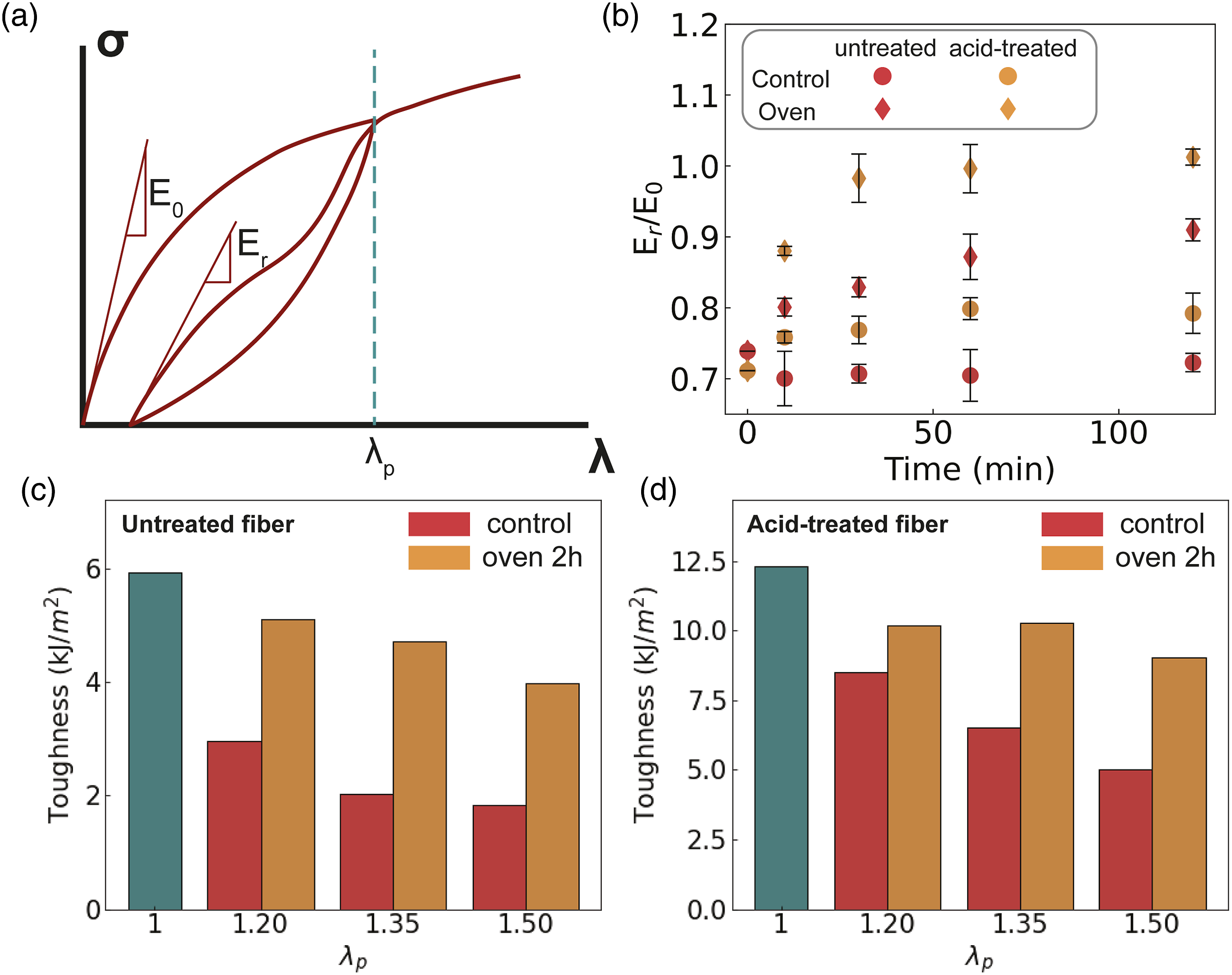
As shown in Figure 4(b), pre-stretching the composites results in the loss of toughness. However, the healing process restores some of this. To measure this effect, we first stretch specimens with no pre-cut crack to a pre-stretch of λ p , followed by unloading. The samples are subsequently placed in the oven for 120 min. Next, we cut a notch and test the samples until failure. As controls, some specimens are subjected to the same procedures but without exposure to elevated temperature. Figure 5 panels c and d show the measured toughness values for specimens with untreated fibers and acid-treated fibers, respectively. For composites with untreated fibers, after healing, the composites are more than 100% tougher than specimens that did not undergo healing at pre-stretch values of 1.35 and 1.50. For composites with acid-treated fibers, the original drop in toughness after pre-stretching is not as significant as that for composites with untreated fibers. After healing, the toughness recovery is not as significant in percentage. Nevertheless, composites with acid-treated fibers can recover more than 75% of the toughness after pre-stretching at large stretch (λ p = 1.50), which is 65% larger than for composites with untreated fibers.
Conclusion
In summary, fiber-matrix debonding is the damage mechanism in the PDMS-GF composites that causes inelastic behavior such as load plateau and a cyclic loading response analogous to the Mullins effect. We found such damage in the composite provided both intrinsic and extrinsic toughening via fiber pullout and mechanical dissipation as a result of fiber-matrix interaction after debonding. We investigated the effect of the strength of the fiber-matrix bond and found that it enhances the intrinsic toughness of the composites while slightly decreasing the contribution from extrinsic toughening. However, the amount of extrinsic toughening depends on the intrinsic toughness (as shown in Equation (4)), leading to higher toughness with improved fiber-matrix bond strength. Finally, we showed that the fibers can be rebonded to the matrix after the composites are relaxed from loading through a simple thermal process. This allows the composites to regain stiffness and toughness even after large pre-stretching. Particularly, composites with acid-treated fibers can recover more stiffness and toughness during the healing process. This allows these composites to be used multiple times and still remain tough.
Footnotes
Declaration of conflicting interests
The author(s) declared no potential conflicts of interest with respect to the research, authorship, and/or publication of this article.
Funding
The author(s) disclosed receipt of the following financial support for the research, authorship, and/or publication of this article: This study is supported by Air Force Office of Scientific Research (FA9550-19-1-0285).
