






Abstract
Natural fiber reinforced polymer composites have attracted great attention in the past few decades due to increasing environmental awareness and various advantages of these materials in terms of mechanical properties, sustainability, renewability and biodegradability. In this study, hemp rovings with various amounts of twist were prepared using water-retted continuous hemp fiber bundles. Then these rovings were used to produce quasi-unidirectional (quasi-UD) woven hemp fabrics. These fabrics were utilized to manufacture epoxy composites. Tensile and flexural tests were carried out to determine the mechanical properties of the developed composites and the effect of yarn twist. The fracture pattern of the composites was investigated using scanning electron microscopy (SEM) analysis. The tensile strength of the composite with 45 turns/m twisted rovings was approximately 20% lower than that of the composite sample with zero-twist hemp rovings. Composites with a twist level of 45 turns/m also showed approximately 37% and 48% lower flexural strength and modulus values respectively when compared to composites with zero-twist yarns. This was attributed to the fact that the yarn twist causes the fibers to align at an angle to the loading direction resulting in reduced properties in the axial direction of the composites as well as fiber damage induced by twisting. SEM observations showed that the composite failure took place predominantly as total fiber fracture, fiber pull-out from the yarns and matrix cracking. There were also limited cases of fiber pull-out from the matrix.
Keywords
Introduction
Natural fiber reinforced composites have attracted great attention in recent years as alternative green materials to commonly used glass fiber reinforced plastics in various industries.1–4 Natural bast fibers such as hemp, flax, kenaf and jute are especially suitable as reinforcement materials due to their high stiffness and strength as well as low density.5–7 Thanks to these properties, composites reinforced with natural fibers can compete with glass fiber reinforced plastics on a per-weight basis. 8 However, natural fiber composites have some problems yet to be solved for their wide-scale usage such as high moisture absorption and incompatibility between hydrophilic natural fibers and hydrophobic polymer resins. The high sensitivity of plant fibers to humidity generate a weak fiber/matrix interface and leads to a significant weakening and alteration of the mechanical properties of the fibers and composites exposed to high humidity levels. The incompatibility between natural fibers and polymer resins leads to poor adhesion at the fiber/matrix interface and resulting low mechanical performance. Various physical, chemical and biological (mostly enzymatic) treatments have been used to improve the fiber/matrix interface such as alkali treatment,9–14 silane treatment,11,15,16 acetylation,11,15,17 graft copolymerization 18 and enzymatic treatments.9,10,19
Hemp (Cannabis sativa L.) has a special place among other fiber crops due to its environmentally friendly nature and superior mechanical properties. There are few studies investigating the mechanical properties of unidirectional hemp fiber reinforced composites which mostly deal with the mechanical characterization and fiber/matrix interface improvement. Liu et al. 9 investigated the effect of pectin and hemicellulose removal from hemp fibers on the mechanical properties of unidirectional hemp fiber/epoxy composites. Pectin removal increased composite stiffness and ultimate tensile strength whereas hemicellulose removal increased composite stiffness, but decreased composite ultimate tensile strength due to removal of xyloglucans. Liu et al. 20 showed that the combined treatment of hydrothermal pre-treatment and enzymatic retting removes non-cellulosic compounds and improves the mechanical properties of hemp fiber/epoxy composites. Liu et al. 21 demonstrated that laccase treatment after 0.5% EDTA +0.2% endo-polygalacturonase (EPG) treatments increased the mechanical properties of unidirectional hemp/epoxy composites. Corbin et al. 22 developed quasi-UD fabrics with hemp fibers. The stiffness and strength properties of the developed composites were comparable to the values reported for flax composites in the literature. Abbas et al. 23 investigated the mechanical properties of hemp/green epoxy composites by using four different weave structures and by adding glass microspheres to the resin. The results showed that the tensile strength of composites with satin weave reinforcement is better than those of the other weaves, due to longer warp thread float and lesser number of intersection points. The composites with 5% glass microspheres showed better tensile, flexural and impact behavior. Umair et al. 24 investigated the effect of weave architecture and glass microspheres percentage on the low velocity impact response of hemp/green epoxy composites. It was demonstrated that both weave design and glass microspheres show a significant effect on impact properties of the composites. The composite sample reinforced with satin woven reinforcement exhibited maximum value of impact force, whereas composite samples containing 5% glass microspheres display more resilience and stiffness as compared to other structures.
One of the disadvantages of natural fiber composites is that the natural fibers have a short length. They are not continuous as the synthetic and high performance fibers such as glass, carbon and high density polyethylene. Therefore, twisting process is needed to obtain a continuous yarn structure from natural fibers, which generally reduces the mechanical properties of their composites due to alignment of fibers at an angle to the loading direction. Lu et al. 25 investigated the influence of hemp roving twist and fiber parameters on the mechanical properties and water absorption of quasi-UD hemp/polyester composites. The roving twist has negatively affected the mechanical properties of the composites when the 40 turn/m roving was used as the weft. Baets et al. 26 determined the optimal flax fiber preparation route for use in unidirectional flax–epoxy composites. They showed that the dry fiber bundle strength increases with the increasing twist angle whereas the twist angle should be minimal for better composite properties. Omrani et al. 27 investigated the mechanical properties of flax fiber-reinforced preforms and composites. They concluded that the twist level of yarn strongly influences the tensile characteristics of the composites and that a higher twist level can increase the internal stress of the yarns. Rask and Madsen 28 evaluated the effect of twist angle on the flax fiber yarn composites. They introduced a range of twist angles to the yarns by using a yarn twisting machine. They produced six types of yarn with twisting angles ranging from 5° to 25°. According to their results, no relation could be found between the composite stiffness and the fiber twisting angle, which they attributed to the fact that the fiber yarns in the composites behave as solid ‘rods’ instead of assemblies of individual fibers. Ma et al. 29 investigated the effect of yarn twist on the mechanical properties of sisal yarns and unidirectional sisal/phenolic resin composites. They observed that there is a critical fiber twist level for unimpregnated sisal yarns beyond which the tensile properties started to decrease with increasing level of yarn twist. However, for sisal yarn unidirectional composites, both tensile strength and modulus in the axial direction decreased with increasing yarn twist level. Goutianos et al. 30 evaluated the effect of yarn twist on the mechanical behavior of impregnated flax roving composites. The composite strength dropped gradually with twist for all the yarn types they examined. The highest strength was obtained for yarns with no twist as all the fibers were almost aligned with the loading direction. With increasing twist, the strength dropped similar to that of the strength of an off-axis laminate. Shah et al. 31 developed a novel mathematical model which can accurately predict the effect of yarn twist on aligned plant fiber composite tensile strength.
To the best of our knowledge, there has not been a study dealing with the production of quasi-unidirectional hemp fabrics by directly using water-retted continuous hemp fiber bundles as warp yarns for composite application. The main aim of this study was to develop hemp fiber composites which resemble, in structure, traditional quasi-UD fabric composites from high performance synthetic fiber rovings such as carbon, glass, and aramid. First, hemp rovings with zero twist and varying degrees of twist were prepared using water-retted continuous hemp fiber bundles. Then these rovings were used to produce quasi-unidirectional woven hemp fabrics. Hemp fiber composites were manufactured using these fabrics and epoxy resin. Tensile and flexural tests were performed to determine the feasibility of using such composite structures. The effect of the level of roving twist on the mechanical properties of the composites was also investigated. The fracture pattern was investigated using scanning electron microscopy (SEM) analysis.
Experimental procedure
Materials
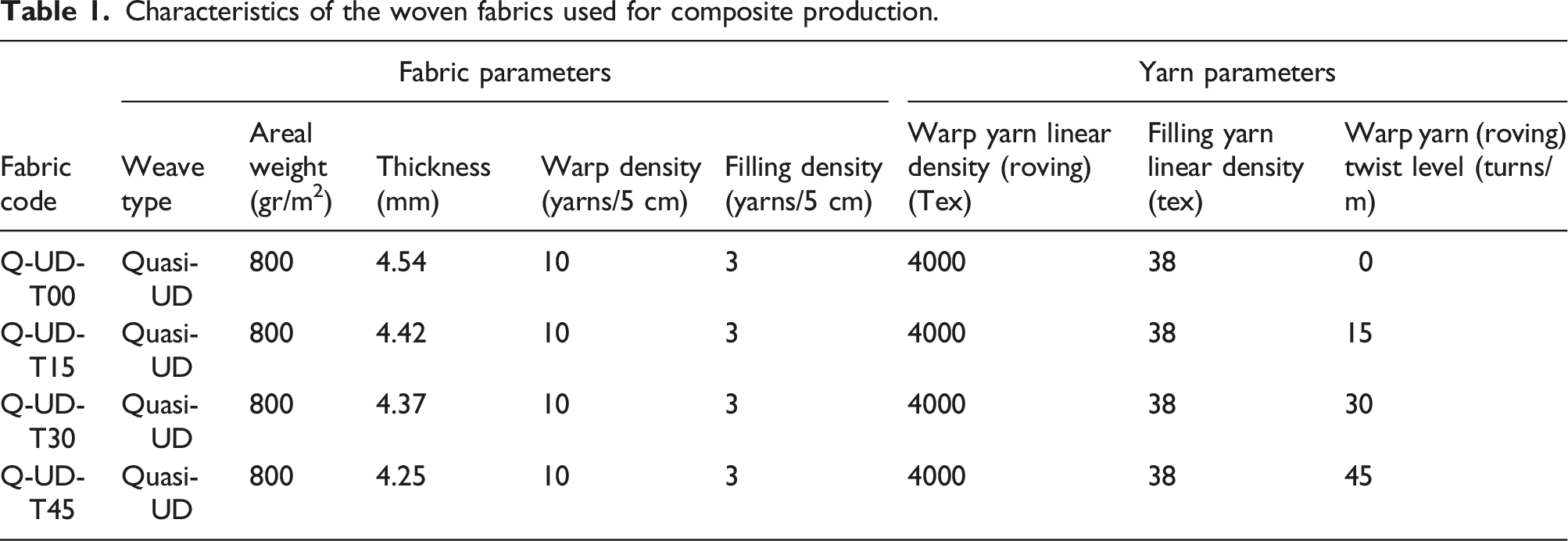
The water-retted hemp fibers used in this study belong to the local Narlısaray population of Samsun region, Turkey. The hemp stalks were water-retted for a duration of 7 days in a stream and the fibers were extracted manually and combed by passing through nails with different densities. After sufficiently cleaned and separated, the fiber bundles were cut to a constant length of 1 m each. Several of these 1 m-fiber bundles were assembled together to make rovings such that all the fibers are parallel to each other and the roving has a constant mass of 4 g per meter resulting in a roving linear density of 4000 tex. Four types of these rovings in terms of roving twist level were used to manufacture quasi-UD woven fabrics, one was untwisted (without twist) and three were twisted with varying degrees of twist measured as turns per meter. The twist levels used for these twisted rovings were 15, 30, and 45 turns/m. West System 105 epoxy resin with 206 slow hardener (West System, Michigan, USA) with a mix density of 1.18 g/cm3 were used with a 5:1 (resin:hardener) ratio to produce the composite specimens.
Fiber pre-treatment
Hemp fibers were pretreated with alkali solution to improve the fiber–matrix interface of the resulting composites. For this purpose, hemp fibers were treated with 5 wt % NaOH aqueous solution at 25° for 1 h. The fibers were then neutralized with 2 wt % acetic acid solution. Finally, the fibers were washed again with distilled water and dried in an air oven at 70°C for 8 h.
Fabric production
Characteristics of the woven fabrics used for composite production.
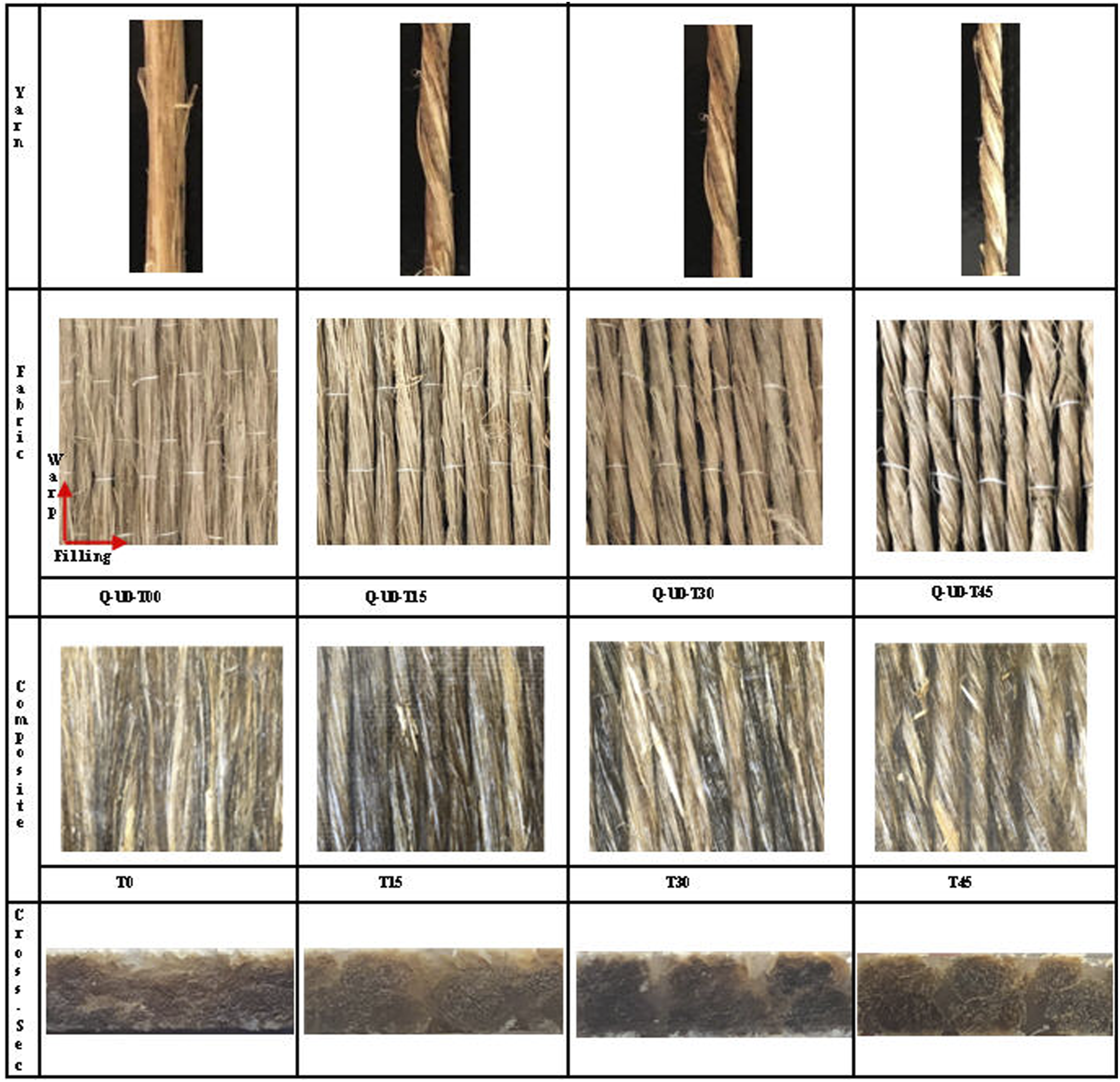
Hemp fabrics and composites produced in the study together with the picture of the yarns with varying twist levels that were used to make the fabrics.
Composite production and physical characterization
Compression molding technique was used to produce hemp/epoxy composites. Four different types of hemp/epoxy composites were manufactured using the four different types of quasi-UD fabrics that have different warp twist levels such as 0, 15, 30, and 45 turn/m. Each composite sample consisted of two layers of the same type of quasi-UD woven fabric (for example, two layers of zero-twist roving Q-UD fabrics) stacked one on top of the other so that the warp yarns are aligned in the testing (material) direction. For the composite production, first, two layers of woven fabrics were impregnated with epoxy resin mixture and placed in a steel mold. Then the mold was closed and placed in a compression molding press and compressed at room temperature using a pressure of 6 bar (0.6 MPa). Composite thickness was controlled by using stopper plates of thickness 3.7 mm. The mold was kept under pressure for 24 h for further curing. After the curing is complete, the mold was opened and the composite plates with dimensions of 300 × 300 mm (length x width) were removed from the mold.
Fiber weight fraction was determined using the following formula:
Composite theoretical density (ρ
th
) and fiber volume fraction (V
f
) were calculated in accordance with the basic Rule of Mixtures using the following equations:
The water immersion technique was used to experimentally determine the actual density of the composites (ρ ac ) according to ASTM D792 32 standard. The rectangle samples with dimensions of 10 mm × 10 mm were used for density measurements. Distilled water was used as the immersion fluid at room temperature.
The volume fraction of voids is given by the following equation:
Composite mechanical testing
Composite tensile and three-point flexural tests were conducted in accordance with ASTM D3039 33 and ASTM D790 34 standards respectively using a Shimadzu AG-X 50 universal testing machine equipped with a 50 kN load cell. Tensile tests were carried out in fabric warp direction. 3-Point flexural tests were carried out flatwise such that the tensile load generated on the back side of the specimen is in the warp direction. Specimen dimensions for the tensile tests were 250 × 25 mm (length x width). Gauge length was 150 mm. Crosshead speed was 2 mm/min. Specimen dimensions for the three-point flexural tests were 80 × 12.7 mm (length x width) with a span length of 64 mm. Loading rate was 2 mm/min for the flexural tests. 5 specimens were tested for each sample group and the average results were reported with the standard deviations.
Flexural strength (σ
fM
), flexural modulus of elasticity (E
B
), and flexural strain (Ɛf) of the composite plates were calculated by means of the following equations:
SEM analysis
Fracture surfaces of composite samples were sputtered with gold–palladium and observed on a FEI Quanta FEG 450 scanning electron microscope. The SEM was operated at an accelerating voltage of 10 kV.
Results and discussion
Tensile properties of the composites
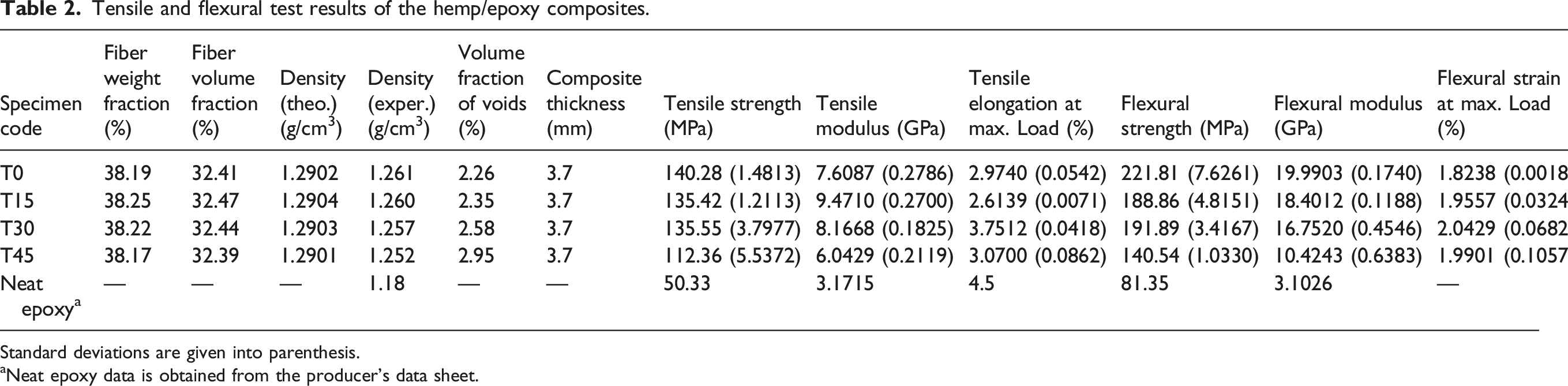
Tensile and flexural test results of the hemp/epoxy composites.
Standard deviations are given into parenthesis.
aNeat epoxy data is obtained from the producer’s data sheet.
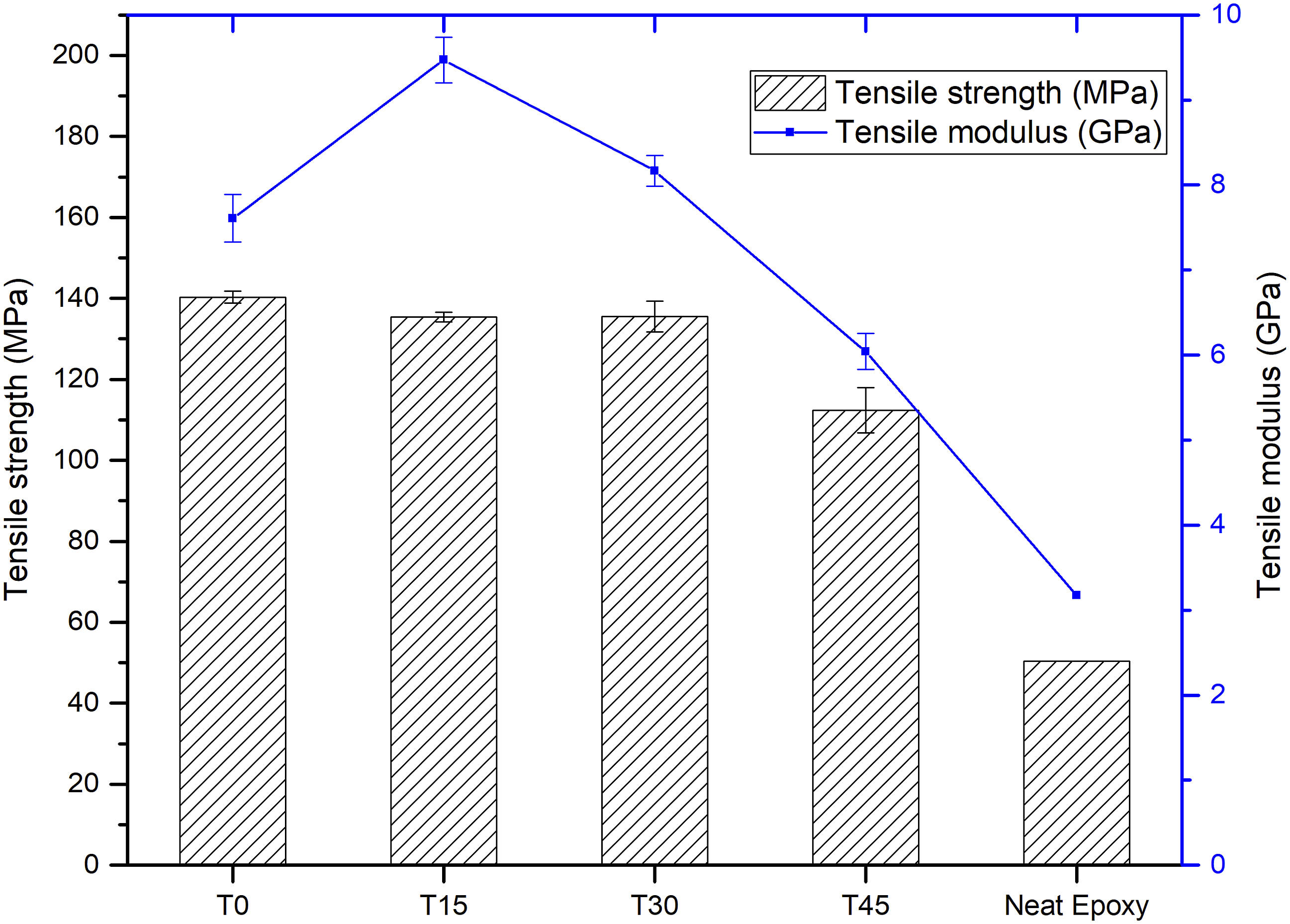
A comparison of the tensile strength and moduli values of the produced composite samples.
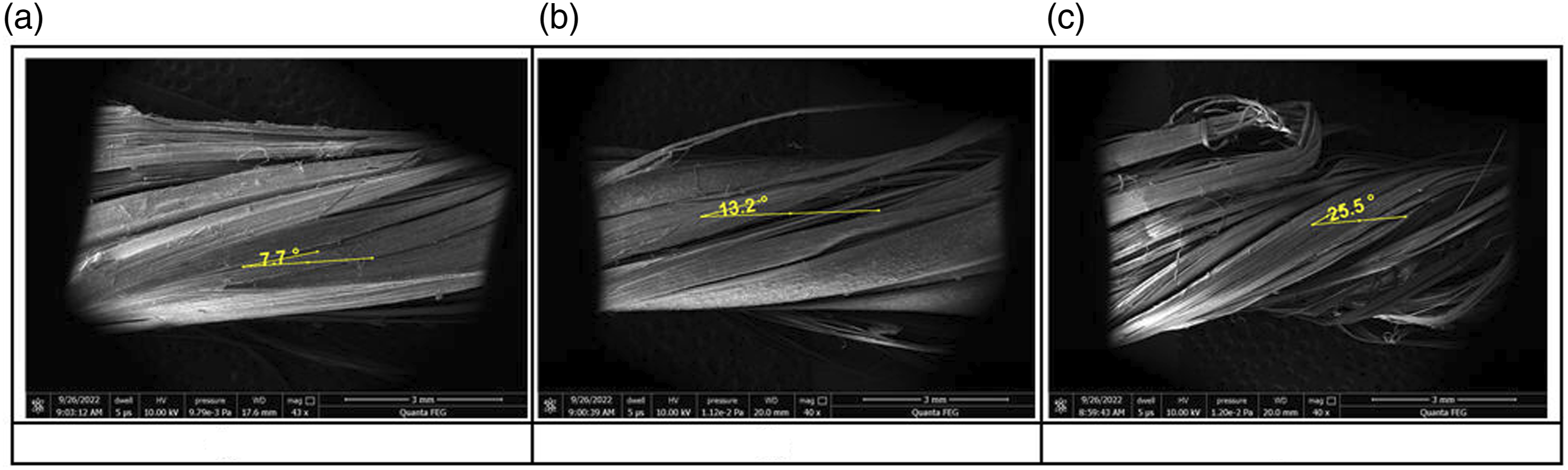
Twist angle measurements of various twisted hemp yarns under SEM (a) 15 turns/m; (b) 30 turns/m); (c) 45 turns/m.
Taking into account the tensile modulus values, a low amount of twist noticeably improved the tensile modulus of the composites as the composites reinforced with 15 and 30 turns/m twisted yarns (T15 and T30, respectively) showed higher tensile modulus when compared to the composite with zero-twist yarns (T0) (Figure 2). Given that the fiber orientation in the axial direction is negatively affected by any twist level, this result is interesting. This result can be attributed to the fact that a low amount of twist removes the yarn crimp and results in a more compact and rigid yarn structure (Figure 1). Fibers without twist in the composite structure have a certain degree of waviness and crimp on them and have a degree of freedom to slide past each other at the beginning stage of tensile loading which can result in relatively low values of tensile modulus. Twisted yarns however, have more compact and rigid structure (Figure 1) which may have resulted in observed high tensile modulus values in the case of 15 and 30 turns/m yarn twist. Further increase in yarn twist level (T45 samples), however, resulted in lower values of tensile modulus compared with zero-twist yarn composites (T0) possibly due to the less oriented fibers in the loading direction due to the increased yarn twist when compared to T0, T15 and T30 samples. Another reason for the lower modulus values of T45 samples can be fiber damage induced by high twist amount (Figure 3(c)). Twisting the rovings is also thought to generate residual stresses in the fibers, which can lead to a premature failure, compared to the zero-twist samples.
There are a low number of studies that investigated the effect of yarn twist on the mechanical properties of natural fiber reinforced composite materials. Ma et al. 29 obtained similar results to ours in their study where they investigated the effect of yarn twist on the mechanical properties of sisal yarns and unidirectional sisal/phenolic resin composites. They observed that there is a critical fiber twist level for unimpregnated sisal yarns beyond which the tensile properties started to decrease with increasing level of yarn twist. However, for sisal yarn unidirectional composites, both tensile strength and modulus in the axial direction decreased with increasing yarn twist level. They attributed this result to two main reasons which led to the decline of the composite mechanical properties. Firstly, as the twist level is increased, the angle between fiber orientation and the loading direction increased. Therefore, the load-bearing capacity of the composites decreased. Secondly, with increasing level of twist, the yarn structure was tightened resulting in a reduced permeability for the resin which resulted in a poor fiber/matrix impregnation. In their study, tensile modulus was slightly decreased by a low amount of twist (20 tpm) whereas tensile modulus noticeably increased for low twist levels (T15 and T30) in our current study. Flexural modulus of their composites decreased with increasing twist levels similar to our current work. Goutianos et al. 30 also obtained similar results in their study where they evaluated the effect of yarn twist on the mechanical behavior of impregnated flax roving composites. The composite strength dropped gradually with twist for all the yarn types they examined. The highest strength was obtained for yarns with no twist as all the fibers are almost aligned with the loading direction. With increasing twist, the strength dropped similar to that of the strength of an off-axis laminate.
When the values obtained in this current study are compared to those obtained by Eksi and Genel 35 for the equivalent unidirectional glass fiber/epoxy composites (V f = 30%), it can be seen that glass fiber UD composite has higher tensile modulus and tensile strength (18.3 GPa and 432 MPa respectively) compared to maximum values for hemp fiber UD composites developed in this study (9.5 GPa and 140 MPa). However, taking into account the lower density of hemp fiber/epoxy composites (1.26 g/cm3) when compared to glass fiber/epoxy composites (1.55 g/cm3) and nature-friendly properties of hemp fiber composites, they can be considered as alternative materials for low-load bearing applications.
Figure 4 shows the tensile stress versus elongation curves of the tested composite samples. Composites with untwisted yarns and low-twist yarns (T15 and T30) have steeper stress–elongation curves when compared to composites manufactured with yarns with high amount of twist (T45) indicating a more ductile behavior for the latter overall. When T30 and T45 are compared, it can be seen that their curves followed very similar paths except the sample with higher amount of yarn twist failed at a lower load possibly due to premature failure of T45 sample because of the disruption of the axial orientation of the fibers and the fiber damage caused by twisting as shown in Figure 3(c). Tensile stress versus elongation curves of the tested composite samples.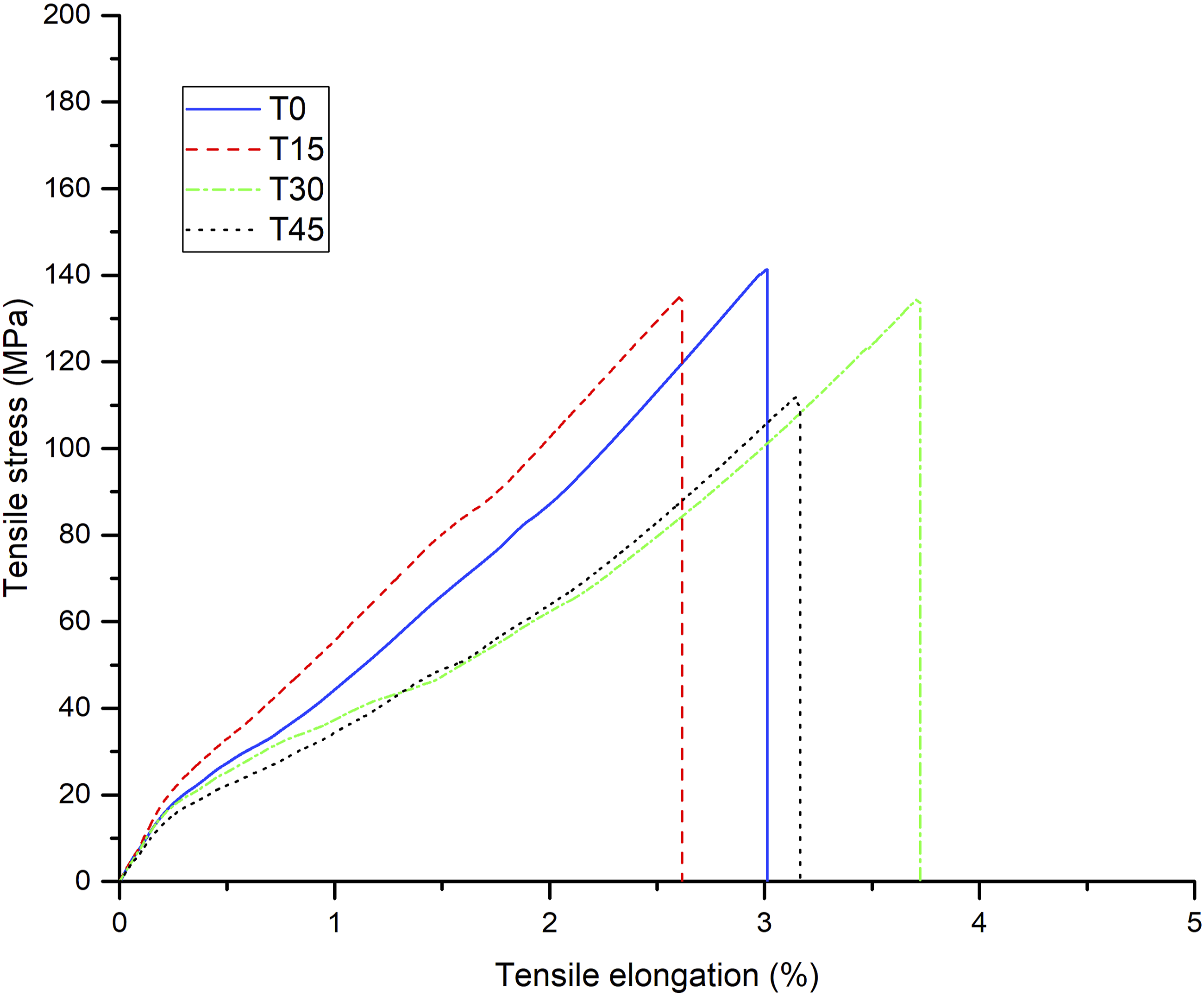
Flexural properties of the composites
Flexural test results of the composites are listed in Table 2 and depicted in Figure 5. In flexural test, the front side of the specimen takes up the compressive loads while the back side experiences a tensile load. It can be seen that the flexural strength and modulus of the composites decreased as the yarn twist level increases. Composites with zero-twist yarns (T0) showed the highest flexural strength and modulus values. Flexural strength and modulus decreased as the yarn twist level increases. Composites with a twist level of 45 turns/m (T45) showed approximately 37% and 48% lower flexural strength and modulus values respectively when compared to composites with zero-twist yarns (T0). This result can be attributed to the fact that as the yarn twist level increases, the angle that the fibers make with the loading axis increases as shown in Figure 3. This disruption in the alignment of the fibers in the loading direction is thought to be responsible for such dramatic decrease in the flexural strength and modulus. The flexural modulus results showed a different pattern when compared to the tensile modulus results where composites with a low amount of twist (15 and 30 turns/m) showed higher tensile modulus results compared with zero-twist yarn composites. This was attributed to the fact that yarns become more compact and rigid under twist which led to higher tensile modulus values for certain levels of yarn twist. When flexural modulus results are taken into account, it can be seen that composites with zero-twist yarns showed higher flexural modulus when compared to twisted yarn composites samples. This result is reasonable considering the fact that tensile loading leads to more pronounced splitting and sliding of fiber bundles compared with flexural loading. In flexural test, however, the flexural strain values are lower and the failure mechanism is mostly governed by tensile-compression loads. The induced shear loads under the flexural loading can also reduce the modulus values of twisted yarn composites. A comparison of the flexural strength and moduli values of the produced composite samples.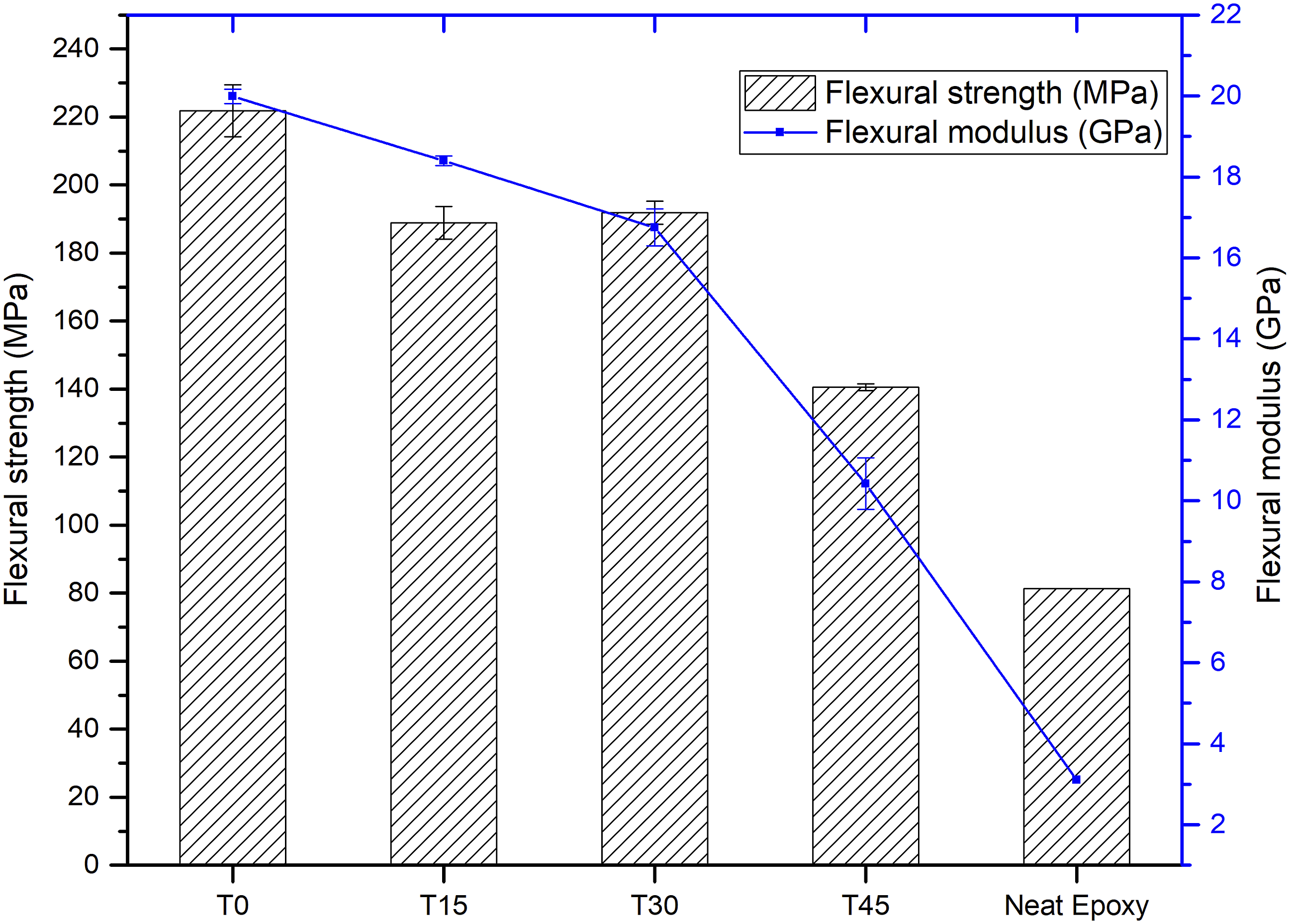
Figure 6 shows the flexural stress versus strain curves of the tested composite samples. All the composite samples behaved in a linear manner at the early stages of loading and then transformed into pseudoplastic region before reaching a maximum stress and then failing abruptly. The fact that the flexural strain values which is the nominal fractional change in the length of the element of the outer surface of the specimen at midspan, where the maximum strain occurs are less than the tensile strain values (Table 2) indicates that the yarn re-orientation and waviness removal was limited. Composites reinforced with high-twist yarns showed more ductile behavior when compared to untwisted and low-twist yarn composites. Flexural stress versus strain curves of the tested composite samples.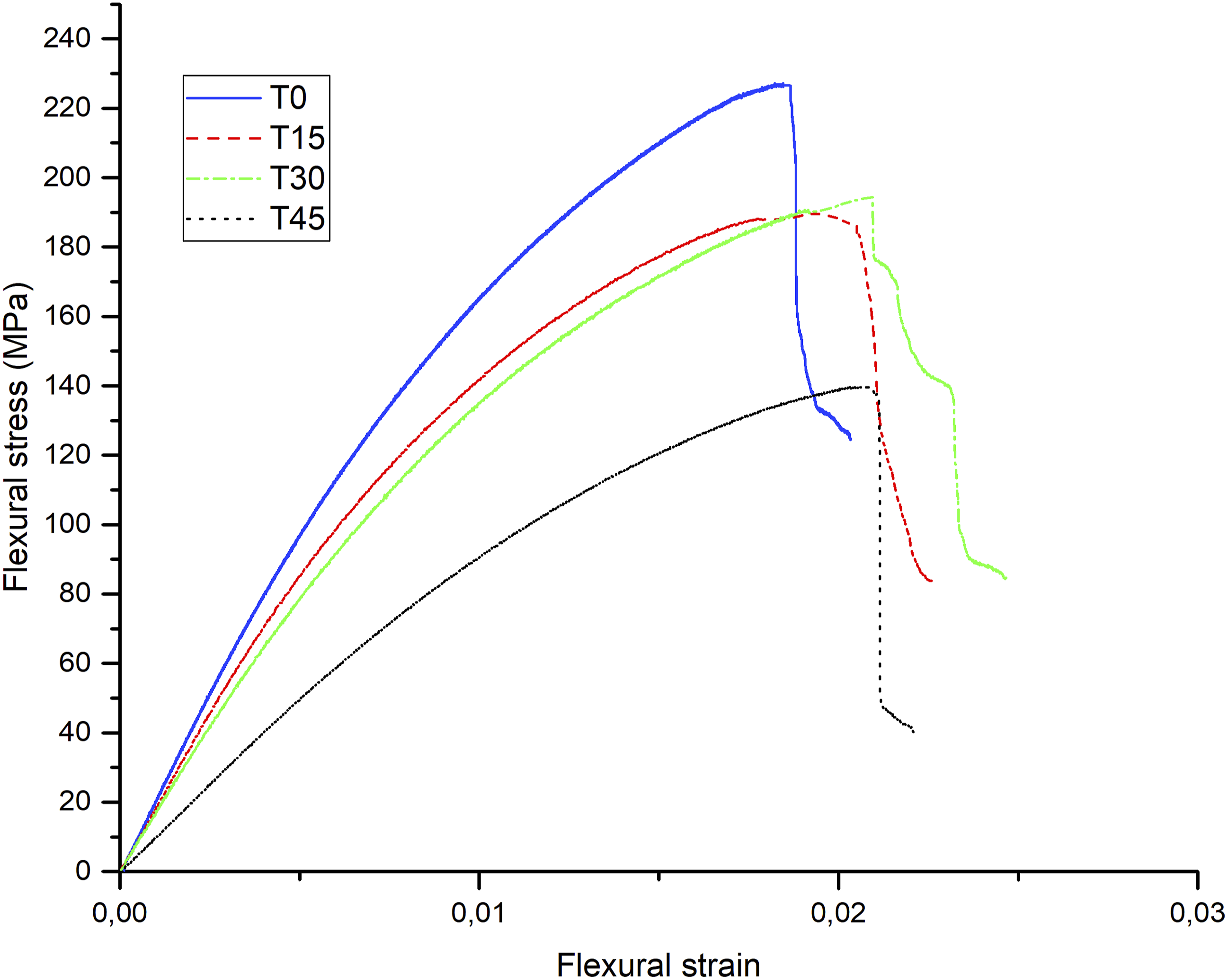
Fracture analysis
Figure 7 shows the pictures of the post-tensile specimens with different yarn twist levels such as 0 (no twist), 15, 30, and 45 turns/m. Figures 8 and 9 show the SEM pictures of the fractured surfaces of the composite samples after tensile tests. Although there is not much difference with regards to breakage patterns of different samples, composites reinforced with yarns that have increased twist levels showed larger resin-rich areas (Figure 8(d)) and the fracture pattern of these samples is mostly governed by total yarn fractures which occurred locally around reinforcing yarns. This suggests the idea proposed by Ma et al.
29
that as the yarn twist level increases, yarns become more compact and tightly packed. This prevents the resin from entering into yarn structure to wet out all the fibers. Consequently, a successful wetting of fibers inside the yarns is not accomplished which leads to poor fiber/matrix interface and composite breakage over total yarn failure mechanism. In the untwisted samples however, individual fibers are successfully wetted out with smaller resin pools between them which resulted in a more fringed breakage zones (Figures 9(a) and (b)). Resin-rich regions in the highly twisted yarn composite samples such as T30 and T45 are bigger when compared to those of T0 and T15. These regions create weak points, reducing the homogeneous load distribution throughout the structure and leading to the lower mechanical properties when compared to those of untwisted yarn composite (T0). Post-failure tensile test specimens. SEM photomicrographs of the fractured surfaces of the composite samples after tensile test at a magnification of 500x: (a) T0, (b) T15, (c) T30, (d) T45. SEM photomicrographs of the fractured surfaces of the composite samples after tensile test at a magnification of 150x: (a) T0, (b) T15, (c) T30, (d) T45.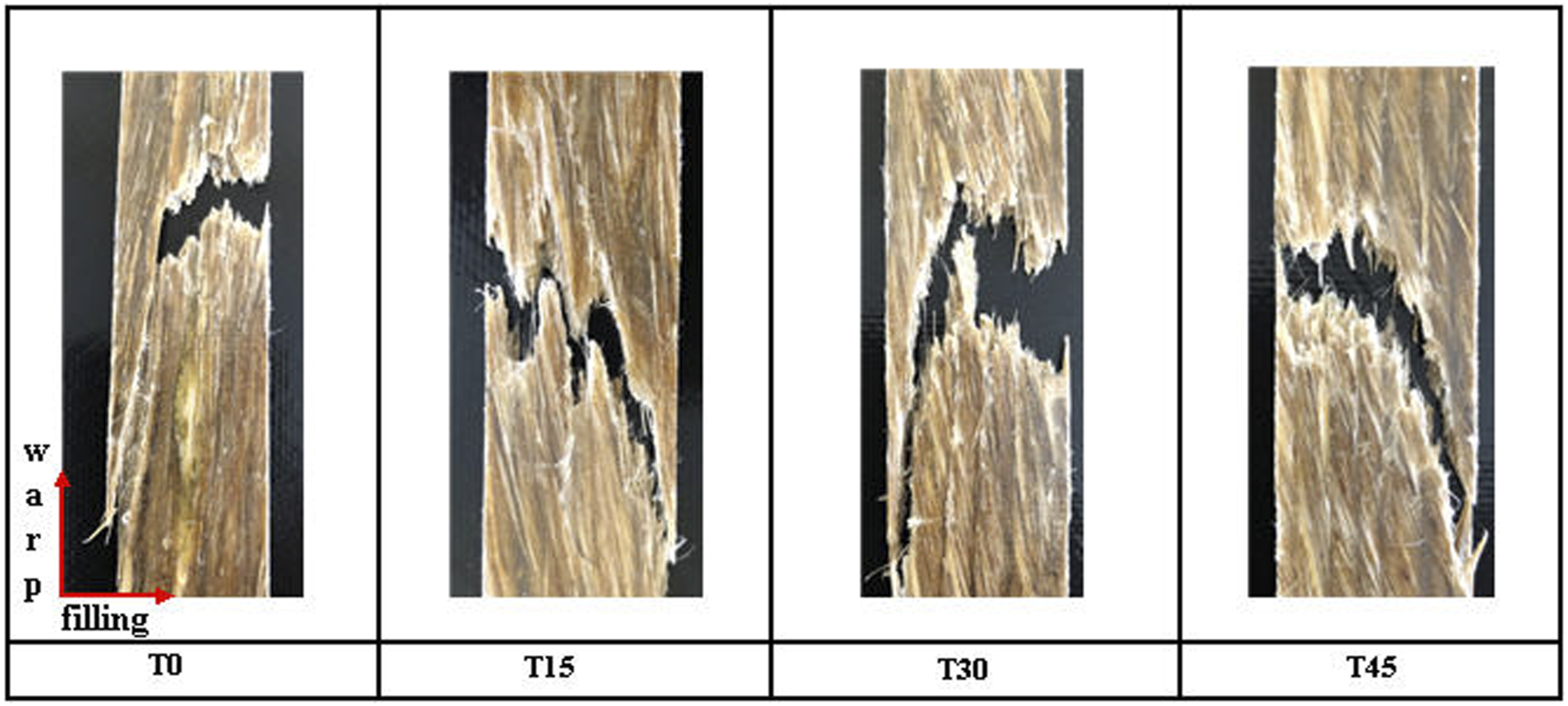
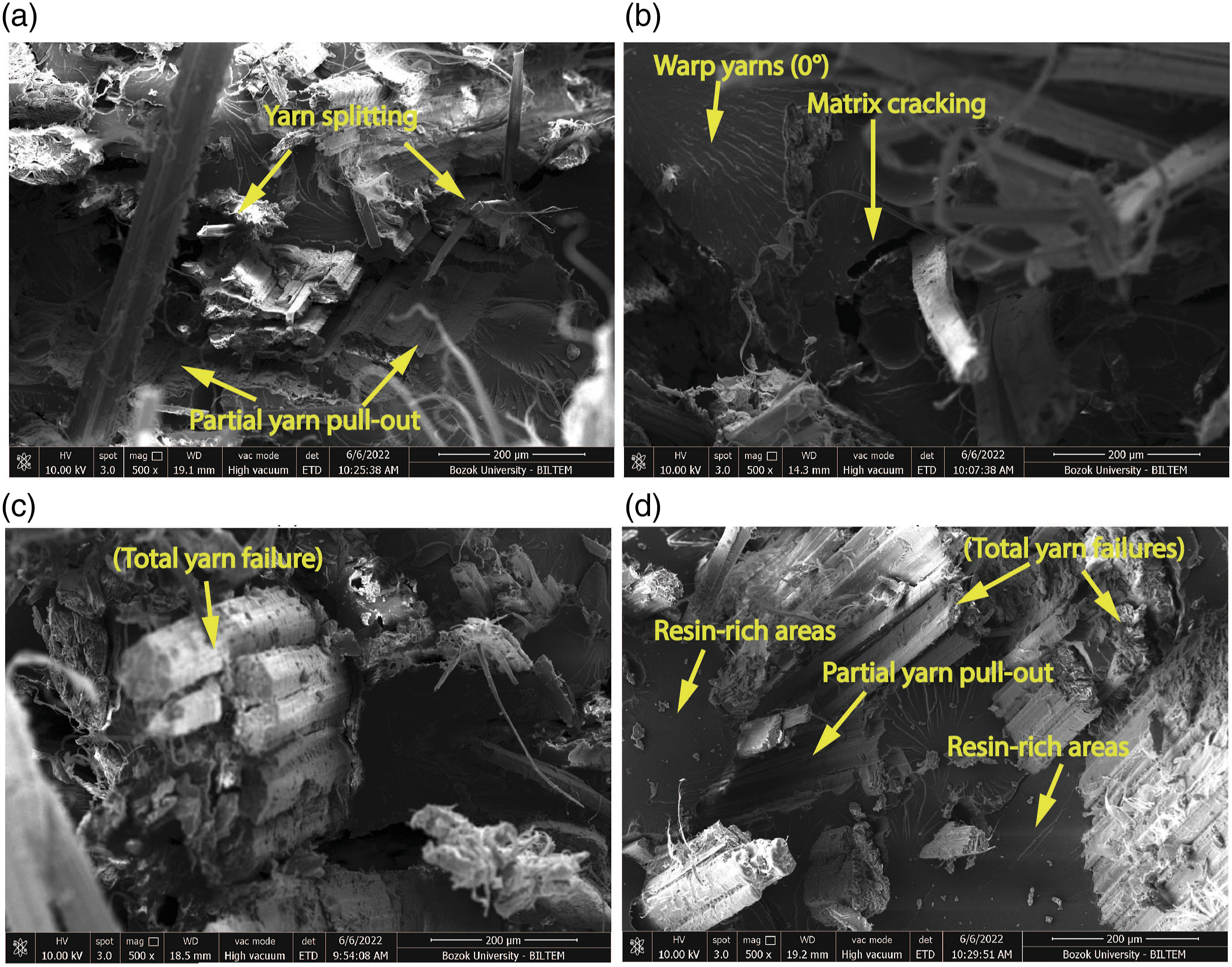

As shown in Figures 8 and 9, composite failure consisted of different mechanisms such as total yarn rupture, yarn failure due to fiber pull-out from the yarn structure, brittle matrix cracking, and fiber pull-out from the matrix. Composite failure took place predominantly as total fiber fracture, fiber pull-out from the yarns and matrix cracking. Fiber tearing was accompanied by brittle matrix cracking which is a characteristic of the epoxy resin. Protruded fibers at the crack surfaces indicate that the fibers sustained the load after the matrix failure. Ahmad et al. 36 observed similar fracture behavior for woven flax/epoxy composites except the fact that the fiber pull-out from the matrix was more predominant.
Conclusions
Composites reinforced with natural fibers have a growing popularity especially for the production of semi-structural parts for various industries such as automotive, construction, sports, packaging etc. This study investigated the possibility of using water-retted hemp fiber bundles as continuous fiber rovings to make quasi-unidirectional woven fabrics and hemp fiber/epoxy UD composites. The aim was to develop natural fiber composites which resemble, in structure, traditional quasi-UD fabric composites from high performance synthetic fiber rovings such as carbon, glass, aramid etc. and characterize their mechanical properties for their possible application in various industries as an alternative to glass fiber reinforced composites. The main findings of the present study are as follows. - It was found that increasing the yarn twist level reduces the tensile strength of the composites. The tensile strength of the composite with 45 turns/m twisted rovings was approximately 20% lower than that of the composite sample with zero-twist hemp rovings. This was attributed to various factors. The yarn twist causes the fibers to align in off-axis directions which reduce the load-bearing capability in the axial direction. The second cause of the reduction in mechanical properties is that the highly twisted yarns become more compact and close-packed, preventing the resin from penetrating into the yarn structure and making a good fiber/matrix adhesion. Damage induced to hemp fibers by twisting is another reason for reduced strength properties in the case of highly twisted yarn composites. Lastly, in the presence of a high amount of yarn twist, resin pools are observed between the warp yarns which can also act as weak points under loading conditions and result in premature failure of the composites. - Low twist levels slightly improved the tensile modulus of the composites as the composites reinforced with 15 and 30 turn/m twisted yarns showed higher tensile modulus when compared to the composite with zero-twist yarns. This was attributed to the fact that a low amount of twist leads to more compact yarn structure and removes yarn crimp to some degree. However, as the twist level further increases, modulus value decreases again due to disruption in axial alignment of fibers and fiber damage induced by twisting. - Flexural strength and modulus decreased as the yarn twist level is increased. Composites with a twist level of 45 turns/m (T45) showed approximately 37% and 48% lower flexural strength and modulus values respectively when compared to composites with zero-twist yarns (T0). This result was also attributed to the disruption in the alignment of the fibers in the loading direction in the presence of yarn twist. - SEM pictures revealed resin-rich regions in highly twisted yarn composites which can act as weak points in loading conditions and reduce the strength of the composites. Composite failure took place predominantly as total fiber fracture, fiber pull-out from the yarns and matrix cracking and there were limited cases of fiber pull-out from the matrix. - When compared with equivalent glass fiber/epoxy UD composites, hemp/epoxy composites developed in this study showed lower modulus and strength values. However, taking into account the lower density of hemp fiber compared with glass fiber and nature-friendly properties of hemp fiber composites, they can be considered as alternative materials for semi-structural and low-load bearing applications.
Footnotes
Declaration of conflicting interests
The author(s) declared no potential conflicts of interest with respect to the research, authorship, and/or publication of this article.
Funding
The author(s) disclosed receipt of the following financial support for the research, authorship, and/or publication of this article: This work was supported by Yozgat Bozok University Scientific Research Projects Coordination Unit [grant number 6608-AMYO/20-431].
