






Abstract
This study explores the thermal insulation potential and structural viability of rice husk (RH)-reinforced polyester bio-composites for sustainable building applications. Departing from conventional RH usage in ash or powder form, RH is used here as a high-volume structural filler (75–95%) in polymer composites. Increasing RH content significantly reduces thermal conductivity (down to 0.0829 W m−1K−1), density, compressive strength, and ultrasonic pulse velocity, while increasing porosity and water absorption. The composite with 75% RH (P25R75) achieved the highest mechanical performance, while samples with 85–95% RH demonstrated excellent thermal insulation properties. Regression analysis indicates a strong correlation between density and both mechanical and thermal behaviours. Despite high water absorption, the composites show promise as eco-efficient, thermally insulating, non-load-bearing building materials, especially with surface treatments in humid environments. These findings position RH as a viable, low-cost reinforcement in the development of energy-efficient building envelopes.
Keywords
Introduction
In recent years, natural fiber reinforced polymer composites have gained increasing attention due to the rising demand for environmentally friendly and sustainable materials in the construction sector. These composites offer advantages over conventional synthetic fiber materials, including low cost, lightweight, biodegradability, and renewability. 1 Additionally, the integration of agricultural residues into composite production contributes to waste valorization and reduces the environmental footprint of construction materials. Recent review studies have emphasized the significance of natural fibers as sustainable reinforcements in polymer composites. Jaiswal et al. 2 provided a comprehensive overview of extraction methods, physicochemical properties, surface modification techniques, and thermal degradation behaviors of cellulose-based fibers, highlighting their potential as eco-friendly alternatives to synthetic materials.
In addition to mechanical benefits, natural fibers exhibit diverse morphological, chemical, and thermal behaviors that significantly affect composite performance. As highlighted by Jaiswal et al., 2 fiber crystallinity, surface energy, hemicellulose degradation, and thermal stability strongly influence bonding, durability, and matrix compatibility. In the agricultural sector, large amounts of waste are generated annually. While a small fraction is used as household fuel or fertilizer, most of this waste remains underutilized and may pose environmental hazards. 3 As a result, researchers have increasingly focused on using agricultural by-products (such as the stems of flax, jute, and hemp, as well as residues from crops like corn and wheat) as reinforcement materials in composites. 4
Among various agricultural residues, RH is of particular interest due to its abundance and physicochemical properties. It is estimated that approximately 0.23 tons of RH is produced per ton of harvested rice. 5 RH contains a high percentage of silica, providing advantageous mechanical, thermal, and fire-resistant properties. 6 Viswanath et al. 7 showed that incorporating eggshell and RH in coconut fiber-reinforced polyester composites enhanced tensile, flexural, and impact strengths. However, Hemnath et al. 8 observed that RH addition reduced tensile and flexural properties in sugarcane bagasse-reinforced polyester composites.
Most previous studies have been reported in the literature on the use of RH as a reinforcement material in combination with different binder systems.9–13 Battegazzore et al. 9 investigated particleboards reinforced with RH particles and fibreboards reinforced with hemp fibres using corn starch as a natural binder. In their study, RH particles were substituted with corn starch at a weight fraction of 50%, while hemp fibres were bonded with starch at a weight fraction of 62.5%. The results indicated that hemp fibre-reinforced fibreboards exhibited superior mechanical properties compared to particle-reinforced particleboards. In the study conducted by António et al., 10 rice husk-based composites were hybridised with expanded cork granules and recycled rubber granules at weight ratios of 50/50 and 75/25. To ensure filler continuity and effective interfacial bonding, a TDI-based polyurethane prepolymer binder was incorporated at 20% of the total filler mass. The authors reported that low-density composites exhibited reduced thermal conductivity and compressive strength values. In particular, composites reinforced with 50/50 RH/expanded cork showed a density of 410 kg m−3, a thermal conductivity of 65.2 mW m−1K−1, and a compressive strength of 0.366 MPa. Hamid et al. 11 employed recycled high-density polyethylene (rHDPE) as the matrix material in biocomposites reinforced with 45% RH and 17.1% sawdust. The effects of antioxidant and flame-retardant additives were also examined. It has been reported that, except for water absorption behaviour, the physical and mechanical properties of biocomposites can be significantly enhanced through the incorporation of these additives. However, in antioxidant-containing systems, weak fibre–matrix interfacial bonding may lead to increased moisture uptake.
Chabannes et al. 12 compared the thermal and mechanical properties of RH- and hemp-reinforced concretes using lime as a binder. Lime-to-reinforcement ratios of 1.5, 2, and 2.5 were investigated. At a lime/reinforcement ratio of 2, the thermal conductivity of RH–lime composites (0.119 W m−1K−1) was found to be higher than that of hemp–lime composites (0.107 W m−1K−1). Under the same conditions, the 60-days compressive strength values were reported as 0.33 MPa for RH–lime composites and 0.48 MPa for hemp–lime composites. Spada et al. 13 produced RH-reinforced foam composites using cassava starch as a binder. In their study, RH was incorporated into the composite structure at weight fractions of 20%, 40%, and 60%. The results demonstrated that the addition of RH improved the mechanical strength compared to starch-only samples, while simultaneously reducing the density and water absorption capacity of the composites.
Although RH has been incorporated typically at low to moderate contents, its high silica content, porous morphology, and low density indicate potential advantages for thermal insulation applications when used at larger proportions. However, very limited research has investigated RH as a bulk filler at ultra-high volume fractions exceeding 60%, leaving its mechanical and thermal effects largely unexplored. Fayzullin et al., 14 have examined the influence of rice husk particle content (0–60 wt.%) on the mechanical, physical, thermal, and rheological properties of polypropylene (PP)-based composites produced by twin-screw extrusion and injection molding. Their results indicated that increasing filler content significantly enhanced tensile and flexural modul, while tensile strength, impact strength, and ductility decreased. Optimal flexural strength was obtained at low filler loadings, whereas higher contents resulted in increased brittleness due to interfacial incompatibility and particle agglomeration. The authors concluded that rice husk is an eco-friendly filler that can improve the stiffness of PP composites when the filler content is carefully optimized. Nevertheless, the use of rice husk as a loose structural filler or in combination with alternative binders (such as mineral, bio-based, or hybrid binders), particularly at high volume fractions, has received very limited attention in the literature.
In building envelope applications (such as insulation panels, partition boards, and non-load-bearing elements) materials with high porosity and low thermal conductivity are desirable, even if mechanical strength is moderate. The intrinsic porous structure and low density of RH suggest that, when used as a bulk filler, it may significantly enhance thermal insulation performance by increasing air entrapment and reducing heat transfer pathways.
In this study, RH was used as a bulk reinforcement material in a polyester matrix, with volume fractions ranging from 75% to 95%. Polyester resin was selected as the matrix material in this study due to its widespread industrial use, cost effectiveness, ease of processing, and compatibility with lignocellulosic materials. While it is acknowledged that polyester is a petroleum-based binder, its use enables a controlled evaluation of RH behaviour at ultra-high volume fractions without introducing additional variables related to curing complexity or moisture sensitivity inherent in some bio-based matrices. Moreover, replacing up to 95% of the composite volume with agricultural waste significantly offsets the environmental footprint of the polymer binder, maintaining a strong sustainability rationale. Accordingly, the present study aims to evaluate the mechanical, thermal, and physical performance of RH-rich composites for potential use in lightweight and thermally insulating building materials.
Materials and methods
In this study, the unsaturated polyester resin (UPR) used as a binder is a commercially available casting-type resin. UPR is widely preferred in composite production due to its properties such as good mechanical strength, low viscosity, easy workability, and suitable curing behaviour. Furthermore, its good wettability with filler and reinforcement materials enables the formation of a homogeneous matrix structure. Its ability to provide a rigid structure after curing positively affects the mechanical and physical performance of the produced composites. Curing was achieved using methyl ethyl ketone peroxide (MEKP) as the initiator, and cobalt octoate as the accelerator. The densities of UPR, MEKP, and cobalt octoate were 1.13 g cm−3, 1.16 g cm−3 and 0.93 g cm−3, respectively.
RH was sourced from the Black Sea Agricultural Research Institute and used as a reinforcement material. Particles passing through a 4 mm sieve were utilized in composite fabrication. The bulk density of RH was measured as 0.222 g cm−3.
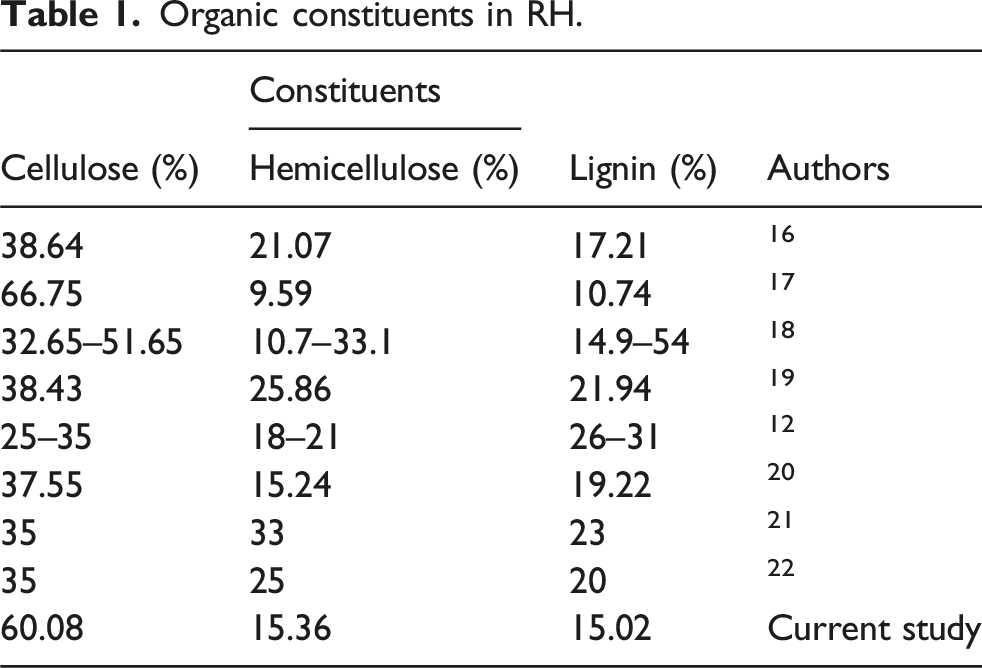
Organic constituents in RH.
The surface morphology of RH was examined using scanning electron microscopy (SEM), as shown in Figure 1. The RH particles exhibit a rough and irregular surface texture, characteristic of lignocellulosic biomass. Energy dispersive X-ray (EDX) analysis revealed that RH mainly consists of carbon (16.637%), oxygen (41.705%), and silicon (38.058%). Additionally, minor amounts of nitrogen (2.326%), potassium (0.856%), and calcium (0.418%) were detected. SEM/EDX micrographs of raw RH.
Preparation of samples
Firstly, the polymer matrix was prepared by mixing MEKP and cobalt octoate with the UPR at 2 wt.% and 0.2 wt.%, respectively. MEKP and cobalt were manually added and stirred sequentially for 90 s each. Subsequently, RH particles were added to the prepared matrix and mixed using a mechanical mixer at 140 rpm for 90 s to ensure homogeneous dispersion. No chemical or physical surface treatment was applied to the RH particles prior to composite fabrication, and the particles were used in their raw form. The resulting mixture was then transferred into a mould measuring 15 × 20 × 3 cm3 cm and subjected to a pressure of 5 bar in a manual hydraulic press for 2 h. After demoulding, the specimens were conditioned at room temperature (23 ± 2°C) and relative humidity (45 ± 5%) before testing (Figure 2). (a) Thermal conductivity test specimens and (b) compressive strength test specimens.
Weight and volume mixing ratios of composites.
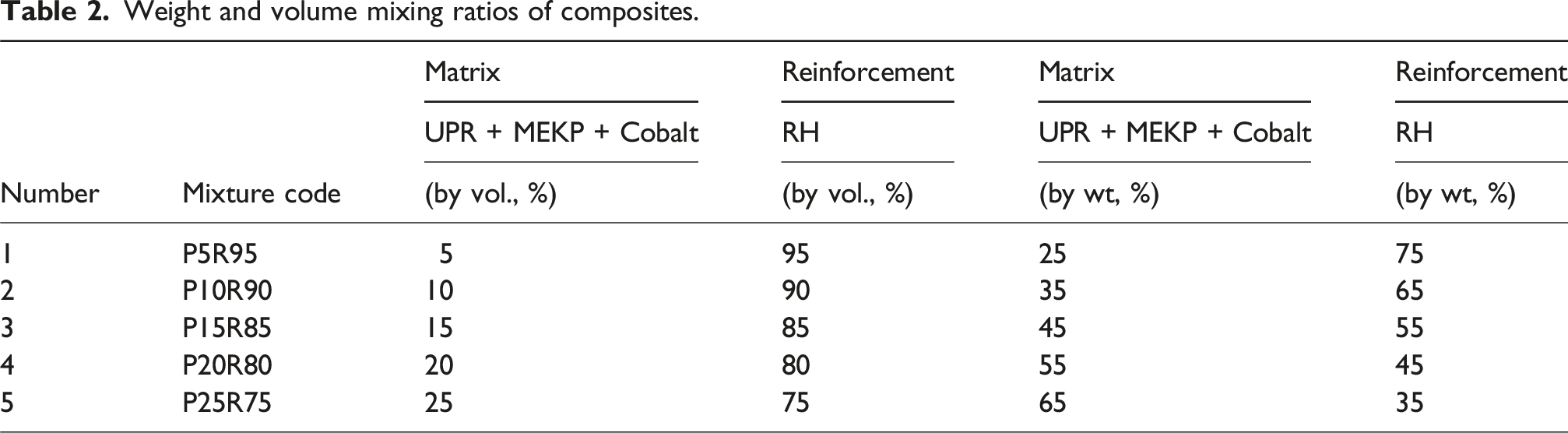
Preliminary tests showed that when the RH content exceeded 95 vol.%, the polymer matrix could no longer adequately cover the filler, resulting in dimensional instability and loss of structural integrity. As the primary objective of this study is to evaluate thermal insulation performance, the polymer binder content has been deliberately kept at the lowest possible level. This approach is significant not only in terms of thermal insulation but also in promoting the conversion of waste-based materials into value-added products, reducing natural resource consumption, and limiting the environmental impact of polymer-based binders. The use of RH, an agricultural waste product, in high volume ratios offers a solution that is both consistent with waste management and sustainability principles and contributes to reducing the environmental footprint of composite materials. In this context, the aim is to minimise the use of fossil-based polymers by favouring high RH content and to develop more environmentally friendly, low-density and energy-efficient building materials.
Considering these processing and material constraints, a volumetric RH content range of 75–95% has been determined as the optimum range for this study, enabling both the maintenance of sufficient structural stability and the evaluation of the contribution of high fill ratios to thermal insulation performance.
Experimental procedure
The physical, mechanical, and thermal characteristics of the RH-reinforced composites were assessed through comprehensive testing procedures. These tests included density, water absorption, porosity, ultrasonic pulse velocity (UPV), compressive strength and thermal conductivity. Density, water absorption and porosity experiments were carried out using Archimedes balance. Initially, the composite samples were oven-dried at 70°C for 24 h, after which their oven-dry mass (M0) was recorded. Then the samples were immersed in water and kept in water for 24 h. The saturated surface-dry mass (M2) and the submerged mass in water (M1) were measured, and the oven-dry density, water absorption, and porosity values were subsequently calculated using equations (1)–(3), respectively. The experiment was carried out by averaging three samples of 5 × 5 × 3 cm3 in size.


ASTM C 597
23
standard was used for UPV test. It is stated that there is an approximate correlation between UPV test and the porosity and compressive strength of the specimens.
24
In this experiment, ultrasonic wave velocity generated with a frequency of 54 kHz in Proceq brand measuring device was used. The transit time of the wave between the transmitter and receiver transducers (t:seconds) and the length of the sample in the measurement direction (L:m) were measured and the UPV value was determined by using equation (4). Three specimens of 5 × 5 × 3 cm3 each were used in the experiment.
For compressive strength, compressive strengths at 10% displacement according to TS EN 826 25 standard were used. The test was carried out under a preload of 250 Pa at a displacement rate of three mm per minute. As stated in the relevant standard, if the specimens fracture before reaching 10% displacement, the compressive strength at that moment was taken as the compressive strength at 10% displacement. Three specimens of 5 × 5 × 3 cm3 each were used in the test.
In compliance with ASTM C1113-90,26 thermal conductivity measurements were performed using the KEM QTM 500 apparatus on specimens with dimensions of 12 × 6 × 3 cm3. The thermal conductivity coefficient (λ) for each specimen was determined by averaging three readings obtained from the front and rear surfaces.
Results and discussion
The bio-composites reinforced with RH were evaluated in terms of their physical, mechanical, and thermal properties. Microstructure analyses and statistical analyses were also performed. Standard deviation values were illustrated in the graphs as error bars to reflect the variability of the experimental data. Experimental results are presented in detail below.
Density
RH-reinforced polymer composite densities are presented in Figure 3. The incorporation of agricultural wastes such as RH into building materials generally results in a reduction in composite density, primarily due to the inherently porous structure of RH.
5
Since RH has a lower bulk density than UPR, the overall density of the composites gradually decreased with increasing RH content. At higher RH ratios, matrix continuity is restricted, leading to the formation of a lighter composite structure. The composite densities ranged from 0.359 to 0.738 g cm−3, with the lowest density (0.359 g cm−3) observed in the P5R95 sample. Composite densities and percentage changes in density.
While the RH content decreased from 95% to 75%, the density change in composites was determined as 106%. Increasing RH content will have a positive effect for lightweight building materials. Muthuraj et al., 27 in their study, reported that the density of the RH-reinforced composite was 0.379 g cm−3.
Water absorption and porosity
Polymer matrices typically exhibit low water absorption, whereas lignocellulosic agricultural residues, such as RH, show high water uptake due to their significant cellulose and hemicellulose contents.28,29 To minimize these drawbacks, various surface treatments (e.g., alkali modification) have been employed in previous studies.30,31
The water absorption behaviour of RH-reinforced composites is illustrated in Figure 4(a). As RH content increases, water absorption significantly rises, reaching a maximum of 188.61% for sample P5R95. In contrast, the minimum value of 45.49% was recorded for P25R75. This trend is attributed to the hydrophilic nature and porosity of RH. Compared to P5R95, a reduction of approximately 76% in water absorption was achieved by increasing the polymer matrix fraction. (a) Water absorption and (b) porosity of the composites.
Porosity results are shown in Figure 4(b). The inherent porous structure of RH, clearly visible in the SEM image (Figure 10(b)), leads to a substantial increase in composite porosity with higher RH content. The porosity values ranged from 33.55% to 66.32%, with the highest again observed in P5R95. Similar observations regarding the porous nature of agricultural fillers have been reported in the literature.32,33
While the increased porosity may contribute positively to thermal insulation and lower composite density (desirable characteristics for building envelope materials) it simultaneously increases moisture uptake. Therefore, for building applications, especially in external or moisture-prone environments, additional protective measures (e.g., surface coatings or barrier layers) are recommended to ensure long-term durability and performance.
These findings suggest that RH-based composites offer potential as lightweight thermal insulation materials, but moisture management strategies must be incorporated to optimize their application in building envelopes.
Ultrasonic pulse velocity
As a non-destructive evaluation technique, UPV is commonly employed to assess the internal structural integrity and predict the compressive performance of composite materials. The porous nature of the composite matrix contributes to lower wave propagation speeds, as entrapped air voids scatter and dampen the ultrasonic signals.
34
The UPV test results of RH-reinforced composites are presented in Figure 5(a). The values ranged between 375 m s−1 and 1677 m s−1, with the lowest velocity recorded for sample P5R95. A clear decreasing trend in UPV was observed as the RH content increased, correlating with the increase in composite porosity. (a) UPV and (b) changes in UPV of composites.
As shown in the SEM image (Figure 10(b)), RH possesses a highly porous morphology, which increases the overall void content when it replaces the polymer matrix. In contrast, the highest UPV value (1677 m s−1) was recorded in sample P25R75. The elevated polymer matrix content in this sample led to improved interfacial bonding and reduced internal voids by effectively encapsulating the RH particles. These findings align with the observations of Ribeiro Filho et al., 35 who reported that ultrasonic waves travel faster through solid and well-bonded regions of a composite. As a result, UPV values increased significantly with higher matrix content. Compared to P5R95, P25R75 showed a 347% increase in UPV, while P10R90 exhibited the smallest improvement at 78%.
Figure 5(b) shows the UPV change ratios relative to the reference sample P5R95. As the UPR content increases and, correspondingly, the RH content decreases, a pronounced increase in UPV is observed. When the UPR content is increased to 10% in the P10R90 sample, the UPV change reaches 78%. With further increases in UPR content, the UPV change rises to 184%, 254%, and 347% for the P15R85, P20R80, and P25R75 samples, respectively. This trend indicates that a higher UPR matrix content enables more effective encapsulation of RH particles, improves matrix continuity, and reduces the void content within the composite structure. These microstructural improvements facilitate ultrasonic wave transmission through the material, resulting in higher UPV values. Consequently, composites with higher polyester content can be considered to possess a more compact and homogeneous internal structure.
This substantial variation in UPV values demonstrates the influence of filler-to-matrix ratios on the internal structure of bio-composites. Such correlations may offer a reliable pathway for using UPV as a non-destructive proxy for evaluating material quality and predicting long-term structural performance in building applications.
Compressive strength
In general, the compressive strength of composites decreases with increasing incorporation of porous materials,36,37 while it tends to improve with a higher proportion of polymer matrix due to enhanced bonding and structural continuity.
38
The compressive strength values of RH-reinforced composites in this study ranged from 0.24 to 4.19 MPa, as shown in Figure 6, with strength increasing proportionally to the polymer matrix content and decreasing with higher RH content. The porous nature of RH, evident in the SEM image in Figure 10(b), contributes to this reduction in mechanical performance. As presented in Figure 6(b), the most significant improvement in compressive strength was observed when RH content decreased from 95% to 75%, yielding a 1646% increase. The lowest improvement was recorded for sample P10R90, with an 83% increase compared to P5R95. (a) Compressive strength and (b) change in compressive strength of composites.
While the polymer matrix enhances the composite’s structural integrity, flexibility, and crack resistance, RH serves as a lightweight and insulating filler. An increase in RH content in composites leads to the development of a porous structure within the material. Increased porosity negatively affects load transfer, resulting in a significant decrease in compressive strength. Similar trends have been reported in previous studies on natural fibre and agricultural waste reinforced composites. For instance, in studies investigating the addition of RH to brick formulations, 36 compressive strength was found to decrease as RH content increased. Another study involving waste concrete aggregate and RH fibers 39 also reported reduced compressive strength values (1.3–13.4 MPa) as RH content increased. Furthermore, composites produced with RH and expanded cork 40 exhibited relatively low compressive strength, between 0.062 and 0.506 MPa.
Despite the observed decrease in strength with higher RH ratios, the composites in this study demonstrated compressive strengths well above typical values for thermal insulation materials. Özer and Acun Özgünler 41 indicated that such materials generally exhibit compressive strengths between 0.1 and 0.2 MPa, along with thermal conductivity values between 0.07 and 0.10 W m−1K−1. In this context, the RH-reinforced composites produced here (0.24–4.19 MPa) satisfy compressive performance requirements for non-structural applications such as partition walls, thermal insulation panels, or facade cladding.
Thermal conductivity
The use of porous materials in composites reduces the density and thermal conductivity coefficients of composites due to the hollow structure of these materials. Considering the porous structure of RH, thermal conductivity values are expected to decrease as RH content increases in composites.
Figure 7 displays the thermal conductivity performance of RH-reinforced composites. Among the tested samples, the P5R95 specimen (Containing the highest RH) exhibited the lowest thermal conductivity value of 0.0829 W m−1K−1. The highest thermal conductivity coefficient was determined as 0.1251 W m−1K−1 in the sample coded P25R75 containing the most polyester. This is due to the porous structure of the RH. The high porosity of the RH creates air voids in the composite and causes a decrease in thermal conductivity. As the polyester ratio increases, thermal conductivity increases as a denser structure is formed. (a) Thermal conductivity and (b) change in thermal conductivity of composites.
Görhan and Şimşek 36 investigated the physical, mechanical and thermal properties of bricks in which 5%, 10% and 15% RH shells were added as reinforcement and reported that the thermal conductivity values decreased as the RH content increased and the lowest thermal conductivity value of 0.165 W m−1K−1 was reached in the sample containing 15% RH. In another study, 40 the effect of RH and expanded cork on thermal properties was investigated and the thermal conductivity coefficient was determined as 0.0453–0.05 for samples with a density of 200 kg m−3. Thermal conductivity values increased as the RH content increased in the composite. This can be explained by the lower thermal conductivity of expanded cork compared to RH (0.041 and 0.063 W m−1K−1, respectively). In another study, 42 the thermal conductivity coefficient of the samples containing RH with an optimum density of 97 kg m−3 produced by pulping method was expressed as 0.037 W m−1K−1.
The observed reduction in thermal conductivity with increasing RH content is closely associated with the simultaneous decrease in composite density and increase in porosity. The formation of interconnected air voids within the composite structure limits heat transfer by conduction, thereby enhancing the thermal insulation performance. This behavior is consistent with the trends observed in density, porosity, and UPV results, confirming the dominant role of internal structure on thermal performance. Thermal insulation materials are generally characterized by thermal conductivity coefficients below 0.1 W m−1K−1.43–45 In the present study, the thermal conductivity values of the P5R95, P10R90, and P15R85 composites were determined as 0.0829, 0.0864, and 0.0946 W m−1K−1, respectively, indicating their suitability for thermal insulation applications. Conversely, the P20R80 and P25R75 samples, with thermal conductivity values exceeding 0.1 W m−1K−1, are more appropriate for use as lightweight building elements rather than thermal insulation materials.
Combined evaluation of physical, mechanical and thermal properties
Correlation matrix heat map analysis
A correlation matrix analysis was conducted to evaluate the strength and direction of the relationships among key material properties (Figure 8). The results revealed several strong correlations that provide insights into the interdependence of these properties. A perfect negative correlation (−1.00) was found between density and porosity, indicating that porosity decreases as density increases. This is consistent with fundamental materials science principles, as denser materials typically have fewer voids. Correlation matrix heat map.
Additionally, a strong positive correlation (0.98) was observed between density and UPV. This suggests that sound waves propagate more efficiently in denser materials due to the reduced presence of internal discontinuities, enabling faster wave transmission. A similarly high positive correlation (0.98) was detected between water absorption and porosity, indicating that materials with higher porosity absorb more water. This relationship reflects the increased surface area and interconnected pore network that enhances water uptake.
Moreover, a high positive correlation (1.00) was observed between compressive strength and thermal conductivity. This indicates that, within the tested composite formulations, samples with higher compressive strength tend to also have higher thermal conductivity.
These findings collectively offer valuable insights into the behaviour of rice husk-reinforced composites and highlight critical trade-offs that should be considered during material selection and design for sustainable building applications.
Correlation and trend analysis
The correlation analysis was conducted to illustrate the relationship trends between density and the physical and mechanical properties of the composites, rather than to perform rigorous statistical inference. Due to the limited number of data points, the analysis is intended to support the experimentally observed tendencies and to clarify structure–property relationships.
As shown in Figure 9, a strong positive correlation is observed between density and UPV (R2 = 0.960), indicating that ultrasonic wave propagation increases with material densification as a result of a more compact internal structure. Similarly, density exhibits a positive correlation with compressive strength (R2 = 0.895), suggesting improved load-bearing capacity in denser composites. This behaviour has also been clearly expressed in previous studies.46,47 Correlation and trend analysis between density and physical–mechanical properties of the composites.
In contrast, strong negative correlations are identified between density and both water absorption (R2 = 0.986) and porosity (R2 = 0.996). These results indicate that increased density effectively reduces void content and limits water penetration pathways within the composite structure. This behaviour was also observed in the study conducted by Liu et al. 47
Overall, this analysis clearly demonstrates the effect of density on composite performance through qualitative correlation trends. The regression lines presented have been used to visualise the direction and strength of the relationships.
Microstructure analyses
Microstructural analysis was carried out using pieces taken from the samples subjected to the water absorption test. SEM images and EDX spectra at 200x magnification for selected samples are presented in Figure 10. SEM/EDX micrographs of (a) P5R95, (b) P15R85 and (c) P25R75.
In the SEM image of the P5R95 sample (Figure 10(a)), the UPR matrix is not clearly observed. This is attributed to the low matrix content (5%), which restricts adequate infiltration into the reinforcement and limits the matrix to only partially coat the surface. The rough texture of the RH’s outer shell and the comparatively smoother inner surface are distinctly visible. The EDX analysis revealed that the elemental composition of this sample includes 40.574% carbon, 35.526% oxygen, and 23.9% silicon.
In the P15R85 sample (Figure 10(b)), the matrix–reinforcement interface is more clearly defined. Swelling of the RH due to water absorption leads to micro cracks and segregation at the interface. A highly porous microstructure is evident in the RH cross-section. These structural voids reduce thermal conductivity, density, UPV, and compressive strength, while contributing to increased water absorption and porosity. The EDX spectrum of this sample shows 43.816% carbon, 37.391% oxygen, and 18.793% silicon.
In the P25R75 sample (Figure 10(c)), UPR appears to adequately fill the gaps between reinforcement particles. Nevertheless, cracks in the matrix remain visible, again attributed to fiber swelling from water uptake. The elemental composition as per EDX is 43.315% carbon, 37.033% oxygen, and 12.612% silicon.
From the EDX results, it is evident that increasing RH content results in a higher silicon concentration due to the silica-rich structure of the husk. Conversely, increasing UPR content leads to a relative decrease in silicon content and an increase in carbon and oxygen due to the organic nature of the polymer.
Conclusions
This study highlights the potential of utilizing RH, an agricultural waste, as particulate reinforcement in polymer composites—an application that has been scarcely addressed in the literature. The physical, mechanical, and thermal insulation properties of RH-reinforced UPR composites were comprehensively assessed. The results showed that increasing RH content led to a reduction in compressive strength and UPV, with the highest compressive strength (4.19 MPa) and UPV (1677 m s−1) observed in the P25R75 sample.
Increasing UPR content was found to significantly reduce porosity and water absorption, with minimum values of 49.49% and 33.55%, respectively, again observed in the P25R75 composite. In terms of thermal insulation performance, the P5R95, P10R90, and P15R85 samples exhibited the lowest thermal conductivity values (0.0829, 0.0864, and 0.0946 W m−1K−1, respectively), indicating their potential use in insulating applications.
Samples with moderate RH content, such as P20R80 and P25R75, offered a favourable balance between mechanical performance and thermal insulation, suggesting their suitability for non-load-bearing partition wall applications. Correlation matrix and regression analyses further demonstrated that increased composite density positively affects compressive strength, UPV, and reduces porosity and water absorption. Strong linear relationships were especially evident between density and both UPV and compressive strength.
While RH-reinforced composites exhibited promising insulation characteristics, their water absorption capacity remains relatively high due to the hydrophilic nature of the agricultural waste. Therefore, the application of surface coatings or sealants is recommended, particularly for exterior and wet-area installations. Future studies may consider chemical treatments, such as alkaline modification of RH, to improve moisture resistance and further optimize composite performance.
Footnotes
Acknowledgements
The authors gratefully acknowledge the support of Bingöl University/Department of Construction, Vocational School of Technical Sciences for providing the necessary laboratory facilities and technical assistance during the experimental phase of this study. Special thanks are extended to Hasan Polat for their valuable contributions to material preparation and testing procedures. This research did not receive any specific grant from funding agencies in the public, commercial, or not-for-profit sectors.

Author contributions
All aspects of the study, including conception, design, material preparation, literature review, analysis, and manuscript writing, were carried out by Mehmet Nuri Kolak. The author read and approved the final manuscript.
Funding
The author received no financial support for the research, authorship, and/or publication of this article.
Declaration of conflicting interests
The author declared no potential conflicts of interest with respect to the research, authorship, and/or publication of this article.
Data Availability Statement
No data was used for the research described in the article.