






Abstract
Fused filament fabrication (FFF) is increasingly used for manufacturing outdoor functional components; however, the long-term performance of FFF-manufactured polymer parts is often limited by inadequate thermal stability, ultraviolet (UV) resistance, and process reliability. In this context, the present study addresses the research question of how different inorganic metal-oxide nanofillers and their stage-dependent incorporation influence the multifunctional performance of acrylonitrile styrene acrylate (ASA) for FFF applications. ASA-based nanocomposites reinforced with 2 wt% silicon dioxide (SiO2), zinc oxide (ZnO), and titanium dioxide (TiO2) were developed using a hybrid processing route that combines solution blending with melt extrusion, including a powder-based pre-mixing step via ball milling to improve nanoparticle dispersion and interfacial bonding. The resulting materials were systematically characterized through morphological (FE-SEM/EDX), structural (XRD), thermal (DSC/TGA), ultraviolet–visible (UV–Vis), and rheological (MFI) analyses to evaluate dispersion quality, thermal behavior, UV shielding performance, and processability. The powder-based blending approach produced markedly improved nanoparticle dispersion and stronger interfacial interactions, with TiO2 exhibiting the highest compatibility with the ASA matrix. Among the investigated nanofillers, ASA–TiO2 nanocomposites demonstrated superior thermal stability, significantly enhanced UV absorption in the UV-A and UV-B regions, and stable melt flow behavior with negligible compromise in processability. These findings establish a clear processing–structure–property relationship and identify ASA–TiO2 nanocomposites as a promising, weather-resistant material system for FFF-manufactured end-use components intended for prolonged outdoor exposure.
Keywords
Introduction
Additive manufacturing (AM) is a promising contender that manufactured polymeric products with desired performance characteristics, which have great industrial importance. The reliability of AM polymeric products under the different outdoor environmental or weathering conditions strongly influenced by material selection, part design, and manufacturing processes. 1 Environmental exposure such as sunlight, moisture, elevated temperature, and chemicals can alter the microstructure, appearance, and overall performance of AM products, ultimately affecting their long-term sustainability. 2 Among AM techniques, fused filament fabrication (FFF) has attracted considerable attention due to its material efficiency, design flexibility, and potential for producing sustainable polymer components for diverse applications. However, FFF-manufactured parts are frequently subjected to multiple degradation mechanisms, including photo-oxidation, thermal degradation, and hydrolysis, which can act simultaneously under outdoor conditions and significantly reduce mechanical integrity and durability through polymer chain scission or crosslinking.3,4 In addition to environmental degradation, the material extrusion–based FFF process itself introduces inherent performance limitations that restrict wider industrial adoption. The layer-by-layer deposition mechanism often results in imperfect interlayer bonding and void formation, leading to internal porosity that reduces mechanical strength, durability, and resistance to environmental degradation. 5 Such porosity and interlayer defects are widely reported as critical factors responsible for reduced mechanical strength, anisotropic mechanical behavior, and premature failure in FFF parts. 6 Furthermore, rapid cooling and discontinuous material deposition contribute to increased surface roughness, dimensional variability, and reduced hardness compared to conventionally manufactured components. 7 These process-induced limitations, combined with environmental exposure, highlight the need for advanced FFF-compatible material systems that can simultaneously improve interlayer bonding, reduce porosity, and enhance surface and mechanical performance—particularly for functional parts intended for outdoor applications. 8
Nowadays, research is being conducted regarding the development of novel materials to be employed in advanced applications, especially in outdoor fields, using the FFF process. 9 A variety of polymer materials have been processed through FFF, but the limited properties of these materials constrain their ability to perform under challenging conditions. 10 In recent times, acrylonitrile styrene acrylate (ASA) has emerged as a promising thermoplastic that is beneficial to use in outdoor applications due to its stable performance and cost effectiveness.11–13 ASA is a terpolymer prepared by grafting copolymerization of acrylonitrile and styrene monomers onto acrylate rubber particles and was developed in the 1970s as a weather-resistance thermoplastic. ASA has a similar structure to acrylonitrile-butadiene-styrene (ABS), except that butadiene rubber is replaced by acrylate rubber, which resolves the physical and chemical aging issues associated with butadiene rubber. As a result, ASA exhibits good toughness, dimensional stability, weatherability, and chemical resistance, making it preferable to use in a wide range of outdoor applications.14,15 However, only a limited number of studies have focused on ASA polymers and the systematic enhancement of their properties for high-performance FFF applications. Some studies have incorporated different types of fillers into the ASA polymer and investigated improvements in mechanical, thermal, and electrical properties.16–18 In order to enhance the material performance of FFF-processable polymers under outdoor environmental conditions, one effective approach is to develop resilient/durable nanocomposite materials through the incorporation of inorganic nanomaterials. 19 Inorganic nanofillers are mostly used in reinforcing polymer matrices to prepare polymer coatings, which are relatively cost-effective and have been used in extensive applications. Accordingly, the incorporation of inorganic nanofillers, preferably metal oxides such as zinc oxide (ZnO), zirconium dioxide (ZrO2), silicon dioxide (SiO2), titanium dioxide (TiO2), antimony trioxide (Sb2O3), and cerium oxide (CeO2), into the polymeric matrices has been explored to improve thermal stability, UV resistance, and environmental durability.20–22 Metal oxides possess strong UV absorbance and protective characteristics, which can mitigate the synergistic effects of environmental degradation. In recent years, polymer-metal oxide nanocomposites have attracted widespread attention because of their potential to exhibit multifunctional and high-performance characteristics. The compatibility of metal oxides with FFF-processable polymers, along with improvements in properties achieved with relatively low filler loadings and minimal impact on processability, makes them suitable for FFF process. However, the performance of polymer nanocomposites is strongly governed by nanoparticle dispersion, internal structure, and the extent of interfacial interaction between the polymer matrix and the nanofillers. Achieving uniform dispersion of nanomaterials remains a major challenge due to the high surface energy of nanoparticles, which often leads to agglomeration. This agglomeration reduces the effective interfacial area, hinders filler-matrix interactions, and may act as a defect site, ultimately deteriorating the mechanical, thermal, or barrier properties of the resulting nanocomposite. 23 The prime objective of the polymer nanocomposites preparation is to ensure homogeneity and compatibility between the nanofillers and the polymer matrix. Proper dispersion enhances the interfacial surface area, which is critical for optimizing material performance. The reinforcing effect of nanofillers depends on various parameters, including their type, aspect ratio, size, distribution, and orientation within the matrix. To achieve this, the selection of an appropriate preparation method is crucial. 24 Polymer nanocomposites are commonly synthesized using in-situ polymerization or ex-situ techniques such as solution blending and melt mixing, each offering distinct advantages and limitations with respect to dispersion and filler–matrix interactions.25,26
Polymer nanocomposites are generally synthesised in a preprocessing stage prior to any manufacturing process. The main goal is to disperse the nanofillers into the polymer matrix to obtain intercalated or exfoliated structures. Ercan et al. studied a comparative analysis of preparation methods, i.e., melt bending (MB) and solution mixing (SM), on the physical properties of TPU/organoclay nanocomposites. Samples prepared with the MB show exfoliated structure and superior performance over samples prepared with the SM, which exhibit intercalated structure. 27 Yang et al. investigated the dispersion state of MWCNT/PVDF composites, which are prepared using melt and solution mixing methods. The study found that the dispersion state is dependent on both the concentration of filler and the mixing method. Solution mixing leads to better dispersion of MWCNTs than melt mixing at low concentrations, while melting mixing is preferred for higher concentrations. 28 Mishra et al. studied a comparative analysis of the morphological and thermal properties of the EVA/clay nanocomposites prepared using melt and solution blend techniques. Results show that the melt blending technique produced high porosity, intercalation, and thermal stability, while the solution blending technique resulted in more intercalated-exfoliated composites. 29 Madaleno et al. studied the effect of Na-MMT and OMMT on the morphology, thermal, and mechanical properties of the PVC/MMT nanocomposites using solution blending and solution blending + melt compounding. The results suggest that a combined approach, i.e., solution blending + melt compounding (sonication and high shear mixing), attains good dispersion of the two types of MMT in the PVC matrix. 30 These are some literature studies that reveal that the implementation of solution mixing in combination with the melt mixing method has been an effective approach to improving the dispersion of the nanofillers in PNCs. Despite these advances, limited studies have systematically explored the influence of stage-dependent filler incorporation, i.e., the addition of nanofillers at different stages of material preparation such as pellet-based mixing versus powder-based pre-mixing prior to solution blending and melt extrusion, particularly for ASA-based feedstock tailored for FFF applications. 31
Against this background, the present study addresses this gap by systematically investigating the stage-dependent incorporation of three technologically relevant metal-oxide nanofillers— silicon dioxide (SiO2), zinc oxide (ZnO), and titanium dioxide (TiO2)—into an ASA matrix at a fixed low loading of 2 wt% using a hybrid solution–melt processing approach combined with mechanical pre-mixing via ball milling. The novelty of this work lies in establishing clear processing–structure–property relationships specific to ASA-based FFF materials, performing a direct comparative assessment of multiple metal oxides under identical processing conditions, and demonstrating that enhanced thermal stability and UV resistance can be achieved without significantly compromising melt processability, which is critical for reliable FFF printing. Metal oxides such as nanosilica (SiO2), zinc oxide (ZnO), and titanium dioxide (TiO2) are oftently used as inorganic nanofillers in composite formulations to enhance mechanical properties, as well as thermal, chemical stability and weatherability — including oxygen and moisture barrier performance as well as UV resistance. The present study investigates ASA-based nanocomposites reinforced with SiO2, ZnO, and TiO2 in terms of processing, characterization, and a comparative analysis of their morphological, structural, thermal, UV-visible spectral, and rheological properties. The nanocomposites were characterised through morphological (FE-SEM, EDX) and structural (XRD) analyses to evaluate dispersion behavior and identify the most suitable preparation approach. Subsequently, thermal (TGA, DSC), Ultraviolet-visible (UV-Vis), and rheological (MFI) analyses were conducted to assess the thermal behaviour, UV absorbance capabilities, and processibility behaviour of nanocomposites. From an application perspective, the outcomes of this work provide a scalable and industry-relevant material design strategy for developing durable, weather-resistant ASA filaments suitable for end-use FFF components in outdoor sectors such as automotive, marine, electrical enclosures, protective housings, and infrastructure-related applications. 19
Experimental
Materials
Acrylonitrile styrene acrylate (ASA, density = 1.05 g/cm3) to be used as the polymer matrix material in the present study was procured under the trade name “Fila-tech” from Wol3D India (Mumbai, India).
32
To facilitate compounding, the ASA polymer filament was converted into powder form through cryogenic grinding. Nano-silica (SiO2, bulk density = 0.25 g/cm3), zinc oxide (ZnO, bulk density = 0.58 g/cm3), and titanium dioxide (TiO2, bulk density = 0.35 g/cm3) were procured from Adnano Technologies pvt. ltd (Karnataka, India) in the form of fine powder of quasi-spherical to irregular nanoscale shape with a mean particle size in the range of 20–80 nm. The purity of the metal-oxide nano powder was over 99.5%. Analytical-grade dimethyl ketone (acetone) from Science Emporium (Jabalpur, India) was utilized as a solvent in solution blending. To investigate the effect of the metal-oxide nanofillers in the ASA polymer matrix, nanocomposite materials were prepared at 2 wt.% filler concentrations. The SEM images and XRD patterns of metal-oxide nanomaterials used in this study is depicted in Figure 1. SEM Images – (a) Nano-silica, (b) Zinc oxide, (c) Titanium dioxide; (d) XRD patterns of the ASA, SiO2, ZnO, and TiO2.
Preparation approach for nanocomposites
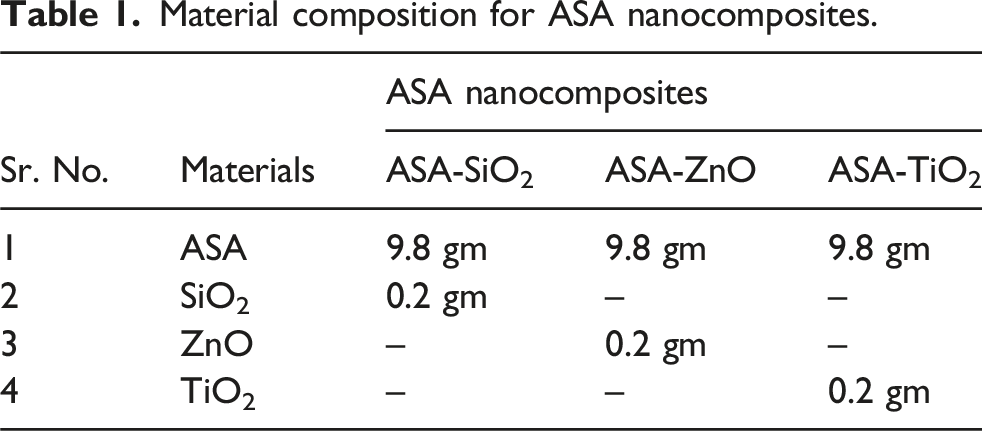
The preparation procedure was divided into two distinct approaches to optimize the interaction and dispersion of metal oxide nanofillers in the ASA matrix, considering practical significance. The preparation approach investigates the effects of the stage-dependent addition of nanofillers in pellet and powder forms of ASA polymer and conducts a comparative analysis to determine the most suitable approach. The schematic of the two different preparation approaches is shown in Figure 2. Schematic of the flow process of preparation approaches.
Material composition for ASA nanocomposites.

Powder particle size distribution before and after the ball milling process.
After the mechanical blending was completed, the mixtures of ASA and metal-oxide powders were directly poured into the chemical solvent (acetone) for solution mixing. In step 3, the aqueous solutions of the mixtures of both the approaches were stirred using a magnetic stirrer (Remi) at 1500 RPM for 3 h. Subsequently, the solutions of the three different samples were poured into petri dishes to solidify and then cut into pellets. The nanocomposite pellets were dried in a hot air oven at 50°C for 12 h to ensure the removal of any entrapped solvent. The converted pellets were fed into a lab-scale single-screw extruder (Filastruder, FFF Lab, India; D: 10 mm, L/D: 14) for melt mixing. The temperature was set at 110°C for the feeding zone and 250°C at the nozzle. The extruded materials were once again cut into pellets and re-extruded to ensure the uniform mixing of the nanomaterials in the ASA polymer matrix. A characterization analysis of three different ASA-metal oxide nanocomposites prepared using two distinct approaches has been performed to find the suitable preparation approach and compatible nanomaterial for further study.
Characterization
Identification of the suitable preparation approach and compatibility analysis performed through characterization of the prepared ASA nanocomposite samples with reference sample (i.e., ASA). For that following analysis were performed: morphological (FE-SEM, EDX), structural (XRD), thermal (TGA, DSC), ultraviolet-visible (UV-Vis) spectral, and rheological (MFI) analysis.
Morphological analysis
Morphology, interfacial interaction, and dispersion of metal oxide nanofillers in the ASA polymer matrix were examined on fractured cross-section of nanocomposite pellets by field emission-scanning electron microscopy (FE-SEM) images of nanocomposites. As the samples were non-conductive, they were sputtered coated with a thin layer of gold before imaging. Also, perform energy dispersive spectroscopy (EDX) analysis to identify the ingredients in the matrix and wt.% at different locations. The FE-SEM analysis was performed using a Carl Zeiss Ultra Plus FE-SEM machine equipped with EDX at a working voltage of 10 kV.
Structural analysis
The presence of the metal-oxide nanofillers in the structure of developed ASA nanocomposites was confirmed through X‐ray diffraction (XRD) analysis. XRD patterns were recorded using a Bruker D8 advanced X-ray diffractometer with Cu-Kα radiation in the range of 5° to 90° with a scan speed of 1.5°/min.
Thermal analysis
Thermal analysis of the nanocomposites was done using a TG/DTA system (model: EXSTAR TG/DTA 6300) for differential scanning calorimetry (DSC) and thermo-gravimetric analysis (TGA) under an N2 environment (200 mL/min) for a maximum temperature of 1500°C. The DSC test was accomplished at a heating rate of 10°C/min from 25°C to 700°C. The thermal transitions, such as glass transition temperature (Tg) and melt temperature (Tm), were determined from the heating scan. The glass transition temperature (Tg) was obtained from the inflection point in the DSC thermograms. A TGA test with a scanning rate of 10°C/min under N2 atmosphere (200 mL/min) was applied to study the thermal stability of the samples. The degradation temperature of the ASA nanocomposite materials was evaluated using TGA analysis. The first derivative of the TGA curve corresponded to the degradation temperature.
UV-Vis spectroscopy analysis
Ultraviolet (UV) resistance characteristics (UV absorbance) of the metal oxide nanomaterials on the ASA polymer matrix were examined by an UV-VIS spectrophotometer (Jabalpur, India). ASA polymer solution was chosen as the white reference, and the scanning region was from 200 to 700 nm. Most of the solar irradiance at the earth’s surface distributes in the wavelength range from 200 nm to 700 nm, which can be mainly divided into the following parts: UV-C region (200-280 nm), UV-B region (280–315 nm), UV-A region (315–400 nm), and Vis region (400–700 nm).
Rheological analysis
Rheological analysis of the samples was conducted using a melt flow index (MFI) tester machine. The ASA and ASA/metal-oxide nanocomposite samples were tested to investigate the influence of the nanomaterials on the flow and processability behavior in the molten state. The MFI of the samples was measured in accordance with ASTM D1238 using an MFI machine (Oracle Equipment’s, India). The material, in the form of pellets, was fed into the machine, and the desired temperature was selected. A standard weight was applied to the material, and the extrusion of the material through a nozzle with a diameter of 1.7 mm was observed. The measurements were performed at different temperatures: 240°C, 245°C, 250°C, 255°C, and 260°C, and at a standard weight of 2.16 kg under room temperature conditions. The flow behavior was evaluated based on the weight of the material that extruded from the nozzle within a specified time period. The MFI was calculated based on the following equation and results were expressed in grams per 10 min:
Results and discussion
Morphological analysis results - FE-SEM and EDX analysis
Morphological analysis using FE-SEM micrographs is a standard characterization technique used to evaluate the dispersion of nanomaterials within the ASA polymer matrix. Owing to its high magnification capabilities, FE-SEM imaging effectively reveals the microscopic dispersion of nanoparticles. FE-SEM imaging of the ASA-SiO2, ASA-ZnO, ASA-TiO2 PNC samples (fractured cross-sections) of two approaches was done to observe the presence of filler material and agglomeration of filler material. Figure 1(a), (b), (c) presents the FE-SEM images of metal-oxide NPs – SiO2, ZnO, TiO2 for confirming their presence in the developed PNC. During preparation of nanocomposites the metal-oxide NPs were separated out by using mechanisms such as ball milling mixing, high speed magnetic stirring and high screw speed in single screw, which dispersed properly in the ASA matrix as seen on the cross-sectional surface area of ASA nanocomposite pellets (Figure 4(a)-(f)). The cross-sectional surface area of ASA nanocomposite pellets was observed by FE-SEM at a magnification of 500× and 50,000× respectively. (a, b) FE-SEM Images and 
Figure 4(a), (b) depicts the FE-SEM images of ASA-SiO2 nanocomposites prepared using approach 1 (A1) and approach 2 (A2), respectively, where inset magnified images show the dispersion behaviour of the nano-SiO2. In approach 1 (A1), due to the inherently high surface energy of SiO2 NPs, it tends to agglomerate at the initial stage of nanocomposite preparation. FE-SEM image (Figure 4(a)) of ASA-SiO2 PNC (A1) showed that NPs agglomerated at different regions of nanocomposites and magnified images confirmed the agglomeration of the NPs in matrix. In contrast, approach 2 (A2) involved a pre-mixing step using ball milling, where ASA powder and nano-SiO2 were blended prior to melt mixing. This method significantly improved the uniformity of nanoparticle distribution. The magnified image in Figure 4(b) reveals well-dispersed SiO2 particles with enhanced interfacial adhesion between the nanoparticles and the ASA matrix. Also, EDX analysis was performed on both nanocomposites at different spectrums to identify elemental composition. The spectra (Figure 4(p), (q)) confirmed the presence of carbon (C), oxygen (O), and silicon (Si), and the weight percentage distribution indicated that nano-SiO2 particles in the (A2) assumed to be well dispersed in the ASA matrix compared to the (A1). Figure 4(c)-(d) depicts the FE-SEM images of ASA-ZnO nanocomposites from both approaches. In both approaches (A1) and (A2), ZnO NPs exhibited partial agglomeration or relatively poor compatibility to mix with ASA matrix as seen in the inset magnified images. As this non-uniform dispersion and weak interfacial bonding of ZnO nanomaterials with ASA matrix, acts as defect and potentially reduces the material properties of the nanocomposites. However, (A2) showed relatively improved dispersion, as supported by EDX analysis (Figure 4(r)-(s)), which confirmed the presence and more uniform distribution of carbon (C), oxygen (O), and zinc (Zn). Moreover, in Figure 4(e)-(f) presents the FE-SEM images of ASA-TiO2 nanocomposites prepared via (A1) and (A2), where magnified images show the dispersion behaviour of TiO2 NPs. Similar trend observed in the ASA-TiO2 PNC under the (A1), where NPs tends to agglomerate to some extent in the ASA polymer matrix as seen in the magnified image of Figure 4(e). While in (A2) resulted TiO2 NPs uniformly dispersed and formed a strong interfacial adhesion with ASA polymer matrix as seen in Figure 4(f). The corresponding EDX spectrum confirmed the presence of the elements i.e., carbon (C), oxygen (O), and titanium (Ti) and uniform dispersion at different regions as seen in specific Figure 4(u).
The result of FE-SEM and EDX analysis together suggested that the approach 2 (powder form) used for blending the metal-oxide NPs into the polymer matrix to develop nanocomposite offered effective adhesion between the filler and ASA resulting in good dispersion of nanoparticles into polymeric matrix without agglomeration up to 2 wt%. The pre-mixing of powders using mechanical blending (ball milling mixing) proved to be an efficient method for achieving homogeneous nanoparticle distribution within the nanocomposite. The final properties of the developed nanocomposites are strongly correlated with the degree of nanoparticle dispersion and diffusion within the matrix. A uniform and homogeneous distribution of SiO2 and TiO2 NPs has been seen from the magnified FESEM images of the nanocomposite pellet surfaces (Figure 4(b), (f)), which indicates formation of the either intercalated or exfoliated structure. 30 However, based solely on FE-SEM analysis, it is not possible to definitively distinguish between intercalated and exfoliated structures. Therefore, further structural characterization using X-ray diffraction (XRD) is necessary to confirm the degree of nanoparticle dispersion and to elucidate the structural formation of the metal-oxide nanoparticles within the ASA polymer matrix.
Structural analysis results - XRD analysis
The structural analysis was performed to confirm the presence of the metal-oxide NPs and analyse phase transformation occurred in developed nanocomposites using two distinct approaches. Figure 5 (a)-(c) show the XRD patterns of ASA-SiO2, ASA-ZnO, ASA-TiO2 PNC materials prepared using two different approaches (A1: pellet-based; A2: powder-based). Apart from that, Figure 1(d) presents the XRD patterns of the neat ASA, pristine metal-oxide NPs (SiO2, ZnO, TiO2) to identify characteristic peaks in the PNCs. In all the nanocomposites, two broad diffraction peaks centered around 2θ = 13 (a) XRD pattern of ASA-SiO2 PNC; (b) XRD pattern of ASA-ZnO PNC; (c) XRD pattern ASA-TiO2 PNC.
Figure 5(a) presents the pattern of ASA-SiO2 PNC prepared using two distinct approaches, which confirmed the observation seen in FE-SEM micrographs. As pellet-based (A1) and powder-based (A2) approach may get formed an exfoliated structure, as the peak of SiO2 NPs in nanocomposite shifted to the higher angle with respect to pristine SiO2 (2θ: 22
Thermal analysis results - DSC and TGA analysis
The thermal behavior of ASA-based polymer nanocomposites (PNCs) incorporating metal oxide nanofillers (SiO2, ZnO, and TiO2) was investigated using Differential Scanning Calorimetry (DSC) and Thermogravimetric Analysis (TGA). These analyses were performed to evaluate the effect of nanofiller addition on the glass transition temperature (Tg), melting temperature (Tm), and thermal degradation behavior of the PNCs, which are critical indicators of their thermal performance under processing and end-use conditions.
Figure 6 presents the DSC thermographs of ASA-SiO2, ASA-ZnO, and ASA-TiO2 nanocomposites. The glass transition temperature (Tg) of neat ASA was found to be in the range of 100–110°C.
14
Upon incorporation of 2 wt% metal oxide nanofillers using the powder-based (A2) approach, a noticeable increase in Tg was observed. Specifically, Tg values of 114.06°C for ASA-SiO2, 116.22°C for ASA-ZnO, and 115.51°C for ASA-TiO2 were recorded. This increase in Tg can be attributed to the restriction of polymer chain mobility due to interfacial interactions between the nanoparticles and the ASA matrix. The nanoparticles may act as physical crosslinking points or nucleating sites around which polymer chains reorganize, making it more difficult for them to move freely, thereby improving the thermal stability of the nanocomposites. Similar trends have been reported in literature, where the incorporation of nanoscale fillers restricts the amorphous phase motion and elevates the Tg of polymer matrices.
34
In terms of melting behavior, neat ASA exhibited a melting point (Tm) of approximately ranges between 280 and 310°C.
35
With the inclusion of nanofillers, marginal shifts in Tm were observed: ASA-SiO2 showed a Tm of 346.88°C, ASA-ZnO 336.45°C, and ASA-TiO2 338.51°C. These variations suggest that the nanofillers significantly influenced the crystalline phase of the polymer, though not significantly altering the crystallinity. The presence of nanofillers might disrupt or promote localized ordering of polymer chains, leading to major changes in the melting point. Dsc thermograph of ASA-SiO2, ASA-ZnO, ASA-TiO2.
Thermal stability and degradation behavior of the nanocomposites were analyzed using TGA, as shown in Figure 7. The thermal decomposition of neat ASA began near 360°C and reached maximum degradation around 386°C.
35
The addition of nanofillers shifted the degradation temperature to a higher range. ASA-SiO2, ASA-ZnO, and ASA-TiO2 nanocomposites showed decomposition temperatures (Td) at approximately 396.97°C, indicating enhanced thermal resistance due to the incorporation of metal oxide fillers. This improvement is mainly due to the barrier effect provided by well-dispersed inorganic particles, which hinder the diffusion of volatile degradation products and heat transfer, thus slowing down the decomposition rate.
36
Furthermore, TGA results confirmed the presence of inorganic residues at the end of the thermal degradation cycle. Residual weights of 33.14 wt% for ASA-SiO2, 30.00 wt% for ASA-ZnO, and 31.33 wt% for ASA-TiO2 were recorded, validating the thermal robustness and stability of the added nanofillers. These residues are representative of the undecomposed metal oxides, confirming their stability under the processing and testing temperature conditions. This observation also correlates with the DSC findings, where the enhanced thermal stability (increased Tg and marginal shift in Tm) complements the higher decomposition temperature revealed by TGA analysis (Table 2). TGA thermograph of ASA-SiO2, ASA-ZnO, ASA-TiO2. Key thermal properties of ASA and nanocomposites from DSC and TGA.
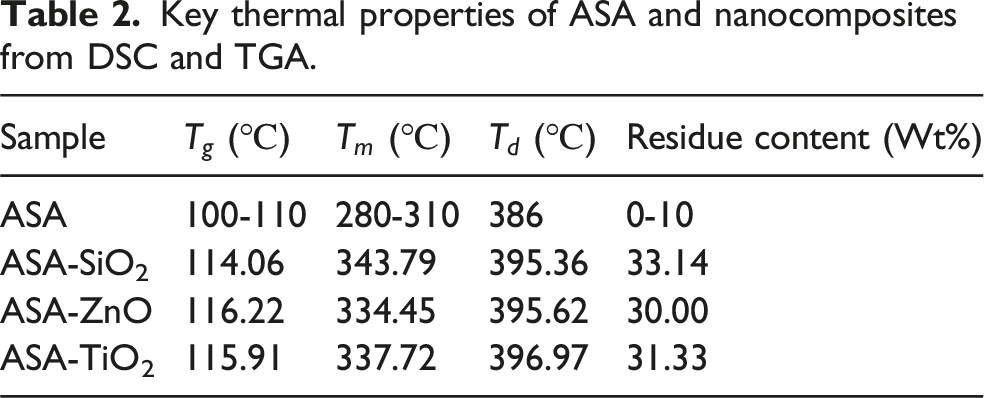
The combined DSC and TGA analysis confirm that the incorporation of metal-oxide nanofillers (especially SiO2 and TiO2) significantly enhances the thermal stability of ASA-based nanocomposites. Elevated Tg and Tm values suggest reduced polymer chain mobility and increased crystallinity. Furthermore, higher decomposition temperatures and residue content from TGA curves indicate that nanocomposites can better withstand thermal degradation compared to neat ASA. These improvements are particularly critical for additive manufacturing of outdoor components, where materials are exposed to thermal cycling and harsh environmental conditions. Therefore, ASA-SiO2 and ASA-TiO2 nanocomposites prepared using the powder-based (A2) approach show great promise for FFF applications demanding high thermal durability and dimensional stability.
UV-Vis spectroscopy analysis results
UV-Vis spectroscopy was employed to evaluate the UV absorbance capabilities of ASA and its nanocomposites reinforced with metal oxide nanoparticles—SiO2, ZnO, and TiO2. As shown in Figure 8, all samples exhibit strong absorbance in the UV region (200–400 nm), with particularly high absorbance in the UVC (200–280 nm) and UVB (280–315 nm) bands. The visible light region (400–700 nm) showed negligible absorbance for all samples, indicating that the incorporation of nanoparticles does not adversely affect the transparency of the base polymer. Among all compositions, the ASA-TiO2 nanocomposite exhibits the highest absorbance in the UV region (UV-C and UV-B regions), followed by ASA-ZnO and ASA-SiO2, with neat ASA showing the lowest absorbance. The enhanced absorbance in ASA-TiO2 is attributed to the strong UV shielding ability and photocatalytic nature of titanium dioxide (TiO2), which has a wide bandgap (∼3.2 eV) and high refractive index, making it effective in scattering and absorbing UV radiation.37,38 Furthermore, TiO2 also forms robust interfacial bonding with the ASA polymer matrix, contributing to a denser and more stable organic-inorganic hybrid nanocomposite structure, which serves as a barrier to UV-induced degradation.
39
UV-Vis spectra of ASA ASA-SiO2, ASA-ZnO, and ASA-TiO2.
The inset magnification in Figure 8 (210–280 nm) highlights a distinct absorbance peak shift and increase for the ASA-TiO2 nanocomposite, this conformed the improved UV absorbance due to the better interaction between TiO2 nanoparticles and ASA molecular chains. The hybrid structure limits the penetration of environmental factors (UV light, oxygen, and moisture), consequently enhancing the photo-stability and weathering resistance of the composite. 21 In comparison, ASA-ZnO and ASA-SiO2 nanocomposites also showed improved UV absorbance over neat ASA, but to a lesser extent. ZnO NPs also contribute to UV absorbance (bandgap ∼3.3 eV) and offer reasonable protection; however, their dispersion and UV attenuation ability are often slightly inferior to TiO2 due to agglomeration tendencies at higher loadings. While SiO2 NPs, being optically transparent with no significant UV absorbance, contributes more to mechanical reinforcement than UV shielding. 40 The UV-Vis spectroscopy analysis confirmed that the incorporation of metal oxide nanofillers significantly enhances the UV shielding performance of ASA, with ASA-TiO2 nanocomposites showing the most pronounced improvement. This enhancement is driven by TiO2 NPs strong absorbance in the UV-C and UV-B regions, coupled with effective dispersion and interfacial bonding within the ASA matrix. These characteristics not only reduce UV-induced degradation but also enhance the long-term stability, weatherability, and durability of the nanocomposite.
Rheological analysis results – MFI analysis
The rheological behaviour of polymer material is a critical parameter for processing, particularly for additive manufacturing applications such as FFF process. One of the most common and practical techniques to assess the flow behaviour of thermoplastic materials is the Melt Flow Index (MFI) test, performed according to ASTM D1238. This test evaluates the rate at which a polymer melts and flows under a standard load and temperature, serving as an indicator of the material’s processability. In the present study, the MFI measurements were carried out for neat ASA and its nanocomposites filled with 2 wt% of metal oxide nanoparticles (SiO2, ZnO, TiO2), following ASTM D1238 standards. The test was performed under a constant load of 2.16 kg and at a range of processing temperatures from 240°C to 260°C in 5°C intervals, which aligns with the typical thermal processing window of ASA.
Figure 9 describes the temperature-dependent melt flow behavior of ASA and its nanocomposites. As expected, a positive correlation was observed between temperature and MFI for all compositions, which is typical due to reduced melt viscosity at elevated temperatures and enhance flowability. Neat ASA exhibited the highest MFI values at each temperature, with a significant increase from 2.10 g/10 min at 240°C to 4.02 g/10 min at 260°C. A similar trend was seen in nanocomposite samples, though with slightly lower values: ASA-SiO2 (1.98 to 3.42 g/10 min), ASA-ZnO (1.98 to 3.12 g/10 min), and ASA-TiO2 (1.92 to 3.6 g/10 min). The reduced flow rate in nanocomposites may be attributed to nanoparticle–polymer interactions that hinder polymer segment mobility, reduce free volume, and introduce physical barriers to chain flow.41,42 This effect is more pronounced in ASA-ZnO samples, likely due to greater agglomeration or poorer dispersion observed in earlier morphological analysis. Temperature-dependent MFI of ASA, ASA-SiO2, ASA-ZnO, ASA-TiO2.
Figure 10 shows the average MFI values for all materials at a constant testing condition. The neat ASA exhibited a melt flow index of 3.096 g/10 min, demonstrating relatively high flowability. Upon incorporation of metal-oxide nanofillers, a decline in MFI values was observed, with ASA-SiO2, ASA-ZnO, and ASA-TiO2 showing MFI values of 2.808, 2.664, and 2.88 g/10 min respectively. This reduction in MFI can be attributed to the restriction in polymer chain mobility due to the physical presence of nanofillers, as well as possible nanoparticle agglomeration, particularly in ZnO-reinforced samples. The ZnO nanocomposites demonstrated the lowest MFI among the three, indicating a higher viscosity and lower flowability, which might be due to poor dispersion and stronger interfacial friction at the polymer–nanoparticle interface. In contrast, TiO2-based nanocomposites showed relatively better flowability, likely due to improved dispersion and interfacial compatibility as confirmed in earlier morphological and structural analyses. The rheological trends align with the findings of Ansari et al., where the addition of inorganic fillers reduced chain mobility and free volume, thereby affecting melt flow.
34
The rheological analysis indicates that the incorporation of metal oxide nanofillers marginally decreases the melt flowability of ASA, with the extent depending on the type and dispersion quality of the nanoparticles. The observed reduction in MFI is still within acceptable limits for filament extrusion and FFF processing, confirming the feasibility of these nanocomposites as viable feedstock materials. Among the three, ASA-TiO2 nanocomposites demonstrate optimal rheological performance, striking a favorable balance between filler-induced reinforcement and processability. This finding reinforces earlier thermal and structural observations that TiO2 provides superior interfacial compatibility and dispersion behavior in the ASA matrix. Average MFI of ASA and ASA-metal oxide PNCs.
Conclusion
This study demonstrates that the incorporation of inorganic metal-oxide nanofillers (SiO2, ZnO, TiO2) can effectively enhance the multifunctional performance of ASA-based materials for fused filament fabrication (FFF), provided that appropriate filler selection and processing strategies are employed. A powder-based hybrid preparation route—combining mechanical pre-mixing through ball milling, solution blending, and melt compounding—was shown to be critical for achieving uniform nanoparticle dispersion and strong interfacial bonding. The resulting processing–structure–property relationships confirm that dispersion quality and filler–matrix compatibility play a decisive role in translating intrinsic nanofiller characteristics into performance gains relevant to FFF applications. Among the investigated nanofillers, TiO2 exhibited the highest compatibility with the ASA matrix, delivering a balanced improvement in thermal stability, UV shielding efficiency, and melt processability. The enhanced glass transition and decomposition temperatures, combined with superior UV absorption and stable melt flow behavior, establish ASA–TiO2 nanocomposites as a promising filament feedstock capable of meeting both performance and processing requirements for outdoor FFF components. In comparison, SiO2- and ZnO-based nanocomposites provided partial improvements but were limited by comparatively weaker interfacial interactions and dispersion-related constraints. Despite these promising outcomes, the present work has certain limitations. The investigation was restricted to a single nanofiller concentration (2 wt%), laboratory-scale filament extrusion, and indirect evaluation of weathering resistance through UV–Vis analysis rather than long-term outdoor exposure testing. Mechanical performance, fatigue behavior, and recyclability under repeated processing cycles were also beyond the scope of this study. Addressing these aspects in future work will be essential for a comprehensive assessment of long-term durability and industrial scalability. Future studies will focus on optimizing nanofiller concentration, exploring surface-modified or hybrid filler systems, assessing long-term dispersion stability and environmental aging behavior, and validating performance across different commercial FFF platforms. From an industrial perspective, the developed ASA–TiO2 nanocomposites show strong potential for applications requiring enhanced thermal and UV resistance with reliable printability, such as automotive exterior components, electrical and electronic housings, protective enclosures, marine fixtures, and infrastructure-related parts. Overall, this work provides a practical and scalable material strategy for advancing weather-resistant, multifunctional polymer feedstocks tailored for additive manufacturing technologies.
Footnotes

Funding
The authors received no financial support for the research, authorship, and/or publication of this article.
Declaration of conflicting interests
The authors declared no potential conflicts of interest with respect to the research, authorship, and/or publication of this article.
Data Availability Statement
The authors confirm that the data supporting the findings of this study are available within the article.