






Abstract
Accurately predicting the Depth of Penetration (DOP) is essential for understanding the impact behavior of Functionally Graded Composite Materials (FGCMs) under high-velocity conditions. However, the nonlinear dynamic behavior governing FGCMs, coupled with the high cost and time-consuming nature of experimental tests, make precise DOP estimation a challenging task. This study proposes an efficient predictive framework that combines finite element (FE) simulations with artificial neural networks (ANNs) to overcome the constraints of conventional numerical and experimental approaches. This work focuses on applying the Whale Optimization Algorithm (WOA) and the Arithmetic Optimization Algorithm (AOA) as independent optimization strategies to improve the control parameters during the initiation phase, avoid convergence to local optima, and accelerate the learning process. Finite Element (FE) simulations were used to generate input-output datasets, which were used to train three ANN models: conventional back-propagation (BP), WOA-ANN, and AOA-ANN. The optimized ANNs accurately captured the nonlinear mapping between impact velocity (
Keywords
Introduction
Functionally Graded Composite Materials (FGCMs) are increasingly adopted across a wide range of engineering applications, including aerospace, shipbuilding, nuclear installations, automotive engineering, geological structures, biomechanics, ballistic protection, as well as sensor and actuator technologies.1,2,3,4,5,6,7 The application of FGCMs in armor systems has attracted growing research interest; however, studies specifically addressing on their ballistic performance under high-velocity impact conditions remain scarce compared to conventional homogeneous or laminated composites. The ballistic efficiency (DOP) of FGCMs is traditionally investigated through experimental testing or numerical simulations. While experimental tests provide valuable data, they are often costly and time-consuming. To overcome these limitations, finite element (FE) simulations offer a more efficient alternative by reducing the need for extensive experimental testing. Nevertheless, FE simulations remain computationally expensive, especially when parametric studies are required, limiting their applicability for optimization. Beyond experimental and numerical approaches, Artificial Neural Networks (ANN) have recently gained attention for their effectiveness in capturing complex nonlinear relationships in materials and structural engineering problems. Owing to their self-learning capability, robustness, and architectural flexibility8,9,10,11,12,13,14,15,16,17,18,19 ANNs have been successfully applied to a wide range of applications, including mechanical fault diagnosis, additive manufacturing, machining processes, vibration analysis, nonlinear material behavior, and composite property prediction.16,17,20–38 These studies consistently demonstrate the ability of ANN-based models to provide accurate and efficient predictions when trained on numerical or experimental datasets.
Despite these advances, the application of ANN models to dynamic impact and ballistic problems remains comparatively underexplored, particularly for FGCMs subjected to high-velocity loading. Existing studies have mainly focused on conventional composite laminates, low-velocity impact damage, or ballistic limit prediction using experimental testing, finite element analysis, and ANN models9,10,11,12,14. Additionally, Xu Long et al. 39 introduced a Long Short-Term Memory (LSTM) network model to forecast the dynamic compressive performance of concrete-like materials subjected to high strain rates. Their findings show that the LSTM network outperforms the conventional BP algorithm and can effectively replace computationally expensive and time-consuming FE modeling. Moreover, Jairo Peinado et al. 15 and J.A. Artero Guerrero et al. 9 proposed a methodology based on the paradigm of experiment-FE analysis-ANN to assess the impact of stacking sequence on the ballistic performance of composite laminate structures. While these studies highlight the potential of ANN-based approaches, they often rely on relatively large datasets and do not explicitly address the challenges associated with highly nonlinear impact behavior and limited training data, which are typical in ballistic simulations of FGCMs.
Despite their growing applications in recent years, Artificial Neural Networks still present certain challenges, such as slow convergence speed, susceptibility to local minima, and uncertainty in determining the optimal number of hidden layer neurons40,41,42. To address these challenges, advanced ANN architectures coupled with optimization algorithms have been proposed, such as ANN-WOA34,43,44,45, ANN-GA 39 , ANN-AOA 13 , ANN-JAYA46,47, and ANN-PSO36,48,49,50. Overall, optimizing ANN parameters through these methods plays a crucial role in improving performance and reliability in structural analysis, fault diagnosis, and strategy evaluation51,52,53,54. For instance, Khatir et al. demonstrated substantial improvements in ANN performance through: (i) the use of the Arithmetic Optimization Algorithm (AOA) for damage assessment 13 , (ii) Jaya search algorithms for identifying single and multiple cracks 47 , and (iii) damage detection in steel beam structures and composite laminates using ANN-PSO-IGA48,55. Their findings confirm that enhanced ANN algorithms offer high accuracy and robustness in damage identification, quantification, and prediction47,55,56,57. However, the use of advanced architecture based on optimization algorithms for predicting the high-velocity impact response of FGCMs, particularly under data-scarce conditions, has not been sufficiently investigated.
Motivated by these gaps, the present study focuses on predicting the ballistic efficiency (DOP) of FGCMs under high-velocity impact via optimized ANN approaches. The novelty of this study lies in the use of the Whale Optimization Algorithm (WOA) and the Arithmetic Optimization Algorithm (AOA) as two independent optimization strategies for ANN training, aiming to improving control parameter estimation during the early learning phase, avoid premature convergence, and improve prediction accuracy when only a limited dataset is available. The remainder of this paper is organized as follows. Section 2 describes the validated FE model employed to generate the training dataset, where the initial impact velocity (
Impact responses of the FGCMs plate
This section aims to construct a database comprising input-output pairs (
In this numerical study, the 3D model consists of two parts: a 0.30 caliber steel fragment-simulating projectile (FSP) and a FGCMs plate, as illustrated in Figure 1. The numerical model consisted of an impacted circular plate with a 90 mm diameter, composed of five functionally graded (FG) layers composed of silicon carbide ceramic (SiC) and aluminum metal (Al) constituents with a total thickness of 16 mm (each layer measuring 3.2 mm). The compositional gradient across the thickness was adjusted to transition from a pure ceramic top layer (100% SiC) to a pure metal bottom layer (100% Al). Additionally, the pure ceramic layer was positioned at the front face against the projectile. FE model for 5-layer Al/SiC FGCMs
58
.
The mechanical properties of FGCMs layers were assumed to vary through thickness following a power-law distribution governing the volume fraction of the metal phase, as defined in equation (1)59,60.

ZEMANI et al
58
found that Al-SiC functionally graded composite plate with a linear composition ( Linear distribution of 5-layers Al/SiC FGCMs
58
.
Proposed optimized ANN trained using FE predictions
Back-propagation learning algorithm
Machine learning techniques serve as effective regression tools in scenarios where examples of an unknown process are available, but no explicit analytical model exists to define their relationships. Among these techniques, Artificial Neural Networks stand out as powerful computational models. A specific type of ANN, the feed-forward neural network (FFNN), consists of neurons arranged in sequential layers, where the output of one layer serves as the input for the next. The FFNN architecture comprises three primary layers: the input layer, hidden layer(s), and output layer. There are no cycles or loops in the FFNN network, no feedback connections
63
. The structural design of the FFNN architecture is illustrated in Figure 3. Architecture of a multi-layer perceptron.
First, the input layer consists of a vector of input parameters, which directly serve as the outputs of this initial layer. Subsequently, the outputs

The synaptic weights

The optimal network architecture is typically determined through a trial-and-error process. Among feed-forward neural networks, the multilayer perceptron is the most commonly used, employing a backpropagation learning algorithm. The primary objective of this algorithm is to approximate the unknown function governing the process. The training process consists of two main steps: (i) feed-forward propagation of the input training pattern and (ii) weight adjustment based on the computed error, enabling the network to learn and improve its predictive accuracy.
During the training process, the synaptic weights are iteratively adjusted to minimize the error between the predicted and actual outputs using the backpropagation algorithm. The learning process concludes once the error falls within the specified accuracy threshold, yielding a trained neural network. If the accuracy requirement is not satisfied, the process continues iterating until the error is reduced to an acceptable level. This iterative cycle ensures optimal weight adjustments for improved predictive performance. Further details on the learning parameters are discussed in the next section.
Optimized-ANN models
The training process of ANN remains one of the most challenging aspects of machine learning, drawing significant research interest in recent years. The primary difficulty lies in the nonlinear nature of neural networks and the uncertainty in determining the optimal set of controlling parameters, particularly the synaptic weights. Traditional training algorithms are often prone to issues such as local optima stagnation and slow convergence. However, optimization algorithms, such as Whale Optimization Algorithm (WOA) and the Arithmetic Optimization Algorithm (AOA), have proven to be highly effective in addressing complex and diverse optimization problems across various fields. Their robustness, flexibility, and adaptability make them suitable for handling continuous, discrete, and combinatorial optimization tasks while efficiently exploring the search space and avoiding local optima. These make the optimization algorithm a reliable alternative to alleviate these drawbacks and motivated our attempts to employ it as a trainer for ANN particularly in generation phase of controlling parameters (i.e., weights) during the initiation phase.
The WOA and the AOA utilize unique strategies to balance exploration and exploitation, making them effective for tackling complex optimization problems. WOA, proposed by Seyedali Mirjalili and Andrew Lewis 64 , balances exploration and exploitation, making it effective for complex optimization problems. Inspired by the hunting behavior of humpback whales, WOA mimics their bubble-net hunting strategy. The algorithm begins with a randomly generated population of solutions and iterates through three key phases: (i) Encircling Prey – involves the whales adjusting their positions relative to the best-known solution, (ii) Bubble-Net Attacking method which combining shrinking encircling (converging toward the optimal solution) and spiral position updating (simulating helical movements around their prey), and (iii) searching for prey. By effectively combining local refinement with global search, WOA demonstrates strong optimization capabilities, making it a powerful tool for solving challenging problems.
In contrast, the AOA, introduced by Abualigah et al 65 mimics arithmetic operations to dynamically adjusts its exploration and exploitation phases, balancing between global and local searches to avoid premature convergence and enhance solution quality. It initializes a population of solutions and iteratively refines them through: (i) addition and subtraction focus on exploration by altering solutions to cover a broad search area, while multiplication and division concentrate on exploitation by fine-tuning solutions for better accuracy. AOA dynamically adjusts these operations to prevent premature convergence, continuing until an optimal solution or iteration limit is reached. Here is a simplified overview of both algorithms in a single tale, for a detailed description of WOA and AOA, please refer to the works documented in studies64,65,66,67,68.
As illustrated in Figure 4, optimization algorithms are integrated in the initiation phase of network to optimize the weight values during the training process. Once the structure of the ANN model is established, each connection weight is represented by a real number. The optimization algorithms iterate until the maximum number of iterations is reached. The goal is to determine suitable weight values using WOA and AOA, where the Mean Square Error ( General step of the optimized ANN models (WOA-ANN and AOA-ANN).

Results and discussions
The finite element (FE) results of the FGCMs specimen studied by ZEMANI et al 58 provide the input-output sequences for the network (i.e. the initial velocity of the training sample that used as a set of input to predict the corresponding depth of penetration). All finite element simulations were performed under fixed and controlled conditions (projectile geometry, impact angle, material properties, and plate configuration), ensuring that impact velocity is the dominant parameter governing the depth of penetration. Consequently, the ANN was formulated as a single-input model to capture its nonlinear relationship with DOP for this study. This nonlinear mapping was then established using the back-propagation (BP) learning algorithm and the proposed optimized ANN models.
The definition of a neural network’s architecture involves selecting the number of parameters that define the input data, the number of hidden layers, and the number of neurons in each layer. At the beginning of this section, input-output sequences of the network are used to determined ANN parameters. However, the node number


The neural network model selected has a single hidden layer with 20 nodes, according to Equations (5) and (6). Using more hidden layers would result in a more complex ANN structure, making optimization techniques more challenging. To provide a fair assessment of the predictive capability of these ANN models, the dataset was randomly partitioned into 54 training sets and 6 validation sets, ensuring a training-to-verification ratio of 0.9:0.1, which aligns with standard ANN modeling practices 39 . This partitioning strategy was applied consistently across all ANN models (BP, WOA-ANN, and AOA-ANN) to enable a reliable comparative evaluation.
Various training functions can be employed, as these functions update the weight values using different optimization algorithms. Some commonly used training functions include Levenberg-Marquardt optimizations, Bayesian Regularization, Scaled Conjugate Gradient method, and One Step Secant method. Among these, Levenberg-Marquardt (LM) and Bayesian Regularization (BR) are more efficient compared to the Scaled Conjugate Gradient and One Step Secant methods, despite requiring more memory and computational time. In this study, the Levenberg-Marquardt training function is selected for both the BP training algorithm and the optimized ANN models.
To enhance the statistical significance of the results, the regression parameter (
Parameters of the database with three ANN models.
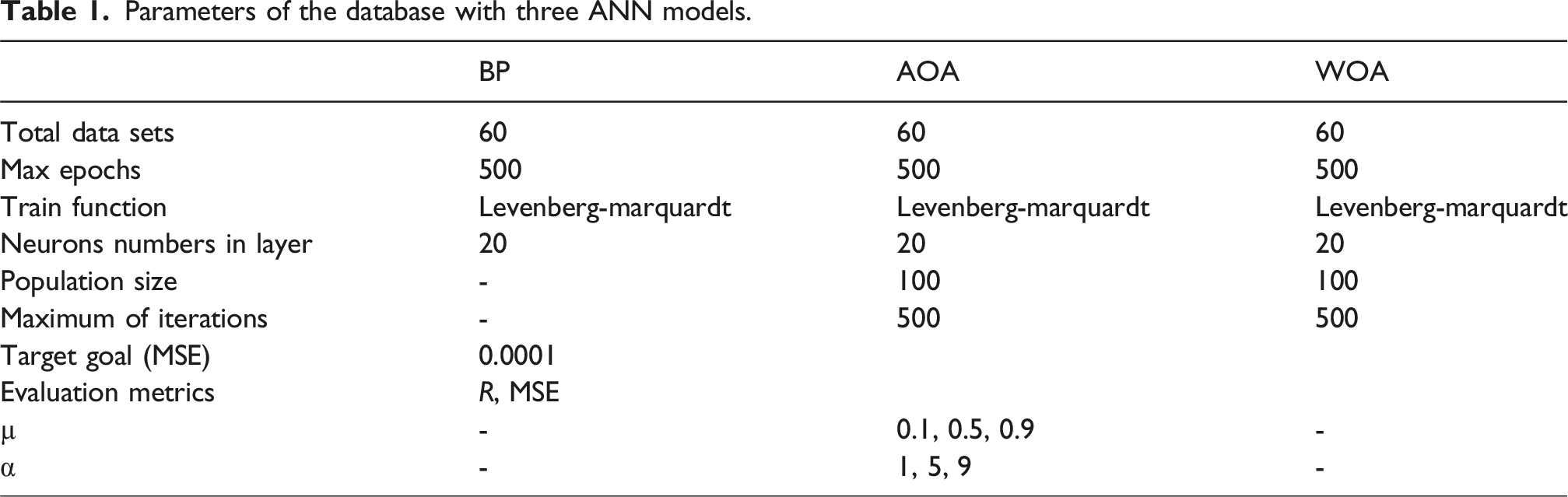
The influence of changing µ and α parameters value of AOA on its performance.

In order to analyze the convergence performance of the proposed WOA compared to AOA algorithms, Figure 5 presents exemplary convergence curves based on averages of the fitness function over 500 iterations. Please note that average fitness function indicates the average of the solutions obtained in each iteration across 30 independent runs. For a fair comparison, all ANN model inputs and settings were kept identical during the optimization process of WOA and AOA algorithms in the optimized ANN process. Evolution of the Fitness Function value during iterations for the DOP prediction using WOA-ANN and AOA-ANN.
It is evident from Figure 5 that the WOA and AOA exhibit a steady convergence and a fast convergence acceleration. However, the steady convergence of both algorithms means they progressively approach the global optimum solution without major fluctuations. These results demonstrate their ability to provide consistent solutions over several runs. This also implies that both algorithms do not behave erratically and follow a smooth trajectory towards the global optimum. The fast convergence acceleration may indicate that the algorithm takes less time to significantly reduce the value of the fitness function, which may be more efficient in terms of execution time. These findings confirm that both WOA and AOA are robust optimization techniques capable of efficiently training ANN models while ensuring convergence to optimal solutions.
Furthermore, the results indicate that WOA outperforms AOA technique in terms of accuracy, despite AOA’s superior initial estimates in the earliest iterations. The superior accuracy of WOA algorithm originates from the saving of the best prey and adaptive search around it. The search agents in WOA tend to search more locally around the prey proportional to the number of iterations. The WOA-ANN trainer inherits this feature from the WOA and managed to outperform the AOA-ANN algorithm.
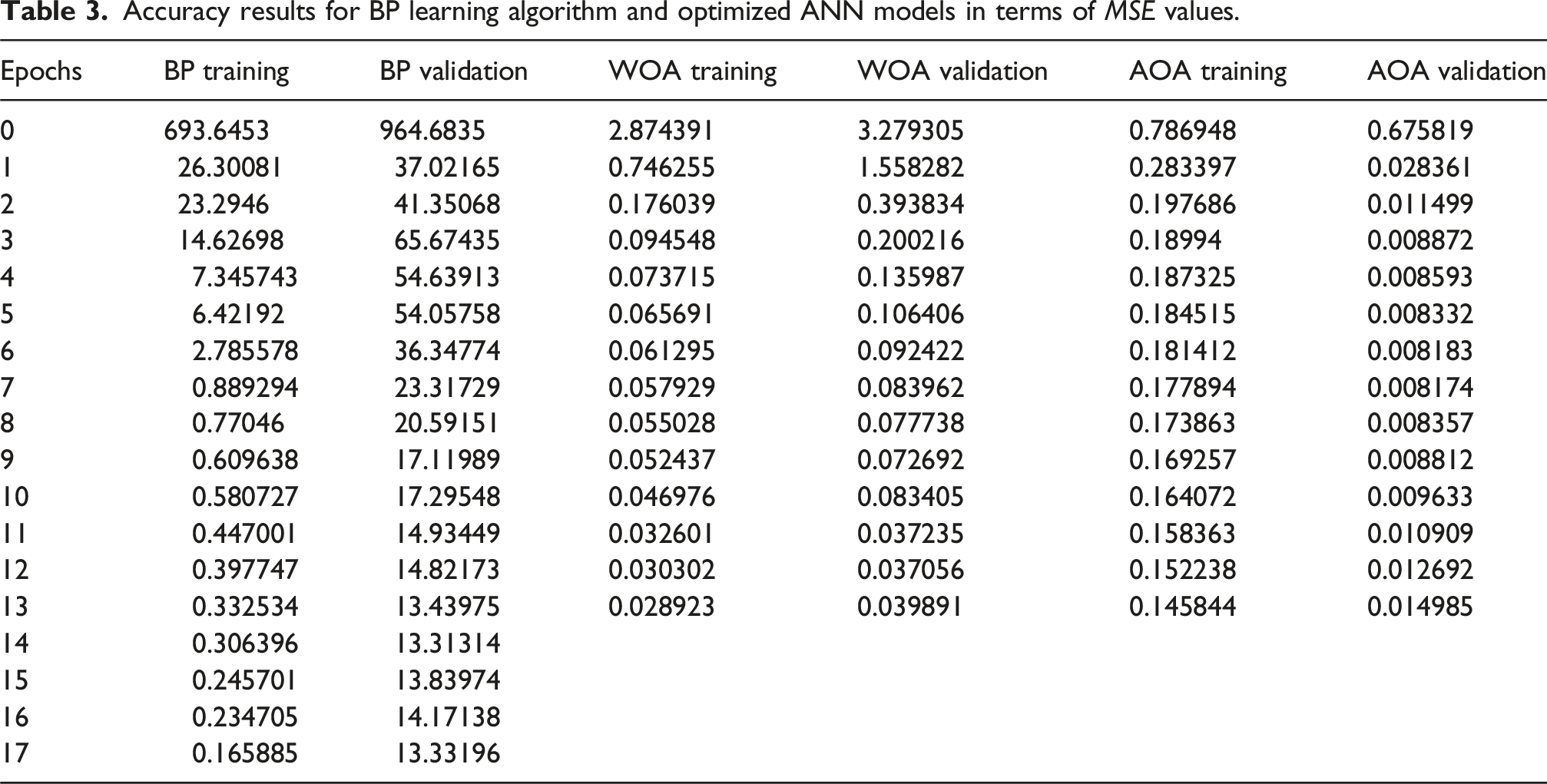
Accuracy results for BP learning algorithm and optimized ANN models in terms of

Optimized-ANN models performance.
Figure 6 presents the training and validation curves for the WOA-ANN and AOA-ANN models, highlighting the performance of the optimized ANN. The training curves illustrate how the model’s error (or performance) evolves over epochs, while the validation curves depict the error on the validation set, which is a subset of the data that the model did not used during training.
As shown in Figure 6, the optimized ANN initially experiences a rapid decline in error as it learns to adjust its parameters. The steady decrease in both training and validation errors continues until the validation error stabilizes, demonstrating effective training and the generalization capability of the optimized ANN model. Furthermore, the WOA-ANN model achieves a lower MSE compared to AOA-ANN, indicating superior prediction accuracy.
To evaluate the predictive performance of the three ANN architectures, the Depth of Penetration estimated from FE simulations are compared with those from the BP training algorithm and the optimized ANN models (i.e. WOA-ANN and AOA-ANN) in Figure 7(a). The results indicate that all three models achieve Comparisons of impact responses predicted using BP and optimized ANN models. (a) Predicting results of DOP using different models (b) Error probability distribution; (c) Percentage error (PE) Analysis.
To further assess the predictive accuracy of the improved ANN models, Figure 7(b) compares FE data with DOP predictions from BP, WOA-ANN, and AOA-ANN methods. The results indicate that WOA-ANN provides the most accurate predictions for initial velocities of 200, 400, 500, 600, 700, 900, and 1000 m/s. Meanwhile, AOA-ANN performs best at 100, 300, and 800 m/s, with predictions closest to the FE values. In all cases, the BP learning algorithm shows the highest gap from the FE results, highlighting the superior accuracy of the optimized ANN models.
To objectively compare the DOP prediction performance of different models, percentage error (
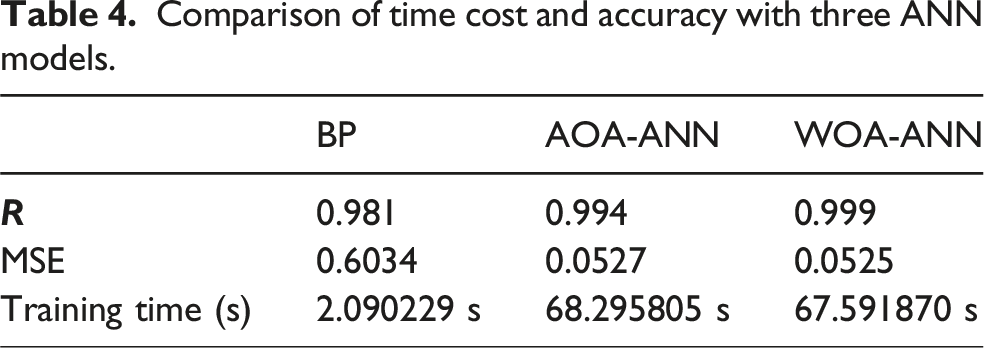
The proposed WOA-ANN model demonstrates the best DOP prediction accuracy based on the
Comparison of time cost and accuracy with three ANN models.
Conclusion
This study proposes three ANN models, including the back-propagation training algorithm and two optimized Artificial Neural Networks (WOA-ANN and AOA-ANN) models to predict the impact response of Al-SiC functionally graded composite materials. The key novelty lies in the independent application of WOA and AOA to optimize the initial weight parameters, effectively overcoming the inherent limitations of conventional back-propagation (BP) algorithms, including slow convergence and local optima stagnation.
Various statistical measures were used to assess prediction performance. The high average accuracy and low standard deviation achieved by the optimized models demonstrate their effectiveness in preventing premature convergence and identifying optimal initial parameters for ANN training. Furthermore, the results confirm that the effective local optima avoidance does not compromise convergence speed. Comparative results demonstrate that the proposed WOA-ANN model achieves superior predictive accuracy even with limited data availability, with the lowest Mean Square Error (MSE = 0.0525), the highest correlation coefficient (R = 0.999), and a narrow percentage error band, outperforming both the AOA-ANN and standard BP models. Moreover, the optimized ANNs reliably capture the complex nonlinear relationship between impact velocity and depth of penetration (DOP) using a limited dataset derived from computationally intensive finite element simulations, thereby offering a practical and efficient alternative to extensive numerical or experimental campaigns.
It is important to emphasize that the present findings are specific to the studied linear Al/SiC FGCM configuration, no external validation using alternative gradation profiles or experimental data has been performed. This constraint is explicitly acknowledged, and claims regarding generalizability have been carefully moderated accordingly. Future work will extend the framework by incorporating additional governing parameters, such as the influence of constituent distribution through the thickness of FGCMs and the influence of manufacturing-induced porosity, to further enhance its predictive scope and applicability.
Footnotes

Funding
The authors received no financial support for the research, authorship, and/or publication of this article.
Declaration of conflicting interests
The authors declared no potential conflicts of interest with respect to the research, authorship, and/or publication of this article.
Data Availability Statement
Data will be made available on request.