






Abstract
Fiber metal laminates (FMLs) enhanced with nanofillers have been explored for thermal management in the automotive and aerospace applications; however, their thermal behavior as a function of distance remains inadequately investigated. This study evaluated the thermal barrier efficacy of aluminium–glass fiber-reinforced polymer (GFRP) fiber metal laminates modified with titanium dioxide (TiO2) nanoparticles, graphene nanoplatelets (GNPs), and silica (SiO2) nanoparticles at heat source distances of 15, 20, and 30 cm. A full factorial design (four materials × three distances × three replicates; n = 36) was implemented with controlled convective heating using a 1000 W hot-air dryer for 10 s. The transient thermal response was assessed using the temperature increase, heating rate, and cooling rate. The TiO2-modified laminate exhibited the lowest temperature increase at 15 cm (0.70 ± 0.03°C), representing a 63% reduction compared to the unfilled control (p < 0.001; Cohen’s d = 60.34). Conversely, GNP-modified laminates displayed non-monotonic distance-dependent behavior, with temperature increase rising from 2.40°C at 15 cm to 2.90°C at 20 cm, and then decreasing to 1.40°C at 30 cm. Two-way analysis of variance (ANOVA) indicated significant effects of material, distance, and their interaction (p < 0.001), showing a clear coupling between the material composition and heat source proximity. The anomalous graphene response warrants microstructural investigation. TiO2 recorded the most consistent performance across all distances. This work systematically quantifies coupled material–distance interaction effects in nano-modified FMLs, establishing that nanofiller selection and standoff distance must be jointly considered in thermal barrier design.
Keywords
Introduction
Thermal management is an important design challenge in modern automotive and aerospace systems. Components are exposed to spatially variable heat loads across different temperature regimes. 1 Applications such as battery thermal management systems, electronics cooling, heating, ventilation, and air conditioning (HVAC) thermal barriers, and automotive interior panels require materials that combine low weight, high structural integrity, and reliable thermal barrier performance. 2 Fiber metal laminates (FMLs), which consist of alternating metal sheets and fiber-reinforced polymer layers, offer a unique combination of mechanical strength, damage tolerance, and corrosion resistance. These hybrid materials have been extensively studied for their mechanical and impact performances. 3 However, their thermal behavior, particularly under transient and non-uniform heat exposure, has received limited attention. 4
Thermal barriers in structural composites function by impeding through-thickness heat conduction, thereby reducing the temperature rise on the shielded surface under applied heat flux. 5 Under transient heating conditions, the thermal response is governed by the material’s thermal diffusivity, specific heat capacity, and interfacial resistance, rather than steady-state conductivity alone. 6 Infrared (IR) thermography has emerged as the preferred technique for non-contact transient thermal characterization of composite materials, enabling spatially resolved temperature mapping with millisecond temporal resolution. 7 However, the accuracy of IR thermography measurements is sensitive to surface emissivity, ambient conditions, and the convective boundary conditions imposed by the heat source. Under forced convective heating, the local heat flux incident on the specimen surface depends on the air temperature, velocity profile, and standoff distance from the nozzle, all of which vary simultaneously as the source distance changes. 6 This distance-dependent boundary condition effect has not been systematically addressed in prior nano-modified FML thermal studies, representing a critical gap between laboratory characterization and practical thermal barrier design.
Early FML research focused primarily on structural systems such as glass-reinforced aluminium laminate (GLARE) and carbon-reinforced aluminium laminate (CARALL). 2 These studies emphasized fatigue resistance, impact damage tolerance, and residual strength after impact. 8 Subsequent investigations have reported the thermal conductivity values and heat transfer behaviors of selected FML configurations.9,10 However, these studies were often limited to steady-state conditions or single heat source distances. Consequently, the influence of the proximity of the heat source on the effectiveness of the thermal barrier remains poorly quantified. This gap is significant, given the practical relevance of variable standoff distances in real-world applications.
Recent advances in nanocomposite technology have enabled the tailoring of thermal properties through nanofiller incorporation. 11 TiO2 nanoparticles are known for their thermal stability and phonon-scattering capabilities. 12 Their zero-dimensional morphology creates numerous interfaces that impede heat conduction. 13 Graphene nanoplatelets exhibit high in-plane thermal conductivity, reportedly exceeding 3000 W m−1 K−1. 14 However, the two-dimensional structure of graphene introduces clear anisotropy and high interfacial thermal resistance. 15 Silica nanoparticles are commonly employed as fillers and are generally associated with thermal insulation behavior. 16 The effectiveness of these nanofillers is sensitive to the dispersion quality, filler morphology, and loading fraction. 17 Agglomeration has been shown to degrade the thermal performance, particularly in graphene-based systems. 18
Despite the growing interest in nano-modified composites, systematic studies examining nanofiller-dependent thermal responses across multiple heat source distances are largely absent from the literature. 19 In practical thermal barrier applications, components experience heat sources at varying standoff distances owing to design constraints, thermal expansion, or operational dynamics. 5 The radiation intensity, heat flux distribution, and conduction pathways change significantly with distance. 6 This potentially alters the effectiveness of the thermal barrier materials in ways that are not captured by single-distance measurements. Under forced convective heating, the dominant mechanism at the temperatures employed in this study (<100°C),the incident heat flux varies with standoff distance through changes in air temperature, convective coefficient, and velocity profile rather than by inverse-square radiation decay alone. The combined influence of these distance-dependent boundary conditions and nanofiller-specific thermal transport mechanisms has not been systematically investigated. 20
A recent comprehensive review by Bakhbergen et al. 21 surveyed 239 references on interface strengthening in FMLs. This review identified thermal characterization as an emerging research priority. However, the authors noted limited attention to distance-dependent effects and called for systematic experimental studies incorporating statistical rigor. Similarly, Wang et al. 22 reported nonlinear thermal behavior in graphene–polymer composites at elevated filler contents. They attributed this to agglomeration-induced percolation effects. However, their study did not examine distance-dependent phenomena or FML configurations. Thiyagu et al. 23 observed performance degradation in graphene nanocomposites above 0.5 wt% loading. They suggested that dispersion quality is an important factor. However, the role of external thermal conditions, such as heat flux magnitude or standoff distance, has not been addressed.
Therefore, several important gaps remain in the current understanding of nano-modified FMLs for thermal applications. First, systematic characterization across multiple heat source distances is lacking. Most studies report thermal properties under fixed or unspecified conditions.24,25 Second, a comparative analysis of nanofillers with different morphologies (zero-dimensional, two-dimensional, and three-dimensional) has not been conducted under consistent experimental protocols. Third, the material–distance interaction effects have not been quantified. Such interactions indicate that optimal nanofiller selection depends on application-specific thermal conditions. Fourth, the reported thermal performance data are limited. Many studies lack adequate replication, effect size quantification, and formal hypothesis testing.
This study addresses these gaps through a systematic experimental investigation of the transient thermal response of nano-modified Al–GFRP FMLs under controlled convective heating across three standoff distances (15, 20, and 30 cm). The specific objectives were: (i) to characterize the distance-dependent transient thermal response of FMLs modified with TiO2, GNP, and SiO2 nanofillers with distinct morphologies; (ii) to quantify material–distance interaction effects using two-way ANOVA, post-hoc comparisons, and effect size calculations; and (iii) to identify optimal nanofiller configurations for distance-varying thermal barrier applications. The principal contribution of this work is the systematic experimental evidence that nanofiller selection and heat source standoff distance act as coupled design variables in FML thermal barriers, a finding with direct implications for material selection in automotive and aerospace thermal management applications.
Materials and methods
Materials
The fiber metal laminate (FML) system investigated comprised of aluminium alloy face sheets bonded to a glass-fiber-reinforced polymer (GFRP) core modified with different nanofillers. Commercially available aluminium alloy sheets (grade AA6061-T6, nominal thickness 0.5 mm) were selected based on their widespread use in automotive and aerospace structures. 26 Prior to laminate fabrication, the aluminium surfaces were mechanically abraded using 600-grit silicon carbide paper. The abraded surfaces were subsequently degreased with acetone (99.5% purity) to provide consistent surface roughness and promote interfacial adhesion. 27
The polymer matrix was based on a room-temperature-curing epoxy resin system. Diglycidyl ether of bisphenol A (DGEBA) was used as the base resin. An aliphatic amine hardener was supplied by the same manufacturer to minimize batch-to-batch variability. The stoichiometric mixing ratio (resin: hardener = 100:30 by mass) was maintained according to the manufacturer’s specifications. Bidirectional E-glass fiber mats (areal density 600 g m−2, plain weave) were used for reinforcement. These mats were selected for their thermal stability, electrical insulation properties, and compatibility with epoxy matrices. 28 The final laminate configuration was Al/GFRP/Al, with a nominal overall thickness of 3.0 ± 0.1 mm.
Three nanofillers with distinct morphologies were used to modify the epoxy matrix. TiO2 nanoparticles (average particle size 25 nm, anatase phase, purity
Fabrication of fiber metal laminates
Nanofiller-modified epoxy systems were prepared using a two-stage dispersion protocol to provide homogeneous filler distribution and minimize agglomeration. Initially, the required quantity of nanofiller was weighed using an analytical balance (precision ±0.001 g, Mettler Toledo). The nanofiller was gradually introduced into the epoxy resin under mechanical stirring at 800 rpm for 30 min at room temperature (26 ± 2°C). This was followed by probe ultrasonication (Sonics VCX-750, 750 W, 20 kHz) for 20 min at 40% amplitude. During ultrasonication, the resin temperature was monitored using a thermocouple and maintained below 40°C using an ice bath to prevent premature curing or thermal degradation. 35 After ultrasonication, the hardener was added according to the manufacturer’s recommended stoichiometric ratio (100:30) and mixed gently by hand for 5 min to prevent air entrapment.
The laminate was fabricated using hand lay-up followed by vacuum-assisted consolidation. The lay-up sequence consisted of a bottom aluminium sheet, three layers of bidirectional GFRP plies impregnated with nanofiller-modified epoxy, and a top aluminium sheet. A roller was used to provide uniform resin distribution and fiber wetting throughout the GFRP core. Care was taken to avoid fiber distortion or misalignment during the lay-up. The assembled laminate stack was placed between nonporous release films and sealed in a vacuum bag with edge sealant tape. Consolidation was performed under a vacuum pressure of approximately −0.08 MPa (−80 kPa) for 2 h at room temperature to remove entrapped air and provide intimate interfacial contact. 36
Curing was conducted at room temperature (26 ± 2°C) for 24 h under continuous vacuum, followed by post-curing at 60°C for 2 h in a convection oven to achieve full crosslinking and stable thermal and mechanical properties. 37 After curing, laminates were removed from the vacuum bag and cooled to room temperature. Specimens of 30 × 30 mm were cut using a diamond-tipped saw at low feed rate. All specimens were conditioned for at least 48 h at 26 ± 2°C and 50 ± 5% relative humidity prior to testing.
Quality control included visual inspection, thickness measurement at five locations using a digital micrometer (resolution 0.01 mm, Mitutoyo), and mass verification using an analytical balance. Only specimens with thickness uniformity within ±0.1 mm were accepted for testing.
Thermal response testing
Experimental setup and equipment
Transient thermal response testing was conducted using a controlled hot-air heating system inspired by the principles of transient thermal testing described in ASTM E1461-13, adapted for convective hot-air heating.
38
Experiments were performed at 26 ± 2°C and 50 ± 5% relative humidity. The heat source was a 1000 W commercial hot-air dryer operated at maximum power. The nozzle exit temperature was 100 ± 5°C. The air temperature at the specimen surface was 60 ± 5°C at 15 cm, 45 ± 5°C at 20 cm, and 35 ± 5°C at 30 cm. The flow rate was approximately 150 L min−1. It is explicitly acknowledged that varying the standoff distance simultaneously modifies the convective boundary conditions at the specimen surface, including the free-stream air temperature (T
∞
), the local convective heat transfer coefficient (h), and the velocity profile of the impinging air jet. The three test distances therefore represent three distinct boundary condition states rather than a simple geometric distance parameter. Estimated convective heat transfer coefficients ranged from approximately 80–100 W m−2 K−1 at 15 cm to 30–50 W m−2 K−1 at 30 cm, based on standard forced convection correlations for impinging air jets at the measured flow conditions.
6
This distance-dependent boundary condition variation is treated as an intrinsic feature of the experimental design, representative of real-world thermal barrier scenarios where standoff distance and heat input co-vary. The complete experimental configuration is illustrated schematically in Figure 1 Schematic illustration (not to scale) of the experimental configuration for distance-dependent transient thermal response testing of nano-modified Al/GFRP/Al fiber metal laminates. Heating was applied to the front surface, while back-surface temperature evolution was recorded using a FLIR One Pro thermal camera with emissivity set to ɛ = 0.12 for AA6061-T6. A circular region of interest (ROI) of 10 mm diameter was used for temperature extraction. A K-type thermocouple on the back surface provided independent validation. Specimens were mounted in a fiberglass insulating fixture to minimize lateral heat loss and promote predominantly through-thickness heat transfer under controlled ambient conditions (26 ± 2°C, 50 ± 5% RH).
Surface temperature evolution was recorded on the back surface using a FLIR One Pro thermal imaging camera (FLIR Systems Inc., USA). The camera specifications included a resolution of 160 × 120 pixels, sensitivity <0.15°C, and accuracy ±3°C or ±5% of reading. Although the absolute accuracy of ±3°C exceeds the magnitude of some reported ΔT values, all measurements in this study represent relative temperature changes (ΔT = Tpeak − Tinitial) recorded on the same camera under identical conditions within each test session. Systematic bias inherent to the sensor therefore cancels in the subtraction, and the relevant performance metric is the camera’s thermal sensitivity (<0.15°C noise equivalent temperature difference (NETD)), which is sufficient to resolve the observed differences. This approach is consistent with established practice in comparative infrared thermography studies. 7 An emissivity correction of ɛ = 0.12 was applied for aluminium surfaces based on AA6061-T6 literature values. 39 This value was applied consistently to the back aluminium surface of all specimens, which underwent identical surface preparation (600-grit abrasion followed by acetone degreasing) prior to fabrication. Since temperature acquisition was performed on the back aluminium face rather than the GFRP core, emissivity variation due to nanofiller type or epoxy composition does not directly affect the measurement surface. Furthermore, at the low absolute temperatures involved (ΔT <3°C above ambient), the radiative emission contribution is negligible relative to the convective heat input, minimizing the sensitivity of relative ΔT measurements to small emissivity uncertainties. Data were extracted from a circular region of interest (ROI) with a diameter of 10 mm.
Test protocol
Specimens were positioned at distances of 15, 20, and 30 cm from the nozzle exit. After 5 min equilibration, baseline imaging was recorded for 30 s. Heating was applied for 10 s, followed by 60 s of natural cooling. Thermal images were recorded at 1 Hz and exported to CSV format using FLIR Tools (Version 6.4). Each condition was tested in triplicate. Representative raw infrared images at the initial (pre-heating) and peak (10 s) conditions for all materials and distances are provided in Supplemental Figures S2 and S1, respectively.
Validation and repeatability
Validation tests were conducted using a 3 mm thick aluminium reference plate with known thermal diffusivity (α = 97 mm2 s−1 at 25°C). Agreement within 5% with analytical predictions was achieved. 40 Repeatability tests yielded coefficients of variation below 3% for peak temperature rise. Additionally, simultaneous back-surface temperature measurements using an independent K-type thermocouple confirmed agreement with FLIR readings within ±0.2°C across all test conditions, providing independent corroboration of the relative ΔT measurements despite the camera’s absolute accuracy specification.
Experimental design
A full factorial design was employed with two factors: material system (four levels: TiO2, graphene, silica, and unfilled control) and heat source distance (15, 20, and 30 cm). Each condition was tested in triplicate, resulting in 36 experiments. Test order was randomized, and all specimens were fabricated from the same material batch. This design enabled evaluation of main and interaction effects with robust statistical interpretation.
41
The complete experimental workflow, from material preparation through data analysis, is illustrated in Figure 2, which provides a visual overview of the sequential phases, decision points, and quality control measures implemented throughout the investigation. Experimental methodology flowchart illustrating composite fabrication, environmental conditioning, baseline temperature measurement, localized heating experiments, thermal data extraction, and mathematical modeling steps used for transient thermal characterization.
Data analysis and statistical methods
Thermal response metrics
The temperature–time data obtained from each experiment were processed to extract three primary thermal response metrics. The temperature rise (ΔT) was defined as the difference between the peak temperature recorded during the heating phase and the initial baseline temperature averaged over the 30 s pre-heating period (equation (1)):

The heating rate (HR) was calculated as the ratio of ΔT to the heating duration (theat = 10 s), representing the average rate of temperature increase during heat application (equation (2)):

The cooling rate (CR) was determined from the temperature decrease during the first 30 s after heat source deactivation. This was calculated as the difference between the peak temperature and the temperature at 30 s post-heating, divided by the elapsed time (equation (3)):

Statistical analysis
Statistical analyses were performed using Python 3.12 with the SciPy (v1.11) and NumPy (v1.24) libraries. Prior to conducting parametric statistical tests, the assumptions of normality and homogeneity of variance were verified. Normality was assessed using the Shapiro–Wilk test (α = 0.05) applied to the residuals from each material–distance combination. Homogeneity of variance was evaluated using Levene’s test (α = 0.05). In all cases, the assumptions were satisfied, and parametric analyses were performed.
A two-way analysis of variance (ANOVA) was employed to evaluate the effects of material type, distance, and their interaction on the thermal response metrics (ΔT, HR, and CR). The ANOVA model was specified as follows (equation (4)):

Post-hoc pairwise comparisons were conducted using Tukey’s honestly significant difference (HSD) test to identify specific differences between material pairs at each distance level. Tukey’s HSD controls the family-wise error rate at α = 0.05, making it appropriate for multiple comparisons.
In addition to p-values, effect sizes were quantified to assess the practical significance of the observed differences. Partial eta-squared
Linear regression analysis was performed for each material to assess the linearity of distance-dependent trends. The coefficient of determination (R2) and regression p-value were calculated to evaluate model fit and statistical significance. Non-significant regression (p > 0.05) or low R2
All results are reported as mean ± standard deviation, unless otherwise specified. Statistical significance is denoted by asterisks: *p < 0.05, **p < 0.01, ***p < 0.001.
Results
Overall thermal performance of Nano-modified FMLs
Descriptive statistics of thermal response (ΔT) for Nano-modified FML composites at varying distances from the heat source.
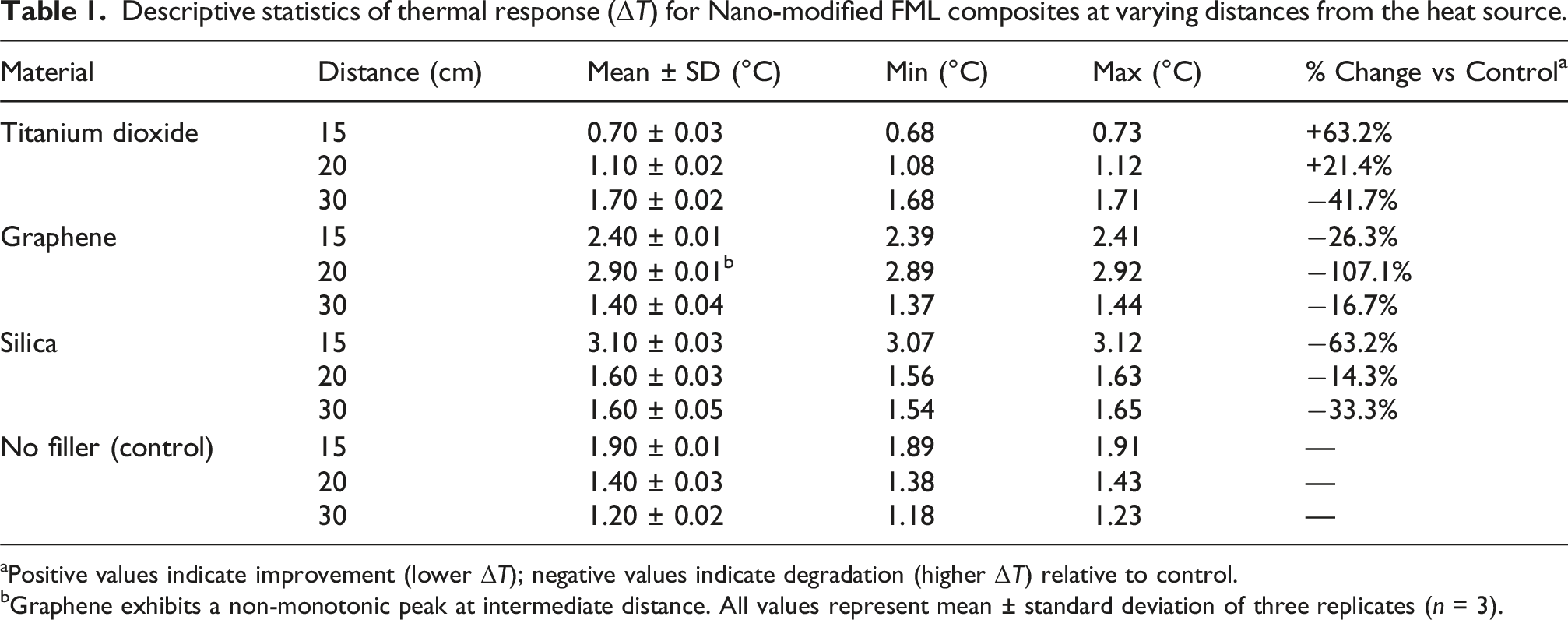
aPositive values indicate improvement (lower ΔT); negative values indicate degradation (higher ΔT) relative to control.
bGraphene exhibits a non-monotonic peak at intermediate distance. All values represent mean ± standard deviation of three replicates (n = 3).
At the closest distance, the TiO2-modified FMLs recorded the minimum ΔT value among all tested materials. This corresponded to the largest performance improvement compared to the unfilled control. Silica-modified laminates exhibited the maximum ΔT at this distance, indicating degradation of the thermal barrier. The graphene-modified FMLs occupied an intermediate position.
Distance-dependent trends varied according to the material type. The unfilled control exhibited a monotonic decrease in ΔT with increasing distance, consistent with the reduced incident heat flux. The silica-modified laminates followed a similar monotonic pattern. The TiO2-modified FMLs exhibited an opposing trend, with ΔT increasing progressively across the distance range.
Figure 3 provides a comparative visualisation of ΔT at each test distance through three separate bar charts. TiO2 exhibits the lowest ΔT values in close proximity, confirming superior thermal barrier performance, while silica shows the highest thermal response at 15 cm, indicating thermal barrier degradation. At far-field distances (30 cm), performance rankings converge, with all materials recording ΔT values between 1.20 and 1.70°C. As highlighted by the bar charts, material performance rankings shift significantly as distance increases. Comparative bar charts of temperature increase (ΔT) at three heat source distances. Error bars represent the standard deviation (n = 3).
The percentage reduction values in Table 1 quantify the performance relative to the control at each distance. Positive percentages indicate an improvement in the thermal barrier, whereas negative percentages indicate degradation. The magnitude of these percentages varied substantially across materials and distances, ranging from substantial improvement to severe degradation. These percentage reductions are interpreted as transient thermal shielding effectiveness metrics under the specific moderate-temperature convective conditions of this study (ΔT <3°C, 10 s exposure). They quantify the relative capacity of each nanofiller to attenuate temperature rise on the protected surface compared to an unfilled reference. These metrics are specific to the tested boundary condition range and should not be extrapolated to steady-state or high-temperature regimes without further experimental validation. Mechanical performance verification under representative service conditions would also be required before application in structural automotive or aerospace thermal barriers.
Non-monotonic Distance-dependent Behavior of Graphene
Table 1 reveals that the graphene-modified FMLs exhibited markedly different distance-dependent behavior compared to the other materials. In contrast to the monotonic trends observed for TiO2, silica, and the control, graphene displayed a non-monotonic pattern. The temperature increase rose from the near-field to the intermediate distance before decreasing substantially at the far-field position.
This behavior deviates from conventional heat transfer expectations. Radiative heat sources typically produce a monotonic decrease in temperature with increasing distance owing to inverse-square intensity reduction. The graphene anomaly was reproducible, as evidenced by the minimal standard deviation values.
Figure 4 illustrates the distance-dependent thermal response for all materials through continuous line plots. The graphene anomaly is distinguishable from the monotonic trends exhibited by the other materials. A peak occurs at an intermediate distance, followed by a sharp decrease at the far-field position. An annotation highlights this non-monotonic behavior in the plot. Distance-dependent thermal response for all the materials.
Figure 5 presents a thermal performance heatmap displaying the ΔT values across the complete material–distance matrix. Colour gradation enables rapid visual identification of performance patterns. The graphene anomaly at an intermediate distance appears as a distinct thermal signature. The red dashed box on the heatmap emphasises this anomalous data point. Thermal performance heatmap.
Table S1 (Supplementary Material) lists the heating and cooling rate data for all conditions. Both the heating and cooling rates reached maximum values for graphene at an intermediate distance. This synchronous behavior suggests that the anomaly arises from intrinsic thermal transport mechanisms. Figure 6 presents a detailed analysis of the graphene anomaly through four complementary panels. Figure 6(a)) shows an overall material comparison with graphene highlighted. Figure 6(b)) isolates the graphene behavior and annotates the percentage changes between distances. Figure 6(c)) compares the performance at the intermediate distance where the anomaly occurs. Figure 6(d)) shows the heating and cooling rates for graphene across all distances. Detailed analysis of the graphene anomaly under distance-dependent thermal loading: (a) overall material comparison, (b) isolated graphene response across distances, (c) comparative performance at the intermediate distance, and (d) heating and cooling rate variation for graphene-modified laminates. Error bars represent the standard deviation (n = 3).
The magnitude of the non-monotonic effect can be quantified using sequential distance comparisons. From the near-field to the intermediate distance, ΔT increased by 20.8%. From the intermediate to the far-field distance, ΔT decreased by 51.7%. No other material exhibited comparable non-monotonic behavior or changes of similar magnitude.
Statistical analysis of material and distance effects
Two-way ANOVA results for thermal response (ΔT) of Nano-modified FML composites.
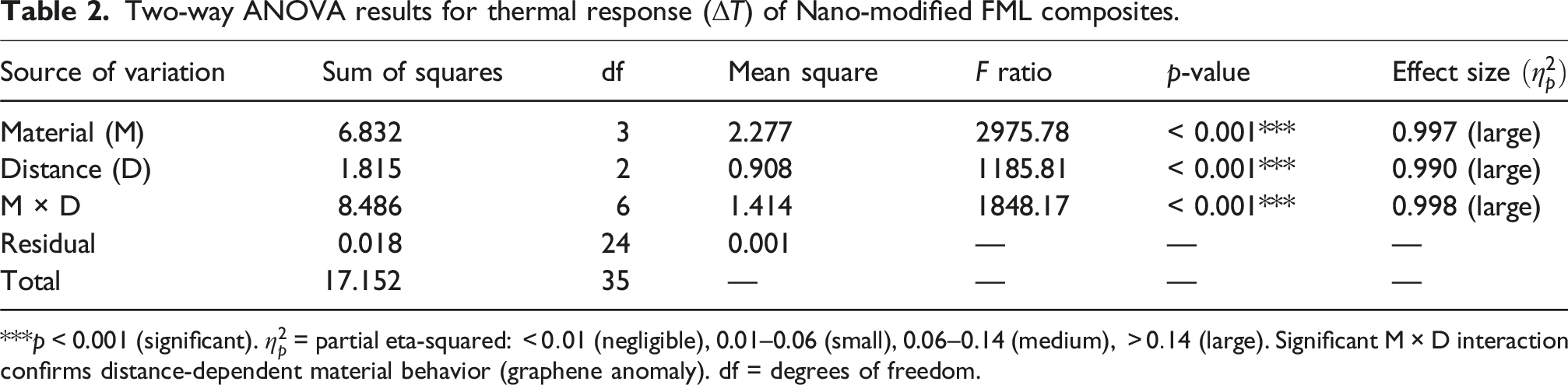
***p < 0.001 (significant).
The material factor exhibited a partial eta-squared
The significant interaction term confirms that material performance is not independent of distance. Different materials respond differently to changes in the proximity of the heat source. This interaction effect provides statistical confirmation of the graphene anomaly and validates the distance-dependent material behavior. The residual variance accounted for less than 0.2% of the total variance.
Post-hoc Tukey HSD pairwise comparisons at each distance.
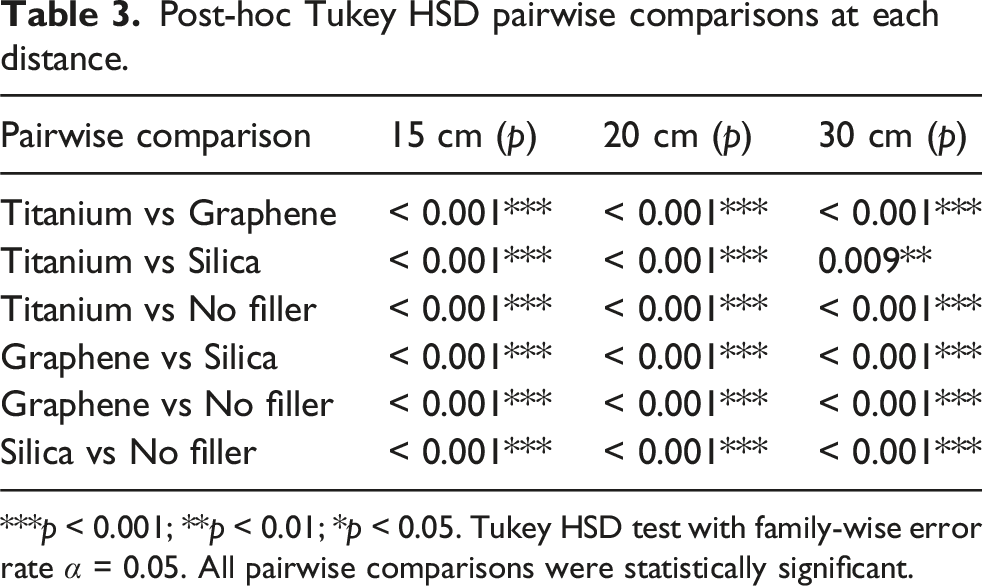
***p < 0.001; **p < 0.01; *p < 0.05. Tukey HSD test with family-wise error rate α = 0.05. All pairwise comparisons were statistically significant.
Material performance rankings varied with distance, as indicated by the pattern of p-values. At proximity, TiO2 significantly outperformed all other materials, including the control. At intermediate distances, graphene occupied the worst-performing position. At far-field distances, the rankings shifted again, with graphene improving relative to the other materials.
Effect sizes (Cohen’s d) for nanofiller materials compared to control.
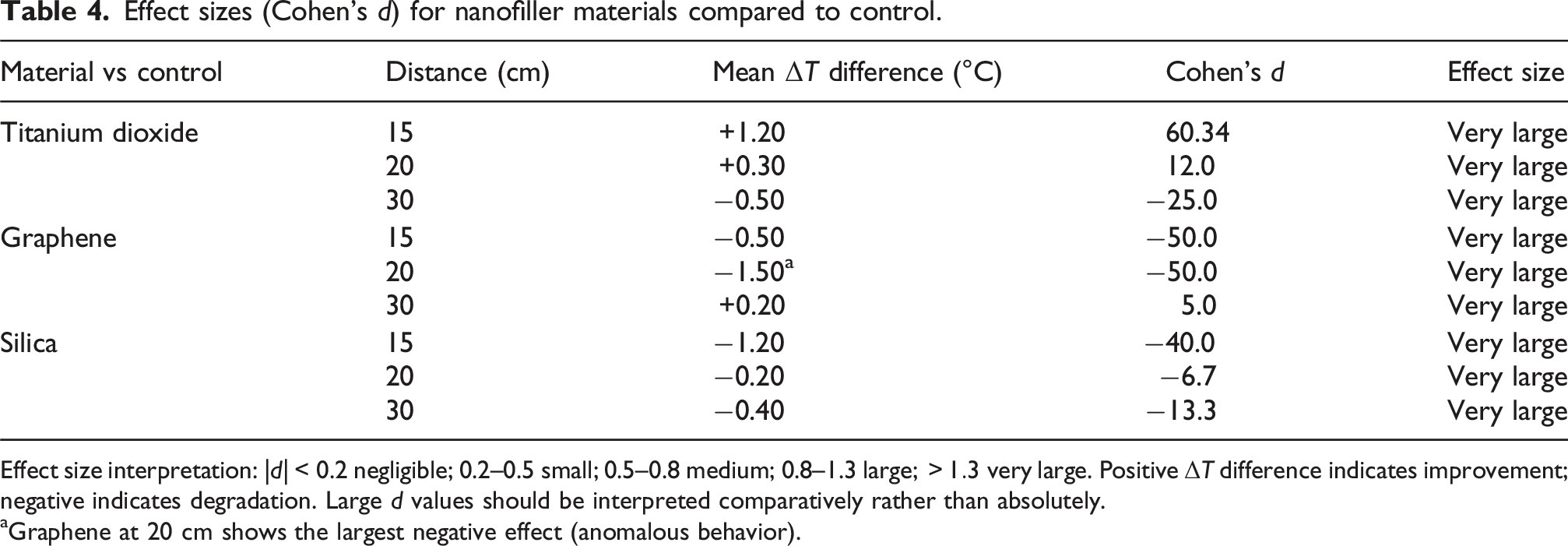
Effect size interpretation: |d| < 0.2 negligible; 0.2–0.5 small; 0.5–0.8 medium; 0.8–1.3 large;
aGraphene at 20 cm shows the largest negative effect (anomalous behavior).
The effect size pattern reinforces the distance-dependent nature of the material performance. The effect sizes of TiO2 decreased in magnitude with increasing distance. The graphene effect sizes followed a non-monotonic pattern, with a peak magnitude at the intermediate distance. Silica consistently maintained large negative effects across all distances.
Linear regression analysis of distance-dependent thermal response.
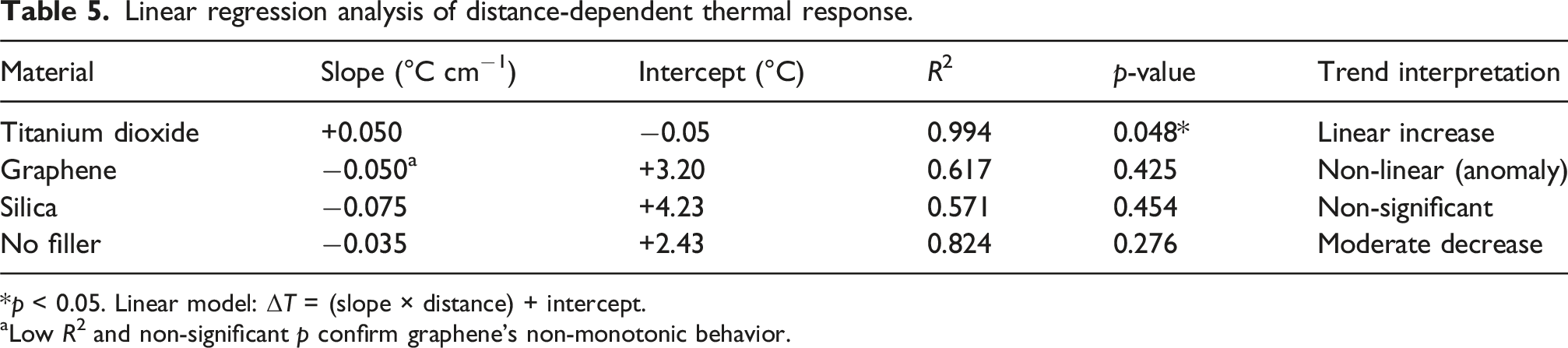
*p < 0.05. Linear model: ΔT = (slope × distance) + intercept.
aLow R2 and non-significant p confirm graphene’s non-monotonic behavior.
Neither silica nor the control achieved significant linear relationships, despite apparently monotonic trends. This suggests that distance effects for these materials may be weak or confounded by other factors. The contrast between the linear behavior of TiO2 and the non-significant fit of graphene statistically distinguishes their fundamentally different distance-dependent responses.
Statistical analyses were also performed for the heating and cooling rate metrics. The results paralleled those of the temperature increase. Material, distance, and interaction effects were all significant (p < 0.001) for both metrics. The graphene anomaly at intermediate distances was confirmed for both heating and cooling rates.
In summary, the experimental results demonstrate that nanofiller type and heat source distance jointly govern transient thermal barrier performance in nano-modified Al–GFRP FMLs. TiO2 provided consistent thermal barrier improvement with a predictable linear distance dependence, while graphene exhibited a statistically confirmed non-monotonic anomaly at intermediate distance. Silica degraded performance across all conditions. The highly significant material–distance interaction
Discussion
The present study provides a systematic characterization of the distance-dependent thermal response in nano-modified fiber metal laminates through rigorous experimental design and statistical analysis. The results showed substantial differences in the thermal barrier performance across the nanofiller types and heat source distances. The observation of non-monotonic distance-dependent behavior in graphene-modified laminates represents a departure from conventional heat transfer expectations. This behavior was statistically validated through significant material–distance interaction effects (F = 1848.17, p < 0.001,
The experimental conditions employed in this study (air temperatures of 35–60°C at the specimen surface) represent a moderate thermal challenge relevant to electronics thermal management, battery cooling systems, and HVAC applications. Under these conditions, heat transfer is dominated by forced convection from the air stream, with minimal radiative contribution owing to the relatively low absolute temperatures (T <100°C). The observed distance-dependent behavior therefore reflects the combined influence of two coupled effects: (i) the distance-dependent boundary condition change, encompassing simultaneous reductions in T ∞ , h, and impingement velocity as standoff distance increases; and (ii) material-specific thermal diffusion characteristics governed by nanofiller type, morphology, and dispersion state. These two effects cannot be decoupled within the present experimental design, and the reported ΔT values represent the net material response to the combined boundary condition at each distance. This framing is consistent with the practical reality of thermal barrier applications, where heat source proximity and thermal input co-vary simultaneously. It should be noted that all mechanistic interpretations in this study are specific to short-duration transient heating (10 s) under moderate-temperature forced convection (ΔT <3°C), and should not be extrapolated to long-term steady-state or high-temperature exposure conditions without further experimental validation.
TiO2-modified laminates exhibited low temperature increase values, at proximity, where a 63% reduction relative to the unfilled control was achieved. This performance is consistent with enhanced phonon scattering at nanoparticle–matrix interfaces, a mechanism reported for TiO2-filled epoxy systems in the literature.
42
The zero-dimensional morphology of TiO2 is expected to generate high interfacial area per unit volume, which may increase phonon scattering frequency and reduce through-thickness thermal conductivity.
43
Direct verification of this mechanism through microstructural characterization was beyond the scope of the present study. Unlike anisotropic fillers such as graphene, spherical TiO2 particles exhibit isotropic thermal properties regardless of their orientation.
44
The exceptional thermal stability of TiO2 (melting point
The forced convection conditions in this study (air velocities
The non-monotonic thermal response of the graphene-modified laminates was the most significant finding of this study. The temperature rise peak at an intermediate distance (20 cm) deviated from expectations based on convective boundary layer decay. 6 In the absence of microstructural characterization, the following mechanistic interpretations are necessarily hypothetical and are offered as plausible explanations consistent with the literature, pending future verification by scanning electron microscopy with energy-dispersive spectroscopy (SEM–EDS), transmission electron microscopy (TEM), or Raman spectroscopy.
Several mechanisms may plausibly explain this phenomenon. First, distance-dependent modulation of graphene agglomeration effects may occur. Graphene tends to agglomerate above 0.1–0.5 wt% owing to van der Waals interactions.34,46,47 At high heat flux (15 cm), rapid heating may partially activate in-plane conductivity pathways before agglomerate-induced through-thickness impedance dominates. At intermediate flux (20 cm), moderate heating may allow preferential heat accumulation at agglomeration zones, which could act as localized thermal bottlenecks. At low flux (30 cm), reduced thermal gradients may diminish the relative influence of agglomeration. Second, thermal percolation effects may have contributed. The two-dimensional morphology of graphene is known to create anisotropic percolation networks 48 ; at intermediate flux, the thermal gradient may place the composite in a partially activated percolation state, where in-plane conduction is engaged without effective through-thickness transport. Third, flux-dependent modulation of interfacial thermal resistance (ITR) is a plausible contributing factor, as graphene–polymer interfaces are reported to exhibit high ITR owing to weak interfacial bonding and phonon frequency mismatch. 49 The synchronised peaks in heating and cooling rates at 20 cm are consistent with an intrinsic material response rather than a surface artifact, but do not constitute mechanistic proof in the absence of microstructural evidence. The non-monotonic behavior suggests that GNP-modified FMLs may be unsuitable for applications involving variable standoff distances unless dispersion quality is rigorously controlled.
Silica-modified laminates consistently exhibited higher temperature increases than unfilled controls across all distances. This degradation may result from thermal bridging pathways, altered epoxy cure characteristics, or poor interfacial bonding, creating thermal discontinuities. 50 Surface functionalization of silica nanoparticles may improve performance but requires validation. The results obtained using untreated silica establish a baseline for comparison with surface-modified variants in future studies.
The experimental design included replication, effect sizes, and formal hypothesis testing, which are not always reported in prior FML thermal studies. The low residual variance (
Among the tested fillers, TiO2 showed the most consistent performance across distances. The combination of large performance improvements at close proximity, predictable linear distance dependence, and better reproducibility positions TiO2 as the preferred filler material. Graphene presents design risks unless dispersion quality and operating distances are tightly controlled. Untreated silica nanoparticles are not recommended for thermal barrier enhancement.
The present study has several limitations that should be acknowledged. Testing was conducted at a single heat flux level and ambient temperature, whereas electronics thermal management, battery cooling, and moderate-temperature automotive applications experience power variations and temperature extremes from −40°C to +150°C. Testing employed short-duration transient heating (10 s), which represents rapid thermal transients but not prolonged steady-state exposure. The incident heat flux at the specimen surface was not directly measured; the reported air temperatures (60, 45, and 35°C at 15, 20, and 30 cm respectively) served as proxies for the boundary condition at each distance. Direct flux measurement using a heat flux sensor in future studies would enable more precise characterization of the distance-dependent thermal input and facilitate numerical modeling of the heat transfer process. A key limitation is the absence of direct microstructural characterization. Nanofiller dispersion quality was not directly verified using microscopy. Mechanistic explanations for graphene therefore remain speculative without supporting evidence from SEM–EDS and TEM. Nanofiller content was fixed at 2.5 wt% across all materials to enable morphology-controlled comparison; loading optimization per filler type is recommended for future studies. Specimens were tested at laboratory scale (30 mm × 30 mm), whereas industrial panels may span meters and exhibit different spatial gradients in nanofiller distribution. A uniform emissivity of ɛ = 0.12 was applied to all specimens based on AA6061-T6 literature values. Although identical surface preparation was maintained across all specimens and measurements were confined to the back aluminium surface, potential emissivity variation due to localized epoxy leakage, oxidation, or thermal cycling effects cannot be fully excluded. Future studies should employ contact thermometry or emissivity calibration targets to independently verify surface emissivity for each specimen condition.
Future studies should prioritize microstructural characterization using SEM–EDS and TEM to elucidate the mechanisms underlying the graphene anomaly. Multi-flux testing across power levels and temperature ranges would validate performance under broader operating conditions. Nanofiller content optimization should identify the optimal loading for each material type. Numerical modeling incorporating experimentally informed microstructures would enable predictive design of nano-modified fiber metal laminates for thermal management applications.
Conclusions
This study investigated the distance-dependent transient thermal response of nano-modified Al–GFRP fiber metal laminates under controlled convective heating. The following conclusions are drawn from the experimental results under the tested conditions: (1) (2) (3) (4) (5)
Collectively, these findings demonstrate that nanofiller morphology and heat source standoff distance act as coupled variables in FML thermal barrier performance under the moderate-temperature convective conditions investigated, with practical relevance to thermal management in automotive battery enclosures, electronics cooling panels, and HVAC shields where heat source proximity varies in service. Broader validation across service temperatures, filler loading levels, and structural configurations is needed before these findings can be generalized to real-world deployment.
Supplemental material
Supplemental material - Distance-dependent thermal response of Nano-modified Aluminium-GFRP fiber metal laminates: A comparative experimental study
Supplemental material for Distance-dependent thermal response of Nano-modified Aluminium-GFRP fiber metal laminates: A comparative experimental study by Pathmanaban Pugazhendi, Vinoth Viswanathan, Narayanamoorthy Kandasamy, Mohamed Suhail Haja and Santhosh Velmurugan in Journal of Composite Materials.
Footnotes
Acknowledgments
The authors acknowledge Easwari Engineering College for providing the laboratory facilities and equipment required to carry out this research.

CRediT authorship contribution statement
Funding
The authors received no financial support for the research, authorship, and/or publication of this article.
Declaration of conflicting interests
The authors declare that there are no potential conflicts of interest with respect to the research, authorship, and/or publication of this article.
Data Availability Statement
Data will be made available by the corresponding author upon reasonable request.
Use of generative AI
Supplemental material
Supplemental material for this article is available online.
References
Supplementary Material
Please find the following supplemental material available below.
For Open Access articles published under a Creative Commons License, all supplemental material carries the same license as the article it is associated with.
For non-Open Access articles published, all supplemental material carries a non-exclusive license, and permission requests for re-use of supplemental material or any part of supplemental material shall be sent directly to the copyright owner as specified in the copyright notice associated with the article.
