






Abstract
This study aims to examine the influence of geometric and mechanical properties on the bending behavior of supported FG sandwich beams, utilizing a refined shear deformation theory. The material properties are assumed to vary gradually and continuously according to a power-law distribution based on the volume fractions of the constituent materials. By applying the developed analytical model and the Navier solution technique, numerical results for non-dimensional stresses and displacements are computed and compared with those derived from other 2D theories. Furthermore, the proposed analytical model is well-suited for analyzing the static deflection of supported FG sandwich beams subjected to high mechanical loads, making it directly applicable to advanced engineering fields such as aerospace, automotive, and civil engineering, thereby enhancing the practicality of the research.
Introduction
Functionally graded materials emerged in the 1980s. 1 This is attributable to Japanese academics who introduced it, as it has been extensively utilized across various domains, including engineering and industry.2,3 Numerous articles and publications, including the laws of exponential, power, and sinusoidal functions, have been employed to examine the mechanical properties of FG constructions. Further details regarding the plant and its structural applications are available for review.4,6 Recently, FG methods have been utilized to fabricate multi-layer structures, particularly sandwich structures.7,8
Researchers have conducted numerous studies to investigate the dynamic and static behaviors of isotropic and sandwich FG structures, including beams, plates, and shells.9–11 Functionally graded materials represent a category of composite materials characterized by a seamless variation in properties across surfaces. This continuous gradient effectively mitigates stress concentrations at the interfaces typically observed in composite materials.12,13 Typically, these items were constructed from metal and ceramic materials. Ceramics exhibit a high level of resistance to extreme temperatures in thermal settings. The metal exhibits various properties, such as its ability to reduce tensile stress on the ceramic surface during the cooling process. 14 Consequently, numerous theories have been formulated to replicate its behavior through mathematical equations, including classical theory,14,15 first-order shear deformation beam theory, and high-order shear deformation theory. 16
These mechanical structures are combined into one complex system in order to meet the high requirements for analyzing the mechanical responses of physical and smart structures.17,18 The use of composite materials in the form of beams and panels has increased significantly, especially in the automotive industry, construction, and aviation fields. 19 FGM processes differ from composite materials, meaning that the volume fraction of the inclusion is uniform throughout the compound, which gives it good properties of composite materials. 20
The theories mentioned can be used together with the numerical solution and the analytical solution to achieve the behaviors of sandwich structures. These analytical solutions can achieve accurate results, but analyzing complex structures with arbitrary boundary conditions is difficult. 21
These theories facilitated the understanding of the influence of porosity and its distribution shape on the normal and shear interfacial stresses in functionally graded materials (FGM) reinforced with a fiber-reinforced polymer (FRP) under a uniformly distributed load. 22 The original approximately excess stress and normal displacement theory for flexing analysis is utilized to assess the impact of thickness expansion in functionally graded sandwich panels. 23 A high-order shear displacement theory is proposed to evaluate a supported functionally graded plate with pores lying on an elastic foundation. 24 Additionally, offering an enhanced theoretical approach to evaluate the surface stress of a concrete beam with an F-G plate and analyzing the buckling characteristics of carbon/glass hybrid composite panels. 25
The application of high-order shear theory to composite beams reinforced with functionally graded carbon nanotubes, which rest on an elastic foundation, can analyze the buckling and stretching effect of these composites.26,27 Using refined shear theory, the vibration behavior of asymmetric armored composite panels can be studied. 28 Regarding the dynamic behavior of functionally graded beams, a new theory of first-order deformation has been developed.29–31
The properties of the materials that compose the FG beam are anticipated to fluctuate in accordance with the volume fraction assigned to the components, following a power law. The formulas for equations of motion and boundary conditions are formulated based on the principle of virtual work. Analytical approaches are derived for the bending of supported beams. Computing instances are provided to demonstrate the validity and precision of current hyperbolic shear deformation theories, or a higher-order model can be employed to assess the significance and correctness of these mathematical frameworks. This theory has three variables, with the displacement along the axis (z) partitioned into two components: one attributable to bending (w) and the other to shear.
Kinematics and constitutive equations
Based on the assumptions given in the previous section, the displacement field can be obtained using the equation

A shape function f(z) is introduced to represent the shear deformation over the thickness of the beam. This is the particular shape function f(z).

Deformation fields
The field of deformations is deduced from the field of displacements of the equation:


The strain components are related to the displacements are given by:


Constraint field
The linear constitutive relations of an FG beam can be expressed as:


E, ϑ the Young’s modulus and Poisson’s ratio, respectively.
The equations of motion
The principle of virtual work is used here to derive the equations of motion. The principle can be stated in the analysis forms:

The variation of the deformation energy U of the beam can be expressed as:

The variation of the potential energy caused by the applied transverse load q on the FG beam can be described as:

Equation (11) can be used to define the equilibrium equations of the FG beam by substituting the formulas of δU and δW from equations (9) and (10), and then integrating throughout the beam’s thickness:

Determination of terms


Assembly of terms

Solutions based on analysis
For bending issues, the aforementioned equations of motion are resolved analytically. The analytical solutions for a simply supported beam are determined using Navier’s solution. The form
8
is considered to be the solution.

α = mπ/L
The transverse load q is also extended in the Fourier series as:

q
n:
is the load amplitude calculated from:

By substituting the extensions of u, w
b
, w
s
and q from equations (15) and (16) into the equations of the equation of motion (13), the analytical solutions can be obtained from the following equations:

The rectangular FGM beam has three layers (two faces sheet and a core: Metal on aluminum and ceramic on alumina for FGM). Let us assume an FGM sandwich beam of rectangular section b × h and length L, as shown in Figure 1. Geometry and coordinates of the FGM beam.
Beam geometry
Sandwich structures
Only in the z-axis can the material properties of the FG beam, including the Young’s modulus (E) and mass density (q), show smooth fluctuations. The rule of mixture provides a precise description of these differences.

Here is the mathematical expression of the rule of mixture, which takes into account the properties of the metal (Pm) and the ceramic (Pc), as well as their volume fractions (Vc and Vm):

To determine the volume fraction Vc, the profile is assumed to follow various simple power laws

In the following analysis, several numerical examples are examined to validate the present study and investigate the flexural behaviour of functionally graded (FG) sandwich beams. The material composition of the FGM beam consists of alumina (Al2O3) and aluminium (Al), with the material properties as follows: • Alumina (Al2O3): Young’s modulus E
c
= 380 GPa, density ρ
c
= 3960 kg/m
3
, Poisson’s ratio ν = 0.3. • Aluminum (Al): Young’s modulus E
m
= 70 GPa, density ρ
m
= 2702 kg/m
3
, Poisson’s ratio ν = 0.3.
The beam is assumed to follow the power law, and the dimensionless parameter is defined as follows
32
:


Results and discussion
Solutions based on analysis comparative studies
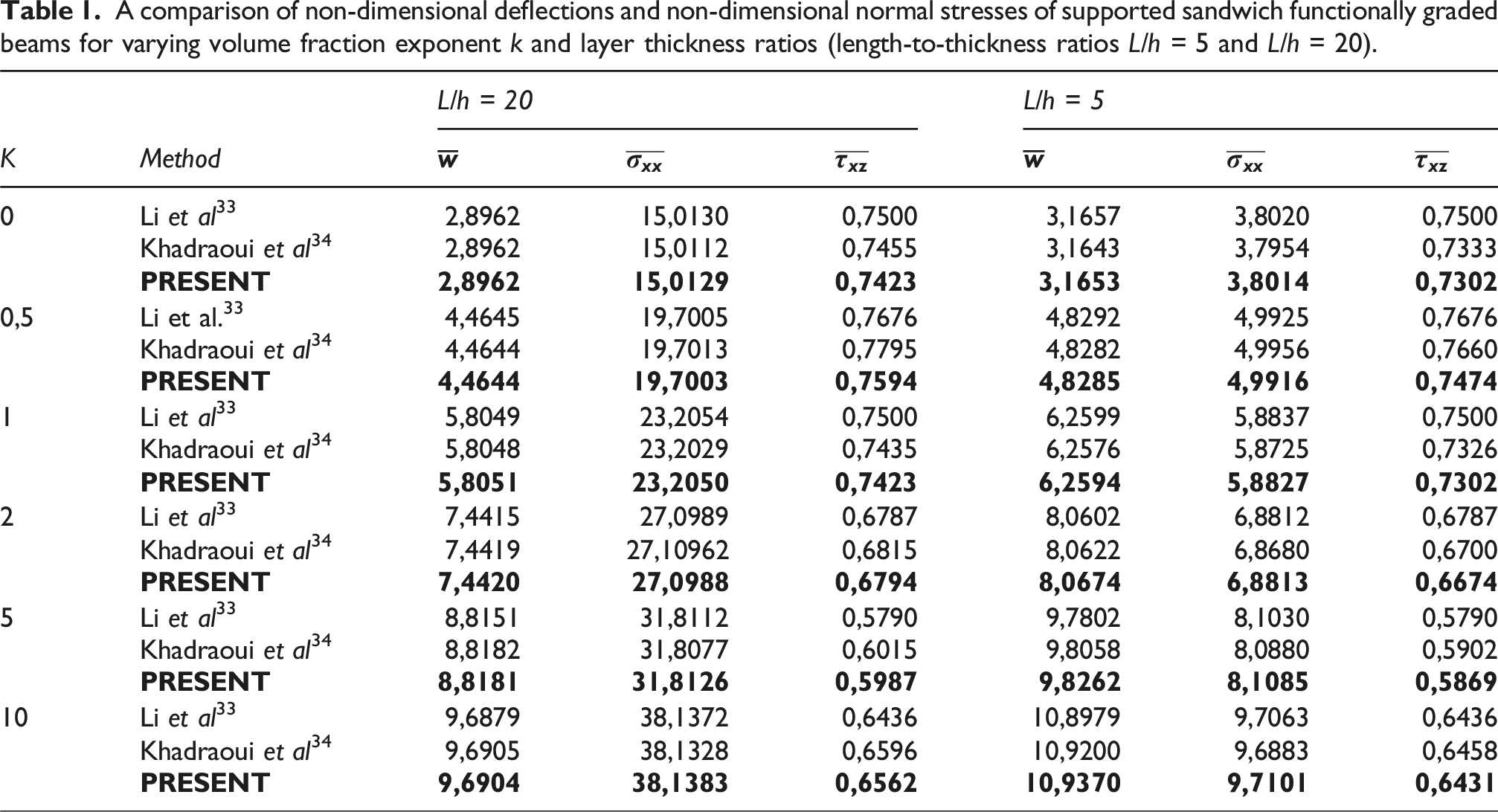
A comparison of non-dimensional deflections and non-dimensional normal stresses of supported sandwich functionally graded beams for varying volume fraction exponent k and layer thickness ratios (length-to-thickness ratios L/h = 5 and L/h = 20).
Parametric study
The impact of the FGM sandwich’s dimensionless thickness on the beam’s transverse deflections for different material index k values, variations in the a/h ratio, and the sandwich’s different structures collectively and simultaneously can be presented and discussed using the graphs. The impact of the FGM sandwich on the transverse deflections of the beam is covered in this section. 35
Both the impact of the material k index on sandwich structures and the impact of various layers on the material k index are illustrated in Figures 2 and 3, respectively. Figure 2 shows that the significance layers S1 and S2 cause a rise in the deflection of the sandwich construction beams [2-1-2] and [1-0-1]. The deflection is lower for structure [1-8-1]. So, the mineral phase’s volume percentage lowers the beams’ rigidity.
35
Variation of the non-dimensionless ratio (x/a) and its effect on the deflection of the FG beam depending on different types of sandwiches. Variation of the non-dimensionless ratio (x/a) and its effect on the deflection of the FG sandwich beam depending on different values of the material index k.

Maximum vertical displacement of and stress FG sandwich beams for different volume fraction exponent (k) and layer thickness ratios (length-to-thickness ratios L/h = 5 and L/h = 20).
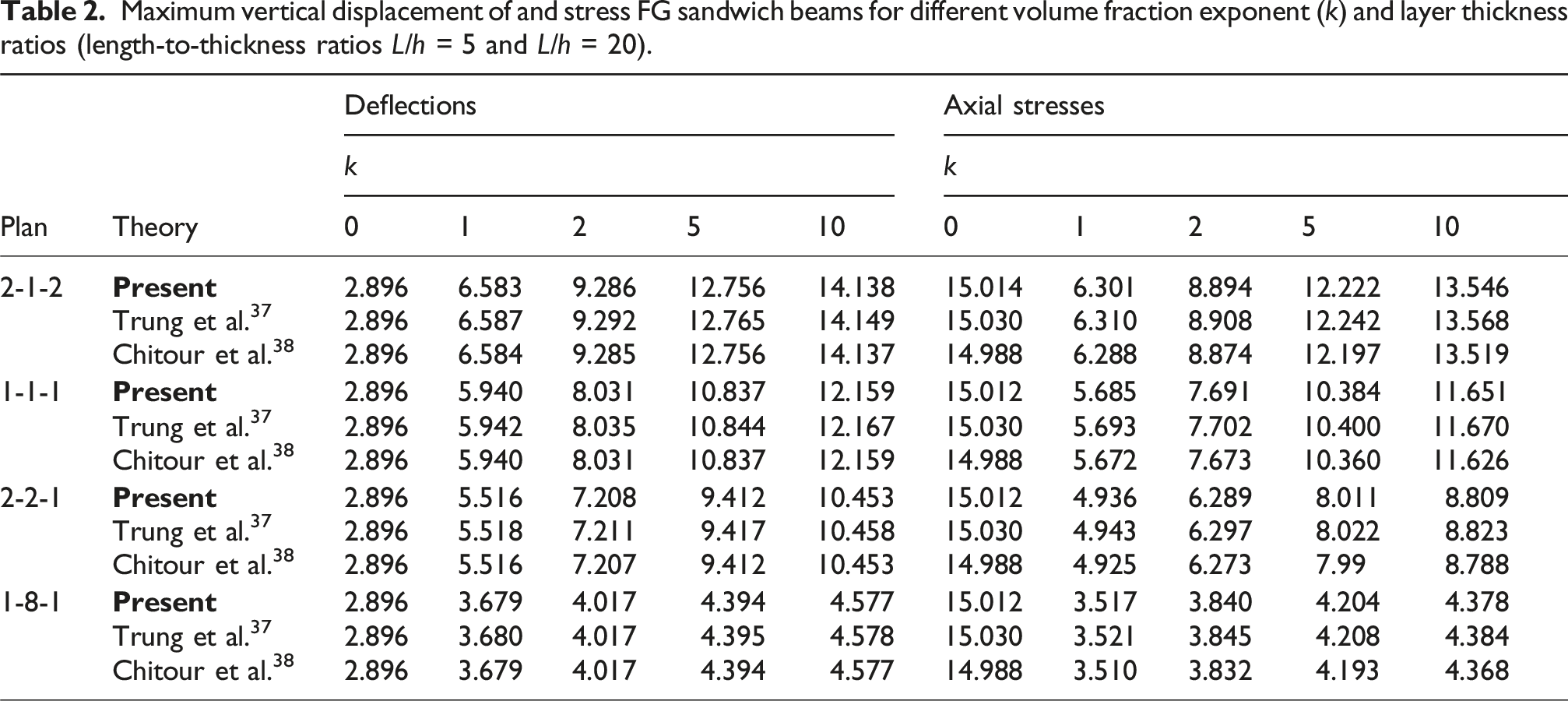
Figure 4 illustrates the influence of the material index k on beam deflection.1–8 This effect is predominantly observed on the surfaces in relation to the core of the beam. A minor deflection is observed in the ceramic volumetric component. An increase in the material index k correlates with an increase in deflection. Furthermore, the deflection observed in metal-rich FG beams exceeds that of ceramic-rich FG beams. The observed discrepancy is due to the higher Young’s modulus of ceramics, which is 380 GPa, in contrast to the 70 GPa of metals.
39
Figure 5 illustrates the variation in axial stress. It shows the influence of material index k10 and sandwich beam thicknesses [1-1-1] and [1-0-1]. The stress-strain curve exhibits symmetry, which could be attributed to the ductility of metals in response to bending, in contrast to the behavior of ceramics under stress. Additionally, the beams were subjected to both tensile and compressive mechanical stresses. It can be concluded that the stresses σxx and k values evolve in parallel.
39
Variation of the dimensionless ratio (a/h) and its effect on the deflection of the sandwich beam FG depending on different values of the material index k. Variation of stresses and its effect on the thickness z of the FG sandwich beam depending on different types of sandwiches.

Conclusion
Using a range of sandwich FG beams, this study aims to demonstrate the bending of supported FGM beams. The approach presented here is currently based on the shear deformation theory of two-dimensional beams. The effects of the beam length-to-thickness ratio and the volumetric fracture index were investigated. According to the results, changes in the volumetric fracture index have a major impact on the bending behavior and produce unique performance traits in various configurations. Furthermore, the findings show that improving the beam’s length-to-thickness ratio can improve its resilience and structural integrity under load.
The impact of stresses, displacements, and deflections on sandwich beams has been found to be significantly influenced by the type of sandwich structure. Finally, a summary of the results is as follows: ⁃ As the volume fraction index k increases, the FG beams’ stiffness reduces, increasing the amount of reflections. This is because they are more flexible than ceramics because of the higher index k values, which also indicate a higher amount of metal. ⁃ Shorter beams are more likely to bend under load, as indicated by the increasing arrow deviations as the beams’ length decreases. The findings also emphasize how crucial it is to optimize the material composition in order to minimize deflections and get the required mechanical properties in real-world applications. L in relation to the h’s thickness. This link implies that improving performance requires careful consideration of both structural dimensions and material type. In order to further increase flexibility and strength, future research may concentrate on creating hybrid materials that combine the beneficial qualities of metals and ceramics. The thickness of the ceramic layer has a significant impact on the arrow value. It is at [1-8-1] at its lowest value.
The results obtained are in good agreement with the published results and with Osofero AI et al., Thanh TT et al., and Li et al.
Footnotes

Funding
The authors received no financial support for the research, authorship, and/or publication of this article.
Declaration of conflicting interests
The authors declared no potential conflicts of interest with respect to the research, authorship, and/or publication of this article.
Data Availability Statement
Data sharing not applicable to this article as no datasets were generated or analyzed during the current study.