







Abstract
Why do political organizations split? Drawing insight from organizational theory and social movement literature, this article explores the effect of organizational factors on group schism. Using a new data set of 112 ethnopolitical organizations in the Middle East, the article examines to what extent organizational factors such as leadership structure, organizational legality, and tactical intensity, as well as contextual variables such as state violence and external support for the organization, influence group schism. Findings show that organizations with a factional or competing leadership structure and those that use violence as a tactic are at a greater risk to split. Contrary to research on political parties, which highlight the importance of factional leadership structure in relation to the maintenance and growth of the party organization, findings suggest that competing leadership structure, along with the employment of tactical violence, precipitates ethnopolitical organizational fission and eventual splintering.
Splinter groups that have broken off from existing organizations are identified as likely users of political violence and are more willing to use violent tactics than mainstream organizations (Della Porta 2006; Darby 2001; Brubaker and Laitin 1998; Tarrow 1998; Hogan and Walker 1989). These groups, also termed “spoiler groups,” are often perceived as key creators of terrorist violence and pose threats to the success of peace processes (Dugan and Gibbs 2008; Cronin 2006; MacGinty 2001; Stedman 1997). Thus, understanding why organizations split, particularly in an age with unprecedented concern about terrorism, and determining the correlates and causes of organizational splits is paramount. Additionally, since organizational split can take on a variety of forms, it is inadequate to make inferences about the causes of schism based on a few case studies, which raises a pressing need to conduct a large-N study to systematically tackle this important research question.
Although understanding splits in political organizations has important policy and national security implications, there is surprisingly little research on why organizations split (with the exception of research on religion and schisms and social movement organization schism; see Balser 1997). Moreover, there is a stark paucity of studies that employ a quantitative approach to exploring this issue. To address these research lacunae, this article as well as other articles in this volume applies a quantitative approach to investigating the question of organizational schism, which helps strengthen this stream of underappreciated literature and shed much needed light on larger trends in the phenomenon.
One factor that has not been adequately examined in the extant studies is the decision-making structure of political organizations. Of particular interest is the phenomenon of enduring factionalized leadership within some social movement organizations and political parties, which contributes positively to the viability of the original organization instead of driving the group into its demise (Park 2001). Factionalism was, in some cases, deliberately encouraged by the initiating organization to serve four purposes (Gerlach 1999): to target and attract different segments of the population, to provide participants with greater programmatic mobility, to offer flexibility for reorganization and interfactional coordination, and to accommodate the adoption of radical organizational tactics by factions without compromising the tactical doctrine of the original organization. Thus, the existence of factions acted to popularize, strengthen, and stimulate the growth of social movements. Similarly, studies of political party factions in the Cuban Communist Party and the Japanese Liberal Democratic Party (LDP) show that the existence and flourishing of party factions serve important purposes without undermining the coherence and power of the party organization as a whole. Rather, their presence could promote healthy, low-intensity internal competitions that serve to effectively evaluate leadership performance and policy, and externally expand the party’s support base (Dominguez 1989; Park 2001). Therefore, having factional leadership and tolerating the coexistence of factions may not necessarily push the organization to the brink of schism or discontinuity.
This study focuses on ethnopolitical organizations. For these groups, the emergence, development, and actualization of their collective goals necessitate group cohesion among members who are bonded by a shared ethnic identity and ideological consensus. They are often assumed to enjoy intense member loyalty and group solidarity. Splintering and schism in these organizations thus pose a particularly interesting research question. For ethnopolitical organizations, the degree to which leadership is arranged and carried out, even in cohesive organizations, can influence the propensity for these organizations to break apart under stress. Specifically, organizations with a factionalized leadership structure are much more likely to split than organizations with a hierarchical and centralized leadership structure. Organizations with factional or competing leadership act to precipitate the organization into fission and schism because they allow for a plurality of potentially competing opinions, objectives, and priorities, and thus are more likely to break apart under external stressors.
Using a new database of ethnopolitical organizations in the Middle East, 1 this article examines why an ethnopolitical organization claiming to represent a minority at risk might split in any given organizational year. A defining feature of this approach is a focus not only on organizations that use violence, or on organizations that have been subjected to state-sanctioned violence. Instead, a broad spectrum of ethnopolitical organizations is examined, which include those organizations that have resorted to violence in their tactics in dealing with the state, those that have been targets of state-sanctioned violence, and organizations that neither use violence nor have been subjected to violence imposed by the state. The inclusiveness of ethnopolitical organizations in the sample affords an opportunity to not only examine the impact of state violence and organizational tactics on the propensity of group schism but also bring the generalizable organizational characteristics such as leadership and decision-making structure to bear an understanding how these organizational features precipitate or deter schism. Thus, this research benefits from and seeks to contribute to the research at the intersection of organizational theory and behavior literature and the research on social movement organizations (SMOs) and contentious politics.
This project contributes to the current research on ethnopolitical organizations, political violence, and organizational theory in the following ways. First, much research concerning ethnopolitical groups emphasized the relationship between organizational splits and violence and sheds little light on the relationship between schism and organizational characteristics. To fill that research void, the influence of salient organizational features is taken into account, in addition to the influence of violence, on ethnopolitical group schism. This focus is important for two reasons. If group schism is related to organizational features as well as violence, then this analysis helps to enrich the existing theorizing between violence and schism and refine theoretical models about the behaviors of minority at risk groups. It will also help develop targeted policies and programs to better respond to threats emanating from these groups. Further, although issues regarding the outcome, and to a lesser extent the causes, of factionalism and fragmentation has been explicated within the context of terrorism, civil wars, political conflict, and revolutions (see, for example, Woldemariam 2008; Bloom 2004; Zirakzadeh 2002), only limited scholarly attention has focused on schism in organizations within the conceptual framework of voluntary communal associations that may or may not engage in contentious politics. Similarly, scholars of organizational theory and behavior have devoted much research energy to examining phenomena such as organizational change (Barnett and Carroll 1995), organization failure (Thornhill and Amit 2003), organization conflict (Kolb and Putnum 1992; Pondy 1969), organizational decline (D’Aveni 1989), organizational death (Freeman et al.1977; Stinchcombe 1965), and organizational dissolution (Pennings, Lee, and Witteloostuijn 1998). Only limited attempts have been undertaken to theorize about and examine organizational schism (for exceptions see Morgan [1981] and Firey [1948]). One of the innovations of this approach is the engagement of a different literature with which conflict scholars do not always engage, but from which new insights and fresh analogies can be fruitfully drawn (McCarthy 2005). Organizational research may not directly inform some unique aspects of ethnopolitical organizational schism, mainly in terms of explaining the effect of political violence and conflicts on schism, but as organizations, these ethnopolitical groups can be meaningfully examined from a broad organizational theory and behavior perspective, not just as violent actors.
The following sections draw insight from the organizational, social movement and religious denominationalism literature to identify the analytical approaches and empirical evidence regarding organizational schism. Based on these, a number of competing explanations for why organizations split are identified. The data and methods used in the analysis are then discussed. The findings section highlights the importance of leadership structure, as well as the importance of the use of violence for understanding why organizations split. The article concludes with a discussion of the study of factionalism and conflict processes.
Schism among Ethnopolitical Organizations
Although splits occur infrequently among ethnopolitical organizations, the schismatic processes and consequences can vary considerably from organization to organization. For some groups, after the organization’s fragment, the newly emerged entities continue to influence politics for some time to come. This type of split often involves political parties that are engaged in the regular electoral political process and results in the creation of a new political party. For example, one of the two splits in Cyprus was a split in the Turkish Cypriot party, Ulusal Birlik Partisi (UBP), which occurred in July of 1992. Dissident members of the UBP broke from the party to protest ongoing negotiations related to resolving “the Cyprus problem.” The dissidents formed a new party, the Democratic Party, to run against their old party. This breakup led to an almost even split in the vote between the old and new party. Though the parties have not reunited, the UBP took back much of the vote over time (Hatay 2006; Solsten 1993).
There are also occasions when the splinter organization reunites with the original organization. The Palestine Liberation Front (PLF) is a case in point. The PLF split due to a disagreement about the Syrian intervention in Lebanon and internal fighting between a variety of Palestinian organizations located in Lebanon. After the split, the PLF and its new splinter organization continued to exist in opposition to each other. In 1989, the two organizations—both of whose members had kept identifying the separate organizations by the same name—chose to reunite (Mannes 2004).
Finally and most commonly, many splinters often disappear. In 1995, during a period of intense competition between Hamas and Fatah (which controlled the Palestinian Authority), a splinter organization emerged from Hamas called the Islamic National Front. The Islamic National Front accepted the Oslo accords and said that Hamas should stop attacking Israel (Maddy-Weitzman 1999; Muslih 1999). After its split from Hamas, the Islamic National Front appears frequently as an intermediary willing to act as a go-between for Hamas and the Palestinian Authority, as well as for other entities that were trying to arrange peace negotiations between Israel and the Palestinians (BBC Summary of World Broadcasts 1999b). Yet, after 1999 the Islamic National Front disappeared.
The organizations that examined here are formal organizations that claim to represent ethnic groups. It is important to note that these ethnopolitical organizations are exactly that—formal organizations. As such they share common and salient institutional features with other organizations and thus can be used as a useful starting point for examining how and why political organizations split. For instance, they often have a clearly defined organizational structure, institutional rules, reward and punitive systems, decision-making processes, status and power differentials, shared vision and objectives, and the necessary means and strategic plans to reach their objectives. For example, the PLO has a national council, an executive committee, and is considered an official representative of the Palestinian people by the United Nations and the Arab League (Cobban 1984).
Ethnopolitical organizations also enjoy several distinctive characteristics. Ethnopolitical organizations often possess closed communal relationships that are deeply embedded in reciprocal boundary recognition and their membership admission criteria are, for the most part, based on ethnic exclusion. As exclusive groups, ethnopolitical organizations are more susceptible to schism than are inclusive organizations (Zald and Ash 1966) in that exclusive groups often impose a much higher initial and continual commitment requirement for members than do inclusive groups, and thus have a more stringent mandate for internal consistency and cohesion. When intense internal dissension arises, inclusive organizations tend to accommodate the factions, whereas exclusive organizations tend to spew out factions (Zald and Ash 1966, 337). Furthermore, since the viability of ethnopolitical organizations often relies on members’ commitment to ethnic identity preservation and boundary maintenance and, to a lesser degree, their members’ individual rational motivation, these communal groups are more prone to schism than are associative groups because communal groups place paramount value on the preservation of collective identity above all other organizational objectives (Ansell 2001). Thus, in face of a conflict between the organizational goal and his or her personal goal, a discontented member may find it relatively easy to exit the associative group than does a communal group. In sum, for ethnopolitical groups held together mainly on the basis of collective identity and the sense of “togetherness,” we should expect them to retain their coherence and unity better than other types of organizations.
As mentioned earlier, the current literature on organizational schism was largely developed within the studies of social movement organizations and religious sects and denominationalism (Stark and Bainbridge 1985; Niebuhr 1929). These studies help generate useful insight and hypotheses regarding schism in ethnopolitical organizations. The idea of schism is applied to the formation of a new group resulting from successful and official breakaway from a preexisting group. This definition is generally congruent with the definitions used in social movement organization studies (see, e.g., Balser [1997] and Gamson [1975]).
In an attempt to draw appropriate theoretical parallels from social movement organizational research and apply them to ethnopolitical organizations, the nuances between these two categories of organizations and their differing purposes and activities is recognized. While some ethnopolitical organizations may indeed engage in social movement-related activities such as protests to directly challenge the distribution of power and resources, others may simply be an institutionalized form of communal associations involved in politics-as-usual, operating within the civic sector and serving the needs of their respective ethnic communities without substantial involvement in contentious politics or violence. The Turkish Republican Party, for example, claims to represent the Turkish Cypriots on Cyprus and has primarily done so by engaging in regular politics and sometimes by providing social services but not by using protest or violence (Minorities at Risk Project 2008). Doing so allows an examination of a universe of cases where the contentious nature of the groups is not selected upon and enhances the ability to understand what impact contention (be it violence or other types of contention) has on the process of schism. Useful new insights might emerge by allowing for a comprehensive assessment of some common factors that actually cause organizational splits in a diverse range of organizations.
Internal Organization Factors and Schism
Organizational studies suggest that leadership structure, divergent organizational goals, and political or ideological cleavage could affect internal strife and organizational disunity (Gates 2002; Gamson 1975). Leadership structure of the organization is arguably the most prominent internal feature and has important implications for the organization’s success or failure. In management studies, a dual leadership structure (CEO also serving as board chair) and an independent structure (separate CEO and board chair) can lead to different organizational outcomes. While the existence of an independent leadership structure are said to be related to better financial performance and crisis mitigation, the dual structure might enable the leader to lead more effectively with greater autonomy at his or her disposal (Daily 1995; Drechter and Dalton 1991; Lorsch 1989). In religious organizational studies, leadership structure also critically affects the unity of the church. Failure to practice effective leadership and ambiguity over who has power within the church hierarchy are closely linked to church schism (Wilton 1971). In their study of religious denominationalism, Liebman, Sutton, and Wuthnow (1998) also listed authority centralization and formalization as one of the key institutional characteristics in relation to schism, but their results suggest that the centralization of authority did not have significant influence over denominational schism. From a path-dependence perspective, once factionalized leadership develops, the transaction costs of maintaining organizational integrity rise significantly, and thus it becomes more likely, but not inevitable, that splits occur. In social movement research, Balser (1997) reports that one of the structural similarities among the splintered organizations is decentralized decision-making structure and suggests that decentralization of institutional authority may contribute to organizational conflict and schism. Gamson (1975) also argues that centralized organizational authority is more capable of controlling and managing organizational conflict and thus less likely to promote organizational fractionalization and splintering. Within the context of ethnoreligious organizations, however, we argue the most important cause of splits should be organizations that have an Achilles’ heel of sorts, or factionalized leadership, that allows for a break down when the organization is under pressure. By factionalized leadership, we mean that the leadership of the organization is competing against each other for control. Conversely, organizations that have a centralized decision structure are less likely to splinter. This suggests the following hypothesis:
Hypothesis 1: Organizations that have a factionalized leadership structure are more prone to organizational splits.
Another key internal factor is the tactical choices made by the organization to achieve its objectives. To obtain its objective, a group adjusts its tactics in relation to the intensity and scope of external context and pressure. In studies on contentious politics, Lichbach (1987) posits that tactical violence will increase in response to state’s increasing repression of the group’s nonviolent conflict activities. To address growing state repression, a group that previously renounced the use of violence might be forced to rearticulate its tactics. Such strategic change might trigger profound dissonance among group members. Some members may favor violent strategies, while others may prefer peaceful coping tactics such as marches or sit-ins. Internal disagreement over the use of organizational strategies in response to state repression could produce internal strife and pull group members into opposition, which exacerbates organizational schism propensity. Indeed, studies have documented how disruptions can tear movements into two camps: a moderate majority and a militant, violence-prone minority (Tarrow 1998). In the same vein, the use of violence as a measure of the intensity of group tactics is included, suggesting the following hypothesis:
Hypothesis 2: The use of violence by an organization is positively related to organizational schism. The more violent the organizational tactic is, the more likely is the organization going to splinter.
The Impact of Outside Influences on Organizational Schism
As discussed previously, while organizational decision structure might critically impact the likelihood of group split, organizational studies highlight the power of extraorganizational factors that shape organizational behavior (Aldrich 2007; DiMaggio and Anheier 1990; Pfeffer and Salancik 1978; Aldrich and Pfeffer 1976). Thus, it is equally crucial to take into consideration the influence of an organization’s external circumstances, such as the forces from society, culture, political systems, on the likelihood of organizational schism. Since organizations operate in a perpetually uncertain environment and depend on external factors for resources (McCarthy and Zald 1977), the context in which organizations operate can impose constraints by defining their functional success, setting cultural expectations, influencing the internal power distribution, and thus creating organizational friction.
Ethnopolitical organizations, which often enjoy only fragmented social support within polyethnic social systems, tend to be more vulnerable to extraorganizational forces. In her comparative case study of four social movement organizations, Balser contends that “Environmental factors may not directly cause schism but they introduce constraints and contingencies, either creating or exacerbating internal conflict” (Balser 1997, 201). In particular, she argues that the political opportunity structure plays a critical role in shaping organizational schism processes and the availability of political access to a group is a fundamental component of its political opportunity structure. Limiting a group's political access, and hence its political opportunity, could stimulate intraorganizational conflict in social movement organizations, which is conducive to group factionalization and splintering.
In this study, we focus on organizational legality as a measure of access to political opportunities. Edelman and Suchman (1997) argue that legality demarcates organizational boundaries and actionable territories, actively shapes organization’s behavior, and most fundamentally dictates “organizational form and interogranizational relations” (p. 479). For illegal ethnopolitical organizations, which can be violent guerrilla groups or terrorist organizations or nonviolent civic organizations that are denied legal status for political or other reasons, lacking legality means limited actionable boundaries, compromised rights, lack of protection, and prohibition against openly obtaining material and human resources. In addition, illegal organizations are likely to face heightened state scrutiny, which could make organizational development and maintenance increasingly difficult. Thus, organizational legality is a proxy measure of the political access available to ethnopolitical organizations. Although not all legal organizations have political access, such access is often entirely unavailable to illegal organizations. Hence:
Hypothesis 3: Legal organizations are less prone to schism than illegal organizations.
With regard to social control mechanisms, the level of state repression is an important source of external pressure that might lead to group faction formation and schism occurrence (Balser 1997). Here, state repression is defined as “the use or threat of coercion in varying degrees applied by government against opponents or potential opponents to weaken their resistance to the will of the authorities” (Henderson 1991, 121). State repression could lead to conflict over the use of tactics among group members and increase the prospect of splintering. Studies point out that the severity of such conflict is positively related to the silencing of internal dissents, thus creating disagreement over the strategic choices made by the group (Coser 1956). As the external pressure escalates, groups that are not conducive to assuaging internal dissent are more likely to warp under pressure. Sani’s (2005) study of the schismatic intentions within the Church of England over the controversy surrounding the ordination of women priests reveals that those church members who perceived their group as intolerant of disagreement and voicing dissent tend to experience a lower degree of group cohesion and hence more intense schismatic intentions. This suggests external pressure can influence the likelihood of group fission. Using state violence as a measurement of state repression, a critical buoy of ethnopolitical organizations’ external political conflict, the following relationship between state repression and organizational schism should be observed:
Hypothesis 4: The level of state repression is positively related to organizational schism. The more repressive the state is toward the organization, the more likely it is that an organization is going to splinter.
Since organizations depend on their external relationships with other entities for critical resources, the availability of and access to external resources can play an important role in shaping organizational behavior (Pfeffer and Salancik 1978). In the competition for organizational power, when a subunit or a faction within an organization is more successful in obtaining resources and thus strengthens its share of institutional power, its acquisition of power can create tension with other competing units or factions. For ethnopolitical organizations, a wide range of external support is possible (Byman et al. 2001). Byman et al. (2000) suggest that although massive direct support for insurgency by super powers has declined after the Second World War, growing local state sponsorships and alternative forms of support, such as diaspora, refugees, advocacy groups, and other nonstate entities, have been playing an increasingly important role in providing financial, material, and human resources to insurgency groups. Each type of external support provider has advantages and constraints. For instance, although the state is capable of providing a broad array of support on a relatively substantial scale, nonstate support, while more moderate in magnitude, can be more readily mobilized and enjoys greater flexibility. Compared to state support, which is predominantly motivated by geopolitical considerations, nonstate support is often based on shared ethnic identity and political and ideological affinity. Also, statesponsorship often comes with strings attached, whereas support from diaspora communities, refugee, and advocacy groups tends to impose fewer requirements of external control. The additive effects of all these external support are an important aspect of ethnoreligious organizations’ survival, growth, and stability, as these things are impossible without resources.
However, dependence on external support can come with a cost. Pfeffer and Salancik (1978) point out external entities’ ability to control the allocation and usage of an organization’s resources is a form of powerful external control. Thus, modeling external support is important because such support may, in some cases, facilitate schism through least two mechanisms. First, congruent with the resource dependence approach, some units, such as those handling external communications and development within an organization, may gain power through interacting with external support groups, attracting more support from them than other units, such as those focusing solely on technical training. This can lead to intraorganizational competition, shifts in power, and internal conflict. Additionally, from the principal-agent perspective, there might be a misalignment of goals between external support groups and ethnopolitical groups, which could produce tension. Support, for instance, may interfere with the achievement of organizational goals if external groups limit how and for what purposes their contribution should be used, particularly if these pressures are not well aligned with the strategies and goals of the organization (Balser 1997). Zunzer (2004), for instance, suggests that even though diaspora groups can function as a peace builder, they can also potentially undermine the group solidarity. Thus, with regard to the influence of external support:
Hypothesis 5: Greater numbers of external resource providers are positively related to organizational schism.
Data and Methodology
In order to test the various arguments about organizational schisms, the Minorities at Risk Organizational Behavior (MAROB) data set that looks at communal groups that have either an ethnic or ethnoreligious identity is used. This data set has yearly data on 112 ethnopolitical organizations in the Middle East from the year 1980 to the year 2004 (Minorities at Risk Project 2008). The project focused first in the Middle East due to the large variance in the organization of groups, as well as because of the policy and theoretical importance of the area. Though, that given the nature of the area, it is important to be careful about the generalizability of findings beyond the region until further data can be collected. Note that MAR groups need to be at least 1 percent of the population of their host country and they also need to have at least 100,000 members. In addition, the groups’ identity must possess political significance, which is identified if a group’s identity is used to mobilize collective political action or if discrimination or benefits are associated with a group’s ethnic or ethnoreligious identity (Gurr 2000
Instead of treating the political behavior of an ethnic group as a singular political act, the MAROB database includes observations that enable a nuanced analysis of organizational behavior and allows for a finer-grained examination of organizations that actually initiate political activities. For example, it would be problematic to ascribe political violence to the Kurdish people as a whole in Iraq. To do so for the Kurdistan Democratic Party in 2004 is a more accurate approach. Cognizant of selection bias problems that have existed in other MAR projects, the MAROB project codes every organization claiming to represent a MAR group that has survived for at least three years. As mentioned earlier, some factions quickly evaporate upon splitting. This data set might have left out those groups that disappeared within the three-year threshold. However, future studies might use a different coding approach to account for those transient faction groups. Also, in order to capture organizational differences in structure and behavior, branches of the same organization in different countries are coded as separate entities. Thus, transnational organizations such as Hamas are coded as separate groups in each country to capture the divergence in organizational structure, leadership arrangements, and group behavior. Treating them as the same organization will grossly mask their institutional differentiation and distinctive group dynamics.
Following the above hypotheses, this analysis includes six key variables (see Table 1 for summary). Factional Leadership is a dummy variable generated from the variable, LEAD, in the MAROB data set. The LEAD variable has separate categories for (1) factionalized/competing leadership, (2) weak or decentralized leadership, (3) a strong ruling council, and (4) a strong single leaders. The four categories are consolidated encapsulated by LEAD into two categories: factional or competing leadership and otherwise. Factionalized/competing leadership structure most fully captures the leadership issue that is believed to have large impact on organizational split as opposed to strong centralized leadership or a middle ground between the two, both of which are included in LEAD. An example of an organization that suffered from factional leadership in the years 2001-2003 is the Partiya Karkari Kurdistan in Turkey after the arrest of their leader. An example of an organization with a long history of strong central leadership was the Ba'ath party in Iraq. Note that because of the use of organizational leadership structures, in the coding of the dependent variable, organizational split, we have lagged this variable one year. For each given organization year, Organizational violence captures whether an organization uses violence as a strategy to achieve its ends. The Organizational Violence variable was generated as a dummy variable from the ORGLOCV variable in MAROB, which captures attacks against civilians or military personnel. Organization legal (referred to as ORGLEGAL in the MAROB codebook) refers to whether or not an organization is legally sanctioned by established law and regulations, with the particular emphasis on its official status being recognized and approved by the state. 2 Additionally, State violence, referred to as STATEVIOLENCE in the MAROB codebook, is an ordinal variable that captures the lethality of violence by a state against said organization for each country year with three levels. State violence ranges from a state not using any violence against an organization to periodic violence to consistent violence. 3 While there are naturally relationships among many of these variables, none of these relationships was strong enough to cause significant concern about multicollinearity. 4 All External Support measures whether or not an organization has received support from diasporas, foreign states, international organizations, or international nongovernmental organizations. This variable was created by combining the IASUP, FORSTSUP, IGOSUP, and INGOSUP variables from MAROB, which creates an additive 5-point scale 5 to capture the number of sources of support. Finally, the age of the group is controlled for. Organizational age refers to the number of years an organization has been in existence at the time of data collection. The range of organization age is 2 to74 years with a mean of 31. 6
Description of Variables in Analysis
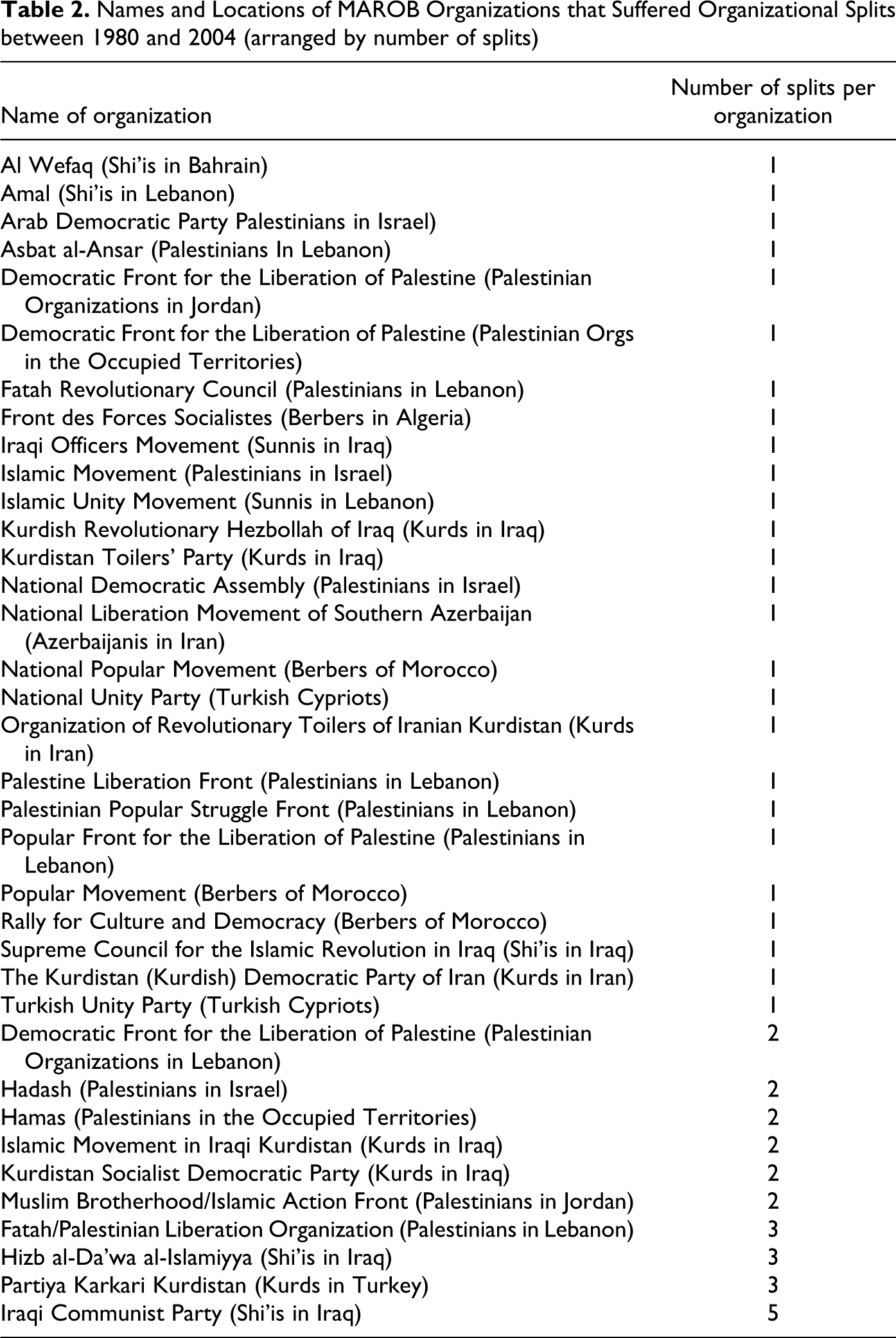
The dependent variable, Organization split, captures whether or not the organization splinters in a given year. The data show that organizational splintering among groups that have existed for a time though is rare. Among the organizations in the data set of 1,649 organization years, there are only fifty-two splits or incidents when new organizations emerge out of the old ones (less than 3 percent of the total number of organizational years). Framed another way, thirty-six organizations had at least one year when they had an organizational split, six of these had two split years, three had three split years, and one had five split years. Since MAROB counts organizations separately by country, this includes countries where different branches of the organization suffered from splits in the same year.
While some organizations are repeat offenders when it comes to organizational splits (e.g., the Iraqi Communist Party has had an organizational split during five different years), a majority of organizations never split. Table 2 lays out the organizations that have split and the numbers of times they have split. As one can see, the organizations that have split are diverse, but certain MAR group organizations seem more prone to splits. Kurdish, Palestinian, and Shi’a organizations account for more than 70 percent of these splits. Both Kurdish and Shi’a organizations split eleven times, which was a little more than 21 percent for each ethnic organizational group population. The ethnic group with the largest amount of splits is the Palestinians with sixteen or a little more than 30 percent of the splits.
Names and Locations of MAROB Organizations that Suffered Organizational Splits between 1980 and 2004 (arranged by number of splits)
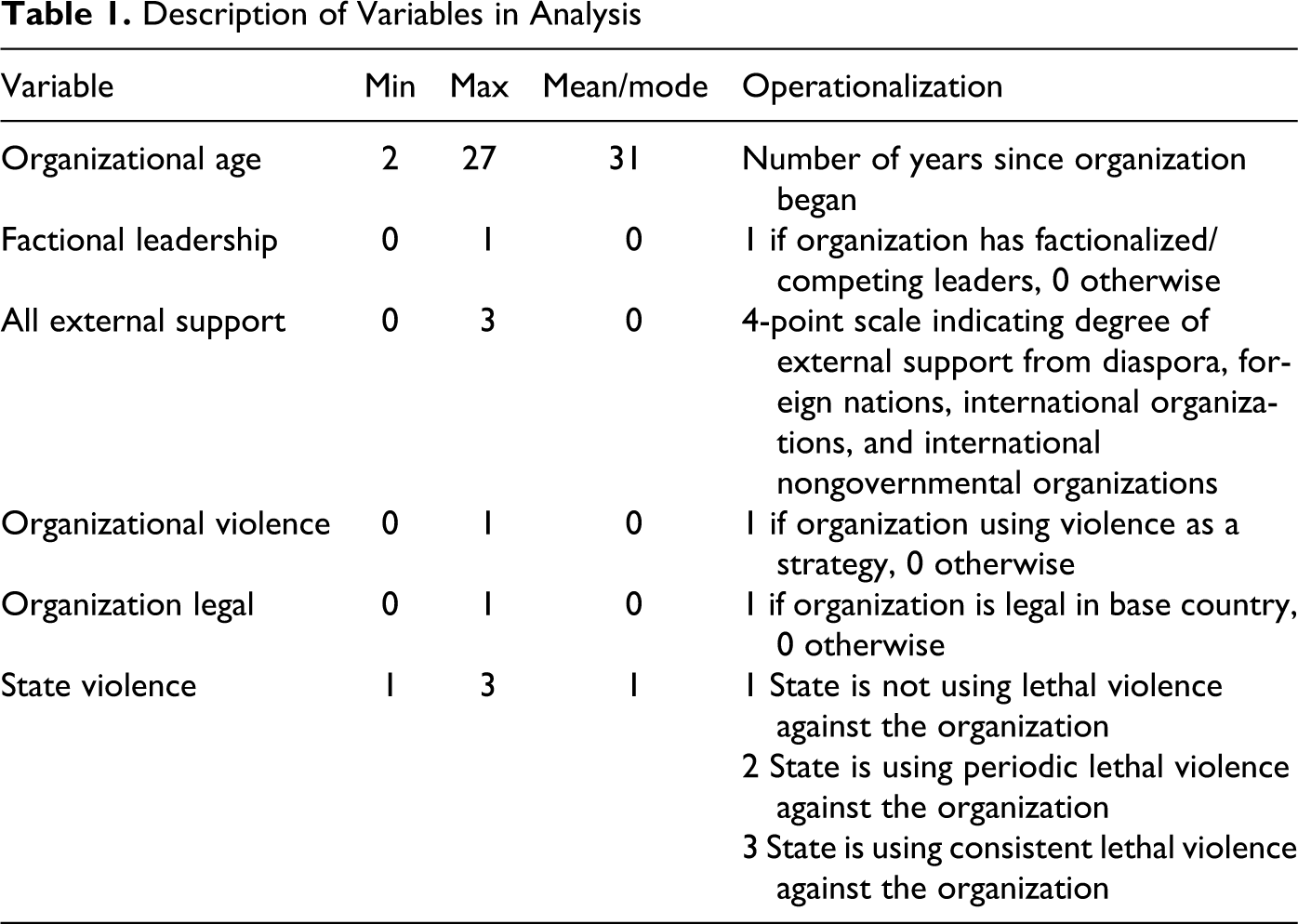
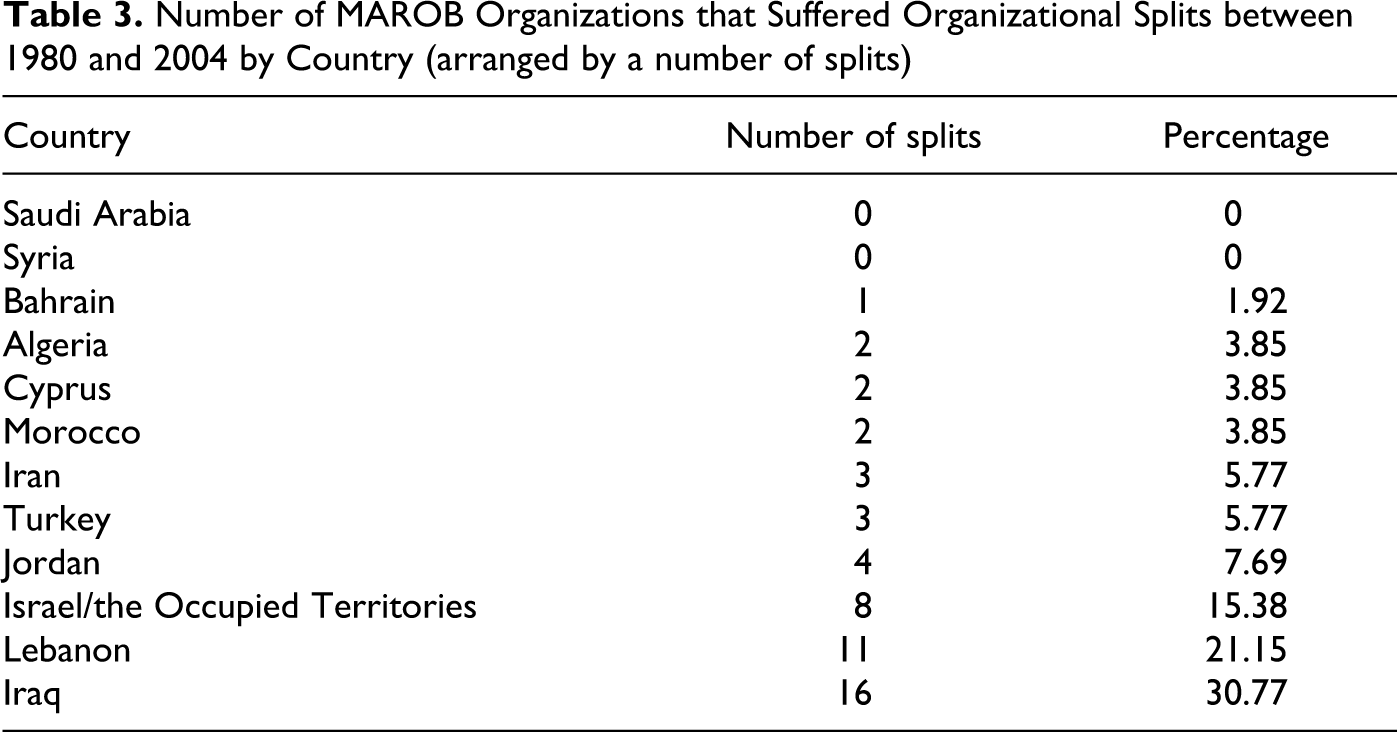
Table 3 reports the number of MAROB organizations that suffered organizational splits between 1980 and 2004 by country. There is great variance in the number of splits suffered by organizations located in different countries. Israel, Lebanon, and Iraq have suffered the largest amount of splits with sixteen in Iraq, eleven in Lebanon, and eight in Israel or the Occupied Territories. Splits also seem to ensue in the wake of destabilizing or major political events. Interestingly, six splits, or 36 percent of the splits in Iraq, have happened since 2000 and 75 percent since 1991, or in other words since the invasion of Kuwait by Iraq and the subsequent ongoing sanctions on Iraq and conflict between Iraq and the United States and its allies. All of the splits in Israel and the Occupied Territories have taken place since the first Intifada in 1987, also coinciding at least in part with the failed Israeli–Palestinian Oslo Peace Process. Palestinian Islamic Jihad broke off from the Muslim Brotherhood in late 1970s (by Palestinians from Gaza). The organizational splits in Lebanon start in 1982—the same year as the invasion of Lebanon by Israel—and end in 1998 when Lahoud became president.
Number of MAROB Organizations that Suffered Organizational Splits between 1980 and 2004 by Country (arranged by a number of splits)
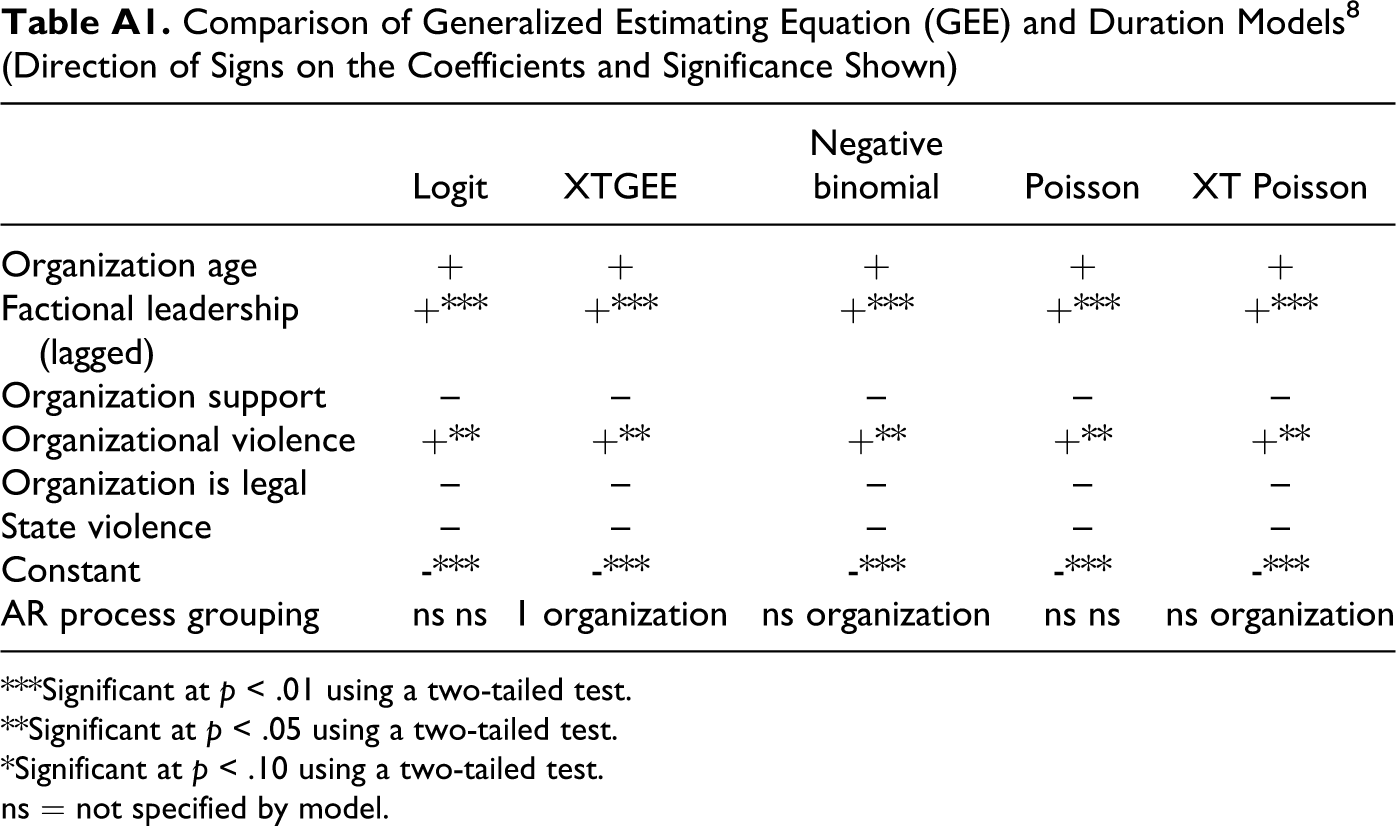
Since the data are pooled time series without a continuous dependent variable, the analysis needs to control for the impact of time as well as grouping on organizations. To account for these three concerns, a dummy dependent variable, a time element in the data, and clustering on organizations, a generalized estimating equation (GEE) model is more appropriate than a duration model (see Zorn [2001] for detailed discussion) in that this model mitigates heteroskedasticity (which results in biased error terms) from clustering on countries, allows specifying a first-order autoregressive correlation structure (meaning that the value of a variable in time 2 may be dependent upon the value of the variable in time 1, and so on), and allows specifying a binomial family with a logit analysis. A series of comparison analyses using alternative models to evaluate their comparability to the GEE model were run; the GEE model were run proves to have the strongest explanatory power and is the preferred functional form (see the appendix for summary table of results).
Results and Discussion
Table 4 provides the results of the model of leadership structure, organization support, legality and state violence, and organizational age on organizational splits. While the model provides strong support for two of the main arguments, the general thrust of the findings was surprising. As expected, factional leadership has a positive and statistically significant impact on organizational splintering. The use of violence by the organization is positive and statistically significant. On the other hand, no statistically significant relationships supporting the hypotheses about organizational legality and level of state violence in relation to group schism were found, which is surprising, given the strongly argued nature of theorizing about state repression and environmental factors in general and their relationship to organizational splits.
XTGEE Results of Organizational Split (Binomial-Logit Analysis)
***Significant at p < .01 using a two-tailed test.
**Significant at p < .05 using a two-tailed test.
*Significant at p < .10 using a two-tailed test.
Examining predicted probabilities, the impact of a factionalized leadership is stark (see Table 5). The baseline probability (where all the modal values for the variables are at their minimum) that an organization will suffer from an organizational split in a particular year is roughly 2.5 percent. If an organization has a factionalized leadership arrangement in previous year, the predicted probability that an organization will have a split rises to 11.4, almost a 9-point change. Given the infrequency of organizational splits in the data, this is a very large change. Given the nature of path dependence for organizational splits and the difficulty of developing a more centralized leadership structure or re-forming an organization, this finding makes perfect sense. It is worth reiterating, however, that factionalized leadership is too often intuitively perceived as a harbinger to the actualization of group fission (Dominguez 1989; Park 2001). In studies of political parties, however, the existence of factions is not only a common phenomenon, but factions are also surprisingly important for the maintenance and longevity of the party organization itself, especially in managing organizational adjustment to changes in its external milieus. Park (2001) explored the reasons why factions and factionalized leadership arrangements in the Japanese LDP continued to survive for decades without breaking up the party organization. He argues that factions serve three essential functions that are vital to the survival of the LDP: expanding the electoral support base, pooling resources and critical political intelligence, and hedging collective bargaining capabilities for cabinet power distributions. In this sense, the existence of formal factions and factional leadership was a rational and beneficial necessity for securing the political gain of the overarching organization rather than a precursor to inexorable group schism. The findings here, although not counterintuitive, suggest that different political dynamics might be at work with ethnopolitical organizations and political parties, and the analysis provides some concrete evidence that factionalized leadership does critically push the organization already in peril of fission toward disjunction.
Finally, while the magnitude of the impact of the organizational use of violence is not as great as that of leadership structure, note that a 6 percent predicted probability is almost triple the likelihood of an organizational split compared to the baseline case. Considering the rarity of schism that actually occurred in the data set, this finding is consequential. In cases where there are both a factionalized leadership structure and a use of violence by the organization, the probability of an organizational split rises to approximately 24.4 percent. Otherwise put, organizations with weak leadership structures set in the context of organizational violence have about a 1 in 5 chance of schism.
Underscoring this finding, an analysis without organizational years in which there was a second (or more) split was run, and Table 6 displays these results. 7 Here only first splits’ importance is modeled because the first split is highly correlated with subsequent splits (pairwise correlation = .566, significant at p < .000). This means that probabilistically splitting in the first place will lead to additional splits, and thus understanding what leads to a first split is critical for understanding the broader phenomenon. In the case of first splits, the only significant variable is factionalized leadership. Overall, the probability of a first split starts at 1.3 percent in cases without factionalized leadership and rises to 4.3 percent with factionalized leadership.
Predicted Probabilities of Organizational Split
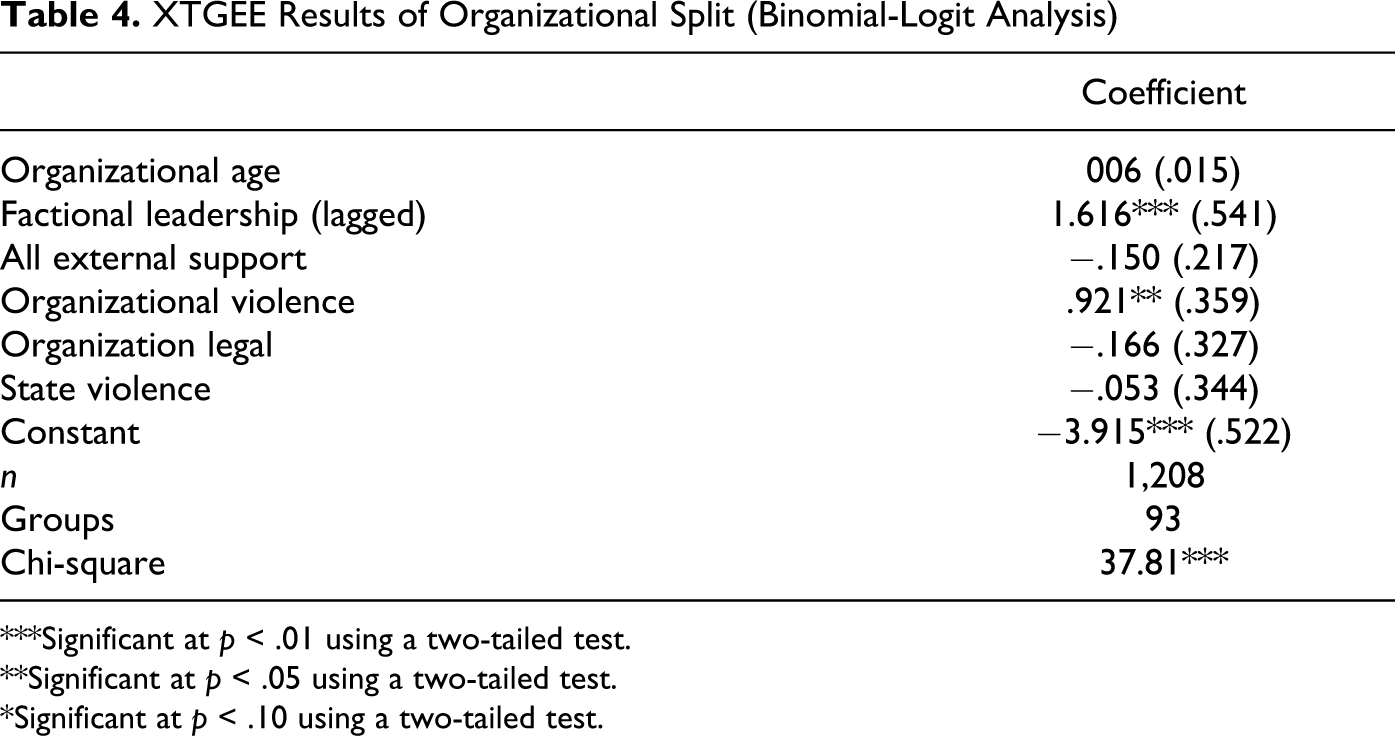
Note: Baseline probabilities developed using mean and modal values:
Organization age = 31 years
Factionalized leadership = No
External support = No
Organizational Violence = No
Organization Legal = Yes
State violence = State not using lethal violence against organization
XTGEE Results of First Organizational Split (Binomial-Logit Analysis)
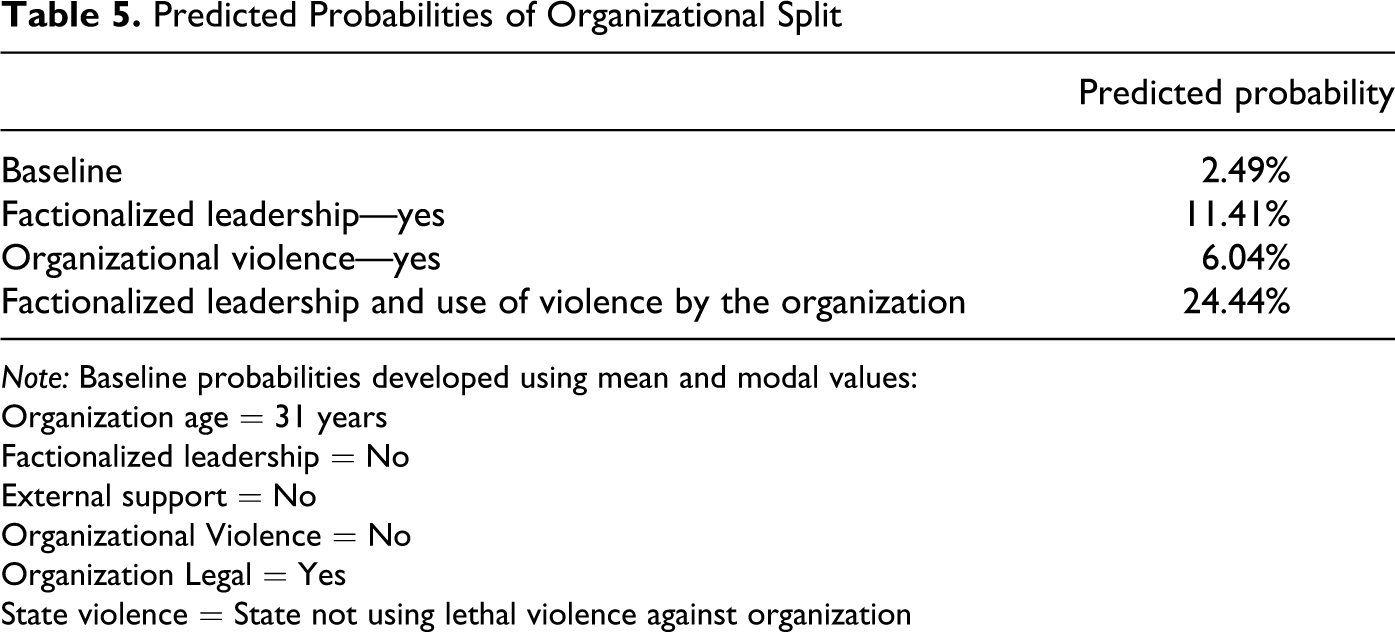
***Significant at p < .01 using a two-tailed test.
**Significant at p < .05 using a two-tailed test.
*Significant at p < .10 using a two-tailed test.
Clearly, at least in the case of ethnopolitical organizations in the Middle East, the internal makeup of an organization has an impact on the likelihood of schism. Similar to Gamson’s (1975) finding that the decentralization of authority has significant influence over denominational schism, the same for ethnopolitical organizational schisms is present. Further, Balser’s (1997) argument that splintered organizations tend to have decentralized decision-making processes was strongly supported by our findings. While a single leader may not keep you together, it appears that a factionalized decentralized leadership is more likely to pull you apart.
Conclusion
While the analysis does not show significant support for the external environment impacting the likelihood that an organization will suffer an organizational split, internal decision-making structure of an organization and the choice to use violence have a critical impact on the likelihood of organizational schisms. Organizations that have a factional leadership are much more likely to breakup. Although this may sound intuitive, it defies the argument made in studies of political party organizations in which the formation and growth of factions functioned as an effective, if not integral, means of expanding support base, providing intraorganizational mobility, creating tactical flexibility, and enabling experimental policy or tactical implementation by one or more factions within the organization (Dominguez 1989) without undermining the organization as a whole. These findings indicate that additional organizational complexity present in ethnopolitical organizations might mitigate the relationship between factional or competing leadership and the lack of group schism, which has been observed in political party organizations. The use of violence by an organization is also related to schism, and when combined with factional leadership, it significantly increases the probability of these occurrences.
The fact that violence by the state does not have an impact on organizational splits is particularly interesting and suggests potentially fruitful avenues for further research. Why might this be the case for these particular organizations? Does this hold for other types of organizations or similar organizations in different areas? Ethnopolitical organizations may be fundamentally different from other organizations, as they have a tendency toward “self-ascription and ascription by others” (Barth 1969, 13). While this limits the possible generalization of our findings to nonethnopolitical organizations, it simultaneously points to other important areas for research.
This analysis is exploratory in nature. The caveats laid out above suggest the need for future data collection to expand the scope of possible analysis, both in terms of the types of organizations beyond the ethnopolitical organizations covered as well as regionally beyond the Middle East. Nonetheless, given the important linkage between organizational splits and the likely use of violence as suggested in the extant literature, the finding that leadership type in an organization increases the likelihood of organizational split is an important first step toward better understanding schisms of nonstate political organizations.
Footnotes
Appendix
Comparison of Generalized Estimating Equation (GEE) and Duration Models 8 (Direction of Signs on the Coefficients and Significance Shown)
| Logit | XTGEE | Negative binomial | Poisson | XT Poisson | |
|---|---|---|---|---|---|
| Organization age | + | + | + | + | + |
| Factional leadership (lagged) | + *** | + *** | + *** | + *** | + *** |
| Organization support | – | – | – | – | – |
| Organizational violence | + ** | + ** | + ** | + ** | + ** |
| Organization is legal | – | – | – | – | – |
| State violence | – | – | – | – | – |
| Constant | - *** | - *** | - *** | - *** | - *** |
| AR process grouping | ns ns | 1 organization | ns organization | ns ns | ns organization |
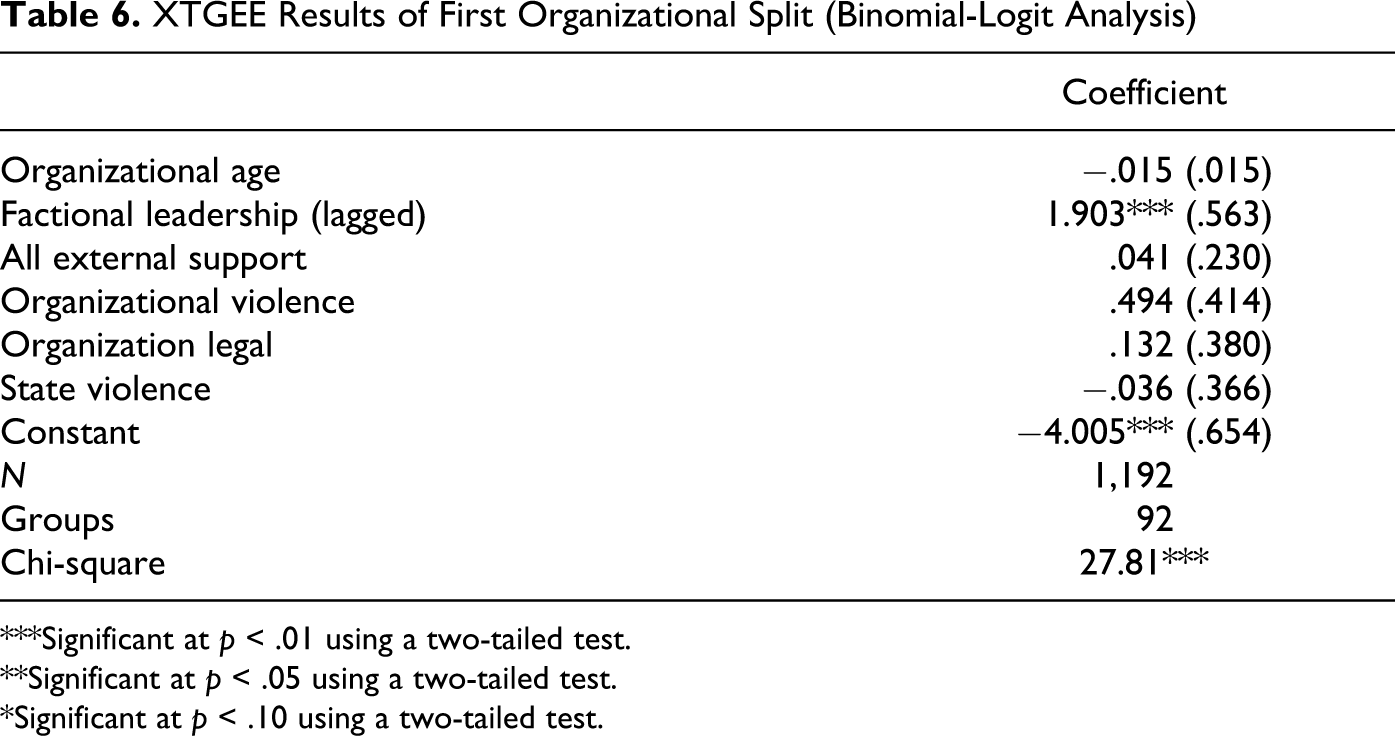
***Significant at p < .01 using a two-tailed test.
**Significant at p < .05 using a two-tailed test.
*Significant at p < .10 using a two-tailed test.
ns = not specified by model.
Acknowledgments
We would like to thank Kathleen Gallagher Cunningham and Wendy Perlman as well as our anonymous reviews for their very useful feedback. We would also like to thank Amy Pate and Jonathan Wilkenfeld for their feedback and their work on the MAROB Project.
The views and conclusions contained in this document are those of the authors and should not be interpreted as necessarily representing the official policies, either expressed or implied, of the US Department of Homeland Security or START.
The authors declared no potential conflicts of interest with respect to the research, authorship, and/or publication of this article.
The authors disclosed receipt of the following financial support for the research, authorship, and/or publication of this article: This material is based upon work supported by the Science and Technology directorate of the U.S. Department of Homeland Security under Grant Award Numbers N00140510629 and 2008-ST-061-ST0004, made to the National Consortium for the Study of Terrorism and Responses to Terrorism (START; www.start.umd.edu).