







Abstract
Preferential trade agreements (PTAs) have increased dramatically in the past several decades and play an important role in the global economy. Dispute settlement mechanisms (DSMs) in these international agreements significantly influence their functioning. In this article, the authors seek to understand what factors determine the legal arrangements of these mechanisms. The authors argue that the confluence of domestic political regime type, emulation incentives, and the development of the multilateral trade regime determines their legal dimension. Using a data set of PTAs between 1957 and 2008, the authors show that (1) democracies are more likely than autocracies to prefer moderately strict DSMs, (2) trading partners increasingly emulate each other by adopting similar legal templates, and (3) the recent trend against legalistic mechanisms is largely driven by the development of the multilateral trade regime. Their findings have important implications for the design of international institutions by highlighting the importance of member-specific as well as macro-level factors.
Keywords
Preferential trade agreements (PTA) 1 have increased dramatically in the past several decades and play an important role in the global economy. One of the standard institutional arrangements of PTAs consists of dispute settlement mechanisms (DSM)—the institutional configurations and procedures adopted by trade partners for resolving disputes. They have been shown to significantly influence the functioning of PTAs and are associated with pacifying and trade-enhancing effects (Li 2000; Haftel 2007; Pevehouse and Buhr 2005; Kono 2007).
PTA-DSMs differ in the extent to which they formalize legal arrangements. Some PTAs, such as the India–Nepal Free Trade Agreement (FTA), adopt political means to reduce trade tensions. Others, such as the North Atlantic Free Trade Agreement (NAFTA), allow third-party adjudication within DSMs. The rest, like the South African Development Community FTA area, adopt DSMs such as standing courts, with more functions being delegated to international dispute settlement bodies and with a higher level of obligation to resolve disputes through those forums. 2 The question therefore arises: when and why do some countries commit to settle disputes in a formal way instead of through informal negotiations? The variability in DSMs brings us back to a central question in international cooperation and institutional design: how strong a commitment will countries be willing to make to international obligations, under what circumstances, and in what ways?
Understanding the sources of institutional variation in DSMs in PTAs is important. The topic allows us to think about the future of trade relations in world politics. PTA-DSMs are expected to alter the landscape of international trade with consequences for how trade relations will be negotiated and adjudicated in the future. At a time when more than ten FTAs are concluded every year, 3 understanding how politics are reflected in institutional design is essential to gauging the prospect of nations achieving cooperation in international trade.
PTAs have received much attention recently (Mansfield, Milner, and Rosendorff 2000, 2002; Mansfield, Milner, and Pevehouse 2006; Baier and Bergstrand 2004); yet, the design of DSMs in PTAs deserves special and separate attention. How countries promise to settle disputes in their preferential frameworks gives us a sense of how trade diplomacy will be conducted, now that PTAs cover half of the total volume of global trade (Mansfield and Milner 2010). The observed variation in levels of legalism can help us anticipate likely patterns of international negotiation. If dispute settlement in PTAs is noninstitutionalized and based on informal negotiation, we would expect to see more backroom negotiations outside formal channels such as third-party arbitration. On the other hand, if dispute settlement rules and procedures in PTAs are formalized, countries will have an opportunity to settle their disputes in PTA forums instead of the multilateral forum of World Trade Organization (WTO) DSM.
In explaining the variation in levels of DSM legalism, we argue that countries strike a balance between commitment and flexibility by adapting DSMs to accommodate their domestic political demands, by emulating the commitment levels of already existing agreements, and by responding to the development of the multilateral trade regime. We demonstrate these effects through an analysis of dispute settlement design in PTAs between 1957 and 2008, after we situate our study in the related literature in the following section.
DSMs: The Institutional Design Perspective
International DSMs, their function and purpose, constitute a much-studied topic (Merrills 1998; Keohane, Moravcsik, and Slaughter 2000; Koremenos 2007). Scholars have paid attention to the causes and consequences of DSMs (Yarbrough and Yarbrough 1997; Maggi 1999; Smith 2000; Li 2000; Rosendorff and Milner 2001; Rosendorff 2005; Pevehouse and Buhr 2005; Kono 2007; Haftel 2007). The earlier arguments focus on the functionalist logic according to which states need DSMs while integrating their economies (Keohane, Moravcsik, and Slaughter 2000; Koremenos, Lipson, and Snidal 2001). According to this logic, states design these mechanisms to take care of cooperation problems akin to the Prisoner’s Dilemma (Koremenos, Lipson, and Snidal 2001). The demand for DSMs mainly arises from their potential to deter future violations (Yarbrough and Yarbrough 1997) as well as from their informational value (Maggi 1999). These early works did a good job explaining why DSMs were adopted and what functions they serve, but these works cannot explain the variability of the DSMs within PTAs, partly because those explanations were exclusively for the multilateral trade regime and also because the functionalist approach would normally predict the uniformity of demand for DSM from countries, not the variability.
More recent discussions of dispute settlement design go beyond the functional value of dispute settlement and explain the variation in DSMs by focusing on political incentives, namely, the balance between commitment and flexibility (Smith 2000; Rosendorff 2005). A legalized DSM can help deepen commitment to the terms of trade agreements, but at the same time, a country has to give up some level of flexibility by giving up its autonomy. The unanswered part is exactly how the balance between commitment and flexibility is achieved in the choice of DSM legalism, and our article attempts to provide the related theoretical story and empirical evidence.
Recent developments in international trade suggest that previous explanations regarding functional demand and the balancing of commitment and flexibility may not be the only story. Institutional design is also influenced by the interdependent decisions of countries that sign the agreements. We show that the way countries balance commitment and flexibility is influenced not only by what kind of trade pact a country has, or the politicoeconomic status of a country, but also by the larger context for cooperation, in particular the development of the international trade regime. Our overarching goal is to provide a more complete theoretical account and fuller empirical picture of DSM design in international trade than is currently available in the extant literature.
Our contribution is to advance scholarship in institutional design by synthesizing the research on micro- and macro-factors. To date, the study of institutional design has been quite divided between rational design literature (Koremenos, Lipson, and Snidal 2001) and diffusion literature (Simmons and Elkins 2004). The rational design literature has emphasized microincentives in institutional design while the diffusion literature has emphasized macro-level trends. Our analysis of DSM design in PTAs synthesizes the two literatures, showing that a comprehensive understanding of the institutional design of international agreements requires consideration of both microincentives and macrotrends. The analysis broadly suggests that both factors are important to consider in understanding the dynamics of institutional choice in international agreements.
This article also makes an empirical contribution by analyzing a new data set of dispute settlement design in PTAs. We update the statistical analyses on dispute settlement design conducted by Smith (2000). The data set assembled by Smith covers agreements between 1957 and 1995. There have been many developments since then, including the proliferation of bilateral and spaghetti bowl interregional and cross-bloc PTAs, the conclusion of the Uruguay Round, staggering Doha, and ten years of accumulated experience of WTO DSM. In light of these recent developments and trends in international trade, we think it is an opportune time to evaluate the effect of multilateral regimes on dispute settlement design.
Legalism in Trade DSMs
Before we provide our explanation for the design of DSMs in PTAs, we describe our dependent variable in more detail to give readers a better sense of the variation we seek to explain. We conceptualize the legalism of the DSMs of PTAs by looking at three key underlying dimensions: (1) whether third-party review is allowed (third-party review), (2) whether the review has any legal effect (bindingness of decisions), and (3) whether there are institutionalized bodies such as standing courts (institutionalization).
The availability of third-party review is critical in determining the level of legalism. Allowing the option of third-party review means the possibility of an independent ruling beyond normal negotiations between the disputants. Allowing a third-party decision is a sign of commitment to an international agreement. By explicitly stating that PTA members will subject to the decision by the third party, countries voluntarily give up some amount of autonomy since they admit that they will not be the sole authority by allowing the third parties to judge over their decisions and obligations.
The legal bindingness of the third-party decision adds another important layer to DSM legalism. The mere inclusion of arbitration procedures does not mean much without bindingness—the explicit expression that countries admit the binding legal power of the arbitral decisions. Such expression of bindingness often comes with the commitment to a compliance review or the specification of what would happen in the case of nonimplementation of decisions. When the consequences of arbitral decisions are not well specified in the agreement, the dispute settlement process may ultimately be subject to political interference from the Joint Committee or political administrative body.
Institutionalization refers to the establishment of legal organizational structures such as permanent arbitration bodies or standing courts. Highly institutionalized dispute settlement bodies indicate the highest level of legalism. Institutionalization entails all the dimensions of legalization (Abbott et al. 2000)—delegation, precision, and obligation. An agreement with an institutionalized DSM specifies the authority of the legal organization and the level of resource commitment by member countries (delegation), the detailed rules of judicial procedures (precision), and the rigid rules for compliance as well as the duties and responsibilities of member states upon receiving a legal ruling (obligation). The establishment of courts means standing judges who can build legal precedents, which implies the possibility of forming judicial independence in the long run.
Based on these three dimensions of legalism, we classify DSMs 4 in three categories corresponding to low, medium, and high levels of legalism. 5 “Low legalism” refers to dispute settlement arrangements that do not allow a third-party review as well as those that allow such review but without bindingness. “Medium legalism” refers to arrangements that allow legally binding third-party reviews. “High legalism” refers to arrangements that permanently institutionalize standing courts or tribunals.
Our measure of DSM is compatible with existing measures. Conceptually, our measure corresponds to the traditional legal literature that classifies DSMs dichotomously as either rule based or negotiation based. 6 Also, our measure almost perfectly correlates with the empirical measure proposed by Smith (2000), the first systematic empirical study conducted on DSMs in regional-trade agreements (RTA). Smith also looks at legal dimensions such as the automaticity of third-party rulings and the bindingness of third-party review 7 and uses a three-point ordinal measure of dispute settlement legalism in his statistical analysis. Our measure is also highly correlated with Kim and Hicks’s (2010) coding of DSMs in Asian FTAs, which features legal dimensions such as the locus of decision-making authority, the bindingness of resolutions, and the compensation mechanism. Although key dimensions of each study differ slightly, our measures are compatible with the existing literature in the sense that we capture the key dimensions of DSM legalization. 8
Three Hypotheses
Democracy, Emulation, and Multilateral Trade Regime
What explains the variation in DSM legalism described in the previous section? We think that the nature of trade bargaining processes matter in determining levels of DSM legalism and propose that the institutional choice of DSM is shaped by three steps in trade bargaining: (1) the first step of signing a trade agreement, based on the domestic politics of PTA members, (2) the second step of making subsequent agreements, and (3) the third step of taking into account the larger institutional context of the multilateral trade regime. For shorthand purposes, we refer to these three factors as the “democracy effect,” the “emulation effect,” and the “multilateral trade effect.” In what follows, we examine each factor one by one.
Political Regime Type and DSM Legalism
Preferences for international trade policies are usually determined through domestic political systems. As such, domestic political regime type has long been regarded as the key determinant of international trade policies. Literature on political regime type and international trade finds that democracies set lower tariffs than autocracies (Mansfield, Milner, and Rosendorff 2002), although democracies have greater incentives to set nontariff barriers than do autocracies (Kono 2006). According to the literature, democracies also trade more than do autocracies (Aidt and Gessebner 2010) while providing liberalized international trade as a public good for the general public (Gawande, Krishna, and Olarreaga 2009). The central assumption in all these articles is that democratic leaders must vie for reelection. As we shift our focus to DSMs, the question then becomes, What kinds of dispute settlement arrangements can we expect to see when we accept the core assumption of the international trade policy literature that leaders’ concern regarding reelection is the most influential determinant of policy decisions?
When democratic leaders conduct trade policy focused on their chances of reelection, they have to take into account two main competing constituencies. One of these is the export-oriented sector, and the other is the import-competing sector. Each sector may exhibit different preferences regarding DSM legalism due to the possibility of cheating (temporarily instituting protectionist measures, deviating from liberalization commitment) by themselves as well as cheating by the sectors of their trade partners. The political demands of domestic groups will be formed in the expectation of implementation of agreements, contingent upon the probability and magnitude of its own defection from liberalized commitments as well as the defection of other trading partners.
Export-oriented sectors may want to institute legalistic DSM to check other trade partners’ protectionist incentives. They are the “whistleblowers” of other trade partners’ trade violations. It is mainly because their interests to secure market access and expand production are directly hurt if trading partners erect protectionist measures. In fact, export-oriented sectors are the ones that put pressure for the government to file disputes at the WTO disputes, one of the most legalized dispute settlement systems at the multilateral level. 9 For export-oriented sectors, legalistic DSMs can work as insurance policies that protect them from other countries’ protectionist policies—policies that may stand in the way of export expansion. 10 Due to the potential circumstances of “being cheated against” and the motivation to monitor other trading partners’ behaviors, export-oriented sectors would generally prefer legalistic DSMs.
Import-competing sectors, on the other hand, would want less legalistic DSMs with plenty of wiggle room for policy discretion. Import-competing sectors often lobby for protectionist measures to guard their industries from international competition. Since they are the ones that are potentially in need of their own government “cheating” if targeted by foreign trade partners due to import surges or antidumping behaviors, the motivation “not to be litigated against” will contribute to their preference regarding DSM legalism. In this context, import-competing sectors may prefer flexible political measures to institute their protectionist demands. Due to the incentives to “cheat” and the motivation “not” to be litigated against, we would expect import-competing sectors would prefer less legalistic DSM.
If democracies face competing pressures for legalized DSM from export-oriented industries and diplomatic DSM from import-competing groups, whose interests will eventually win out? Given the rising power of import-competing industries (Goldstein and Martin 2000) and given the better political organization of import-competing sectors compared to export-oriented sectors (Ehrlich 2007), we would argue, the net effect is that democratic governments would reflect the wishes of import-competing sectors more and choose medium or low levels of legalism.
By responding to the organized lobbying of import-competing industries, democracies would be able to balance commitment and flexibility in their international trade policy. They can use flexible, less legalistic DSMs strategically as an institutional device to hedge the risk associated with the kinds of binding commitments most PTAs bring. Many PTAs promise binding commitments of zero tariffs or tariff reduction schedules for many product items. When governments make these binding commitments in PTAs, they may want to keep open the option of flexible dispute settlement venues. Democratic leaders in particular have incentives to use a flexible DSM as an institutional mechanism to compensate domestic protectionist groups during the process of market opening by leaving room for political negotiation. Through these institutional substitutions and bundling tactics, democratic leaders can better balance the interests of export-oriented industries with those of import-competing industries. By having an open and flexible option in dispute settlement in PTAs, democratic governments are able to commit to international free trade while at the same time catering to occasional domestic political pressures often generated by electoral cycles.
In contrast, autocracies are less likely to be subject to the countervailing political pressures democratic leaders are under. Also, autocratic leaders would face a different kind of constituencies from democracies. Autocracies will cater to local elites primarily by protecting import-competing industries (Aidt and Gessebner 2010). Those industries will demand a low level of DSM legalism to keep diplomatic options open rather than tying themselves to third-party adjudication. While democracies face the displeasure of export-oriented lobbying groups if they choose a DSM with a low level of legalism and abandon their liberal commitments, it is much easier for autocracies to adopt less legalistic international trade policies.
Some may suggest that sectoral politics would be directly translated to the DSM outcome without the mediating effect of political institutions. That is, countries would adopt the preferences of larger sectors, instead of balancing competing demands when they choose levels of DSM legalism. However, we argue that how each political system settles their competing interests matter because the channels by which economic preferences are translated into international policy outcomes are different. In democracies, the leaders’ concern for reelection would make them heed to competing interests, whereas autocratic leaders would cater their core constituencies which are mostly import-competing industries.
The consideration of competing interest groups and their demands for DSM leads us to expect that democracies would differ from autocracies in their choice of a medium level of legalism, with democracies showing a much greater tendency to choose this medium level than autocracies. Although import-competing sectors in both democracies and autocracies would prefer low-level legalism, the weight of export-competing sectors and liberalization commitments in democracies will produce divergent preferences between autocracies and democracies regarding the choice of medium-level legalism DSM. We summarize this theoretical expectation as the following:
Hypothesis 1 (Political Regime and DSM Legalism): Democracies are more likely than autocracies to adopt a medium level of DSM legalism.
Legal Boilerplates and DSM Legalism
Antecedents exert considerable influence on processes of institution creation. States tend to build on existing legal frameworks, using those as a template for creating similar legal instruments to deal with similar problems. DSM designs in trade agreements are not independent policy choices, but interdependent ones. Even a cursory reading of recent trade agreements reveals that many agreements are explicitly modeled on earlier agreements. For example, the Andean Community Court was modeled on the European Court of Justice and Mercosur (Southern Common Market) mechanism (Lacarte and Granados 2004). Mexico concluded a PTA with the EU, which has adjudicative DSM, following the NAFTA provision (Bartels and Ortino 2007). These examples suggest the general trend in DSM design—the way that one agreement often has effects on other, subsequent agreements.
We propose that the emulation process of DSMs in PTAs mainly occurs through comembership and the subsequent negotiation of trade agreements. A country signing a legalized DSM is more likely to sign a legalized DSM in a subsequent agreement, and the use of legal templates generates institutional spillovers. When there is shared membership, DSMs may be copied by one country and incorporated in other subsequently negotiated agreements. Decision makers regarding DSMs are usually trade bureaucrats who participate in a series of trade negotiations with potential partners. Consequently, with the same negotiators returning to the table for successive negotiations, there is a strong tendency for a preference for commitment to engender a preference for commitment on subsequent occasions; by the same token, flexibility will beget flexibility. This emulation incentive sometimes produces self-reinforcement. If a country makes a PTA with a legalized DSM with one partner, the same institutional setup is likely to reappear in subsequent agreements.
Hypothesis 2 (Legal Boilerplates: emulation by comembership): When an agreement adopts a high or low level of legalism with regard to its DSM, then subsequent agreements that share memberships are likely to exhibit a comparable level of DSM legalism.
Other kinds of emulation processes are possible besides comembership emulation. Regional emulation or distance-based emulation is a plausible mechanism of diffusion (Simmons and Elkins 2004) as evidenced by many cases of policy diffusion. It is also sometimes the case that countries copy the DSM design of neighboring countries. We think this region- or distance-based emulation mechanism will be weak in the case of DSM design since international trade agreements are no longer confined to regions. Structural emulation is another possibility: countries may follow the crowd and adopt a general trend at the time of design. Although structural emulation is a plausible pattern, it seems unlikely that countries would ever blindly follow a trend in DSM design. We control for these various kinds of emulation processes later in the empirical section, but we think that, at the level of theory, emulation through shared membership is the most important emulation process because it reflects the political dynamics and sequence of trade negotiations.
Multilateral Trade Regime and DSM Legalism
We argue that the development of a multilateral trade regime has a consequential impact on how DSMs are designed in PTAs. We specifically suggest that the development of the multilateral trade dispute settlement system prompted trading partners to prefer low- or medium-level DSMs rather than DSMs with a high level of legalism in forging new PTAs.
In light of the development in multilateral trade regime, the first reason PTA signers prefer DSMs with a low or medium level of legalism pertains to the increasing value of retaining autonomy in trade diplomacy. The reform of the WTO’s Dispute Settlement Understanding (DSU) has been stalled for years at the Doha Round. 11 Although the WTO dispute settlement body (DSB) has been touted as the crown jewel of the world trading system, many reform agendas have been put forward at the Doha Round. Against this backdrop, the value of “opting out” as opposed to “opting in” may become appealing to PTA signers with respect to the DSM design. Opting out means exercising an outside option by opening a possibility for a separate legal forum or no legal forum, outside of the WTO system. Opting in would mean the continuation of utilizing the WTO DSB.
In exercising an outside option, countries will often prefer a less legalized form of dispute settlement, mainly because they already have a legitimate legal option at the WTO. Countries can opt for PTA DSMs when it is politically convenient to use alternative dispute settlement forums (Davis 2009). Likewise, countries will utilize the WTO system when it is important to establish a precedent within the multilateral regime (Busch 2007). This trend of opening up options is consistent with the preference most countries have for maintaining a balance between commitment and flexibility. In the presence of new WTO-plus obligations within PTAs, many countries are able to balance their existing obligations at the WTO with new obligations within PTAs. In this context, the macrotrend at the level of the multilateral trade regime tips the balance in favor of flexible, unlegalistic DSMs. 12 If countries want, they can opt to settle a dispute within the PTA; alternatively, they can go to the WTO.
This forum shopping incentive does not necessarily imply that countries under the current multilateral trade regime will collectively reject the WTO DSU. They may still respect the multilateral system and utilize the WTO DSB as a legitimate forum to settle their disputes (Davey 2006). The compliance rate for the WTO DSB has been relatively good, compared to other international institutions, reaching approximately 67 percent (Horlick and Coleman 2008).
Recently though, the number of consultation requests at the WTO DSB has been in decline (Palmeter 2008, 846). One possible explanation for this downward trend may be that, on the whole, countries have become more compliant. More plausibly, the decline in the number of consultations may mean that countries are utilizing other means of dispute settlement outside the WTO. Also, we know that countries tend to lodge fewer complaints against their PTA partners than against nonpartners at the WTO forum (Bown 2005). The evidence collectively indicates that PTA members increasingly prefer to settle disputes within their own forum rather than take a dispute to the WTO. Since many cases among PTA member countries are often resolved at a political level and do not proceed to formal panels, it is difficult to systematically observe how frequently PTA DSM has been used. However, long-running, established PTAs, such as NAFTA, Mercosur, and US–Israel, have witnessed active usage of DSM. For instance, there have been a total of 355 consultations within Mercosur from 1995 to 1999 (Bouzas and Soltz n.d.), and a substantial number of requests have been made under NAFTA chapter 20 on general dispute settlement (Vega 2003).
Some may suggest a counterargument to our conjecture and argue that the moderate success of the WTO DSB generates incentives to further “legalize” DSMs in PTAs. Certainly, some countries may opt to use the WTO DSM as a boilerplate for their PTA DSM and further legalize their DSMs. However, we doubt the utility of having the choice of yet another highly legalized forum when countries already have the option of going to the WTO DSB. There is little incentive to pursue institutional redundancy when countries can already fall back on the WTO DSB for legalistic dispute settlement. If trade disputants want to settle disputes and also wish to have access to more than one dispute-settlement option, it is optimal for them to seek a less legalistic PTA DSM. The incentive to adopt a less legalistic DSM will therefore outweigh the incentive to adopt a legalistic DSM similar to the WTO DSM.
The political incentive to create alternate fora for dispute settlement outside the multilateral trade regime thus yields the expectation that a change in multilateral regime dispute settlement will lead to the increased adoption of low or medium level legalistic dispute settlement arrangements in lieu of highly legalistic DSMs. We therefore hypothesize that the decrease in highly legalistic DSMs in PTAs coincides with recent developments in the multilateral trade regime. The Uruguay Round (1986–94) was decisive in establishing the WTO DSB, and the period after the Uruguay Round saw the implementation of the WTO DSM. We therefore suggest it is from that point on that the trend toward less legalistic PTA DSMs was strengthened.
Hypothesis 3 (Development in Multilateral Trade Regime and DSM Legalism): DSMs adopted after the Uruguay Round are more likely to have a low level of legalism than DSMs adopted before the Uruguay Round, which are more likely to have a high level of legalism.
Statistical Analysis of Dispute Settlement Design in PTAs
Using the data set 13 of the design of dispute settlement arrangements in 221 PTA between 1957 and 2008, we test for the respective influence of (1) domestic political regime, (2) boilerplate incentive across PTAs, and (3) multilateral trade regime. The statistical analysis shows the confluence of this triad of factors in DSM arrangements within PTAs.
Sample
The data set includes information about DSMs in 221 PTAs. Our sample is constructed from the WTO (2009), 14 Smith (2000), the International Trade Reporter (various years), and Frankel (1997). 15 Legal texts are mainly from the International Legal Materials, the United States Trade Representative (USTR), 16 WorldTradeLaw.net, the Global Preferential Trade Agreements Database compiled by the World Bank-Tuck Center for International Business, the United Nations Treaty Series, and the Foreign Trade Information System.
We exclude three categories of trade agreements from our sample. 17 First, we exclude agreements involving quasi-state actors, such as China–Hong Kong and Turkey–Palestine Liberation Organization (PLO). The reason is that our theory mainly pertains to state-to-state relations. Second, we exclude some treaties from our analysis due to text nonavailability, such as 1964 Arab Common Market. Third, we exclude successor agreements to avoid the problem of nonindependent observations. These exclusion criteria eliminate about 173 PTAs currently in force.
Unit of Analysis and Unit of Observation
Our main unit of analysis is a country’s choice of DSM in a PTA, and the unit of observation in our data set is the DSM choice of a country in a PTA. We focus on the country-level choice of DSM legalism for our central unit of analysis because our arguments are about country-level preferences regarding DSMs in PTAs. 18 We conduct our analysis with the country-level analysis, most importantly because our theory is about the preferences of countries regarding their choice of DSM. Our three hypotheses—political regime type, emulation, and multilateral trade context—all address choices made by national governments.
Independent Variables
We first introduce the measures for our key independent variables: political regime, emulation, and multilateral trade regime, and then explain control variables.
Measuring political regime type
We utilize the Polity IV project (Marshall and Jaggers 2002) for the measure of political regime type, which ranges from −10 (indicating the most autocratic regime) to 10 (indicating the most democratic regime). We later conduct two robust checks, one with a binary variable dividing democracies from autocracies, classifying countries with a polity score of 6 and above as democracies, and others as autocracies. The second robust check involves an alternative measure of democracy, originally developed by Przeworski et al. (2000) and extended by Cheibub, Gandhi, and Vreeland (2009). Both Polity IV and an alternative democracy measure capture our key institutional features of democracies, such as executive competition, openness of elections, and checks and balances. We therefore expect the results would be comparable for both measures.
Measuring emulation
As explained in the theory section, we think that the most important dimension of interdependence in DSM design is shared membership. We capture the degree of legalization of DSMs in previous agreements that share the same members by using a spatial lag (Ward and Gleditsch 2008). The notion of “space” in this emulation variable is not geographical distance, but rather an “institutional space,” capturing the extent of shared institutional membership across two agreements. The emulation variable is different from normal control variables in that we can directly model and take into account the degree of interdependence among observations. The central idea in creating this variable is to weight the dependent variable by the pattern of interdependence among DSMs in previous trade pacts.
A spatial lag is constructed in three steps. 19 First, the connectivity matrix is made. We have a total of 221 agreements, so the dimensions of the matrix are [221, 221]. The elements of the connectivity matrix are based on shared memberships. For example, NAFTA and Mexico–Japan share at least one member, Mexico. So, the value for the element in the connectivity matrix between these two agreements is 1. The Caribbean Community and Common Market (CARICOM) and Mercosur do not share membership, so the connectivity value is 0. 20 The second step involves the making of a weights matrix, W. We weight the connectivity matrix by the row-sum of the connectivity matrix (the mean of each row). To eliminate endogeneity, 21 W is constructed as a lower triangular matrix to ensure that only previous agreements affect subsequent agreements, not the other way around. Third, the spatial lag of DSM, S, is created by multiplying the W matrix by the Y matrix, where Y is the [221 × 1] vector of DSM in each agreement. Essentially what we do in creating this emulation variable is to weight the dependent variable matrix by the degree of shared membership of an agreement with other agreements. Substantively, the spatial lag S would mean the average value of legalism of the previous agreements with shared membership.
Measuring multilateral trade regime effect
We test multilateral regime hypothesis by employing a dummy variable to indicate whether an agreement was signed before or after the Uruguay Round (Post Uruguay Round). This variable is coded as 1 if a PTA is signed since 1995, 0 otherwise.
Control Variables
Informed by previous literature in trade cooperation and institutional design, we control for several variables that are known to impact design decisions regarding DSMs. Our ability to control for these variables ensures that we accurately estimate and parse out the separate effects of political regime type, emulation, and multilateral trade regime. Besides the variables we introduce in this section, we also include two variables Smith (2000) used in his study: the asymmetry in economic size within PTA members and the level of economic integration of a PTA.
Trade partners’ regime type
Not only the PTA signer’s political regime type but also the partners’ political characteristics matter. When the United States signs an agreement with Oman, for instance, we would expect a different outcome for DSM legalism than we would in a case where the United States signs an agreement with Canada. To take into account this “partner effect,” we include the control variable that measures the ratio of democracies to nondemocracies among partners, excluding the country that makes the DSM decision, within a trade pact. The theoretical expectation here, as an extension of Hypothesis 1, is that a democratic PTA signer with democratic partners is more likely to prefer a DSM with a medium level of legalism than when the partners are autocratic.
Number of members
We control for the effect of membership size. A large number of members usually means more integration and therefore implies a more substantially legalized DSM as a baseline. The other reason to control for the effect of membership size is that bilateral agreements share particular characteristics different from those of multilateral agreements. Among the 221 agreements included in our sample, 181 are bilateral agreements. Controlling for bilateral agreements is important chiefly due to their initial propensity to adopt diplomatic means of dispute settlement. In our data set, no existing bilateral treaty sets up a standing court, and arbitration is the most legalistic settlement mechanism. For this reason, we include the number of members as a key control variable.
Volume of trade
The need for dispute settlement arises with the growth of trade flows. A large volume of trade flows will require DSMs to deal with the application and interpretation of trade agreements, especially with regard to noncompliance. We use the volume of intrapact trade as a control variable to parse out the effect of functional demand. Volume of trade is measured as the total of imports and exports to and from trade partners in a specific trade pact, in millions of US dollars. The data source is the Expanded Trade data set (Gleditsch 2002) and the Direction of Trade Statistics (IMF).
Relative strength of sectors (RSS)
Since import-competing and export-oriented sectors exhibit different preferences regarding DSM legalism, the RSS is expected to influence the choice of DSM legalism. The RSS is measured as the ratio of the volume of total exports to the volume of imports to and from partner countries in a given trade agreement. The values greater than 1 indicate that export-oriented sectors are larger than import-competing sectors for a country’s economy, whereas the values less than 1 mean that import-competing industries are larger than export-oriented industries. A value of 1 indicates equal strength between both sectors. These data come from the Expanded Trade data set (Gleditsch 2002) and the Direction of Trade Statistics (IMF).
Alliance
The aim of PTAs is often to help solidify long-standing geostrategic military alliances between partner countries. In this sense, trade agreements are expressions of economic as well as political alliances. Previous research has demonstrated a relationship between military and trade alliances (Gowa and Mansfield 1993; Powers 2004; A.Long and Leeds 2006). We control for the effect that alliance relationship may have on DSM design beyond the stage of PTA formation. The expectation is that alliance relations will reduce the perceived need for legalistic dispute settlement arrangements due to already existing diplomatic networks. The alliance variable is measured as the number of existing alliance agreements between trade partners within a trade pact, and the data are drawn from the Alliance Treaty Obligations and Provisions (ATOP) project (Leeds et al. 2002). 22
Structural emulation
Structural emulation captures the tendency countries may have to follow the overall trend in DSM design. This tendency is measured as the average DSM score for all the agreements that were concluded one year prior to the signing year.
Dummy for regional cluster
To control for the effect of regional emulation, we include a dummy variable to account for regional clustering. Of the of 221 agreements, many are concluded within a single region: Asia (53), Africa (11), America (29), and Europe (62). Sixty-two agreements are interregional PTAs (e.g., Mexico–Japan FTA). Within the European cluster, we have hub-and-spoke treaties concluded by the member countries of the European Community,23 the European Free Trade Agreement, and the Central European Free Trade Agreement.
Statistical Model and Results
We build the empirical model of DSM legalism that tests for the effects of political regime type, emulation, and multilateral regime, as follows:

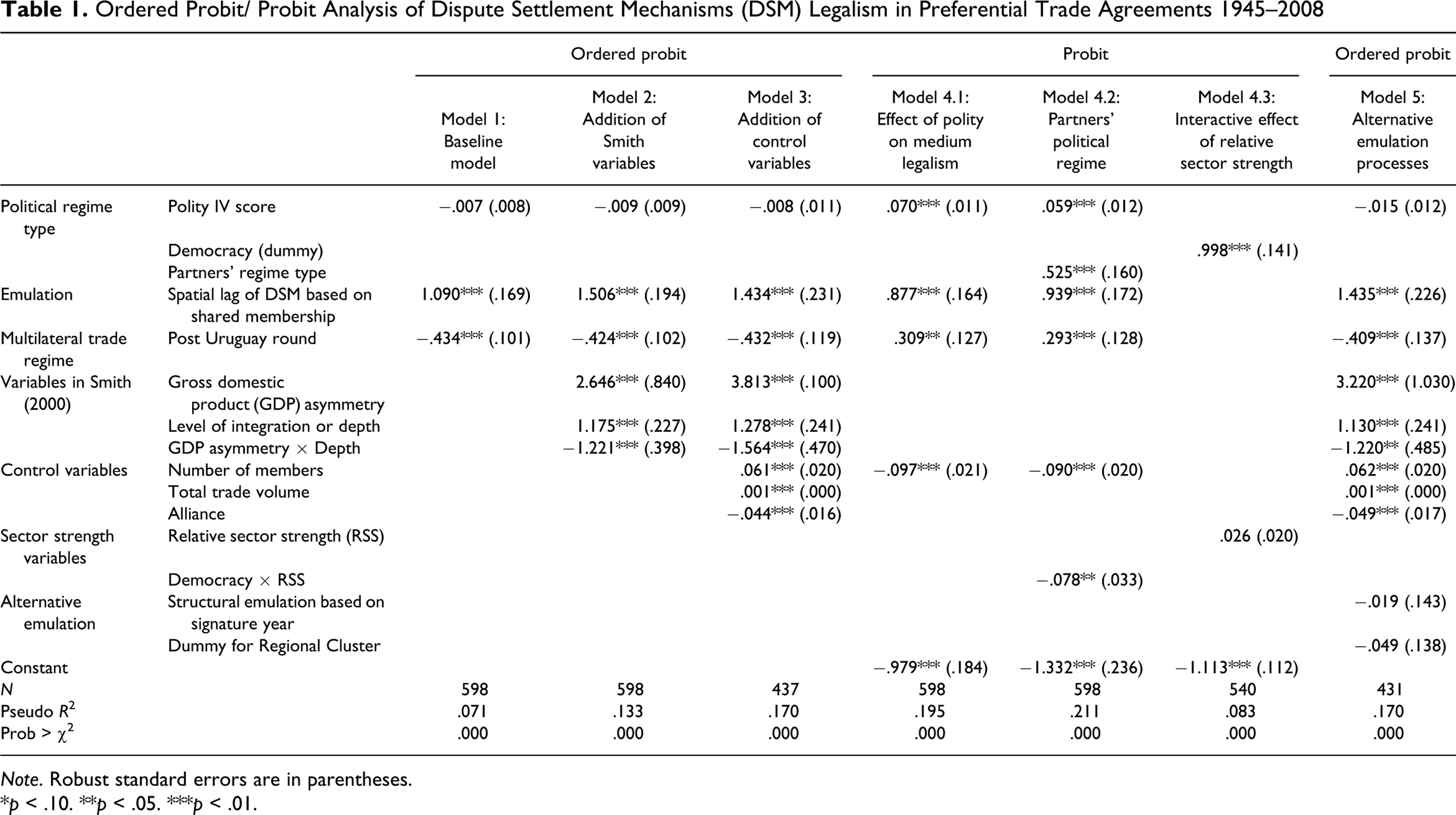
The statistical analysis in Table 1 shows the effect of the three main variables on the adoption of DSM legalism in PTAs. Models 1 through 3 and 5 are ordered probit analyses with the three levels of DSM legalism for the test of Hypotheses 2 and 3, and model 4 is a probit model for the test of Hypothesis 1, with a binary dependent variable–whether a DSM has a medium level of legalism or not. Model 1 is a baseline specification that tests the explanatory power of political regime, emulation, and multilateral regime in accounting for the choice in DSM legalism. Model 2 tests for the theoretical claim suggested by Smith (2000) about the interactive effect between power asymmetry and the level of integration. Model 3 introduces a number of control variables added to the baseline model, including trade volume and alliance. Model 4.1 analyzes the effect of political regime on medium-level legalism, as hypothesized in Hypothesis 1, while model 4.2 controls for the partner countries’ political regime types. Model 4.3 examines the interactive effect between political regime type and the relative sector strength to see whether democracies directly represent preferences of larger sectors or mediate competing interests from each sector. Model 5 adds two additional variables for emulation—structural emulation and regional cluster, as alternative explanations, to test for the possibility of other kinds of emulation at work in DSM design.
Ordered Probit/ Probit Analysis of Dispute Settlement Mechanisms (DSM) Legalism in Preferential Trade Agreements 1945–2008
Note. Robust standard errors are in parentheses.
*p < .10. **p < .05. ***p < .01.
The statistical results largely support our theoretical conjectures. Models 1 through 3 indicate that political regime type does not have a significant impact on the ordered level of legalism, but models 4.1, 4.2, and 4.3 show that political regime type has a significant impact on the choice of a medium level of legalism, controlling for the characteristics of partner countries’ political regimes 24 and the RSS. The comparison of models 1 through 3 and the three versions of model 4 lends support to our Hypothesis 1: democracies are more likely than autocracies to adopt a medium level of legalism. Also, democracies are more likely to opt for a medium level of legalism when their partners are democratic than when their partners are autocratic, as the result in model 4.2 indicates. The result in model 4.3 demonstrates that the sectoral strength is mediated by domestic political systems, showing evidence of our suggested causal mechanism. The first difference of the predicted probabilities between democracy and autocracy shows a substantively significant effect of interaction term. As the political regime type changes from autocracy to democracy, fixing the relative sector strength at its mean value, the predicted probability of a medium-level DSM being adopted increases from 14.5 percent to 39.2 percent. 25
Table 2 presents a Heckman model (Heckman 1979; Greene 2003), accounting for the possibility of nonrandom selection into the sample, namely selection bias. In the analysis of institutional design of international agreements, the problem of selection bias frequently arises (Von Stein 2005; Mitchell and Hensel 2007). In the context of the present analysis, selection bias would be a worry if we expected countries that sign a PTAs to have preferences regarding DSM legalism that are systematically different from those of countries that do not sign PTAs. It is plausible to suppose that PTA-signers would prefer a higher level of DSM legalism than nonsigners, and we test for this possibility in Table 2. The Heckman selection model was developed for binary dependent variables, not for ordinal dependent variables, so we collapse medium and high legalism into one category and leave low legalism as the other category.
Heckman Selection Model
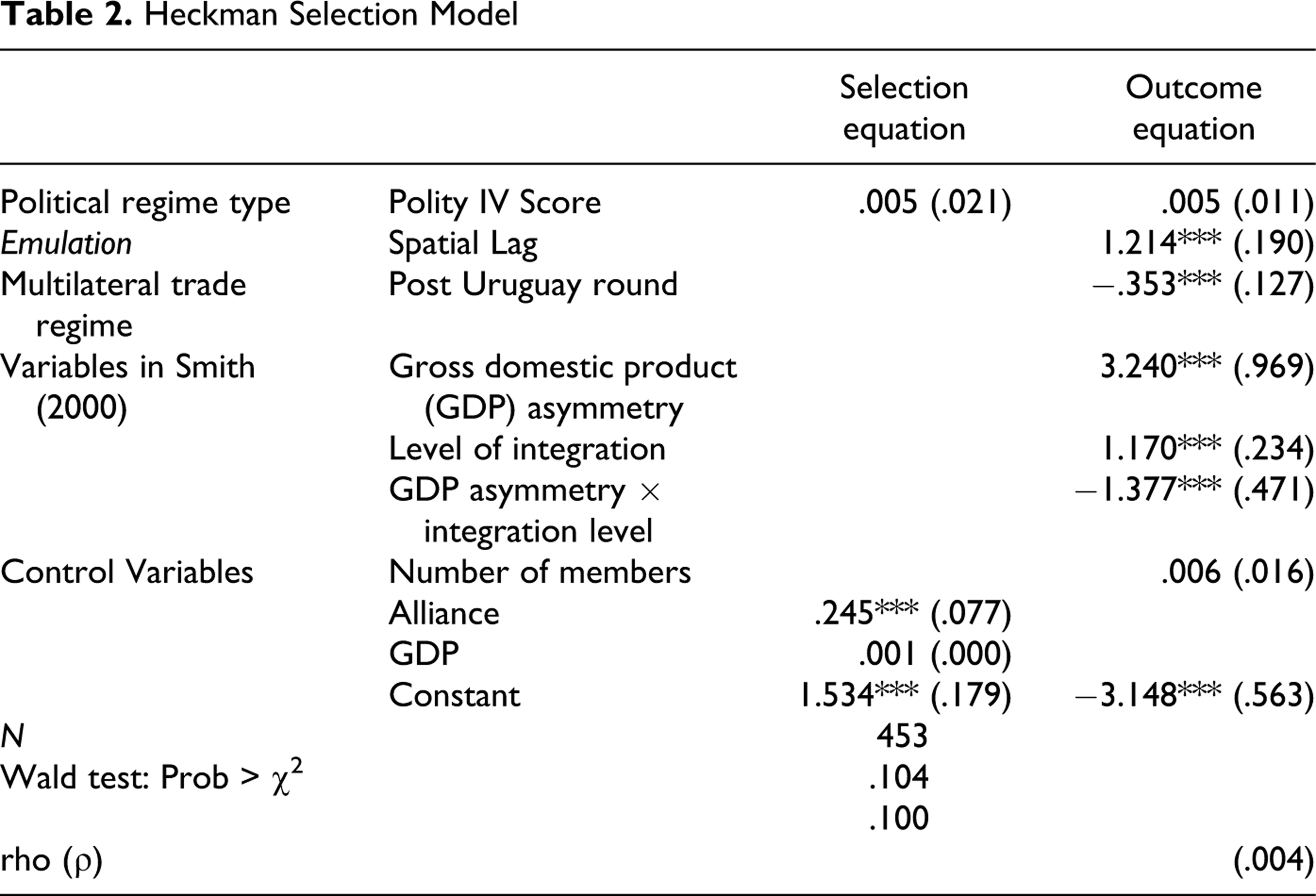
The selection equation includes the predictors for PTA formation, such as political regime type, alliance, and gross domestic product (GDP; Mansfield and Reinhardt, 2003; Milner and Keiko 2005). We use GDP as an identifying variable that satisfies the exclusion restriction required in Heckman models for identification (Sovey and Green 2011). That is, we assume that GDP significantly affects the formation of PTAs (Mansfield and Reinhardt 2003) but not the level of DSM legalism. We think that there is no a priori reason for large countries to favor one form of DSM legalism over the other. 26 In fact, the size of GDP does not have a significant effect on DSM legalism if we run ordered probit with our dependent variable and GDP size as an independent variable.
If the selection process into the PTA alters the estimation of our key explanatory variables, and if the rho (
As suggested in Hypothesis 2, the emulation variable, the spatial lag of DSM, is significant throughout all the specifications. This result indicates that the level of DSM legalism in previous agreements has a positive impact on subsequent DSMs via the mechanism of shared membership, with a low level of legalism in one agreement predicting a low level in subsequent agreements, and a high level of legalism predicting an equally high level in subsequent DSMs. As in Hypothesis 3, the variables related to multilateral regime—Post Uruguay Round—produce a negative effect on DSM legalism.
To see the magnitude and size of variable effects, we report the changes in predicted probabilities and marginal effects (S. Long and Freese 2006) in Table 3. Emulation has the largest marginal effects; its instantaneous rates of change for emulation variable while all other variables are held constant, are approximately 38 percent. This means that DSM legalism in previous agreements has a significant impact on subsequent agreements, with an emulation rate of 38 percent. Although political regime type has a 2 percent marginal effect according to model 4, its overall effect is not ignorable. A seven-unit change in polity score results in a 15 percent increase in the probability of obtaining a medium level of legalism. The effect of the multilateral regime on DSM design is estimated to be as large as 11 percent. DSMs in the Post Uruguay Round period are 11 percent more likely to be less legalized than earlier DSMs.
Marginal Effects and Changes in Predicted Probabilities in Dispute Settlement Mechanisms (DSM) Legalism According to Change in Political Regime Type, Emulation, and Multilateral Trade Regime
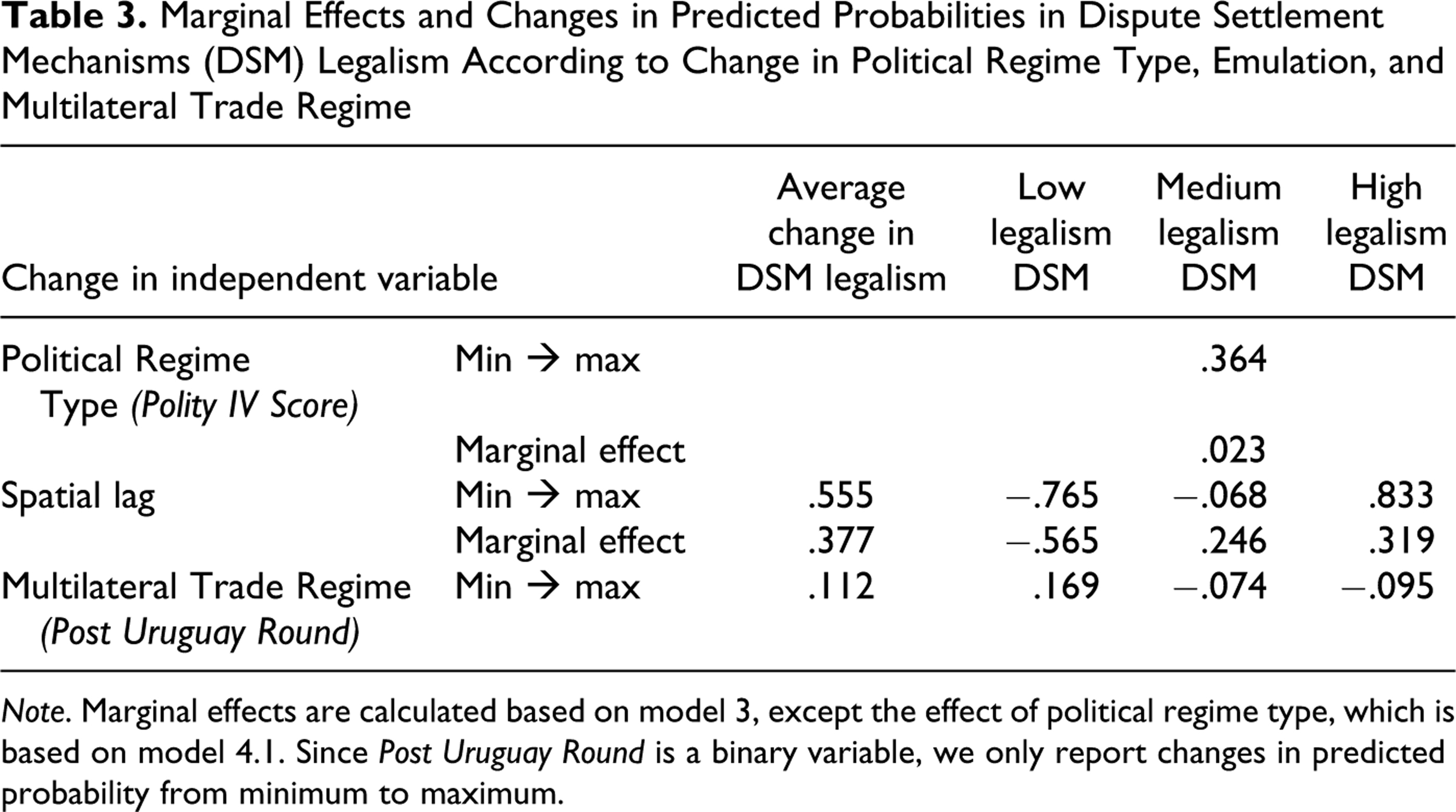
Note. Marginal effects are calculated based on model 3, except the effect of political regime type, which is based on model 4.1. Since Post Uruguay Round is a binary variable, we only report changes in predicted probability from minimum to maximum.
For additional postestimation results, we present predicted probabilities in two figures. For the range of the Polity IV scores in the sample, Figure 1 is a graph of the predicted probabilities for a medium level of legalism in relation to change in political regime type. The estimates based on model 4 are calculated by setting other independent variables at their means. One can easily discern the general upward trend, which indicates that democracies are 35 percent more likely to choose a medium level of DSM legalism, compared to autocracies. The increase in Polity score increases the probability that countries will choose a DSM with a medium level of legalism. As the Polity score increases from minimum to maximum, the probability of a medium-level DSM being established increases by 40 percent. For the most autocratic countries, the probability of obtaining a medium-level DSM is approximately 5 percent, whereas the most democratic countries are likely to choose a medium-level DSM 40 percent of the time.
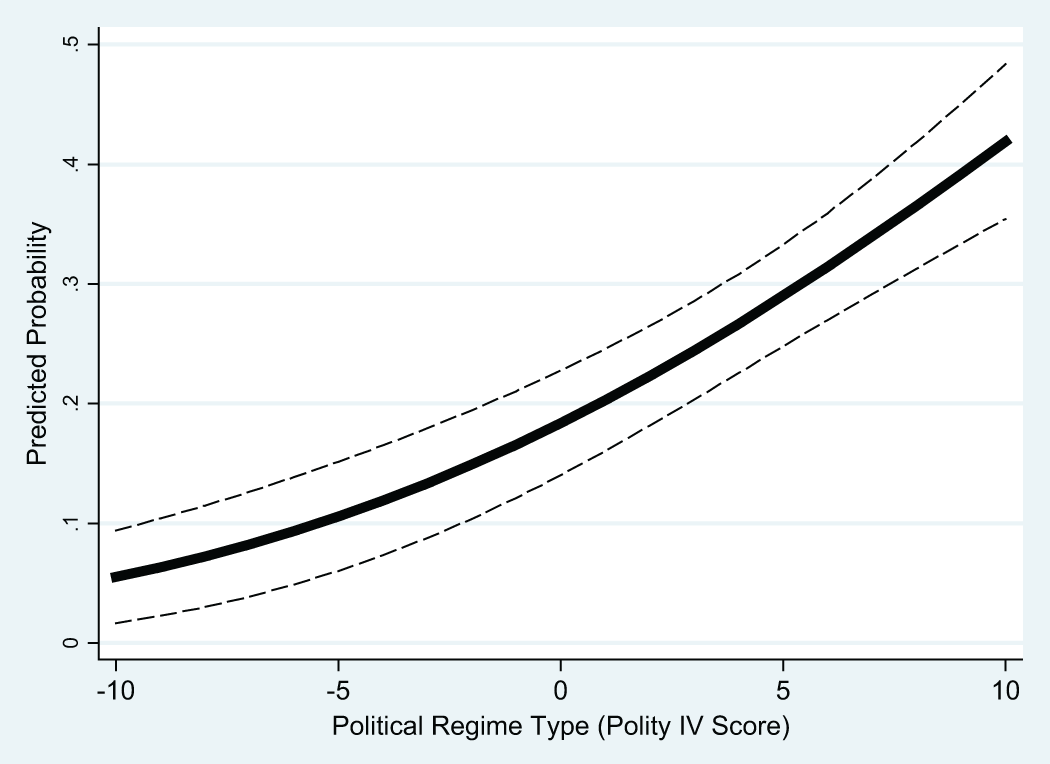
Predicted probability for medium legalism dispute settlement mechanisms (DSM) according to change in political regime type
Figure 2 examines the effect of emulation and plots the predicted probabilities for DSM legalism according to the change in spatial lag, with the estimates based on model 3. The graphs show the bifurcation of low and high legalism in relation to the emulation trend. The graph on the left tells us that a low level of legalism in previous agreements is 80 percent likely to result in low legalism in subsequent agreements. The graph on the right tells us that a high level of legalism in previous agreements is 85 percent likely to result in subsequent high legalism, but almost 0 percent likely to result in low legalism. In sum, Figure 2 provides evidence that previous agreements condition subsequent agreements through the mechanism of shared membership. Collectively, the results from the statistical analysis convey our central message that the confluence of political regime type, emulation, and multilateral trade regime plays an important role in influencing the design and adoption of DSMs in PTAs.
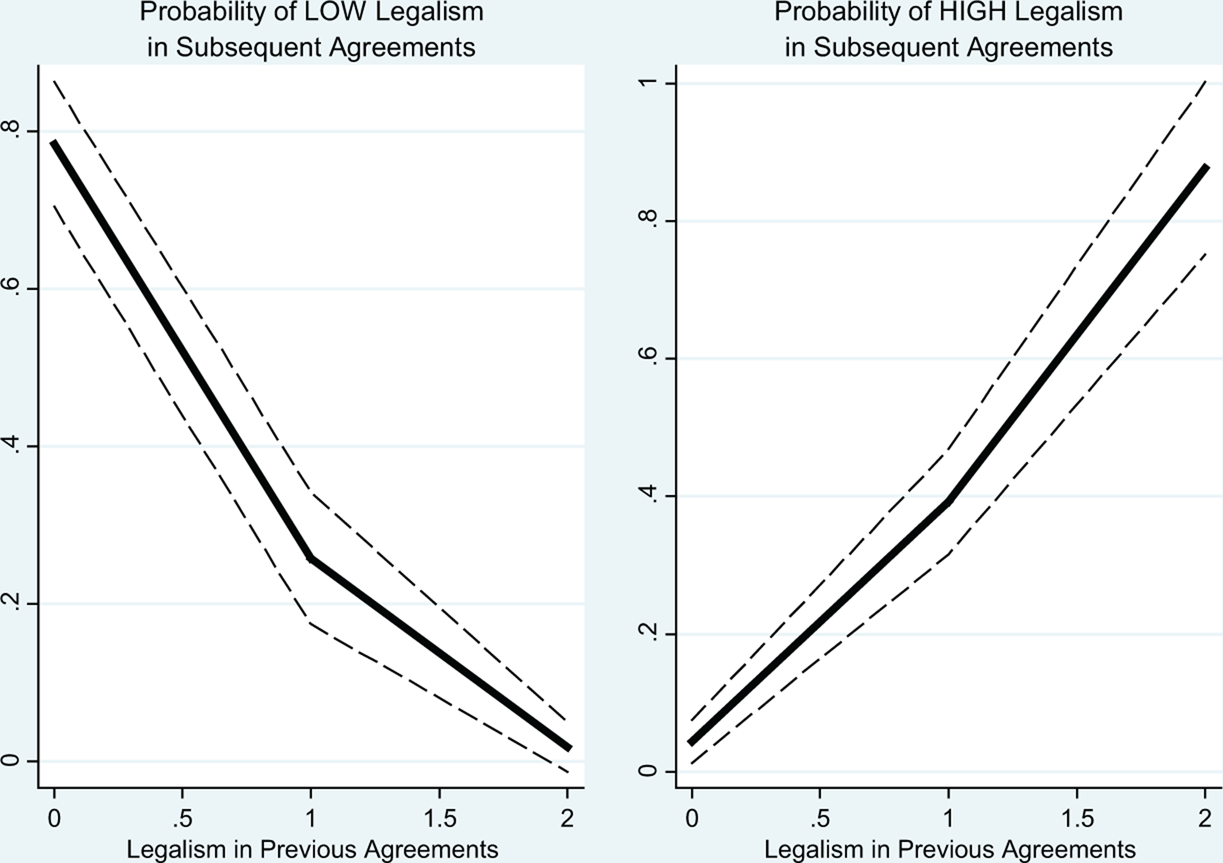
Predicted probability for the dispute settlement mechanisms (DSM) legalism in subsequent agreements according to change in legalism in previous agreements
Conclusion
This article presents several findings regarding the design of DSMs in PTAs. We show that the choice of institutional arrangements depends on three key factors: the political regime characteristics of member countries, previous institutional choices, and larger institutional developments at the multilateral level. The analysis of 221 PTA-DSMs between 1957 and 2008 demonstrates that the institutional choice of DSM is significantly driven by the combination of political regime type, emulation incentive, and multilateral trade regime. Here, by way of conclusion, we discuss the implications of these findings.
The first implication concerns the institutional analysis of international agreements: both macro and micro factors matter. Microincentives and considerations of domestic politics lead democracies to favor a medium level of legalism in the DSMs they adopt. At the same time, macro factors, such as emulation patterns and the current multilateral trade regime, shape the institutional choice of DSMs in PTAs. This analytical framework has broader implications for the institutional design of international institutions, as well as for related issues of legalization. While the Rational Design project (Koremenos, Lipson, and Snidal 2001) mainly focused on micro-level incentives, our analysis shows that we need to be attentive to both micro-level incentives and macro-level patterns in institutional analysis. This article also shows, in line with the legalization thesis (Abbott et al. 2000), that legalization does not occur in a political vacuum, but that the delegation of dispute settlement functions is subject to domestic as well as international political conditions.
The second implication is more practical and pertains to the influence of the current global trade regime. Now that about twenty PTAs are being signed every year, the perspective on future institutional development offered by this article may serve as an interim assessment of what could be a larger long-term trend. What the trend implies for the actual use of DSMs is not yet clear, as many PTAs were signed after 1995 and dispute resolution patterns under PTAs are not easily observable. On one hand, the proliferation of decentralized arrangements for dispute settlement may portend the partial erosion of the current multilateral system of dispute settlement directed by the rule-based WTO dispute settlement system. The available evidence shows that, at least on paper (Bown 2005), countries are increasingly opting for arrangements that set the stage for a greater degree of freedom in settling disputes. This signifies that countries increasingly prefer to leave themselves the option of conducting most trade matters using negotiation, thereby avoiding direct and public arbitration under the auspices of the WTO DSB. This may ultimately result in the decline of benefits traditionally associated with multilateral regimes, in particular the benefits of information sharing mechanisms (Maggi 1999) and the value of deterrence (Yarbrough and Yarbrough 1997).
On the other hand, this trend in DSM design does not necessarily mean that states will actively use the PTA-DSMs. 27 We have analyzed de jure choices of DSMs but de facto decisions made in the implementation stage may be guided by different political calculations. 28 The letter and spirit of the agreements may not be followed during the prebargaining stage or before resorting to an existing DSM. States still use the WTO DSB as a legitimate forum (Davey 2006) and whether states will in fact use newly created DSMs rather than multilateral forums is subject to future empirical investigation. The forum-shopping behavior of countries in the coming decade is going to be of utmost interest to future researchers, 29 as countries go about implementing the preferential trading agreements that they have signed. Whether these legalistic measures will be experienced as stumbling blocks or, instead, as building blocks is a matter that will be tested when future scholarship systematically assesses the behavioral impacts of these written rules.
Footnotes
Declaration of Conflicting Interests
The authors declared no potential conflicts of interest with respect to the research, authorship, and/or publication of this article.
Funding
The authors received no financial support for the research, authorship, and/or publication of this article.
Notes
References
Supplementary Material
Please find the following supplemental material available below.
For Open Access articles published under a Creative Commons License, all supplemental material carries the same license as the article it is associated with.
For non-Open Access articles published, all supplemental material carries a non-exclusive license, and permission requests for re-use of supplemental material or any part of supplemental material shall be sent directly to the copyright owner as specified in the copyright notice associated with the article.
