







Abstract
Temporary membership on the United Nations Security Council (UNSC) has pernicious effects on the political and economic development of nations, particularly in nondemocracies. The leaders of rich democratic states often trade resources for the salient policy favors that UNSC members can deliver. This provides the leaders of temporary UNSC members with access to “easy money” resources. Such resources have deleterious consequences, particularly in nondemocracies, because they provide leaders with the means to pay off their coalition of supporters without reliance on tax revenues. While foreign aid is an important form of easy money bribe, it is but one of many. Empirical tests show loans are a substitute means for bribing UNSC members.
Keywords
Omar Bashir and Darren Lim’s “Misplaced Blame” provides a much appreciated opportunity to further clarify the predictions from selectorate theory regarding the pernicious consequences of access to easy money for newly elected members of the United Nations Security Council (UNSC). While Bashir and Lim provide new evidence that bolsters our theoretical and empirical results, we realize from their mistaken critique that we have not done an adequate job explaining the expectations about resource transfers formally derived from selectorate models. In particular, Misplaced Blame contends that the observed pernicious effects of temporary membership on the UNSC cannot be attributed to foreign aid. The basis for this conclusion is the authors’ claim to have shown that after controlling for aid, UNSC membership still has pernicious effects. This result is, as we shall explain, fully consistent with the selectorate theory.
There seem to be two sources of confusion in the critique: (1) Bashir and Lim have misunderstood central features of the selectorate logic as applied in “The Pernicious Consequences of UN Security Council Membership” as well as formalized in models on which that article is based (Bueno de Mesquita and Smith 2007, 2009a, 2009b; Smith 2008); and (2) the key statistical tests in Misplaced Blame rely on an incorrectly specified measure of foreign aid that is driven, in part, by the authors’ misunderstanding of the theory and its central distinction between the probability of receiving aid and the amount of any - if any - that is received.
The key to the errors in Misplaced Blame is its failure to recognize that aid is but one way to buy policy concessions, albeit a very important one. There are substitutes for aid as sources of what we refer to throughout our article as easy money. We tried to be clear in our 2010 JCR article as well as in other selectorate-related papers on foreign aid published both before and since, to make the point that foreign aid is but one example of relatively cheap resource transfers, sometimes referred to by us as “free resources” or as “easy money” (Bueno de Mesquita and Smith 2007, 2009b, 2010, 2011). Whichever term (resource transfers, free resources, easy money) we used in different papers, they each clearly refer to money leaders can use to help secure their hold on power without relying on taxes. We wrote in our article critiqued in “Misplaced Blame” that “access to easy money is detrimental to development, particularly in non-democratic states” (p. 669). This critical point is re-emphasized in the final sentence of our article: “UNSC elections, therefore, offer a window through which to view the effects of easy money on development” (p. 682).
To rectify misunderstandings, this article proceeds as follows. First, we summarize the theoretical arguments as to why nations on the UNSC gain access to easy money and why such free resources are detrimental to economic and political development. Then, we explain why the testable implication Bashir and Lim derives does not follow from these arguments. The third section looks at how temporary UNSC membership affects overall levels of indebtedness to show how one easy money means of buying policy concessions can be a substitute for another. Fourth, we show why the measure of aid change in Misplaced Blame fails to capture the shifts in aid patterns that accompany UNSC elections. To do so, we use simple summary statistics to differentiate how UNSC membership affects whether nations receive any aid, and if so how much, two distinct concepts in the selectorate models that are conflated in the critique.
Selectorate Theory and the Pernicious Effects of Free Resources
The primary assumption of the selectorate theory is that leaders want to retain office. Hence, they undertake those policies that maximize the probability of attaining that goal. Which policies best fulfill this ambition depends upon the institutional and economic context in which a leader rules (Bueno de Mesquita et al. 2003). Selectorate theory characterizes institutions by the size of a leader’s winning coalition without whose support a leader cannot remain in power and the size of the pool of people, called the selectorate, from which the winning coalition is drawn. Leaders are assumed to face multiple domestic threats to their tenure. They face political challenges from rivals interested in gaining power within the existing institutional arrangements and from revolutionaries who wish to overturn both the incumbent regime and the institutions of governance.
A key concern of our articles on resource transfers is to model how easy money might improve the survival prospects of donor and recipient leaders by exchanging access to money for policy concessions. We have previously shown that these opportunities for interstate deals are driven by the incentives in selectorate theory for resource allocations by incumbents as a function of the size of their winning coalition. Specifically, survival-oriented large coalition leaders (e.g., democrats) are incentivized to allocate resources disproportionately to public goods such as successful foreign and domestic policies. Survival-oriented small coalition leaders (e.g., autocrats, junta leaders, monarchs), in contrast, are incentivized to allocate resources disproportionately to private goods that benefit their coalition members.
Easy money plays a particularly important role in shaping responses to revolutionary threats such as mass uprisings (Bueno de Mesquita and Smith 2009b, 2011; Smith 2008). Citizens in small coalition systems are unhappy with their lot because their leader does little for them, preferring instead to reward loyal cronies with private goods. This provides the motivation for revolutionary change. Yet, revolutionary success is about more than simply wanting change. Revolutionaries need to organize and coordinate people’s actions. Coordination is particularly enhanced when leaders provide adequate quantities of coordination goods, meaning especially a free press, free speech, and freedom of assembly. If leaders contract the supply of coordination goods, then it is very hard for the citizens to organize effective resistance against the government. However, as seen in our models, such repressive policies can also make it hard for people to work productively, diminishing the economy a leader relies on to reward cronies.
Small coalition leaders face a dilemma. If they increase the supply of those public goods that facilitate communication and coordination, then the people can interact efficiently. This increases economic productivity and provides the incumbent leadership with a resource base they can tax and use to pay off their supporters. However, such freedoms endanger leader tenure because they allow the people to organize against the regime. Small coalition leaders can stamp out the revolutionary threat by suppressing the coordination goods that allow the people to interact efficiently. The downside of doing so is that suppressed opportunities for coordination contract the economy and reduce the resources a leader has with which to pay off supporters.
How a dictator best resolves the dilemma created by the need to retain coalition loyalty and to suppress revolutionary movements depends upon the nature of government finance. In addition to taxing productive economic enterprise, leaders often have access to other revenues that we refer to interchangeably as free resources or easy money. These resources are free in the sense that the people do not have to work to generate them. But this terminology is ironic in that access to ample such resources allows small coalition leaders to suppress the revolutionary risk by contracting the supply of coordination goods and still have sufficient resources to pay off cronies.
There are many forms of easy money. Perhaps, the most notable are natural resource rents. Their pernicious effects on economic and political development are well documented in the literature on the resource curse (Gelb 1988; Humphreys 2005; Jensen and Wantchekon 2004; Ross 1999; Sachs and Warner 2001). Foreign aid, particularly in the form of direct government-to-government transfers, is another important free resource, and one that motivated our analysis of the UNSC. But resource rents and foreign aid are not an exhaustive list. Borrowing, for instance, constitutes another important example (Bueno de Mesquita and Smith 2011). Borrowing provides the current leader with resources today, while repayment typically has to be made by a future government. From the national perspective, loans are not free resources, but unless the leader is fortunate enough to have a long tenure, they are from the leader's perspective. They constitute resources that can be used to reward supporters without relying on the productive economic activity of the citizenry. Free resources, particularly in small coalition systems, have pernicious effects (Morrison 2009). Temporary membership on the UNSC often increases the supply of free resources precisely because new members have something of value to sell their vote - even if - policy concessions they could have offered before election were not valued sufficiently to be worth buying.
Bribes
Leaders buy the loyalty of their supporters through a mix of material rewards (private goods) and the delivery of policies their backers want. Institutions and wealth affect the relative value of policy benefits compared to private financial rewards. Consider a rich, large coalition system. The leader of such a system needs to maintain the loyalty of many supporters. Buying support through the distribution of private goods is difficult because resources must be spread too thinly over many people. Furthermore, if the people are wealthy, then the marginal value of money is relatively low, meaning it would take considerably more money to compensate them for policies they dislike than if the people were relatively poor. Thus, as we show in our formal models, for democratic leaders, delivering policies the people want is important for political survival. Democratic leaders, particularly those from wealthy nations, are willing to give up resources if it helps them deliver the policies their supporters want. They are, therefore, the primary source of easy money transfers in exchange for policy concessions.
The opposite is true in poor, small coalition nations. Their leaders can more effectively ensure survival by rewarding their relatively small number of supporters with private goods rather than effective public policies that benefit all. Since each supporter’s share of any additional resources is relatively large, additional free resources make it easy for a small coalition leader to make key supporters better off. This forms the basis of a resources-for-policy exchange. Leaders who value extra resources over policy sell policy. Leaders who value policy over resources buy policy. Political institutions dictate the pattern of bribes. In broad terms, leaders in rich, large coalition systems transfer resources to leaders in poor, small coalition systems in exchange for policy concessions.
The size of bribes and whether they are made at all depends upon political and economic conditions. The price to purchase policy concessions is set within the prospective recipient nation by its coalition size, wealth and the policy salience of the issues in question. As coalition size, wealth and policy salience rise in the recipient nation, the recipient leader needs to receive larger bribes to compensate key supporters for the policy concessions demanded by the large coalition buyer. The prospective recipient will not trade policy for resources unless it makes the leader and coalition of supporters better off. Similarly, a donor will not give up resources unless the policy concessions bought are worth more to the donor's coalition than retaining the resources for domestic uses.
It is worth noting who benefits from resource-for-policy exchanges. Coalition members in both nations must be better off (in utility terms); otherwise, the exchange is not in the interests of the leaders. Such exchanges typically benefit the citizens in the donor nation too because they desire the policy concession that is purchased. The losers from such deals are the citizens in the recipient state. They stomach policies they dislike and, since most of the rewards are private benefits for supporters, they receive little compensation for enduring those policies. Further, and most pertinent for our study of the UNSC, since exchanges provide the recipient leader with free resources, these exchanges help dictators implement policies that contract freedom but improve leader survival. Thus, selectorate theory predicts that leaders of small-coalition regimes look for easy money with which to buy crony loyalty while large coalition regimes seek policy concessions to bolster the loyalty of their voters. Foreign aid, borrowing (Bueno de Mesquita and Smith 2011, especially 92–99), favorable trade relations (Bueno de Mesquita et al. 2003), and many other means are available to compensate autocrats for policy concessions if their price is not too dear.
We see now that it was our failure to assume that readers would be sufficiently familiar with the array of selectorate-related studies on free resources/easy money to understand that foreign aid is an important but not an exclusive example of such money. Our purpose in using an ironic term like free resources or in describing aid as easy money was to emphasize the broader implications of selectorate theory for the purchase of policy concessions. Indeed, in our papers on aid-for-policy deals, we thought that we were being clear that aid is a readily measured form of resource transfer, but that it is not the only way to transfer resources. Our models all denote resource transfer --with aid as the case in point --with “r,” explaining the term as a resource transfer to be added to the recipient’s total revenue (denoted R) and subtracted from the donor’s total revenue. Nothing in our models limits the resource transfer to aid. That is why we refer to these transfers as free resources or easy money. We note in our literature review in the article critiqued in Misplaced Blame that others had already demonstrated that UNSC election confers greater access to World Bank and International Monetary Fund (IMF) programs on favorable terms (e.g., Dreher, Sturm, and Vreeland 2009a, 2009b) and a host of other organizations, such as the Asian Development Bank (Lim and Vreeland 2013). Easy money comes in many forms.
“Misplaced Blame” unintentionally builds on our view of easy money, showing that other sources such as loans can substitute for foreign aid. The pernicious effects in our theory follow from being able to buy policy concessions from UNSC members with easy money, and not exclusively from foreign aid transfers. Thus, our concluding sentence and the critique make exactly the same point once one better understands the theory and its formal modeling foundations. Unfortunately, Bashir and Lim have misunderstood the theory and so argue incorrectly that “Contrary to the expectations generated by Bueno de Mesquita and Smith . . . aid bribery cannot be invoked to explain this set of results, since UNSC terms are paired with control country–periods that undergo similar and simultaneous changes in aid inflow. We should detect little difference in outcomes for UNSC members compared to nonmembers” (ms. p. 9). In the empirical section of this essay we show that properly specified in accordance with the theory, the critique’s results are fully explained by our selectorate aid-as-easy-money model.
A second important area of theoretical confusion relates to the probability of receiving easy money and the amount received. In the selectorate models, the quantity of resource transfers is essentially inversely related to the probability of receiving transfers at all. Put simply, holding the value of a policy concession constant across countries, the more expensive the purchase price, the lower the probability that the purchase is made at all. Indeed, this distinction is crucial to understanding why the theory predicts that, all else being equal, poor countries are more likely to receive easy money than rich countries but that among recipients of easy money, rich countries are expected to get more than poor countries. As we will see when we turn to the empirical portion of this analysis, “Misplaced Blame” treats the amount of aid received and, in essence, the expected amount, as linear. In selectorate theory, those who would receive the greatest amount of aid if they received aid are least likely to get aid, all else being equal, and so those getting zero aid are a mix of states with no policy concessions to sell and states with policy concessions not worth as much (in political terms) to the buyer as to the seller. This, as we will see, means that the measurement choices in “Misplaced Blame,” contrary to the authors’ expectation do not produce “similar . . . changes in aid inflow.” The critique and its operational measurement misunderstand the difference between the probability of getting aid or other easy money and the utility of such transfers, if any.
Evidence for Easy Money Substitution
As we have noted, “Misplaced Blame” finds robust empirical support for our original claim that temporary membership on the UNSC has deleterious effects in terms of reducing economic growth, retarding democratization and increasing suppression of a free media. The authors, however, claim to show that the pernicious effects of UNSC membership persists even after controlling for aid and that these persistent effects are inconsistent with our theoretical predictions. This, as should now be clear, is an incorrect inference. The selectorate theory indicates that unearned income has a pernicious effect because access to easy money harms political and economic development. Easy money provides the resources with which leaders can reward their supporters without having to provide the public goods that enable citizens to work productively. Aid is an example of, but not the only example of bribery. As we have emphasized, “Misplaced Blame” unfortunately treats aid as if it were the only means through which UNSC nations gain easy money.
The authors back up their statistical claims with anecdotal cases dealing with Nigeria and Guyana. In each case, UNSC membership appears to have had pernicious effects and yet foreign aid decreased (p. 7), allegedly contradicting our theory. It is worth looking at these cases in detail to illustrate Bashir and Lim’s (2012) failure to consider substitution effects across sources of resource transfers.
Nigeria was elected to the UNSC in 1977. By 1981, its per capita gross domestic product (GDP) had declined by 19 percent, while aid had decreased. Likewise, Guyana, elected in 1981, also experienced concurrent declines in aid and GDP. While it is true that aid to Nigeria declined drastically between 1977 and 1981, the Nigerian regime’s access to easy money greatly increased. In 1976, the year prior to UNSC election, Nigeria’s external debt stood at 4 percent of gross national income (GNI). By 1981, this figure had risen to 20 percent. While this is the money that future Nigerian leaders would have to repay, from the recipient regime’s perspective it was money they could lavish on their supporters. Such free resources are anticipated by selectorate logic to have pernicious effects. For this reason, most small coalition leaders always want to borrow (Bueno de Mesquita and Smith 2011, chap. 4). What limits borrowing is the willingness of others to lend. This constraint appears to have been significantly relaxed after Nigeria’s election to the UNSC in 1976.
Guyana exhibits a similar pattern. In 1980, the year prior to election to the UNSC, Guyana’s external debt was 149 percent of GNI. By 1982, the debt had jumped to 238 percent. What is more, as the overall debt climbed, the proportion of the debt granted at concessional rates increased from 27 percent to 35 percent. While Nigeria or Guyana experienced a decline in aid during their spell on the UNSC, their leaders greatly increased their access to other sources of unearned income.
The anecdotal evidence, it turns out, is consistent with the substitution effect we claim reflects alternative sources of easy money bribes. Anecdotes are one thing; demanding tests are quite another. We turn, therefore, to a systematic test of the substitution hypothesis implicit in the selectorate focus on resource transfers as easy money bribes.
Substitute Bribes
As we have noted, foreign aid is a common form of easy money for governments, so on average we believe it has detrimental effects. As we have also noted, leaders like to borrow to get hold of resource transfers now while shifting the cost of payment to future leaders. Now we examine whether borrowing may substitute for aid. Indeed, we show that on average UNSC membership leads to an increase in external debt. However, this effect is suppressed in UNSC members if they receive a significant increase in foreign aid. That is, there is a clear substitution effect between borrowed money and aid money.
To examine the substitutability of aid and loans as means for resource-for-policy deals for UNSC members, we examine how UNSC membership and access to aid affects the stock of external debt. We use the World Bank’s World Development Indicator of external debt stock as a percentage of GNI (DT.DOD.DECT.GN.ZS) as our measure of debt. All other data and variables are as in our original article.
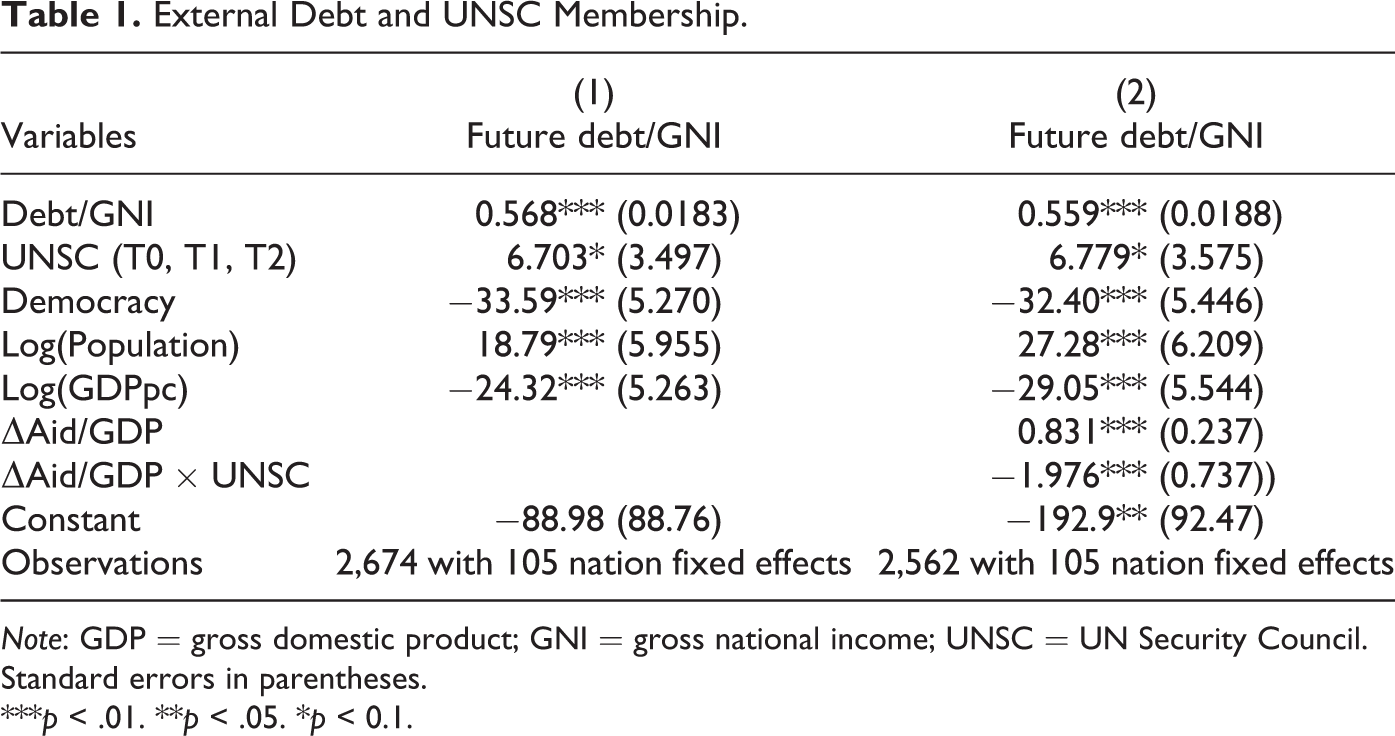
To analyze substitution effects between aid and debt, we examine how the size of the external debt changes over the next four years as a function of existing debt, UNSC membership, aid flows, controls for political institutions, per capita wealth and population, and fixed effects for each nation for each nation-year observation. The results of these fixed effect regressions are shown in Table 1.
External Debt and UNSC Membership.
Note: GDP = gross domestic product; GNI = gross national income; UNSC = UN Security Council. Standard errors in parentheses.
***p < .01. **p < .05. *p < 0.1.
The dependent variable in models 1 and 2 is the level of debt four years into the future. As in our original article, we focus on four years because this is the time after election to the UNSC that nations again become eligible for UNSC election. The variable UNSC takes the value for the year of a nation’s election to the UNSC, and during the two years during which it serves (T0, T1, and T2). Otherwise it is coded as zero. Aid here is measured as total aid from all donors as a percentage of GDP. The change in aid variable, ΔAid/GDP, subtracts the average level of aid as a percentage of GDP over the preceding two years from the average level of aid as a percentage of GDP in the current and two following years: ΔAid/GDP = (Aid/GDP t + Aid/GDP t + 1 + Aid/GDP t + 2)/3−(Aid/GDP t − 1 + Aid/GDP t − 2)/2. Although in the same spirit as the Δaid variable in Misplaced Blame, this formulation avoids the problems of division by zero or near-zero values which plagues the specification in Misplaced Blame. In addition, our variable represents the change in aid resources on the scale of the economy and government spending. The pathologies associated with Δaid variable in “Misplaced Blame” are explored in a later section.
As expected, the best predictor of future debt is the current level of indebtedness. The analyses also indicate that small, rich democracies accumulate debt more slowly than large, poor nondemocracies. We focus attention on the impact of UNSC membership and the impact of aid.
Both models indicate that UNSC membership leads to an increase in future debt of around 7 percent of GNI. Model 2 examines how aid affects the accumulation of debt. For nations outside the UNSC, an increase in aid leads to an increase in accumulated debt. If the average increase in aid is 1 percent of GDP, then debt increases by about .6 percent of GNI. A radically different pattern is observed for nations that are temporary members of the UNSC. The variable ΔAid/GDP × UNSC represents the interaction between the increase in aid and membership on the UNSC. For nations that are UNSC members, the effect of aid on debt is given by the sum of the two aid coefficient estimates. This suggests that while UNSC membership increases debt by about 7 percent, aid reduces the accumulation of debt by UNSC members. If aid increases by an average of around 1 percent of GDP then the accumulation of debt will also be reduced by about 1 percent. Likewise, if aid decreases then debt increases by about the same amount. This is clear evidence of the substitutability of aid for debt or debt for aid. In exchange for a new UNSC member’s support, a donor has a choice to step up loan access or aid access. The details behind that choice is likely to be situation specific and beyond the scope of this brief article.
To sum up, leaders seeking to bribe UNSC members for policy concessions can use multiple means of doing so. The substitutability between increased borrowing capacity and aid undermines the premise of “Misplaced Blame.” Even if an UNSC nation receives no increase in aid, its leader is still likely to experience an increase in easy money.
UNSC Membership and Aid Prospects
Having articulated an erroneous implication, Bashir and Lim (2012) seek to test it. They argue that if aid is responsible for economic and political declines, then, once the level of aid is controlled for, temporary UNSC membership should have no additional deleterious effect. To carry out the test they calculate the percentage change in aid. They then match temporary members of the UNSC with nations that are similar to them on the basis of democracy, per capita income, population, and changes in the amount of aid given. Then they calculate the difference in difference on a number of performance measures. Such matching was one of the methods used in our original article. The empirical result claimed by the authors is that even after controlling for changes in the amount of aid, the UNSC still has pernicious effects. Their expectation is that if aid is solely responsible for the pernicious effect, then, once aid is controlled for, UNSC membership should have little impact on economic growth. As we believe we have now made clear, this inference does not follow from the selectorate theory because aid, in that theory, is not the only source of easy money. However, putting aside the theoretical error which we have already addressed at length, even if the theory implied what Bashir and Lim claim, their variable measuring the change in aid fails to provide a metric for appropriately matching similar cases as it fails to account for patterns of aid distribution.
“Misplaced Blame” codes the change in aid variable upon election to the UNSC as ▵aid = (aid_after − aid_before)/aid_before, where aid_after = (aid T 0 + aid T 1 + aid T 2)/3 and aid_before = (aid t − 1 + aid t − 2)/2 where the subscripts t − 1 and t − 2 indicate the two previous years. The same variable can be constructed for each nation-year for nations not on the UNSC. Although this formulation is straightforward, the operationalization means that very different circumstances can lead to the same measure for ▵aid. As a result, this variable poorly matches like with like.
Suppose, for example, a nation receives a token level of aid, say $1,000 per year. This token level might double to $2,000 per year. This is a 100 percent increase in the level of aid, but on the scale of the resources a leader must spend on the leader's coalition of supporters (which is central in our selectorate models of easy money transfers), it is almost certainly a trivial amount. In contrast, aid might increase from 20 percent to 30 percent of government revenues. This increase would be only half the increase of the former example given the operationalization in “Misplaced Blame” but in terms of easing a leader’s reliance on tax revenues derived from productive economic activity to sustain coalition support, it would constitute a huge difference.
While we might suppose such hypothetical examples are contrived, the pattern of aid distribution suggests otherwise. It is useful to turn to the example of Egypt cited in “Misplaced Blame” (p. 7). U.S. aid to Egypt increased threefold upon its election to the UNSC in 1960. However, in part this is because while U.S. aid jumped from $8.3 M in 1959 to $12.4 M in 1960, $14 M in 1961, and $38.6 M in 1962 (in 1996 constant dollars), the percentage increase is greatly inflated by the very low figure of only $0.1 M in 1958. If nations receive only token levels of aid, then the denominator in the ▵aid calculation is near zero, so that even relatively modest amounts of aid can appear as enormous percentage increases. The calculation of ▵aid becomes even more problematic when we consider that on average about 18 percent of nonhigh-income nations receive no U.S. aid. In these cases, the denominator for ▵aid is zero and so ▵aid cannot be calculated. Yet, the selectorate theory indicates that getting aid (going from zero to a positive quantity) is distinct from and not monotonic with the amount of aid demanded or received.
It is essential in evaluating the selectorate claims to separate the quantity of aid and whether a nation received any aid at all. As our formal models show, the amount of resources a donor needs to transfer to get the recipient leader to grant the requested policy concession depends on the cost to the recipient leader for paying off its coalition as compensation for the concession. As coalition size, wealth and the salience of the policy increase in the recipient state its leader requires a larger bribe before agreeing to the policy concession. If the price of policy concessions becomes too large, then no bribe occurs. The interpretation of zero aid (or probably more generally token amounts of aid) is not as straightforward as its incorrect treatment in “Misplaced Blame” assumes. Bashir and Lim are not alone in conflating the probability of getting aid at all and the amount of aid received.
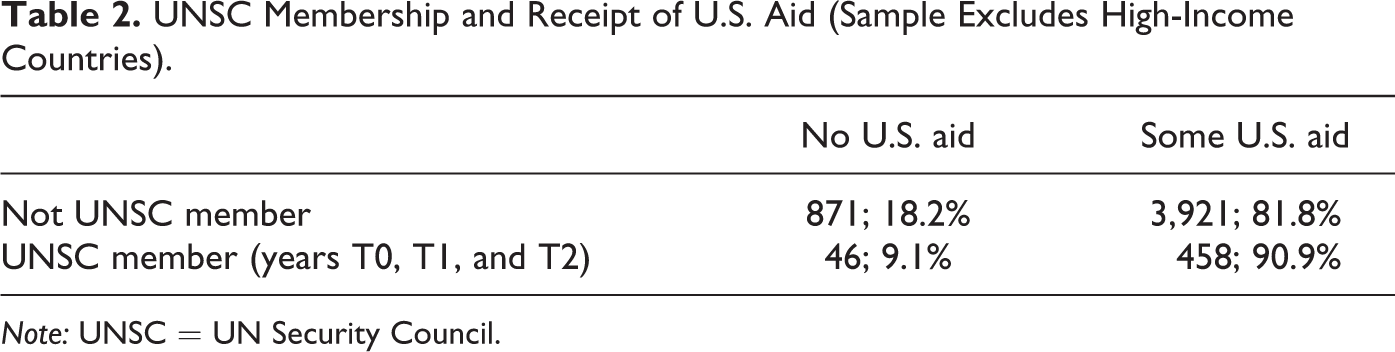
In their study of aid and UNSC membership, Kuziemko and Werker (2006) examine ln(aid + 1). In doing so, they conflate the effects of those states previously receiving aid who now get more with states previously not getting aid who first receive any. UNSC membership gives states salient policy favors to sell. This means that on average, nations elected to the UNSC are more likely to get aid if they were receiving none and to get some more aid if they were already receiving aid before election. Table 2 illustrates the former effect. It shows whether nonhigh-income countries receive any aid from the United States. The unit of observation is the nation-year. The top row shows nations outside the UNSC. The second row looks at nations in the year of their election and the two years they serve on the UNSC (T0, T1, and T2).
UNSC Membership and Receipt of U.S. Aid (Sample Excludes High-Income Countries).
Note: UNSC = UN Security Council.
The differences are stark. While about 18 percent of nations receive no aid from the United States, this figure is cut in half to about 9 percent for nations elected to the UNSC. As Kuziemko and Werker (2006) show, UNSC membership increases aggregate aid by 56 percent. However, this aggregate is composed of two separate effects. Nations already receiving aid get more, on average. And UNSC nations are more likely to become aid recipients, moving from zero to some positive quantity. An unfortunate consequence of the construction of the ▵aid variable is that the latter cases are dropped due to division by zero and yet they are cases of great concern in the selectorate models of resource transfers.
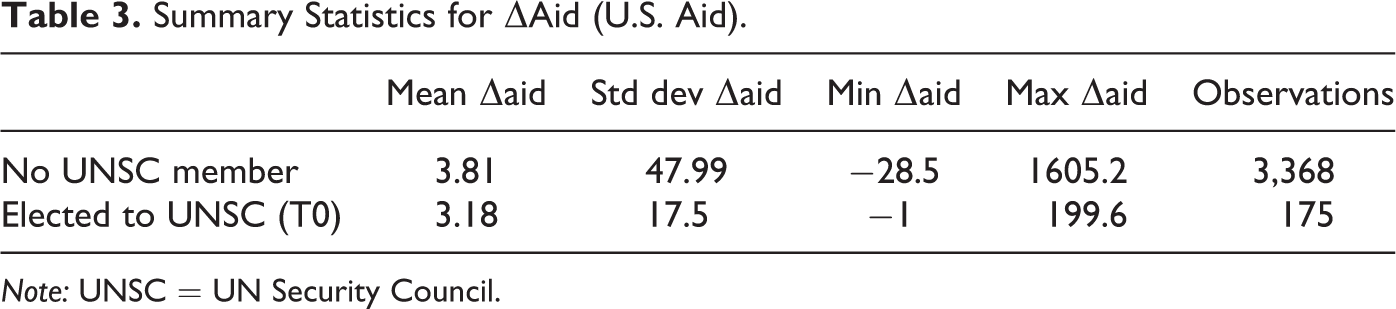
Unfortunately, the problematic construction of the ▵aid variable invalidates it for matching cases because it eliminates the salient cases and mistreats cases with low baseline levels of aid. As we saw in Table 2, UNSC membership substantially increases access to aid. If the ▵aid variable reflects this trend, then we should expect nations elected to the UNSC to experience greater increases in the amount of aid they receive. Table 3, which shows summary statistics for ▵aid calculated for U.S. aid, suggests otherwise. Non-UNSC nations actually appear to experience a higher average increases in aid, 3.8 versus 3.2. That the ▵aid measure has an over threefold mean increase in aid suggests its suspect nature. T-tests and nonparametric rank-sum tests reject there being differences between the aid increases of UNSC members and other nations. Although Table 3 looks only at change in U.S. aid, examinations of the other aid variables used for matching follow a similar pattern. The trouble is that the ▵aid variable’s construction renders it extremely volatile as the denominator approaches—or equals, as in new aid recipients—zero.
Summary Statistics for ▵Aid (U.S. Aid).
Note: UNSC = UN Security Council.
The pathologies of ▵aid mean it is a poor and misleading measure to control for leaders’ access to easy money in the form of aid. The interpretation of the empirical results in Misplaced Blame depends upon ▵aid accurately matching like cases. The tests do not substantiate the claims made that are based on them. One might propose constructing an alternative measure for the level of aid flows, such as the one we used in the tests in Table 1. However, we believe such additional tests would be pointless for the theoretical reasons made earlier. There are many substitute mechanisms for bribing nations so matching on the basis of aid does not equate to matching on access to easy money. As we saw in Table 1, aid and borrowing are two (of a larger set) of the possible substitutes for regime bribes.
Conclusion
We believe that we should close with the cautionary note from our original article that “the analysis cannot rule out some other as yet undiscovered mechanism through which UNSC membership undermines development” (682). However, “Misplaced Blame” offers neither a refutation of the deleterious effects of easy money nor develops any alternative explanation to that provided by the selectorate models of resource transfers. Furthermore, its empirical results do not show what the authors claim and, even if they did, the derivation behind their testable implication does not logically follow from the theory. The analyses in “Misplaced Blame” reinforce the evidence that temporary membership of the UNSC has pernicious consequences for political and economic development, particularly in nondemocratic nations.
Footnotes
Declaration of Conflicting Interests
The author(s) declared no potential conflicts of interest with respect to the research, authorship, and/or publication of this article.
Funding
The author(s) received no financial support for the research, authorship, and/or publication of this article.