







Abstract
For more than two decades, private military and security companies (PMSCs) have become increasingly involved in armed conflicts. A common view is that PMSCs are menaces who simply take economic advantage of—and thereby aggravate—already bad situations. Yet, empirical research has rarely investigated these claims or the impact of commercial actors’ selling force-related services. This article investigates how PMSCs impact the severity of armed conflict in weak states and advances the argument that PMSC services increase the client’s military effectiveness. In turn, increased military effectiveness translates into increased conflict severity, the extent of which depends on type of service provided by the PMSC, the level of competition on the market, and oversight.
In 2000, Doug Brooks—the then president of the International Stability Operations Association—asked whether private military and security companies (PMSCs) that intervened in conflicts were “messiahs” or “mercenaries” (D. Brooks 2000b). Brooks’s question strikes at the heart of the debate: how does the presence of PMSCs affect conflict dynamics?
Though “PMSC” was not coined until the 1990s, the phenomenon behind the term is years older. In the 1970s and 1980s, a handful of British firms had already begun offering security and military training, consultancy, and support services as commodities on the market (Kinsey 2006, 47, 51; O’Brian 2000, 46). By the early 1990s, however, observers noted a qualitative shift in the market for force (Avant 2005). Firms had professionalized into corporate actors, expanded in size, and diversified their services portfolio (Percy 2007, 206; Singer 2003, 49). Currently, twenty-first-century PMSCs are legal entities that offer an array of force-related services: armed protection, which comprises security and guarding tasks and, more rarely, combat; consultancy and training services; and support services, including logistics for militaries, demining, and the maintenance of weapon systems and/or installations (Avant 2005, 16-22).
Though multiple factors spur the growth of the private military market, demand partly comes from failing or failed states. After the Cold War ended, many weak states faced dwindling support from Western states, especially reduced Western military presence in more unstable regions, which resulted in a security capability gap (Singer 2003, chapter 4). Due to the declining standards of the armed forces in many weak states, governments were no longer able to overcome local insurrections (Shearer 1998, 27). As an alternative, these weak states increasingly turned to the market to bolster their security and military capabilities. Overall, of thirty-two failing or failed states, twenty-seven sought PMSC services from 1990 to 2007 (Branovic 2011, 23-24).
Surprisingly, literature addressing armed conflicts has paid only scant attention to the repercussions of PMSC involvement in armed conflict in weak states. One reason for such neglect may be that research has traditionally focused less on the impact of single actors in favor of structural variables, including regime type, military power, and natural resources (Cunningham, Gleditsch, and Salehyan 2009, 571). Similarly, literature addressing PMSCs has only rarely investigated their involvement in armed conflicts. While some studies have illuminated the reasons why and under what conditions mercenaries are hired in civil wars (Kinsey 2007; Chojnacki, Metternich, and Munster 2009), others have produced case studies of the repercussions of PMSC involvement in armed conflicts (Shearer 1998; Vines 2002; Fitzsimmons 2013a; Dunigan 2011; Petersohn 2011). Yet, only recently have these strands of literature begun both to develop theories to describe PMSC involvement in conflicts and to investigate the consequences of such involvement with quantitative means. For instance, Seden Akcinaroglu and Elizabeth Radziszewski (2013) have examined with statistical means the impact of PMSCs over the course of civil wars in Africa, while Ulrich Petersohn (2014) has studied how mercenaries and PMSCs impacted the severity of civil wars from 1947 to 2007. By extension, the present study seeks to contribute to the discussion of PMSC involvement in conflicts by investigating how different PMSC services and the level of PMSC performance affect conflict severity in failing or failed states.
In the next section, this article proceeds by developing both a theory-based explanation of how PMSCs influence conflict severity and three testable hypotheses. Broadly put, this article argues that PMSC services increase the military effectiveness of weak states (Shearer 1998, 65), as long as military effectiveness refers to the ability of the client’s forces to inflict damage upon the enemy and expand military operations. Nevertheless, the extent to which PMSCs improve military effectiveness depends on the type of service provided and the level of PMSC performance, the latter of which depends on the level of oversight and competition. This article then outlines the operationalization of variables, introduces the data sources, and describes PMSC presence in armed conflicts. Finally, an analytical section puts the hypotheses to the test and discusses the results.
Considerations of Theory
A concern widely debated in the literature is that the presence of PMSCs increases the severity of hostilities, as they lack the proper motivation to fight or are simply “lover of war” with a “cowboy persona” (Taulbee 1998, 154; Carmola 2010, 140). Due to their contingent motivation, they use excessive force, perpetrating massacres, looting, and spreading instability (Human Rights First 2008, 3-4; Burchett and Roebuck 1977, 8). However, this is rather a normative judgment, as Western military personnel enlist for similar reasons—adventurism and a stable income, to name two (Pung et al. 2008)—yet are usually not blamed for perpetrating similar acts.
To grasp the relationship between PMSC deployment and conflict severity, the military capability aggregation approach has proven more worthwhile (see Bensahel 2007, 11). This approach assumes that members of military alliances can increase their military effectiveness by supplementing and combining their military capabilities (Bensahel 2007, 187-90). As aforementioned, military effectiveness here refers to a military’s ability to inflict damage upon the enemy and win battles (Reiter and Stam 1998, 260; Millett, Williamson, and Watman 1986, 37). In the early literature addressing PMSCs, the logic of capability aggregation is often implicit. Military capabilities bought on the market are simply added to the client’s capabilities, and as a result, military effectiveness improves (Shearer 1998, 65). However, the approach oversimplifies the production of military effectiveness. First, military effectiveness is not only determined by adding up military hardware but constitutes a multidimensional concept (R. Brooks 2007, 9-10). Second, the approach assumes a constant outcome of military effectiveness and does not differentiate types of military capabilities or count different performance levels of the market actor. However, both of these factors—albeit differently—may well contribute to military effectiveness.
More recently, the PMSC literature has overcome these limitations by introducing more sophisticated approaches to military effectiveness. Molly Dunigan’s (2011, 33-35) groundbreaking investigation of PMSCs influence on the democratic war-fighting advantage applies Risa Brooks’ comprehensive framework of military effectiveness. Scott Fitzsimmons (2013a) looks at the interaction of different military cultures to determine battlefield performance of mercenaries in Africa. Building on Dunigan insights, the exploration at hand will draw on Brooks’s concept for analyzing how military effectiveness is produced. From this perspective, specific properties of the military organization are indicators of military (in)effectiveness (R. Brooks 2007, 7). In general, military effectiveness depends on the military’s level of integration—its coordination of strategic, operation-related, and tactical activities—as well as its level of responsiveness, or ability to adapt military activities to available capabilities and adversaries’ actions. It also depends upon its level of skill, or the competency of military personnel, and the quantity and quality of material resources, a term including the quantity of personnel and quality of equipment (R. Brooks 2007, 9-15). 1 The more that these four features are developed, the more effective the military will be. However, the ultimate goal in increasing integration, responsiveness, skill, and resource quantity and quality is to improve the military’s ability to inflict damage upon the enemy and prevail on the battlefield. As such, the extent to which PMSCs increase military effectiveness depends on two factors: the PMSC’s type of service and level of performance.
Military Effectiveness and Different Types of PMSC Services
Roughly, PMSC services can be categorized into one of three groups: armed combat and security services, training and consultancy expertise, and support services (Singer 2003, 91).
For one, PMSCs can be contracted to provide armed services, such as combat and security. PMSCs who provide armed services are hired to either replace or directly support host nation forces on the battlefield (Dunigan 2011, 3), and the sudden influx of highly trained military operatives tremendously increases the client’s overall military skills and responsiveness. Combat providers may also improve the client’s offensive and defensive war-fighting skills and responsiveness by bringing, for instance, new tactics to the battlefield, by introducing the capacity to conduct air-to-ground attacks, and by setting up superior command-and-control systems (Fitzsimmons 2013a, 23-24). Security contractors, in contrast to combat providers, are contracted to perform defensive tasks only. Still, they improve the client forces’ overall defensive fighting skills and responsiveness, as well as bolster the availability of offensive resources. PMSC personnel can furthermore relieve combat troops of guarding services and make them available for military operations. As such, PMSC personnel deployed to perform combat and security services directly increase the ability of the client’s armed forces to perform on the battlefield. Ultimately, then, their improved fighting skills and responsiveness increase the forces’ ability “to inflict damage upon the enemy” (Millett, Williamson, and Watman 1986, 37), as well as the government’s ability to extend military operations (Ross 2004, 58-59). From this angle, both factors—increased fighting capability and extended operations—are expected to significantly increase conflict severity.
PMSCs are also often hired to provide consultancy and training to domestic or host nation forces. In contrast to combat and security PMSCs, consultancy and training PMSC personnel do not replace host nation forces, but instead seek merely to improve the client’s operational military skills and responsiveness, thereby enabling them to conduct more elaborate battlefield maneuvers and better adjust to opponent tactics. Furthermore, their training courses can increase the client’s in-house tactical skills and responsiveness. Altogether, such support increases the client’s ability both to inflict damage on the battlefield and to expand combat operations. In this sense, increased military effectiveness can also be expected to increase conflict severity. However, the presence of consultancy and training PMSCs tends to increase conflict severity to a lesser extent than that of armed PMSCs due to the difference in military competency. Though local troops are better trained, they have to perform the fighting and are not replaced by PMSC personnel. Relatively speaking, the operatives of combat and security PMSCs command higher operational and tactical skill than the forces—even the trained forces—of weak states.
Lastly, PMSCs can be contracted to support armed and police forces or intelligence gathering. This improves the responsiveness of the client’s armed forces, while those firms’ information furnishes commanders with a clearer picture of the enemy’s positions and intentions. Overall, such support increases the client’s operational responsiveness in the sense that the client’s forces can better adjust to enemy operations and deploy troops more efficiently. Again, the increase in military effectiveness can be expected to increase conflict severity, yet also again, PMSCs hired to reinforce the intelligence of armed and police forces are even less likely to increase conflict severity than consultancy and training PMSCs. While the latter firms increase the client’s direct tactical fighting skills and responsiveness in one way or another, intelligence firms improve operational responsiveness only.
Another aspect of PMSC support comes in the form of logistics and support contractors, who improve the availability and quality of weapon systems and the logistics chain. With these PMSC services, the client’s armed forces can field and maintain their weaponry, as well as sustain a higher weapons-ready ratio, by reducing maintenance cycles. Furthermore, logistics and support PMSCs can increase the efficiency of client forces by improving the tooth-to-tail ratio (Palmer 1999). If PMSC personnel take over support tasks, then fewer fighting personnel are preoccupied with maintenance tasks, and commanders thereby have more troops available to assign to combat tasks (Cotton et al. 2010, 45). As such, only a slight increase in conflict severity can be expected given the presence of logistics and support firms, the services of which do not directly translate to improved war-fighting skills but instead expand resource availability.
In consideration of all the above, Hypothesis 1 can be written as follows: (a) the presence of PMSC services increases operational and tactical military effectiveness and, consequently, conflict severity. (b) The less the PMSC service improves the operational and tactical skills of the armed forces, the less conflict severity increases.
Military Effectiveness and the Level of PMSC Performance
When applied to PMSCs, the classical capability aggregation model assumes that the added units constantly perform at the same level. However, the performance level of market actors is not constant, and as it varies, so too does the level of military effectiveness.
The performance level of market actors fluctuates, for it depends significantly on the incentive structure of the market in which they operate (Akcinaroglu and Radziszewski 2013, 800). This is assuming, of course, that the principal (i.e., the client) and the agent (i.e., the PMSC providing the service) are rational, cost-calculating actors. 2 Though both have contractually agreed to cooperate with each other, agents have an incentive to be opportunistic, since they are primarily guided by their own interest and benefit (Ben-Porath 1980, 4). This suggests that the agent will decrease its performance level on behalf of the client to increase the profit margin. In general, the agent is in a good position to take advantage of the client due to information asymmetry. Since a company is hired to apply its superior expertise in performing day-to-day business, it has far more knowledge of the stage, quality, and extent of the effort and implementation of the contract than the client. Without access to such information, the client has difficulties assessing performance quality and might not even be aware of any poor performance. The likelihood of being punished for poor performance is therefore low, and such behavior involves little or no cost for the agent (Braun and Guston 2003, 303-4).
In particular, in a combat situation with considerable risk of harm to company personnel and assets, the likelihood of the agent to engage in the contractual task in a less than optimal, risk avers, manner is high (Akcinaroglu and Radziszewski 2013, 802; Leander 2006, 79; Singer 2003, 157). 3 Furthermore, the “fog of war” increases the principal’s difficulties to gather information on the agent’s performance, yet it increases the provider’s ability to justify any failure or lack of progress. Responsibility for problems can be shifted easily to enemy action and the complexity of the situation (Akcinaroglu and Radziszewski 2013, 801). In addition, the “fog of war” makes contracting very difficult. It is impossible to know how the conflict will develop, and therefore exact specifications of what is required and constitutes optimal performance are difficult to formulate. Contracts necessarily need to be rather unspecified due to the “fog of war” (Leander 2006, 78). This provides an opportunity for the agent to save costs by interpreting any obligations narrowly. However, an agent will prefer such opportunistic behavior only as long as little or no cost is associated with such behavior. In this sense, poor performance can lose the company a contract—it would go to a competitor—as well as harm the company’s reputation, which hinges “on speed quality, price and most importantly, results” (D. Brooks 2000a, 3). If a PMSC has a reputation for poor performance, then it will be unable to obtain future contracts. Thus, if costs of opportunistic behavior are likely to increase, the agent should be incentivized to improve performance.
The possibility of costs increases, if the information asymmetry between the agent and the client is decreased. It is therefore essential for the principal to implement an oversight structure to gather information on the agent’s performance. Though oversight can come in many forms, it always reduces the agent’s information advantage and increases the risk of poor performance being detected (Feaver 2003, 56). As a consequence, the agent should be incentivized to perform at a high level, despite having an opportunistic, profit-driven disposition (Fredland 2004, 211). Yet, as studies have shown, oversight is a particular problem in weak states (Avant 2005, 7), in which corrupt institutions and inadequate management impair the government’s ability to oversee contract performance (Akcinaroglu and Radziszewski 2013, 801). Though it is ideal for the client state’s administration to provide oversight, other oversight mechanisms—namely, competition and external actors—can be adequate substitutes.
Meanwhile, competition requires the presence of alternative suppliers (Fredland 2004, 211). To some extent, the presence and integration of other actors can remedy the government’s lack of a strong oversight structure and in particular reduce information asymmetry. As outlined above, specification for contacts in conflicts is rather unspecified, which makes it difficult for the client to establish a measure of optimal performance of the agent. A potential solution to this problem is to observe and compare the performance of different market agents (Akcinaroglu and Radziszewski 2013, 802). The performance of other actors introduces an effective measure for agent’s performance. Since all actors are subject to the similar challenges, poor progress cannot be easily justified by enemy activities. If the agent performs less or worse than other competitors, it can be attributed to a lack of effort or competence. In addition to the increased ability of the government to exert oversight, competition introduces a peer-monitoring system, that is, agents monitoring performance of other agents. Establishing an oversight structure to gather information is costly for the client, yet the same costs do not necessarily accrue if oversight is shared with market participants. Indeed, under the condition of competition, other market actors have an incentive for peer monitoring (Kandel and Lazear 1992, 811; Stiglitz 1990, 353). If poor performance is detected and publicized, the competitor’s reputation may decrease and even lead to the replacement of the agent. Peer monitoring among competitors can therefore increase information gathering and accuracy for the client. In short, with increased competition, companies become increasingly pressured to demonstrate that they can effectively meet challenges or risk both replacement by competitors and reputational costs.
Yet, the mere presence of numerous PMSCs on the market is not enough to assume competition. It must be considered that the market for PMSCs is increasingly segmented (Branovic 2011, 27). Only firms in the same segment that provide similar services can be compared and eventually replace each other. In these segments, competition might be generally limited, for only a few firms have the capability, expertise, and capital to deliver a particular service (Donahue 1989, 126). Thus, if competition is present, competitive pressure also incentivizes PMSCs to perform well (Akcinaroglu and Radziszewski 2013, 802-3), and the overall quality of the services and, in turn, military effectiveness should increase. However, if competition dwindles, the PMSC’s opportunistic behavior can increasingly go unchecked, which breeds poor performance. In prevailing, this poor performance leads to decreased conflict severity, since PMSCs shy away from combat, while poorly trained, poorly advised, and poorly supported host nation forces similarly avoid or withdraw from fighting.
As such, Hypothesis 2 holds that competition in any market segment increases both operational and tactical military effectiveness and, in turn, conflict severity.
Another option for improving oversight in weak states is applying the support of external actors: transnational actors, international organizations, and foreign governments. These institutions have developed administrative capabilities with established contracting systems and proper monitoring and sanctioning structures. If such actors are involved in contracting private security forces on behalf of weak states, they can to some extent improve the monitoring and oversight capabilities of the host state. Larger international organizations, such as the United Nations (UN), have experience of contracting in warzones and monitoring expertise and capabilities. Although international organizations may not be able to provide comprehensive oversight, they can monitor the compliance with certain standards and contractual arrangements, as such international organizations can discourage agent’s opportunism (Avant 2009, 106). Foreign governments can provide even stronger support for the weak state’s oversight capability. They may provide not only monitoring capabilities but also sanctioning capabilities. In Iraq, for instance, the US military and State Department was providing oversight, and US legal regimes to sanction misbehavior were expanded to the territory of Iraq (Petersohn 2011, 793-95). Indeed, international organizations or foreign governments cannot be expected to provide similar comprehensive oversight as a fully functioning host state, yet their presence is certainly an improvement over the total absence of oversight. In any case they increase the risk of detection and the potential cost of poor performance, PMSC performance should improve.
Or, more formally, Hypothesis 3: the involvement of external actors increases both oversight and military effectiveness and, as such, conflict severity.
Characteristics of the Conflict
The determinants of conflict severity are complex—so complex that this article will not attempt to provide a comprehensive account of all factors. Instead, the analysis here will focus on the impact of PMSC involvement in conflicts. However, into the investigation will be integrated the most common control variables: regime type, external intervention, the quality of the armed forces, and ethnic fragmentation.
Regime Type
Though numerous regime types exist, the present investigation differentiates only democracies and nondemocracies. It is widely acknowledged in the literature that the degree to which a state displays the characteristics of democracy influences the onset of civil wars (Hegre et al. 2001). However, regime type can also impact conflict severity. The rationalist approach argues that democratic leaders are elected and therefore depend on public support to remain in power. As such, officeholders are under constant pressure to generate benefits for the winning coalition or the proportion of the population necessary to ensure the officeholder’s reelection. Though winning coalitions exist in any system, in democracies coalition size is broad, which complicates generating benefits for such a large group and, at the same time, shifts costs to other parts of society (Mattes and Morgan 2004). By contrast, autocratic leaders can more easily shift costs and distribute benefits, since their coalitions consist of only a small group (Mattes and Morgan 2004; Filson and Werner 2004, 303). Since the costs of war are not fixed but accumulate over time, it becomes more difficult to deflect costs. Democracies therefore seek both to avoid bloodshed and to end wars as quickly as possible (Bennett and Stam 1996).
Another, perhaps more normative perspective of democracies suggests that they are more restrained in their actions during wartime. In contrast to nondemocracies, in which the government can suppress and even eliminate opposition, in democracies the political process is designed to generate compromise between parties and to respect human rights. Normative socialization goes beyond even individual state borders and is applied in foreign policy (Maoz and Russett 1993, 625). In essence, then, both approaches suggest that democratic regimes are less likely to resort to using excessive force in internal conflicts (Valentino, Huth, and Balch-Lindsay 2004; Harff 2003).
External Intervention
James Fearon suggests that parties in civil war face a particular dilemma; even if a peaceful solution exists on which both sides can agree, each party lacks a guarantee that the other will comply with the settlement. Without an intervening neutral party to guarantee that the warring sides will adhere to their commitment, hostilities and distrust prevail (Fearon 1995, 405-6; Walter 1997, 360). Another option for external intervention during civil war is to abandon the idea of a neutral facilitator and instead intervene on behalf of one party. Favoring this option, Edward Luttwak (1999, 38) argues that the international community should intervene on behalf of the stronger side, so that it can defeat the weaker side more quickly and decisively. However, external intervention can also increase the severity of fighting, for the additional capabilities provided by the intervener can—indeed, intend to—tip the balance of power (Krain 2005, 369). New military tactics, more sophisticated weaponry, or simply additional manpower can enable one party to strike harder and reach areas not previously fought over, and as a consequence, fighting can be expected to intensify and become bloodier. In sum, external assistance typically suggests increased severity of hostilities (Lacina 2006, 281).
Quality of the Armed Forces
For success in a military engagement, the importance of the quality of the military forces has been widely acknowledged (Van Creveld 2007; Hanson 2001). The reason is straightforward enough: skilled, well-structured, and well-equipped forces are more effective and thus likelier to achieve their military goals (R. Brooks 2007). However, the quality of the military directly influences not only the outcome but also the severity of conflict (Keen 1998, 28). Ill-disciplined, ragtag forces are often far more violent than disciplined, well-trained forces. Mueller (2000, 47-56) argues that forces of the former stripe often consist of little more than armed thugs, who are much more willing than ordinary soldiers to harass, murder, and plunder whatever they can find. Though the actions of these ill-disciplined forces may increase the number of victims in the civilian population, they may not necessarily increase the number of battle-related deaths (i.e., conflict severity). By contrast, high-quality fighting forces can fight in a disciplined manner and engage the enemy in frequent, lethal battles. In short, high-quality forces are far likelier to increase conflict severity.
Ethnic Fragmentation
In literature addressing civil war, the ethnic fragmentation of the society at war is widely used to explain the onset of civil war. However, many consider this factor to also influence conflict severity (Lacina 2006; Fearon 2004). To begin, Chaim Kaufmann argues that ethnic conflicts are different from ideological conflicts; the crucial distinction is that ideological affiliations are flexible and can change, while ethnic affiliation is fixed. Consequently, ideological conflicts can be more easily solved by economic, political, and social reforms that address certain grievances (1996, 140-41). Ethnic conflicts, by contrast, are often characterized by deep-rooted antipathy toward other groups—antipathy that is difficult to reverse and which, given the civil war, has clearly rendered peaceful cohabitation in a territory impossible (Kaldor 1999). Therefore, each side becomes willing to bear high costs in order to defeat the opponent and thereby achieve complete control of the territory (Kaufmann 1996, 139). Fearon’s “sons of the soil” mechanism is a version of this problem, in which conflict erupts if a dominant ethnic group migrates into less populated regions, often with the support of state development projects. The inhabitants of the periphery—usually an ethnic minority, or “sons of the soil”—then commit to insurgency against the migrants and their support from the state (2004, 283).
Furthermore, groups in ethnic conflicts face an intense security dilemma. If the state has broken down as a neutral institution that can regulate conflicts, the various groups must then rely on themselves for protection. However, the arming and mobilization of one group—even if ostensibly for self-defense only—pose a threat to the security of others. The severity of ethnic dilemmas increases even further if the settlements of the groups are mixed, since this circumstance renders both sides vulnerable to attacks by the opponent’s forces (Posen 1993, 28, 32). When combined with the anxiety that the other group will prevail militarily and use its prevailing position to expel or even exterminate the losing own group, this vulnerability leads to more severe, determined fighting. As such, all mechanisms suggest that ethnic conflicts are zero-sum situations in which compromises are unlikely and the stakes high for all parties.
Operationalization
The first challenge for research on armed conflict is defining the subject, since it has become quite common to integrate casualty thresholds into the definition. At the same time, the scientific community has not reached any consensus regarding where to set the bar for armed conflict. 4 Consequently, since different data sets use various thresholds, the assessment of violence in the world depends to a great extent on the data set used (Eberwein and Chojnacki 2001, 26). Yet, this article intends neither to solve the debate nor fathom its depths. This investigation has adopted the definition set by the Peace Research Institute in Oslo (PRIO), for which armed conflict is “a contested incompatibility that concerns government and/or territory where the use of armed force between two parties, of which at least one is the government of a state, results in at least 25 battle-related deaths” (Centre for the Study of Civil Wars 2012, 1).
Until recently, the dependent variable of severity in armed conflicts was often considered to be a mere byproduct of hostilities. However, conflict severity is not a random phenomenon, but the result of the conditions in which war occurs (Heger and Salehyan 2007, 386). Here, severity refers to the death toll—all casualties—civilian and military—that result directly from hostilities. However, the risk posed by using such a criterion is that it might obfuscate the actual humanitarian cost of war, since people who die from war-related hardships (e.g., famine) are not counted. Given that this investigation is interested in the severity of armed hostilities, it is reasonable to consider only casualties directly caused by combat (Lacina 2006, 278). To this end, data regarding the severity of civil wars are drawn from PRIO’s Battle Related Deaths Dataset version 5.0 (http://www.prio.no/CSCW/Datasets/Armed-Conflict/Battle-Deaths/). Though thirty countries are included in this investigation, it is important to note that casualty data refer to conflict years, of which there are 265 in the data set, all of which range from 25 to 12,054 casualties per year. In the present analysis, any results shown below reflect the average increase or decrease of battle-related deaths per conflict year.
Control variables are drawn from different sources. For one, the variable intervention, which is dummy-coded, comes from the Correlates of War project (http://www.correlatesofwar.org/). To determine the level of democracy in the state in conflict, this investigation draws on the Freedom House Index, which provides an overview over the state of political rights and civil liberties in 195 countries. Specifically, this variable differentiates “free,” “partly free,” and “not free” countries (http://www.freedomhouse.org). The quality of ethnic fragmentation is based on data used in Bethany Lacina’s (2006) data set, which is coded continuously, while the quality of military forces is measured by the military budget in a given year (in thousands of US$) and is based on the Correlates of War’s National Capability Database. Ethnic fractionalization is coded continuously and based on Fearon and Latin’s Ethnicity, Insurgency, and Civil War data set (http://www.stanford.edu/group/ethnic/publicdata/publicdata.html).
Data for the variables of interest have been drawn from the Private Security Database (PSD), which has systematically collected publicly available information on contracts between failing or failed state actors and PMSCs from 1990 to 2007. Overall, the PSD includes thirty-two countries and thirty armed conflicts. However, in the PSD, armed conflicts in failed and failing states represent only a subset of the total number of armed conflicts—thirty of sixty-seven cases. PMSCs may therefore be present in far more armed conflicts than available data suggest. Table 1 lists all armed conflicts from 1990 to 2007 in failing or failed states.
Armed Conflicts in Failing or Failed States, 1990–2007.
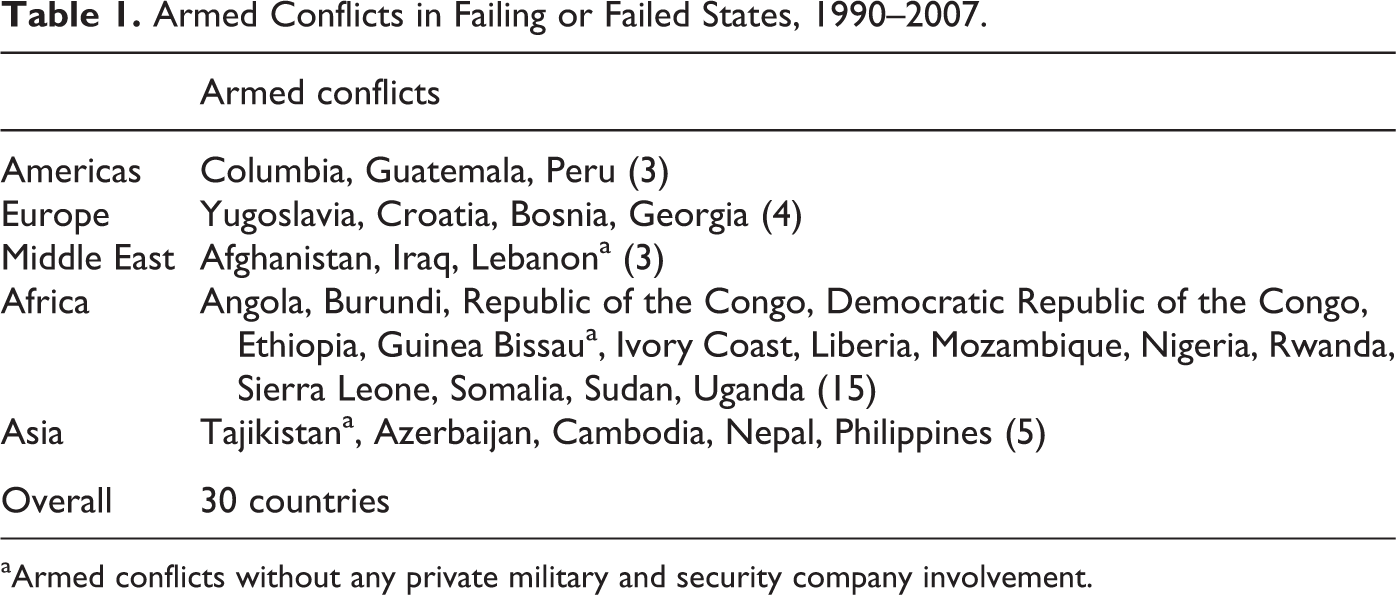
aArmed conflicts without any private military and security company involvement.
Table 1 also shows that the use of PMSCs is not limited to one world region. The plurality of conflicts with PMSC presence occurred on the African continent (fifteen cases). However, in half of all cases, PMSCs were active in Asia, South America, Europe, and the Middle East. Furthermore, as Table 1 indicates, PMSCs have been present in all of these conflicts except three. However, not conflict but conflict year is the unit of analysis in this investigation. Thus, though PMSCs have been present in nearly all conflicts, they have not been present in all conflict years. By conflict years, PMSCs have only appeared in 96 of 265 conflict years. 5
Table 2 provides an overview over the different categories of PMSC activities. In this investigation, variables are dummy-coded to differentiate the presence from the absence of a particular category of contract. These detailed data allow the impact of each PMSC activity on conflict severity to be tested (Hypothesis 1).
Private Military and Security Company (PMSC) Services.
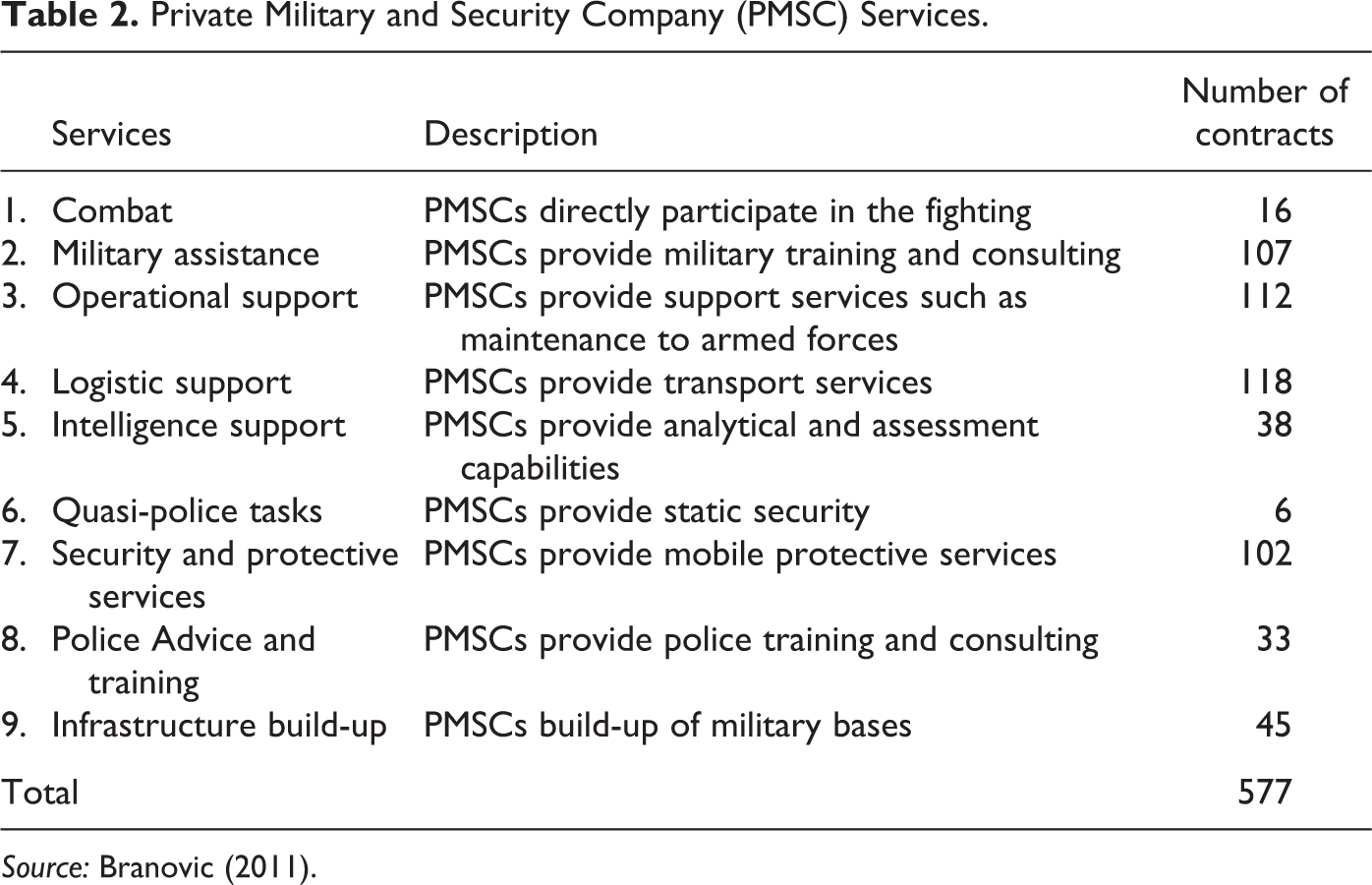
Source: Branovic (2011).
It may be objected that PMSCs are not responsible for conflict severity and that the causal relation is actually the reverse—that PMSCs are likelier to be deployed in conflicts of higher intensity. However, in empirical terms, such does not seem to be the case. For one, casualty data in the year prior to PMSC deployment show no particular pattern. However, data of the intensity of the armed conflict one year prior to PMSC deployment are available for only seven conflicts. Furthermore, and as Table 3 shows, PMSCs were not deployed in particularly violent conflicts. If compared to the average number of casualties across all conflicts in a given year, all but two cases are conflicts with casualties below average.
Severity of Conflict Prior to Private Military and Security Company Deployment.
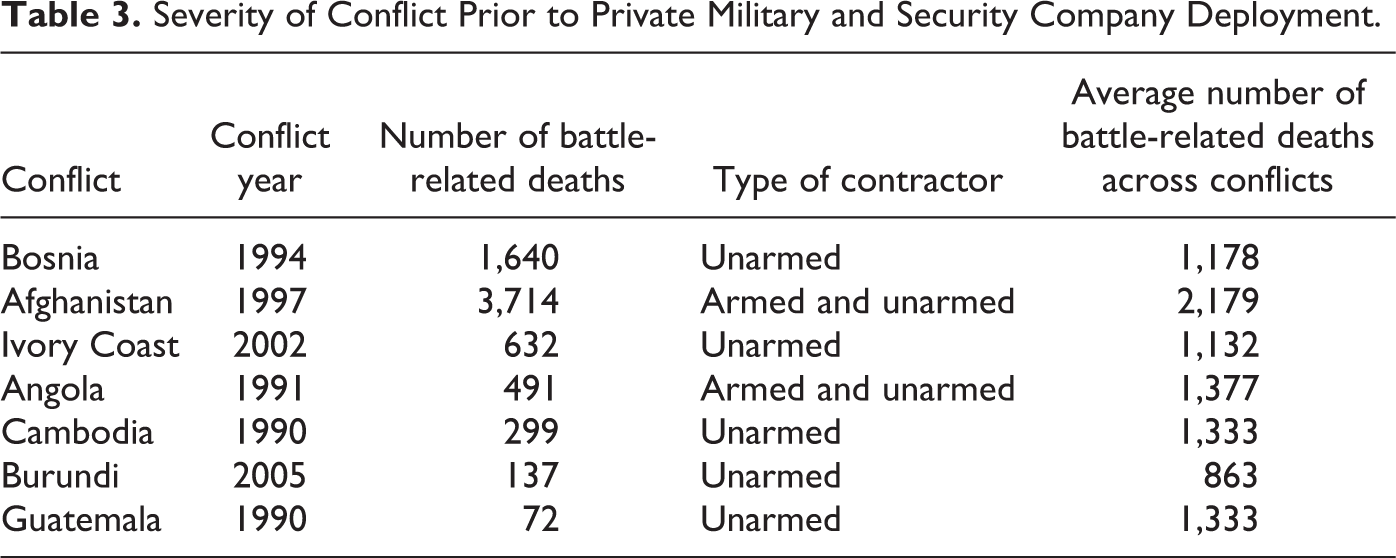
Nevertheless, armed PMSCs may have a greater chance of deployment in more intense conflicts, though armed and unarmed PMSCs are often deployed alongside each other. Of ninety-six conflict years with PMSC deployment, armed and unarmed PMSCs were codeployed in forty-nine of them, and only in fifteen were armed PMSCs deployed independently. Lastly, the casualty data prior to the deployment of PMSCs do not suggest any particular pattern of deployment. Table 3 also shows that in the five cases in which unarmed PMSCs were deployed independently, the number of casualties per year ranges from 72 to 1,640. In the two cases in which both types of PMSCs were codeployed, the number of casualties per year was 491 and 3,714. Thus, available data strongly indicate no correlated pattern between conflict intensity and deployment of PSMC, regardless of type.
To test Hypothesis 2, the level of competitiveness within market segments must be determined. Here, the assumption is that greater the number of firms present in a particular segment, the greater the competition. As such, the above introduced service categories are grouped into four market segments: combat (category 1), security (categories 6 and 7), training and consultancy (categories 2 and 8), support and logistics (categories 3, 4, and 9), and intelligence (category 5). The rationale behind segmentation is the similarity of tasks involved.
The total number of firms in a given conflict year in each individual category cannot be directly determined by using PSD data, which provide information on individual contracts only. However, information is available regarding the number of firms that provide a particular service to a particular client as stipulated by a given contract. Unfortunately, however, this information does not allow individual firms to be distinguished. A single firm may provide the same service to the same client under a different contract, the same task to a different client, or a different task to the same client. It is therefore impossible to simply total the number of firms that provide similar tasks.
Though the total number of firms in a single category cannot be determined, it is possible to determine the minimum number of firms involved in a certain segment during a certain year. As aforementioned, the PSD provides information regarding whether one or more firms is working under the same contract, which provides a basis for determining the minimum number of firms active in this category during a given year. For instance, if in a given year eight firms provide security under a single contract, then it can be assumed that at least eight firms competed in the category. However, the number of firms competing in the category may be underestimated, since it is possible that, under a particular contract, eight firms are involved, while under another contract, two firms provide similar services to the client. According to the minimum count, it would thus be assumed that eight firms competed against each other, while the remaining two would be ignored. However, the latter two firms may be entities different from the other eight, which would increase the actual number of firms in the category to ten. As such, a potential outcome of the minimum count is the underestimation of the effects of competition. Still, the strategy is preferable to simply toting up firms in a category, since the strategy precludes the risk of counting firms multiple times, measuring competition that does not exist and thereby exaggerating its effect. Furthermore, if the effects can be detected at a lower level of competition, it is safe to say that the effect also exists if competition is greater.
The PSD also collects data purporting the contractual involvement of foreign parties, including states and international organizations, which facilitates the testing of Hypothesis 3 (i.e., whether foreign contracting exerts any influence on conflict severity). In this investigation, the variable is dummy-coded to differentiate the absence and presence of foreign entities financing and/or contracting in the conflict. Overall, twenty-four parties contracted in conflict zones, though only eight contracted in foreign conflicts. Moreover, the extent to which the parties engaged in contracting and the number of conflicts in which they were involved varies greatly. In this regard, the most important actor is certainly the United States, which contracts extensively abroad, while the UN comes in at second. Table 4 shows the extent of contracting by different parties and their involvement in armed conflict.
Extent of Contracting by Party.
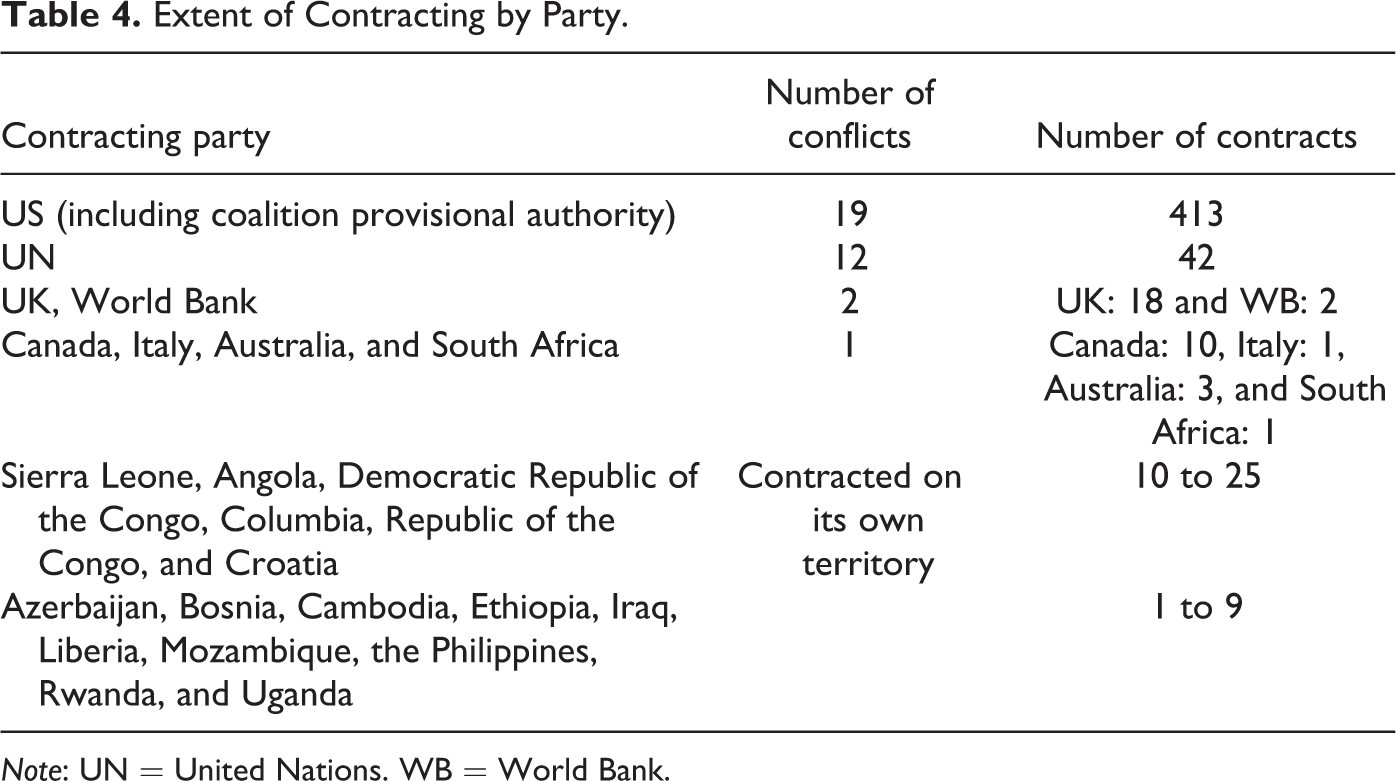
Note: UN = United Nations. WB = World Bank.
Analysis
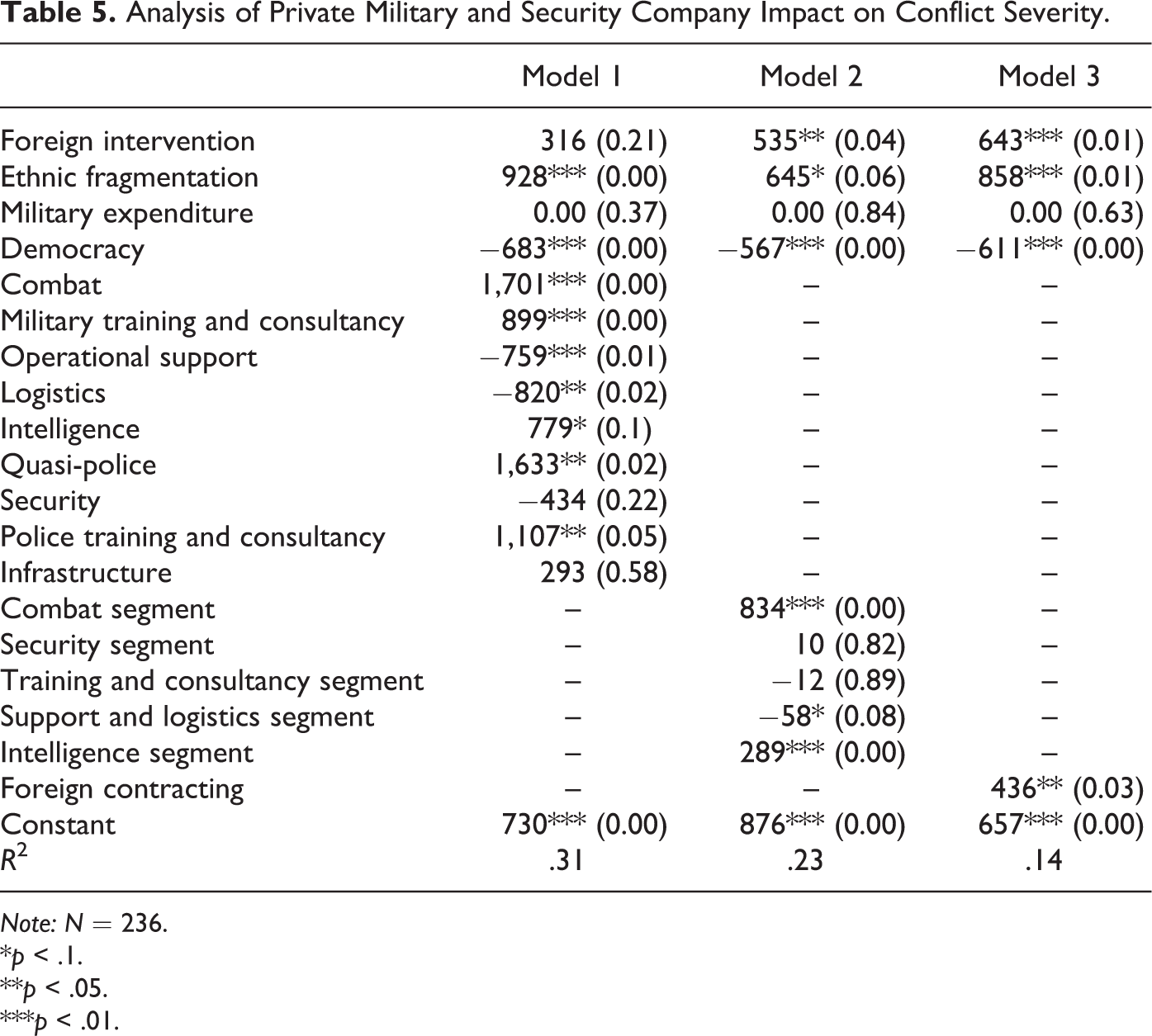
This investigation seeks to determine the influence of PMSC presence on conflict severity by using an ordinary least squares regression model. Three different models were calculated, the first of which determines the general impact of the presence and absence of different kinds of PMSC services on conflict severity (model 1). The second model gauges the extent to which competition in different market segments influences the outcome on the dependent variables (model 2). Lastly, the third model determines the influence of the presence of foreign contracting (model 3). Table 5 provides an overview of the results of the respective calculations.
Analysis of Private Military and Security Company Impact on Conflict Severity.
Note: N = 236.
*p < .1.
**p < .05.
***p < .01.
Model 1 seeks to test Hypothesis 1, which holds that (a) PMSC services increase military effectiveness and, thus, conflict severity and (b) the less the PMSC service improves the operational and tactical skills of the armed forces, the less conflict severity increases.
Results support Hypothesis 1(a) to a considerable extent. Combat services are correlated with increased conflict intensity. On average, the number of casualties per year increases by 1,701 if combat services are provided and by 1,633 in the case of quasi-police tasks. Given that conflicts in failing or failed states generally have an average casualty rate of 730 per year, this finding signifies a substantial increase and, in turn, lends plausibility to the assumption that combat PMSCs that support government forces directly increase those forces’ military effectiveness. With more skilled troops ready for deployment, the client’s leadership may act more aggressively on the battlefield, seek out direct confrontations, and expand military operations. The result would be more lethal confrontations. Moreover, this result points in the same direction as earlier research. Ulrich Petersohn (2014), for instance, has found that the presence of armed PMSCs after the Cold War has correlates with an increase in civil war severity.
Likewise, training and consultancy, and intelligence services correlate with an increase in battle-related deaths. Specifically, military training and consultancy correlate with an increase of 899 casualties on average per conflict year, while police training and consultancy tasks correlate with an increase of 1,107. In addition, intelligence services correlate with an increase of 779. These results support the assumption that PSMC training and consultancy, and intelligence provision increase the client’s operational and tactical military effectiveness. On the battlefield, the increased skill of the armed forces translates into more aggressive actions, more frequent direct confrontations, and the expansion of military operations. As a consequence, the conflict becomes more severe.
Moreover, by comparison, the increase of combat and training corroborates Hypothesis 1(b). While consultancy and training services are clearly correlated with increased severity, the increase itself is less substantial than that of armed services. This finding agrees with the claim that combat and security PMSCs have a greater impact on military effectiveness due to their higher skill level. Though training and consultancy PMSCs can still increase the skill level of the government forces, they will be unable to reach the same professionalism as PMSC operators.
Similarly, as expected with Hypothesis 1(b), the presence of operational and support PMSCs contributes even less to conflict severity. Indeed, the quality of equipment and the efficiency of resource use may increase, yet hardware and resources are less relevant for military effectiveness than how those elements are employed (Friedman, Sapolsky, and Preble 2008, 3-4). Though the direction of the impact was anticipated (Hypothesis 1b), the specific result does not uphold Hypothesis 1(a). Logistics and operational supports are correlated not only with increased but also with reduced conflict severity. Logistic services correlate with an average casualty reduction of 820 per conflict year and operational support services with 759. These results indicate that stand-alone logistic services do not apparently increase operational and tactical military effectiveness in weak states. The military organization may have improved its maintenance cycles and logistics overall, yet the war-fighting skills of the client’s national forces stay the same. As such, their ability to inflict damage to the enemy’s forces cannot be expected to improve.
However, data suggest that the presence of logistics and support PMSCs can also decrease operational and tactical military effectiveness. For this result, at least two explanations may prove useful. First, logistics and support PMSCs do not increase the operational and tactical military effectiveness of the client’s forces. The presence of the PMSC does not free up internal resources, since most weak states’ militaries do not have support and logistics structure already in place. Efficiency gains are therefore negligible, if not nonexistent. Moreover, unarmed PMSCs in a conflict zone require protection from enemy attacks, which can tie down military personnel (Cotton et al. 2010, 46), and consequently, the client forfeits effectiveness since the number of troops available for military operations has actually decreased. With fewer troops ready for deployment, military leadership may act more hesitantly on the battlefield by avoiding direct confrontations and not expanding military operations. Ultimately, the result would be fewer lethal confrontations and a general reduction in conflict severity.
Second, logistics and maintenance PMSCs improve operational and tactical effectiveness, but their services do not translate on the battlefield. Better maintained weapon systems and better logistics can give the government’s forces a material edge over the opponent. With overwhelming firepower and well-equipped forces, the government may decide to expand its military operations. However, in the face of a superior force, it is rational for the now weaker opponent to avoid engaging in open field battle and resort instead to guerilla warfare (Arreguin-Toft 2001, 107-10), the hit-and-run tactics of which are designed to negate material superiority. Since logistics and support contractors do nothing to enhance their client’s war-fighting skills, the government’s forces will simply lack the skills to make use of their increased operational and tactical effectiveness against an enemy that avoids battle. In short, logistics and support contractors increase a client’s operational and tactical effectiveness, though the advantage cannot be brought to bear on the battlefield and, as such, does not increase conflict severity.
Indeed, PMSC services are not the sole factor affecting conflict severity. In model 1, two control variables—namely, ethnic fragmentation and democracy—also exert influence on the dependent variable. Ethnic fragmentation correlates with an average increase of 928 casualties per conflict year. This result agrees with parts of the literature that assume that ethnic conflicts are more severe, since the stakes are quite high for all parties (Kaufmann 1996). Furthermore, the results of model 1 support the claim in the theory that conflicts in democracies are less severe. The more democratic a state, the less severe the hostilities appear to be. On average, fully democratic countries correlate with 683 casualties fewer than partly democratic states, while partly democratic states on average correlate with fewer casualties per year (683) than nondemocratic states. These results corroborate the findings of Heger and Salehyan (2007, 396), whose analysis shows that democracies fight fewer severe civil wars and correlate with substantial reductions in casualties.
Model 2 tests Hypothesis 2 (i.e., that competition in any market segment is expected to increase conflict severity). Here, the assumed relationship is corroborated in two market segments, yet contradicted in another. Competition indeed correlates with an average increase of casualties per conflict year across two segments: combat and intelligence. In the combat segment, competition correlates with an increase of 834 casualties and, in the intelligence segment, an increase of 289. However, in the operational support segment, by contrast, competition correlates with a slight decrease in average battle-related deaths per conflict year (−58 casualties).
Yet, the results of the combat segment need to be treated with caution. Though data indicate competition in the combat segment, this indication may be erroneous. Combat services were provided in five countries—Angola, Sierra Leone, Republic of the Congo, Ethiopia, and Columbia—the first two of which are the most influential. Nine of sixteen conflict years with combat providers present occurred either in Angola or Sierra Leone. Moreover, cases in these countries represent nearly all cases in which competition appears to be present. Though services in these two cases were provided from 1994 to 1998, the minimum number of combat providers firms per year never exceeded three. Against this backdrop, the firms active on the market can be identified with high certainty: 6 former South African firm executive outcomes (EO) and two British firms, Gurkha Security Guard (GSG) and Sandline International.
However, EO and Sandline did not compete but were subsidiaries of each other. They formed business alliances, drew upon the same personnel pool, and even cooperated on contracts (Pech 1999, 92; Musah 2000, 105). Though GSG was a separate firm, it lost credibility as a competitor. As outlined above, companies need to maintain a good reputation if they want to remain competitive. By pulling out of Sierra Leone in January 1995, GSG was commonly thought to have left the client in a vulnerable position (Singer 2003, 26). Such abandonment “damaged its [GSG’s] reputation beyond repair” and the firm was “little more than a letterhead” (Vines 2002, 136). In short, results in the combat segment may indicate a level of competition that is actually nonexistent.
The intelligence segment, however, clearly agrees with the prediction of Hypothesis 2. As expected, the presence of competition in the intelligence segment increases operational and tactical effectiveness and therefore correlates with increased conflict severity. This finding corroborates the assumption that, if faced with competition, market actors will seek to improve their performance on the client’s behalf in order to avoid being replaced by a competitor. This increased performance also results in increased military effectiveness, which increases the lethality of combat.
Finally, the operational support segment does not corroborate Hypothesis 2. Competition in the area does not appear to increase military effectiveness and, as such, does not correlate with increased conflict severity. On the contrary, the results show that competition is correlated with a slight decrease in conflict severity. According to these results, PMSC services do not appear to improve military effectiveness. As outlined above, the finding may be due either to the negligible impact of these services on military effectiveness or to the fact that such services do not improve military skill. Nevertheless, in both cases, the client should be dissatisfied and replace the PMSC with a more capable company. An explanation for the client’s behavior may be that the performance of logistics and support is not measured in terms of battlefield impact but by the number of delivered goods or the duration of the maintenance cycle (Butler 2001). Competition may therefore still lead to an agent’s improved logistical and support performance, yet the services are not expected to translate directly into an improved ability to inflict damage upon the opponent.
Overall, it would be premature to read the results as a straightforward corroboration of Hypothesis 2. Since only two of three results confirm the prediction—and in one instance the presence of real competition is doubtful—there is only a slight indication of the relationship claimed in Hypothesis 2.
To turn to the control variables, model 2 suggests that foreign intervention, democracy, and ethnic fragmentation effect severity as well—the latter two of which have already been discussed and will therefore not be addressed again. The results concerning interventions agree with what the theory predicts. The variable correlates with increased conflict severity. In contrast to conflicts in which intervention is absent, its presence correlates with an average increase of 535 casualties per year, which corroborates other findings in the literature. For example, Lacina (2007) shows that foreign aid and interventions increase the number of battle deaths, and others have found that internationalized conflicts during the Cold War showed an increase in combat deaths (Lujala 2009, 62; Heger and Salehyan 2007, 396).
Model 3 seeks to test Hypothesis 3—or whether external actors’ involvement increases oversight and PMSC performance and thus conflict severity—which can be confirmed based on this analysis. Indeed, results point in the predicted direction. Foreign contracting correlates with an increase in battle-related deaths. Compared to cases in which external actors are not involved in contracting, these actors’ involvement correlates with an increase in casualties by 436, which suggests that external contracting entities can reduce information asymmetry and contribute to oversight. As a result, the PMSC performs well on behalf of the client and thereby increases its military effectiveness, which translates on the battlefield as more aggressive actions and more frequent direct confrontations, the latter of which are more severe.
Yet, the results also pose a puzzle. In this investigation, foreign contracting entities are either democracies or international organizations. Statistically, conflicts in democracies are strongly correlated with a reduction of battle-related deaths (Lujala 2009). Yet, when democracies—here, chiefly the United States and the United Kingdom—finance PMSCs to support weak governments in conflicts, their doing so does not have the same effect. This interesting finding can be explained by the difference in constraints of military and PMSC deployment. Democratic states do not simply apply force in a more restrained way because they have passed a democratic threshold (Avant and Sigelman 2010, 236-37). Democracies share institutional features that shape their behavior. Despite some disagreement about the factors, there is a consensus that transparency, elections, and public scrutiny are crucial. The government’s power depends on the support of the electorate and if the latter disagrees, then the government and its actors may be forced to pay political costs. Therefore, political leaders must engage in public debates in order to convince the population of the necessity of military operations and the loss of human life (Avant and Sigelman 2010, 237).
Moreover, if the decision to deploy troops has been made, then the population in a democracy pressures the government to limit the consequences of war and to fight with more respect for human life (Valentino, Huth, and Balch-Lindsay 2004, 382). Yet, the deployment of PMSCs is not subject to the same public scrutiny (Avant and Sigelman 2010, 246-48). The military involvement of the government in the conflict is less transparent and garners less attention than regular troop deployment. Such is more clearly the case when PMSCs are deployed on behalf of a third party. Altogether, the reduced political costs for democratic governments allow them to support actors who increase the severity of hostilities.
Conclusion
Does the deployment of PMSCs increase or decrease conflict severity in weak states? The short answer is that, most of the time, PMSCs do increase conflict severity. Yet, this increased severity is not due to a particular bloodlust but is the result of PMSCs’ fulfilling their contractual obligations. PMSC services are meant to enhance military effectiveness (i.e., the client’s capability of inflicting damage on the opponent and of expanding military operations). Such military aid, in turn, translates into increased conflict severity.
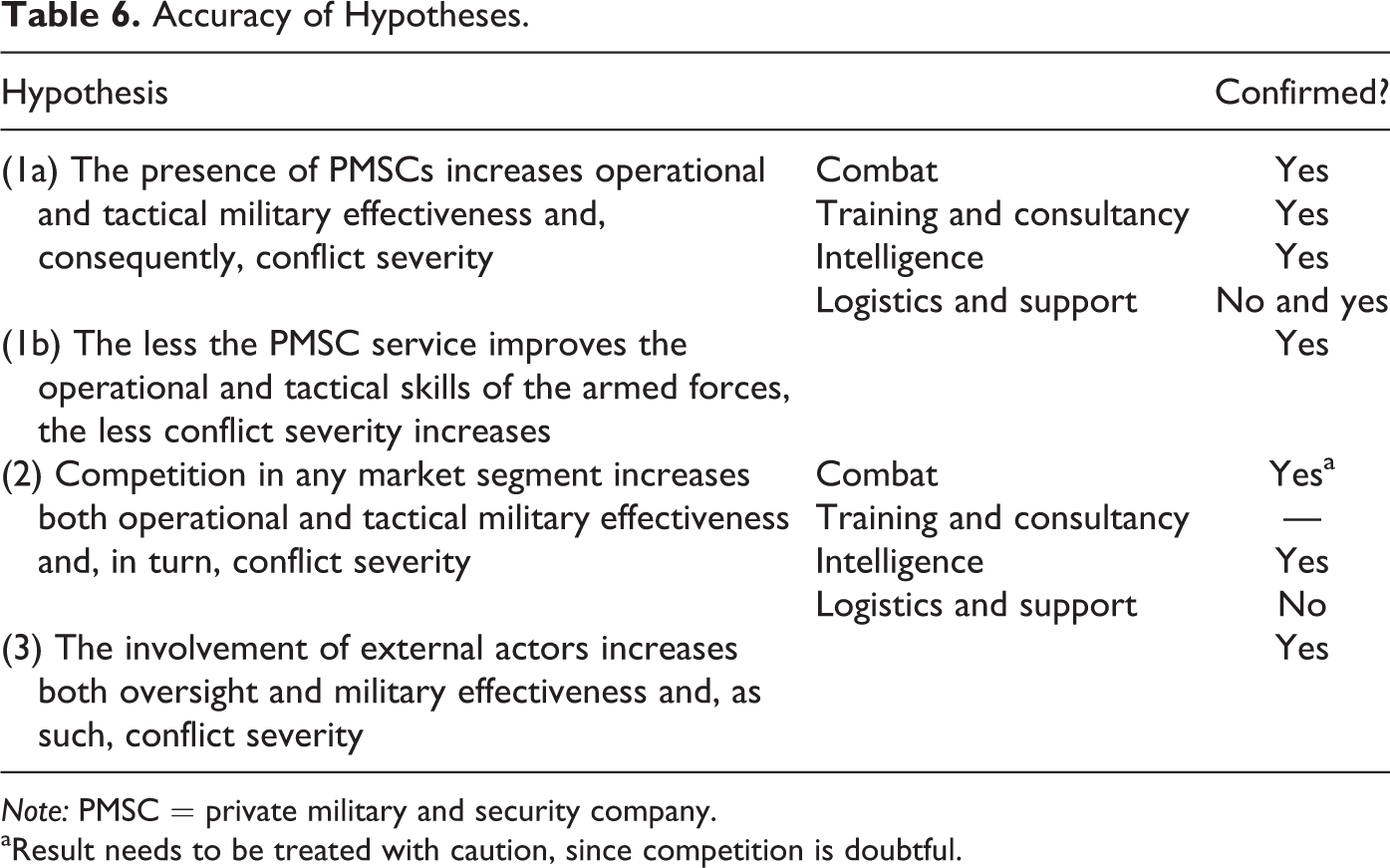
As the results in Table 6 show, most PMSC services correlate with increased conflict severity (Hypothesis 1a), though to different extents depending on the service (Hypothesis 1b). More specifically, PMSC services can affect different elements of military effectiveness. Those that improve the armed forces’ military skills and responsiveness result in increased severity. In fact, the more the service can improve war–military skills, including combat and training services, the more severity increases. Services that address responsiveness only, such as consultancy services, still contribute to increased severity, though to a lesser extent. PMSC services that do not affect military skills and responsiveness, yet which are specialized in improving the military resources such as logistics and support PMSCs, correlate with decreased conflict severity. This result may be due to logistics and support PMSCs’ decreasing military effectiveness by preoccupying troops, or else the client’s inability to translate the enhanced quality of the weapon system to the outcome on the battlefield.
Accuracy of Hypotheses.
Note: PMSC = private military and security company.
aResult needs to be treated with caution, since competition is doubtful.
Apart from the type of service, military effectiveness is also dependent on PMSC performance. Though operating in a conflict zone and selling military-related services, PMSCs behave very much like any other company. PMSCs are driven by profit and seek to increase their profit margins by decreasing the quality of performance. If competition is present, PMSCs are incentivized to perform at a higher level, which results in improved military effectiveness, and, thus, in increased conflict severity (Hypothesis 2). However, this result needs to be treated with caution. Indeed, the relationship between competition and increased conflict severity occurred in two market segments: combat and intelligence. However, it is doubtful whether there was real competition in the combat segment, given the close cooperation of a few combat providers. Furthermore, the logistics-and-support relationship between competition and severity points in the opposite direction. Still, such does not necessarily contradict the idea that competition can improve PMSC performance. Logistics and support PMSCs may be assessed not according to their impact on battlefield performance but instead according to their ability to improve the logistics chain and shorten maintenance cycles. Lastly, even if competition is present, PMSCs can still attempt to get away with poor performance. Since weak states usually have insufficient oversight structures, the risk of detecting poor performance is low. However, the administrative capabilities of external actors such as international organizations and states can improve oversight. Consequently, PMSC performance improves if external actors are involved in the contract. Ultimately, this dynamic results in improved military effectiveness and, thus, increased conflict severity (Hypothesis 3).
Overall, the results corroborate to some extend the already existing scholarship on PMSC effectiveness. Petersohn (2013) and Dunigan (2011, 154) argue that professional PMSCs increase the quality dimension of military effectiveness in codeployed situations. The effect is even greater when deployed separately from state’s armed forces, and they may even be able to defeat materially superior forces (Dunigan 2011, 154; Fitzsimmons 2013a, 273). However, the study at hand complements the research, as it includes not only the effects of armed PMSCs but the entire portfolio of PMSC services on effectiveness. Furthermore, it explores not the effects of increased effectiveness on success and failure but on conflict severity. In this regard, this investigation’s results provide a new perspective on PMSC involvement in conflicts. Luttwak (1999) has famously argued to “give war a chance.” According to him, wars end either if both parties agree to a settlement or one party is defeated decisively. Foreign interventions on behalf of one side can help with the latter. However, the appetite for Western states to intervene in domestic conflicts in weak states has declined not only since the Cold War but also certainly since the disastrous operations in Iraq and Afghanistan. PMSCs were frequently promoted as solutions to this problem. Doug Brooks (2000a), for instance, has argued that PMSCs can intervene in conflicts effectively, and the data here support that argument. PMSCs certainly can bolster the military effectiveness of weak states in countering armed opposition on their territory. Foreign interventions appear to be unnecessary, though some form of involvement in terms of financing PMSCs and supplementing weak oversight capabilities is still required. However, little would be gained if PMSC intervention led to increased military effectiveness and more casualties if conflicts nevertheless dragged on. According to Akcinaroglu and Radziszewski (2013), however, such is not the case, as they have shown that PMSC presence leads to briefer civil wars, if competition is present. Thus, PMSC deployment in weak states leads to conflicts that, though more intense, are nevertheless briefer.
Footnotes
Declaration of Conflicting Interests
The author declared no potential conflicts of interest with respect to the research, authorship, and/or publication of this article.
Funding
The author received no financial support for the research, authorship, and/or publication of this article.

Notes
References
Supplementary Material
Please find the following supplemental material available below.
For Open Access articles published under a Creative Commons License, all supplemental material carries the same license as the article it is associated with.
For non-Open Access articles published, all supplemental material carries a non-exclusive license, and permission requests for re-use of supplemental material or any part of supplemental material shall be sent directly to the copyright owner as specified in the copyright notice associated with the article.
