







Abstract
We provide a new perspective on how domestic factors shape the prospects for international cooperation. Internal arms, specifically conscription, signal a willingness and suitability to be a dependable ally. Possessing ineffective military forces inhibits a state’s ability to assist prospective allies and renders a state less able to deter threats on its own. This exemplifies an instance where the trade-off between arms and allies does not apply. Using new data on the military recruitment policies of states since 1816, we find that adopting a conscription-based recruitment system in the previous five years makes a state more likely to form an alliance in the current year, even when accounting for a heightened threat environment.
Overcoming the dim prospects for cooperation under anarchy is a core focus of international relations research (Stein 1982; Axelrod and Keohane 1985; Abbott and Snidal 1998; Dai and Snidal 2010). A key component of this literature is how national-level factors, such as domestic politics, shape the possibilities for cooperation (Putnam 1988; Ikenberry 2000; Martin 2000; Lipson 2003; Simmons 2009). As Putnam (1988, 427) famously remarked, “Domestic politics and international relations are often somehow entangled.” A key puzzle for international cooperation is how states signal that they will be a good partner.
Because international cooperation can take many forms, from peace treaties to trade agreements, scholarly progress is made by concentrating on specific agreement types. Most notably, the literature on military alliances—one of the oldest and most prominent of international agreements—deeply explores how states signal a desire to be a good ally (Morrow 1994; Smith 1995; Fearon 1997; Leeds 2003a, 2003b; Leeds and Savun 2007; Crescenzi et al. 2012; Mattes 2012a, 2012b; Benson 2012; Benson, Merowitz, and Ramsay 2014). As with the broader international cooperation literature, the alliance literature emphasizes the domestic sources of international alignments and alliances, especially how states can signal commitment. In particular, scholars have long recognized a relationship between internal arms and external alliances (Morgenthau 1967, 175; Waltz 1979, 168; Most and Starr 1984; Barnett and Levy 1991; Morrow 1991, 1993; Conybeare 1992; Sorokin 1994; Diehl 1994). Waltz (1979, 168) observed how “[The United States and Russia] balance each other by internal instead of external means, relying on their own capabilities rather than on the capabilities of allies.” Morrow (1993, 208) states how “[a]lliances are one means to improve a nation’s security, but there are others. In this paper, we focus on arming as an alternate means to increasing a nation’s security.” 1
We contend that these two central issues—ally reliability and internal arms—are intrinsically linked in a way different from that explained by previous scholars. We offer a new theory about the relationship between internal arms and external allies that highlights how states make inferences about whether an ally will be reliable. Arming, especially if politically costly, strongly suggests that a state will not free ride deliberately on the contributions of other allies. Conversely, by choosing to reduce arms, a state is less capable of assisting prospective allies and deterring threats, rendering them less attractive to potential alliance partners. 2
States that are more threatened are more likely to be interested in both arms and allies. But with whom should a threatened state ally and how can a threatened state attract allies? Threatened states will seek out states that internally arm and states will internally arm to attract allies. In either case, arms and allies function as complements. 3 During the alliance formation process, when states are uncertain about the credibility of potential allies, internal arming can send a costly signal of commitment (Morrow 1993, 223). We argue that beyond the effect of the security environment on the probability that a state pursues both arms and allies, states view arms as a means of attracting allies.
To test this claim, we use new data on a historically important form of internal military mobilization: the decision to conscript. We focus on conscription for three reasons. First, conscription is an especially strong signal of internal military mobilization. For example, the Prussian conscription law passed in 1814 ensured a powerful Prussian force for future conflicts and fixed military deficiencies that led to defeat against Napoleon. Second, the initial decision to switch from volunteer recruitment can generate domestic political costs, thereby strengthening its value as a signal of commitment. For instance, Napoleon III sought to counter the Prussian threat with conscription of a mass-based army, but domestic pressures prevented him from doing so (Morrow 1993, 223). Third, military recruitment data are not plagued by the measurement challenges that exist with alternative measures of internal military mobilization, such as troop or expenditure level. 4
Recent research on conscription, however, mostly focuses on the consequences of conscription, rather than the motivation behind the decision to “switch” from volunteer to conscript armies (Scheve and Stasavage 2010; Onorato, Scheve, and Stasavage 2014; Cederman, Warren, and Sornette 2011). Since countries maintain military recruitment policies for many reasons and switching between recruitment systems is relatively rare (Horowitz, Simpson, and Stam 2011), switches to conscription, when states in the international system perceive conscription as a signal of capabilities, demonstrate that a country is seriously invested in providing for its security. Conscription may also tie the hands of countries by ensuring their mobilization in a contingency.
We find strong empirical support for our argument, further bolstering the claim that national-level factors are critical for understanding international cooperation. Countries that switched to conscript armies from 1816 to 2001, controlling for the probability of future conflicts, are significantly more likely to enter new alliances than similar states who have not implemented conscription. These findings are robust to alternative measures of internal military mobilization. They are also not merely the result of an overall desire to increase capabilities in the face of a direct external threat. 5 This is an important concern and one that cannot be definitively disproven. However, we continue to find a strong, positive relationship between conscription and alliance formation even controlling for external threats in several ways: (1) controlling for a state being in a period leading up to war, (2) controlling for a state being involved in an interstate rivalry, (3) conditioning on whether a state is in a time of war or a time of peace, (4) conditioning on the state being involved in an interstate rivalry, (5) conditioning on the threat environment of the state, and (6) conditioning on whether the state was a “buffer state” prior to 1945. These tests are tentative, of course, and further work is necessary in this area. We also address the possibility of an endogenous process whereby forming alliances leads countries to switch to conscription. Theoretically, such a process still suggests the complementary role of arms and allies, supporting our argument. Regardless, models detailed below show that, in most cases, it is conscription that precedes alliances, rather than the other way around.
This article begins by outlining our argument about how conscription signals a commitment to alliance formation. Next, we test our theory using new, national-level data on military mobilization strategies since 1816. We then present our results and describe a series of robustness tests that reinforce our findings. We conclude by discussing the implications of our work for broader research on conflict and cooperation.
Using Arms to Attract Allies
A core concern of alliance research is commitment credibility in an anarchic system (Axelrod and Keohane 1985; Morrow 1994; Smith 1995; Fearon 1997; Crescenzi et al. 2012; Mattes 2012a, 2012b; Leeds 2003a; Benson 2012; Benson, Meirowitz, and Ramsay 2014; Kimball 2010). Concerns regarding the reliability of alliances can take on one of two forms. First, allies could abandon a partner during its time of greatest need (Snyder 1984, 466). Second, power asymmetries between alliance partners can create burden-sharing challenges (Olson and Zeckhauser 1967; Sandler 2001). While less pernicious than abandonment, such “free riding” is still troublesome and concerns about free riding can undermine the ability of states to reach an alliance agreement.
Free Riding and Alliance Politics
Stronger countries fear being exploited by providing an excessively disproportionate share of the military resources in an alliance. For instance, statements by former American Secretary of Defense Robert Gates shortly before he left office exhibit significant concern with declines in defense spending by America’s European partners in the North Atlantic Treaty Organization (NATO): But some two decades after the collapse of the Berlin Wall, the U.S. share of NATO defense spending has now risen to more than 75 percent—at a time when politically painful budget and benefit cuts are being considered at home. The blunt reality is that there will be dwindling appetite and patience in the U.S. Congress—and in the American body politic writ large—to expend increasingly precious funds on behalf of nations that are apparently unwilling to devote the necessary resources or make the necessary changes to be serious and capable partners in their own defense. (Gates 2011, emphasis added)
Whether increasing defense spending, increasing military size, developing and demonstrating military technologies, 6 or mobilizing existing troops (Slantchev 2011), such measures highlight a state’s “worthiness” as an alliance partner. One example comes from the initial reluctance of the British Joint Chiefs to form an alliance with Russia in 1939. In a March 18, 1939 cabinet meeting, the Joint Chiefs maintained that the Soviet Union could not be expected to fight outside her own borders because the Soviets were “militarily an uncertain quantity” (Quoted in Manne 1974, 5). The Joint Chiefs’ reluctance was not due to a lack of coordination between British and Soviet troops or the fact that Soviet troops were not stationed on the German border (to deter advances by Hitler). Instead, the Joint Chiefs hesitated to form an alliance with Russia due to questions regarding the quality and quantity of the Russian military itself.
Signaling Military Strength with Conscription
A particularly important means of signaling military strength is a state’s military recruitment policy. States have two main means to generate sufficient numbers of personnel for their armed forces: recruit volunteers by offering sufficient inducements to join, instead of entering the private labor force, or engage in conscription. 7 This decision has important implications for national defense, including military effectiveness (Horowitz, Simpson, and Stam 2011), doctrine (Kier 1997), and even domestic policy choices such as tax rates (Scheve and Stasavage 2010) and political rights (Alesina and Angeletos 2005). Conscript armies, though less efficient, person-for-person, than volunteer armies, were associated with dramatic increases in the severity of war, especially during the Napoleonic period and most of the nineteenth century (Cederman, Warren, and Sornette 2011). Like decisions about defense spending, both domestic political constraints and the strategic environment likely influenced the decision of states to employ conscripts.
From the Napoleonic Era until very recently, the decision by countries to utilize conscription signaled a commitment to a strong national defense posture. 8 Conscription was something that powerful countries did when necessary. For example, all of the major combatants in World War II used conscription. Additionally, using conscription to maintain a strong standing army, beginning in the post-Napoleonic period, signaled military competency for key powers such as Prussia/Germany (Posen 1993). In the era of the mass army, countries believed that quantity represented a critical element on the path to victory and there existed no better means of generating a large number of troops at a reasonable cost than conscription (Onorato, Scheve, and Stasavage 2014; Posen 1993). With conscription, the government can control the cost of soldiers, rather than having to pay market or near-market wages in an all-volunteer system.
The growing prospect of international conflict figures prominently in explanations for both why states form alliances and why they adopt conscription. One of the most famous examples of a state “switching” to a conscript army due to foreign threats was the British in World War I, who shifted to a conscript army in 1916 after their all-volunteer force was nearly decimated (Dewey 1984). Conscription allows a country to have a large standing army or at least a large standing set of trained reserves. Thus, if a country is attacked, a large conscripted force can quickly convert from potential capability to active capability. In contrast, the British in World War I and the United States in World War II spent considerable time ramping up a smaller volunteer army into a larger conscript army during significant conflict.
Given that alliance formation and conscription adoption have a security driven motivation, states facing large-scale security threats should be especially likely to both conscript and form external alliances.
We maintain that the decision to conscript and the decision to form an alliance are related, not simply because states with conscription are similar in other characteristics (such as their threat environment or political institutions), but because the need to attract allies is a key factor influencing whether a country adopts conscription. For instance, when deciding whether to end conscription in the early 1950s, British Minister of Defense Walter Monckton explained how, because conscripts were necessary for maintaining a force of sufficient size to deter Russian invasion, ending the policy “would likely have a disturbing effect both on the public and on Britain’s allies” (quoted in Grant 2008, 15). 9
Recent research on conscription (Scheve and Stasavage 2010; Onorato, Scheve, and Stasavage 2014; Cederman, Warren, and Sornette 2011), however, mostly addresses the consequences of conscription. It does not focus on the reasons states decide to switch from volunteer forces to conscript armies. When the literature does discuss why states conscript, it typically emphasizes local reasons—short-term threats and immediate military contingencies, like the case of the British in World War I (Scheve and Stasavage 2010). However, a key mechanism by which a country can credibly signal its willingness to spend appropriate resources on defense is its military recruitment policy. Specifically, since conscription involves a form of government coercion designed to increase the size and capacity of the armed forces, enacting conscription signals to potential allies (and adversaries) that a country is serious about providing for its own defense.
Enacting conscription involves significant sunk costs. First, conscription is generally politically unpopular.
10
Enacting conscription raises potential political costs for the leader and even protests—US Civil War draft riots in New York are just one example. Enacting conscription generates a guns-versus-butter trade-off that may be politically risky. Specifically, Vasquez (2005) argues that democratic leaders with conscript systems will have more domestic sensitivity to military casualties than leaders in all-volunteer systems. Given that a country must pay such upfront costs when it implements conscription, only a state truly committed to its defense should pay these domestic political costs. Essentially, conscription is not only a signal of military capabilities but also resolve. Second, conscription signals that you will invest more effort in defending yourself if attacked, for example, by demonstrating more willingness and capacity to impose costs on adversaries. Hence, the conscripting state signals to a potential ally that it is not just seeking a convenient means of free riding. Given the costliness of the signal and the way it demonstrates both resolve and capabilities, we expect conscripting states to attract allies.
One example of conscription’s influence on alliance politics comes from the 1894 Franco-Russian alliance. The negotiations to form the alliance did not explicitly reference conscription policies. This is not surprising since both states had implemented universal conscription in the 1870s (and both countries had some form of conscription dating back to at least the Napoleonic era): France following the Franco-Prussian War and Russia following a series of reforms implemented after the Crimean War (Andreski 1971, 69). Moreover, universal conscription enabled both countries to draw from a large pool of military reserves. This is relevant because a major (if not the major) issue of the negotiations was the level of troops each would provide in a war with Germany. An 1891 French Chief of Staff memo outlining the requirements of the alliance demonstrates this clearly (Kennan 1984, 148-50). According to the plan put forth in the memo, France could direct approximately 1,300,000 men against Germany, leaving 360,000 in reserve. Russia would deploy 700,000–800,000 men immediately against Germany (Kennan 1984, 149). In a 1892 memorandum from Russian War Minister Pyotr Vannovski to Russian Foreign Minister Nikolai Giers (which, in turn, was shared with Tsar Alexander), Vannovski writes that the ability of both sides to simultaneously mobilize their massive forces of reserve conscripts is an “entirely rational provision” that “must be placed at the very foundation of the convention.” 11
The later Russian response to changes in France’s conscription law further demonstrates that conscription was key to both countries’ expectations regarding the alliance. In direct response to Germany passing a similar law in June 1913, France adopted the Three Years Military Service Act in July 1913 (also called the “Three Year Law” of 1913). This law extended the term of compulsory military service to three years with almost no deferments (the same as in Germany). The move was extremely unpopular in France, which placed pressure on the government to revert to the previous two-year system (Gildea 2008, 433-34). A year later, on June 5, 1914, the newly appointed French Ambassador to Russia, Maurice Paléologue, returned to Paris and informed French Prime Minister Réne Viviani that he would resign if the new French Cabinet revised the Three Year Law. Paléologue’s motivations were driven by his knowledge of the reaction in Saint Petersburg if France ended (or weakened) its conscription recruitment policy. Paléologue wrote to Vivian, I have exact knowledge of the state of mind of the Court and Government circles in Russia, and must tell you that they are following with close attention the controversies aroused in France over the Three Years Act. If the scheme of military service is modified in the slightest, I must also tell you that I shall find myself forced to send in to you my immediate resignation, as I should be unable in such conditions to return to the post entrusted to me. (Quoted in Michon 1969, 272) Yes, you may assure him (the Tsar) that the Three Years system will be maintained without restriction and that I shall allow nothing to be done which might enfeeble or relax our alliance with Russia. (Quoted in Michon 1969, 276)
Possible Caveats to Conscription as a Signal
One potential critique is that our argument does not accurately describe the alliance formation process. In many cases, such as the Cold War, major powers may wish to extend deterrence over minor powers for the purpose of troop deployments or to prevent a minor power from falling into the “camp” of the opposing major power. This is a way to think about how the Warsaw Pact states extracted rents from the Soviet Union during the Cold War (Bunce 1984–1985). If true—that the major power may not care much about the minor power’s military strength, per se—it actually biases any tests against our theory. Similarly, if states that join alliances subsequently increase their military strength, like the Eastern European states joining NATO after the Cold War, we also do not expect to see a relationship between conscription and alliance formation. Under either of these situations, any evidence in favor of a relationship between conscription and alliance formation would be especially strong for our theory.
We focus on conscription, rather than army size, for two reasons. First, as described above, conscription imposes significant potential political costs on a leader and political regime, meaning states will not implement conscription unless they are serious about providing for their own defense. Second, having a large standing army without conscription is extremely costly. Volunteer armies have to pay quasi-market rates to attract personnel (Horowitz, Simpson, and Stam 2011), imposing a much larger budgetary per unit cost, though that is not necessarily true of aggregate totals (depending on overall force sizes). Nevertheless, we will consider below alternative measures of arming in order to demonstrate the robustness of our findings.
Additionally, our argument pertains to signaling almost entirely during the time of alliance formation, though it also has relevance for alliance preservation. For example, American General Douglas MacArthur believed that Australia needed to implement conscription in 1942 because “conscription for overseas service was necessary to preserve [the alliance]” (Quoted in Hirst 1994, 46). However, once the alliance is formed, internal arming is just one of many factors that can influence the reliability of the alliance (Leeds and Savun 2007). Once countries form an alliance, they may now share commands, have bases on the territory of one another and/or make security decisions in consultation with one another (including, most likely, the decision to switch to an all-volunteer force). Here, we only hypothesize about the states’ initial decision to ally. Consider, for example, Britain’s decision to switch to an all-volunteer force in 1957. The British move away from conscription was motivated by domestic political and economic considerations: political unpopularity, a shift in strategy to massive retaliation, and need for civilian labor (Navias 1989). Despite the domestic political motivations to end conscription, British Minister of Defence Walter Monckton insisted on consulting with Britain’s NATO allies: “our discontinuance of these preparations should not be so abrupt as to cause a shock to our allies and our own public” (Quoted in Grant 2008, 10).
Finally, there are situations where countries may ally even though one state is not contributing a significant proportion of the military capabilities to the alliance. For example, a stronger country may ally with a weaker one to provide for its security and discourage the weaker state from arming itself, since this might lead to greater overall instability. Yet in a classic case of such an alliance, the United States and Japan after World War II, the United States encouraged Japan to rearm by the early 1950s. The dynamics within an alliance might change over time—as the decreasing share of European contributions to NATO (in terms of capabilities) demonstrates. However, when it comes to alliance formation, in most cases, we expect that a state signaling its commitment to “try its best” is an important signal that raises the likelihood of alliance formation.
Research Design
We are interested in how implementing conscription influences a country’s decision and/or ability to join an alliance. Our unit of observation is the country-year from 1815 to 2001. Testing our argument requires operationalizing two primary concepts: a country’s choice to implement conscription and its decision to be a member of a defensive alliance. 12
We use the Alliance Treaty Obligation and Provisions (ATOP) dataset to code whether state i in year t is a member of a defensive alliance (Leeds et al. 2002). Diehl (1994, 164) emphasizes that consideration of defensive alliances is particularly critical when analyzing the arms–allies relationship, as defense pacts bring with them a promise of direct assistance (rather than, e.g., simple consultation). We use these data to construct two variables. The first variable, Defensive Alliance Member, we set equal to 1 if country i in year t is a member of a defensive alliance, 0 otherwise. The second variable, Join Defensive Alliance, we set equal to 1 in year t for country i if country i joined a defensive alliance in year t, 0 otherwise. 13 For example, the United Kingdom formed an alliance with Japan in 1902. Thus, both Join Defensive Alliance and Defensive Alliance Member equal 1 in 1902 for the United Kingdom. Since this alliance lasted until 1905, this means Defensive Alliance Member equals 1 in 1904 and 1905, but Join Defensive Alliance equals 0 in 1904 and 1905. Overall, we have alliance data for 214 different countries from 1815 to 2001.
We measure a state’s military recruitment strategy using new data on the recruitment systems of states for all years from 1816 to 2005. Building on the wartime recruitment system data compiled by Horowitz, Simpson, and Stam (2011) and Horowitz and Stam (2014), we compiled our data from a variety of sources (Especially Toronto 2007, but also Prasad and Smyhte 1968; Keegan 1983; Horeman et al. 1998; Choi and James 2005). We checked these data against historical sources and made improvements—for example, filling in military recruitment choices for many countries during the Napoleonic warfare period. 14 In coding these observations, we followed two principles. First, if we found evidence on the military recruitment strategy that contradicted existing data sets such as Toronto (2007), we ensured that we had multiple sources confirming the veracity of the new coding. Second, when existing data sets contradicted, we dug deeper to find historical evidence that confirmed one or the other.
We use these data to construct two variables. The first variable, Conscription, we code as 0 for country i in year t if country i’s military is fully volunteer in year t, 0 otherwise. Hence, Conscription is coded as 1 if the country has any form of conscription in year t. The second variable, Switch to Conscription t −5, we code as 1 in year t for country i if country i changed from a volunteer force to a conscripted force within the previous five years, 0 otherwise. Our sample contains 277 observations (representing 61 different countries) in which a country switched to conscription. We consider a five-year period because Diehl highlights how alliance relations (and military expenditures) show little year-to-year variation. Diehl (1994, 164) writes “with respect to alliances, they are often made after careful thought and not easily abandoned or traded as one changes clothes.” Below, we show that our results are robust to a series of tests in which we vary the time lag under consideration (to years less than five or years greater than five). Overall, we have recruitment system data for 214 different countries over the 1815–2005 period. As described above and elsewhere, countries do not switch military recruitment systems lightly (Horowitz, Simpson, and Stam 2011). Instead, once countries make a decision about a military recruitment system, they tend to optimize within that system unless they decide to make a larger-scale change. In our data, only about 1 percent of observations witnessed a switch in recruitment system (either to volunteer or to conscription). 15
We also control for theoretically driven factors potentially correlated with the decision to ally and the choice of recruitment system (Achen 2005). First, since a crisis period is more likely to induce states to seek means of protection (both internally and externally), the variable Prewar Period equals 1 for the five years prior to and including a war, 0 otherwise. We want to control for this relationship to determine the independent impact of military recruitment policy on alliance formation. We further address this issue below by evaluating other ways threats could influence the relationship. In a similar vein, we also control for whether the country is in an interstate rivalry (Colaresi, Rasler, and Thompson 2008).
Second, since the nuclear age dramatically altered and expanded the means by which states could balance (either internally or externally), we include the variable Post-1945, which equals 1 for all years after 1945, 0 otherwise. 16 Furthermore, since NATO might drive our results, as the protection offered to its members by the United States allowed them to reduce internal armaments, we include the dummy variable NATO, which equals 1 for each year that country i is a member of NATO, 0 otherwise.
Fourth, Gartzke (2001) argues that capital intensity is a major determinant of a country’s defense policies, such as its ability to support an alliance partner. We therefore include the variable Military Expenditure/Population. This variable takes the inflation-adjusted measure of each country’s total military expenditures and divides it by that state’s military personnel. 17 Likewise, to separate the effect of the recruitment system from the effect of military size, we control for the size of country i’s military, normalized by country i’s population. Data on military size (measured in terms of military personnel) and total population come from the Correlates of War (COW). 18
Fifth, since previous research has considered the relationship between regime type and alliance formation (Lai and Reiter 2000; Gibler 2008) and regime type and recruitment systems (Horowitz, Simpson, and Stam 2011), we control for whether country i is a democracy. The variable Democracy is coded as 1 if the 21-point Polity variable from the Polity IV project for country i in year t is greater than or equal to 6, 0 otherwise (Marshall, Jaggers, and Gurr 2009).
Finally, we control for past experience with both alliances and conscription. We use the ATOP data to code if the states had an alliance in the previous year. We also use the above described recruitment system data to code whether the country used conscription in its most recent war.
Empirical Evidence
To begin, Table 1 compares the rate of alliance membership for country-years during which a country had a conscription-based recruitment system and a volunteer-based recruitment system. Looking at the country-years in which a country had conscription, Table 1 shows that 52 percent also had alliance memberships. In contrast, only 44 percent of country-years in which a country had a volunteer system did those countries also have alliance memberships. The difference in these rates is statistically significant at the 0.99 confidence level, providing evidence in favor of Hypothesis 1.
Relationship between Conscription Recruitment System and Defensive Alliance Membership, Country-years.
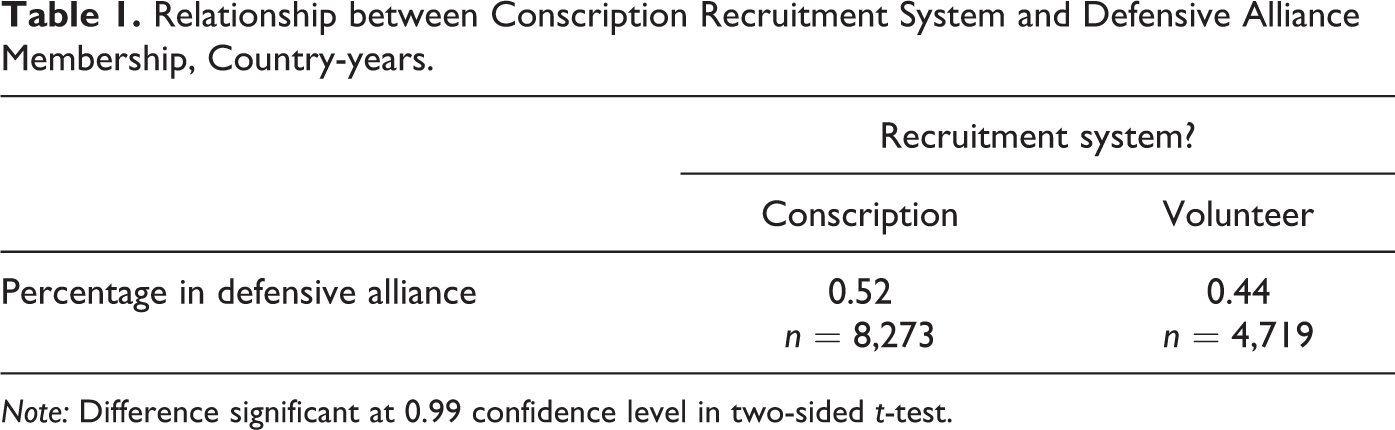
Note: Difference significant at 0.99 confidence level in two-sided t-test.
While the results in Table 1 are suggestive of a complementary relationship between conscription and alliances, they cannot answer the more fundamental question: does having conscription make a country more likely to join an alliance? Moreover, Table 1 does not point to causality: does the adoption of conscription make a state more likely to join an alliance? To begin answering this question, we compare the rate of defensive alliance formation when a country adopted a conscription-based recruitment system in the previous five years to when the country did not adopt conscription in the previous five years. Table 2 shows that the rate of alliance formation for the group of country-years that witnessed the adoption of conscription in the previous five years is over 150 percent higher than for country-years that did not witness the adoption of conscription in the previous five years. This result is consistent with Hypothesis 2: a country that switched to a conscription-based recruitment system prior to year t is more likely to join a defensive alliance in year t.
Relationship between Switching to Conscription Recruitment System in Previous five Years and Joining a Defensive Alliance This Year, Country-years.
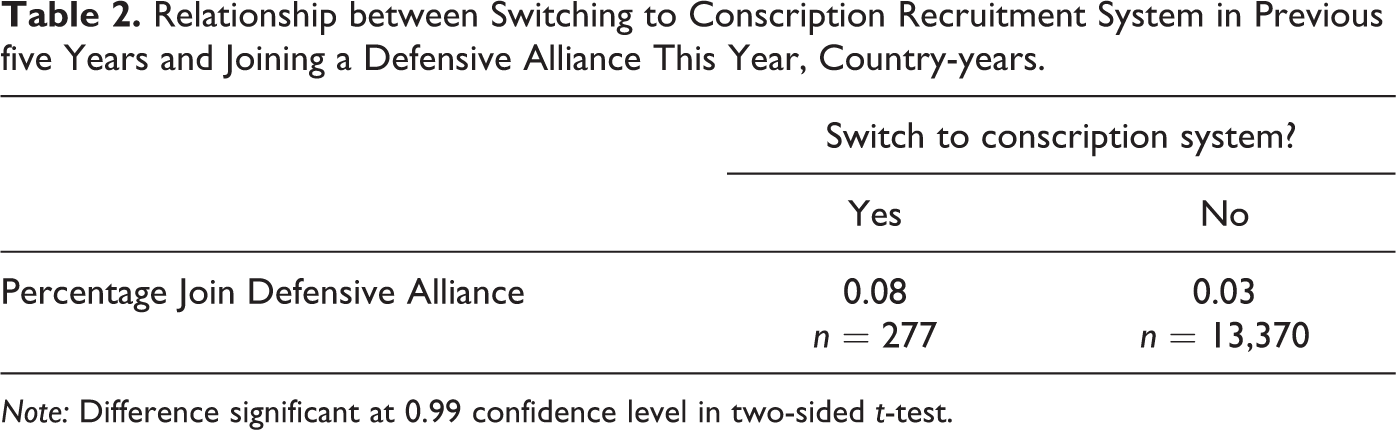
Note: Difference significant at 0.99 confidence level in two-sided t-test.
Multivariate Analysis
To account for the way that confounding factors—especially the external threat environment—may drive this relationship, 19 we turn to multivariate analysis by estimating a logit model with standard errors clustered on the country. Below, we also describe robustness tests using a duration model and a bivariate probit model, which reinforce our findings. The dependent variable is Join Defensive Alliance t , the key explanatory variable is Switch to Conscription t −5, and the control variables are described above. Summary statistics for all of the variables are available in the Online Appendix. In addition, while these results concentrate on switching to conscription, the Online Appendix reports results from a test in which the key independent variable is simply the presence of conscription. This test produces results consistent with those reported here, demonstrating the robustness of our findings.
Table 3 reports the results from estimating our main models. Model 1 shows the results without control variables, while model 2 adds control variables. In both cases, switching to conscription in the previous five years is a positive and highly significant predictor of joining a defensive alliance in a given year. This provides support for Hypothesis 2. To give substantive meaning to the coefficient on the Switch to Conscription t −5 variable, consider Figure 1. This figure depicts the substantive effect of conscription on the probability of alliance formation after controlling for confounding variables (model 2 in Table 3). Countries that did not switch to conscription in the previous five years had a 2 percent probability of forming an alliance, while countries that did switch to conscription in the previous five years had over 6 percent probability of forming an alliance. Computing the substantive effect, we find that switching to conscription raises the probability of joining a defensive alliance by over 150 percent, which is similar to the result reported in Table 2. 20 This is an extremely large shift and demonstrates the way that countries use military recruitment policies to signal their military capacity and attract allies.
Effect of Switch to Conscription on Joining a Defensive Alliance, Logit Results. Dependent Variable: Join Defensive Alliance in year t.
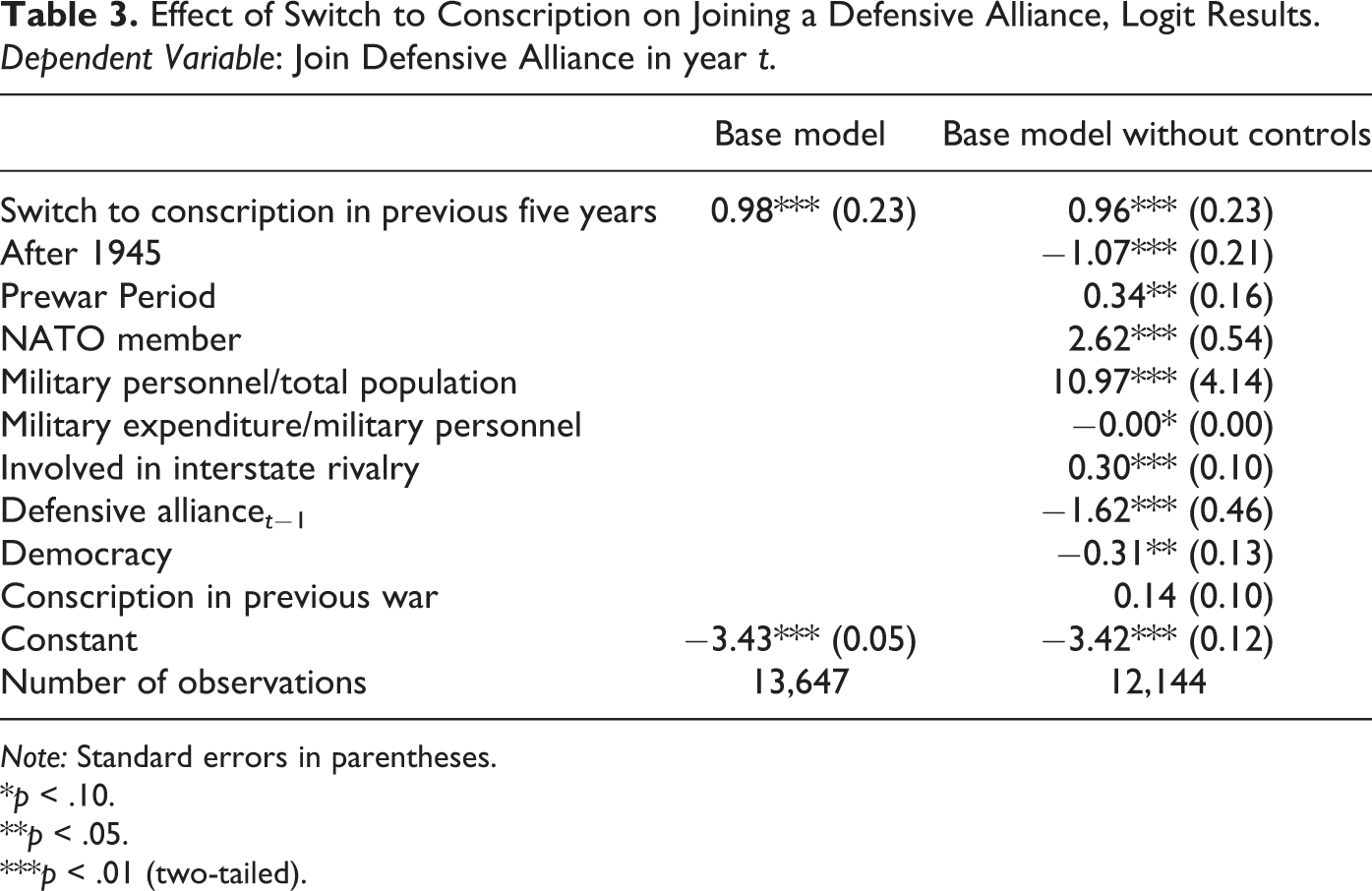
Note: Standard errors in parentheses.
*p < .10.
**p < .05.
***p < .01 (two-tailed).
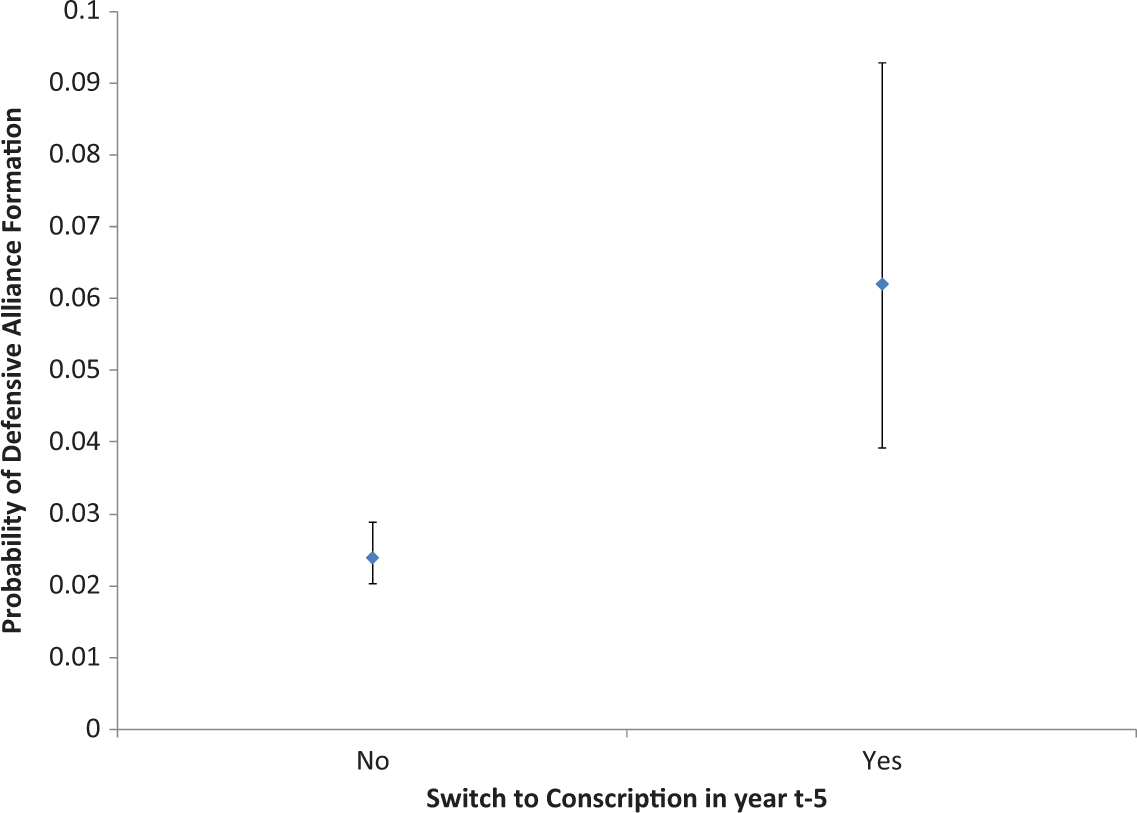
Substantive effect of conscription on defensive alliance formation.
Threat Environment as Omitted Variable Bias
While we control for interstate rivalry and for being in a Prewar Period, readers might still be concerned that threat environment is an unobserved confounder that is driving both conscription adoption and alliance formation. It might be the case that when the probability of war increases, states look for more alliances and implement conscription. There is no way to completely alleviate this concern. Absent threats, states will likely not seek ways to enhance their external and internal military capacities. Indeed, this is why Nordhaus and Tobin (1972) refer to military expenditures as “regrettable necessities.” Nevertheless, we conduct four additional tests in order to bolster confidence that the link we identify between conscription and alliance formation is not purely driven by attempts to enhance security.
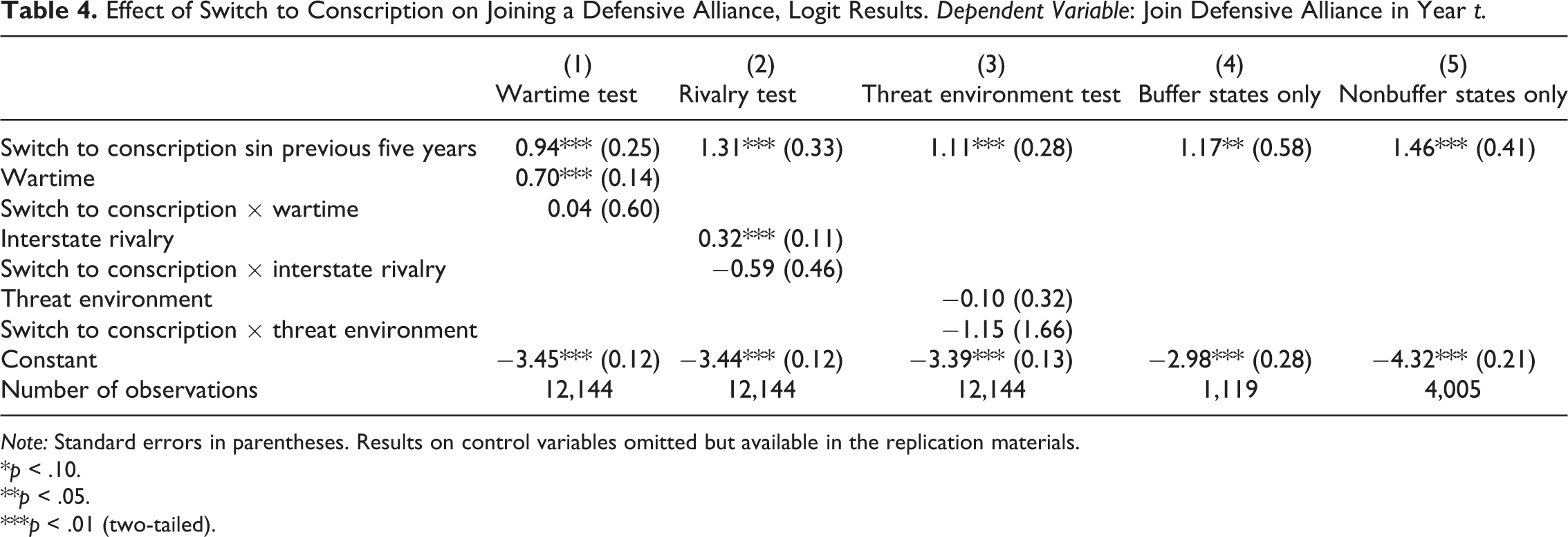
First, we interact Switch to Conscription t −5 with the variable Wartimet , which equals 1 if the country is in the prewar buildup or actually at war in year t, 0 otherwise. This allows us to identify the effect of Switch to Conscription t −5 in peacetime (when Wartime t = 0) and during wartime (when Wartime t = 1). The results are reported in column (1) of Table 4. We find that switching to conscription in the previous five years increases the probability of forming an alliance in year t whether the country is in a time of peace (a 154 percent increase) or war (a 176 percent increase), but the effect is only statistically significant for peace years. While the insignificance of the effect during the war periods directly refutes the possibility that states are simply seeking out all means of security, it could also be due to the small number of observations in which a country switched to conscription during a time of war (thirty one observations).
Effect of Switch to Conscription on Joining a Defensive Alliance, Logit Results. Dependent Variable: Join Defensive Alliance in Year t.
Note: Standard errors in parentheses. Results on control variables omitted but available in the replication materials.
*p < .10.
**p < .05.
***p < .01 (two-tailed).
Second, we interact Switch to Conscription t −5 with the variable Rivalryt , which equals 1 if the country is in an interstate rivalry in year t, 0 otherwise. This allows us to identify the effect of Switch to Conscription t −5 in low threat periods (when Rivalry t = 0) and during high threat periods (when Rivalry t = 1). The results are reported in column (2) of Table 4. We find that switching to conscription in the previous five years increases the probability of forming an alliance in year t whether the country is not in a rivalry (a 263 percent increase) or in a rivalry (a 107 percent increase), and these effects are statistically significant under both conditions. These findings reveal that switching to conscription raises the probability of alliance formation regardless of the threat environment (as measured by rivalry) and, quite interestingly, that the effect of conscription is larger when the state is in a lower threat environment (though the difference in the effect is not statistically distinguishable from zero).
Third, we use an alternative measure of international threats proposed by Leeds and Savun (2007) to control for a key limitation in the Rivalry measure—it requires both parties to feel threatened, meaning it does not capture instances where small powers feel threatened by a larger state which, in turn, does not consider the small state a threat. The Leeds and Savun Threat Environment variable sums the Composite Index of National Capabilities scores for all members of state i’s “politically relevant international environment” (major powers and contiguous states) that have no alliance with state i and have below a 0.81 Signorino and Ritter (1999) s-score measure of foreign policy similarity. 21 Threat Environment is a continuous measure running from 0 to 0.85. We then interact Switch to Conscription t −5 with Threat Environment t . This allows us to identify the effect of Switch to Conscription t −5 from low threat environments (when Threat Environment t = 0) to high threat environments (when Threat Environment t = 1). The results in column 3 of Table 4 show that switching to conscription in the previous five years increases the probability of forming an alliance in year t, regardless of the value of Threat Environment t (though the effect is only statistically distinguishable from 0 when Threat Environment t is below 0.30). 22 These findings again reveal that switching to conscription raises the probability of alliance formation regardless of the threat environment.
Fourth, we consider a particular set of states, buffer states. Buffer states offer a unique way of empirically capturing a high threat environment. A buffer is a state located between two states that recently engaged one another in militarized conflict or view one another as hostile strategic rivals. A classic example of a buffer state was Poland during the 1700s, the 1920s and 1930s, and the Cold War. According to Fazal (2007) and Poast (2013), buffer states are especially prone to violent state death, “the formal loss of foreign policy control to another state” via military invasion (2007, 17). Though maintaining the sovereignty of the buffer state is ideal for both rivals (as it creates a barrier between the rivals that decreases the probability of war), both rivals know the other has an incentive to invade the buffer and gain the strategic advantage. This commitment problem contributes to the demise of the buffer state.
Given that the onset of invasion and complete annexation has become exceedingly rare after 1945 for both buffer and nonbuffer states, buffer states prior to 1945 had an exceptional level of vulnerability. By running our model specifically on buffer and nonbuffer states prior to 1945, 23 we can see how a particularly heightened threat environment influences the relationship between conscription and alliance formation. While the regression results are reported in columns (4) and (5) of Table 4, Figure 2 plots the probability of defensive alliance formation when a state has conscription for two scenarios: buffer and nonbuffer states. While the probability of defensive alliance formation is higher for buffer states, it is not statistically discernible from the probability of defensive alliance formation for nonbuffer states. The results are the same if we plot the actually marginal effects (i.e., the change in the probability of alliance formation from having conscription to not having conscription; Brambor, Clark, and Golder 2006). Overall, the buffer states results, along with the other tests described above, suggest that a heightened threat environment does not statistically drive or modify the relationship between conscription and alliances.
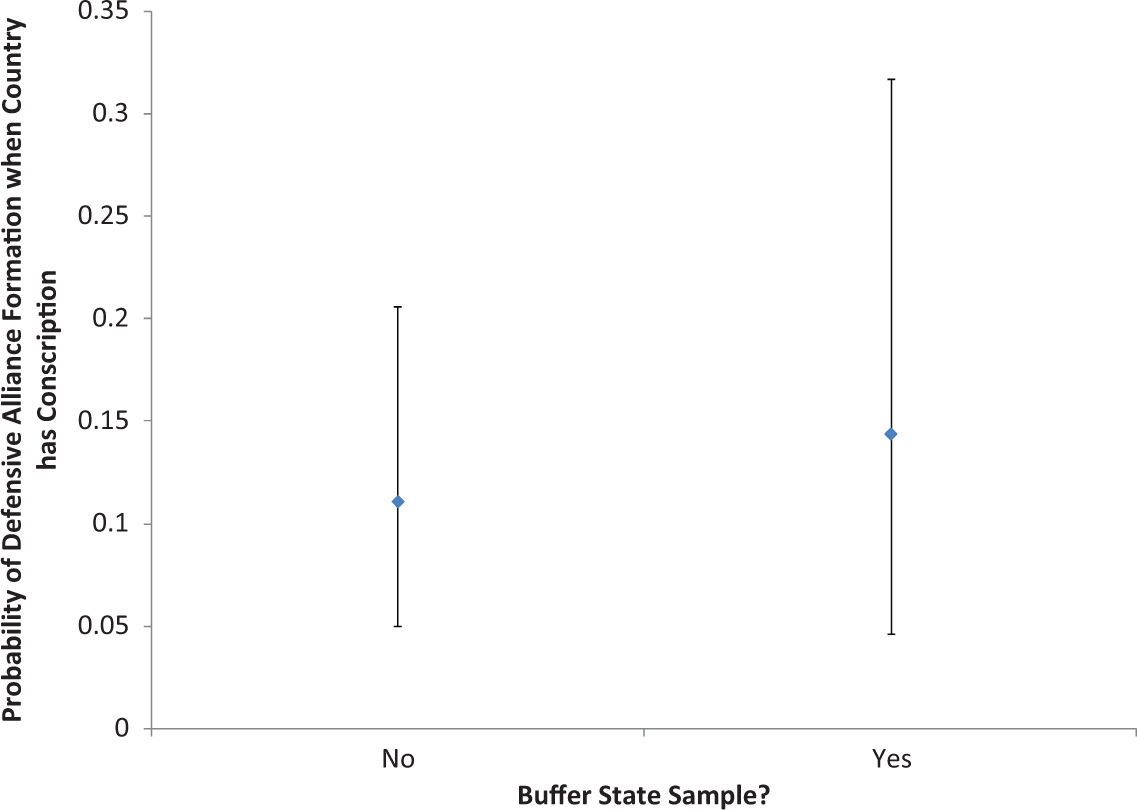
Probability of defensive alliance formation, buffer state or no buffer state.
Robustness Checks
We conduct several additional robustness tests to increase our confidence in these findings. Unless noted below, the results are statistically and substantively consistent with those reported in Table 3 and Figure 1 (please see the Online Appendix for the results tables from these tests). These tests fall into four groups: (1) additional controls and confounders, (2) alternative specifications of the Switch to Conscription variable and alternative measures of internal mobilization, (3) alternative specifications of alliance formation, and (4) endogeneity between conscription adoption and alliance formation. We now describe each group of tests.
Additional controls
First, to control for unobserved unit-level heterogeneity, we estimate both a random-effects model and a fixed-effects model. Second, we account for possible time dependencies in the data by including a time polynomial (Carter and Signorino 2010) and by estimating a Cox Proportional Hazard model. Third, we control for other omitted variables, including whether a state in the post-1945 time period had nuclear weapons or a nuclear ally (Gartzke and Kroenig 2009), whether the country is a COW designated major power, the lessons learned by the state during the previous major war (Reiter 1996; Lai and Reiter 2000), and whether a country experiences a change in polity score (captured as an increase or decrease in the polity score of 1 point or greater). Fifth, to account for any spatial interdependence between countries, we control for the proportion of states with conscription in year t − 1 in country i’s region. The region classifications are from the COW Project. Sixth, in case the United States is disproportionately driving the results, we reran the main models excluding the United States. 24
Alternative coding of switch to conscription
We also run a series of tests to ensure it is not the particular way we code the Switch to Conscription variable that drives the results. First, using different lags for when a country switched to conscription (two, ten, and fifteen years), we find that the coefficient size and significance level are robust to different time lags. Second, to show that it is truly a change to conscription that leads to forming a defense pact and not simply a change in recruitment system, we replace Switch to Conscription t −5 with Switch to Volunteert −5 and find that switching to a volunteer force in the previous five years does not alter a state’s probability of forming an alliance. Third, though we focus on conscription because it is an especially strong signal of internal mobilization and data on conscription lack the measurement errors widely acknowledged to exist in alternative measures of internal mobilization, we conduct additional tests employing alternative measures of an internal military mobilization (using troop and expenditure levels). As reported in the Online Appendix, the results reinforce our findings.
Alternative coding of alliance formation
Just as we consider alternative measures of our key explanatory variable, we also consider different measures of alliance formation. First, Morrow (1991) highlights the difference in motivation for forming alliances between major powers (who possess both autonomy and security) and minor powers (who possess just autonomy). To test this, we split our sample and run our model just on COW defined major powers (1,070 observations) and then just minor powers (11,074 observations). The coefficient on Switch to Conscription t −5 remains positive, large, and statistically significant (0.99 confidence level) in the minor power sample and (0.95 confidence level) in the major power sample. Second, one might contend that the causal logic of our argument should apply to offensive alliances because they are less likely to face the unifying pressure of existential threat from an aggressor. This test shows that Switch to Conscription t −5 has a positive and highly significant (0.99 confidence level) relationship with the formation of offensive alliances.
Endogeneity
Observers might also be concerned about the possibility of endogeneity between defense pacts and the adoption of conscription, meaning that the forming of defense pacts is driving the decision to conscript. As stated above, we do not view such endogeneity as a threat to our theory: if a country adopted conscription after forming an alliance, this is consistent with our core theoretical claim—countries use conscription to enhance (and signal a willingness to contribute to) alliance partnerships. Nevertheless, it can still prove informative to directly account for this endogeneity. To accomplish this, we use a bivariate probit model to explicitly account for a defense pact influencing a country’s decision to have conscription (Heckman 1978; Freedman and Sekhon 2010). If the endogenous binary variables are y 1 and y 2, then a bivariate probit model entails estimating two models via maximum likelihood, where the first model has y 1 as the dependent variable and y 2 as an independent variable, while the second model has y 2 as the dependent variable and y 1 as an independent variable. To ensure identification, the dependent variables are the presence of a defense pact in year t and of conscription in year t. Also, we remove from the defense pact model the variable accounting for conscription in the previous war, while the conscription model excludes the variable capturing the presence of a defense pact in year t − 1. The model identifies the presence of an alliance as having a positive and statistically significant (0.99 confidence level) relationship with the likelihood of conscription and finds that having conscription raises the probability of a country being in a defense pact (relationship statistically significant at the 0.99 confidence level).
Testing the Mechanism
While the above results help establish a clear positive relationship between internal arming and alliance formation and how the threat environment does not appear to condition this relationship, the results say little about signaling, per se. Our theory argues, after all, that adopting conscription increases the likelihood of alliance formation because it signals a commitment to strengthening one’s military.
The way different military recruitment systems change societal expectations about the extent to which the political and human costs of war are diffuse or concentrated provides one way to think about signaling in the conscription–alliance context. 25 Conscription spreads the human costs of war across a wider swath of society and involves coercive selection. In contrast, volunteers are compensated at market rates. Consequently, the public, on average, should be relatively less sympathetic to the costs of fighting in a voluntary system, compared to a conscription system. Additionally, conscription increases the costs of fighting for elites. Elites are either at a greater risk of fighting themselves or must now engage in costly actions to receive deferments. Even if receiving a deferment is not exceedingly onerous, the elite would not need to spend time, money, or influence to gain such a deferment if the country used a volunteer system.
Because conscription imposes costs across a wider swath of society, leaders more dependent on support from larger sections of society, for example, mostly democratic states, are likely more vulnerable to political pressure to not implement conscription, or to maintain it. As Vasquez (2005, 852) writes, “since conscription more directly threatens the sons, daughters, and neighbors of those with greater political power—either in terms of becoming a casualty or in terms of being drafted—elites governing democracies with conscription are more likely to be lobbied by powerful social groups to halt conflicts at lower numbers of casualties than democracies with volunteer forces.” Moreover, opposition to maintaining conscription is likely to be lower, than opposition to establishing conscription, given that policy changes are generally more politically costly.
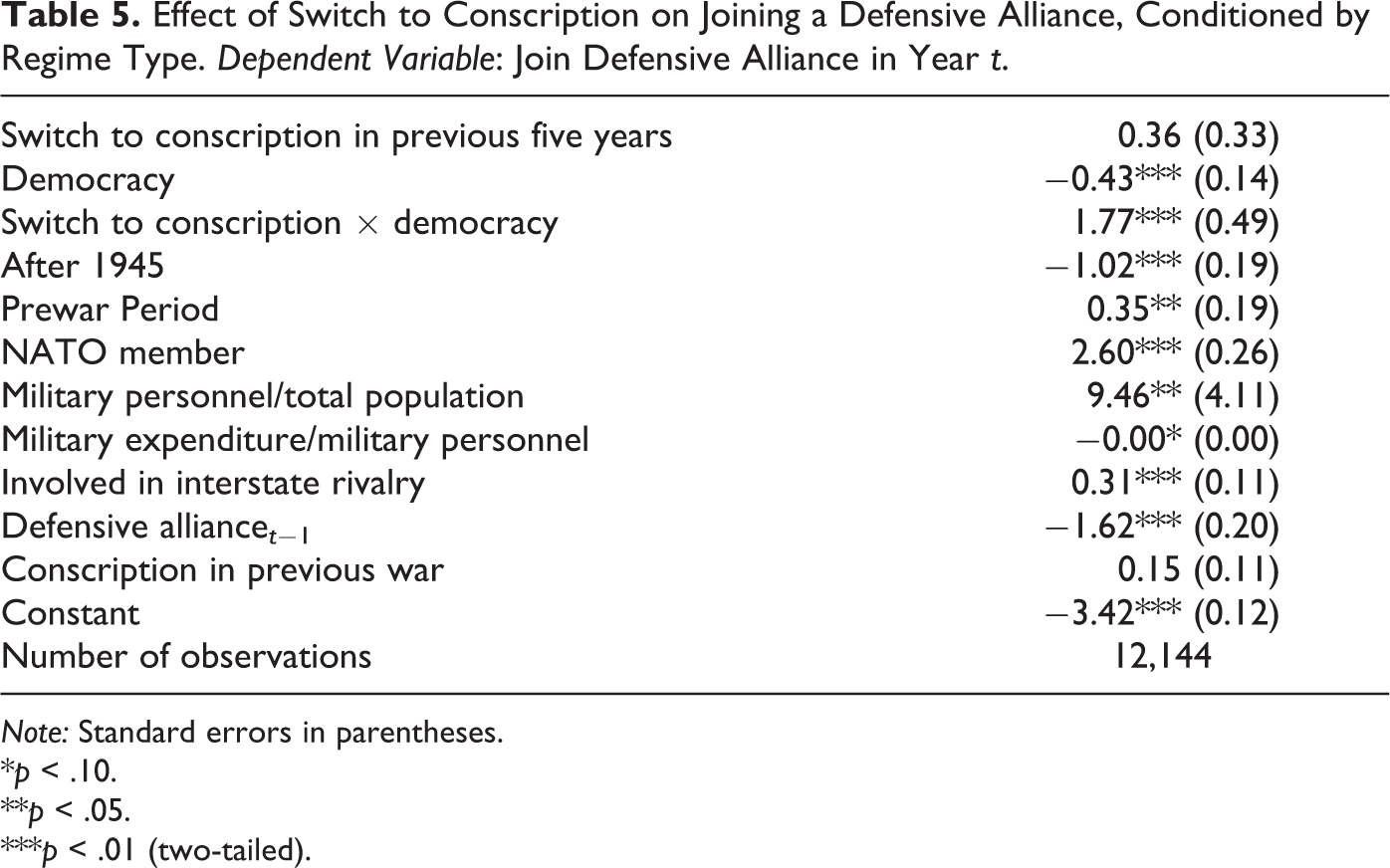
Given that the costs of establishing (and maintaining) conscription may be a costlier signal in a democracy than in an autocracy, this suggests that a conditional test could help tease out the signaling story: because democracies might be more vulnerable to political pressure to avoid conscription, the effectiveness of conscription as a costly signal will be conditional on the state being a democracy. 26
This leads us to estimate the following model:

where
Table 5 reports the regression results from this model. The results provide initial support for our argument, showing that democracies that switch to conscription are much more likely to attract allies than nondemocracies. To ensure the correct interpretation of the substantive effects, Figure 3 plots the percentage chance in the probability of alliance formation that is associated with a switch to conscription when Democracy = 1 and Democracy = 0 (Brambor, Clark, and Golder 2006). To create Figure 3, we estimate the model, acquire the coefficients, and then generate 10,000 simulated values of the coefficients. These are then used to compute the confidence intervals around the percentage change in the predicted probability of alliance formation due to adopting conscription under democracy or nondemocracy.
Effect of Switch to Conscription on Joining a Defensive Alliance, Conditioned by Regime Type. Dependent Variable: Join Defensive Alliance in Year t.
Note: Standard errors in parentheses.
*p < .10.
**p < .05.
***p < .01 (two-tailed).
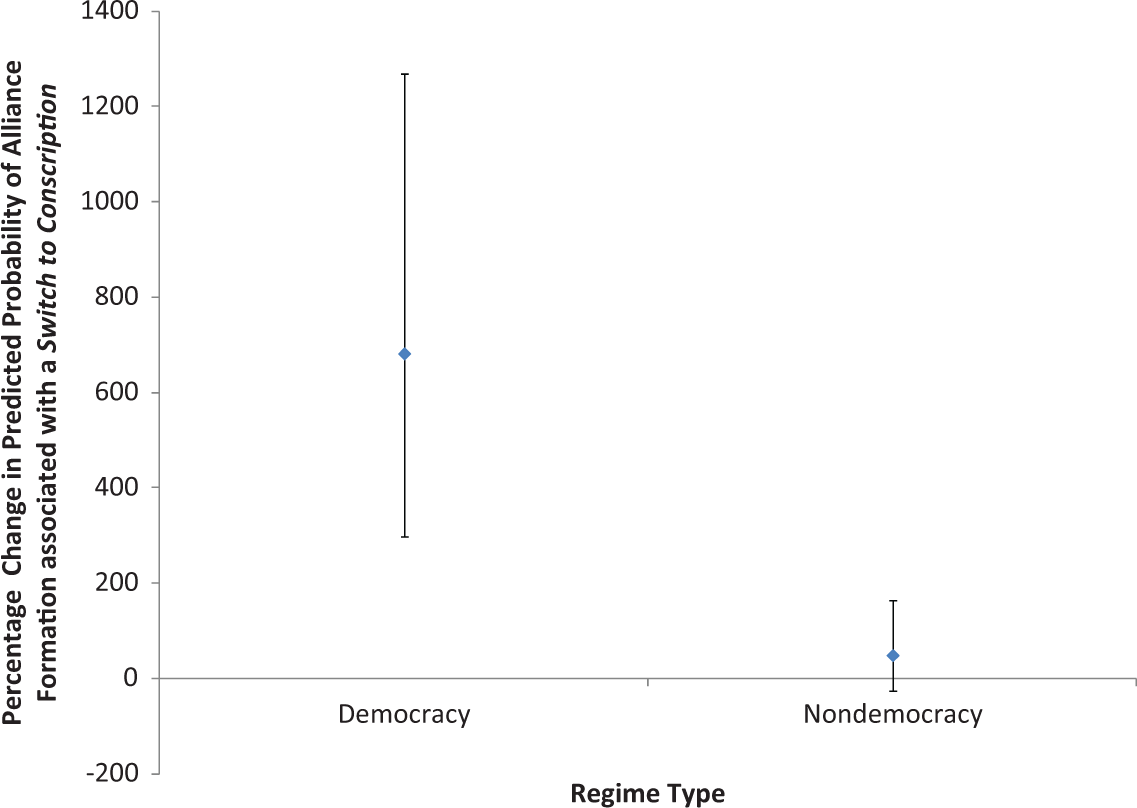
Effect of switch to conscription on alliance formation, democracy versus nondemocracy.
Figure 3 shows that the decision to switch to conscription is only associated with a large and statistically significant increase in the probability of alliance formation for democracies. This is consistent with conscription being a costly signal of alliance commitment. Given research suggesting that some types of autocratic leaders also have to pay significant political costs for their policies, we investigated variation in autocratic regime type after 1945, following Weeks (2008, 2014). However, using this more refined regime categorization leads to perfect separation in some segments of the data due to a limited number of post-1945 positive cases. 27 Thus, it is difficult to determine for certain the impact across variants of autocratic regimes. Overall, we consider these tests preliminary and not confirmation of conscription’s signaling properties. Instead, this could prove a fruitful avenue for future research.
Conclusion
In order to signal their reliability as alliance partners, both during peacetime and when countries expect to go to war, countries build up their militaries in an attempt to attract allies. While this is especially likely to occur during periods where countries experience large-scale external threats, it also happens more generally. For much of the 1816 to 2001 time period, countries perceived conscription as critical to creating a mass army and protecting the nation (Onorato, Scheve, and Stasavage 2014). Hence, those countries that switched to conscription also became significantly more likely to form external alliances. Rather than just reflecting their external security environment, our evidence suggests a strong causal relationship. Countries used conscription to signal that they would not shirk on their alliance contributions. This specific relationship faded once conscription no longer became essential to demonstrating a commitment to strong national defense. However, it suggests that there is a generally positive relationship between arms and allies, especially at formative stages.
At the margin, there is good evidence that leaders must choose between expending their political capital to build their military and forgo freedom of action by joining an alliance. In peacetime, however, when the threat of war does not loom and one might expect leaders to consider these marginal costs more carefully, our results are especially strong. Moreover, most cases of countries facing imminent war, when the pressure to make difficult choices looms largest, suggests that countries view arms and allies as going hand in hand. As Thucydides suggested, it would be useful to acquire troops “both from Athens and from our allies” (Thucydides Book VI, 6.22, emphasis added).
Our findings have implications for a range of work in international relations, from the impact of military mobilization strategies on signaling (Slantchev 2011) to research on military effectiveness (Biddle 2004) to research on alliances (Leeds 2003). One particularly important implication is that the relationship between arms and allies may work in sequence rather than as an “either/or” proposition. At the onset stage, the arms versus allies choice is complementary—states are simply attempting to bolster their security.
These findings also open avenues for future research. First, states may shift how they balance between arms and allies over time, in particular given resource constraints and domestic politics. This could provide a way to integrate the findings of this article with prior research by Morrow and others. It also suggests potential avenues for thinking about military recruitment and alliance decisions, and related signaling, as part of a bargaining process. Second, future research should also consider when states seek allies to enhance their own internal arms. This could be accomplished through military aid, provision of military equipment, or by sharing the costs of research and development. Finally, the attractiveness of conscription seems to have declined in the last few decades, often traced to the US decision to end conscription in 1972. Future research could explore how external modeling and mimicry influence how states evaluate the costs and benefits of different military recruitment systems.
Footnotes
Authors’ Note
Authors names are in alphabetical order. Earlier versions of this article were presented at the 2012 Annual Meeting of the Peace Science Society (International) and the 2013 Annual Meeting of the International Studies Association. All errors are our own.
Acknowledgments
We thank Paul Diehl, Ashley Leeds, and Jack Levy for comments and suggestions.
Declaration of Conflicting Interests
The authors declared no potential conflicts of interest with respect to the research, authorship, and/or publication of this article.
Funding
The authors received no financial support for the research, authorship, and/or publication of this article.
Supplementary Material
Supplementary material for this article is available online.