







Abstract
Protests and democratic transitions tend to spread cross-nationally. Is this true of all political events? We argue that the mechanisms underlying the diffusion of mass-participation events are unlikely to support the spread of elite-led violence, particularly coups. Further, past findings of coup contagion employed empirical techniques unable to distinguish clustering, common shocks, and actual diffusion. To investigate which events diffuse and where, we combine modern spatial dependence models with extreme bounds analysis (EBA). EBA allows for numerous modeling alternatives, including diffusion timing and the controls, and calculates the distribution of estimates across all combinations of these choices. We also examine various diffusion pathways, such as contagion among trade partners. Results from nearly 1.2 million models clearly undercut coup contagion. In comparison, we confirm that more mass-driven political events robustly spread cross-nationally. Our findings contribute to studies of political conflict and contagion, while introducing EBA as an effective tool for diffusion scholars.
Introduction
The wave of protests that engulfed the Middle East during the Arab Spring has renewed interest in the cross-national contagion of major political events like democratic transitions, revolutions, and coups (Black 2013; Hale 2013; Zhukov and Stewart 2013; Aidt and Jensen 2014). Yet the study of diffusion continues to be plagued by theoretical uncertainties about what types of events diffuse and why (Solingen 2012; Hale 2013). Are all events contagious or is there something distinctive about protests and democratic transitions? Equally prominent are the methodological challenges concerning proper model specification and testing (Beck, Gleditsch, and Beardsley 2006; Zhukov and Stewart 2013). In particular, concerns persist that the inability to account for common shocks and the clustering of omitted variables may systematically overestimate contagion (M. H. Ross and Homer 1976; Plümper and Neumayer 2010).
This article introduces a new approach to testing cross-national contagion that can help distinguish the types of events that do and do not spread across borders. To illustrate our technique and some of the pitfalls of diffusion research, we focus on reexamining the coup contagion hypothesis, an early and influential finding in diffusion scholarship that claims coups increase the coup propensity of surrounding countries. We marshal extensive evidence that coups are not contagious. We then apply our technique to seven other types of political events and demonstrate a striking pattern—it is primarily the mass-based events that spread cross-nationally rather than elite-led violence like coups.
Examples do abound of coups following in rapid succession in specific times and places. Sub-Saharan Africa, for instance, suffered five coups in the first two months of 1966 alone. From 2000 to 2010, the same region experienced twenty-three coup attempts. But were these events causally connected or independent products of a highly coup-prone environment? In a seminal article, Li and Thompson (1975) argue that coups indeed diffuse within regions. Subsequent articles confirmed the finding in specific regions (Lutz 1989; Lunde 1991). Further, the coup contagion idea is widely believed by political leaders. The Dominican Republic’s President Leonel Fernández warned that the 2009 Honduras coup could have “a contagion effect towards other nations of the region and return to a period of barbarism.” Presidents in Costa Rica, Ecuador, and Guatemala warned of a “domino effect” across Central America if the coup was allowed to stand, complemented by worries among US diplomats (Associated Press [AP] 2009; Rogers 2009).
This article casts doubt on the coup contagion hypothesis both theoretically and empirically. We argue that the key mechanisms underlying political diffusion—emulation, learning, and focal points—are more consistent with the spread of mass-participation events like protests compared to elite-led violence. We then show that previous coup contagion findings resulted from inappropriate estimators and a failure to account for clustering and common shocks.
To provide a superior test of coup contagion while accounting for model uncertainty, we combine modern spatial dependence models with a technique called extreme bounds analysis (EBA; Leamer 1985; Sala-i-Martin 1997). EBA allows us to consider numerous alterations to our empirical model, such as the window measuring diffusion and the controls. It then runs all possible combinations of these choices and calculates the distribution of estimated effects. The results strongly undercut regional coup contagion, as virtually none of the estimates are substantively or statistically significant. We reach the same conclusion using six other diffusion metrics, including a country’s neighbors and trade partners. Across nearly 1.2 million distinct estimates, we find robust evidence against coup contagion.
The findings carry a number of important implications. By addressing several methodological issues, we overturn the conventional wisdom on coup contagion, which has widely influenced both scholars and government actors. Dispelling such beliefs can improve coup forecasts and ensure that attention and pressure are directed at the highest-risk countries. The results also contribute to our understanding of regional instability and the causes of coups more generally. Although coups have declined in propensity, recent cases in Egypt, Thailand, and Mali demonstrate that they remain significant global events.
Our work also illustrates persistent empirical issues in the spatial dependence literature, especially how poor model specification can lead to spurious contagion findings. This has spurred interest in new empirical approaches to cross-national diffusion (Beck, Gleditsch, and Beardsley 2006; Solingen 2012; Zhukov and Stewart 2013). We propose EBA as an ideal technique for analyzing spatial dependence models, given their high specification uncertainty and model dependence. If a range of models are non-significant regardless of specification, we can conclude (as with coup contagion) that diffusion is unsupported. We hope this illustrates how to convincingly challenge a positive finding, a continual issue in academic work. Alternatively, if the models are consistently signed and significant (as with regional protest contagion), this furnishes stronger evidence of contagion than any one model can provide. Our analysis thus demonstrates how diffusion scholars can use EBA to assess the robustness of their findings.
With this in mind, we conclude by applying EBA to the contagion of seven non-coup political events, including democratization, protests, and civil violence. An advantage of this exercise is that we test the different events using a consistent, comparable method. This is preferable to comparing different studies that may use highly dissimilar empirical approaches. Publication bias may also tilt published work toward positive findings. We find robust evidence of contagion primarily for the relatively peaceful mass-participation events. Some evidence is found for the spread of civil wars and revolutions, but only to neighbors. Thus, the results provide new insight into what types of events diffuse and their most common pathways.
Background on Coup Contagion
We define contagion as any process in which the occurrence of a political event in one country increases the likelihood of a similar event in another country. Following Simmons, Dobbin, and Garrett (2006) and Solingen (2012), we treat this as synonymous with diffusion, although some scholars consider diffusion a broader concept. 1
To develop our theory on elite-led violence, we first overview the studies supporting coup contagion and how they have influenced political science more broadly. We then explain the methodological shortcomings of Li and Thompson (1975) and related papers, which we address in our analysis. However, we argue that coup contagion is unlikely given current theories of why coups occur and why other political events spread.
Previous Findings on Coup Contagion
The idea that coups may be contagious goes back at least to Huntington (1962, 45), who speculates that “a successful coup or insurrection by one party or group in one country inspires similar parties or groups in other countries to similar action.” Sporadic testing of coup contagion subsequently occurred, with Putnam (1967) finding no evidence in Latin America and Midlarsky (1970) finding some evidence there in specific periods. Huff and Lutz (1974) investigate coup contagion in sub-Saharan Africa, but focus on descriptive statistics rather than empirical testing. For instance, they note that 38 percent of countries’ first coup attempts occurred in the year following a coup in a neighbor (365).
To our knowledge, Li and Thompson (1975) represents the only global empirical test of coup contagion to date. In a pioneering study, they find “systematic if not overwhelming” (p. 80) evidence of regional diffusion from 1946 to 1970, although this varies by region and time period (see below). Further testing has been rare and limited to specific regions: Lutz (1989) and Lunde (1991) support contagion in sub-Saharan Africa, whereas Lehoucq and Pérez-Liñán (2014, 1114) find evidence of negative coup contagion in Latin America.
Despite these mixed findings, the coup contagion idea has widely influenced governments, policy circles, and diffusion research more broadly. Following a military coup, it is common to read of observers’ expectations of a domino effect in the surrounding region. For instance, Turkey’s foreign minister warned that Egypt’s 2013 coup could produce a wider political reversal among Arab Spring countries (Hurriyet Daily News 2013). The African Development Bank recently warned of “coup contagion” risks in Central and Eastern Africa (Barka and Ncube 2012). Similarly, Gaestel (2012) reports “Guinea-Bissau followed Mali’s example last week, as members of the military seized power” (our emphasis). Finally, Jay Ulfelder includes measures of regional and global coup activity in his coup forecasts. 2
Coup contagion has also had a major impact on political diffusion scholarship (Elkins and Simmons 2005; Simmons, Dobbin, and Garrett 2006). The finding has led scholars to theorize that additional conflicts should diffuse, including terrorism (Midlarsky, Crenshaw, and Yoshida 1980), ethnic conflict (Bosker and de Ree 2014), and political instability more generally (Pitcher, Hamblin, and Miller 1978; Most and Starr 1980; Forsberg 2008). It is also acknowledged as an inspiration for studies on the diffusion of authoritarianism (Ambrosio 2010), democracy (Starr 1991), and oil nationalization (Kobrin 1985). Despite coup contagion’s substantial influence, digging into its methodological and theoretical underpinnings casts doubt on its validity.
Methodological Problems
We focus on critiquing Li and Thompson (1975), as it is the most widely cited article on coup contagion and remains, to our knowledge, the only global test. However, several of the problems we identify are common in diffusion studies more generally. Li and Thompson test for regional coup contagion from 1946 to 1970. There are two central methodological problems with the article: (1) inappropriate estimators and (2) inadequate controls for clustering and common shocks.
First, Li and Thompson use two estimation strategies, both of which analyze annual counts of coup attempts in specific regions. 3 The first applies two Poisson estimators, only one of which allows the distribution mean to vary by year. Since the latter provides a better model fit for some regions, this is consistent with coup contagion waves producing higher coup counts in some years. But as the authors themselves note (pp. 68, 71), this cannot distinguish contagion from variation in coup propensity by time period. The second estimation strategy, a Gaussian model shows that regional coup counts correlate with their lagged values. Again, this cannot distinguish contagion from time period effects. Further, it does not differentiate coup dependencies across countries from those within countries. 4
Second, a key challenge for contagion models is distinguishing true diffusion from common external shocks (such as geopolitical shifts and global recessions) and the clustering of omitted variables. This is often termed “Galton’s problem” (M. H. Ross and Homer 1976; Plümper and Neumayer 2010). As an early critic of coup contagion models explains, “even if contagion may appear to be present, the same conditions in the ‘model’ country and in the ‘imitating’ country may, in effect, be the cause for the co-occurrence of events” (Zimmermann 1979, 400).
At minimum, coup contagion models require two additional controls to address this: region fixed effects and time controls. The first accounts for the general propensity of a region to experience coups, which can easily be mistaken for contagion. For instance, suppose coups are ten times as likely in Latin America compared to Europe. It follows that a Latin American coup is ten times as likely to be followed closely by another regional coup even without any causal connection between them, presenting a spurious contagion relationship. The second requirement accounts for time to distinguish diffusion from common trends and shocks. This avoids mistaking coups as contagious when they occur closely in time simply because both countries are in a period with high coup propensity.
To get a sense of this variation, Figure 1 displays the fraction of country-years experiencing coup attempts and successes by region and decade. There is clearly a strong variation across regions and a general decline in coup propensity over time. Our tests thus always include region fixed effects and some control for the year (either a linear term or year fixed effects). We also consider a large range of controls to account for clustering.
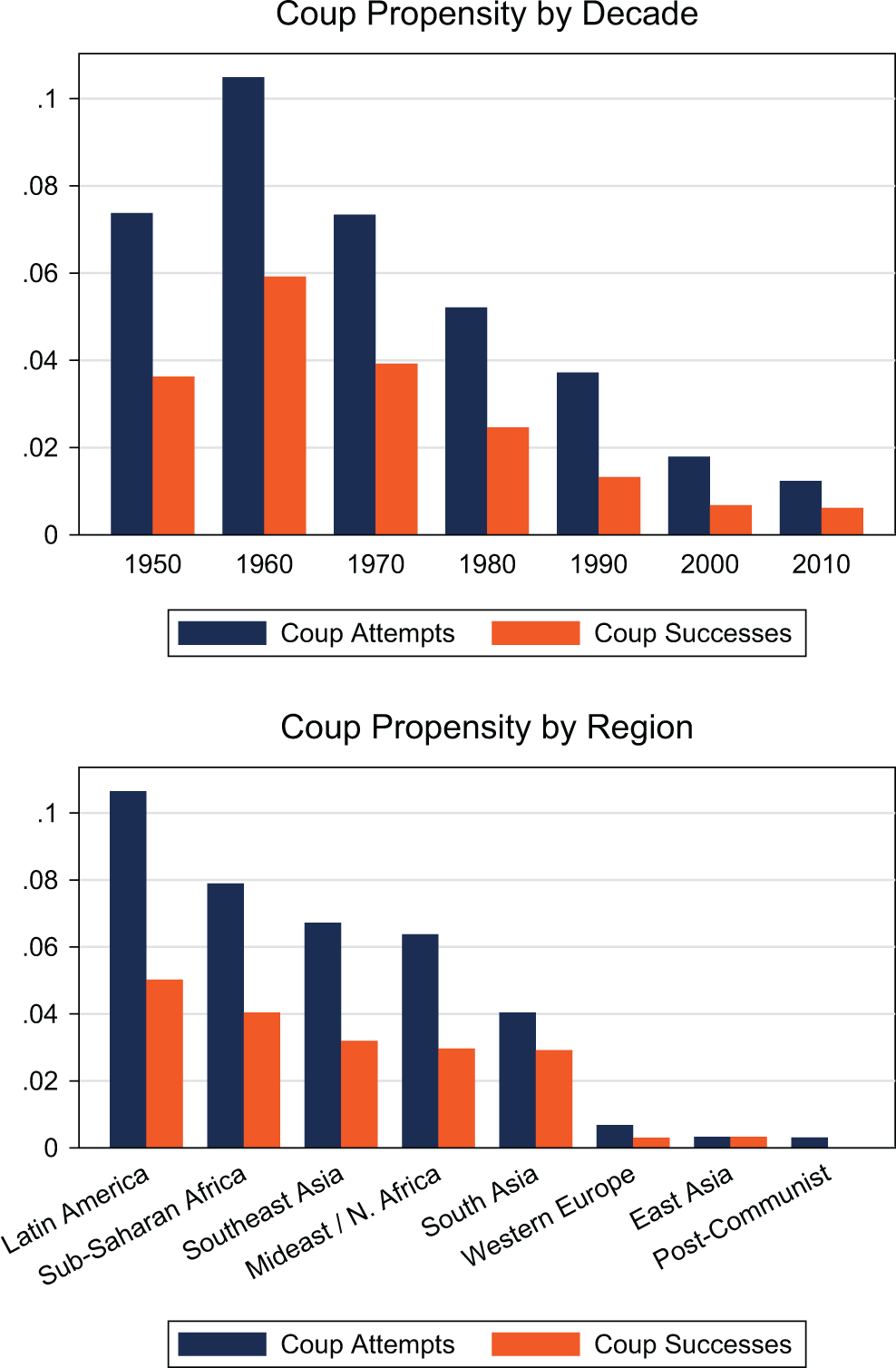
The figures show the number of coup attempts and successful coups per country-year, by decade (top panel) and across eight regions (bottom panel). Overall coup propensity varies strongly over time and by region, which must be accounted for in testing for coup contagion. Coup data come from Powell and Thyne (2011).
In contrast, Li and Thompson (1975) include no control variables in any test nor do they account for temporal trends. Subsequent tests of coup contagion add controls and look within specific regions (Lutz 1989; Lunde 1991; Lehoucq and Pérez-Liñán 2014), negating the need for region fixed effects. However, only Lehoucq and Pérez-Liñán (2014) include a control for time period; perhaps not by coincidence, they find no evidence of contagion in Latin America.
Why Coup Contagion Is Unlikely
Existing Explanations of Coups
We now explain why coup contagion is theoretically unlikely, given prevailing understandings of why coups occur and why political events diffuse. The traditional view of coups was that militaries were pushed or pulled into politics. Domestic instability and social change might pull the military into power to prevent radical turns in civilian politics or to fix political crises (Huntington 1968; O’Donnell 1973). Alternatively, characteristics of the military itself might push soldiers to seize control of government (Stepan 1971; Nordlinger 1977).
More recently, scholars have suggested that coups occur when the military has both the motive and opportunity to intervene in politics (Belkin and Schofer 2003; Powell 2012), although views diverge on which motives and opportunities are most influential. Regarding motives, the military may seek to safeguard the nation (Stepan 1971; O’Donnell 1973) or redress institutional and personal grievances, including issues of funding and ethnic patronage (Jackman 1978; Powell 2012). Suitable windows of opportunity include economic crises, when the state loses legitimacy (Belkin and Schofer 2003), politics becomes polarized (O’Donnell 1973), and military capacity is strong (Powell 2012). Other research focuses on domestic structural factors, including past coup attempts (Londregan and Poole 1990; Lunde 1991), ethnic cleavages (Jackman 1978; Lunde 1991), and the level of development (Huntington 1968; Londregan and Poole 1990). As we discuss below, external coups are unlikely to play into either the motives or opportunities for coups.
Leading research does acknowledge the influence of the international environment. Scholars have studied the direct intervention of the Soviet Union and the United States during the Cold War and how interstate conflicts influence coup propensity (Piplani and Talmadge 2016). Coups can also trigger various penalties, including sanctions, aid reduction, and diplomatic pressure, especially post shorter -Cold War (von Soest and Wahman 2015). Unlike external coups, however, these international factors directly affect the motives and opportunities for coups. Further, they help explain why coups cluster in particular times and places without any causal relationship between coups.
Mechanisms behind Political Diffusion
There is strong evidence that many political events diffuse across borders, especially mass-driven, contentious political action. Prominent examples include the sit-ins that spread across the American South in the 1960s (Andrews and Biggs 2006) and the waves of mass-driven liberalization in Europe in 1848, Eastern Europe in 1989, the Color Revolutions, and the Arab Spring (Beissinger 2007; Weyland 2009; Hale 2013). Several studies find that democratic neighbors encourage democratization (Starr 1991; Gleditsch and Ward 2006), while others cover the diffusion of revolutions (Aidt and Jensen 2014) and riots (Govea and West 1981).
Why do these events diffuse but coups do not? Rather than expecting all political events to diffuse, we contend that attributes of the event itself should predict its likelihood of spreading. Consider then some essential features of coups that differ from most mass-driven events: Coups are violent seizures of power, typically undertaken by a small, coordinated group of professional elites, primarily high-ranking military officers. 5 In contrast, most protest movements focus on normative goals like democracy and are comprised of broad collections of politically excluded opposition groups and spontaneous mass actors.
Given these differences, we argue that the three primary mechanisms used to explain political diffusion—emulation, learning, and focal points (Elkins and Simmons 2005; Hale 2013)—better support the spread of mass contestation. Specifically, emulation favors the spread of aspirational normative behavior over violent acts like coups, especially in the current international environment. Learning is more likely among mass actors rather than professional military elites, who have experience with politics and the use of force. Lastly, focal points are primarily needed by mass actors who are too numerous or diffuse to directly coordinate. Although we cannot establish that coup contagion is theoretically impossible, we claim that each of these mechanisms provides a stronger logical basis for the spread of mass contestation.
Emulation
Political behavior spreads through emulation when new cultural norms and reference groups develop around a political action and change its value to potential adopters (Elkins and Simmons 2005). In international politics, a state may mimic the policies associated with an exemplar state, an advocacy group, or an epistemic community (Simmons, Dobbin, and Garrett 2006, 801). For instance, democracy has spread due to normative diffusion (Gleditsch and Ward 2006), Western cultural linkage (Levitsky and Way 2005), and acculturation through regional organizations (Pevehouse 2002).
Emulation is an unlikely channel for coup contagion. For emulation to be at work, a coup in a nearby country would raise the normative value or prestige of undertaking a coup in an observing officer’s own country. However, there is little evidence that officers look to neighboring (and often rival) militaries as normative political models. Extensive research shows that norms of civil shorter-military relations are primarily derived from a country’s own experiences and, secondarily, from general international prescriptions working against coups (Stepan 1971; Nordlinger 1977; Feaver 1999).
A deeper problem is that coups are inherently non-normative acts, typically undertaken either for personal gain or in response to domestic crises. A norm is commonly defined as “a standard of appropriate behavior,” which is then adopted by international actors to maintain esteem and legitimacy (Finnemore and Sikkink 1998, 891). Although periods have existed in which powerful international actors justified coups as necessary, never have coups been regarded as inherently legitimizing or esteemed acts. Observers are thus unlikely to interpret an external coup as signaling a “coup norm.” It is possible that a lack of coups could signal an international norm against coups, but this is more likely to be signaled by the international community’s reaction to external coups and the prescriptions communicated by international organizations. Moreover, this mechanism does not involve true coup contagion, but the simultaneous effect of a shared international environment.
Learning
Learning can trigger diffusion when an external event provides information about the process, costs, or benefits of adopting a similar strategy (Elkins and Simmons 2005, 42). This can occur spontaneously, such as when a population views a revolution in a neighbor and recognizes the similarity of their own circumstances (Weyland 2009; Hale 2013). Learning may also be orchestrated, as when movement strategies diffuse through direct ties among civil society groups (Bunce and Wolchik 2006; Beissinger 2007).
Learning also falls short of justifying coup contagion, as neighboring coup attempts are unlikely to provide critical information on the probable success or process for seizing power. Coups are high-risk propositions that hinge on the interplay of domestic institutions and personal loyalties. Senior military personnel are thus likely to draw on current political contexts and their own country’s history rather than relying on external examples or heuristics (Londregan and Poole 1990; Singh 2014). Further, the techniques for orchestrating coups are usually well known to military officers, who have expertise in mobilizing force. In contrast, effective mass mobilization requires innovation, multiple strategies, and long-term planning, often managed by average citizens and groups excluded from politics (Strang and Soule 1998; Bunce and Wolchik 2006). These are precisely the actors most in need of external models.
Lastly, it is particularly unlikely that orchestrated learning encourages coup contagion. In our case research, we found little evidence of coup leaders deliberately coordinating or sharing information with regional peers. 6 Whereas democracy advocates are often committed to the higher purpose of ensuring freedom for all citizens, military officers are rarely drawn to spreading coup tactics, but rather concentrate on securing power domestically.
Focal points
Finally, salient events can serve as focal points that help solve collective action problems for mass movements. Major events like stolen elections and the deaths of key leaders are often linked to protest movements (Bunce and Wolchik 2006; Weyland 2009). Hale (2013) similarly suggests that external events can provide focal points to spur mass coordination and defection from authoritarian regimes.
We expect this to play much less of a role for elite coordination, especially for coups, where the key decision-makers in a military hierarchy are much smaller in number and can usually directly communicate. Unlike protests, most coups are organized by a small, centralized group (Belkin and Schofer 2003; Powell 2012). In fact, many coups begin with senior military officers meeting to decide on and plan the coup (Singh 2014, 84). Even junior officer coups are typically launched by a small group of plotters, such as the Armed Forces Movement behind Portugal’s 1974 coup and the small team of soldiers behind Samuel Doe’s coup in Liberia in 1980. 7 When such organization is impossible, coup attempts are relatively rare. As Powell (2012, 1023) writes, coup plotters “will be wary of attempting a coup as the number of necessary co-conspirators or potential opponents increase.”
Of course, militaries are not unitary actors—Singh (2014) convincingly theorizes that coups, once launched, often operate like coordination games because soldiers prefer to support whichever side the majority of fellow soldiers support. As a result, successful plotters must control the information environment (especially public broadcasts), coordinate expectations (such as by taking symbolic targets), and present the coup as a fait accompli. However, beliefs about fellow soldiers’ loyalties are unlikely to be influenced by external coups. Indeed, Singh argues that officers overwhelmingly draw from domestic events and past experiences rather than international factors.
In sum, we do not expect external coups to inspire potential coup plotters normatively, informationally, or as coordination devices. Further, external coups are unlikely to influence the motivations for coups, which are driven by domestic political crises, structural economic factors, and institutional prerogatives. Thus, coup contagion does not coincide with why soldiers launch coups or why political phenomena diffuse more generally. Of course, coup contagion could operate through another mechanism or conditional on other factors, such as domestic receptivity or specific regions and periods. However, when we examine the evidence, we find no support for coup contagion.
In contrast, mass populations facing sharper collective action problems and greater uncertainty over the techniques and risks of opposition are more likely to draw inspiration from external events. Indeed, there is strong evidence that mass events like protests and democratic transitions spread through emulation, learning, and focal points, although it remains unclear precisely where these events travel. This leads us to the following hypotheses:
We argue that Hypothesis 1 should hold regardless of the spatial metric used (e.g., within regions or among trade partners). For Hypothesis 2, theoretically predicting the most influential metrics for each type of event is beyond the scope of this article. Instead, we proceed to empirical testing and let the data speak.
Empirical Setup
After discussing our coup data, we overview spatial dependence models and the specific metrics of influence that we consider. We then discuss EBA and the model variations included in our tests of coup contagion.
Coup Data
Our measure of coups comes from Powell and Thyne (2011), which includes data on 221 successful coups and 448 attempted coups in a global sample from 1950 to 2010. Under their definition, coup attempts include all “illegal and overt attempts by the military or other elites within the state apparatus to unseat the sitting executive” (2011, 252). This is coded as successful if the plotters hold power for at least seven days. Powell and Thyne provide exact dates for each coup attempt, which we utilize in our models. Generally, we follow the Lunde (1991) setup using external successful coups to predict coup attempts in each country. We also predict successful coups and test the influence of external failed coups in several models.
Spatial Dependence Models
Testing for spatial dependence requires estimating a model of the following form:

Here, we are testing whether Y is predicted by the weighted sum of Y values of other units (with weights specified by the researcher through
The key choice for spatial dependence models is specifying the weighting matrix
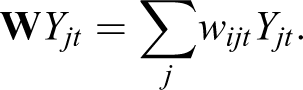
As Plümper and Neumayer (2010) and Zhukov and Stewart (2013) emphasize, the choice of
Rather than select one particular Regional diffusion: This is our primary focus, given the prior literature.
9
Diffusion from contiguous neighbors: This is a discrete metric that includes countries sharing a land border or separated by less than twenty-four miles of water (COW [Correlates of War] Project 2007). Weighted by inverse capital distance (Gleditsch and Ward 2001): This is a popular spatial metric meant to capture the greater influence of geographically closer countries. Diffusion from allies, who represent natural targets for emulation: This is a discrete metric that includes countries sharing a formal military alliance (COW Project 2013). Weighted by dyadic trade (total imports and exports, from Barbieri and Keshk 2012), which captures economic interaction and leverage. Diffusion from countries in the same trade community: Following Lupu and Traag (2013), this is a discrete metric that defines trade communities as clusters of states sharing dense trade ties with each other. This is calculated by applying the Louvain modularity maximization algorithm (Blondel et al. 2008) to the Barbieri and Keshk (2012) data each year. Diffusion from countries sharing an official language (Melitz and Toubal 2014): This captures linkages through culture, colonial history, and possibly direct ties and news sources.
Once
Our article applies these modern spatial dependence techniques to coup contagion (and later other events). In our primary models, the DV Yit is a binary measure of whether at least one coup attempt occurred in country i in year t. Following Lunde (1991), we focus on how successful external coups within a multi-year window influence coup attempts. Thus, Yit and Yjt are defined somewhat differently, but this does not present any estimation difficulty.
As emphasized above, testing for spatial dependence faces the threat of common shocks and clustering producing spurious associations (M. H. Ross and Homer 1976; Plümper and Neumayer 2010). For coup contagion, it is especially critical to control for each region’s general propensity for coups and patterns in time. All of our models therefore include region dummies, as well as either year dummies or a linear year term to detrend the data. We also investigate the robustness of our estimates to various controls associated with coup propensity.
EBA
To challenge coup contagion, we want to avoid choosing a specific model and metric. Although model choice is always uncertain, it is especially so when one theorizes that no effect should exist. We therefore seek to show that a null or negative finding holds regardless of the model. To demonstrate this, we employ EBA, a form of sensitivity analysis that estimates a range of related models to ascertain how robust a main effect is (Leamer 1985). In principle, any element of the model can be varied, although this is most commonly the set of controls. Thus, EBA estimates a series of regressions of the following form:

where X is the main variable of interest, in our case a weighted measure of successful coups in other countries (i.e.,
Empirical testing with EBA
Once EBA produces a range of model estimates, how do we summarize them? The primary purpose of EBA is to capture the sensitivity or robustness of model estimates. Leamer’s (1985) original formulation called for focusing on the extremes of these estimates: only if all estimates are in a consistent direction should one claim the results are robust (also see Levine and Renalt 1992). However, this can be unduly influenced by unrepresentative estimates, especially when one considers a large number of models. Instead, Sala-i-Martin (1997) recommends capturing the full distribution of the estimates by calculating how many are consistently signed and how confident the estimates are. His suggested rule of thumb is that 95 percent of estimates should be in a consistent direction to be considered robust. He also recommends a summary statistic called CDF(0), which measures the total fraction of the cumulative distribution functions of the
A secondary use of EBA is to aggregate the various estimates into a single “representative” estimate. This has the advantage of capturing the substantive size of any effects. A common approach is to simply present the mean coefficient and standard error. Another option is to compute a weighted average of the coefficients, usually weighting by the explanatory accuracy (e.g., R 2 or likelihood) of each model (Sala-i-Martin 1997). 10
We present a range of statistics to capture our results. To measure robustness, we display the distribution of t-values from each EBA run testing coup contagion. We also calculate the fraction of estimates that are positive, the fraction positive and significant (p < .05), and CDF(0). We also present representative estimates in the form of mean coefficients and standard errors, as well as pseudo–R 2 weighted means.
Interpreting EBA results
This leaves open the question of how to substantively interpret EBA results. If the estimates either consistently support or consistently fail to support a hypothesis, we can draw conclusions with high confidence. But what if the results are mixed? Relatedly, some models may be better supported theoretically than others—shouldn’t these receive greater weight in our conclusions?
In our view, EBA’s starting point is an admission of the inherent uncertainty of empirical models. EBA requires analysts to select necessary modeling choices to include in every specification, as well as choices they cannot be certain about. In our analysis of coups, for instance, we always retain region fixed effects and a year control. But we acknowledge that more tertiary modeling choices are uncertain given existing theory. Having made these decisions, if EBA reveals consistent outcomes, then scholars don’t need to decide on these tertiary modeling choices. If results are mixed, then more analysis is needed. We suggest that when there is no consistent outcome across the models, researchers look for patterns in the results. They may discover that a finding is consistently supported conditional on a specific modeling choice. This lays bare that conclusions depend on how convincing this choice is. Alternatively, researchers can accept that when EBA gives you mixed results, it’s revealing that the findings are inherently uncertain.
Therefore, we do not recommend EBA as a replacement for theory in modeling. Rather, EBA forces researchers to use theory to distinguish the necessary and uncertain modeling choices, then to acknowledge how conclusions depend on their confidence (again, theoretically motivated) over specific choices in the latter group. As a result, EBA is ideally suited for analyzing spatial dependence models, which have a large number of modeling choices that are rarely guided by theory (Plumper and Neumayer 2010; Zhukov and Stewart 2013). Further, results can be highly sensitive to these choices (Zhukov and Stewart 2013). Yet as Leamer (1985, 308) cautions, “A fragile inference is not worth taking seriously.” We therefore propose EBA as a technique to determine how fragile models of political contagion really are. 11
Our model variations
Our coup contagion models incorporate a comprehensive set of alternative controls
GDP/capita (logged, in real 2000 US dollars, from Haber and Menaldo 2011; World Bank 2013), a strong predictor of coups and other forms of political instability. The Polity democracy score (a twenty-one-point rating, from Marshall and Jaggers 2010), included either as a linear term or a quadratic to capture the higher instability at middle values. The regional Polity average (excluding the country itself), which accounts for regional pressures against coups and other antidemocratic actions. Autocratic regime type, captured by dummy variables for military regime and party-based regime (Geddes, Wright, and Frantz 2014).
Economic growth, the average percentage change in GDP/capita over the prior two years. A measure of domestic civil violence (a ten-point rating tracking civil and ethnic conflict, from Marshall 2012). A similar ten-point measure of international violence (Marshall 2012).
Fuel dependence (percentage of GDP from oil and gas, from M. L. Ross 2013).
Economic inequality, measured by the Gini index of income inequality (interpolated and averaged from Galbraith and Kum 2003; UNU-WIDER 2005; World Bank 2013).
Military size (military personnel as percentage of population, from COW Project 2010b). We vary the year control between a single linear term or year fixed effects.
We also vary the specific measure of coup contagion. However, we do not include variations in the spatial metric (e.g., regional vs. neighbor contagion) within a single EBA run, as the estimates are not directly comparable. Instead, we vary the following: 12. The size of the window measuring external coups (one, two, five, or ten years). 13. Taking advantage of the precise coup dates, we vary whether the window ends (a) the day prior to the first of any coups in the current year or (b) at the end of the previous year. Thus, (a) includes external coups earlier in the calendar year as possible influences. If no coup occurs in a country-year, then (a) ends the window on December 31 of that year. 14. We also vary whether the measure captures external coups per country-year or total coups, which corresponds to the choice of whether to row-standardize
Altering the measure of the main variable of interest is somewhat unusual for EBA, but we believe estimates across these measures are directly comparable. For the last option (row-standardization), the coefficients are not comparable across different choices, but it is still appropriate to compare significance levels. Therefore, when we calculate average coefficients, we only use row-standardized measures.
Finally, we include two further controls based in part on how we define coup contagion: 15. The number of successful coups and coup attempts in the country within the window defined above. This acts like a lagged DV, reflecting well-known results on coup traps that lead to repeated cycles of political violence (e.g., Londregan and Poole 1990).
13
16. The inclusion of failed coup attempts in other countries, measured exactly in parallel with successful coup contagion.
We test every possible combination of these sixteen variations (two with more than two options) for each of the seven specifications of
Empirical Analysis of Coup Contagion
Regional Coup Contagion: Initial Tests
Before delving into the EBA results, we first present some representative logit models testing for regional coup contagion. Although our EBA results are much more comprehensive, it is worth illustrating our findings in a familiar and transparent form. In addition, we show results for our control variables, whereas the later discussion focuses on contagion. Summary statistics for the included variables are shown in Table A1 in the Online Appendix.
Table 1 displays results predicting whether a country experiences a coup attempt. The main variable of interest is regional coup contagion, coups per country-year in the surrounding region over the previous two years. 14 Model 1 includes only region fixed effects and a linear year term as controls. We see that the estimated contagion effect is negative, although not significant. This is despite the fact that this estimate is likely upwardly biased, since we are not accounting for clustered characteristics. Indeed, the estimate only becomes more negative as controls are added. Model 2 adds year fixed effects. Model 3 controls for the country’s number of coup attempts and successes in the past two years. Model 4 controls for failed coups per country-year in the region. Model 5 adds all of the remaining control variables. Model 6 uses total coups for the contagion variable rather than coups per country-year. Finally, model 7 changes the DV to successful coups rather than coup attempts.
Logits Predicting Regional Coup Contagion.
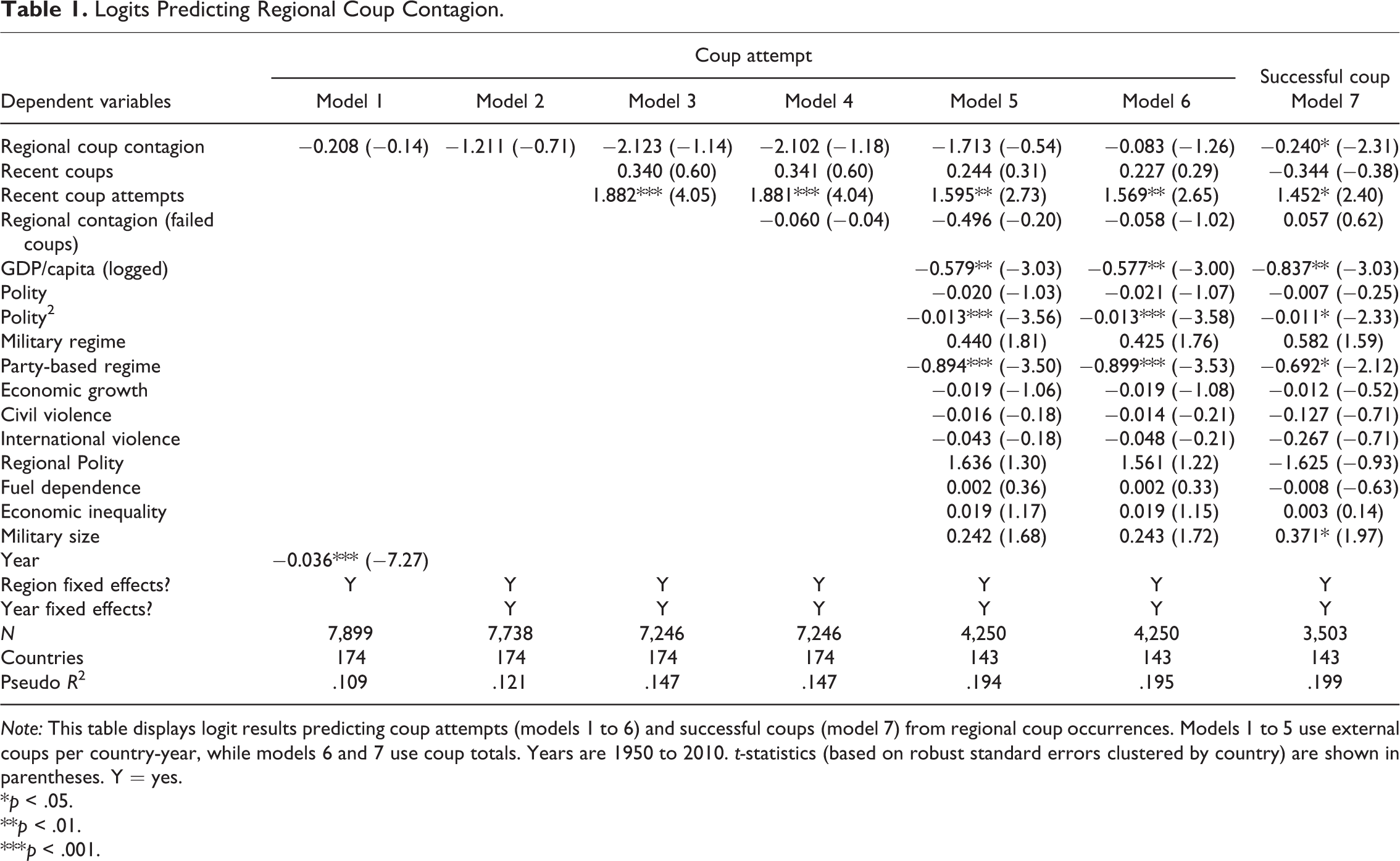
Note: This table displays logit results predicting coup attempts (models 1 to 6) and successful coups (model 7) from regional coup occurrences. Models 1 to 5 use external coups per country-year, while models 6 and 7 use coup totals. Years are 1950 to 2010. t-statistics (based on robust standard errors clustered by country) are shown in parentheses. Y = yes.
*p < .05.
**p < .01.
***p < .001.
In every case, regional coup contagion is negative, although only significantly so in model 7. The effect sizes are also small—based on model 4 (which produces the largest-magnitude effect), with all variables at their means, if an additional 10 percent of countries in the region have coups each year, the likelihood of a coup attempt falls by 0.4 percent. Failed coups in the region are also unrelated to coup attempts. Among the other variables, coup attempts are more likely after recent coup attempts, at lower average income, in non-party-based regimes and in countries at middle values of Polity.
Could coup contagion be conditional on some other factor? As in past research, we focus on testing average effects, but contagion could still operate in specific contexts or depend on a country’s receptivity. Since contagion is negative on average, we regard this as unlikely, but investigate several possibilities. We begin by testing whether coup contagion varies by time period or region. Contagion could have operated during the Cold War but disappeared only recently. Similarly, contagion could hold in sub-Saharan Africa (a focus of the literature) but not elsewhere. Figure 2 shows the estimated effect of regional coup contagion by decade and by region, derived by extending model 1 of Table 1 with the appropriate interactions. 15 We see that regional coup contagion is insignificant in every decade and every region. We further tested regional coup contagion interacted with seven domestic factors: military size, military spending, military regime, a dummy for a coup within the past five years, civil violence, Polity, and GDP/capita. Extending either model 1 or model 5 from Table 1, no conditional contagion effect is found (see Table A3 in the Online Appendix).
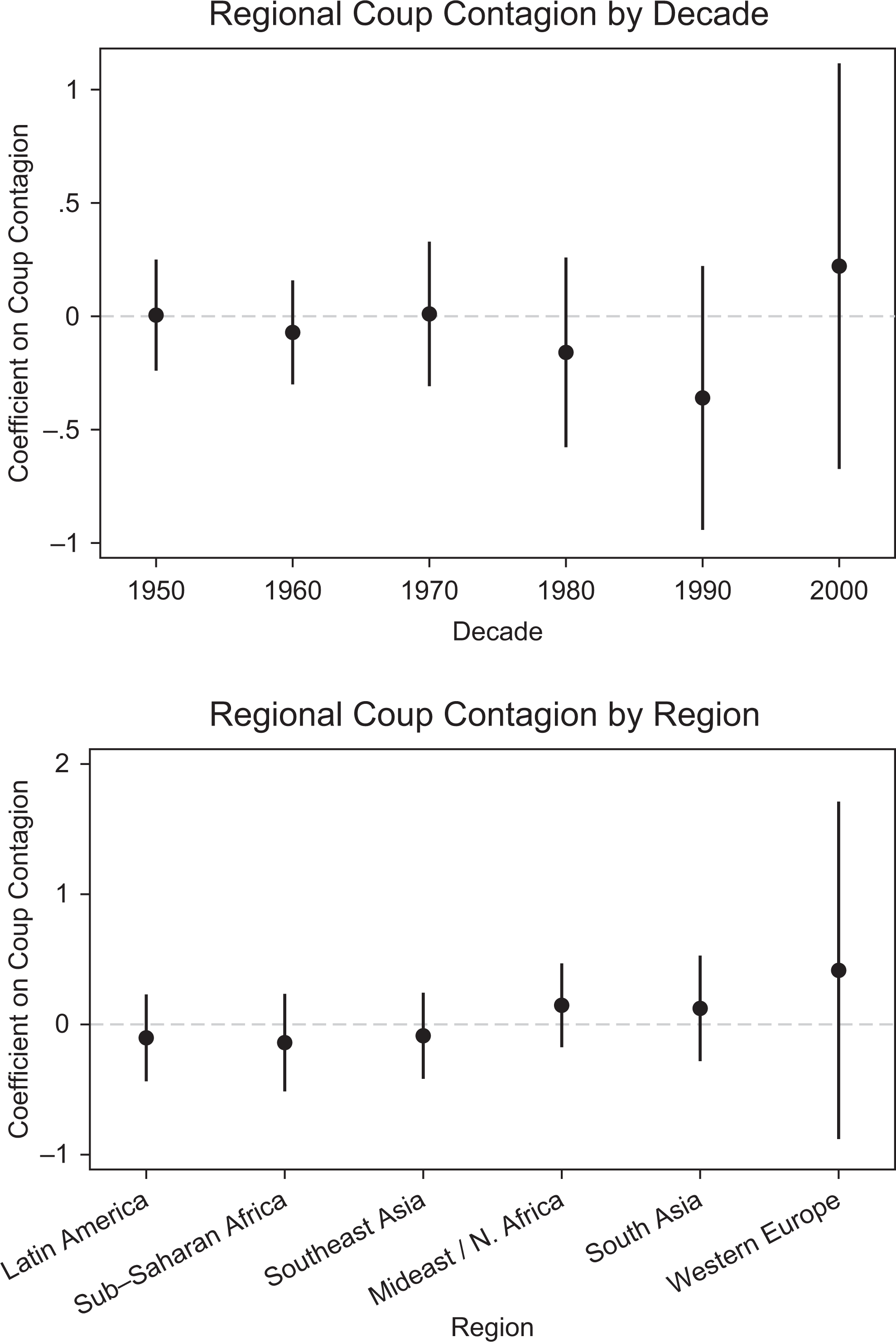
The figures show the estimated effect of regional coup contagion by decade (top panel) and six regions (bottom panel). The dots show the estimated coefficients (from an interaction of decade or region with regional coup contagion) and the bars represent the 95 percent confidence intervals.
EBA
Regional coup contagion
We now greatly expand the set of models considered using EBA. We analyze all subsets of the control variables and various alterations to the measure of regional coup contagion, such as the window of time measuring external coups. The only constant is the inclusion of region fixed effects and a year control. All 196,608 models examine the effect of successful regional coups on the likelihood of a domestic coup attempt.
Figure 3 (top–left) displays the distribution of t-values for regional coup contagion from these 196,608 distinct models, with further summary statistics in Table 2. Considering t-values rather than coefficients is preferable, as they are more comparable across models and take into account estimation uncertainty. The lack of support for coup contagion is immediately evident. In fact, the average estimate is negative (
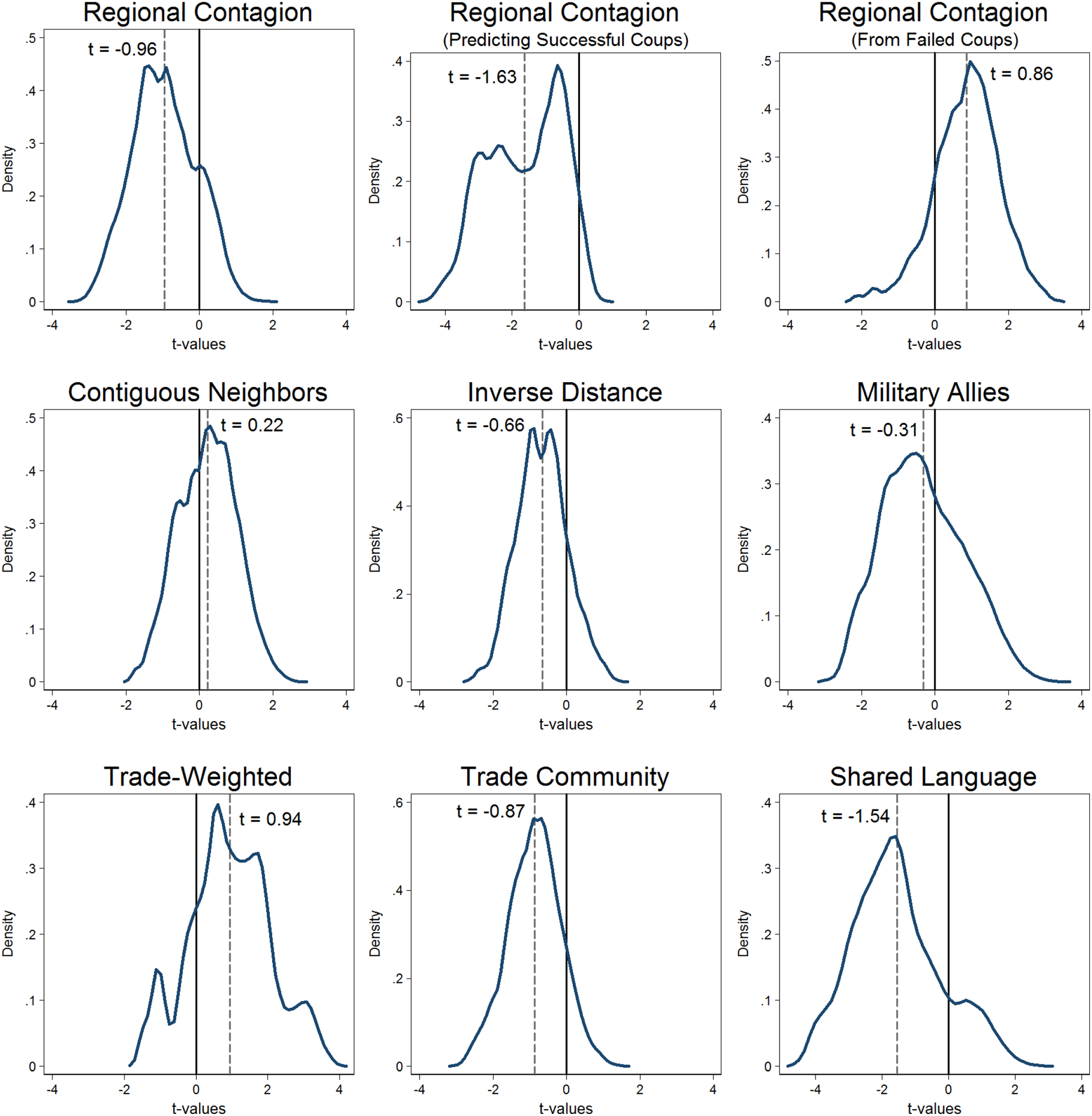
The figures show the distribution of t-values from nine separate extreme bounds analysis (EBA) runs, with the dashed lines indicating averages. The top three panels are for regional contagion, varying whether external coups predict attempts (top–left) or successful coups (top–middle), or whether failed coups predict attempts (top–right), respectively. The remaining EBA runs apply different spatial metrics testing whether external coups predict coup attempts. Summary statistics are given in Table 2. Note the robust lack of positive evidence for coup contagion across all EBA runs.
Extreme Bounds Analysis Statistics.
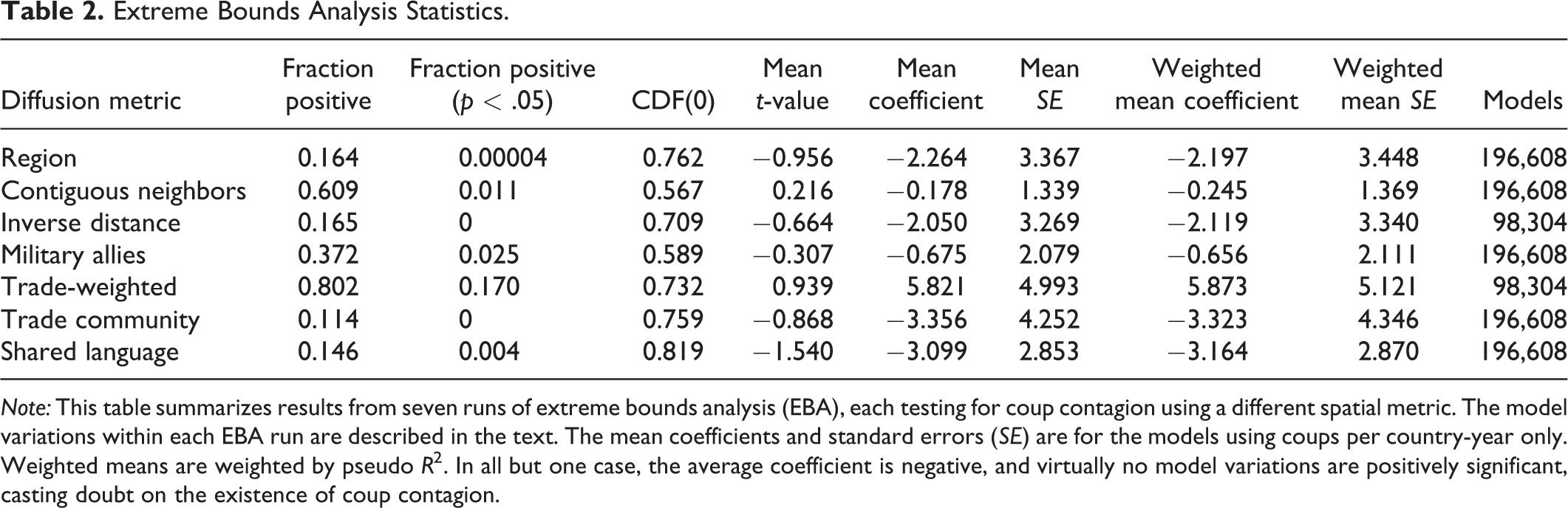
Note: This table summarizes results from seven runs of extreme bounds analysis (EBA), each testing for coup contagion using a different spatial metric. The model variations within each EBA run are described in the text. The mean coefficients and standard errors (SE) are for the models using coups per country-year only. Weighted means are weighted by pseudo R 2. In all but one case, the average coefficient is negative, and virtually no model variations are positively significant, casting doubt on the existence of coup contagion.
Results from the same models predicting successful coups (rather than coup attempts) are broadly similar, but even more consistently negative (top–middle of Figure 3). Now, 95.3 percent of models are negative and 40.2 percent are significantly so. The average
Other diffusion metrics
It remains possible that coups are contagious, but region is the wrong metric of influence. We therefore extend our EBA technique to six other diffusion metrics. In four diffusion metrics, we consider other discrete samples besides region: contiguous neighbors, military allies, trade communities, and countries speaking the same language. In the remaining two, we weight influence by inverse distance and trade. We apply the same models as above, again predicting coup attempts from successful external coups. Distributions of t-values for each metric are shown in Figure 3, with further statistics displayed in Table 2.
The absence of evidence for coup contagion holds across the alternative metrics. In all but one case, the mean coefficient is negative, and for the majority of metrics, at least five out of the six estimates are negative. The outlier to this pattern is trade-weighted contagion, for which 80 percent of estimates are positive. However, the mean t-value is only 0.94 and only about one in six models is positively significant. 18 In total, of the nearly 1.2 million models across the seven metrics, only 2.1 percent are positive and significant (at the .05 level). If we take out the trade-weighted models, this is reduced to 0.7 percent. Results for failed external coups are broadly similar (summary statistics shown in Table A2 in the Online Appendix). Thus, regardless of the diffusion metric, there is little evidence of positive coup contagion.
Do External Coups Predict Coup-proofing?
Is it possible that the true effect of external coups is negative for coup attempts and successes? This would cohere with Lehoucq and Pérez-Liñán (2014, 1114), who find a negative coup contagion effect in Latin America. They speculate that regional coups provide warnings to political leaders, prompting them to more closely monitor potential coup plotters, increase their cooptation of key allies, and implement various coup-proofing strategies. Following Honduras’s 2009 coup, for instance, Ecuador began organizing civil society groups “to defend against Honduras-style coups” (AP 2009). It is also possible that our null results are a product of positive coup contagion effects for plotters getting washed out by negative contagion effects operating through incumbents.
We test whether this is plausible by looking at the spread of a key coup-proofing strategy, the creation of multiple military organizations. As Pilster and Bohmelt (2012) and Powell (2012) argue, this “counterbalancing” strategy divides military power and makes coordinating coups more difficult and risky. We use Pilster and Bohmelt’s (2012) data on the effective number of military organizations into which ground forces are divided, then run regressions predicting shifts in this variable from regional coups and a full set of controls (see Table A4 in the Online Appendix).
We find that regional coup contagion significantly predicts increases in military organizations, especially over a five-year window. The effect size is modest—if an additional 10 percent of the region has a coup each year, then military organizations increase by 0.098 (about one-sixth a standard deviation). In further tests, however, we do not find that military organizations predict coup attempts or successes (see Table A5 in the Online Appendix). Further, to see if increased coup-proofing is confounding the contagion effect, we retested the models in Table 1 on a sample of countries that did not shift on military organizations over the prior two years. The coefficients on regional coup contagion are substantively identical (see Table A6 in the Online Appendix). As a result, it’s unlikely that a negative contagion effect runs through this particular coup-proofing strategy. However, the significant finding predicting military organizations suggests that leaders do react to regional coups. An intriguing area for future work is to catalogue which other strategies are used and whether they can account for a degree of negative contagion.
Diffusion of Other Events
We have used EBA to demonstrate a highly robust negative finding: External coups do not inspire attempted coups in observing countries, regardless of the model. What about the spread of other political events? Besides the inherent interest in testing for political contagion, this extension can illustrate the use of EBA for studying which political events diffuse and through which metrics of influence. In particular, positive findings for other events can serve as an instructive contrast to the generally null findings for coup contagion.
We investigate the diffusion of seven other events: Protests, strikes, riots, and revolutions: These four measures are taken from Banks (1976) for 1950 to 1971 and Norris (2008) for 1972 to 2007. Each are count variables measuring the number of events in each country-year. Democratization: Measured by a shift to democracy on the dichotomous Boix, Miller, and Rosato (2013) measure, which has been updated to 2010.
19
The sample is restricted to autocracies. Civil war onset: Measured from COW Project (2010a), which requires a 1,000 battle-death threshold. The sample is restricted to countries not currently in a civil war. Civil violence: The ten-point rating of civil and ethnic violence from Marshall (2012).
For each, we test whether external instances of these events predict their spread. Like coups, these events fall within the category of contentious political action, but generally involve greater mass participation. Because emulation, learning, and focal points are more critical channels for mass action, we expect these events to be more likely to diffuse. Indeed, compared to coups, there is a much more extensive and rigorous literature supporting the spread of these events, especially for democratization, protests, and civil war (e.g., Starr 1991; Gleditsch and Ward 2006; Weyland 2009; Hale 2013).
We conduct separate EBA runs for each type of event and five metrics: region, contiguity, inverse distance, trade, and trade community. Most of the options used for coups are included, but we eliminated some out of computational necessity. 20 We mostly maintain the same options across events for simplicity and comparability, but future work can examine more tailored models. Total models in each EBA run vary from 768 to 1,536. Results from these thirty-five EBA runs are displayed in Figure 4. Each pie chart shows the fraction of models for which the contagion coefficient is positive and the fraction positive and significant (p < .05). Event types are listed by column and metrics by row. Further summary statistics are given in Table A7 in the Online Appendix.
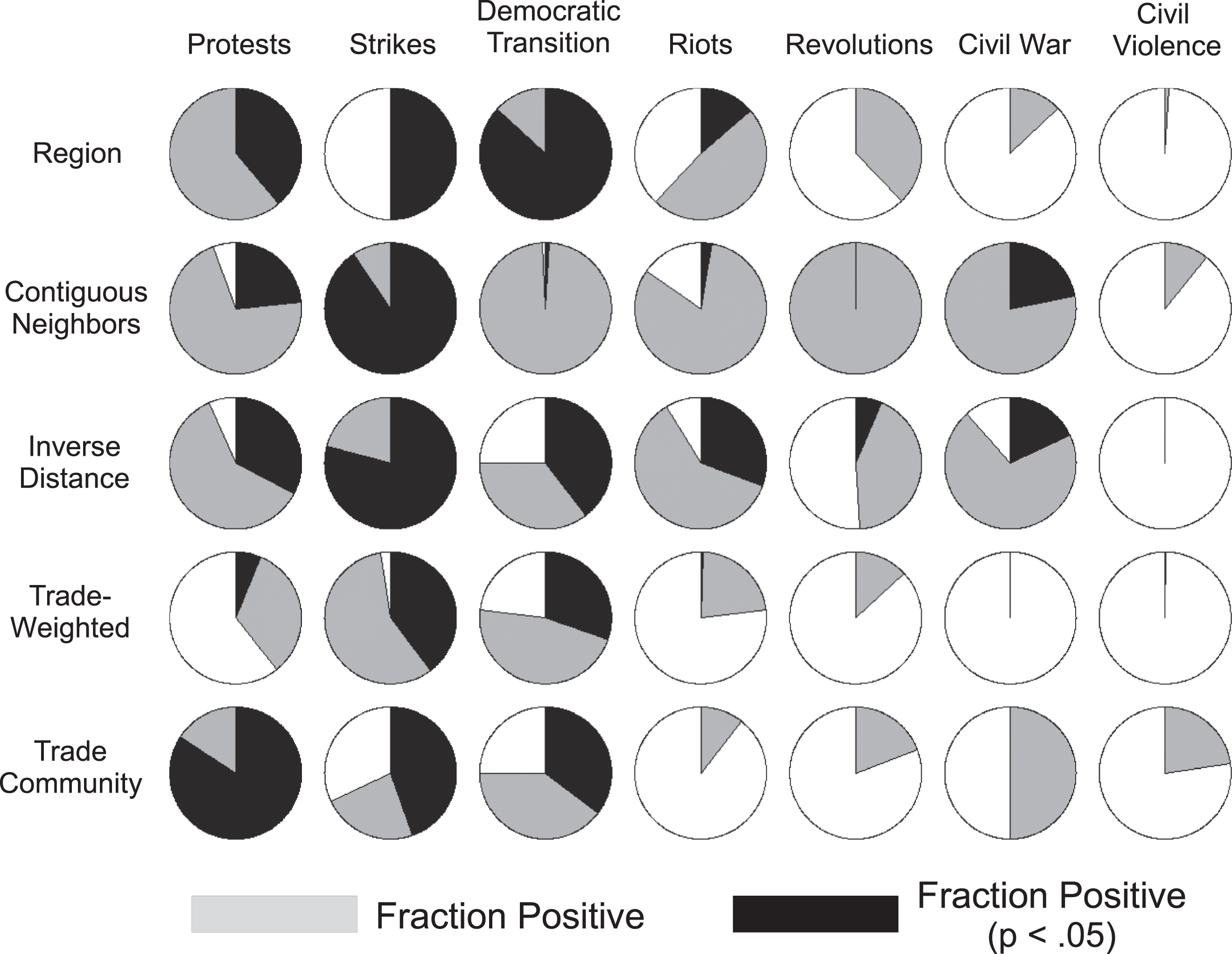
The figure summarizes the results from thirty-five separate extreme bounds analysis (EBA) runs, each testing for the diffusion of a type of political event. The events are listed by column and the diffusion metrics by row. For each combination, the pie charts indicate the fraction of EBA models that are positive and the fraction positive and significant.
It is immediately clear that there is substantially more evidence of contagion compared to coups, but this varies by event type and metric. Protest contagion is strongly supported, except through the trade-weighted metric. The contagion of strikes is robust among neighbors and weighted by inverse distance and trade, but less so for regions (see below). Democratic transitions are especially likely to spread by region, with mixed results for trade-based diffusion. Weaker evidence is found for riots, although there is some indication of contagion weighted by inverse distance. Revolutions appear only to spread to neighbors, while civil wars spread to neighbors and other nearby countries. No evidence is found for civil violence contagion; if anything, the results suggest a negative contagion effect (average t = −2.39 when weighted by inverse distance). 21 Altogether, the strongest evidence is found for the contagion of democratic transitions within regions (average t = 3.17), strikes weighted by inverse distance (average t = 4.63), and protests within trade communities (average t = 3.52).
Although we don’t have space to delve more deeply into all of these runs, we can illustrate our call to look for patterns in mixed EBA findings by examining the results on the regional diffusion of strikes. Here we see starkly divided estimates, with half significantly positive and half negative. We find that this divide stems from whether we control for year fixed effects, with results negative when they are included. This suggests that the positive estimates may be spurious products of shared global events in specific years. In contrast, strike diffusion robustly holds up among neighbors and weighted by inverse distance even with year fixed effects, implying a geographically constrained contagion effect at work.
An intriguing pattern in Figure 4 is the divide between the violent events (revolutions, civil wars, and civil violence) and relatively peaceful events (protests and strikes, with democratization and riots somewhere in the middle). The latter display a more consistent tendency to spread, especially within regions and through trade networks. If violent events spread, they do so solely through geographic proximity (especially for civil war), implying a simple spillover effect or entangling of neighboring ethnic groups (Salehyan and Gleditsch 2006; Bosker and de Ree 2014). This suggests that relatively peaceful mass action is more likely to spread through emulation and learning (mechanisms that do not require spatial proximity). In turn, this further validates our nonfinding for coup contagion.
Conclusion
We tested for the contagion of eight political events, combining spatial dependence models with EBA. Our results confirm existing research showing that nonviolent popular events diffuse, but contradict the long-standing conventional wisdom that coups spread across borders. We argue that the three mechanisms most commonly linked to political diffusion—emulation, learning, and focal points—are unlikely to alter elite decisions to launch coups. Elites are aware of the gains from coups, well-educated in the use of force, and advantaged in the ability to coordinate. In short, there is little to learn from coups abroad. In contrast, mass populations facing significant collective action problems, high uncertainty, and little experience in activism may be strongly influenced by external events.
The diffusion literature presents ambiguous guidance on several aspects of contagion testing, such as how one should specify country connections (
In future work, diffusion scholars can apply EBA to other open questions that we did not consider, such as the spread of terrorism, corruption, and political extremism. Further, EBA can pinpoint the channels these events spread through (if any) by comparing distinct metrics of influence. For example, terrorism might spread to countries sharing a religion or national language. Policymakers should care not just about whether events spread but which pathways are likely to transmit them.
In our concluding analysis, we demonstrated how EBA can compare contagion effects across distinct types of events. We found robustly positive evidence of contagion for democratic transitions, protests, and strikes, but more mixed or negative evidence for riots, revolutions, and civil violence. This presents an intriguing pattern, suggesting a divide in the strength of contagion depending on the degree of mass participation and the level of violence. A vital question is what this implies for the maintenance of regional security and the mechanisms behind diffusion.
Footnotes
Acknowledgments

Declaration of Conflicting Interests
The author(s) declared no potential conflicts of interest with respect to the research, authorship, and/or publication of this article.
Funding
The author(s) received no financial support for the research, authorship, and/or publication of this article.
Notes
References
Supplementary Material
Please find the following supplemental material available below.
For Open Access articles published under a Creative Commons License, all supplemental material carries the same license as the article it is associated with.
For non-Open Access articles published, all supplemental material carries a non-exclusive license, and permission requests for re-use of supplemental material or any part of supplemental material shall be sent directly to the copyright owner as specified in the copyright notice associated with the article.
