







Abstract
We explore US covert forcible actions against democratic governments and their citizens and show that interdemocratic use of covert force is common and can be accommodated within the theory of democratic peace. Grounded in the Perceptual Theory of Legitimacy, we argue that democracies are constrained by public perceptions of their legitimacy from overtly aggressing against other democratic states. When democracies desire to aggress against their democratic counterparts, they will do so covertly. We test the assumptions of the theory and its implication with (1) laboratory studies of the conflation of democracy with ally status and (2) historical analyses of covert militarized actions and prisoner detention, which show that US forcible actions, when carried out against democracies and their citizens, are carried out clandestinely.
The dearth of open militarized disputes between advanced democracies does not mean that democratic foreign policies direct no violence against each other. Advanced democratic states have a documented history of employing coercion against isolated and weaker democracies. The security and economic interests of advanced democracies, the expectation of an easy victory, and perceived political dissimilarities can supersede the normative pull of the democratic concord (Henderson 2002; James and Mitchell 1995; Kim 2005; Reiter and Stam 2002; Van Evera 1990a).
The “war on terror” has put the democratic peace theory (DPT) to yet another test by marking a notable shift in the powers of Western security services and the range and nature of their clandestine operations. Pressed to develop a policy in response to the events of 9/11, the Bush administration’s policies afforded security services unprecedented levels of autonomy to kill, detain, transfer to other jurisdictions, and otherwise abuse the rights of terrorist subjects. Reports from the US Senate and the Bush administration’s secret memorandums revealed that the subjects of extraordinary rendition and victims of enhanced interrogation techniques included citizens of democratic states (Ramsay 2010; United States Senate Committee on Armed Services 2008). European Parliament investigations uncovered cooperation between European secret services and the US extraordinary renditions programs (European Parliament 2007). The extrajudicial transfers of terrorist suspects continued with reduced frequency under the Obama administration, which has also given the security services discretion in the apprehension and killing of “terrorists,” including by targeting suspects with drones.
Why would democracies engage in violent covert actions against other democratic states and their citizens? The variety of interdemocratic violence and coercive actions short of war have been viewed as a critical challenge to DPT arguments, especially its normative propositions (Downes and Lilley 2010). American military interventions against other democratic regimes constitute “the starkest empirical anomalies for democratic peace” (Kinsella 2005, 455). If the US government uses force covertly against other democracies, how can we reconcile this with the absence of overt war between democratic states?
DPT scholars have tried to resolve these apparent discrepancies in interdemocratic violence and covert operations in three ways. First, there is a definitional issue; one may argue that covert operations fall below the threshold for violence and do not amount to war. Second, one can impugn the democratic nature of a state targeted for violence; they are perceived as nondemocratic by the aggressing state. Finally, the very nature of covert operations—hidden from the public eye—makes them consistent with the democratic peace because they imply the concern of the democratic leaders with public opinion and fear of political consequences for the unpopular attack on another democracy (Kim and Hundt 2012).
The studies in this article develop arguments consistent with the third “clandestine hypothesis.” We contend that the interdemocratic use of covert force can be accommodated within the principles of liberal democratic peace. We foreground liberal ideology and discuss how the expectations of congruence between individuals’ liberal preferences and democratic governments’ policies constitute an important part of their thinking. Our arguments are based on the Perceptual Theory of Legitimacy (PToL, Crandall and Beasley 2001): decisions to use covert action results from the normative and institutional constraints through the dynamic process of sustaining popular consent in the legitimacy of democratic government. The latter is constrained by public perceptions of its legitimacy from overtly aggressing against democracies. To the extent that democracies desire to aggress against other democratic actors they will tend to do so covertly.
We first establish the perceptual tendency for citizens to see US allies as more democratic (study 1), and we establish the causal relationship between these tendencies through a controlled experiment (study 2). We then demonstrate a behavioral tendency on the part of the United States to prefer covert action when aggressing against more democratic targets. We examine this in two contexts: US covert interventions from 1949 to 2000 (study 3) and US renditions of detainees in the war on terror (study 4).
Theory
DPT
The assertion that democracies, while no less war prone, rarely fight one another has generated an avalanche of empirical and theoretical research (Maoz and Russett 1993; Oneal and Russet 1999a; Owen 1994) and stimulated theoretical and methodological discussions (Morgan and Schwebach 1992; Mousseau 2009; Rosato 2003; Ungerer 2012). The structural or institutional accounts of DPT identify various democratic institutions, procedures, and processes that enhance the accountability of policy makers to the public, legislatures, and interest groups. As a result, use of large-scale violence is both politically costly and inefficient (DeMesquita et al. 1999; Rosato 2003; Ungerer 2012; for the critique of institutional explanations, see Maoz and Russett 1993; Morgan and Schwebach 1992). Normative accounts of democratic peace maintain that democratic culture, liberal ideology, and democratic norms, once externalized, steer democracies away from the use of violence against their own people (Rosato 2003). Recent years have seen the advent of several new accounts of interdemocratic peace. The informational hypothesis is that the openness and transparency of democratic institutions enable them to send and receive costly signals, which allows democracies to resolve disputes at lower levels of hostilities (Levy and Razin 2004). The preferential logic, derived from social identity theory, posits a strong correlation between domestic institutions and foreign policy choices and expects democracies to have similar foreign policy preferences. Finally, the perceptions-based argument requires democracies to perceive their counterparts as similarly democratic for peace between them to hold (Owen 1997; Oren 2013).
Although debates about what constitutes a war and what counts as democracy continue (Owen 1994; Tures 2002), critics of DPT argue that both institutional and normative mechanisms should avert democracies from the use of direct physical force in any form, including war, military interventions, assassinations, small-scale aggression, torture, and the threats of force (Downes and Lilley 2010; Layne 1994; Reiter and Stam 2002). Contrary to these expectations, democracies have frequently employed a wide range of coercive behavior in their relations with other democratic states. Covert use of force has become a hotly contested instrument of contemporary statecraft advocated by security advisers in democratic nations. The United States in particular has resorted to covert military activities and clandestine interventions against other elected governments and supported coercive actions against individuals under the pretext of the war on terror (Forsythe 1992; Kegley and Hermann 1995; Kim and Hundt 2012).
The significance of these debates has been elevated by the close interplay of DPT scholarship with security strategies and foreign policies of democratic states (Ish-Shalom 2008). In the United States, the idea of democratic peace informed the Clinton administration’s strategy of “democratic enlargement” for fostering international peace and became the cornerstone of the security strategy under the Bush administration. However, the use of DPT arguments for legitimizing US intervention in Iraq was followed by the revelations of torture of prisoner of wars, drone wars, and several covert operations accompanying the American quest for international democratization, rekindling debate about the conduct of democracies (Goldstein 2011).
Some contend interdemocratic clandestine operations short of open war constitute an aberration for DPT, particularly its normative logic (Rosato 2003; James and Mitchell 1995; Van Evera 1990a). We differ interdemocratic covert operations involving the use of force can be accommodated within DPT. In the context of covert operations and extraordinary renditions against other democratic states and their citizens, we show how decisions concerning war and peace are motivated by the interest in building and sustaining popular consent in the legitimacy of democratic government.
Perceptual Theory of Legitimacy
The core of democratic peace relies on liberal ideas about autonomous individuals capable of defining and pursuing their interests in self-preservation and well-being (Doyle 2005; Oneal and Russett 1999b). Freedom is required for the pursuit of these interests, and peace is a prerequisite for freedom. Since violence and coercion are inimical to freedom, individuals are predisposed to value peace (Owen 1994). In liberal political theory, individuals and their interests are thought to exist prior to politics, but they can advance their interests through collective action and participation in the institutional framework of a democratic state (Moravcsik 1997). The underlying interests of democratic citizens are not only expected to constrain state policies but also to define the social identity of democracy. Together, the social identity, interests, and preferences specify the legitimate order in a democratic state (Moravcsik 1997).
A government’s legitimacy can be construed as a result of a psychological process, where individuals’ perceptions of the moral worth of the government and its actions constitute elemental parts of their perceptual field. According to the PToL, legitimacy is conferred when the moral value of a nation and governmental actions are consistent with each other (roughly equal; Crandall and Beasley 2001). The two essential propositions of the PToL relevant to the perceptions of legitimacy of a democratic government and its international conduct are “structural balance” and “unit relationship” (Crandall et al. 2007). The principle of structural balance, which also underpins the perceptual logic of DPT (Owen 1997), stipulates that individuals are motivated to have an affectively uniform impression of their own states or other nations and their peoples; citizens wish to avoid ambivalence and inconsistency among related objects or events. People are motivated to put positive elements together and negative elements together: democracies are “good” (Sen 1999) and all things democratic are good as well, whereas nondemocracies are bad (or at least worse than democracies), and nondemocratic governments and people have lesser moral value (Falomir-Pichastor et al. 2011).
Affective consistency is important only among objects that belong together (e.g., actors and their deliberate choices, citizens and their government). Because citizens in a democracy are perceived to freely choose their governments, the government is in a unit relationship with the populace. The government and citizens are viewed as belonging together or as two parts of the “whole.” By extension, the actions of the governments epitomize the choices of the citizens. If, however, the government policies go against the core of the state’s social identity represented in the citizens’ true interests in freedom, material well-being, and peace, individuals will experience affective inconsistency (how can a good government engage in “bad” behavior?). This perceptual inconsistency will force individuals to expend mental energy for a potentially unpleasant reevaluation of their cognitive and affective elements (“Is this legitimate leader of a good nation really a good person?”); inconsistency leads to the perception of illegitimacy.
The PToL belongs to the family of consistency theories—such as balance theory (Heider 1958) and cognitive dissonance theory (Festinger 1957)—which are premised on the idea that people are motivated to seek coherent attitudes, beliefs, values, and behaviors. Inconsistencies result in aversive feelings or discomfort and motivate people to make relevant cognitions consistent with one another. Cognitive dissonance theory has been a prominent exemplar of consistency theories applied to the study of international relations and foreign policy (Jervis 1976; Larson 1985; Snyder 1978). By contrast, the PToL draws more directly from Heiderian balance theory, in three particular ways. First, we are more interested in the overall inconsistencies that are likely to be perceived as imbalanced, rather than the individual-level factors or situational contexts that are more likely to give rise to those inconsistencies. Second, we do not specify the degree of intensity with which individuals will feel cognitive inconsistencies, as does most cognitive dissonance theorizing, only that inconsistencies will give rise to efforts to reduce them. Thus, drawing on balance theory offers a more concise approach. Third, and most important, we are positing a perceptual “unit relation” between governments and citizens, which is conceptually more similar to balance theory precepts, as cognitive dissonance theory does not directly specify which cognitive elements will be involved in arousing dissonance.
In sum, the PToL proposes that there is a desire to view things that belong together as affectively consistent. People are motivated to restore consistency either by changing the affective value of an object or by changing the connectedness of objects (e.g., Beasley and Crandall 2004; Heider 1958, 1990). Legitimacy arises out of this consistency—when inconsistency persists, legitimacy suffers. Applied to democracy, the legitimacy of a democratic government arises out of the consistency of its institutions and actions with citizens’ expectations. A democratic government, for example, is expected to allow the public to be represented in the decision-making process, to have a voice in its assessment and evaluation, and to allow some control over the outcomes of governance (Lipset 1959). Individuals then extend their support to the government in exchange for institutions and policies that jibe with their preferences. These institutions and policies, as well as the government that epitomizes them, are harmonious in their value, and thereby legitimate. Since democratic governments are concerned about their legitimacy, their conduct regarding the use of force will be motivated in part by an effort to realize individuals’ interests in freedom and peace.
We do not assume that citizens and leaders of democracies share the same interests and preferences, as many other DPT scholars do (see Hermann and Kegley 1995; Rosato 2003). Even if the preferences of democratic citizens and leaders were uniform, it is not uncommon for the leaders’ preferences to be in tension with what they view as their state’s immediate political goals. The originator of republican peace, Immanuel Kant, himself feared that the republican governments would occasionally engage in nonliberal international conduct cloaked in liberal justifications (Doyle 1995). In the parlance of international relations, states’ preferences are causally independent of their strategies and tactics. Even if the democratic states’ preferences represent their citizens’ true concerns, their strategies and tactics are affected by the immediate political aims and external circumstances made up of threats, opportunities, and incentives (Moravcsik 1997; Rousseau et al. 1996).
When faced with a dilemma of reconciling the incompatible preferences and policy options dictated by their state’s immediate political interests, democratic leaders will be constrained by the preferences of their people. While it has already been acknowledged that perceptions matter in the democratic comity, the jury is still out on precisely how the process works to constrain belligerency among democracies. Our argument aligns with that of Jerrod Hayes (2012), who explains democratic peace through the mechanisms of constraints placed on political elites by the perceptions and expectations of their constituents unwillingness to pick fights with members of a putative “in-group” as it arouses cognitive inconsistency in people. Hayes, however, does not articulate how these perceptions are created and sustained. According to the PToL, democratic citizens have positive evaluations of democracy (Falomir-Pichastor et al. 2012) and they are connected by a unit relationship with their governments and other democratic nations. For reasons of cognitive consistency, they think that other democracies and their citizens are good. War against a democracy creates a highly inconsistent, deeply imbalanced perception, and is thus illegitimate. Democratic citizens also deserve commensurately positive treatment; their abuse or mistreatment is inconsistent with democratic comity.
Since democratic governments are both constrained by and concerned with their popular legitimacy, 1 they will engage in acts of coercion and violence that are both psychologically and socially inconceivable only to the extent that they are able to (1) make their actions seem legitimate or (2) merely conceal them. When the creation of popular consent for openly coercive policies appears unattainable using the elaborate myths of legitimization, the democratic government may resort to covert force to evade ex ante due approval process and to avert the ex post delegitimation and electoral retribution (Reiter and Stam 2002).
Therefore, in relations with other democracies, democratic states will be likely to substitute nonmilitary and covert operations for direct military confrontation when these types of coercion serve their governments’ immediate political aims (Morgan and Palmer 2000; Most and Starr 1984; Palmer, Wohlander, and Morgan 2002). As a consequence, the connection between the democratic peace and covert operations will be inverted. This is the clandestine hypothesis: democratic states will use covert types of force against each other more often precisely because they desist from engaging in the open military hostilities and war with one another, as the overt use of force hurts legitimacy of democratic governments. 2
The Studies
In this article, we present four studies that test the causal mechanism of interdemocratic covert force informed by the PToL. In study 1, we test whether US students perceive a correlation between the democracy level of a nation and its ally status. In studies 2a/b, we test whether knowing a nation is an ally causes US students to perceive it as a democracy, and that knowing a nation is a democracy causes US students to perceive it as an ally. In study 3, we compare US-militarized actions against democracies and nondemocracies, to see how often these two kinds of disputes are carried out covertly. In study 4, we compare the democracy level of the home nations of detainees in the US war on terror and test whether more democratic “origins” increase the probability of extraordinary rendition.
Study 1: Perceptions of Allies and Democracies
To the extent that individuals view the United States as both good and democratic, they should also view countries related to the United States in a more favorable light; allies should be seen as democratic, and democracies should be seen as allies. These results should manifest as a positive correlation between perceptions of the United States, perceived alliance with and similarity to the United States, and perceived level of democracy among the countries of the world.
Method
Data came from 190 self-identifying US citizens in an undergraduate course at the University of Kansas (KU) in the spring of 2007. Participants were told they would be filling out a questionnaire regarding their perceptions of several different countries within the United Nations (UN).
Each participant received a one-page questionnaire consisting of five or six UN member states grouped at random. The thirty-three different questionnaires provided brief innocuous information for each target nation (e.g., location, population, gross domestic product, and exports). In all, 190 out of the 192 member nations were rated (excluding the United States and the Democratic Republic of the Congo, because of its name).
Participants answered four questions: how important is this country on the world stage, how similar is this country to the United States, how democratic is this country, and what level of relation does this country hold with the United States. Participants then completed two items examining their perceptions of the United States: “The United States is the greatest nation in the world” and “How democratic is the United States government?”
Results and Discussion
Perceptions of democracy and alliance with the United States were correlated, r = .23, p < .001, n = 190 (see Figure 1). Because Iraq was an outlier and relations with the United States were complex in 2007, we removed it, with r = .26, p < .001, n = 189. As perceived levels of either democracy or alliance increased, so did the other in a way that promoted a balanced state. The perception of a nation’s alliance with the United States was correlated with perceived similarity to the United States, r = .63 (see Table 1). The target nation’s perceived importance and alliance with the United States were correlated r = .24, and there was a correlation between a target nation’s perceived importance and similarity to the United States, r = .69.
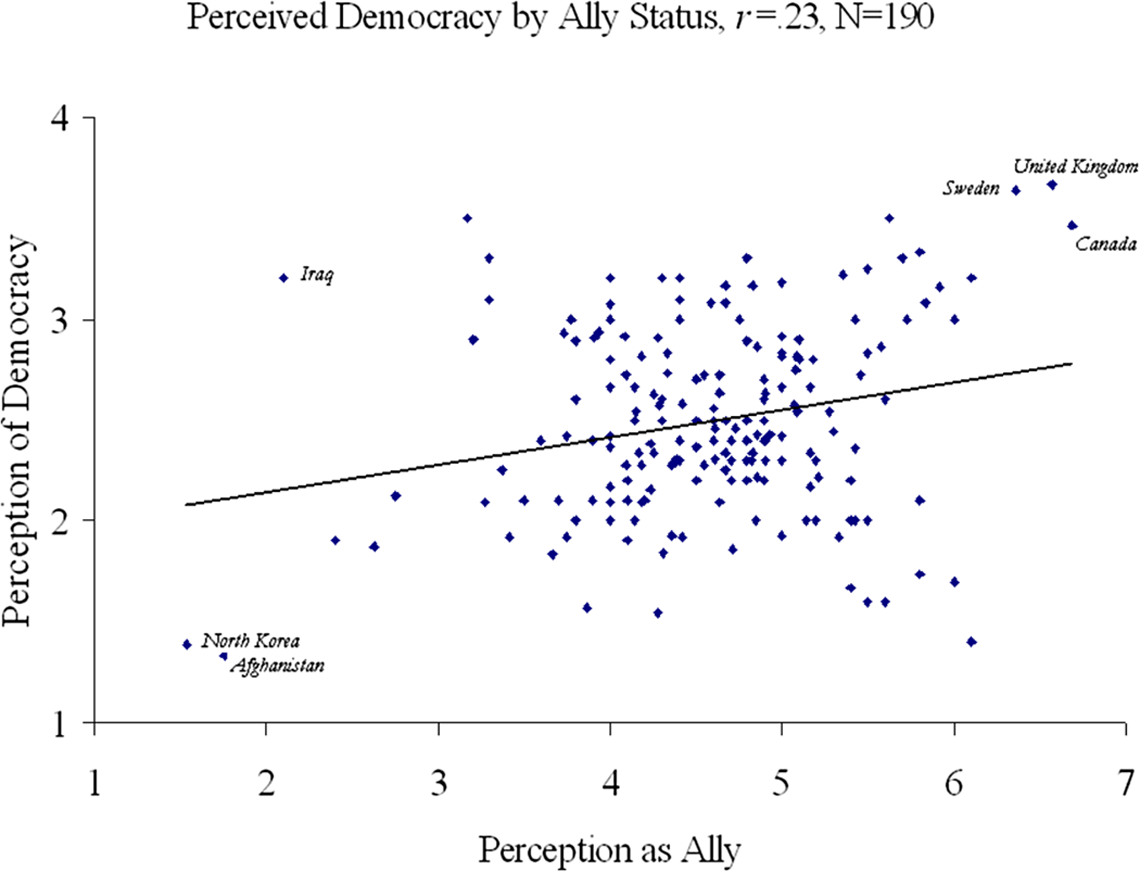
Correlation of perceived ally status by perceived democracy.
UN Correlations, Study 1.
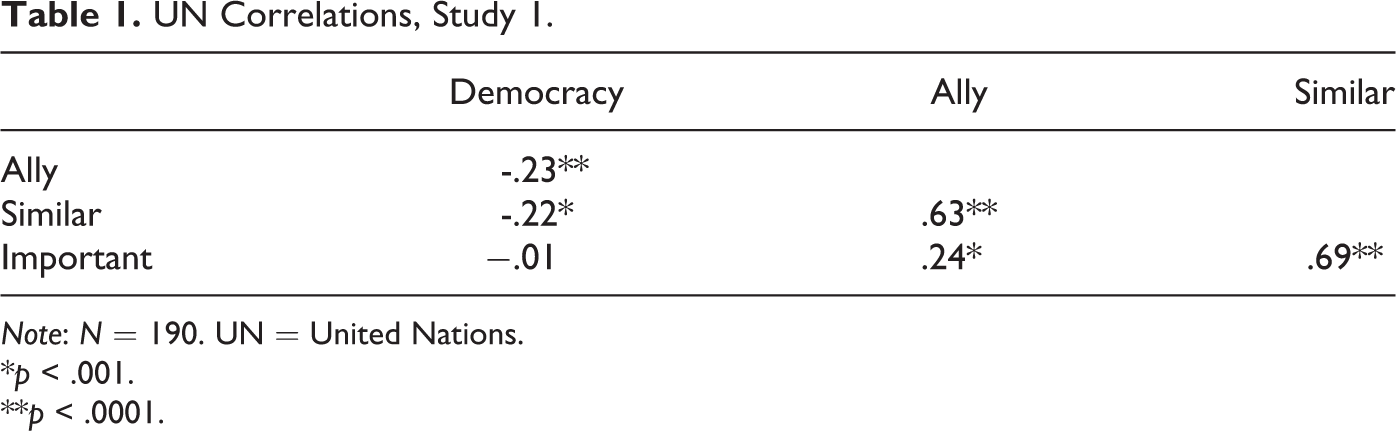
Note: N = 190. UN = United Nations.
*p < .001.
**p < .0001.
Consistent with the PToL, our participants believed that US allies were similar to the United States, they are democracies and were important on the world stage; our participants showed consistency when forming their perceptions of foreign governments and global relationships. These correlations are not large, and they cannot demonstrate causal linkages. In study 2a, we experimentally manipulate the historical democracy status of Iran and measure whether or not students perceive it to be an ally when it is a democracy. Simultaneously, in study 2b, we perform the mirror image of this experiment by manipulating whether or not Iran was an ally and measure whether or not students perceive Iran to be a democracy.
Studies 2a and 2b: Causal Connection between Democracy and Ally Status
Design and Participants
Two simultaneous and independent experiments were run. Each participant read a vignette about Iranian history and its relations with the United States across two decades, the 1970s and the 1980s. In study 2a, we manipulated the ally status of the United States and Iran and measured participants’ perception of Iran’s democracy level. In study 2b, we manipulated the democracy level of Iran and measured participants’ perception of Iran’s ally status with the United States. Within each study, there were two conditions. In study 2a, Iran was described as an ally in the 1970s and an adversary in the 1980s, or alternatively an adversary in the 1970s and an ally in the 1980s. Similarly, in study 2b, Iran was described either as a democracy in the 1970s and an autocracy in the 1980s or as an autocracy in the 1970s and as a democracy in the 1980s.
In this way, democracy or ally status are manipulated within subject, so that each person in study 2a evaluates Iranian democracy both when an ally and an adversary; each person in study 2b evaluates Iranian–US ally status both as a democracy and as an autocracy. This enhances the statistical power of the experiment and provides what is an independent replication built into the study. Because our participants were mostly ignorant of Iranian history, whether we describe Iran as a democracy (or an ally) in the 1970s versus the 1980s is relatively arbitrary, and so the two conditions within studies serve as independent replications of each other. The participants were 113 KU undergraduates, 54 in study 2a and 59 in study 2b.
To test knowledge about Iran, we asked four general knowledge questions. Two were open-ended: the most common language in Iran (Farsi) and the year the Islamic Republic was founded (1979). We asked two multiple-choice questions, “The word ‘mullah’ is best translated as Leader, Dictator, Priest, or General” and “Which of the following countries does NOT share a border with Iran? Afghanistan, Iraq, Kazakhstan, Pakistan, or Turkey.”
Vignettes
Participants read a brief and accurate historical account of Iran, beginning with Cyrus the Great, the eleventh-century Turkish invasion and Genghis Khan’s Mongol invasion. When the account reached the twentieth century, the manipulations (and historical inaccuracies) were introduced. In study 2a, the vignettes gave substantial information about the ally status of Iran and the United States (which changed from 1970s to the 1980s), but introduced no information about Iran’s level of democracy. In study 2b, the vignettes gave substantial information about Iran’s democracy level, but gave no information about relations with the United States.
At the end of each vignette, to separate what they might know of Iran–US relations today, participants were told “A lot of time has elapsed since the 1980’s and change continued to take place in Iran over the years” and “Iran continues to be an important player of on the world stage.”
Dependent Variables
For study 2a, the critical dependent variable read “How much of an ally was Iran to the United States?” with a 1-4 response scale labeled “Not an ally at all” (1), “A limited ally” (2), A partial ally” (3), and “A major ally” (4). This question was answered twice, once with the instruction “Please answer the following questions about Iran during the 1970s [1980s], when Iran was a democracy,” and once with the instruction “Please answer the following questions about Iran during the 1980s [1970s], when the country was presided over by an unelected mullah.”
For study 2b, the critical dependent variable read “How democratic is the Iranian government?” with a 1-4 response scale labeled “No democracy at all” (1), “A very limited democracy” (2), “A partial democracy” (3), and “A complete democracy” (4). This question was answered twice, once with the predicting instruction “Please answer the following questions about Iran during the 1970s, when the USA and Iran were allies. […when the US and Iran were not allies]” and once with the instructions “Please answer the following questions about Iran during the 1980s, when the alliance between the country had ended…when the US and Iran had become allies].”
Results and Discussion
Knowledge
Knowledge of Iran was very low, with a modal score of 0 (50.8 percent of participants, mean = 0.76 percent correct), and only 5.1 percent of participants answered all four correctly. Most participants did not have enough knowledge to reject our version of Iranian history. (Results were virtually identical when knowledgeable participants were removed; no participants were dropped for these analyses.)
For both studies 2a and 2b, the main dependent variable was analyzed with a 2 (Decade) × 2 (Ally/Democracy status) mixed-model analysis of variance. Because in both studies, the critical test is between decades (but different decades for the two conditions), the interaction term is the appropriate hypothesis test; the two main effects test the effect of counterbalancing. The results are displayed in Figure 2a and b.
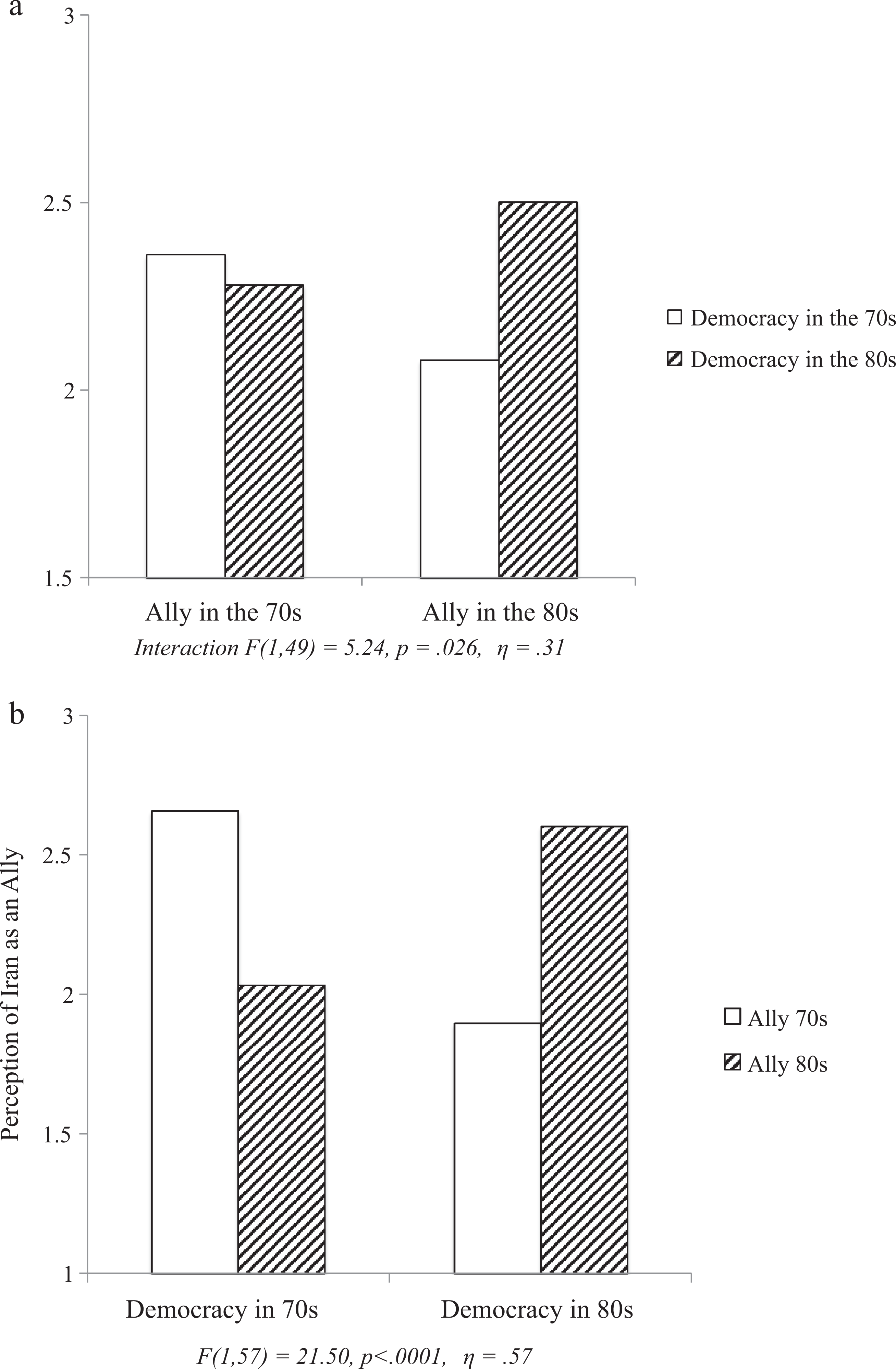
(a). Perceived democracy of Iran by US Ally status. (b). Perceived US Ally status of Iran by level of democracy.
Inferring Ally Status from Democracy
For study 2a, there was no main effect comparing democracy status in the 1970s versus the 1980s, F(1, 49) = 2.44, p = .125, and the order in which democracy versus autocracy occurred, F < 1. The hypothesized interaction occurred, F(1, 49) = 5.24, p = .026, η = .31 (see Figure 2a). Participants tended to perceive Iran as an ally when it was a democracy, as compared to when it was an autocracy.
Inferring Democracy from Ally Status
For study 2b, there was no main effect comparing ally status in the 1970s versus the 1980s, and the order in which ally versus adversary occurred, both Fs < 1. The hypothesized interaction occurred, F(1, 57) = 21.50, p < .0001, η = .57 (see Figure 2b). Participants tended to perceive Iran as a democracy when it was an ally, as compared to when it was not.
Studies 2a and 2b show that our participants inferred quite strongly and reliably that democracy and being an ally of the United States go hand in hand. These two studies show that knowing a country is a democracy causes US students to believe that country is our ally, and conversely, knowing that a country is our ally causes them to believe that country is a democracy. Our participants showed a reliable pattern of perceiving consistency—good things (e.g., democracy) belong with other good things (e.g., alliance with the United States).
These data have an ironic flavor, as the particular history of relations between the United States and Iran is a counterexample to the experiment. The period of time since World War II of closest relations between the United States and Iran coincide with the period of least democracy in Iran (Abrahamian 2013; Patrikarakos 2013). The era preceding our closest relations (prior to the 1953 US-sponsored coup) and the era of mutual discontent (from the 1979 Islamic Revolution to the present) represent a syncretic blend of constitutional democracy and theocracy (Juergensmeyer 2008). Nevertheless, our participants intuited exactly the opposite of reality, as a way of maintaining consistency between ally and democracy status. The United States does not exclusively seek for allies among democracies; our participants behave as if this might be so.
Study 3: Democratic Warfare and US Covert Action
To restate the PToL, US citizens view democracy as good, and people in democracies are in unit relationship with their governments, so people in democracies are good. War is not good, so war against democracies creates inconsistency, and is thus illegitimate. To preserve legitimacy and engage in militarized hostilities toward another democracy, a democratic nation may (1) deny that it is a democracy, (2) deny that its target is a democracy, or (3) hide its actions from the public. The first option is comparatively rare, the second option is popular (e.g., British response to Falklands/Malvinas invasion) but is not always possible (Kim and Hundt 2012). We investigated the third option, and compared overt and covert militaristic actions by the United States to assess the level of democracy of the nations targeted by those actions. We hypothesize that the United States engages in overt militarized international disputes (MID) or international war at a significantly greater rate against nondemocracies than against democracies, but when the United States uses force against democracies, it will use covert force at greater rate than against nondemocracies. 3
Method
We used the Correlates of War Project (CoW; Ghosn and Palmer 2003) to define the overt occurrences of MID, the Polity IV data set (Gurr, Jaggers, and Moore 1989; Marshall and Jaggers 2005) to ascertain the level of democracy of nations involved in the disputes (on a 0-10 scale), and developed our own database of US-involved covert military operations from 1949 to 2000.
Measuring overt military operations
The CoW (Ghosn and Palmer 2003) lists all countries taking part in the dispute and the hostility level reached in this dispute. Hostility level ranged from 1, no militarized dispute, to 5, open war. Disputes rated 2 (threat of force) and higher were included in the analysis; this is a conservative estimate that errs on the side of the null hypothesis because it includes minor acts of aggression that the general public are less likely to pay attention to. The low-level acts of aggression were included, however, as a match to the covert actions, which often fall far short of full-scale war. We followed the most common practice and used the combined Polity IV democracy–autocracy score to determine a country’s level of democracy (Bogaards 2012).
Measuring covert military operations
No comprehensive data set was available that listed covert interventions taken by the United States against foreign nations with a reliable classification of the use of force as “covert,” we set out to create our own. 4 To generate the list, we consulted several historical accounts of the Central Intelligence Agency (CIA) and US interventions. To be included in the database, each action had to be considered a true intervention by at least three separate sources and needed to achieve a level of action as high or higher than threat of force (that is a standard comparable to the one used for overt MIDs).
To establish that the US intervention should indeed be considered covert, we developed a two-prong test. First, an action must have not also been listed as an MID by the CoW. Second, the covert actions identified in historical accounts and not listed in the CoW project were examined for major press coverage. Two research assistants, working independently, searched for news articles in New York Times and Washington Post relating to the actions, ranging from the time the action took place until a year after the action ended.
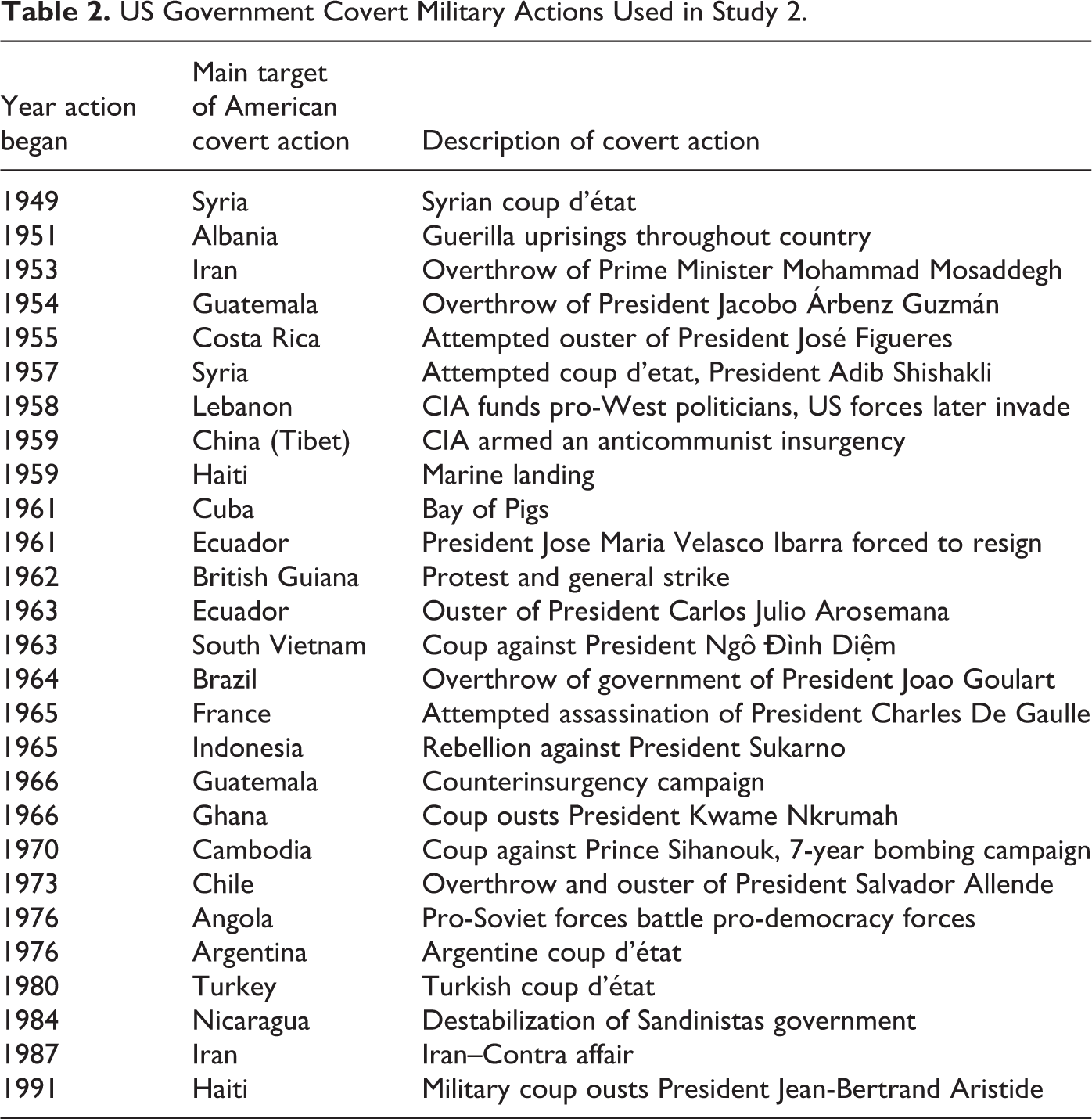
Research assistants rated the level of “covertness” of each action, based on whether the action was mentioned at all in the newspapers, if it was mentioned as a US action, and if the US government took responsibility for the action. To be considered covert, actions had to either receive no mentions in either newspaper or if the action was mentioned, the description must lack any connection to the United States in the reporting. US involvement was scored as covert only if the US government denied involvement in the action. This method identified twenty-seven cases of US covert intervention; they are enumerated in Table 2.
US Government Covert Military Actions Used in Study 2.
Results and Discussion
Table 3 displays the twenty-seven covert actions and 231 overt MIDs by democracy status. Table 3 differentiates between democracies and nondemocracies in two ways. We defined democracies by an “inclusive” standard, with democracies scoring 0 or above on their Polity IV values, and we also defined democracies by a “strict” standard, using democracy scores of 7 and above. 5
Overt versus Covert Actions by Democracy Status Using Two Democracy Standards.
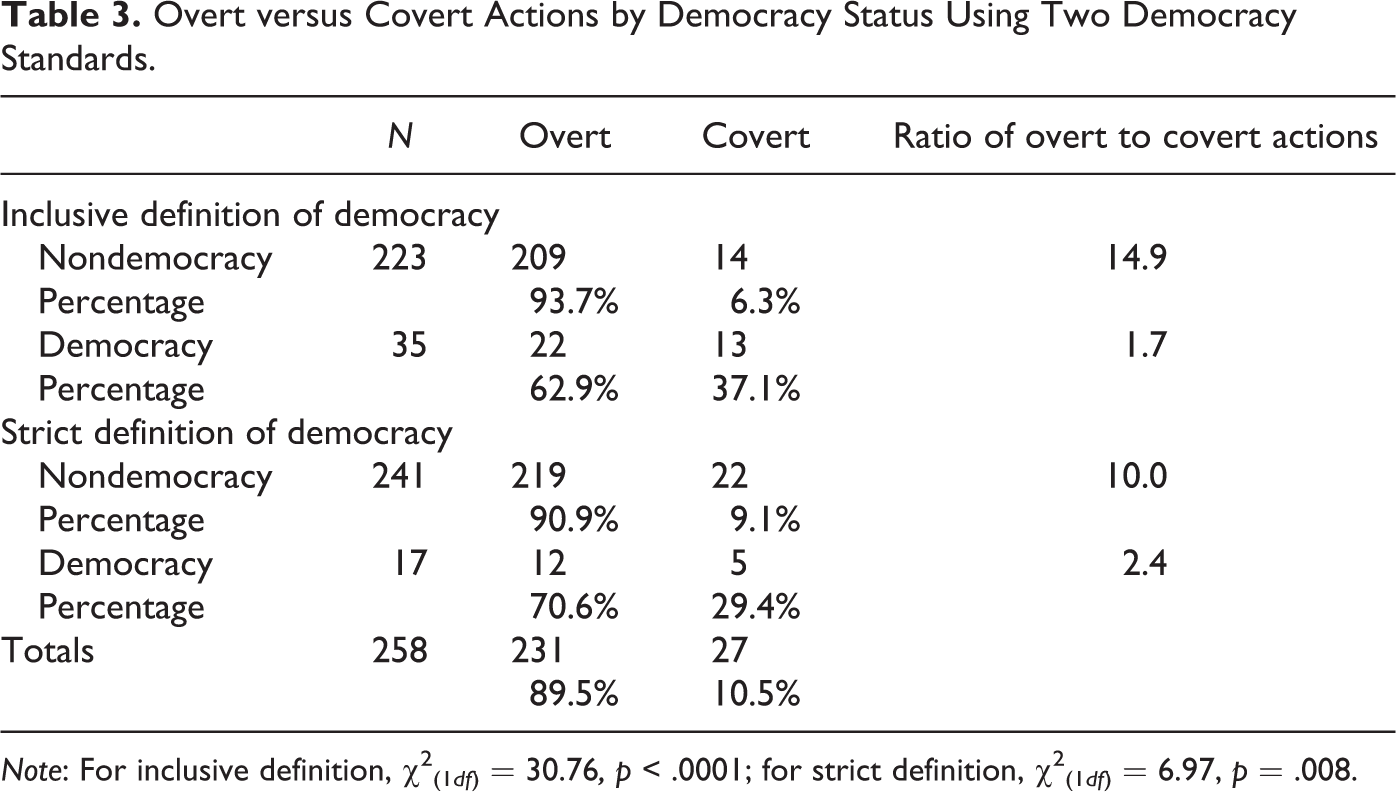
Note: For inclusive definition, χ2 (1df) = 30.76, p < .0001; for strict definition, χ2 (1df) = 6.97, p = .008.
Covert interventions in our data set were comparatively rare, representing about 10 percent of all US interventions. (Some covert military actions may have occurred that are not included in Table 2, as by their very nature, the actions were concealed.) US aggression against democracies was rare, ranging somewhere between 6 percent and 14 percent of all interventions, depending upon the standard.
Nearly 90 percent of all US military interventions were overt, and using the inclusive standard, we found that against nondemocracies this rate was about 94 percent. By contrast, covert operations were significantly more likely when intervening against democracies; although 6.3 percent of interventions against nondemocracies were carried out covertly, a much larger 37 percent of interventions against democracies were carried out covertly, χ2 (1df) = 30.76, p < .0001. Alternatively, the United States acted overtly almost 95 percent of the time when aggressing against nondemocracies compared to just 63 percent of the time it aggressed against democracies.
Using the strict standard, the United States overt actions accounted for 91 percent of the interventions against nondemocracies, compared to just 71 percent of the time it aggressed against democracies. Covert operations were again more likely to be used against democracies, representing 29 percent of all interventions, as compared to 9 percent of interventions against nondemocracies, χ2 (1df) = 6.97, p = .008.
If we treat democracy as a continuous variable, the correlation between overt/covert status and level of democracy is rpb = .36, N = 258, p < .0001. This provides an estimate of a fairly substantial effect size of democracy on enhancing the probability of a covert intervention.
This continuous analysis is statistically stronger than those that rely on artificially dichotomized variables, but it highlights one aspect of our data set that needs discussion. The unit of statistical analysis is the historical incident, and it occasionally relies on more than one incident from the same country. For the twenty-seven covert incidents, twenty-two countries are involved, five of which had two incidents, and all the rest had only one. For the 231 overt incidents, forty countries are represented, of which twenty-two had two or more. Although the incidents are statistically independent of each other for their overt/covert status, they are not independent with respect to democracy level (especially if those incidents occurred in the same year, for which only one Polity IV value exists). To solve this problem, we calculated average level of democracy and average level of covertness within nation (across all incidents; some nations received both overt and covert operations). This leaves fifty-two separate countries, with r = .29, p = .037, between the level of covertness and level of democracy. Whether analyzed at the level of incident or at the level of nation, as the democracy level of the target nation goes up, so too does the probability of a US intervention being carried out covertly—strong evidence in support of the clandestine hypothesis.
Study 4: Democracy and Detention in the War on Terror
We now apply the PToL and the issue of democratic peace to the treatment of individuals from democracies and nondemocracies. The US detention and interrogation policies applied to the so-called enemy combatants detained over the course of the “war on terrorism” have been a highly contentious issue (Cole 2013). A result of the wartime decision-making formalized in a series of presidential orders, memorandums, and legal memos, these policies contain guidelines for classifying lawful and unlawful combatants and allow for trials of the latter category of detainees in military tribunals, deny them the protection of the Geneva Conventions, and authorize the implementation of enhanced interrogation techniques against these prisoners by the US military personnel (Pfiffner 2009). Most of the individuals detained by the US military on the order of the US administration were placed in the Guantanamo Bay (Gitmo) detention camp established at the Gitmo Naval Base, Cuba, and controlled by the United States. Those detained during the war in Iraq were transferred to Abu Ghraib. In parallel to the US military operations, the CIA seized a number of persons in foreign territories suspected of hostile actions against the United States. Held incommunicado and without due process of law, these individuals were either placed in the CIA secret prisons (“Black Sites”) or transferred to states known for forced disappearances and torture (Boys 2011; Forsythe 2011), known as “extraordinary rendition.”
We studied people detained between 2001 and 2006 inclusive, sent either to Gitmo or extraordinary rendition. This was the period of widest interception and detention of prisoners, and in the case of prisoners sent to Gitmo is a matter of public record; the US Department of Defense released prisoner records on the Internet. By contrast, extraordinary rendition was a very secretive process; the US government has not released official records (Grey 2006; Mayer 2005; Senate Select Committee 2012/2014).
The choice between rendition and Guantanamo is a choice between covert and overt detention. This represents—at the individual level—the same choice of action as in the study 3. When aggressive, war-like treatment of individuals takes place overtly, detainees are imprisoned where scrutiny is possible. When war-like treatment of individuals takes place covertly, detainees are handled away from public scrutiny.
We hypothesize that when people were detained in the war on terror, their subsequent treatment would be based partly on the democracy level of their country of origin. Because detention/interrogation can be conceptualized as war at the individual level, the PToL suggests that the most vigorous forms of interrogation are not appropriate for good citizens of democracies. For these detainees, the US government will try to hide their interrogation and detention by having them subject to extraordinary rendition. We hypothesize that detainees from a democracy, ironically, are more likely to be subjected to extraordinary rendition than sent to Gitmo; suspects from nondemocracies will be more likely to be publicly sent to Gitmo.
Method
Participants in this study were in a very real sense unwilling—detainees picked up by the United States in its war on terror. The detainees consisted of two separate groups for comparison and were obtained through two separated sources. The first group of detainees was those being held at the US detention camp at the Gitmo Naval Base on the island of Cuba. Information concerning these detainees was obtained through a US Department of Defense document procured off of their website (US Department of Defense 2006). This list provided the names of 754 individuals detained at Gitmo between January 2002 and May 2006 and also provided the detainee’s country of citizenship.
The second group of detainees was those that the US government had detained and rendered through the process of extraordinary rendition. Because extraordinary rendition operates covertly, the US government does not provide online lists of those rendered. Instead, an accounting of rendered “participants” was obtained through a list based on reports from Human Rights Watch, Amnesty International, the American Civil Liberties Union, the Center for Human Rights and Global Justice at New York University, Guantanamo Files (Worthington 2007), and Ghost Plane (Grey 2006), and published online by Mother Jones (Bergen 2008). This list named fifty-three individuals subject to extraordinary rendition from 2001 to 2006 (same window as for Gitmo). The list provided where they were rendered from and to, dates of the rendition, and detainee’s country of origin.
We used the Polity IV data set to determine the detainees’ countries’ level of democracy (for the year of detention), using the same strict and inclusive standards as in study 2. A small number of detainees carried passports from two nations, and these nations did not share the same Polity IV values. In these cases (e.g., Syrian-Spanish), we always used the higher democracy level (e.g., Spain); the treatment of democracies that is the critical element in the PToL’s view of DPT.
Results and Discussion
We identified 807 people detained by the US government in the War on Terror; they are categorized in Table 4 by democracy and detention status. Table 4 again differentiates between democracies and nondemocracies using both an inclusive standard (democracy defined at 0 or above on Polity IV values) and a strict standard (democracy defined at 7 or above). Extraordinary renditions made up just 6.6 percent of our detainee data set.
Number of Detainees Held by Level of Democracy in Nation of Origin.
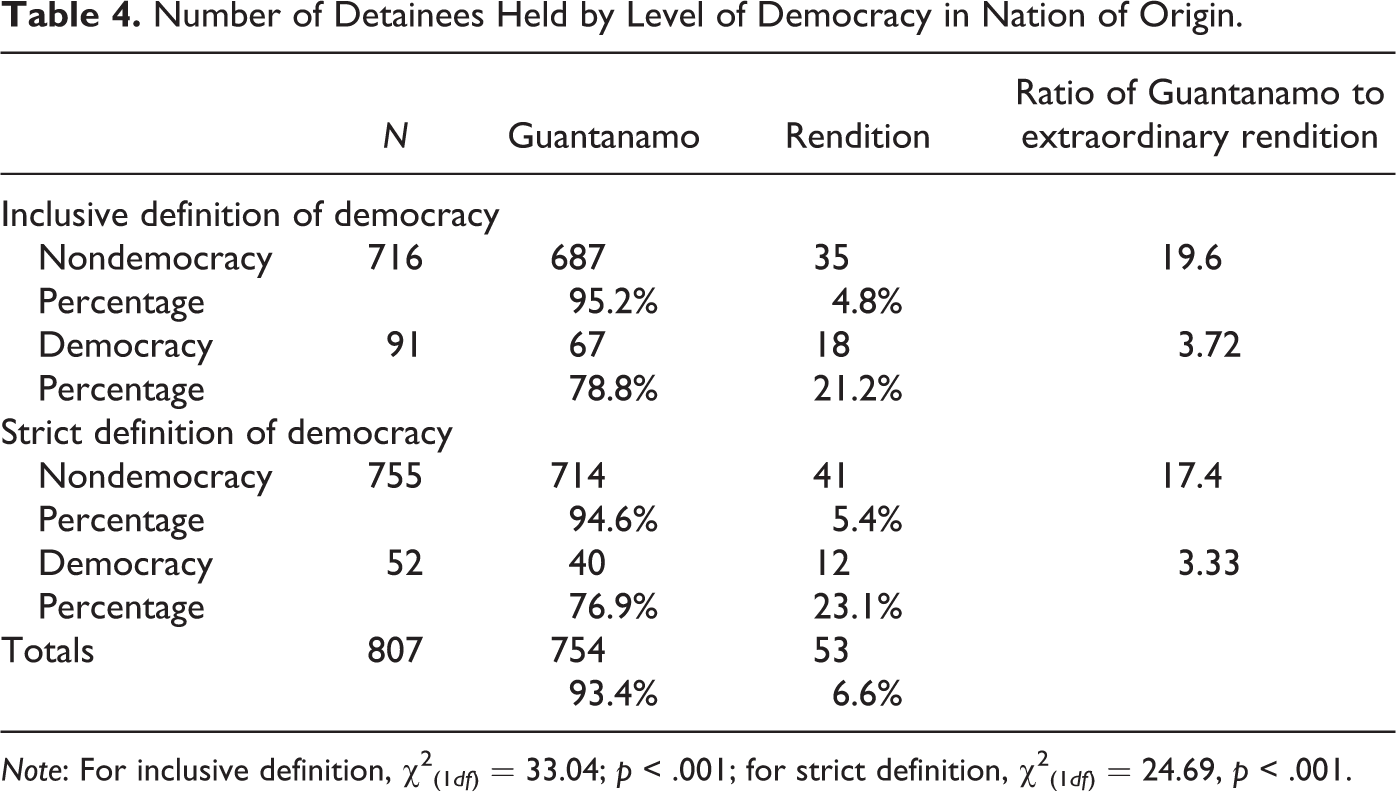
Note: For inclusive definition, χ2 (1df) = 33.04; p < .001; for strict definition, χ2 (1df) = 24.69, p < .001.
Over 90 percent of all detainees were sent to Gitmo, and using the inclusive standard, we found that for detainees from nondemocracies this rate was about 95 percent. By contrast, being extraordinarily rendered was significantly more likely when detainees were from democracies. About 5 percent of detainees from nondemocracies were sent into extraordinary rendition, 21.2 percent of detainees from democracies were subject to extraordinary rendition, χ2 (1df) = 33.04, p < .001.
Using the strict standard, the United States sent detainees from nondemocracies to Gitmo in about 95 percent of the cases in which they were detained, compared to just under 77 percent of the time when detainees were from democracies. Extraordinary rendition was still more likely to be used against detainees from democracies, representing over 23 percent of all detentions, as compared to only 5.4 percent from nondemocracies, χ2 (1df) = 24.69, p < .001. The United States is substantially more likely to use extraordinary rendition for detainees from democracies.
Because the list of detainees subjected to extraordinary rendition is less reliable than the list of Guantanamo detainees, we explicitly considered unreliability as a cause of our results. It is possible that the available data are biased in favor of underreporting of individuals from nondemocracies who were extraordinarily rendered (e.g., citizens of failed states may go unreported). To address this, we ran a “file drawer” test, a calculation to see how many detainees from nondemocracies would be necessary to add to our observed rendition data to create statistical nonsignificance. An additional sixty-two unreported detainees from nondemocracies would be necessary for the results fall above the .05 level. This amount is nearly triple the size of the observed sample; a biased sample is an unlikely account.
Our data demonstrate an ironic disadvantage of democracy; the possession of a passport from a democracy substantially increases one’s chances, once detained, to be sent to the less desirable extraordinary rendition. As predicted by PToL and the clandestine account of DPT, citizens from democracies were treated with high rates of covert detention.
General Discussion
These studies offer some compelling insights into the behavior of the United States in relation to DPT. In our first study, we established that individuals do indeed tend to balance their perceptions of the United States, its allies, and their levels of democracy. In our second study, we showed that democracy and alliance with the United States go hand in hand as a way of maintaining consistency; Americans see democracy in their allies, and they see alliance with other democracies. These sentiments of a democratic public, we argue, represent a constraint on decision makers. In the third study, we hypothesized that a logical consequence of citizens’ tendency toward perceptual balance on the international stage would result in a parallel tendency for the United States to prefer covert action as the means of intervening against more democratic countries. We found that the United States is more likely to use covert intervention against democracies than against nondemocracies. In our fourth study, we extended this behavioral tendency to the treatment of captured suspects in the war on terror. We found that the United States more often pursues covert detention against detainees from democracies than from nondemocracies.
We argue that these foreign policy choices are rooted in US elites’ desire to avoid negative public sentiment, which in turn is rooted in cognitive consistency, a premise of the PToL. Hayes’ (2012) and Weart’s (1998) analyses of democratic peace have illuminated how the needs for cognitive consistency affect perceptions of citizens and elites and constrain decision makers’ belligerent choices toward fellow democracies. These studies represent a helpful advance in articulating the plausible normative explanations of democratic peace focusing on public constraint and elite preference formation. By integrating the PToL with DPT, our study pushes this research agenda forward by explicating how perceptions of legitimacy are created and sustained in democratic states, and by showing how these perceptions serve as constraints on elites pondering a military solution to a dispute with another democracy and thus, inadvertently, prompting them to resort to clandestine subversive behavior and the use of covert military force.
PToL emphasizes consistency among relations in the simplest terms; the principle that “bad people deserve bad treatment…and good people deserve good treatment” (Crandall and Beasley 2001, 79) is fundamental to judgments of justice and legitimacy. This simple balancing of moral affect and treatment—structural balance—provides a basis for understanding the mechanisms of DPT (see also Hart 1974). Citizens of democracies are from good countries that are US allies, and the close relationship between democratic citizens and their nation mandate good treatment. When US government policy and interests lead to harsh treatment of democratic citizens, the government risks its legitimacy. To preserve legitimacy, it hides its actions, prosecuting wars, and detainees in the twilight.
These support the “clandestine” hypothesis advanced in this research and the perceptual logic of DPT suggested in the article. We might consider the 1953 coup d’état in Iran orchestrated by the United States and UK, or the 1954 Guatemalan coup d’état that deposed the democratically elected president by an anticommunist “army” recruited, trained, and armed by the CIA, or the “secret wars” of the Reagan Administration against the Sandinista government in Nicaragua as illustrations of this logic. The clandestine war cases were selected for their covertness, that is, these operations were either silenced in press or if mentioned in newspaper reports, ruled out any connection between the United States and the violence. The cases also indicate the concern of the US leaders with public opinion and the fear of political and reputational consequences for an unpopular attack on another democratic state. In some instances, elites from both the invading and target states were aware of the nature and goals of the covert use of force and this information can sometimes leak to the target country’s population. The only populace that remains reliably ambivalent or misinformed is the general US public.
Governments might attempt to affect public perception of a potential target of aggression to engender public support for the use of force. The histories of both covert and overt military operations provide a wealth of evidence of the manipulation of public opinion to win citizens’ hearts and minds. In 1954, the Eisenhower Administration engineered public consent for a Guatemalan coup d’état using a public relations campaign in the North American press. Fear-mongering propaganda about the “communist leanings” of the Guatemalan president—a “puppet of the Soviet Union”—created a negative and fearful perception of the Guatemalan regime in American minds. The American news media subsequently misrepresented the coup as a successful restoration of democracy in Guatemala, carried out by local freedom fighters. The fact that the CIA had masterminded and funded the revolt was excluded from the news (Gleijeses 1992). This and other historical cases of the intelligent use of propaganda (the British government, e.g., used the British Broadcasting Corporation’s Persian service for advancing its anti-Mosaddegh agenda in pre-1953 Iran) comport with the logic of the governments’ clandestine actions against other democratic states. Since the democratic governments are both constrained by and concerned with their popular legitimacy, they will engage in acts of coercion against other democracy only to the extent that they are able to make their actions seem legitimate through the elaborate myths of legitimation and/or conceal them. Whether the government creates these public perceptions are beyond the scope of this article, but our studies provide evidence that the US government may be taking public perception into account when crafting its foreign policy action.
Certainly, other Western liberal democracies have been implicated in direct and indirect support of covert operations against other democratic states. Following WWII, the United States and UK set up a network of paramilitary forces for countering possible invasion of the armies of states from the Warsaw Pact. During the Cold War, these networks were turned into what became known as North Atlantic Treaty Organization’s “secret armies” operated by the military intelligence services of European states. Trained in covert operation and subversion techniques, these armies were used in a series of clandestine violent actions against “threatening” regimes—often democratic—in Europe and other parts of the world (Ganser 2005).
Legitimacy is important to authorities because it allows them the ability to act and have their actions supported more easily than if it is absent. A government that lacks legitimacy must then rely on force to get its citizens to comply with its actions and policies. For these reasons, it is desirable for a government to try and maintain its legitimacy by acting consistently with public perception, and when its actions are out of step with the public’s opinion it will attempt to hide those actions so their legitimacy is not questioned.
The normative constraints from the public, however, could conceivable apply at the elite levels as well. Kim and Hundt (2012) analyze the case of US covert intervention in Chile and develop hypotheses regarding democratic peace by examining just this interaction between the normative demands of popular opinion and the institutionally bound constraints afforded potentially belligerent democracies. They argue that the US intervention in democratic Chile was covert precisely because of a prevailing public mood opposed to military ventures. They go on to consider that “…a path to regime change typified by covert action rather than open warfare implies a lower degree of cohesion within the policy-making elite…some elites in the State Department opposed the intervention in Chile on philosophical grounds. It seems that one of the reasons why the elites undertook covert operations was to circumvent normative restraints” (Kim and Hundt 2012, 67). Although we have not sought to test elite perceptions of legitimacy, the intriguing possibility persists that policy divisions—inspired by debate born of questions of legitimacy—could, somewhat ironically, result in covert actions.
Our findings also have implications for postcovert action behavior once a covert operation is revealed. If balance is an operational factor, we would expect to see concerted efforts to justify the behavior by realigning public sentiments. This might take the form of denying the democratic qualities of the target: “When it was no longer feasible to conceal their involvement in Chile, US elites attempted to depict Allende as an evil figure” (Kim and Hundt 2012, 65). This denigration matches hostile action with an evil figure, and thus restores balance and preserves legitimacy.
Democratic peace has given rise to a great deal of scholarly debate in part because of its potential implications for the dominant theories in international relations. If democracies avoid war with other democracies, realist theories are presumably weakened. Driven by the mandates of anarchy and self-interests, realist accounts of state behavior do not well tolerate varying standards of behavior for different potential adversaries based on type of government. Liberal theories, on the other hand, allow more room for cooperation under anarchy, given the right circumstances. If democratic dyads behave no differently than any other type of dyad, a substantial empirical asset is potentially lost to the self-help, self-interest version of international affairs purported by realism.
The studies presented here cannot hope to fully adjudicate such a foundational and enduring debate. Rather, we offer a psychological perspective that might help account for states’ strategies. Democratic states pursue their national interests, but they appear to do so with deference to the powerful normative influence of public perceptions. Whether elites wring their hands over potential breaches of the democratic covenant is open for debate, but US foreign policy behavior seems to suggest deep recognition of the consequences of such breaches. Why hide these acts from the public? Of course, covert action is not undertaken for the sole purpose of hiding acts from the US public. There are many audiences to international relations. But why would we expect a different rate of use of covert force toward democracies than toward nondemocracies? Such an argument has more trouble explaining our extraordinary rendition findings, where the detention itself is a fait accompli and the rendition itself (we argue) merely acts to remove the detainee from the public spotlight.
Although many have seen the fact of nonwar aggression between democracies as an indication that the so-called law of international relations is suspect, we disagree. Covert violence, we argue, results from elites who are constrained by public sentiments, which themselves are rooted in a need for perceptual consistency. As citizens become aware of the inconsistencies between their value of peaceful conflict resolution, on the one hand, and the aggressive behaviors of their own government, on the other, the great democratic experiment itself becomes unbalanced. Covert policies are the sometimes the result of the competing mandates of perceived national interests countered by the constraining force of democratic values. When elite actors wish to pursue a policy at odds with the democratic peace, to preserve their legitimacy they engage in hostilities clandestinely.
Supplemental Material
Supplemental Material, download - Covert Operations, Wars, Detainee Destinations, and the Psychology of Democratic Peace
Supplemental Material, download for Covert Operations, Wars, Detainee Destinations, and the Psychology of Democratic Peace by Christian Crandall, Owen Cox, Ryan Beasley, and Mariya Omelicheva in Journal of Conflict Resolution
Footnotes
Authors’ Note
Original data files and experimental materials are on file at the Open Science Framework. Retrievable from osf.io/4n85y.
Declaration of Conflicting Interests
The author(s) declared no potential conflicts of interest with respect to the research, authorship, and/or publication of this article.
Funding
The author(s) received no financial support for the research, authorship, and/or publication of this article.
Supplemental Material
Supplementary material for this article is available online.
Notes
References
Supplementary Material
Please find the following supplemental material available below.
For Open Access articles published under a Creative Commons License, all supplemental material carries the same license as the article it is associated with.
For non-Open Access articles published, all supplemental material carries a non-exclusive license, and permission requests for re-use of supplemental material or any part of supplemental material shall be sent directly to the copyright owner as specified in the copyright notice associated with the article.
