







Abstract
A large literature has emerged in political science that studies the wars in Afghanistan and Iraq. This article summarizes the lessons learned from this literature, both theoretical and practical. To put this emerging knowledge base into perspective, we review findings along two dimensions of conflict: factors influencing whether states or substate groups enter into conflict in the first place and variables affecting the intensity of fighting at particular times and places once war has started. We then discuss the external validity issues entailed in learning about contemporary wars and insurgencies from research focused on the Afghanistan and Iraq wars during the period of US involvement. We close by summarizing the uniquely rich qualitative and quantitative data on these wars (both publicly available and what likely exists but has not been released) and outline potential avenues for future research.
One consequence of America’s post–9/11 wars in Afghanistan, Iraq, and elsewhere has been a profusion of new scholarship on civil war and insurgency. There have been at least 275 studies on these conflicts published in academic journals or presented at major political science conferences since 2002 as well as more than eighty analytical books. To put this emerging knowledge base into perspective, it is useful to think about it along two dimensions. First, what have we learned about factors that influence whether states or substate groups enter into conflict at all? Second, which insights have we gained into factors affecting the intensity of conflict at particular times and places once it has started?
Most of what has been learned from the wars in Afghanistan and Iraq about conflict onset relates to reasons for bargaining failure. Recent research is mostly consistent with the rational choice bargaining model but also highlights the limited explanatory power of models that characterize bargaining as a simple two-player game, ignore domestic politics, and adopt conventional representations of war costs. A number of papers on the politics of the Afghanistan and Iraq wars provide evidence of political bias in the sense of Jackson and Morelli (2007) who outline how differences between the costs of violence to political leaders and the costs to the state as a whole can be a source of bargaining failure. Others identify a kind of domestic security dilemma as the cause for bargaining failure that triggered sectarian violence in Iraq.
Turning to explanations for variation in the intensity of fighting at the local level, most research from these wars falls into one of two broad theoretical perspectives; one focuses on variation in the opportunity costs of participating as the key independent variable, while the other stresses the influence of information flows to various sides. Consistent with Berman and Matanock (2015), we find the evidence to be more in line with an information-centric perspective on local variation in conflict intensity. 1
A key observation that emerges from reviewing this literature is that there is no reason to expect the same correlation between a given cause (e.g., poverty) and both the onset of conflict and subnational variation in its intensity. For example, basic intuition suggests that once fighting has started, a factor that increases the capacity of one warring faction, such as an increase in the number of fighters due to poor economic conditions, should increase the level of violence. But that same change may have different implications for onset or termination in bargaining models. In such models (e.g., Walter 2009), factors that increase the power of one side in ways that reduce uncertainty (e.g., a highly salient political event that rallies supporters to one side or an economic shock that everyone agrees will increase rebels’ potential combat power) may actually make bargaining failures less likely and thus reduce the probability of onset or lead to settlement. 2 Thus, a factor that would be expected to increase the intensity of conflict given that a bargaining failure has already occurred could make such a failure less likely in the first place. 3
While a great deal has been learned, the full academic potential of studying these wars has not yet been realized. In particular, researchers have only now begun to tap the rich body of survey data collected during these conflicts and they have barely scratched the surface of what we can learn through interviews and archival work.
To put the work that has been done in perspective and lay out potential future directions, this article reviews what has been learned over the last fifteen years in six parts. The first section provides some basic statistics on the academic journal articles and conference papers written on these wars. The second and third sections summarize what has been learned about the production of political violence from research on the wars in Afghanistan and Iraq. The fourth section discusses what is unique about these conflicts and the implications for external validity of all these studies. The fifth section assesses the potential for future research driven by unprecedented data in three areas: inputs and outcomes of violence and contextual information. In each area, we argue these wars have created unprecedented opportunities for both quantitative and qualitative works. Our summary of data sources is designed to serve as a useful guide to scholars exploring potential work on the topic. The sixth section concludes.
Overall, the evidence from Afghanistan and Iraq weighs heavily in favor of an extended rational choice bargaining model as the best explanation of conflict onset and information flows from noncombatants being the key factor influencing local conflict intensity in such asymmetric settings. Once a counterinsurgent force with vastly superior capabilities (like the Afghan or Iraqi governments working with the United States) is confronted with an insurgency, the civilian population’s willingness to share information on antigovernment combatants determines the efficacy of the counterinsurgency (COIN) effort. 4 This finding is different from the results in a broad set of papers showing the centrality of opportunity costs in more symmetric conflicts but very likely extends to other highly asymmetric conflicts. While both wars are clear outliers in terms of the capacity of the counterinsurgent forces, or at least were while the United States was actively involved, they are vastly different on most other dimensions (urban vs. rural locus of conflict, extent of sectarian violence, financing opportunities for insurgents, physical terrain, literacy of the population, etc.). Those differences imply that common patterns likely have relatively strong external validity wherever there is a highly asymmetric balance of power between the sides.
Trends in Scholarship
America’s post–9/11 wars in Afghanistan and Iraq have been the subject of at least 275 papers published in academic journals or presented at major political science conferences. 5 Of these studies, 139 (53 percent) focused on events in Iraq, 81 (31 percent) investigated Afghanistan, and 45 (16 percent) analyzed both countries. Overall, the number of studies peaked at thirty-one papers presented or published in 2007 but has declined slowly with twenty-four being published in 2014. In the years following the invasion of Iraq, the vast majority of scholarly articles focused on the interstate war and insurgency in Iraq. In the second half of the 2000s, scholarly interest gradually turned toward the conflict in Afghanistan. Since 2010, a roughly equal number of articles have been devoted to the wars in Afghanistan and Iraq, and an increasing number of studies conduct cross-national research on both conflicts. Figure 1 displays these trends. It shows that the number of studies on Iraq peaked at twenty-three in 2007. More studies on Afghanistan were presented or published in 2010 than in any other year. Thus, the surges in the number of US combat troops in Iraq in 2007 and in Afghanistan in 2010 coincided with “surges” in the number of studies presented or published in these years. This temporal coincidence illustrates how scholarly interest varied as a function of political events and that empirical studies yielded timely results.
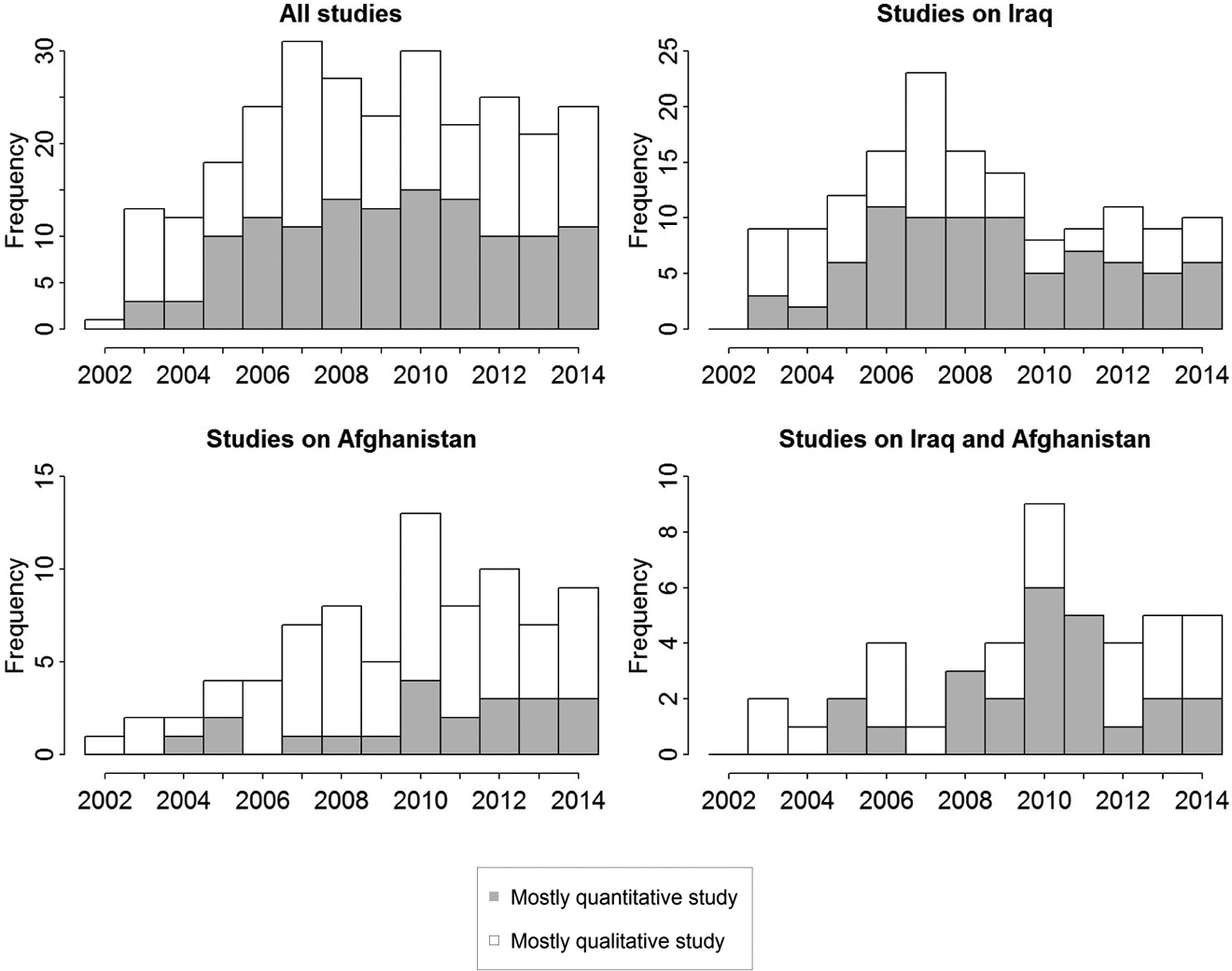
Studies on conflicts in Afghanistan and Iraq by year and by method of inquiry. This figure displays the primary method of inquiry for empirical papers that were published in academic journals or presented at major political science conferences between 2002 and 2014 and written in English. The upper left panel shows this information for all studies. The upper right panel shows the corresponding data for studies on Iraq, the lower left panel focuses on studies on Afghanistan, and the lower right panel examines studies on conflicts in both countries.
Qualitative case studies were the most common method used, though there were differences across wars. The majority of studies on Iraq were mostly quantitative while almost three in four on Afghanistan primarily used qualitative methods (see Figure 1). Overall, 148 (54 percent) of the papers entailed descriptive and causal inference through qualitative case studies while 127 (46 percent) reported results from econometric analyses. This pattern suggests, first, that political scientists have made many contributions to the historiography of the wars in Afghanistan and Iraq, with at least eleven studies making extensive use of archival materials. Second, it indicates that the literature has not fully tapped the rich quantitative data on these conflicts yet.
The single most researched topic across these 275 studies was COIN in Afghanistan and in Iraq (see Figure 2). 6 Eighty-eight papers (32 percent) primarily focused on this topic. The focus on COIN was particularly pronounced among the studies on Afghanistan, half of which investigated efforts by the United States, North Atlantic Treaty Organization (NATO), and the Afghan government to fight the Taliban. Surprisingly, the second most frequent subject of inquiry was public opinion. Seventy-two papers (26 percent) investigated the effect of the two conflicts on public attitudes, political participation, and voting behavior. Strikingly, the vast majority of these studies (fifty-one) focused exclusively on public opinion in the United States, whereas merely eleven studies investigated Afghan and Iraqi public attitudes. 7 Fifty-five studies (20 percent) investigated the origins and dynamics of insurgent or sectarian violence in Afghanistan and Iraq. Thirty-three other papers (12 percent) examined the US-led invasions of these two countries, with the overwhelming majority (twenty-three) focusing solely on Iraq. The remaining twenty-seven papers (10 percent) analyzed the ramifications of these conflicts on geopolitics, transnational terrorism, and political institutions in Afghanistan and Iraq.
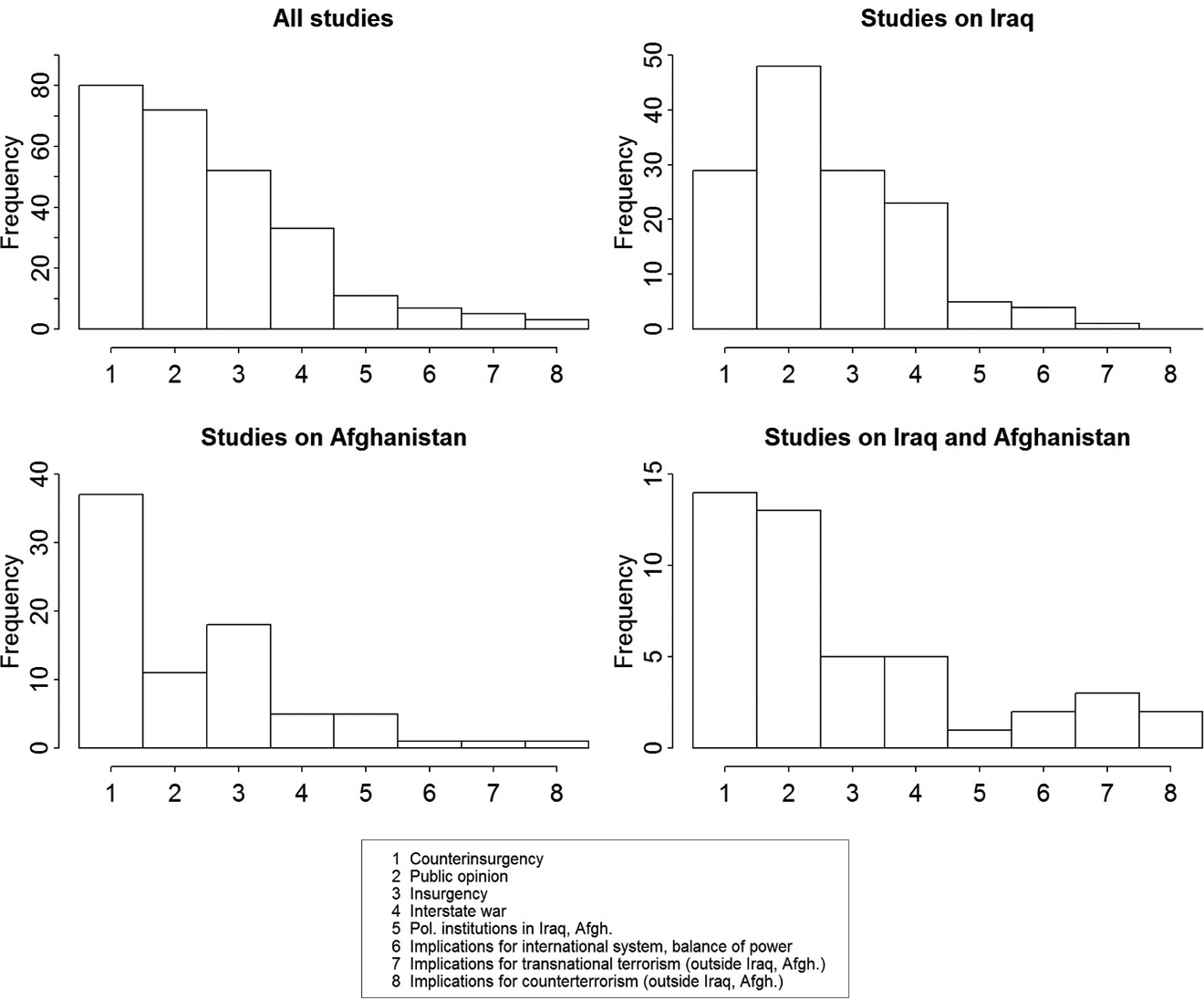
Studies on conflicts in Afghanistan and Iraq by topic (2002 to 2014). This figure displays the frequency distribution of topics of empirical papers that were published in academic journals or presented at major political science conferences between 2002 and 2014 and written in English. The upper left panel shows this information for all studies. The upper right panel shows the corresponding data for studies on Iraq, the lower left panel focuses on studies on Afghanistan, and the lower right panel examines studies on conflicts in both countries.
Overall, this distribution shows a strong focus in the literature on the implications of the two wars for Western countries. More than 60 percent of the studies analyzed decision-making in or outcomes from variation in US-led COIN efforts than did so for the insurgencies. Four times more studies investigated public opinion in the United States than in Iraq and Afghanistan combined, even though various theories on the production of civil war violence stress the importance of local civilian attitudes.
What Explains the Outbreak of Conflict?
There is a good deal of evidence about on when and where conflict will break out from work on the onset of wars in Afghanistan and Iraq, as well as work on the subsequent start of the insurgencies and sectarian strife. This section focuses on lessons learned from work on the onset of sectarian violence in Iraq and the two insurgencies. Our analysis of lessons learned regarding interstate war onset is presented in the Online Appendix.
Bargaining failure due to asymmetric information and commitment problems is the prevalent rationalist explanations of the onset of violent conflict (Fearon 1995). This rationalist perspective has been used to explain the postinvasion onset of sectarian violence between Shiites and Sunnis in Iraq. In particular, one long-standing argument holds that commitment problems and uncertainty about the other side’s intentions and capabilities translate into bargaining failure when ethnic or religious groups are caught in a security dilemma under conditions of domestic anarchy. According to this argument, the state’s inability or unwillingness to control violence among communal groups is a precondition for the onset of sectarian conflict (Petersen 2002; Posen 1993; Wilkinson 2004). Several studies conclude that sectarian violence in Iraq was the result of a security dilemma in mixed areas, where Coalition and Iraqi government forces failed to maintain law and order (Agnew et al. 2008; Weidmann and Salehyan 2013). Computer simulations suggest that the risk of civil strife would have been lower if the United States had deployed a larger force when it invaded Iraq (Enterline and Greig 2007). Staniland (2010, 1640) explains that the failure by Iraqi government and Coalition forces to impose order, which gave rise to the security dilemma, was politically motivated: American and Iraqi leaders constrained their COIN forces, because they hoped to reach a political settlement. Moreover, close ties between the Iraqi government and Shiite militias provided the latter with political cover, which enabled them to engage in violence with relative impunity (Staniland 2010; see also Thurber 2014). Senior Iraqi officials also contributed to the sectarian security dilemma by undermining Coalition efforts to build a professional Iraqi police force (Radin 2014). Some studies also show variation in the perception of security dilemma. Interviews in Baghdad tentatively suggest that some neighborhoods proved resilient to efforts by sectarian militias to gain a foothold in their area (Carpenter 2012). Refugees and internally displaced persons (IDPs) made particularly easy targets for attackers and were particularly prone to being recruited into sectarian militias (Lischer 2008).
While the ethnic security dilemma argument has been a prominent explanation of the onset of sectarian violence in Iraq, there is little empirical support for the argument that ethnic groups’ security dilemma were at the root of the Taliban insurgency in Afghanistan. Sullivan (2007, 100) and Jones (2008) conclude that ethnicity was not the channel through which the Taliban mobilized. And none of the papers examined explicitly assess reasons why the Afghan insurgency began following the establishment of the new government in 2002, the Taliban resurgence is taken for granted in the literature we reviewed. That said, Beath, Christia, and Enikolopov (2012) do test an observable implication of rationalist bargaining models for the impact of development aid projects on violence in Afghanistan. They do not find empirical support for the hypothesis that development aid might shift the balance of power between factions and thus generate commitment problems that lead to bargaining failure and conflict.
The extent to which the removal of the security dilemma explains the dramatic decline in sectarian violence in Iraq in 2007 to 2008 is debated. Agnew et al. (2008) and Weidmann and Salehyan (2013) argue that “ethnic cleansing” of mixed areas (especially those in Baghdad) eventually mitigated the security dilemma and caused a drop in sectarian violence. In contrast, Biddle, Friedman, and Shapiro (2012) challenge the argument that the completion of ethnic cleansing was the main reason for the decline in violence in Iraq in 2007. They show that violence began to decline first in Anbar province, which was almost entirely Sunni and that the ethnic cleansing in Baghdad, where Shiite militias attempted to conquer formerly Sunni neighborhoods, was far from complete by the time violence dropped.
In conclusion, rational choice bargaining theory is consistent with most analyses of the onset of the sectarian violence in Iraq but has not been used to explain the start of the insurgency in Afghanistan and fails to account for the drop in violence in Iraq in 2008 to 2010. Moreover, this approach has not been broadly applied to explain the failure of the Taliban and Afghan government to reach a peace settlement.
What Explains Local Variation in Conflict Intensity?
Evidence from the wars in Afghanistan and Iraq has been used to test a range of theories about what drives local variation in the production of violence in civil war. We divide the theories on the intensity of conflict for purposes of the review into opportunity cost and informational theories.
One striking fact about the wars in Afghanistan and Iraq is just how varied the trends in combat were over time and space. Figures 3 and 4 display the number of monthly combat incidents per capita for the twenty-four most violent districts in Afghanistan and Iraq. 8 These incident data are based on administrative reporting by US and allied forces and were released through a Freedom of Information Act request. The Iraq data include all recorded acts of insurgent violence against Coalition military units, Iraqi Security Forces, civilians, Iraqi infrastructure, and government organizations (see fifth section for details). The Afghan data record the analogous information.
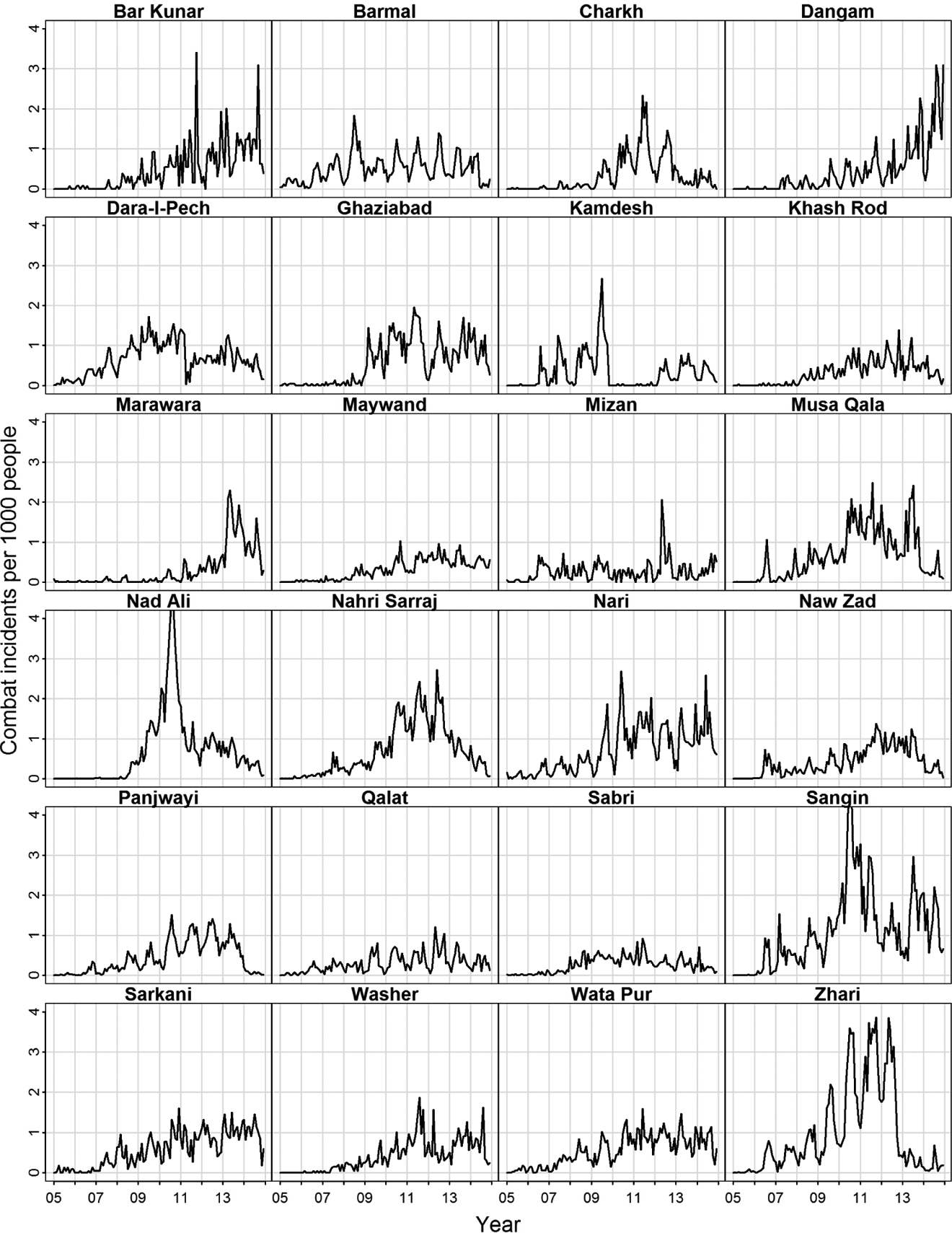
Monthly combat incidents per capita in Afghanistan, 2005 to 2014. Number of combat incidents per capita by month in the twenty-four most violent districts on a per capita basis in Afghanistan from January 2005 to December 2014. Values for Nad Ali for August and September 2010 and for Sangin for July and August 2010 (all between 4 and 4.6) are not displayed due to scale. Data from the International Security Assistance Force Combined Information Data Network Exchange database, released through Freedom of Information Act.
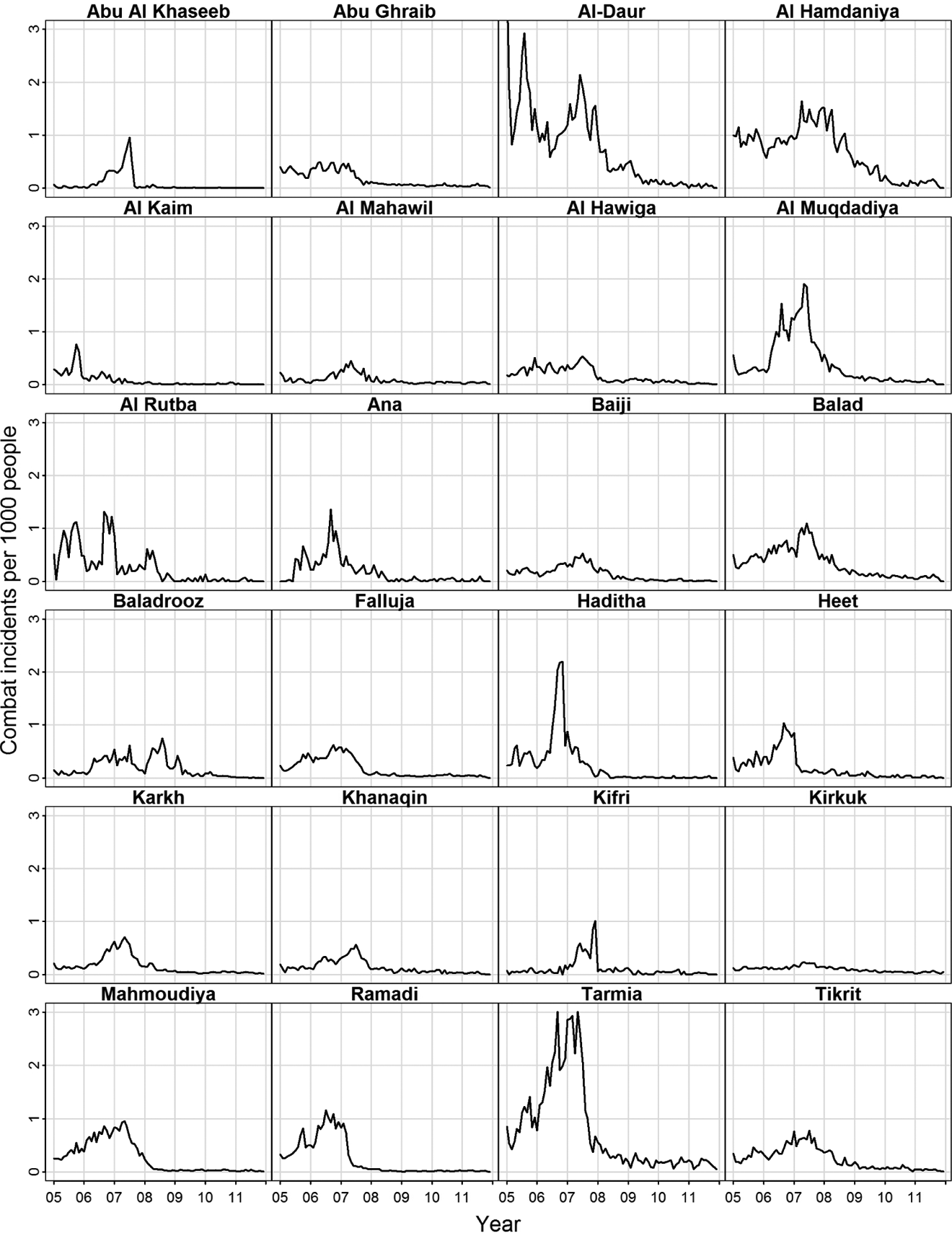
Monthly combat incidents per capita in Iraq, 2005 to 2011. Number of combat incidents per capita by month in the twenty-four most violent districts on a per capita basis in Iraq from January 2005 to December 2011. The value for Al-Daur for January 2005 (=4.2) is not displayed due to scale. Data from the MNF-I SIGACT-III database, released through Freedom of Information Act.
These plots show that within each conflict violence greatly varied across time and space. In Afghanistan, for example, there is a clear fighting season across districts (April to October for the most part), but beyond that broad trend districts vary hugely. Some, such as Panjwayi district, an area outside of Kandahar where the Taliban first emerged, show fairly consistent trends year-on-year. Others, such as Washer, a small district in Helmand province that hosted the main Marine Corps base in Southern Afghanistan, show big differences year-on-year. Similar variation was present in Iraq. Violence peaked in Haditha, a small district in Anbar between Ramadi and the Syrian border, a full year before it did so in Balad, a district in Salah-al-Din province to the northeast of Baghdad which hosted a major US base.
We summarize below the literature that has sought to explain this variation and that uses it to understand what drives conflict. We divide the literature into work focusing on (a) variation in the opportunity cost of being an insurgent and (b) variation in information shared by the community with counterinsurgents. Both factors could, of course, play a role, but the evidence from Afghanistan and Iraq suggests the latter is more often critical in these conflicts.
Opportunity Cost Theories
Opportunity cost models posit that the availability of labor is the binding constraint on the production of violence (Grossman 1991), and therefore when the local labor constraint on insurgents is eased then violence in that area should increase (Dube and Vargas 2013). Studies applying opportunity cost theories to explain insurgent violence in Afghanistan and Iraq produce mixed results. Iyengar, Monten, and Hanson (2011) show that greater availability of outside options in the nonviolent labor market due to spending on labor-intensive projects through the Commander’s Emergency Response Program (CERP), which they argue, raised the opportunity cost of participating in violence production, reduced insurgent recruiting, and caused substitution away from labor-intensive forms of insurgent violence to more capital-intense attacks. In their study on the impact of the National Solidarity Program (NSP) in Afghanistan, Beath, Christia, and Enikolopov (2012) similarly find that a community-driven development program improved economic welfare and reduced violence in regions with relatively low initial violence. At the same time, this aid program improved attitudes toward the Afghan government, even though opportunity cost models would not predict such an effect (Beath, Christia, and Enikolopov 2012), leading the authors to conclude that their findings are more consistent with the informational model of COIN than with an opportunity cost approach. Evidence of a negative effect of business revitalization initiatives in Iraq on violence is consistent with both the opportunity cost model and an informational theory of COIN (Shaver 2013).
But other studies reach a different conclusion. While economic opportunity cost models would expect a positive correlation between unemployment and political violence, Berman et al. (2011) find a negative relationship between changes in district-level unemployment rates and changes in per capita attacks against government and allied forces in Afghanistan and Iraq (as well as in the Philippines). Bahney et al. (2010, 2013) raise further doubts about opportunity costs as the driving force behind participation in the insurgency in Iraq. They show that al-Qa’ida in Iraq (AQI) paid its operatives salaries that were low by Iraqi standards and that did not include a risk premium. These two studies tentatively conclude that AQI may have used low wages to screen out uncommitted individuals who may pose a security risk to the group, given there was an abundance of willing fighters. If so, labor was not the binding constraint on the production of insurgent violence in Iraq.
A second strand of opportunity cost models suggests that insurgents are motivated by “greed” and seek to capture the government for the sake of personal economic gain (Collier and Hoeffler 1999, 2004). This approach predicts that the value of the prize that can be captured by controlling the government shapes individuals’ decisions to participate in rebellion rather than engage in productive activity. In line with this expectation, Suhrke (2007, 1301) notes that state building in Afghanistan increased the prize of capturing the central government and may thus have increased the contest for control of the central government, which might explain the failed coup by the demoted Minister of Defense Fahim in 2003. At the same time, Jones (2008) finds little support for greed-based explanations of the rise of the Taliban in Afghanistan. Instead, he contends that the increase in drug trade was a result of the insurgency and not its cause. While the greed model implies that a large increase in the amount of contested resources caused by an influx of aid would increase violence production, Beath, Christia, and Enikolopov (2012) find the opposite effect.
Informational Theories
Informational theories on the production of violence take exception with the claim that rebels seek to produce violence at capacity. Instead, they suggest that rebel activity is strategically chosen taking into account the government’s repressive capacity (Fearon 2008; Kalyvas 2006; US Army and Marine Corps 2006; Tsedung 1937). Where rebels face competent governments who can act effectively on information shared by the civilian population, rebels may endogenously choose to produce at lower levels. In this case, their labor constraint will not bind. Instead, the binding constraint is the information on the insurgency that is available to counterinsurgent forces. A broad range of studies from Afghanistan and Iraq are consistent with this perspective.
Which factors explain variation in the provision of information by civilians to the COIN forces? Research on the insurgencies in Afghanistan and Iraq suggests that COIN tactics, civilian casualties, unemployment, aid programs, and information technology coverage all provide part of the answer to this question. A paired comparison of two US Army divisions in Iraq in 2003 and 2004 shows that higher levels of COIN force mechanization inhibit direct contact with the civilian population and thus hamper the force’s ability to acquire reliable information about the enemy (Lyall and Wilson 2009). This finding validates a key component of the COIN strategy of the US Army and Marine Corps (2006), and it echoes insights from the US military surge in Iraq in 2007. The deployment of 30,000 additional US troops and the simultaneous shift in COIN tactics have been credited with sustaining the Anbar Awakening, that is, the realignment of Sunni forces in Anbar province from their erstwhile AQI allies to the US-led coalition. As Biddle, Friedman, and Shapiro (2012) show, the US military surge afforded the necessary protection to Sunni “Sons of Iraq” units and civilians and thus led the latter to provide valuable information to the COIN forces, which in turn fought more successfully against the insurgency.
If protecting civilians by stationing troops in forward operating bases in residential areas has a positive impact on the provision of actionable intelligence to COIN forces, civilian casualties, and indiscriminate targeting by COIN forces may have the opposite effect. An analysis of weekly time-series data on civilian casualties and insurgent violence in Iraq between 2004 and 2009 indicates that coalition killings of civilians increased the number of insurgent attacks, while insurgent killings of civilians had the opposite effect (Condra and Shapiro 2012). These relationships were strongest in ethnically mixed areas and in highly urban districts. This finding corroborates the argument that civilians punish warring factions for inflicting collateral damage and the authors interpret the evidence as consistent with a mechanism where noncombatants victimized by the government share less information while those victimized by insurgents share more. Consistent with that explanation, Shaver and Shapiro (2015) use newly declassified data to provide direct quantitative evidence that tips to Coalition forces increased following insurgent-caused civilian deaths and dropped after Coalition-caused ones. Concern about political backlash from abuse by Taliban operatives partly explains why their leaders established a code of conduct and a military justice system (Giustozzi 2014).
Since counterinsurgent forces depend on tips from the civilian population, such variation in information flows introduces variation in COIN effectiveness, which in turn impacts the production of violence by the insurgency. Consistent with this view, “search and cordon” missions aimed at flushing out the Taliban in Helmand province in 2006 alienated the local population and adversely affected long-term stabilization efforts (Pritchard and Smith 2010). Civilians’ preexisting bias in favor of one side that is perceived as the in-group may lead them to react more strongly to civilian casualties inflicted by the out-group and to discount killings of noncombatants by the in-group. Thus, a survey experiment conducted in five Pashtun-dominated provinces in the center of the Taliban insurgency shows that victimization by International Security Assistance Force (ISAF) reduced support for ISAF and increased support for the Taliban, while Taliban-inflicted harm to civilians did not translate into greater support for ISAF and only marginally decreased Taliban support (Lyall, Blair, and Imai 2013). In contrast, results from two surveys administered in Northern Afghanistan show that civilian exposure to Taliban and counterinsurgent violence did not change communities’ average perception of the two sides while it polarized opinions within these communities (i.e., it increased variation in attitudes; Weidmann and Zürcher 2013). Since exposure to violence did not reduce trust inside the local community (Weidmann and Zürcher 2013), it is unclear whether the polarization of views induced civilians to tell on each other or not.
While the opportunity cost model expects a negative relationship between household income and participation in the insurgency, the informational model suggests a positive correlation between these variables. If counterinsurgents buy information from civilians, a drop in household incomes implies that a marginal dollar spent on intelligence yields more success at combating the insurgency, thus leading to a decline in violence (Berman et al. 2011). Analyses of district-level unemployment and violence in Afghanistan and Iraq provide empirical support for this argument (Berman et al. 2011).
Counterinsurgent forces often use aid in an effort to buy the allegiance of civilians and access to their valuable information about the insurgency. Empirical evidence from Afghanistan and Iraq suggests that this strategy succeeded in “winning hearts and minds.” The Afghan NSP improved civilians’ economic welfare and attitudes toward the government, and it temporarily reduced violence in areas with low levels of initial violence (Beath, Christia, and Enikolopov 2012). In Iraq, small aid projects financed through the CERP accounted for a significant decline in the number of violent attacks against Iraqi government and Coalition forces (Berman, Shapiro, and Felter 2011). Mikulaschek, Pant, and Tesfaye (2016) show that a rise in Sunni expectations of future public service and security provision in the wake of a change in the leadership of the Iraqi government triggered a realignment of popular support from an insurgency to the counterinsurgency. In addition, Shaver and Tenorio (2014) find that increased electricity supply in Iraq had a negative effect on insurgent violence. The authors ascribe this effect to an increase in the supply of actionable intelligence by the local population, which may have been due to the fact that the provision of electricity increased support for the government and trust in the latter’s commitment to delivering public goods.
Finally, variation in access to information technology shapes the dynamics of the provision of information to the COIN forces. The spread of cell phone coverage in Iraq led to reduced violence at multiple geographic scales, most likely by increasing information flows from the population to the military (Shapiro and Weidmann 2015). Moreover, high levels of access to negative US news coverage of the Iraq war emboldened the insurgency (Iyengar and Monten 2008). One possible explanation is that civilians who were not strongly committed to either side reduced their support of the COIN in response to negative US news reports, which signaled a lack of US resolve to defeating the insurgency (Iyengar and Monten 2008). 9
What Is Unique about These Conflicts?
Of course, care must be taken in extending findings from the conflicts in Afghanistan and Iraq to other settings. This is a common challenge with any observational or experimental study, and one way to address it is to ask which conditions made it possible for the observed causal relationships to obtain (Cartwright and Hardie 2012).
Several factors were unusual in America’s post–9/11 wars, most obviously the massive asymmetry in combat power between combatants. It is a common trope that civil wars involve a large discrepancy in military power, at least in their early stages, but the asymmetries in Afghanistan and Iraq were unusually large. The US military had the capability of striking any part of the territory controlled by insurgents at any time of day or night, which is not true of most countries fighting insurgencies. Because of the international involvement, the counterinsurgents in both wars had access to cutting-edge mobility (helicopters and heavily armored road vehicles), intelligence, logistics, and precision indirect fires (artillery and air power).
These capabilities imply that insurgents’ ability to produce violence in these conflicts was unusually sensitive to information leakage (Shapiro and Weidmann 2015, 5). Once the geotemporal coordinates of an insurgent fighter or arms cache were known, they could be targeted on short notice, and such targeting could happen on very limited intelligence. While scholars have long noted the fact that insurgents are inherently vulnerable once the government has information about them (Kalyvas 2006), advances in communications, tactical procedures, and organization (drones, special operations task forces, etc.; see, e.g., McChrystal 2013; Woods 2015) greatly magnified that vulnerability compared to earlier conflicts.
That vulnerability has two theoretical implications. First, it makes it more likely that insurgents will be constrained not by their total capacity to produce but by a strategic decision predicated on the level/type of violence the population would tolerate. 10 Thus, the extreme imbalance in capabilities between insurgents and counterinsurgents may explain why the binding constraint on the production of violence in Afghanistan and Iraq was the information available to the COIN and not the insurgents’ abilities to mobilize fighting capacity. Consistent with that argument, there is substantial evidence that even the most extreme insurgents in Iraq were concerned with violating community norms. 11
Second, the sensitivity of violence production to information flow effectively ameliorated or eliminated the collective action problem for civilians wishing to aid the COIN. Theorists have posited that civilians that seek to help a warring faction in the mid of civil war face a collective action problem, because such behavior typically entails private risks and nonexcludable public benefits (Popkin 1979; Wood 2003). In an environment where simply calling in a tip through an anonymous hot line could lead to highly effective action against insurgents angering even one civilian was potentially detrimental to insurgents (Shapiro and Weidmann 2015). Information cascade or tipping point models, which rely on mass participation to overcome collective action problems among opponents of the regime, may thus be less relevant in this context (see, e.g., Lohmann 1994; Kuran 1995).
A further unusual factor in both Afghanistan and Iraq was the presence of tens of thousands of foreign soldiers, which dramatically altered the nature of bargaining between local elites. In both countries, certain bargains were off the table because of the veto power of foreign governments with troops in the conflict theater. The Karzai government could not, for example, have met Taliban preferences about the place of women in society even if it had wanted to, because doing so would have been anathema to NATO powers. Moreover, the presence of foreign troops introduced unusual temporal dynamics, which affected the local governments’ and insurgents’ valuation of negotiated settlements. For the Afghan and Iraqi governments, the massive foreign-backed training programs for their militaries implied that they could reasonably ponder whether it made sense to make deals in the present when they could be assured of foreign support to fight a bit longer and almost certainly have a better balance of power if they decided to agree to a settlement in the future. At the same time, some insurgents could reason that waiting for the interveners’ withdrawal might be preferable to launching major offensives while the latter were still deployed.
Of course, while both conflicts are unusual in terms of the high capacity of the counterinsurgent forces, they are vastly different on most other dimensions. Iraq is a highly urbanized society while Afghanistan is mostly rural. In Afghanistan, most of the conflict occurred in rural areas; in Iraq, it took place in the cities. In Afghanistan, there is little history of sectarian violence, while in Iraq, the Sunni/Shia divide has long been a critical cleavage and Shiites were repeatedly repressed and rose up in the twentieth century. In Afghanistan, the overthrow of the Taliban in 2001 was predated by more than two decades of civil conflict, whereas the most recent insurgency in Iraq prior to the US invasion occurred in the early 1990s. In Afghanistan, the opium economy provided massive financing opportunities for insurgents, which had no equivalent in Iraq. The countries further differed in terms of physical terrain (Afghanistan is highly mountainous while Iraq is mostly flat), literacy of the population (Afghanistan has one of the lowest literacy rates in the world while Iraq’s population is largely literate), and so on. Those differences imply that common patterns observed in both conflicts likely have relatively strong external validity in civil wars and insurgencies with a highly asymmetric balance of power. Cases where the government had vastly superior force-projection capabilities include the British COIN effort in Malaya as well as counterinsurgencies in Chechnya, Colombia, and the Philippines. At the same time, findings from conflicts in Afghanistan and Iraq may not generalize to intrastate conflicts where the COIN lacks comparable force projection abilities (e.g., in today’s civil conflicts in Iraq and Syria).
Future Research Potential
The Iraq and Afghanistan wars have led to the generation of unprecedented qualitative and quantitative micro-level data. The literature reviewed above has not yet fully made use of these data, leaving many opportunities for promising future research. In this section, we review some of the most substantial data on outcomes, inputs, and context of the wars in Afghanistan and Iraq.
Outcomes
Micro-level data are available on three sets of outcomes of the conflicts: political violence, control over territory, and public opinion in the conflict theater.
Event data on violence
The amount, quality, and detail of micro-level data on violent events in Afghanistan and Iraq surpass comparable information on any other recent armed conflict. The MNF-I SIGACTS III data specify the precise location and time of incidents of insurgent violence against coalition, Iraqi Security Forces, civilians, Iraqi infrastructure, and government organizations. Unclassified data drawn from the MNF-I SIGACTS III database provide the location, date, and time of attack incidents between February 2004 and February 2009. The substantive scope of the “significant activity reports” (SIGACTS) data can be illustrated with a list of studies that investigated various subsets of these data: Benigni and Furrer (2012) analyzed improvised explosive device attacks, Weidmann and Salehyan (2013) examined sectarian violence in Baghdad, Condra and Shapiro (2012) studied civilian casualties, and Berman et al. (2011) and Shaver and Tenorio (2014) researched insurgent attacks against Coalition and Iraqi government forces. Shaver and Bollfrass (2014) present SIGACT data that were updated until 2011 and extended by the inclusion of the specific nature of the target (outpost, convoy, etc.). While the SIGACTS data are based on reports by the US-led coalition, Iraq Body Count provides data on civilian deaths from violence based on a variety of sources including media reports and figures provided by hospitals, morgues, nongovernmental organizations (NGOs), and government authorities. For each incident, Iraq Body Count records the location, the perpetrator (Coalition Forces or insurgents), a description of the method of attack, and the target of the attack (civilians, political leaders, police, or Iraqi police and military forces). These data were used, for example, by Iyengar, Monten, and Hanson (2011) and Condra and Shapiro (2012). Aggregate monthly data from a third source, the website www.icasualties.org, were used in the study on patterns in escalations in insurgent and terrorist activity by Johnson et al. (2011). In contrast to the other sources, icasualties does not report how the data were compiled. Finally, Fitzsimmons (2013) introduces a new data set on violent incidents involving private security companies operating in Iraq between 2005 and 2007; the data are based on reports by media, government authorities, and NGOs.
SIGACTs were also recorded in Afghanistan, and unclassified data are available up to December 2014 (Shaver and Wright 2016). Since SIGACTs are recorded by Western forces, the probability any given act of antigovernment violence is recorded is necessarily correlated with the presence of such troops. This is a potential limitation of these data for measuring total violence (Management Systems International 2012, 20), though not for measuring attacks against ISAF troops. Another caveat is that administrative reporting by the Afghan National Army and Afghan National Police, which were supposed to report into the data system that ISAF maintained, was inconsistent through at least 2012.
Since 2008, ISAF has released monthly data on the number of civilian casualties and the number of events that caused civilian casualties in Afghanistan. These data are disaggregated by responsible party (ISAF or insurgents), by region, and by weaponry (see Bohannon 2011, 2014). ISAF also published its methodology for collecting and reporting civilian casualty data up the chain of command (see Bohannon 2011). While these data have not been publicly released, they were being collected into 2015 and could in principle support research down the line. Starting in 2007, the UN Assistance Mission in Afghanistan (UNAMA) has provided monthly data on civilian casualties inflicted by pro- and antigovernment forces, respectively. icasualties provides monthly data on casualties by the ISAF. The source for the icasualties data is unclear. Subsets of the UNAMA and icasualties data were used, for example, in the study on social cohesion in Northern Afghanistan by Weidmann and Salehyan (2013). In addition to these monthly data sets, Benini and Moulton (2004) present weekly data on casualties inflicted by Operation Enduring Freedom between September 2001 and June 2002. While the ISAF and UNAMA data sets were compiled by government and international organization staff, the data introduced in Benini and Moulton (2004) were gathered through interviews conducted by an NGO in 2002 in all communities that had been subject to air strikes or ground operations during Operation Enduring Freedom. The Afghanistan Rights Monitor published event data on civilian casualties in 2011, which were gathered by a network of forty informants and verified by additional sources (Bohannon 2011). Very recently, the Uppsala Conflict Data Program published event data on fatal organized violence in Afghanistan, which include state-based armed conflict incidents, nonstate conflict events, and one-sided violence (Sundberg and Melander 2013); these data were compiled from accounts by news media, government sources, and NGO reports.
Subjective assessments of control
UNAMA prepares residual risk accessibility classifications for each Afghan province in order to assess the danger of providing humanitarian relief in different parts of the country. Even though these assessments are confidential, some of them have been published by news media and in academic studies (Higashi 2015, 68; Trofimov 2010). The ISAF regional commands also conducted regular district-level assessments of control, though their criteria varied over time and across commands, making them less than ideal for academic work even if they were released. 12
Public opinion
In Afghanistan, ISAF has conducted more than two dozen waves of the Afghanistan Nationwide Quarterly Assessment Research survey starting in 2008. This survey is administered to a sample of more than 8,000 Afghans in all thirty-four provinces. One limitation of this survey is the high refusal rate: for instance, almost 50 percent of the respondents refused to participate in the fourteenth wave of the survey administered in late 2011 (Blair, Imai, and Lyall 2014, 1045). In addition, ISAF conducted almost two dozen waves of the quarterly Foghorn survey focused on public sentiment and perceptions of government services as well as the quarterly Anvil survey on media consumption and exposure to different messages from parties to the conflict. Starting in 2011, ISAF also conducted the quarterly BINAA nationwide household survey of approximately 13,000 households across eighty key terrain districts. In addition to a high nonresponse rate, the BINAA surveys may suffer from inadequate sampling strategies (Management Systems International 2012, 21). Between 2004 and 2014, the Asia Foundation conducted nine rounds of a survey with more than 6,000 respondents across all provinces (see, e.g., Warren 2014). Recently, the Measuring Impact of Stabilization Initiatives project funded by US Agency for International Development started a semiannual survey to track stabilization trends and measure program impacts in Afghanistan. The first two rounds included 35,000 and 38,000 respondents, respectively. In Iraq, the Multi-National Corps-Iraq and the Multinational Division-Baghdad also conducted series of surveys over several years, including one which collected political sentiments from a sample of more than 6,000 respondents per month from September 2004 through 2010. Unfortunately, even sensitive questions were posed directly in these surveys, which can lead to severe bias from nonresponse and social desirability bias.
Information flow to warring factions
COIN forces in Iraq and Afghanistan paid informants that provided actionable intelligence (see, e.g., Associated Press 2004). While systematic data on the amount of the rewards have not been released, it should have been recorded according to instructions governing the program (Center for Army Lessons Learned 2009, chap. 6). Weekly data on the number of tips received by COIN forces in most Iraqi provinces have been declassified for a sixty-week period in 2007 and 2008 (Shaver and Shapiro 2015).
Inputs
Detailed data are available from Afghanistan and Iraq on aid, force deployments, and strategies.
Aid and nonlethal actions
The US Army Corps of Engineers Gulf Region Division has made detailed data on reconstruction efforts in Iraq publicly available. Several studies on the war in Iraq examined US reconstruction funds allocated through the CERP (Berman, Felter, and Shapiro 2011; Iyengar, Monten, and Hanson 2011; Shaver and Tenorio 2014). CERP was designed to give military commanders resources for small-scale infrastructure and social service projects that respond to local communities’ needs and improve security. Data are available on the location, project type, amount spent, date, and duration of each project. In addition, the US Army Contracting Business Intelligence System contains data on contractual obligations with Iraqi vendors under the Iraqi First program, a local business revitalization initiative, between 2007 and 2011 (Shaver 2013).
Over the past decade, more actors have delivered aid in Afghanistan than in Iraq. The Afghanistan Country Stability Picture (ACSP) seeks to provide a comprehensive data set on reconstruction and development projects in Afghanistan. It contains information on the date, cost, location, and type of some 85,000 projects conducted between 2002 and 2008 (Davids, Rietjens, and Soeters 2010). ACSP contains information provided by a large number of civilian and military aid providers. The single largest development program in Afghanistan has been the NSP, which was devised in 2002 as a means to deliver services to rural areas (such as infrastructure and education) and build village-level representative institutions (Beath, Christia, and Enikolopov 2012). It has been implemented in 32,000 villages at a cost of over US$1 billion. The second phase of this program encompassed a randomized experiment to assess the program’s impact.
Force deployments
The Institute for the Study of War compiled monthly data on the order of battle of all US forces in Iraq from June 2006 to November 2011 and for US forces in Afghanistan from February 2009 to date (Morgan 2013). These data describe the composition and placement of forces down to battalion level. Lee Lindsay (2014) compiled two data sets that catalog the locations and concentrations of US and coalition forces in Iraq from February 2004 through October 2008 and the locations of maneuver companies in Afghanistan between January 2005 and December 2012. These two data sets draw on various primary and secondary sources. Between January 2007 and August 2013, ISAF published periodic Placemat reports, which contain approximate numbers of ISAF forces provided by each force-contributing country, on Provincial Reconstruction Teams, and on the countries responsible for ISAF Regional Commands. Since February 2009, the Placemat also indicates the approximate size and location of Afghan National Army units. 13
The size and location of insurgency forces is much less well documented in declassified data. AQI payroll data reported by Bahney et al. (2013) allow some inferences on the strength of different AQI units in Iraq. In addition, the Harmony Program at the Combating Terrorism Center at West Point released numerous documents captured from AQI, which offer insights into the organization and strength of this group. This information includes, for instance, nearly 700 records of foreign nationals that entered Iraq between August 2006 and August 2007 in order to fight with al-Qaeda (Felter and Fishman 2007, 2008). These records were captured by coalition forces in October 2007, and they contain—with varying degrees of detail—the country of origin, hometown, age, occupation, route into Iraq, and the recruiter’s name. Seifert and McCauley (2014) present data on 1,779 suicide terrorists who attempted or completed attacks in Iraq between 2003 and 2010. Moreover, the US-led coalition recorded data on weapons caches it discovered in Iraq between 2004 and 2011 (Shaver and Tenorio 2014).
Strategies
Data on the conflicts in Afghanistan and Iraq reveal substantial variation over time, across space, and between contingents in the COIN strategies employed by government forces and their allies. Numerous accounts show that the surge in Iraq coincided with major changes in COIN strategy (see, e.g., Biddle, Friedman, and Shapiro 2012; Burton and Nagl 2008; Jensen 2014). In the absence of declassified country-wide micro-level data on counterinsurgent strategies, three studies conduct comparative case studies to reconstruct strategies at the local level. Lyall and Wilson (2009) conduct a paired comparison of COIN efforts by two US Army divisions in Iraq in 2003 and 2004, Larsdotter (2008) compares British and German COIN strategies in Northern Afghanistan, and Grandia Mantas (2013) compares British and Dutch COIN strategies in Helmand and Uruzgan in Southern Afghanistan. Other studies analyze single cases: Briggs (2014) examines the COIN strategy of US Naval Special Warfare detachments Naw Bahar district in Zabul province in Afghanistan while Dimitriu and de Graaf (2010) investigate Dutch COIN strategy in Afghanistan’s Uruzgan province. Wither (2009) presents a case study of British COIN strategy in Iraq and Brocades Zaalberg and ten Cate (2012) analyze Dutch COIN strategy in Iraq. In one of the few efforts to systematically analyze variation in COIN strategy across a large number of contingents engaged in COIN warfare, Saideman and Auerswald (2012) present data on the restrictions placed upon each ISAF contingent by the troop contributing country.
Insurgent strategy is less well recorded in unclassified documents than counterinsurgent strategy. Perhaps the most comprehensive source of evidence on insurgent strategy in Iraq is the Harmony Program at the Combating Terrorism Center at West Point, which has published operational reports, budgets, and “lessons learned” reports of AQI (see, e.g., Fishman 2009). Captured al-Qaeda documents from Afghanistan allow some inferences on insurgent strategy (Liebl 2012).
Contextual Information
This subsection focuses on three sets of contextual information that are highly relevant for the study of conflict in Afghanistan and Iraq: data on ethnicity and demographics, economic data, and information on IDPs and refugees.
Ethnicity and demographics
The Gulf 2000 Project at Columbia University compiled data on Iraq’s ethnic distribution at the neighborhood level prior to the US invasion in 2003 and during the conflict. This publicly available data were used, for example, by Weidmann and Salehyan (2013). In addition, the Iraqi Central Statistical Office and the World Food Program compiled district-level data on community characteristics, which were used by Berman et al. (2011).
Economy
To assess access to electricity, which serves as an indicator of relative quality and stability of everyday life in Iraqi cities, Agnew et al. (2008) use nighttime light satellite imagery from the Defense Meteorological Satellite Program. Shaver and Tenorio (2014) present daily province-level data on electric energy production in Iraq compiled by the US State Department on the basis of reports by the Iraqi Ministry of Energy. Moreover, Shaver and Tenorio (2014) present plant-level data on the daily production of crude and gas in Iraq that were gathered by the Iraqi government. Cell phone coverage is another measure of economic development, for which subnational time-series data are available from Iraq and Afghanistan (see Shapiro and Weidmann 2015).
Internal displacement and refugee flows
The International Organization for Migration (IOM) has gathered seventeen rounds of province-level data on the number and location of IDPs in Iraq between March 2014 and March 2015. Disaggregated information on Syrian refugees in Iraq is available online at the Syria Regional Refugee Response portal set up by the United Nations High Commissioner for Refugees (http://data.unhcr.org/syrianrefugees/country.php? id=103#).
Interviews
Interviews offer a massive potential for learning about the inputs, outcomes, and context of violence in Afghanistan and Iraq. This potential has not been fully tapped by existing research. Field historians of the US Marine Corps recorded more than 250 briefings and meetings as well as 1,300 interviews with members of the US armed forces, civil servants, and civil society members during Operation Iraqi Freedom in 2003 and 2004 (Lowrey 2005). These interviews contain valuable insights on strategies used during the interstate war and the first phase of the insurgency. 14 Carpenter (2012) relied on semistructured interviews about sectarian violence in different neighborhoods of Baghdad, while Karam (2007) conducted unstructured interviews during multiple stays with family based in Baghdad at the height of the insurgency.
A few studies relied on interviews to make inferences about the conflict in Afghanistan. Jones (2008) reports evidence from interviews with Afghan government officials on the origins and dynamics of violence, while Williams (2010) interviewed commanders of the Afghan Northern Alliance on the 2003 war to overthrow the Taliban. Liebl (2012) evaluates interviews conducted by al-Qaeda and the Taliban with their own operatives about the 2003 war. Koehler and Zuercher (2007) report evidence from interviews in Northern Afghanistan on local-level conflict, traditional and state-based conflict resolution institutions, and the drug economy. Finally, Waldman (2014) interviewed ISAF officers and diplomats in Kabul and Western capitals on the pursuit of negotiations with the Taliban.
Conclusion
Scholarship on the wars in Afghanistan and Iraq can inform thinking on both why conflicts start and on what makes them more or less intense at particular places and times. When it comes to onset, it is clear that decision makers on all sides in these conflicts held beliefs which seem in retrospect to have been inconsistent with available information and behaved in ways that reflected a strong disconnect between costs for their nation and costs for individual decision makers. While their behavior thus falls outside of traditional rationalist bargaining models, it is consistent with models that incorporate political bias or that do not assume bargaining unfolds between two unitary actors.
Much more has been learned about what drives local variation in conflict, as should be expected given that there are potentially millions of daily observations of local conditions in these conflicts. Much of the research on the wars in Afghanistan and Iraq supports theoretical perspectives in which insurgent production of violence is constrained by the willingness of civilians to share information with counterinsurgents, and not by the insurgents’ ability to muster recruits or amass financial resources. This finding is at odds which much of the literature on other conflicts, which finds evidence for opportunity-cost mechanisms by which negative economic conditions lead to increased violence. We argue that the difference stems from the US and international participation which made Afghanistan and Iraq outliers in terms of the counterinsurgents’ massive firepower and mobility advantages over insurgents. 15 While we should not expect results from these conflicts to travel to more symmetric settings—such as portions of Syria as of this writing—the large differences between Afghanistan and Iraq mean that common findings should have relatively strong external validity in civil wars and insurgencies with a highly asymmetric balance of combat power.
Overall, while the literature on conflict has advanced significantly from studying these conflicts, the full academic potential of studying them has not yet been realized. In particular, researchers have only now begun to tap the rich body of public opinion data collected during these conflicts as the firms that conducted the surveys become more interested in sharing their data. Moreover, researchers have barely scratched the surface of what is possible through interviews and archival work, both with populations in Western countries who fought in these conflicts and with people in Afghanistan and Iraq. While recent events in parts of Afghanistan and Iraq suggest that some of this research will be difficult in the near term, over the longer run there is a tremendous amount that could be learned by combining the rich data described above with the kind of nuanced locality-specific histories of the conflict that can only be captured through interview and archival work. We hope this review will provide a useful resource to scholars interested in conducting that work.
Footnotes
Declaration of Conflicting Interests
The author(s) declared no potential conflicts of interest with respect to the research, authorship, and/or publication of this article.
Funding
The author(s) received no financial support for the research, authorship, and/or publication of this article.
Supplemental Material
Supplementary material for this article is available online.
Notes
References
Supplementary Material
Please find the following supplemental material available below.
For Open Access articles published under a Creative Commons License, all supplemental material carries the same license as the article it is associated with.
For non-Open Access articles published, all supplemental material carries a non-exclusive license, and permission requests for re-use of supplemental material or any part of supplemental material shall be sent directly to the copyright owner as specified in the copyright notice associated with the article.
