







Abstract
Recent research emphasizes the effectiveness of biased third parties and their use of leverage in resolving conflicts. However, scholars fail to explore systematically the conditions under which conflict management strategies straddle the confines between mediatory techniques and approaches more commonly associated with joining behavior. This article examines the threshold between neutral conflict management and overt joining by offering a model of third-party intervention based on the notion of international social proximity and situated within the familiar opportunity–willingness framework. Our arguments are tested with a novel combination of data on biased joining from Corbetta and Dixon and data on neutral mediatory efforts from Frazier and Dixon. Our findings reveal that the application of biased leverage and mediation is rare but salient, and asymmetrical ties between third parties and combatants explain their occurrence.
In the spring of 1982, many countries in the Americas and Europe found themselves torn about how to handle the dispute over the Falkland Islands between Argentina and the United Kingdom (UK). In the midst of the cold war, the dispute between two staunch anticommunist regimes was unsettling for broader strategic reasons. At the domestic level, many European and American countries shared strong political, economic, historical, and cultural ties with both Argentina and the UK. The dispute was particularly troubling for the United States, since it not only called into question the Monroe Doctrine but also involved two of its strongest allies in both continents. In early April 1982, several countries, including the United States, made offers to mediate the brewing conflict. After such offers fell on the deaf ears of the two uncompromising disputants, third parties began to take sides. While the then European Community countries imposed sanctions on the Galtieri junta, several Latin American states openly sided with Argentina. The United States, instead, first offered to mediate the conflict. After the American mediation offers were rebuffed, the United States imposed military sanctions on Argentina and provided military support to Great Britain. 1
The combination of neutral approaches with overt joining is not limited to the Falkland case. Similar third-party reactions occurred during the breakup of Yugoslavia, the Vietnam War, and various conflicts between Israel and its neighbors. The United States’ approach during the Falkland Islands War is representative of a broader dynamic that is often ignored in the study of conflict. As illustrated above, the complexity of conflict management efforts can lead states to adopt both neutral and biased intervention techniques in the course of the same dispute. Heeding Rosenau’s (1969) advice, many conflict management scholars have looked at peaceful mediation attempts and biased acts of “joining” as two separate and independent foreign policy actions. 2 Most research on intervention in conflicts has been concerned with “who mediates” and “who joins” but has overlooked the fact that mediators are often joiners or vice versa. While recent theoretical works in this subfield have begun to blur the boundaries between mediation and joining by exploring the effectiveness of biased mediators and the use of leverage in conflict management, we do not have a strong understanding of when neutral mediation turns into biased joining or, conversely, the application of biased leverage creates opportunities for neutral mediation.
We investigate the intersection of mediation and joining behavior by looking at instances of what we term dual-technique interventions in militarized interstate disputes (MIDs) during the post–World War II era (Ghosn, Palmer, and Bremer 2004; Jones, Bremer, and Singer 1996). What circumstances encourage states to combine neutral management techniques with overt joining? After reviewing the literature on mediation and joining behavior, we offer a theory of dual-technique interventions based on international social proximity, as expressed by the existence of ties between states. Using logit analysis for rare events and a two-stage selection model, we test the implications of this theoretical framework with a novel combination of data on conflict management from Frazier and Dixon (2006) and on joining from Corbetta and Dixon (2005). The results indicate that the presence of relational ties between third parties and disputants predict conflict management occurrence, but it is the asymmetry in those connections, in combination with the material means necessary to apply leverage, that predict which third parties will employ dual-technique interventions in managing conflict.
Conflict Management Research
Interstate conflict and third-party reactions to its occurrence are complex processes. They involve the actions and reactions of multiple actors in a high stakes and volatile environment. In a seminal article, Rosenau (1969) attempted to bring order to emerging research on intervention by distinguishing between three forms of this behavior: mediation and other forms of neutral conflict management; joining behavior, in which third parties take sides with or fight on the side of a combatant; and foreign intervention in another country’s domestic politics. Since then, scholarship on intervention has developed along these three parallel, yet separate, tracks. Despite adopting similar terminology and facing similar theoretical and empirical challenges, mediation scholars and researchers focusing on conflict expansion have treated the two phenomena as if they were independent of one another. Many studies shared the assumption that mediation and joining behavior were unrelated phenomena because the third parties who engage in them have opposite intentions. Because they are primarily interested in the peaceful resolution of a conflict, mediators were often assumed to be neutral and distinct from joiners who prefer a specific combatant to prevail. Mediation has long been considered a form of conflict management, whereas joining behavior has been seen as the main driver of conflict expansion. From this “neutral versus biased” dichotomy, different theoretical models have been developed to explain mediation and joining behavior.
Recently, scholars have begun to question the dichotomization of third-party activities by exploring the effectiveness of biased mediators and the nature of the relationship that a third party shares with each disputant. This research shows that relationship has important implications for the conflict management process. For example, recent research on mediation has shown that, while ties between third parties and disputants are not a precondition for conflict management (Beardsley 2009), they reflect third parties’ strategic interests and often incentivize manager involvement. Third parties with relationships to disputants are more likely to act as conflict managers in disputes that involve their strategic partners (Greig and Regan 2008; Melin 2011). Ties serve as a conduit of information and a motivator of action, increasing both the supply of and demand for third-party involvement. Outside states sharing alliance ties, trade relationships, or regime similarity with a disputant are more likely to be aware of conflicts and crises involving that country and have a stake in ensuring their timely resolution. On the demand side, disputants are more likely to see the third parties with which they have ties as credible and trustworthy, increasing the likelihood that their involvement is either requested or accepted (Melin, Gartner, and Bercovitch 2013) and the likelihood of their success (Crescenzi et al. 2011; Kydd 2003, 2007). We suggest that these ties have implications that can help us move beyond the dichotomized characterization of third-party management efforts.
Scholars conceptualize ties between third parties and disputants in two ways: (1) as an avenue for leverage, through which a third party can influence one or both disputants, incentivizing them to settle their conflict; and (2) as an expression of bias, which connotes a lopsided affiliation with one disputant and potentially has implications for management success. We discuss the scholarship on each topic in turn, then briefly overview the literature on overt joining behavior.
Leverage
Leverage is a third party’s power or authority to influence the disputants. Third parties can use leverage to raise the disputants’ cost of rejecting a settlement, increase the benefits gained from committing to an agreement, and provide mechanisms for ensuring compliance with settlement terms. A state’s primary sources of leverage are power and status, as these resources easily and effectively transfer to influence. Powerful third parties have access to resources that can be used to encourage and cajole conflict resolution, such as utilizing their ability to gather intelligence to communicate information about the conflict to the disputants (Rauchhaus 2006). Similarly, high-ranking third parties bring prestige and status that can be leveraged into concessions (Bercovitch and Houston 1993). In the so-called power mediation, third parties promise rewards or threaten punishment to coerce settlement (Bercovitch 1996, 242), although such a use of carrots and sticks often has implications for the future involvement as a guarantor. Insufficient leverage or over pressuring and promising can backfire, however, leading to unsustainable agreements (Beardsley 2013).
Bias
Biased third parties have preferences aligning with one disputant, hoping to resolve the conflict in a way that especially favors their ally. Conversely, unbiased third parties prefer resolving the conflict to ensuring that one side achieves a favorable outcome. The role of third-party bias in generating peaceful outcomes is a source of debate. Some scholars argue that unbiased third parties are trustworthy and therefore effective (Rauchhaus 2006). Unbiased actors, however, are less likely to select into mediation (Beber 2012; Melin 2011). Since biased third parties are more likely to employ weak forms of management (such as good offices) and address fewer issues than unbiased third parties, their techniques have been shown to be less effective (Gent and Shannon 2011).
Other scholarship claims that biased third parties are more successful at generating peaceful settlements. These scholars argue that bias increases a third party’s credibility (Kydd 2003; Crescenzi et al. 2011), shows commitment, and increases their ability to provide information (Savun 2008), all of which increase the third party’s effectiveness. In civil wars, biased mediators have been shown to generate higher-quality agreements that incorporate the institutional arrangements necessary to ensure a durable peace (Svensson 2009).
There are three interrelated logics behind arguments about the effectiveness of biased mediators. First, a biased mediator is more credible in the eyes of the disputant it favors and has fewer incentives to misrepresent its favorite party’s position, thereby becoming more credible to the least favorite side as well (Kydd 2003). Second, biased managers produce lasting agreements because they have a stake in the outcome and are thereby motivated to apply maximum leverage, whereas neutral mediators are engaged primarily to end the conflict and generate faster but lower-quality agreements. Third, biased third parties, and especially the more powerful ones, are more motivated to (1) expand the available bargaining space and (2) coerce a reluctant disputant into reducing its demands and accepting a settlement it would otherwise reject (Favretto 2009; Yuen 2009).
Many theoretical claims about the relationship between third-party bias and their use of leverage remain empirically untested. Questions also persist about how third parties apply their influence. If bias indeed affects third parties’ use of leverage, such an exercise of influence may occur in a variety of forms, ranging from weak involvement to heavy-handed coercion. Scholars focusing on biased third parties theorize that their effectiveness rests on their ability to impose peace by exercising their leverage in a heavy-handed manner in asymmetrical fashion, especially toward one side in an ongoing conflict. If this is indeed the case, Rosenau’s (1969) categorical distinction between intervention as mediation and intervention as joining loses some analytical appeal, and the research on conflict joining can offer some insight on the role of bias and conflict managers’ use of asymmetrical leverage.
Joining
Research on joining behavior draws from many research agendas, all of which either directly or indirectly address the problem of conflict expansion. The popular predator–prey model suggests that potential joiners affect the disputants’ calculations of a conflict outcome, as aggressors overestimate their probability of victory and underestimate the likelihood that targets will receive help (Gartner and Siverson 1996; Smith 1995). Similarly, the extended deterrence literature argues that conflicts expand because initiators choose to attack despite the presence of a likely joiner because the status quo is no longer tenable (Huth 1988; Werner 2000) or because noncredible third parties and weak challengers select themselves out of a conflict in the pre-conflict bargaining process (Fearon 2002).
A third stream of research focuses on the motivations of those likely to join an ongoing conflict. Notable among this body of research is Siverson and Starr’s (1991) work on opportunity and willingness, which focuses on the role of alliances, geographical proximity, and what they term “decision latitude.” Decision latitude refers to the idea that not all states join wars in the same manner. For example, powerful states have high decision latitude over whether to join, while weak states that border a conflict have little decision latitude over whether to join. Similarly, Altfeld and Bueno de Mesquita (1979), Aydin (2010), Corbetta (2010, 2013), Corbetta and Grant (2012), Joyce, Ghosn, and Bayer (2014), Melin and Koch (2010) and Werner and Lemke (1997) focus on the presence of ties—mostly alliances and similarity in regime type—and power relations between joiners and disputants as affecting third parties’ willingness and opportunity to enter an ongoing conflict and steer it toward a desirable outcome. Allies, states with similar political and cultural traits, and countries with established trade relations are more likely to support each other in conflicts and to oppose disputants who lack such traits. This is facilitated by the availability of capabilities and unequal power relations between joiners and disputants.
In sum, conflict management research suggests that the factors affecting mediators’ bias and ability to exercise leverage in conflict management are similar to those influencing joiners’ opportunity and willingness to enter ongoing conflicts. The theoretical frameworks generating explanations of mediation under conditions of bias and explanations of joining behavior rest on common assumptions about third parties’ motivations and resources and lead to similar predictions about their likelihood of involvement. Treating (biased) mediation and joining behavior as if they were categorically different behaviors is likely an academic distinction that, although useful for research purposes, does not fully reflect what occurs in “real-world” conflict management. If mediators and joiners face the same set of motivations and constraints, it is then possible that third parties may resort to both mediation and joining action, perhaps in the context of the same conflict. If that is the case, the question arises of which conditions lead third parties to employ both forms of conflict management in some cases but only mediation or only joining in other cases. In the following section, rather than treating biased mediation and overt joining as independent behaviors, we approach these activities as variation in degrees of bias on the spectrum of possible state reactions to the outbreak of a conflict. 3 We therefore seek to unite these two literatures under the banner of explaining third-party motives and policy choices.
A Theory of State Conflict Management Approaches
Why do some states employ a combination of biased and neutral management techniques, while others limit themselves to a single conflict management approach? Combining strategies differs from strictly joining a side in a dispute or solely attempting to mediate in terms of both third-party traits and conflict-based factors. Dual-technique interventions may convey crucial information about the type of third party, the nature of the conflict, and the likely outcomes of these efforts. Dual-technique interventions signal commitment to conflict resolution and reflect a state’s ability to pursue multiple approaches. A dual-technique intervention is likely warranted in difficult to resolve conflicts where a single strategy is likely to be ineffective. We suggest that dual-technique interventions result from a combination of state supply and dispute demand.
We begin with the uncontroversial assumption that all conflict management efforts are costly. Both biased and neutral efforts involve investing political, reputational, and material resources to bring a conflict to the desired outcome and ensure postconflict stability. These costs prevent the involvement of actors without motivation and resources, as they either fail to intervene or disengage after a timid resolution attempt. 4 Building on existing research, we argue that states’ choice of dual-technique interventions depends on their opportunity, as defined by state resources, and willingness, which is a function of their interests, to engage in more costly conflict management efforts. In sum, we assume states are strategic actors who make decisions based on their need to promote or defend their interests when they are affected by an ongoing conflict and on their expectations about the likely responses and outcomes related to these choices. In contrast to existing research, we conceive third-party conflict management not as a series of mutually exclusive intervention strategies but, rather, as a process (Melin 2011; Owsiak 2014) in which conflict managers may resort to a combination of different techniques. At a broader level, we claim that the ultimate choice among the possible combinations of management techniques largely depends on the relations between a third-party state and both disputants. More narrowly, we investigate the extent to which third-party disputant relations influence the decision to combine neutral mediation with biased leverage.
State Interests and Ties to the Disputants
For a state to voluntarily become involved as a conflict manager, it must value involvement in the conflict resolution process. Conflict management efforts, in the form of both neutral mediation and biased joining, require the presence of strategic interests (Terris and Maoz 2005). Interests can stem from either helping a “friend” resolve a conflict or influencing the outcome of the conflict or agreement (Altfeld and Bueno de Mesquita 1979). Both sources of interest are linked to the relational ties a state has with the disputants. In line with previous research on mediation and joining, we conceive of potential intervening states’ motivations as emerging from being embedded in a dense web of ties with other states.
The nature of the ties third parties have with each disputant varies. Some of these connections are positive, self-reinforcing, and bring states close together in the international “social space.” States sharing similar basic traits, such as similar regime type and culture, are more likely to establish ties of this type (Leng and Regan 2003; Maoz 2010, 2012; Corbetta 2013). Dissimilarity in traits, instead, pushes states away from each other and fosters antagonistic relations. States have an interest in preserving the stability of their “social neighborhood” and addressing instability within it, when such instability cannot be marginalized. When third parties have negative or nonexistent relations with the states involved in a conflict, they will see themselves as being “socially distant” from the conflict and will be unwilling to commit resources to its resolution.
Similarity in traits promotes and is reinforced by positive relational ties such as alliances and trade. Positive relational ties are valuable to states, and third parties sharing connections with combatants in an ongoing conflict are more likely to have interests at stake that encourage voluntary involvement in an already challenging environment (Beardsley 2009; Melin and Svensson 2009; Owsiak and Frazier 2013). Relationships also help to build trust between the mediator and disputants (Kydd 2007; Rauchhaus 2006).
Negative Relations
We propose that the relationship between third-party bias and conflict management intervention increases monotonically in a slightly curvilinear fashion. Third parties without a relationship or with a negative relationship to the disputants lack the incentive to intervene and may actually derive benefit from the continuation of the conflict. States with symmetrical, positive relations with both disputants are well positioned to use their ties to either neutrally mediate or effectively exercise even leverage between the two sides in a dispute, so that multiple technique interventions will not be required. 5 As relations between a third party and the disputants grow asymmetrical—a third party has ties with one side but not with the other—a conflict manager’s bias increases, and so does its incentive to manage and resolve the conflict in a way favoring their preferred side. At this stage, a third-party state likely faces an increasing need of adopting multiple conflict management techniques, using some degree of leverage—most likely against its least favorite side—to manipulate the disputants toward a peaceful outcome without necessarily having to join in the fight. As the asymmetry in relations approaches its apex—there is perfect asymmetry in ties between a potential third party and the two disputants—a conflict manager’s bias peaks. The likelihood of observing a combination of peaceful mediation-like techniques and coercion should attenuate, and a third-party manager’s behavior progressively transitions toward pure joining behavior. Inability to communicate credibly with the “unfriendly” disputant may make neutral mediation impossible and require militarized joining. According to the literature on joining behavior (Altfeld and Bueno de Mesquita 1979; Corbetta 2010, 2013; Werner and Lemke 1997), at this stage, third-party states begin to look not just at the asymmetry of relations but also at the strength and intensity of their ties with one of the disputants to decide whether to join or not.
Figure 1 visually summarizes the proposed relationship between potential conflict managers’ bias, as expressed by the symmetry/asymmetry of their ties to the disputants, and the likelihood of observing a combination of neutral mediation and coercion in conflict management. In the central, shaded portion of this function, we expect a high probability of observing dual-technique interventions. This may be due to the need to use some biased leverage to create some room for mediation or—as suggested in our introductory example of the Falkland Island war—to prior rejection of neutral mediation efforts that then require a third-party manager to up the ante and intervene more energetically.
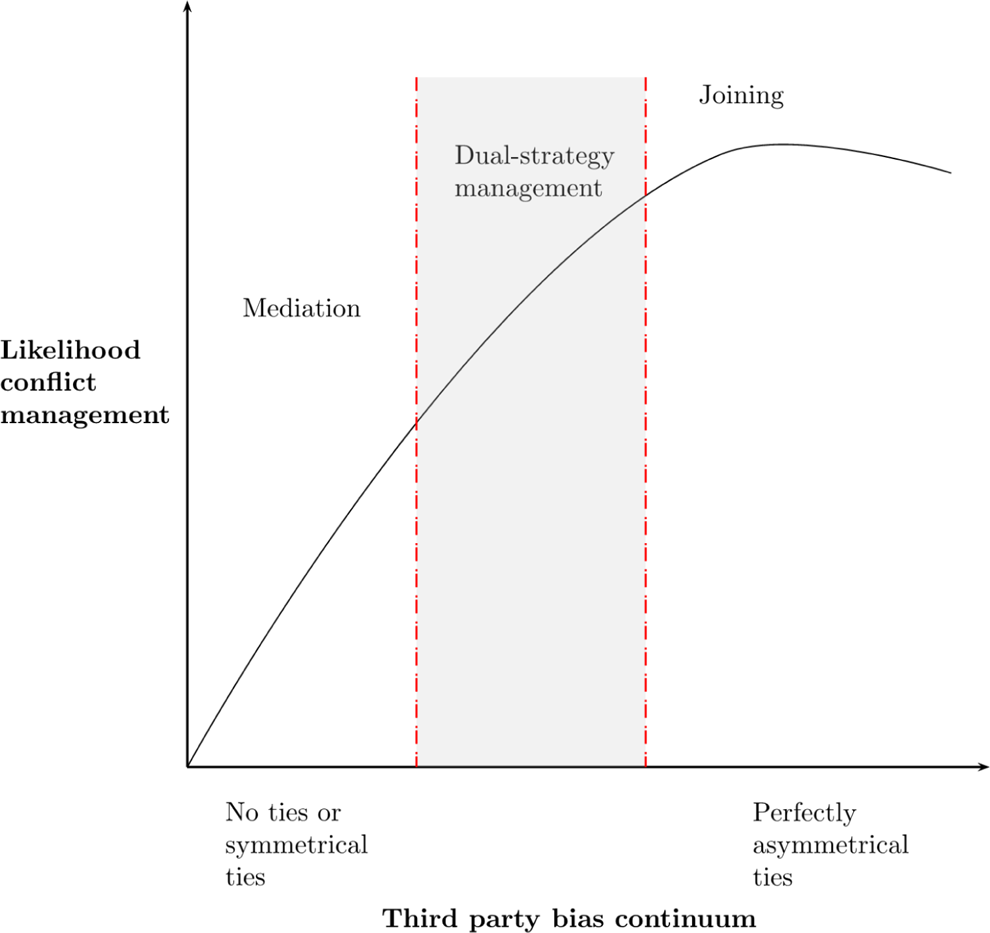
Asymmetrical (biased) third-party disputant ties and conflict management intervention.
As the likelihood of pure mediation or pure joining as a function of third-party bias toward the disputants is extensively explored in the conflict management literature, this article investigates the existence and positive linearity of the central, shaded portion of the function in Figure 1.
6
We expect that:
While we have cast our argument in rational choice terms, this logic is consistent with theories of structural balance in triadic relations, which suggests that a focal actor k will have the strongest incentive to resolve relational unbalances when it has positive ties with actor i and negative ties with actor j in the triad. Existing applications of structural balance arguments to conflict management, however, have overlooked the joint use of mediation and joining techniques (see, for instance, Corbetta and Grant 2012).
Leverage and Power Relations
While the saying that “if there is a will, there is a way” may apply even in international politics, strong states have a wider range of foreign policies from which they choose (Clark, Nordstrom, and Reed 2008) and fewer policy constraints (Siverson and Starr 1991). If one policy fails to produce a desired outcome, another approach can be adopted. This ability to shift management strategies and use force where necessary explains why powerful states are often successful mediators (Favretto 2009). The availability of resources is also related to states’ ability to intervene in ongoing conflicts as joiners (Altfeld and Bueno de Mesquita 1979; Werner and Lemke 1997). Powerful states have the ability to project power and intervene in distant conflicts.
We see relative capability as a more important consideration than a state’s raw power, as this enables the third party to influence the conflict. While a third party’s baseline power can have implications for a third party’s initial involvement as a manager, it does not influence the escalation of management techniques (Melin 2011, 2014). Third parties prefer to become involved in cases when they expect to be effective (Terris and Maoz 2005). They can alter the balance of power between disputants, giving a military edge to their favored side. Joining behavior is more likely when then third party can provide a material advantage (Melin and Koch 2010; Werner and Lemke 1997). In sum, capabilities allow a state to employ forceful coercion if its mediation attempt is unsuccessful or, conversely, to apply leverage to create a bargaining room before mediation is attempted. We therefore expect:
Conflict Dynamics
An alternative, although not mutually exclusive, account of conflict management efforts suggests that the decision to employ multiple management techniques may simply depend on a dispute’s dynamic environment. The mediation literature shows that previous management experiences encourage further third-party involvement, regardless of the outcome (Bercovitch and Gartner 2006; Greig 2005; Rubin 1992). Prior management failures may particularly increase third parties’ incentive to double down by resorting to dual-technique intervention, while discouraging other potential third parties from becoming involved, as Aydin (2010) shows in the civil war context. We expect that a history of involvement in a dispute as a conflict manager should encourage dual-technique interventions because initial management efforts “soften up” (Greig and Diehl 2006) disputants, making future involvement more likely. Additionally, prior efforts are likely to provide the third party with important information that can be incorporated into future efforts. This may be particularly likely when third parties care about reputation as credible and effective conflict managers (Crescenzi 2007). Even prior efforts by other third parties have been shown to encourage the efforts of additional mediators (Clayton and Gleditsch 2014) and repeat management attempts (Melin 2014). Previous conflict management efforts signals disputant willingness to involve a conflict manager and can have cumulative effects, whether successful or not. It is then possible that:
In sum, we argue third parties are more likely to employ dual-technique interventions when they have stronger ties to one of the disputants, when they are powerful, and when they have previously intervened.
Data, Measures, and Methods
We test how willingness (third-party disputant ties) and opportunity (third-party capabilities) affect the likelihood of a dual-technique intervention with a data frame that uniquely combines information about third parties’ neutral management attempts and biased interventions. The data “backbone” is Maoz’s (2005) dyadic MIDs data. 7 To account for potential interveners, we expand the data to all international system member states, except microstates. In essence, for each dyad-dispute year, a third-party state faces the opportunity to intervene in some fashion in an ongoing dispute. We prefer to include all third-party states as possible interveners—and not just, for example, major powers—because (1) even small states can mediate and (2) the data on joining behavior we employ include interventions below the militarized threshold, which may be carried out by minor powers as well. The final data contain 274,624 triadic-conflict years from 1946 to 2001.
Outcome Variables
To capture conflict management events, we employ data on neutral interventions/mediations from Frazier and Dixon (2006) and on biased interventions from Corbetta and Dixon (2005), both of which code interventions in Correlates of War’s MIDs (Ghosn, Palmer, and Bremer 2004; Jones et al. 1996). 8 Both data sets allow third parties to intervene multiple times in the course of an MID, necessitating that some triad-dispute years appear multiple times to account for multiple interventions. 9
Our dependent variable codes dual-technique interventions in which states combine traditional, neutral conflict management techniques with biased ones. The final data contain 360 instances of mediation and 1,426 instances of biased intervention, with 126 instances of combined neutral and biased techniques. This means that 35 percent of all neutral interventions are matched with some exercise of leverage or, alternatively, that almost 9 percent of all biased interventions are accompanied by some neutral attempt. 10
Even a brief, descriptive overview of dual-strategy interventions produces some interesting findings for conflict management research. Most dual-technique interventions are carried out by major power states (103 of 126) and take place in disputes involving other major power states (72 of 126). The United States is responsible for seventy-nine dual-technique interventions, France engages in fourteen, the UK and the Soviet Union/Russia in ten, and Japan in one. The United States is the major power disputant attracting the most dual-technique interventions (thirty-one), followed by the Soviet Union/Russia (twenty-six). 11 These figures seem to corroborate much of what is argued in the literature about major powers’ ability to apply leverage in coercive conflict management (e.g., Favretto 2009). While consistent with the notion that major powers seem to drag one another into their war spirals (Yamamoto and Bremer 1980), this raises the question of why conflict managers try to exercise leverage in disputes involving those least sensitive to leverage—that is, major power states.
The data do not reveal any systematic pattern in how conflict managers choose to combine intervention techniques. Although we focus on neutral and biased interventions as broad categories, one of the characteristics of the Frazier and Dixons’s (2006) data and the Corbetta and Dixon’s (2005) data is that they report more specific management techniques than generic mediation and militarized joining. Regarding neutral techniques, in cases of dual-technique interventions, we find thirty-four instances of cease-fire appeals, thirty-two appeals to negotiate, eighteen acts of actual mediation, seventeen fact-finding missions, nine invitations to withdraw troops, eight offers to facilitate or mediate negotiations, three provisions of good offices, and one case of conciliation. With regard to biased techniques, we see an even greater variety, with twenty diplomatic expressions of support, thirty-nine diplomatic expressions of opposition, seven appeals to one side to cease-fire, four provisions of diplomatic assistance, two cases of diplomatic sanctions, two cases of economic assistance, four cases of economic sanctions, thirteen cases of military assistance, seven cases of military sanctions, seven threats to use force, ten instances of force mobilization, and four cases of actual use of force. Overall, the most recurring combination of strategies involves a one-sided diplomatic condemnation or public opposition and appeals to either negotiate or sign a cease-fire. 12
The sequencing of dual-technique interventions is also of interest. One could argue that biased, coercive interventions are more likely to follow failed attempts to manage a conflict peacefully and neutrally. Equally viable is the hypothesis that a third party may resort to biased coercive techniques first in order to create or expand the bargaining space and then resort to mediation or some other form of neutral intervention. The latter option is the sequence indirectly suggested by the literature on coercive conflict management. Our data do not provide clear support for either argument. A neutral attempt precedes a biased intervention in sixty-three instances, and a biased intervention occurs before mediation in fifty cases. In eight instances, dual-technique interventions occur simultaneously—that is, on the same day—and a management effort is preceded by both neutral and biased interventions in five cases. We are not interested in the sequencing and timing of dual-technique interventions but instead focus on third parties’ decisions to resort to dual strategies.
Our main dependent variable, dual-technique intervention, is coded 1 if a state is involved in a dual-strategy management effort and 0 if it employs a single strategy—either just neutral mediation or only biased joining. Based on our prior arguments, however, we must also account for the self-selection dynamics driving particularly motivated and capable third-party managers. To do so, we create a second dependent variable, intervention, which is coded 1 if a third party chooses to manage a conflict, regardless of technique used, and 0 if it abstains. Both dependent variables are used in a two-stage selection model, the details of which are given below. 13
Explanatory Variables
Our theoretical framework focuses on third parties’ willingness (ties with the disputants, as reflected in Hypotheses 1a and 1b), opportunity (the ability to influence outcomes, as reflected in Hypothesis 2), and policy feedback (previous management attempts, as reflected in Hypothesis 3). We operationalize willingness as a function of asymmetry in various interstate ties between third-party states and disputants. States with similar regime ties are said to enjoy special relationships and are more likely to intervene in each other’s conflicts both neutrally and in biased fashion (Corbetta 2010, 2013; Dixon 1993, 1994; Leng and Regan 2003; Werner and Lemke 1997). We use Polity IV data (Marshall and Jaggers 2004) to create a dichotomous variable expressing whether a conflict manager is “biased” because it shares the same regime type with a disputant but not with the other. Biased regime ties is coded 1 if a third party and either one of the disputants (but not the other) are mature democracies or autocracies. It is coded 0 if (a) a third party and both disputants are mature democracies or autocracies—they all share the same regime type, making the conflict manager–disputants’ ties symmetrical—or (b) a third party and neither disputant have the same regime type. 14
We use Henderson and Tucker’s (1999) civilization data to create a dichotomous measure of third-party asymmetric cultural/religious ties. 15 Biased cultural ties is coded 1 if a third-party manager shares the same religion or culture with one disputant but not the other and coded 0 if a third-party shares ties with both or neither disputants.
Because allies are more likely to both fight on the side of their associates and manage peacefully their partners’ disputes, we include an indicator expressing bias as a function of shared alliance ties created from the Alliance Treaty Obligations and Provisions data (Leeds, Long, and Mitchell 2000). Biased alliance ties is coded 1 if a conflict manager has a defense pact with one side in dispute but not with the other. It is coded 0 if a third party has a defense pact with both disputants or with neither one.
Because economic ties are also said to influence biased and unbiased conflict management efforts (Aydin 2008, 2012), we include a variable meant to capture biased economic relations between a conflict manager and the disputants. Using Gleditsch’s (2002) expanded trade data, we first estimate the overall volume of trade between a third-party state and both disputants in an MID. If 60 percent or more of the total volume of trade depends on trade between a third party and, for example, side A in a dispute, we consider such economic ties to be asymmetrical and code biased economic ties as 1. This variable is coded 0 if a third party has a similar volume of trade—40 percent to 60 percent of the total volume of trade within the triad—with both disputants.
To test whether biased, asymmetrical ties have an additive effect on a third party’s willingness to invest heavily in a dispute by applying a dual-strategy intervention approach (Hypothesis 1b), we create a variable that counts the number of such asymmetrical relations. Cumulative biased ties ranges from 0 if a conflict manager has no regime, cultural/religious, alliance, or economic bias toward the disputants—an ideally neutral manager—to 4, if a third party is biased toward one side in a dispute along all four dimensions.
In addition to willingness, third parties must have the means to apply leverage and engage in prolonged conflict management efforts. To explore Hypothesis 2, we operationalize a third party’s ability to influence the direction of a militarized dispute as a function of its capabilities vis-à-vis the overall capabilities of the disputants. Capability ratio is a ratio of a potential third party’s Cumulative Index of National Capabilities (CINC) score (Singer, Bremer, and Stuckey 1972; Singer 1988) to the sum of the CINC scores of the disputants and the third party.
We also consider the role of management dynamics and policy feedback in looking at third parties’ prior involvement in disputes within the same dyad. Prior management is a dummy variable coded 1 if a potential third party has managed conflicts between the same two disputants in the past and 0 otherwise. While this is not an ideal measure of policy feedback (which we discuss in further detail below), we believe it captures both a process of “softening up” (Greig and Diehl 2006) and pressure to be successful. Indeed, prior efforts are likely to provide the third party with important information that can be incorporated into future efforts, while the need for additional intervention implies a failure to resolve the conflict.
We do not control for two factors we previously mentioned as having a possible effect on the choice of dual-strategy intervention due to the lack of variance in the data. First, we argued that major power status may affect the credibility and reputation of conflict managers. In fact, the vast majority of third parties adopting dual-strategy management techniques are major power states, according to the Correlates of War definition. It would be pointless to include an independent variable controlling for major power status, as there is no variation on this variable. Second, we argued that the adoption of a dual-strategy approach may depend on the failure of previous management attempts. However, we found no satisfactory way to control for prior management success. Both the Frazier and Dixon’s (2006) data and the Corbetta and Dixon’s (2005) data contain a variable reporting the “short-term success” of management efforts. As explained above (see note 12), this variable is not reflecting the impact of a third party’s action on the evolution of a dispute. In addition, in these two data sets, most initial interventions are coded as short-term failures, and we do not have sufficient variability to include this variable in the analysis. 16
Our analysis proceeds in two steps. Given the low number of dual strategy management attempts, we begin by estimating a logit model for rare events. We then address the possibility that selection dynamics are at work, determining the type of third parties who select themselves into our pool of conflict managers. We therefore reestimate our logit models for rare events using a selection model with the so-called Sartori estimator (Sartori 2003). We report the results in the following section.
Findings
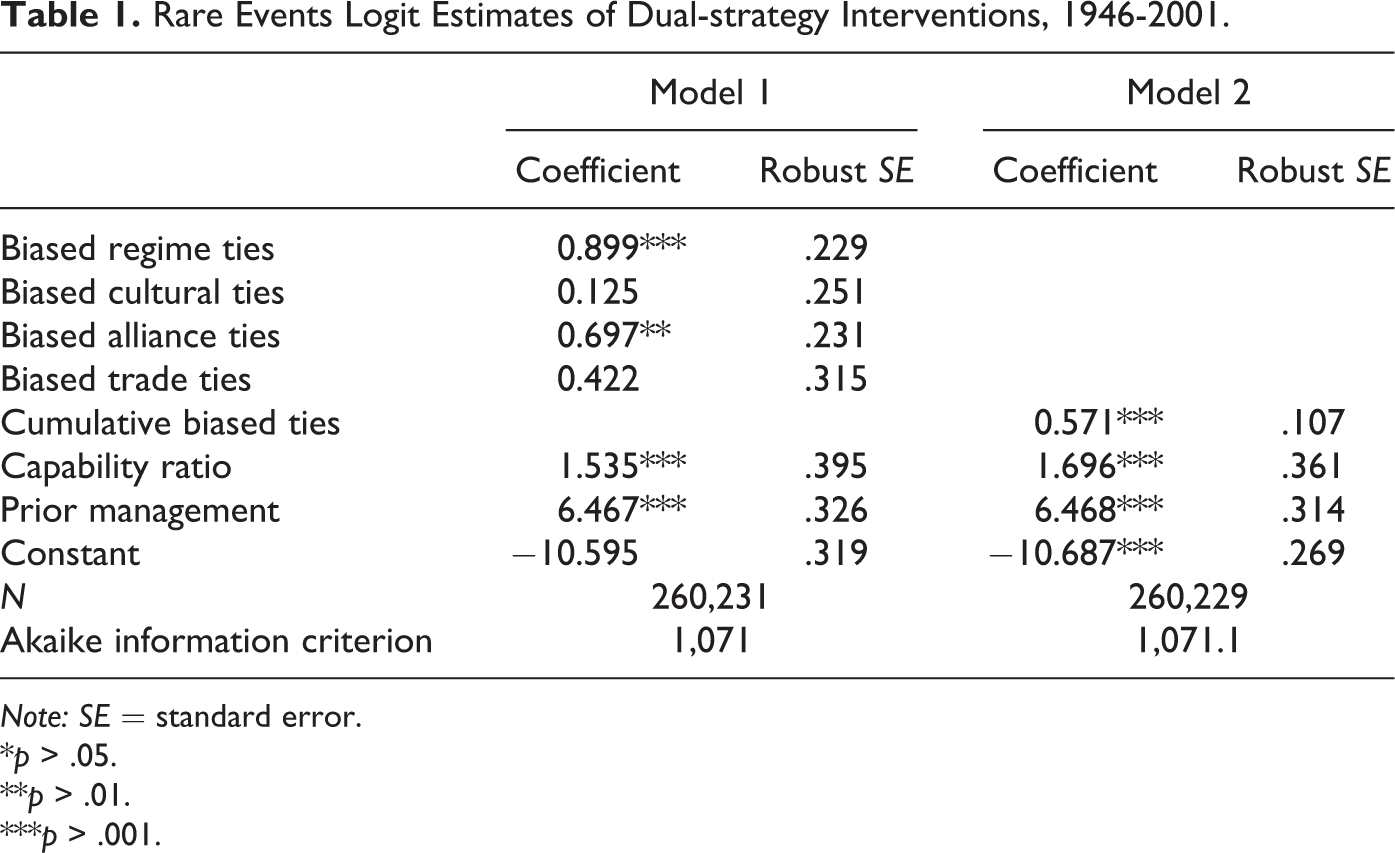
Table 1 reports the results of two logit models for rare events, with weights accounting for the low ratio of dual-strategy efforts to potential interventions. The first model evaluates the effect of asymmetrical ties between third parties and the disputants, while model 2 explores the cumulative effects of biased relations.
Rare Events Logit Estimates of Dual-strategy Interventions, 1946-2001.
Note: SE = standard error.
*p > .05.
**p > .01.
***p > .001.
These results are generally supportive of our hypotheses. Biased third parties, or those with asymmetrical ties toward one of the disputants, face stronger motivation to invest greater resources in managing an ongoing conflict and are more likely to employ a combination of neutral and biased techniques. However, not all forms of bias matter equally. Shared regime ties and shared defensive pacts with either, but not both, disputant make a third party more willing to match coercive strategies with neutral mediation. Shared cultural similarity and asymmetric economic relations do not have an impact that is statistically distinguishable from zero. The various dimensions of bias, however, seem to have a cumulative effect. Model 2 confirms Hypothesis 1b, suggesting that the greater the number of asymmetrical relations between a conflict manager and the disputants, the greater the likelihood that a third party will combine mediation with some form of coercion. 17
Conflict managers’ willingness to steer a conflict toward a preferred outcome must be mediated, however, by the opportunity to do so and by the resources they have previously invested in preserving the peace between two disputants. In the models in Table 1, coefficients for both capability ratio and prior involvement in previous conflicts between the two disputants are positive and statistically significant. The effect of capability ratio reflects the descriptive finding that most conflict managers who resort to dual-strategy approaches are great power states. This finding, however, appears more intriguing if one considers it in association with the statistical significance of prior conflict management efforts. First of all, we would expect that more powerful conflict managers should be able to settle a conflict decisively early on and, failing to do so, they should be able to cut their material and reputational losses and walk away. Our findings, however, indicate that even powerful conflict managers often have to return to manage conflicts between the same disputants and are willing to “double down” by combining coercive techniques with more neutral techniques.
We explore the substantive impact of the most notably significant predictor—asymmetrical regime ties—on the likelihood of dual-technique management efforts by simulating its parameters and quantities of interest as suggested in King, Tomz, and Wittenberg (2000). 18 Given that prior attempts to manage a conflict seem to drive third parties’ continuous involvement, we are particularly interested in whether asymmetric ties still manage to have a notable effect on the behavior of previous conflict managers. Figure 2 plots the predicted probabilities of dual-strategy management, with their respective confidence intervals, across different values of capabilities for third parties who share a regime tie with one of the disputants, but not with the other, and who have been involved in the disputants’ prior conflicts. Because the associated use of mediation and coercion is rare, we note that the probability of its occurrence remains low. However, Figure 2 shows that third-party states with asymmetric regime ties toward the disputants are distinctively more likely to resort to dual-strategy conflict management especially when the balance of capabilities tilts in their favor. More powerful conflict managers are clearly more likely to combine leverage with neutral mediation, but regime tie considerations carry increased weight on their decision as the third party’s power increases.
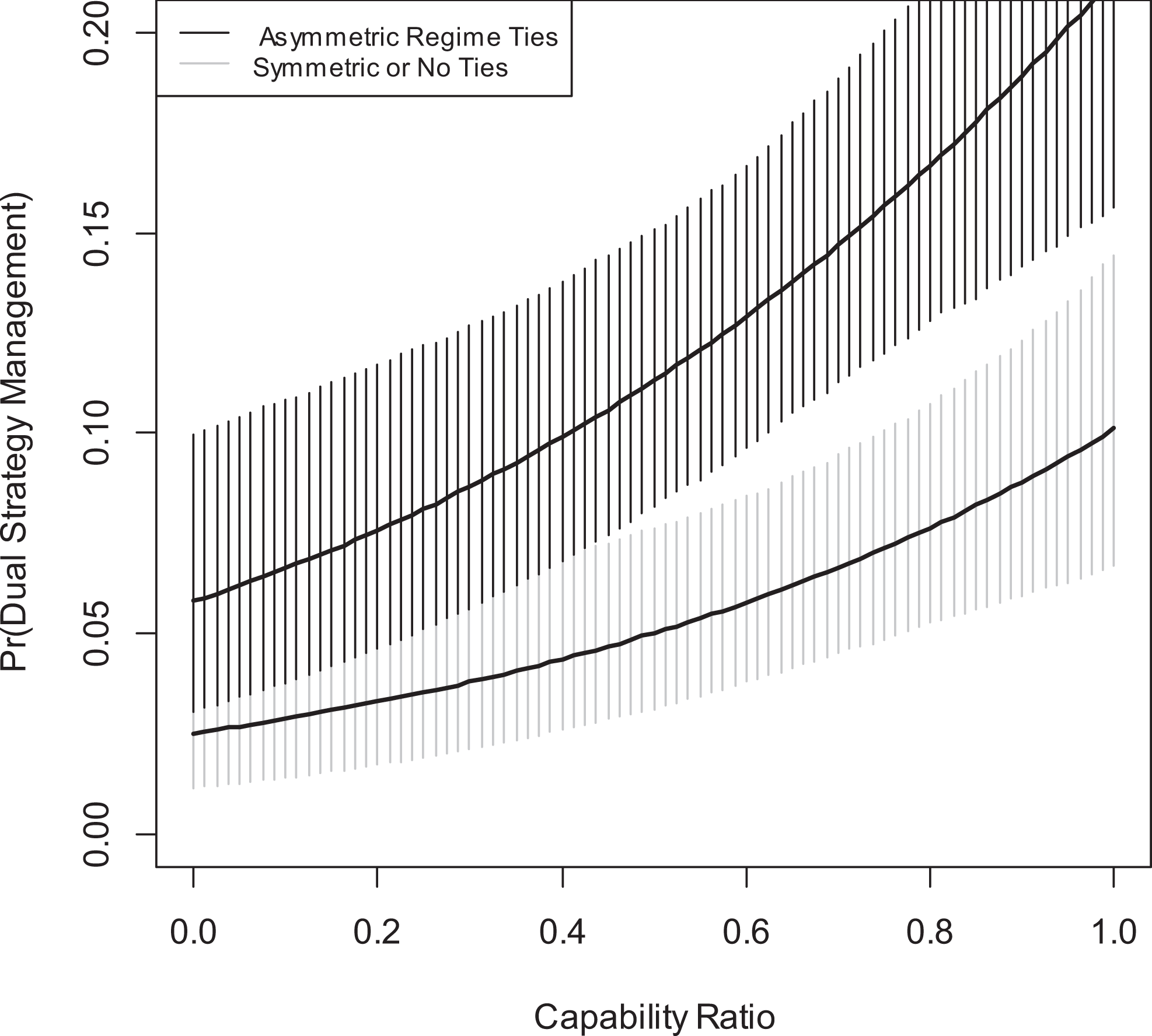
Predicted probabilities, with confidence intervals, of third-party states’ dual-strategy conflict management as a function of asymmetric regime ties with the disputants.
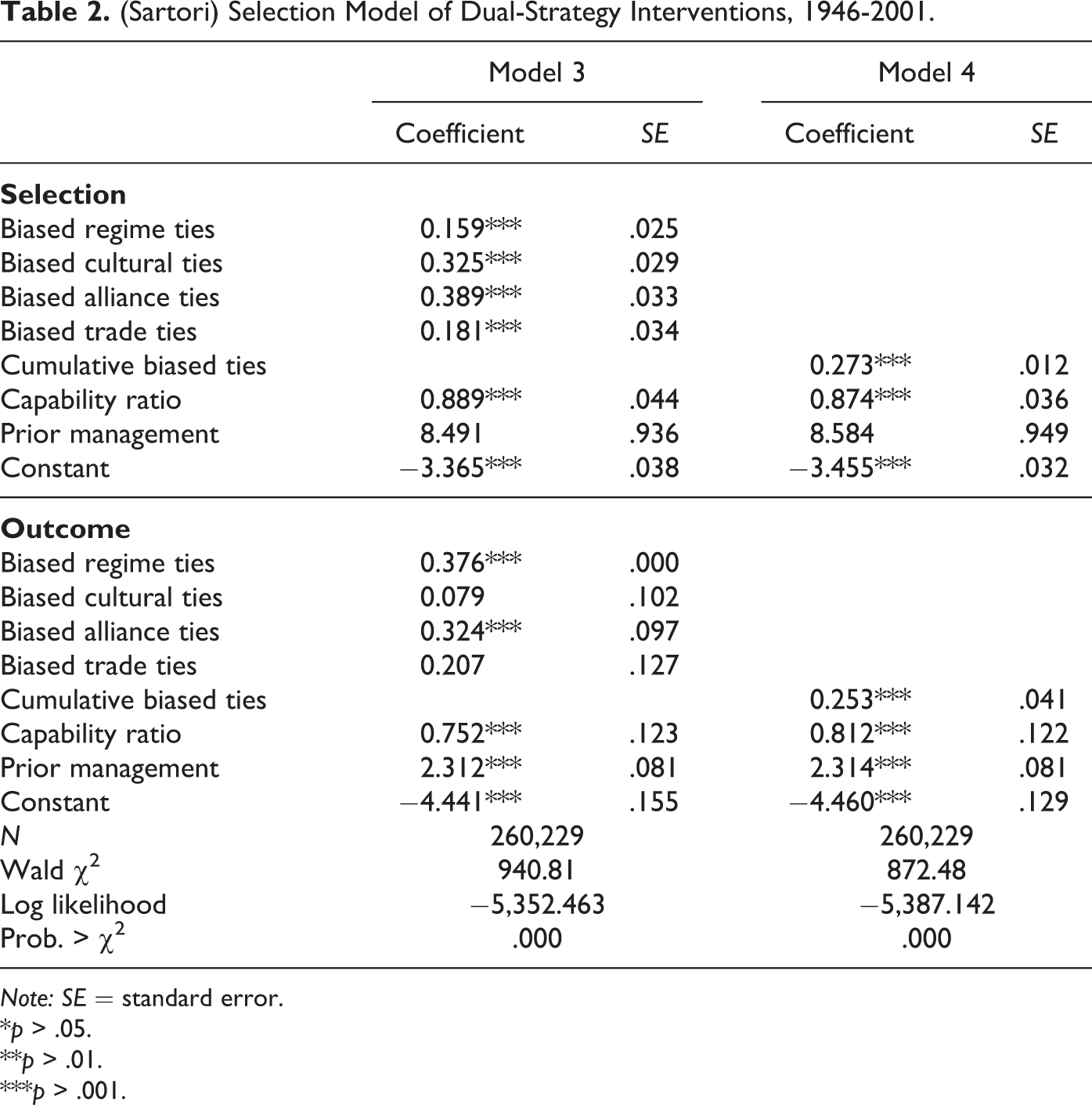
Because these results may be biased by the selection dynamics that inevitably operate in the decision to manage conflicts (Bercovitch and Gartner 2006), we reestimated the models above using a two-stage selection that employs the “Sartori estimator” (Sartori 2003). Selection models often face identification problems in the absence of meaningful instrumental variables in the selection stage. Our theoretical approach does not provide us with one or more instrumental variables that may operate at the selection stage but not at the outcome stage. The estimating procedure suggested by Sartori (2003) allows us to employ the same set of explanatory variables in both stages. The results are reported in Table 2. Model 3 uses separate dimensions of third-party bias, whereas model 4 employs the cumulative measure of relational asymmetry.
(Sartori) Selection Model of Dual-Strategy Interventions, 1946-2001.
Note: SE = standard error.
*p > .05.
**p > .01.
***p > .001.
The two-stage selection approach largely confirms the results from the rare events logit analysis, although some interesting distinctions between the selection and outcome stage appear. Again, regime ties between a third party and the disputants—and especially asymmetrical ties—remain effective predictors of dual-strategy conflict management, as does the capability to exercise leverage (model 3). We see that bias in cultural ties and trade relations—both insignificant at the outcome stage and in the rare events logit model—significantly predict initial third-party involvement.
Prior conflict management efforts are insignificant in the selection stage but significantly predict a third party’s use of dual-strategy intervention. This finding is rather robust and seems to differ from prior research on conflict management. In most existing studies, however, the outcome variable is the occurrence of interventions of the same type without distinction of the actual intervention technique. 19 When, instead, we differentiate between the decision to intervene and the choice of conflict management technique, it seems reasonable to expect that all conflict managers with high levels of willingness and opportunity will be equally likely to join, but that only those who have previously committed to resolving the conflict will be willing and able to choose techniques that require more resources.
Importantly, model 3 suggests that while biased relations in general predict conflict management occurrence, only certain types of bias predict how a conflict will be managed. Model 3 also qualifies our finding about prior conflict management. Previous attempts to manage conflicts within the same dyad do not significantly increase the chances of future management efforts in general but, when they do, they predict that third parties will invest more by resorting to dual-strategy efforts. It is likely that weaker and less committed conflict managers are screened out after initial attempts, so that only the more powerful and more strongly biased third parties—those who have both willingness and opportunity to resort to multiple management strategies—remain.
Model 4 confirms that selection dynamics do not particularly affect our expectation that the chances of dual-technique management should increase with bias. In fact, the coefficient for the count of asymmetric ties between third parties and the disputants is positive and significant. The results for capabilities and prior management remain stable across models 3 and 4.
In substantive terms, we note again that intervention of any kind is a rare occurrence, and that dual-technique intervention is an even rarer phenomenon. The impact of each explanatory variable can only be small in absolute terms. To provide substance to this second set of results, we have obtained predicted probabilities, contingent on selection into the “conflict management pool,” and their respective standard errors from model 4. In Figure 3, we plot the mean predicted probabilities with the respective mean standard errors at different levels of bias in relations between third parties and the disputant. Figure 3 visually confirms our expectation that the likelihood of dual-technique management increases linearly with third-party bias before it may eventually become pure joining.
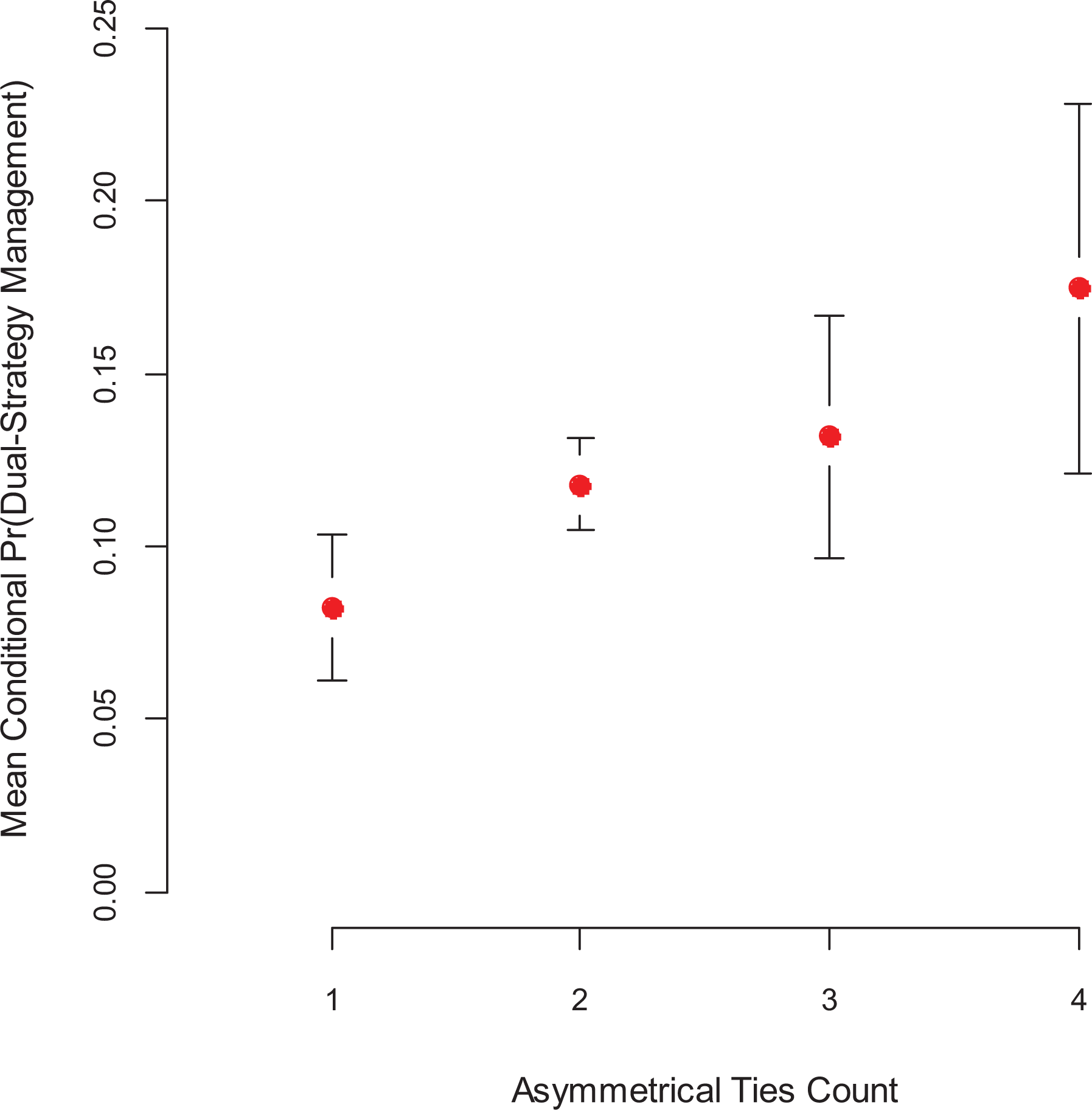
Mean conditional predicted probabilities, with standard errors, of dual-strategy intervention by number of asymmetric ties.
Discussion and Conclusion
Why and under which conditions do third-party states resort to dual-strategy management techniques? Drawing from the existing literature in the mediation and joining arenas, we argue that engagement in both mediation and coercion depends upon on third parties’ interests and willingness to engage in more costly conflict management efforts and on the resources available to them to exercise leverage.
Potential intervening states are embedded in a dense web of ties with other states. As the asymmetry of ties in the international social space increases, so does the likelihood that a third party will employ a mix of conflict management strategies. Our findings that regime, cultural, and trade ties encourage the use of dual methods support this argument. In addition, we find that states with an increased opportunity to act, those with greater capabilities, are more likely to adopt dual methods.
Our findings provide a first empirical confirmation of what is generally theorized, but rarely systematically tested with “real-world data,” in the mediation and joining literature about the use of biased leverage vis-à-vis, and in combination with, neutral mediation. As with previous research, we show that relational ties—and, in particular, regime similarities and alliance ties—strongly shape states’ preferences and behavior—including the behavior of conflict managers. Third parties with these ties are more likely to have the interests at stake that encourage voluntary involvement in an already challenging environment (Beardsley 2009; Corbetta 2010, 2013; Melin and Svensson 2009). In addition, such ties provide third-party managers with avenues for applying a combination of bias leverage and neutral mediation techniques in their conflict management efforts. Our results further refine existing knowledge about the combination of leverage and mediation by highlighting that it is the asymmetry in connections and the capability to apply leverage that help us predict which third parties combine conflict management methods. Furthermore, we confirm that strong states have a broader “menu for choice” and are more likely to adopt multiple foreign policies (Clark, Nordstrom, and Reed 2008) when they act as conflict managers. Surprisingly, however, our original combination of data on joining and mediation suggests that great powers often try to manage conflicts involving other great powers and do so by applying a dual-technique approach.
While mediation and conflict joining have previously been treated as distinct events, evidence suggests that these mechanisms for conflict resolution have similar motivations, and that third parties often employ both mechanisms in the same context. Future research should therefore work to develop theoretical approaches and empirical tests that jointly address these behaviors, helping us to further untangle the complicated management process. Because of data limitation, the present project cannot address the issue of the effectiveness of dual-technique management efforts. The question of whether mixed management strategies interventions can resolve ongoing conflicts and establish a more durable peace than just mediation or pure joining follows naturally from this project, and we intend to pursue it in the future. More data collection is needed in this regard as well as more data collection efforts aimed at untangling the strategic interplay and sequencing of third parties’ selective application of leverage and mediation-like techniques and the disputants’ responses to such interventions. Overall, the threshold between “neutral” conflict management and behavior previously conceived as joining in biased intervention is both smaller and more dynamic than originally thought. This finding reintroduces complexity where Rosenau (1969) had attempted to achieve conceptual clarity, but we believe it opens up new, fruitful avenues for future research and opportunities for making more grounded policy recommendations to conflict managers.
Supplemental Material
onlinesupplements - Exploring the Threshold between Conflict Management and Joining in Biased Interventions
onlinesupplements for Exploring the Threshold between Conflict Management and Joining in Biased Interventions by Michael C. Horowitz, Matthew Fuhrmann, Renato Corbetta, and Molly M. Melin in Journal of Conflict Resolution
Footnotes
Authors’ Note
Previous drafts of this article were presented at the annual meeting of the Midwest Political Science Association, April 3 to 6, 2014, Chicago, IL, and the annual meeting of the American Political Science Association, August 29 to September 1, 2013, Chicago, IL. Authors are listed alphabetically.
Acknowledgment
We would like to thank Amy Yuen, Mark Mullenbach and Matilda Lindgren for their helpful feedback. We also would like to thank Derrick Frazier and Bill Dixon for sharing their mediation data.
Declaration of Conflicting Interests
The author(s) declared no potential conflicts of interest with respect to the research, authorship, and/or publication of this article.
Funding
The author(s) received no financial support for the research, authorship, and/or publication of this article.
Supplemental Material
Supplemental material is available for this article online.
Notes
References
Supplementary Material
Please find the following supplemental material available below.
For Open Access articles published under a Creative Commons License, all supplemental material carries the same license as the article it is associated with.
For non-Open Access articles published, all supplemental material carries a non-exclusive license, and permission requests for re-use of supplemental material or any part of supplemental material shall be sent directly to the copyright owner as specified in the copyright notice associated with the article.
