







Abstract
Six decades of JCR research on negotiation and mediation are celebrated in this article. Starting with the earliest articles on these topics, we trace the development of recurring themes. The themes serve to organize a review of findings reported in the journal. The research on negotiation covers processes and conditions that occur prior to, during, and at the end of negotiation. The work on mediation provides insights into mediator approaches and impacts. This article concludes with suggestions for integrating and better understanding of the negotiation and mediation processes.
Keywords
An anniversary issue provides an opportunity to take stock. This is a welcome opportunity for a review of JCR articles on negotiation and mediation, which have been popular topics for contributors to and readers of the journal. With about 150 articles published since 1957, there is much to discuss. We organize the discussion in terms of recurring themes, beginning with the earliest articles on each topic. We then trace the development of central findings and contributions that have appeared through the decades. 1
The article is divided into two parts. The first part on negotiation is divided into six thematic concepts that have been at the forefront of the published research. The second part on mediation develops themes introduced in the early JCR articles on this topic. Although the thematic approach taken in the review is similar for both topics, the respective literatures have evolved in different ways. Negotiation scholarship has been cumulative, evincing a continuity from early to recent articles. Mediation scholars have focused more on issues of structure and processes. This difference is reflected in the way the two sections are developed.
Negotiation
Negotiation has been a popular topic for JCR authors. With nearly 100 articles appearing on this topic since the inception of the journal, JCR has been a preferred outlet for negotiation researchers. The articles cover a wide range of theoretical and methodological approaches including contributions from most of the social sciences. Both cognitive and social dynamics have been featured in experiments, case studies, statistical analyses, and formal modeling approaches. A review of the articles can be organized thematically by tracing paths from early classics and from recurrent themes that have appeared over time in the journal. This approach highlights the thematic coherence of the JCR contributions and, by so doing, provides a window into the way that knowledge has accumulated on each of these concepts.
Thematic Paths
Several articles appearing in the early issues contribute key concepts that influence the way we think about negotiation and the research of a number of other JCR authors. We begin with themes introduced by two articles from the first JCR issue (prominent solutions and concession-making dynamics), continuing with four other themes introduced in articles appearing in the fifties and sixties, and conclude the section with a discussion of contextual influences.
Prominent solutions
Schelling’s (1957) idea of tacit bargaining calls attention to nonverbal elements in negotiation and makes evident that negotiation is not limited to formal discussions around a table. Indeed, “bargainers” often engage in nonverbal communication intended to coordinate their interests. Faced with incomplete information about the other’s preferences and uncertainty about one’s own preferences, bargainers are caught in a dilemma of balancing their willingness to reveal and desire to conceal information. Questions asked are: How much should I reveal about my preferences in order to coordinate toward a mutually satisfying agreement? How much should I conceal about my preferences in order to protect my interests in the agreement? Schelling’s concept of focal points is one way to get around this dilemma. By searching for and finding prominent or conspicuous solutions, bargainers can coordinate without feeling pressure to reveal sensitive information about their interests. Indeed, coordination toward an agreement has been shown to be jeopardized by revealing “too much information” in role reversal exercises (Johnson 1967, Muney and Deutsch 1968). The focal point directs attention toward a solution and away from discussing the interests at stake. 2 Further experiments by JCR authors shed light on some conditions that influence the coordinating value of focal points.
In their gaming experiment on prominence as a predictor of outcomes, Willis and Joseph (1959) identify several conditions under which prominence may not work. Their multitrial game—in contrast to Schelling’s single trial classroom problems—provided opportunities for gathering partial information about opponents’ preferences. This information served to obfuscate the basis for coordination, making it more difficult to find a prominent solution. Another difference between the Schelling tasks and this experimental situation was that the reward matrix was unclear in the latter task. Structurally prominent solutions, such as a 50-50 division, may not be clearly perceived by subjects in multitrial, multi-issue, or multiparty bargaining situations. When this occurs, coordination through tacit bargaining does not work well.
Further constraints on the effectiveness of prominence were demonstrated by Eisenberg and Patch (1976). They showed that prominent solutions, suggested by a mediator in their experiment, were a frequent basis for settlement when no communication was permitted. Disputant-generated norms were more important when bargainers were allowed to communicate with each other. Specifically, prominent solutions had more impact when they satisfied perceived fairness norms (see also Carpenter [2003] for results showing that shared fairness norms facilitate coordinating outcome expectations). Similar to the findings of Willis and Joseph, these authors found that as opportunities for acquiring information increase, prominent solutions become less of a basis for coordination. Thus, the effectiveness of prominent solutions may be limited to Schelling’s case of tacit bargaining where coordination depends on nonverbal cues in the environment and is not obfuscated by other aspects of the negotiating situation. But, effective tacit bargaining may not depend on finding prominent solutions. It is also the case that Schelling recognized the value of focal points even when communication was possible, and this recognition was developed by legal scholars (see Huth et al. [2013] for an application to territorial disputes).
Summary
Following Schelling’s introduction of the idea of focal points, several JCR authors specified conditions that either increase or decrease its usefulness as a solution. Focal points are helpful when information about the other’s preferences is unclear, when the reward matrix is clear, and when the bargainers adhere to fairness norms. They are less relevant when there is a lack of clarity in the reward structure found in complex games, when there are opportunities to communicate and obtain information from an opponent, and when other strategies to induce cooperation are available.
Concession-making
In another article in the first issue of JCR, Douglas (1957) pioneered the idea of bargaining phases. She observed an orderly movement in cases of labor management negotiation. The sequence proceeds from establishing the bargaining range (phase 1) to reconnoitering the range (phase 2) and to precipitating the decision-making crisis (phase 3) where concession-making must take place. The phase 1 bargaining range idea surfaces again in JCR five years later in the 1962 article by Ikle and Leites. The phase 3 dilemma resembles Ikle’s (1964) concept of a threefold choice (agree, withdraw, and continue) and Druckman’s (1986) analysis of stages, crises, and turning points (see also Druckman 2001).
Concession-making in bargaining was a popular research topic in the 1960s and 1970s. A debate that received the most attention perhaps was between Siegel and Fouraker (1960) and Osgood (1962). The former recommended setting levels of aspiration high and not offering concessions. The latter argued that moderate concessions are helpful in reaching agreement after a long impasse of mutual toughness. Komorita (1973) weighed in on this debate with experimental evidence. He showed that the “toughness” hypothesis was valid at the initial and intermediate stages of bargaining, but the “softness” hypothesis was valid at a later stage after an extended deadlock and when the expected losses were high: early toughness followed by later concessions resulted in the best agreements. The way that the concession is communicated at the time of transition is also important. Lindskold and Finch (1981) showed that noncontingent communications (“I will cooperate”) worked better than contingent messages (“If you will cooperate I will”) or no communication. This finding is consistent with Osgood’s Graduated Reciprocation in Tension Reduction (GRIT) proposal of making unilateral cooperative moves. They remove ambiguity from one’s intention to make progress. 3
Turning to more complex negotiation situations, several JCR authors asked how international negotiators respond to each other’s concessions. An early study by Jensen (1963) on Soviet–US disarmament negotiations showed a strong willingness to reciprocate concessions in the same (immediate response) or next (delayed response) round of bargaining. Similar findings were reported in Jensen’s (1984) update of the disarmament negotiation data set (twenty-three rounds of the Strategic Arms Limitations Talks/Treaty [SALT I and II] from 1969 to 1979). Jensen’s SALT data set was used by Stoll and McAndrew (1986) to evaluate three alternative models of concession-making, referred to as directional (Tit-for-Tat: TFT), trend (response to concession changes in previous rounds), and comparative (matching the other’s previous concession) responsiveness. They found some support for both the trend and comparative models, suggesting that responses made to the other’s moves involve more complex information processing than needed for the action–reaction dynamic characteristic of TFT. These findings call attention to a more complex dynamic than shown by Axelrod (1980) to occur in the prisoner’s dilemma game.
Taking these evaluations further, Druckman and Harris (1990) compared ten models with seven cases of international negotiation. Nine of the ten models were variations on trend and comparative responsiveness using different weightings, lags, and combinations. Clear results indicated that the comparative reciprocity model was the best fit to the cases: negotiators reacted to the difference between their own and the other’s previous move. Implications were developed for perceived fairness and monitoring in negotiation (see also Druckman 1986). They also support the laboratory findings from Bartos (1977) and the 1962 to 1963 nuclear test ban negotiation findings from Hopmann and Smith (1977) showing that negotiators largely discount the past (trend reciprocity) when reacting to each other’s moves.
Bargainers appear to be rooted in the present or oriented to the future when considering concessions. As noted by Bartos (1977), “they are torn between the desire to make a large concession and get a quick agreement and the fear of being taken advantage of” (p. 573). The decision made at any juncture has been shown to be influenced by a web of situational factors (in the present) and by expectations for unfolding processes. The web includes audiences, location, time pressure, constituency pressures, alternatives, and distance between positions (Druckman 1993). It is also influenced by a powerful reciprocity norm (Diekmann 2004).
Looking toward the future, a variety of solution concepts have been proposed, the most popular being the Nash equilibrium and related expected utility concepts (Felsenthal and Diskin 1982). Many of these concepts can be subsumed under a more general principle of fairness (Bartos 1977), equality (Albin and Druckman 2012), or prominence (see above) as well as optimality or integrative solutions (Carnevale and Lawler 1986). But Brams and Doherty (1993) raised questions about solution concepts. They showed that current information may be a more powerful source of intransigence than such forward-looking formulae as the Condorcet solution.
Summary
Concession-making is central in models of distributive bargaining. Laboratory research has shown that a strategy of early firmness followed by later conciliation produces the best agreements. Research has also shown that offers are accepted more often when they are not contingent on the other’s response. Moving from the laboratory to cases of international negotiation, authors of JCR articles have demonstrated that negotiators respond to the difference in concessions made in the most recent moves. This form of comparative reciprocity is rooted in the present but oriented toward the future. Throughout the negotiation process, bargainers are guided by fairness norms but also influenced by a variety of forces in the immediate situation.
Trust and threats
The distinction between positive and negative bargaining turns on relationships and strategies in negotiation. The relational concept of trust was introduced to JCR readers by Deutsch (1958), and the strategic concept of threats was analyzed by Kelley (1965).
Trust
Deutsch (1958) contrasted trust and suspicion in terms of attributions of intent. Mutual trust (or suspicion) occurs when each bargainer perceives the other as having positive (or malevolent) intentions. Perceived intention is one of the several conditions hypothesized to influence trusting or suspicious behavior. Other conditions include the opponent’s perceived power, the power relationship between the parties, communications, third parties, and self-esteem. Results from Deutsch’s gaming experiments showed that trusting behavior was more likely to occur when (a) there was an opportunity to know what the other is likely to do before committing to a trusting choice, (b) cooperative intentions were communicated along with procedures for dealing with violated expectations, (c) the players had the power to reduce the other’s incentive to make untrustworthy choices, and (d) there was a third party whose choices were detrimental to both of the principal game players. These findings illuminate the importance of aspects of the game situation as influences on decisions. A large experimental literature on trust in negotiation developed in the years since the Deutsch article. Some of these articles appeared in the JCR and are discussed in the paragraphs to follow.
Trust plays a role in responses to the other’s strategy. The increased levels of cooperation in response to a reciprocating (tit for tat) strategy was shown by Pilisuk et al. (1965) to be related to the predictability of this strategy. As noted by Wilson (1971), consistent responding to the other’s choices—reward cooperative, punish competitive choices—bolster perceptions of credibility, which turn the game from mutual competition early to mutual cooperation later. By monitoring and then imitating the other’s choices, this strategy produces a form of trust referred to as calculus based.
Studies by Halpern (1994) showed differences in the way that friends (i.e., trusted parties) and strangers (i.e., less trusted) bargain. Whether in the role of buyer or seller, pairs of friends made pricing decisions that were favorable (better than a midpoint prominent solution) to their counterpart while stranger pairs did not. Trust and anticipation of future interactions with friends (vs. strangers) also motivates negotiators to develop and follow scripts that foster cooperative behavior. These effects generalized widely across contexts, commodities, role (as negotiating for oneself or through an agent), and when observing others engage in friend or stranger transactions (Halpern 1997). The scripting effects may also influence the development of rapport as the negotiation unfolds (Bronstein et al. 2012). This logic is consistent with Arad and Carnevale’s (1994) finding that negotiators react differently to the same evenhanded offers when made by a member of one’s own group or by a member of an adversarial out-group.
Trust comes into play as well when international negotiators face a crisis, such as the death of one party’s president during the talks. When given a choice to agree, continue, or reframe the negotiation at the moment of crisis, Druckman and Olekalns (2013) found that the type of trust made a difference. The agree choice was made when affective trust, defined as shared values, was high. The continue choice was made when cognitive trust, defined as meeting expectations, was high. The reframe choice was most likely to occur when trust (either affective or cognitive) was low.
Threats
As Schelling and other authors note, threats can be beneficial in negotiations by communicating one’s own position, reducing the other’s aspirations, or motivating the other to make concessions. Yet several aspects of the threatening situation influence the way intended threats are interpreted (Kelley 1965). These include the language used to communicate the threat, the relative status of senders and receivers of threats, dimensions of the mixed-motive situation such as compromising alternatives, and the history of the relationship between the parties. The instrumental or goal-striving purposes of threatening communications may give way to strong emotional reactions—such as dislike, contempt, and moral indignation—that thwart the purpose of influencing the other’s behavior in the short term and discourage further interactions over the long term. Reactions to threatening communications depend on opportunities provided by both the situation and the relational context in which the communications are embedded.
The question of meaning arises when the threatening and threatened parties attempt to judge each other’s force capabilities and intentions to use them. This was illustrated by Wagner’s (1982) analyses of nuclear deterrence through the prism of bargaining theory. He suggested it is possible to evince a credible deterrent threat by implementing a series of limited punishments in a game of attrition. Credible threats can also be communicated better when leaders tie the other’s hands by incurring audience costs than by the sunk costs incurred from pressuring them to mobilize troops. (Fearon 1997).
The motivation to use power is also influenced by psychological factors. Contrasting expected value with prospect theory, Butler (2007) showed that bargainers’ reference points make a difference in outcomes. Those who are guided by power or aspirations maintain the status quo more often while equity-referencing bargainers seek changes in the status quo when they judge that it is inequitable, even when they are more powerful than their bargaining opponent. While power-referencing bargainers may make their threats more credible, equity-referencing bargainers increase the chances for lasting agreements.
Turning forward to the world of international politics, Debs and Weiss (2016) demonstrated that domestic audiences may play an important role in the use of force. They showed that when constituencies encourage the use of force, governments can extract better terms than when these audiences discourage force or are silent about the issue. Thus, in addition to the availability of coercive capabilities, international bargainers may need public support to embolden them to increase their demands rather than to concede to the other’s demands. Another recent article by Brown and Urpelainen (2015) showed that international treaty negotiators are influenced by and can influence domestic interest groups. By strategically selecting treaties to support, they can mobilize interest groups to promote particular candidates. Likewise, powerful interest groups can influence treaty negotiators’ leeway to shape political outcomes.
Summary
Trust and threats are two sides of a coin referred to as positive and negative bargaining. The thread of JCR studies following Deutsch’s (1958) article showed that trust plays an important role in attaining agreements that work for all of the bargainers. Laboratory studies demonstrated that perceived predictability and credibility increase the chances that a cooperative move will be reciprocated. Analyses of international cases showed that comprehensive agreements to end violence were more likely to occur when negotiators moved up the trust ladder from predictability to identity-based trust. The “higher-level” trust is activated as part of a cognitive script when friends bargain, leading to both concessions and rapport at the table. It also encouraged taking risks by continuing to negotiate in the face of crises or impasses.
A thematic emphasis on threats is also in evidence by JCR authors following Kelley’s (1965) article. The research illuminates the multifaceted features of threatening communications. Interpretations of threats by threatened parties are influenced by the historical relationship to the party conveying the threat, how the threat is delivered, the orientation of the threatener, the relative perceived power of the parties, and support from constituencies and other audiences.
Types of conflict
In his 1963 JCR article, Aubert distinguished between conflicts of interests and a conflict of values. The former arises from situations of scarcity where actors must compete for the limited supply of valued goods. It is often settled through distributive bargaining practices. The latter is based on a disagreement over the normative status of a social object and may call into play issues of identity. The oppositional values are often debated but rarely resolved through bargaining. They evoke intense conflicts that may involve deeply held moral, ideological, and religious beliefs. Progress has, however, been made recently on ways to mollify the pernicious effects of different values on bargaining settlements.
In their recent study on value versus interest conflicts, Harinck and Druckman (2017) showed that when a conflict is about values, an intervention known as other affirmation reduces the intensity of that conflict and leads to better joint outcomes than when the other’s values are not affirmed. Other-affirmation bargainers listed the positive qualities, unrelated to their different values, of their opponent. The better joint outcomes were due to increased self-concern or higher aspirations and decreased defensiveness about their value-derived positions. Another intervention, referred to as shared identity, did not improve the joint outcomes attained by the opposed values (or opposed interests) bargainers.
Another approach to dealing with the conflict-intensifying effects of value differences is by encouraging discussion of values in informal prenegotiation settings (Druckman, Broome, and Korpor 1988). When the informal discussion increases perceptions of familiarity and liking, more settlements occur (Druckman and Broome 1991). But, it may also be the case that the conflict itself encourages the sharing of information. Common information provided about values during a conflict may lead to a resolution of the disagreement (Smith and Stam 2004).
Other factors for resolving value conflicts come into play when the conflicting parties are teams that deal with each other in repeated interactions. Differences within the teams on values can reduce the between-team conflict, as moderates on both sides bring their more extremist members closer together (Evan and MacDougall 1967; Jacobson 1981). Over time, these interactions wax and wane between increasing and decreasing polarization, as cleavages within teams are sharpened or diminished (Marwell 1966; Aubert 1963). Competitive pressures to reduce within-team differences are offset by crosscutting interests. This dynamic is illustrated by Wayne et al.’s (2016) analysis of accountability. Accountability increased ideological polarization between left- and right-leaning Israelis. The polarization increased further, and within-team differences decreased, when the process focused on identity-based issues such as a two-state solution versus security.
Todd, Hammond, and Wilkins (1966) showed that conflicting parties can resolve their differences without changing their belief systems. By focusing on differences between them over technical issues, disputants can reach agreements without invoking either values or interests. In their experiment, participants were asked to predict the level of democracy in a number of countries. They differed with regard to the relative importance of two criteria used to make the prediction, level of state control or extent to which elections determined the government. They found that the more informative the feedback given (right or wrong answer vs. exact criterion values), the more likely the conflict would be resolved by compromise rather than capitulation or impasses (see also Summers [1968] and Rappoport [1969] for more on the relationship between belief systems and cognitive conflict).
Summary
Aubert’s (1963) article continued an earlier tradition of theorizing on the sociology of conflict. Emphasizing the differences and interactions between conflicting values and interests, he set the stage for several JCR empirical studies. Those studies showed that values are more difficult to resolve through negotiation than interests due in part to issues of identity. Those issues have, however, been addressed with interventions that frame the other bargainer in positive terms, create conditions for discussing the opposed values, or focusing on technical issues rather than those of values or interests. Values or beliefs have also been shown to play a role in resolving cognitive conflicts.
Intraorganizational processes
McKersie, Perry, and Walton’s (1965) article on intraorganizational bargaining examined the role of union negotiators who attempted to reach an agreement with management while simultaneously pleasing their constituents. They did this by employing a set of tactics that included insulation from their constituents, communicating shared objectives, tacit cooperation with the company representative, utility matching or logrolling (trading on less important issues), and timing their concessions to avoid a strike. These tactics were intended to help them resolve a boundary role conflict where bargainers attempt to manage the competing pressures from their own and the other side (see Druckman [1977] for an application of this concept to international negotiation and Putnam [1988] for an analysis of two-level games in domestic and international politics).
This dual “representative–bargainer” role or the boundary dilemma of the representative is construed by McKersie et al. as pushes and pulls from two entities, the company representative and the local unions. Yet neither of these entities was monolithic. Postures and positions varied considerably among the local unions being represented. A question of interest is: how do these within-team differences play into the between-team talks? This question was addressed in a labor management bargaining experiment by Evan and McDougall (1967). They found that public disagreements within both teams (bilateral dissensus) produced more and better terms of agreement than when there were no differences (bilateral consensus) or differences within only one of the teams (unilateral dissensus). They also showed that the moderates within each team collaborated and managed to move their more extreme teammates closer to the center, paving the way for agreements.
A replication of these experimental conditions was conducted fourteen years later in a different context by Jacobson (1981). He simulated the Israeli–Palestinian conflict over the West Bank and the Gaza Strip. His results supported the earlier finding: bilateral dissensus led to more and better agreements than bilateral consensus or unilateral dissensus. Similar to another Evan and McDougall finding, he found no support for the hypothesis that divided parties would be dominated. Both experiments demonstrate the importance of the structure of the situation. Open dissent has positive consequences when it serves to moderate the positions of more extreme members of the negotiating team. It may also be regarded as a strategy for resolving intra- or interorganization disputes.
The bilateral dissensus condition in both these experiments reduced the competitiveness often found when teams, rather than individuals, negotiate (Polzer 1996). They also attained more integrative rather than compromise solutions to the issues. As demonstrated by Polzer, this is more likely to occur when experimental subjects have a keen understanding of the issues.
Teams afford the opportunity to share more ideas, which is an important feature of the information exchange that occurs prior to deciding on an agreement that integrates the various interests represented at the table. Bilateral dissensus expands the range of ideas discussed within and between the teams and thus is more likely to produce integrative outcomes. But the issues are also important as Marwell (1966) notes in his typology of cleavage. The positive effects of within-team differences may be limited to conflicting interests. Conflicts over values or cognitions may be more difficult to resolve within teams and to integrate between teams.
Summary
In their analysis of labor negotiations. McKersie and his colleagues identified a role in which bargainers attempt to balance their loyalty to those they represent with the task of attaining agreement with the opponent. Referred to as a boundary role, this dilemma entails monitoring the constituents for preferences and the opponent for movement. This dual monitoring is further complicated when there are divisions within teams. It is also the case, however, that these divisions can be used tactically by both labor management and international bargainers as a tactic for resolving the conflict. It reduces between-team competitiveness by providing a mechanism where moderates soften the stances taken by their more extreme delegates. By increasing the exchange of information, within-team dissensus also increases the chances for an integrative agreement.
Institutional context
A major contribution of the JCR negotiation literature over the past six decades has been that numerous authors call attention to the domains within which negotiation takes place. These include bargaining within environmental, trade, and arms control institutions as well as between antagonists in intrastate conflicts. The article by Bayer, Marcoux, and Urpelainan (2015) compares state international organizations bargaining for twenty recipients of projects from the Global Environment Facility. A key independent variable in this study is whether the implementing agency was egalitarian (United Nations Development Programme [UNDP]) or nonegalitarian (World Bank). They found that economically important countries (e.g., China and India) performed better than less important countries (e.g., Jordan and Morocco) when bargaining with nonegalitarian, but not egalitarian, international organizations. This may reflect the observation that egalitarian international organizations have a worldview that supports economically disadvantaged countries. A larger implication is that organizational context matters, particularly with regard to the composition of the bargaining parties.
The article by Milner and Rosendorff (1997) showed how domestic politics shaped international trade negotiations. A particularly interesting result of their game-theoretic models is that election induced uncertainly reduces cooperation in the negotiations. Under these conditions, trade negotiators are reluctant to seek trade liberalization in favor of more protectionist positions favored by legislators. Uncertainty is also induced by divided governments. Contrary to Schelling’s (1960) conjecture about the advantages of divided government, these authors show that trade negotiators from divided countries are less effective in extracting better international agreements (see Huth and Allee, 2002 for a similar finding in territorial dispute negotiations). More broadly, this study illuminates the importance of domestic politics in international trade negotiations. Trade negotiators have more leverage to deal with foreign governments—and to ratify the deals—when they represent a unified legislature and election outcomes are predictable. These deals are more likely to favor free rather than protectionist trade.
Arms control is another negotiating domain represented by JCR authors. Many of the earlier articles, discussed above, focused attention on a concession-making dynamic. Jensen’s (1963, 1984) findings on reciprocity in the early disarmament negotiations were extended by Stoll and McAndrew’s (1986) analysis of comparative reciprocity in the SALT talks. These findings were supported in a different arms control setting by Hopmann and Smith (1977). These authors showed that United Nations Disarmament Committee negotiators discounted the past as they reacted to the concessions made most recently. Additional insights on arms control negotiations come from Wagner (1982) and Bonham (1971). Wagner’s models showed the nuclear threats were more credible when issued in a game of attrition with limited punishments for escalating the talks. Bonham demonstrated a negative consequence of differences in issue salience: rather than using their different issue priorities for logrolling, simulated arms control negotiators increased their negative attitudes, reducing the chances for agreements. Together, these studies provide insights into the arms control context by elucidating the way that these bargainers respond to each other’s moves and preferences.
Turning to intrastate conflict, several JCR authors addressed issues of the stability of negotiated agreements that terminated civil wars. Hartzell’s (1999) analyses of all negotiated settlements from 1945 to 1997 showed that security fears were alleviated when institutional guarantees were provided. The guarantees took the form of safeguards that addressed the use of coercive power, the distribution of political power, and the distribution of resources, leading to stable agreements. But, the negotiation process was also shown to influence the stability of negotiated agreements. Albin and Druckman (2012) found that stability increased when the parties adhered to principles of procedural justice during the negotiation. The two studies are complementary: improved relationships developed during the negotiation are bolstered by institutionalized security guarantees following the talks. The power-sharing arrangements that result also improve the prospects for long-term cooperation. This is particularly likely to occur when there is less uncertainty about the relative strengths of the parties as shown by Findley (2013). Reliable information reduces the chances for misinterpretation that can jeopardize the power-sharing provisions in an agreement.
Summary
JCR authors have studied negotiation in a variety of institutional contexts. Their research calls attention to the importance of egalitarian international organizations, unified legislatures, institutional guarantees, and clarity about the relative strength of the parties in negotiations to terminate civil wars.
The themes are organized in terms of a time-ordered depiction of negotiation in Table 1. Illustrative references are the earliest JCR articles on each of the reviewed themes. The JCR literature on negotiation has covered the gamut of antecedent, concomitant, and consequence features of negotiation. The table highlights relationships among the themes discussed above. We turn now to a review of the JCR literature on mediation, which can also be considered as part of the process or conditions of negotiation.
Negotiation Themes in JCR Articles.
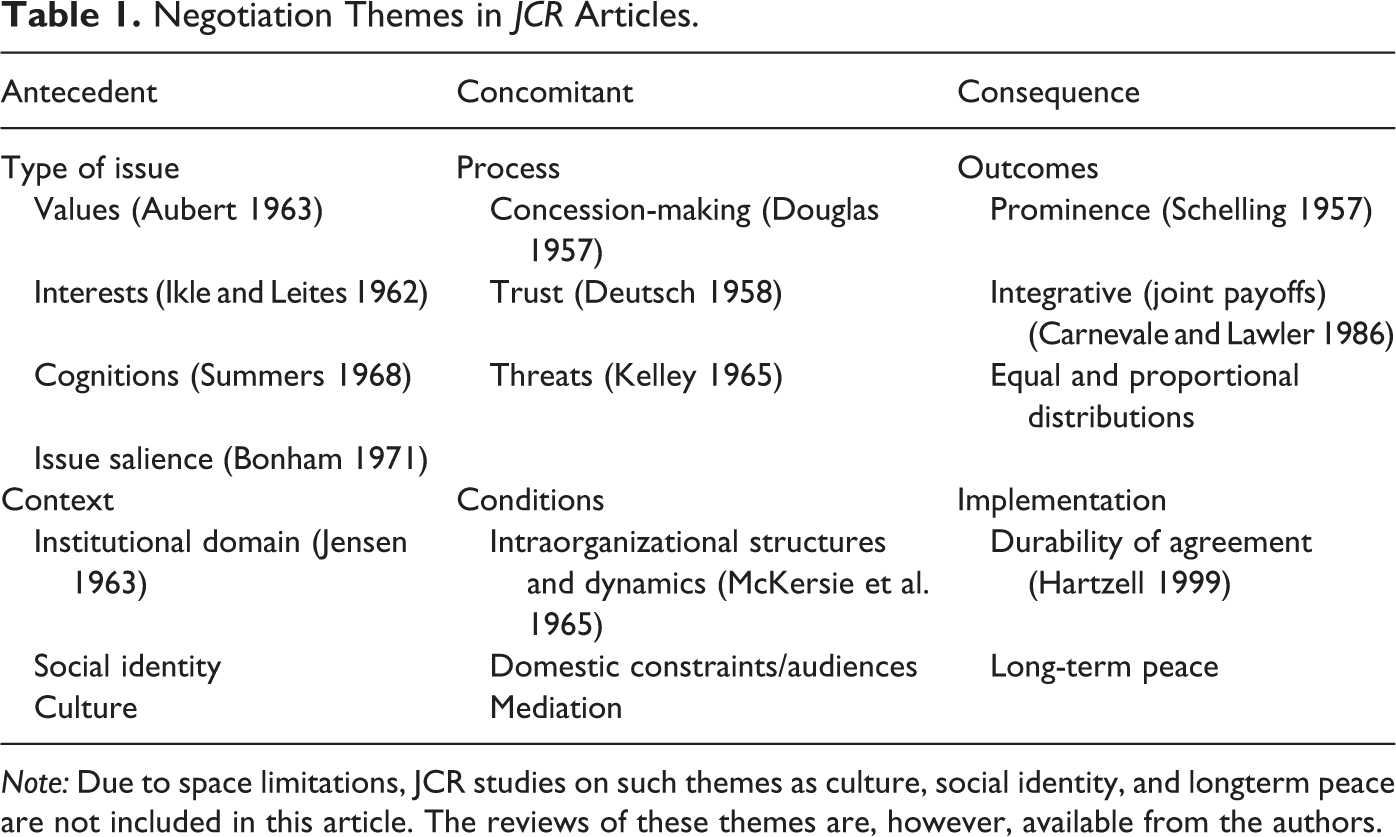
Note: Due to space limitations, JCR studies on such themes as culture, social identity, and longterm peace are not included in this article. The reviews of these themes are, however, available from the authors.
Mediation
When we shift from negotiation to mediation, there is a penchant to view mediation as an expanded negotiation. With negotiation, there are typically two interacting parties and one negotiation. Now with mediation, there are three parties and three negotiations—the original one as well as negotiations between the mediator and each of the negotiators.
While this extrapolation is understandable, it does not capture the nature of the mediation process. That process is better regarded as one of influence, in which the mediator attempts to alter the negotiators’ behaviors toward each other and to improve their relationship. And, as we will soon learn, these influence attempts are more complex than the negotiators’ behaviors.
Because the mediation process differs significantly from that of the negotiation and because the mediator’s behaviors are more complex, the mediation literature is more diverse and episodic than the negotiation literature. There is some overlap with the negotiation literature; there are a few common threads, but mediation scholars mainly focus on objectives, about half a dozen of them. At first, researchers sought to delineate the structure of the mediation process. Subsequently, they investigated the components and the links among them. These components include antecedents to mediation, mediator behavior, effects of mediation on outcomes, and interactive and direct effects. They are the basis for the sections that follow.
The Mediation Process
Prior to 1972, the objective of scholars contributing articles to JCR on mediation was to describe and analyze the mediation process. Douglas (1957), focusing principally on negotiation (see the Concession-making section), noted some steps mediators could take, such as offering advice to negotiators, but she maintained mediators should allow the negotiation to run its usual course, and she held the preferred outcome was to “loosen up” the hostile negotiation situation. Her pioneering work provided the beginning rudiments for the structure of the process (Figure 1).
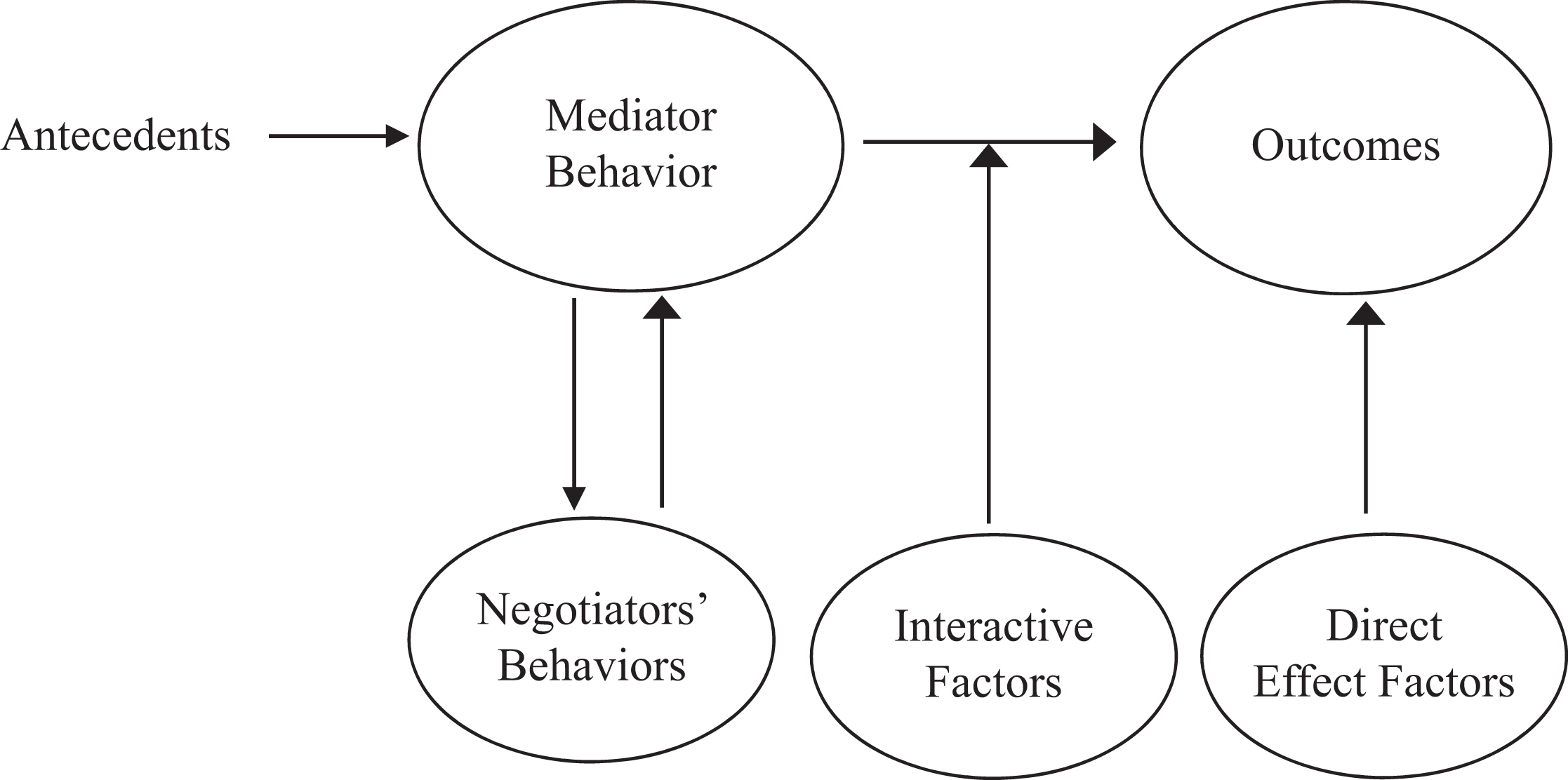
Structure of the mediation process.
Blood (1960) recognized mediation and his objective was to describe what mediator behavior can and should be. He also gives mediation two nods, noting it has useful outcomes and that the simple presence of a mediator makes the negotiators more rational. Likewise, Podell and Knapp (1969) pointed out the usefulness of mediation. Rehmus (1965) emphasized that the mediation process can be thoroughly described and analyzed. He also mentioned mediator neutrality and, like Blood, noted that the sheer presence of the mediator has positive outcomes; however, Rehmus was more specific in his delineation of mediator behaviors and their outcomes. In a subsequent work, Holsti (1966) focused more robustly on mediator behavior and outcomes. These works underpinned Young’s (1972) major step forward. He indicated that there is mediation behavior which leads to outcomes, and there are antecedents to this behavior. In addition, he identified factors that influence the impact of the mediator’s behavior as well as those that have direct effects upon the outcomes.
Young’s description of mediator behavior is divided into two facets (a) whether or not a third party mediates and (b) how she or he mediates. When considering the antecedents to the mediator’s behavior, Young initially explores antecedents to the first facet—if the third party mediates—rationally with a cost–benefit analysis and indicates that factors which raise the benefits (e.g., adequate remuneration) enhance the chances a party will mediate, and factors that raise the costs (e.g., irksome negotiators) reduce it. As for the second facet—how the mediator mediates—Young is less specific about its antecedents. He seems to imply that mediators will select the techniques that have the best cost–benefit ratios—that is, those most apt to yield valued outcomes and a low cost to the mediator.
Turning to the outcomes, Young considers the primary one to be agreement between the negotiating parties. But he also acknowledges there are outcomes for the mediator such as pay, career advancement, gratitude, and personal satisfaction. As for the “factors’ in the paradigm, it is difficult to determine whether Young perceives them as “direct effect factors” that determine the likelihood that the settlement will result or whether he thinks of the factors as “interactive factors” that alter the effectiveness of the mediators’ behavior in attaining settlement. Regardless of these ambiguities, Young’s inclusion of these factors in his discussion is a major contribution. They include the size of the contract zone, the number of players, and availability of alternative techniques.
Kochan and Jick’s (1978) structuring of the mediation process strongly paralleled that of Young. They note specific antecedents, mediator behaviors, and other factors that determine the outcomes and the effectiveness of the mediator’s behavior. Among the antecedents are the mediator’s style, the analysis of the impediments, norms about behavior, and the mediator’s characteristics. As for the mediator’s behavior, this includes the level of assertiveness and the extent to which the behavior matches the situation. The outcomes encompass settlement, the number of issues resolved, and level of conceding. When considering other factors affecting the mediation process, Kochan and Jick distinguish between the factors that moderate the effect of the mediator’s behavior upon the outcomes and those that directly affect the outcomes. As for the former, they include the sophistication of the negotiators, and the latter entail the sources of impasse and situational factors such as the arbitration statutes that are in place.
Components of the Mediation Process
The core paradigm furnishes a format for our subsequent review. Using it as a template, we next review the articles that focus on the antecedents of mediator behavior. Subsequently, we examine that behavior and then turn to the impact of the behavior on the outcomes. Finally, we examine the interactive and direct-effect factors.
Antecedents to mediator behavior
When addressing this topic, Young adopted a rational, cost–benefit perspective that holds a third party will mediate only when it is personally worthwhile to him or his group to do so. Specifically, he maintained that a third party will mediate when the benefits exceed the costs. A simple extension of Young’s thinking is that third parties are apt to mediate when the predicted total net benefits for all parties is greater than the total net benefits of not mediating. Such an extension is consistent with Carment and Rowland’s (1998) game theory model that holds third-party intervention should be based on a calculation which considers costs and benefits to all parties.
If the third party is available and willing to mediate, the next antecedent requirement is that mediation must be chosen by the negotiating parties. LaTour et al. (1976) made this point in a laboratory study of preferences for conflict resolution. Negotiating parties do not automatically stampede to a mediator’s door. Rather, they can choose to bargain themselves, use arbitration or force, or break off the relationship.
As the negotiators consider whether or not to use an available mediator, various factors come into play. Read and Michelson (2008) note that the choice to use mediation depends on how well the negotiators know the potential mediator, where the negotiators are located, the customs in that area, and how actively the negotiators are involved in the governance structure where the mediator operates. Bohmelt (2010) reports negotiators/disputants are more likely to seek mediation if they are engaged in dense bilateral trade. Furthermore, Inman and her associates (2014) note that negotiators with cultural similarities are more apt to turn to mediation than are those with cultural differences.
Having discussed the antecedents to the decision to mediate, we now turn to the antecedents of the more specific behaviors. A powerful determinant here is culture, wherein institutions, beliefs, values, and norms come into play. As an example, in China there is a formal mediation institution, where the mediator’s principal responsibility is to provide harmony, which is a major goal of the society and their formal authority gives them the right to do so. Therefore, the Chinese use the forceful technique of “education,” that is, they give strong advice to the disputants on how they should get along in society. In recent years, it is reported, Chinese citizens rely less on mediation than they did previously (Read and Michelson 2008) and with modernization the mediators have become less forceful.
When examining mediation within organizations, Kolb (1987) reports that the antecedents to the “helper” and “fact finder” styles are authority and information sources. Specifically, she reports helper mediators have some degree of authority and information sources they can mobilize. By contrast, fact finders have minimal authority or connectedness. In their study of community mediations, Pruitt and his colleagues Welton, Pruitt, and McGillicuddy (1988) noted the effect of structure, specifically of caucusing (private meetings) versus not caucusing. In the caucuses, the mediators were more likely to request information, challenge the disputants to generate new alternatives, to violate neutrality norms, and to side with the disputant who originally filed the complaint.
Mediator behavior
Wall (1981) presents an exhaustive list of a 100 mediation techniques and sorts them into broad categories. After listing these techniques, he notes that they are seldom, if ever, applied alone. He proposed a research plan for studying the techniques and their combinations. The first task is to identify them within mediations. One way to do this is to survey the mediators, subsequent to the mediation, and to ask them what they did. Their statements can then be coded for technique use. Such an approach was employed by Wall and colleagues in about a dozen studies of community mediation (e.g., Callister and Wall 2004). Likewise, Wall and Druckman (2003) utilized this approach in studying peacekeeper mediation.
While seemingly effective, surveying the mediators depends heavily upon their recall, which can be limited. A better approach was pioneered by Pruitt and his colleagues (1993). In their study of community mediation in the United States, they had observers watch the mediations and code the statements as well as the actions of the mediators. This approach was very demanding on the observers/coders and relied strongly upon the cooperation of the mediators and their superiors. Unfortunately, such cooperation is not easily obtained. Therefore, similar studies have not been pursued and published in JCR.
After identifying the techniques, a second task when studying the mediators’ techniques is to condense their number in some manner. If scholars do not, there will be too many techniques to deal with in their studies and the results would be difficult to interpret. Furthermore, including all of the techniques and their combinations in studies would capitalize on chance findings when investigating the outcomes of the behaviors. With the objective of limiting and/or condensing the techniques in some meaningful fashions, scholars have proceeded along a broad, mixed front. Some researchers selected the techniques they wanted to investigate and then studied their antecedents and outcomes. This was the approach of Wall and Druckman (2003) in their study of peacekeeping mediations.
An approach that reduces the number of techniques more adequately is to develop taxonomies—referred to as strategies or styles. This is the most prevalent approach (Wall and Lynn 1993) in the wider mediation literature. Some taxonomies are conceptual (Bercovitch and Houston 2000), while others (Wall and Rude 1987) are empirically based. The pioneering taxonomy was constructed by Kressel and Pruitt (1989). It contains three basic groups of techniques: reflexive, substantive, and contextual. For their studies of international mediation, Bercovitch and Houston (2000) also traveled this conceptual route. They identified three fundamental mediator strategies: communication-facilitation, procedural, and directive. This taxonomy was adopted in part by Beardsley et al. (2006) and Wilkinfeld et al. (2003). In her study of interorganizational conflicts, Kolb (1987) interviewed ombudsmen and on the basis of her interviews classified them into two groups: helpers and fact finders.
Wall and his colleagues identified the strategies of assistance, procedure, educating, and use of third parties in China (Wall and Blum 1991). In Korea (Kim et al. 1993), they identified the strategies of reconciliation, emphasis on dependency, analysis, and data gathering. In Wall and Callister’s (1999) study of Malaysian community mediation, the categories of caucusing, assertiveness, and use of information emerged. Instead of developing taxonomies for the techniques, researchers can cut through the mediator behaviors, labeling them, for example, as biased or neutral (Svensson 2009).
The above listing of the various condensations employed by JCR scholars spawns a critical question: Has there been progress in condensing the 100 possible mediation techniques? At this point, we can identify over a dozen categories in the JCR literature, and a review of the wider literature contributes another dozen or so. While these lists are much too long, there is an opportunity for progress. Kleiboer (1996) maintains that the various styles/strategies can be described on an ascending scale of mediator involvement from passive to active. A facilitative or neutral style would be passive, directive would be active, and fact finding is in the middle. This conclusion is consistent with Wilkenfeld and colleagues’ (2003) contention that the literature has converged on three styles: facilitative, formulative, and manipulative. We can extend this line of thought by scaling most of the categories along a passive–assertive continuum. Facilitative can be viewed as passive (third-party consultation is included in this group). Manipulative is judged to be assertive, and formulative is somewhere in the middle.
With this scaling as a template, we could progress in condensing the techniques and styles by first identifying exactly what the mediators said and did. When these are obtained, they could each be scaled for assertiveness. Researchers could also look for surrogates or indicators of assertiveness such as the number of techniques employed, length of the mediation, number of caucuses with each side, or number of mediations. Subsequent to the coding of the mediators’ overall behavior, along a passive–assertive dimension, researchers could, in a coordinated manner, examine the antecedents to this behavior, its outcomes, and the factors affecting the outcomes. Such structuring is necessary if we are to advance from the current state of affairs where each researcher selects his or her preferred behavior or style to investigate.
Effects of mediator behaviors on outcomes
As we turn to the effects of mediator behavior on outcomes, we note that understanding this link is the primary objective of scholars and practitioners in the wider mediation field, but it has drawn limited attention from JCR authors. A major question here is, what works in mediation? What mediator behaviors lead to concessions, reduced hostility, agreement, and disputant satisfaction?
The simple act of mediating appears to have a straightforward effect. Blood (1960) and Rehmus (1965) are probably correct that the mediator’s presence helps. Beardsley and Lo (2014) support this conclusion, as they report mediation increases disputant concessions. Thus, mediation (vs. no mediation) reaps positive outcomes. However, mediators do not just show up and expect their presence to have an effect. They always do something.
Turning to the effects of these behaviors, we must acknowledge that almost any behavior tends to engender agreements. The reasoning for this conclusion is that across the wider literature, we find the average agreement rates in mediations are about 60 percent (Wall and Lynn 1993), and we can assume that the types of behavior or styles are rather randomly distributed across these mediations.
When we move from these general conclusions to investigate the effects of specific behaviors, the analyses become more complex. The primary reason is that it is quite difficult to measure specific mediator techniques. Pruitt and his colleagues (1993) were pioneers in this arena. They observed and coded mediator behavior as well as its effects. When doing so, they found that the use of joint problem-solving by the mediators was related to improved relations between the disputants. Also, mediation that was evenhanded and that addressed all of the problems led to long-term success (notably compliance), improved relationships, and the absence of new problems.
From the international arena, Svensson (2009) reports that biased behavior from mediators (vs. neutral) is more likely to lead to elaborate institutional arrangements, such as third-party security guarantees, which are conducive to durable peace. Also from the international field, Beardsley and associates (2006) report the effectiveness of the facilitation, formulation, and manipulation styles on the mediation outcomes. Relying on the International Crisis Behavior database, they report that the facilitation style leads to higher levels of postcrisis tension reduction, whereas the manipulation style—the most assertive one—is more likely to yield formal agreements.
In concluding this section, we would like to report that in the wider mediation literature there seems to be evidence that assertive mediator behavior leads to more agreements than do passive, facilitative, and neutral behaviors (e.g., Wall, Dunne, and Chan-Serafin 2011). This report is consistent with Regan’s (2002) and Gleditsch and Beardsley’s (2004) investigations. The former seems to be discussing third-party force rather than mediation, but it does make the point that bias in intervention—more force against one party—is apt to yield success. The latter authors report that consistency—which would be interpreted as more assertive than inconsistency—heightens third-party influence.
Interactive and direct effects
When we move to the other factors affecting the outcomes—other than mediator behavior (Figure 1)—it is often difficult to ascertain whether authors are discussing factors that interact with mediator behavior to determine the outcomes or whether the factors under discussion have direct effects. Having noted this problem, we lay it aside and discuss the factors that are in play.
In an early laboratory study, Bartunek, Benton and Keys (1975) found that bargaining representatives who were highly accountable to their constituents were more likely to accept a reasonable mediator suggestion than were representatives who were not very accountable. This finding established that the negotiating context of the mediation can be as important as the process.
Shifting to the international domain, Bercovitch and Langley (1993) reported factors that influence mediation effectiveness. They developed an extensive database by systematically scanning two major events data sources, from which they gleaned information on mediations. They identified whether or not mediation took place rather than attempting to determine the specific types of mediator behavior. They showed that the outcomes of the mediation were affected by the nature of the dispute, the parties, and the mediator. After examining the mediation data, they concluded that the number of fatalities, dispute complexity, and timing of the intervention affected mediation effectiveness. Specifically, high fatalities encourage further hostility and contentious behavior, which diminish mediation effectiveness in both the short term and long term.
Utilizing Bercovitch’s data bank, Greig (2001) found that the success of mediation behaviors in reducing both the severity of future disputes and the time until the next use of force by disputants was affected by the timing of the mediation and by disputant actions. With regard to timing, he found mediation was more successful in the short term if it was initiated before disputants developed high levels of hostility. But mediation was more successful in the long term if it came late, after a stalemate had developed. As to the interactive effect of disputant actions, Grieg reports mediation is effective in the short run if it is initiated by at least one of the disputants. Also drawing on a large database—Issue Correlates of War—Hansen, Mitchell, and Nemeth (2008) report that third-party intervention is more successful in international disputes if the third parties have democratic members and if they are highly institutionalized.
In their study of mediations at a community dispute resolution center, Zubek and her colleagues (1992) unearthed several factors that they determined had intervening and direct effects on the outcomes. Their results indicate that joint problem-solving, a less contiguous relationship, no intangible issues at stake, and a continuing relationship increased the chances of reaching an agreement. Contentious behavior was inversely related while a continuing relation was positively related to satisfaction.
Conclusion
The previous sections review the works of JCR negotiation and mediation scholars over the past six decades and provide a base for suggestions about future research. These scholars have focused on negotiators’ and mediators’ behaviors; however, they have largely ignored the interplay between the two sets of behaviors. This link is delineated in both the negotiation themes (Table 1) and the mediation paradigm (Figure 1), and researchers would agree that the mediator’s behavior is determined in part by that of the negotiators. Likewise, the mediator’s behaviors do alter the negotiator’s behavior.
Given this deficiency, what route do we recommend for addressing it? First, we must acknowledge a basic premise: a study of the interplay of negotiation and mediation behaviors must take place in a mediation setting. (Admittedly, this approach would miss the situations in which negotiations take place without mediation thereby generating a nonrandom set of negotiations.) A second requirement is that these studies must entail measurements of negotiator and mediator behaviors. Pruitt’s studies of community mediation (e.g., Zubek et al. 1992) serve as a guide to this research. Following this approach, investigators could observe and code both negotiators’ and mediators’ behaviors in mediations. An alternative approach would be to record the behaviors and code them later. Regardless of the path taken, we believe it is essential that the measurement be based upon observation rather than recall of the mediators or the negotiators.
We also suggest that the mediators’ and negotiators’ behaviors be recorded in the order in which they occurred. This would allow scholars to trace the effects of specific negotiators’ behaviors upon mediators’ behaviors and vice versa. Using this approach, investigators might, for example, find that negotiator concessions lead to subsequent assertive tactics by the mediator. Or they might find that when mediators note prominent agreement points, negotiators are more likely to agree. We suggest this research approach in forthcoming mediation studies of civil cases, community disputes, labor management negotiations, school-peer mediations, victim-offender cases, and intrafirm disputes. International mediation presents a larger challenge: negotiator and mediator behaviors are not accurately included in the existing databases.
When researchers have a better handle on the interplay between the negotiator and mediator behaviors, they can begin to study the antecedents to this interactive process. They may find some antecedents, such as cultural norms, that influence both the negotiators’ and the mediators’ behaviors. Other antecedents such as demands from the negotiators’ constituents would not have dual effects. Similarly, some researchers could investigate the outcomes from the negotiator–mediator interplay. And other researchers could investigate the impact of interactive and direct effect factors on the link between the negotiators–mediator behaviors and the negotiated/mediated outcomes.
Footnotes
Declaration of Conflicting Interests
The authors declared no potential conflicts of interest with respect to the research, authorship, and/or publication of this article.
Funding
The authors received no financial support for the research, authorship, and/or publication of this article.