







Abstract
This article describes a new data set for the study of genocide, politicide, and similar atrocities. Existing data sets have facilitated advances in understanding and policy-relevant applications such as forecasting but have been criticized for insufficient transparency, replicability, and for omitting failed or prevented attempts at genocide/politicide. More general data sets of mass civilian killing do not typically enable users to isolate situations in which specific groups are deliberately targeted. The Targeted Mass Killing (TMK) data set identifies 201 TMK episodes, 1946 to 2017, with annualized information on perpetrator intent, severity, targeted groups, and new ordinal and binary indicators of genocide/politicide that can serve as alternatives to existing measures. Users are also able to construct their own indicators based on their research questions or preferred definitions. The article discusses the concept and operationalization of TMK, provides comparisons with other data sets, and highlights some of the strengths and new capabilities of the TMK data.
This article describes the Targeted Mass Killing (TMK) data set, a new resource for the study of genocide and other mass atrocities that target particular ethnic, religious, or political groups. 1 In quantitative social science, genocide and mass killing are under-researched topics, relative to their devastating impacts. By one estimate (Anderton 2014), more than 84 million civilians were killed in genocide and mass killing episodes since 1900, while roughly 36 million combatants died in inter- and intrastate wars, and just under 250,000 people were killed in incidents of terrorism. Yet, there are fewer than 50 quantitative studies of genocide and mass killing compared to more than 500 of interstate war and more than 100 each of terrorism and civil war (Anderton and Carter 2015).
To an extent, this gap is also reflected in efforts to predict genocide and mass killing. Advances in social science mean that forecasting some high-impact events is a reasonable goal. This includes forecasts of US national and local election outcomes and turnout (Campbell 1992, 2014; Lewis-Beck and Rice 1984), forecasts of civil and interstate war (Brandt, Freeman, and Schrodt 2011; Schrodt and Gerner 1997; Hegre et al. 2017; Tikuisis, Carment, and Samy 2013), political instability (Goldstone et al. 2010; O’Brien 2002), ethnic conflict (Weidmann and Duffy Toft 2010), and forecasts of specific events and decisions (Bueno de Mesquita 1997; Organski and Lust-Okar 1997; Schrodt and Gerner 1997; Gleditsch and Ward 2013). To the best of our knowledge, there are three groups producing genocide-related forecasts based on quantitative models (Goldsmith and Butcher 2018; Harff 2012; Ulfelder 2013), and two rely on genocide data produced by the Political Instability Task Force (PITF; Marshall, Gurr, and Harff 2017). 2 This article outlines a new data set designed to stimulate quantitative work on the analysis and prediction of genocide and related mass atrocities.
In part due to the use of different definitions of genocide (Verdeja 2012), considerable disagreement persists over its basic correlates and causes (Stewart 2013). While we do not claim to develop the single “correct” definition for all scholars or all purposes, we have reconceptualized the definition that is most commonly used in quantitative analyses and forecasts in a way that we believe is better suited to these purposes (Verdeja 2013, 41). Taking our cues from the pathbreaking work of Harff and Gurr (1988), we developed the concept of TMK to improve connections between concepts and measurement, improve documentation and reproducible codings, include nonstate actors, and capture attempted (and possibly thwarted) genocides (Goldsmith and Butcher 2018; Ulfelder 2013; Ulfelder and Valentino 2008; Verdeja 2013).
The TMK data set employs a baseline measure of atrocity severity and perpetrator intent to identify 201 episodes (1946–2017). Indicators of higher-level intent and severity, precise start and end dates, perpetrator and target groups, and descriptions of triggering events and episode endings are provided for each case. The TMK data improve on the PITF data by (1) clarifying ambiguities and measurement problems associated with intent to destroy specific groups, while maintaining a distinction between mass killing, repression, and terrorism; (2) enabling users to customize thresholds of intent and severity for particular research questions, for example, to identify genocide/politicide episodes as a subset of TMK events; (3) explicitly and systematically identifying state and nonstate actors as perpetrators 3 ; (4) identifying attempted episodes of genocide; and (5) providing extensive documentation of coding decisions and source material.
This article proceeds by first outlining existing data sets on genocide/politicide and mass civilian killing, addressing how our conceptualization and operationalization of TMK departs from these. We then show the distribution of TMK events across time and regions and comparisons with the PITF Genocide/Politicide data, State-sponsored Mass Killing (SSMK) data, and Uppsala Conflict Data Program (UCDP)’s one-sided violence (OSV) data (Eck and Hultman 2007). We next extend Wayman and Tago’s (2010) data exploration using our new data, point to some potentially promising implications for analysis, prediction, and prevention, and conclude.
Existing Data Sets
As noted, the main source of quantitative data on genocide and politicide (hereafter, “genocide”) is the PITF data set (available in their “State Failure Problem Set” data file). The PITF definition is widely employed in empirical research (Colaresi and Carey 2008; Goldsmith et al. 2013; Harff 2003; Rost 2013; Krain 1997) and is based on the definition developed by Harff over decades (Harff and Gurr 1988; Harff 2003, 1992). The term politicide refers to the deliberate mass killing of a politically defined group of people (e.g., Communists) in order to eliminate them, in whole or in part, while genocide refers to such killing directed at a “communal” group (often defined by ethnicity, e.g., Sri Lankan Tamils). Specifically: Genocides and politicides are the promotion, execution, and/or implied consent of sustained policies by governing elites or their agents—or, in the case of civil war, either of the contending authorities—that are intended to destroy, in whole or part, a communal, political, or politicized ethnic group. In genocides the victimized groups are defined by their perpetrators primarily in terms of their communal characteristics. In politicides, in contrast, groups are defined primarily in terms of their political opposition to the regime and dominant groups. (Harff and Gurr 1988, 360)
In terms of measurement, PITF judge that the intent to destroy “in whole or in part” is established when violence is directed against a political or communal group for longer than six months, resulting in the killing of a “substantial portion” of that group (Marshall 2017, 15). As a consequence, the PITF data capture episodes of implemented genocide while excluding attempted episodes that were thwarted, for example, by peacekeepers or other external intervention. East Timor (1999), Libya (2011), and Ivory Coast (2011) are possible examples. This is problematic, as these states were at high risk of genocide, but are not included in the dependent variables that current models aim to predict, potentially leading to underestimates of genocide risk or overlooked independent variables. Moreover, PITF does not currently provide documentation for their coding decisions, especially numbers of people killed and estimated target group size, making measurement of destruction in whole or part unreplicable. Since evidence of partial destruction of a group is, we believe, often not very informative of intent, but evidence of total destruction is exceedingly rare, our approach is to measure intent more directly.
A number of projects do not specifically aim to study genocide but speak to the core question of mass violence against civilians such that comparison can help illustrate the nature and contribution of the TMK data. Ulfelder and Valentino (2008) define “mass killing” for the purposes of the SSMK data set as “any episode in which the deliberate actions of state agents or other organizations of the state kill at least 1,000 noncombatant civilians from a discrete group.” This definition reduces problems associated with establishing intent to destroy a group, but the lower criterion for intent makes it difficult to separate low-level violence or repression of a general nature from episodes of group-specific violence intended to terrorize or intimidate social groups. For example, SSMK data include cases that endure for twenty years or more (including Haiti, 1958–1986; South Africa, 1976–1994; and Iran 1979–2010), making prediction of genocidal periods within these episodes difficult, such as the imprisonment and murder of Baha’i in Iran in 1979 to 1980 and the eradication of political opponents, 1979 to 1988. Cases of genocide committed by nonstate actors are also omitted, such as the Alliance of Democratic Forces for the Liberation of Congo in 1997 and more recently Islamic State in Iraq and Syria. Neither do the SSMK data presently provide documentation for coding decisions. The SSMK data set is a valuable resource but focuses on a different class of events than TMKs (a superset, as we show below) and thus cannot be effectively used specifically for the analysis or forecasting of genocide.
The OSV data (Eck and Hultman 2007) also focus on a broader class of violence against civilians. This includes events of repression and acts short of systematic campaigns of civilian killing entailed by genocide but has the advantage of including nonstate as well as state actors. We draw upon the OSV data below, but like SSMK, these are not ideally suited to studying genocide. The TMK data likewise differ from the Armed Conflict Location and Event Data project’s “violence against civilians,” which requires civilians to be deliberately targeted but not necessarily as part of a broader campaign with the higher levels of intent implied by definitions of genocide.
The Worldwide Atrocities Dataset also covers a wider universe than TMK, recording events of atrocity against noncombatant civilians that result in more than five deaths worldwide, but for the limited period 1995 to 2018 (Schrodt and Ulfelder 2016). These data record information on perpetrator and victim identity and include indicators of perpetrator intent to kill noncombatant civilians. TMKs require more than intent to kill noncombatants—the targeted group(s) must share an ethnic, religious, or political identity to enter the TMK data. Our measure of intent is also sensitive to changed evidence of intentions after an episode has started. For example, while execution of opposition members by the Ethiopian Derg (junta) began in 1976, it was not until 1977 that a key Derg leader declared “for every revolutionary killed, a thousand counter-revolutionaries executed” and the killings known as the “Red Terror” escalated (Africa Watch 1991, 102). We believe this makes the TMK data set better suited to studying escalation to higher levels of atrocity including genocide.
Finally, Rummel’s (1997) “democide” data have been used to study mass killing of civilians. However, these instances of “death by government” again include a wider set of events, while excluding nonstate perpetrators, and have not been updated beyond 1999. Thus, there are alternative sources of data that measure the mass killing of civilians. But, other than PITF’s genocide/politicide data, none of these is well suited to the study or forecasting of genocide in particular.
TMK
TMKs are a set of events that cross a minimum threshold of severity and intent for killing specific identity groups. From this broad set of cases, researchers can focus on all TMKs, or customize their thresholds for higher levels of atrocity, including those that fit common conceptions of genocide and politicide.
TMK is defined as follows: Targeted mass killing is the direct killing of noncombatant members of a group by a formally organized armed force that results in twenty-five or more deaths in an annual period, with the intent of destroying the group or intimidating the group by creating a perception of imminent threat to its survival. A targeted group is defined in terms of political and/or ethnic and/or religious identity.
TMK is similar to genocide because of the group-selective nature of the violence and the close overlap between the targets of the violence and the audience (Straus 2007, 2001). Although the goal might usually be impossible to reach, genocide is often characterized as those cases for which the intent of the perpetrator is to entirely destroy a social group (Harff 2003). The TMK data also include cases where the intent is intimidation of a social group by creating the perception of an existential threat. TMK thus captures the idea that some perpetrators may seek a “final” solution, while others (most, in our view) are seeking a political one, more akin to ethnic cleansing in which populations are expelled, cowed into irrelevance, or scapegoated for the sake of in-group mobilization but not totally or even substantially physically eliminated. All cases of genocide are also cases of TMK, but not all cases of TMK are cases of genocide. There exist cases with similarly high levels of intent but that result in far fewer fatalities. Even many cases usually characterized as genocides, such as Bosnia (1992–1995) and Darfur (2003–2011), did not involve the large-scale killing seen in other prominent cases, like Cambodia (1975–1979) or Rwanda (1994), in which substantial portions of the targeted groups were actually eliminated.
TMKs are distinct from mass killings due to the higher requirement for evidence of intent to destroy or existentially intimidate an entire ethnic, religious, or political group. For example, mass killings can include cases in which civilians are killed during civil war as a consequence of the pursuit of broader military goals, such as the taking of a rebel-held city, which would be unlikely to meet our criteria for intent. Mass killings may also include cases where the government kills civilians or dissidents to deter future participation in anti-government activity without necessarily aiming to destroy all dissidents or even creating this perception.
Repression is the use of coercion to deter present and future collective action or dissent but is not necessarily group-selective. Repression can be indiscriminate and designed to intimidate and/or deter other dissidents, or dissidence in general, regardless of preexisting membership in social groups (Davenport 2007). Most TMKs are examples of extremely violent and group-specific repression. However, not all cases of repression are also cases of TMK.
In cases of terrorism, the direct targets of violence may or may not belong to the same social group as the intended audience (which, in many cases, is the mass public in general or the government leadership specifically). TMKs overlap with terrorism only where members of a particular ethnic, religious, or political group are targeted with the intent of intimidating the entire identity group. Our requirement that actors have a minimum local military presence in the target zone also means mass-casualty terrorist attacks, such as the 9/11 attacks on the United States, are excluded.
Operationalizing TMK
With this definition translated into coding guidelines, we coded cases of TMK from 1946 through 2017. First, we collected a broad pool of potential TMK cases, relying on existing data sets and our own historical research. The data sets, chosen to ensure as wide a pool as possible of potential TMK candidates, were OSV, SSMK, and Major Episodes of Political Violence (MEPV; Marshall 2017). 6 To locate additional possible cases, we consulted the genocide and mass atrocities literature, historical accounts, and area and genocide studies experts. This research led to the inclusion of, for example, events from the Chittagong Hill Tract conflict in Bangladesh (discrete episodes in the 1980s and early 1990s) and the Gukurahundi massacres in Zimbabwe (1983–1987). News media reports, government, and nongovernmental organization publications were also consulted for the period covered by the OSV data set, locating additional cases involving some armed combat, such as Sri Lanka (2009), Egypt (2013), and Uzbekistan (2005).
From this broad pool of potentially relevant events, we then applied our coding criteria and made decisions based on extensive research into each case’s characteristics. Coding guidelines as well as a “data diary” for each included case are available alongside the data set to make these choices as transparent as possible. Our process was designed to minimize the chances of omitting relevant TMK cases, and we went to considerable lengths to track down reliable information on obscure or underreported events. Our confidence in the data quality and coverage are high, but, as with any such data set, there are potential shortcomings and limitations based on biases in news media reporting, government censorship, language barriers, and event severity, and we discuss these in the Online Supporting Materials.
From this broad set of potential cases, a new episode of TMK was coded when there was evidence that an organized armed actor: killed twenty-five or more civilians in a year, these civilians were deliberately targeted by that actor, one (or more) political, ethnic, or religious group(s) were disproportionately targeted, and the group was targeted in order to substantially reduce its numbers, expel, or affect the political activity of that specific group.
An active TMK episode was coded when all four of these criteria were met. Criterion (1) is a baseline measure of severity. Criterion (2) differentiates TMK from events in which civilians are killed incidentally in conflict. Criterion (3) constitutes evidence of group-selective violence, and criterion (4) requires the goal of annihilation or that the intended audience of the violence was the targeted social group such that group members could plausibly believe that their lives were at risk simply because of their identity. New TMK episodes start in the year that a new actor engages in civilian killing that crosses the TMK threshold or where the same actor reengages in such activity after a period of nonactivity of one calendar year or more. Episodes end when they drop below the twenty-five deaths annual threshold. A country-year may experience multiple TMK events. The 201 TMK episodes comprise over 524 episode-years from 1946 to 2017.
Two examples can illustrate the role of intent in identifying TMK events. The Government of Sri Lanka began their final operation against the Tamil Tigers (LTTE) in September 2008, but the transition of operations to the deliberate targeting of Tamil civilians and civilian areas where the LTTE were based began in January 2009, when we code a TMK onset (United Nations 2011, 2012). This distinguishes the TMK onset date from that recorded in the PITF genocide data, which is September 2008. The First Sudanese Civil War, while destructive and fought between ethnic Arabs and ethnic Equatorian Southern Sudanese, to the best of our knowledge yields little evidence for intent to target a specific group or groups beyond the purposes of war fighting. PITF classes the entire civil war, 1956 to 1972, as a genocide. Our coding, on the other hand, found two distinct 1965 massacres in Juba and Wau that meet the criteria for TMK but no other such incidents over the sixteen-year period (Kaufman 2006; Poggo 2009).
Severity and Intent Variables
Once an episode was classed as TMK, additional measures of intent and severity were coded that allow users to customize thresholds for genocide/politicide or other mass-atrocity types such as ethnic cleansing. Annual indicators of severity measured in the number of civilians killed and an indicator of the severity of the total episode were coded where possible. When sources disagree on the number of victims, we provide high, low, and best (in our judgment) estimates, documenting the sources and reasons for preferring a particular estimate.
Two higher-order measures of genocidal intent were recorded: (1) public statements and (2) systematic preparation. First, we examined primary and secondary sources for public statements of intent to destroy a group or public statements that deadly violence was specifically directed toward a group (e.g., as “enemies of the state”). Specific types of hate speech are, anecdotally, common precursors to genocidal violence (Semelin 2007). Where evidence of publicly stated intent was found, we coded a 1, and 0 otherwise, for the variable Intent—Public Statements.
Governments and nonstate perpetrators do not always announce their intentions, and evidence of systematic political, logistical, or organizational preparation to facilitate large-scale killing of targeted groups was recorded. Verdeja (2013, 310) suggests that genocidal intent can often be inferred from level of lethality, degree of coordination, and scope (portion of the victim group affected). While lethality and the proportion of the victim group affected enter our operationalization under the category of severity, which we treat as distinct from intent, Verdeja’s “degree of coordination” captures activities that may signal preparation for genocide. Clear territorial control by the perpetrator group in the affected area, separation of people on the basis of identity, destruction of cultural symbols, systematic use of sexual violence against a population, the pattern of refugee origin and internal displacement, and the clear development of organizational infrastructure for genocide potentially contribute to evidence of intent. Where we found this sort of evidence, we coded a 1, and 0 otherwise, for the variable Intent—Organization.
For example, in the Central African Republic in 2013, Christian self-defense militias calling themselves “anti-Balaka” were responsible for killings of Muslims. Anti-Balaka militias entered villages over which they established clear territorial control; selected out Muslim men, women, and children to be murdered; destroyed Mosques; and sometimes announced that they were going to “kill all Muslims” in the village (Human Rights Watch [HRW] 2013; Kane 2014). The latter counts as public statement evidence of intent, while the territorial control, separation of Muslims, and targeting of cultural symbols count as organizational evidence of intent.
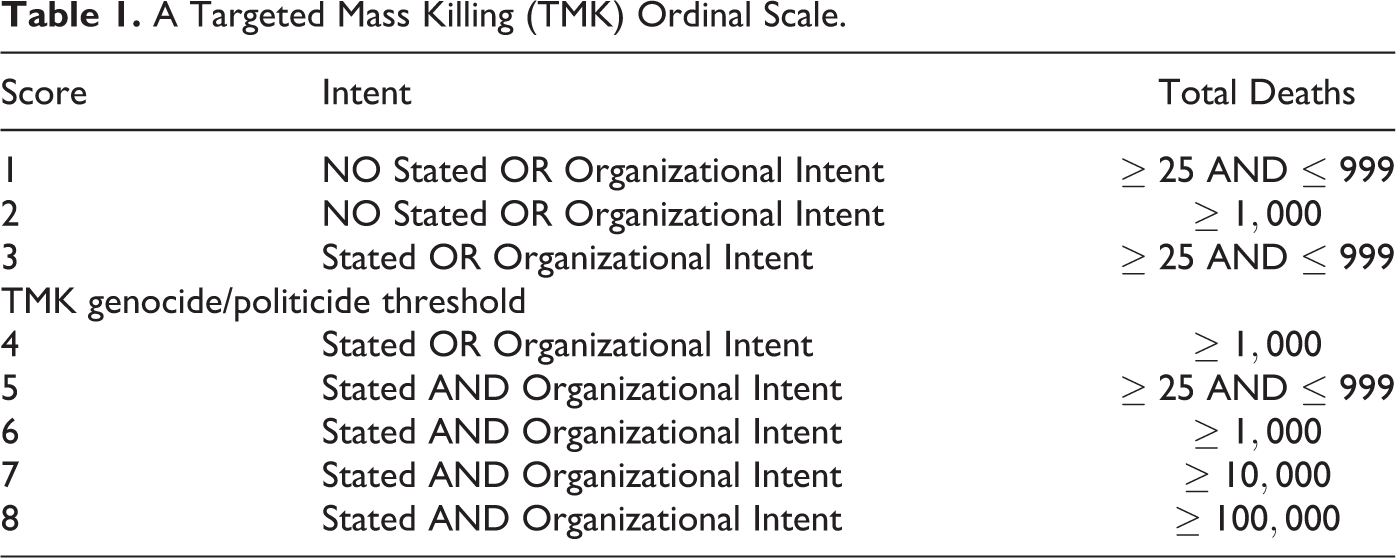
Each intent variable is coded annually, but additional evidence is not required in subsequent years to maintain the coding (e.g., there does not have to be a new public statement of the intent to kill all members of a group in each subsequent year, after the initial such statement). The strongest evidence of intent exists when both categories are met: perpetrators declare they plan to kill the targeted group on a mass scale, and they make the observable preparations using the resources of the state or other resources at their command. Only these cases reach the highest level of intent in our framework (see Table 1).
A Targeted Mass Killing (TMK) Ordinal Scale.
Precise start and end dates; perpetrator actors; the specific ethnic, religious, or political target groups; and numbers killed by group were all recorded where possible. Victim death counts were broken down annually and by targeted group where possible. We also recorded identifiable triggering events and characterize the process by which the TMK event ended. With these variables, users can customize thresholds to identify episodes of genocide or employ multiple thresholds. Users should also consult the TMK Coding Guidelines that document the data set and provide the instructions used to code each variable. A further resource is the Data Diaries, providing additional information on each case, including data sources, coding justifications, and the coder’s degree of confidence in the codings. There is one data diary for each TMK case.
Figure 1 graphs the annual number of new TMK events (onsets) recorded, the number of ongoing TMK events, and the number of TMK episodes that cross one possible threshold for genocide or politicide—at least a total of 1,000 deaths across the entire episode and either public statements of intent or evidence of preparations for genocide/politicide at some point during the episode (level 4 in Table 1).
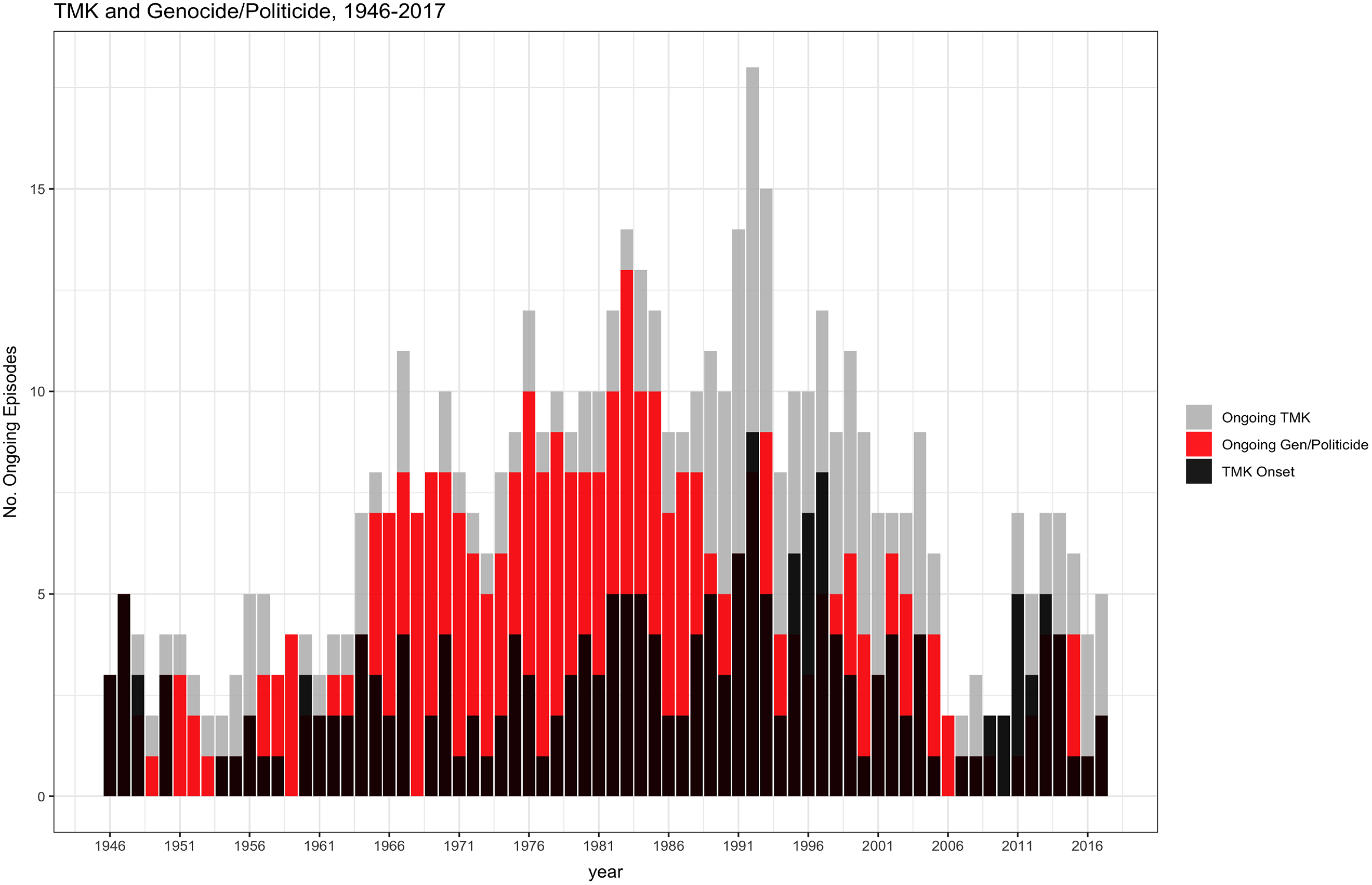
Targeted mass killing and genocide/politicide (1946–2017).
Figure 1 suggests that TMK episodes have fallen since a peak in 1992, and risen again since 2011, while onsets were relatively stable from 1946 through 1981, with spikes in 1982 to 1984, 1992, 1997 to 1998, and 2011 to 2013. Episodes meeting the abovementioned threshold of genocide have steadily fallen as a proportion of all ongoing TMKs since 1989, suggesting that while attempts are stable, they are less likely to escalate after the Cold War. Due to better news media coverage, we may also capture more attempted events over time, although the decline in absolute numbers of TMK events and genocide/politicide episodes since 1992 is observed despite this possibility.
The temporal patterns suggest a possible role for the characteristics of the international system in driving the frequency and severity of TMK, something which has been studied for intrastate conflict in general (Kalyvas and Balcells 2010) but less so for mass atrocities. They also demonstrate an important feature of the data set—the ability to distinguish between levels of atrocity within the broad class of TMKs, for the purpose of better understanding causation, escalation, and trends.
Comparisons with Other Data Sets
Here, we compare the TMK data set with data sets that have more inclusive criteria regarding intent or target groups—specifically the OSV, SSMK, and MEPV data—and the PITF data with more restrictive inclusion criteria regarding the level of violence. We would expect TMKs to form a subset of the former and to encompass all cases of the latter. Figure 2 shows the distribution of ongoing TMK episodes compared with ongoing episodes of OSV, SSMK, and the number of countries with MEPV episodes that crossed our designated threshold. 7 TMK episodes clearly appear to be a subset of OSV and SSMK events, indicating that TMK isolates a set of events which manifest the intent to use violence against civilians to eliminate or influence the political activity of specific groups.
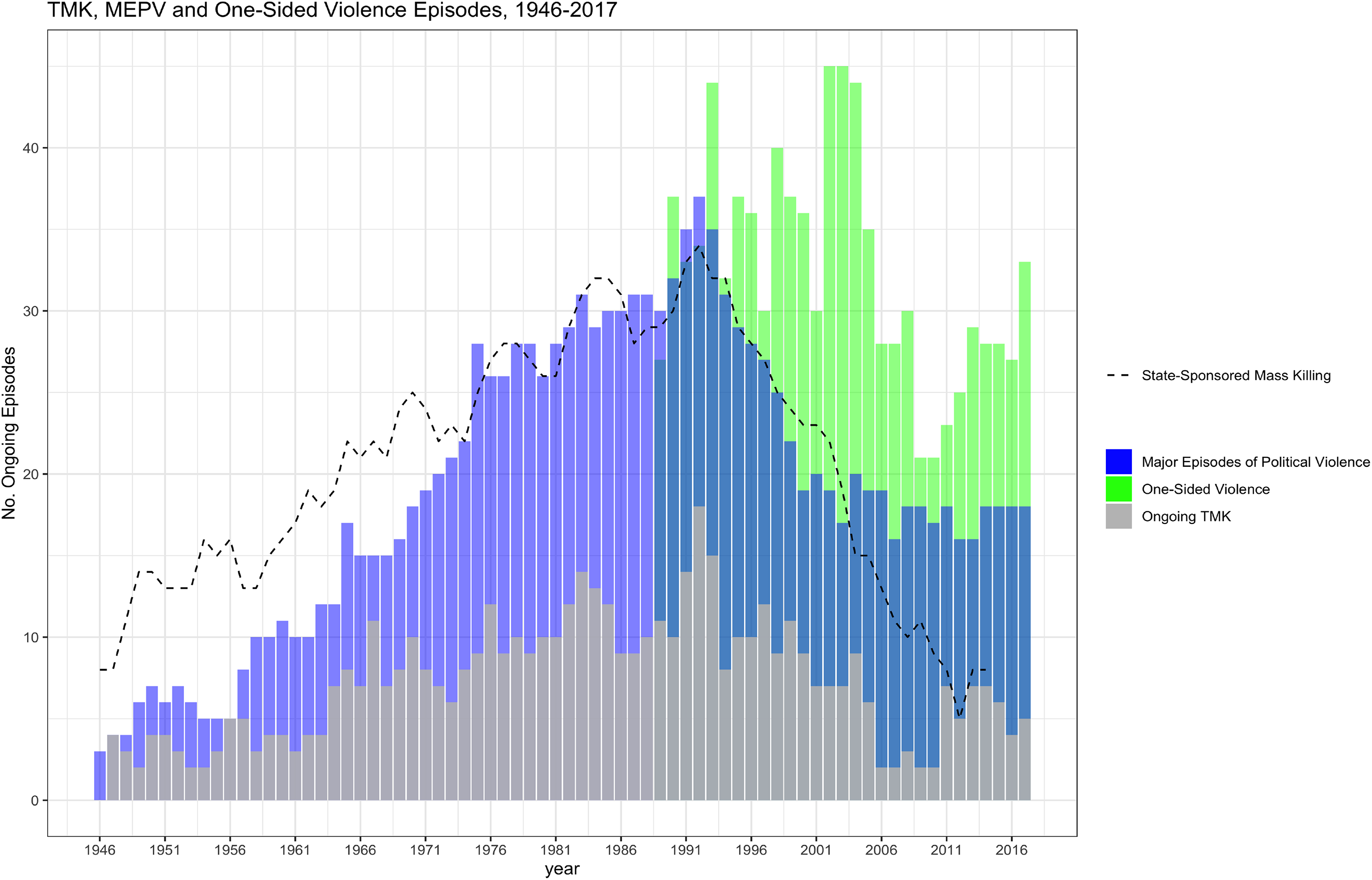
Targeted mass killing, major episodes of political violence, and one-sided violence episodes (1946–2017).
Figure 3 compares ongoing TMK episodes with PITF Genocide and Politicide episodes. TMK events are more frequent, reflecting the more inclusive concept in terms of intent and severity thresholds. Moreover, our selected threshold for genocide/politicide in the TMK data (see Table 1, level 4) maps on to the PITF episodes fairly well, with the added advantages of a more consistent and transparent coding scheme for genocide and politicide, easy customization of genocide indicators in terms of thresholds of severity and intent, and other conditioning variables such as perpetrator and target types.
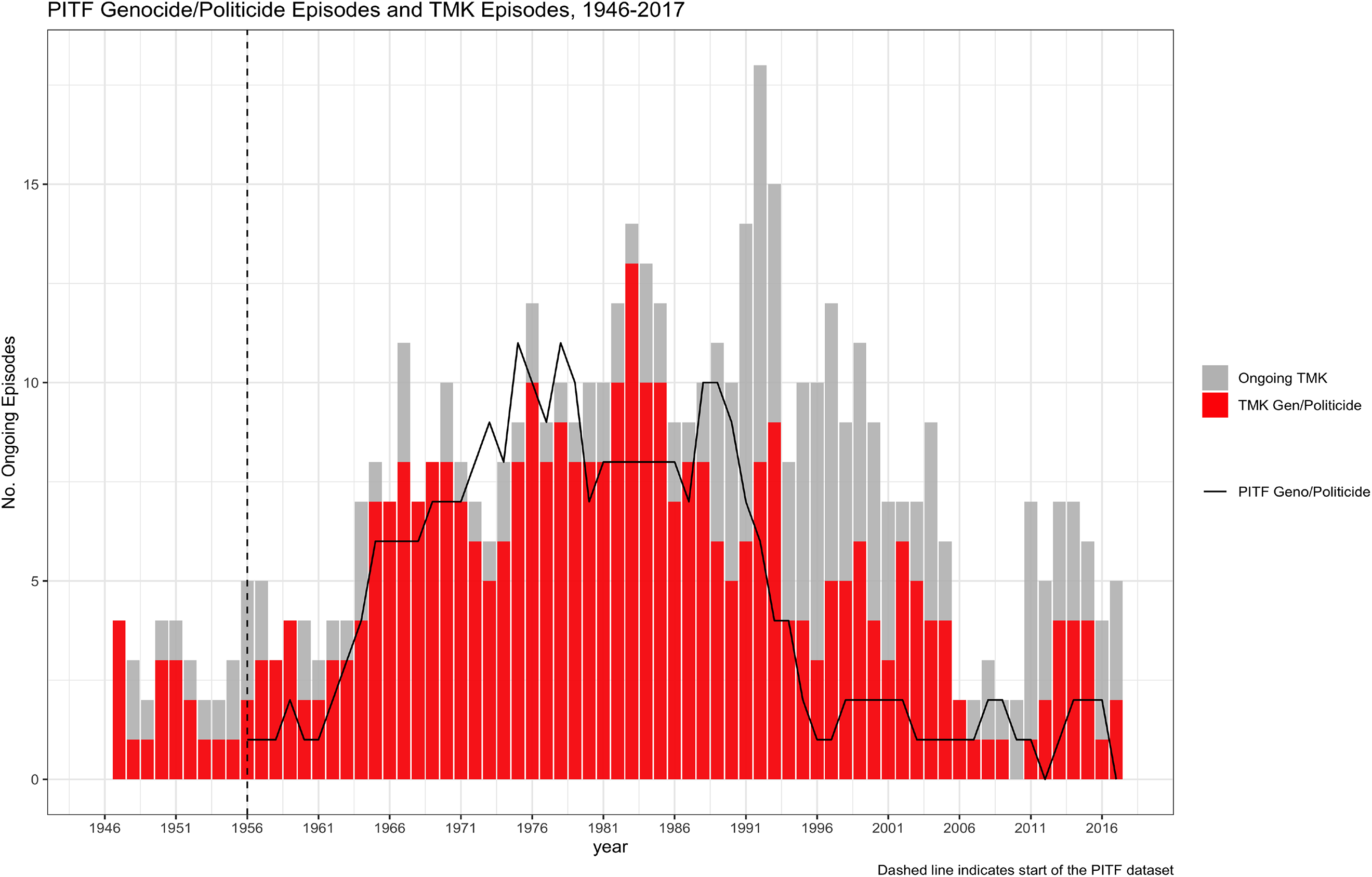
Political Instability Task Force (PITF) genocide/politicide episodes and Targeted Mass Killing episodes (1946–2017). Dashed line indicates the start of PITF data set.
A closer look at the geographic distribution of the data sets indicates that the higher frequency of TMK onsets pertains in all global regions, although the Middle East and North Africa (MENA) region and the Asia-Pacific show the greatest difference between PITF and TMK rates of onset (Figure 4).
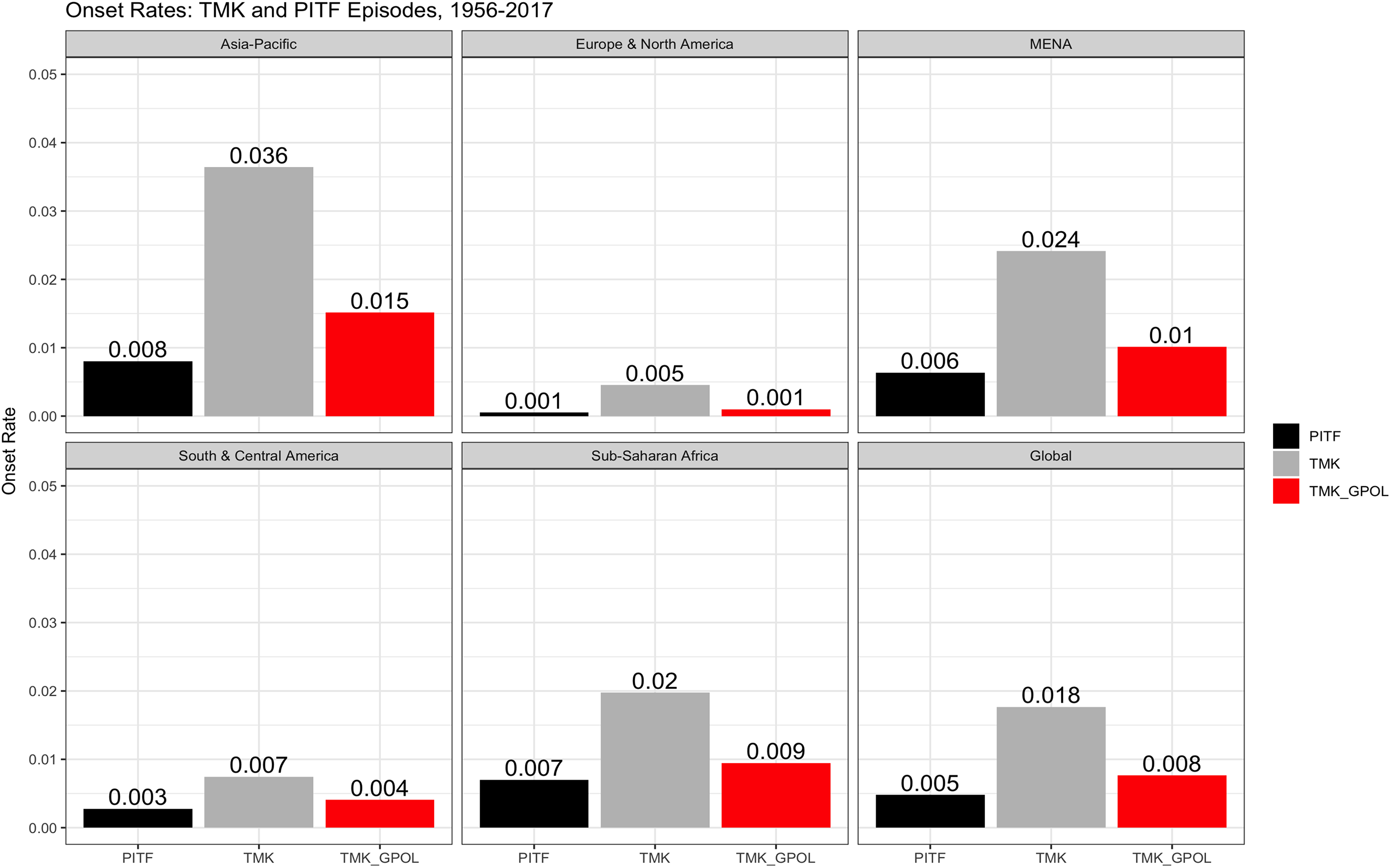
Onset rates: Targeted Mass Killing and Political Instability Task Force episodes (1956–2017).
Table 1 and Figure 5 illustrate how the TMK data set can be used to construct an ordinal measure of genocidal violence based on the level of intent and severity. One possibility is the eight-point ordinal scale in Table 1. The genocide/politicide threshold level of 4 is that used in Figures 3 and 4. It identifies eighty-five cases of genocide/politicide. Over the period 1955 to 2017, the PITF data identify forty-four while we find seventy-two. The full case list can be found in the Online Supporting Materials. In Figure 5, the y-axis shows the total logged deaths over the episode, while the x-axis shows the distribution over years. The size of the circles is proportional to the logged severity (total deaths) of the episode. Gray dots are those that qualified as TMK episodes, but we found no evidence of systematic preparations or stated intentions to eradicate or remove the target group. Orange circles indicate evidence for either type of intent, and in red are cases where we found evidence for both. Users could construct alternative indices of genocide/politicide by combining these dimensions in various ways.
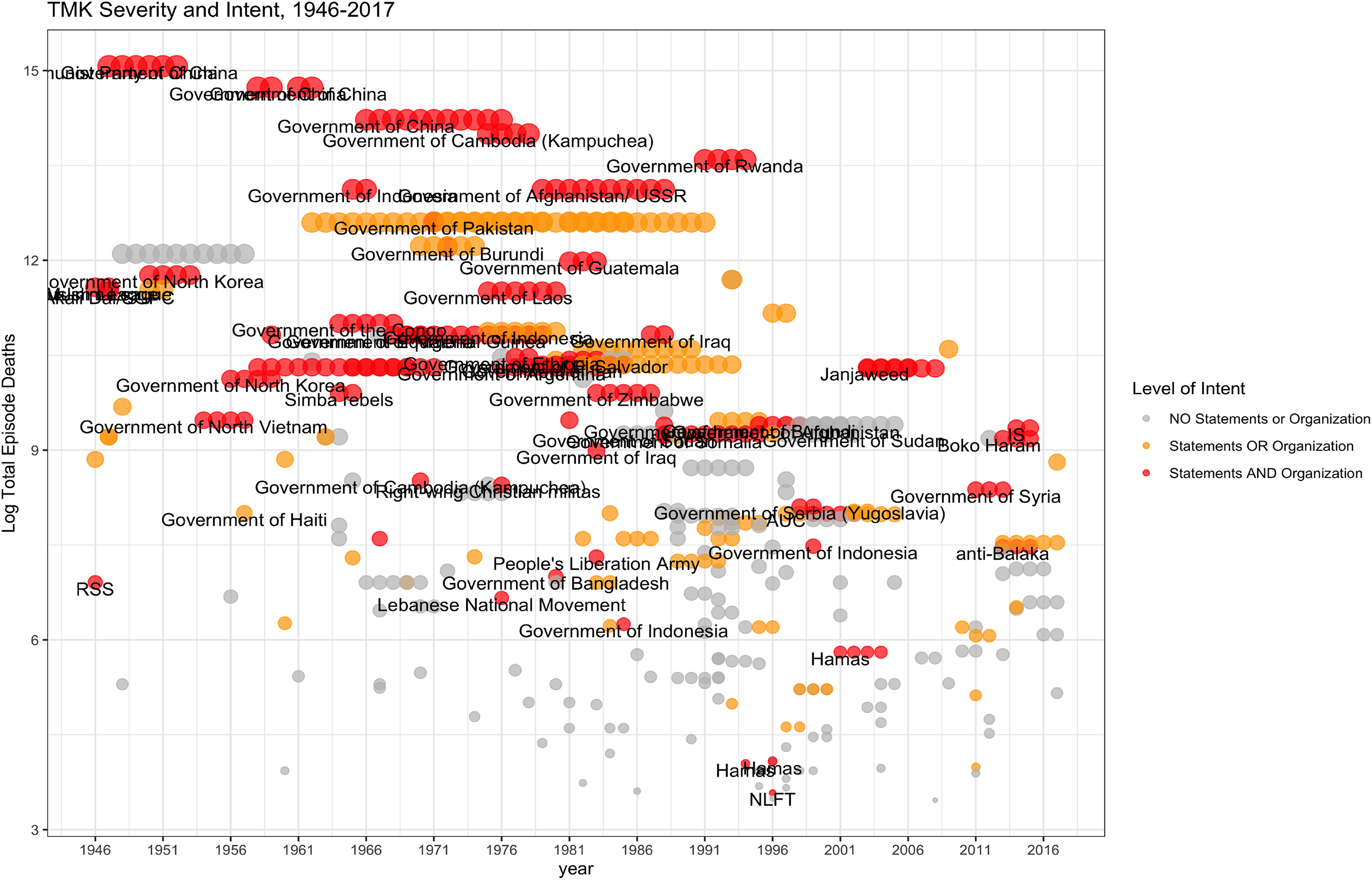
Targeted mass killing severity and intent (1946–2017).
Figure 5 shows that the severity of TMK episodes has declined over time and that evidence of intent is not always accompanied by the highest levels of severity. After the end of the Cold War, escalation of some cases was arguably prevented by the international community such as Indonesia (East Timor, 1999) and the Central African Republic (2011–2013). Some orange cases also appear to have been defused before escalation such as Libya (2011) and South Sudan (2013). The ability to identify attempted episodes is a useful feature of the TMK data. Harff (2003) uses years of political instability (civil war or adverse regime changes) 8 to identify cases where genocide/politicide are likely. However, political instability would be a poor proxy for attempted genocide (and there is no indication that she intended it as such). As a brief example, in 2013, there was ongoing instability (as identified by the PITF) in twenty-six countries, while we record only seven cases of TMK in this year, including cases that are plausibly attempted genocides. The South Sudan case in particular was at significant risk of escalating to genocide if not for the intervention of the United Nations (HRW 2014). Serious political instability at best weakly suggests probable attempted genocides that the TMK data capture with a lower death threshold and a closer focus on actor intent. A handful of these cases involve nonstate actors such as Hamas, the Lebanese National Movement, or the Simba Rebels (Democratic Republic of Congo). 9
The differences in onsets of TMK and PITF genocide/politicide are displayed in Figure 6. 10 In green are the number of onsets that match (are the same across the TMK and PITF data sets). In blue are onsets identified by TMK only and in red are PITF-only onsets. There are twenty-four matches and 147 onsets that are TMK only. Interestingly, eighteen onsets are PITF only. The majority are cases where we identify onsets earlier or later than PITF (e.g., in Uganda, Syria, Sudan, Sri Lanka, Myanmar, Philippines, Iraq, Iran, China). However, at least five appear to be genuine discrepancies where on our assessment PITF episodes did not qualify as TMK episodes (Angola [1975 and 1998], Iraq [1963], Zaire [1977], and Pakistan [1973]).
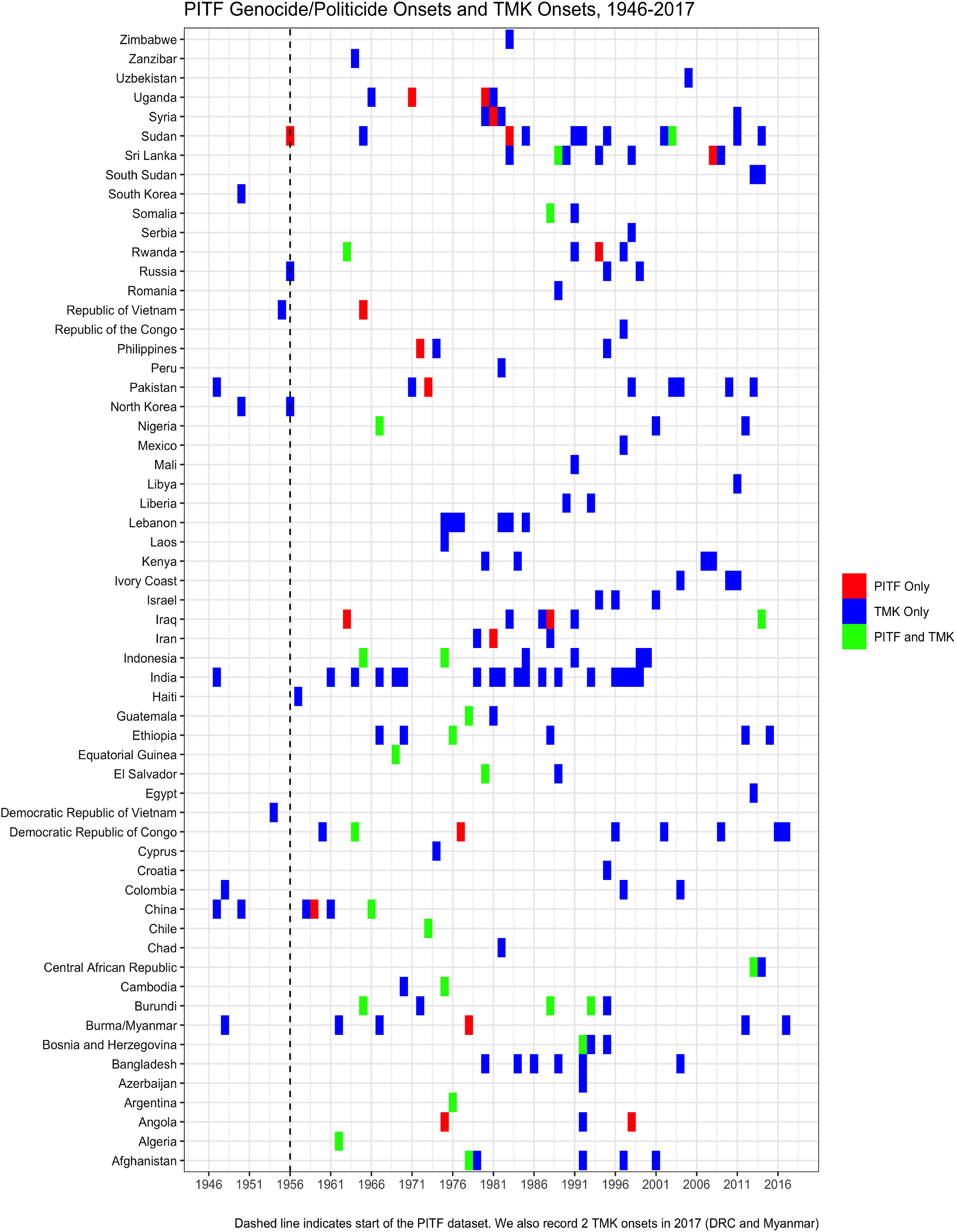
Political instability task force genocide/politicide onsets and targeted mass killing onsets (1946–2017).
We can briefly explore reasons for the discrepancies using the two cases from the Angolan Civil War which did not qualify for inclusion in our data set but are included in the PITF genocide/politicide data set. PITF codes genocide events in Angola for 1975 through 1994 and again for 1998 through 2002. In our assessment, the civil war included the regular targeting of civilians, but the available evidence indicates that most civilian deaths were caused by war-related disease and starvation, not direct violence, and analysis of those direct killings indicates that civilian targeting was mainly linked to battlefield territorial loss. Specifically, while retreating in the aftermath of battles, Angolan government forces and those of the rebels (National Union for the Total Independence of Angola) were just as likely to target their coethnics and supporters as they were other ethnic groups or supporters of the other side. Ziemke (2012, 29) argues that this is due to both sides fearing civilian defections when the war looked to be turning against them such that “combatants preemptively strike out, deliberately honing their violence to appear irrational and harsh in order to send a message to others” (see also Heywood 2011; Thaler 2012). In the absence of evidence of disproportionate targeting of an ethnic, religious, or political group, these cases do not qualify as TMK and cannot meet our criteria for genocide.
Correlates of TMK Onset
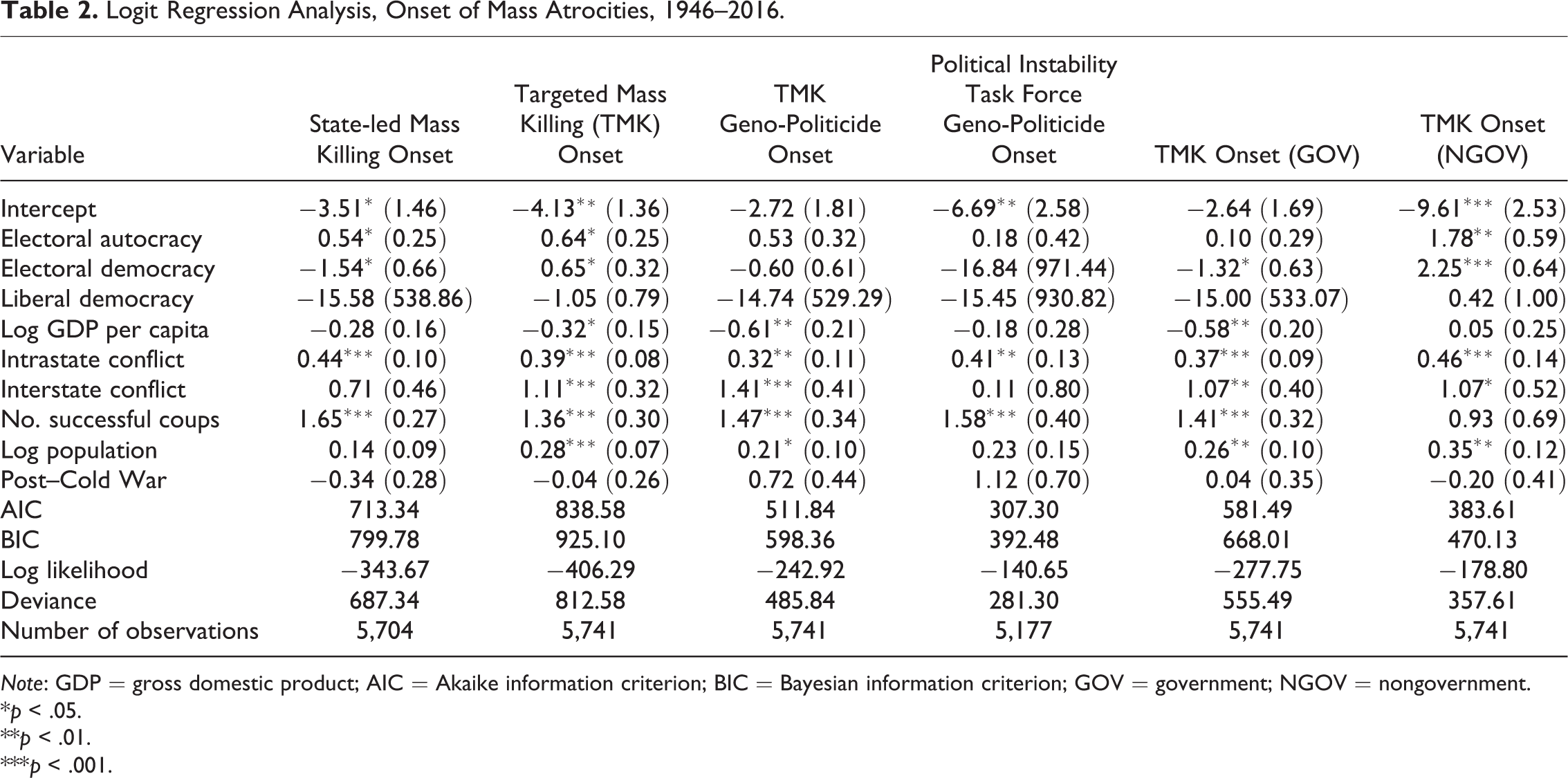
This section presents an extension of Wayman and Tago (2010) as an initial comparison of the correlates of TMK onsets with the correlates of onsets of PITF genocide/politicide and SSMK. 11 Wayman and Tago (2010) analyze the 1949 to 1987 period, and we expand this to 1946 to 2016. We focus on the same categories of variables, although measured differently as new data have become available. Specifically we examine (1) how intrastate war, interstate war, and the occurrence of coups d’état condition the onset of TMK with the UCDP Armed Conflict Database and the Integrated Network for Societal Conflict Research Coups Dataset and (2) associations with types of political regimes, specifically with the Regimes of the World indicators (Lührmann, Tannenberg, and Lindberg 2018) for closed and electoral autocracy, and electoral and liberal democracy (with the reference category being closed autocracy). We also examine (3) associations with development measured as gross domestic product per capita (logged and lagged by one year) from the World Bank Databank. Further extensions include a variable for the total population of each country (in log) and a dummy variable for the post–Cold War period (i.e., post-1990). Table 2 shows the results of logit models of the following dependent variables: (1) SSMK onset, (2) TMK onset, (3) TMK genocide/politicide onset, (4) PITF genocide/politicide onset, (5) TMK onset (government actors only), and (6) TMK onset (nonstate actors only). The results should be interpreted as associations only—we make no causal claims.
Logit Regression Analysis, Onset of Mass Atrocities, 1946–2016.
Note: GDP = gross domestic product; AIC = Akaike information criterion; BIC = Bayesian information criterion; GOV = government; NGOV = nongovernment.
*p < .05.
**p < .01.
***p < .001.
When comparing results using the TMK measure of genocide with that of PITF, one striking result is that economic development is negatively and significantly associated with the likelihood of genocide as measured with the TMK data but not as measured by PITF. The same negative association also holds for TMKs perpetrated by governments. These are intuitive findings—wealthier countries are less likely to experience genocide and less likely to have governments that target and kill ethnic, religious, or political groups. Possible explanations include that citizens in such countries are less easily pitted against each other in seemingly existential competition because they do not suffer from extreme scarcity of basic resources, that minority groups are less likely to rebel because their basic welfare needs can be met even if they suffer some disadvantage relative to dominant group(s), and that the state has the internal intelligence and security capability to deter or combat military challenges without resorting to mass murder. The fact that these associations emerge with TMK data but not with other data sets may suggest how the consistent coding and conceptual focus of the TMK data allow theoretically expected relationships to be identified while the potentially noisier PITF 12 or broader SSMK data obscure them.
The ability to disaggregate TMKs based on whether the government or a nongovernmental group is the perpetrator highlights another potential advantage. This gives insight into the conditions under which regime type matters for understanding mass atrocities. The results suggest that middle-range regimes, that is, electoral autocracies and electoral democracies, are more prone to TMKs perpetrated by nongovernment actors, while regime type is not significantly associated with TMKs committed by governments. This provides a potentially revealing insight into the finding of Fein (1995) that there is “more murder in the middle” and suggests why it might contradict findings using the PITF genocide data (Harff 2003).
The Online Supporting Materials show a more direct comparison with Wayman and Tago (2010) using their data from 1949 to 1987, attaching the TMK onset data and using Cox proportional hazards. The main difference is that TMK onsets are significantly correlated with interstate wars while democide onsets from Rummel and politicde onsets are not. TMKs are correlated with intrastate wars and coups, but not democracy, autocracy, military, or communist regimes.
The purpose here is to demonstrate the distinctiveness and potential utility of the TMK data, rather than to present particular new findings, but we believe the results demonstrate the unique features of the TMK data set and its considerable promise for improving the understanding and forecasting of mass atrocities in general and genocide/politicide in particular.
Conclusion
This article has described the TMK data set and discussed differences between existing data sets measuring mass atrocities and genocide and its utility for improving our understanding of these horrific events. We have described the TMK definition and coding process and visualized the basic features and distribution of the data across time and global regions in addition to graphical and statistical comparisons with the PITF genocide/politicide data and other related atrocity data sets. While assessment of the added value of the TMK data must await its use for more in-depth analysis, we hope the promise of the data is clear. We believe that the new measurements of intent, severity, and perpetrators; the potential to be customized for specific research problems; and the reliability and validity of the indicators provided can facilitate advances in knowledge, prediction, and ultimately prevention of mass atrocities.
Supplemental Material
Supplemental Material, sj-bib-1-jcr-10.1177_0022002719896405 - Introducing the Targeted Mass Killing Data Set for the Study and Forecasting of Mass Atrocities
Supplemental Material, sj-bib-1-jcr-10.1177_0022002719896405 for Introducing the Targeted Mass Killing Data Set for the Study and Forecasting of Mass Atrocities by Charles Butcher, Benjamin E. Goldsmith, Sascha Nanlohy, Arcot Sowmya and David Muchlinski in Journal of Conflict Resolution
Supplemental Material
Supplemental Material, sj-csv-1-jcr-10.1177_0022002719896405 - Introducing the Targeted Mass Killing Data Set for the Study and Forecasting of Mass Atrocities
Supplemental Material, sj-csv-1-jcr-10.1177_0022002719896405 for Introducing the Targeted Mass Killing Data Set for the Study and Forecasting of Mass Atrocities by Charles Butcher, Benjamin E. Goldsmith, Sascha Nanlohy, Arcot Sowmya and David Muchlinski in Journal of Conflict Resolution
Supplemental Material
Supplemental Material, sj-csv-2-jcr-10.1177_0022002719896405 - Introducing the Targeted Mass Killing Data Set for the Study and Forecasting of Mass Atrocities
Supplemental Material, sj-csv-2-jcr-10.1177_0022002719896405 for Introducing the Targeted Mass Killing Data Set for the Study and Forecasting of Mass Atrocities by Charles Butcher, Benjamin E. Goldsmith, Sascha Nanlohy, Arcot Sowmya and David Muchlinski in Journal of Conflict Resolution
Supplemental Material
Supplemental Material, sj-dta-1-jcr-10.1177_0022002719896405 - Introducing the Targeted Mass Killing Data Set for the Study and Forecasting of Mass Atrocities
Supplemental Material, sj-dta-1-jcr-10.1177_0022002719896405 for Introducing the Targeted Mass Killing Data Set for the Study and Forecasting of Mass Atrocities by Charles Butcher, Benjamin E. Goldsmith, Sascha Nanlohy, Arcot Sowmya and David Muchlinski in Journal of Conflict Resolution
Supplemental Material
Supplemental Material, sj-dta-2-jcr-10.1177_0022002719896405 - Introducing the Targeted Mass Killing Data Set for the Study and Forecasting of Mass Atrocities
Supplemental Material, sj-dta-2-jcr-10.1177_0022002719896405 for Introducing the Targeted Mass Killing Data Set for the Study and Forecasting of Mass Atrocities by Charles Butcher, Benjamin E. Goldsmith, Sascha Nanlohy, Arcot Sowmya and David Muchlinski in Journal of Conflict Resolution
Supplemental Material
Supplemental Material, sj-pdf-1-jcr-10.1177_0022002719896405 - Introducing the Targeted Mass Killing Data Set for the Study and Forecasting of Mass Atrocities
Supplemental Material, sj-pdf-1-jcr-10.1177_0022002719896405 for Introducing the Targeted Mass Killing Data Set for the Study and Forecasting of Mass Atrocities by Charles Butcher, Benjamin E. Goldsmith, Sascha Nanlohy, Arcot Sowmya and David Muchlinski in Journal of Conflict Resolution
Supplemental Material
Supplemental Material, sj-pdf-2-jcr-10.1177_0022002719896405 - Introducing the Targeted Mass Killing Data Set for the Study and Forecasting of Mass Atrocities
Supplemental Material, sj-pdf-2-jcr-10.1177_0022002719896405 for Introducing the Targeted Mass Killing Data Set for the Study and Forecasting of Mass Atrocities by Charles Butcher, Benjamin E. Goldsmith, Sascha Nanlohy, Arcot Sowmya and David Muchlinski in Journal of Conflict Resolution
Supplemental Material
Supplemental Material, sj-pdf-3-jcr-10.1177_0022002719896405 - Introducing the Targeted Mass Killing Data Set for the Study and Forecasting of Mass Atrocities
Supplemental Material, sj-pdf-3-jcr-10.1177_0022002719896405 for Introducing the Targeted Mass Killing Data Set for the Study and Forecasting of Mass Atrocities by Charles Butcher, Benjamin E. Goldsmith, Sascha Nanlohy, Arcot Sowmya and David Muchlinski in Journal of Conflict Resolution
Supplemental Material
Supplemental Material, sj-R-1-jcr-10.1177_0022002719896405 - Introducing the Targeted Mass Killing Data Set for the Study and Forecasting of Mass Atrocities
Supplemental Material, sj-R-1-jcr-10.1177_0022002719896405 for Introducing the Targeted Mass Killing Data Set for the Study and Forecasting of Mass Atrocities by Charles Butcher, Benjamin E. Goldsmith, Sascha Nanlohy, Arcot Sowmya and David Muchlinski in Journal of Conflict Resolution
Supplemental Material
Supplemental Material, sj-RData-1-jcr-10.1177_0022002719896405 - Introducing the Targeted Mass Killing Data Set for the Study and Forecasting of Mass Atrocities
Supplemental Material, sj-RData-1-jcr-10.1177_0022002719896405 for Introducing the Targeted Mass Killing Data Set for the Study and Forecasting of Mass Atrocities by Charles Butcher, Benjamin E. Goldsmith, Sascha Nanlohy, Arcot Sowmya and David Muchlinski in Journal of Conflict Resolution
Supplemental Material
Supplemental Material, sj-tex-1-jcr-10.1177_0022002719896405 - Introducing the Targeted Mass Killing Data Set for the Study and Forecasting of Mass Atrocities
Supplemental Material, sj-tex-1-jcr-10.1177_0022002719896405 for Introducing the Targeted Mass Killing Data Set for the Study and Forecasting of Mass Atrocities by Charles Butcher, Benjamin E. Goldsmith, Sascha Nanlohy, Arcot Sowmya and David Muchlinski in Journal of Conflict Resolution
Supplemental Material
Supplemental Material, sj-tex-2-jcr-10.1177_0022002719896405 - Introducing the Targeted Mass Killing Data Set for the Study and Forecasting of Mass Atrocities
Supplemental Material, sj-tex-2-jcr-10.1177_0022002719896405 for Introducing the Targeted Mass Killing Data Set for the Study and Forecasting of Mass Atrocities by Charles Butcher, Benjamin E. Goldsmith, Sascha Nanlohy, Arcot Sowmya and David Muchlinski in Journal of Conflict Resolution
Supplemental Material
Supplemental Material, sj-tex-3-jcr-10.1177_0022002719896405 - Introducing the Targeted Mass Killing Data Set for the Study and Forecasting of Mass Atrocities
Supplemental Material, sj-tex-3-jcr-10.1177_0022002719896405 for Introducing the Targeted Mass Killing Data Set for the Study and Forecasting of Mass Atrocities by Charles Butcher, Benjamin E. Goldsmith, Sascha Nanlohy, Arcot Sowmya and David Muchlinski in Journal of Conflict Resolution
Supplemental Material
Supplemental Material, sj-tex-4-jcr-10.1177_0022002719896405 - Introducing the Targeted Mass Killing Data Set for the Study and Forecasting of Mass Atrocities
Supplemental Material, sj-tex-4-jcr-10.1177_0022002719896405 for Introducing the Targeted Mass Killing Data Set for the Study and Forecasting of Mass Atrocities by Charles Butcher, Benjamin E. Goldsmith, Sascha Nanlohy, Arcot Sowmya and David Muchlinski in Journal of Conflict Resolution
Supplemental Material
Supplemental Material, sj-tex-5-jcr-10.1177_0022002719896405 - Introducing the Targeted Mass Killing Data Set for the Study and Forecasting of Mass Atrocities
Supplemental Material, sj-tex-5-jcr-10.1177_0022002719896405 for Introducing the Targeted Mass Killing Data Set for the Study and Forecasting of Mass Atrocities by Charles Butcher, Benjamin E. Goldsmith, Sascha Nanlohy, Arcot Sowmya and David Muchlinski in Journal of Conflict Resolution
Supplemental Material
Supplemental Material, sj-tex-6-jcr-10.1177_0022002719896405 - Introducing the Targeted Mass Killing Data Set for the Study and Forecasting of Mass Atrocities
Supplemental Material, sj-tex-6-jcr-10.1177_0022002719896405 for Introducing the Targeted Mass Killing Data Set for the Study and Forecasting of Mass Atrocities by Charles Butcher, Benjamin E. Goldsmith, Sascha Nanlohy, Arcot Sowmya and David Muchlinski in Journal of Conflict Resolution
Supplemental Material
Supplemental Material, sj-tex-7-jcr-10.1177_0022002719896405 - Introducing the Targeted Mass Killing Data Set for the Study and Forecasting of Mass Atrocities
Supplemental Material, sj-tex-7-jcr-10.1177_0022002719896405 for Introducing the Targeted Mass Killing Data Set for the Study and Forecasting of Mass Atrocities by Charles Butcher, Benjamin E. Goldsmith, Sascha Nanlohy, Arcot Sowmya and David Muchlinski in Journal of Conflict Resolution
Footnotes
Acknowledgments
We thank Jonathan Pinckney, Ole Magnus Theisen, Jesse Dillon Savage, Indra de Soysa, Karin Dyrstad, Tibi Galis, Ben Valentino, Ernesto Verdeja, and participants in the 2018 I-GMAP Conference at Binghamton University and the 2019 PREVIEW Conference at the German Federal Foreign Office in Berlin for valuable feedback. We also thank John Laidlaw Gray and Harry Maher for valuable research assistance.
Declaration of Conflicting Interests
The author(s) declared no potential conflicts of interest with respect to the research, authorship, and/or publication of this article.
Funding
The author(s) disclosed the following financial support for the research, authorship, and/or publication of this article: Australian Research Council (Grant ID: DP160101122), University of Otago Research Grant (2015).

Supplemental Material
Supplemental material for this article is available online.
Notes
References
Supplementary Material
Please find the following supplemental material available below.
For Open Access articles published under a Creative Commons License, all supplemental material carries the same license as the article it is associated with.
For non-Open Access articles published, all supplemental material carries a non-exclusive license, and permission requests for re-use of supplemental material or any part of supplemental material shall be sent directly to the copyright owner as specified in the copyright notice associated with the article.
