







Abstract
How do concerns about fairness shape foreign policy preferences? In this article, we show that fairness has two faces—one concerning equity, the other concerning equality—and that taking both into account can shed light on the structure of important foreign policy debates. Fielding an original survey on a national sample of Americans, we show that different types of Americans think about fairness in different ways, and that these fairness concerns shape foreign policy preferences: individuals who emphasize equity are far more sensitive to concerns about burden sharing, are far less likely to support US involvement abroad when other countries aren’t paying their fair share, and often support systematically different foreign policies than individuals who emphasize equality. As long as IR scholars focus only on the equality dimension of fairness, we miss much about how fairness concerns matter in world politics.
From alliance politics to climate change, many of the central challenges in international politics today relate to questions of fairness. Superpowers who contribute more to collective defense complain about burden sharing (Oneal 1990), while rapidly growing economies like China bristle at the prospect of suffering disproportionate economic harm to protect the global environment. Fairness concerns pervade territorial disputes (Goddard 2006), peace negotiations (Albin and Druckman 2012), international cooperation (Kapstein 2008; Kertzer and Rathbun 2015; Efrat and Newman 2016), and the domestic politics of crisis bargaining (Gottfried and Trager 2016). Among policymakers, fairness appears to be a bipartisan principle: Democratic President Obama once declared that “free riders aggravate me” and warned British Prime Minister David Cameron to “pay your fair share” in military spending or risk the “special relationship.” 1 A few years later, Republican President Trump echoed Obama’s concerns that NATO allies’ reliance on U.S. defense spending was simply “not fair” 2 while also decrying China’s “unfair trade practices.” 3
What makes a foreign policy action “unfair”? We argue that fairness has two faces. IR scholars tend to discuss fairness primarily in terms of equality—in which something is fair if everyone receives the same outcome (see, e.g., Baldwin 1993; Albin and Druckman 2012; Kertzer and Rathbun 2015; Gottfried and Trager 2016). This is consistent with a voluminous body of research on the ultimatum game, which finds that players often reject offers that deviate from a 50-50 resource division because unequal allocations are perceived as unfair (Güth, Schmittberger, and Schwarze 1982). The IR literature on relative gains reaches similar conclusions, finding that actors dislike agreements that cause them to gain less than the other side (Grieco 1988; Mutz and Kim 2017).
Yet equality is not the only criterion used to judge what’s “fair”—many actors are also motivated to maintain equity. Equity implies that differential rewards are fair if they are proportional to actors’ relative contributions (Adams 1965). Capturing this distinction is especially important given ideological divides in American politics. Although most Americans report a commitment to fairness in the abstract (Graham, Haidt, and Nosek 2009), they disagree on what fairness looks like in practice, with liberals expressing more concern about equality than conservatives, for example (Haidt 2012; DeScioli et al. 2014; Jost, Federico, and Napier 2009; Meegan 2019). As Hochschild (1981) and Fiske and Tetlock (1997, 276) note, the tension between these two fairness conceptions animates many of the key debates in American political culture. Yet apart from research on inequity aversion in international political economy (IPE; Lü, Scheve, and Slaughter 2012; Bechtel, Hainmueller, and Margalit 2017), IR scholars who invoke fairness have almost exclusively focused on equality rather than equity, thereby neglecting fairness’ second face.
In this article, we argue that both equity and equality have important implications for the study of international politics, and we seek to make three important contributions to research on fairness in foreign policy. First, we introduce a new way to measure individual differences in equity and equality concerns that we believe will be useful for future research on fairness in both IR and political science more generally. Since respondents can have different principles in mind when they report that fairness matters using standard survey items (Rathbun, Powers, and Anders 2019), we elicit moral judgments about specific equity or equality violations in everyday life. In an original national survey of American adults, we find that the two faces of fairness form distinct factors: some Americans care about equity, some care about equality, and some care about both.
Second, we show that the distinction between these two faces of fairness can help explain debates in the United States about burden sharing. Although burden sharing is one of the central dilemmas in contemporary foreign policy, looming large in debates about the future direction of American grand strategy (S. G. Brooks and Wohlforth 2016), climate policy negotiations (Bernauer, Gampfer, and Kachi 2014), and global governance more generally, it is strangely understudied in American public opinion about foreign policy. We show that individual differences in concerns about equity meaningfully shape Americans’ attitudes about burden sharing in international politics, and can help explain the bipartisan aversion to disproportionate U.S. contributions. These findings are consistent with bottom-up theories of public opinion about foreign policy, offering another example of how personal values spill over into the foreign policy domain (Rathbun et al. 2016; Kertzer and Zeitzoff 2017): the more concerned about equity individuals are in their daily lives, the more they are bothered by burden sharing imbalances in foreign policy.
Finally, we turn to a broader selection of foreign policy issues. We show that equality concerns are associated with support for policies that advance joint gains, and equity concerns are associated with support for policies that maximize relative gains. As a result, the effects of each face of fairness on foreign policy preferences sometimes diverge: equality predicts support for free trade, for example, while equity predicts support for protectionism, and these results hold even when controlling for partisanship or political ideology. Together, our results demonstrate that as long as IR scholars primarily focus on a single equality dimension of fairness, and associate fairness exclusively with prosociality, we miss much about how fairness concerns shape foreign policy.
What’s Fair in Foreign Policy?
One of the central puzzles in the study of public opinion about foreign policy is how the mass public comes to form its judgments about foreign policy issues, despite knowing relatively little about international politics. The political science literature on this subject has largely fallen into two camps. Some scholars offer top-down models, in which members of the public overcome their uncertainty about foreign policy issues by taking cues from trusted political elites, usually the leaders of their preferred political party (e.g., Berinsky 2009; Baum and Potter 2015; Guisinger and Saunders 2017). Others offer bottom-up models, in which members of the public overcome their uncertainty about foreign policy issues by drawing on their basic value systems or orientations (e.g., Hurwitz and Peffley 1987; Goren et al. 2016; Kertzer and Zeitzoff 2017). Unlike in top-down models, which assume citizens are partisan but not ideological, bottom-up models argue that citizens have more structured policy preferences than cynics suggest, because the same values that shape our behavior in our personal lives also shape our foreign policy preferences (Rathbun et al. 2016). People who care about retribution, for example, are more likely to support punitive wars (Liberman 2006) and oppose unconditional financial bailouts (Rathbun, Powers, and Anders 2019). The value commitments that predict our lifestyle choices or consumption behaviors also predict our foreign policy preferences (Cohrs et al. 2005; Kertzer et al. 2014; Bayram 2015; Kreps and Maxey 2018).
One value that occupies a prominent place in this literature—and in the psychology of morality more generally—is fairness (e.g., Graham, Haidt, and Nosek 2009; Rai and Fiske 2011; Meegan 2019). Concerns about fairness are usually seen as having evolutionary origins: people must be able to detect and punish cheaters if they want to enjoy the spoils from cooperation and guard themselves against exploitation (Haidt 2012), and fairness concerns typically begin to appear in children around the age of five (Fehr, Bernhard, and Rockenbach 2008). Political scientists have thus linked fairness concerns to a range of phenomena in international politics, including crisis bargaining (Gottfried and Trager 2016), post-war peace negotiations (Albin and Druckman 2012), diplomacy (Kertzer and Rathbun 2015), international humanitarian law (Chu 2019), international cooperation (Efrat and Newman 2016), and foreign direct investment (Chilton, Milner, and Tingley 2020).
What IR scholars have neglected, however, is that “fairness” carries multiple meanings, based on different moral principles (Hochschild 1981; Rasinski 1987; Jennings 1991; Trump 2018; Brutger and Rathbun 2020). While there are debates in both normative and empirical research about the number of distinct allocation principles (Deutsch 1975; Scott et al. 2001), for our purposes we follow Rasinski (1987) in focusing on two principles in particular: equality and equity.
Equality implies a concern with egalitarian outcomes: an agreement or distribution is fair when actors attain equivalent end-states. Behavioral economic games routinely find that participants prefer resources to be distributed equally among players (e.g., Güth, Schmittberger, and Schwarze 1982; Thaler 1988; Fehr and Schmidt 1999). In ultimatum games where initial endowments are fixed by the experimenter, for example, receivers usually “put their money where their mouth is” and reject unequal offers from proposers (Camerer 1997, 169), choosing to receive nothing at all rather than accept less than 50 percent of the pot. 4 Other research illustrates that equality-minded individuals support policies that promote symmetric outcomes without regard to whether some beneficiaries contribute more resources than others. In American politics, for example, concerns about equality tend to be linked with support for social programs like welfare (Feldman and Zaller 1992). The same pattern applies in an IR context: If the purpose of an alliance is to ensure equal security for all parties, the “fairest” arrangement might require wealthy members like the U.S. to spend more than their poorer allies.
Equity, in contrast, shifts the focus from outcomes to inputs. Equity implies a concern with proportionality: resource allocations should account for beneficiaries’ perceived contributions (Rai and Fiske 2011). Individuals who value equity believe that people ought to reap what they sow. 5 The actor who contributes more to a common resource merits a bigger slice of the pie: according to the equity principle, actors’ payoffs should be proportionate to their effort (Adams 1965; DeScioli et al. 2014). Inequity occurs when individuals share a resource but some beneficiaries shoulder more of a burden for supplying it. Demands that welfare recipients work to receive benefits often invoke equity principles, for example, and research on free-riding demonstrates that equity violations plague social dilemmas (Ostrom 1998). Fuhrmann (2020) describes how weaker states in an alliance have incentives to free-ride because they can benefit from collective deterrence while powerful allies like the U.S. pay the costs. When policymakers protest that it is unfair for some NATO members to dedicate the requisite 2 percent of their GDP to defense while others spend less but receive the same security benefits from the alliance, they call attention to inequity. Free-riding is common, but inequitable. 6
Despite evidence that people evaluate fairness in terms of both equality and equity, IR scholarship almost exclusively focuses on the former. When Albin and Druckman (2012), for example, find that “just” civil war settlements are more durable than their unfair counterparts, they focus on the distributive justice principle of equality. Former belligerents prefer agreements that provide equal rights for citizens of all parties to the agreement alongside equal political power. Efrat and Newman (2016) similarly rely on equality when they argue that states will be more likely to defer child abduction cases to partners whose legal systems are fair. In public opinion, Kertzer et al. (2014), Kreps and Maxey (2018), and Cram et al. (2018) similarly define fairness in terms of equal treatment for individuals.
Equality’s privileged place in research on fairness in IR is significant for several reasons. 7 First, we know that equity and equality tend to dominate in different domains in domestic politics—equality reigns in the family, but equity in the marketplace, for example (Hochschild 1981; Jennings 1991), such that splitting food equally tends to be considered fair, while splitting money equally regardless of contribution is not (DeVoe and Iyengar 2010). But we have little sense of when each principle dominates in the foreign policy realm.
Second, those few IR scholars who do study equity tend to treat equity preferences as a constant, rather a variable. Scholarship on inequity aversion in IPE assumes that everyone bristles at inequity (Lü, Scheve, and Slaughter 2012; Bechtel, Hainmueller, and Margalit 2017). Yet an ever-growing body of psychology research tells us that people vary in their commitment to moral principles (Graham, Haidt, and Nosek 2009). Consistent with research on the role of equality in foreign policy public opinion (Kertzer et al. 2014), we can treat equity concerns as an individual difference, asking not just whether equity matters, but for whom. Like the business-minded leaders in Fuhrmann’s (2020) research on free-riding, some members of the public might be especially sensitive to imbalances between inputs and outcomes.
Third, and related, research in social psychology shows that liberals value equality more than their conservative counterparts (Haidt 2012; Starmans, Sheskin, and Bloom 2017; Meindl, Iyer, and Graham 2019). When conservatives invoke fairness in domestic politics, they tend to be concerned primarily with whether those who work hard or pay more taxes reap appropriate rewards, whereas liberals emphasize both equity and equality, hoping to advance societal well-being by meeting everyone’s basic needs. This distinction illuminates partisan differences about welfare work requirements, for example, but also clarifies important areas of convergence such as the widespread support for social security across the ideological spectrum: working Americans all “pay in” but the program provides some financial stability for all citizens (Haidt 2013; Meegan 2019). Disaggregating fairness also enriches our understanding of how fairness shapes foreign policy attitudes. If equality is primarily a liberal value, but equity matters to Americans across the ideological spectrum, we can make sense of the cross-partisan nature of complaints about free-riding in U.S. foreign policy. Moreover, psychologists have also found gender differences in fairness preferences: whether due to structural societal differences or early childhood socialization, women often display stronger preferences for equality than men do (Rasinski 1987; Scott et al. 2001). If fairness attitudes are correlated with distinctive foreign policy preferences, the tension between these competing fairness principles could explain part of the gender gap in public opinion about foreign affairs (D. J. Brooks and Valentino 2011; Mansfield, Mutz, and Silver 2015; Eichenberg and Stoll 2012; Lizotte 2019).
Our initial goal, then, is to replicate existing findings in the psychological literature with additional evidence that different types of Americans think about fairness in different ways: to demonstrate that equity and equality are distinct moral principles, and to map constituencies that support each face of fairness. These considerations lead to our first hypothesis:
Support for Hypothesis 1 would largely confirm previous work, though we introduce a new way to measure individual differences in these distinct dimensions of fairness. But we further claim that both faces of fairness matter for foreign policy preferences in different ways. IR scholars often portray fairness as a prosocial value that inspires international cooperation by promoting positive reciprocity (Kertzer et al. 2014; Kertzer and Rathbun 2015), but this expectation only holds if we limit our understanding of fairness to equality. Because equality-minded Americans prioritize outcomes, they are inclined toward foreign policies that maximize jointly enjoyed gains and improve global conditions. In pursuit of parity, they set aside egoistic concerns about the U.S.’s return on their foreign policy investments—like whether the U.S. gains more relative to other states or contributes more resources than its partners in pursuit of just, egalitarian ends. 8 The U.S. can contribute to egalitarian outcomes by working through international institutions like the UN, providing foreign aid to developing countries, or helping to clean up the global environment so that everyone has equal access to clean air. Each policy is compatible with an equality principle: The fact that the U.S. might be required to contribute more to institutions, aid, or environmental protection than other states does not undermine fairness when it is defined as equality. This logic explains why previous research reports a relationship between fairness values and cooperative internationalism (Kertzer et al. 2014), or between equality-oriented predispositions like Social Dominance Orientation and support for trade agreements that maximize joint rather than relative gains (Mutz and Kim 2017).
By contrast, equity-oriented individuals attend to the cost side of the equation. Just as research on retribution demonstrates how concerns about justice can lead to aggression (Liberman 2006; Rathbun and Stein 2020), we argue that equity-minded Americans will oppose international cooperation on the basis of fairness. Equity does not imply prosociality. An equity principle demands that actors receive rewards that reflect their relative contributions, a situation that rarely obtains when the U.S. responds to distant global problems.
We therefore expect that compared to equality, equity concerns will be strongly associated with negative evaluations of burden sharing problems in international politics in particular, and with opposition to policies that do not strike a balance between the price the U.S. pays and the direct benefits it receives in general. Insofar as concerns about free-riding dominate debates about everything from NATO contributions to humanitarian interventions, financial bailouts, and climate change negotiations, we miss out on important dynamics in world politics if we measure only one face of fairness. Moreover, when a policy promises global or indirect benefits at a high cost to the U.S., the two faces of fairness will diverge—equality will be associated with support whereas equity will be associated with opposition.
Together, these theoretical insights lead to two additional hypotheses:
Methods and Results
To demonstrate the value of studying both faces of fairness in IR, we conducted an original survey in August 2014 on a national sample of 1,073 Americans recruited through Survey Sampling International (SSI). Participants, 69.5 percent of whom identified as white and 51.3 percent of whom identified as female, ranged in age from 19 to 95 (median: 49) and reported a median household income of $50 to 60,000. SSI employs an opt-in method to recruit a panel of participants targeted to census quotas for sex, age, race, and region; Table 1 in Online Appendix
Fairness Vignettes: To What Extent Does Each Scenario Feel Morally Wrong?
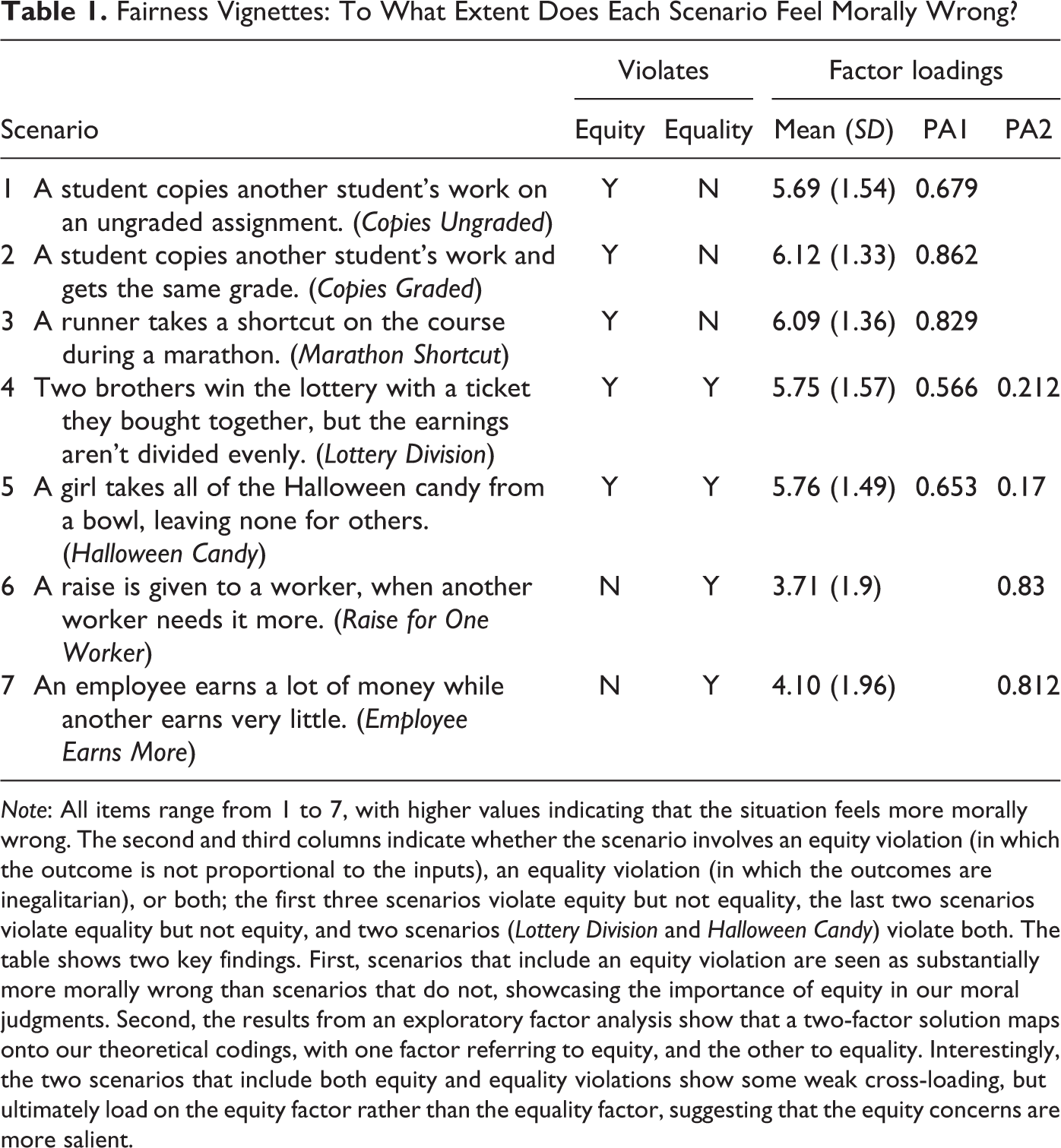
Note: All items range from 1 to 7, with higher values indicating that the situation feels more morally wrong. The second and third columns indicate whether the scenario involves an equity violation (in which the outcome is not proportional to the inputs), an equality violation (in which the outcomes are inegalitarian), or both; the first three scenarios violate equity but not equality, the last two scenarios violate equality but not equity, and two scenarios (Lottery Division and Halloween Candy) violate both. The table shows two key findings. First, scenarios that include an equity violation are seen as substantially more morally wrong than scenarios that do not, showcasing the importance of equity in our moral judgments. Second, the results from an exploratory factor analysis show that a two-factor solution maps onto our theoretical codings, with one factor referring to equity, and the other to equality. Interestingly, the two scenarios that include both equity and equality violations show some weak cross-loading, but ultimately load on the equity factor rather than the equality factor, suggesting that the equity concerns are more salient.
We present our analysis in three stages. First, we introduce our measurement strategy to show that Americans differentiate between equity and equality when they make judgments about right and wrong, and that Americans from both ends of the political spectrum value equity. Second, we show that variations in Americans’ equity commitments can help explain the polarized debates in the United States about burden sharing in American foreign policy. Third, we analyze a series of broader foreign policy issues to show that the effects of equity and equality sometimes diverge, with concerns about equality associated with support for policies that maximize global gains, and concerns about equity associated with policies that maximize relative gains. These results highlight why scholars need to consider both faces of fairness in research on public opinion in foreign policy.
Differentiating between Two Faces of Fairness
Although political scientists sometimes use the Moral Foundations Questionnaire (MFQ) to study the extent to which individuals care about people being “treated fairly” (Graham, Haidt, and Nosek 2009), our purposes preclude this and similar scales because the meaning of “fairness” here is itself ambiguous: participants could interpret “fair” treatment as equity, equality, or both—leaving us uncertain of which construct we are measuring (Rathbun, Powers, and Anders 2019; Brutger and Rathbun 2020). A key goal of this paper is to develop an alternative measurement scale that can usefully distinguish between equity and equality for future political science research.
We therefore build on Clifford et al. (2015, 1179), which develops a series of “moral foundations vignettes” to assess individuals’ moral commitments. Each vignette describes a situation in which an actor violates some moral principle, and asks respondents to evaluate whether the action feels morally wrong. The vignettes are designed both to depict violations of one value at a time, such that ideal items will discriminate between even closely related moral principles, and to distinguish moral violations from social norms. For example, the fairness vignettes avoid references to (1) physical or emotional harm, which taps the harm/care foundation, (2) hierarchical relationships, lest they invoke authority values, and (3) “race, gender, or structural equality” because these characteristics are more likely to tap other, non-moral, attitudes (Clifford et al. 2015, 1181). 10 Clifford et al. (2015, 1179) note that the moral foundations scale “relies on respondents’ rating of abstract principles, rather than judgment of concrete scenarios,” and that abstract endorsements may not always translate into political attitudes. The vignettes allow us to probe concrete moral judgments, but in scenarios taken from everyday life, rather than politics or foreign policy.
Table 1 displays the seven vignettes we employ to measure fairness attitudes, building on the fairness inventories established by Clifford et al. (2015), Iyer (2010), and Meindl, Iyer, and Graham (2019). For each vignette, participants indicated the extent to which the situation felt morally wrong on a seven-point scale from “not at all wrong” to “extremely wrong.” The first three vignettes in Table 1 depict clear equity violations, where individuals receive outcomes that are not proportionate to the inputs they provide. For example, “A student copies another student’s work and gets the same grade,” or “A runner takes a shortcut on the course during a marathon” both describe outcomes that do not accurately correspond to individuals’ contributions. These scenarios are not problematic on equality principles (we don’t care about guaranteeing equality of outcomes when evaluating assignments, or on a race course) but are problematic on equity principles (we expect that individuals who perform better will be rewarded as such).
The last two vignettes capture clear equality violations, where actors fail to attain equivalent end-states. It might be considered fair from an equity perspective when “An employee earns a lot of money while another earns very little” (since under equity principles, earnings can be guided by merit), but this asymmetry in wages is considered unfair from an equality perspective (Meindl, Iyer, and Graham 2019). Finally, two of the vignettes depict a violation both of equity principles and of equality principles. In the lottery division scenario (“Two brothers win the lottery with a ticket they bought together, but the earnings aren’t divided evenly”), the uneven division of the winnings not only represents an equality violation, but also an equity violation, since the two brothers bought the ticket together. In the halloween candy scenario (“A girl takes all of the halloween candy from a bowl, leaving none for others”), the girl who absconds with the candy not only fails to split it evenly with others (an equality violation), but given the lack of information indicating she was the one who provided all of the candy in the first place, likely takes a haul that is disproportionate to her contributions (an equity violation).
Two additional points are worth noting about Table 1. First, the table presents basic descriptive statistics for each vignette. Although the means for most of the items are relatively high—consistent with extensive research showing that fairness is an important moral principle for most Americans (Graham, Haidt, and Nosek 2009; Haidt 2013)—some are substantially higher than others: scenarios that include an equity violation are seen by our respondents as more morally wrong than scenarios that do not, showcasing the importance of equity in our moral judgments.
Second, we conducted an exploratory factor analysis (EFA) on the fairness vignettes. If fairness is unidimensional—if moral judgments about fairness violations depend on a single principle—we would find that one factor explains most of the common variance in the data. Instead, parallel analysis and model fit statistics suggest a two factor solution, which fits the data well (TLI=
To obtain respondent-level measures for sensitivity to different types of fairness concerns, we extract factor scores from the factor analysis and produce latent measures for concerns about equity (
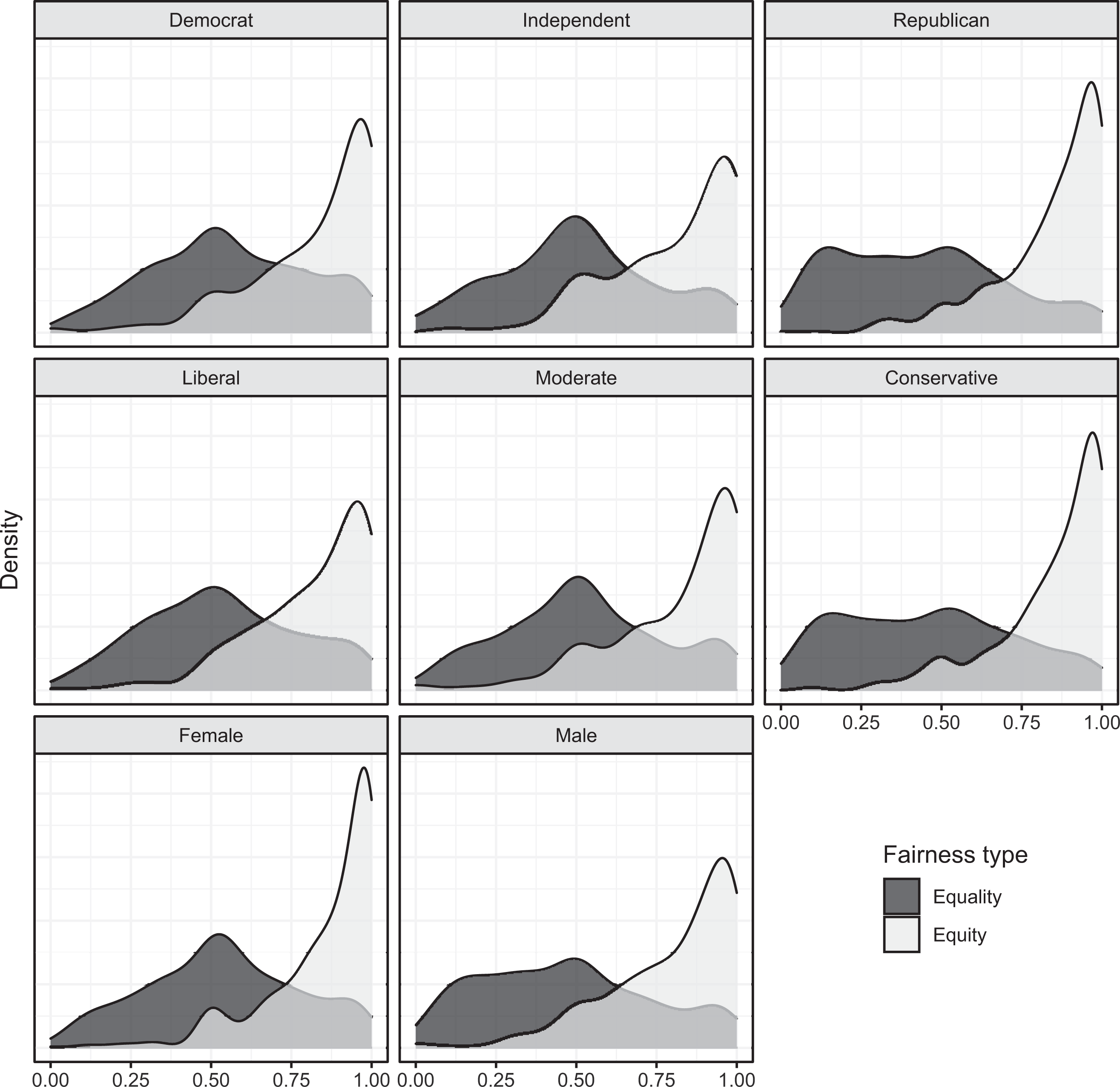
Strong concerns about equity across demographic groups.
Finally, we find even starker differences with respect to gender. Women care significantly more about fairness violations than men do, both for equity (
Equity Predicts Opposition to Burden Sharing Violations
Our initial findings show that most Americans value equity. We therefore turn to a specific class of foreign policy issues where we expect this type of moral principle to loom particularly large: burden sharing. Despite the fact that burden sharing concerns animate contemporary debates about the most consequential foreign policy issues from NATO to the Paris Climate Agreement, they are rarely included in standard measures of foreign policy attitudes (e.g., Hurwitz and Peffley 1987; Chittick, Billingsley, and Travis 1995; Rathbun et al. 2016; Gravelle, Reifler, and Scotto 2017). We argue that when members of the public decry actions in which the U.S. bears disproportionately large costs, they transfer their general concern for equity in their daily lives to the foreign policy domain.
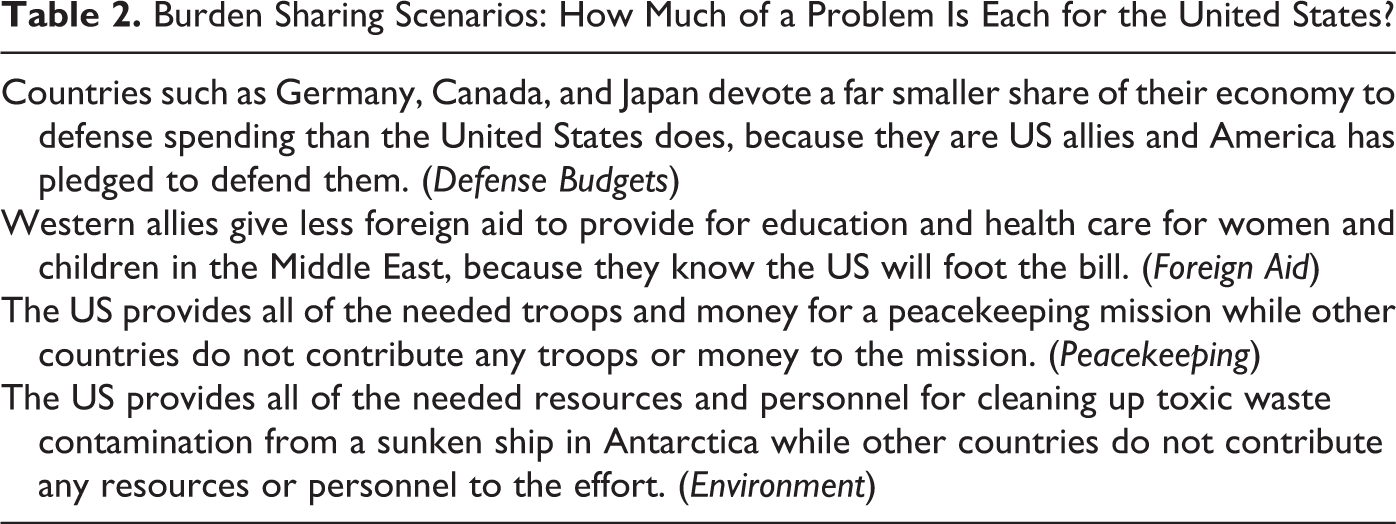
Our four dependent variable questions solicit individual reactions to common scenarios in which the U.S. makes a substantial contribution to resolve a collective problem. Participants responded to four hypothetical foreign engagements and rated the extent to which each poses a problem for the U.S. on a scale from 1 (“not a problem at all”) to 7 (“a very big problem”). Each item, listed in Table 2, describes a different substantive domain in which the U.S. plays a dominant role in resolving a collective problem. Defense Budgets, for example, implicates U.S. allies who earmark fewer resources for defense, while Environment introduces a hypothetical scenario in which the U.S. foots the bill for an environmental disaster in international waters. The scenarios each highlight the concerns about proportionality that plague foreign policy questions across issue areas. In creating the four scenarios, we aim to capture a set of problems that implicate equity and demonstrate its important role in foreign policy public opinion. We turn to a broader set of foreign policy problems that implicate both equity and equality in a subsequent section below.
Burden Sharing Scenarios: How Much of a Problem Is Each for the United States?
In addition to factor scores for equity and equality, our primary independent variables, we control for three widely-used scales for foreign policy orientations—militant internationalism, cooperative internationalism, and isolationism (Wittkopf 1990). Militant internationalism (MI) refers to an inclination to use force to achieve foreign policy goals, and emphasizes the importance of demonstrating military resolve. This measure of military assertiveness thus taps the familiar distinction between foreign policy hawks and doves. Cooperative internationalism (CI) captures the extent to which individuals want the U.S. to work with other states and international institutions to solve global problems like climate change (Wittkopf 1990). It entails a commitment to global participation but not to military force. For isolationism, we include a scale that taps this general preference for disengagement from the world—a stance that maintains that America should “come home” and scale down its conception of itself as a leader (Chittick, Billingsley, and Travis 1995).
Finally, we included a battery of demographic questions alongside measures of partisanship and ideology. Participants report their age, sex, race, education attainment (from less than high school to Post-graduate), income (split into quartiles for analysis), and U.S. region of residence (midwest, northeast, south, or west). We measure self-reported partisanship with a seven-point scale where a 7 indicates strong Republican, and ideology on a seven-point scale from extremely liberal to extremely conservative. The fairness vignettes, burden sharing violations, foreign policy orientations, and demographics appeared in separate, randomly ordered blocks.
Table 3 presents estimates from a series of OLS regression models that predict responses to the four burden sharing vignettes. The dependent measures and continuous independent variables have been rescaled from 0 to 1, and higher values indicate that participants rated the scenario a bigger problem for the United States. Positive coefficients suggest that stronger commitments to the moral principle are associated with less support for America taking on an “unfair” global burden. Models 2, 4, 6, and 8 include foreign policy orientations and demographic controls.
Americans High in Equity Preferences Tend to be More Concerned about Burden Sharing Violations in US Foreign Policy.
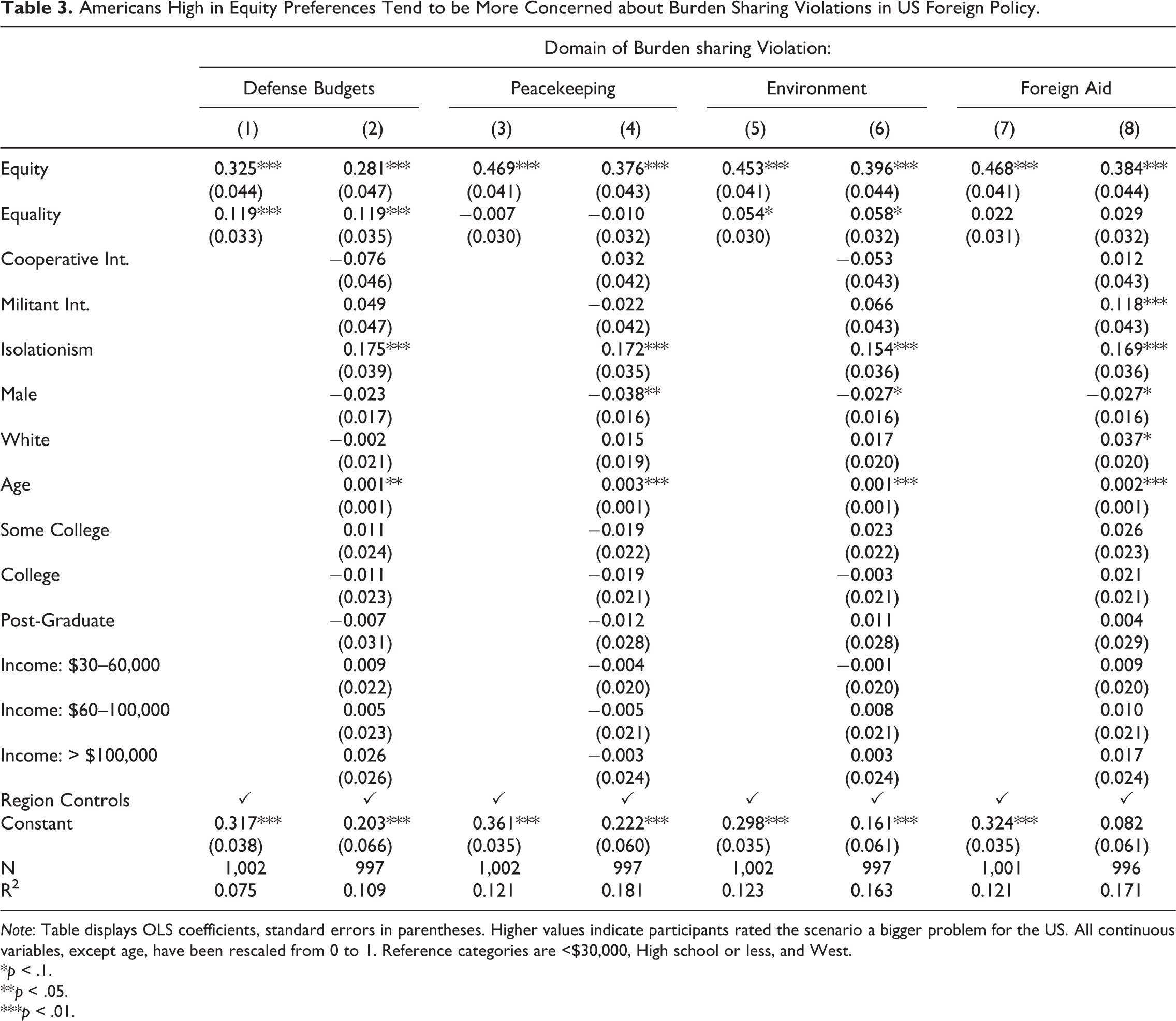
Note: Table displays OLS coefficients, standard errors in parentheses. Higher values indicate participants rated the scenario a bigger problem for the US. All continuous variables, except age, have been rescaled from 0 to 1. Reference categories are <$30,000, High school or less, and West.
*p < .1.
**p < .05.
***p < .01.
Consistent with H2, equity is a statistically and substantively important predictor of attitudes toward U.S. contributions to global problems. The extent to which individuals believe that input/output ratios dictate whether an action should be deemed moral or immoral predicts their view of whether certain foreign policy activities are justifiable. Indeed, the environment, foreign aid, and peacekeeping vignettes draw almost exclusively on equity concerns—not equality. In the case of environmental cleanup in Antarctica, a move from the minimum to the maximum on equity is associated with a 0.453-unit increase in the policy preferences—a shift in nearly half the 0 to 1 scale. Since Antarctica does not belong to just one state, the cleanup arguably benefits all global actors. Like President George W. Bush, who avowed that he would not “let the United States carry the burden for cleaning up the world’s air,” equity-minded citizens think that other states should contribute if they expect to reap the rewards from a clean environment. 14
The same logic underlies the strong association between equity and foreign aid. Because allies know that the U.S. will provide long run development benefits abroad, they shirk the opportunity to contribute a share proportionate to their GDP or relative interest in the positive externalities associated with advancing women’s healthcare. As participants’ moral commitment to equity increases, so does their disdain for this foreign aid arrangement (
In contrast, equality plays a relatively smaller role: The coefficient for equality is statistically significant in Model 5—the environment vignette (
Only burden sharing in security alliances—Models 1 and 2—seems to draw significant opposition on the basis of both equity and equality. A move from the minimum to the maximum on the equity dimension of fairness predicts a 0.325-unit increase in reporting that disproportionate defense spending is a problem for the United States. Allies contribute relatively less as a share of their GDP, and yet benefit greatly from U.S. protection. At the same time, there are disparate outcomes to consider if the U.S. is not equally secure as a consequence of their alliances. The positive coefficient on equality bears out this relationship.
Models 2, 4, 6, and 8 include three foreign policy orientations frequently identified as the main organizing structures for foreign policy attitudes (Gravelle, Reifler, and Scotto 2017) alongside demographic controls. Of the three orientations, only isolationism has a consistent and statistically significant relationship with the dependent variables. Isolationist participants report that it is problematic for the U.S. to act as the primary contributor to resolving any of the four international problems. Cooperative and militant internationalism have little bearing on how participants judge America’s unfair burdens. Importantly, the effects of equity are substantively larger than isolationism. For example, a shift from the minimum to the maximum on isolationism predicts a 0.172-unit increase in the assessment that it is a problem for the U.S. to contribute all resources to peacekeeping mission. In contrast, a shift from the minimum to maximum on equity is associated with a 0.376-unit increase in the DV—twice the size of isolationism’s effect.
The results presented in Table 3 demonstrate that Americans who care about equity express significantly greater concern about foreign policy scenarios in which the U.S. contributes more than they benefit. This pattern holds across four diverse policy domains and when we control for a range of foreign policy orientations and demographic variables. The effect of equality, however, is less consistent—the moral commitment to equal outcomes held by many left-leaning Americans predicts attitudes toward defense spending but not other forms of cooperation. The fact that equity continues to exert a substantively large effect on burden sharing attitudes even controlling for foreign policy orientations like isolationism is important: it shows that there is a class of individuals who are not necessarily predisposed to want the US to stay home and focus more on its own problems, but who are aggravated by other countries not pulling their weight. Moreover, we fielded this study in 2014, well before Donald Trump and the Republican party began amplifying concerns about “unfair” trade deals and alliance arrangements, suggesting that our results are unlikely to be the artifact of elite cues.
In Online Appendix
Equity and Equality Shape Foreign Policy Attitudes beyond Burden Sharing
Our results show that equity values—but not equality values—are important for understanding divergent reactions in the United States toward burden sharing in foreign policy. Given the extent to which burden sharing issues feature prominently in contemporary foreign policy debates, but are somewhat understudied in the academic literature on public opinion about foreign policy, these findings make an important contribution. However, one concern about this analysis is that the outcome variables uniquely implicate equity—the DV question itself makes U.S. costs salient by asking people whether the situation is a problem for the U.S.—and thereby mask the important role of equality. In this section, we therefore measure support for a broader set of concrete foreign policy proposals and probe the conditions under which the two faces of fairness complement or contradict each other.
We measure support for three policy proposals, each of which implicates a potential mismatch between U.S. contributions and the policy’s primary beneficiaries abroad in a different domain of foreign affairs: international political economy, international cooperation, and defense. The first proposal asks participants whether they support or oppose decreasing limits on imports of foreign-made products, and signing more free trade agreements like NAFTA (Free Trade). 15 We expect that equality will predict support for this proposal, because free trade agreements level the playing field for foreign companies and economies by allowing them to compete for American business. Regional trade agreements like NAFTA can produce larger gains for Mexico than for the U.S., but Americans who value equality view closing the economic gap between developed and developing states as a desirable end. 16 Our values shape whether we paint free trade as fair trade. By contrast, equity-minded Americans might oppose free trade agreements that could damage some sectors of the U.S. economy and improve trading partners’ overall welfare to a greater extent than America’s. In turn, equity would predict less support for the Free Trade proposal. Yet others might view competitive markets as inherently equitable, because free markets enable actors to reap proportionate gains for their work. We consider these competing expectations for equity in our analysis.
The second proposal asks participants whether they support an arms control treaty that would reduce both US and Russian nuclear arsenals (Arms Control). We expect a positive relationship between equality and support for this proposed treaty, which offers global benefits: the potential for consequential accidents declines alongside the number of nuclear weapons (Sagan 1995). Equity-minded participants, however, will attend to the costs associated with arms control. The U.S. and Russia will each witness a small decrease in their overall power. Some people who value equity might think that this is a “fair” price to pay for the security the U.S. will gain from a smaller Russian stockpile. But the proposal lacks information about the U.S. and Russia’s respective starting positions, which could arouse relative gains concerns among those who view equal reductions as inequitable—driving opposition. These concerns muddy our expectations about how equity relates to support for arms control.
Finally, we ask participants if they support increasing military spending to allow the US to better solve international problems (Military Spending). Again, this proposal presents clear global benefits—to the extent that deploying the U.S. military augurs peace, equality-minded Americans will be eager to invest. Viewed in a different light, though, the proposal requires the U.S. to invest scarce economic resources into a program that only benefits national security via indirect routes: “Solving global problems” can bolster U.S. security in the long run, but the description emphasizes those benefits that accrue to the world. Much like our burden sharing scenarios, this proposal asks the U.S. to pay while others reap the rewards—driving equity-based opposition.
Each of these proposals entail ambiguous framing relative to the burden sharing vignettes. They describe a plan, but leave room for participants to gauge the distribution of costs and benefits associated with implementing the policy. This ambiguity creates conceptual distance between our independent and dependent variables and allows us to test out theory’s implications for a broader range of issues. But it also limits our ability to parse fairness from partisanship if party identification partly colors which face of fairness a proposal evokes. For example, Republicans might focus on the equity-reducing prospects for new trade agreements, whereas Democrats might look at the same proposal and think of the implications for global equality. Controlling for partisanship cannot account for this subtler pathway for confounding, whereby partisanship shapes the relative salience of different policy aspects. Our analysis proceeds with this important caution in mind.
Figure 2 presents estimates from a series of OLS models that estimate the relationship between equity, equality, and support for each policy proposal. Each model also controls for militant/cooperative internationalism and isolationism—coefficients depicted for comparison—and demographic variables.
17
The results point to five key conclusions. First, consistent with Hypothesis
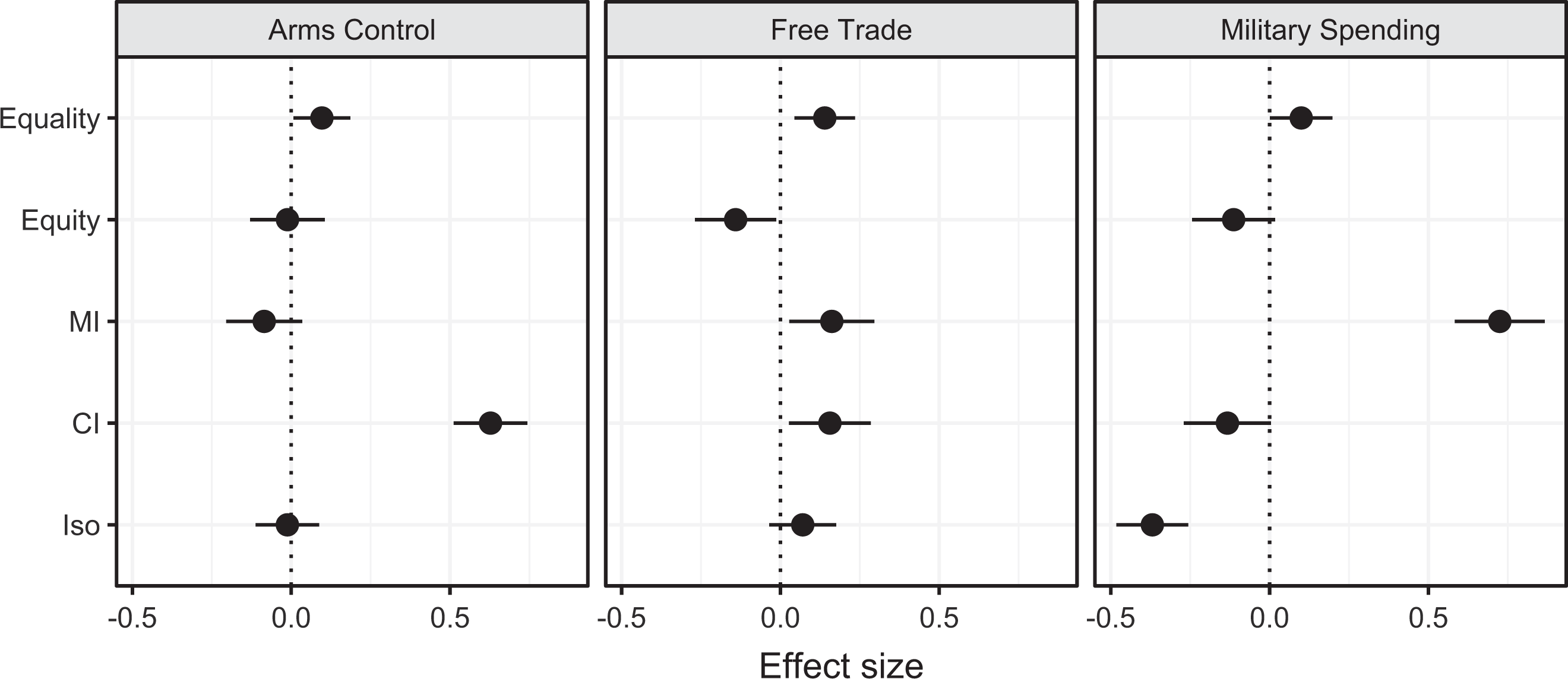
Equity, equality, and policy proposals. Note: N = 489, 515, 477, respectively. Figures display OLS coefficient estimates and 95 percent confidence intervals for equality, equity, militant internationalism (MI), cooperative internationalism (CI) and isolationism from models that also include additional demographic controls. To facilitate direct comparability, each variable has been rescaled to range from 0 to 1, and higher values on the DV indicate support for the policy.
Second, these results underscore our argument that fairness is not inherently prosocial: equity values discourage international economic agreements, for example. Moreover, we find evidence that concerns about equality can increase demands for military spending. Focused on outcomes, equality-minded respondents see promise in bolstering the U.S. defense budget if it might help solve international problems. Defense spending could therefore draw support from a coalition of militant internationalists and the equality-minded Americans who otherwise eschew hawkish politics (Maxey 2020).
Third, although research on foreign policy attitudes tends to divorce security from economics and assume that international trade attitudes follow a different logic than other foreign policy domains, we find evidence that equity and equality can shape public support for NATO and NAFTA alike. This finding complements a growing body of work on the relationship between values and public opinion about international economic policies (Kaltenthaler and Miller 2013; Rathbun 2016; Rathbun, Powers, and Anders 2019).
Fourth, it illustrates the importance of studying core values in foreign policy preferences more generally: even though these foreign policy proposals are arguably further removed from fairness considerations than the burden sharing vignettes are, a set of Wald tests find that we experience a significant reduction in model fit when we drop equity and equality from the two models where we have the strongest theoretical expectations (Free Trade and Military Spending), even when controlling for a wide range of other demographic characteristics and foreign policy orientations. Indeed, Online Appendix
Fifth, the proposals that we focus on here each represent policy areas that have been characterized by pronounced gender gaps: in the United States, women have historically been less supportive of free trade (Mansfield, Mutz, and Silver 2015; Guisinger 2016), more supportive of arms control (Silverman and Kumka 1987), and less supportive of defense spending (Eichenberg and Stoll 2012) than men. Despite extensive documentation of gender gaps in foreign policy public opinion, “the reason for these differences remains elusive” (Lizotte 2019, 126). Given the apparent gender differences in fairness commitments, variation in concerns about equality could be one explanation for these gaps.
Results from the OLS models, presented in Online Appendix
The average causal mediation effect (ACME) of gender on support for arms control, through equality, is −0.007 (−0.017, 0.00). To the extent that men are less committed to equality than women, they will in turn be less supportive of arms control. The ACME is small, but statistically significant. We find similar evidence for indirect-only mediation on support for free trade. The effect of gender channeled through equality is significant and negative, accounting for approximately 31.5 percent of the total effect. These results suggest that the gender gap in trade attitudes may be explained in part through women’s greater commitment to egalitarian outcomes. We find no evidence that the relationship between gender and support for these three policy issues is mediated by equity. Importantly, the absence of significant direct or total effects for gender implies one or more possible suppressors—other, unmeasured mechanisms that push men toward arms control and free trade (Rucker et al. 2011). Future research should account for equality values alongside other relevant factors like partisanship, identity, and other prosocial values to offer a more complete understanding of gender gaps in foreign policy attitudes.
Conclusion
In this article, we sought to contribute to the study of fairness in IR by reminding IR scholars that fairness is multidimensional (Adams 1965; Deutsch 1975; Hochschild 1981). Whereas the existing literature on fairness in IR has focused almost exclusively on fairness as equality, we can also understand fairness as equity. Because personal values spill over into the foreign policy domain (Rathbun et al. 2016), both faces of fairness are important for understanding the contours of foreign policy preferences.
Although IR scholars typically associate fairness with cooperation, our results demonstrate that equity values encourage opposition to security cooperation and public goods provision across several contexts, due in particular to concerns about inadequate burden sharing. We therefore find evidence of a new psychological microfoundation for isolationism, something existing scholarship has failed to uncover (Kertzer et al. 2014). Moreover, we fielded our survey in 2014, before Donald Trump campaigned on inequities in the US alliance system, which suggests that our findings are not merely an artifact of partisan cue-taking. Our results offer further support for the continued importance of core values and moral judgments in shaping foreign policy preferences (Bayram 2015; Rathbun et al. 2016; Kreps and Maxey 2018), and in studying fairness concerns as a variable rather than a constant. And although our findings are consistent with bottom-up theories of public opinion in foreign policy (Kertzer and Zeitzoff 2017), they also suggest important implications for theories of elite political behavior. Framing research in American politics argues that political elites seek to mobilize and persuade voters using appeals that frame issues in terms of the values that resonate with their audience (Nelson, Clawson, and Oxley 1997). The fact that Republicans and Democrats alike value equity suggest that it should be a particularly potent way to frame foreign policy issues.
We also observe important differences in how Republicans and Democrats think about equality. Our findings thus contribute to a growing literature on partisanship and ideology in foreign policy. IR scholars have found that Republicans and Democrats tend to conduct systematically different types of foreign policies, not just because each party’s base has a different set of interests, but because “right parties have somewhat different values from left parties.” (Palmer, London, and Regan 2004, 1-24; see also Rathbun 2004; Bertoli, Dafoe, and Trager 2019). We observe differences in how Democrats and Republicans conceptualize fairness—Democrats place greater value on equality than Republicans do—that suggest a potential microfoundation for distinct partisan approaches to foreign policy.
Our findings also relate to research on partisan or ideological differences in moral reasoning generally (Graham, Haidt, and Nosek 2009). Indeed, although our analysis focused on the two faces of fairness in foreign policy, it also informs research on public opinion about domestic issues—since the equity and equality scales can be fruitfully applied in other contexts. As Hochschild (1981) noted nearly four decades ago, many key debates in American political life involve competing conceptions of fairness. Understanding individual differences in equity- and equality-based moral judgments can therefore enrich our understanding of public opinion more broadly.
Supplemental Material
Supplemental Material, sj-pdf-1-jcr-10.1177_00220027211041393 - What’s Fair in International Politics? Equity, Equality, and Foreign Policy Attitudes
Supplemental Material, sj-pdf-1-jcr-10.1177_00220027211041393 for What’s Fair in International Politics? Equity, Equality, and Foreign Policy Attitudes by Kathleen E. Powers, Joshua D. Kertzer, Deborah J. Brooks and Stephen G. Brooks in Journal of Conflict Resolution
Supplemental Material
Supplemental Material, sj-zip-1-jcr-10.1177_00220027211041393 - What’s Fair in International Politics? Equity, Equality, and Foreign Policy Attitudes
Supplemental Material, sj-zip-1-jcr-10.1177_00220027211041393 for What’s Fair in International Politics? Equity, Equality, and Foreign Policy Attitudes by Kathleen E. Powers, Joshua D. Kertzer, Deborah J. Brooks and Stephen G. Brooks in Journal of Conflict Resolution
Footnotes
Acknowledgment
We thank Scott Clifford, Jeff Friedman, Chris Gelpi, Ravi Iyer, Rose McDermott, Chris Ray, Julie Rose, Drew Rosenberg, and audiences at the 2017 ISA meeting and 2020 Grand Strategy Conference at Ohio State’s Mershon Center for helpful feedback and discussions, and Chelsea Lim and Felicia Jia for excellent research assistance.
Declaration of Conflicting Interests
The author(s) declared no potential conflicts of interest with respect to the research, authorship, and/or publication of this article.
Funding
The author(s) received no financial support for the research, authorship, and/or publication of this article.

Supplemental Material
Supplemental material for this article is available online.
Notes
References
Supplementary Material
Please find the following supplemental material available below.
For Open Access articles published under a Creative Commons License, all supplemental material carries the same license as the article it is associated with.
For non-Open Access articles published, all supplemental material carries a non-exclusive license, and permission requests for re-use of supplemental material or any part of supplemental material shall be sent directly to the copyright owner as specified in the copyright notice associated with the article.
