







Abstract
Over the last 12 years, Mexico has become one of the most dangerous places to be a journalist. We examine how this risk-environment influences the content and strategies of reporting at one of Mexico’s most well known national newspapers, Reforma. We argue that as the risk environment worsens, journalists use less specific language about armed actors to report on violent events. To test our claims, we turn to three novel sources of data: the first captures granular information about attacks against journalists, the second uses natural language processing to measure changes in reporting overtime; and the third incorporates interviews from journalists themselves. We show that as violence against journalists increases, news story specificity decreases. Importantly, our findings reveal the ways in which journalists develop protection strategies to ensure high quality reporting, even under risky conditions and highlight the critical link between risk and information environments in areas of protracted violence.
Mexico is one of the most dangerous countries to practice journalism (CPJ 2020). Since the beginning of the War on Drugs in Mexico, attacks against media outlets and journalists have multiplied. Organized criminal groups (OCGs) increasingly control the flow of information and have become a primary perpetrator of violence against journalists in Mexico. How have journalists reacted to this ‘risk environment‘? How has it affected news coverage of events related to organized crime?
In the face of criminal violence, some Mexican newspapers have opted for confrontation strategies. For instance, after the murder of a photojournalist working for El Diario de Juárez, this local newspaper published an editorial entitled “What do you want from us?” directly aimed at OCGs, demanding answers on how to protect its staff from further attacks and violence. A few journalists in northern Mexico have likewise refused being intimidated and continued to publish ‘sensitive’ information (Relly and González de Bustamante 2014). The majority of journalists across Mexico, however, are forced to remain silent (Ruiz, Rea, and Almazán 2018) and may even avoid publishing the types of information that could put their lives at risk (Salazar 2012, 75).
Recent scholarship in Political Science has begun to explore the determinants of criminal violence against journalists. According to Holland and Rios (2017), competition among criminal groups leads to an increase in attacks against journalists, as organized crime seeks to influence press content. Arias (2017) argues that, from a criminal governance perspective, even in the context of criminal monopoly, organized crime tends to informally govern the press and control the flow of information. Through a diverse set of qualitative case studies across different Mexican states, studies on journalism have investigated the media’s response to this type of violence, looking into both intimidation of media members and how media outlets and journalists respond and adapt to such pressures (Del Palacio Montiel 2015; Relly and González de Bustamante 2014; Reyna-Garcia 2017; Ruiz, Rea, and Almazán 2018). While these studies offer important insights into the behavior of journalists, scholars lack a systematic analysis of the relationship between violence against journalists and changes in media content.
Understanding the effects of criminal violence on reporting is relevant for theoretical, social, and practical reasons. First, extant research mainly focuses on the relationship between state repression and freedom of expression. However, organized crime-related violence is a growing threat across the world, and is a particularly acute concern in Latin America. While the actions of criminal groups are intertwined with state agents, criminal groups follow a distinct set of incentives in their relationships with social actors, including journalists. Thus, departing from other studies on state repression and the media, we seek to understand the effect of criminal activity on journalistic practices. Second, the literature on the politics of organized crime has largely focused on the logic of criminal violence. In this study, we shift the focus away from violent actors in order to highlight the role of journalists and analyze the impact of criminal activity on media content. Third, although the scientific literature on communication and media has indeed examined many of the key conditions that drive media content and coverage, few studies in political science address how journalists’ risk environment specifically plays a role in driving media coverage.
This paper also touches upon issues of democratic stability. Electoral and societal accountability suffer when freedom of expression is vulnerable and the media is unable to shine a light on ongoing violence (Peruzzotti and Smulovitz 2000). Citizens lack information to punish incumbent governments and to dismantle state protection networks that help keep organized crime alive. Low information quality opens the space for organized crime to operate with relative freedom and impunity.
In this paper, we explain why media coverage about criminal violence changes over time. In doing so, we show how the risks that journalists face—a context we refer to as the ‘risk environment‘—influence news coverage of events related to organized crime. We argue that journalists respond to these risks by publishing stories with less specific information about perpetrators of violence. To evaluate the consequences of violence against journalists on media content, we focus on the case of the renowned Mexican newspaper Reforma. We use original data on two key dimensions. We present a unique collection of over 8,000 news reports from Reforma. These data capture news stories about violence and OCGs at the monthly level of analysis. We also use original data that draws information from five national newspapers, 34 local newspapers, and ten civil society organizations (CSOs) to record attacks on journalists. Our quantitative analysis is supported by interviews with journalists working and living in Mexico. 1
Overall, we find that as the risk environment for journalists worsens, journalists change the way they report information about violent events. Importantly, our evidence reveals that an increase in violence against journalists is associated with a decrease in story specificity overtime. Specificity reflects how often journalists use the precise names of non-state armed actors to publish stories about violent events. Our analysis also reveals that journalists use protection strategies—such as the use of anonymous bylines—to report more specific content in a given news story. Thus, although violence does limit journalists’ abilities to report specific details about perpetrators of violence in Mexico’s drug war, protection strategies might allow journalists to bypass these pressures and report sensitive information.
Reporting in risk-prone regions
Media coverage is driven by both micro-and macro-level conditions. Scholarship on media influence have proposed several key conditions that influence media content (Shoemaker and Reese 1996): (1) journalists’ individual characteristics, such as age, gender, and education; (2) news media routines, which may include the use of particular technologies or data collection techniques that underscore the daily patterns of the job (Becker and Vlad 2009); (3) news media organizations’ policies, including editorial management (Freedman 2008); (4) social institutions beyond new media outlets, which might include both state actors and private enterprises or non-state armed actors; and (5) ideologies and perceptions surrounding the role of the journalistic work within society. How do these conditions affect coverage on violent events related to organized crime?
Scholarship on the bias and reliability of political violence-related event data, a type of data often gleaned from publicly available news stories (O’Brien 2010; Raleigh et al. 2010; Schrodt 2012), helps address this question. Davenport (2007) highlights three possible limitations of such data, mainly driven by the third influence factor identified by Shoemaker and Reese (1996): the news media organizations’ policies. In particular, conflict scholars argue that threshold, fatigue, and newshole effects are likely to affect reporting in armed conflicts and violent settings (Davenport 2007; Weidmann 2016). Threshold effects result in the coverage of only ‘big’ events because they appeal to the largest audience and are easier to cover than small events (McCarthy, McPhail, and Smith 1996). Therefore, events with a higher number of casualties or that involve high-profile victims are likely to gain media attention, disregarding other ongoing violent events that, though ‘smaller’ in magnitude, could reveal a lot more information about the ongoing conflict, its involved actors and resulting outcomes. Yet not all ’big-events’ are created equal: political communication scholar Amber Boydstun describes the discord between some ‘big events’ and their minor coverage as driven by the disproportionate information-processing system of media agenda-setting wherein the media does not process real-world events in real-time, but instead shifts from one ‘hot topic’ to another (Boydstun 2013, 6). Shifting topics can be driven by a variety of other factors related to the media marketplace such as the amount of prior attention paid to the issue (past news predicts present news) and mimicking behavior across organizations (news organizations compete and copy one another) (Boydstun 2013, 47-48).
Fatigue effects and newsholes effects might also shift the behavior of media groups. Fatigue effects occur when short lived news events receive more coverage than long lasting events because long lasting events become more difficult to cover over time, both in terms of logistical costs and audience costs. These effects might be particularly salient in areas with prolonged crises or crisis-like events, such as widespread criminal violence where-in audiences’ attention grows weary and reporting in detail becomes increasingly costly overtime. Media and communication scholars also point to newsholes effects, which occur when an event, like a presidential election or a natural disaster, ‘crowds out’ the coverage of other important events in a given violent conflict (Hornig, Walters, and Templin 1991). News coverage, however, is not only driven by context and flashpoints, but also by institutional incentives. Different news organizations might have different values and different audiences associated with their deliverables (Weidmann 2016). Journalistic ‘gatekeeping'—in which a high volume of information is reduced to a few stories—can be driven both by event trends as well as newsroom culture.
Beyond the news media routines and organizational policies that may affect media coverage amid violence, journalism scholars have also examined the role of extra-media influences, looking into the effects of violent environments and threats exerted by both state and non-state armed actors attempting to affect the flow of information. Related claims and findings are, however, limited and have mainly concentrated on individuals’ journalistic experiences while covering conflicts in Iraq (Kim 2010; Kim and Hama-Saeed 2008; Fahmy and Johnson 2012). In addition, extant works have focused on journalists’ perceptions of their environment and of their subsequent performance, instead of examining the actual changes in media content and coverage. Nonetheless, journalists working in deadly news-gathering environments have reported that increases in danger affects the topics they covered and how they covered them (Fahmy and Johnson 2012). Threatened reporters in Iraq explicitly decided not to write on controversial topics and refrained to travel for assignments that could put them at an even greater risk, even if that meant being unable to cover a key political event (Kim and Hama-Saeed 2008). In this paper, we seek to contribute to a still limited understanding of the role of extra-media influences amid violence, which, according to Shoemaker and Reese (1996), are likely to exert a greater effect than lower-level influences, such as individual characteristics or news media routines.
Risk effects: How criminal violence shapes reporting on violent events and victimization
Research on media influence intuitively suggests that journalists working in risky regions might simply stop covering violent events or even flee violent regions altogether to seek assignments in safer areas. Yet countries across Latin America experiencing wide-spread criminal violence reveal that, empirically, journalists and media groups often maintain their positions and keep reporting on violence despite the risks. This suggests an important area for research: how, in risky environments, are journalists able to continue producing content on violent events?
To answer this question, we first explain how organized crime and government corruption generate pressures and risks for reporters. Organized crime cannot exist without state-sponsored protection networks. State-sponsored protection networks allow criminal organizations to operate illicit markets under the protection of the state (Trejo and Ley 2020). In fact, the use of violence by OCGs greatly depends on changes within such state-sponsored protection networks (Snyder and Durán-Martínez 2009). 2 Therefore, media coverage of criminal violence always has the potential of putting journalists at risk through several channels. First, threats can come from both the state and organized crime and reporting on violent events can reveal sensitive information on colluding government officials. But, second, even if the actors involved in a given state-sponsored protection network are difficult to identify, the fact is that in a democracy, journalists’ persistence in covering violent events can affect the electoral fortunes of incumbent authorities, who can then threaten journalists and explicitly ask them to stop such reporting or simply block their access to crucial sources of information (Reyna-Garcia 2017). Third, as previous research has shown, an essential element in organized crime’s quest for the establishment of criminal governance regimes includes control over information flows (Arias 2017; Trejo and Ley 2020). Organized criminal groups, therefore, have an interest in media content, not just in terms of the frames used by media outlets and journalists, but also regarding the level of detail shared in their reports. Detailed information could put state-sponsored protection networks at risk, as well as reveal OCGs’ strategies and location, which could result in unwelcome attention and weaken their territorial control.
In this study, we integrate previous research on the media with research on conflict dynamics to introduce the concept of risk effects for media members. Risk effects could influence both the individual reporters and the organizational behavior of media groups. We define risk effects as the effect produced by a worsening risk environment, where the safety of journalists and media members is increasingly threatened. The risk environment is dependent on the types of violence produced by the conflictual behavior of armed actors. These effects should be particularly strong when any form of violence—both physical attacks and threats—occur against members of the media.
A democratic context permeated by criminal violence poses twin pressures to journalists. On the one hand, the media face risks effects generated not only from violence by criminal groups, but also political repression from state authorities. In the midst of crime and insecurity, the media’s ability to inform citizens is strained. As other research has found, self-censorship is an everyday activity in newsrooms, but is particularly prevalent during times of tension (Skjerdal 2008). These conditions represent interlocking incentives for media silence whereby a constrained media benefits corrupt politicians and OCGs and can potentially mitigates the risks journalists face. Yet, on the other hand and despite these constraints, media members also face demands for information from citizens who seek media content about risks and violence in their region.
We argue that journalists respond to these opposing pressures by altering the content of their news stories to contain less specific details of armed actors involved in violent events. Doing so provides journalists with a form of self-protection and enables them to keep reporting about risky topics.
Journalism in Mexico during the ‘drug war’ period
To examine risk effects on reporting, we focus on the Mexican case. While our focus is on the role that rising criminal violence since 2006 has played on journalistic coverage, it is important to recall the transformation of media in Mexico, long before such a violent turn. As Lawson (2002) carefully documented, it was not until the late-1990s that newspapers in Mexico began to show more independent coverage. As a result of a long history of a single-party rule, media content was largely manipulated by government officials who funded and bribed newspapers. The public agenda was set by the government. Journalists did not cover sensitive issues and showed a clear partisan bias in favor of the ruling party. It was not until after the 1997 midterm election, when the PRI lost its majority in Congress, that the Mexican press began to rely more on commercial rather than political considerations. In fact, as noted by Lawson (2002), the media opening in Mexico reinforced the democratization process, even triggering political scandals and influencing public opinion and voting behavior. The evolution of the independence of local press in Mexico, however, has been uneven and many local newspapers still depend on government subsidies to survive, naturally affecting the nature and quality of news coverage (Salazar 2018). We argue that more changes in news reporting took place as a result of a new threatening environment for journalists. Threats did not derive from an authoritarian government, but from new activity and interests of criminal organizations.
On December 2006, Felipe Calderón (2006-2012) declared a “battle against crime, drug trafficking and organized crime.” From then on, the federal government launched 16 military campaigns across the country’s most conflict laden regions. Multiple studies have shown that this militarized strategy resulted in a major increase in violence (Atuesta and Madrazo 2017; Espinosa and Rubin 2015; Merino 2011). President Enrique Peña Nieto (2012-2018) followed a similar militarized approach. As criminal groups confronted state forces and fought among themselves for turf, more than 200,000 were murdered between 2007 and 2018; 3 more than 32,000 went missing 4 and over 300,000 were forcefully displaced. 5 In addition, more than 300 public officials and candidates have been attacked by organized crime (Trejo and Ley 2019) and approximately 200 human rights defenders have been target of violent attacks. 6 Most importantly for the purposes of this paper, between 2007 and 2018, more than 100 journalists were murdered, 7 over 20 have disappeared, and 48 media facilities have been attacked by armed groups (CASEDE 2018).
As violence began to rise across the country, the Mexican government failed to provide reliable information on how many people were dying and disappearing. The Mexican media faced the challenge of both understanding and reporting what was unfolding; violence was not only spreading, but the nature of violence itself was rapidly transforming. Brutal displays of violence, such as corpses with narco-messages (narcomantas) hung in bridges and freeways, became increasingly common. Several newspapers began releasing their own daily or monthly death counts. Excélsior, Milenio and Reforma published what became known as “ejecutómetros” or “executometers.” The numbers provided by each outlet differed slightly and their methodologies remained obscure, but during the first 5 years of the Calderón administration, these were the only instruments available that provided a rough assessment of how violence was evolving overtime. It was not until January 2011 that the federal government released a dataset on homicides allegedly related to organized crime for the 2007-2010 period (de la República 2011). This database was highly controversial and had several limitations: 1) it criminalized victims by assuming that all casualties could be effectively linked to involvement with organized crime and did not reveal further information about the victims; 2) the cases lacked an open investigation and, therefore, the database also lacked legal support; and 3) the methodology was unclear and mainly relied on information only available among federal security agencies (Hope 2012). Given these difficulties, the government did not continue to update this database.
It was in this context that in March 2011, 715 newspapers, radio and television stations attempted to improve crime coverage by signing an “Agreement for the Informative Coverage of Violence” to promote fair coverage. Among other things, this agreement made a call to: avoid becoming spokesmen for organized crime; avoid the language and terminology used by criminals; omit messages that came from criminals, e.g. narcomantas; contextualize violent events; attribute responsibility and make it clear for audiences who caused each act of violence; show solidarity with reporters and media threatened by crime; avoid disseminating information “that jeopardizes the viability of actions and operations against organized crime or that puts the lives of those who fight crime at risk.” Some scholars and journalists accused participants of becoming servants of the federal government and contributing to its efforts to manipulate the narrative of violence (Lozano 2016). It is important to note two things in this regard. First, Reforma, the case we examine here, was among the few national newspapers that did not sign the agreement. Second, Lozano (2016) found that the agreement had little to no effect on media coverage due to lack of mechanisms to review and report non-compliance.
Despite these efforts of solidarity among Mexican media outlets, attacks against journalists continued to increase. Organized crime groups have been identified as perpetrators of at least one third of such attacks (WOLA 2016), often as a result of the publication of delicate information that sheds light on criminal activity and its collusion with local authorities. Such was the case of Miroslava Breach, a journalist at the national newspaper La Jornada, who, after revealing the ability of criminal groups to influence local elections in the Tarahumara Highlands in Chihuahua, was violently murdered by an armed group on March 2017. The assassination of renowned journalist Javier Valdez was also the result of his publications on the turf wars within the Sinaloa Cartel (Bojorquez 2018). These killings have multiplied across Mexico. In the face of such attacks against the media, many journalists have decided to silence themselves; to stop publishing stories that may put their lives at risk; and to report selectively (Ruiz, Rea, and Almazán 2018).
In 2012, the Mexican government created the Mechanism to Protect Human Rights Defenders and Journalists. “The Mechanism” is intended to receive and process requests from human rights defenders and journalists who consider themselves at risk. The Mechanism then conducts a risk analysis and establishes protection measures accordingly. Historically, protection measures have mainly consisted of police rounds to activists’ or journalists’ homes or workplaces; panic buttons and satellite phones that may be activated in situations of emergency; cameras and alarm systems in the homes and workplaces of defenders and journalists. Beneficiaries agree that this type of measures are often insufficient and, when implemented, are also ineffective. Police rounds call further attention to the vulnerable target, technology frequently fails, emergency response time is slow, and CCTV systems can be accessed or intervened by third parties (WOLA 2016). In addition, the Mechanism is understaffed and its budget is quite limited (Nalvarte 2018), which affects the type of analysis and attention it can provide. Regardless of what the Mechanism can or cannot do, an additional difficulty is the high level of impunity that prevails in Mexico. Approximately 98% of crimes committed in the country remain unresolved (WOLA 2016) and the Mechanism lacks the authority to investigate crimes. Due to both the growing levels of risk to journalists in Mexico and the on-going complexity of the criminal conflict, Mexico is an appropriate case for our study.
Data collection and measurement
We turn to a four part data collection and measurement strategy to examine our expectation that news stories related to violence become less specific over time conditional on journalists’ risk environment: (1) first we harvest stories from Reforma’s database; (2) we then pre-process this data to ensure that we are capturing the correct type of stories (i.e. stories about violence); (3) next we construct measures of specificity and protection strategies; (4) last, to examine the relationship between violence and reporting, we incorporate data on violence from the Committee to Protect Journalists (CPJ) and Mexico’s National Laboratory of Public Policy (LNPP, for its acronym in Spanish). Our final data contains national news stories at the monthly level from 2006 to 2016. We summarize these processes below before turning to our modeling and results.
Reforma dataset
For the analysis of media coverage, we rely on one of Mexico’s most important national newspapers, Reforma. It enjoys stature in the country equivalent to that of The New York Times or The Washington Post in the United States. Reforma was founded in 1993 in Mexico City as a branch of the local newspaper El Norte based in Monterrey, Nuevo León, which continues to cover local and regional news in northern Mexico, along with its other branch El Mural, based in Guadalajara, Jalisco in southwest Mexico. It, therefore, has a unique organizational structure. Grupo Reforma, the media company that owns Reforma as well as numerous other dailies around Mexico, employs 70 editorial boards made up of 850 people from a wide variety of occupations and positions who work on a volunteer basis to set the monthly editorial strategy of each paper section. According to Shirk and Wallman (2015, 1352), the daily national newspaper Reforma is among “the most useful nongovernmental sources” that has “systematically reported on organized-crime violence.” As noted before, Reforma was among the few national newspapers that did not sign the “Agreement for the Informative Coverage of Violence” that sought to omit messages from narcomantas, avoid the language used by criminals, among other features that altered media content on violence. Therefore, analyzing whether criminal violence has in fact affected the coverage of one of the most serious and professional media outlets allows us to examine a ‘least likely’ and ‘crucial case.’ If we find a relationship between the risks journalists face and changes in the way they write stories about criminal violence, it is very likely that other newspapers have been equally or more affected by criminal activity in their editorial decisions.
We acknowledge, however, that our focus on a major national newspaper like Reforma comes with several limitations. First, unlike local newspapers, Reforma does not rely on official government resources; instead, it has a diverse set of private resources, in addition to charging a subscription fee for online access. Beyond violence, the dependence of Mexican local newspapers on government resources has greatly affected media coverage, with governors dictating what can or cannot be reported (Salazar 2018). However, precisely because of the secretive character of such clientelistic practices, it becomes difficult to systematically study how such strategies offset (or do not offset) the effects of violence on local reporting. In this sense, examining Reforma allows us to more effectively isolate and analyze the impact of violence on media coverage, which is our main interest. Second, we are aware that other media outlets, such as Proceso have had a longer reporting history on drug-related issues. As noted, we hope that this initial, intensive examination of Reforma can open up new avenues of research on the role of criminal violence in media coverage. Our decision to focus on this particular outlet is that, unlike Proceso, Reforma is a daily publication, which multiplies our observations and expands our analysis. Third, we are aware that lack of coverage in official newspaper outlets does not mean that journalists stop reporting completely and that many of them may actually move to informal social networks to share their information (Correa-Cabrera 2017). Our analysis is unable to investigate this phenomenon. Nevertheless, to the extent that newspapers like Reforma remain key outlets of information that are available and open to the public, our analysis can be useful for understanding and assessing how violence shapes the kind of information citizens have access to—a process that is crucial for accountability in any democracy.
To collect data on Reforma’s coverage of violence related to OCGs, we turn to ProQuest’s Global Newsstream database. Reforma does provide an historical archive of most published issues. However, accessing this archive requires a paid subscription and, more importantly, provides only PDF-formatted images of individual pages. Processing text from PDFs with optical character recognition or other techniques with an acceptable level of accuracy is often expensive (Grimmer and Stewart 2013). The ProQuest Global Newsstream contains full-text Reforma articles from 1995 to present day including all of the paper’s major sections, but excluding Sunday-edition inserts and translations of major English-language stories.
Keyword Dictionary.
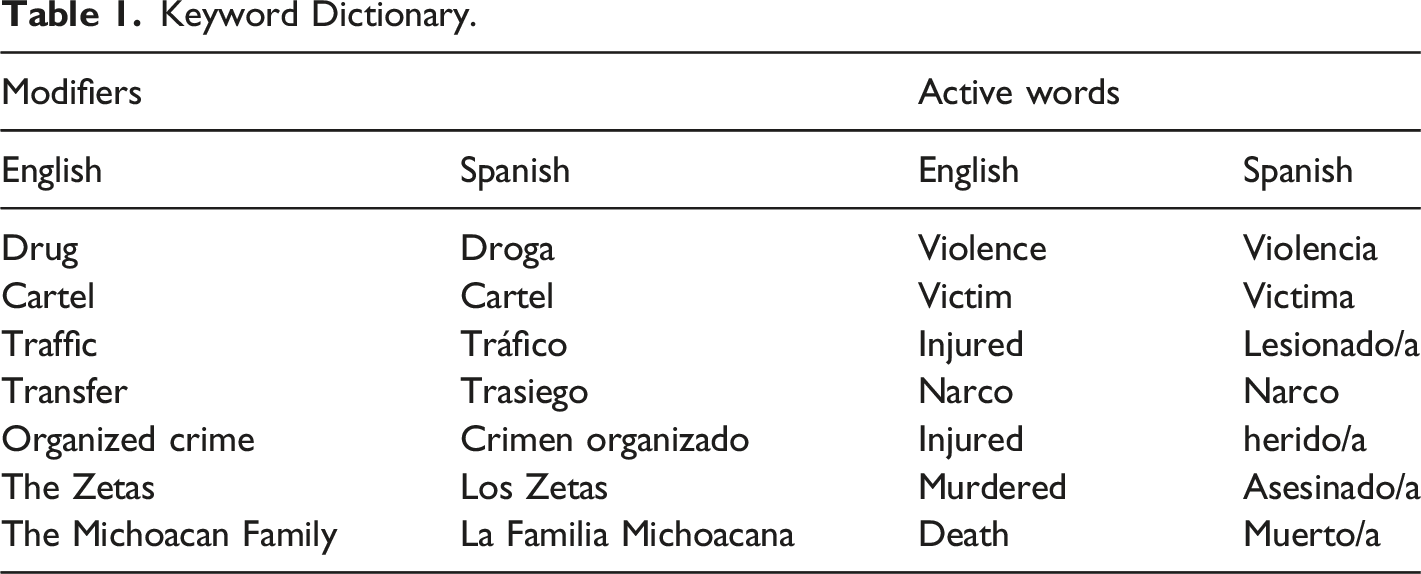
Entry into the dataset requires an article to include at least one combination (conjunctive AND) of an action word and modifier word anywhere in the full text of the article. As we explain in the following sections, for the purposes of analysis and availability of our data on violence against journalists, we focus our data collection for the 2006-2016 period. Our initial collection effort captured 11,120 articles of 1,519,128 articles published in Reforma. After processing this data, which we describe below, our final study uses 8,174 articles for analysis.
Second, using the Python Natural Language Toolkit (NLTK), the raw text of the articles is processed into a tidy, analysis-ready dataset. Exported ProQuest documents include the full article, author byline, publication date, page number, section, and a unique ProQuest document identification number embedded in the document text. Using regular expressions and parts-of-speech tagging, we identify each of these items and extract them from the document text. These provide the basis for a variety of measures, including length of article and number of anonymous bylines.
Pre-processing
After we have our data base of documents from Reforma, our next step is to use an ensemble of natural language models to generate measures of reporting specificity and other changes in reporting overtime. To begin, we pre-process the corpus in order to remove articles of non-relevant subject matter. We found, through reading random samples of our stories, that our original data base contains some irrelevant stories, primarily about sports, movies, or international conflict events. We pre-process this data to remove “non-relevant” articles using a random-forest classifier. We generate features for the classifier model in two ways: (1) we generate a term-frequency inverse-document-frequency (TFIDF) matrix from the corpus of labeled and unlabeled documents; (2) second, we use structural topic modeling to generate the most frequent topics from the corpus. 8
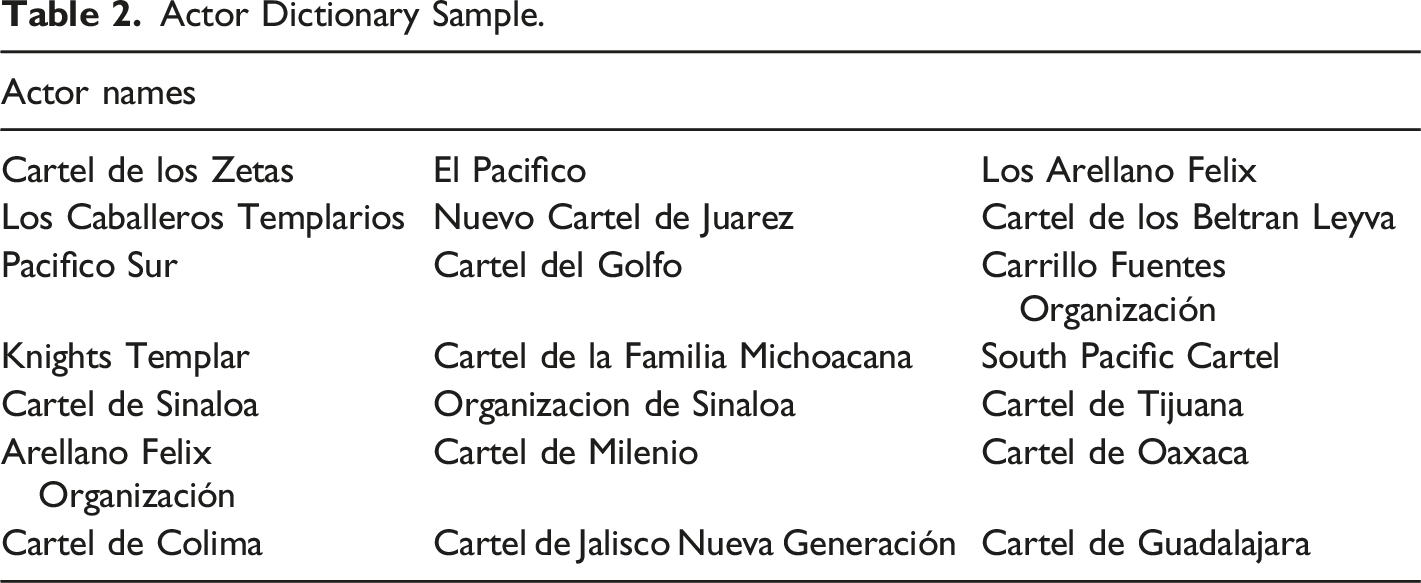
Actor Dictionary Sample.
Measuring specificity
After pre-processing the data we now create our specificity measure for analysis. Because we are interested in how journalists change the way they report about violent stories, particularly in terms of how specific journalists are willing to be when they write about perpetrators and their victims, our measures focus on the use of specific proper nouns over time. To create a measurement tailored to the dependent variable of our study we create a specificity measure based on a dictionary of key actor names. Table 2 below presents a sample of actors used to generate specificity counts at the monthly level for Reforma articles. The actor dictionary is compiled from lists found in the US Department of Justice 2010 National Drug Threat Assessment (US Department of Justice National Drug Intelligence Center 2010), the US Drug Enforcement Agency 2018 National Drug Threat Assessment (US Department of Justice Drug Enforcement Administration 2018), and a report prepared by the Attorney General’s Office under the Nieto administration in 2013 obtained by Contralinea (2013). Our final measure is a frequency (count) of how many times any of the unique names from our actor dictionary were used in a story. We aggregate this to the monthly level (shown in Figure 1). The figure shows that one of the lowest points of reporting specificity occurred in 2006, a time when Mexico first experienced severe increases in the level of violence associated with OCGs.
10
Reporting specificity overtime in Reforma from 2000-2017.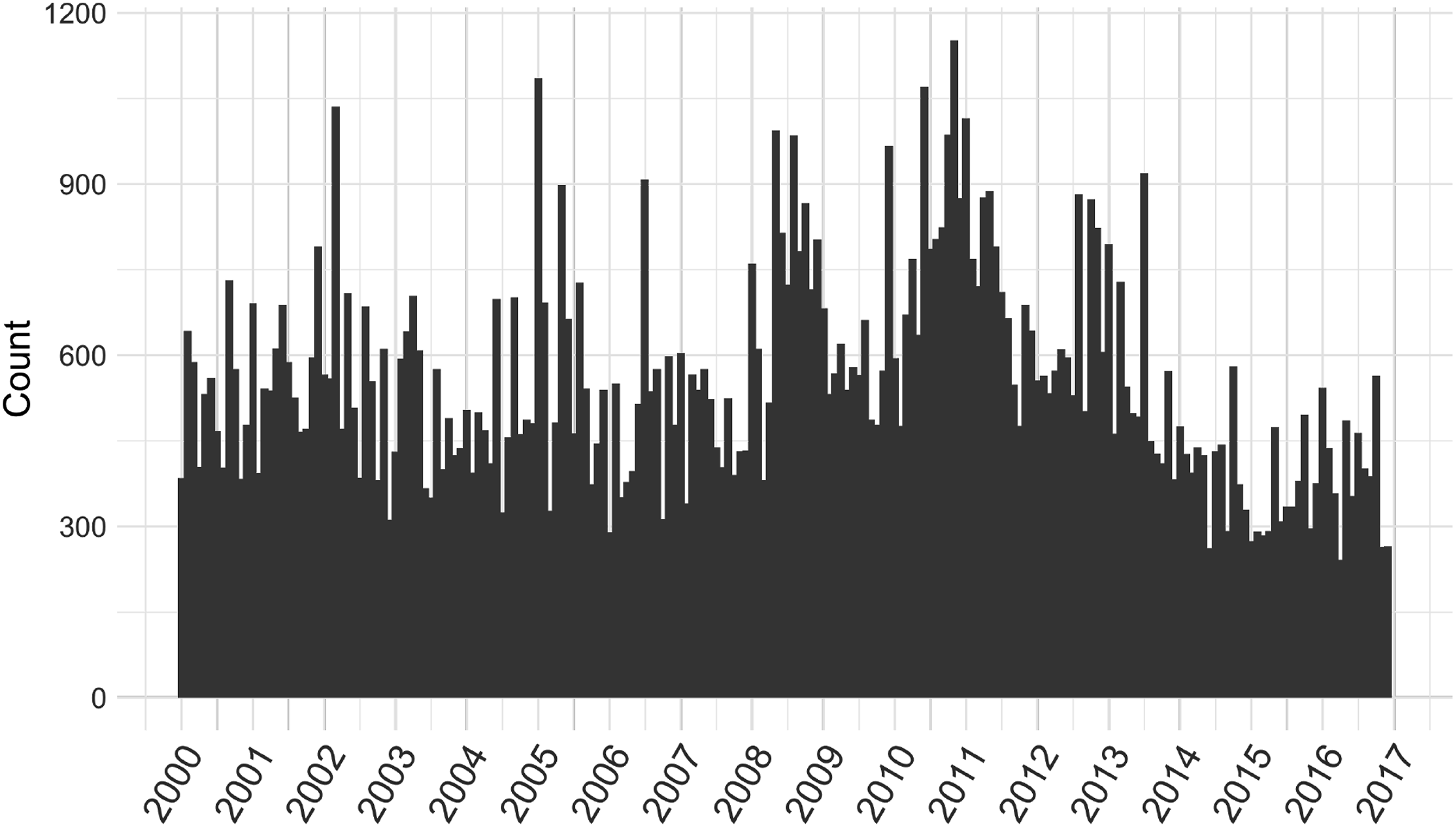
Violence data
Our key independent variables measure both violence directly targeted against journalists and a broader measure of DTO-related homicides. We create two variables to capture attacks against journalist. First, we include a measure of lethal attacks which capture events sufficient to plausibly cause death such as kidnappings, assaults, and homicides of journalists. Then we create a measure for non-lethal attacks, such as verbal threats and attacks against property. These variables measure violence against media workers from 2006 to 2016 and is generated by the LNPP (LNPP, for its acronym in Spanish). This novel database was created by the LNPP located at the Center for Research and Teaching in Economics (CIDE), in collaboration with DataLab, a program by the Mexican government’s Digital Strategy Office. This dataset was built from the automated and systematized review of five national newspapers, 34 local newspapers, together with reports of 10 CSOs devoted to the defense of journalists and human rights defenders. The data was collected following the methodology established by Javier Osorio’s software EventusID. 11 The inclusion of a diverse group of sources allows for a more complete count of attacks against journalists and media facilities (Figure 2).
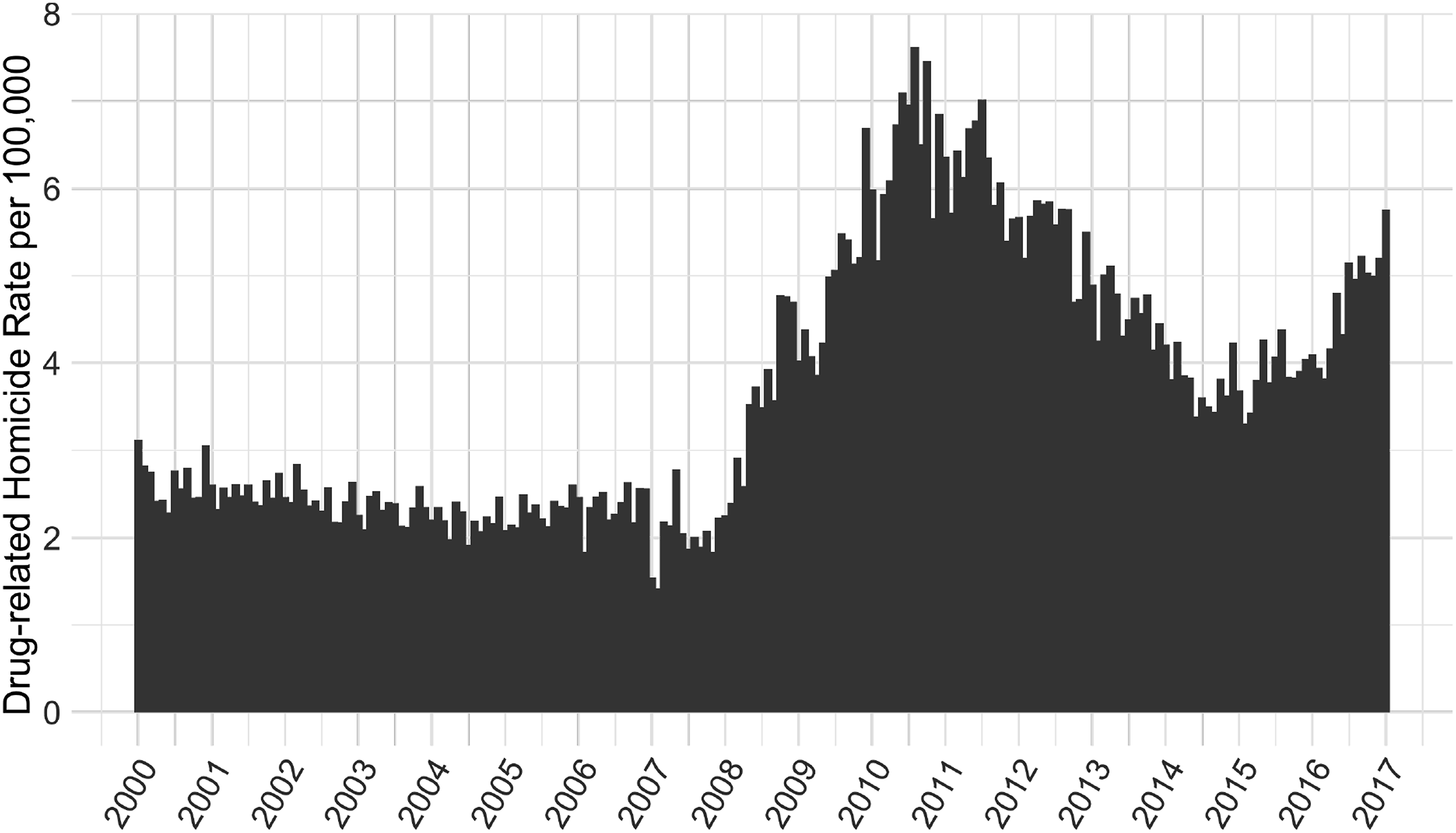
This data is quite different from existing data available through official sources—that largely depend on self reporting—or non-governmental organizations that tend to focus on high level murders or disappearances. Data collected by the CPJ is a standard source of data commonly used to assess violence against journalists; it includes information about disappearances with no investigation, inconclusive investigations, and deaths of journalists country-wide. Committee to protect journalists defines journalists as people who “cover news or comment on public affairs through any media—including in print, in photographs, on radio, on television, and online” CPJ (2018). The LNPP dataset includes both cases investigated and collected by the CPJ, and violent cases that CPJ investigators may have missed or been unable to verify. One limitation of the LNPP data, however, is that it does not allow us to identify the perpetrators and distinguish among those attacks perpetrated by state actors from those perpetrated by non-state armed actors (Figure 1). Finally, we replicate Calderón et al. (2015)’s methodology and estimate the homicide rate among males between 15 and 39 years old, which best resembles the variation across time and space of drug-related homicides in Mexico (Figure 3). Stacked bar chart showing non-lethal and lethal attacks against journalists overtime according to national laboratory of public policy data. National drug-related homicide rate by month from 2000-2017.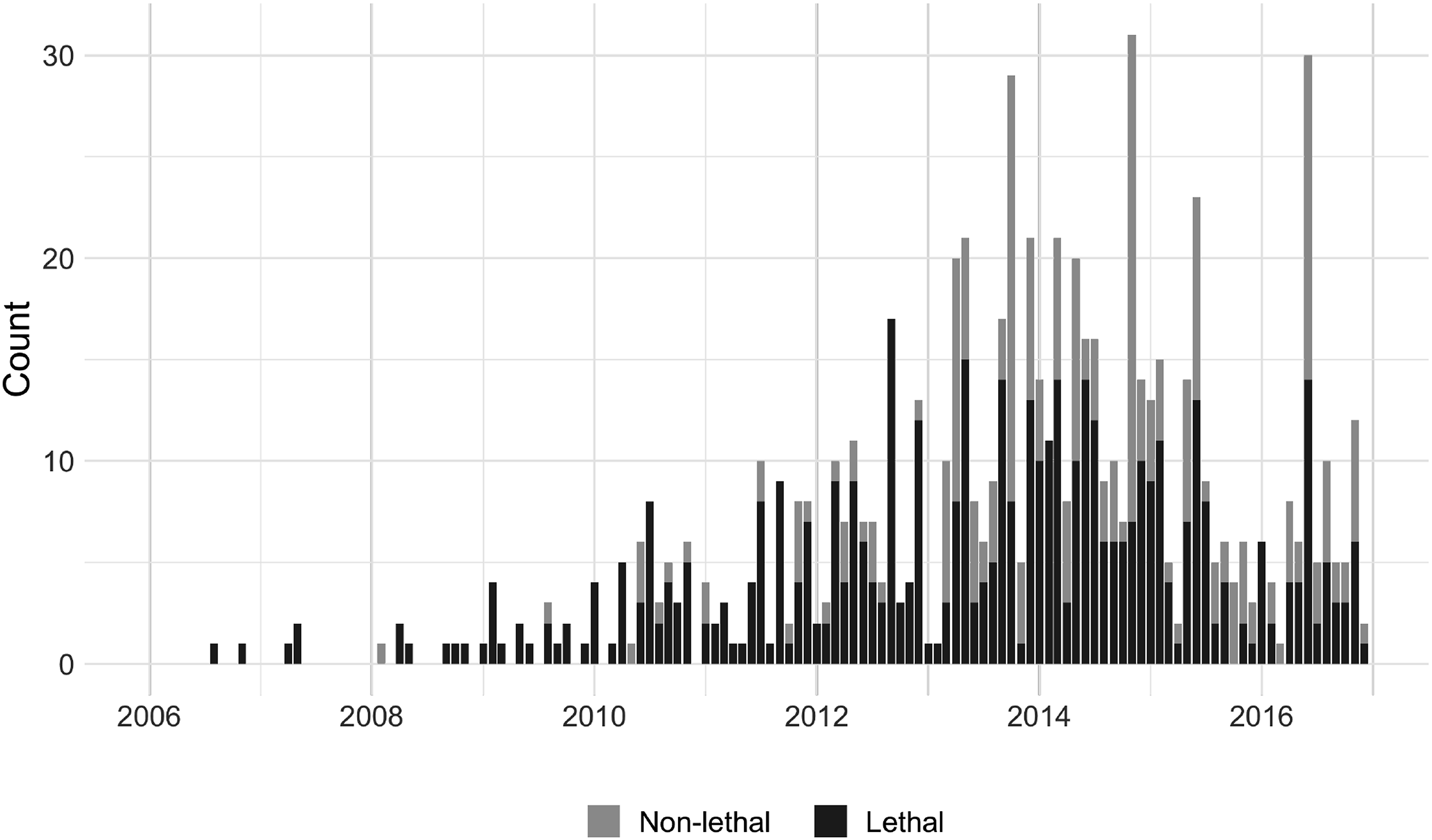
Modeling
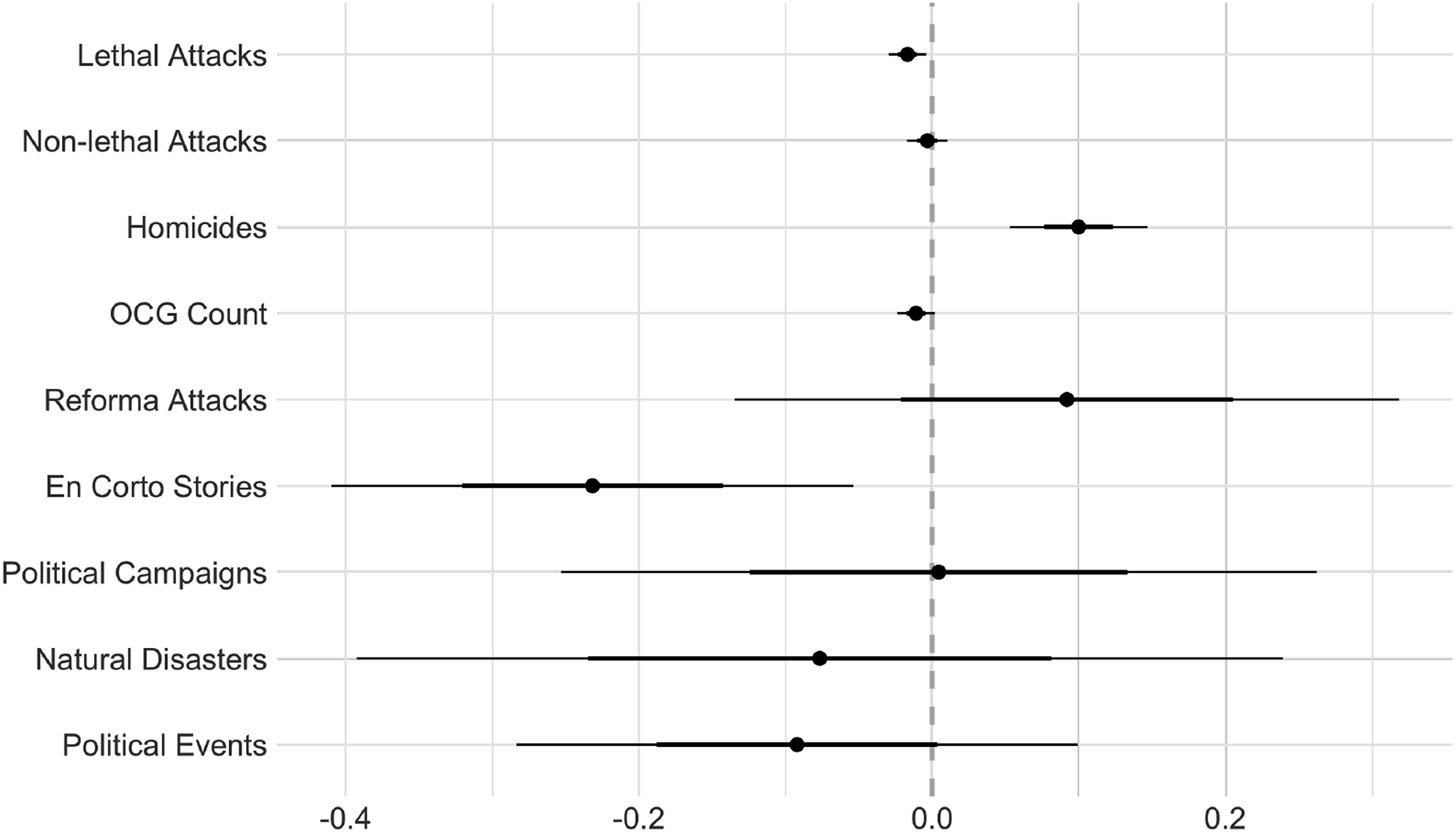
An implementation of a common test for overdispersion Cameron and Trivedi (1990) reveals that our dependent variable is overdispersed under the assumptions of a Poisson distribution. Thus, we estimate negative binomial regression models for our dependent variable: the number of specific proper names used each month to describe perpetrators in news stories published by Reforma (Specificity). All of our models are run on data from 2006-2016. Despite that some of our measures contain data beyond these years, we truncate the data to the smallest range which is restricted to 2006-2016 due to the LNPP data. The first model only includes covariates that measure the risk environment. Our violence measures include our LNPP-generated counts of lethal and non-lethal attacks against journalists to account for risk effects, and the general homicide rate for the most at-risk demographic for violence related to OCGs (males between 15 and 39 years old) to account for the broader risk environment. Model 1 (Figure 4) includes only LNPP violence data and homicide data as independent variables, while Model 2 (Figure 5) incorporates six additional covariates to control for editorial or exogenous changes, which we explain next. Negative Binomial coefficient plots modeling monthly specificity during the 2006-2016 time period. National laboratory of public policy data is used to measure both lethal and non-lethal attacks against journalists. Model 1 includes the coefficients for key variables of interest reflecting the risk environment: drug-related homicide rates and attacks against journalists. Negative Binomial coefficient plots modeling monthly specificity during the 2006-2016 time period. Model 2 includes all control variables.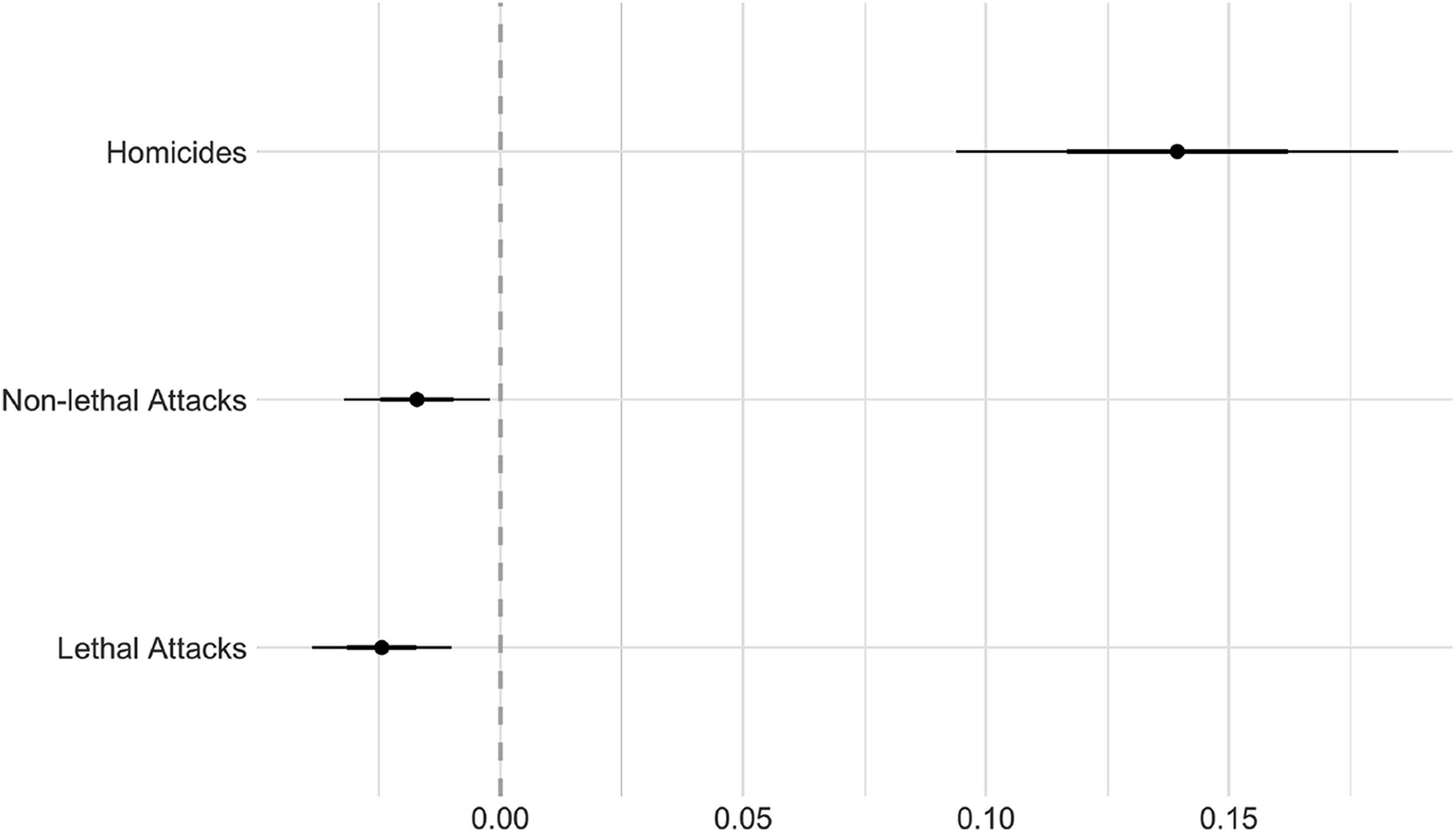
First, we construct a document-level binary variable to control for how often the newspaper utilizes ‘En Corto’ stories (en corto stories), aggregated to the monthly-level of analysis. These stories were introduced by Reforma as a way to report violent events as a count of incidents rather than full stories with detailed information about the event itself. Instead, an ‘En Corto’ article simply lists the number of dead and the states or municipalities where victims were killed. Months in which Reforma printed at least one ‘En Corto’ story receive a ‘1’ in the dataset. An anonymous interview with a former member of Reforma’s editorial team revealed that this was a news media organization policy that the newspaper explicitly implemented to compile and communicate information on violence across the country, because Reforma did not have enough financial and human resources to cover the increasing number of violent events. Our source also explained that the format of short stories in ‘En Corto’ helped the newspaper reduce pages, simultaneously providing information and refreshing the newspaper’s image. According to our interview, a main source for ‘En Corto’ articles came from press bulletins from the Mexican army, informing on its activities, it’s confrontations with organized crime, and the total casualties. 12
Second, we also control for monthly major political events, like national and gubernatorial elections or scandals (political events), 13 and campaigns (political campaigns). 14 Months in which these events occur receive a ‘1.’ In addition, we control for attacks against Reforma personnel directly (reforma attacks), which may have an out-size effect on editorial decisions and reporting. 15 This measure is also a binary variable aggregated at the monthly level. Through these measures, we attempt to take into account newsholes effects and acknowledge that, in addition to the negative impact that we argue attacks against journalists have on media coverage, other important events could compete with reporting on violence and therefore decrease the extent to which violent events are covered.
Third, it is possible that when violence reaches its highest and most destructive state, the risk to reporters is not only great, but the logistical task of gathering information about an extremely high number of events is, simply, very difficult. With too many cases to report, and a lack of reliable institutional information on the number of arrests (and thus the perpetrators of attacks) reporting is simply not possible and reporting specificity might suffer. We recognize that our current measurements do not entirely distinguish between the risk environment and its effects on a generally poor information environment–indeed, the two are likely intimately linked. To address this concern, we include a monthly count variable of OCGs present nationally to control for proliferation of and competition between criminal groups. Competition between OCGs over territory, recruitment, and other goods drives violence and could contribute to the risk environment journalists face. This measure comes from the Mapping Criminal Organizations in Mexico project (Signoret et al. 2021).
Risk environment and specificity: Statistical results
We begin by examining the relationship between the risk environment and reporting specificity. Models 1 and 2 confirm our expectation that as violent threats and attacks targeting journalists increase, the number of named perpetrators in Reforma decreases and, thus, the specificity of articles concerning drug-related violence, decreases. However, these two models also show that as the broader threat environment worsens and the drug-related homicide rate increases, specific references to violent actors in Reforma increase. This suggests that journalists are responding to two pressures: on the one hand they report more details on violent events as general levels of violence increase, yet on the other hand they respond to heightened in-group risks for media personnel by writing less specific articles. Our descriptive presentation of the data in Figures 1 and 2 mirrors a similar story; even though homicides reach high levels in 2010, attacks against journalists are fairly low during this same time period. The findings from Model 1 and 2 supports our theoretical expectations: LNPP measures better reflect the risk environment directly faced by media workers than measures that focus on homicides.
Most of the controls for other key events that might shift media attention do not reach significance. However, in Model 2, “En Corto” stories are associated with a decrease in specificity. En Corto stories are bulletin-like and necessarily avoid specific description, so this is not surprising. Interestingly, our control for OCG competition, as measured by the changes in the number of OCGs in a given time period, is negative and reaches statistical significant. Our key finding, that targeted attacks decrease reporting specificity, holds with this variable. However, our study also shows that even when homicides, or general levels of violence are very high, journalists do still report detailed information. Qualitative research also demonstrates that journalists have their own sources, beyond government reports, that enables them to continue reporting in weak environments (Hughes et al. 2017). Nevertheless, this result suggests that other indicators of the risk environment tell a similar story, namely, that greater competition among OCGs results in a more difficult reporting environment.
Finally, we acknowledge that, in some instances, criminal groups can seek to communicate specific messages to the general public, government authorities, or competing criminal organizations. Phillips and Ríos (2020) show that banners and signs have been used by criminal groups in Mexico to share messages and that they seek to make them public through their coverage in news outlets. However, as the authors also find, such type of communication also puts journalists at risk, as it raises attention to other criminal groups and stimulates further competition. Thus, journalists are likely to adapt their self-protection strategies in response. For the purposes of our study, we control for the potential effect of this kind of competition-messaging by measuring the number of times “narco” messages are reported in a given month in our sample. Our main findings are robust to this additional variable. 16
Interpreting coefficient estimates is often not as revealing as evaluating the marginal effects of key variables. Below, in Figure 6 we present the effect of lethal attacks against the media on our dependent variable, specificity, when all other variables are held constant at their mean. We find support for our key theoretical expectation that as risks for journalists worsen, reporting specificity substantially declines.
17
Marginal effects reflect the negative relationship between lethal attacks against journalists and their reporting behaviors.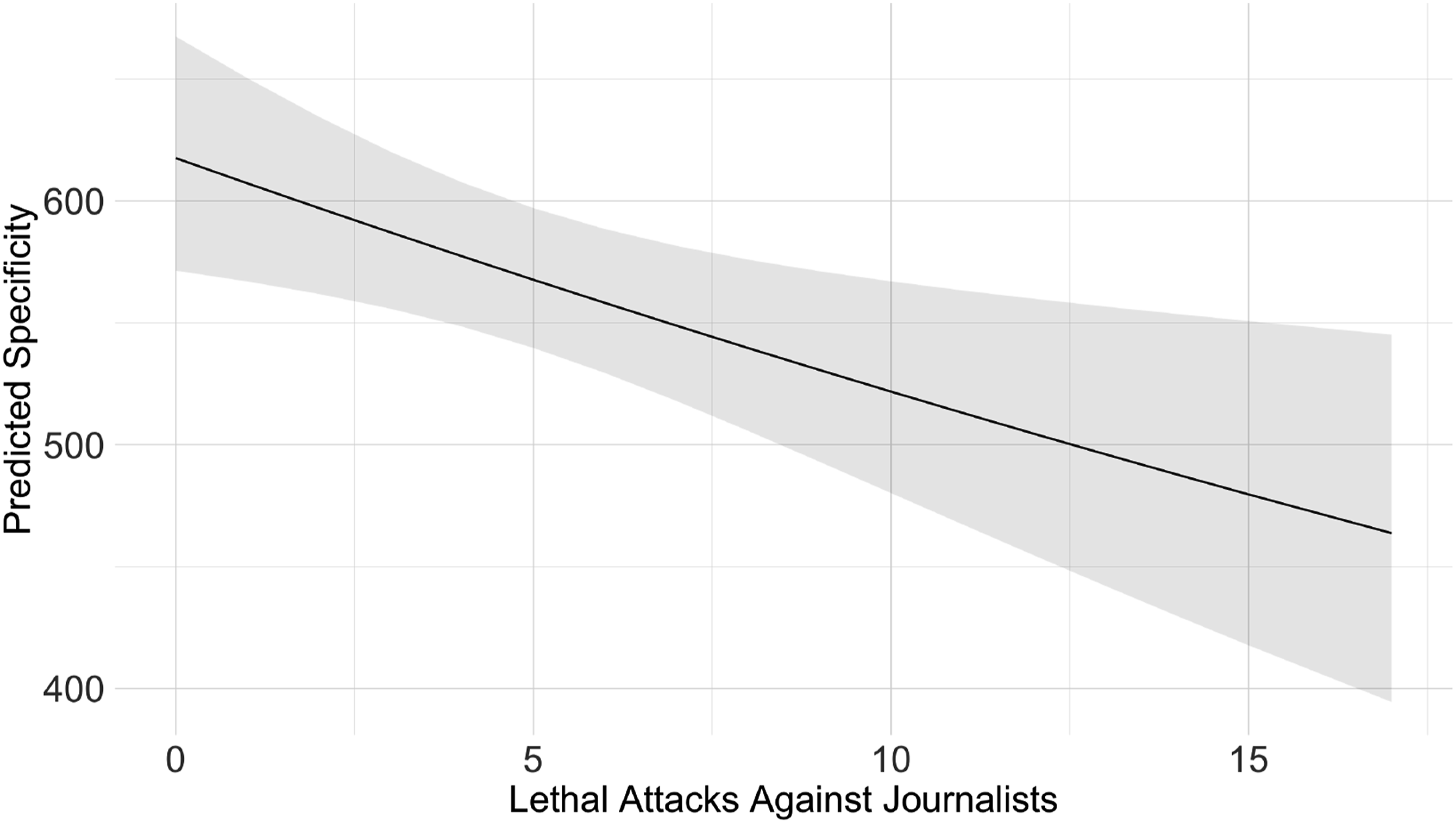
Protection strategies: How to overcome (declining) specificity
The contrasting effects of general organized crime violence (positive) and of attacks explicitly directed against journalists (negative) on specificity is likely to raise a key question: How could reporters at Reforma continue to cover criminal violence, as it continued to both expand and threaten them directly? To address this puzzle, we interviewed four key members of the newspaper Reforma with an active role during our period of study, including: a member of the editorial team; a renowned Mexico City-based journalist that has focused on the coverage of criminal violence; two journalists that reported from two of the most violent states in Mexico. 18
A former Reforma editor was very clear about the newspaper’s decision on “not letting organized crime define what could or could not be published.” According to him, “it was best not to sign a story with the reporter’s name than not publishing it at all.” 19 Our subsequent interviews with Reforma local correspondents confirmed this information: when the stories they wrote explicitly mentioned criminal groups, they did not sign it with their name. One of them shared that, beyond what later became an informal organizational rule in Reforma, the personal threats that he received on two separate occasions by armed civilians “made him more cautious about what to say and how to publish his information,” especially when he had details on the specific names of the involved actors. 20 He further noted that he had to be particularly careful because all local actors knew that whatever was published in Reforma from their state was information he had reported, as he was the only Reforma correspondent. Overtime, as he saw a dozen local reporters murdered, he explains that these events made him “more cautious,” but that he “never stopped covering violence-related events” and simply tried “not to be as exposed.”
An interview with a second correspondent substantiated our argument on the double threat that reporting on criminal violence involves and elaborated on how it transformed his publishing approach. He noted it is especially risky to publish information that “involves colluded politicians.” 21 According to this reporter, “when politicians are involved in violence and they know who you are, you have to analyze the situation and consider whether or not to provide detailed information.” He shared that, after receiving several threats, he learned that when information was sensitive but he still felt it needed to be published, it was best not to publish it with his name.
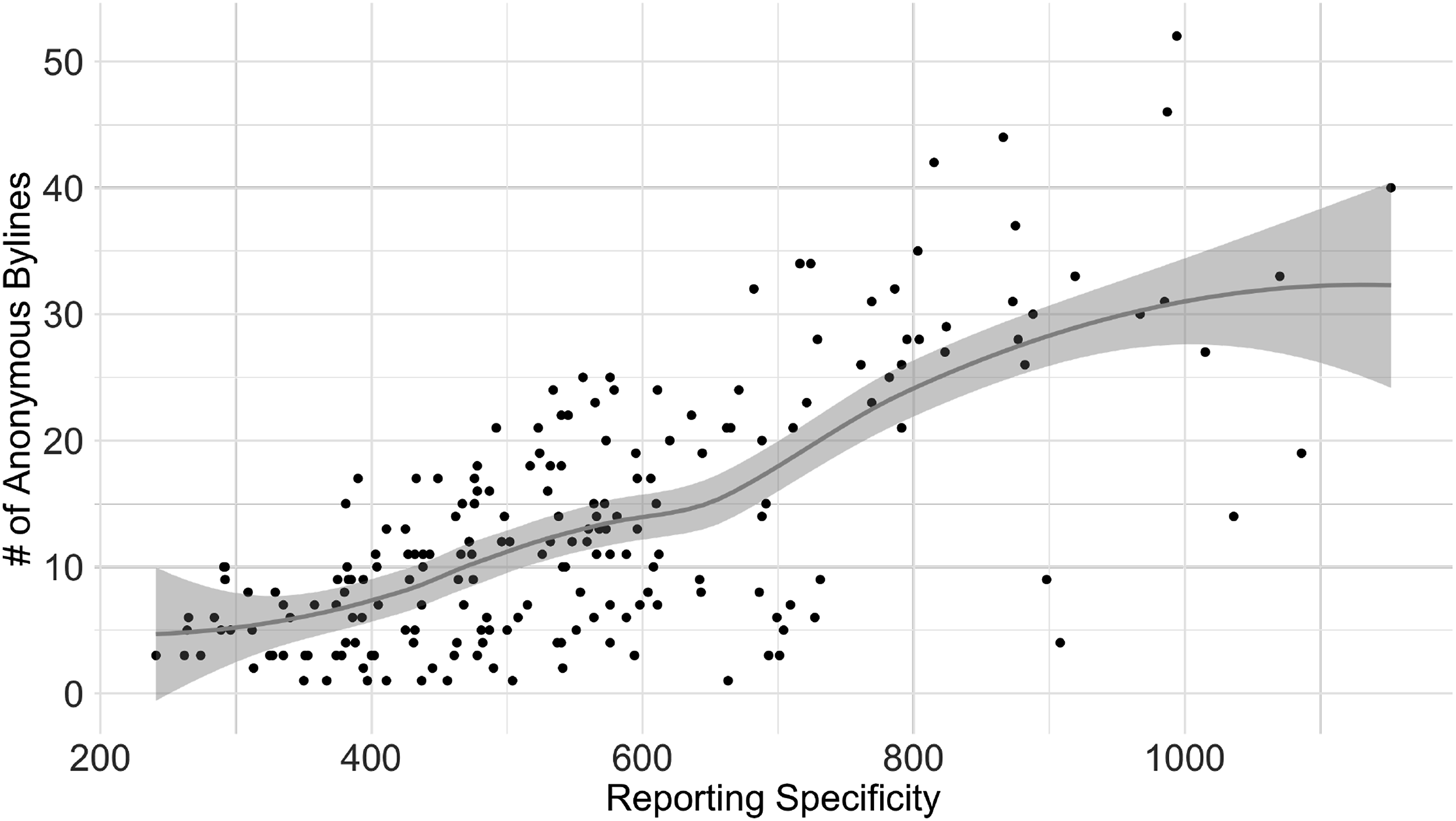
These interviews reveal that journalists and editorial teams might also adopt protection strategies as a way to respond to changes in the risk environment and continue to report on sensitive topics. Our data allows us to examine the role and prevalence of the protection strategies referred by our interviewees, particularly in regards to the use of anonymous bylines when journalists decide to share detailed information in their stories. Specifically, we would expect to find at least a general bivariate correlation between the use of anonymous bylines and specificity. To examine this, we construct a document-level variable to capture editorial changes to protection strategies over time at Reforma (Figure 7). We measure whether or not bylines associated with stories on violence were anonymous (anonymous byline count, aggregated to the monthly level). “Anonymous” bylines may be blank, attributed to reporting staff or unnamed editors. For the most part, the descriptive presentation of this data in Figure 7 follows a familiar trend from the homicide data in that the use of anonymous bylines steeply increases following the start of the criminal conflict around 2006. Below in Figure 8 we show that these two variables, anonymous bylines and reporting specificity, are positively correlated in our data. Counts of anonymous bylines printed from 2000-2017. Bivariate relationship demonstrating positive correlation between anonymous bylines and reporting specificity.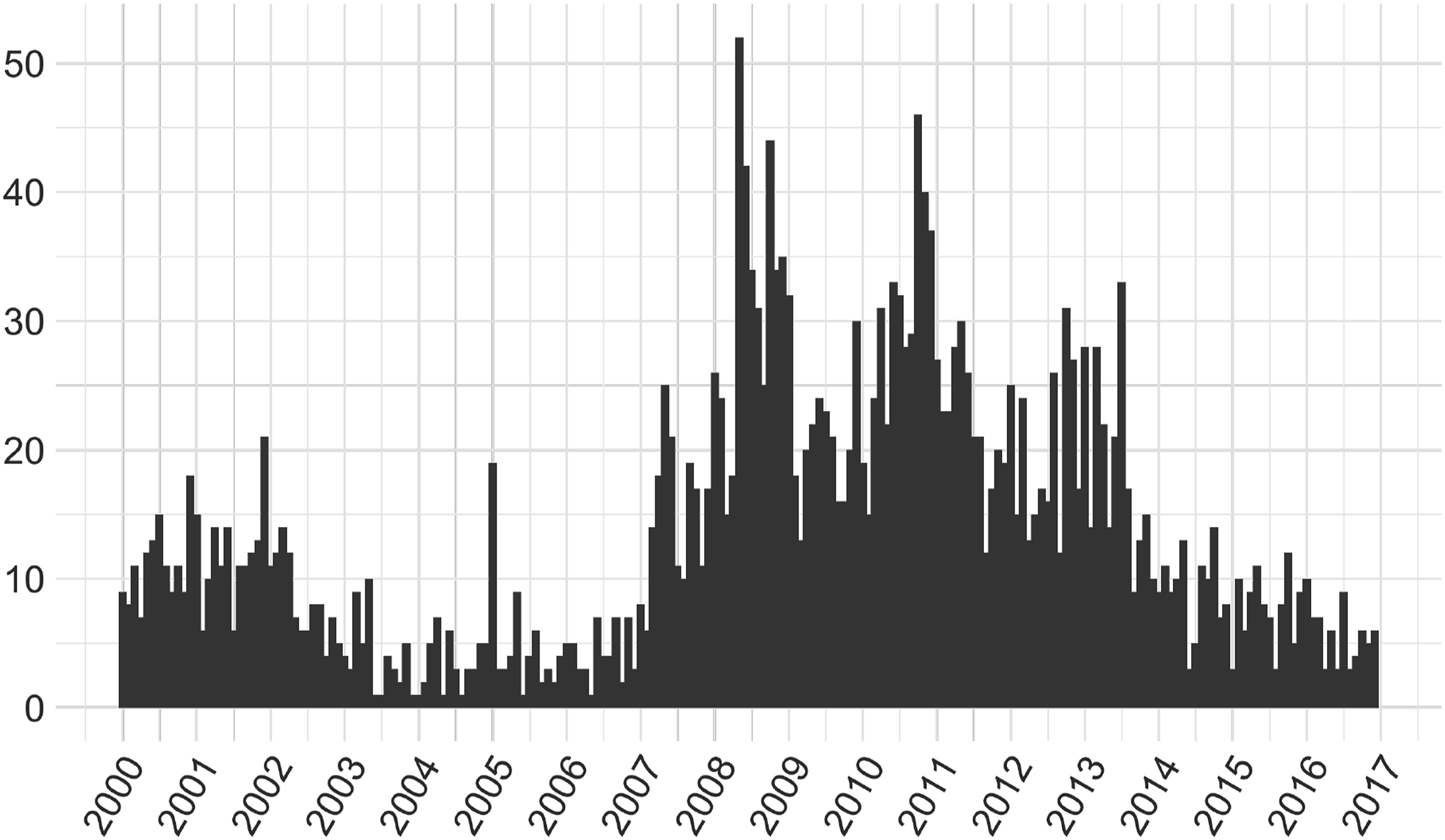
If we include this variable in our model, as we show in Figure 9, we see that the effects of violence are less pronounced, suggesting that some protection strategies might be effective in alleviating the threats posed by a worsening risk environment. This evidence suggests that anonymous bylines are sometimes used in response to a dangerous reporting environment in order to allow stories to go to print without the risk of association. Negative binomial coefficient plot modeling monthly specificity during the 2000-2016 time period. In this model, Model 3, we control for the number of anonymous bylines used by Reforma reporters in a given month.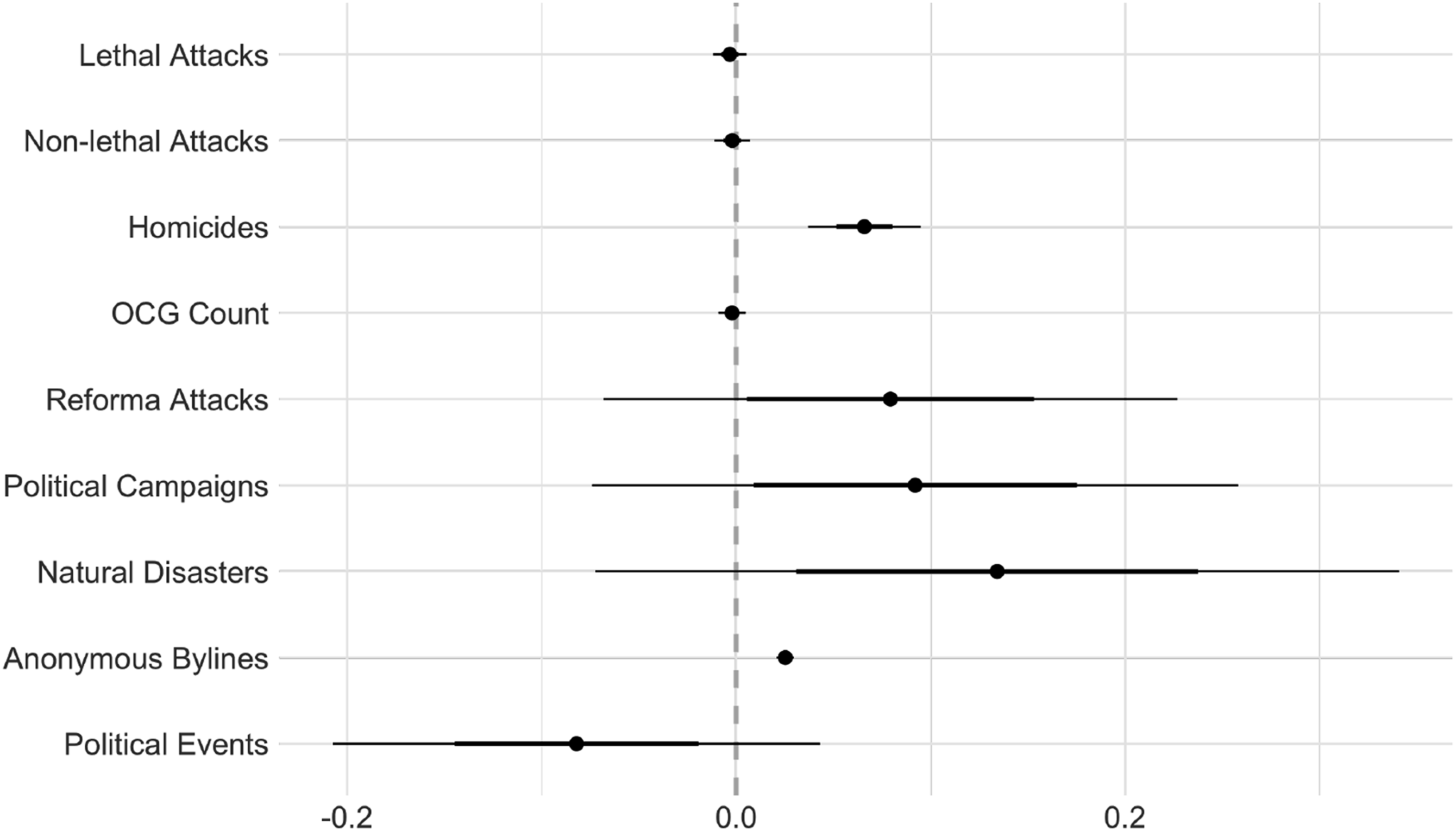
It is important to note that protection strategies are likely to be quite diverse and go beyond the use of anonymous bylines. Our interviews with a former Reforma editor and one of its Mexico City-based reporters covering criminal violence confirmed that whenever a journalist is too exposed through their coverage of security-related issues, they would be sent to report other kind of news, or even be removed from the worksite until “things cooled off.” Most likely, this strategy also means losing some level of detail, as other correspondents might not have the same kind of local networks and trust among local actors, or the newspaper might simply have to rely on official government sources, such as press bulletins, to report minimal information on local violent events. In either case, specificity declines.
Discussion
Democratic accountability largely depends on access to information. Active and uncensored investigative journalism exercises are crucial for both electoral and societal accountability. Voters need information to reward or punish incumbents, as well as to influence the political agenda and mobilize accordingly. Information can be particularly crucial for dismantling protection networks and trigger truth and justice processes. Our research suggests, however, that, in contexts of high criminal violence, due to declining informational details, the chances of achieving accountability and justice are also likely to diminish.
A question that may arise at this point is whether the experience at a national newspaper like Reforma resonates with other journalistic experiences across Mexico. Ruiz, Rea, and Almazán (2018) collected 22 testimonies from journalists across 12 Mexican cities and 10 regions across the country. Each personal story reveals shocking self-censorship experiences among Mexican journalists working in the most violent areas. Whether they are independent journalists or work at a local or national newspaper, all of them report direct experiences with violent actors, from the military and the police to organized crime groups and vigilante organizations. Although it may appear that reporters working exclusively for local news outlets outside of Mexico City tend to face greater risks, compared to those working for national Mexico City-based newspapers, the stories of violent threats and encounters repeat no matter the source for which reporters work. As put forth by one of Reforma’s local correspondents we interviewed, “reporting amid violence is difficult regardless of whether you work for a national or local outlet; you might have more access as part of a national newspaper, but you have to be equally careful with what and how you write on crime-related reports.” 22 Another reporter at Reforma further notes that given that local correspondents at national newspapers tend to be the only source of information for reports in a given region, they can be easily located and targeted and, therefore, must be careful with the details they share in their stories. 23
It is also important to note that even if a reporter works for a national newspaper, they are likely to be aware of the threats and attacks that other journalists have experienced. Reporters across the country have built tight networks, such as Red de Periodistas de a Pie or Red de Periodistas del Noroeste, to share both their experiences and their protection strategies. The experiences of local reporters often inform the decisions and perceptions of journalists working for either local or national outlets. The situation that fellow colleagues face also shapes their own perceptions of risk, which subsequently define their own decision making process on what to report and how to do so. The case of Patricia Mayorga, a renowned reporter for the national news magazine Proceso, is revealing in this regard. After the murder of her fellow colleague, Miroslava Breach—reporter at the national newspaper La Jornada and who, like Mayorga, covered criminal activity in the Tarahumara Highlands in the state of Chihuahua— Mayorga asked herself whether she wants to continue reporting violence-related stories and whether she should change the way she has reported them (Ruiz, Rea, and Almazán 2018, 166). 24
The declining specificity of media reports is also a widespread phenomenon in local newspapers. Del Palacio Montiel (2015) and Reyna-Garcia (2017) describe how the information on violent events in the states of Veracruz and Sonora, respectively, has become “thinner.” Both authors note that, as attacks against journalists—from both local authorities and criminal groups—have increased in these states, local newspapers have increasingly relied on press bulletins from the state government or the national armed forces, to report minimal stories on just a few events. The nature of these sources necessarily means that media coverage loses specificity. As noted, we have used the case of Reforma as a ‘crucial’ case, as it is likely that the effects that we see in a financially robust national newspaper multiply in local newspapers as those described by Del Palacio Montiel (2015) and Reyna-Garcia (2017).Some reporters explain that journalists’ decision to report on delicate violent events depends on whether other journalists and outlets also report information on the same event. Others confess having to wait for authorization from local criminal groups in order to write stories about ongoing disappearances or deaths. Many more explain their inability to reveal the names of perpetrators of violence, largely because of the involvement of local and federal authorities. Many media members agree that self-censorship sometimes becomes “the only mode of survival” (Ruiz, Rea, and Almazán 2018, 130).
Moving beyond the Mexican case, many of the most cited datasets describing violent conflicts, protests, and state repression are compiled from news stories filed by local journalists. ACLED (Raleigh et al. 2010), the UCDP Georeferenced Event Dataset (Sundberg and Melander 2013), Conflict and Mediation Event Observations (Gerner et al. 2002), the Machine-learning Protest Event Data System (Hanna 2017), and many others use some form of automated coding or human coding of news articles with little direct auditing of sources. That is, of course, one of the main attractions of these data: accessible information about political violence that reflects ground-truth. However, our results show that the specificity with which journalists cover violent events — battles, terrorist attacks, protests, and the like — declines as journalists are victimized. This might simply make the data compiled by these projects less accurate in a recognizable and quantifiable way. This effect might also cause these datasets to miss violent events that journalists declined to cover or editors declined to publish, distorting measures of political violence in unknown ways. Worse still, armed actors may target journalists for violence if they believe that reporting on the true extent of conflict will reach researchers, policy makers, or international institutions sympathetic to their opponents. For all these reasons, we should be treating the reporting that these data are based on as endogenous to the conflict process itself, and take seriously this threat to scientific inference. There is recent work that may help conflict scholars account for threats to journalists, by carefully considering the biases at play (Earl et al. 2004; Weidmann 2016) and Gohdes and Carey (2017), for example, show that killings of journalists are leading indicators of future violent repression. More research on understanding when journalists are most at risk could help us adjust our expectations about data accuracy and precision during different stages of the conflict process.
Conclusion
The goal of our study was to uncover how violence against journalists influences changes in reporting overtime in a contentious risk-environment. We have shown that attacks and threats against journalists are associated with less specific news stories about violent events related to organized crime. Yet our study also reveals additional strategies of self-protection adopted by journalists and media members in order to alleviate some pressures of the risk-environment in which they live. These protection strategies seem to allow for greater freedom of speech and a higher level of detail when reporting about violent, non-state armed actors. These findings have important implications for the study of conflict and democratic accountability.
First, our work asks scholars of political and criminal violence to think more carefully about the implications of violence on key sources of information for analysis: newspapers. Increasingly, conflict scholars rely on open source media accounts of violent processes to code event data, and other forms of data, utilized to understand the ebb and flow of violence across the globe. Though no ‘ground-truth’ data is perfectly available, an important next step for measurement and data quality scholars is to better specify the relationship between violent settings and reporting. Second, it is widely known that media plays an important role in democracies and that freedom of expression is a crucial element of democratic success. Yet, little is known about how journalists and other members of the media might overcome the pressures of the risk-environment to ensure accurate and detailed reporting. Our study suggests that though perhaps difficult to establish, avenues of self-protection are possible.
Finally, as (Gohdes and Carey 2017) have shown in their research on repression, the killing of a journalist is a sign of “deteriorating respect for human rights” in a country. It might be difficult to pinpoint who exactly is responsible for violence against journalists in a region like Mexico, where collusion between state and non-state actors is high and corruption influences politics at both local and national levels. Despite this, our research suggests that it is not only governments who directly repress journalists and the media, but also security problems more broadly that can deteriorate the flow of information and free speech. Our study focuses on the general risk environment at the national level and demonstrates that journalists respond to violence even when they are not directly targeted themselves. Future research can extend this line of inquiry to better deepen our understanding of how local versus national media outlets respond to pressures from both state and non-state actors.
Supplemental Material
Supplemental Material - Does Violence Against Journalists Deter Detailed Reporting? Evidence From Mexico
Supplemental Material for Does Violence Against Journalists Deter Detailed Reporting? Evidence From Mexico by Cassy Dorff, Colin Henry, Sandra Ley in Journal of Conflict Resolution
Footnotes
Acknowledgments
For their helpful feedback and insightful comments, we would like to thank the Conflict Consortium Virtual Workshop The Center for Statistics and the Social Sciences at the University of Washington; the Quantitative Methods Colloquium at Vanderbilt University; the Latin American Peace Science Society; the Women Studying Violence Workshop at the University of Notre Dame; Jessica Feezell, Shahryar Minhas, Philip Schrodt, Elizabeth Zechmeister and our anonymous reviewers. All mistakes are our own.
Declaration of Conflicting Interests
The author(s) declared no potential conflicts of interest with respect to the research, authorship, and/or publication of this article.
Funding
The author(s) received no financial support for the research, authorship, and/or publication of this article.

Supplemental Material
Supplemental material for this article is available online.
Notes
References
Supplementary Material
Please find the following supplemental material available below.
For Open Access articles published under a Creative Commons License, all supplemental material carries the same license as the article it is associated with.
For non-Open Access articles published, all supplemental material carries a non-exclusive license, and permission requests for re-use of supplemental material or any part of supplemental material shall be sent directly to the copyright owner as specified in the copyright notice associated with the article.
